The Dynamics of Hosting
The Foundation of Great Podcast Hosting
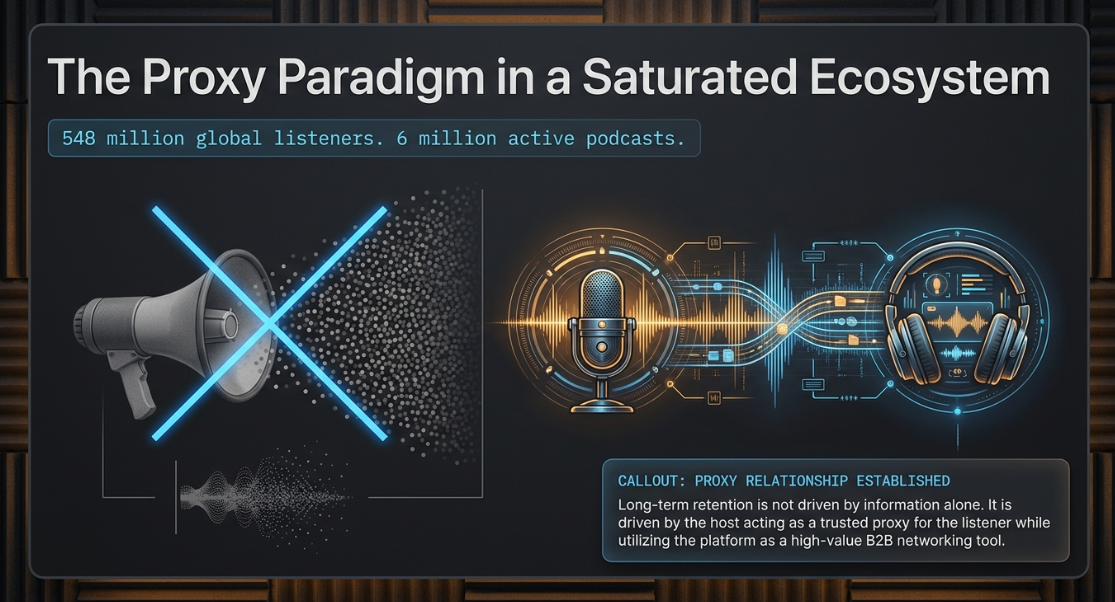
The modern auditory landscape has undergone a monumental expansion, with current metrics indicating that approximately 548 million listeners tune into an estimated 6 million podcasts globally.1 In this highly saturated digital ecosystem, the architecture of a successful podcast extends far beyond the mere transmission of information or the booking of high-profile guests. The true differentiation and foundational pillar of great podcast hosting relies on the cultivation of a parasocial relationship between the host and the listener.2 While an audience might initially discover a program due to the relevance of its subject matter, the intrinsic draw of the guest roster, or the explicit informational utility, long-term audience retention and loyalty are contingent upon the host's ability to act as a trusted, relatable proxy.
A prevalent, yet fundamentally flawed, misconception within the broadcasting medium is the assumption that effective, natural hosting is purely an innate, untrainable talent. On the contrary, expressive vocal storytelling and natural audio leadership are the direct outcomes of acquiring specific skills and utilizing advanced tools that grant the host absolute control over their voice and psychological presence.2 Great hosting requires treating the human voice as an instrument of authentic self-expression, which demands continuous refinement, deliberate experimentation, and a strict departure from robotic, overly filtered, or highly scripted delivery.4
Furthermore, the host's fundamental duty is to represent the listener rather than simply serving as an uncritical conduit for the guest's agenda.3 This requires advanced situational awareness, enabling the host to intuitively sense when to pause a highly technical conversation, ask for clarification on opaque industry jargon, or press a guest for an illustrative narrative when their responses become overly theoretical or evasive.3 The foundation of great podcast hosting, therefore, is an amalgamation of mastering the physical and mechanical production of speech, fortifying the psychological resilience required for public performance, and deploying the strategic empathy necessary to center the listener's auditory experience above all other considerations.
Voice Discovery and Vocal Training
The human voice is the primary vehicle for delivering the podcast's message, and precisely like any complex physical instrument, it requires calibration, pre-performance warming up, and ongoing physiological maintenance.5 Podcasters, akin to stage actors, comedians, or professional vocalists, must engage in targeted vocal exercises to protect their vocal cords from the intense fatigue generated by long recording sessions, and to maximize their resonant, authoritative presence.5
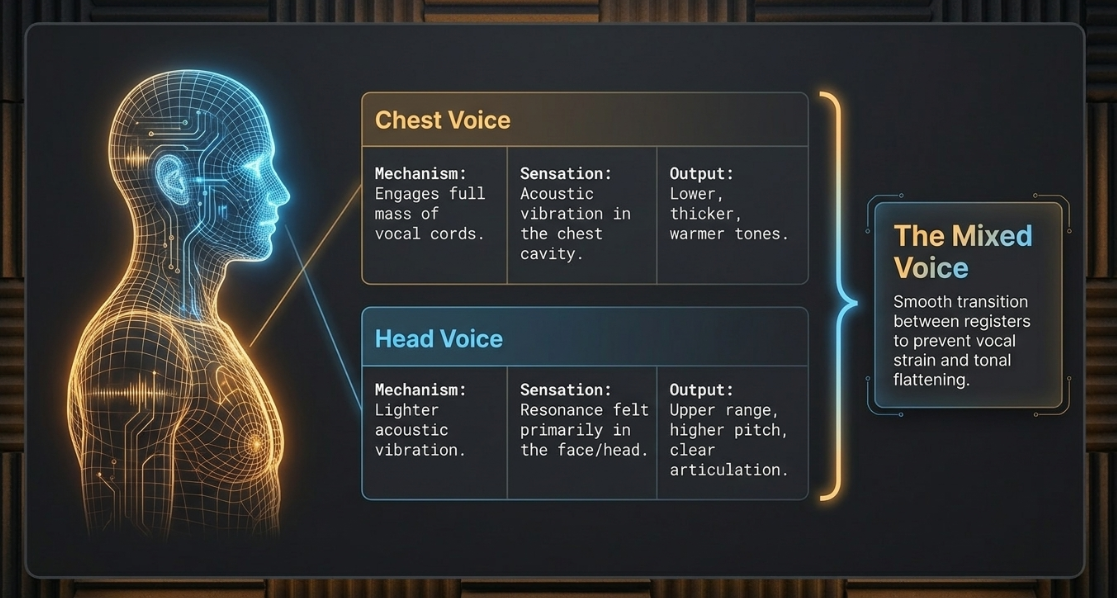
The mechanical production of high-quality, professional audio begins with a deep anatomical understanding of vocal registers, specifically distinguishing between the "chest voice" and the "head voice".5 The chest voice produces lower, thicker, and warmer tones, effectively engaging the full mass of the vocal cords, and is physically characterized by a noticeable vibration in the speaker's chest cavity.5 Conversely, the head voice enables access to an upper vocal range, producing higher pitches where the acoustic vibration is felt primarily in the face or head rather than the torso.5 Effective podcasters learn to transition smoothly between these two registers—a sophisticated technique known as the mixed voice—which prevents the vocal strain, abrupt cracking, and tonal flattening that inevitably occurs when a speaker attempts to push higher notes while relying exclusively on their heavier chest voice.
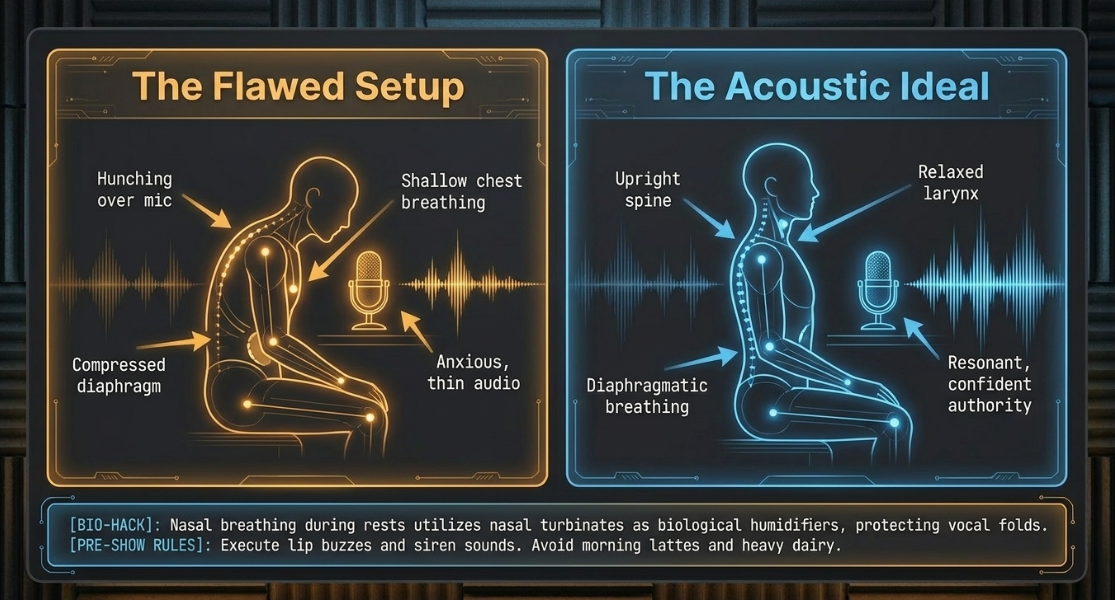
Proper vocal execution is inextricably linked to the mechanics of breath control. Diaphragmatic breathing is the critical biological mechanism for avoiding vocal tension and debilitating throat strain.5 When a speaker relies on shallow "chest breathing"—where the shoulders rise and fall conspicuously—they fail to utilize their lung capacity and are subsequently forced to use the delicate vocal cords to forcefully regulate the exit of air.5 This causes unnecessary muscular tension, leading to a thin, anxious-sounding delivery and rapid vocal exhaustion. By breathing deeply into the diaphragm—conceptually expanding the lower rib cage and maintaining a continual downward pressure during exhalation, a sensation often compared to the physical exertion of the lower abdomen—the host gains precise control over their airflow.5 This creates a steady, confident, and resonant sound without requiring the throat to act as a restrictive valve.5
Furthermore, environmental and physiological factors profoundly impact acoustic vocal quality. Podcasters must actively practice breathing through their nose rather than their mouth during their rests; nasal breathing utilizes the nasal turbinates (or conchae), which act as biological humidifiers to warm and moisten the air before it enters the lungs.5 This prevents the throat from drying out, a common hazard of prolonged mouth-breathing during discussions.5 Additionally, hosts must consciously monitor the position of their larynx, commonly known as the Adam's apple. Nervousness or performance anxiety organically causes the larynx to pull upward, tightening the vocal folds and restricting sound output.5 By purposefully relaxing and lowering the larynx, the speaker yields a much richer, higher-quality acoustic resonance with significantly less muscular effort.5
Pre-recording warm-ups are not optional for professional creators; they are essential for vocal flexibility. Effective pre-show exercises include stretching the jaw and lips by mimicking an exaggerated yawn, purposefully over-enunciating words to loosen "tight-lipped" or mumbly speech patterns, and performing vocal scales by sliding from the lowest resonant chest voice up into the head voice on a sustained "ah" vowel.5 Professional voice actors and podcast producers also heavily utilize lip buzzes, siren sounds for flexibility, and targeted tongue twisters to ensure crystal-clear pronunciation before the microphone is made active.5 In addition to these exercises, hosts must prioritize hydration strategies and avoid substances like morning lattes or heavy dairy immediately prior to recording, as these can coat the throat and sabotage vocal clarity, resulting in unprofessional throat-clearing and disruptive audio artifacts.
Improving Hosting Skills (On-Mic and Off-Mic)
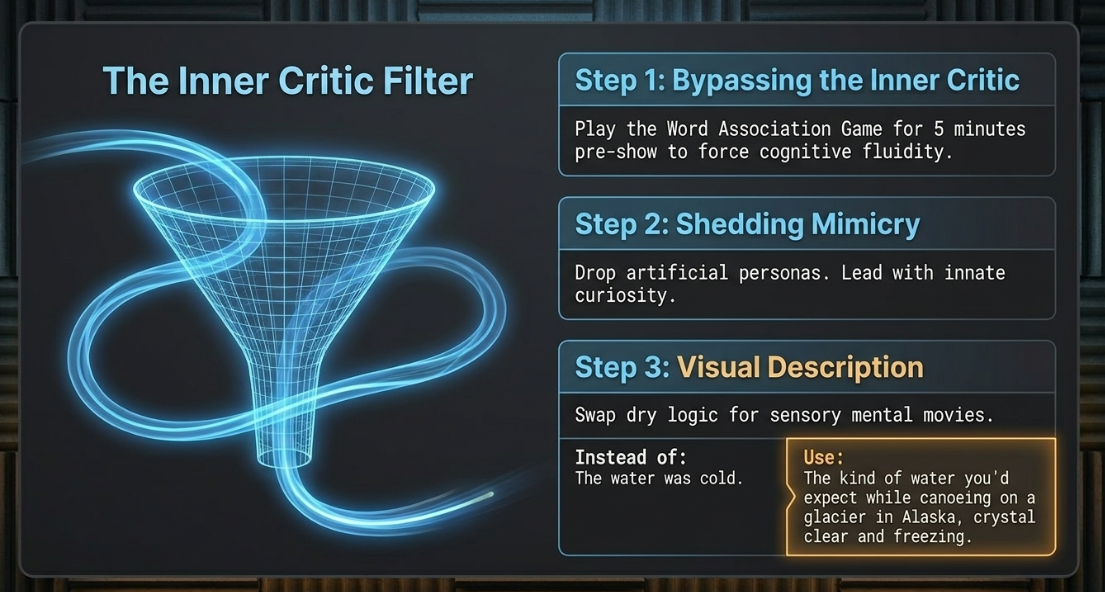
The translation of a well-warmed, resonant voice into compelling, engaging content requires the mastery of specific on-mic and off-mic cognitive skills. One of the most prevalent and damaging barriers to natural hosting is the tendency for novice broadcasters to unconsciously mimic the tone, cadence, and specific mannerisms of highly established, famous podcasters, such as attempting to replicate the exact interview style of Tim Ferriss or Joe Rogan.5 This mimicry frequently serves as a psychological defense mechanism, but it inadvertently strips the host of their unique authenticity, causing them to sound robotic, rehearsed, and fundamentally disconnected from their audience.5 True audience connection mandates that the host shed these artificial personas, embrace their unique vocal identity, and lead with their own innate curiosity.5
To sound organic and highly engaging, hosts must learn to actively bypass their "inner critic." When speakers over-analyze or meticulously filter their thoughts in an effort to sound perfectly intelligent or flawless, they exit the present moment and disrupt the natural, spontaneous flow of conversation.5 An incredibly effective off-mic exercise to combat this hesitation is the continuous "word association game," played for five unbroken minutes prior to beginning a recording session.5 The strict rules of this cognitive exercise dictate that the speaker must not stop talking under any circumstances, must completely ignore the critical judgment of their own mind, and must directly associate each new sentence with the preceding one.5 This exercise forces cognitive fluidity, training the brain to bypass its natural filtering mechanisms, thereby generating ideas on the fly and ensuring the host's mind is nimble enough to produce witty responses, sharp comebacks, or spontaneous analogies during high-pressure live interviews.5
On the microphone, hosts can significantly elevate their conversational delivery by intentionally incorporating literary devices rather than relying solely on dry, logical, or overly technical facts.5 The strategic use of analogies, metaphors, and similes provides essential context, helping listeners digest and map complex subjects onto familiar concepts.5 Visual description exercises—such as taking five minutes to describe an everyday object with rich, sensory imagery—train the host to create a vivid "mental movie" for the audience.5 For example, instead of logically stating that a beverage is cold, a skilled host might describe it as "the kind of water you'd expect while canoeing on a glacier in Alaska, crystal clear and freezing".5 By transforming a basic, sterile statement into a highly visual narrative scene, the host captures the listener's imagination, significantly increasing audience retention and emotional engagement. Furthermore, seamlessly integrating self-deprecation, a willingness to ask ostensibly "dumb" questions on behalf of the audience, and a sprinkle of natural humor disarms guests and endears the host to the listener, establishing an unshakable foundation of trust.
Cultivating Podcasting Confidence
Confidence in the realm of podcasting is not merely a transient psychological state or a mindset to be adopted; it is deeply rooted in physical positioning, rigorous preparation, and establishing grounding rituals. The human body serves as the acoustic instrument through which the voice is projected and modulated. Therefore, body posture directly and measurably correlates with the emotional inflection, volume, and perceived confidence of the speaker.4 Slouching or hunching over a microphone compresses the diaphragm and chest cavity, severely restricting the volume of air traveling to the lungs, which immediately impairs the power, punch, and resonance of the voice.5 Conversely, maintaining an upright, open posture—with the shoulders rolled back, the spine properly aligned, and the chest expanded—facilitates optimal oxygen flow, which organically and effortlessly introduces natural tones of authority, ease, and confidence into the vocal delivery.5
Beyond posture, psychological confidence is cultivated through thorough, yet highly flexible, pre-show preparation. While deep research into a guest's background is vital, adhering to rigidly scripted interviews is universally detrimental, as it suffocates the dynamic energy of a genuine conversation.8 Hosts often grapple with the balance between under-preparing and over-preparing; under-preparation leads to disorganized rambling, while over-preparation leads to interrogations rather than discussions.9 Confidence is ultimately demonstrated when a host establishes personal grounding rituals prior to the interview—taking a moment to center themselves, review their strategic story threads, and trust their ability to navigate the unscripted spaces between their prepared outline.3 When a host breathes properly into their diaphragm, maintains an upright physical presence, executes their grounding rituals, and permits themselves to speak without the suffocating filter of an inner critic, the resulting audio presence commands attention. They project a calm, assured authority that inherently puts both high-profile guests and discerning listeners entirely at ease.
Strategic Guest Acquisition
The Strategic Value of Podcast Guests
The acquisition of podcast guests is not merely an administrative exercise in filling an editorial content calendar; it is a profound strategic lever that can drive massive, measurable business outcomes. Particularly for B2B organizations, marketing directors, and digital entrepreneurs, the true return on investment (ROI) of a podcast often lies in a sophisticated strategy known as "content-based networking".11 This framework shifts the entire paradigm of podcasting from a one-to-many broadcast medium into a highly targeted, one-to-one business development tool.
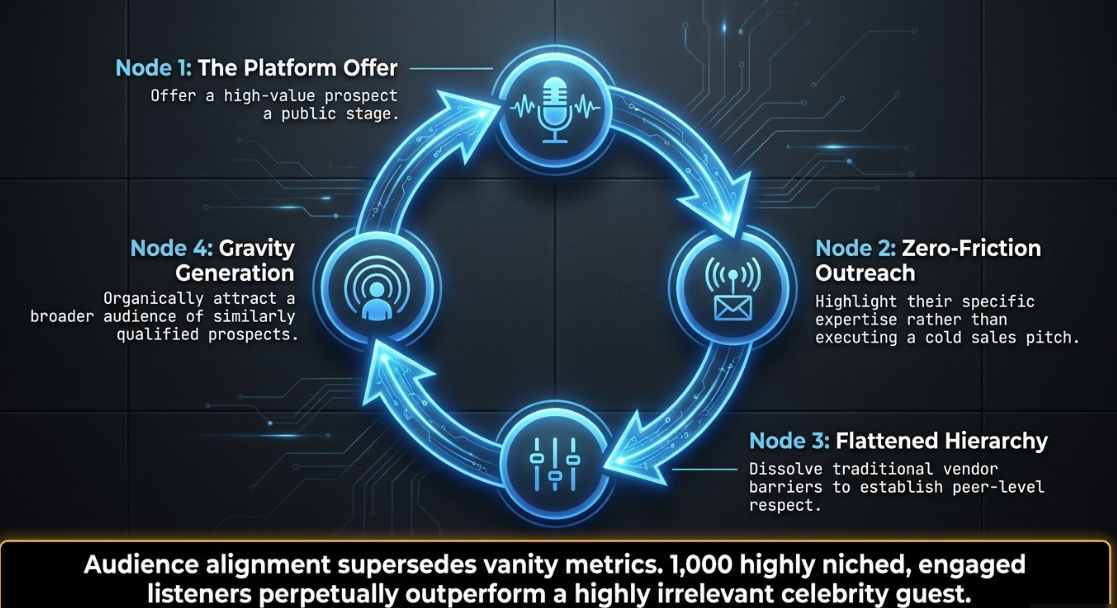
Content-based networking operates on the strategic premise of inviting ideal target customers, highly sought-after industry decision-makers, or invaluable strategic partners to be guests on the show.11 Instead of engaging in traditional, friction-heavy sales outreach—such as cold calling or sending unsolicited lead-generation emails—the podcaster offers the prospect a valuable public platform. By making the content entirely about the guest's expertise, shining the spotlight on their professional accomplishments, and asking thought-provoking questions that highlight their authority, the host builds a lasting, high-trust relationship with a high-value individual.11 The episode serves as a collaborative vehicle that flattens the traditional hierarchy between a vendor and a prospect, fostering a dynamic of peer-level mutual respect. The second-order effect of this strategy is that while the host is systematically expanding their network of ideal clients and partners, they are simultaneously generating valuable, industry-specific content that organically attracts a broader audience of similar, highly qualified prospects.11
Sourcing and Finding High-Caliber Guests
Finding high-caliber guests who can deliver profound value requires a systematic, data-driven approach that transcends relying solely on immediate personal networks or passive inbound requests. The primary objective is to meticulously identify individuals whose specific expertise perfectly aligns with the podcast's target listener persona. Sourcing can be executed through a variety of channels, leveraging both manual investigation and specialized discovery tools.
LinkedIn is widely considered one of the most robust, high-yield platforms for identifying subject matter experts, corporate decision-makers, and thought leaders.12 By conducting Boolean searches for specific job titles, tracking industry-specific hashtags, or monitoring recent publications within target sectors, producers can build highly curated lists of potential prospects. Beyond LinkedIn, podcasters can mine alternative, rich sources of talent, such as authors with upcoming book releases on Amazon (who are actively seeking promotional tours), speakers at relevant industry conferences, and individuals who have recently appeared as guests on similar or competitor podcasts.12
For larger operations or established agencies, leveraging specialized discovery platforms and databases, such as Rephonic or Listen Notes, allows producers to filter potential guests by hyper-specific categories, geographic regions, and audience influence.13 Additionally, partnering with dedicated podcast booking agencies or utilizing internal networks of past guests can yield high-quality, pre-vetted referrals.12 However, the foundational, non-negotiable rule of sourcing is that audience alignment must always supersede the sheer size of the guest's following or their vanity metrics.13 An engaged, niche expert who speaks directly to the specific pain points of a host's audience of 1,000 listeners will perpetually yield better engagement and conversion than a high-profile celebrity whose expertise is entirely irrelevant to the show's core thesis.
Structuring the Value Proposition to Appeal to Guests
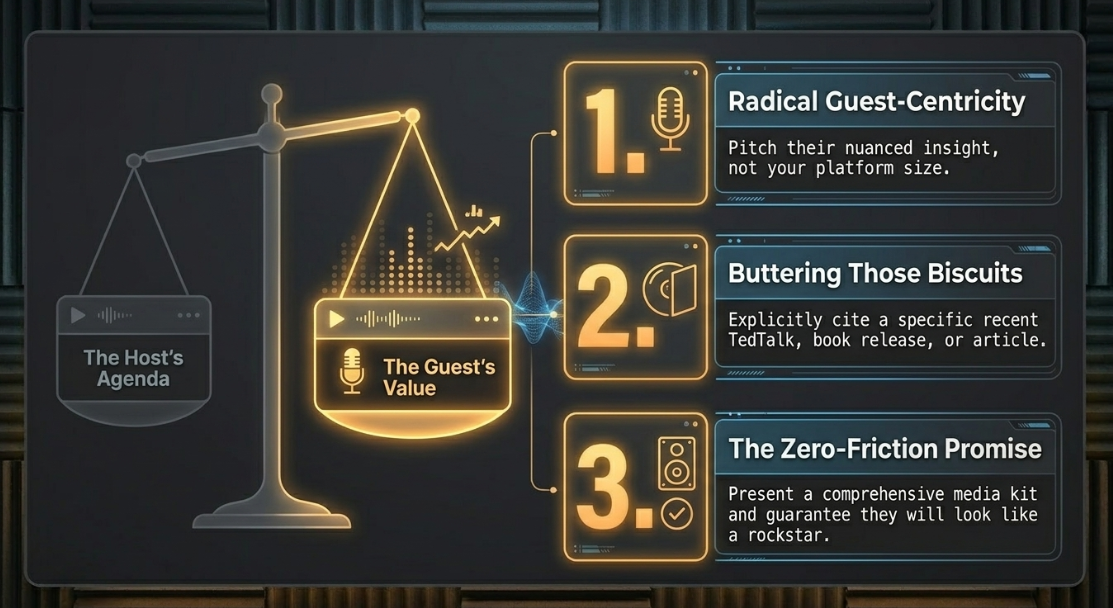
High-caliber experts, authors, and executives receive a relentless barrage of media requests and PR pitches, rendering generic, copy-and-paste emails highly ineffective and often instantly deleted.13 To successfully secure top-tier talent, the host must structure a value proposition that instantly, explicitly communicates the benefit of the appearance to the guest, rather than focusing on the host's platform or needs. The core philosophy of the pitch must be radically guest-centric.11
When structuring the initial outreach, the sender must strongly avoid detailing their own company's achievements, their recent awards, or the self-serving goals they harbor for their podcast.11 Instead, the pitch must highlight the guest's specific expertise and explicitly reference a recent, notable piece of content they have produced, such as an insightful article, a new book release, or a compelling TedTalk.11 The value proposition is essentially formulated as: "Your specific, nuanced insight on this exact topic is precisely what my audience needs to hear, and I want to provide you with the optimal platform to share it."
Furthermore, the pitch should incorporate genuine appreciation—a tactic colloquially referred to as "buttering those biscuits"—to warm up the prospect and unequivocally demonstrate that the host is an active, informed consumer of their work, not just a marketer casting a wide net.11 The proposal must make it clear that the interview will be strategically designed to make the guest look like a "rockstar" by providing them with an engaged, targeted demographic that yields tangible benefits, such as industry exposure, elevated thought leader status, or direct audience crossover.11 To further reduce friction, providing a comprehensive media kit—including the show's demographics, past high-profile guests, and topic focus—can quickly legitimize the request.16 Ultimately, the value proposition must present the opportunity as a high-reward, zero-friction mechanism for the guest.
Approaching Potential Guests (Outreach Strategies)
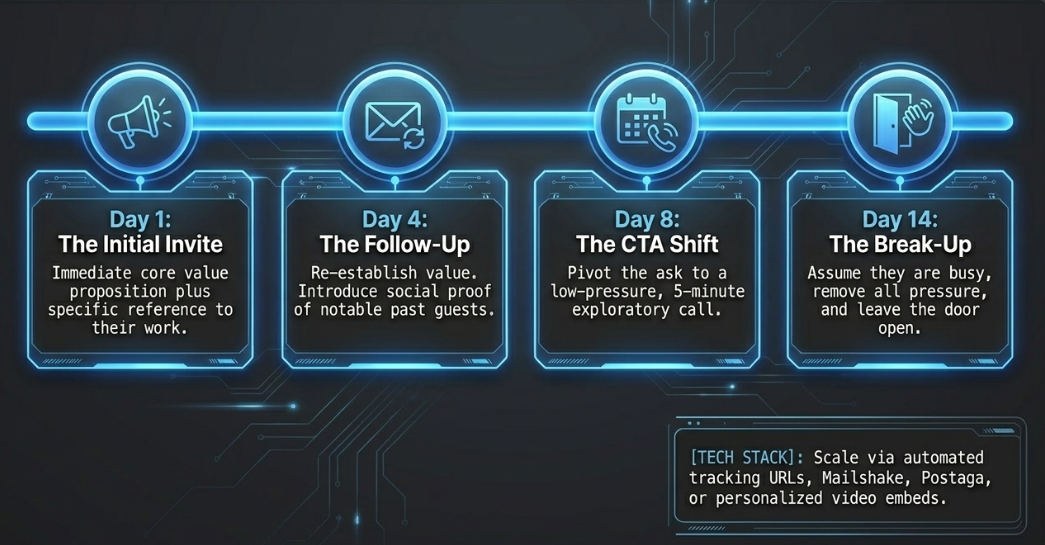
Executing the outreach strategy requires a sophisticated blend of personalization, persistent follow-up, and multi-channel communication. Because executives and high-profile individuals maintain heavily guarded inboxes, a single, isolated email is rarely sufficient to secure a booking. A structured, automated follow-up sequence is standard practice for professional guest acquisition.11
A highly effective, industry-standard outreach methodology utilizes a concise, strategically spaced four-email sequence.11 The sequence is designed to be persistent and top-of-mind without crossing the line into unprofessional harassment or spam:
To optimize open rates, subject lines must be compelling, highly specific, and rigorously avoid generic phrasing like "Podcast Guest Pitch" or "Collaboration Inquiry".13 Referencing a previous guest they may know, or a specific theory they have published, significantly increases the likelihood of a click.13 Furthermore, testing the timing of the pitch—treating the subject line and send time as if pitching a hard news story to a journalist—can improve visibility in crowded inboxes.19
If traditional email proves ineffective, hosts can deploy alternative mediums to creatively cut through the noise. Personalized video messages, utilizing software like BombBomb embedded directly in emails, provide a face-to-face human connection that is difficult to ignore.11 Additionally, customized LinkedIn voice messages sent immediately after a connection request is accepted, or highly condensed, polite direct messages (DMs) on platforms like Twitter or Instagram, can highly differentiate the host from standard, automated PR noise.11
To scale these efforts without losing the illusion of one-to-one communication, producers utilize CRM software and email sequencing tools like Mailshake, Postaga, or Drip.13 These platforms allow hosts to manage follow-ups, track open rates, and organize communication histories. Once a guest is booked and the episode is ready for release, the strategy shifts to performance tracking; assigning unique tracking URLs (e.g., website.com/guestname) and custom promo codes allows the host to use Google Analytics to measure the exact ROI and lead generation metrics resulting from that specific outreach effort.
Advanced Podcast Interviewing
The Crucial Pre-Interview
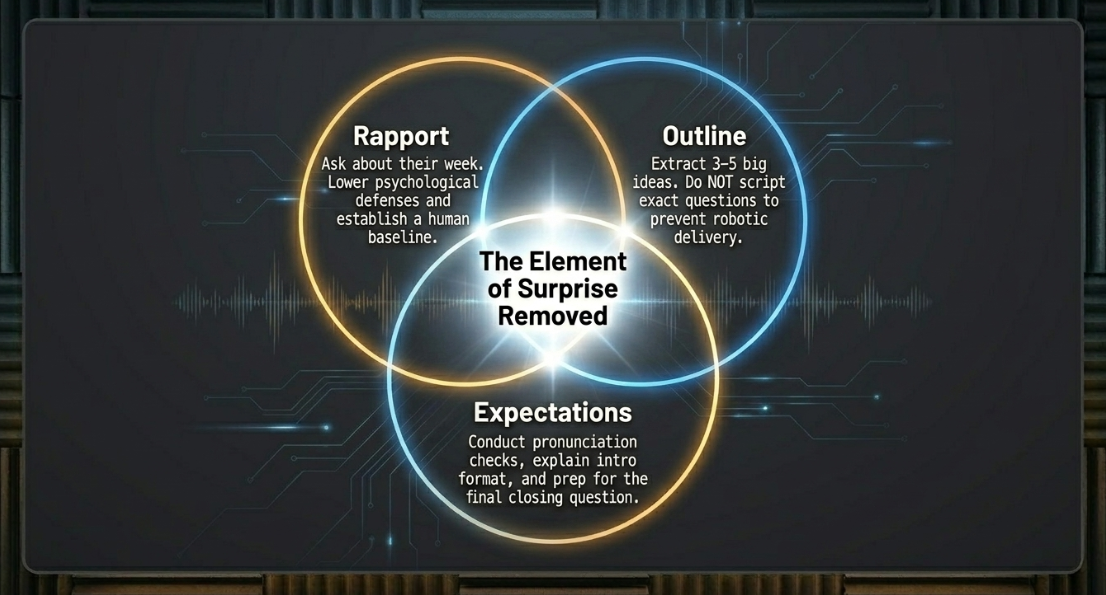
The moments immediately preceding the recording of a podcast episode are often the most determinative of the final product's quality. A structured pre-interview, typically conducted via a quick call or immediately upon logging into the remote recording software and lasting roughly 5 to 10 minutes, is an indispensable best practice for professional podcasters.20 The pre-interview serves a triad of critical functions: establishing human rapport, formulating a cohesive content outline, and setting clear technical and procedural expectations.20
The psychological utility of the pre-interview cannot be overstated. Many subject matter experts, while brilliant in their respective fields, are unaccustomed to the unique pressures and rhythms of audio broadcasting. If a guest has never been behind a microphone, it is the host's duty to educate and guide them through the process, transforming from an interviewer into a trusted producer.21 By outlining the trajectory of the conversation during the pre-interview, the host removes the "element of surprise," which, rather than stifling spontaneity, actually allows the guest to organize their thoughts, drastically reducing filler words (ums, ahs) and aimless rambling during the actual recording.7
However, there is a distinct debate regarding sending questions in advance. Providing a rigid list of exact questions often prompts guests to over-prepare, resulting in them reading scripted, robotic answers that destroy the conversational flow.8 A superior practice is to send a general list of topics or bullet points ahead of time, adding the explicit caveat that it is merely a guide for the conversation and that organic follow-ups will occur.22 Finally, the pre-interview is the last line of defense for technical checks, ensuring the guest is utilizing headphones to prevent audio bleed and confirming their microphone is properly selected within platforms like Riverside or Descript.
Techniques for Executing a Great Interview
Executing a masterful podcast interview requires the host to simultaneously manage the technical flow of the conversation, the psychological comfort of the guest, and the listening experience of the audience. The highest tier of podcast interviewing does not occur when reading off a clipboard; it occurs in the dynamic, unscripted spaces between the prepared questions.3
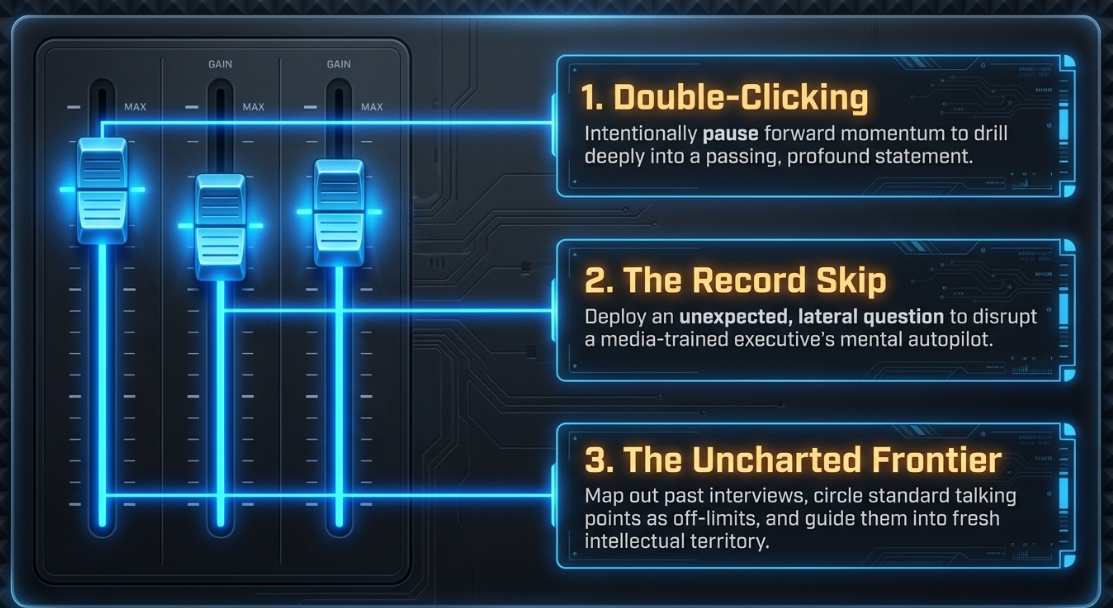
Active listening is the foremost skill of an elite interviewer. Rather than mentally rehearsing the next question while the guest is speaking, the host must lean in, remain fully present, and allow their genuine curiosity to dictate the follow-up.3 This approach leads to the deployment of "double-clicking," an advanced technique where a host identifies a passing, profound statement made by the guest and intentionally pauses the forward momentum of the interview to delve deeper into that specific point before moving on.8
To extract non-rehearsed, highly authentic answers from media-trained guests who are accustomed to delivering canned responses, hosts can employ several unconventional psychological tactics. Stating an intentionally inaccurate opinion, summarizing a topic with slightly incorrect numbers, or playing the "dumb" proxy allows the guest to step into the role of the correcting authority, which almost universally yields a much more passionate, detailed, and genuine explanation.8 Similarly, deploying a "record skip question"—an unexpected, lateral, or seemingly unrelated inquiry—disrupts the guest's mental autopilot and forces them into a state of genuine, real-time contemplation.8
A critical component of advanced interviewing is exploring the "uncharted frontier".26 Guests are significantly more motivated to share and promote an episode if the host pushes them beyond their standard talking points.26 By mapping out what the guest has said on fifty other podcasts, circling those topics in red as off-limits, and intentionally guiding them into new intellectual territory, the host creates a uniquely valuable piece of content that the guest is proud of.
The flow of the interview is also heavily dependent on the host's restraint. While occasional, polite interruptions for clarification are necessary to represent the listener, chronic interruption frustrates the guest and creates an unlistenable, chaotic audio product.3 A master host recognizes that the central thesis of the episode should emerge organically through the conversation, guided by the pre-interview outline rather than rigidly adhering to a script.8 By opening up, matching the guest's energy, engaging in healthy debate if the guest enjoys arguing, and occasionally showcasing their own vulnerability, the host creates a mirrored psychological state where the guest feels entirely safe to share their most valuable, unguarded insights.8
Identifying and Mitigating Guest Red Flags
Not every willing guest is a suitable addition to a podcast. Protecting the integrity of the show, the quality of the audio, and the trust of the audience requires the host to aggressively screen for behavioral and professional "red flags" prior to confirming a recording slot. Identifying these warning signs early saves significant production time, prevents the creation of unusable content, and guards against audience attrition.27
Mitigating these red flags requires a rigorous, unapologetic vetting process. Conducting the pre-interview is the primary filtration mechanism; it allows the host to visually and auditorily assess the guest's communication style, verify their technical setup, and set unyielding boundaries regarding the show's format.27 If a guest demonstrates an inability to provide concise, value-driven answers, or exhibits overly controlling tendencies during the vetting stage, the host must exercise their editorial authority and pass on the opportunity, remembering that the ultimate allegiance is always to the listener, not the guest.14
Graceful Rejection Strategies for Unsuitable Guests
As a podcast grows in visibility and prestige, hosts will inevitably face a daily deluge of inbound guest pitches. Because the host serves as the ultimate gatekeeper for their audience's ears, saying "no" is not just an administrative task; it is an act of leadership and an absolute necessity for maintaining show quality.30 However, rejecting potential guests—especially when they are peers, industry professionals, or aggressive PR agencies—must be handled with distinct tact and grace to preserve long-term relationships and brand reputation.
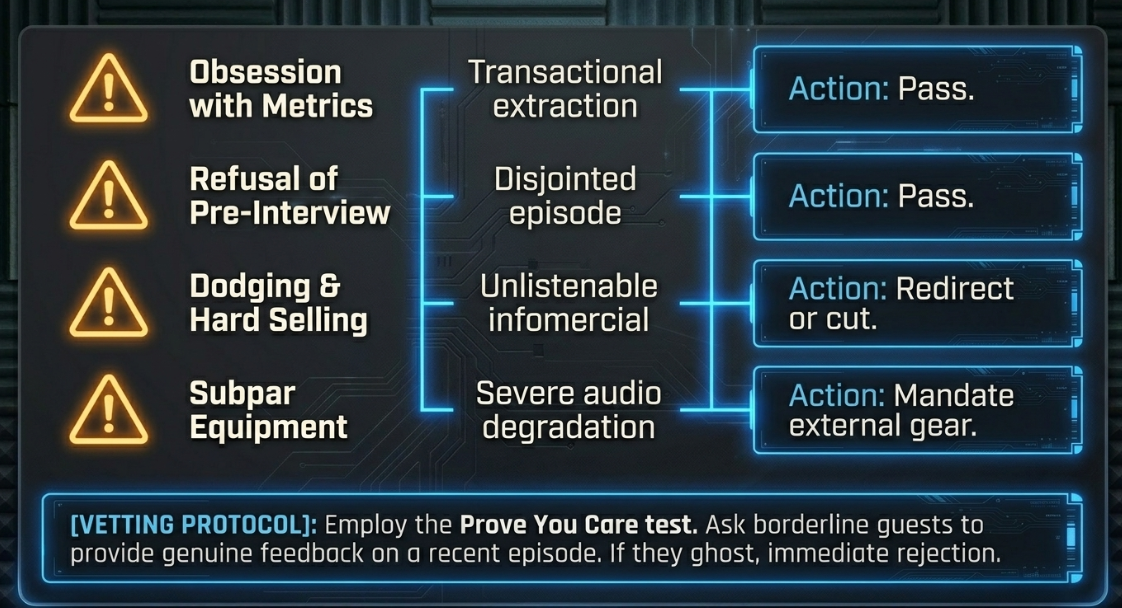
To systemize rejections without succumbing to decision fatigue, podcasters can implement a rigid three-filter vetting process.30 If a pitch is completely misaligned with the audience demographic, it receives an immediate "Absolutely Not." If the pitch is intriguing but lacks compelling evidence of unique value, it is categorized as a "Maybe." The deciding factor for a "Maybe" is the "Prove You Care" test, where the host asks the potential guest to listen to a specific recent episode and provide genuine feedback.30 If the prospect refuses, ghosts the email, or provides a generic, automated response, the rejection is instantly justified by their lack of genuine interest in the platform.
When issuing the formal rejection, utilizing a library of standardized email templates removes the emotional friction of saying no, prevents the host from over-explaining, and ensures a prompt, professional response.33
By providing a clear, polite reason for the rejection, the host maintains a professional boundary without burning bridges, acknowledging that a well-delivered "no" to an unsuitable guest is ultimately a resounding "yes" to protecting the listener's time and trust.
Navigating Relationships with Publicists
A significant friction point in podcast production arises when coordinating with public relations (PR) agencies and professional publicists. While publicists can provide unparalleled access to high-profile guests, celebrities, and highly guarded CEOs, they frequently approach the podcast medium with an outdated, traditional broadcast mentality.35 Understanding this disconnect and asserting the podcast's specific needs is vital for hosts seeking to manage these relationships effectively.
The primary operational challenge when dealing with PR is the "soundbite mentality." PR representatives are heavily trained to prepare their clients for rapid-fire television hits or terrestrial radio segments, advising them to deliver meticulously rehearsed, 30-to-40-second answers.35 In the long-form, deeply conversational arena of podcasting, this training is detrimental; it results in stunted, superficial interviews that feel like teeth-pulling and entirely lack narrative depth. Furthermore, PR professionals routinely underestimate the infrastructural necessity of high-quality audio.35 They frequently fail to brief their clients on the importance of using broadcast-quality microphones, stable wired internet connections, or isolated recording environments, often assuming a standard laptop microphone or a cell phone connection will suffice for a digital medium.
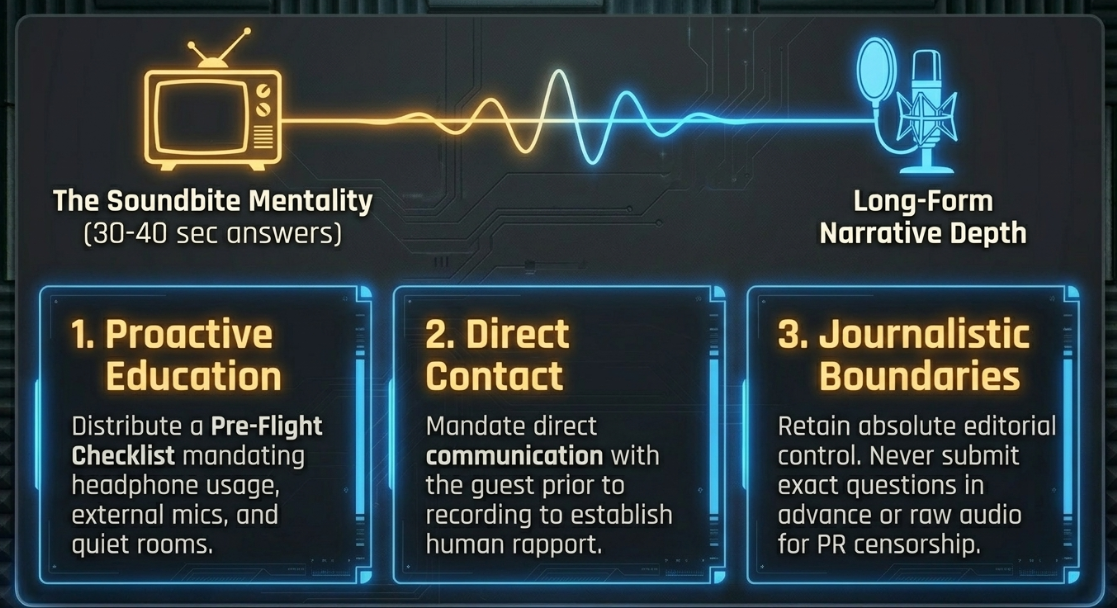
To bridge this gap, ensure high-quality output, and assert editorial control, podcasters must proactively educate the PR representatives.35 Hosts should create and distribute comprehensive "Tip Sheets" or "Pre-Flight Checklists" to the publicist immediately upon booking. These documents must explicitly outline the absolute technical requirements (e.g., mandatory headphone usage, external microphones, quiet rooms) and the editorial expectations (e.g., the explicit desire for extended storytelling, vulnerability, and exploration over brief, corporate soundbites).25
Whenever possible, the host should mandate direct communication with the guest prior to the recording, circumventing the publicist's filter to establish human rapport and directly align on the interview's outline.35 Finally, hosts must firmly maintain their journalistic boundaries against overzealous agencies. The host is under absolutely no obligation to provide a rigid list of exact questions in advance to the publicist, nor must they submit the final edited audio for the PR agency's review, approval, or censorship before publication.35 Publicists operate on timelines ranging from a one-month turnaround for smaller shows to over a year for major productions; thus, hosts must navigate these relationships with patience, firm boundaries, and an unyielding commitment to their own audio standards.36
Legal Foundations: The Guest Release Agreement
As podcasts evolve from casual hobbyist projects into monetized digital assets, intellectual property portfolios, and highly visible media brands, the legal infrastructure surrounding guest contributions becomes paramount. A casual email confirmation or a verbal agreement is entirely insufficient to protect the intellectual property, copyright, and liability of the podcast network. Hosts must implement a formal Guest Release Agreement to secure their rights in perpetuity and safeguard their back-catalog from future disputes.37
A comprehensive Guest Agreement requires several standard legal clauses to be enforceable and protective:
The absolute necessity of the "Grant of Rights" and "Ownership" clauses has become increasingly critical in the modern, highly volatile media landscape. Without an irrevocable release, a guest who later experiences regret over their statements—or becomes entangled in public controversies or "cancel culture"—could legally demand the retroactive removal of their episode.39 This is particularly complex with video podcasts distributed on platforms like YouTube, where an algorithmically successful video may rank high on search engines, prompting a guest who has changed careers to demand a takedown to hide their past associations.40
While a host may choose to compassionately remove an episode as a professional courtesy if it aligns with their ethical standards, the Guest Release Agreement ensures that the podcaster retains the ultimate legal authority over their published assets, preventing a disgruntled guest from forcibly destroying a highly trafficked, monetized piece of content.39 To effectively operationalize this, hosts should utilize digital signature platforms (e.g., DocuSign, HelloSign) to seamlessly execute the agreement during the standard onboarding process, accompanied by a quick verbal confirmation of consent recorded at the very beginning of the raw audio track for absolute redundancy.
Salvaging Suboptimal Interviews and Managing Difficult Guests
Despite rigorous vetting protocols, comprehensive pre-interviews, robust technical preparation, and legally sound agreements, hosts will occasionally find themselves entangled in a fundamentally flawed, exhausting interview. A guest may unexpectedly freeze due to performance nerves, become uncharacteristically dull and unengaging, adopt a combative tone, or suffer from severe, unavoidable internet degradation that ruins the connection.22 In these high-stress scenarios, the host must rapidly pivot from a conversational interviewer into an assertive audio-director, utilizing real-time mitigation and post-production strategies to salvage the asset.
If an interview begins to derail due to tension, fatigue, or the guest visibly struggling to articulate a coherent point, the most effective real-time tactical intervention is to call a definitive "time-out".41 Pausing the recording software to take a brief five-minute break allows both parties to reset their energy, step away from the pressure of the red light, clarify the topic off-mic, and return to the conversation with renewed focus.41 If a guest becomes overly dominant, aggressively promotional, or consistently veers off-topic into irrelevant tangents, the host must forcefully, yet politely, redirect the flow. Acknowledging their passion for the tangent (e.g., "It sounds like you have a lot to say about that, which we can definitely get to at the end, but let me have you answer this first") validates the guest's ego while allowing the host to seamlessly reclaim the structural reins of the episode.24
When live mitigation fails to correct the trajectory, heavy post-production editing becomes the host's primary, uncompromising defense. Because the host operates as the executive producer of the platform, they must ruthlessly edit the audio to serve the listener's ear.24 This includes surgically cutting extended tangents, tightening the pacing to remove dull pauses and filler words, and splicing the best, most coherent segments together to artificially inject energy and flow into an otherwise flat performance.
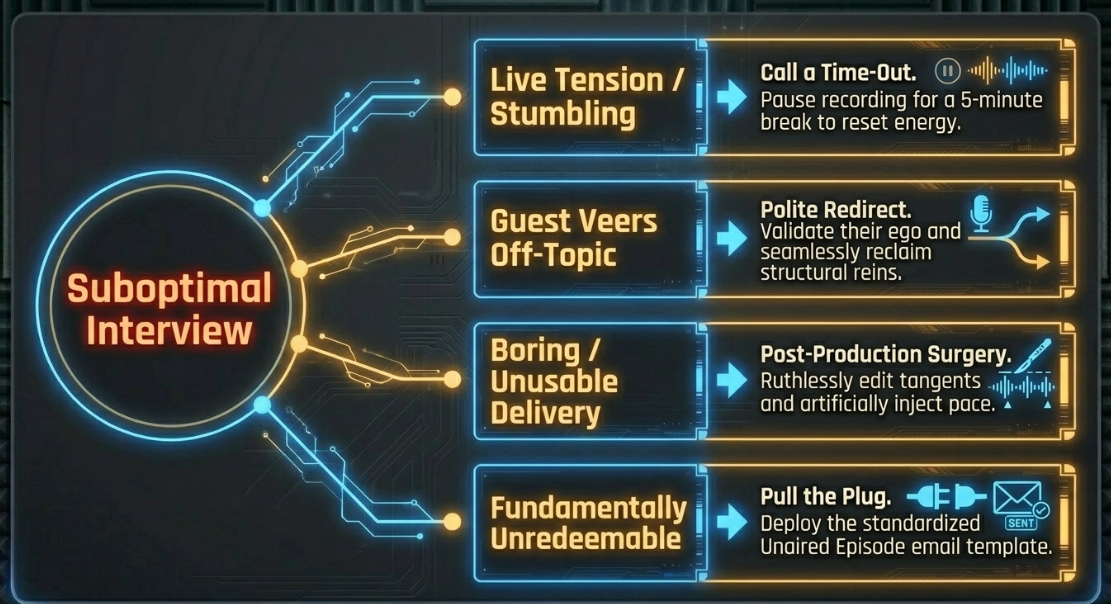
However, there exists a threshold where an interview is fundamentally unredeemable and cannot be saved by post-production magic. If a guest delivers obstinate single-word answers, exhibits highly inappropriate behavior, or if the audio quality is entirely compromised by static and dropouts, the host must prioritize their brand integrity and their audience's time over the guest's feelings.41 In such severe cases, the host must pull the plug entirely. If the realization occurs live during the recording, the host may transparently halt the process, cite unworkable technical issues or fatigue, and offer to reschedule for a better day.41
If the realization that the episode is unusable occurs in post-production, the host must utilize tactful communication to inform the guest that the episode will not air.33 The approach depends on the relationship: a host might deploy a white lie stating that the audio files were corrupted or lost, inform the guest that the episode is sitting in an indefinite "queue" due to a full content calendar, or politely but directly state that upon review, the conversation did not align with the podcast's upcoming editorial direction.44 Pre-written email templates specifically designed for notifying a guest of an unaired episode provide clear, kind, and professional messaging, removing the emotional burden from the host.47 Ultimately, the host's loyalty is owed exclusively to the listener, and the difficult decision to scrap a bad episode, while uncomfortable, is a necessary execution of supreme quality control.
Works cited
Tips for making your podcast pitch stand out - PR Daily, accessed May 21, 2026, https://www.prdaily.com/tips-for-making-your-podcast-pitch-stand-out/
Vocal Training: How to Enhance Your Podcast Voice to Keep Your ..., accessed May 21, 2026, https://sarahmikutel.com/how-to-podcast/improve-your-podcast-voice-through-vocal-training
188 Shut Up and Listen - Podcaster Interview Best Practices, accessed May 21, 2026, https://podcastperformancecoach.com/188-shut-up-and-listen-podcaster-interview-best-practices/
Vocal Training: How to Enhance Your Podcast Voice to Keep Your Audience Listening, accessed May 21, 2026, https://pod.link/1456181773/episode/ZjVhNzUzNTItMjgzYi00NGQ4LTlhNDMtMmU5NGM1ODNhMDhk
7 Effective Voice Exercises for Podcasters - Podcasting Hacks, accessed May 21, 2026, https://podcastinghacks.com/effective-voice-exercises-for-podcasters/
Vocal Warm-Ups for Podcasters, Audiobooks and Content Creators - YouTube, accessed May 21, 2026, https://www.youtube.com/watch?v=NJdvGRDyOcw
Do you send guests your interview questions before having them on the show? - Reddit, accessed May 21, 2026, https://www.reddit.com/r/podcasting/comments/pop4pe/do_you_send_guests_your_interview_questions/
How to Interview Someone for a Podcast (15 Actionable Tips) - Alex Birkett, accessed May 21, 2026, https://alexbirkett.com/podcast-interview/
How the Best Podcasters Prepare to Interview Guests - YouTube, accessed May 21, 2026, https://www.youtube.com/watch?v=7ovEacmePqI
Podcast Hosts: How Do You Prep for an Interview? - Reddit, accessed May 21, 2026, https://www.reddit.com/r/podcasting/comments/12oxv4k/podcast_hosts_how_do_you_prep_for_an_interview/
Podcast Guest Pitch Template: Book More Guests - Sweet Fish Media, accessed May 21, 2026, https://www.sweetfishmedia.com/blog/podcast-guest-pitch-template
Podcast Guest Booking Best Practices - Sweet Fish Media, accessed May 21, 2026, https://www.sweetfishmedia.com/blog/podcast-guest-booking
Podcast PR Agency 101: Your Ultimate Guide, accessed May 21, 2026, https://leveragewithmedia.com/podcast-pr-agency-guide/
How to Say No to Podcast Guest Requests - YouTube, accessed May 21, 2026, https://www.youtube.com/watch?v=uSNpFw_pVik
The Perfect Podcast Guest Pitch Template (Free) - Leverage With Media PR, accessed May 21, 2026, https://leveragewithmedia.com/podcast-guest-pitch-template/
Best cold email tactics for booking podcast guests? - Reddit, accessed May 21, 2026, https://www.reddit.com/r/podcasting/comments/1mo9q7r/best_cold_email_tactics_for_booking_podcast_guests/
How To Get On A Podcast: Booking Pitch Template + Tips - Sweet Fish Media, accessed May 21, 2026, https://www.sweetfishmedia.com/blog/podcast-guest-checklist-pitch
Podcasting for Business: A 26-Step Process - Sweet Fish Media, accessed May 21, 2026, https://www.sweetfishmedia.com/blog/podcasting-for-business
How To Write Media Pitches Journalists Actually Open And Use, accessed May 21, 2026, https://www.publicrelationsreviewpodcast.com/how-to-write-media-pitches-journalists-actually-open-and-use/
How to Do a Pre-Interview for Your Podcast - Sweet Fish Media, accessed May 21, 2026, https://www.sweetfishmedia.com/blog/podcast-pre-interview-how-to
Mastering Your Podcast Interview: 5 Steps & The Best Podcasting Questions - Libsyn, accessed May 21, 2026, https://libsyn.com/blog/the-interview-podcast-in-5-steps/
What to do when your guest is downright boring? : r/podcasting - Reddit, accessed May 21, 2026, https://www.reddit.com/r/podcasting/comments/iwh0u1/what_to_do_when_your_guest_is_downright_boring/
How to Prepare Your Guest for a Remote (Podcast) Interview - YouTube, accessed May 21, 2026, https://www.youtube.com/watch?v=ljtciWzN9FQ
5 Types of Challenging Podcast Guests (and How to Handle Them) - Emily Prokop, accessed May 21, 2026, https://www.epodcastproductions.com/podcasting-blog/5-types-of-challenging-podcast-guests-and-how-to-handle-them
Podcast Interview Checklist - Get Your Guest Ready to Record - East Coast Studio, accessed May 21, 2026, https://eastcoaststudio.com.au/podcast-interview-pre-flight-checklist/
The Reason Your Podcast Guests Aren't Sharing Their Episodes (and What You Can do to Fix it), accessed May 21, 2026, https://podcastmarketingacademy.com/podcast-guest-sharing/
9 Podcast Guest Booking Red Flags to Watch For - Krystal Proffitt, accessed May 21, 2026, https://krystalproffitt.com/podcast-guest-booking-red-flags-to-watch-for/
Red Flags for Podcast Guests: How to Spot 'Em, accessed May 21, 2026, https://www.podcastconsultant.com/red-flags-for-podcast-guests-how-to-spot-em/
The Ultimate Checklist for Becoming a Sought-After Podcast Guest, accessed May 21, 2026, https://www.smoothbusinessgrowth.com/becoming-a-sought-after-podcast-guest/
Saying No to Podcast Guest Pitches Without Feeling Bad w/ Agi Keramidas - YouTube, accessed May 21, 2026, https://www.youtube.com/watch?v=OE0l6NRTXI0
Accepting/rejecting guests on my podcast - Reddit, accessed May 21, 2026, https://www.reddit.com/r/podcasting/comments/1cbli5x/acceptingrejecting_guests_on_my_podcast/
How to Say No to People Wanting to Guest on Your Podcast - PodMatch, accessed May 21, 2026, https://podmatch.com/blog/how-to-say-no-to-people-wanting-to-guest-on-your-podcast
How to Reject a Podcast Pitch - Gaffin Creative, accessed May 21, 2026, https://gaffincreative.com/how-to-reject-a-podcast-pitch/
Using Email Templates to Say “No” with Grace | Full Focus, accessed May 21, 2026, https://fullfocus.co/using-email-templates-to-say-no-with-grace/
How To Work With PR People - Podcast Business Journal, accessed May 21, 2026, https://podcastbusinessjournal.com/how-to-work-with-pr-people/
Your Podcast Publicist with Christina Lenkowski, accessed May 21, 2026, https://podcasts.apple.com/us/podcast/your-podcast-publicist-with-christina-lenkowski/id1583316820
Podcast Guest Consent: Legal Guide & Templates, accessed May 21, 2026, https://homestudiomastery.com/podcast-guest-consent-legal-guide-and-templates/
PODCAST GUEST RELEASE FORM PRODUCER - Columbia University, accessed May 21, 2026, https://library.columbia.edu/content/dam/libraryweb/about/Podcast-Guest-Release-Form.pdf
Guest release agreements – how do you guys do it? : r/podcasting - Reddit, accessed May 21, 2026, https://www.reddit.com/r/podcasting/comments/1sxc3sd/guest_release_agreements_how_do_you_guys_do_it/
Q&A: My Podcast Guest Wants Me to Remove His Episode, accessed May 21, 2026, https://bulletin.bigpodcast.com/remove-podcast-episode
8 Tips For Saving a Bad Podcast Interview, accessed May 21, 2026, https://weeditpodcasts.com/8-tips-for-saving-a-bad-podcast-interview/
How To Deal With A Difficult Podcast Guest - Uncommonly More, accessed May 21, 2026, https://uncommonlymore.com/how-to-deal-with-a-difficult-podcast-guest/
What do you do when you don't love the interview you recorded? : r/podcasting - Reddit, accessed May 21, 2026, https://www.reddit.com/r/podcasting/comments/1s44hy9/what_do_you_do_when_you_dont_love_the_interview/
How to tell a guest you aren't releasing their episode : r/podcasting - Reddit, accessed May 21, 2026, https://www.reddit.com/r/podcasting/comments/1aohxsd/how_to_tell_a_guest_you_arent_releasing_their/
How to tell a guest their episode won't be released? : r/podcasting - Reddit, accessed May 21, 2026, https://www.reddit.com/r/podcasting/comments/mhhamt/how_to_tell_a_guest_their_episode_wont_be_released/
Email Templates for Asking Your Podcast Guest to Re-record - Gaffin Creative, accessed May 21, 2026, https://gaffincreative.com/product/email-templates-for-asking-your-podcast-guest-to-re-record/