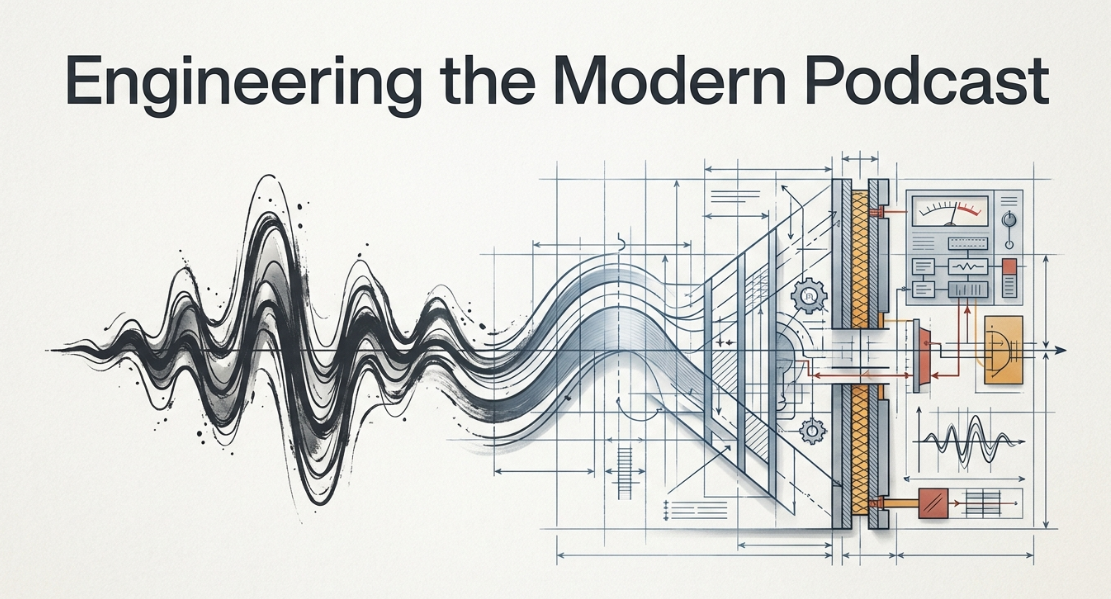
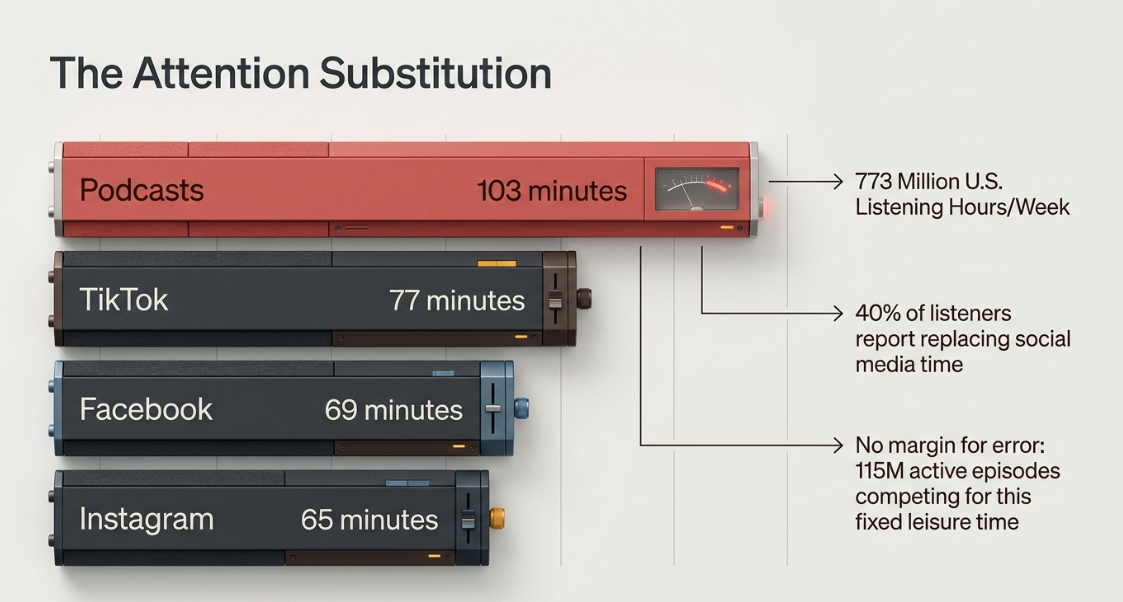
The contemporary digital audio landscape has evolved from a decentralized ecosystem of hobbyist creators into a highly sophisticated, algorithmic media industry. As of recent data, 73% of the United States population aged 12 and older has consumed a podcast, with 55% engaging on a monthly basis and 40% tuning in weekly—representing an all-time high in market penetration.1 Over the last decade, the aggregate time spent with podcasts among those aged 13 and older has surged by an astounding 355%, culminating in 773 million hours of listening per week.1 The depth of this engagement is profound; daily podcast consumption among adults has seen a nearly fourfold rise, surging from just 6% in 2015 to 23% in recent years.2
Crucially, this consumption is not merely an additive behavior to preexisting media diets. In a world where available leisure time is fixed, podcast growth operates as an intentional behavioral substitution. Nearly four in ten listeners report that the time they spend with podcasts replaces time previously allocated to scrolling through social media platforms, while another 34% indicate it replaces time spent listening to streaming music.2 Today, United States adults spend an average of 103 minutes per day listening to podcasts, a metric that significantly outpaces daily engagement on major visual platforms such as TikTok (77 minutes), Facebook (69 minutes), and Instagram (65 minutes).
The demographic composition of this expanding audience also reveals significant shifts toward younger and highly diverse listener bases. Penetration among the 18 to 29 age bracket has reached 67%, which is approximately double the listenership rate of those aged 65 and older.3 Multicultural audiences are particularly engaged, with monthly consumption rates reaching 66% among APAC demographics, 65% among Hispanic audiences, and 62% among Black audiences.4 Furthermore, podcasts are increasingly serving as primary informational vectors; approximately one-third of adult listeners utilize the medium as a source for news, illustrating a high degree of trust in the format.3 This trust is corroborated by monetization data, which shows that 88% of weekly consumers consider advertising a fair price for free content, and 68% do not mind hearing ads integrated into the audio.
Table 1: Daily Digital Engagement Comparisons.2
Because listeners treat podcasts as primary vehicles for education, news, and entertainment—and with over 115 million episodes actively tracked across global directories—the margin for error in content delivery is virtually non-existent.5 Success in this saturated environment demands more than mere charismatic hosting. It requires rigorous architectural planning of the episode itself, empirical topic validation, industrialized production workflows, and meticulous search engine optimization.
The psychological architecture of a podcast episode fundamentally serves to reduce the listener's cognitive load. A highly consistent, predictable structure allows audiences to anticipate the flow of information, minimizing the friction associated with processing new audio content.6 When listeners intuitively understand the blueprint of a show—knowing precisely when the core value will be delivered and when the actionable takeaways will be summarized—they exhibit significantly higher retention rates.6 Conversely, shows that improvise their core structure frequently produce meandering, unstructured episodes that trigger premature listener abandonment.7
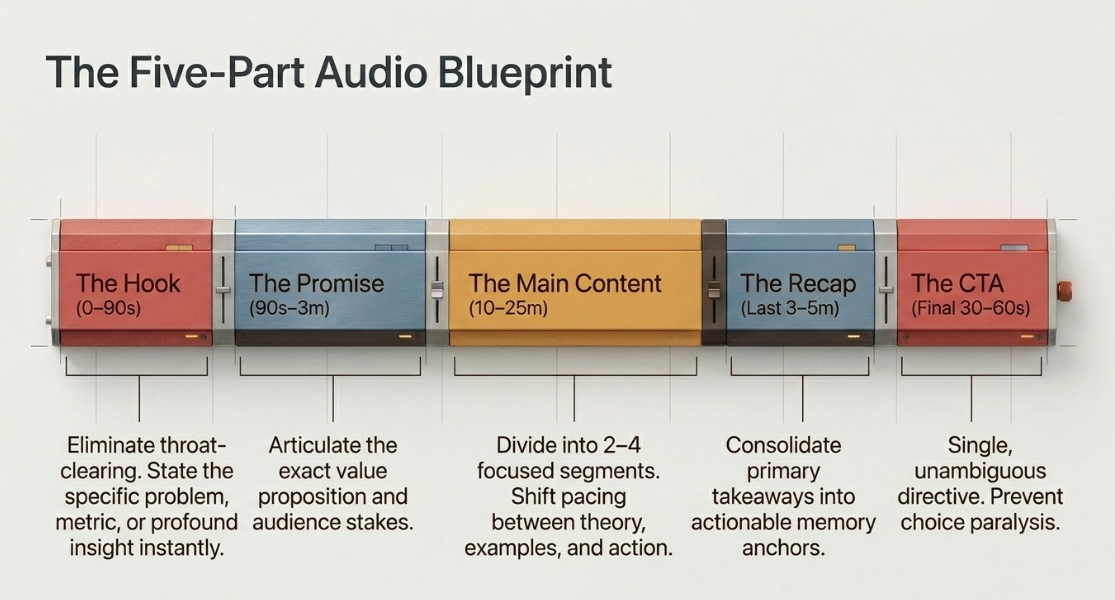
While specific formats dictate varying internal timings, the most effective, retention-optimized podcast episodes utilize a foundational five-part sequential flow.6 This structure functions as an auditory map, guiding the listener from initial curiosity to final action.
The first critical phase is the Hook, which typically occupies the initial 30 to 90 seconds of the episode.6 The modern listener decides whether to commit to an episode within this narrow window.6 Consequently, opening an episode with conversational "throat-clearing"—such as extended logistical updates, weather discussions, or inside jokes—is highly detrimental to listener retention.6 An effective hook must grab attention immediately by stating a specific problem, revealing a surprising metric, or teasing a profound insight that will be unpacked later in the episode.6
Following the hook, the host must transition into the Promise, typically occurring between the 90-second and three-minute marks.6 This segment explicitly articulates the episode's value proposition, answering the listener's subconscious inquiry regarding why the content matters to them. The promise outlines exactly what the audience will learn, how it applies to their specific pain points, and what the ultimate stakes are.6
The third phase is the Main Content, which constitutes the core body of the episode. This section should be explicitly organized into two to four highly focused segments, ranging anywhere from 10 to 25 minutes depending on the total runtime.6 Depending on the format, this section explores frameworks, conducts interviews, or unravels narrative stories. The pacing here is critical; long examples or theoretical explanations should not exceed a few minutes without offering a concrete takeaway to keep the listener oriented.6
Because audio is a transient medium—frequently consumed while listeners are commuting, exercising, or performing household chores—a formal Recap phase is vital.9 Occupying the last three to five minutes of the recording, the recap consolidates the primary takeaways into actionable memory anchors, summarizing the overarching "so what" of the episode.6
Finally, the episode must conclude with a single, unambiguous Call to Action (CTA) in the final 30 to 60 seconds.6 Offering multiple directives, such as asking a listener to subscribe, leave a review, visit a website, and follow social media channels simultaneously, induces choice paralysis. A professional outro focuses on one primary request, explicitly explaining how taking that action benefits the listener or supports the ongoing production of the show.
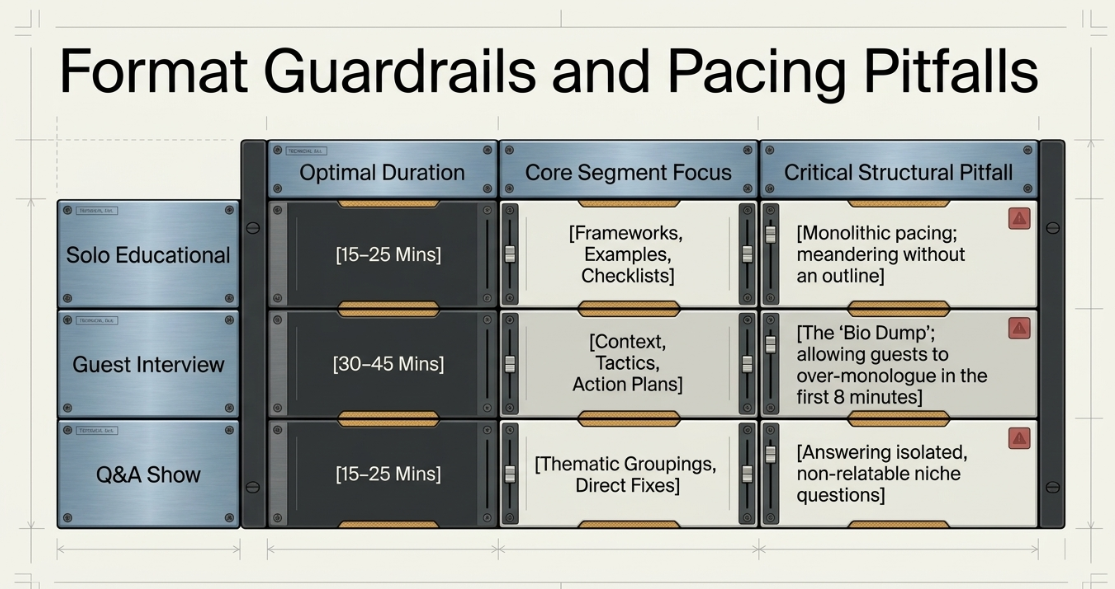
The application of this five-part flow requires contextual adaptation depending on the specific genre and format of the podcast. For solo podcasters, maintaining engagement without the dynamic interplay of a co-host is uniquely challenging. A highly structured 20-minute solo template typically dictates a precise pacing rhythm.6 Following the hook and promise, the main body is subdivided into clear instructional phases. The first segment might define a framework or methodology, followed by a pivot to a concrete, real-world example.6 Subsequent segments identify common mistakes, provide corrective measures, and deliver a step-by-step implementation checklist.6 This varied pacing—shifting from abstract theory to concrete examples to actionable steps—prevents the monologue from becoming monolithic and fatiguing.
Interview formats, while ubiquitous, frequently suffer from structural bloat. A critical best practice in structuring professional interviews is the complete elimination of the traditional "bio dump" during the introduction. Reading a guest's extensive website biography is inefficient audio; instead, the host should highlight only the most compelling, relevant aspects of the guest's background before transitioning rapidly into the hook.8 A highly optimized interview structure allocates the first five to eight minutes to establishing the guest's origin or context.6 The bulk of the episode should then extract tactical, specific methodologies, followed by an exploration of common industry failures, and culminating in a synthesized action plan for the audience.6
Regardless of the format utilized, structural integrity is maintained through the use of verbal "signposts." These are specific cues that explicitly tell the listener where the episode is heading, ensuring they never feel disoriented.6 Phrases such as, "Before we move on to the implementation checklist, let's look at where most people fail," act as connective tissue that propels the narrative forward.6 Furthermore, integrating three-act narrative beats—setup, friction, and resolution—into informational segments ensures that educational content retains the propulsive momentum of a story, preventing the delivery from sounding overly clinical or robotic.6
Table 2: Optimal Episode Architecture by Format Type.6
Content Planning and Generating Episode Topics
A meticulously structured episode will ultimately fail to generate traction if the underlying topic does not resonate deeply with the target audience. A leading cause of podcast abandonment—a phenomenon colloquially known within the industry as "podfade," which frequently occurs before a creator reaches 20 published episodes—is the exhaustion of ad-hoc topic ideas.11 Sustainable podcasting requires moving away from reactive, week-to-week brainstorming and toward proactive, systematic content planning methodologies.
The foundational step in content planning is establishing absolute clarity regarding the target listener persona. Content created for a generalized, undefined audience inevitably fails to penetrate a saturated market; vague content does not rank well algorithmically and fails to inspire listener loyalty.12 Strategists must construct detailed listener profiles, explicitly defining the specific professional or personal struggles the demographic is facing, the language they use to describe their pain points, and the gaps that exist in the current media market that the podcast can exploit.12
Once the audience is defined, the topic must be restricted to a highly specific niche. A hyper-focused niche not only facilitates easier brainstorming, but it establishes the podcast as an authoritative entity much faster than a broad-focus show. Before finalizing a content calendar, concepts should be validated against actual market demand using analytical tools such as Spotify Charts, Google Trends, Ahrefs keyword generators, and Reddit community discussions to ensure empirical interest exists.
When creators inevitably face creative exhaustion after the initial launch phase, systematic brainstorming methodologies are required to replenish the content bank.14 The most reliable source of resonant content is the audience itself. Leveraging social media engagement, monitoring email replies, and hosting dedicated Q&A segments to source questions directly from listeners ensures that upcoming episodes address verified, real-world demands.8 Furthermore, choosing to interview listeners rather than high-profile industry guests can yield deeply relatable, narrative-driven episodes that organically generate new topical avenues and foster intense community loyalty.16
To avoid echoing the exact sentiments of competitors within a niche, creators can utilize the "flipping" technique. This involves taking a universally accepted industry standard or a commonly asked question and arguing the exact opposite, or approaching it from a deliberate contrarian perspective.15 Additionally, because traditional desktop environments can stifle creative ideation, separating the brainstorming process from the production environment is highly effective. Utilizing mobile voice-to-text tools like Otter.ai or Google Docs Voice Typing allows creators to capture and outline raw concepts while walking, exercising, or commuting, securing uninhibited thoughts that can later be structured into formal episode outlines.10
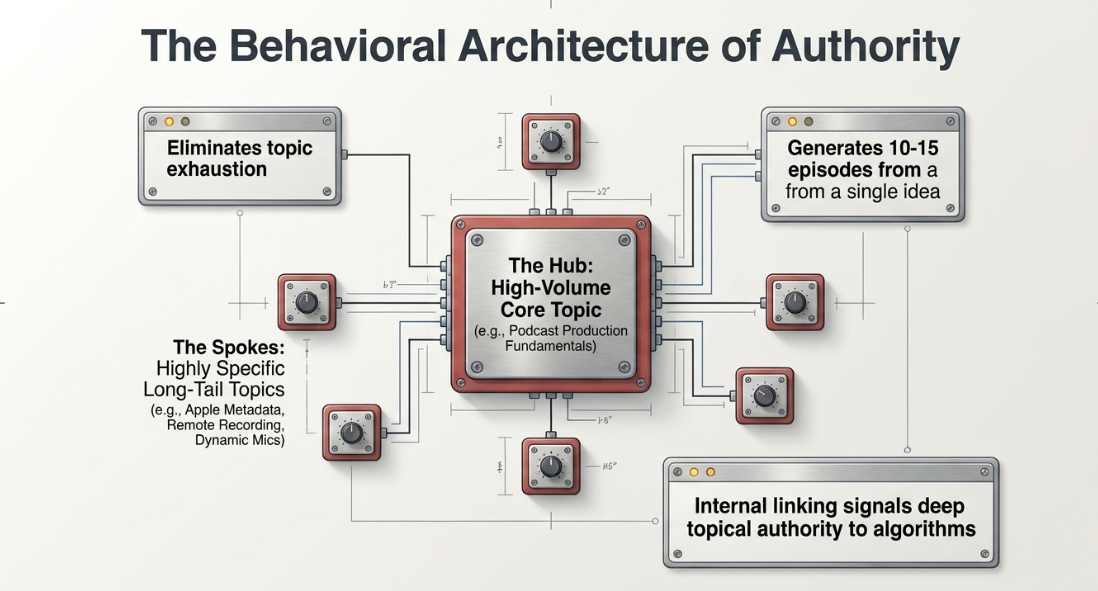
To completely eradicate topic exhaustion and establish true topical authority, sophisticated podcast strategists employ the "Hub-and-Spoke" content model, a powerful framework borrowed from advanced search engine optimization.17 Instead of conceptualizing episodes as isolated, disparate units, content is mapped into highly interconnected webs.
In this model, the Hub represents a broad, high-volume core topic that the podcast aims to build ultimate authority around.17 For instance, a Hub might be a definitive, comprehensive episode on "The Fundamentals of Podcast Production." The Spokes are numerous, highly specific, longer-tail sub-topics that branch directly off the Hub.17 For the aforementioned Hub, Spokes would include individual, deep-dive episodes on "Choosing the Right Dynamic Microphone," "How to Write a Podcast Script," "Optimizing Apple Podcasts Metadata," and "Recording Remote Interviews."
This architectural model offers profound strategic advantages.18 First, a single broad idea immediately generates a cascading list of ten to fifteen highly specific episode topics, drastically reducing planning time. Second, this architecture forces the creation of a cohesive, logical content strategy rather than a random assortment of recordings. Finally, it creates a powerful internal linking ecosystem. The host can constantly refer back to the Hub episode within the Spoke episodes, and link all related content within the show notes. This behavioral architecture signals deep topical authority to search engine algorithms and encourages listeners to binge-listen to the entire interconnected series, rapidly increasing total download metrics, session durations, and overall audience retention.
To ensure these planned topics actually reach production without interruption, creators are advised to maintain a running list of at least ten to twenty-five backup episode ideas.21 If a scheduled guest cancels unexpectedly, or technical difficulties prevent an interview, having a robust backlog of thoroughly researched Solo or Q&A concepts guarantees that the publishing schedule remains uninterrupted.21 Furthermore, implementing strategic theming—planning podcast content three months in advance around specific quarterly themes—allows creators to selectively recruit guests and align their content strategy systematically, rather than scrambling for ad-hoc interviews each week.21
Podcasting Frequency, Consistency, and Content Batching
With the episode architecture defined and a robust web of topics generated, the operational challenge transitions to execution and delivery. The empirical data surrounding podcast growth is unequivocal: consistency is the primary catalyst for audience habituation and algorithmic algorithmic preference.
A defining characteristic of podcast consumption is its role as a habitual medium. Listeners weave audio content into recurring, predictable daily routines. Consequently, an erratic or unpredictable release schedule fundamentally breaks the psychological habit loop required for long-term audience retention. Statistical analysis of the global podcast ecosystem hosted on platforms like Buzzsprout reveals that 34% of active podcasts publish a new episode every three to seven days, while 38% publish on an eight to fourteen-day cycle.5
Among top-tier, highly successful podcasts, a weekly publishing cadence is standard, with a notable industry preference for releasing episodes mid-week—specifically Tuesdays through Thursdays—as these days historically capture peak commuter and professional audiences.9 However, deeper empirical analysis suggests that the specific day of the week is far less critical than the unwavering predictability of the release.9 Whether a creator publishes every Tuesday at 6:00 AM or every other Friday afternoon, both the human audience and the platform algorithms heavily reward reliability.9 Spotify's algorithm, for instance, explicitly favors shows that maintain regular release patterns, artificially boosting their visibility within the platform's automated recommendation feeds.23 Conversely, long periods of silence or erratic publishing schedules signal to the algorithm that the content is dormant, resulting in suppressed visibility.
Table 3: Distribution of Podcast Publishing Frequencies.5
To validate whether a chosen frequency is actually resonating, creators must leverage robust hosting analytics. Platforms such as Libsyn and Buzzsprout provide detailed barometers of audience health. Libsyn’s Advanced Stats package offers insights into user-agents, geographic heat maps, and detailed historic date ranges to track performance.24 Buzzsprout data indicates that an episode achieving 417 downloads in its first seven days ranks in the top 10% of all podcasts globally, while the median podcast receives approximately 29 downloads per episode in the same timeframe.5 By analyzing these benchmarks, creators can gauge whether their current frequency is resulting in cumulative audience growth or if audience fatigue is setting in.
The fundamental failure point for most independent podcasters is the "treadmill effect"—attempting to research, script, record, edit, and publish a new episode linearly, every single week.26 This linear workflow merges highly disparate cognitive tasks, forcing the creator to continuously context-switch between creative ideation, performative hosting, and tedious technical editing. Industry estimates suggest that producing a professional podcast can take six to eight times the actual length of the recorded episode.28 This immense friction invariably leads to creator burnout.
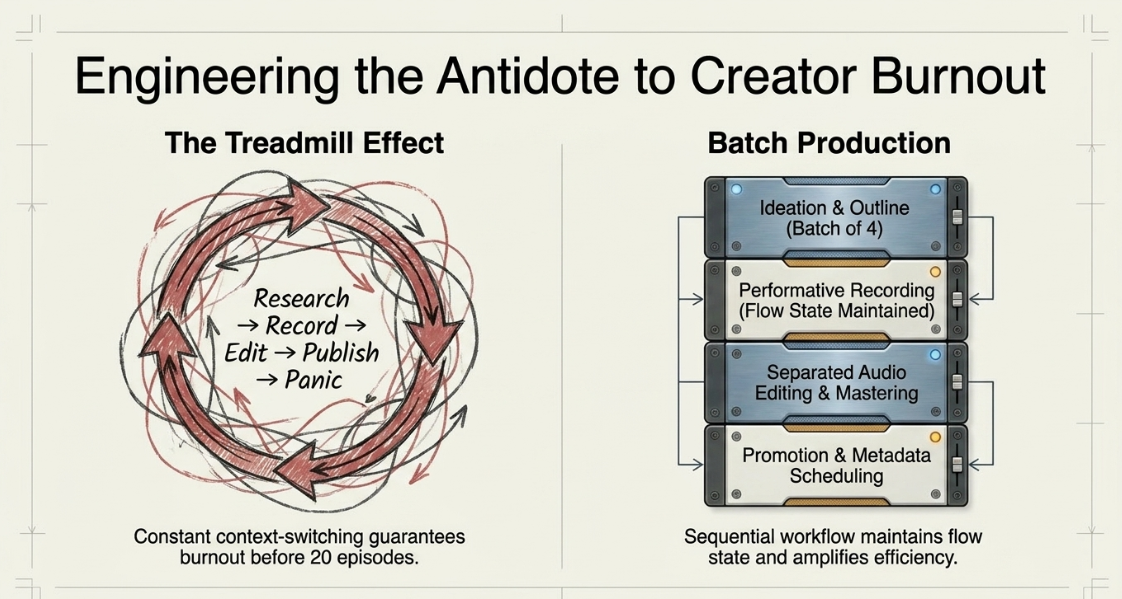
The professional standard to counteract this production fatigue is Batch Production.21 Batch recording involves clustering similar tasks into dedicated, uninterrupted time blocks, rather than executing the entire lifecycle of a single episode at once. By recording three to four episodes back-to-back in a single afternoon, a creator drastically reduces the aggregate time spent on technical setup, microphone checks, software routing, and environmental optimization.27 More importantly, batching preserves psychological momentum; once a host enters a performative "flow state" behind the microphone, maintaining that energy across multiple recordings yields significantly higher quality audio delivery than starting cold each week.27
This philosophy of consolidation extends to all facets of the production lifecycle. Editing days should be entirely separate from recording days, allowing an audio engineer (or the creator themselves) to master, splice, and level several audio files concurrently without breaking concentration.29 Promotion days can be reserved exclusively for extracting video audiograms, drafting SEO-optimized show notes, and scheduling social media posts for an entire month's worth of content.30 By decoupling these processes, the gap between effort and return narrows substantially, making the medium operationally sustainable over the long term.26
To facilitate batch production effectively, robust editorial systems and project management tools must be deployed. Relying on memory or basic to-do lists is wholly insufficient for managing the complex assets, guest communications, and metadata requirements of multiple concurrent episodes. Strategic workflows rely heavily on visual project management platforms such as Notion, Trello, Asana, Monday.com, or ClickUp.21
A highly optimized workflow system utilizes a standardized Podcast Content Calendar to track the macro-level themes for the quarter, combined with a Production Dashboard to manage the micro-level status of each individual episode.21 Episodes are moved through rigid Kanban-style progression stages: Ideation, Outlined, Scheduled, Recorded, In Post-Production, Scheduled for Release, and Published.21 Furthermore, creating Standard Operating Procedures (SOPs)—detailed checklists encompassing everything from pre-interview emails to final audio leveling standards—ensures absolute consistency.31 This systematization allows the creator to eventually delegate editing or administrative tasks to external producers without suffering any degradation in quality.33
Maximizing Discoverability Through Episode Notes
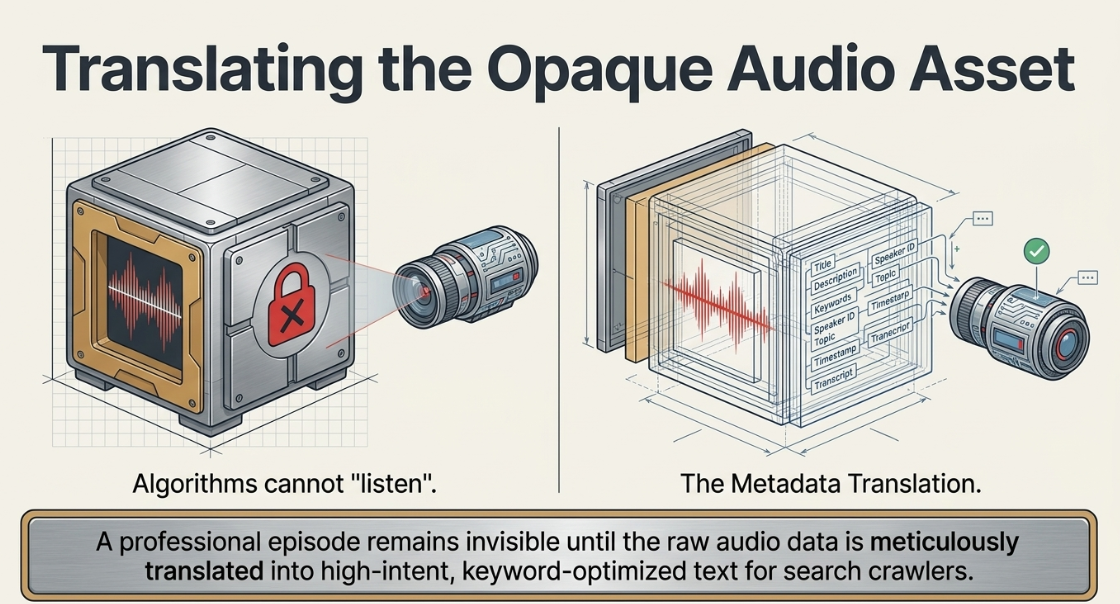
Creating excellent audio content and executing a flawless production workflow guarantees nothing if the intended audience cannot discover the podcast. Discoverability in the modern podcasting landscape is fundamentally an exercise in Search Engine Optimization (SEO). However, unlike traditional blog posts or text-heavy web pages, the core asset of a podcast—the audio file itself—is completely opaque to legacy search engine crawlers.34
Neither Google, Apple, nor Spotify can natively "listen" to an audio file to determine its nuanced value or relevance to a specific user.34 Therefore, search algorithms rely almost entirely on the text-based metadata wrapped around the audio asset. If the surrounding text fails to accurately translate the depth and specificity of the audio, the podcast remains a digital black box, invisible to potential listeners searching for that exact information.34 Podcast SEO, therefore, reduces to a singular mandate: ensuring that the text attached to an episode precisely matches the specific, high-intent queries that the target audience is typing into search bars.34
Many podcasters instinctively name their episodes for themselves or their existing fans rather than their potential listeners, utilizing vague, clever, or ego-driven titles (e.g., "Episode 45: A Chat with John Smith" or "The Big Pivot").35 These titles possess zero organic search volume. To capture organic traffic, creators must conduct rigorous keyword research before the episode is published, targeting both short-tail keywords (broad concepts like "content marketing") and long-tail keywords (specific, problem-oriented queries like "how to build a B2B content marketing strategy").35 These strategic keywords must then be meticulously injected into the episode's metadata—specifically the show title, episode titles, episode descriptions (show notes), and transcripts.
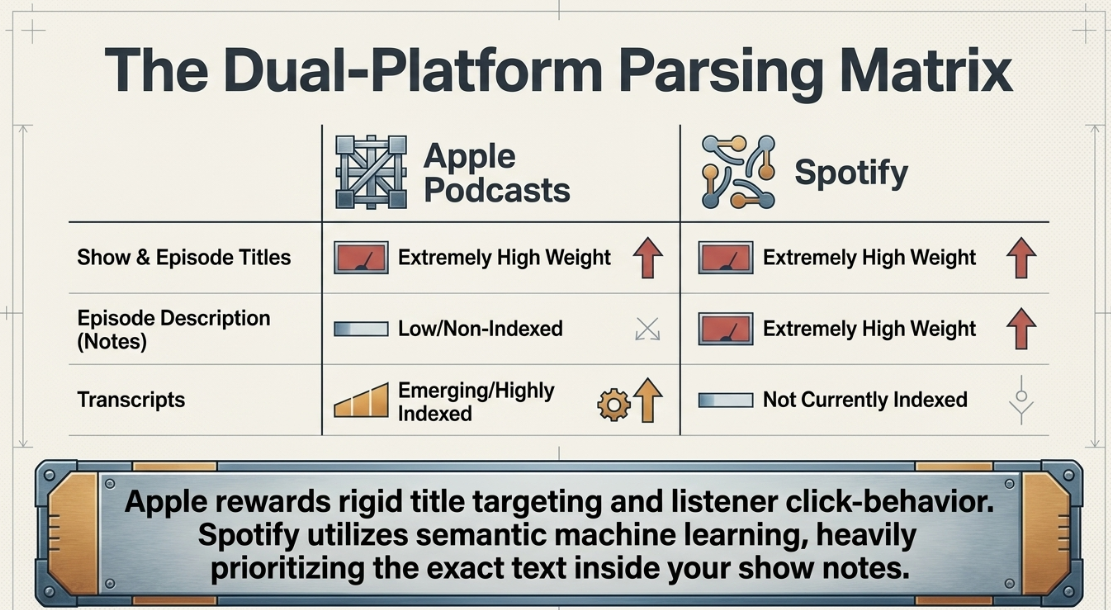
While both Apple Podcasts and Spotify operate on similar foundational SEO principles, their proprietary search algorithms weigh metadata elements quite differently. Understanding these nuances is critical for achieving dual-platform dominance.38
Apple’s search engine is notoriously restrictive regarding which fields it actually indexes for search visibility. Empirical data indicates that Apple heavily prioritizes keywords located in the Show Title, the Episode Title, and the Author/Publisher field.34 Placing a target keyword directly in the episode title drastically boosts search visibility on the platform.38 Notably, Apple Podcasts historically places little to no algorithmic weight on the actual episode description (the show notes) for search ranking purposes.38 However, Apple has recently begun processing and indexing embedded episode transcripts, making the actual spoken words searchable within their ecosystem.38 Furthermore, Apple's algorithm is heavily influenced by "Listener Behavior." It tracks granular engagement metrics: if a user searches for a term, clicks on an episode, and immediately begins playing it or subscribes to the show, that specific episode's ranking for that specific search query surges.38
Conversely, Spotify operates a broader, more holistic text-parsing algorithm. Unlike Apple, Spotify explicitly indexes and heavily weighs the Episode Description alongside the show and episode titles.23 Therefore, keyword-rich show notes directly and immediately impact Spotify search visibility.23 Spotify’s algorithmic engine also leverages complex machine learning models, utilizing massive datasets of past search logs to map "unsuccessful queries" to eventual "successful reformulations," helping the platform understand the natural, colloquial language users deploy when looking for specific audio.39 Additionally, Spotify’s engine is deeply intertwined with its recommendation algorithm, pushing content to users based on past listening history and heavily rewarding shows that maintain a consistent publishing schedule.
Given that show notes are vital for Spotify ranking, Google web indexing, and overall user experience, treating them as an afterthought or a mere dump of hyperlinks is a massive strategic failure.36 High-impact episode notes must be meticulously crafted to serve both the machine crawler (SEO) and the human reader (UX).
The anatomy of optimized show notes begins with a magnetic, keyword-rich title. The title must combine the target keyword with clear, outcome-driven value. Front-loading the keyword—placing it at the very beginning of the title string—is an established best practice, ensuring it is immediately read by algorithms and isn't truncated on smaller mobile screens, considering PRX guidelines note that around 20 characters is the average visible space before truncation.35
Beneath the title, the first 100 to 200 words of the show notes act as the crucial meta-description.35 This tight summary must include the primary keyword naturally within the first few sentences and succinctly pitch the core value of the episode to a busy professional scrolling through an application.35 Following the summary, breaking the show notes into readable sections using structured H2 and H3 subheadings helps web crawlers understand the hierarchy of information, and allows human readers to quickly scan the document.
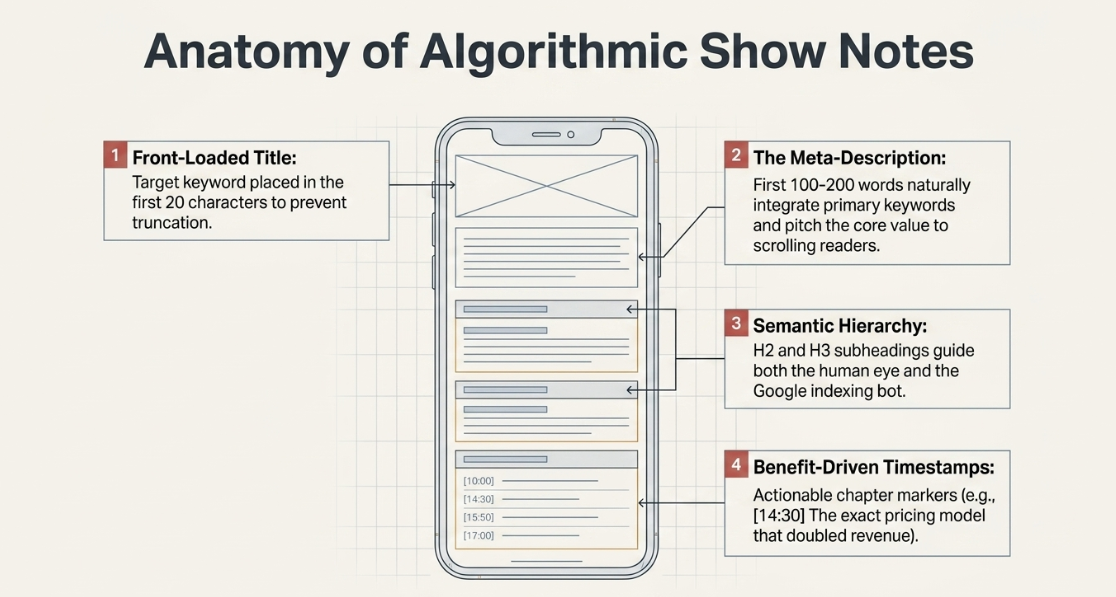
Detailed timestamps, or chapter markers, are a non-negotiable element of modern podcast user experience.35 Busy listeners demand the ability to navigate directly to the segments that solve their immediate problems. Timestamps should not merely list the topic being discussed, but explicitly state the benefit (e.g., "[14:30] The exact pricing model that doubled agency revenue").35 Accompanying these timestamps, establishing authority and utility requires providing outbound links to every tool, book, report, and framework mentioned in the audio, alongside comprehensive guest biographies and co-marketing links.35 This transforms the podcast from a fleeting audio experience into an evergreen, highly bookmarked resource hub.
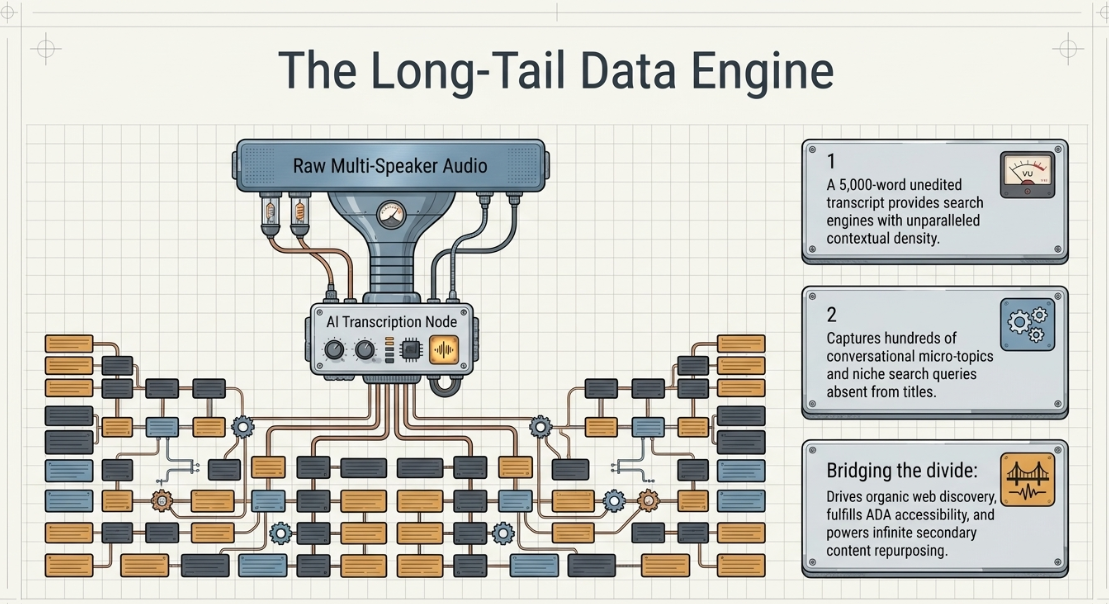
Finally, the ultimate method for maximizing audio discoverability and completely bridging the audio-text divide is the publication of full, unedited episode transcripts. While manual transcription was once prohibitively expensive and time-consuming, modern AI systems such as Otter.ai or Exemplary AI can transcribe multi-speaker episodes with high fidelity in minutes.15
An accurate transcript acts as a massive repository of latent, long-tail keywords.35 Because natural human conversation touches on hundreds of related micro-topics, publishing a 5,000-word transcript on a dedicated podcast website provides search engines with unparalleled contextual data.35 This density allows an episode to rank organically for conversational phrases and niche search queries that the creator never explicitly targeted in the title or summary.35 Beyond pure SEO, transcripts fulfill crucial accessibility requirements for the deaf and hard-of-hearing communities, allow international audiences to translate the text via browser extensions, and provide the foundational raw material for efficiently repurposing the podcast into secondary assets like blog posts, newsletters, and social media quotes.
The elevation of a podcast from an amateur audio recording to a highly scalable, authoritative media property relies entirely on the synthesis of structural architecture, operational systems, and algorithmic discoverability. Passive, unstructured conversations will not retain modern audiences, who possess infinite media options and finite attention spans.2 By implementing the five-part narrative flow, cognitive friction is removed, and listener retention is maximized.6 By adopting a Hub-and-Spoke planning model, topical authority is entrenched, and creative burnout is mitigated.17 By strictly adhering to batch-production workflows, the technical burdens of the medium are minimized, allowing for sustainable consistency.27 Finally, by translating invisible audio data into highly structured, keyword-optimized metadata and transcripts, the podcast is integrated into the broader digital search ecosystem, ensuring continuous, exponential organic discovery.34
Works cited
The Podcast Consumer 2025 - Edison Research at SSRS, accessed May 21, 2026, https://www.edisonresearch.com/the-podcast-consumer-2025/
Podcasts Are Dominating — And Signaling a Shifting Audience Behavior - Audacy Inc., accessed May 21, 2026, https://audacyinc.com/insights/podcasts-are-dominating-and-signaling-a-shifting-audience-behavior/
Podcasts and News Fact Sheet | Pew Research Center, accessed May 21, 2026, https://www.pewresearch.org/journalism/fact-sheet/podcasts-and-news-fact-sheet/
The Podcast Landscape 2025 Part One: Core Podcast Metrics - Sounds Profitable, accessed May 21, 2026, https://soundsprofitable.com/research/the-podcast-landscape-2025/
Buzzsprout Podcast Stats, accessed May 21, 2026, https://www.buzzsprout.com/stats
Podcast Episode Structure Template: How to Design Engaging ..., accessed May 21, 2026, https://www.automateed.com/podcast-episode-structure-template
accessed May 21, 2026, https://resonaterecordings.com/general/podcast-structure/#:~:text=Hook%20(30%20seconds)%2C%20Intro,body%20usually%20produce%20meandering%20episodes.
How to Structure Podcast Episodes: The Complete ... - Podcast Primer, accessed May 21, 2026, https://www.podcastprimer.com/blog/how-to-structure-podcast-episodes-complete-guide
Best Day to Release a Podcast (Real-Life Data) - YouTube, accessed May 21, 2026, https://www.youtube.com/watch?v=4ZoAcSVAgyg
Solo Podcast Ideas, Script and Outline Tools I Love - YouTube, accessed May 21, 2026, https://www.youtube.com/watch?v=u-OxHIqU-_4
4 Practical Strategies for Brainstorming Podcast Content Ideas | Successful Podcasting Unlocked Ep.6 - YouTube, accessed May 21, 2026, https://www.youtube.com/watch?v=AmmdQMkBEwQ
How to Start a Podcast: Step-by-Step Guide & Free Checklist - Riverside, accessed May 21, 2026, https://riverside.com/blog/how-to-start-a-podcast
Planning A Podcast: A Step-By-Step Guide - YouTube, accessed May 21, 2026, https://www.youtube.com/watch?v=cWJceHNlRA0
Endless Inspiration for Your Podcast - Buzzsprout Weekly, accessed May 21, 2026, https://buzzsproutweekly.buzzsprout.com/2366845/episodes/17677449-endless-inspiration-for-your-podcast
Stuck for Podcast Ideas? 5 Creative Brainstorming Techniques - YouTube Music, accessed May 21, 2026, https://music.youtube.com/podcast/R9Lat1vF93k
75 Podcast Ideas and Topics to Explore in 2026 - Buzzsprout, accessed May 21, 2026, https://www.buzzsprout.com/blog/untapped-podcasting-ideas
Hub and Spoke Content Marketing: What Is It & How Does It Work? - Conductor, accessed May 21, 2026, https://www.conductor.com/academy/hub-spoke-content-marketing/
Hub & Spoke Content Model Examples & Guide | Terra, accessed May 21, 2026, https://terrahq.com/en/blog/a-guide-to-the-hub-and-spoke-content-model-with-examples/
The Pillar and Spoke Strategy: Reinventing Content Marketing - Azarian Growth Agency, accessed May 21, 2026, https://azariangrowthagency.com/the-pillar-and-spoke-strategy/
Build Your Content Marketing Strategy Around a Hub & Spoke Model - IDX, accessed May 21, 2026, https://www.idx.inc/newsroom/build-your-content-marketing-strategy-around-hub-spoke-model
Podcast Content Calendar: The Ultimate Guide for Growth ..., accessed May 21, 2026, https://galatimedia.com/podcast-content-calendar-the-ultimate-guide-for-growth-organization/
How to Build an Effective Podcast Content Calendar: Step-by-Step Guide - propodcastsolutions.com, accessed May 21, 2026, https://propodcastsolutions.com/podcast-content-calendar-guide/
Podcast SEO: Getting Found in Apple Podcasts and Spotify - propodcastsolutions.com, accessed May 21, 2026, https://propodcastsolutions.com/podcast-seo-getting-found-in-apple-podcasts-spotify-and-google/
How to Start a Podcast: Complete Beginner's Guide | Libsyn, accessed May 21, 2026, https://libsyn.com/how-to-start-a-podcast/
Buzzsprout vs. Libsyn: Which Podcast Hosting Service is Right for You? | GoTranscript, accessed May 21, 2026, https://gotranscript.com/public/buzzsprout-vs-libsyn-which-podcast-hosting-service-is-right-for-you
How to Build an Efficient Podcast Production Process That Saves Time, accessed May 21, 2026, https://podcasts.apple.com/ie/podcast/how-to-build-an-efficient-podcast-production-process/id1095853073?i=1000745877083
Batch Recording for Podcasts: Boost Productivity and Stay Ahead of Schedule, accessed May 21, 2026, https://www.podcastvideos.com/articles/batch-recording-for-podcasters-save-time-stay-ahead-of-schedule/
How to Structure Your Podcast in 5 Steps - Buzzsprout, accessed May 21, 2026, https://www.buzzsprout.com/blog/podcast-structure
accessed May 21, 2026, https://www.red11media.com/blog/-professional-podcast-production-workflow#:~:text=A%20professional%20podcast%20workflow%20often,applies%20to%20editing%20as%20well.
Master Your Podcast Production Workflow - Fame.so, accessed May 21, 2026, https://www.fame.so/post/podcast-production-workflow
Podcast Content Calendar Template | Notion Marketplace, accessed May 21, 2026, https://www.notion.com/templates/podcast-content-calendar
Podcast Workflows: The 12 Best Podcast Editorial Calendar Templates in 2025 - Fame.so, accessed May 21, 2026, https://www.fame.so/post/podcast-editorial-calendar-template
How to Make Your Podcast Production Process More Efficient - Diferente Creative, accessed May 21, 2026, https://diferentecreative.com/blog2/how-to-make-your-podcast-production-process-more-efficient
Podcast SEO 101: How Search Actually Sees Your Show | SoundMadeSeen, accessed May 21, 2026, https://soundmadeseen.com/blog/podcast-seo-101
A Guide To Podcast Show Notes For SEO And Engagement | Fame, accessed May 21, 2026, https://www.fame.so/post/podcast-show-notes
Podcast SEO Tips To Optimize Your Show + Grow Your Audience - Leah Bryant Co., accessed May 21, 2026, https://leahbryantco.com/podcast-seo-make-your-show-easy-to-find/
Best Practices for Podcast Discoverability - PRX – Help Desk, accessed May 21, 2026, https://help.prx.org/hc/en-us/articles/6923215266715-Best-Practices-for-Podcast-Discoverability
Mastering the Apple and Spotify Algo to Maximize Your Visibility, accessed May 21, 2026, https://www.ausha.co/academy/podcast-search-optimization/apple-spotify-algorithms/
How Spotify Uses Semantic Search for Podcasts - Pinecone, accessed May 21, 2026, https://www.pinecone.io/learn/series/wild/spotify-podcast-search/
Podcast Show Notes 101: How to Boost Your Podcast SEO | Exemplary AI, accessed May 21, 2026, https://exemplary.ai/blog/podcast-show-notes-boost-seo