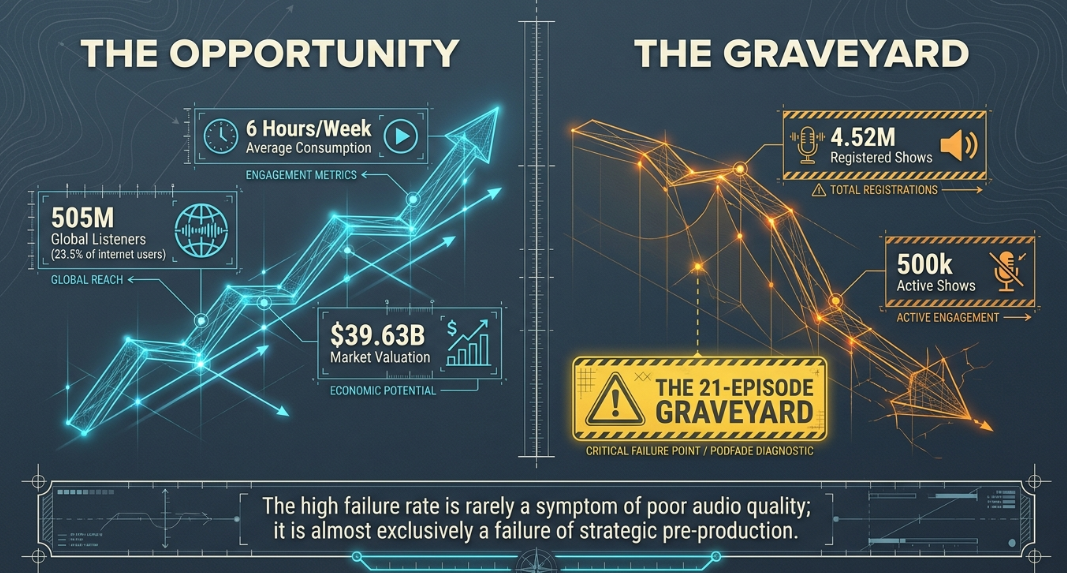
The global digital audio landscape has undergone a seismic transformation, evolving from a fringe, decentralized medium into a foundational pillar of modern corporate media consumption and B2B marketing strategy. Current market analytics reveal that the podcasting ecosystem now reaches approximately 505 million listeners worldwide, representing roughly 6% of the global population and an astonishing 23.5% of all global internet users.1 The industry's financial footprint mirrors this explosive audience growth, with global podcasting revenue tracking toward a valuation of $39.63 billion.2 Engagement metrics further underscore the medium's penetration into daily life: 42% of Americans are regular listeners, 31% consume audio content weekly, and the average weekly listener dedicates approximately six hours to the medium, accumulating roughly 312 hours of specialized audio consumption annually.1 Furthermore, demographic expansion is occurring rapidly across multiple vectors, with Generation Alpha showing an 11% discovery growth rate, and Hispanic Americans emerging as the most regular listener demographic in the United States at 63%.
However, beneath the surface of this thriving, multibillion-dollar ecosystem lies a stark reality characterized by extreme market saturation and unprecedented attrition rates. Of the approximately 4.52 million podcasts registered globally across digital directories, only around 500,000 actively release new episodes.1 The vast majority of creators abandon their efforts shortly after inception, with the average show joining the so-called "podcast graveyard" after a mere 21 episodes.1 This high failure rate is rarely a symptom of poor audio quality or inadequate technical equipment; rather, it is almost exclusively a failure of strategic pre-production and market positioning.
Podcasting is an inherently complex medium that demands a synthesis of numerous moving parts, requiring substantially more time, technical knowledge of digital syndication, and strategic foresight than most creators or corporate marketing teams anticipate.3 To successfully navigate this environment, organizations must adopt a rigorous, phased roadmap encompassing pre-planning, strategic planning, pre-production, active production, and post-production optimization.3 In the preliminary pre-planning phase, stakeholders must conduct deep market analysis, evaluate internal resource allocation, and utilize methodologies such as SWOT (Strengths, Weaknesses, Opportunities, Threats) analyses to determine the viability of entering the space.3 For institutional or corporate podcasts, the initiative must be inextricably tied to broader strategic communication plans and identifiable Research, Planning, Implementation, and Evaluation (RPIE) vectors to ensure alignment with organizational intent.3
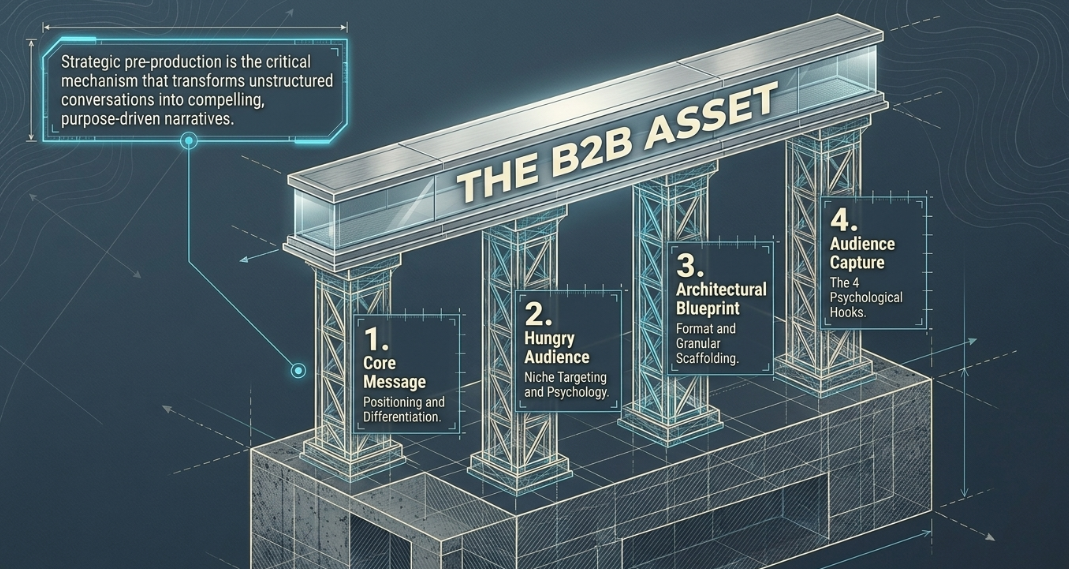
Before a microphone is ever activated, the structural integrity of the show must be established. A sustainable, well-thought-out strategy deployed from day one separates the podcasts that generate measurable return on investment (ROI) and deep audience loyalty from those that quietly disappear into digital obscurity.1 Strategic pre-production functions as the critical mechanism that transforms unstructured conversations into compelling, purpose-driven narratives. It requires brutal honesty regarding why a show exists, exactly whom it is designed to serve, and what unique value it provides to an increasingly discerning audience whose primary reason for abandoning content is a simple loss of interest in the topic or annoyance with repetitive structures.1 This exhaustive report delineates the theoretical frameworks and practical methodologies required to engineer a successful professional podcast from the ground up. By meticulously defining the core message, identifying a highly specific target audience, constructing a resilient episode architecture, and mastering the psychological hooks necessary for audience acquisition, creators can build audio properties with enduring market value.
The Core Message and Strategic Focus
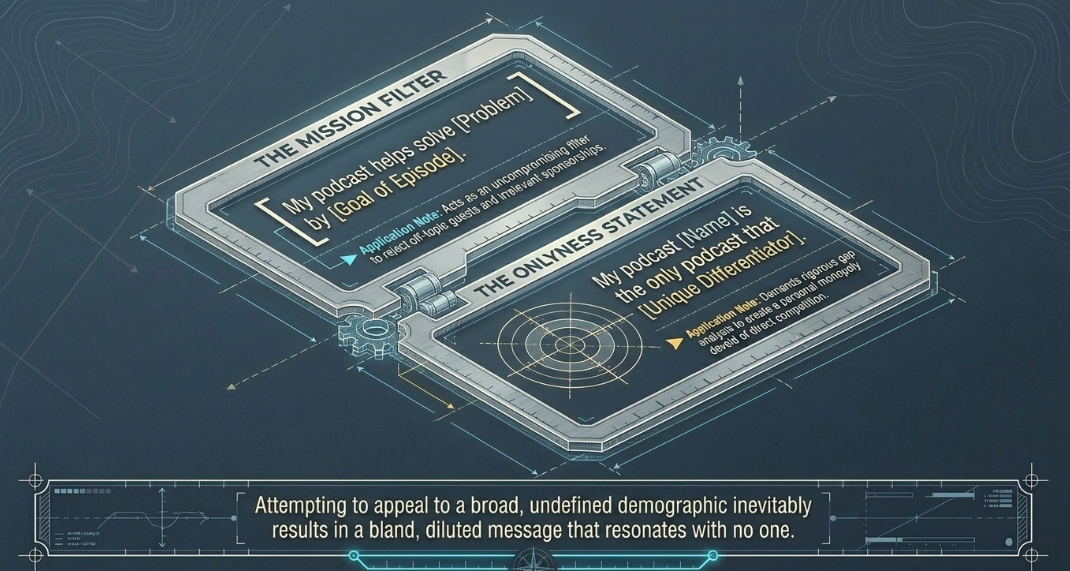
The foundational phase of pre-production—often the most overlooked and rushed element—dictates the trajectory of every subsequent decision in the podcasting lifecycle.1 A podcast cannot succeed as a generalized entity. Attempting to appeal to a broad, undefined demographic inevitably results in a bland, diluted message that resonates with no one.4 To break through the noise of a saturated market, a podcast must establish a sharp strategic focus grounded in a highly specific niche and a crystallized value proposition.1 For example, a generalized focus on "marketing" will immediately be lost in the competitive algorithmic noise, whereas a hyper-focused mandate such as "demand generation for enterprise SaaS" creates immediate relevance for a high-value, intent-driven audience.1 The crystallization of this strategic focus is operationalized through two vital frameworks: the Podcast Mission Statement and the Onlyness Statement.
The Podcast Mission Statement Framework
A robust podcast mission statement serves as the strategic north star for the entire production process, acting as an uncompromising filter for content creation, topic selection, guest outreach, and even sponsorship alignment.5 Without a clearly articulated mission, a podcast risks meandering into irrelevant topics, thereby violating the unwritten contract of value established with the listener and precipitating audience churn. The framework for constructing this statement relies on a specific, three-part formula: “My podcast helps solve by [Goal of Each Episode].”.5
The first component requires the explicit definition of a niche target audience. This intentional narrowing of focus actively repels non-ideal listeners while serving as a powerful magnet for the intended audience, who immediately recognize the content is engineered specifically for their unique professional or personal context.5 Although niching down may seem counterintuitive to creators seeking mass reach, it is the only viable method for establishing initial traction in a crowded marketplace.5 The second component involves identifying a specific problem, roadblock, or aspiration shared by that demographic. This segmentation ensures the show reaches individuals actively seeking solutions, transforming the podcast from passive entertainment into an essential, actionable utility.5 The final component mandates that every piece of produced audio must predictably deliver a solution to the aforementioned problem.5 Whether through expert interviews, panel discussions, or solo educational lessons, the episode's structural goal must align with overcoming the listener's specific friction point.5
Examples of this framework in practice illustrate its efficacy in the B2B sector. A show such as B2B Marketers on a Mission operates on the premise of helping marketers and marketing teams (the Target Audience) become a revenue-generating part of their organizations (The Problem) by interviewing top-level marketing experts who have successfully accomplished this feat (Goal of Each Episode).5 Similarly, Finding Focus assists stressed-out B2B marketers who suffer from workload overwhelm (the Target Audience and Problem) by exploring how successful business leaders prioritize tasks in a noisy world (Goal of Each Episode).5 By utilizing this mission statement as a filter, producers can confidently reject prominent guests or lucrative sponsors if their underlying product or expertise does not directly serve the specific problem outlined in the show's foundational thesis.5 Furthermore, a well-crafted mission statement provides internal motivation and persistence for the production team, ensuring that the content remains consistent in tone and approach even during the challenging early days of audience growth.
The Onlyness Statement and Brand Commitment
While the mission statement defines the internal operational compass and topical boundaries, the Onlyness Statement defines the show's external market positioning. Conceptualized by global brand strategist Marty Neumeier in his foundational work Zag, the Onlyness Statement demands that creators identify exactly what makes their entity entirely unique within a competitive matrix.8 The formula is deceptively simple but incredibly challenging to execute: “My podcast [name of the show] is the only podcast that [unique differentiator].”.9
Defining the "only" forces producers to conduct rigorous gap analysis. It requires examining the competitive landscape to understand how other shows are positioned and actively choosing to occupy a different conceptual space.9 Differentiation in podcasting is not an accident; it is an active, strategic decision. This might involve a unique intersection of topics, an unorthodox production format, or a distinct tonal approach that contrasts with the industry standard.9 For instance, if every real estate podcast focuses on the financial mechanics of flipping houses, an Onlyness Statement might dictate that a new show is the only real estate podcast that explores the psychological toll and family dynamics of high-risk property investment.
The Onlyness Statement operates as the pinnacle of Neumeier's broader Brand Commitment Matrix, which aligns a company's deep-seated values and overarching aims with its market differentiation.10 When a podcast aligns its core beliefs with a unique delivery mechanism, it creates a "personal monopoly"—a concept where the creator becomes so uniquely positioned that they effectively eliminate direct competition.9 A well-crafted Onlyness Statement provides a cognitive shortcut for the audience, allowing them to immediately categorize the show and understand exactly why it deserves their limited attention bandwidth over established, legacy alternatives.
Nomenclature, Branding, and B2B Profitability Alignment
The manifestation of the core message extends directly into the nomenclature and visual branding of the show. Naming a podcast is not merely a creative exercise; it is a foundational search engine optimization (SEO) lever and a critical determinant of algorithmic discoverability.2 Naming protocols should prioritize a balance between descriptive clarity and memorable branding, as descriptive names (e.g., "Customer Retention Insights") capture high-intent search traffic, while memorable hooks facilitate word-of-mouth growth.1 Strategic naming formulas often utilize exact keyword integration, such as ": The [Niche] Podcast" or leverage alliteration to enhance cognitive recall.2 During this phase, producers must conduct extensive trademark searches, utilize web scraping proxies to check domain availability, and cross-reference major directories like Apple Podcasts and Spotify to ensure the chosen name is both legally viable and algorithmically distinct.2 Additionally, professional visual branding—including high-quality cover art and graphic templates for social media syndication—is non-negotiable, as amateur aesthetics immediately erode the show's credibility and deter high-profile guests from participating.2
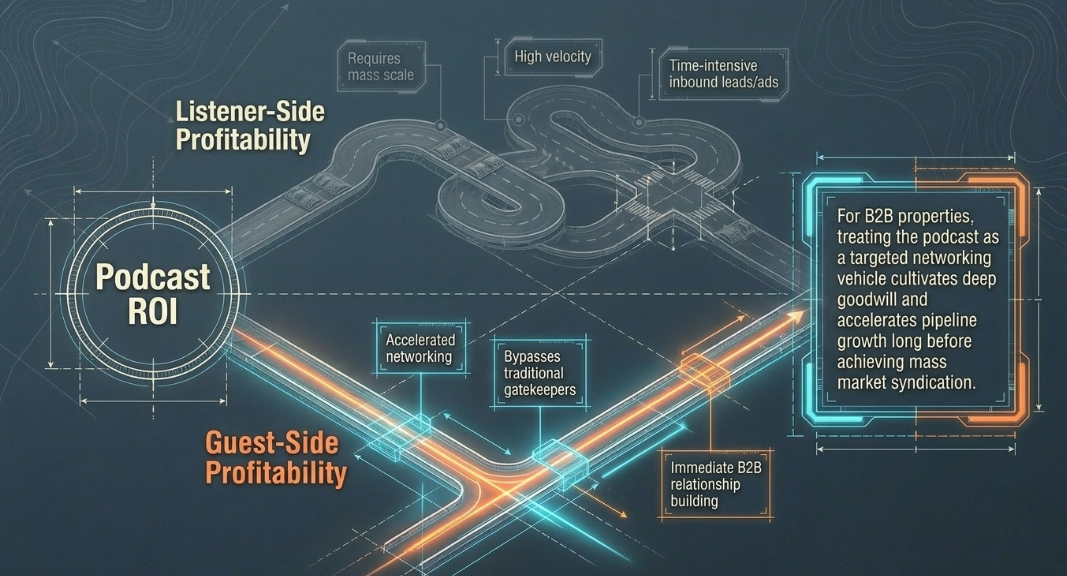
Crucially, the strategic focus established during pre-production must align with measurable business outcomes and a defined profitability model.2 For B2B podcasts, ROI is frequently realized through two distinct channels: the "listener side" and the "guest side".2 Listener-side profitability relies on building a massive audience to generate inbound leads or secure traditional advertising revenue, a process that requires significant time, capital, and sustained marketing velocity. Conversely, guest-side profitability offers an accelerated path to ROI.2 By strategically utilizing the podcast as a networking vehicle, producers can invite high-value targets—such as prospective clients, strategic partners, or industry influencers—onto the show.2 The interview format bypasses traditional gatekeepers, providing an hour of dedicated, intimate conversation with a key decision-maker.2 Providing the guest with an exceptional production experience, high-quality audio assets, and a platform to share their expertise cultivates deep goodwill, rapidly accelerating pipeline growth and establishing direct relationships long before the show achieves mass market syndication.
Identifying and Targeting a Hungry Audience
A compelling message holds no intrinsic value if it does not reach an audience intrinsically motivated to consume it. The phrase "hungry audience" refers to a specific demographic experiencing an acute, unresolved pain point, a widening knowledge gap, or a deep desire for specialized information.11 In periods of rapid technological advancement, economic shifting, and market uncertainty, audiences actively seek out specialized knowledge consumption to maintain a competitive professional edge, alleviate anxiety, or master complex new paradigms.12 Identifying and capturing this specific subset of listeners requires moving beyond intuition, deploying rigorous empirical research, and constructing dynamic, multi-dimensional audience personas.
Market Gap Analysis and the Underserved Niche
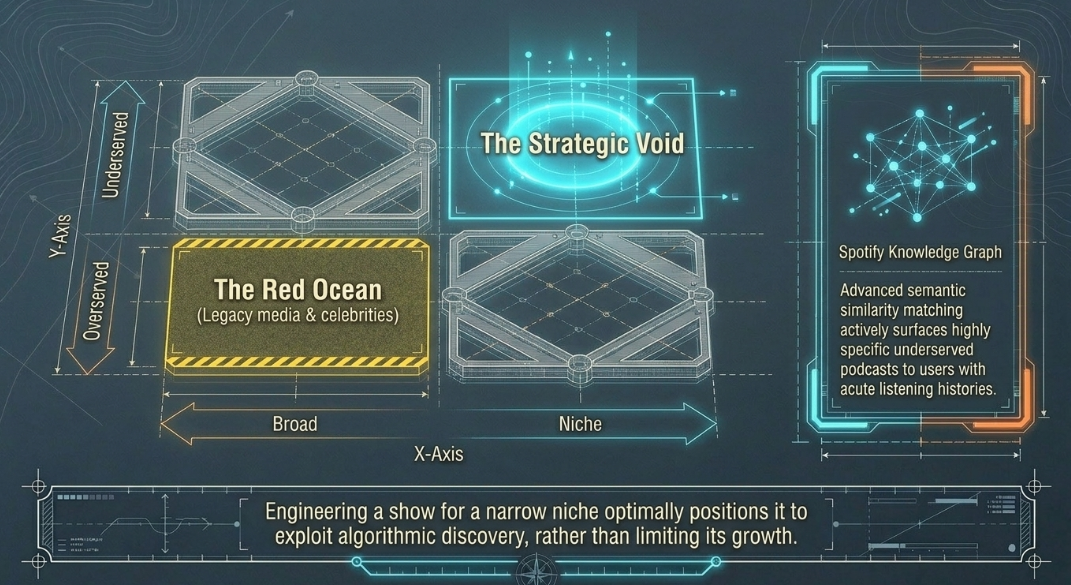
The most reliable pathway to rapid podcast growth is the identification and exploitation of an underserved niche.4 Attempting to compete in broadly defined categories places new, independent podcasts in direct competition with heavily capitalized legacy media organizations and celebrity-driven vehicles. Conversely, an underserved niche allows a creator to build a highly engaged community where the audience feels deeply understood and intimately catered to.9
Advanced data science within digital audio platforms supports the efficacy of this strategy. Empirical research conducted by Spotify on "underserved podcasts"—defined as highly specific shows that are typically difficult for broad recommendation algorithms to surface effectively—reveals that these properties possess massive latent growth potential if matched correctly with their ideal listeners.14 By leveraging advanced semantic similarity matching and comprehensive Knowledge Graphs, platforms are increasingly capable of connecting underserved podcasts with users whose highly specific listening histories indicate a strong affinity for niche content.14 Therefore, engineering a show for a narrow, hungry niche does not limit growth; rather, it optimally positions the podcast to benefit from the evolving architecture of algorithmic discovery on major syndication platforms.14
Furthermore, identifying a hungry audience requires understanding cross-platform behavioral synergies. For instance, data from The Media Audit indicates a strong correlation between affluent newspaper readership and heavy podcast consumption.15 Consumers who regularly read newspapers are highly likely to listen to podcasts daily, with demographics earning over $100,000 annually indexing at 118 and higher for dual consumption.15 College graduates and those with advanced degrees index between 115 and 139, suggesting that highly educated, affluent demographics do not view traditional and digital media as competitive, but as complementary sources of deep-dive information.15 Producers can leverage this insight by utilizing high-level, journalism-style research in their podcasts, knowing that their target demographic has the appetite and the attention span for rigorous, intellectual content.
The Architecture of the Audience Persona
Understanding the audience requires transcending superficial demographic data such as age, gender, and location. It necessitates the creation of an Audience Persona—a highly detailed composite representation of the ideal listener based on psychographic data, search behavior, professional anxieties, and content consumption habits.16
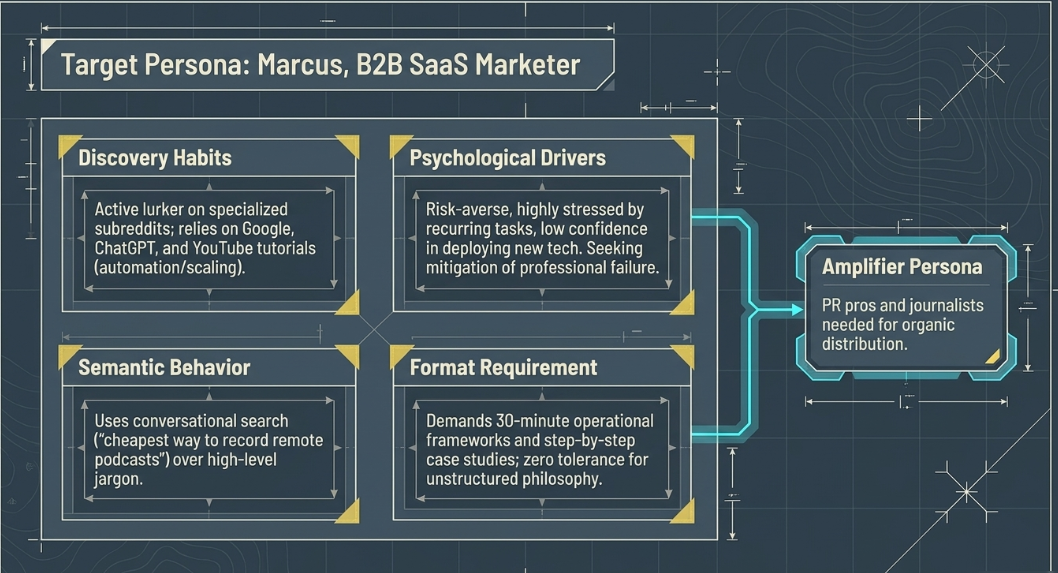
A highly developed persona informs every aspect of the production workflow, from determining the optimal episode pacing to guiding the selection of guest experts. Consider the analytical framework of a highly specific B2B audience persona, utilizing a fictional SaaS industry example named "Marcus" to demonstrate the necessary depth of understanding required during pre-production 18:
This granular level of psychological profiling fundamentally alters the pre-production process. A producer who understands that their core listener is risk-averse, highly stressed, and strapped for time will not produce a two-hour, unstructured philosophical monologue. Instead, they will engineer a tight, 30-minute operational breakdown featuring clear frameworks, actionable takeaways, and immediate utility.18 Furthermore, an audience persona cannot be treated as a static document; it must function as a living thesis that is continuously updated as the audience's sophistication evolves and macroeconomic conditions shift.17
In addition to the core listener, sophisticated pre-production strategies also map an "Amplifier Persona".17 This secondary persona represents the public relations professionals, journalists, complementary brand managers, and industry creators who possess the network and influence to amplify the podcast's content.17 Designing specific segments or supplementary content that appeals to the Amplifier Persona ensures the podcast has a built-in mechanism for organic, high-leverage distribution.
Research Methodologies for Audience Identification
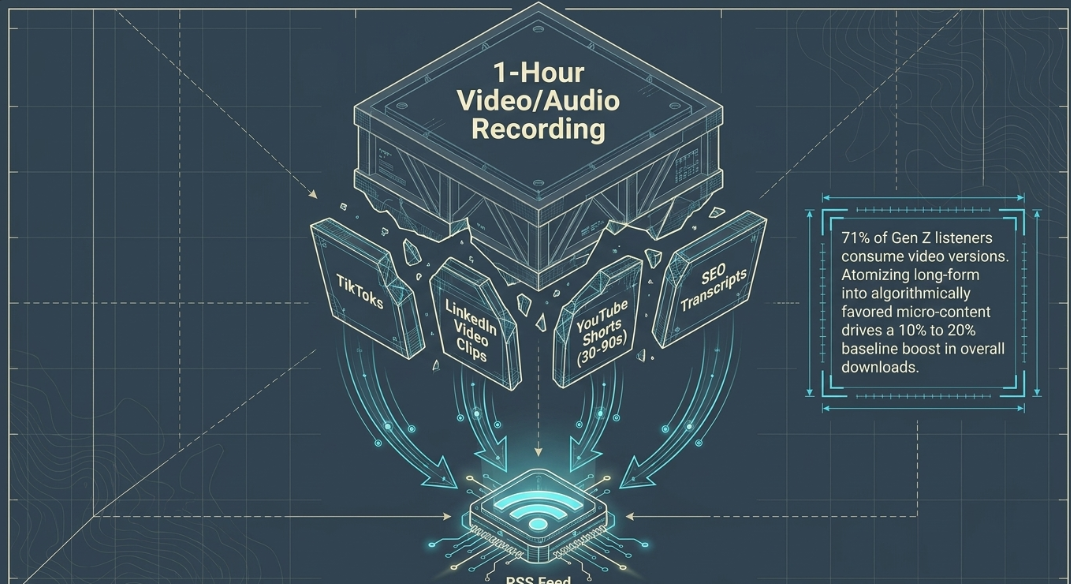
To populate these complex personas with empirical data rather than assumptions, producers must deploy rigorous, multi-tiered research methodologies. This begins with analyzing macro-trends using entities like Edison Research, Statista, or Grand View Research to comprehend overarching consumption habits.11 For example, macro-data reveals that 75% of listeners consume podcasts via smartphones, dictating that audio mixing must be optimized for mobile devices.1 Furthermore, data indicates that 71% of Generation Z listeners ("Zoomers") who consume podcasts regularly also watch the video versions of their chosen shows, driving the industry-wide shift toward "video-first" podcasting strategies.1
Subsequent research must dive into micro-level, qualitative interactions:
Competitor Analysis and Social Listening: Analyzing the reviews, comments, and community engagement of adjacent podcasts reveals immediate content gaps. Negative reviews on a competitor's show provide a direct blueprint for unmet audience needs.21 Engaging directly in niche subreddits, Discord servers, and LinkedIn groups allows producers to observe the exact phraseology and urgent questions of the target demographic.2
Citation Gaps and SEO Analysis: Utilizing advanced SEO tools like Semrush or Voxalyze allows producers to identify "citation gaps"—specific, high-volume questions the target audience is asking online that no established brand is adequately answering.2
Direct Feedback Loops: Establishing surveys, questionnaires, and direct interaction channels allows the production team to gather continuous feedback, ensuring the show remains calibrated to the audience's shifting priorities.21 Understanding exactly why listeners abandon content—such as the 41% who cite a lack of free time, or the 15% who stop due to excessive advertisements—allows producers to proactively engineer formats that respect listener constraints.1
By synthesizing macro-level demographic data with micro-level behavioral insights, the pre-production team guarantees that the podcast is engineered from its inception to satisfy an existing, ravenous market demand.
Architectural Blueprint: Determining the Podcast Format
If the core message serves as the foundational concrete and the audience persona identifies the optimal site location, the podcast format is the architectural blueprint.2 Drawing a parallel to the physical world, just as Frank Lloyd Wright’s iconic 'Fallingwater' utilized specific structural blueprints to harmonize with its environment, a podcast utilizes formatting to harmonize content with the listener's cognitive state.23 In the realm of Information Architecture, a taxonomy structures how data is organized and retrieved; similarly, the podcast format dictates not just what content is delivered, but how it is meticulously packaged, sequenced, and experienced over time.24
The human brain instinctively seeks pattern recognition to reduce cognitive load. Therefore, a highly predictable, structurally sound format allows the listener to relax into the content, thereby increasing cognitive retention, fostering habituation, and building brand loyalty.25 Failing to define a strict structural outline often results in "content sprawl"—meandering, unfocused conversations that disrespect the audience's time, dilute the core message, and accelerate listener drop-off.2 To prevent this structural failure, the producer must select a definitive overarching format, invest in the appropriate physical architecture, and engineer a repeatable segment template.
Typology of Podcast Formats
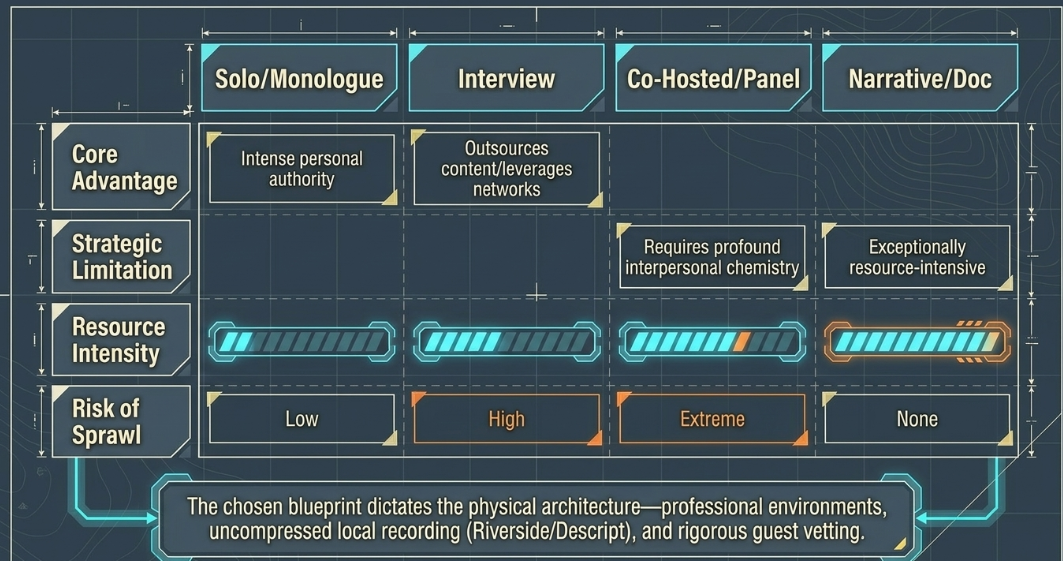
The selection of a format must align flawlessly with the Onlyness Statement, the preferences of the audience persona, and the logistical capabilities of the production team. The primary architectural styles include 20:
Regardless of the chosen format, maintaining consistency is paramount. While early experimentation is acceptable during pilot phases, long-term algorithmic and audience success requires a reliable architectural rhythm that listeners can anticipate and trust.
Physical Architecture and Guest Management
The structural format is highly dependent on the physical architecture of the recording environment. High-quality raw audio saves countless hours in post-production and prevents listener fatigue. Essential equipment includes dynamic or condenser USB microphones (e.g., Blue Yeti or Rode NT-USB+), an audio interface to cancel background noise, pop filters to eliminate plosives, and dedicated headphones to prevent audio bleed.1 The recording environment itself must be optimized; producers should select moderately furnished spaces with soft surfaces (rugs, blankets, acoustic panels) to absorb sound and prevent echoes.1 For remote interviews, relying on standard conferencing software is insufficient due to audio compression and reliance on stable internet connectivity. Professional productions utilize platforms like Riverside or Descript, which record uncompressed audio and video locally on each participant's device before uploading to the cloud, ensuring crystal-clear, multi-track recordings regardless of bandwidth fluctuations.1
Furthermore, interview formats require a highly structured Guest Management System to function smoothly.1 A professional system for managing high-value experts involves rigorous vetting by listening to their previous appearances to gauge clarity and alignment.1 Outreach must be highly personalized—abandoning generic templates for emails that feature a specific compliment, a clear value proposition, and frictionless scheduling links, resulting in a realistic success rate of 10% to 20%.1 Crucially, a "Guest Prep Kit" should be dispatched a week prior to recording, detailing logistical links, technical requirements (mandating headphones and external microphones), an audience profile, and a rough outline of talking points to eliminate uncertainty and prevent robotic, scripted answers.1
The Granular Episode Structure
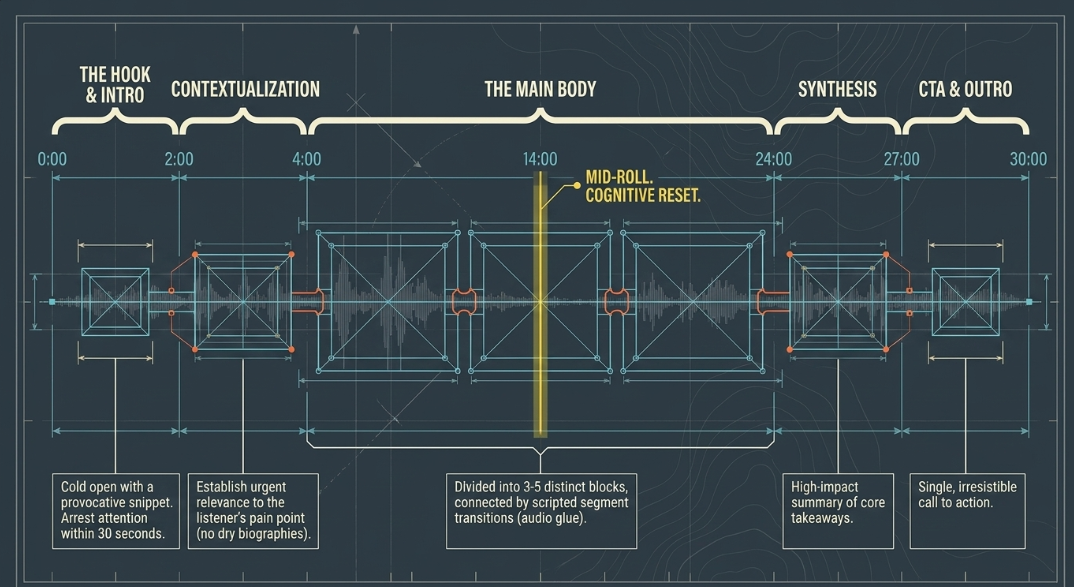
A professional podcast requires a granular outline that maps out the psychological journey of the episode. This outline functions as the episode's skeleton, ensuring the content hits specific emotional and intellectual beats within the allocated timeframe.2 For a standard 30-minute B2B or educational podcast, industry best practices dictate a highly modular, predictable structural breakdown 2:
The Hook and Intro (0:00 - 2:00): The most critical real estate of the episode. This segment must arrest the listener's attention within the first 30 seconds to mitigate immediate drop-off.2 It typically bypasses mundane pleasantries, launching immediately into a shocking statistic, a provocative question, or a compelling audio snippet extracted from the climax of the episode to establish immediate stakes.2 Following this cold open, the host officially welcomes the listener, states the show's name and episode number, and provides a concise thesis of the value they will extract from the upcoming 30 minutes.28
Guest or Topic Contextualization (2:00 - 4:00): This segment rapidly establishes credibility.2 Rather than reading a dry, chronological biography, the host must articulate exactly why this specific topic or guest is urgently relevant to the listener's current professional or personal pain points.2
The Main Body / Core Segments (4:00 - 24:00): The heart of the architecture. To prevent rambling, this section must be subdivided into three to five distinct key discussion areas, questions, or "blocks".2 Each block contains a main point, supporting data or case studies, and a tangible takeaway for the listener.28 Between these blocks, the host must utilize scripted "segment transitions".2 These transitions act as audio glue, briefly summarizing the previous point and effortlessly pivoting to the next, demonstrating expert conversational control and preventing awkward lulls.2
Interlude / Mid-Roll (Optional, 14:00 - 15:00): A natural break utilizing a musical sting or sound effect to reset the listener's attention span. This is commonly used for sponsor messages, dynamic ad insertions, or self-promotional calls to action.28
Concluding Synthesis (24:00 - 27:00): A rapid, high-impact summary of the two to three most vital takeaways from the episode.2 This solidifies cognitive retention, resolves the narrative arc, and ensures the listener walks away feeling they received a high return on their time investment.2
The Call to Action (CTA) and Outro (27:00 - 30:00): A highly focused directive. Rather than overwhelming the listener with multiple requests, a professional blueprint isolates one primary, irresistible action that provides immediate value (e.g., downloading a specific framework or signing up for a targeted newsletter).2 This is followed by a "tease" for the upcoming episode to build anticipation, concluding with official sign-off music and social media handles.2
Scripting vs. Scaffolding
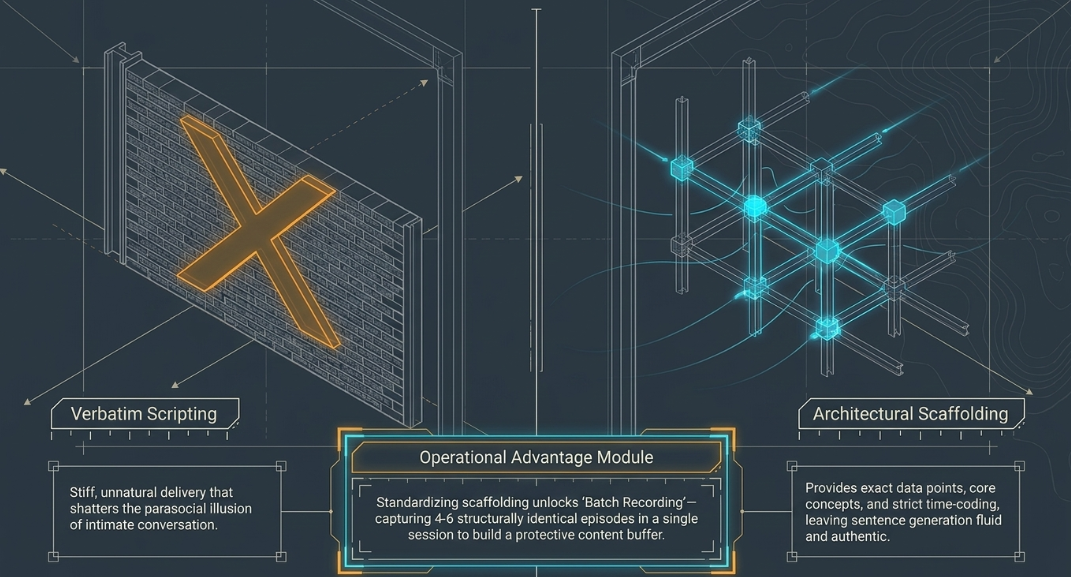
A frequent point of failure in podcast pre-production is the misunderstanding of script utilization. Unless producing a highly edited, heavily stylized narrative documentary, writing a word-for-word script is ultimately detrimental. Reading verbatim inevitably results in a stiff, unnatural vocal delivery that shatters the parasocial illusion of an intimate, spontaneous conversation.1
Instead, producers must rely on the concept of "scaffolding".32 The architectural blueprint provides a robust, detailed outline of core concepts, exact data points, transition phrasing, and strict time-coding.28 This ensures the host knows precisely where the narrative is heading and what psychological beats must be hit, while leaving the actual sentence generation spontaneous, fluid, and authentic.28 By standardizing this architectural scaffolding, the production team unlocks the ability to "batch" content efficiently.1 Recording four to six structurally identical episodes in a single, prolonged session maintains strategic cohesion, drastically reduces technical setup time, and builds a protective content buffer to ensure consistent publishing schedules.1 Furthermore, maintaining this structural discipline allows production teams to leverage AI editing tools efficiently—a practice deemed ethical and acceptable by 85% of podcast listeners—to accelerate the post-production workflow while maintaining creative control over the storytelling.
Communicating the Core Message: The 4 Hooks Framework
Even the most meticulously engineered podcast format, addressing the most urgent needs of a hungry audience with flawless audio fidelity, will fail spectacularly if the initial point of contact does not convert a prospective browser into an active listener. The digital audio ecosystem is an environment of extreme frictionlessness; a listener is always one swipe or tap away from abandoning the content in favor of infinite alternatives.
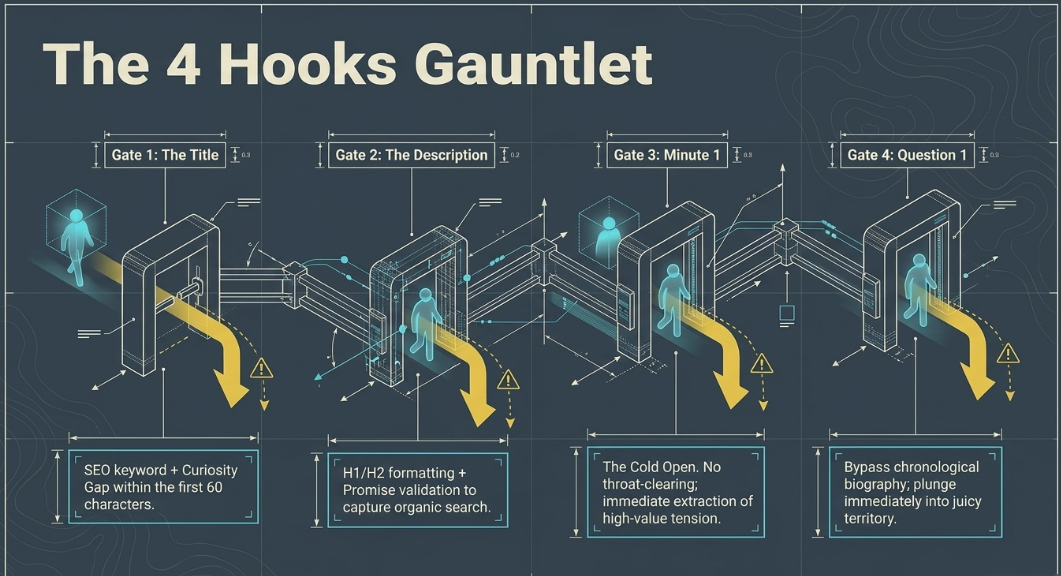
In pre-production, the marketing, packaging, and positioning of an episode must be treated as a psychological gauntlet.34 The success of a podcast ultimately hinges on the creator's ability to master the micro-decisions a potential listener makes during the discovery phase. This is operationalized through the "4 Hooks Framework," a strategic sequence designed to entice the audience at four primary decision points, pulling them progressively deeper into the content funnel until they are fully invested in the narrative.34
Hook 1: The Title
The episode title is the absolute vanguard of the podcast's marketing efforts. It carries the heaviest burden in the 4 Hooks Framework, tasked with two critical, parallel jobs: seizing the browser's attention amidst a sea of digital noise and generating an irresistible curiosity gap that mandates a click-through.34
In the context of the overarching strategy, the title cannot simply be clever or abstract; it must be surgically optimized for both human psychology and search engine algorithms.2 Vague titles (e.g., "Episode 4: A Conversation with John") provide zero intrinsic value to a new listener and completely fail to trigger keyword search parameters on major platforms. Conversely, highly engineered titles seamlessly integrate the audience's specific pain points, the promised solution, and highly searched industry keywords.2 By front-loading the most compelling information within the first 60 characters, the title ensures complete visibility across all mobile podcast directory screens, compelling the user to stop scrolling and evaluate the episode further.2
Hook 2: The Episode Description and Show Notes
Once the optimized title secures the initial click, the prospective listener evaluates the episode description or show notes.34 This second hook serves to logically justify the investment of their time. The description must rapidly build upon the premise of the title, providing necessary context, establishing the credentials of the host or guest, and elevating the stakes of the conversation.34 A masterful description confirms to the "hungry audience" that their specific problem is about to be systematically solved.34
Furthermore, from an SEO perspective, this text acts as a powerful digital storefront. Optimized descriptions place primary and secondary keywords within the first 125 characters, satisfying search engine preview algorithms.2 Advanced pre-production dictates that show notes must be structured similarly to a comprehensive blog post, featuring H1, H2, and H3 subheadings, bulleted key takeaways, and hyperlinked timestamps.2 Incorporating full transcriptions via services like Otter.ai or Rev.com, alongside proper "PodcastEpisode" Schema Markup, allows Google to crawl, index, and rank the content, capturing organic traffic from users who prefer reading or are searching for highly specific answers.
Hook 3: The First Minute
Having pressed play, the listener enters the most precarious phase of audio retention. The vast majority of episode abandonment occurs within the first few seconds of a broadcast.34 The third hook requires that the first minute of audio instantaneously affirms the listener's decision to commit their time.34
This directly correlates with the architectural blueprint's mandate to eliminate meandering pleasantries, throat-clearing, and excessive introductory music. The first minute must feature the tightly engineered "cold open" that pulls the listener straight into the highest-value content or most dramatic tension of the episode.34 By aggressively validating the promise made by the title and description within the first 60 seconds, the producer neutralizes the listener's inherent skepticism and secures their attention for the substantial body of the show.
Hook 4: The First Question
In formats utilizing guests, panels, or co-hosts, the transition from the introductory monologue into the main dialogue represents the final psychological hurdle in the gauntlet. The fourth hook mandates that the very first question posed bypasses chronological biographies, resume reading, or mundane warm-up chatter regarding the weather.34 Instead, the host must plunge the conversation immediately into "juicy territory".34
Starting with a provocative, high-level question establishes an immediate tone of authority, intellectual rigor, and urgent pacing. It signals to the audience that the podcast respects their intelligence and their time, ensuring that the ensuing 30 to 60 minutes will be dense with actionable value rather than superficial exposition.
Expanding the Hooks: The Pillars of Promotion
The 4 Hooks Framework ensures that when a potential listener encounters the podcast, they are converted. However, feeding this funnel requires a robust, systemic promotional strategy integrated into pre-production. Best-in-class B2B agencies, which typically guarantee a 10% month-over-month download growth rate, rely on comprehensive promotional pillars.1 These include Video, Audio, and Written SEO, content syndication across social profiles, leveraging guest networks for shared audiences, participating in niche communities (such as Reddit), and utilizing paid platform advertising.1
Crucially, modern pre-production must adopt a "Video-First" mentality.1 By recording high-quality video alongside audio, producers can "atomize" the long-form content into micro-content, generating 30 to 90-second vertical audiograms and insight-driven video clips.2 Distributing these highly visual, easily consumable assets across YouTube Shorts, TikTok, Instagram Reels, and LinkedIn captures attention in algorithmically favored formats, driving traffic back to the primary audio RSS feed and typically increasing overall downloads and subscribers by 10% to 20%.
Synthesizing Pre-Production for Long-Term Viability
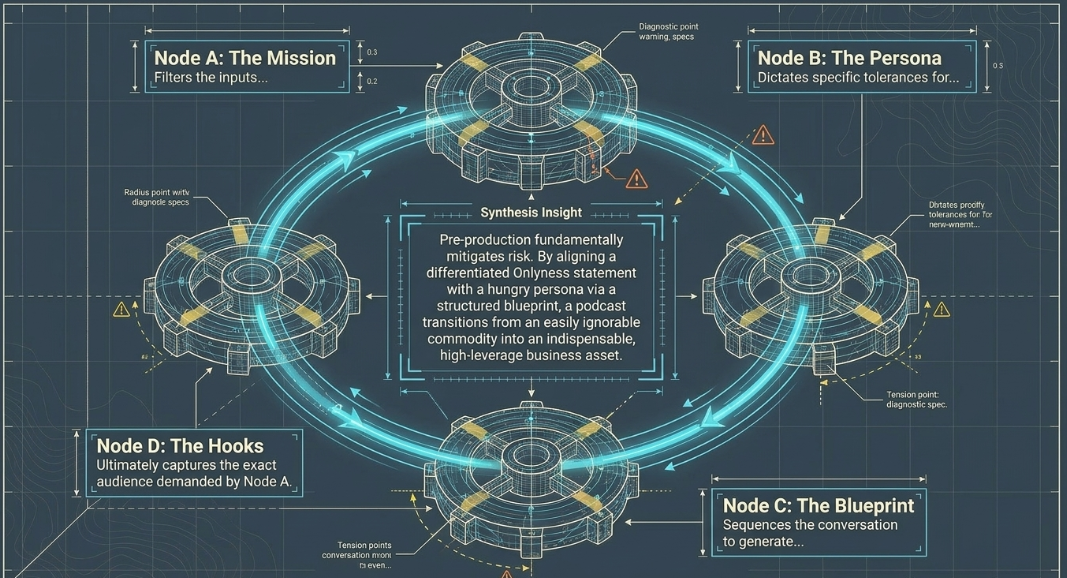
The development of a professional, revenue-generating podcast is fundamentally an exercise in risk mitigation, audience psychology, and value maximization. The alarming rate of "podfade" and high abandonment observed across the digital audio industry is not an inevitability of the medium, nor is it a reflection of an oversaturated market. Rather, it is the direct consequence of creators and corporate entities launching into a highly competitive environment without a comprehensive, strategically rigorous pre-production framework.
When a podcast's architecture is built upon the solid bedrock of a hyper-specific Mission Statement and a clearly differentiated Onlyness Statement, the show inherently knows what it is, and more importantly, what it is not. When this tightly focused core message is directed toward a meticulously researched, data-verified audience persona experiencing an acute professional or personal knowledge gap, the podcast transitions from an easily ignorable commodity into an indispensable, high-leverage resource.
By encasing this strategic alignment within a rigorous, repeatable, and highly structured episode blueprint, the production team minimizes cognitive load for both the creator and the consumer, ensuring consistent delivery of value. Finally, by aggressively packaging and marketing the audio through the psychological sequence of the 4 Hooks Framework—supported by a sophisticated, cross-platform video and SEO syndication strategy—the podcast systematically converts passive scrolling into active, dedicated listenership.
Ultimately, exhaustive strategic pre-production ensures that when the microphone finally goes live, the creator is not merely broadcasting a conversation into the void, hoping for accidental discovery. Instead, they are executing a precise, scalable, and highly engineered strategy designed to cultivate industry authority, drive measurable business outcomes, and achieve sustained dominance within their specific corner of the digital audio landscape.
Works cited
Master Your Podcast Production Workflow | Fame, accessed May 14, 2026, https://www.fame.so/post/podcast-production-workflow
A Winning Outline for Podcast Episodes | Fame, accessed May 14, 2026, https://www.fame.so/post/a-winning-outline-for-podcast-episodes
Podcast Roadmap for Success - PAVILION | DINFOS Online Learning, accessed May 14, 2026, https://pavilion.dinfos.edu/Article/Article/3251297/podcast-roadmap-for-success/
How to Launch a Niche Learning Platform (2026 Guide) - Pinlearn, accessed May 14, 2026, https://pinlearn.com/how-to-launch-a-niche-learning-platform/
Creating a Compelling Podcast Mission Statement, accessed May 14, 2026, https://ringmaster.com/creating-a-compelling-mission-statement-for-your-podcast/
How to Create a Powerful Podcast Mission Statement: Define Your 'Why' in 5 Steps, accessed May 14, 2026, https://thewavepodcasting.com/articles/how-to-write-a-podcast-mission-statement
Defining Your Podcast's Mission Statement - Ringmaster B2B Podcasting, accessed May 14, 2026, https://ringmaster.com/your-podcasts-mission-statement/
Brand Positioning: A Strategic Guide to Help You Stand Out, accessed May 14, 2026, https://freshsparks.com/brand-positioning/
3 Ways to Make Your Podcast Different So It Stands Out and Grows - PodMatch, accessed May 14, 2026, https://podmatch.com/blog/3-ways-to-make-your-podcast-different-so-it-stands-out-and-grows
Marty Neumeier's Brand Commitment Matrix and how it works, accessed May 14, 2026, https://howbrandsarebuilt.com/marty-neumeiers-brand-commitment-matrix-and-how-it-works/
Start a Podcast: Beginner's Guide by PodcastCrew (2025), accessed May 14, 2026, https://podcastcrew.online/how-to-start-a-podcast-for-beginners-a-comprehensive-guide-to-planning-recording-and-growing-your-show/
Digital Content and Campaigns - eMoney Advisor, accessed May 14, 2026, https://emoneyadvisor.com/wp-content/uploads/2021/01/ebook-FinancialAdvisorGuideDigitalContentCampaigns_21.1.6.pdf
The 3 Rules of YouTube Growth w/ Colin & Samir | The Futur™, accessed May 14, 2026, https://thefutur.com/watch/youtube-growth-secrets-colin-samir
Researching how less-streamed podcasts can reach their potential, accessed May 14, 2026, https://research.atspotify.com/researching-how-less-streamed-podcasts-can-reach-their-potential
New data from The Media Audit shows strong overlap between newspaper readers and podcast listeners | Editor and Publisher, accessed May 14, 2026, https://www.editorandpublisher.com/stories/new-data-from-the-media-audit,254021
Developing Audience Personas for Event Marketers: A Comprehensive Guide, accessed May 14, 2026, https://blog.vmgstudios.com/guide-to-developing-audience-personas-for-event-marketers-a-comprehensive-guide
You Don't Need a Buyer Persona. You Need Multiple Audience Personas. - SparkToro, accessed May 14, 2026, https://sparktoro.com/blog/you-dont-need-a-buyer-persona-you-need-multiple-audience-personas/
8 Persona Examples For Creating Ideal Personas | by Userpilot Team - Medium, accessed May 14, 2026, https://userpilot.medium.com/8-persona-examples-for-creating-ideal-personas-8c359d7524c5
How to Build Audience Personas for Modern Search + Template, accessed May 14, 2026, https://backlinko.com/audience-personas
The Complete Podcast Production Guide: From Concept to Launch ..., accessed May 14, 2026, https://www.cueproductions.com/post/the-complete-podcast-production-guide
How to identify and focus on your target audience for podcasts - Idea Sonora, accessed May 14, 2026, https://ideasonora.com/podcast-2/identify-your-target-podcasts/
How to discover and reach your podcast's target audience - Spotify for Creators, accessed May 14, 2026, https://creators.spotify.com/resources/grow/podcast-target-audience
The Frank Lloyd Wright approach to fitting clothes #sewing #sewinghacks #podcast #patternmaking - YouTube, accessed May 14, 2026, https://www.youtube.com/shorts/GtU4EK14zfA
Taxonomy 101: Definition, Best Practices, and How It Complements Other IA Work - NN/G, accessed May 14, 2026, https://www.nngroup.com/articles/taxonomy-101/
Understanding Audio Programme Formats: An Introduction - Journalism University, accessed May 14, 2026, https://journalism.university/audio-podcast/understanding-audio-programme-formats/
Top Podcast Scripts Examples To Captivate Your Audience - Fame.so, accessed May 14, 2026, https://www.fame.so/post/podcast-scripts-examples
Podcast Episode Planner > DINFOS Pavilion > Template, accessed May 14, 2026, https://pavilion.dinfos.edu/Template/Article/3073510/podcast-episode-planner/
5 Unique Podcast Outline Templates to Structure Your Episodes ..., accessed May 14, 2026, https://hubhopper.com/blog/podcast-outline-templates/
Podcast Pre Production - B2B PodcastPros, accessed May 14, 2026, https://b2bpodcastpros.com/podcast-pre-production-597995/
22 Architecture Podcasts to Listen To (A Curated List for 2026), accessed May 14, 2026, https://www.archivinci.com/blogs/architecture-podcasts-list
How to Write a Podcast Script for a High-Impact Show, accessed May 14, 2026, https://flexworkstudios.com/how-to-write-a-podcast-script/
Podcast Structure: How to Create One + Examples and Templates - Riverside, accessed May 14, 2026, https://riverside.com/blog/podcast-structure
How to Write a Podcast Script [8 Free Script Templates] - Buzzsprout, accessed May 14, 2026, https://www.buzzsprout.com/blog/write-podcast-script-examples
The 4 Hooks Framework: The Key to Winning Over New Podcast ..., accessed May 14, 2026, https://podcastmarketingacademy.com/4-hooks-framework/
accessed May 14, 2026, https://podcastmarketingacademy.com/4-hooks-framework/#:~:text=The%204%20Hooks%20Framework%20is,ultimately%20lead%20them%20to%20listening.