Dealing with Background Noise When Recording at Home
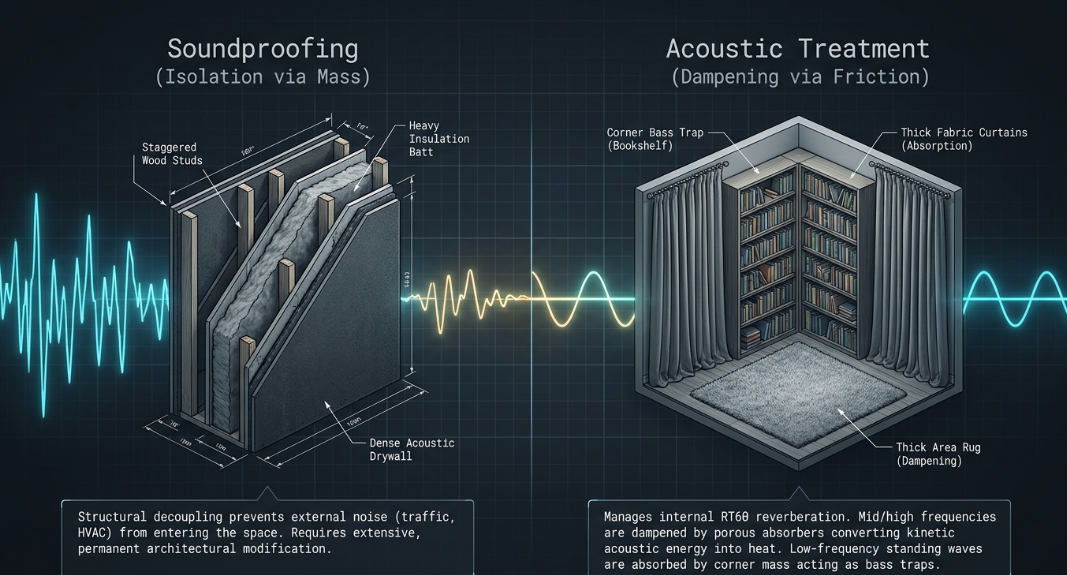
In the discipline of professional audio execution, the foundational fidelity of any recording is inextricably bound to the acoustic characteristics of the tracking environment. For independent podcast productions operating within domestic residential spaces, mitigating background noise and managing room acoustics represent the most significant electroacoustic challenges. A widespread fallacy in audio production is the conflation of "soundproofing" with "acoustic treatment".1 Soundproofing involves structural decoupling and the addition of sheer physical mass to prevent external noise—such as traffic, sirens, or HVAC rumble—from transmitting through walls and floors.1 Highly effective soundproofing often requires extensive architectural modifications, including the installation of staggered stud walls, resilient channels, and door sweeps, which seal the room from external airflow and isolate it from the surrounding environment.1 Conversely, acoustic treatment focuses on managing internal sound wave reflections and flutter echoes within a given space to optimize the captured signal.
The physical realities of standard residential architecture, which typically features parallel drywall surfaces, hardwood floors, and glass windows, naturally result in problematic acoustic anomalies. To address high-frequency reflections and excessive reverberation times (RT60), the deployment of porous absorbers is strictly required. While commercial studios utilize specialized high-density acoustic foam and rigid fiberglass panels, highly effective domestic alternatives can be engineered on a strict budget.2 The strategic installation of thick, dense fabrics, such as heavy curtains, lightweight 100% polyester faux linen, or cotton muslin fabric (available at approximately $12 per yard), can dramatically dampen mid-to-high frequency reflections.2 These porous materials function by converting the kinetic energy of propagating sound waves into trace amounts of heat via friction as the waves penetrate the fibrous matrix.3 However, low-frequency energy behaves differently, tending to accumulate in the structural corners of rectangular rooms due to the formation of room modes and standing waves. Mitigating this low-end buildup requires the addition of bass traps; a structurally dense and cost-effective approach involves placing tall, thin bookshelves filled with dense books across the corners of the room, effectively adding necessary mass to absorb low-frequency nodal accumulations.4 Covering hard floors with thick carpets, rugs, and exercise mats further attenuates unwanted acoustic reverberance.2 Choosing a windowless room is also heavily advised to eliminate the severe acoustic reflections caused by flat glass panes, while simultaneously reducing the ingress of external environmental noise.
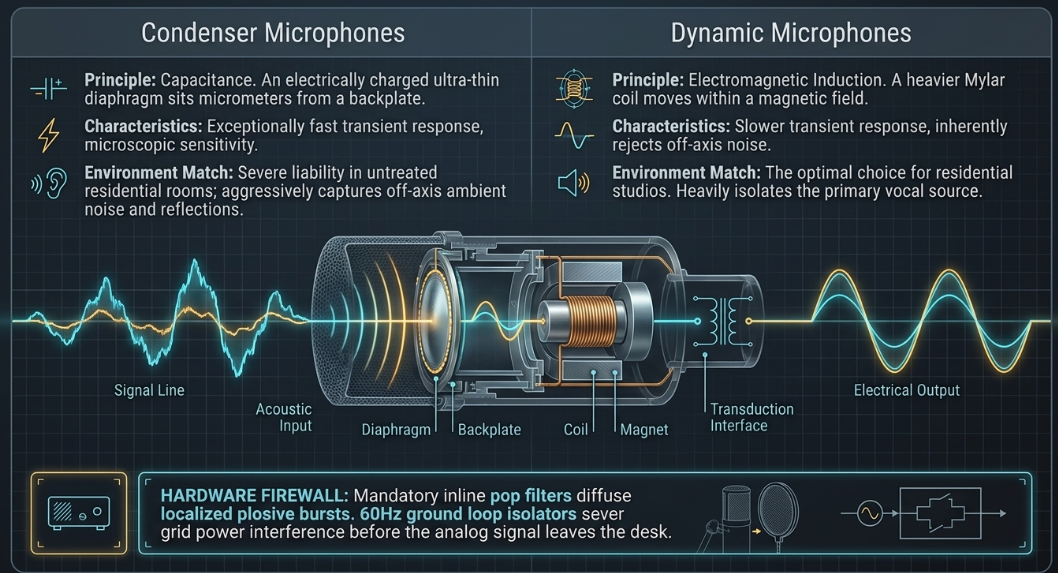
Beyond the physical alteration of the recording space, the architectural topology of the chosen microphone dictates the ultimate success of background noise rejection. Microphones utilized in broadcast applications are predominantly categorized into two fundamental classifications: dynamic and condenser.5 Condenser microphones—such as the LCT 240 PRO or MA50—operate on a highly sensitive capacitance principle.6 They utilize an ultra-thin, electrically charged diaphragm positioned micrometers away from a solid backplate.7 As acoustic waves strike the diaphragm, the distance between the plate and the diaphragm fluctuates, altering the capacitance and generating a proportional electrical voltage.7 This low-mass design yields an exceptionally fast transient response and a remarkably broad frequency range, capturing the finest, most microscopic nuances of the human vocal tract.6 However, this extreme sensitivity functions as a severe liability in untreated residential environments, as the condenser capsule will aggressively and indiscriminately capture unwanted ambient noise, distant computer fans, and harsh room reflections, rendering the audio unprofessional and hollow.6
Conversely, dynamic microphones function via the principle of electromagnetic induction.7 They utilize a heavier, moving Mylar coil attached to the diaphragm, which is suspended within a magnetic field.7 The inherent physical mass of the moving coil results in a slower transient response and significantly lower overall sensitivity compared to condensers.5 As a direct consequence of this design, dynamic microphones naturally reject off-axis ambient noise and exhibit a steep drop-off in proximity sensitivity, making them highly forgiving in untreated, reverberant spaces.5 Furthermore, they perform exceptionally well in environments with high sound pressure levels (SPL) without suffering from capsule distortion.7 For podcasters operating in acoustically compromised home environments, dynamic microphones, particularly industry standards like the Shure SM58 or the broadcast-focused Shure SM7B, are vastly superior choices; their lower sensitivity effectively isolates the primary vocal source and mitigates audio spill when multiple speakers are conversing in the same room.5
Further noise reduction strategies involve refining the immediate physical signal chain. Pop filters—mesh screens placed directly between the vocalist and the microphone capsule—are mandatory hardware for diffusing localized bursts of air pressure that cause low-frequency plosive artifacts (such as harsh "p" and "b" consonants).2 A standard 6-inch round windscreen shield with a stand clip is a minimal expenditure (approximately $5.99) that yields massive clarity improvements.2 Additionally, electrical anomalies, such as constant 60Hz hums or high-pitched buzzing introduced by power grid interference, can be resolved at the hardware level utilizing inline ground loop noise isolators, which break the electrical ground path and cost approximately $10.2 While advanced post-production software employing digital noise gates, parametric equalization (EQ), and algorithmic compression can filter out residual ambient noise, these tools must be viewed as supplementary.3 Software calibration cannot completely replace the physics of acoustic treatment; establishing a pristine, isolated signal at the analog source through proper room dampening and targeted dynamic microphone selection remains the unassailable foundation of high-fidelity podcast production.
When to Record on a Smartphone
The ubiquity and processing power of the modern smartphone have catalyzed a structural paradigm shift in mobile audio recording, offering a highly portable and exceedingly cost-effective alternative to traditional, static studio configurations. Recording a podcast on a smartphone is optimal under several specific logistical parameters: when operating under strict budgetary constraints, when maintaining a demanding travel schedule that precludes the transportation of heavy gear, or when conducting impromptu, on-location journalism where deploying a full multi-track rig is tactically unfeasible.10 The primary operational advantage lies in pure mobility and convenience; the device acts as a self-contained digital audio workstation (DAW) that fits seamlessly in a pocket, drastically lowering the barrier to entry for independent content creation without requiring thousands of dollars in initial hardware capitalization.10
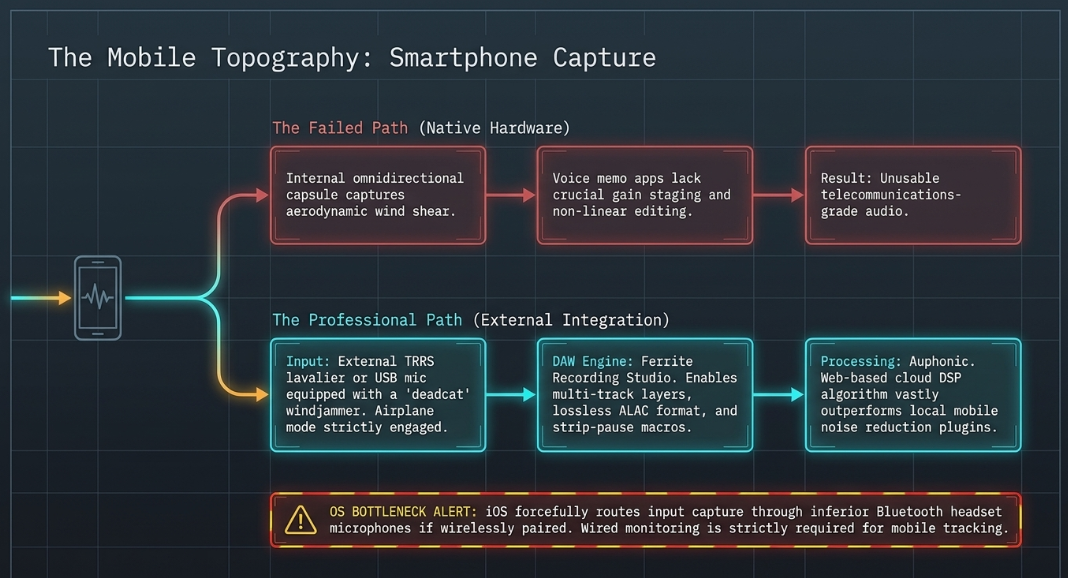
However, relying strictly on the internal hardware topography of a smartphone introduces severe, often fatal, acoustic limitations. The built-in omnidirectional microphones integrated into modern mobile devices are aggressively engineered and equalized for telecommunications and speakerphone utility, not for high-fidelity broadcast audio.10 These internal capsules are highly susceptible to aerodynamic wind shear, percussive handling noise, and broad-spectrum environmental interference, resulting in an unacceptably thin and noisy sonic profile.10 To achieve a professional standard, external hardware integration is absolutely mandatory. Routing a dedicated external USB condenser microphone, such as a Blue Snowball, or utilizing a high-quality TRRS lavalier microphone directly into the smartphone's input port vastly elevates the initial signal quality, bringing it closer to studio specifications.10 When executing recordings outdoors or in unpredictable environments, specialized acoustic windshields—often referred to in the industry as "deadcats" or windjammers—must be applied to the external microphone to physically suppress wind shear and prevent low-frequency aerodynamic rumble from overloading the capsule.
The software ecosystem surrounding mobile podcasting requires strategic navigation to maximize fidelity and workflow efficiency. While standard, pre-installed voice memo applications (such as Apple Voice Memos or the Android Recorder app) are functional for dictation, they entirely lack the multi-track capabilities, gain staging, and editing resolution required for complex podcast production.13 Professional-grade iOS applications, such as Anchor, Spreaker Studio, and notably Ferrite Recording Studio, offer robust, multi-layered functionality that mimics desktop-class DAWs.12 Ferrite, for example, is recognized as a full-featured podcast production platform rather than a pared-down mobile application.12 It allows audio engineers to record directly into the application utilizing lossless formats like ALAC (Apple Lossless Audio Codec) or lossy formats like AAC (Advanced Audio Coding) if local device storage constraints are a primary concern.12 Furthermore, Ferrite provides highly advanced post-production editing features, including "strip pauses" algorithms that automatically detect and truncate silence, followed by "tighten" macros to close the resulting gaps in the audio timeline.12 For power users, the application supports comprehensive multi-track editing capabilities driven by customizable external keyboard shortcuts and precise Apple Pencil gestures, allowing for rapid ripple deletes and track manipulation.12
Despite these impressive software advancements, mobile operating system constraints present unique, frustrating bottlenecks for the professional workflow. For instance, the iOS architecture lacks the native user interface capability to manually select specific, discrete audio input and output devices within third-party applications.12 If a wireless Bluetooth headset is connected to the device for monitoring purposes, the operating system forcefully defaults to the headset's inferior, low-bitrate microphone for input capture.12 To route audio from a higher-quality USB microphone into Ferrite, the user must physically disconnect or unpair the wireless headset, a workflow limitation that complicates real-time monitoring.12 Furthermore, mobile recordings executed in untamed environments often require intensive post-production cleanup due to unpredictable acoustic noise. While third-party noise-reduction plugins like Brusfri exist, running them directly inside mobile DAWs like Ferrite can occasionally cause odd audio peaking and track instability.12 Consequently, cloud-based digital signal processing (DSP) solutions have become indispensable. Web-based platforms such as Auphonic provide highly sophisticated algorithmic noise reduction, automated leveling, and loudness normalization that far exceed the processing power of local mobile plugins, successfully rescuing audio compromised by severe environmental noise (such as an active apartment heating system) that traditional gates cannot handle.14 Finally, recording on a mobile device actively connected to cellular networks introduces the extreme risk of radio frequency (RF) interference bleeding into the audio path, alongside the threat of digital notification sounds interrupting a take; therefore, enabling "airplane mode" is a mandatory procedural step prior to rolling any audio on a smartphone.
Audio Interface: The Analog to Digital Connection
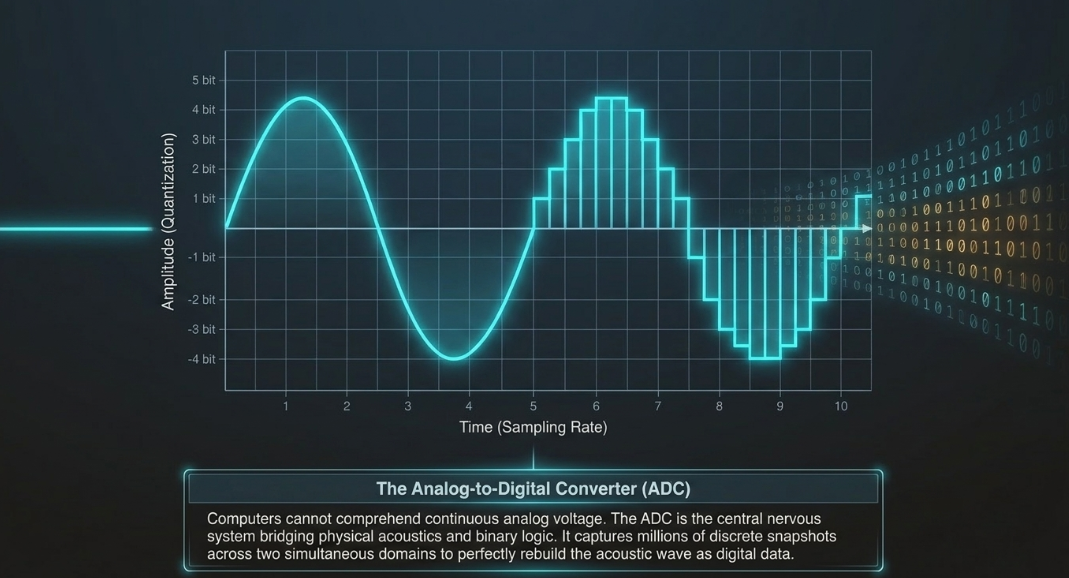
To successfully transition captured audio from the physical, acoustic realm into the digital domain of a host computer, a complex intermediary conversion process is required. This is the primary and indispensable function of the audio interface, serving as the central nervous system of any modern podcast studio. The core of this mechanism is the Analog-to-Digital Converter (ADC).15 When a podcast host speaks into a microphone, the acoustic pressure waves are transduced by the microphone's internal capsule into a continuous, variable analog electrical voltage.16 Computers, however, possess no capacity to interpret continuous analog waveforms; they operate strictly on discrete binary logic consisting solely of 1s and 0s.16 The ADC bridges this fundamental technological gap through two simultaneous, mathematically rigorous processes: sampling and quantization.17
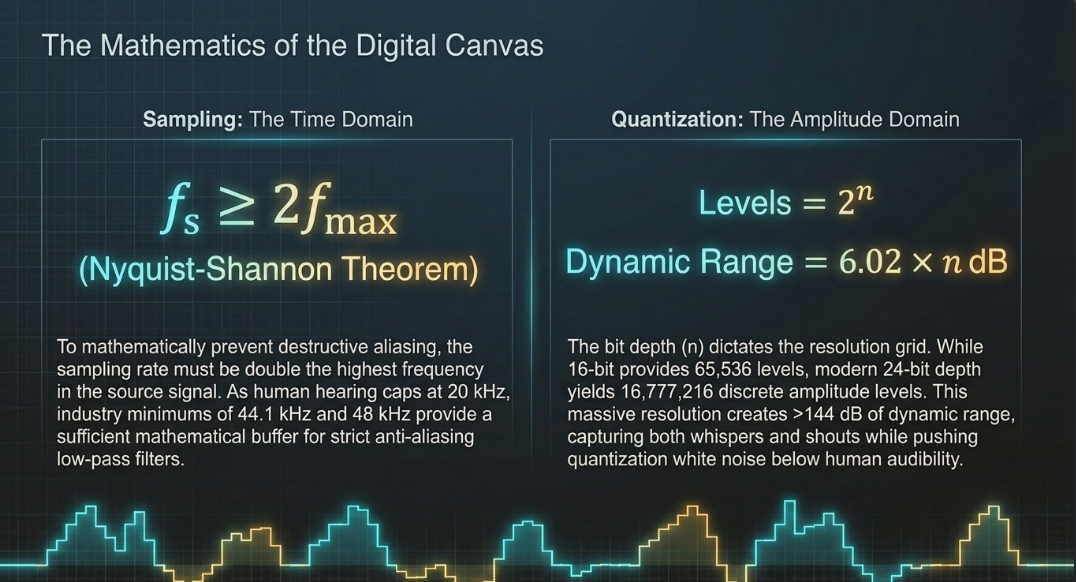
Sampling operates strictly within the time domain. The ADC measures the amplitude of the incoming analog voltage at highly precise, regular, and rapid intervals.17 The frequency at which these individual measurements (samples) are taken is defined as the sample rate, expressed in Hertz (Hz) or kilohertz (kHz).19 The mathematical foundation governing this process is the Nyquist-Shannon sampling theorem, a bedrock principle of digital signal processing. The theorem dictates that in order to accurately capture and subsequently reconstruct an analog signal without introducing destructive aliasing artifacts, the sampling rate must be strictly set to at least twice the highest frequency present in the source signal (
Following the extraction of discrete samples in the time domain, the signal must be mathematically approximated in the amplitude domain via the process of quantization.15 During quantization, the continuous, infinite amplitude range of the analog voltage wave is mapped to the nearest available discrete digital value on a predetermined, fixed scale.15 The granularity and resolution of this scale are determined entirely by the system's bit depth, also known as quantization resolution.15 In a binary computing system, the total number of available discrete amplitude levels is calculated exponentially as 

The precision of this quantization directly correlates to the audio system's theoretical dynamic range and signal-to-noise ratio (SNR). The mathematical relationship dictates that each bit of depth provides approximately 6.02 dB of dynamic range, modeled precisely by the equation 

Inputs and Outputs
The physical architecture and connectivity topography of an audio interface determine its routing flexibility, operational capacity, and compatibility within a diverse podcasting configuration. The analog input stage typically features highly versatile combination jacks (Combo Locking XLR / 1/4-inch TRS), allowing sound engineers to connect professional balanced XLR microphones, line-level outboard gear, or unbalanced instrument cables into the same physical port seamlessly.20 Modern interfaces are internally equipped with onboard preamplifiers, a critical analog component designed to take the microscopic, millivolt signal generated by a dynamic or condenser microphone (mic level) and transparently boost it to a standardized, robust operating voltage (line level) before it reaches the ADC.18 Furthermore, these input stages must be capable of supplying +48V phantom power, a direct current (DC) voltage transmitted backward through the XLR cable, which is strictly necessary to polarize the capacitive diaphragm and power the internal active circuitry of condenser microphones.23
On the digital output side, the data pipeline from the interface to the host computer is predominantly governed by the Universal Serial Bus (USB) protocol standard.18 The evolution of USB physical topographies—from the bulky USB-A and square USB-B connectors to the contemporary, ubiquitous USB-C—has standardized connectivity and power delivery across various computing hardware ecosystems.24 USB-C provides distinct mechanical and electrical advantages. Mechanically, its rotationally symmetrical design completely eliminates user error and port damage during connection, while its highly compact footprint allows manufacturers to radically miniaturize interface chassis for mobile deployment.25
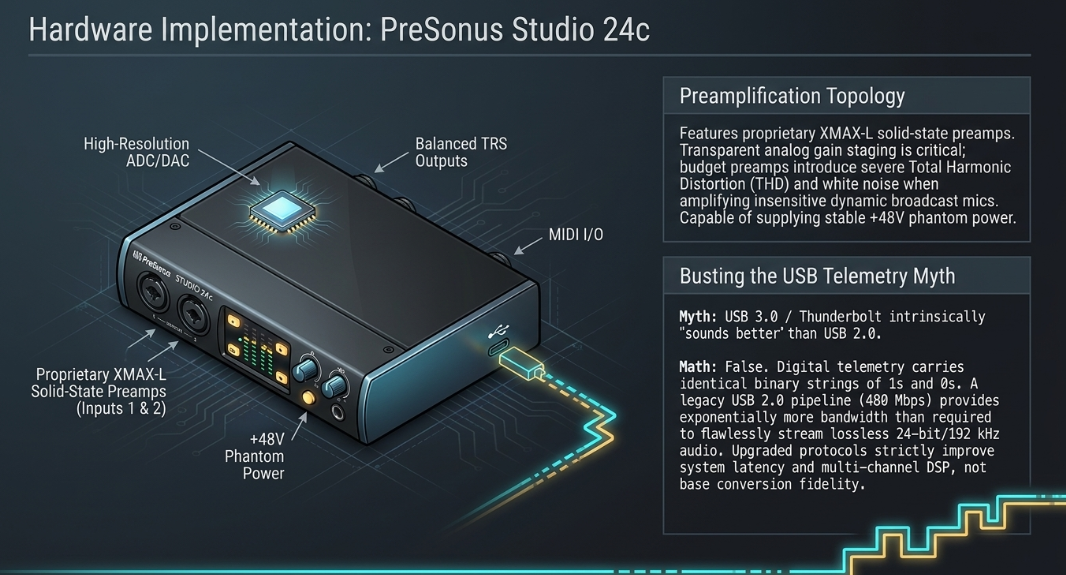
A pervasive and persistent misconception in digital audio production is the belief that the generation of the USB protocol itself (e.g., USB 2.0 versus USB 3.0, USB 4, or Thunderbolt) intrinsically affects the sonic quality or fidelity of the recorded audio. Mathematical analysis of digital telemetry demonstrates that this is entirely false.25 Digital transmission protocols carry identical binary data streams—strings of 1s and 0s. As long as the pipeline's bandwidth is sufficient to transport the data stream reliably without dropping packets, the audio quality remains utterly pristine, lossless, and identical across all formats.26 A standard, legacy USB 2.0 connection, operating at a transfer rate of 480 Mbps, possesses vastly more bandwidth than is mathematically required to simultaneously stream dozens of channels of high-resolution 24-bit/192 kHz audio.25 This is precisely why industry-leading interface manufacturers, such as Focusrite, often retain the highly stable USB 2.0 protocol for their mid-tier devices.26 The true determinants of audio fidelity reside entirely in the analog domain (the quality of the microphone capsule and the transparency of the preamplifier) and the precision of the AD/DA converter chips, not the digital data transfer speed.26
However, the chosen protocol heavily impacts system latency, power delivery, and extreme channel count capabilities. Advanced professional interfaces utilizing Thunderbolt architecture benefit from direct, low-level access to the host computer's PCIe lanes.26 This massive bandwidth enables ultra-low latency processing and allows engineers to run complex, real-time digital signal processing (DSP) plugins—such as emulations of vintage analog compressors and equalizers found in the Universal Audio Apollo series—directly on the interface's internal chips without taxing the host CPU.26 For the standard, independent podcasting setup, which typically consists of two to four microphones recording simultaneously, a USB-C interface operating on the USB 2.0 protocol provides optimal stability, sufficient power delivery for bus-powered operation, and flawless audio fidelity without the exorbitant cost associated with Thunderbolt arrays.
The Audio Quality of the Presonus Studio 24c
Evaluating a specific hardware iteration provides necessary context for these theoretical principles. The PreSonus Studio 24c serves as a representative benchmark model of modern, high-fidelity compact audio interfaces explicitly engineered for podcasters, solo content creators, and mobile producers.20 It is a 2-in/2-out, fully bus-powered device featuring a USB-C connection, securely housed within a rugged, 180x144x44mm full-metal chassis designed to withstand the rigors of mobile tracking and location recording.20
The sonic character and overall fidelity of the Studio 24c are primarily defined by its analog input stage, which utilizes proprietary PreSonus XMAX-L solid-state microphone preamplifiers.20 Preamplifier design is a critical distinguishing factor in interface quality; lower-tier, budget preamps frequently introduce severe self-noise (a highly audible, high-frequency electronic hiss) and total harmonic distortion (THD) when the gain potentiometer is pushed past 70% to accommodate insensitive dynamic broadcast microphones like the Shure SM7B.6 The XMAX-L preamps are engineered to deliver clean, highly transparent gain structures with an extended headroom capacity, ensuring that the source audio remains uncolored, punchy, and free of white noise even when driven hard.23 User testing and acoustic data indicate that the XMAX-L preamps provide a significantly quieter noise floor and more dynamic headroom compared to entry-level alternatives, such as the older PreSonus AudioBox 96 or standard Behringer UM2 units, rendering the Studio 24c a distinct mathematical upgrade for pristine voice capture.29
Following the critical analog preamplification stage, the Studio 24c relies on high-grade digital conversion architecture. The internal ADC and DAC components support a maximum 24-bit resolution and offer highly variable sampling rates of 44.1, 48, 88.2, 96, 176.4, and up to an extreme 192 kHz.20 Operating at a 24-bit depth guarantees the aforementioned massive theoretical dynamic range, capturing nuances with profound mathematical precision and completely preventing digital truncation distortion at very low amplitudes.15 While the final delivery format for a commercial podcast is ultimately down-sampled (typically rendered as a 16-bit/44.1 kHz mp3 or AAC file for efficient streaming), capturing the source audio at an elevated 24-bit/96 kHz or 192 kHz ensures maximum malleability during the post-production phase.20 This high-resolution capture provides the digital headroom necessary to apply aggressive equalization and heavy compression without causing the accumulation of quantization errors or aliasing artifacts across the mixbus, resulting in a cleaner final product.16 When compared to direct competitors in its price bracket—such as the Focusrite Scarlett series, Audient Evo 4, SSL 2, and MOTU M2—the Studio 24c offers a highly competitive blend of transparent conversion, robust build quality, and pristine preamplification.
Latency
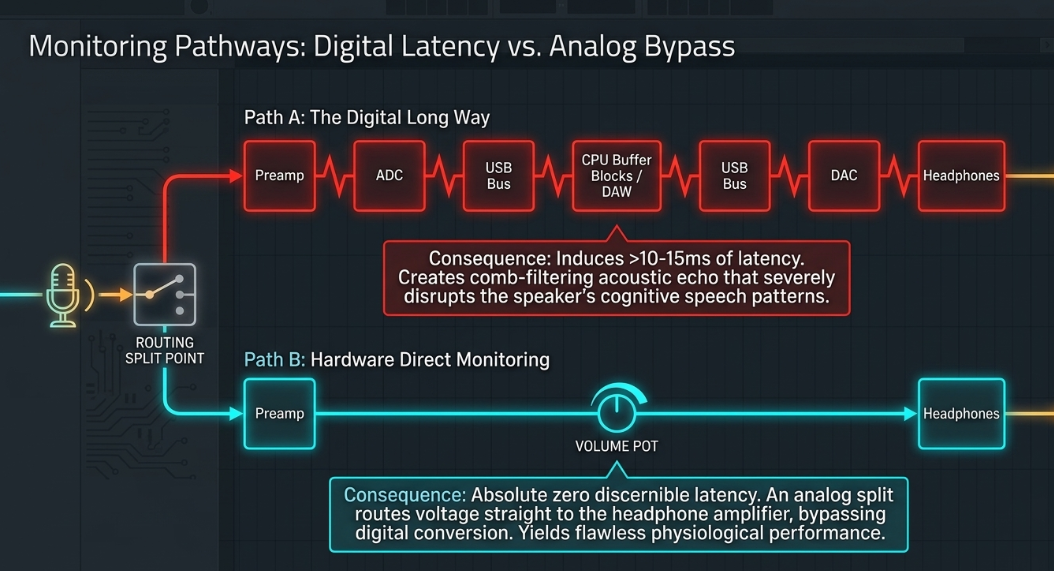
In the context of digital audio production, latency is defined as the temporal delay between the precise moment an acoustic sound enters the microphone capsule and the moment that identical sound is played back through the monitoring headphones after successfully navigating the entire digital signal path.19 In standard, native digital audio architectures, this delay is induced cumulatively by the interface's Analog-to-Digital conversion, the transmission of data over the USB bus, the host computer's CPU processing the data through designated input/output buffer blocks, and finally, the Digital-to-Analog conversion returning the signal to the physical realm.19 If a podcast host attempts to monitor their own voice with a round-trip latency exceeding roughly 10 to 15 milliseconds, the delay creates a highly disorienting comb-filtering echo effect. This psychoacoustic anomaly severely disrupts normal cognitive speech patterns, often causing the speaker to stutter, slur, or entirely lose their train of thought during a recording.26
To cleanly circumvent this physiological and technological bottleneck, interfaces like the PreSonus Studio 24c deploy a highly effective hardware-based solution known as low-latency direct input monitoring.20 The unit features a dedicated, physical "Mixer" potentiometer knob on the front panel.20 This analog control mechanism splits the incoming microphone signal immediately after it passes through the analog preamplifier stage, routing a direct, pure copy of the analog voltage straight to the headphone amplifier circuit, while simultaneously sending the digitized signal through the USB port to the computer for recording.20 By entirely bypassing the ADC/DAC conversions, the USB data bus, and the computer's CPU buffer blocks, direct monitoring allows the podcast host to hear themselves in real-time with absolute zero discernible latency.20 This ensures a seamless, comfortable, and natural vocal performance regardless of the host computer's processing constraints or the size of the software buffer. The only minor trade-off of hardware direct monitoring is that the host cannot hear software-based DAW effects (such as digital reverb or compression plugins) applied to their voice in real-time, as the monitoring path intercepts the audio before it reaches the computer.
Other Considerations
Beyond the core acoustic parameters of preamplification and AD/DA conversion, several critical peripheral factors govern the selection, deployment, and long-term utility of an audio interface within a podcasting pipeline. Professional interfaces routinely function as comprehensive, centralized production hubs. The PreSonus Studio 24c, for example, integrates legacy, dual 5-pin female DIN MIDI In/Out connectivity directly into its rear panel.20 While standard dialogue podcasting relies strictly on microphone audio, the inclusion of MIDI architecture (Musical Instrument Digital Interface) allows producers to interface external hardware synthesizers, drum machines, or MIDI control surfaces directly into the DAW without requiring the purchase of a supplementary, standalone USB MIDI peripheral, which is a rare and highly valued inclusion at this specific price point.20
Power delivery mechanisms also heavily dictate hardware stability and deployment flexibility. The Studio 24c is entirely reliant on USB bus power, meaning it draws its operational voltage directly from the host computer rather than an external AC wall adapter.20 While highly convenient for mobile, laptop-based setups and field recordings, bus-powered devices are inextricably reliant on the host computer's motherboard to deliver consistent, uninterrupted voltage.20 If the interface is connected via cheap, unpowered USB-A hubs alongside other high-draw peripherals (like external hard drives), voltage sags can induce catastrophic digital audio dropouts or severely compromise the steady +48V phantom power delivery required to keep condenser microphones functioning correctly.23 It is strictly recommended to connect bus-powered interfaces directly to the host machine's primary USB-C ports.20
Visual feedback systems built into the physical hardware chassis provide critical operational safety nets for the engineer. Interfaces featuring distinct ladder-style LED level meters—such as the highly visible 4-segment LEDs (2 for input, 2 for main output) found on the Studio 24c—allow the producer to visually monitor input gain staging and output levels in real-time.20 This immediate visual feedback is vital for instantly identifying clipping and preventing the ADC from overloading before a recording is ruined, a feature often omitted on budget interfaces that rely solely on a single clipping light.20 Finally, hardware acquisitions are increasingly augmented by highly valuable bundled software ecosystems. Units like the Studio 24c package proprietary DAWs (such as a license for Studio One Artist) and high-end plugin suites (including a 6-month trial for Fender Studio Pro), providing a comprehensive, out-of-the-box post-production solution that effectively eliminates the need for further immediate software expenditures by the podcaster.
Portable Recorders
While computer-tethered audio interfaces represent the uncompromising standard for fixed, controlled studio environments, portable audio recorders have secured an indispensable, specialized role in field recording, mobile journalism, and on-location podcast production.31 These highly specialized devices function as entirely autonomous, miniaturized digital audio workstations. They integrate internal microphone arrays, professional-grade microphone preamplifiers, high-resolution AD/DA converters, and digital storage mechanisms into a single, compact, battery-powered chassis.31
The contemporary UK market features a highly diverse topography of incredibly capable portable recorders tailored for various acoustic demands and budgets. The Tascam DR-40X (and its updated DR-40XP iteration, retailing between £147.00 and £234.99), the Zoom H5 (£159.00), the larger Zoom H6 (£345.64), the highly compact Sony PCM-A10, and the budget-friendly Zoom H1 Essential (£157.00) represent the industry standards for reliability, tactical deployment, and fidelity.30 Other notable models include the Roland R-07, Deity PR-2, and the Tascam Portacapture series.30 These portable devices liberate the audio producer from physical laptop tethers and the constant threat of operating system software instability, offering robust, dedicated tactile controls. Portable recorders are absolutely critical for capturing ambient environmental sounds to build immersive, documentary-style podcast soundscapes, or for seamlessly recording multi-guest roundtable discussions in non-traditional venues (such as coffee shops or conference halls), effectively acting as high-resolution auditory notebooks that can be deployed in seconds.31
Recording with the Inbuilt Microphones of a Portable Recorder
The immediate acoustic utility and convenience of a portable recorder are primarily dictated by the geometric configuration of its inbuilt microphone capsules. Manufacturers almost universally deploy highly sensitive, matched pairs of electret condenser microphones, leveraging their rapid transient response and wide frequency capture to document nuanced environmental details flawlessly.31 However, the physical, spatial configuration of these dual capsules directly influences the perceived width, focus, and phase coherence of the resulting stereo image.
The two dominant stereophonic miking techniques engineered into these portable devices are the XY and AB configurations.31
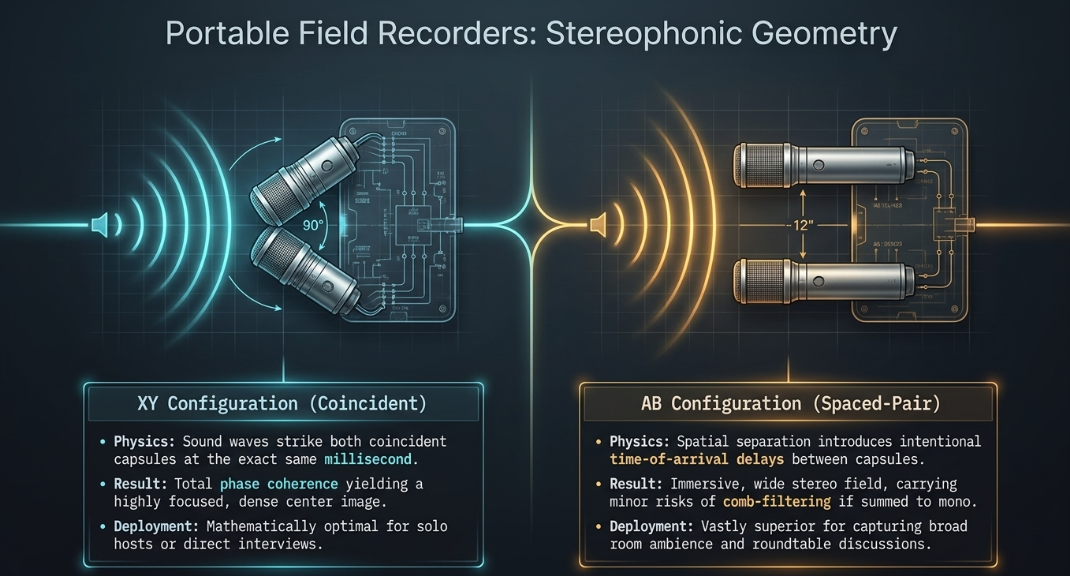
XY Configuration: In this precise, coincident setup, two highly directional (typically cardioid) capsules are rigidly mounted at a 90-degree angle to one another, with their diaphragms stacked as close together as physically possible without touching.31 This tight coincident placement ensures that acoustic sound waves originating from any direction arrive at both capsules at virtually the exact same microscopic moment in time. The mathematical result is total phase coherence and a highly focused, dense, and stable center audio image. The XY configuration is mathematically optimal for podcasting scenarios where a single, primary sound source—such as a solo host or an interviewee speaking directly into the device—must be recorded with distinct, uncompromised clarity while still maintaining a realistic, natural stereo field.31
AB Configuration: In this spaced-pair setup, the microphones are physically separated by a determined distance and pointed parallel to each other or angled slightly outward.31 Because the capsules are spatially displaced, acoustic energy originating from the side of the device will strike the nearer capsule fractions of a millisecond before reaching the further capsule, introducing intentional time-of-arrival and phase differences. While this delay can cause minor, destructive comb-filtering if the stereo track is later summed perfectly to mono, it yields an incredibly wide, expansive, and highly immersive stereo image when listened to on headphones. The AB configuration is vastly superior for capturing broad environmental acoustics, natural room ambience, or multi-person panel discussions spread across a wide table.31
Premium portable models, such as the Tascam DR-40XP and the Sony PCM-A10, feature highly advanced articulatable microphone arrays, allowing the engineer to physically and manually swivel the capsules between XY and AB configurations to instantly adapt to the specific acoustic demands of the recording location.31 Conversely, budget-focused models, such as the Zoom H1 Essential, typically rely on fixed, immovable XY arrays, trading stereophonic versatility for mechanical simplicity and cost reduction.
Inputs and Outputs
To bridge the substantial gap between consumer-level field recorders and professional broadcast standards, high-end portable units bypass their internal electret condensers entirely by offering highly robust external input and output topographies.31 Professional portable recorders integrate multiple, balanced XLR/TRS combination jacks into their lower chassis, allowing field engineers to connect industry-standard dynamic broadcast microphones, external condenser shotguns, or even route line-level signals from an outboard mixing console directly into the device's ADC.31
These external analog inputs are driven by the unit's internal preamplifiers. For example, the Tascam DR-40XP utilizes specialized High Definition Discrete Architecture (HDDA) preamplifiers, which are engineered to provide substantial electrical gain with an exceptionally low noise floor.31 This is a critical specification for mobile podcasting, as external dynamic microphones (like the ubiquitous Shure SM58 or SM7B) require significant voltage amplification; deploying a noisy, low-quality preamp in a portable recorder will introduce a highly audible, destructive white hiss into the track.34 To combat this in lower-tier models, engineers frequently deploy inline mic boosters—such as the Klark-Teknik CT-1, FetHead, or Cloudlifter CL-1—which use phantom power to provide 25dB of ultra-clean, transparent gain before the signal even reaches the recorder's internal preamplifier.34 On the output side, architecture generally includes a dedicated 3.5mm stereo mini-jack utilized for low-latency headphone monitoring or for routing a clean, line-level audio signal directly into the input of a DSLR camera for synchronized video production.31 Additionally, these devices feature built-in reference speakers for quick field auditioning, and highly versatile USB-C ports, which permit the portable unit to bypass its internal SD card and function dually as a standard computer audio interface when tethered to a laptop in a hotel room or studio.30
Using a Portable Recorder with an External Microphone
Deploying external, broadcast-grade microphones in conjunction with a portable recorder exponentially increases the final production value of a podcast, but it introduces highly specific operational and electrical requirements that must be carefully managed in the field. When utilizing external studio condenser microphones, the portable recorder is forced to supply a constant +48V of phantom power through the XLR cables to polarize the microphone's backplate.31 Generating this continuous DC voltage draws heavily on the unit's internal AA batteries, drastically reducing operational field time from a potential 18 hours down to mere fractions of that.30 Field engineers must rigorously monitor battery levels, utilize high-capacity rechargeable cells, or deploy external USB power banks to prevent catastrophic, mid-interview power failures and corrupted audio files.
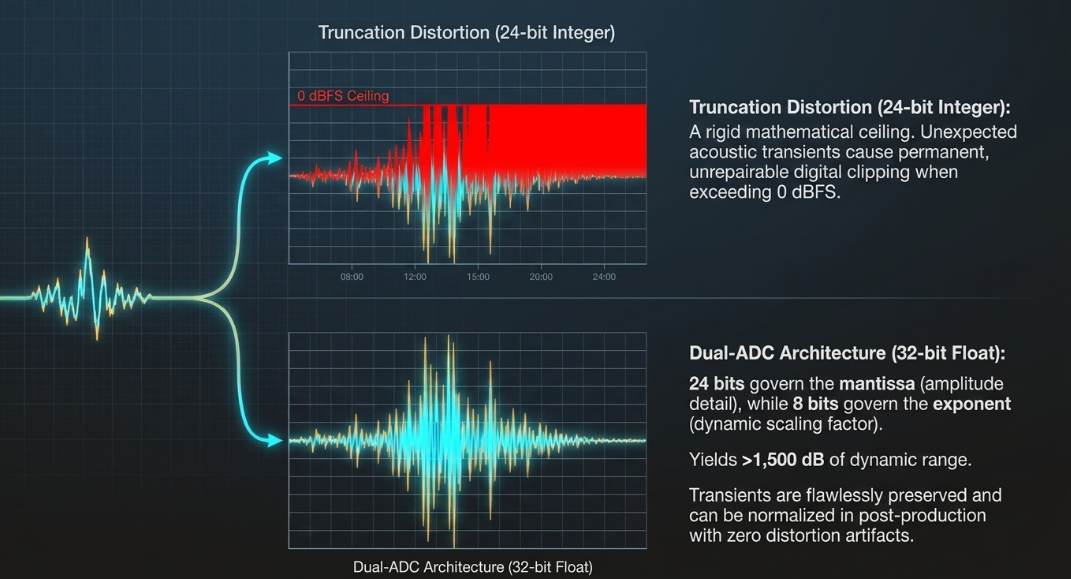
Perhaps the most profound technological advancement in recent portable recorder digital processing is the widespread integration of 32-bit float audio resolution.31 Traditional 24-bit integer recording possesses a rigid, mathematically hard digital ceiling; if an acoustic transient (such as an unexpected shout, a siren, or explosive laughter) generates a voltage that exceeds 0 dBFS (Decibels Full Scale) at the converter, the ADC simply runs out of numbers to represent the amplitude.19 It mathematically truncates the waveform, resulting in permanent, unrepairable, and highly unpleasant digital clipping distortion.19
Modern portable recorders equipped with 32-bit float technology (such as the contemporary iterations of the Zoom Essential line and Tascam Portacapture series) completely eradicate this issue by utilizing a dual-ADC architecture combined with an advanced DSP algorithm. The mathematical structure of a 32-bit floating-point file is revolutionary: it dedicates 24 bits to the mantissa (which records the highly detailed amplitude data) and 8 bits to the exponent (which acts as an automated, dynamic scaling factor).31 This exponent scales the data up or down instantly, yielding a theoretical dynamic range in excess of 1,500 dB—a range that vastly outperforms the dynamic range of the human ear and safely exceeds the physical SPL destruction limits of the microphone capsule itself.31 In practical, chaotic mobile podcasting applications, this means that audio recorded using 32-bit float cannot digitally clip. If the incoming microphone signal wildly exceeds 0 dBFS, the data is preserved perfectly intact within the file's floating-point architecture.31 It can be seamlessly normalized and reduced in volume within the post-production DAW with absolutely zero distortion artifacts, effectively eliminating the high-stress requirement for the producer to set and constantly ride analog input gain levels during unpredictable, high-pressure field recordings.
Other Considerations
In the demanding context of portable field recording, meticulous data management and physical handling represent paramount considerations that can dictate the success or failure of a shoot. High-resolution audio files (captured as lossless WAV files up to 96kHz/32-bit float, or compressed MP3s) are locally encoded and written onto removable Secure Digital media cards (SD, SDHC, or microSDXC).30 Devices support varying capacities (for instance, up to 512GB for the Tascam DR-40XP, and a massive 1TB limit for the Zoom H1 Essential).31 Field engineers must carefully format these media cards strictly within the recorder itself prior to every session to prevent filesystem fragmentation and catastrophic sector corruption during long, continuous multi-hour takes.30
Mechanical vulnerability is another highly crucial factor. Because the highly sensitive condenser microphone capsules are physically hard-mounted directly to the recorder's external chassis, any physical handling of the plastic casing—such as shifting fingers, adjusting grip, or tapping buttons—creates low-frequency mechanical vibrations that transfer instantly into the capsules and destroy the recording.10 Deploying specialized rubber shock mounts (such as the Movo SMM8) or placing the recorder on a stationary, isolated tripod is absolutely necessary to decouple the device and isolate it from handling noise.10 Furthermore, while indoor environmental use is generally straightforward, taking portable recorders into the outdoor field mandates the deployment of specialized wind protection accessories.10 The thin foam covers occasionally included in the box are entirely insufficient for outdoor elements; thick, furry windjammers ("deadcats") must be applied securely over the capsules to disrupt violent wind shear and prevent catastrophic, low-frequency aerodynamic rumble from destroying the capsule's delicate phase coherence and blowing out the audio track.10 Specialized add-ons, like the Rode VideoMic Me-C+, can also be utilized to augment smartphones, bringing dedicated field-recording hardware to mobile devices.31
Headphones
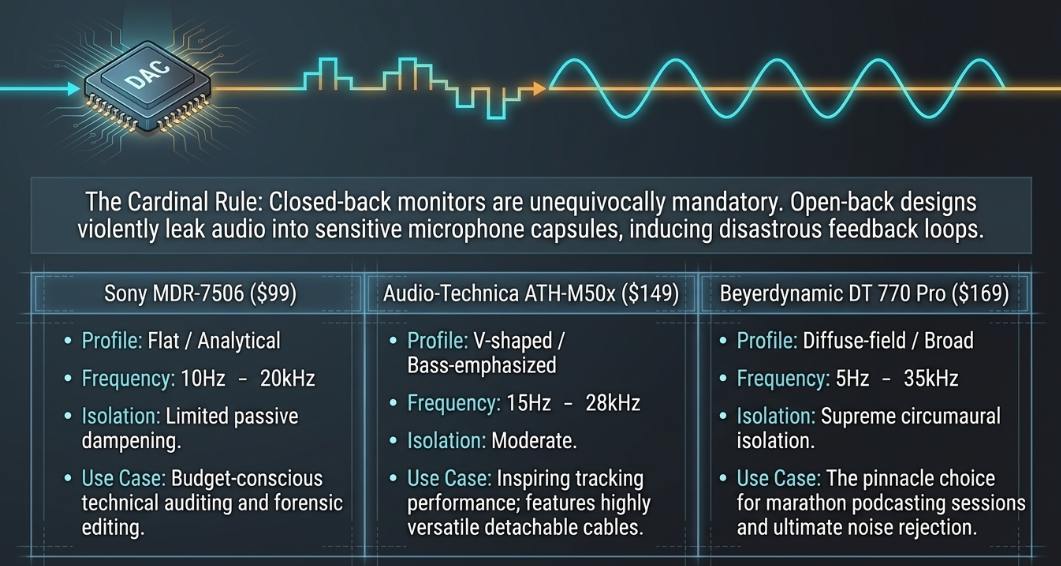
Accurate, uncompromised auditory monitoring is the final, critical fail-safe in the entire audio recording pipeline. The selection of studio headphones dictates the audio engineer's ability to accurately identify acoustic anomalies, balance microphone gain levels, and detect faint background interference (such as distant traffic or electrical hums) long before the performance concludes and the talent departs.3 In professional podcast recording and live vocal tracking, the use of closed-back (sealed) headphones is strictly and unequivocally mandatory. Closed-back designs feature physically sealed acoustic earcups that provide critical passive isolation (naturally attenuating ambient room noise by approximately -10dB to -15dB).37 More importantly, this sealed design completely prevents the headphone's audio output (the monitoring mix or a click track) from bleeding back into the highly sensitive microphone capsules, a phenomenon that causes disastrous echo and feedback loops.37 Open-back headphones (such as the Sennheiser HD 600 or Hifiman Sundara), while offering vastly superior spatial imaging, a flat frequency response, and a wider soundstage that is highly prized for post-production mixing and mastering, leak audio aggressively through their vented cups and are therefore entirely unsuitable for active microphone recording environments.37 For environments requiring extreme isolation, In-Ear Monitors (IEMs) can provide up to -25dB of passive attenuation.37
Three industry-standard closed-back models frequently and reliably deployed in global broadcast environments include the Sony MDR-7506, the Audio-Technica ATH-M50x, and the Beyerdynamic DT 770 Pro.37
Studio Monitor Comparison
Data aggregated from professional audio specifications and market analysis. 37
The Sony MDR-7506 ($99.99) is a legendary studio staple that relies on a remarkably flat, uncolored frequency response (10 Hz to 20,000 Hz), serving as a highly analytical, surgical tool for identifying technical recording errors.37 While exceptionally lightweight and foldable for travel, its acoustic isolation is noticeably limited, making it suboptimal for tracking in highly noisy recording environments, and its heavy coiled cable is permanently affixed.37
The Audio-Technica ATH-M50x ($149.00) introduces a more sculpted frequency curve (15 Hz to 28,000 Hz), featuring a highly pronounced bass response and distinct high-end clarity that many producers find inspiring during tracking.37 Its inclusion of three different detachable cables significantly enhances studio routing flexibility, and its collapsible design aids in portability.37 However, the synthetic vinyl earpads can induce physical fatigue and flake over time, and its noise isolation is only considered moderate.37
The Beyerdynamic DT 770 Pro ($169.99) represents the absolute pinnacle of acoustic isolation and long-term comfort within this specific tier, regularly cited as the "Best Overall" choice for podcasting.37 Featuring incredibly dense, circumaural (around-the-ear) velour earcups, it effectively blocks out extreme external noise, meticulously maintaining the host's focus.37 Furthermore, its exceptionally broad frequency range (5 Hz to 35,000 Hz) and availability in high-impedance variants provide precise volume leveling, immense headroom, and supreme transient reproduction.37 While inherently bulky, non-collapsible, and featuring a fixed cable, its tank-like durability and superior isolation render it the optimal choice for permanent podcasting installations and marathon editing sessions.
Cables
The physical transmission lines connecting microphones, instruments, audio interfaces, and studio monitors are highly susceptible to electromagnetic interference (EMI) and radio frequency interference (RFI) constantly emitted by surrounding domestic electronics, Wi-Fi routers, cellular devices, and alternating current (AC) power mains.41 Mitigating this invisible interference requires a deep understanding of the electrical topology of audio cables, which are categorized universally into unbalanced and balanced paradigms.41
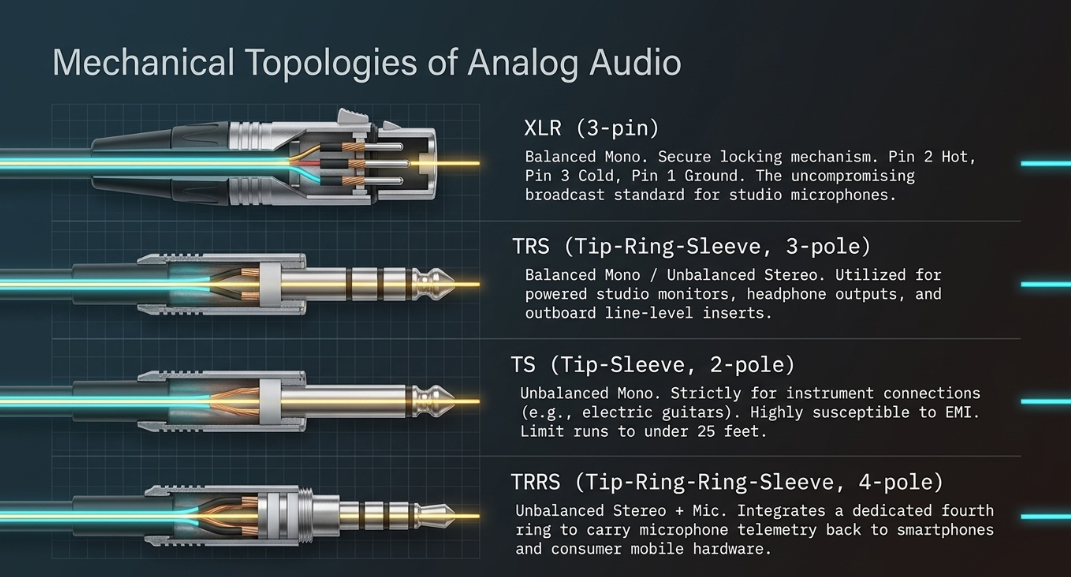
Unbalanced cables utilize a fundamentally simple, two-wire construction: a single central conductor wire carrying the positive audio signal, surrounded by a braided metal shielding sleeve that acts as both the electrical ground and the negative return path.41 The primary, fatal deficiency of this unbalanced design is that the shielding wire itself behaves as a long, highly receptive antenna, actively collecting ambient EMI and RFI from the environment and injecting it directly into the audio path.41 Unbalanced cables (such as standard 1/4-inch TS instrument cables used for electric guitars or RCA interconnects used for consumer hi-fi gear) must therefore be kept extremely short—typically under 25 feet—to minimize severe signal degradation, high-frequency loss, and the accumulation of buzz.41
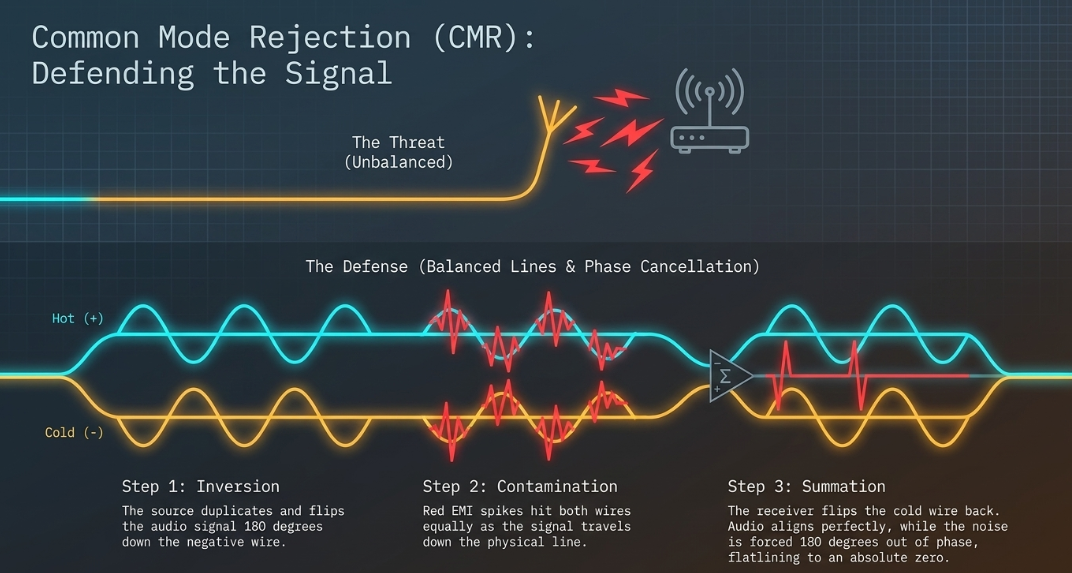
Balanced cables, conversely, rely on a highly sophisticated three-wire architecture designed specifically to cancel out external noise via an ingenious physics phenomenon known as Common Mode Rejection (CMR).41 A balanced cable contains a dedicated ground wire, a positive ("hot" or "high") conductor, and a negative ("cold" or "low") conductor.41 The source device duplicates the original audio signal, sending it down the positive wire normally, but actively phase-inverting (flipping exactly 180 degrees) the identical signal sent down the negative wire.41 As the audio signal travels down the length of the cable run, any external electromagnetic noise penetrates the shielding and hits both the positive and negative wires equally (this is the "common mode" noise).41 Upon reaching the balanced input of the destination audio interface, a differential amplifier receives the signals, flips the negative wire back 180 degrees to its original phase, and sums the two together.41 This mathematical action aligns the original audio signals into perfect phase coherence (effectively doubling their voltage), while simultaneously throwing the induced external noise exactly 180 degrees out of phase with itself, resulting in total, absolute mathematical phase cancellation of the interference.41 This profound mechanism allows balanced lines to run for hundreds of feet across noisy studio floors without accumulating a single decibel of noise.
Connector Typologies
Understanding the physical terminations of these cables is necessary for proper signal routing and hardware interfacing.44
Data aggregated from standard audio cable configurations. 41
For analog connections, XLR connectors represent the uncompromising broadcast standard due to their secure locking mechanisms and balanced noise rejection capabilities (Pin 2 is positive, Pin 3 is negative, Pin 1 is ground).41 The 1/4-inch or 3.5mm TRS (Tip-Ring-Sleeve) cables are equally utilized; they can run balanced line-level mono signals between outboard gear and active studio monitors, or they can be utilized to run unbalanced left/right stereo signals to headphones.41 In modern consumer gear, TRRS (Tip-Ring-Ring-Sleeve) cables integrate an extra, fourth conductor ring specifically to carry microphone telemetry back to smartphones or laptops.44 Finally, standard TS (Tip-Sleeve) cables remain the domain of unbalanced instrument connections.41
In the digital domain, data cables maintain distinctly strict physical tolerances. Historical reliance on Micro-USB connections frequently resulted in catastrophic hardware failures; the fragile, microscopic pin alignment and lack of locking tension caused cables to literally slip out of the back of microphones (like the Shure MV7) during active tracking, severing data streams, causing software to freak out, and resetting hardware logic boards mid-performance.50 The universal integration of USB-C has largely eradicated this unreliability. USB-C's symmetrical pinout, deep seating architecture, and significantly enhanced data and power delivery pipelines ensure a highly robust, secure digital lock between the audio interface and the host system, radically reinforcing the structural and operational integrity of the entire podcasting setup.24 Beyond USB, facilities utilizing networked audio standards (such as Dante, AVB, or AES67) rely on standard twisted-pair Ethernet cables (Cat 5, Cat 6, Cat 7) with RJ45 connectors to transmit massive arrays of digital audio over long distances.
Intermission
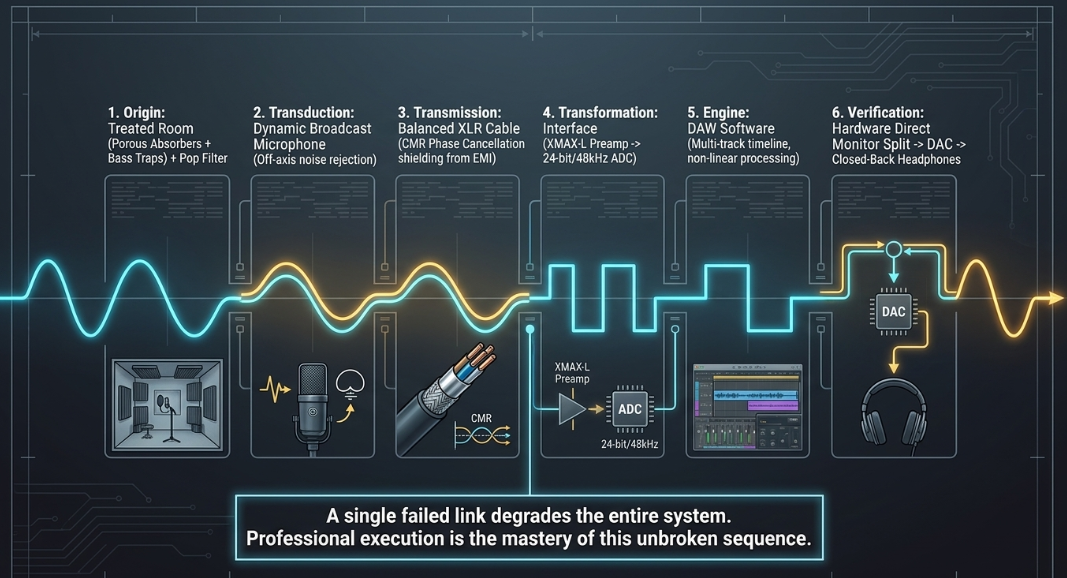
The audio execution pipeline relies on a highly rigorous, uncompromising chain of electroacoustic transduction, beginning with the physical, architectural management of background noise in the room and terminating in the precise, mathematical delivery of binary code to a digital storage medium. Selecting the appropriate transducer topology (dynamic versus condenser), properly managing the Analog-to-Digital conversion threshold via optimized interfaces like the PreSonus Studio 24c, leveraging the advanced, distortion-proof mathematics of 32-bit floating-point dynamics in mobile recording contexts, and rigorously defending the fragile analog signal from electromagnetic decay via balanced transmission lines establishes the unshakeable baseline for professional broadcast fidelity. With the mechanical, acoustic, and electrical foundations of the hardware acquisition stage fully secured, the audio is now safely digitized. The subsequent phase of professional execution requires exploring the non-linear dynamics of software processing, advanced DAW multi-track editing architectures, complex mixbus routing, and the final loudness mastering parameters strictly required to translate high-resolution studio audio into universally compliant commercial podcasts.
Works cited
Noise reduction for podcasting and recording series - sound ... - Reddit, accessed May 14, 2026, https://www.reddit.com/r/podcasting/comments/108y9yj/noise_reduction_for_podcasting_and_recording/
Noise reduction for podcasting and recording. Part 1: sound proofing ..., accessed May 14, 2026, https://medium.com/@opengears/noise-reduction-for-podcasting-and-recording-part-1-sound-proofing-the-studio-8b2fa6c819ac
Got Podcast Background Noise? Here's How to Eliminate Ambient ..., accessed May 14, 2026, https://commandyourbrand.com/got-podcast-background-noise-heres-how-to-eliminate-ambient-noise/
Soundproofing vs. Sound Treatment: Why It Matters for Your Home Voiceover Studio, accessed May 14, 2026, https://www.backstage.com/magazine/article/setting-home-vo-studio-must-know-5341/
Dynamic Mic vs Condenser Mic: Choosing the Best Microphone for Home Studio Recording, accessed May 14, 2026, https://www.saramonic.com/blogs/dynamic-vs-condenser-mic-home-studio
Dynamic vs. Condenser Mics: Which Is Best for Your Podcast?, accessed May 14, 2026, https://thepodcastconsultant.com/blog/dynamic-vs-condenser-mics
Condenser Mic vs Dynamic Mic: Comparison for Creators and Professionals | NearStream Official, accessed May 14, 2026, https://www.nearstream.us/blog/in-depth-comparison-condenser-mic-and-dynamic-mic
10+ statements on condenser microphones versus dynamic mics, accessed May 14, 2026, https://www.dpamicrophones.com/mic-university/background-knowledge/10plus-statements-on-condenser-microphones-versus-dynamic-mics/
Can software calibration replace acoustic treatment in a home studio? - Sonarworks Blog, accessed May 14, 2026, https://www.sonarworks.com/blog/learn/can-software-calibration-replace-acoustic-treatment-in-a-home-studio
Can I Start a Podcast With Just a SmartPhone? - Independent ..., accessed May 14, 2026, https://independentpodcast.network/training/can-i-start-a-podcast-with-just-a-smartphone/
Smartphone recordings are comparable to “gold standard” recordings for acoustic measurements of voice - PMC, accessed May 14, 2026, https://pmc.ncbi.nlm.nih.gov/articles/PMC10545813/
Producing Podcasts with Ferrite Recording Studio – The Sweet Setup, accessed May 14, 2026, https://thesweetsetup.com/producing-podcasts-with-ferrite-recording-studio/
Podcasting on a Smartphone: Can You Really Record High-Quality Audio? -, accessed May 14, 2026, https://commandyourbrand.com/podcasting-on-a-smartphone-can-you-really-record-high-quality-audio/
Auphonic – I Can't Recommend it Enough! : r/podcasting - Reddit, accessed May 14, 2026, https://www.reddit.com/r/podcasting/comments/1kyam0b/auphonic_i_cant_recommend_it_enough/
Fundamental Concepts: Sampling, Quantization, and Encoding - Monolithic Power Systems, accessed May 14, 2026, https://www.monolithicpower.com/en/learning/mpscholar/analog-to-digital-converters/introduction-to-adcs/fundamental-concepts
Analog-to-digital conversion (ADC): What it is and how it works - Blog | Splice, accessed May 14, 2026, https://splice.com/blog/analog-to-digital-conversion/
How Do Sampling and Quantization Affect Analog-to-Digital Conversion? - PatSnap Eureka, accessed May 14, 2026, https://eureka.patsnap.com/article/how-do-sampling-and-quantization-affect-analog-to-digital-conversion
Audio Interface Buying Guide - InSync - Sweetwater, accessed May 14, 2026, https://www.sweetwater.com/insync/audio-interface-buying-guide/
Chapter 13: Digital to Analog Conversion and Sound, accessed May 14, 2026, https://users.ece.utexas.edu/~valvano/Volume1/E-Book/C13_DACSound.htm
Studio 24c - PreSonus, accessed May 14, 2026, https://www.presonus.com/products/studio-24c
PreSonus Studio 24c review - MusicRadar, accessed May 14, 2026, https://www.musicradar.com/reviews/presonus-studio-24c-review
ANALOG-DIGITAL CONVERSION, accessed May 14, 2026, https://www.analog.com/media/en/training-seminars/design-handbooks/data-conversion-handbook/chapter2.pdf
PreSonus Studio 24c Review: Compact 2x2 Interface with Studio ..., accessed May 14, 2026, https://soundandsignal.co.uk/presonus-studio-24c-review/
USB-C, USB-B, and USB-A: What's the Difference? - ViewSonic Library, accessed May 14, 2026, https://www.viewsonic.com/library/tech/usb-c-usb-b-and-usb-a-whats-the-difference/
USB In Audio: Explained - Audient, accessed May 14, 2026, https://audient.com/tutorial/usb-in-audio/
Any audio quality difference between USB A, USB C and Thunderbolt? - Reddit, accessed May 14, 2026, https://www.reddit.com/r/musicproduction/comments/1dtgoe8/any_audio_quality_difference_between_usb_a_usb_c/
USB Microphone vs Audio Interface - Which is Best For You? - YouTube, accessed May 14, 2026, https://www.youtube.com/watch?v=A1OX6lweC7s
NOT SPONSORED - Presonus Studio 24 C IN 2025 - ( HONEST REVIEW ) - YouTube, accessed May 14, 2026, https://www.youtube.com/watch?v=kOuNEkxSPX8
Is Presonus studio 24c really worth the overprice between the Presonus audiobox 96 and it? : r/musicproduction - Reddit, accessed May 14, 2026, https://www.reddit.com/r/musicproduction/comments/1ah0807/is_presonus_studio_24c_really_worth_the_overprice/
Tascam DR-40X (5 stores) find prices - PriceRunner, accessed May 14, 2026, https://www.pricerunner.com/pl/191-5018755/Voice-Recorders-Handheld-Music-Recorders/Tascam-DR-40X-Compare-Prices
Best field recorders: Top portable recorders | MusicRadar, accessed May 14, 2026, https://www.musicradar.com/news/best-field-recorders
Best Digital Voice Recorders | Tested & Ranked - TechGearLab, accessed May 14, 2026, https://www.techgearlab.com/topics/small-and-home-office/best-digital-voice-recorder
Recording Equipment (2026) at the best price | idealo.co.uk, accessed May 14, 2026, https://www.idealo.co.uk/cat/12553/recording-equipment.html
Tascam DR-40X Review. Worth it or A Waste of Money? Input noise level tests, XY/AB stereo and more. - YouTube, accessed May 14, 2026, https://www.youtube.com/watch?v=bCguyhm7gs8
Audio pro for your videos: ZOOM H5 review with test and comparison vs Tascam DR-40x, accessed May 14, 2026, https://www.youtube.com/watch?v=PqAKJWF3Si8
Audio recorder comparisons - Choosing the right one for your production - YouTube, accessed May 14, 2026, https://www.youtube.com/watch?v=w9BJ0zNFB5o
12 Top Headphones for Podcasting in 2025 | Hurrdat Media, accessed May 14, 2026, https://hurrdatmedia.com/podcasting/best-podcast-headphones/
Best studio headphones 2026: Top picks for music production - MusicRadar, accessed May 14, 2026, https://www.musicradar.com/news/the-best-studio-headphones-top-headphones-for-music-production
The BEST Studio Headphones I Tried Totally Changed My Mind! - YouTube, accessed May 14, 2026, https://www.youtube.com/watch?v=AnD_T7veLcM
For Producing: MDR 7506, DT 770/990, M50X or something else? - Reddit, accessed May 14, 2026, https://www.reddit.com/r/HeadphoneAdvice/comments/1rf6zp7/for_producing_mdr_7506_dt_770990_m50x_or/
Cable Buying Guide - InSync - Sweetwater, accessed May 14, 2026, https://www.sweetwater.com/insync/cable-buying-guide/
Audio Cable Types: A Complete Guide, accessed May 14, 2026, https://www.cablematters.com/Blog/Audio/audio-cable-types-a-complete-guide
Best Cables for Streaming and Podcasting - Monoprice Support, accessed May 14, 2026, https://monopricesupport.kayako.com/article/378-best-cables-for-streaming-and-podcasting
The Ultimate RØDE Cable and Adaptor Guide (International), accessed May 14, 2026, https://rode.com/en-int/about/news-info/the-ultimate-rode-cable-and-adaptor-guide
accessed May 14, 2026, https://monopricesupport.kayako.com/article/102-what-is-the-difference-between-ts-trs-and-trrs#:~:text=The%20main%20difference%20is%20in,plus%20a%20microphone%20for%20headsets.
TS vs TRS vs TRRS AUDIO CABLES: What Is the Difference? - Audio University, accessed May 14, 2026, https://audiouniversityonline.com/ts-vs-trs-vs-trrs-audio-connectors/
What Are the Differences Between TS, TRS and TRRS Audio Connectors & Which One Should You Use? - Movo, accessed May 14, 2026, https://www.movophoto.com/blogs/movo-photo-blog/differences-between-ts-trs-and-trrs-connectors
What's the Difference between TS, TRS, and TRRS connectors? - RØDE, accessed May 14, 2026, https://help.rode.com/hc/en-us/articles/10489395008783-What-s-the-Difference-between-TS-TRS-and-TRRS-connectors
Unveiling the mystery: TS vs TRS vs TRRS audio cables - Thomann Blog, accessed May 14, 2026, https://www.thomann.de/blog/en/gear/ts-vs-trs-vs-trrs-audio-cables/
Podcast Equipment Guide: What I Recommend After 500 Episodes - Buzzsprout, accessed May 14, 2026, https://www.buzzsprout.com/blog/podcast-equipment-guide