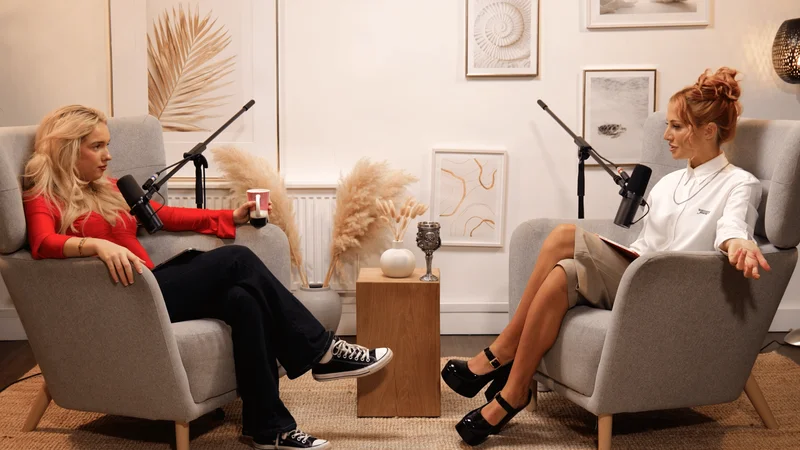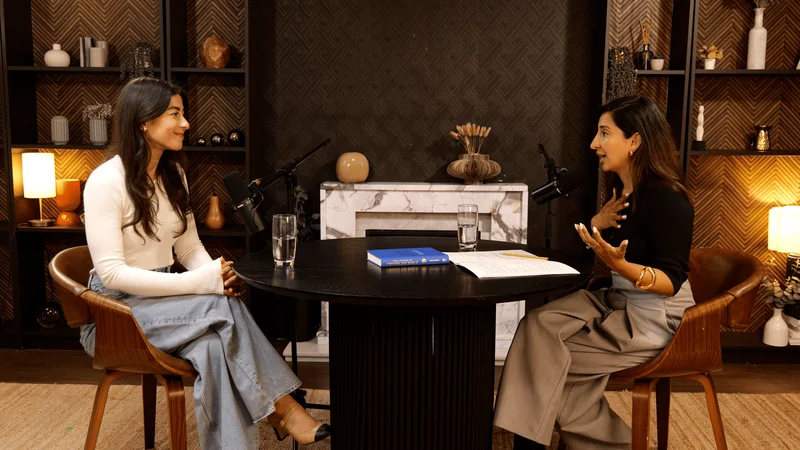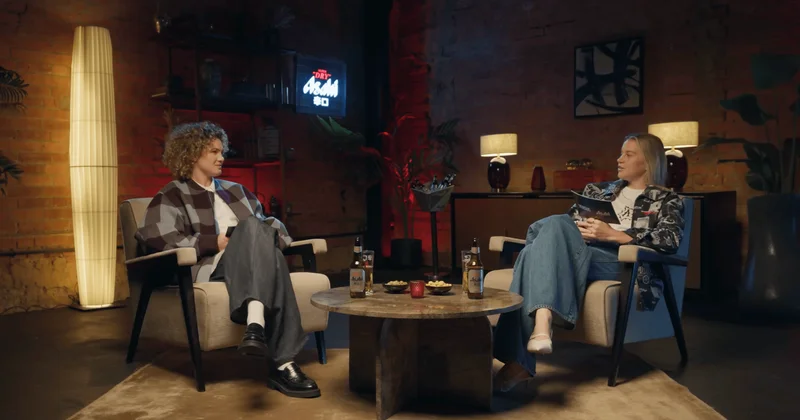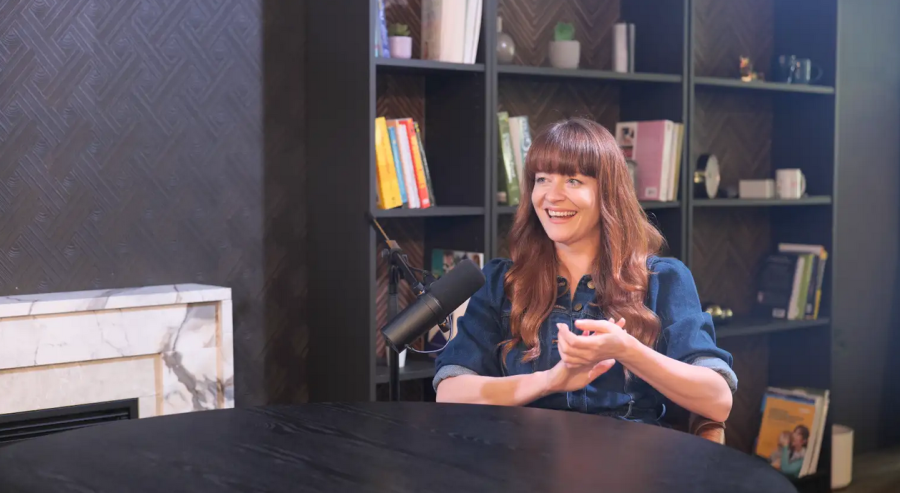
The proliferation of podcasting as a dominant medium for global communication, corporate brand building, journalism, and decentralized storytelling has elevated the baseline expectations surrounding audio fidelity. While the continuous democratization of digital recording technology allows virtually any individual to capture and distribute content, the physical properties of sound dictate that the recording environment itself fundamentally shapes the acoustic signature of the final product. A comprehensive, foundational understanding of signal flow, room acoustics, acoustic isolation techniques, and the deployment of professional equipment is essential for achieving true broadcast-quality audio. The acoustic environment—often referred to in audio engineering as the "live room" or "tracking space"—interacts dynamically and continuously with the human voice. This interaction produces complex reflections, late reverberations, phase cancellations, and standing waves that will either transparently enhance or severely degrade audio intelligibility. This exhaustive analysis explores the critical variables involved in executing professional audio recording indoors, spanning purpose-built commercial studios, repurposed community makerspaces, traditional radio facilities, and the highly variable, often problematic environments found within residential homes.
Recording in a Studio
Recording in a professionally designed studio represents the apex of audio execution, providing an environment where acoustic variables are strictly controlled and manipulated, rather than merely mitigated. Professional podcast studio design revolves around the strategic engineering of a content creation hub that is optimized for the consistent, high-fidelity capture of both audio and video.1 The primary and most immediate advantage of a dedicated commercial studio lies in its foundation of acoustic predictability. Unlike repurposed residential or office rooms, professional studios are explicitly constructed from the ground up to manage critical metrics such as noise floors, reverberation times (
In recent years, the commercial real estate and production landscape has evolved significantly. Premium coworking spaces and flexible office providers have recognized the surging demand for multimedia production, increasingly integrating dedicated podcast studios into their high-tier amenities.3 Facilities managed by organizations such as Venture X, Paddington Works, WeWork, and specialized creative hubs like Ampersand Studios offer state-of-the-art, soundproofed environments.4 These spaces are frequently equipped with industry-standard hardware, providing independent creators, marketing agencies, and corporate entities access to high-end production capabilities without the prohibitive, upfront capital expenditure required to build a private, acoustically treated facility from scratch.
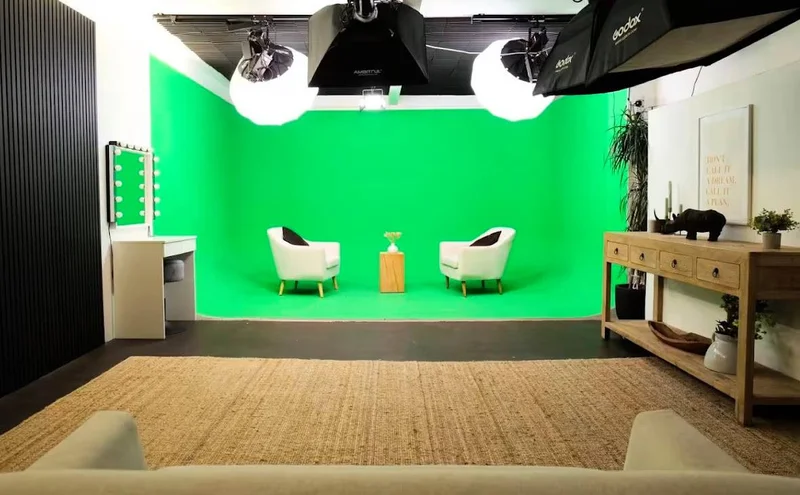
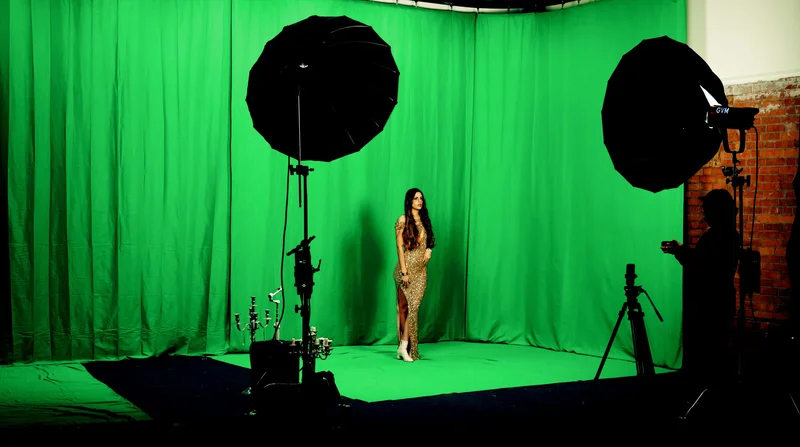
These coworking and rental studios offer a broader collaborative ecosystem, fostering organic networking opportunities and creative cross-pollination among members, while simultaneously solving the most significant technical hurdle for independent producers: reliable, repeatable sound quality.3 The financial viability of these shared spaces is highly advantageous for independent producers. Rather than investing tens of thousands of dollars in structural soundproofing, acoustic paneling, and hardware infrastructure, creators can utilize professionally tuned rooms on a tiered membership or hourly basis.8 Furthermore, these environments are explicitly designed to accommodate various, complex production workflows, ranging from solo monologue recordings to multi-guest roundtable discussions. To meet modern demands, they often incorporate advanced visual production elements such as multi-camera setups, cyclorama (cyc) walls for seamless backgrounds, and professional three-point lighting grids.1
What’s in a Studio?
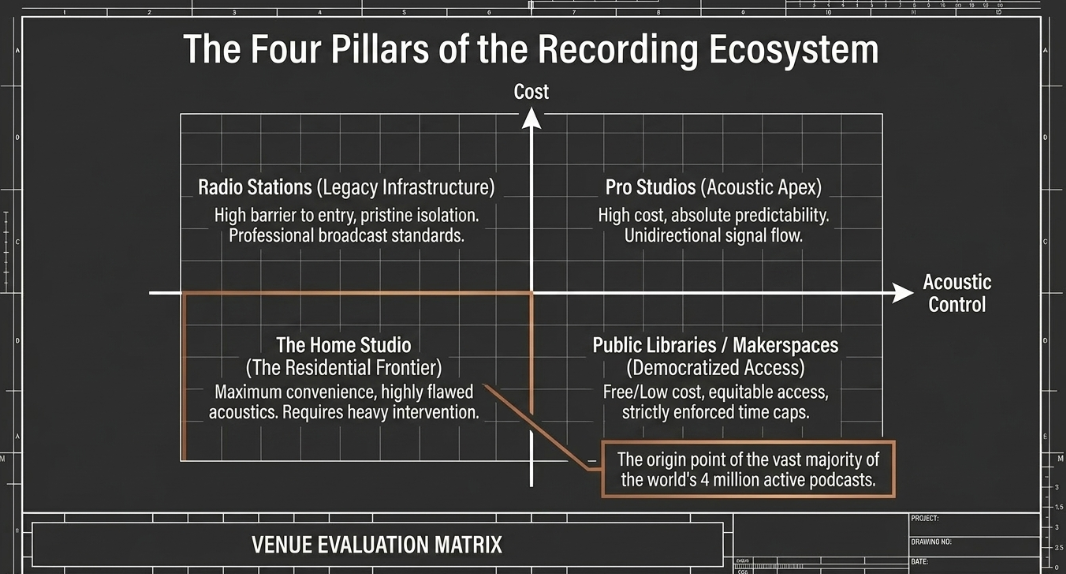
A professional podcast studio is defined by the quality, interoperability, and strategic integration of its technological and acoustic components. The equipment chain follows a strict, unidirectional signal flow: a transducer (the microphone) captures acoustic energy and converts it into an electrical voltage, an audio interface or mixing console amplifies that signal and converts it from analog to digital (A/D conversion), and finally, a digital audio workstation (DAW) records and processes the data.1
The selection of the microphone is the most critical hardware decision in the signal chain. While highly sensitive condenser microphones (such as the Neumann TLM103) capture immense transient detail and high-frequency "air," they are notoriously unforgiving. Condensers demand an acoustically perfect space because they will pick up every background hum, ambient noise, and room reverberation.1 Consequently, dynamic microphones—such as the Shure SM7b, Audio-Technica 2100x, or Samson Q2U—are predominantly utilized in professional podcast studios due to their ruggedness and their superior off-axis noise rejection.1 Dynamic microphones excel in multi-person setups, effectively mitigating microphone bleed, which occurs when one participant's voice spills into an adjacent microphone's audio channel, causing phase issues during post-production.
Additionally, professional setups prioritize proper physical infrastructure. Cable management is strictly enforced, utilizing raceways mounted under desks and labeled reusable Velcro ties to ensure a safe, organized, and interference-free environment.1 From a visual perspective, the studio layout is optimized for both conversational flow and video aesthetics. Common configurations include face-to-face setups (ideal for intimate, two-person interviews), roundtable designs (ensuring clear sightlines for panel discussions), and L-shape configurations (which create a strong visual anchor when filming).1 This is supplemented by a three-point lighting system: a bright "Key Light" at a 45-degree angle, a softer "Fill Light" to eliminate harsh shadows, and a "Back Light" (or hair light) to separate the subject from the background.1
Beyond the electronic hardware, the physical materials applied to the studio walls are highly specialized. Acoustic manipulation falls into two distinct categories: soundproofing (isolation) and acoustic treatment (control).1 Soundproofing prevents external sound transmission by adding heavy mass to structures and sealing air gaps, while acoustic treatment manages the internal behavior of sound waves within the space.1 Proper treatment involves placing porous acoustic panels at early reflection points to absorb mid-to-high frequencies, installing thick bass traps in the room's corners to absorb low-frequency buildup, and utilizing diffusers to scatter sound waves, creating a natural, open sound without the presence of discrete echoes.
Public Libraries and Community Spaces
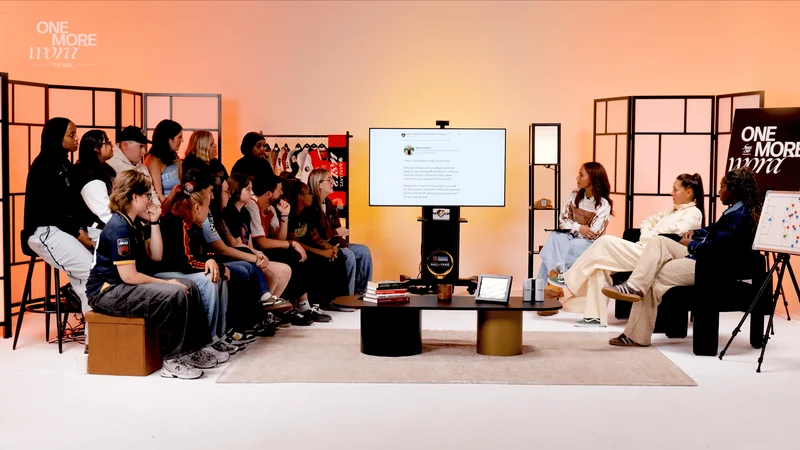
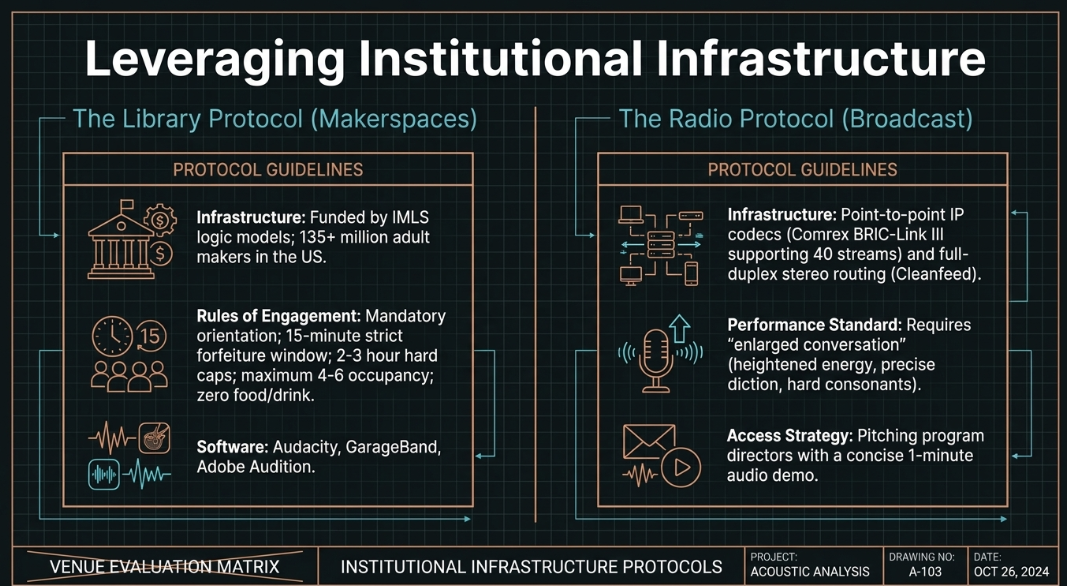
The democratization of podcasting technology has been significantly accelerated by the emergence of "makerspaces" and digital media labs within public libraries and community centers. There were more than 135 million adult makers identified in the United States by 2015, prompting institutions to pivot from merely housing content to actively facilitating content creation.13 Public libraries across the country—ranging from the San Diego Public Library's Valencia/MLK branch to the Brooklyn Public Library's Info Commons, and the San Jose MakerShip—have reconfigured their physical architecture to host dedicated recording studios, providing equitable access to technology that was once the exclusive domain of commercial broadcasters.14
Library podcast studios operate as vital community assets, enabling grassroots local journalism, the preservation of oral histories, and comprehensive digital literacy education.18 These spaces are specifically designed to bridge the digital divide. For example, logic models and grant frameworks provided by the Institute of Museum and Library Services (IMLS) help libraries optimize space needs, community engagement, and resource allocation to ensure these studios are accessible to marginalized groups.15 These labs are typically outfitted with professional-grade gear, such as multi-channel audio interfaces, high-quality dynamic microphones, and dedicated editing workstations equipped with open-source or industry-standard software like Audacity, GarageBand, or Adobe Audition.14
Due to extremely high demand, the utilization of library studios is governed by strict operational protocols designed to maximize community access while preventing monopolization by individual users or commercial entities. Generally, access requires patrons to hold a valid library card in good standing and undergo a mandatory orientation, workshop, or certification process with library staff to ensure equipment safety and basic technical competency.2
Booking parameters strictly regulate time. Reservations must usually be made in advance—often up to 28 or 30 days prior—with absolute strictness regarding punctuality.17 If a patron fails to claim the room within 15 minutes of the scheduled start time, the reservation is universally forfeited.17 Furthermore, session durations are usually capped at two to three hours per reservation, with a hard limit on the number of bookings a patron can make per month or week.17 Occupancy limits are strictly enforced—typically capping at four to six individuals depending on the studio's square footage—and food or drink is universally prohibited to protect the sensitive electronic equipment.22 Libraries also stipulate age requirements; while minors are often permitted to participate in the recording process, the primary reserving applicant must be an adult (18 years or older) who remains present and assumes legal liability for the space and equipment.17 Importantly, usage policies typically dictate that these spaces are strictly designated for non-commercial audio/video production and cannot be repurposed as general study or meeting rooms.
Radio Stations
Traditional radio stations possess decades of legacy infrastructure dedicated to pristine audio capture and transmission, making them highly desirable environments for professional podcast production. Broadcasters have increasingly recognized that podcasting is not an existential threat to terrestrial radio, but rather an asynchronous extension of their audience reach, allowing for on-demand consumption of high-quality content that can drive station membership and engagement.26
Local and community radio stations (including FM volunteer-run college stations) possess vast, pre-licensed music catalogs, highly sophisticated mixing consoles, and perfectly isolated acoustic environments.28 Utilizing a radio station provides an independent podcaster with an inherent level of perceived credibility, access to seasoned audio engineers, and the potential to syndicate the podcast across the station's broadcast network.27 To secure access to these facilities, prospective podcasters are advised to approach station program directors professionally. Best practices dictate preparing a concise, well-edited audio demo (typically a minute in length) that clearly encapsulates the show's premise, tone, and audio quality, accompanied by a short, convincing pitch letter.29 Having clear talking points and practicing the pitch prior to the meeting is essential.30 Alternatively, volunteering at community stations often grants backdoor access to both their recording spaces and intensive technical training programs.28
Operating within a broadcast facility also requires adopting professional broadcast techniques. Hosts must learn to employ what vocal coaches term "enlarged conversation"—speaking with heightened energy, impeccable diction, and precise articulation.31 Broadcasters must consciously avoid dropping ending consonants, ensuring that intelligibility is maintained even after the voice is heavily compressed and processed through the station's broadcast chain.31
Radio stations also employ specialized remote broadcasting equipment that can be leveraged for highly stable, high-fidelity remote podcast interviews. Systems such as the Comrex BRIC-Link III function as point-to-point IP audio codecs, establishing rock-solid bidirectional connections over standard internet lines.32 These hardware units can deliver up to 40 streams over dedicated internet connections, supporting HE-AAC audio, and acting as source feeds for Shoutcast and Icecast servers without requiring a dedicated PC.32 For software-based remote connections, platforms like Cleanfeed—an Emmy Award-winning browser-based audio software—offer full-duplex stereo audio routing.34 Cleanfeed bypasses the severe compression artifacts typical of consumer VoIP software (like Zoom or Skype), allowing podcasters to interview remote guests with the same pristine audio fidelity as if they were sitting in the same physical studio, even utilizing advanced low-latency connections like Starlink satellite internet for exceptionally remote broadcasts.
Recording at Home
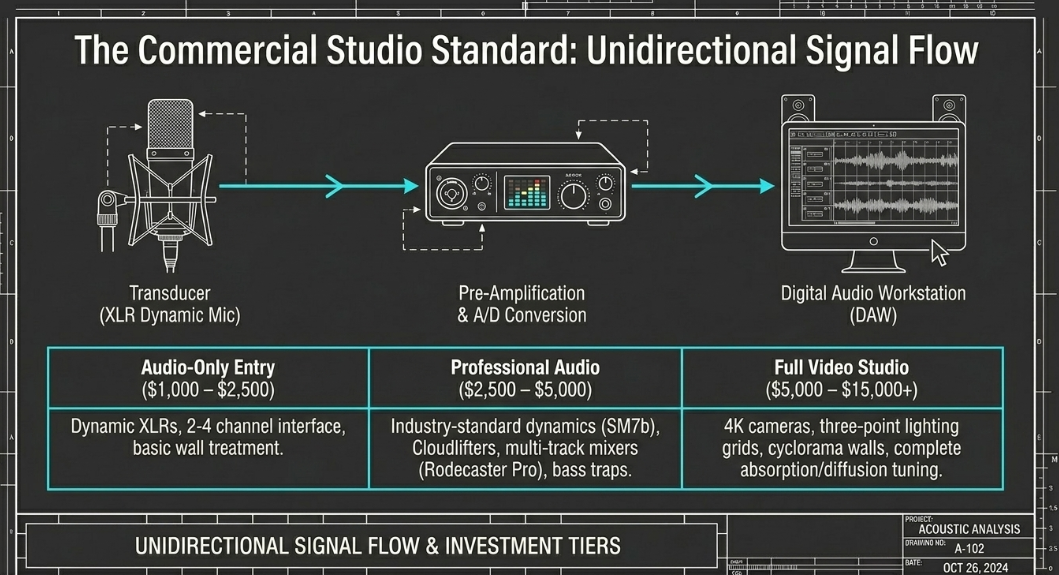
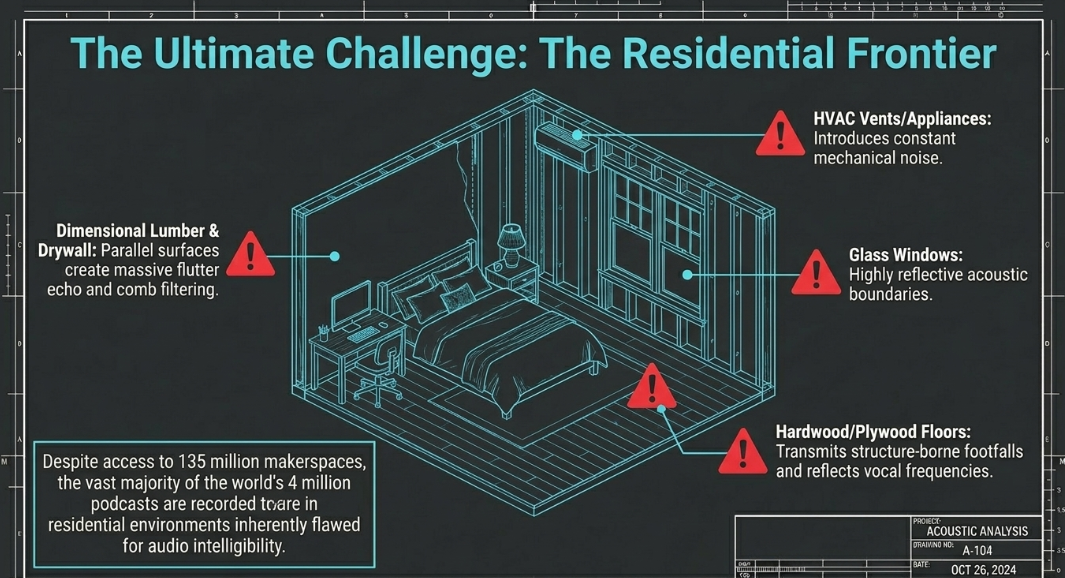
Despite the increasing availability of commercial coworking spaces, library digital labs, and radio stations, the vast majority of podcasts are still recorded in residential environments.35 The exponential expansion of the medium—which now encompasses over four million active podcasts globally—means that bedrooms, living rooms, and home offices are routinely utilized as primary production hubs.35 However, from an acoustical engineering perspective, residential spaces are inherently flawed for audio recording.
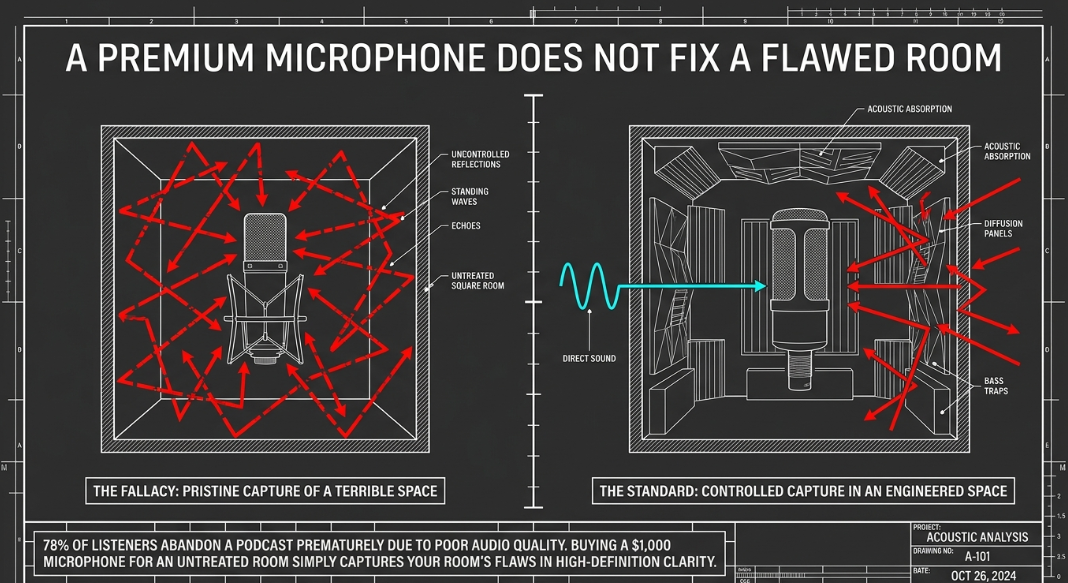
Typical homes are constructed with dimensional lumber, plywood or OSB subfloors, parallel drywall surfaces, large glass windows, and hard flooring.35 All of these materials act as highly reflective acoustic boundaries that produce flutter echo, severe reverberation, and comb filtering.35 The acoustic signature of an untreated residential room is universally recognizable and highly detrimental to audience retention; industry metrics indicate that 78% of listeners will prematurely abandon a podcast if the audio quality is poor.35
A common fallacy among amateur producers is that purchasing expensive hardware will solve room acoustics. In reality, placing a premium microphone in an untreated, highly reflective space will simply capture the acoustic flaws of that room with pristine, high-resolution clarity.11 Consequently, optimizing the home recording environment is generally far more critical—and ultimately more effective—than continuously upgrading electronic hardware.11 The primary challenges in the residential environment encompass mitigating ambient background noise and subsequently controlling the internal room reflections.
Reducing Background Noise
Before an audio engineer can address how a room colors the tone of a voice, they must first deal with external and mechanical noise sources. Background noise introduces a "noise floor"—the constant, baseline level of unwanted acoustic energy present in a recording.38 Historical noise reduction techniques heavily relied on analog hardware processing developed by companies like dbx and Dolby to eliminate tape hiss caused by the magnetic particles on cassette tapes (where more expensive chromium dioxide or metal tapes were required to lower the hiss).38 Today, modern digital podcasters face environmental noise floors caused by HVAC systems, exterior traffic, sirens, computer fans, and domestic appliances.2
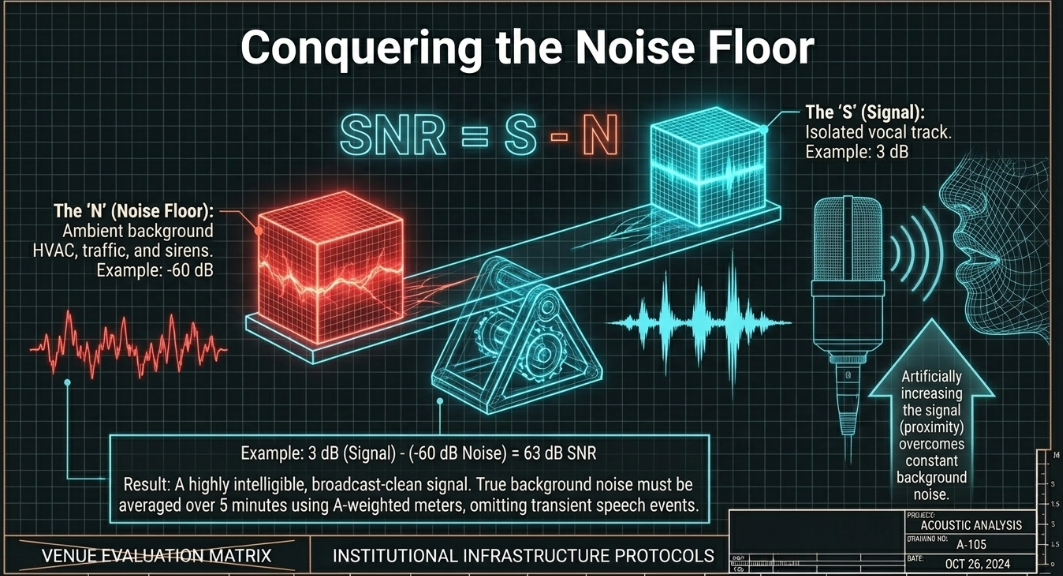
The ultimate goal in managing the noise floor is to maximize the Signal-to-Noise Ratio (SNR). The mathematical relationship is expressed simply as:

where 


Evaluating the ambient noise floor requires analytical measurement rather than mere subjective listening. Acoustic engineers use data-logging sound level meters or digital audio workstation software (such as the playback level meter in Reaper, or amplitude statistics in Adobe Audition) to capture slow-response, A-weighted minimum values over a sustained duration (e.g., five minutes).9 Averaging these values over time omits transient speech events and identifies the persistent, true background noise.40
To physically lower the noise floor, structural soundproofing (isolation) is required. Airborne noise travels through open air gaps, necessitating the use of acoustic caulk, heavy weatherstripping under doors, and the installation of dense, mass-loaded barriers to prevent sound transmission.1 Structure-borne noise, such as footsteps from a floor above or the vibration of a passing truck, requires complex decoupling techniques. If heavy soundproofing is architecturally or financially impossible for a home podcaster, they must rely on utilizing highly directional dynamic microphones, positioned extremely close to the mouth. This technique artificially increases the signal (

Consider the Size of Your Room
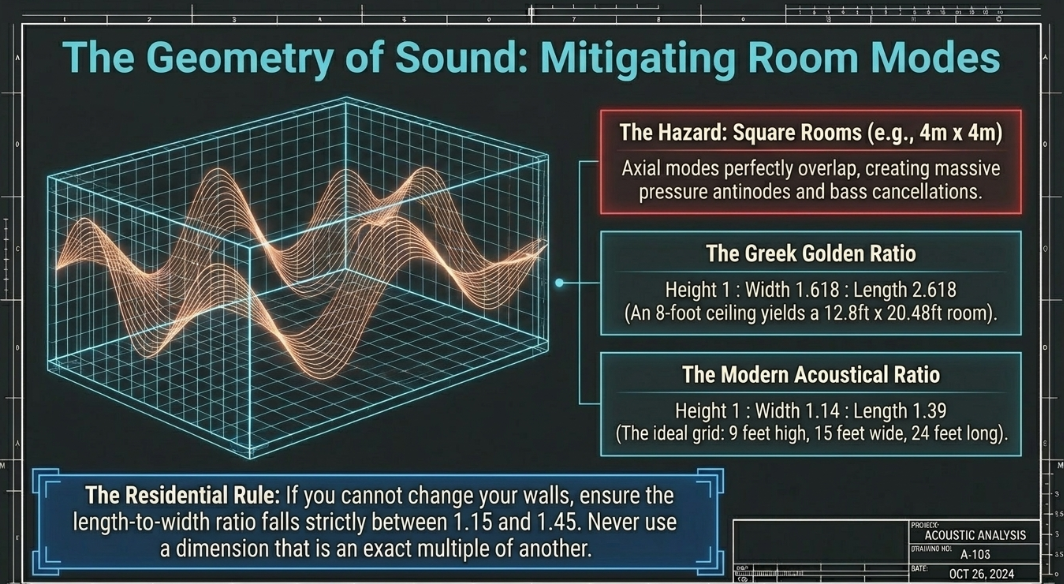
The three-dimensional geometry of a room dictates its acoustic behavior, particularly concerning high-energy, low-frequency sound waves. When the physical dimensions of a room correspond exactly to the wavelength of a specific frequency, "room modes" (or standing waves) are generated. These modes cause massive pressure buildups (antinodes) and total phase cancellations (nodes) at specific physical locations within the room, resulting in an uneven, muddy, or highly distorted frequency response.2
Acoustical physics demonstrates that square rooms—where the length and width are identical (e.g., 4m x 4m)—are the most problematic spaces possible, as axial modes perfectly overlap, amplifying specific bass frequencies to uncontrollable levels.2 Larger rooms, while generally preferred for tracking instruments, introduce significant travel distances for sound waves, resulting in prolonged echo and an uneven distribution of sound pressure where some areas sound loud while others lack clarity.42 Conversely, very small rooms push room modes higher up into the lower-midrange frequencies, muddying the fundamental frequencies of the human voice.
To optimize frequency spacing and mitigate modal overlapping, acousticians rely on specific mathematical dimension ratios when constructing or selecting rooms. The most famous is the classic Golden Ratio (Height : Width : Length), invented by the Greeks and defined mathematically as:

For a room with an 8-foot ceiling, optimal dimensions following this ratio would theoretically be 12.8 feet in width and 20.48 feet in length.44 Modern recording engineers frequently utilize an updated derivation of this ratio to achieve incredibly smooth frequency responses:

Under this modern ratio, an ideal listening and recording space might measure 9 feet high, 15 feet wide, and 24 feet long.45 In residential scenarios where precise architectural ratios cannot be met, acousticians recommend a simple design rule: ensuring that the length-to-width ratio (

Look for Asymmetrical Surfaces to Randomize Reflections
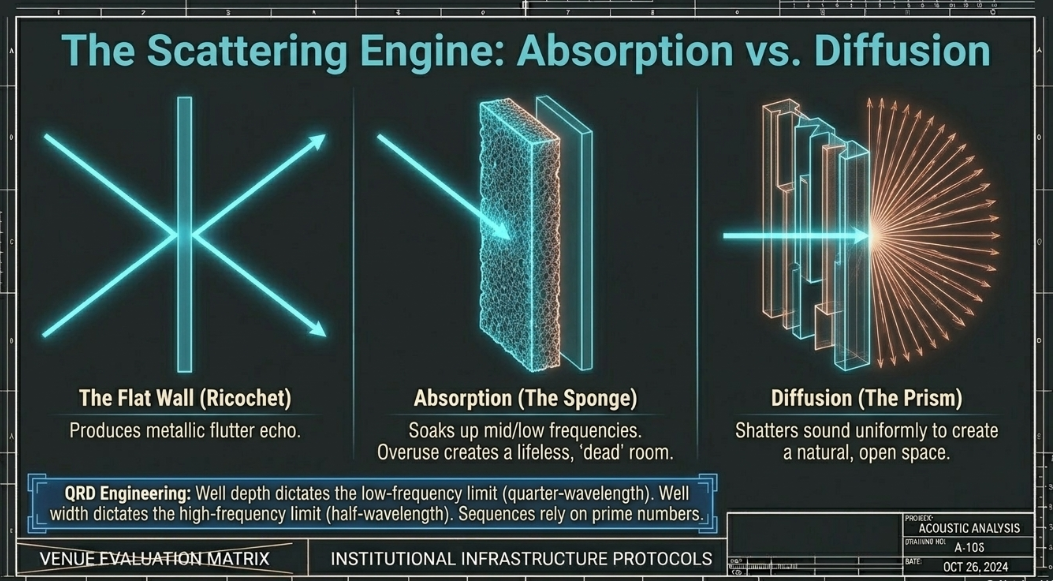
While dimensional room ratios primarily govern low-frequency behavior, mid-to-high frequencies behave much more like light, reflecting sharply off rigid, flat surfaces. In an untreated rectangular room, a flat wall will reflect sound at the exact opposite angle it arrived from.48 When sound bounces rapidly back and forth between parallel walls, it creates "flutter echo"—a rapid, metallic ringing that severely degrades the clarity of vocal recordings.43 To combat this, acoustic treatment requires a highly balanced deployment of both absorption and diffusion.50
Over-treating a room purely with absorptive foam is a common amateur mistake; it creates an unnaturally "dead" or anechoic environment that sounds oppressive, lifeless, and fatiguing to the listener.12 Therefore, diffusion—the even scattering of sound energy—is essential. Diffusers do not remove or absorb acoustic energy; rather, they break up the temporal and spatial reflections, redirecting sound waves in a complete 180-degree array.48 This ensures the reflections arrive at the microphone or listening position at varying times and much lower intensities, effectively tricking the ear into perceiving a much larger, more natural acoustic space without recognizing the true dimensions of the room.
Designing and Implementing Diffusion
True diffusion requires precise mathematical calculation, most notably seen in Quadratic Residue Diffusers (QRDs). These devices are not arbitrary shapes; they consist of varying depths of "wells" or troughs separated by thin dividers. The operation of a QRD is entirely frequency-dependent: the depth of the wells (following quarter-wavelength rules) dictates the lower frequency limits of the diffuser, while the width of the wells (following half-wavelength rules) governs the high-frequency limits.51 The sequence of these wells is determined by complex mathematical formulas utilizing prime numbers to ensure perfectly even scattering.48
Diffusers are broadly categorized into two types:
One-Dimensional (1D) Diffusers: Designed to scatter sound on a single axis (typically horizontally). This spreads sound energy in a 180-degree horizontal array, creating a wider perceived soundstage while maintaining vertical focus.51
Two-Dimensional (2D) Diffusers: Often referred to as "Skyline" diffusers due to their city-block appearance, these scatter sound both horizontally and vertically. Utilizing 2D diffusion on a standard 9-foot ceiling can make the room sound as if the ceiling is 12 to 13 feet high.51
Because diffusers function similarly to speakers, emitting a complex radiation pattern, they require sufficient physical distance for the scattered lowest octave to fully form before reaching the microphone.51 Consequently, they are best placed on the rear wall of a control room or the ceiling of a live space.51 For home podcasters operating on stringent budgets, DIY diffusers can be constructed using 2x2 and 1x6 lumber, following online pattern calculators to achieve professional results.53 Alternatively, asymmetrical furniture, such as heavily populated bookshelves, can act as rudimentary diffusers, provided the books vary significantly in depth and size to approximate randomized scattering.
Managing Room Asymmetry
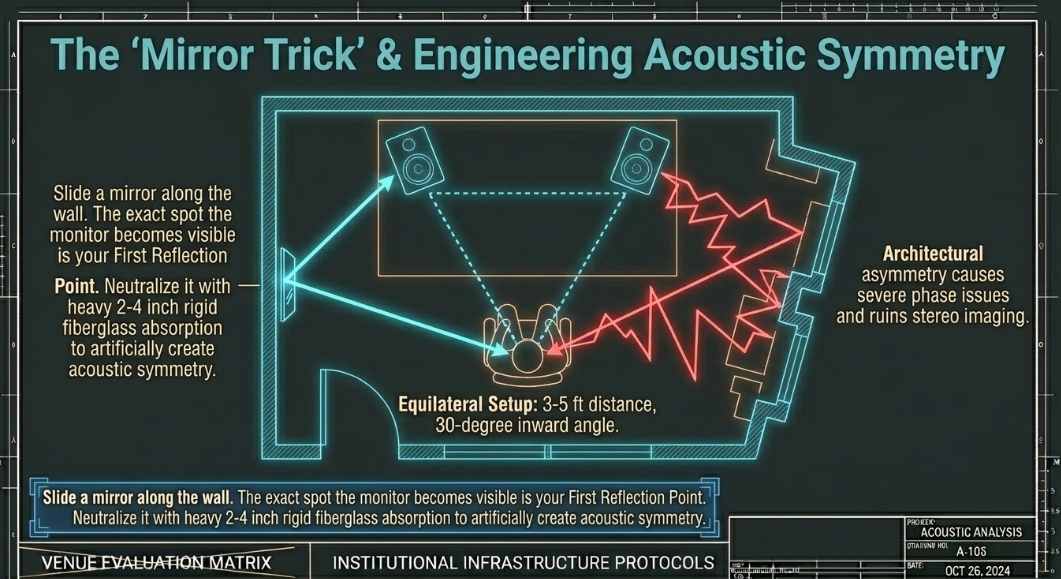
While introducing asymmetrical surfaces (like diffusers or bookshelves) into a symmetrical room is highly beneficial, dealing with an architecturally asymmetrical room (e.g., an L-shaped room, or a space with one angled wall) presents severe acoustic challenges. In an asymmetrical room, reflections from the left and right walls travel completely different distances before reaching the listener or microphone.58 This results in the reflections arriving out of sync, causing severe phase issues, comb filtering, and a hopelessly compromised stereo image.58 Equalization (EQ) cannot fix this time-domain distortion.58
To counteract architectural asymmetry, acousticians must engineer "acoustic symmetry" through strategic equipment placement and targeted treatment. The "Phantom Speaker Test" or the utilization of the "mirror trick" helps identify the exact first reflection points in an odd-shaped room.12 By placing heavy absorption at these specific reflection points on the side walls, the engineer effectively neutralizes the physical reflections, creating a symmetrical acoustic space within an asymmetrical physical envelope.57 In highly irregular spaces, positioning the setup in a corner facing outward can intentionally elongate lateral reflection path lengths, maximizing and equalizing the delay before reflections hit the microphone, thus reducing the immediate negative impact of the room's shape.
Consider the Surfaces of the Walls, Floor, and Ceiling
Every physical boundary in a recording space possesses a distinct absorption and reflection coefficient. Modifying the walls, floor, and ceiling is essential to control the aggregate reverberation time and isolate the recording from external interference.
Floors: Hardwood versus Carpet
The choice of flooring significantly impacts both airborne and structure-borne sound transmission. In acoustic engineering, floor performance is measured using two standard, universally recognized ASTM testing metrics:
Sound Transmission Class (STC): Evaluates how well a material blocks air-borne noise, such as voices, television audio, or traffic.63
Impact Insulation Class (IIC): Evaluates resistance to structure-borne mechanical impact, such as footsteps, dropped objects, or chair movement.36
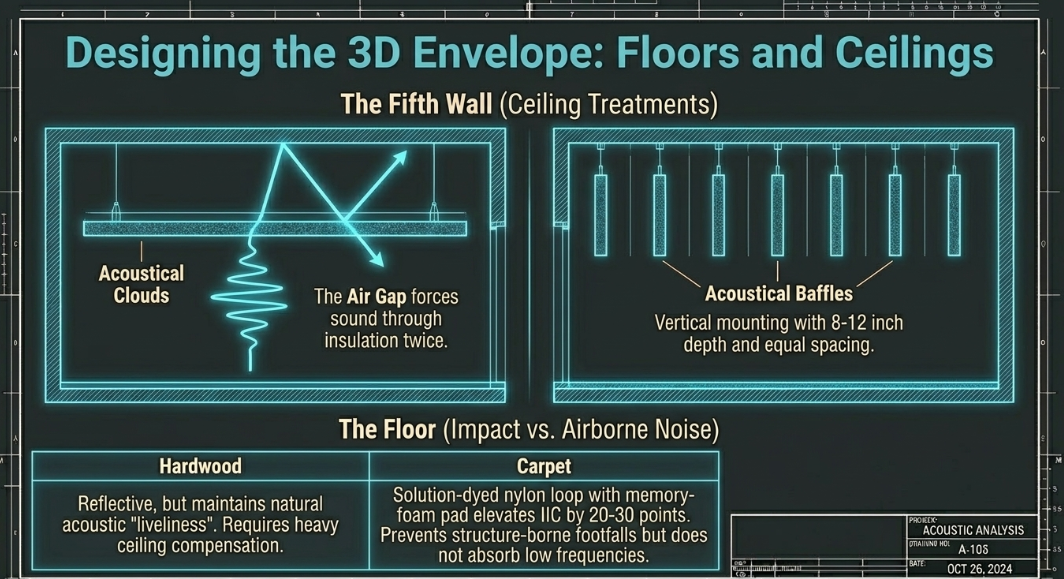
Hardwood and laminate floors are highly reflective by nature. Sound waves bounce sharply off them, drastically increasing overall room reverberation and causing sound to deflect back into the microphones.36 Conversely, carpet serves as an outstanding, broad-spectrum, high-frequency sound absorber.65 From a technical standpoint, utilizing a dense loop or textured cut-loop carpet (specifically solution-dyed nylon rather than polyester), paired with a high-density 8-10 lb rebond or memory-foam underpad, can elevate a floor's IIC rating by 20 to 30 points.36 This dramatically mitigates footfall transmission to lower levels and reduces ambient echo.36 However, it is vital to understand that carpet does not absorb low frequencies. Therefore, some audio engineers actually prefer the acoustic "liveliness" of a hardwood floor to maintain a natural tone, compensating for the floor's reflections by mounting thick absorptive materials and diffusers exclusively on the ceiling to control the vertical sound bounce.
Ceilings: Clouds and Baffles
The ceiling is often referred to as the "fifth wall" in acoustic design and is a primary source of destructive first reflections.67 To treat high, bare, or highly reflective commercial and residential ceilings, acousticians deploy specific suspended treatments: either baffles or clouds.
For maximum effectiveness, baffles should possess a depth of 8 to 12 inches, and their installed spacing should perfectly match their depth (e.g., 10-inch deep baffles spaced exactly 10 inches apart).67 When utilizing an acoustic cloud, the panel should be hung several inches below the structural ceiling rather than flush against it.12 The air gap between the panel and the hard boundary forces the sound wave to pass through the absorptive material twice (once upon entry, and again after reflecting off the hard ceiling), drastically improving its acoustic efficiency, particularly in lower frequency ranges.12 In basement studios featuring exposed floor joists, an incredibly cheap and effective DIY ceiling treatment involves simply packing the joist cavities with heavy insulation and stapling acoustic fabric over the bottom, instantly creating a massive, room-spanning bass trap.
Walls: Placement and Material Density
For walls, strategic placement is infinitely superior to blanket coverage. Mounting thin acoustic foam directly flush against a drywall surface primarily attenuates only high-frequency "zing." This results in a room that sounds unnatural, unbalanced, and "muddy" because the low-midrange frequencies remain completely uncontrolled and dominate the space.12 Professional panels must possess significant density and thickness (typically 2 to 4 inches of rigid fiberglass or rockwool). Furthermore, just like ceiling clouds, wall panels should be spaced a few inches off the wall using furring strips or cardboard to maximize their absorptive bandwidth and capture lower frequencies.12 The "mirror trick" remains the industry standard for locating horizontal first reflection points on side walls: a producer sits in the listening position while an assistant slides a mirror along the wall. The exact spot where the microphone or speaker becomes visible in the mirror marks the geometric point where absorptive treatment must be applied to prevent direct reflections.1
Finding a Place to Record at Home
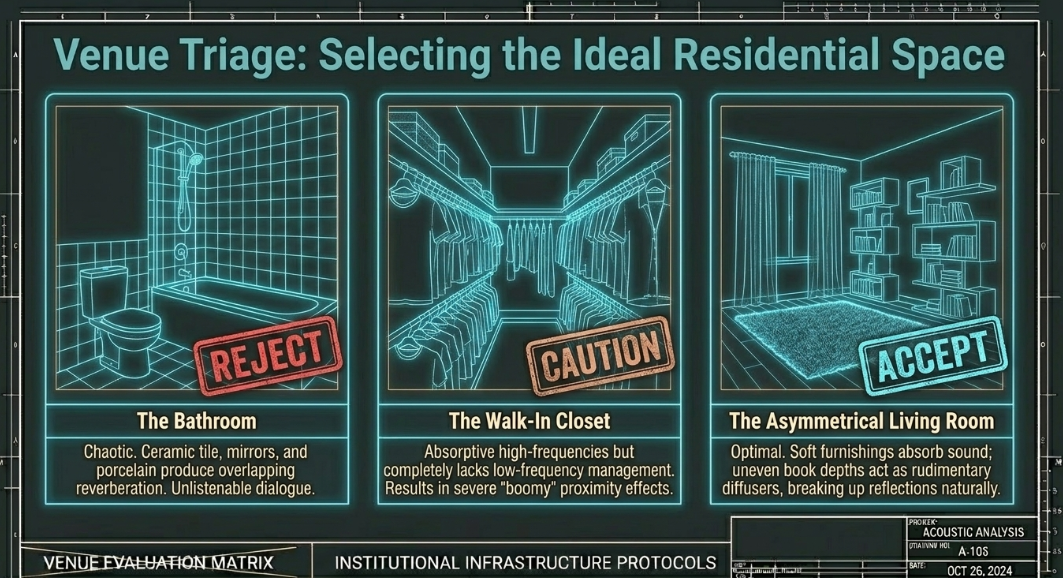
When a podcaster must select a specific space within a home environment, understanding basic acoustic physics immediately eliminates certain rooms. A surprisingly common misconception is that a bathroom—due to its physical isolation from the rest of the house—is a suitable recording environment. In reality, the ceramic tile, glass mirrors, and porcelain fixtures found in bathrooms are intensely reflective surfaces that produce chaotic, overlapping reverberation, rendering dialogue muddy, distant, and completely unlistenable.37
Conversely, the popular advice to record inside a walk-in closet is rooted in solid acoustic principles. A closet densely filled with soft, irregular materials (hanging clothing) acts as a highly absorptive, natural acoustic enclosure.37 The clothing provides massive high-frequency absorption, while the lack of large, parallel hard surfaces prevents flutter echo. However, closets are often too small to manage low-frequency resonances, potentially resulting in a "boomy" proximity effect where the bass frequencies of the voice become overwhelming.12
If a closet is unviable, the optimal choice is a medium-sized room (e.g., 
When configuring the monitoring setup within the chosen room, geometry is critical. The listener's seat and the two studio monitors must form a perfect equilateral triangle, with the listener positioned ideally 3 to 5 feet away.12 The speakers should be angled inward at exactly 30 degrees to face the listener directly, positioned at ear level, and pulled at least one meter away from the front wall to prevent destructive boundary interference and phase cancellations.12 Even in emergencies where a room is largely untreated, erecting a temporary "blanket fort" or draping heavy duvets over boom stands placed one meter behind the microphone can intercept immediate reflections, artificially creating a localized, dry recording zone.
Listening to the Space
Once a room is selected, furnished, and acoustically treated, the final critical step is objective evaluation. The acoustic response of a room is incredibly complex, dynamic, and entirely invisible. Without rigorous testing, acoustic treatment interventions are merely guesswork, often exacerbating existing problems rather than solving them.71
The Fallacy of the Clap Test
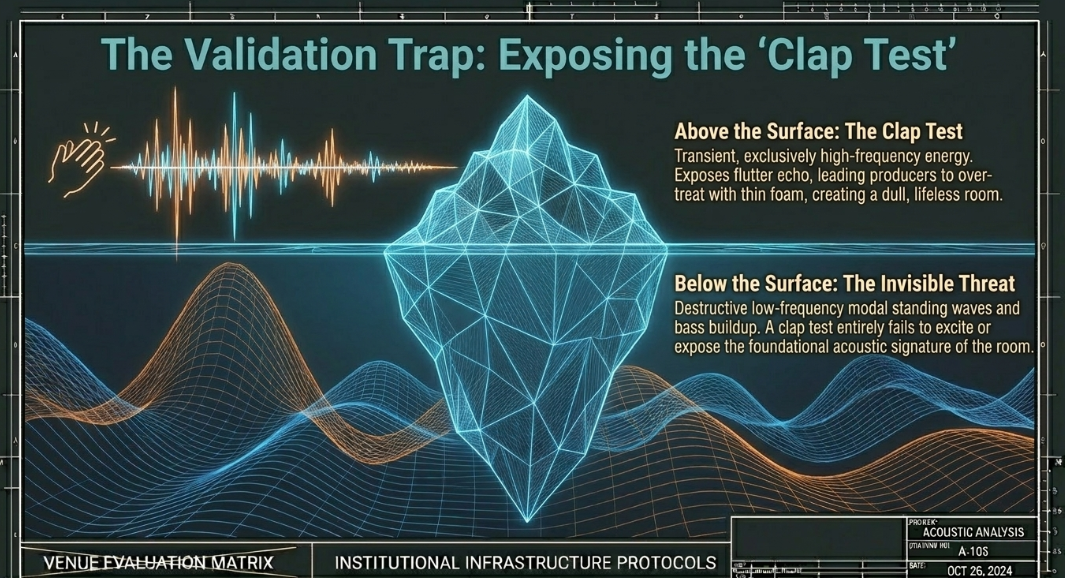
A widespread, rudimentary method for testing room acoustics among amateur producers is the "clap test"—clapping hands loudly and listening to the resulting echo to diagnose room quality.72 While a handclap will readily expose high-frequency flutter echo pinging between parallel walls, it is an incomplete, inherently flawed, and highly misleading diagnostic tool.49
A human clap generates a sharp, transient burst of exclusively high-frequency acoustic energy. It entirely fails to excite the low and lower-midrange frequencies that dictate the foundational acoustic signature and modal behavior of a room.72 Relying solely on a clap test often leads producers to over-treat their rooms with thin acoustic foam, deadening the high frequencies to eliminate the flutter, while leaving massive standing waves and destructive bass buildup completely unresolved.12 This results in a severely imbalanced, muddy recording environment. In one documented case study, a filmmaker utilized a clap test to incorrectly diagnose an acoustically perfect home cinema as "flawed," proceeding to destroy the room's carefully tuned 
Objective Acoustic Measurement
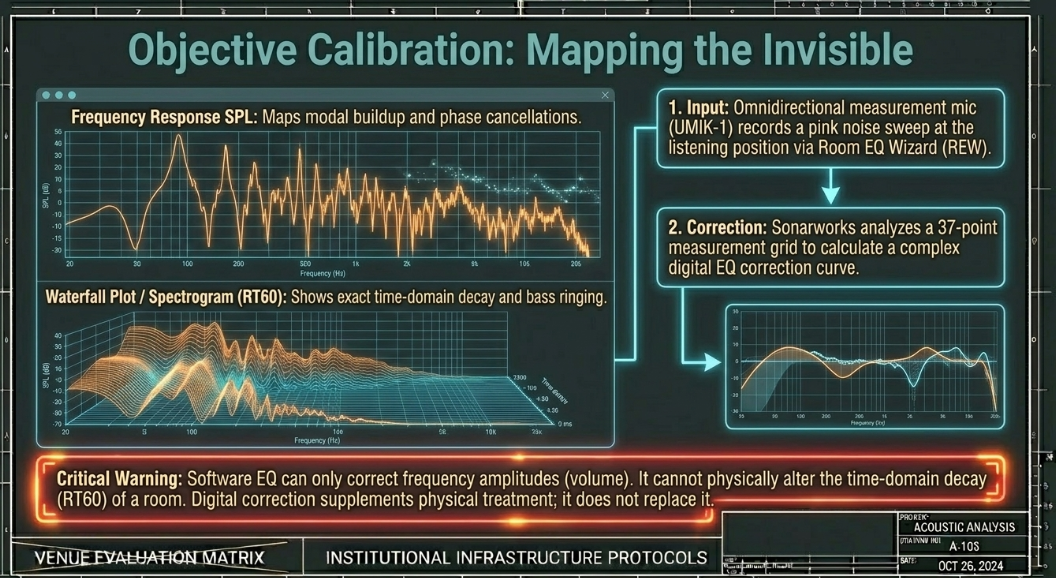
Professional acoustic calibration requires sophisticated analysis software and specialized measurement hardware. Room EQ Wizard (REW) is an industry-standard, free acoustic analysis software suite that, when paired with a calibrated, omnidirectional measurement microphone (such as the miniDSP UMIK-1 or Dayton Audio EMM-6), visualizes the precise, microscopic acoustic behavior of a room.12
By projecting frequency sweeps and pink noise through the monitoring system and capturing the room's reaction via the measurement microphone placed precisely at the listening position, REW generates a suite of detailed visual plots.12 These critical analytics include:
Frequency Response and SPL Graphs: Identifying specific peaks (modal buildup) and nulls (phase cancellations) across the entire audible spectrum.12
Waterfall Plots and Spectrograms: Illustrating the decay time of specific frequencies in the time domain, revealing exactly how long low-frequency energy "rings" or sustains in the space before fully dissipating.12
Once the acoustic anomalies are mathematically mapped, physical acoustic treatment (bass traps, panels, diffusers) can be micro-adjusted. If physical treatment cannot entirely resolve the issues due to architectural limitations, audio engineers utilize highly advanced digital room correction algorithms, such as Sonarworks Reference 4.12 This software analyzes a painstaking 37-point measurement grid recorded around the listening position using a specialized microphone (like the XREF20).12 The software then calculates and applies a highly complex EQ correction curve directly to the digital audio output (either systemwide or via a DAW plugin), artificially flattening the room's frequency response to ensure that mixing and monitoring decisions are perfectly accurate.12 However, it is vital to understand the limitations of digital correction: software EQ can only correct frequency amplitudes (volume). It cannot physically alter the time-domain behavior or decay time (
Summary
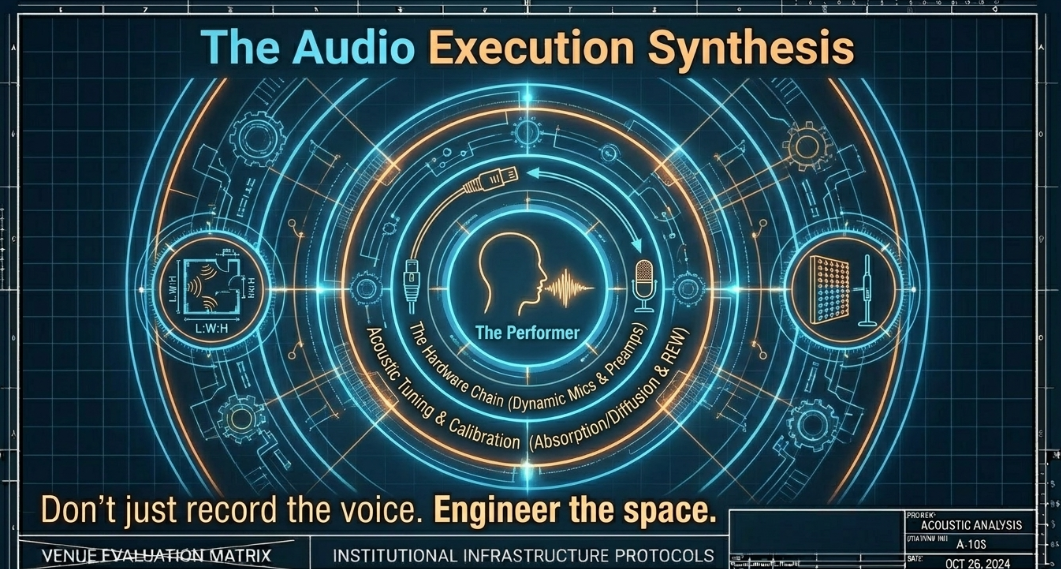
The execution of professional indoor audio recording is a rigorous exercise in managing the immutable physics of sound. Whether a producer is operating in a high-end commercial coworking facility equipped with cyclorama walls, a repurposed library makerspace funded by federal grants, a local radio station leveraging specialized IP codecs, or a retrofitted residential bedroom, the fundamental acoustic laws remain absolute. Capturing pristine, broadcast-ready audio requires a holistic, systemic approach that balances the electronic signal chain—utilizing robust dynamic microphones and clean, high-headroom pre-amplification—with stringent, calculated environmental controls.
Producers must aggressively mitigate the ambient noise floor through structural isolation to achieve a high signal-to-noise ratio, while carefully controlling internal room reflections through a mathematically sound deployment of broadband absorption and targeted diffusion. Understanding the impact of dimensional room ratios, respecting the severe phase issues introduced by structural asymmetry, leveraging the contrasting acoustic properties of surface materials like carpet and hardwood, and relying on objective software measurements rather than flawed subjective auditory tests are all mandatory competencies. By comprehensively addressing and manipulating these variables, audio professionals can ensure that their technical execution perfectly matches the quality of their content, delivering a transparent, highly intelligible auditory experience that commands and retains listener engagement in an increasingly saturated digital landscape.
Works cited
A Guide To Professional Podcast Studio Design | Fame, accessed May 14, 2026, https://www.fame.so/post/podcast-studio-design
Room Design Considerations for Optimal Podcasting - Acoustics.org, accessed May 14, 2026, https://acoustics.org/room-design-considerations-for-optimal-podcasting/
Why Podcasting Is the Ultimate Business Tool in Coworking, accessed May 14, 2026, https://nuvodesk.com/why-podcasting-is-the-ultimate-business-tool-in-coworking/
5 Benefits of Having a Podcast Studio in a Coworking Space - Paddington Works, accessed May 14, 2026, https://www.paddingtonworks.com/5-benefits-of-having-a-podcast-studio-in-a-coworking-space/
Rent Fully Equipped Professional Podcast Studios - Venture X, accessed May 14, 2026, https://venturex.com/solutions/podcast-rooms/
Top 10 Coworking Spaces in Nashville Yards for Creative Entrepreneurs, accessed May 14, 2026, https://amperstudios.com/top-10-coworking-spaces-in-nashville-yards-for-creative-entrepreneurs/
Eight pro podcast studios that are waiting for your show - WeWork, accessed May 14, 2026, https://www.wework.com/ideas/workspace-solutions/flexible-products/eight-pro-podcast-studios-that-are-waiting-for-your-show
Why a Coworking Podcast Room is Your Audio Oasis, accessed May 14, 2026, https://spokecoworkingtucson.com/a/why-coworking-podcasts-are-awesome
How to Test Your Noise Floor - YouTube, accessed May 14, 2026, https://www.youtube.com/watch?v=INslHz-NfZ4
How To Record A Podcast (The Easy Way) - YouTube, accessed May 14, 2026, https://www.youtube.com/watch?v=rZcIv6xxL_s
The ultimate podcast equipment guide for creators, accessed May 14, 2026, https://creators.spotify.com/resources/grow/podcast-equipment-guide
7 Essential Tips For Treating Your Home Studio | BuzziSpace, accessed May 14, 2026, https://www.buzzi.space/inspiration/7-essential-tips-for-treating-your-home-studio
A Librarian's Guide to Makerspaces: 16 Resources | OEDB.org, accessed May 14, 2026, https://www.oedb.org/ilibrarian/a-librarians-guide-to-makerspaces/
MakerSpaces in Libraries, accessed May 14, 2026, https://www.urbanlibraries.org/resources/makerspaces-in-libraries
Makerspaces and Making in California Public Libraries: Fostering Community Creativity, accessed May 14, 2026, https://www.library.ca.gov/uploads/2024/06/Makerspaces-in-California-Public-Libraries_-Fostering-Community-Creativity.pdf
Makerspaces | Public Library Association, accessed May 14, 2026, https://www.ala.org/pla/resources/tools/technology/makerspaces
Information Commons Recording Studio | Brooklyn Public Library, accessed May 14, 2026, https://www.bklynlibrary.org/locations/central/dept/infocommons/recording-studio
Start A Library Podcast | New Jersey State Library, accessed May 14, 2026, https://www.njstatelib.org/start-a-library-podcast/
The Power of Podcasting: Conversations that Create Community – News - UD Library, accessed May 14, 2026, https://library.udel.edu/news/2020/07/22/the-power-of-podcasting-conversations-that-create-community/
Library Makerspaces - Planning Your Space, accessed May 14, 2026, http://nlc.nebraska.gov/libraries/maker/planning.aspx
How to Start a Library Podcast in 8 Simple Steps, accessed May 14, 2026, https://www.urbanlibraries.org/blog/how-to-start-a-library-podcast-in-8-simple-steps
Podcast Studio Guidelines | Baytown, TX, accessed May 14, 2026, https://baytown.org/1513/Podcast-Studio-Guidelines
Recording Studio | Garland, TX, accessed May 14, 2026, https://www.garlandtx.gov/4519/Recording-Studio
Podcast Studio Policy - Montgomery County Memorial Library System, accessed May 14, 2026, https://countylibrary.org/about_us/about/policies/podcast_studio_policy.php
Audio and Podcasting Studio | Racine Public Library, accessed May 14, 2026, https://www.racinelibrary.info/use-your-library/innovation-lab/studio/
Community Radio & Podcasting: Benefits and Best Practices - Cablecast, accessed May 14, 2026, https://www.cablecast.tv/cablecast-blog/community-radio-and-podcasting-benefits-and-best-practices
How to Get Your Podcast on Broadcast Radio, accessed May 14, 2026, https://bulletin.bigpodcast.com/how-to-get-your-podcast-on-the-radio
Need help figuring out how to record a music podcast - Reddit, accessed May 14, 2026, https://www.reddit.com/r/podcasting/comments/vkr8ta/need_help_figuring_out_how_to_record_a_music/
How do I get in touch with a radio station for the first time so that they air a radio show I have created? - Reddit, accessed May 14, 2026, https://www.reddit.com/r/radio/comments/l0h98g/how_do_i_get_in_touch_with_a_radio_station_for/
APPROACHING A RADIO OR TELEVISION STATION, accessed May 14, 2026, https://www.sertoma.org/Portals/SERTOMA/4-Approaching-a-Radio-or-Television-Station.pdf
Talking for Radio - The Open Notebook, accessed May 14, 2026, https://www.theopennotebook.com/2015/06/30/talk-for-radio/
BRIC-Link III - Comrex, accessed May 14, 2026, https://www.comrex.com/products/bric-link-iii/
Looking for a two-way streaming solution for remotes : r/radio - Reddit, accessed May 14, 2026, https://www.reddit.com/r/radio/comments/1jd30ql/looking_for_a_twoway_streaming_solution_for/
Radio & Broadcast | Cleanfeed, accessed May 14, 2026, https://cleanfeed.net/radio-broadcast
Soundproofing and Acoustic Treatments for Your Podcast - Audimute, accessed May 14, 2026, https://www.audimute.com/blog/soundproofing-and-acoustic-treatments-for-podcast/
Carpet vs Hardwood Noise Reduction | Sacwal Flooring Centres Ontario, accessed May 14, 2026, https://www.sacwalflooringcentres.com/blog/articles/carpet-vs-hardwood-for-noise-reduction-in-open-concept-ontario-homes
Finding the Right Podcast Recording Space - Pro Voice Guy, accessed May 14, 2026, https://www.provoiceguy.net/blog/finding-the-right-podcast-recording-space
A Podcaster's Guide To Noise Reduction | by Joe Nash - Medium, accessed May 14, 2026, https://medium.com/@jowie/a-podcaster-s-guide-to-noise-reduction-e8cad9fc21f4
Demystifying the Noise Floor: Unraveling its Impact on Audio Quality - WhisperRoom, accessed May 14, 2026, https://www.whisperroom.com/blog/demystifying-the-noise-floor-unraveling-its-impact-on-audio-quality
About background noise levels | Nureva support, accessed May 14, 2026, https://support.nureva.com/docs/about-background-noise-levels
How to Measure Noise Floor Level in Reaper | Quick Tutorial - YouTube, accessed May 14, 2026, https://www.youtube.com/watch?v=lK5iK9LIpzQ
Room Size & Surface Properties: Their Impact on Acoustics, accessed May 14, 2026, https://www.acousticalsurfaces.com/blog/acoustics-education/room-size/
Podcast Studio Design Guide: Plan It Properly | Sound Zero, accessed May 14, 2026, https://sound-zero.com/podcast-studio-design-guide/
SOUND 101: The “Golden Acoustic Ratio” | RADIOBOMB - WordPress.com, accessed May 14, 2026, https://radiobombfm.wordpress.com/2012/09/15/sound-101-the-golden-acoustic-ratio/
Critical room dimensions - PS Audio, accessed May 14, 2026, https://www.psaudio.com/blogs/pauls-posts/critical-room-dimensions
Golden Ratio in Acoustics | Aural Exchange, accessed May 14, 2026, https://www.auralexchange.com/knowledgebase/golden-ratio-in-acoustics/
Preferred dimension ratios of small rectangular rooms, accessed May 14, 2026, https://odeon.dk/pdf/A29-JASA-EL-021601_1_Rindel.pdf
Understanding Diffusion And How To Use It In Your Room | GIK Acoustics, accessed May 14, 2026, https://www.gikacoustics.com/blogs/knowledge-base/understanding-diffusion
You're doing the “clap test” WRONG (how to remove FLUTTER ECHO) - YouTube, accessed May 14, 2026, https://www.youtube.com/watch?v=7s6F_uXt9Jk
A Beginner's Guide To Acoustic Treatment - Sound On Sound, accessed May 14, 2026, https://www.soundonsound.com/sound-advice/beginners-guide-acoustic-treatment
Sound Diffusion in Small Rooms – Acoustic Fields, accessed May 14, 2026, https://www.acousticfields.com/sound-diffusion-in-small-rooms/
Acoustic panels to the rescue: fixing asymmetrical speaker setups - Dynaudio, accessed May 14, 2026, https://dynaudio.com/magazine/2025/may/acoustic-treatment-ask-the-expert
The Best DIY Acoustic Diffuser Panel - How To Make A 3D Skyline Diffuser - YouTube, accessed May 14, 2026, https://www.youtube.com/watch?v=IGclF77Cskc
How To Build This Beautiful DIFFUSER to get BETTER ACOUSTICS - YouTube, accessed May 14, 2026, https://www.youtube.com/watch?v=4R6ZE4hxeec
How To Build A HUGE Acoustic Sound Diffuser! DIY PRO! - YouTube, accessed May 14, 2026, https://www.youtube.com/watch?v=8PQGsKh7RuM
Home studio soundproofing and DIY acoustic room treatment - CafeSaxophone Forum, accessed May 14, 2026, https://cafesaxophone.com/threads/home-studio-soundproofing-and-diy-acoustic-room-treatment.36868/
From The Audiophile's Guide: Dealing with Odd-Shaped Rooms - PS Audio, accessed May 14, 2026, https://www.psaudio.com/blogs/copper/from-em-the-audiophile-s-guide-em-dealing-with-odd-shaped-rooms
Asymmetric vs symmetric room | Audio Science Review (ASR) Forum, accessed May 14, 2026, https://www.audiosciencereview.com/forum/index.php?threads/asymmetric-vs-symmetric-room.26528/
Room Acoustics: Strategies for different room shapes - YouTube, accessed May 14, 2026, https://www.youtube.com/watch?v=wOTAS7ncihI
Understanding room modes in oddly shaped rooms - Acoustics Insider, accessed May 14, 2026, https://www.acousticsinsider.com/blog/odd-room-dimensions-shape-your-sound-and-how-to-deal-with-it
If my room is asymmetrical, how does that affect treatment? - Acoustics Insider, accessed May 14, 2026, https://www.acousticsinsider.com/blog/if-my-room-is-asymmetrical-how-does-that-affect-treatment
Best way to deal with a highly asymmetrical room? | Audio Science Review (ASR) Forum, accessed May 14, 2026, https://www.audiosciencereview.com/forum/index.php?threads/best-way-to-deal-with-a-highly-asymmetrical-room.47818/
Flooring & Acoustic Ratings Explained, accessed May 14, 2026, https://metrofloors.com/acoustics-101
Acoustics Better With Carpet or Hardwood/Laminate? : r/hometheater - Reddit, accessed May 14, 2026, https://www.reddit.com/r/hometheater/comments/cbiqb7/acoustics_better_with_carpet_or_hardwoodlaminate/
Acoustical Characteristics of Carpet, accessed May 14, 2026, https://carpet-rug.org/wp-content/uploads/2018/08/Acoustical-Characteristics-of-Carpet.pdf
Floor choice for best acoustics: Carpet or Wood? - Audio Science Review (ASR) Forum, accessed May 14, 2026, https://www.audiosciencereview.com/forum/index.php?threads/floor-choice-for-best-acoustics-carpet-or-wood.15621/page-2
A Specifier's Guide: Acoustical Baffles vs Clouds - Altispace, accessed May 14, 2026, https://altispace.com/a-specifiers-guide-acoustical-baffles-vs-clouds/
Design Guide: Acoustical Baffles vs. Acoustical Clouds - CSI Creative, accessed May 14, 2026, https://www.csicreative.com/blog/design-guide-acoustical-baffles-vs-acoustical-clouds/
6 Acoustic Ceiling Options to Curb Excess Noise in the Office - Arktura, accessed May 14, 2026, https://arktura.com/6-acoustic-ceiling-options-to-curb-excess-noise-in-the-office/
From which height does it become unnecessary to use acoustic panel clouds? - Reddit, accessed May 14, 2026, https://www.reddit.com/r/audioengineering/comments/1j3r0ak/from_which_height_does_it_become_unnecessary_to/
Home Recording: Analyzing Your Room's Acoustics to Get Flat vs. Making Your Room Sound "Good" To You : r/audioengineering - Reddit, accessed May 14, 2026, https://www.reddit.com/r/audioengineering/comments/a53fbt/home_recording_analyzing_your_rooms_acoustics_to/
The Myth of the Clap Test: An Unreliable Measure of Room Acoustics, accessed May 14, 2026, https://sosacoustics.co.uk/2025/02/17/the-myth-of-the-clap-test-an-unreliable-measure-of-room-acoustics/
The power of the clap test : r/audioengineering - Reddit, accessed May 14, 2026, https://www.reddit.com/r/audioengineering/comments/c9kzkc/the_power_of_the_clap_test/
Handclap for Acoustic Measurements: Optimal Application and Limitations - MDPI, accessed May 14, 2026, https://www.mdpi.com/2624-599X/2/2/15
Acoustic Measurement: Optimize Your Studio's Sound Quality - Studiobricks, accessed May 14, 2026, https://studiobricks.com/news/acoustic-measurement/