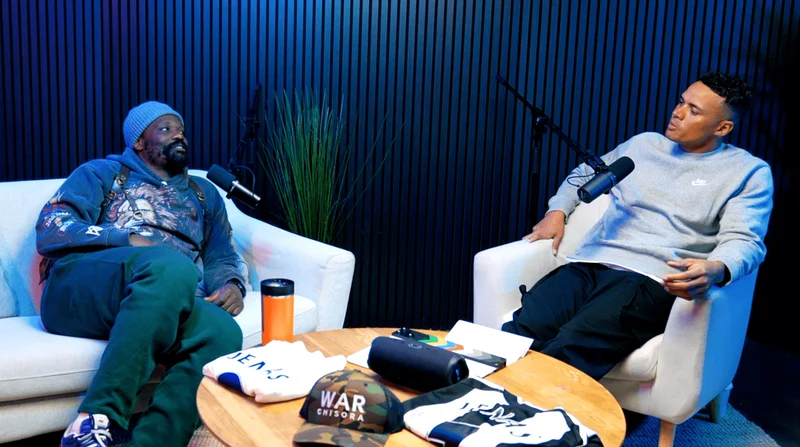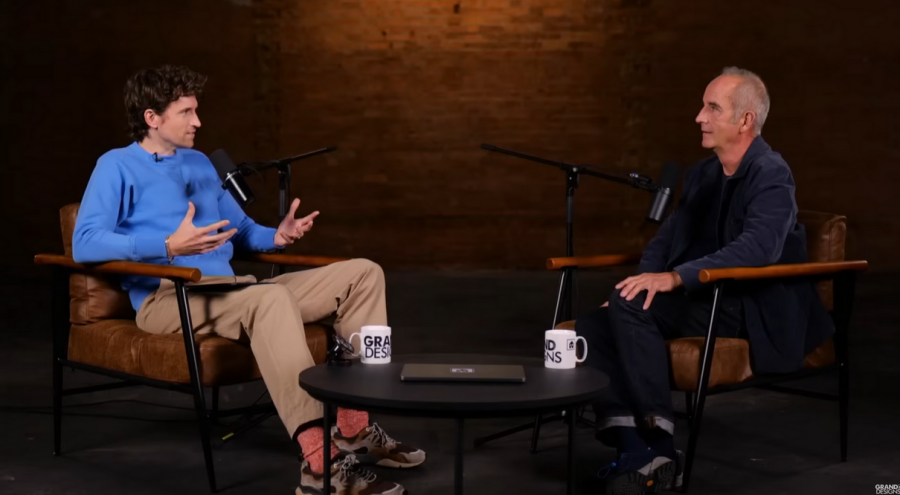
Stand out from the social media noise: why you should be podcasting
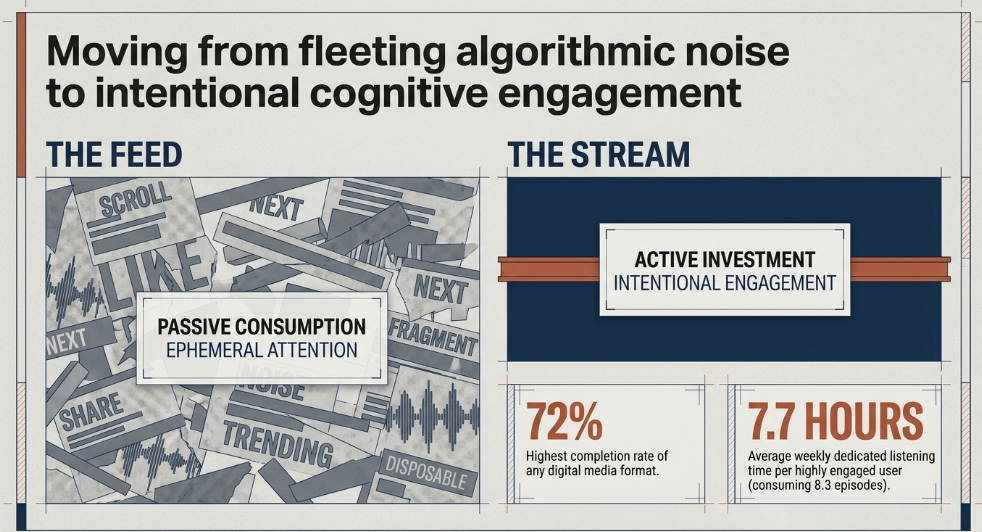
The digital landscape is currently characterized by an overwhelming volume of algorithmic noise, fleeting attention spans, and an ever-increasing saturation of visual, short-form content. Amidst this highly fragmented media environment, podcasting has emerged as a distinct, premium channel defined by deep, intentional engagement. Unlike social media platforms—where content is passively consumed and aggressively scrolled past within seconds—long-form audio content requires a deliberate decision from the user to press play. This inherent intentionality translates into a highly attentive and captive audience. For marketers and content creators, the medium offers an unprecedented opportunity to bypass the superficiality of traditional digital feeds. Instead of battling algorithms for momentary impressions, podcasting allows brands to establish a direct, intimate line of communication with consumers, fostering an environment where complex narratives, nuanced thought leadership, and sustained brand building can genuinely thrive.
The growth of podcasts
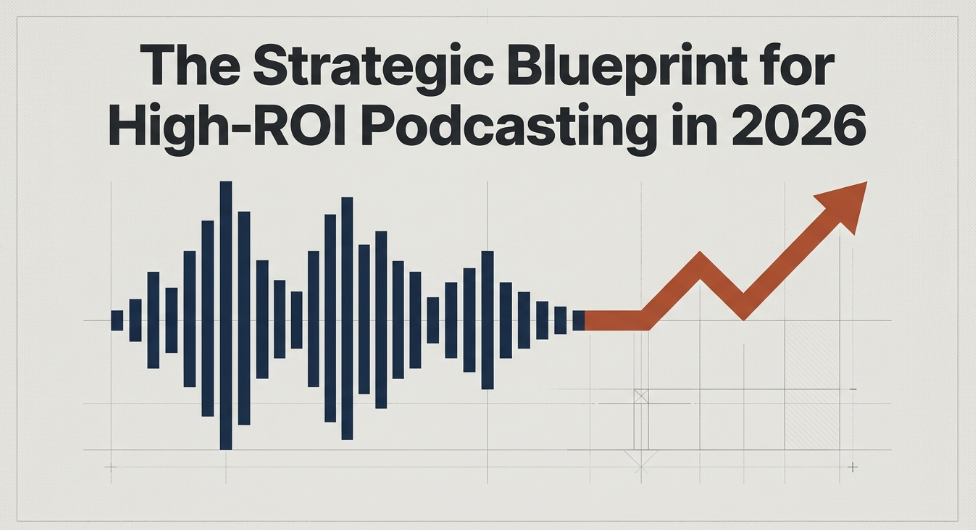
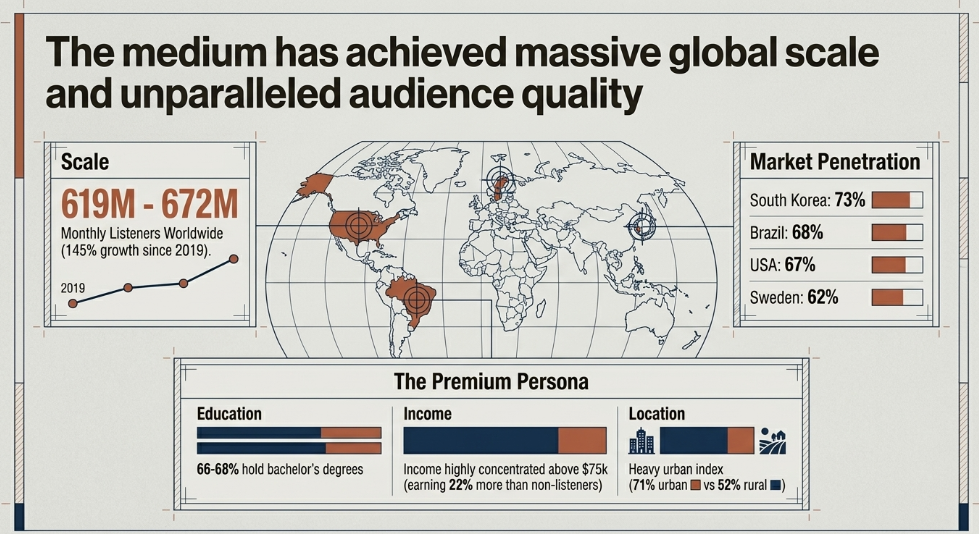
The maturation of the podcasting industry over the last decade has transformed it from a niche hobbyist medium into a foundational pillar of global media consumption. By the end of 2026, the global podcast audience will reach an estimated 619.2 to 672 million monthly listeners, representing a staggering 145% growth trajectory since 2019.1 In the United States alone, 67% of the population aged 12 and older now listens to podcasts on at least a monthly basis, while weekly listenership has surged to encompass 45% of the population.1 This rapid expansion is supported by the availability of 4.4 to 4.69 million active podcasts and over 214 million individual episodes across all digital directories.1 As the medium continues to grow at a compound annual growth rate that significantly outpaces traditional digital advertising channels, it has firmly solidified its position as a primary vector for information, entertainment, and commercial marketing.
The barrier to entry
While the technological barrier to entry for podcasting has never been lower, the strategic and creative barriers remain formidable. Affordable dynamic microphones, intuitive recording software, and accessible hosting platforms have thoroughly democratized audio production, allowing virtually anyone to publish an episode.4 However, this unprecedented ease of publication has cultivated a hyper-competitive ecosystem. With an average of 85,000 new episodes published weekly worldwide, simply launching a podcast and submitting an RSS feed is no longer sufficient to guarantee an audience.1 Today, the true barrier to entry lies in the ability to craft compelling narratives, execute precise digital distribution strategies, and sustain long-term audience engagement amidst millions of competing shows.1 Success requires treating the podcast not as a casual experiment, but as a rigorous, professionally managed media property.
Podcast passion
The inherent intimacy of spoken-word audio fosters a unique parasocial relationship between the host and the listener. This connection generates a level of audience passion and loyalty rarely observed in other digital formats. Listeners routinely invite podcast hosts into their private, daily routines—during commutes, household chores, or exercise regimens. Consequently, completion rates for podcasts are remarkably high. Industry data indicates that 72% of listeners finish episodes in their entirety, representing the highest completion rate of any digital media format currently available.1 Furthermore, highly engaged weekly listeners consume a large volume of content, tuning into an average of 8.3 episodes per week, representing roughly 7.7 hours of dedicated listening time.3 This sustained attention span demonstrates a profound level of cognitive investment from the audience.
The podcast opportunity
The commercial opportunity within the podcasting sphere is substantial, highly scalable, and expanding rapidly. The global podcast market valuation is estimated at approximately $38 to $40 billion in 2025, with worldwide advertising spending projected to exceed $4.46 billion to $5.0 billion by 2026.6 Advertisers and marketers are capitalizing on the medium's high engagement metrics, noting that 85% of podcast audiences have taken a brand action—such as visiting a website or utilizing a promotional code—after hearing an audio campaign.8 For brands and individual creators alike, podcasting represents a rare convergence of high-fidelity storytelling, targeted niche reach, and measurable commercial outcomes. Whether utilized for direct-response advertising, B2B pipeline acceleration, or top-of-funnel brand awareness, podcasting is an indispensable component of modern digital marketing strategies.
References and further reading
To fully contextualize the historical growth and future trajectory of the medium, marketing practitioners are advised to monitor ongoing longitudinal studies. The annual Infinite Dial report published by Edison Research serves as the industry standard for tracking consumer adoption rates, audio consumption behaviors, and platform penetration. Additionally, global market analyses provided by PwC’s Global Entertainment & Media Outlook and the Interactive Advertising Bureau (IAB) offer vital context regarding macroeconomic shifts in audio advertising expenditures, programmatic insertion adoption, and international regulatory trends affecting digital media distribution.
Podcast adoption: growth and expansion of podcasting as a popular medium
The adoption of podcasts has decisively transcended early-adopter demographics, achieving mainstream market penetration across varied geographic and socioeconomic boundaries. It is no longer considered an emerging alternative channel; rather, it has become a fundamental daily habit for hundreds of millions of people globally, fundamentally altering how information and entertainment are distributed and monetized.
Global adoption of podcasts
While the United States remains the largest market by total revenue and absolute listener volume, international audience growth is accelerating at a much faster pace. South Korea leads the world in market penetration, with 73% of the adult population tuning into podcasts on a monthly basis.1 Brazil follows closely at 68%, demonstrating the massive appeal of audio content in Latin America—a region experiencing 34% year-over-year growth, making it the fastest-growing market globally.1 The European market is also expanding at an annual rate of 24%, driven by strong adoption in countries like Sweden.1
Demographics of podcast listeners
The demographic profile of the average podcast listener is highly attractive to marketers and brand strategists. The audience leans heavily toward younger, educated, and affluent individuals, making them a prime target for premium goods, services, and B2B solutions.
Furthermore, the gender distribution has achieved near parity across global markets, with approximately 51% to 57% of monthly US listeners identifying as male and 48% to 52% identifying as female.9 Geographically, the medium indexes heavily toward metropolitan centers, with 71% of urban residents listening monthly compared to 52% in rural areas.1
New ways of listening
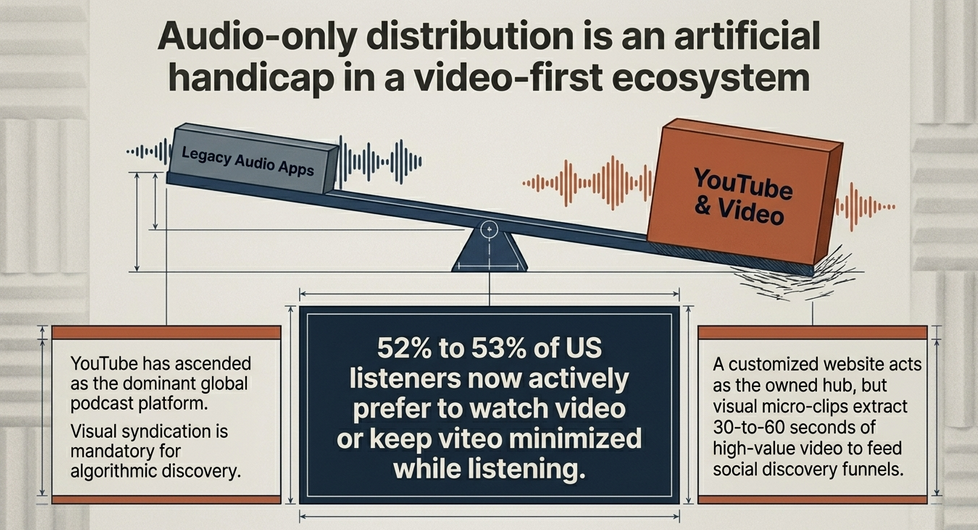
The architecture of podcast consumption has evolved significantly over the past five years. While mobile devices remain the undisputed dominant hardware—representing 86.1% to 89% of primary listening devices—the specific platforms utilized on these devices have shifted.1 The most profound structural change in the industry is the rapid transition to video-first podcasting. YouTube has ascended to become the dominant podcast platform, with 52% to 53% of US listeners now preferring to actively watch video podcasts or keep the video minimized while listening.1 This paradigm shift means audio-only publishing is increasingly viewed as a distribution handicap.12 Additionally, the proliferation of smart speakers and seamless in-car infotainment integrations has embedded podcasts deeply into domestic environments and daily commutes.
References and further reading
For deeper insights into audience demographics and hardware adoption, regular review of statistical aggregators is recommended. Reports from eMarketer, Statista, and specialized research divisions within major agencies provide ongoing updates regarding the shift from traditional radio to on-demand audio. These resources are particularly valuable for tracking the accelerating convergence of audio and video platforms, as well as the rising penetration rates of smart audio devices in emerging global markets.
Understanding how people really listen to and absorb audio content
To effectively market a podcast and maximize its impact, one must thoroughly understand the behavioral mechanics of the audience. Listening is rarely a singular, isolated activity; rather, it is frequently a secondary, companion activity that enhances primary tasks.
What, where and when
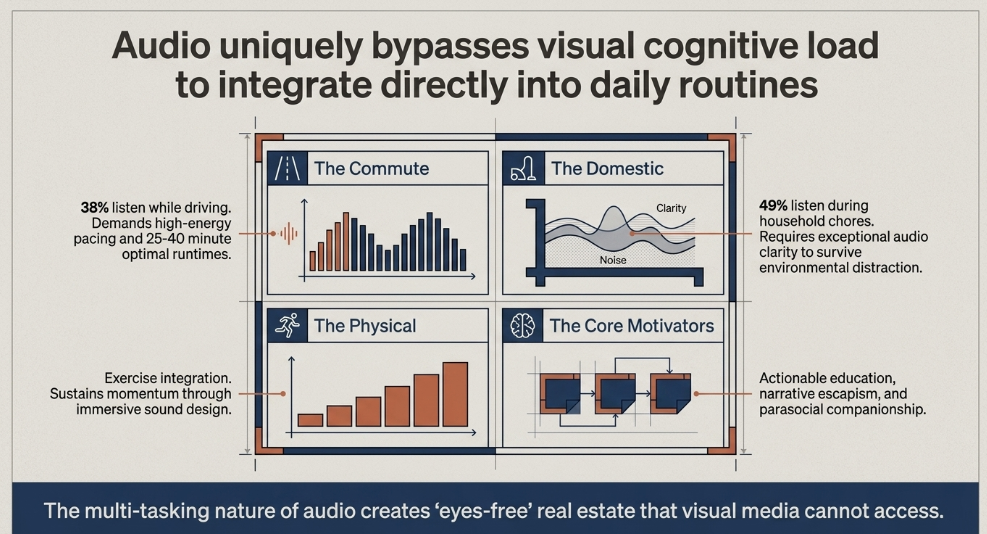
Audience behavior data reveals distinct environmental and temporal patterns for audio consumption. Approximately 38% of podcast listeners tune in while driving, transforming the daily commute into a dedicated learning or entertainment window.10 Another 49% consume episodes while performing household chores, and a significant portion listen during exercise routines.10 This multi-tasking nature means the audio must be produced with exceptional clarity and structured in a way that accommodates occasional cognitive lapses. The content must be captivating enough to sustain attention, yet accessible enough that a listener does not lose the overarching narrative thread while navigating traffic or completing a task.
Understanding the Why: building personas
Developing a rigorous podcast strategy requires moving beyond surface-level demographic data to construct deep, psychographic personas. Why does the target audience press play? The motivations typically fall into three primary categories: actionable education, narrative entertainment, and parasocial companionship.13 In the B2B sector, listeners tune in to advance their careers, seek competitive industry intelligence, or solve specific operational bottlenecks within their organizations. In the consumer space, listeners often seek companionship from trusted hosts or immersive narrative escapism. Building accurate listener personas involves meticulously mapping these specific emotional and practical needs and ensuring the podcast's core value proposition directly addresses them.
Speed of content
The velocity at which audio content is consumed reflects deep habitual integration and a mature user base. The average weekly listener consumes approximately 7.7 to 8.3 episodes per week.3 Many listeners also utilize playback speed adjustments, consuming content at 1.2x or 1.5x speed to maximize their informational intake. This high speed of content consumption indicates a strong appetite for consistency and routine. However, it also highlights intense competitive pressure; a new podcast must either aggressively displace an existing show in a listener's carefully curated weekly rotation or offer compelling enough value to expand their total listening time.
Bringing it all together
Combining the what, where, when, and why creates a comprehensive matrix for strategic programming and content delivery. A successful strategy dictates that a podcast designed for morning commuters should feature high-energy pacing, clear segment transitions, and run times strictly adhering to the 25-to-40-minute average commute window. Conversely, a deep-dive narrative investigative series intended for weekend leisure consumption can afford longer run times, complex storytelling structures, and immersive sound design.
Reference
To further understand the psychology of audio consumption, behavioral marketing studies focusing on cognitive load during multitasking provide excellent frameworks. Academic and industry research examining the differences between visual processing (reading/watching) and auditory processing (listening) helps creators structure their scripts and audio cues to maximize retention and recall among distracted audiences.
Building genuine personal engagement through podcasting
The foundational currency of the podcasting medium is trust, generated through sustained, authentic engagement over time. Unlike viral social media content, which relies on shock value or novelty, podcasting builds influence slowly but durably.
Podcast personality and value proposition
The personality of the host is often the primary differentiator in an increasingly saturated market. Listeners build profound, long-term trust with hosts; data indicates that 64% of people consider podcast hosts more trustworthy than other digital influencers, and they rank alongside journalists in terms of credibility.8 This trust translates directly into commercial power, with two-thirds of listeners reporting that a host's recommendation has led them to consider a completely new brand.8 The value proposition of the podcast must align seamlessly with the host's innate expertise and personality, presenting an authentic voice that clearly articulates what the listener stands to gain from investing their time.
Podcast format
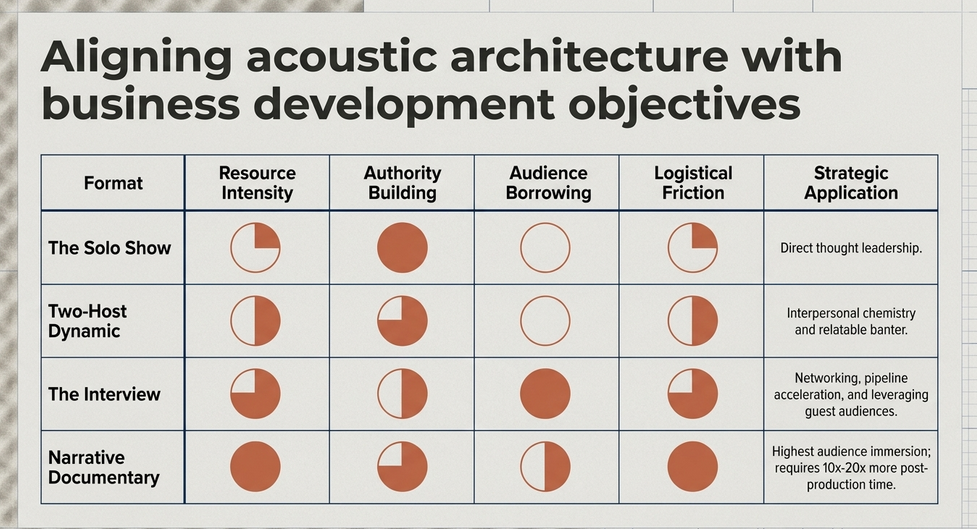
The chosen structural format profoundly impacts the depth and nature of personal engagement. Solo formats build intense, direct authority, positioning the single host as an undisputed subject matter expert. Interview formats rely heavily on the dynamic exchange of ideas and serve as powerful networking tools, bringing external audiences into the show's ecosystem. Co-hosted formats succeed on the strength of interpersonal chemistry and relatable banter, offering listeners the feeling of sitting in on a conversation between friends. Selecting the right format requires matching the host's natural communication style with the specific preferences of the target persona.
Further reading
For practitioners seeking to refine host dynamics and format selection, analyzing case studies of top-performing shows within the Apple Podcasts and Spotify charts provides actionable insights. Literature focusing on broadcast journalism techniques, interview facilitation, and vocal performance training can also dramatically elevate the quality of engagement and help hosts develop a more authoritative and welcoming on-mic presence.
Building your business case and plan
How to use podcasts to drive business results
Podcasting is no longer an experimental public relations exercise or a mere vanity project; it is a measurable, scalable asset capable of driving substantial business outcomes. Securing executive buy-in or allocating significant marketing budget necessitates a robust business case firmly anchored in empirical data.
Driving your objective
The fundamental step in building a business case is defining the specific commercial objective the podcast is intended to serve. Is the primary goal top-of-funnel brand awareness, mid-funnel lead nurturing, or direct customer acquisition? B2B podcasts, for example, often aim to influence pipeline velocity, engage target accounts, and establish thought leadership. Conversely, direct-to-consumer (DTC) podcasts may focus on moving inventory through promotional codes, affiliate links, and direct response mechanisms.15 A podcast cannot be optimized if its business objective remains ambiguous.
The challenges of podcasts
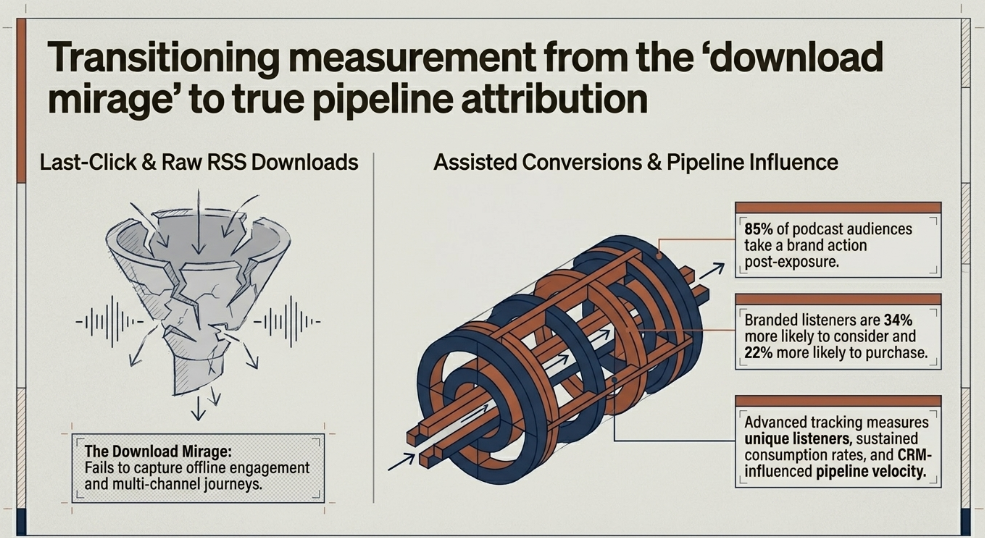
The primary challenge of podcast marketing is the inherent difficulty of attribution. Audio is largely an offline or "eyes-free" consumption experience; listeners cannot easily click a hyperlink directly from an audio stream while driving or washing dishes. Consequently, traditional performance marketing metrics—which rely heavily on immediate click-through rates—often fail to capture the medium's true impact.15 Furthermore, relying exclusively on RSS download metrics creates a "download mirage," wherein marketers celebrate raw file transfers without knowing if the audio was actually consumed, or if the listener matches the target demographic.
Beyond the last click
To capture the true value of podcasting, marketers must move beyond rudimentary last-click attribution models. Because podcasting drives long-term familiarity, emotional resonance, and brand memory, its impact is often found in assisted conversions.17 Advanced measurement requires multi-touch attribution frameworks that analyze the entire customer journey.18 Tracking mechanisms must account for users who hear a podcast advertisement, conduct an organic search days later, and eventually convert. Failing to account for this multi-channel journey drastically undervalues the podcast's contribution to revenue.
Traditional brand metrics
For campaigns focused heavily on brand awareness rather than direct response, success is quantified through traditional brand health metrics evaluated via brand lift studies. These studies, often utilizing pixel-based surveys or controlled exposure environments, measure statistical shifts in ad recall, brand favorability, and purchase intent among exposed listeners compared to a control group.20 Industry benchmarks indicate that branded podcast listeners are 34% more likely to consider a sponsoring brand and 22% more likely to make a purchase, confirming the medium's profound efficacy in shifting long-term brand perceptions.7
Understand the value of every marketing activity
Podcasting should never be evaluated in total isolation. It functions as a powerful multiplier that enhances the effectiveness of concurrent marketing activities. When audiences are primed through high-trust, long-form audio environments, performance marketing channels—such as paid search or retargeting—often experience significantly higher click-through rates and lower customer acquisition costs. A holistic business case accounts for this synergistic lift across the entire marketing portfolio.
Benchmarked measures
A sophisticated business plan tracks engagement metrics that prove audience quality rather than just sheer quantity.
Understanding the role of podcasts in the user journey
A podcast must be integrated strategically into the broader marketing ecosystem to maximize its utility as a business development tool. It cannot exist as an isolated silo.
The role of podcasting in multichannel marketing
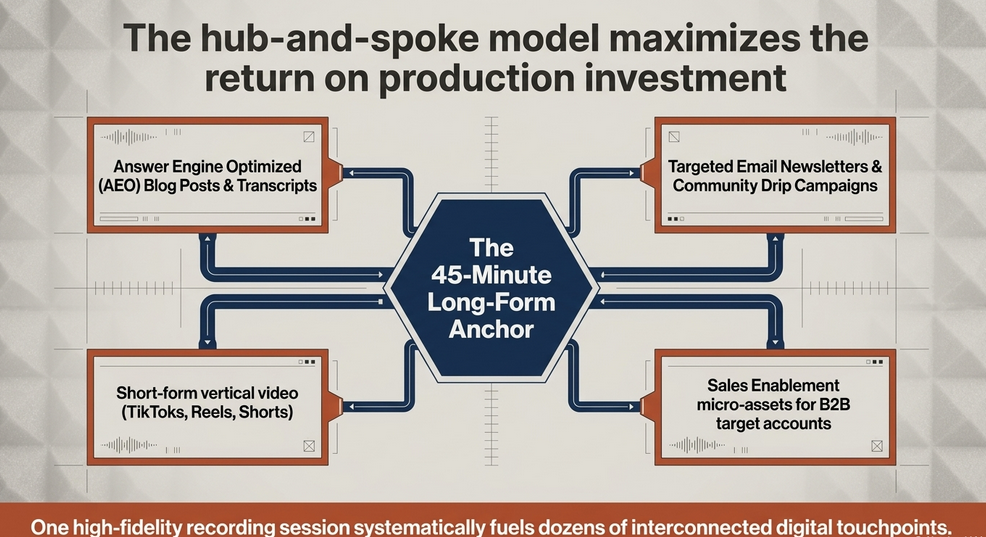
In a mature multichannel strategy, the podcast often serves as the anchor asset—the foundational piece of long-form content from which all other marketing materials are derived.8 A single high-value audio or video episode can be systematically fractured into dozens of micro-assets, including search-optimized blog posts, email newsletters, and short-form social media clips (e.g., TikToks, YouTube Shorts, and Instagram Reels). This hub-and-spoke model ensures narrative consistency across all touchpoints while maximizing the return on production investments.
Two different types of user journey
The podcast user journey diverges significantly depending on the underlying business model. In a B2C framework, the journey is often transactional and relatively short: the listener hears a trusted host's endorsement, feels an immediate affinity or need, and utilizes a vanity URL or promo code to make a purchase. Conversely, the B2B journey is characterized by complex, multi-stakeholder decisions that take months.15 Here, the podcast acts as a long-term nurturing tool. A prospect may consume 10 to 15 hours of deep thought leadership over several quarters, building profound organizational trust before ever initiating a formal sales conversation.
Using podcasts as content marketing
Podcasts represent the pinnacle of modern content marketing. They require minimal effort to consume, allowing brands to deliver deep, nuanced explanations of their methodologies, corporate values, and industry perspectives directly into the ears of their target market. This establishes the brand as an authoritative voice, effectively transforming corporate communication from intrusive, interruptive advertising into sought-after, opt-in programming.23
Illustrating the steps within the user journey
The audio user journey typically follows a distinct, four-step progression:
Discovery: The user encounters the podcast via search engine optimization (SEO), algorithmic recommendation on platforms like YouTube, or a cross-promotional guest appearance on another show.
Evaluation: The user assesses the episode title, show notes, cover art, and the first three minutes of audio to determine relevance and quality.
Engagement: The user consumes the episode, developing parasocial trust with the host and absorbing the core messaging.
Action: The user responds to a call-to-action (CTA), migrating from the audio platform to an owned digital property, such as an email list, community forum, or e-commerce website.
Fitting podcasts into the user journey to enhance our value proposition
To seamlessly enhance the value proposition, the podcast must naturally bridge the gap between audience curiosity and the brand's business solutions. This involves mapping specific podcast topics to different stages of the marketing funnel. Broad, educational topics serve top-of-funnel discovery, while highly technical, case-study-driven deep-dives cater to mid-funnel prospects actively evaluating specific vendor expertise.
Reference
To effectively map the user journey, marketing teams should review literature on full-funnel attribution models and B2B pipeline velocity. Frameworks detailing how to score engagement depth—such as tracking which specific stakeholders within a target account consume which episodes—provide the necessary tactical groundwork for integrating audio into CRM systems like Salesforce or HubSpot.
An introduction to podcast marketing
Podcast marketing is the systematic, data-driven process of increasing visibility, driving listenership, and converting that attention into measurable commercial value. It requires a disciplined, multi-disciplinary approach encompassing SEO, digital public relations, email automation, community building, and paid acquisition.
Pragmatic curiosity
A successful marketing approach demands "pragmatic curiosity"—the willingness to systematically test new digital channels and tactics without abandoning core marketing fundamentals.24 As the digital landscape evolves rapidly, marketers must be willing to experiment with emerging tools like programmatic audio, AI-driven audience segmentation, or dynamic ad insertion. However, they must do so with measurable hypotheses, strict ROI constraints, and a clear understanding of how these experiments tie back to overarching business goals.
Reference
Explorations of agile marketing methodologies and growth hacking principles offer excellent frameworks for applying pragmatic curiosity. By structuring podcast marketing initiatives as rapid, iterative sprints, teams can test different promotional strategies (e.g., audiograms vs. text quotes, host-read vs. programmatic ads) and scale only the tactics that yield statistically significant results.
What differentiates a great podcast?
Amidst a sea of millions of active shows, exceptional podcasts share three distinct architectural traits that facilitate sustainable growth and high retention.
Clarity on value proposition
Great podcasts operate with surgical precision regarding their target audience. They do not attempt to appeal to everyone; instead, 78% of successful new podcasts target highly specific niches and micro-communities.1 A clear value proposition immediately communicates what the listener will learn, how they will be entertained, or what specific professional or personal problems will be solved by tuning in. Ambiguity is the enemy of growth.
Hosts’ dynamic
Whether solo or co-hosted, the dynamic presentation of the audio is paramount. For co-hosts, chemistry, pacing, and the ability to challenge one another constructively prevent the audio from becoming monotonous or overly scripted. For solo hosts, the dynamic relies entirely on vocal inflection, strong storytelling structure, and the authoritative command of the subject matter.
Content is king
Audio fidelity and slick marketing cannot mask poor substance. The content must consistently deliver on the promise made by the show's branding and title. This requires rigorous preparation, deep research, and a commitment to providing unique, actionable perspectives rather than merely aggregating or summarizing existing industry commentary.
What is digital branding and how does business development fit in?
Podcasting sits perfectly at the intersection of digital branding and direct business development, effectively dissolving the historical boundaries between the two disciplines.
It’s all digital
The distinction between traditional media branding and digital media marketing has evaporated. Every brand interaction today is heavily digitized, and audio is no exception. A podcast is a dynamic digital asset that contributes directly to a brand's overall digital footprint, influencing search engine rankings, social media sentiment, and automated discovery algorithms across platforms like YouTube and Spotify.
Brand awareness as an excuse
Historically, marketers have used "brand awareness" as a convenient excuse for creative campaigns that fail to deliver measurable financial returns.15 In the modern digital era, awareness must be quantifiable. A podcast should not exist merely for the sake of corporate vanity; it must be held accountable to engagement metrics, pipeline influence, and overall business development goals, utilizing proper tracking links and CRM integrations.15
What digital branding really means
Digital branding is the consistent delivery of a company's identity, expertise, and values across all digital touchpoints. In podcasting, branding is conveyed not just through visual cover art and typography, but through the tone of voice, the quality of the audio environment, the caliber of guests selected, and the reliability of the publishing schedule.
How digital has changed branding
Digital platforms have shifted branding from a one-way corporate monologue to a two-way, interactive dialogue. Podcasts facilitate this shift by encouraging listener feedback, incorporating audience questions directly into the show, and extending complex conversations onto social media platforms and private community channels (like Discord or Slack).
Global soapbox
A podcast functions as an incredibly powerful global soapbox. It allows a niche business operating in one geographic region to instantly build authority and intimate rapport with highly targeted prospects on the other side of the world. This borderless distribution mechanism makes podcasting an unparalleled tool for international business development and market expansion.
Reference
For further insight into integrating branding with business development, reading materials focused on account-based marketing (ABM) and content-led growth strategies are highly recommended. These resources detail how to utilize long-form content to penetrate enterprise accounts and build global brand equity simultaneously.
Defining your content plan and using content calendars
Sustainable podcasting requires rigorous editorial discipline. A strategic content calendar transitions a podcast from a sporadic, stress-inducing creative endeavor into a reliable, predictable media property.
Informing your content plan
Content planning should never rely on guesswork; it must be driven by audience data and search trends. By analyzing the questions prospects ask during sales calls, examining high-volume search queries related to the industry, and utilizing social listening tools, creators can build an editorial calendar that directly answers the market's most pressing inquiries. This ensures the content remains highly relevant and searchable.
Driving action from podcasts
Every single episode must have a strategic purpose culminating in a clear, singular Call to Action (CTA). Instead of overwhelming the listener with a laundry list of requests (e.g., subscribe, leave a review, visit the website, follow us on Twitter, and buy our product), a strong content plan dictates one focused action per episode. This might involve downloading a specific lead magnet, registering for an upcoming webinar, or utilizing a specific promotional code, thereby maximizing conversion rates.
Building your podcast and making it a success
The importance of landing pages and show notes (and getting SEO right)
Discoverability remains the primary hurdle in podcast marketing. Because search engines process text far more efficiently than raw audio files, highly optimized written assets are non-negotiable for organic growth.
A supporting website
Relying exclusively on third-party podcast directories (like Apple Podcasts or Spotify) surrenders control of the audience and limits SEO potential. A dedicated supporting website acts as the central, owned hub for the brand. It houses embedded audio players, lead capture forms, and detailed show notes. It is where true podcast SEO occurs, transforming audio into indexable, searchable web pages that drive inbound traffic.26
Creating your own stand-alone fully customized show website
A customized show website provides the digital infrastructure necessary for business development. Every episode should possess its own dedicated landing page functioning as a conversion engine. These pages should feature rich media, clear navigational pathways, and conversion-optimized design to transform curious web traffic into dedicated audio listeners or email subscribers.26
Search engine optimization
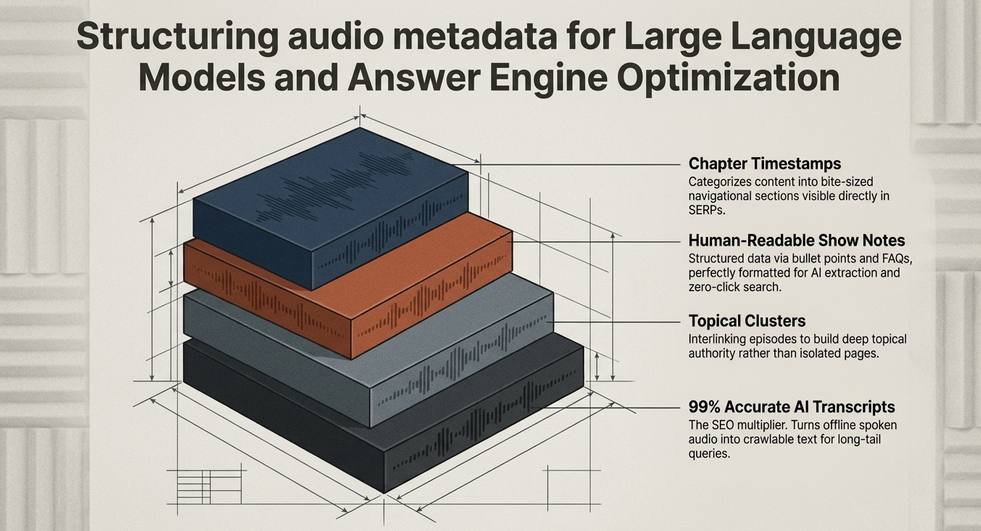
Podcast SEO has evolved rapidly into Answer Engine Optimization (AEO), anticipating the rise of AI-driven search and Large Language Models (LLMs).27
Defining your podcast audience and content
A successful podcast requires ruthless editorial focus to attract and retain a dedicated audience. Attempting to be everything to everyone results in being nothing to no one.
Finding your niche and sticking to it
The podcast landscape heavily punishes generalists. Establishing topical authority requires selecting a defined niche and addressing it comprehensively. A hyper-focused show catering to a specific micro-community stands a far greater chance of dominating search algorithms, attracting highly relevant sponsors, and building a loyal following than a broad, unfocused conversational program.
Snap decisions
Listeners make snap decisions about whether to engage with a new show based almost entirely on visual and textual metadata. Episode titles are often more influential than the overarching podcast brand itself in driving initial discovery. Titles must clearly signal the specific problem being addressed, include a primary keyword naturally, and spark immediate curiosity.32 Vague titles like "Episode 42: An Interview with John" offer no incentive to click.
Pitching your show
The podcast description serves as the ultimate elevator pitch. In just a few sentences, it must clearly articulate who the show is for, the core topics covered, and the credentials of the host. This metadata is parsed by directory search engines and evaluated by prospective listeners within seconds. It should be written persuasively, utilizing targeted keywords without resorting to unnatural keyword stuffing.30
Stay focused and true to your audience
Once an audience is established, the creator must honor the psychological contract made with the listener. Deviating wildly from the established niche or fundamentally changing the show's format without warning can severely damage listener retention and trust. Evolution is necessary, but it must be managed in dialogue with the audience.
Understanding and selection of different podcast formats
The architectural format of the show dictates production workflows, resource requirements, and the ultimate audience experience.
Solo show
The solo format positions the host as the ultimate authority. It requires immense preparation and strong vocal delivery, as there is no co-host to rely on for pacing or conversational relief. This format is highly efficient to produce, requires less logistical coordination, and is exceptionally effective for building direct thought leadership.
Narrative storytelling
Relying on heavily scripted segments, field audio, and complex sound design, narrative storytelling offers the highest level of audience immersion and retention. However, it requires significantly more post-production time and editing expertise, often taking 10 to 20 times longer to produce per minute of finished audio than a standard conversational episode.
The two-host format
A co-hosted show thrives on chemistry, contrasting perspectives, and dynamic banter. It lowers the conversational burden on a single individual and introduces natural pacing. However, it requires strict logistical coordination and highly reliable remote recording technology if the hosts are not physically co-located.
Interview shows
Interview formats are excellent vehicles for "audience borrowing"—leveraging the guest's existing following to grow the podcast's reach.28 It provides a steady stream of new insights and expert perspectives but requires excellent outreach, scheduling, and interview facilitation skills to prevent the show from feeling generic.
Multiple show hosts
Featuring three or more hosts allows for diverse opinions and high energy, a format often utilized successfully in comedy, sports, or gaming niches. The primary challenge is audio mixing and conversational discipline; preventing participants from talking over one another is essential to avoid a chaotic listening experience.
Roundtable/panel discussions
Ideal for industry deep-dives and news analysis, roundtable discussions bring multiple experts together to dissect complex issues. Strong moderation by a central host is critical to ensure equitable speaking time, manage dominant personalities, and keep the conversation tightly aligned with the episode's central thesis.
Preparing your podcast recording environment
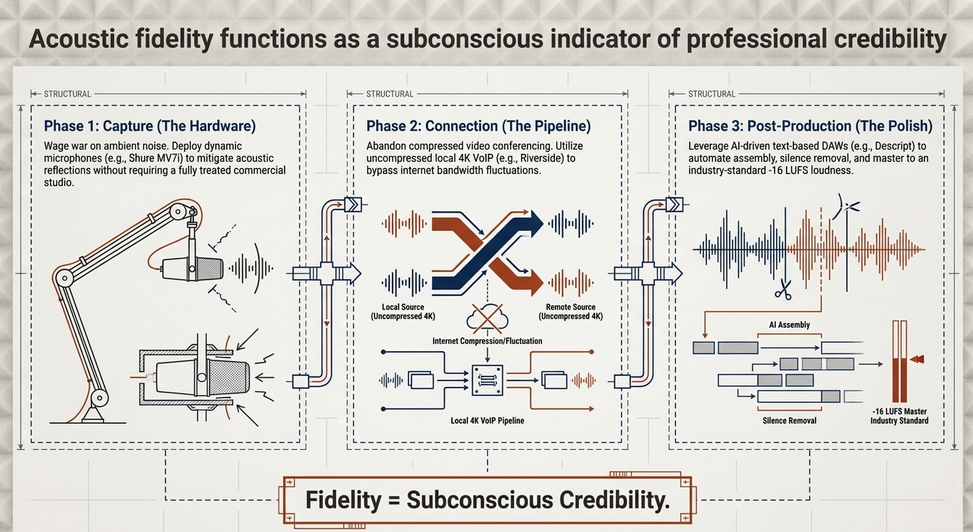
Audio fidelity is a subconscious indicator of professional credibility. Poor audio quality will drive listeners away immediately, regardless of the value of the content.5
Your war on unwanted noise
Creating a professional recording environment necessitates dedicated acoustic treatment. This does not strictly require a commercial studio; rather, it involves mitigating hard, reflective surfaces that cause echo and reverb. Utilizing soft furnishings, dedicated acoustic panels, and strategic microphone placement allows creators to wage a successful war on ambient noise and capture pristine vocals.
Voice-over-IP interviews
When recording remotely, relying on standard video conferencing software (like Zoom or Microsoft Teams) often results in compressed, glitch-prone audio due to internet bandwidth fluctuations. High-fidelity audio requires specialized tools that record audio locally on each participant's machine before uploading it to the cloud, ensuring studio-grade quality regardless of internet connection speeds.33
Choosing your recording hardware and software
Strategic investments in hardware and software yield exponential returns in production quality and workflow efficiency.
Essential equipment for getting started
The foundation of a strong audio setup is a quality dynamic microphone. Dynamic microphones (such as the Shure MV7i) are generally preferred over condenser microphones for home studios or untreated rooms because they are far less sensitive to background noise and acoustic reflections.5 Additional essential hardware includes closed-back headphones to prevent audio bleed into the microphone, a boom arm for optimal positioning, and a pop filter to soften harsh plosive sounds (like 'p' and 'b').4
Voice-over-IP call interviews
For remote interviews, dedicated platforms are essential for maintaining professional standards.
Audio editing
The choice of Digital Audio Workstation (DAW) or editing software depends heavily on the creator's technical proficiency. Industry-standard tools like Adobe Audition or Apple Logic Pro offer granular control for seasoned audio engineers.37 Alternatively, AI-powered text-based editing platforms like Descript have revolutionized the workflow, allowing producers to edit audio and video simply by deleting words in an automatically generated transcript, drastically reducing post-production time.36
Mobile recording on the run
For creators conducting on-site interviews, attending conferences, or engaging in field reporting, portable digital recorders and high-quality lavalier microphones ensure that mobility does not compromise audio fidelity.
An overview of podcast editing options and how to do it
Post-production is the phase where a good recording is transformed into a great, listenable podcast.
Editing your podcast: why edit?
Editing is a fundamental demonstration of respect for the listener's time. Removing prolonged silences, distracting verbal tics, technical glitches, and tangential ramblings ensures a tight, engaging narrative flow. It keeps the pacing energetic and maximizes the density of value provided per minute, which is critical for audience retention.
The editing process
The professional editing process involves several distinct, sequential phases:
Assembly: Splicing the core structural components (intro, main content, ad reads, outro) together.
Cleanup: Removing background noise, harsh breaths, and excessive filler words using noise reduction algorithms.
Mixing: Balancing the volume levels between different speakers and the background music to ensure consistency throughout the episode.
Mastering: Applying equalization (EQ) and compression to ensure the final file meets industry loudness standards (typically -16 LUFS for stereo audio), ensuring listeners do not have to constantly adjust their volume dials.
Using interviews with influencers to maximize your podcast strategy
Strategically leveraging guests is a powerful growth mechanism, provided the outreach is executed professionally and strategically.
The basics of influencer outreach
In 2026, influencer marketing in podcasting has shifted away from pursuing raw, superficial follower counts to seeking alignment, resonance, and deep credibility.8 When pitching high-profile guests, the outreach must clearly articulate the mutual benefit. It should highlight the specific demographic overlap between the show's audience and the influencer's target market, demonstrating deep respect for the guest's time and a clear understanding of their expertise.
Setting your guest at ease
A comfortable, relaxed guest produces compelling, authentic audio. Implementing a structured pre-interview workflow—such as providing a clear technical briefing on microphone etiquette, sharing a loose outline of topics, and conducting a brief off-record warm-up chat—reduces anxiety and fosters a natural, free-flowing conversation.
Mind mapping
To conduct masterful, fluid interviews, top hosts increasingly utilize mind-mapping techniques for content planning. Rather than relying on a rigid, linear list of sequential questions, a visual mind map organizes central themes, subtopics, and potential conversational pivots.38 This allows the host to guide the narrative fluidly, adapting organically to the guest's answers while ensuring all strategic business touchpoints are covered.
Show branding intros and outros: making the right first impression
The structural bookends of the podcast dictate the listener's initial engagement and final resulting action.
First impressions matter
The first 15 to 30 seconds of an episode are absolutely critical; listeners decide almost instantly whether to commit to the episode or abandon the track.40 A rambling, unstructured opening damages credibility and destroys retention rates before the core content even begins.
Making the right first impression
A highly polished intro establishes immediate authority. Best practices dictate opening with a compelling "hook"—a brief, provocative quote extracted from the episode—followed by a tightly scripted introduction of the host, the show's value proposition, and the specific topic of the day. Furthermore, audio mixing is crucial; intro music must be properly ducked beneath the voiceover to ensure the narration is not overpowered.40 The outro is equally vital; it must summarize key takeaways, thank the listener, and deliver a single, clear Call to Action.42
Podcast advertising and monetization: where to begin and how to manage
As the podcast industry matures, monetization strategies have diversified significantly beyond rudimentary sponsorship models.
Inspiration for monetization
Relying solely on programmatic ad revenue leaves creators highly vulnerable to macroeconomic advertising fluctuations. The most resilient and profitable podcasts in 2026 leverage diverse monetization streams, including premium listener-supported subscriptions, private ad-free feeds, gated community access, and the direct sale of high-margin digital products or consulting services.44
Advertising formats
When accepting advertising, creators must choose between host-read integrations and programmatic dynamic ad insertion (DAI). Host-read ads, delivered organically by the creator, generate 60% to 70% ad recall and command premium pricing because they leverage the host's inherent trust.7 Programmatic ads, inserted automatically by the hosting platform, offer massive scale and ease of deployment but yield significantly lower recall rates (24% to 31%).7
Podcast advertising revenue models
Advertising revenue is calculated using a Cost Per Mille (CPM) model, representing the cost per one thousand downloads. In 2026, standard podcast CPM rates vary heavily based on the show's niche and audience quality.
Show merchandise
Physical merchandise transforms an ephemeral audio experience into a tangible brand touchpoint. For highly engaged communities, apparel, accessories, or bespoke physical goods serve both as a lucrative additional revenue stream (often representing 5% to 20% of creator revenue) and as walking billboards for the show.16
Sponsorship
Deep, long-term sponsorships are vastly superior to transient, single-episode ad placements. A true sponsorship involves deep brand alignment, where the advertiser provides value beyond the financial transaction, such as co-hosting live events, providing exclusive resources for the listeners, or sponsoring specific highly-produced segments.
References and further reading
For comprehensive guidance on monetization, creators should consult resources provided by industry think tanks such as Sounds Profitable, which routinely publishes data on brand lift studies, dynamic ad insertion trends, and programmatic audio yields. The IAB Podcast Measurement Guidelines are also essential reading for understanding how downloads and impressions are standardized and audited for major advertisers.
Publishing and distributing your podcast
The logistical mechanics of getting audio from the editing bay to the listener's ears must be seamless and technically sound.
Getting your podcast episode ready to publish
Before uploading, the final audio file must be properly tagged with ID3 metadata, containing the episode title, show name, artwork, and copyright data. The accompanying show notes must be formatted with hyperlinks, timestamps, and optimized text ready for broad syndication across various platforms.27
Distributing to multiple destinations
A podcast must be universally accessible to eliminate friction for the listener. Upon publishing, the RSS feed seamlessly distributes the audio to major directories like Apple Podcasts, Spotify, Amazon Music, and Pocket Casts.46 Crucially, in 2026, the distribution strategy must include publishing the video component—or at minimum, a static-image audio file—to YouTube, which now captures over 25% of all US podcast consumption.7
Podcast hosting
The hosting platform is the central nervous system of a podcast. It stores the heavy media files, generates the RSS feed, and collects primary analytics.
Measuring success: tapping into how and why people listen to your podcast
Understanding audience behavior requires navigating a complex web of disparate data sources, as no single platform provides a complete, unified picture of the listener journey.
Podcast host statistics
The hosting provider tracks raw downloads and total distribution numbers across all listening apps.49 While this provides the macro view of total reach, it cannot confirm if a downloaded file was actually played or completed. Therefore, host statistics must be cross-referenced with platform-specific data to gauge true engagement, avoiding the trap of the "download mirage".50
Apple’s Podcast Connect
Apple Podcasts Connect (and its equivalent, Spotify for Creators) provides critical granular data regarding actual listener behavior on those specific platforms. These dashboards reveal "Average Consumption" rates—indicating exactly when listeners drop off during an episode—and track follower growth, geographical distribution, and the conversion rates of free trials to paid podcast subscriptions.47 Analyzing these specific engagement metrics allows creators to continuously refine their segment lengths and content structures.22
Podcast reviews
While quantitative data reveals how audiences interact with the audio, qualitative data from written podcast reviews reveals why. Monitoring reviews provides direct, unfiltered feedback on host performance, audio quality issues, and topic resonance, serving as a vital feedback loop for ongoing editorial optimization.
The podcast marketing toolkit
Amplifying a podcast requires a synchronized deployment of digital marketing assets across multiple channels.
Social media
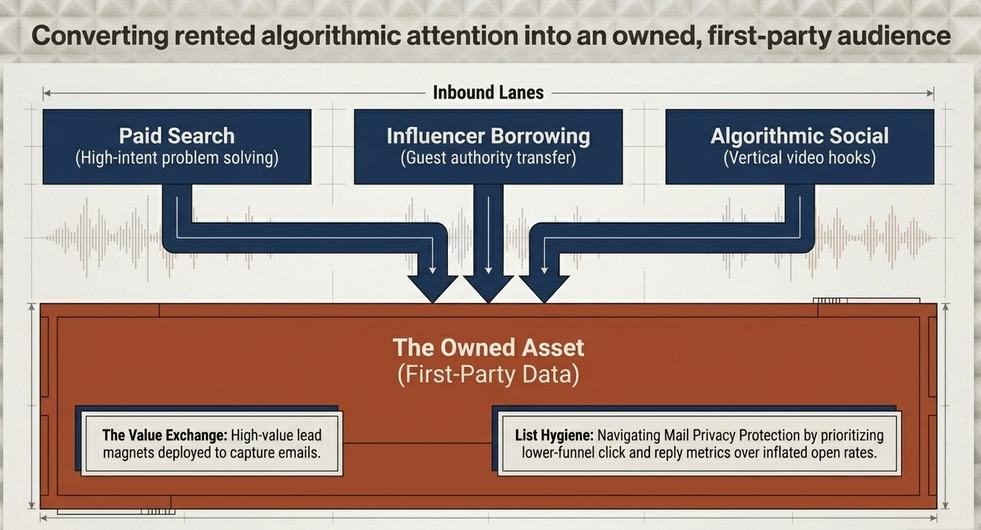
Social media algorithms heavily favor short-form vertical video. By extracting the most compelling 30-to-60-second visual clips from a long-form podcast and deploying them across TikTok, Instagram Reels, and YouTube Shorts, creators generate highly shareable micro-content that acts as a powerful discovery funnel, driving new listeners back to the main show.52
Online advertising
Paid acquisition can aggressively accelerate growth if the podcast has a clear conversion mechanism. Targeted audio ads on platforms like Spotify, or display ads on niche industry websites, can effectively capture users who already exhibit high podcast consumption habits, ensuring the ad spend is highly efficient.
Email marketing
In a landscape increasingly dominated by shifting, opaque algorithms, an email list is the single most valuable owned marketing asset a podcaster can possess.44 It provides a direct, unmediated line of communication to the audience, enabling creators to notify listeners of new episodes, solicit direct feedback, and promote monetization efforts without relying on podcast app notifications or social media feeds.44
Gaining opt-ins and building a list
Converting anonymous listeners into known email subscribers requires compelling incentives. Offering high-value "lead magnets"—such as exclusive bonus episodes, downloadable templates, or detailed industry reports—in exchange for an email address is highly effective.53 Marketers must also maintain rigorous list hygiene, utilizing AI for behavioral segmentation while navigating technical changes like Apple Mail Privacy Protection, which artificially inflates open rates and requires marketers to track lower-funnel metrics like clicks and replies instead.55
Paid search
For B2B and educational podcasts, paid search (Google Ads) captures high-intent prospects. Bidding on targeted keywords related to the podcast’s specific niche ensures that the show's landing page appears when users are actively searching for solutions to their problems, moving them directly from a search query into the podcast ecosystem.28 In 2026, leveraging first-party data and AI-driven bidding algorithms is critical to preventing budget waste caused by over-segmentation.56
References and further reading
To master audience acquisition, marketing professionals should review case studies on advanced email deliverability, specifically focusing on overcoming the tracking limitations introduced by Apple's Mail Privacy Protection. Furthermore, comprehensive guides on structuring Google Ads for content assets (rather than e-commerce products) provide essential strategies for optimizing paid search budgets to drive audio subscriptions.
The value of web analytics: measuring the impact of your podcast activity
Integrating podcast activity with overarching digital analytics bridges the critical gap between audio consumption and commercial action.
Making the most of Google Analytics
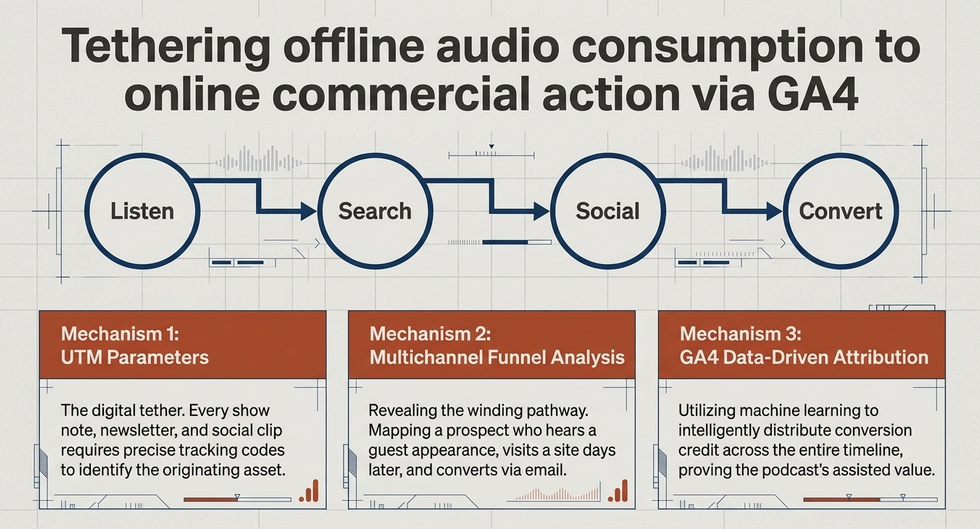
Google Analytics 4 (GA4) provides the necessary infrastructure to track how podcast listeners interact with the brand's website. By leveraging data-driven attribution models powered by machine learning, GA4 moves beyond simplistic last-click tracking, distributing conversion credit intelligently across the entire customer journey based on actual contribution.57
Using ‘multichannel funnels’ reporting
Multichannel funnel analysis reveals the complex, winding pathways listeners take to conversion. It highlights how a user might discover the brand through a podcast guest appearance, visit the website directly a week later, and finally convert via an email newsletter link.59 This comprehensive view proves the assisted value of the podcast in driving ultimate business outcomes.17
Adding in tracking code
Robust tracking is achieved through the disciplined use of UTM (Urchin Tracking Module) parameters. Every single link placed in the podcast show notes, social media promotional posts, and email newsletters must contain specific tracking codes. This allows GA4 to accurately identify the exact episode or marketing channel that directed a converting user to the website.22
How web analytics can be used in relation to our podcasting activity
By synthesizing UTM data, conversion events, and GA4 funnel explorations, marketers can definitively prove ROI. They can identify which specific episodes or topics generate the highest quality leads, adjust their content strategy accordingly, and justify continued or increased investment in audio production to executive stakeholders.15
References and further reading
For advanced implementation, technical documentation regarding GA4 setup, specifically focusing on defining custom conversion events and adjusting lookback windows, is invaluable. Understanding the nuances between data-driven, linear, and first-click attribution models ensures that the marketing team is accurately reporting the podcast's impact on pipeline generation.
The Ecosystem of Podcast Production, Search Engine Optimization, and Strategic Promotion
Where next for podcasting? Conversational design, artificial intelligence and machine learning
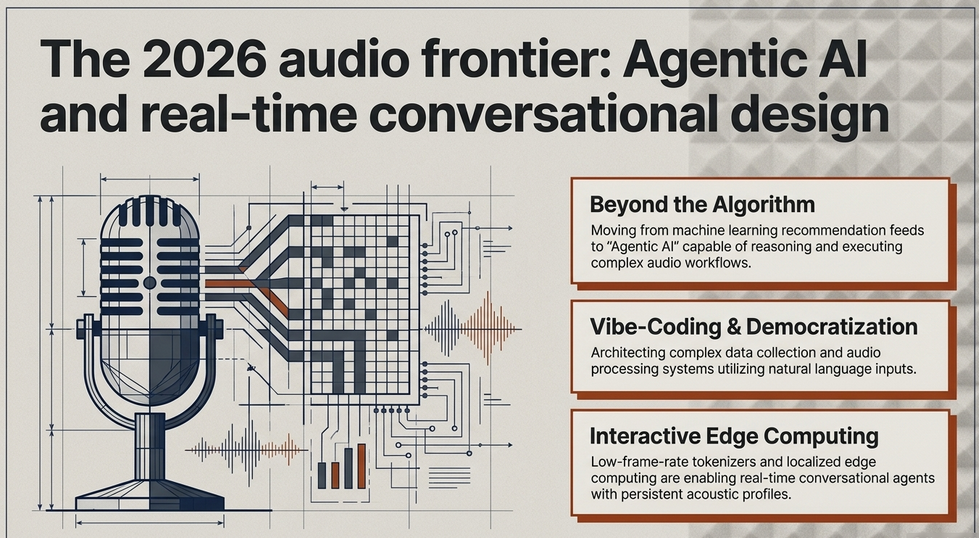
The technological frontier of podcasting is currently being rapidly reshaped by advancements in artificial intelligence. By 2026, the industry is witnessing a profound shift from traditional, screen-based media discovery to screenless, audio-based conversational experiences. The historical lines between reading text, listening to audio, and engaging in interactive dialogue are blurring, as users increasingly utilize AI assistants to query information and seamlessly transition into deep, long-form audio reporting.61
AI vs machine learning
It is critical to distinguish between traditional machine learning and the rapid emergence of generative AI within this space. Historically, machine learning algorithms have dictated podcast distribution by analyzing massive sets of behavioral data to serve personalized content recommendations (e.g., Spotify's or YouTube's discovery algorithms). However, the current technological evolution involves generative "agentic AI" and complex reasoning models.61 These systems do not merely recommend existing audio files; they enable dynamic, intelligent workflows. Innovations like "vibe coding" allow creators to architect complex data collection and audio processing systems using natural language, democratizing advanced technical workflows.61 Furthermore, edge computing and low-frame-rate tokenizers are enabling localized, real-time conversational agents capable of maintaining consistent acoustic profiles across long-form interactions, paving the way for fully interactive, AI-generated podcast experiences.62 Simultaneously, AI tools have fundamentally transformed post-production, automating transcription, mastering, and even synthetic voice generation for localized dynamic ad insertion.64
Future-proofing your podcast strategy for the ever-changing user journey
Content and narrative
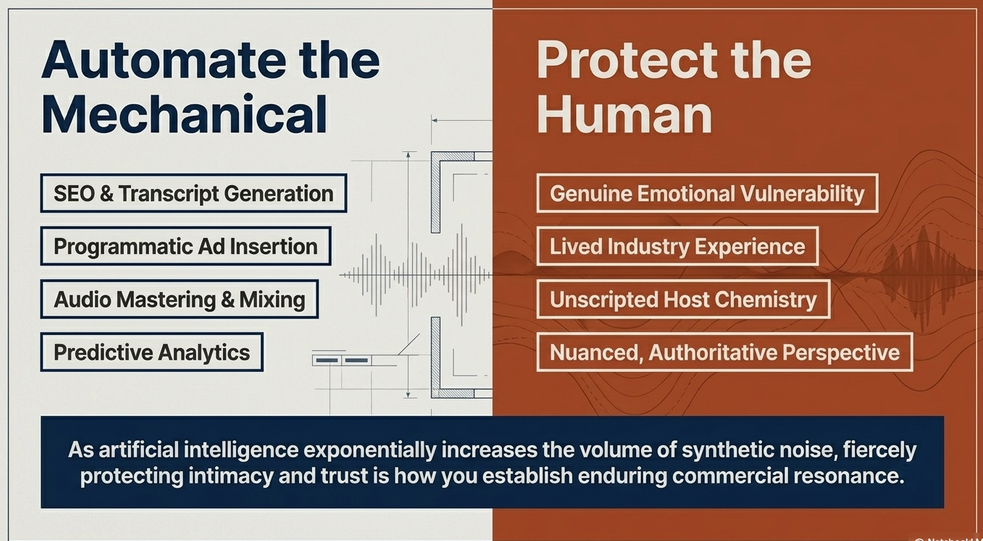
As artificial intelligence exponentially increases the volume of synthetic, automated, and potentially sterile content available on the internet, the strategic value of authentic human connection will command a massive premium. To future-proof a podcast strategy, creators and brands must lean heavily into the elements that machines currently cannot replicate: genuine emotional vulnerability, lived experience, unscripted chemistry, and highly nuanced, authoritative perspective.8
While AI will optimize the mechanical aspects of SEO, transcription, programmatic advertising, and analytics, the core differentiator for any successful show will remain the human narrative. A successful podcast strategy in 2026 and beyond must leverage cutting-edge technical distribution and multi-touch attribution, while fiercely protecting the intimacy and trust that makes audio storytelling uniquely powerful. By combining rigorous, data-driven marketing with compelling, highly-niched, and authentically human content, brands can cut through the algorithmic noise and establish enduring commercial and cultural resonance in an increasingly automated world.
Works cited
Podcast Statistics 2026 | 80+ Facts & Data Points | Searchlab, accessed April 30, 2026, https://searchlab.nl/en/statistics/podcast-statistics-2026
Podcast Statistics 2026: Powerful Audience Data - SQ Magazine, accessed April 30, 2026, https://sqmagazine.co.uk/podcast-statistics/
How Many Podcasts Are There in 2026? (Listeners Stats) - DemandSage, accessed April 30, 2026, https://www.demandsage.com/podcast-statistics/
Best Podcast Equipment for Beginners in 2026 - Choppity, accessed April 30, 2026, https://www.choppity.com/blog/best-podcast-equipment-for-beginners-in-2026/
The Best Podcast Equipment We've Tested for 2026 | PCMag, accessed April 30, 2026, https://www.pcmag.com/picks/the-best-podcast-equipment
The Business Case for Podcasting in 2025 (With Numbers) - - Command Your Brand, accessed April 30, 2026, https://commandyourbrand.com/the-business-case-for-podcasting-in-2025-with-numbers/
Podcast Statistics 2026: 130+ Advertising Data Points - Digital Applied, accessed April 30, 2026, https://www.digitalapplied.com/blog/podcast-statistics-2026-advertising-data
Four lessons from Podcast Pulse 2025, and why they matter for your ..., accessed April 30, 2026, https://advertise.acast.com/news-and-insights/four-lessons-from-podcast-pulse-2025-and-why-they-matter-for-your-next-campaign
Podcast Statistics You Need To Know in 2026 - Backlinko, accessed April 30, 2026, https://backlinko.com/podcast-stats
65 Podcast Listener Statistics: 2026 Trends, Growth, Rank, ROI + Facts, accessed April 30, 2026, https://talks.co/p/podcast-listener-statistics/
33 Podcast Statistics 2026 (Number of Podcasts & Viewership), accessed April 30, 2026, https://podcastatistics.com/
Podcast Growth in 2026: How Businesses Get Listeners Using AI, accessed April 30, 2026, https://nextmedia.london/podcast-growth-2026-ai-listeners/
The State of Podcasting 2026: What Advertisers Need to Know - iHeartMedia, accessed April 30, 2026, https://www.iheartmedia.com/advertise/insights/articles/the-state-of-podcasting
Radio at the Crossroads of a Networked Society: What is Going Wrong with the Radio in Kosovo? - UBT Knowledge Center, accessed April 30, 2026, https://knowledgecenter.ubt-uni.net/cgi/viewcontent.cgi?article=4800&context=conference
The Ultimate Guide To Measuring B2B Podcast ROI: From ... - Fame.so, accessed April 30, 2026, https://www.fame.so/post/ultimate-guide-to-measuring-b2b-podcast-roi
150+ Podcast Statistics for 2026 (Listeners, Growth, Ads, and Trends), accessed April 30, 2026, https://newmedia.com/blog/podcast-statistics
If you want better outcomes, stop relying on last-touch attribution | MarTech, accessed April 30, 2026, https://martech.org/if-you-want-better-outcomes-stop-relying-on-last-touch-attribution/
What is Multi-Channel Attribution? - Singular, accessed April 30, 2026, https://www.singular.net/glossary/multi-channel-attribution/
Podcast advertising has rapidly become a cornerstone of influencer marketing, offering authentic engagement with highly targeted audiences. Yet, accurately measuring the return on investment (ROI) from podcast ads remains a complex challenge due to fragmented data sources and multi-channel customer journeys. Without precise ROI tracking, marketers risk misallocating budgets, underestimating campaign impact, - Zigpoll, accessed April 30, 2026, https://www.zigpoll.com/content/what-are-the-most-effective-ways-to-track-and-measure-roi-from-podcast-advertising-campaigns-within-influencer-marketing
Brand Lift Study - Signal Hill Insights, accessed April 30, 2026, https://signalhillinsights.com/research/brand-lift-study/
Podcast Brand Lift Study - Markteffect, accessed April 30, 2026, https://markteffect.nl/en/research-types/podcast-brand-lift-study
A Brand's Guide to Podcast Measurement in 2026 - CoHost, accessed April 30, 2026, https://www.cohostpodcasting.com/resources/podcast-measurement-for-brands
Corporate Podcasting in 2025: How to Drive Business Growth, accessed April 30, 2026, https://podcasthawk.com/corporate-podcasting-in-2025-how-to-drive-business-growth/
Digital Branding, accessed April 30, 2026, https://www.usetech.org/wp-content/uploads/ebooks/Digital-Branding-A-Complete-Step-by-Step-Guide-to-Strategy-Tactics-and-Measurement.pdf
Habits on Purpose - Podcast Addict, accessed April 30, 2026, https://podcastaddict.com/podcast/habits-on-purpose/3832426
SEO for Podcasts + Podcasters — SpearPoint, accessed April 30, 2026, https://www.thespearpoint.com/blog/seo-for-podcasts
Podcast SEO 2026: Optimising for AI Search and LLMs, accessed April 30, 2026, https://blog.podcast.co/create/podcast-seo-2026-optimise-for-ai
The Playbook for Podcasting In 2026: The 5 Strategies That Matter - Claricast, accessed April 30, 2026, https://claricast.com/the-playbook-for-podcasting-in-2026-the-5-strategies-that-matter/
Podcast SEO: How to Get Your Show Found in 2026 (and Beyond) - Saspod, accessed April 30, 2026, https://saspod.com/blog/post/podcast-seo
Podcast SEO: Best Practices [2026]| Lower Street, accessed April 30, 2026, https://lowerstreet.co/blog/podcast-seo
The BEST Podcasting Gear in 2026! - YouTube, accessed April 30, 2026, https://www.youtube.com/watch?v=YXO-z-Qca6k
Podcast SEO In 2026: How To Make Your Show Easier To Find (and ..., accessed April 30, 2026, https://soundcartel.com.au/blog/podcast-seo-in-2026/
Top Remote Podcast Recording Platforms (2026) - Cutsio, accessed April 30, 2026, https://cutsio.com/blog/top-remote-podcast-recording-platforms-2026
Zencastr vs Riverside vs Squadcast (2026) - Which One Is BEST? - YouTube, accessed April 30, 2026, https://www.youtube.com/watch?v=iN4Y7RSFX6E
The Essential Equipment Needed for a Podcast in 2026, accessed April 30, 2026, https://contesimal.ai/blog/equipment-needed-for-a-podcast/
Best Podcast Recording Software in 2026: An Honest Listicle | Autozy Blog, accessed April 30, 2026, https://autozy.co/blog/best-podcast-recording-software-2026
The 13 Best Editing Software For Podcasts In 2026 - Fame.so, accessed April 30, 2026, https://www.fame.so/post/best-editing-software-for-podcasts
Discover the Power of Mind Mapping in Content Planning: A Complete Guide, accessed April 30, 2026, https://www.contextminds.com/blog/mind-mapping-in-content-planning
Mind Mapping for Podcasts | Biggerplate, accessed April 30, 2026, https://www.biggerplate.com/collections/2007/mind-mapping-for-podcasts
Learn How To Create A Podcast Intro Your Listeners Will Love - Buzzsprout, accessed April 30, 2026, https://www.buzzsprout.com/blog/podcast-introduction
Create a Podcast Intro Like a Pro in 2026 - OBSBOT, accessed April 30, 2026, https://www.obsbot.com/blog/podcast/podcast-intro
Crafting the Perfect Podcast Intro and Outro, accessed April 30, 2026, https://blubrry.com/manual/podcasting-best-practices-with-blubrry/crafting-the-perfect-podcast-intro-and-outro/
The Ultimate Guide to Starting a Podcast in 2026 (8 Things You MUST Do!), accessed April 30, 2026, https://elizabethmccravy.com/starting-a-podcast-in-2025/
Smart Podcast Monetization Strategies for Every Audience Size ..., accessed April 30, 2026, https://www.beehiiv.com/blog/podcast-monetization-strategies
Podcast Sponsorship Rate Cards 2026 Guide | InfluenceFlow, accessed April 30, 2026, https://influenceflow.io/resources/podcast-sponsorship-rate-cards-the-complete-2026-guide-for-creators-brands/
Best platform for distributing a podcast to all major apps? - Reddit, accessed April 30, 2026, https://www.reddit.com/r/podcasting/comments/1r5q4bt/best_platform_for_distributing_a_podcast_to_all/
Best Podcast Analytics Platforms - Resonate Recordings, accessed April 30, 2026, https://resonaterecordings.com/general/what-to-know-about-podcast-analytics/
Top 12 Podcast Hosting Platforms in 2026 - TYX Studios, accessed April 30, 2026, https://tyxstudios.com/blog/best-podcast-hosting-platforms
How to understand podcast stats - Podnews, accessed April 30, 2026, https://podnews.net/article/understanding-podcast-statistics
Best Analytics? : r/podcasting - Reddit, accessed April 30, 2026, https://www.reddit.com/r/podcasting/comments/1if994t/best_analytics/
Measure podcast analytics & stats - Apple Podcasts for Creators, accessed April 30, 2026, https://podcasters.apple.com/measure
How Influencers Grow After Adopting Podcast: 10 Case Studies - CTRL Collective, accessed April 30, 2026, https://www.ctrlcollective.com/blog/how-influencers-grow-after-adopting-podcast/
How to Build a Podcast Email List: Turn Listeners to Subscribers - Gravity Forms, accessed April 30, 2026, https://www.gravityforms.com/blog/build-a-podcast-email-list-turn-listeners-to-subscribers/
Start Your Email List Here: High-Converting Opt-In Ideas That Actually Work - Jenna Kutcher, accessed April 30, 2026, https://jennakutcherblog.com/email-list-opt-in-ideas-that-convert/
5 NEW Email Marketing Trends That Actually Work in 2026 - YouTube, accessed April 30, 2026, https://www.youtube.com/watch?v=3i2binoTuFk
How to Create a Profitable Paid Search Strategy for 2026 - YouTube, accessed April 30, 2026, https://www.youtube.com/watch?v=_kltR_ILXYk
Best Multi-Channel Attribution Platforms Guide 2026 - Cometly, accessed April 30, 2026, https://www.cometly.com/post/multi-channel-attribution-platforms
Set Up GA4 Attribution Models Properly (2026), accessed April 30, 2026, https://www.codeble.com.au/blog/setup-proper-attribution-ga4-2026
What Is Multi-Channel Attribution And Tracking? - Usercentrics, accessed April 30, 2026, https://usercentrics.com/guides/smarter-tagging-with-google-tag-manager/multi-channel-attribution-and-tracking/
Funnel exploration in Google Analytics 4 (2026) || Funnel report in GA4 - YouTube, accessed April 30, 2026, https://www.youtube.com/watch?v=1bK72QxzbJY
How will AI reshape the news in 2026? Forecasts by 17 experts from ..., accessed April 30, 2026, https://reutersinstitute.politics.ox.ac.uk/news/how-will-ai-reshape-news-2026-forecasts-17-experts-around-world
The State of Audio AI in 2026: Open-Source Models and the Shift to Edge Computing, accessed April 30, 2026, https://tutorialsdojo.com/the-state-of-audio-ai-in-2026-open-source-models-and-the-shift-to-edge-computing/
Building real-time conversational podcasts with Amazon Nova 2 Sonic | Artificial Intelligence, accessed April 30, 2026, https://aws.amazon.com/blogs/machine-learning/building-real-time-conversational-podcasts-with-amazon-nova-2-sonic/
Using AI Tools for Podcasting in 2026 - Recast Studio, accessed April 30, 2026, https://recast.studio/blog/using-ai-tools-for-podcasting-in-2024
Podcasting Meets AI: What's Next for Brands - SiriusXM Media, accessed April 30, 2026, https://www.siriusxmmedia.com/insights/podcasting-meets-ai-whats-next-for-brands