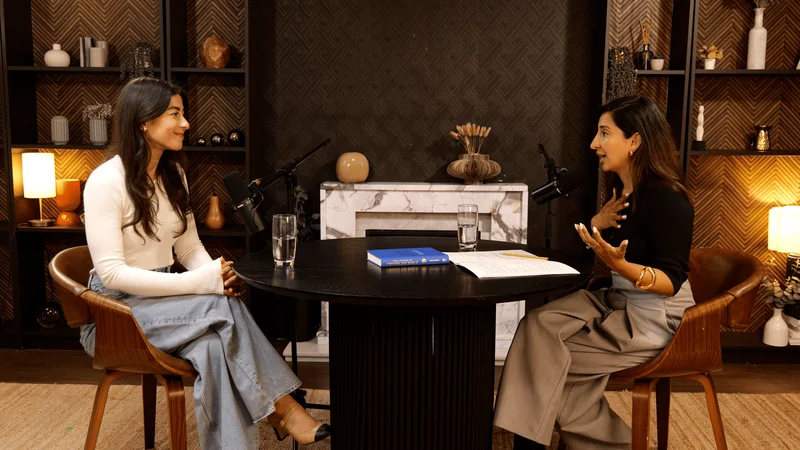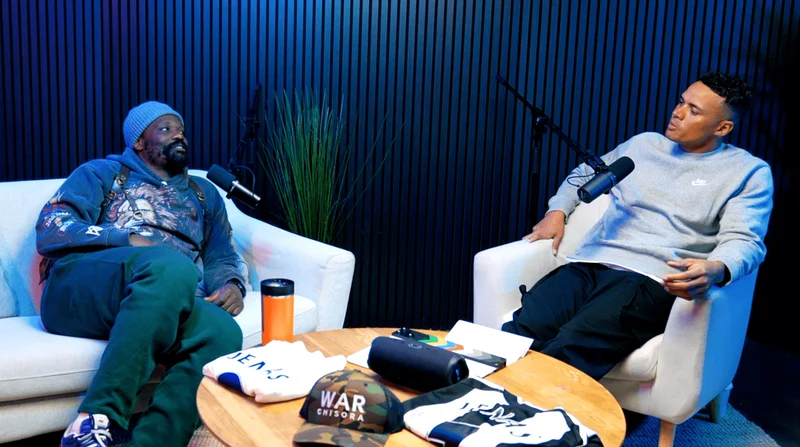
The global digital audio landscape has matured into a highly sophisticated, hyper-competitive, and extraordinarily resilient marketing and communication channel.1 As attention becomes increasingly difficult to capture across scroll-based social media feeds, display networks, and short-form video platforms, podcasts remain one of the few environments where audiences intentionally opt into long-form, immersive engagement.1 Listeners routinely dedicate thirty to ninety minutes to a single episode, often integrating this consumption into daily routines such as commuting, exercising, or performing focused work.1 This intentionality leads to stronger message absorption, higher recall rates, and the cultivation of deep parasocial relationships and brand trust.1 Consequently, treating a podcast merely as a casual audio diary is a strategic failure. Launching and sustaining a successful production requires transitioning from the mindset of a content creator to that of a media director, prioritizing rigorous pre-production planning, structured content design, and the systematic development of professional hosting and interviewing acumen.4
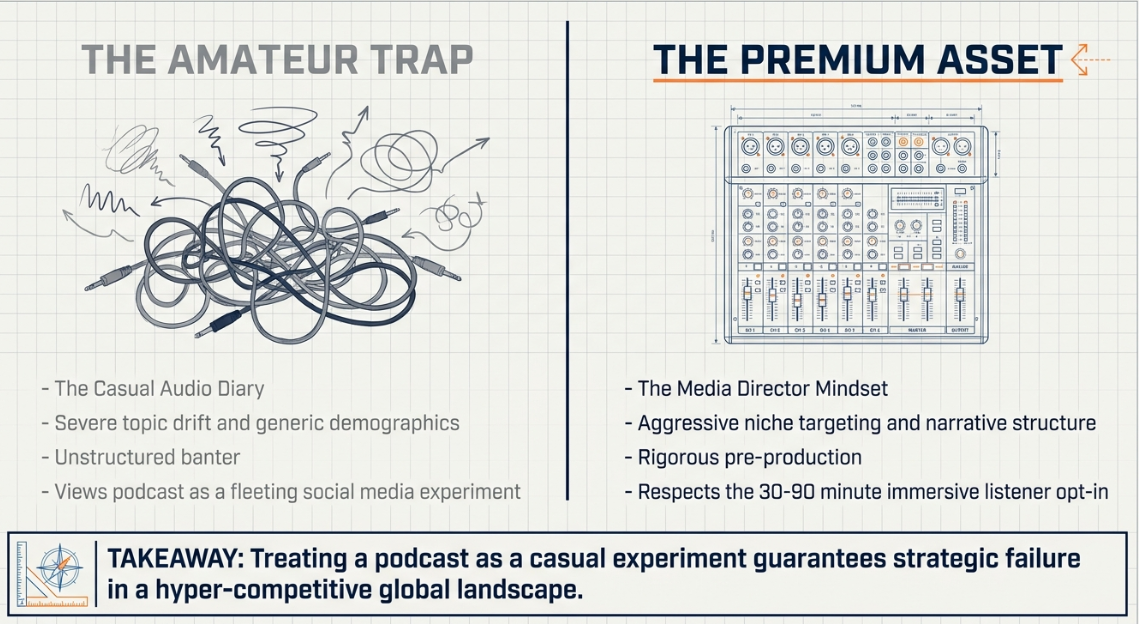
Formulating a Compelling Message and Cultivating a Hungry Audience
The architectural foundation of any successful audio production is a meticulously defined strategic thesis. A podcast represents a significant ongoing investment of organizational capital, human resources, and time; therefore, its fundamental message must be rigorously validated before recording equipment is even procured.5 The most successful productions make the process appear effortless specifically because they are engineered with highly specific goals in mind, perfectly aligned with a broader brand or marketing strategy.5
The Core Message and Strategic Focus
The strategic focus of a podcast must operate as the underlying thesis that governs all content decisions. A compelling message prevents "topic drift"—a common phenomenon where unstructured podcasts gradually lose their thematic identity, thereby alienating their core listener base and diluting their authority.6 Formulating this message begins with addressing foundational strategic inquiries: the purpose behind the show (the "Why"), the specific, tangible value provided to the listener (the "What"), the operational approach to delivering that value (the "How"), and an analysis of both the target audience and the competitive landscape (the "Who").7
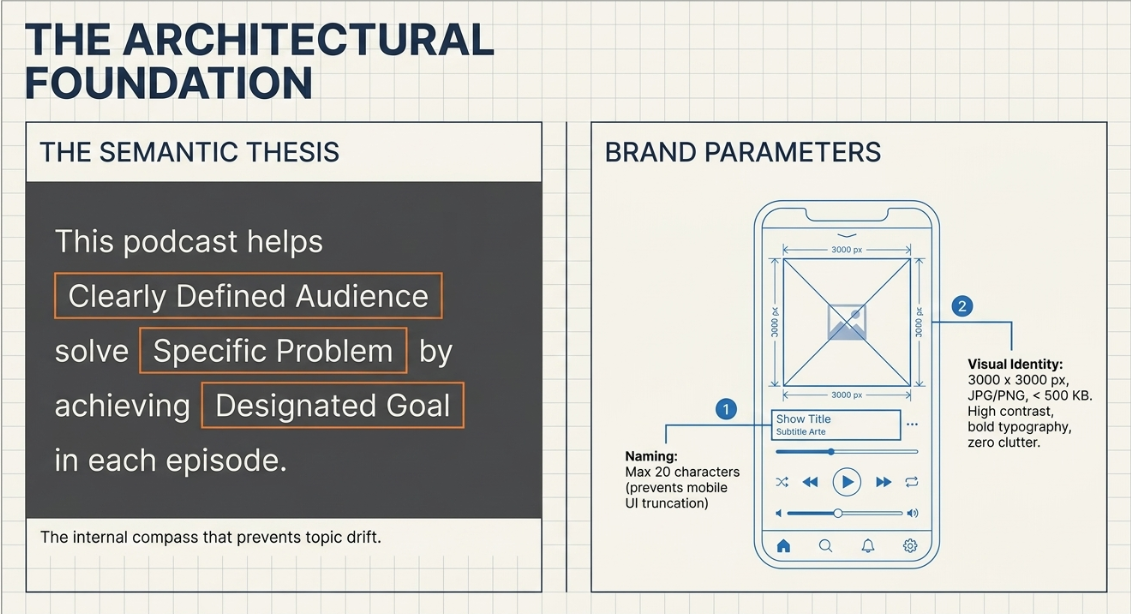
A highly effective methodology for crystallizing this focus is the development of a formal podcast mission statement. This statement serves as an internal compass, guiding episode ideation, guest selection, and marketing efforts. The optimal framework for this mission statement follows a specific semantic structure, functioning similarly to a strategic mad-lib: the podcast helps a clearly defined target audience solve a specific problem by achieving a designated goal in each episode.8 For example, rather than stating the podcast is about "business leadership," a precise mission statement would dictate that the podcast helps "mid-level B2B sales managers overcome pipeline stagnation by deconstructing the daily habits of Fortune 500 executives." This precise focus ensures that every minute of audio serves a deliberate purpose.6
Identifying and Targeting a Hungry Audience
Identifying and deeply understanding the target audience is the paramount precursor to content creation.3 Novice podcasters often attempt to appeal to a broad, generalized demographic in hopes of maximizing download numbers. However, strategic pre-production requires aggressive niche targeting. The most valuable audience in podcasting is not necessarily the largest, but rather the most highly engaged and aligned with the core message.11
Understanding the audience involves detailed psychographic profiling. Producers must investigate whether their intended audience is internal or external, and whether they possess a genuine appetite for the proposed audio content.5 Direct market research, such as surveying existing email lists, conducting customer interviews, or leveraging social listening tools, is essential to gauge this interest.5 The overarching objective is to craft content that the audience inherently trusts. Because podcast listeners form emotional connections and habitual listening routines over time, an authentic message that accurately targets their pain points will yield higher recall rates and more meaningful brand exposure than traditional interruptive advertising.1 Furthermore, understanding the audience dictates the tone, vocabulary, and complexity of the content delivered.
Architectural Blueprint: Determining the Podcast Format
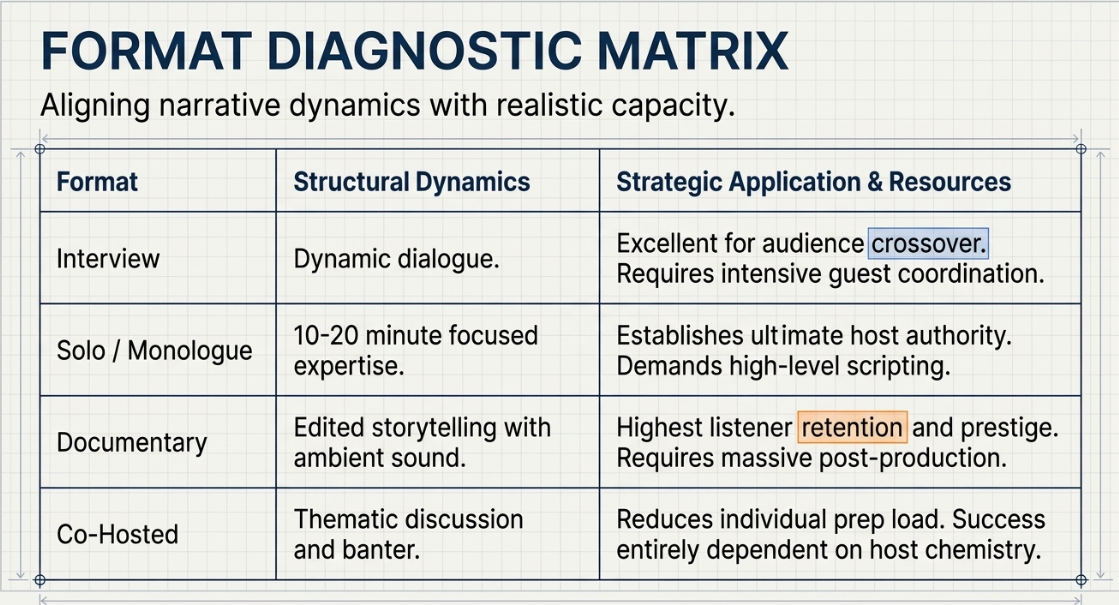
The structural format of a podcast dictates the production workflow, the technological requirements, and the listener's cognitive load. Format decisions must balance the creator's realistic resource constraints against the audience's consumption habits.2 Consistency in format and episode length is paramount because listeners integrate specific podcasts into specific daily routines; erratic episode lengths disrupt this integration and damage listener retention.
Brand Identity and Naming Conventions
In a market saturated with over four million podcasts, standing out requires a cohesive brand identity that encompasses visual, auditory, and psychological elements.15 A podcast brand is the sum of every impression made on the audience, transforming casual listeners into loyal community members.15
The podcast name is the primary cognitive touchpoint. Best practices developed by naming experts dictate that the name should ideally be twenty characters or less to ensure it displays correctly across mobile device user interfaces without truncation.7 The name must ignite curiosity while simultaneously indicating the subject matter, functioning as an immediate identifier of the show's tone.7
Visual identity centers on the podcast cover art. Technical specifications require strict adherence to platform parameters, most notably Apple Podcasts' guidelines: a square image measuring 3000 by 3000 pixels, in JPG or PNG format, and compressed to under 500 kilobytes.4 Because the artwork will frequently be viewed as a tiny icon on a mobile screen, typography must be bold, color palettes must be high-contrast, and the design must avoid visual clutter.15 Consistency across all visual touchpoints—from the RSS feed artwork to website design and social media templates—builds instant recognition.15
Beyond visuals, audio branding establishes the sonic texture of the show. This includes intro and outro music, transition stingers, sound effects, and the overall emotional tone of the audio engineering.15 When a listener hears the intro music, it acts as an auditory trigger, communicating a promise of the specific experience to follow.15
Communicating the Core Message: The 4 Hooks Framework
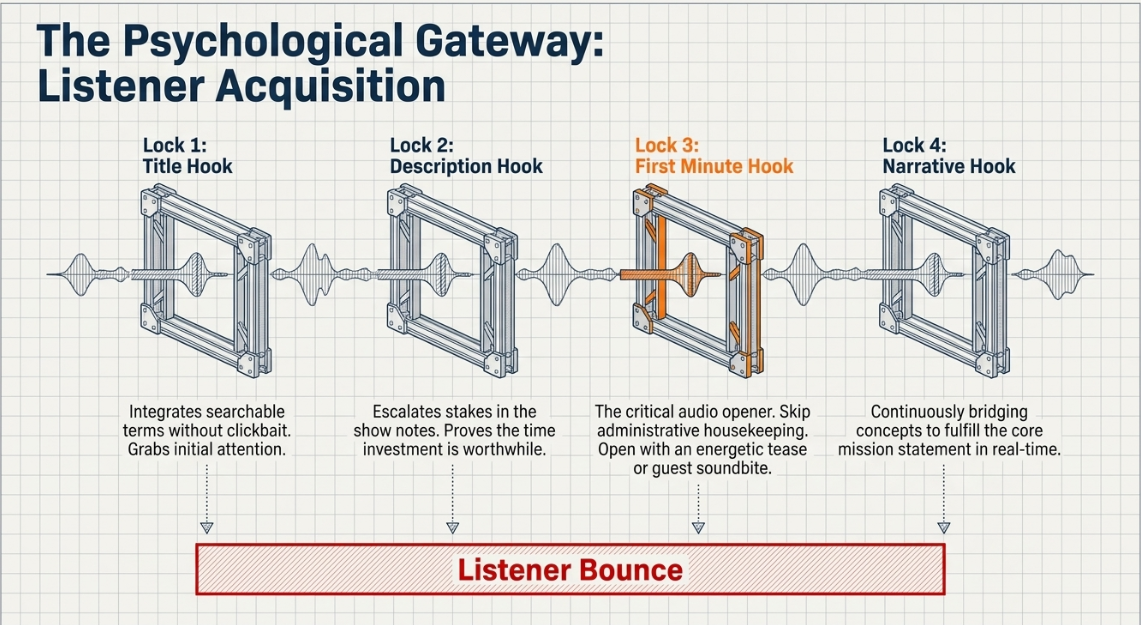
To effectively communicate the podcast's message and convert casual browsers into dedicated listeners, producers must master the psychological mechanics of listener acquisition. The survival of a podcast relies heavily on moving potential listeners past multiple decision points within the first few seconds of contact.19 This requires the implementation of the "4 Hooks Framework".19
The Title Hook is the first barrier. The episode title must simultaneously grab attention, create curiosity, and incorporate highly searchable terms without resorting to clickbait.19 The Description Hook follows; the show notes must escalate the stakes, providing context that proves the episode is worth the time investment.19 The First Minute Hook is perhaps the most critical. The opening audio must immediately affirm the listener's choice to click play. Instead of a meandering introduction filled with administrative housekeeping or lengthy biographies, the episode should open with an energetic tease, a compelling narrative question, or a provocative soundbite from the guest that hints at the immense value to come.19 Finally, the Narrative Hook requires the host to continuously bridge concepts throughout the episode, ensuring the core mission statement of the podcast is actively fulfilled in real-time.
Structuring Podcast Content
A meticulously designed brand identity and a compelling mission statement are entirely ineffective without a sustainable, highly structured content strategy. Content planning bridges the gap between the initial creative spark and long-term, consistent execution, ensuring that the podcast remains a viable asset rather than a fleeting experiment.22
Content Planning and Generating Episode Topics
Generating engaging episode topics requires moving beyond mere intuition and leaning heavily into data-driven methodologies, specifically Search Engine Optimization (SEO) and algorithmic social listening.23 Content should be reverse-engineered based on what the target audience is actively seeking, ensuring that the podcast acts as a solution to existing market demands. Utilizing advanced keyword research tools such as Semrush, Ahrefs, Moz Keyword Explorer, or Google Keyword Planner allows producers to identify long-tail keywords and high-volume search queries within their specific niche.23 Understanding the exact phrasing the audience uses to search for solutions allows producers to name episodes strategically and map out a comprehensive content roadmap.23
When planning individual episodes, an architectural blueprint—or structured outline—is the greatest defense against meandering, unfocused content.6 Regardless of whether an episode is heavily scripted to ensure regulatory compliance or loosely conversational to foster organic banter, a defined outline ensures that every segment serves a deliberate purpose.6 A professional outline begins with a defined single episode objective, incorporates gathered research and micro-stories, sequences the transitions, and leads toward a powerful, unified Call to Action (CTA).6 Advanced topic planning also involves auditing the best-performing past episodes to identify "sequel" opportunities, analyzing competitor content to find missed content gaps, and focusing heavily on evergreen topics that will remain relevant and drive back-catalog downloads for years to come.10
Podcasting Frequency, Consistency, and Content Batching
The cadence of episode releases fundamentally impacts audience growth, listener habituation, and algorithmic favorability on major directories. Whether the strategic schedule dictates a weekly, bi-weekly, or monthly release, strict adherence to the chosen frequency is an absolute imperative.24 A weekly schedule is optimal for maintaining momentum and building a dedicated following; a bi-weekly schedule offers a balance of consistency without overwhelming the creator; and a monthly schedule is reserved for highly produced, long-form documentary narratives.24 Inconsistent publishing is one of the primary reasons listeners abandon subscriptions and high-caliber guests decline invitations.11
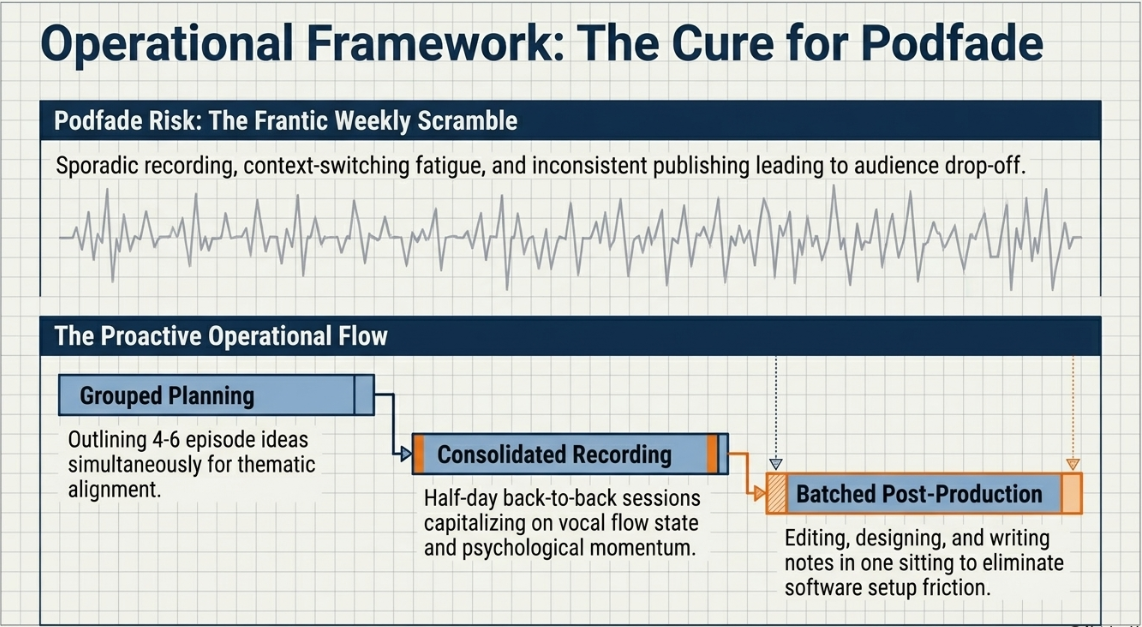
To sustain consistency without experiencing "podfade"—the phenomenon where creators burn out from the relentless weekly production cycle—producers must employ workflow systematization, most notably content batching.25 Content batching transitions podcasting from a frantic, reactive scramble into a predictable, proactive operational flow, creating cognitive breathing space that ultimately boosts creative storytelling.25
The batching process is divided into three distinct operational blocks. First, content planning is grouped, allowing the creator to outline four to six episode ideas simultaneously, ensuring thematic alignment and strategic continuity.25 Second, recording is consolidated into focused blocks. By scheduling a half-day session to record multiple episodes back-to-back, the host capitalizes on vocal warm-ups and psychological momentum, finding a flow state that is difficult to achieve when recording sporadically.25 Finally, post-production and writing tasks are batched, allowing the creator to edit audio, design assets, and write show notes for multiple episodes in one sitting, significantly reducing software setup time and context-switching fatigue.
Maximizing Discoverability Through Episode Notes
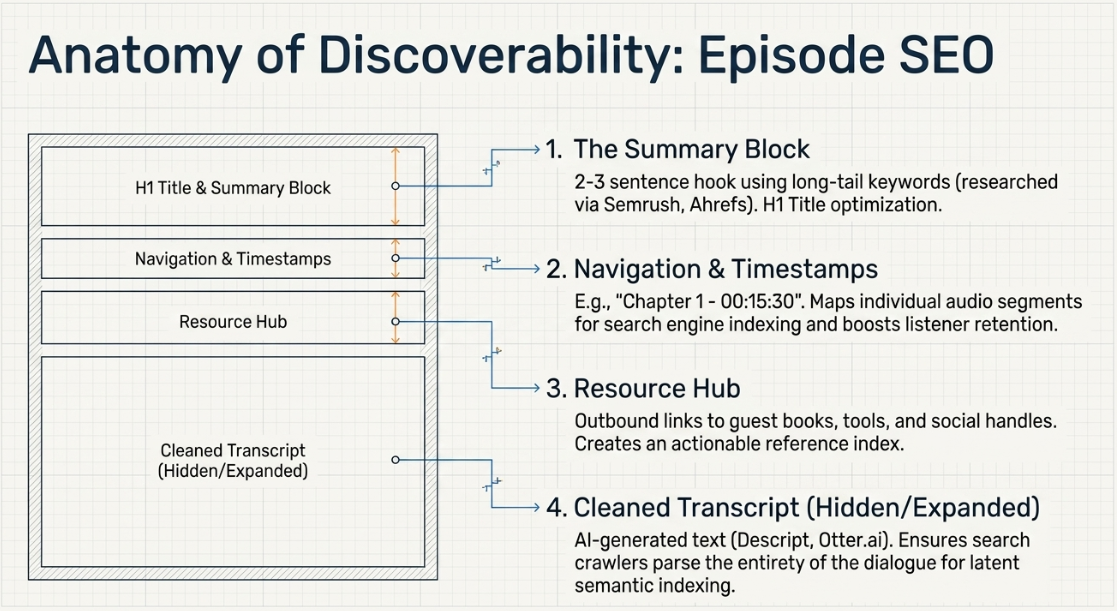
Episode show notes serve a vital dual purpose: they enhance the user experience by providing navigation and supplementary resources, and they act as the primary vehicle for SEO discoverability.23 Podcasts with detailed, highly optimized show notes experience a quantifiable increase in organic web traffic, better listener retention, and higher overall download metrics.27
A comprehensive, professional episode notes template must be standardized to streamline production and should include specific, structured elements.27 The notes begin with a clear Episode Header for quick identification, followed by a Summary Block designed to hook the reader. This summary should consist of a two-to-three sentence overview featuring a compelling hook, the main topics discussed, and natural long-tail keyword integration to improve search visibility.27
Navigation is facilitated through the precise use of Time Markers (timestamps). Providing timestamps (e.g., 15:30 or Chapter 1 – 00:15:30) dramatically boosts listener retention by allowing users to jump directly to specific segments of interest, thereby improving the overall user experience.27 Furthermore, mapping these timestamps to specific keyword-rich topic descriptions allows search engines to index individual audio segments.28 The notes must also include a robust Resource Section, acting as a hub that provides brief guest biographies, social media handles, and outbound links to books, courses, or tools mentioned during the discourse.27
From a technical SEO perspective, the show notes published on the podcast's native website should expand up to 1,000 words, utilizing target keywords in the H1 title and organizing the content with H2 and H3 subheadings.27 Integrating a full, cleaned transcript—generated via AI transcription software such as Descript, Otter.ai, or Rev.com—allows search engine crawlers to parse the entirety of the dialogue, radically improving latent semantic indexing and discoverability.27 Finally, employing technical markup such as PodcastEpisode schema and actively building backlinks from authoritative industry websites to the show notes page will further solidify the podcast's search engine ranking.
Delivering the Message
The strategic preparation of pre-production culminates in the execution of the recording. Delivering the message requires mastery over three distinct, highly specialized domains: the host's personal vocal and psychological performance, the strategic acquisition and management of guests, and the nuanced, dynamic art of interviewing.
Part I: The Dynamics of Hosting
The Foundation of Great Podcast Hosting
The host serves as the emotional and structural anchor of the podcast. Regardless of a guest's prestige or the relevance of the topic, audiences return primarily because they develop a strong parasocial connection with the host.30 Therefore, hosting is not merely the administrative task of reading a script or reciting a list of questions; it requires establishing unquestionable authority, guiding narrative flow with precision, and projecting an authentic, commanding presence.31 The host's voice literally sets the tone of the show, pulling out stories that hold attention and creating moments that build long-term trust and pipeline growth.31
Voice Discovery and Vocal Training
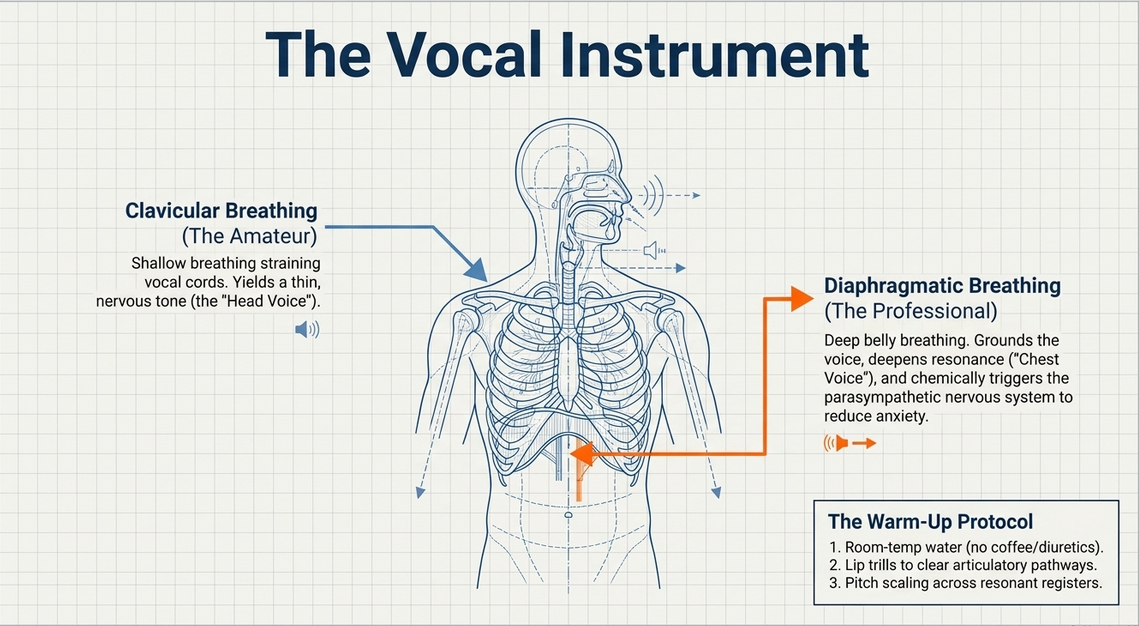
A pervasive trap for novice podcasters is the attempt to invent a "broadcaster persona," an artificial modulation of the voice that inevitably sounds inauthentic and alienates the audience.26 Finding one's voice means learning to project one's natural personality with enhanced clarity, energy, and physiological control. Vocal delivery is a mechanical process that can be trained and optimized. An untrained host often defaults to shallow, clavicular breathing, which strains the vocal cords, raises the pitch, and results in a thin, nervous tone.32 Proper podcast vocal mechanics require diaphragmatic (belly) breathing. Breathing deeply into the diaphragm grounds the voice, deepens resonance, prevents vocal strain, and activates the parasympathetic nervous system, which chemically reduces performance anxiety.32 Hosts must understand the physiological distinction between their "head voice"—a higher pitch suitable for projecting excitement—and their "chest voice"—a lower, resonant vibration that conveys intimacy and authority.32
Pre-recording vocal warm-ups are critical for professional delivery. These begin with hydration; consuming room-temperature water well before recording ensures the vocal folds are lubricated, while strict avoidance of diuretics like coffee or energy drinks prevents the throat from drying out.34 Physical warm-ups involve utilizing lip trills, humming, and specific tongue twisters to relax the jaw, improve diction, and clear articulatory pathways.33 Furthermore, pitch scaling—moving the voice smoothly from the lowest resonant chest register to the upper head register—ensures a dynamic vocal range during the recording, preventing a monotonous delivery.
Improving Hosting Skills (On-Mic and Off-Mic)
Great hosts recognize that the microphone exposes every hesitation and structural flaw in speech. Improving hosting skills requires deliberate, continuous practice, both during production and in unrelated environments. On-mic, the most critical skill to master is pacing, specifically the strategic use of the pause.34 Rather than relying on verbal filler words (e.g., "um," "ah," "like," "you know"), hosts must cultivate the discipline to sit in silence.35 A deliberate pause commands attention, allows the listener time to digest complex points, and frequently forces guests to elaborate deeper into their thought process to fill the void.34 Furthermore, the host must develop hyper-active listening skills, treating the conversation as a fluid journey rather than rigidly adhering to a pre-written roadmap, embracing detours when a guest reveals a unique insight.37
Off-mic, hosts can systematically improve their vocal cadence, narrative structuring, and improvisational thinking through several distinct disciplines. Reading aloud daily—whether scripts, literature, or news articles—builds vocal stamina, sight-reading fluency, and the ability to inject emotional inflection into written text.39 Participating in structured public speaking environments, such as Toastmasters, forces hosts to research, outline, and deliver content while receiving critical, immediate feedback on their filler-word usage, structural timing, and audience engagement.42 Furthermore, taking improvisational comedy classes trains the brain to think laterally, react instantly to unexpected guest pivots, and embrace conversational spontaneity without freezing.42 Perhaps the most grueling but effective method for rapid improvement is for the host to edit their own raw audio. Listening back to unedited tape forces the host to confront their conversational crutches, poor pacing, and missed follow-up opportunities, acting as an accelerated feedback loop for continuous, targeted improvement.42
Cultivating Podcasting Confidence
Confidence behind the microphone is not an innate genetic trait; it is the direct byproduct of extensive preparation and repetition. Speaking aloud daily and engaging in thorough topic research naturally reduce hesitation and build ease behind the microphone.46 Furthermore, hosts must prioritize the process over the final product, accepting the reality that early episodes will inherently feature unpolished elements, a mindset that separates creators who endure from those who succumb to podfade.26 True confidence allows the host to remain calm and in control of the room, maintaining a hospitable, secure environment that puts nervous guests at ease and prevents the interview from derailing into awkwardness.
Strategic Guest Acquisition
The Strategic Value of Podcast Guests
For interview-based formats, guests are the primary engine for content variety, intellectual depth, and audience expansion. Guests introduce novel expertise, unique storytelling perspectives, and—crucially—access to adjacent audience demographics, serving as a powerful cross-promotional mechanism.49 However, the strategic objective is not simply to book anyone willing to speak into a microphone; it is to meticulously curate a roster of individuals who perfectly align with the show's mission statement and provide distinct, actionable value to the established listener base.11
Sourcing and Finding High-Caliber Guests
Finding guests requires moving beyond passive inquiries and implementing a proactive, systematized sourcing ecosystem. The modern podcasting landscape offers highly sophisticated matchmaking platforms that utilize algorithmic matching to pair hosts with subject matter experts based on niche, audience size, and mutual marketing objectives.
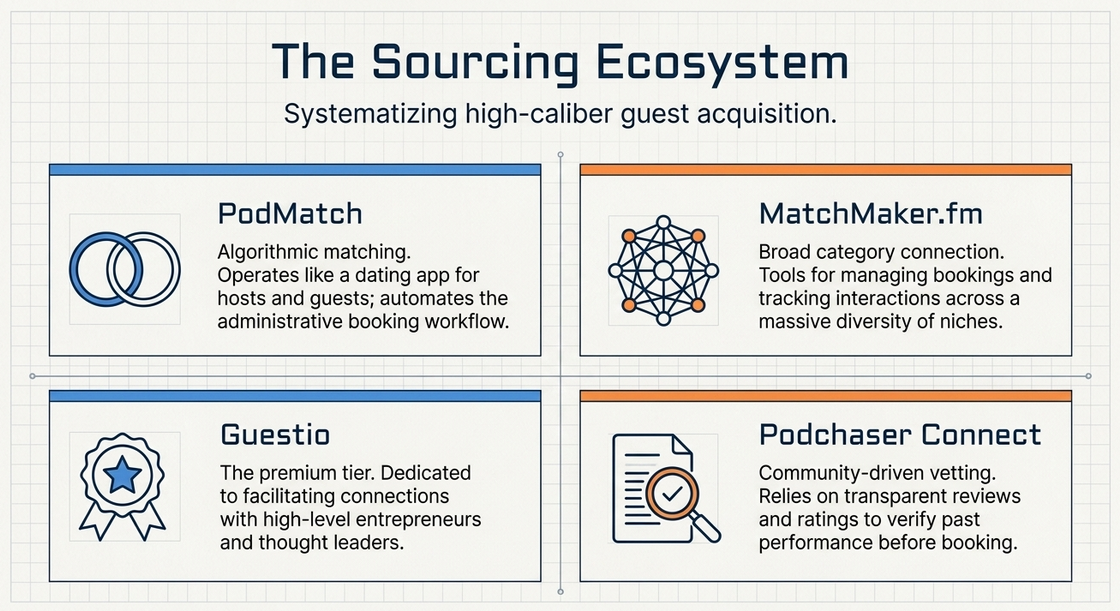
Beyond automated platforms, strategic manual sourcing involves leveraging professional networks like LinkedIn (searching for specific industry tags combined with terms like "speaker" or "author"), monitoring new book releases and PR circuits, and cross-referencing speaker lists from major industry conferences within the podcast's specific niche.55 Additionally, analyzing the guest rosters of ancillary podcasts within the same broader category can yield highly qualified, "mic-tested" candidates who are already familiar with the medium.55
Structuring the Value Proposition to Appeal to Guests
High-profile guests, industry leaders, and celebrities ruthlessly protect their time and their personal brands. To make a podcast appealing to this echelon, the host must present a compelling, highly professional value proposition.11 Guests meticulously vet podcasts before agreeing to appear, scanning for indicators of quality and audience engagement.11
A podcast signals its premium quality through several key indicators: high-fidelity audio production, an established track record of consistent publishing, and a highly active, professional digital footprint across social media and the web.11 A host must prove that the show offers high-attention, trust-driven engagement that will tangibly elevate the guest's status and credibility.1 This value is best formalized through a professional media kit that highlights audience demographics, download metrics, and the specific promotional reach the guest will receive in exchange for their time.11 To secure top-tier talent, hosts must also demonstrate extreme logistical flexibility, accommodating the strict schedules of executives, and aligning the interview with the guest's upcoming promotional cycles, such as a book launch or major event.
Approaching Potential Guests (Outreach Strategies)
Cold outreach is a delicate art form that requires deep personalization. Generic, mass-emailed pitches are immediately identified and discarded by busy professionals.56 A successful outreach campaign requires systematization to track correspondence, follow-ups, and conversion metrics, effectively treating guest booking as a specialized, relationship-based sales funnel.11 Utilizing outreach software or a dedicated CRM prevents communication from falling through the cracks and standardizes the follow-up process.11
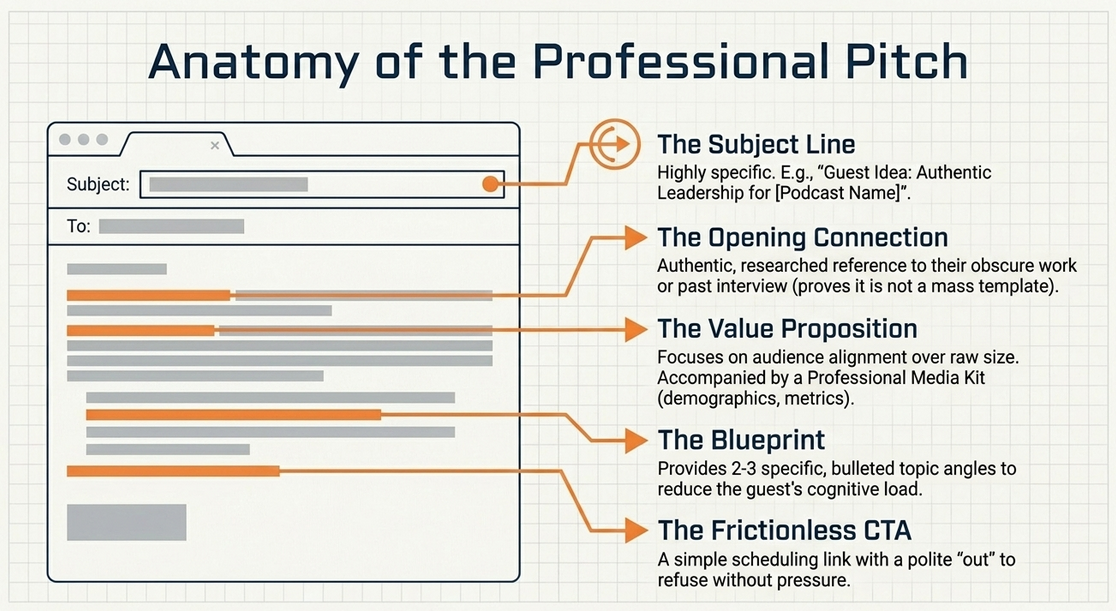
The anatomy of a highly converting pitch email includes several non-negotiable elements. It must begin with a highly specific subject line, referencing the podcast name and the exact angle or topic being proposed (e.g., "Guest Idea: Authentic Leadership for [Podcast Name]") to stand out in a crowded inbox.11 The opening must establish a personalized connection, featuring a specific, authentic reference to the guest's recent work, a previous interview they gave, or an article they published, unequivocally proving the host has done thorough research.11 The pitch must prioritize audience alignment over raw size, emphasizing exactly why the guest's specific expertise is the perfect fit for the podcast's unique listener base.11 To reduce the cognitive load on the guest, the email should provide two to three specific, bulleted topic suggestions or angles for the conversation.60 Finally, it must conclude with a frictionless Call to Action, offering a simple scheduling link, clearly outlining the time commitment required, and providing a polite "out" to refuse without pressure.56
Part III: Advanced Podcast Interviewing
The Crucial Pre-Interview
The most significant strategic error a host can make is treating the live recording session as the first point of human contact with a guest. The pre-interview—a brief, 10-to-15 minute discovery call conducted days prior to the recording—is an essential diagnostic and preparatory tool utilized by professional broadcasters across all mediums.51
The pre-interview serves multiple vital functions. It establishes baseline human rapport, breaking the ice before the psychological pressure of the microphone is introduced. It allows the host to pre-screen the guest's audio quality, internet connection, and technical setup, mitigating disastrous technological failures on recording day.63 Most importantly, it provides an opportunity to align on expectations, format, and the specific narrative boundaries of the episode, ensuring both parties understand the desired outcome.51 A guest who flatly refuses a pre-interview is frequently demonstrating a lack of respect for the process, which is a major early warning sign of a difficult recording.
Techniques for Executing a Great Interview
Most hosts consider themselves above-average interviewers, yet the vast majority default to either a rigid, sterile journalistic interrogation or a meandering, structureless chat that provides little value.64 Elite interviewing requires a synthesis of intensive, customized preparation and high-level improvisational active listening.37
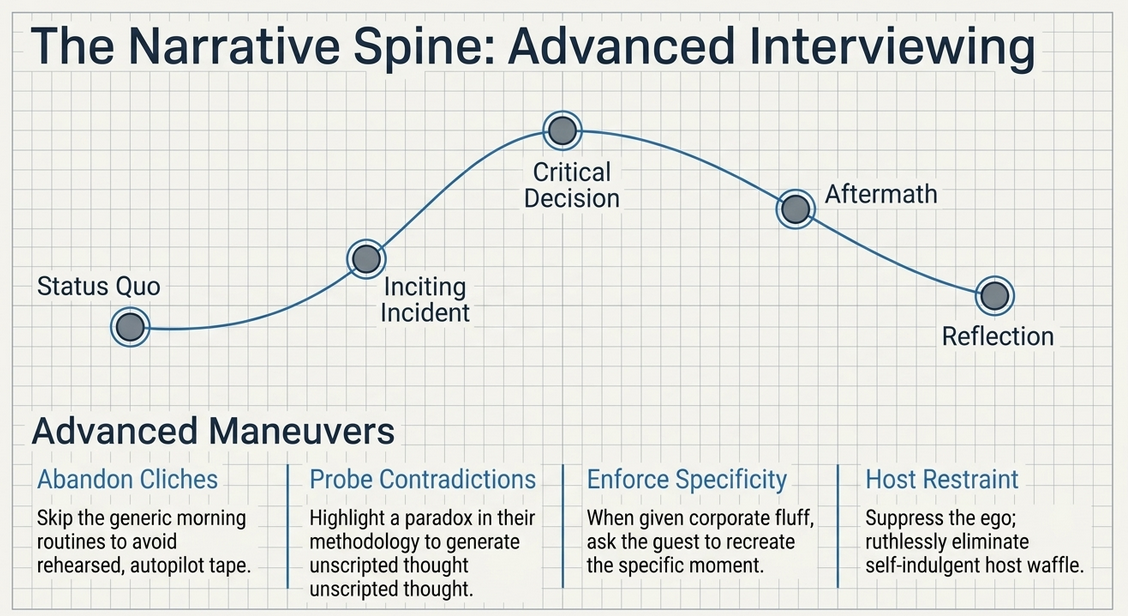
A compelling interview relies heavily on narrative structure. Rather than reciting chronological biographies, hosts should aim to uncover the "spine" of a story: the state of affairs before an event, the inciting incident, the critical decision made, the aftermath, and the ultimate reflection.35
To achieve this depth, hosts must employ advanced verbal maneuvers:
Abandon Cliche Inquiries: Questions such as "What inspired your journey?" or "What is your morning routine?" trigger rehearsed, autopilot responses that the guest has delivered on dozens of other shows.35 Instead, hosts must tailor questions to specific, obscure details found well beyond the first page of search engine results.35
Probe Contradictions: Asking a guest about a time they fundamentally changed their mind, or highlighting a paradox in their methodology, forces them to pause, think deeply, and generate highly original, unscripted tape.35
Active Listening and Probing: The host must listen to the actual response rather than merely waiting for their turn to ask the next pre-written question.35 If a guest offers a vague, highly polished corporate response, the host must respectfully challenge them to dig deeper, asking them to "recreate the specific moment" rather than speaking in conceptual abstractions.35
Host Restraint: The host's primary objective is to elevate the guest and make them shine. This requires suppressing the ego, avoiding the urge to constantly relate the guest's story back to their own experiences, and ruthlessly eliminating self-indulgent "host waffle" from the conversation.35
Identifying and Mitigating Guest Red Flags
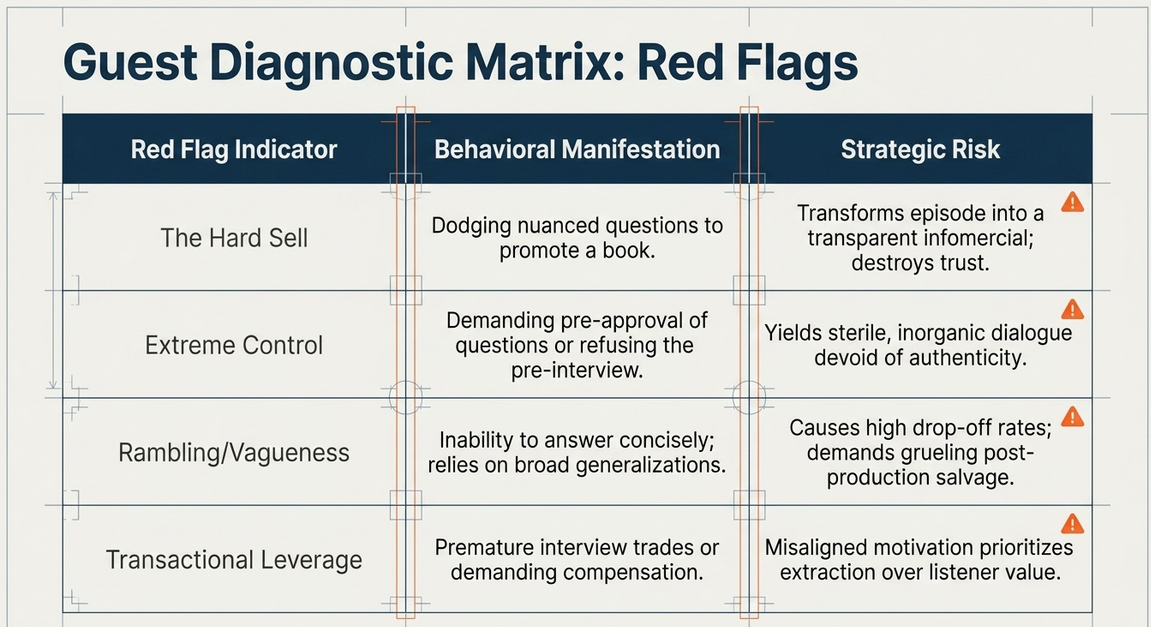
Protecting the integrity of the podcast requires rigorous, unapologetic gatekeeping. Hosts must remain vigilant during the pre-interview and early communications for behavioral indicators that suggest a guest will deliver a suboptimal performance, derail the content, or damage the show's hard-earned credibility.
Graceful Rejection Strategies for Unsuitable Guests
As a podcast grows in authority, the influx of inbound guest pitches will inevitably exceed production capacity, and the vast majority of these inbound pitches will be poor fits for the show's specific niche.65 Ignoring pitches damages the host's industry reputation, but accepting misaligned guests betrays the trust of the audience.66 The host is the ultimate gatekeeper of the audience's time and attention, and must protect it fiercely.66
Establishing a formalized filtering process—such as a "Prove You Care" test regarding whether the pitching guest actually understands the show's premise and format—allows hosts to categorize and process rejections efficiently and without guilt.65 Rejection must be handled gracefully through systematized email templates.67 Templates should be direct but gentle, highly personalized with the candidate's name, completely stripped of robotic corporate jargon, and clear about the reasoning.67 Valid reasons for rejection include stating the guest is "not a good fit for current audience demographics," indicating the "editorial calendar is full," or noting a "subject matter overlap" with recently recorded episodes.67 A polite, definitive "no" preserves professional bridges, provides constructive feedback, and establishes firm boundaries, positioning the host as a decisive media leader.65
Navigating Relationships with Publicists
Public relations professionals and publicists are increasingly acting as the primary intermediaries between high-profile guests (authors, executives, celebrities) and podcasters.49 Working effectively with a publicist can unlock access to top-tier talent that would otherwise be unreachable, but it requires a deep understanding of the PR ecosystem and mutual expectations.50
Publicists evaluate podcasts strictly based on reach, demographic alignment, and the host's professionalism.72 Hosts must be prepared to clearly articulate their show's metrics and value proposition. When receiving pitches from publicists, hosts should demand tailored approaches; generic, mass-distributed press releases that demonstrate no understanding of the podcast's format should be immediately discarded.59 Conversely, if a host successfully secures a guest through a publicist, adherence to strict scheduling deadlines, providing promotional audio and visual assets promptly upon release, and keeping the publicist informed of publication dates are best practices.71 Demonstrating this level of reliability will ensure the PR agency continues to route premium, sought-after clients to the podcast in the future.71
Legal Foundations: The Guest Release Agreement
The professionalization of a podcast necessitates robust legal architecture. Every single guest appearance must be governed by a formally executed Podcast Guest Release Form.75 Operating without this document exposes the podcast entity to significant, potentially existential liability. Without a signed release, the host does not have the definitive legal right to monetize, alter, or perpetually host the audio containing the guest's voice, likeness, and intellectual property.
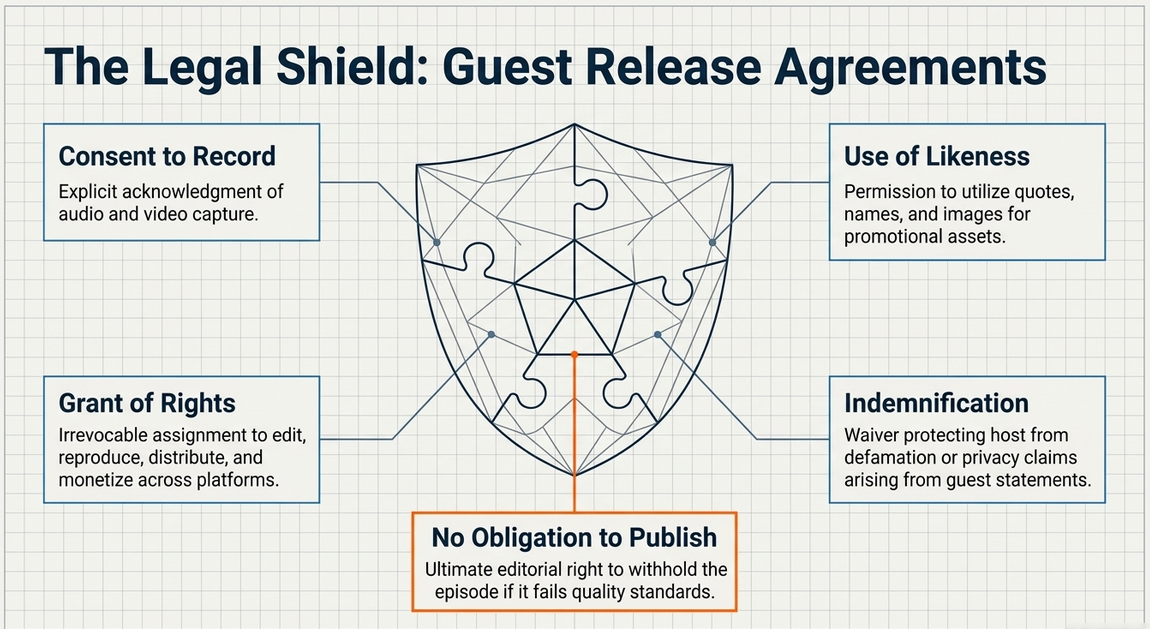
Essential clauses within a standard Guest Release Form must include:
Consent to Record: Explicit, documented acknowledgment that the guest knows they are being recorded (both audio and video).75
Grant of Rights and Copyright Ownership: A clause wherein the guest irrevocably assigns the host the rights to edit, reproduce, distribute, and monetize the final episode across all current and future distribution platforms.75
Use of Name and Likeness: Explicit permission to utilize the guest's name, biographical data, quotes, and image for marketing, social media clips, and promotional assets.75
Release from Liability (Indemnification): A vital waiver protecting the host and the publishing entity from legal claims (e.g., defamation, loss of income, invasion of privacy) arising directly or indirectly from the guest's statements during the interview.78
No Obligation to Publish: A protective clause stating that the host retains the ultimate editorial discretion to withhold the episode from publication if the recording does not meet quality standards or editorial guidelines.75
Salvaging Suboptimal Interviews and Managing Difficult Guests
Despite rigorous vetting, extensive pre-interviews, and thorough preparation, a host will inevitably encounter a fundamentally flawed interview. The guest may freeze due to technical anxiety, become combative, deliver aggressively boring and monotone responses, or suffer from catastrophic equipment failure.
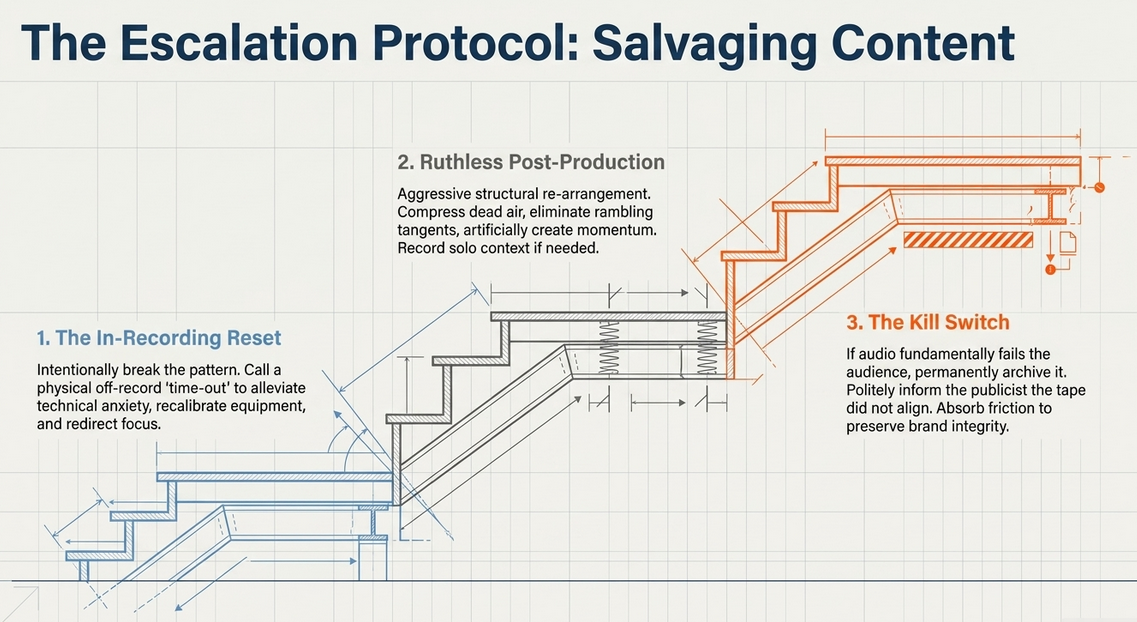
The immediate in-recording tactic is to intentionally break the conversational pattern. If energy is flagging, tension is rising, or the guest is rambling uncontrollably, the host should halt the recording and call a physical "time-out".47 A brief off-record reset can alleviate nerves, recalibrate the audio equipment, and allow the host to gently redirect the guest's focus. If the guest is delivering boring, sprawling answers, the host must interject with highly specific, boundary-setting questions to force a tighter conversational scope, or use advanced active listening to pivot toward the guest's genuine passions.81
If the live session cannot be entirely salvaged in the moment, the secondary defense mechanism is aggressive post-production. Ruthless editing is required to protect the listener's time. This involves eliminating rambling tangents, compressing dead air, removing verbal crutches, and structurally re-arranging the dialogue to artificially create pacing and narrative momentum.35 In some cases, the host may need to record supplementary solo audio to provide context for a disjointed guest segment.84
However, if the content fundamentally fails to serve the audience, the host must exercise their ultimate editorial right: killing the interview.84 A professional producer does not release substandard, damaging content simply out of a sense of obligation to the time the guest spent.66 The episode must be permanently archived, and the host must politely inform the guest (or their publicist) that the audio did not align with the final editorial direction of the show, absorbing the temporary friction to preserve the long-term integrity and reputation of the podcast's brand.70
The transition from an amateur broadcasting hobby to a professional, monetizable podcasting operation is entirely dependent on the rigor of pre-production and strategic execution. By meticulously defining a core message, implementing data-driven content architectures, standardizing outreach, and continually refining both physiological vocal delivery and psychological interviewing techniques, producers can create highly resilient media assets. Ultimately, the successful podcast is one that fiercely protects its listeners' attention, curates exceptional insights through strategic guest management, and builds an enduring platform based on trust, consistency, and unparalleled narrative value.
Works cited
2026 Guide to Podcasting from Cineverse and BloodyFM, accessed April 30, 2026, https://podcasts.bloody-disgusting.com/guide-to-podcasting/
Planning Podcast Episodes 2023 Guide – Templates, Outlines & Format Tips - Captivate.fm, accessed April 30, 2026, https://www.captivate.fm/learn-podcasting/planning-podcast-episodes-guide
Understanding the Full Audio Landscape - iHeartMedia, accessed April 30, 2026, https://www.iheartmedia.com/advertise/insights/articles/understanding-the-full-audio-landscape
Podcast Naming & Rebrand Checklist: How to Rename and Relaunch Your Show - Libsyn, accessed April 30, 2026, https://libsyn.com/blog/podcast-naming-rebrand-checklist-how-to-rename-and-relaunch-your-show/
How to Launch a Podcast: Best Practices to Get Started | Clariant Creative, accessed April 30, 2026, https://www.clariantcreative.com/launch-a-podcast-best-practices
A Winning Outline for Podcast Episodes - Fame.so, accessed April 30, 2026, https://www.fame.so/post/a-winning-outline-for-podcast-episodes
Need podcast branding advice? These Spotify marketing pros can help, accessed April 30, 2026, https://creators.spotify.com/resources/create/podcast-branding
Creating Your Compelling Podcast Mission Statement, accessed April 30, 2026, https://ringmaster.com/creating-a-compelling-mission-statement-for-your-podcast/
Defining Your Podcast's Mission Statement - Ringmaster B2B Podcasting, accessed April 30, 2026, https://ringmaster.com/your-podcasts-mission-statement/
15 Podcast Best Practices For 2025: Everything You Need To Know - Podsqueeze, accessed April 30, 2026, https://podsqueeze.com/blog/podcast-best-practices/
How to Master Podcast Outreach & Get Booked, accessed April 30, 2026, https://leveragewithmedia.com/podcast-outreach-guide/
Podcast Topics Guide [8 Examples] - Pepperland Marketing, accessed April 30, 2026, https://www.pepperlandmarketing.com/blog/podcast-topics-guide
Best practices for creating a storytelling podcast: tips from an award-winning journalist, accessed April 30, 2026, https://www.thepodcastspace.com/resources-for-podcasters/best-practices-for-storytelling-podcast-aleksandra-bucko
Do you plan your podcast episodes in detail, or figure them out while recording? - Reddit, accessed April 30, 2026, https://www.reddit.com/r/podcasting/comments/1qkpqgc/do_you_plan_your_podcast_episodes_in_detail_or/
Podcast Branding Guide: Build a Memorable Podcast Identity - OnPodium, accessed April 30, 2026, https://onpodium.com/blog/podcast-branding-guide/
482 Designing Brand Identity by Rob Meyerson - Apple Podcasts, accessed April 30, 2026, https://podcasts.apple.com/us/podcast/482-designing-brand-identity-by-rob-meyerson/id961463317?i=1000651515916
Podcast Branding Guide | uStudio, accessed April 30, 2026, https://ustudio.com/wp-content/uploads/2020/06/uStudio_Podcast_Branding_Guide-v2.pdf
The definitive guide to creating engaging podcast content - YouTube Blog, accessed April 30, 2026, https://blog.youtube/creator-and-artist-stories/the-definitive-guide-to-creating-engaging-podcast-content/
The 4 Hooks Framework: The Key to Winning Over New Podcast Listeners, accessed April 30, 2026, https://podcastmarketingacademy.com/4-hooks-framework/
How to Create an Attractive Podcast Intro That Hooks Your Audience - Podbean Blog, accessed April 30, 2026, https://blog.podbean.com/create-podcast-intro/
How to Write a Show Trailer That Hooks in 30 Seconds - The Podcast Sessions, accessed April 30, 2026, https://thepodsessions.com/how-to-write-a-show-trailer-that-hooks-in-30-seconds/
Enhancing Your Podcasting Skills: Key Areas to Focus on for Improvement (Experience Sharing) | by chakra.debottam | Medium, accessed April 30, 2026, https://medium.com/@chakra.debottom/enhancing-your-podcasting-skills-key-areas-to-focus-on-for-improvement-experience-sharing-5f301a62e424
Podcast SEO for Beginners - Trint, accessed April 30, 2026, https://trint.com/creator-hub/podcast-seo-for-beginners
How to Create a Podcast Content Calendar for Consistency and Success -, accessed April 30, 2026, https://commandyourbrand.com/how-to-create-a-podcast-content-calendar-for-consistency-and-success/
Podcast Content Batching for Consistency and More Creative Freedom, accessed April 30, 2026, https://podcastmagician.com/podcast-content-batching-for-consistency-and-more-creative-freedom/
Watch This to Build Your Podcast Confidence - YouTube, accessed April 30, 2026, https://www.youtube.com/watch?v=WJDr7tNlBXU
How to Write Engaging Podcast Show Notes: A Complete Guide ..., accessed April 30, 2026, https://propodcastsolutions.com/how-to-write-engaging-podcast-show-notes-a-complete-guide/
13 Podcast SEO Tips to Know Before Hitting Record | Rev, accessed April 30, 2026, https://www.rev.com/blog/how-to-boost-seo-with-podcast-transcription
7 Podcast SEO Best Practices for Explosive Growth in 2025 - Fame.so, accessed April 30, 2026, https://www.fame.so/post/7-podcast-seo-best-practices-for-explosive-growth-in-2025
Vocal Training: How to Enhance Your Podcast Voice to Keep Your Audience Listening, accessed April 30, 2026, https://sarahmikutel.com/how-to-podcast/improve-your-podcast-voice-through-vocal-training
Podcast Host Training: Elevate Interviews and Storytelling - Content Allies, accessed April 30, 2026, https://contentallies.com/learn/podcast-host-training
7 Effective Voice Exercises for Podcasters, accessed April 30, 2026, https://podcastinghacks.com/effective-voice-exercises-for-podcasters/
Improve Your Vocal Skills: Tips and Exercises - Blubrry Podcasting, accessed April 30, 2026, https://blubrry.com/podcast-insider/2024/10/21/improve-your-vocal-skills-tips-and-exercises/
Developing Your Podcasting Voice, accessed April 30, 2026, https://www.voicepowerstudios.com/blog/274-developing-your-podcasting-voice.html
Why Most Interview Podcasts Suck (and How to Fix Yours) - Baird ..., accessed April 30, 2026, https://baird.media/why-most-interview-podcasts-suck-and-how-to-fix-yours/
5 Interview Techniques That Will Transform Your Podcast - YouTube, accessed April 30, 2026, https://www.youtube.com/watch?v=devdnWQCQd4
How Being a Podcast Host Made Me an Active Listener - Cynthia Lockrey, accessed April 30, 2026, https://lockreycommunications.com/how-being-a-podcast-host-made-me-an-active-listener/
Practice Your Active Listening Skills - Apple Podcasts, accessed April 30, 2026, https://podcasts.apple.com/us/podcast/practice-your-active-listening-skills/id1683948659?i=1000640420708
After a year of running a podcast, here's what I wish I knew before I started - Reddit, accessed April 30, 2026, https://www.reddit.com/r/podcasting/comments/vz28z6/after_a_year_of_running_a_podcast_heres_what_i/
How Podcasting in the Classroom Boosts Communication Skills - Edutopia, accessed April 30, 2026, https://www.edutopia.org/video/how-podcasting-in-the-classroom-boosts-communication-skills/
Reading Aloud: Tips for Captivating Your Audience for Podcasting and Video, accessed April 30, 2026, https://www.writersdigest.com/getting-published/reading-aloud-tips-for-captivating-your-audience-for-podcasting-and-video
9 Ways to Get Better at Podcasting, accessed April 30, 2026, https://bulletin.bigpodcast.com/g
Podcasting With Purpose - Toastmasters International, accessed April 30, 2026, https://www.toastmasters.org/magazine/magazine-issues/2020/apr/podcasting-with-purpose
Pondering the Podcasting Project? Stop Procrastinating! Pathways Level 4 Elective, accessed April 30, 2026, https://toastmasters86.org/pondering-the-podcasting-project-stop-procrastinating-pathways-level-4-elective/
7 Ways To Help You Improve As A Podcast Host | by George “Ace” Acevedo - Medium, accessed April 30, 2026, https://medium.com/podcast-and-broadcast/7-ways-to-improve-your-podcast-a304ea84c02d
8 Tips For Saving a Bad Podcast Interview, accessed April 30, 2026, https://weeditpodcasts.com/8-tips-for-saving-a-bad-podcast-interview/
7 Interviewing Tips for Podcasters - Writer's Digest, accessed April 30, 2026, https://www.writersdigest.com/getting-published/7-interviewing-tips-for-podcasters
Podcasts and Publishers Tips and Tricks by Jenna Spinelle - Timber.fm, accessed April 30, 2026, https://timber.fm/stories/how-authors-podcasters-and-publicists-can-help-each-other-reach-new-audiences/
How to Know if a Podcast Publicist is Right for Your Business, accessed April 30, 2026, https://www.publicityxchristina.com/podcast-publicist
9 Podcast Guest Booking Red Flags to Watch For - Krystal Proffitt, accessed April 30, 2026, https://krystalproffitt.com/podcast-guest-booking-red-flags-to-watch-for/
PodMatch: Matching Hosts and Guests for Podcast Interviews, accessed April 30, 2026, https://podmatch.com/
The Best Podcast Guest Booking Agencies of 2025 - The Expert Bookers, accessed April 30, 2026, https://www.expertbookers.com/podcast-marketing-authority-blog/the-best-podcast-guest-booking-agencies-of-2025
A guide to the best podcast matching sites. - The UnNoticed Entrepreneur, accessed April 30, 2026, https://www.theunnoticedentrepreneur.com/a-guide-to-the-best-podcast-matching-sites/
Where to find guests for your podcast - Steve Hart, accessed April 30, 2026, https://www.stevehartmedia.com/where-to-find-guests-for-your-podcast-2/
Podcast Guest Pitching: How to Attract High-Profile Guests to Your Show -, accessed April 30, 2026, https://commandyourbrand.com/podcast-guest-pitching-how-to-attract-high-profile-guests-to-your-show/
How To Pitch As A Desirable Podcast Guest | Marketing by Human Design for Business, accessed April 30, 2026, https://juliettestapleton.com/how-to-pitch-as-a-desirable-podcast-guest/
How To Land High Profile Podcast Guests - YouTube, accessed April 30, 2026, https://www.youtube.com/watch?v=2crbl2OUt5c
Podcast PR Agency 101: Your Ultimate Guide, accessed April 30, 2026, https://leveragewithmedia.com/podcast-pr-agency-guide/
How To Land Podcast Guest Appearances Through Effective Outreach, accessed April 30, 2026, https://ronntorossianupdate.com/how-to-land-podcast-guest-appearances-through-effective-outreach
10 Step Guide to How to Write the Perfect Podcast Guest Pitch Email - Phil Fraser, accessed April 30, 2026, https://philfraser.co.uk/perfect-podcast-guest-pitch-email/
What are some green flags, and red flags when working with a podcaster? I'm new to this, and would like some input! - Reddit, accessed April 30, 2026, https://www.reddit.com/r/podcasting/comments/1st37lg/what_are_some_green_flags_and_red_flags_when/
5 Types of Challenging Podcast Guests (and How to Handle Them) - Emily Prokop, accessed April 30, 2026, https://www.epodcastproductions.com/podcasting-blog/5-types-of-challenging-podcast-guests-and-how-to-handle-them
How to Become A Better Podcast Interviewer, accessed April 30, 2026, https://podcastmarketingacademy.com/how-to-become-better-podcast-interviewer/
How to Say No to Guest Pitches | Agi Keramidas - Buzzsprout, accessed April 30, 2026, https://www.buzzsprout.com/367916/episodes/18187369-how-to-say-no-to-guest-pitches-agi-keramidas
How to Say No to Podcast Guest Requests - YouTube, accessed April 30, 2026, https://www.youtube.com/watch?v=uSNpFw_pVik
How to Reject a Podcast Pitch - Gaffin Creative, accessed April 30, 2026, https://gaffincreative.com/how-to-reject-a-podcast-pitch/
Saying No to Podcast Guest Pitches Without Feeling Bad w/ Agi Keramidas - YouTube, accessed April 30, 2026, https://www.youtube.com/watch?v=OE0l6NRTXI0
5 great rejection email templates to copy & paste | Flodesk Tips, accessed April 30, 2026, https://flodesk.com/tips/rejection-email-templates
How to Reject a Podcast Pitch as a Podcast Host | Templates - Gaffin Creative, accessed April 30, 2026, https://gaffincreative.com/how-to-reject-a-podcast-pitch-as-a-podcast-host/
How To Effectively Work with a Publicist: A Comprehensive Guide - ERPR Group, accessed April 30, 2026, https://www.erprgroup.com/erpr-group-blog/how-to-effectively-work-with-a-publicist-a-comprehensive-guide
PR people are you working with podcasts? : r/PublicRelations - Reddit, accessed April 30, 2026, https://www.reddit.com/r/PublicRelations/comments/1gta54e/pr_people_are_you_working_with_podcasts/
How to Use Podcasts for PR with Ashley Graham - Blog - The OnePitch Tea, accessed April 30, 2026, https://blog.onepitch.co/how-to-use-podcasts-for-pr-with-ashley-graham
3 Rules for Podcast Guests (and Those Who Book Them), accessed April 30, 2026, https://bulletin.bigpodcast.com/3-rules-for-podcast-guests-and-those-who-book-them
Podcast Guest Release Forms: What PR Professionals Should Know - Podseeker, accessed April 30, 2026, https://www.podseeker.co/blog/podcast-release-form
Podcast Guest Consent: Legal Guide & Templates - Home Studio Mastery, accessed April 30, 2026, https://homestudiomastery.com/podcast-guest-consent-legal-guide-and-templates/
Guest Release Forms : r/podcasting - Reddit, accessed April 30, 2026, https://www.reddit.com/r/podcasting/comments/13lvwea/guest_release_forms/
9 Key Elements Every Podcast Guest Contract Should Have - Selene the Lawyer, accessed April 30, 2026, https://selenethelawyer.com/blog/podcast-guest-contract
PODCAST GUEST RELEASE FORM PRODUCER - Columbia University, accessed April 30, 2026, https://library.columbia.edu/content/dam/libraryweb/about/Podcast-Guest-Release-Form.pdf
[NAME OF ORGANIZATION] PODCAST GUEST RELEASE FORM - RSS.com, accessed April 30, 2026, https://rss.com/blog/wp-content/uploads/2020/02/Podcast_Guest_Release_Form_Template-.pdf
What to do when your guest is downright boring? : r/podcasting - Reddit, accessed April 30, 2026, https://www.reddit.com/r/podcasting/comments/iwh0u1/what_to_do_when_your_guest_is_downright_boring/
How to Get Better at Podcast Interviews | The Flow - YouTube, accessed April 30, 2026, https://www.youtube.com/watch?v=GMH7BwL6j7s
What Do I Do of This Horrible Audio From My Boring Podcast Guest?, accessed April 30, 2026, https://www.schoolofpodcasting.com/what-do-i-do-of-this-horrible-audio-from-my-boring-podcast-guest/
What do you do when the guest episode is not good? : r/podcast - Reddit, accessed April 30, 2026, https://www.reddit.com/r/podcast/comments/1f4vs53/what_do_you_do_when_the_guest_episode_is_not_good/
073 How to Kill a Bad Podcast Interview, accessed April 30, 2026, https://podcastperformancecoach.com/073-how-to-kill-a-bad-podcast-interview/