The Evolution of the Digital Audio Landscape and the Cost of Attention
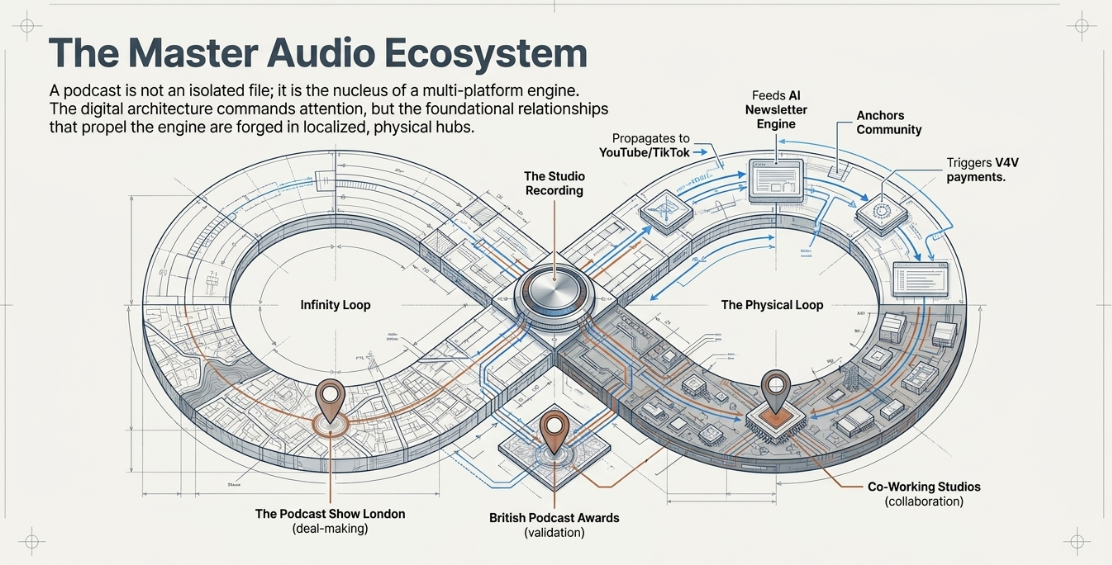
The paradigm of podcasting has fundamentally shifted, evolving from a niche medium of syndicated audio files into a central pillar of global content marketing. As of 2026, a podcast is no longer accurately defined merely as an audio file delivered via a Really Simple Syndication (RSS) feed.1 Instead, it operates as a comprehensive, multi-channel storytelling engine that powers a vast commercial ecosystem.1 What begins as a structured conversation within a studio is now engineered to be an audio-first anchor that subsequently propagates across multiple platforms. This singular audio feed is routinely adapted into full-length video episodes for YouTube, distilled into short-form vertical video clips for TikTok and Instagram, integrated into weekly email newsletters, and leveraged as the foundation for live touring events and gated community platforms.
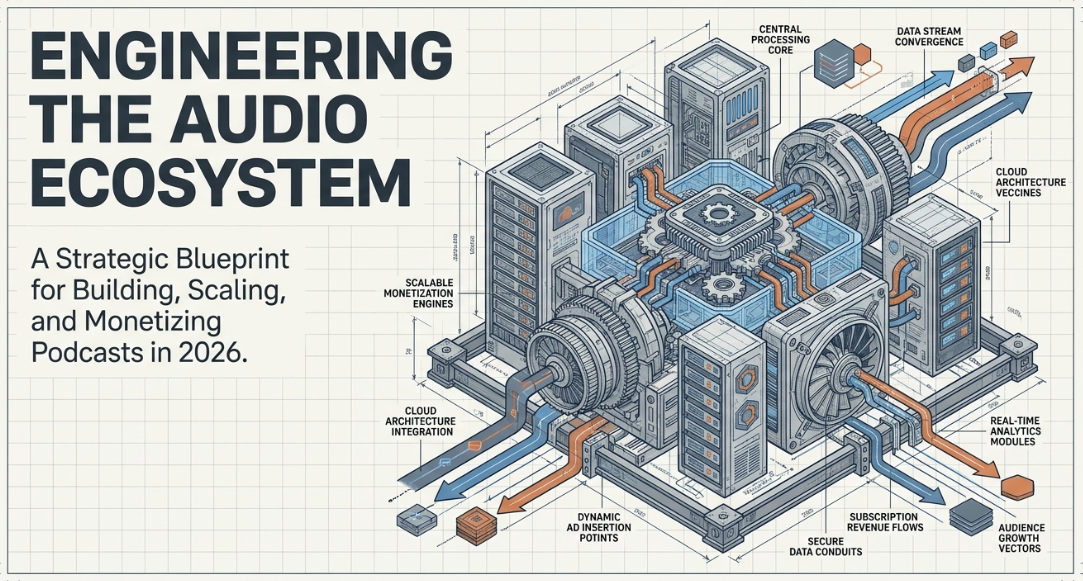
For brands, business owners, and independent creators, this structural evolution signifies that podcast marketing demands a holistic strategy wherein the audio program acts as the central hub of a broader content ecosystem. The medium offers a level of sustained audience attention that few other marketing channels can match.1 Listeners frequently consume episodes while commuting, exercising, or performing routine tasks, dedicating extended, uninterrupted periods to the content.2 This immersive consumption leads to significantly higher engagement rates compared to other digital advertising platforms, fostering deep trust and driving measurable commercial results.1
However, the proliferation of the medium—with over 3.2 million podcasts currently covering every conceivable topic and interest—necessitates highly sophisticated marketing, production, and community-building strategies to achieve visibility and sustained growth.1 The contemporary landscape is characterized by the "Cost of Attention," an industry metric highlighting the intense competition between audio and video formats, where originality fades rapidly as viral campaigns are routinely copied and rehashed.4 To stay ahead of industry trends, professionals increasingly turn to specialized programs, such as Benjamin Shapiro's "The MarTech Podcast," which provides actionable insights on mobile marketing attribution, retail media networks, and the role of artificial intelligence in podcast advertising, or Neil Patel's "Marketing School".5 These resources underscore that success in the current environment requires continuous adaptation to algorithmic shifts and evolving audience preferences.
Foundational Frameworks and the Podcast Growth Engine
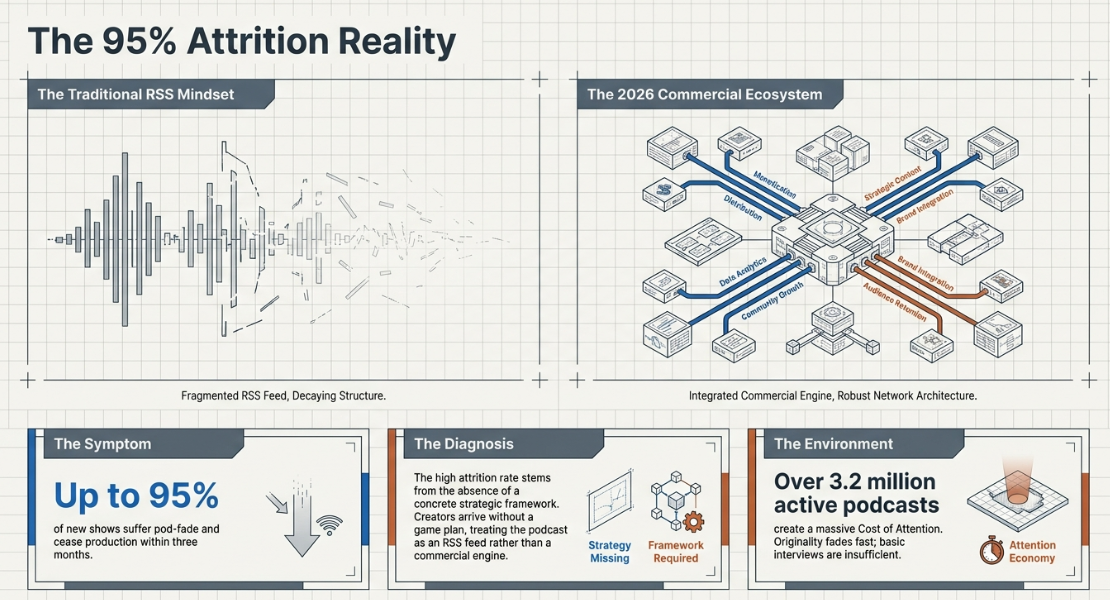
The overwhelming majority of new podcasts fail, with industry data suggesting that up to 95% of shows undergo "pod-fade" and cease production within their first three months.6 This high attrition rate is rarely due to a lack of initial enthusiasm; rather, it stems from the absence of a concrete strategic framework and a fundamental misunderstanding of the podcast's commercial and psychological purpose.6 Without a strategy, creating a podcast is akin to arriving at a competitive sporting event without a game plan, practically ensuring a rapid decline in motivation as the production burden outweighs the perceived benefits.7
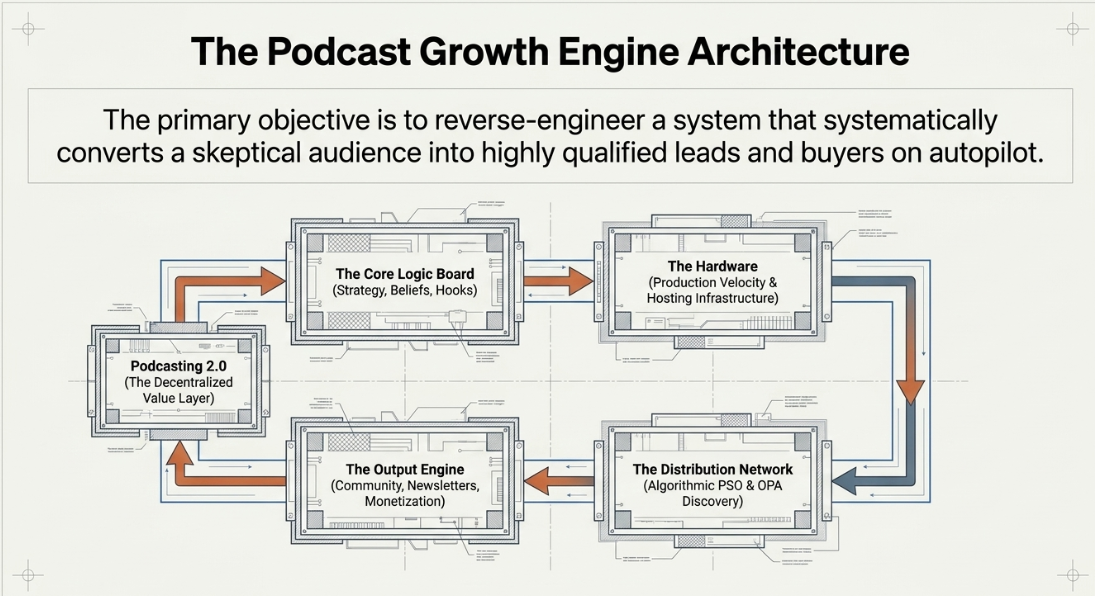
To circumvent this, strategic planning must begin long before the first recording session. A highly effective framework utilized by industry experts is the Podcast Growth Engine Model, a comprehensive six-part marketing and sales schematic designed specifically to blend creative execution with rigorous systems thinking.4 The primary objective of this model is to reverse-engineer a system that systematically converts a skeptical audience into highly qualified leads and buyers on autopilot, allowing creators to focus on the elements of their business they find most fulfilling.
The Content Strategy Schematic and the Chain of Beliefs
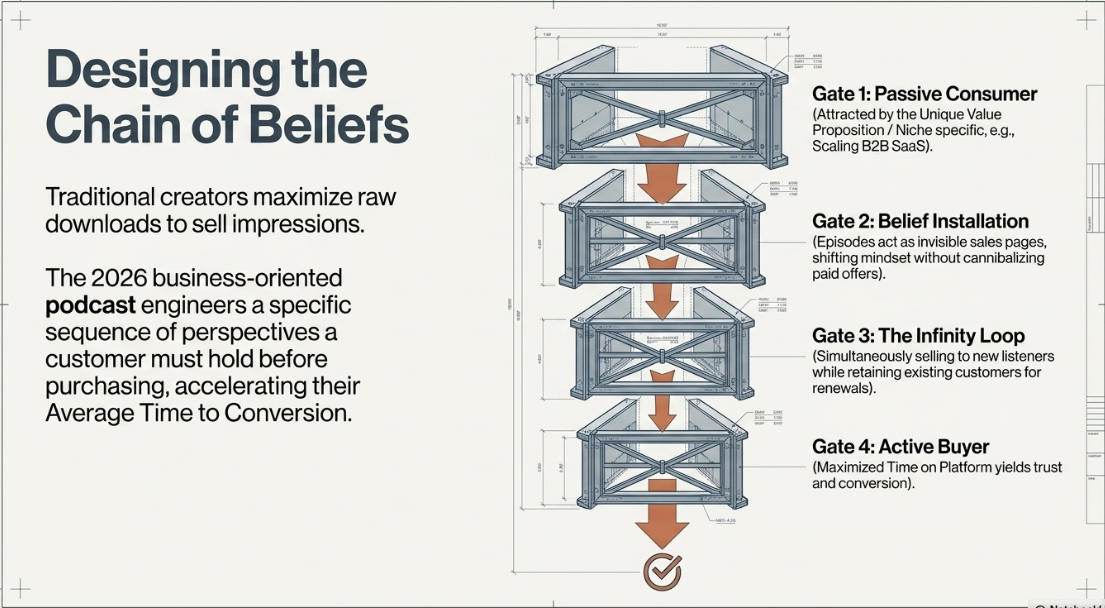
Within this foundational phase, creators must adopt what is known as the Content Strategy Schematic.4 This four-tiered system posits that content creation for a business differs vastly from the traditional "Content Creator" model.4 While traditional creators focus on maximizing raw downloads, views, and plays to sell impressions to advertisers—often giving away exhaustive educational material for free—the business-oriented podcast utilizes a "Content Marketing Model" where the ultimate metric is the attraction and conversion of buyers.4
The Content Strategy Schematic aligns all four tiers of content to ensure every published episode accelerates the listener's "Average Time to Conversion".4 Rather than merely educating the audience—which can inadvertently cannibalize paid offers—the content is engineered to construct a specific "Chain of Beliefs." This means the narrative is designed to organically instill the exact sequence of perspectives and knowledge a future customer must possess before they are ready to make a purchase, effectively acting as an invisible, highly engaging sales page.4 This approach incorporates an "Infinity Loop" strategy, organically selling products to new listeners while simultaneously keeping existing customers engaged to drive subscription renewals and repeat business.4 By maintaining focus on this conversion-driven metric, creators reduce the pressure to produce an unsustainable volume of content, focusing instead on maximizing the "Time on Platform"—a critical, often overlooked metric that correlates directly with long-term profitability.4
Defining the Unique Value Proposition and Audience
The foundation of the Growth Engine requires extreme clarity regarding the target audience and the show's Unique Value Proposition (UVP). A podcast must identify a specific niche where the creator's expertise and passion intersect with measurable market demand.8 Instead of tackling broad subjects, creators must pinpoint gaps in the existing market by researching the top three to five podcasts in their niche and identifying the specific angles they omit.9 For example, rather than launching a generic show about "B2B Marketing," a precisely engineered show might focus exclusively on "scaling B2B SaaS startups through content marketing".9
The target persona must be defined granularly, encompassing exact job titles, industry sectors, primary challenges, scaling issues, and core motivations.9 Every episode should be designed to solve a specific problem for this demographic, establishing the host as the default authority in that particular micro-niche. Once established, this UVP must be consistently communicated across all touchpoints, including the show's intro, outro, social media presence, and community interactions, constantly reminding listeners of the unique value provided.
The Science of Audience Retention and Hook Stacking
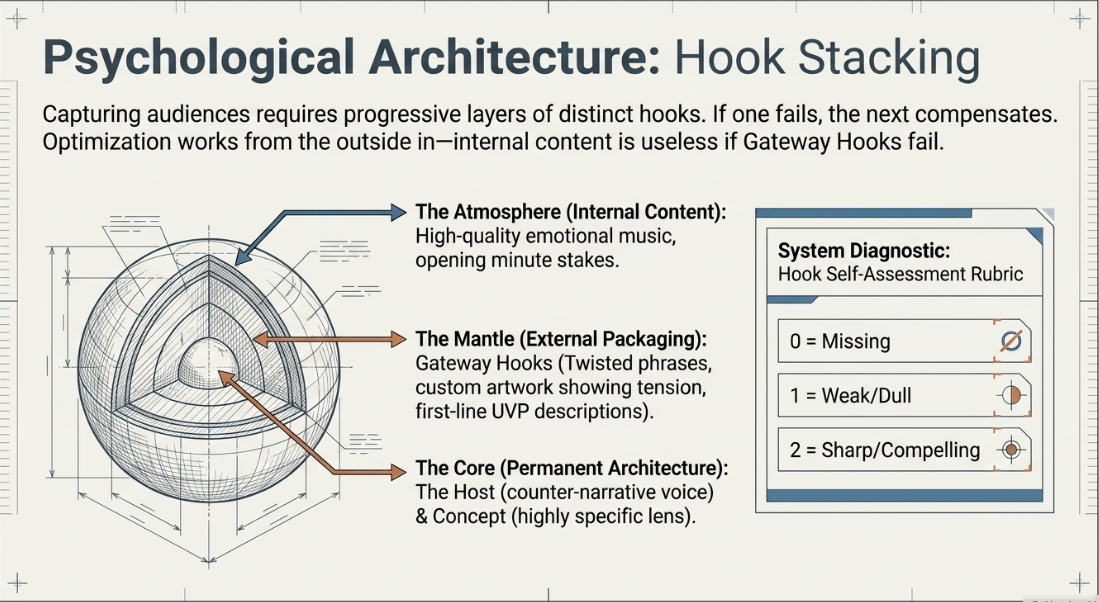
Capturing an audience in a saturated market requires more than just high-quality information; it requires structural engineering and psychological pacing. This brings forth the concept of "Hook Stacking," a methodology derived from the composition techniques of top-tier songwriters.4 In the music industry, artists layer multiple distinct hooks—melodic, lyrical, emotional, harmonic, and percussive—into a single track to make it irresistible; if one hook fails to capture a listener, a subsequent one immediately compensates.4 In podcasting, Hook Stacking is the practice of designing a show utilizing a progressive stack of distinct hooks rather than relying on a single, central premise.4
Show-Level and Episode-Level Hooks
Hook Stacking operates simultaneously on two primary planes: Show-Level and Episode-Level.
Show-Level Hooks form the permanent architecture of the podcast. These foundational elements attract and retain an audience for the show as an overarching entity. They include:
Show Topic and Concept: Sharpened by defining a specific audience, a promised outcome, a unique method of delivery, and a refreshing format (e.g., viewing a common topic through a highly specific, unconventional, or data-driven lens).4
The Host: Utilizing the host's distinct credibility, existing fame, highly-credible subject matter expertise, or an unconventional background to provide a counter-narrative voice that stands out from industry consensus.4
Brand Assets: Cover art that visually hints at the show's inherent tension and tone, and a show title that employs a clever twist on a known phrase to pique curiosity without appearing forced or ham-handed.4 The description must also concretely lay out the value proposition in its very first line.4
Episode-Level Hooks are applied to individual releases and are further divided into external packaging and internal content. External packaging involves optimizing the specific topic, highlighting the guest's credentials, and crafting custom artwork and titles.4 Internal content hooks include high-quality intro and outro music that immediately elicits an emotional response, and the careful structuring of the opening minute to establish immediate stakes and affirm the listener's decision to press play.4
Creators are advised to objectively evaluate their implementation using a Hook Self-Assessment rubric, scoring each element from 0 to 2. A score of 0 indicates the hook is irrelevant or missing; a 1 indicates it is dull and weak; and a 2 signifies the hook is sharp, specific, and highly compelling on its own.4 The strategy prioritizes "Gateway Hooks"—refining the podcast from the outside in—because optimizing the internal content is futile if the external touchpoints fail to convince the audience to click play.
Advanced Interviewing and Retention Tactics
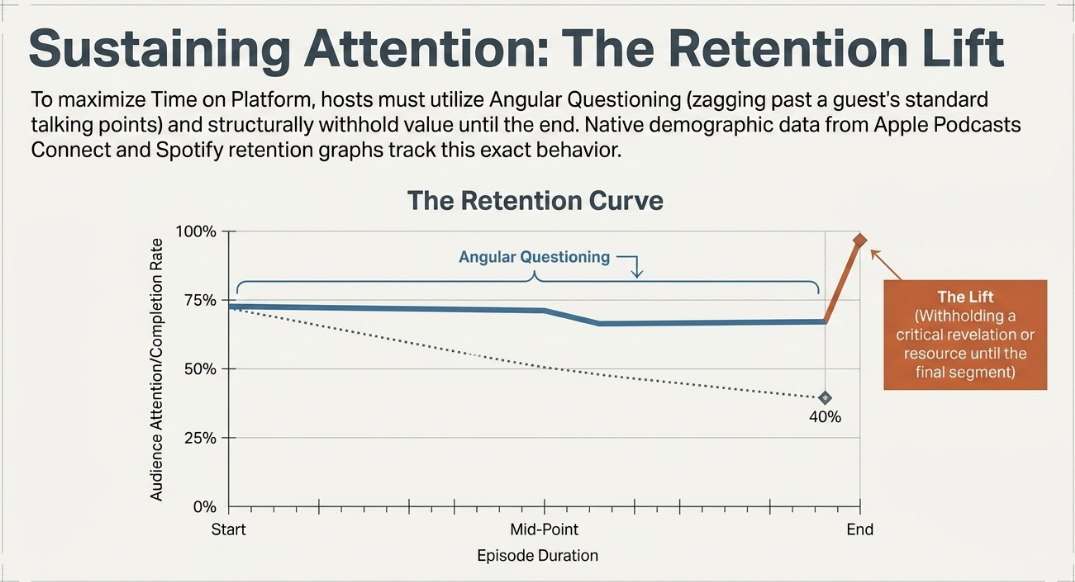
To maintain the psychological hooks throughout an episode, hosts must master "Angular Questioning," or the art of "Zagging".4 This involves researching a guest thoroughly to deliberately avoid asking questions they have answered on previous promotional tours, thereby preventing audience boredom. The host must possess the skill to craft a highly specific, novel First Question that immediately cracks open the theme and turns the guest into a storyteller rather than a mere provider of information, as neurological responses to narrative structures far exceed responses to raw data.4
Furthermore, to maximize completion rates, creators employ a technique known as "The Lift".4 This is a structural retention skill where a critical revelation, highly valuable resource, or compelling narrative conclusion is intentionally withheld until the final segment of the episode. By systematically saving a "gem" of value for late in the recording, the host trains the audience to listen entirely through the content, thereby increasing the total "Time on Platform" and building long-term trust.4
Production Workflows, Scheduling, and Episode Formatting
The physical execution of a podcast requires a careful balance between consistent output and sustainable production workflows. The "perfection trap" often derails early creators; while broadcast-quality audio is essential, over-polishing can lead to rapid burnout, and industry consensus suggests that "good enough is good enough" when utilizing budget-friendly but effective hardware like the Blue Yeti or ATR2100 microphones, paired with accessible software like Audacity or Riverside.fm.
Episode Length and Pacing
Determining the optimal episode length is a function of the content's depth, the format, and the audience's attention span.11 Research indicates the following distribution of podcast episode lengths across the industry:
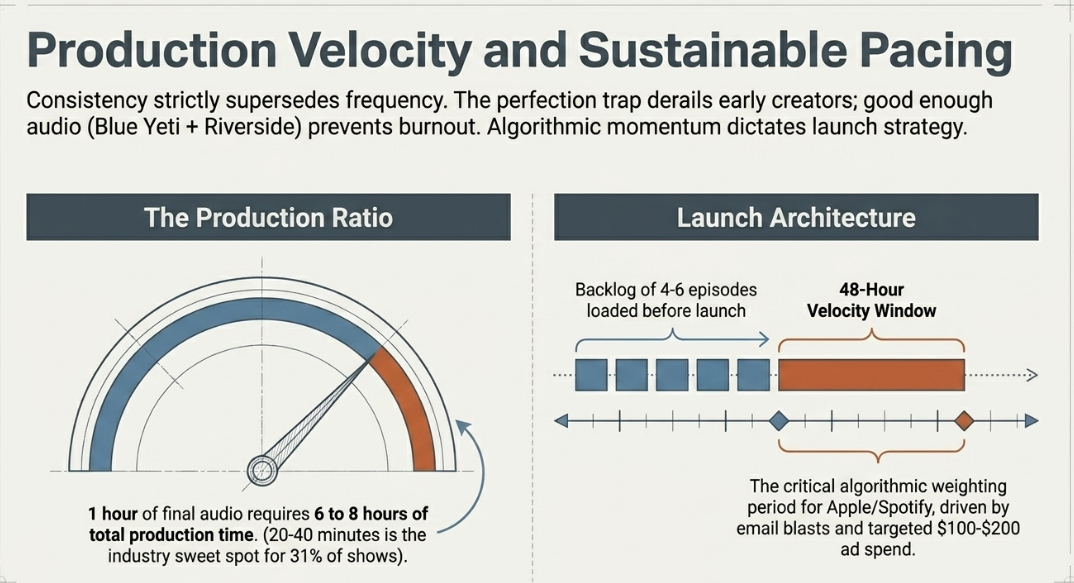
The most common duration falls within the 20 to 40-minute range, accounting for nearly a third of all shows.11 For nascent podcasts, data suggests starting with shorter episodes to quickly build trust without demanding excessive initial commitment from the listener.11 A solo commentary show might effectively utilize formats as brief as 10 minutes to avoid listener fatigue, while duo or trio commentary formats discussing complex fandoms, comedy reactions, or political topics are better suited for longer, bi-weekly releases.12 A crucial metric for sustainability is the production ratio: creating a podcast typically requires six to eight times the length of the final episode in total production time.11 Creators are advised to take the number of hours they can commit each week and divide it by six to determine a sustainable episode length.
Consistency and Launch Architecture
Consistency strictly supersedes frequency. Whether a creator chooses a weekly, bi-weekly, or monthly schedule, maintaining that specific cadence is paramount to retaining listenership.12 Pacing matters significantly post-launch; a heavy initial release schedule of weekly episodes during the first eight to twelve weeks helps establish familiarity, but should only be adopted if it can be sustained once the initial excitement wanes and the realities of promotion and editing set in.13 To mitigate production pressure, creators must implement batch production, recording multiple episodes in a single session, and aiming to have a backlog of four to six episodes completed prior to the official launch.9
The launch sequence itself must be orchestrated as a major event to capitalize on the algorithmic behaviors of platforms like Apple Podcasts and Spotify, which heavily weight early velocity in their initial 48 hours.9 An effective launch strategy requires a comprehensive content calendar that outlines episode topics, promotional activities, and publishing deadlines.14 The launch plan includes blasting an existing email list to encourage immediate reviews, deploying teaser clips and quotes on social media, equipping guests with ready-made graphical assets for frictionless cross-promotion, and potentially allocating a modest budget ($100–$200) for highly targeted initial advertising on podcast directories like Castbox or platforms like LinkedIn.9
Platform Architecture and Hosting Infrastructure
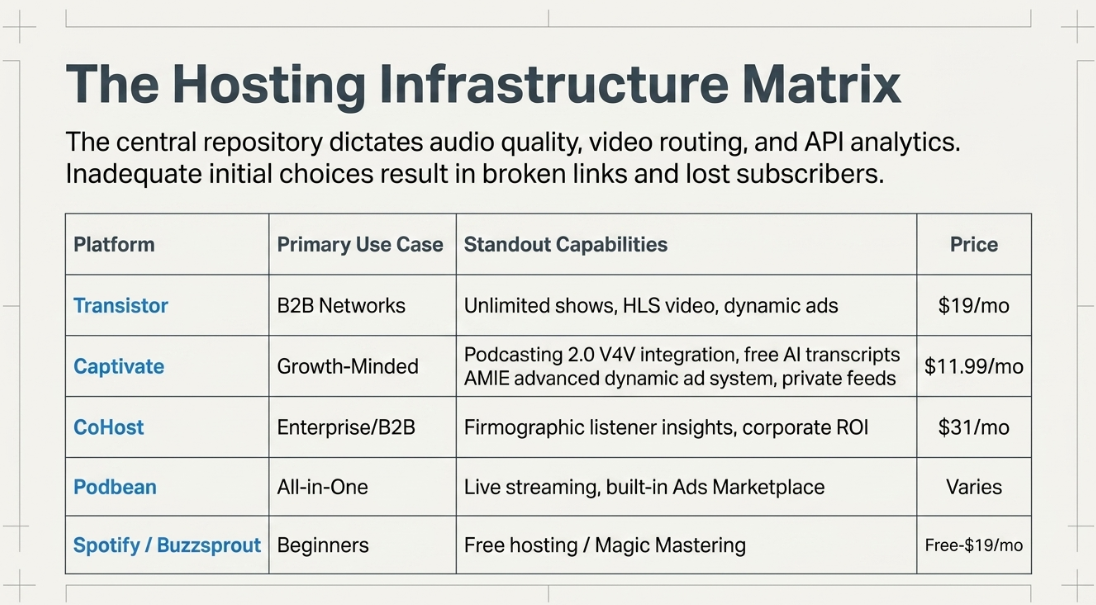
Selecting the appropriate podcast hosting platform is a foundational technical decision that dictates future capabilities regarding audio quality, video integration, analytics, and revenue generation. The hosting platform serves as the central repository that generates the RSS feed and distributes the content globally.15 Choosing an inadequate host initially can result in costly migrations, broken links, lost subscribers, and disrupted analytics down the line.17
The market in 2026 offers highly differentiated platforms tailored to specific operational needs and creator profiles:
These platforms now act as sophisticated distribution hubs. Beyond simply pushing files to Apple and Spotify, platforms like RSS.com and Transistor automate the distribution process across emerging AI search platforms, specialized video directories like YouTube, and independent open-source applications like AntennaPod and Pocket Casts.18
Algorithmic Discoverability and Podcast Search Engine Optimization (PSO)
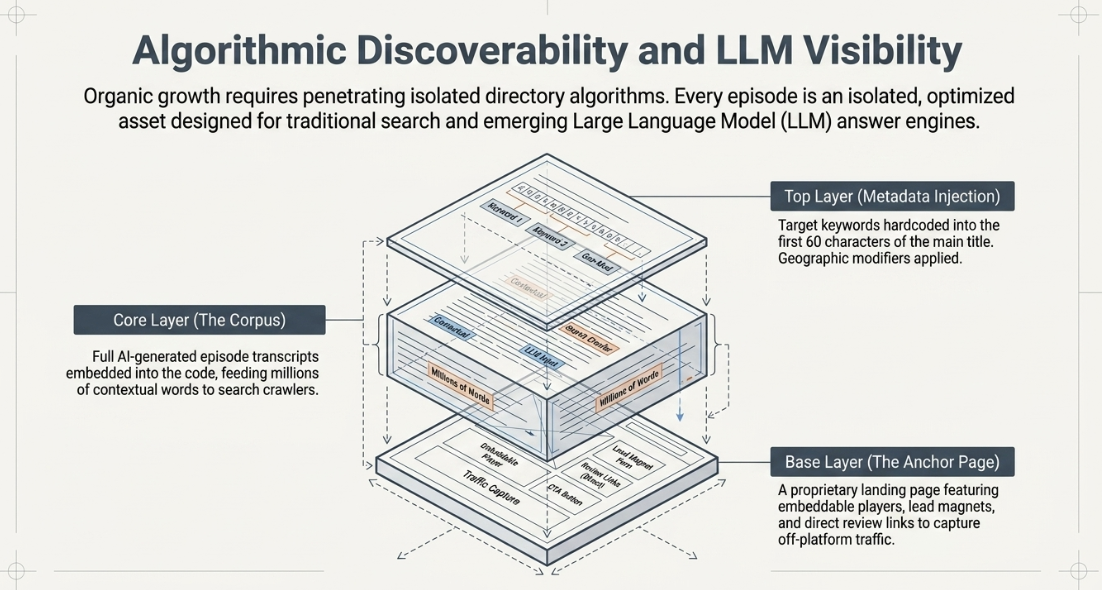
Organic discoverability remains one of the highest hurdles in podcasting. To overcome this, creators must implement comprehensive Podcast Search Engine Optimization (PSO). Unlike traditional web SEO, PSO requires an intimate understanding of how distinct, closed algorithms within isolated directories rank and present audio content based on user intent and historical listening data.
The primary mechanism for optimization involves rigorous keyword research and precise metadata application.3 The overarching title of the podcast is the most heavily weighted factor in search algorithms; therefore, primary target keywords must be placed within the first 60 characters of the main title to ensure visibility across all mobile devices.24 If a podcast serves a localized demographic—for example, "Real Estate Investing in Austin"—incorporating geographic modifiers into the title and description will significantly enhance local visibility.24
Every individual episode presents a unique search opportunity and must be treated as an isolated, fully optimized asset.24 This involves publishing highly detailed show notes, which function similarly to blog posts for web crawlers, and interlinking related episodes to build an internal architecture.25 Crucially, the implementation of full episode transcripts is now an industry standard. Transcripts not only dramatically improve accessibility for hearing-impaired audiences but also provide search engines with thousands of highly contextual, crawlable words. As discussed by Matthew Bertram on "The Best SEO Podcast," this vast text corpus improves discoverability across traditional search engines and emerging Large Language Model (LLM) answer engines, driving the future of "LLM Visibility".25
Furthermore, the creation of a dedicated, proprietary podcast landing page serves to anchor the show's digital footprint outside of closed audio apps. A well-constructed landing page acts as a central conversion mechanism. Utilizing strategies akin to those championed by Brian Dean of Backlinko, the landing page must feature embedded subscribe forms to capture email addresses, offer downloadable lead magnets (such as eBooks or resource guides), showcase guest rosters, host an embeddable player, and provide direct, frictionless links to leave reviews on major platforms.18
Cross-Promotion and Collaborative Audience Acquisition
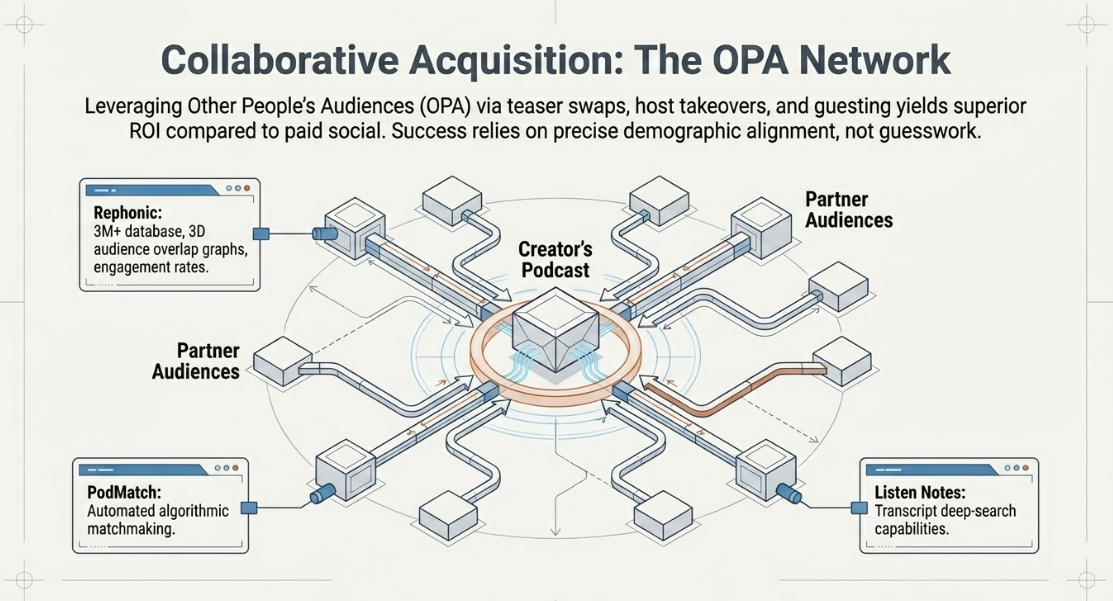
While algorithmic optimization provides a steady baseline of organic growth, exponential audience acquisition relies heavily on the "Other People's Audiences" (OPA) strategy.9 Because podcast listeners exhibit high levels of trust in the hosts they follow, they are uniquely receptive to recommendations for new shows within the same medium. Podcast cross-promotion campaigns are low-cost, highly efficient, and frequently generate a superior Return on Investment (ROI) compared to paid social media advertising.
Methodologies of Cross-Promotion
Cross-promotion manifests in several distinct formats, each with unique operational requirements and strategic benefits:
Teaser Ad Swaps: The simplest and lowest-friction form of collaboration, where hosts agree to play a short, pre-recorded promotional clip for each other's shows during their respective mid-roll or pre-roll ad breaks.29
Host Takeovers and Episode Swaps: A deeper integration where entire episodes are traded and dropped into each other's RSS feeds, exposing the entire subscriber base to the guest host's full narrative style and production quality.29
Guest Interviews: Traditional cross-pollination where hosts appear as subject matter experts on each other’s programs, allowing for dynamic interaction and chemistry to drive organic audience migration.29
Collaborative Giveaways and Shoutouts: Utilizing social media integration to co-host contests, driving simultaneous subscriber growth across both platforms.30
Strategic Sourcing and Pitch Execution
Identifying appropriate partners requires rigorous data analysis to ensure audience alignment. Specialized platforms have emerged to facilitate this exact process, transitioning cross-promotion from a guessing game into a precise science.
Rephonic acts as an enterprise-grade database containing over three million podcasts, designed specifically for advanced outreach and cross-promotion.29 It provides an extraordinary level of granular data necessary for strategic alignment. Using Rephonic, a creator can filter potential partner shows by exact location, average listener numbers per episode, engagement rate percentages (calculated from social media activity), and gender skew to ensure demographic alignment.29 To verify the viability of a partnership, Rephonic's 3D audience graph maps the connections between shows by extracting data from Apple Podcasts' "Listeners Also Subscribed To" feature, visually revealing overlapping subscriber bases.29
Once a target list is generated within Rephonic's dynamic campaign lists, the platform provides direct contact information.29 If specific emails are missing, Rephonic offers a concierge research service where their team manually sources the correct production contacts.29 The platform also features a built-in pitch editor loaded with customizable templates and a pipeline manager to track the status of outreach workflows across a collaborative team.29 Industry professionals frequently highlight Rephonic and Muck Rack as superior tools compared to overpriced alternatives that suffer from limited or inaccurate producer contact data.31
For automated, algorithmic matchmaking, platforms like PodMatch function similarly to dating applications for the podcast industry. PodMatch automatically pairs hosts and guests based on niche, expertise, and target demographics, streamlining the booking process without requiring manual email outreach.32 Other notable platforms include Talks for highly detailed profile matching and automated instant messaging, Listen Notes (a powerful global podcast search engine that allows creators to search deep within individual episode transcripts to find highly specific thematic overlaps), and Matchmaker.fm for simple, algorithm-driven basic matching.32
The success of any outreach campaign relies on three strict principles: thorough research, leading with value, and persistent follow-up. Pitches must reference specific recent episodes, demonstrate the guest's unique expertise, and articulate precisely how the collaboration will benefit the target host's specific audience.
Cultivating Communities and the Newsletter Engine
Converting a passive listener into an active community member is the critical threshold for long-term podcast sustainability. Community-driven marketing yields engagement rates up to five times higher than traditional one-way broadcasting.35 To achieve this, creators must establish dedicated digital spaces where listeners can interact with the host and, more importantly, with each other.
Selecting the Community Platform Architecture
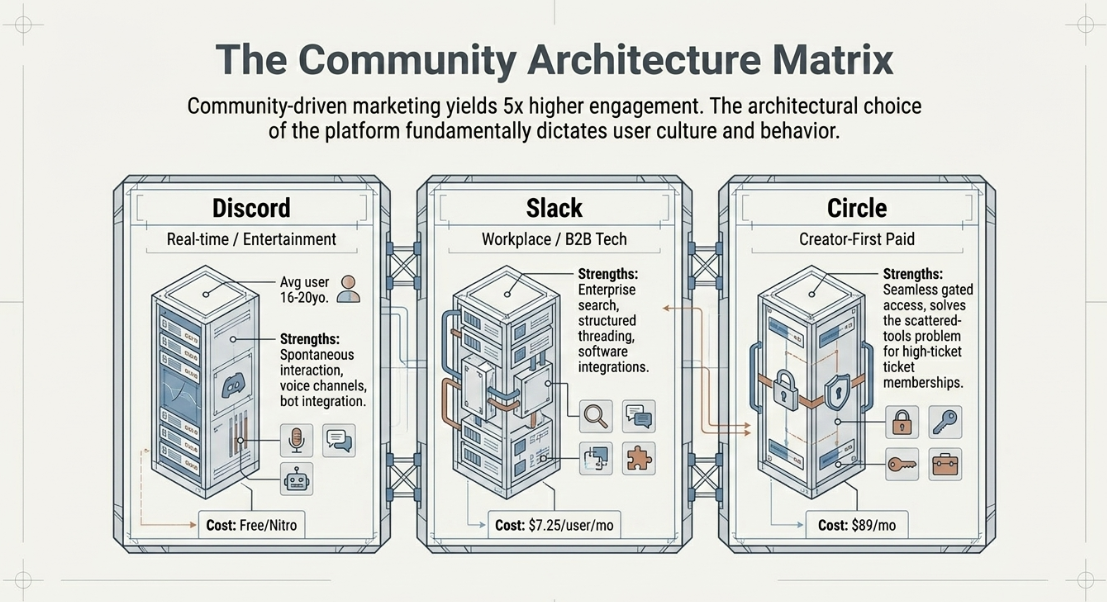
The architectural choice of the community platform fundamentally dictates the behavior and culture of the members.
Discord has emerged as the dominant force for highly active consumer and entertainment podcasts. Creators set up distinct text channels for episode discussions, political discourse, and off-topic socializing (e.g., "pet photos every Friday"), transforming the audience into a self-sustaining social hub.37 Conversely, Slack remains the standard for professional development and B2B tech communities, though the per-user licensing costs can make scaling a massive free community prohibitively expensive for independent creators.38
Successful community management requires a delicate balance of presence and restraint. Creators should give members a warm welcome, seed conversation starters tied to recent episodes, host 'Ask Me Anything' (AMA) sessions, and provide exclusive sneak peeks.38 However, micromanagement must be avoided; the most resilient communities are those where members feel co-ownership of the space, supporting each other and generating their own organic discussions while the host focuses on content production.38 Directing feedback specifically to these channels (rather than vaguely asking for comments "on social media") creates a structured point of contact that deepens listener investment.
The Role of Email Newsletters
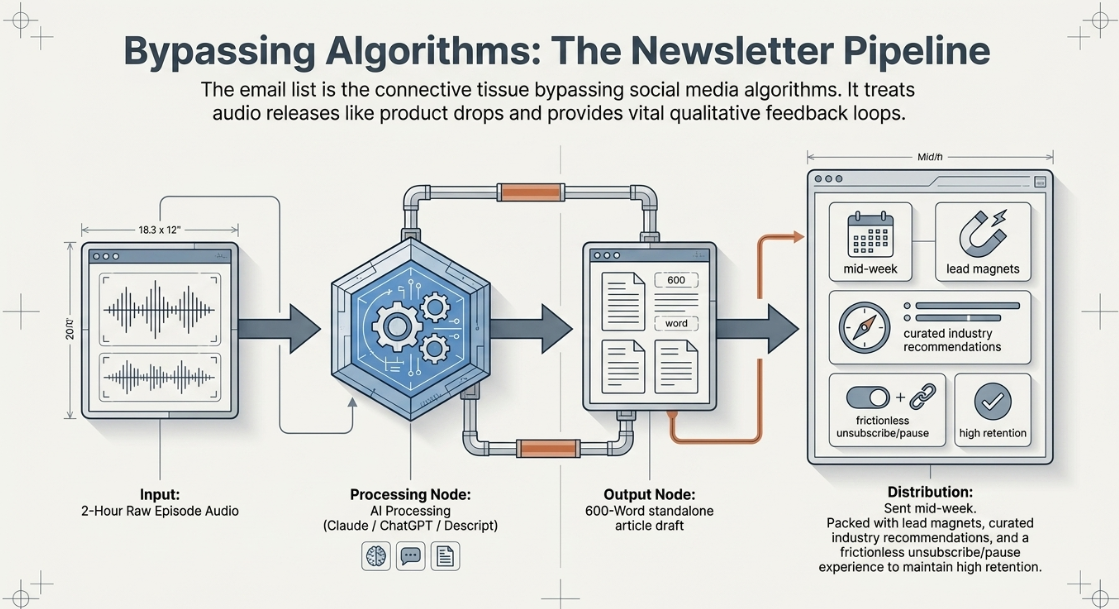
The email newsletter serves as the connective tissue between the podcast audio, the community, and commercial offerings. It is a direct communication channel that entirely bypasses the algorithmic whims of social media and podcast directories, ensuring that release announcements actually reach the audience.43
An effective podcast newsletter strategy treats the email list as an extension of the show's core value. To grow the list, creators should offer compelling lead magnets—such as downloadable guides or templates—and promote them through strategic social media giveaways.45 Newsletters should not merely serve as automated RSS alerts; they must provide standalone value. Best practices include sending mid-week episode summaries, highly curated industry recommendations, or deeper dives into topics discussed on the show.44 Sending podcast teaser emails before a launch treats the audio release like a product drop, increasing suspense and driving higher initial download velocity.46
To alleviate the administrative burden of writing, creators can leverage AI tools (such as Claude, ChatGPT, or Descript) to rapidly process multi-hour episode transcripts into concise, 600-word newsletter drafts written in the style of newspaper articles, which can then be assembled and distributed in minutes.47 Establishing a plug-and-play newsletter system utilizing proven formats ensures that the creator is not staring at a blank page each week.48 Furthermore, optimizing the unsubscribe experience by offering options to merely reduce email frequency or pause communications can significantly improve long-term retention.44 Newsletters also provide vital qualitative data; encouraging subscribers to reply directly to emails creates a two-way engagement channel that yields immediate feedback and future content ideas.44
Advanced Monetization: Beyond Traditional CPM Advertising
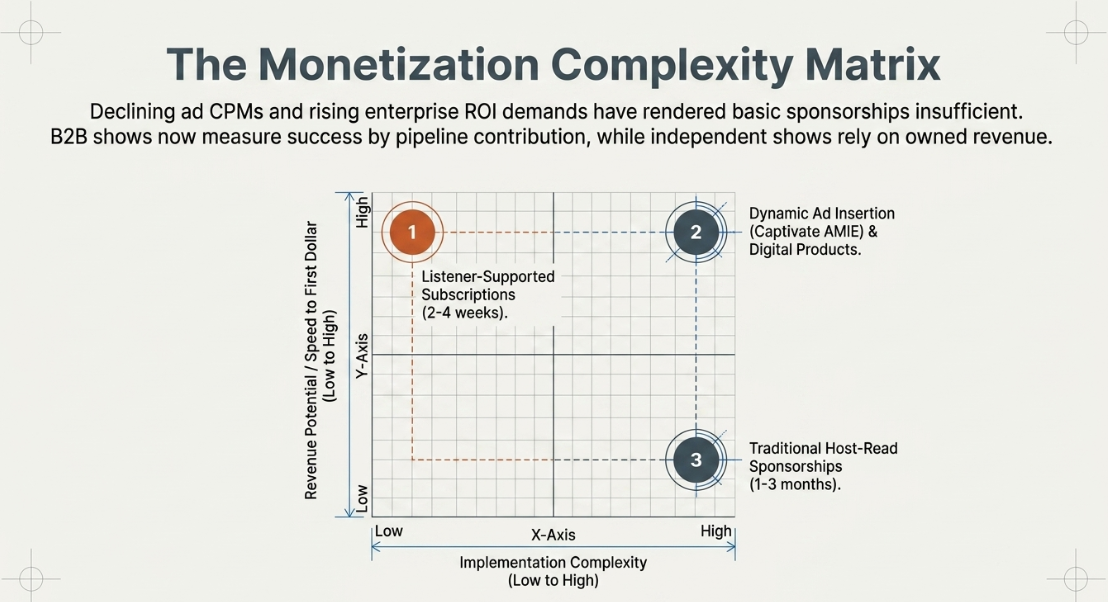
The economic model of podcasting is undergoing a rapid transition. Historically, the industry relied heavily on Cost Per Mille (CPM) advertising, where brands purchased host-read or pre-produced spots based on total downloads of new episodes. By 2026, declining ad CPMs, rising audience expectations, and pressure from enterprise advertisers to prove measurable ROI have rendered basic sponsorships insufficient for sustained independent growth.
The Evolution of Dynamic Advertising
For shows with sufficient scale (typically exceeding 10,000 to 20,000 downloads per month), Dynamic Ad Insertion (DAI) has become the industry standard for programmatic monetization.15 Platforms like Captivate (utilizing their AMIE content management system) and Podbean (via PodAds) allow creators to retroactively insert geographically targeted, time-sensitive advertisements across their entire historical back catalog.19 This ensures that new listeners discovering older episodes are served relevant, monetizable advertisements, vastly increasing the inventory of ad impressions without requiring the host to manually re-edit and re-upload legacy audio files.20 Furthermore, for B2B podcasts, monetization is increasingly measured by pipeline contribution, strategic partnerships, and direct lead generation rather than broad brand awareness.49
Owned Revenue Streams and Direct Support
With industry research indicating that up to 25% of podcast listeners are willing to pay directly for audio content, direct support models and internal monetization tactics have proliferated to future-proof revenue.49
Data derived from industry monetization benchmarks.43
For brand-new or highly niche podcasts, creating paid membership tiers that offer ad-free listening, bonus episodes, or access to private community servers is the most immediate, low-friction path to revenue.43 As the show scales, creators can layer on affiliate marketing links within show notes, digital product sales (such as templates related to the podcast topic), and live events or ticketed workshops.50
Podcasting 2.0 and the Value-for-Value Revolution
The most transformative development in digital audio economics and distribution is the Podcasting 2.0 initiative. Born from a coalition of developers and podcast enthusiasts, this movement expands the capabilities of the open RSS standard through a new "Podcast Namespace," adding features like advanced interactive chapters, embedded transcripts, cross-app comments, and live-stream notifications.53
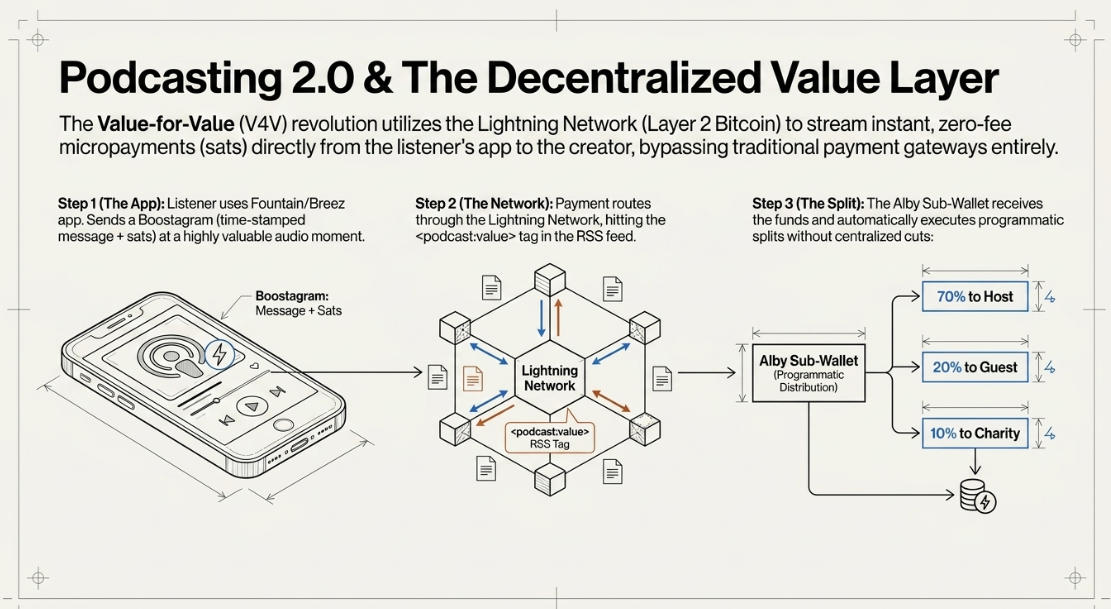
The financial centerpiece of Podcasting 2.0 is the Value-for-Value (V4V) model. V4V is an open, decentralized monetization framework that allows listeners to stream micropayments directly to creators in real-time as they consume content, entirely bypassing traditional payment gateways, paywalls, and third-party platforms like Patreon or PayPal.18
The mechanism relies on the Lightning Network, a second-layer technology operating on top of the Bitcoin blockchain. The Lightning Network utilizes off-chain micropayment channels to facilitate instant, low-cost transactions, settling the final balances on the main blockchain only when the channels are closed.18 This enables the seamless transfer of "sats" (satoshis)—the smallest unit of Bitcoin, equating to one hundred millionth of a single Bitcoin (0.00000001 BTC).18
To implement V4V, a creator must utilize a compatible hosting platform, such as RSS.com. The setup process is highly streamlined and accessible even on free hosting tiers:
Wallet Creation: The creator navigates to their hosting dashboard (e.g., the Monetization tab in RSS.com) and initiates a connection with a Lightning wallet provider, such as Alby.18
Sub-Wallet Isolation: Within Alby, a dedicated sub-wallet is created specifically to isolate incoming podcast revenues from other financial activities.57
The Value Tag: The system automatically generates a unique
tag, which is permanently embedded into the podcast's RSS feed. This tag signals to any compatible playback software exactly where to route the incoming funds. 57
Once activated, listeners using modern Podcasting 2.0 apps (such as Fountain, Breez, Podverse, or Castamatic) can engage in two distinct peer-to-peer payment behaviors:
Streaming: The app can be configured to automatically stream a set number of sats per minute while the episode plays.18
Boostagrams: Listeners can send manual, one-time lump sum payments known as "boostagrams." These are distinct because they allow the listener to attach a short text message to the transaction.18 Because the apps track playback, these messages are often time-stamped to the exact second of the audio, providing the creator with an explicit, monetary "value signal" indicating precisely which joke, insight, or interview segment the audience found most valuable.18
Crucially, the decentralized nature of the Lightning Network allows for automatic, programmatic "splits" (Value Recipients). A creator can configure their RSS feed so that a V4V payment is instantly divided—for example, 70% to the host, 20% to the guest, and 10% to the audio engineer or a chosen charity—without any intermediary taking a centralized cut or requiring manual accounting at the end of the month.18 This ensures creators completely own their wallets, retaining their funds even if they migrate their show to a different host.
Leveraging Analytics for Strategic Business Intelligence
Data analytics transform podcasting from a creative exercise into a rigorous business discipline. Modern platforms have moved far beyond merely tracking vanity metrics like total downloads, focusing instead on granular behavioral data that directly informs content iteration and commercial ROI.
To measure success accurately, creators must rely on a stack of robust analytics tools tailored to specific goals:
Podstatus & Podkite: Excellent for tracking broad competitive metrics, including chart rankings across 175 countries, competitor performance, keyword SEO positioning, and aggregating international reviews.59
Apple Podcasts Connect & Spotify for Podcasters: Essential for deep native demographic data, including listener age, gender, and episode-by-episode retention graphs. These retention graphs are the most critical tool for a producer; they identify exactly where listeners drop off, allowing creators to tighten their hooks, adjust the length of intros, or reposition calls-to-action (CTAs) before the audience abandons the episode.60
Podtrac & Triton Digital: The industry standards for large-scale audience measurement and enterprise-level reporting, providing the IAB-certified numbers strictly required by premium corporate sponsors.59
Chartable: Best utilized for marketing attribution, determining which specific promotional channels are driving actual subscriber growth.60
Podigee: An advanced platform that bridges the gap between raw audio metrics and actionable business intelligence. Podigee allows B2B creators to append source parameters to podcast links and export API data directly into CRMs. This functionality translates ambiguous statistics (e.g., "5,000 downloads") into hard business metrics for executive leadership (e.g., "5,000 downloads generated 600 qualified demo requests on the landing page"), proving the podcast actually moves the needle on revenue.62
Key Performance Indicators (KPIs) must be monitored dynamically. While total downloads indicate top-of-funnel reach, Completion Rate (the percentage of the episode consumed) and Subscriber Growth over time are far stronger indicators of the show's inherent quality.60 Furthermore, platforms like Castos provide proprietary "True Fans Metrics" to identify the most loyal repeat listeners, allowing creators to focus their monetization efforts on the segment most likely to convert.63
The Physical Ecosystem: Networking and Infrastructure
Despite the globally distributed, digital nature of the medium, the podcasting industry thrives heavily on physical proximity, serendipitous networking, and localized professional ecosystems. Building strategic alliances, securing high-level guests, executing complex cross-promotions, and negotiating distribution deals are predominantly achieved through face-to-face interaction and community integration.
London has rapidly established itself as a premier global hub for audio professionals, boasting a dense infrastructure of events, studios, and organizations designed to foster continuous collaboration.
Industry Events and Guilds
The pinnacle of the UK calendar is The Podcast Show London. This large-scale festival is specifically engineered to maximize networking, featuring curated meetups (Creator Socials), specific Brand & Advertiser receptions, and high-level executive dinners located in exclusive "PodHouse" invitation-only zones.64 It serves as a primary marketplace where independent creators interface directly with global platforms, agencies, and talent.64 Similarly, broader creative events like SXSW London offer highly structured 1-on-1 mentorship sessions with industry executives, fast-paced group chats, and topic-led roundtables, accelerating career trajectories for emerging producers.66
Industry associations play a crucial regulatory, educational, and supportive role. AudioUK serves as the primary trade body, heavily involved in advancing commercial growth, advocating for creators, and organizing major summits—such as the Podcast Creator Summit held at Apple's London offices at Battersea Power Station, focusing on advanced monetization, branding, and video integration.67 The overarching excellence of the UK sector is celebrated annually at the British Podcast Awards, an event generating massive brand awareness and millions of listener votes.70 In a significant move to democratize the industry, the 2026 iteration introduced "Ambassador" roles, replacing traditional judging structures with a diverse panel representing independent talent, ensuring that ground-breaking, grassroots audio receives equal validation alongside major broadcast productions.72 Winning or simply attending these awards provides independent creators with "ultimate creative validation" and acts as a powerful lever when negotiating with networks.70
Grassroots Communities and Co-Working Studios
At the grassroots level, continuous local engagement is sustained through regular, informal meetups. The Podcast Social, hosted monthly at All Is Joy in Soho (and backed by The Dean Street Podcast Studio), offers a relaxed, happy-hour environment for agencies, hosts, and producers to share ideas and spark collaborations outside of formal corporate structures.74 Furthermore, organizations like MIC's Podcast Club provide vital support networks, offering consistent Q&A sessions, virtual gatherings, and peer-to-peer troubleshooting for independent creators navigating the technical challenges of production.75
To support the physical production needs of this expanding community, a new wave of membership-based co-working studios has emerged across the capital. Facilities like The Qube (with locations in Canary Wharf, Acton, Hackney, and Elephant & Castle) and TYX Studios (based in Tileyard London) operate not just as rentable soundproof booths, but as comprehensive creative ecosystems.78 By offering tiered monthly memberships, 24/7 access, and communal lounges, these spaces eradicate the isolation typically associated with solo podcast production, fostering organic collaborations between podcasters, videographers, DJs, and musicians operating within the same physical environment.78 Other notable professional spaces include Premiere Podcast Studios, SE1 Studios, and Outset Studio, all catering to the increasing demand for high-end video and audio capture.81
For digital continuity between these physical events, location-specific digital communities maintain the dialogue. Highly active Slack chapters dedicated to London tech and audio professionals (such as the Slack Community London chapter) provide spaces to discuss software workflows.82 Dedicated Discord servers like the "Podcasters Community" and specific show-led hubs (e.g., the London is Blue Chelsea FC podcast server), alongside prominent Facebook groups like the "Podcasters Support Group" and "She Podcasts," provide permanent, asynchronous environments for sharing resources, sourcing guests, requesting feedback, and troubleshooting equipment issues in real-time.
Strategic Conclusions for Long-Term Success
Succeeding in the podcasting ecosystem of 2026 requires a fundamental operational shift from casual audio recording to holistic business architecture. A podcast is no longer an isolated, single-format asset; it is the nucleus of a sophisticated, multi-platform content engine designed to command audience attention and drive measurable conversions.
To ensure longevity and bypass the prevalent threat of pod-fade, creators must strictly define their Unique Value Proposition and target audience long before launching. Content must be reverse-engineered to serve explicit commercial or community-building goals, utilizing frameworks like the Content Strategy Schematic to build a persuasive Chain of Beliefs. The execution of the audio itself must be rigorously structured, employing advanced psychological Hook Stacking, angular questioning, and structural retention tactics like "The Lift" to combat audience fatigue and maximize Time on Platform.
Furthermore, algorithmic discoverability cannot be left to chance; it demands technical precision through targeted Podcast SEO, the strategic utilization of embedded transcripts to dominate emerging LLM answer engines, and aggressive cross-promotion via data-driven platforms like Rephonic.
Financially, the erosion of traditional CPM advertising dictates a rapid pivot toward diverse, resilient revenue streams. Direct audience support, whether through gated subscription communities, ecosystem-driven digital product sales, or the decentralized, frictionless micropayments enabled by the Lightning Network and Podcasting 2.0, represents the most sustainable future for independent audio. Ultimately, while the medium operates globally through digital distribution, the foundational relationships that propel a show from obscurity to industry prominence are continually forged in localized, physical ecosystems and highly engaged, specialized digital communities. Success is no longer merely about being heard; it is about engineering a comprehensive architecture where the audio acts as the gateway to an immersive, monetizable brand experience.
Works cited
Podcast Advertising: The Ultimate Guide [2025] - Acast, accessed May 7, 2026, https://advertise.acast.com/news-and-insights/podcast-advertising-the-ultimate-guide
Top Podcast Advertising Tips to Drive Success in 2025 - Integral Ad Science, accessed May 7, 2026, https://integralads.com/insider/top-podcast-advertising-tips-to-drive-success-in-2025/
Top Podcast SEO Tips for 2026: Boost Your Podcast's Reach - Teleprompter.com, accessed May 7, 2026, https://www.teleprompter.com/blog/podcast-seo-tips
Podcast Marketing Trends 2025 – Podcast Workflows - Podcast ..., accessed May 7, 2026, https://podcastmarketingacademy.com/podcast-marketing-trends-podcast-workflows/
Top Digital Marketing Podcasts To Follow In 2026, accessed May 7, 2026, https://insiderone.com/top-10-marketing-podcasts-2025/
10 Step Framework to Start a Successful Podcast in any Niche, accessed May 7, 2026, https://thepodcastinguniversity.com/start-a-successful-podcast/
How to Plan a Podcast Content Strategy: 12-Step Checklist & Guide - Talks.co, accessed May 7, 2026, https://talks.co/p/podcast-content-strategy/
Podcasting Success Secrets: What It Takes to Make a Great Show | Amberscript, accessed May 7, 2026, https://www.amberscript.com/en/blog/podcasting-success-secrets/
How to start a business podcast: A proven step-by-step guide for ..., accessed May 7, 2026, https://cxl.com/blog/how-to-start-a-business-podcast/
Guide to Finding Your Podcast Niche, accessed May 7, 2026, https://www.theperspectivepodcast.ca/wp-content/uploads/2024/05/Guide-to-Finding-Your-Podcast-Niche.pdf
How to Structure Your Podcast in 5 Steps - Buzzsprout, accessed May 7, 2026, https://www.buzzsprout.com/blog/podcast-structure
Crafting a Successful Podcast: Finding the Best Length, Schedule, and Style - LoveThyNerd.com, accessed May 7, 2026, https://lovethynerd.com/crafting-a-successful-podcast-finding-the-best-length-schedule-and-style/
How Often Should I Release Podcast Episodes for Real Growth - Humanise Live, accessed May 7, 2026, https://www.humanise.live/how-often-should-i-release-podcast-episodes/
Podcast Content Calendar: The Ultimate Guide for Growth & Organization - Galati Media, accessed May 7, 2026, https://galatimedia.com/podcast-content-calendar-the-ultimate-guide-for-growth-organization/
Best Podcast Hosting Platforms in 2026: Compared & Ranked - Transistor, accessed May 7, 2026, https://transistor.fm/best-podcast-hosting-platform/
Top 12 Podcast Hosting Platforms in 2026 - TYX Studios, accessed May 7, 2026, https://tyxstudios.com/blog/best-podcast-hosting-platforms
Podcast Hosting Platforms Compared: Pricing, Features & Reviews 2026 - RSS.com, accessed May 7, 2026, https://rss.com/blog/best-podcast-hosting-platforms/
Understanding Value for Value: Earn Bitcoin from Your Podcast ..., accessed May 7, 2026, https://rss.com/blog/understanding-value-for-value-earn-bitcoin-from-your-podcast/
Dynamic Ads & Content - Captivate Unlimited Podcast Hosting & Analytics, accessed May 7, 2026, https://www.captivate.fm/feature-focus/dynamic-ads-content
Dynamic Ad Insertion for Podcast | Podbean, accessed May 7, 2026, https://podads.podbean.com/
5 Best Free Podcast Platforms in 2025 - Beamly, accessed May 7, 2026, https://beamly.com/best-free-podcast-platforms/
Where to Post Podcasts: Best Podcast Hosting & Streaming Platforms in 2025 - NearStream, accessed May 7, 2026, https://www.nearstream.us/blog/best-podcast-platforms
Maximize Your Podcast Discoverability through Podcast Search ..., accessed May 7, 2026, https://podcastmarketingacademy.com/maximize-podcast-discoverability-podcast-search-optimization/
7 Podcast SEO Best Practices for Explosive Growth in 2025 - Fame.so, accessed May 7, 2026, https://www.fame.so/post/7-podcast-seo-best-practices-for-explosive-growth-in-2025
Podcast SEO: How To Optimize Your Podcast For Search, accessed May 7, 2026, https://jarpodcasts.com/podcast-seo-optimization/
The Best SEO Podcast: Defining the Future of Search with LLM Visibility, accessed May 7, 2026, https://podcasts.apple.com/us/podcast/the-best-seo-podcast-defining-the-future-of/id303672420
11 Podcast Marketing Strategies For 2025 - Podsqueeze, accessed May 7, 2026, https://podsqueeze.com/blog/10-podcast-marketing-strategies/
10 Tips For Building A Successful Podcast - Forbes, accessed May 7, 2026, https://www.forbes.com/councils/theyec/2023/03/27/10-tips-for-building-a-successful-podcast/
Podcast Cross-Promotion Tool: Find & Research Partner Shows ..., accessed May 7, 2026, https://rephonic.com/podcast-cross-promotion
How to Cross Promote Your Podcast, accessed May 7, 2026, https://www.quillpodcasting.com/blog-posts/cross-promote
Is there a BEST podcast pitching tool? Experience with Podmatch? Others? - Reddit, accessed May 7, 2026, https://www.reddit.com/r/PublicRelations/comments/1j270jf/is_there_a_best_podcast_pitching_tool_experience/
11 Best Podcast Matching Platforms in 2026: Cost, Features + Guide - Talks.co, accessed May 7, 2026, https://talks.co/p/podcast-matching-platform/
6 Best Podcast Guest Booking Services for Experts - Leverage With Media PR, accessed May 7, 2026, https://leveragewithmedia.com/podcast-guest-booking-service/
A guide to the best podcast matching sites. - The UnNoticed Entrepreneur, accessed May 7, 2026, https://www.theunnoticedentrepreneur.com/a-guide-to-the-best-podcast-matching-sites/
Discord vs Slack vs Circle: Complete Community Platform Comparison Guide | Hashmeta, accessed May 7, 2026, https://hashmeta.com/blog/discord-vs-slack-vs-circle-complete-community-platform-comparison-guide/
The Marketer's Guide to Discord for Community Building • The Shelf, a Data-First Influencer Marketing Company, accessed May 7, 2026, https://www.theshelf.com/digital-marketing/guide-to-discord-for-community-building/
Discord vs Telegram vs Slack vs others : r/podcasting - Reddit, accessed May 7, 2026, https://www.reddit.com/r/podcasting/comments/171cczn/discord_vs_telegram_vs_slack_vs_others/
Building Podcast Communities: Discord, Slack, and Beyond - Modern Stoa, accessed May 7, 2026, https://modernstoa.co/building-podcast-communities-discord-slack-and-beyond/
Any experience creating a paid Slack community based on the people that listen to your podcast? - Reddit, accessed May 7, 2026, https://www.reddit.com/r/podcasting/comments/cbtkxn/any_experience_creating_a_paid_slack_community/
How do you actually turn podcast listeners into your people and not just random numbers?, accessed May 7, 2026, https://www.reddit.com/r/podcasting/comments/1p9mcap/how_do_you_actually_turn_podcast_listeners_into/
How to Build a Community Around Your Podcast | by Amanda McLoughlin | Bello Collective, accessed May 7, 2026, https://bellocollective.com/building-your-podcasts-community-414e599c1409
How to Turn Your Podcast Listeners Into Paid Supporters - Supercast, accessed May 7, 2026, https://www.supercast.com/blog/turn-podcast-listeners-into-paid-supporters
Smart Podcast Monetization Strategies for Every Audience Size | beehiiv Blog, accessed May 7, 2026, https://www.beehiiv.com/blog/podcast-monetization-strategies
How to Write a Top-Notch Email Newsletter (27+ Tips) | Twilio, accessed May 7, 2026, https://www.twilio.com/en-us/blog/insights/write-email-newsletter
Email Marketing For Podcasts - Tips, Platforms, & Best Practices - Podsqueeze, accessed May 7, 2026, https://podsqueeze.com/blog/email-marketing-for-podcasts/
7 Podcast email marketing practices you should know - Chamaileon, accessed May 7, 2026, https://chamaileon.io/resources/podcast-email-marketing/
How to transform a podcast into a newsletter? : r/content_marketing - Reddit, accessed May 7, 2026, https://www.reddit.com/r/content_marketing/comments/1dfl29b/how_to_transform_a_podcast_into_a_newsletter/
5 Quick & Effective Newsletter Formats for Busy Podcasters - The Podcast Space, accessed May 7, 2026, https://www.thepodcastspace.com/newsletter
Top Advanced Podcast Monetization Strategies to Drive Revenue in 2026 - Content Allies, accessed May 7, 2026, https://contentallies.com/learn/top-advanced-podcast-monetization-strategies
How do you monetize your podcast? What's your favorite service? : r/podcasting - Reddit, accessed May 7, 2026, https://www.reddit.com/r/podcasting/comments/1eeyt6l/podcasters_how_do_you_monetize_your_podcast_whats/
Podcast Monetization: 10 Practical Ways to Make Money Podcasting - Beamly, accessed May 7, 2026, https://beamly.com/podcast-monetization/
Podcast monetization strategies, accessed May 7, 2026, https://www.podcastinc.io/post/podcast-monetization-strategies
Podcasting 2.0 - Podcast Mirror, accessed May 7, 2026, https://www.podcastmirror.com/podcasting-2-0/
Podcasting 2.0 - Making podcasts better for everyone!, accessed May 7, 2026, https://podcasting2.org/
Podcasting 2.0 for podcasters, accessed May 7, 2026, https://podcasting2.org/podcasters
Why “Fringe” Was the Wrong Word and What I Actually Meant About Podcasting 2.0, accessed May 7, 2026, https://robgreenlee.com/2026/05/04/why-fringe-was-the-wrong-word-and-what-i-actually-meant-about-podcasting-2-0/
Podcaster & musicians sub-wallets | Alby Hub | Alby Guides, accessed May 7, 2026, https://guides.getalby.com/user-guide/alby-hub/sub-wallets/podcaster-and-musicians-sub-wallets
How to Use the Value for Value (V4V) Feature | Captivate Help and Support, accessed May 7, 2026, https://help.captivate.fm/en/article/how-to-use-the-value-for-value-v4v-feature-tiujjn/
7 Best Podcast Analytics Tools in 2026 - Compared | Podstatus Blog, accessed May 7, 2026, https://podstatus.com/blog/best-podcast-analytics-tools
Podcast Analytics Tools & Metrics That Actually Drive Growth, accessed May 7, 2026, https://blog.podcast.co/inspire/podcast-analytics-tools-and-metrics
Best podcast analytics tools - Transistor, accessed May 7, 2026, https://transistor.fm/public-podcast-stats/
Analytics & Reporting - Business KPIs, not vanity metrics - Podigee, accessed May 7, 2026, https://www.podigee.com/en/features/analytics-reporting/
The Best Podcast Analytics Tools in 2026 - CoHost, accessed May 7, 2026, https://www.cohostpodcasting.com/resources/best-podcast-analytics-tools
The Podcast Show London, accessed May 7, 2026, https://www.thepodcastshowlondon.com/
NETWORKING & EVENTS - Podcast Show 2026, accessed May 7, 2026, https://www.thepodcastshowlondon.com/networking-events
SXSW London Networking | High-Impact Connections 2026, accessed May 7, 2026, https://www.sxswlondon.com/networking
PRX and AudioUK Announce Programming for 2026 Podcast Creator Summit in London, accessed May 7, 2026, https://medium.com/prxofficial/prx-and-audiouk-announce-programming-for-2026-podcast-creator-summit-in-london-7736824a6c4f
PRX and AudioUK Announce 2026 Podcast Creator Summit in London, accessed May 7, 2026, https://audiouk.org.uk/prx-and-audiouk-announce-2026-podcast-creator-summit-in-london/
PRX and AudioUK Announce 2026 Podcast Creator Summit in London - Podnews, accessed May 7, 2026, https://podnews.net/press-release/prx-audiouk-podcast-creator-summit
British Podcast Awards, accessed May 7, 2026, https://www.britishpodcastawards.com/
Partnerships - British Podcast Awards, accessed May 7, 2026, https://www.britishpodcastawards.com/partnerships
British Podcast Awards announce first 2026 ambassadors - Podnews, accessed May 7, 2026, https://podnews.net/press-release/ambassadors-bpa
British Podcast Awards - Wikipedia, accessed May 7, 2026, https://en.wikipedia.org/wiki/British_Podcast_Awards
"The Podcast Social" Launches in London to Connect Local Audio Creators, accessed May 7, 2026, https://www.podcastvideos.com/articles/podcast-social-london-monthly-meetup/
Podcasting events near London, GB - Meetup, accessed May 7, 2026, https://www.meetup.com/find/gb--london/podcasting/
News & Views - MIC media – Podcast Production and Podcast Training, accessed May 7, 2026, https://micmedia.co.uk/news/
MIC's (virtual/in-person) Podcast Club for global podcasters | Meetup, accessed May 7, 2026, https://www.meetup.com/micpod/
Qube: Studio Membership in London | Music & Podcast Studios, accessed May 7, 2026, https://www.theqube.com/
Best Podcast Studios in London (Updated for 2026), accessed May 7, 2026, https://tyxstudios.com/blog/best-podcast-studios-in-london
TYX Studios: Podcast, Music & Photography Studios London, accessed May 7, 2026, https://tyxstudios.com/
11 Best Podcast Studios London to Hire in 2026 - Saspod, accessed May 7, 2026, https://saspod.com/blog/post/best-podcast-studios-london
Slack Community London, accessed May 7, 2026, https://slackcommunity.com/london/
Slack Frontiers is coming to London, accessed May 7, 2026, https://slack.com/intl/en-gb/blog/news/slack-frontiers-is-coming-to-london
London Is Blue - Chelsea FC Podcast - ART19, accessed May 7, 2026, https://art19.com/shows/london-is-blue
London Is Blue - Chelsea FC Podcast, accessed May 7, 2026, https://podcasts.apple.com/is/podcast/london-is-blue-chelsea-fc-podcast/id914691565
Join The Podcasters Community Discord Server 🎙️ - Reddit, accessed May 7, 2026, https://www.reddit.com/r/podcast/comments/hs2you/join_the_podcasters_community_discord_server/
Our Favorite Facebook Groups for Podcast Creators - The Simplecast Blog, accessed May 7, 2026, https://blog.simplecast.com/facebook-groups-for-podcast-creators
12 Best Podcasting Communities, Facebook Groups, and Forums - Buzzsprout, accessed May 7, 2026, https://www.buzzsprout.com/blog/best-podcast-communities