The evolution of podcasting has fundamentally transformed the medium of spoken-word audio from loosely assembled voice recordings into highly engineered, immersive auditory experiences. As audience expectations have matured, the standards for podcast audio quality have risen to rival those of professional music production and broadcast television. Audio engineering in the post-production stage is not merely a corrective process; it is a creative discipline that shapes narrative impact, ensures listener retention, and establishes a brand's sonic identity. This exhaustive analysis explores the theoretical frameworks, cognitive psychology, and advanced technical toolsets required to produce professional-grade podcast audio.
Concepts and Practices
Music and Mixing
Music: An Extremely Short Introduction
In the context of podcast post-production, "music" encompasses not only the introductory themes and sequenced scoring but the melodic pacing of human speech itself. Spoken word possesses inherent rhythm, dynamics, and tonal frequencies that must be treated with the same meticulous care as a lead vocal in a musical composition. The orchestration of these elements—dialogue, ambient sound design, and musical bumpers—forms a cohesive sonic landscape that guides the listener's emotional journey.
The Role and Importance of the Mix
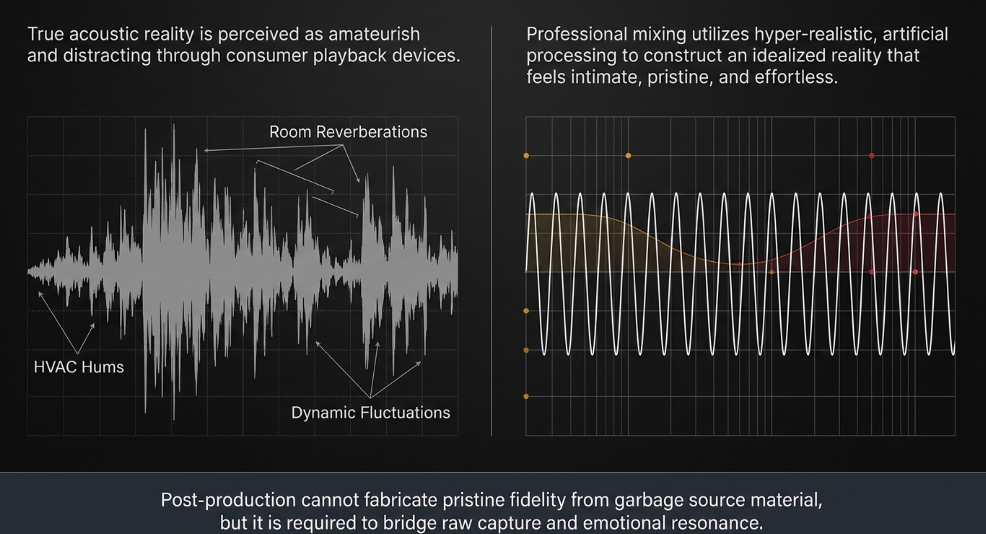
The mix serves as the critical bridge between raw audio capture and the final consumer experience. Audio engineering is fundamentally dependent upon the quality of the raw material; post-production cannot fabricate pristine fidelity that was never originally captured.1 The adage "garbage in, garbage out" remains immutable.1 However, when high-quality source material is provided, the mix is responsible for establishing spatial balance, ensuring absolute vocal intelligibility, and guaranteeing that the audio translates consistently across a vast array of consumer playback systems, from premium studio monitors to low-grade smartphone speakers.
The Perfect Mix
The concept of a "perfect mix" is largely an unattainable ideal that serves as a theoretical benchmark driving the iterative engineering process.2 A perfect mix would flawlessly balance technical precision (absence of masking, optimal phase coherence) with profound emotional resonance.4 Because audio evaluation is highly subjective, engineers strive instead for a "stable" and "appealing" mix—one that successfully directs the listener's attention precisely where the narrative demands it without inducing auditory fatigue.4
Some Axioms and Other Gems
Louder is Better
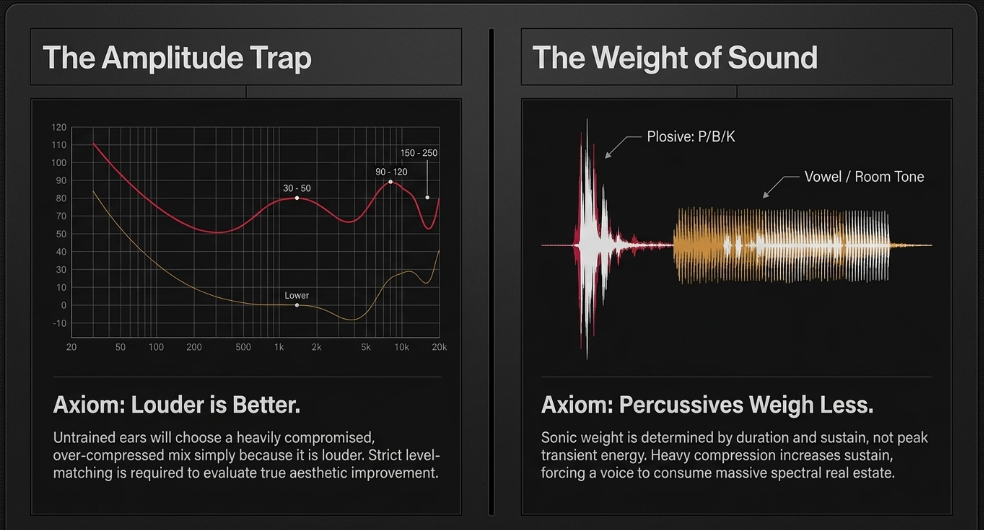
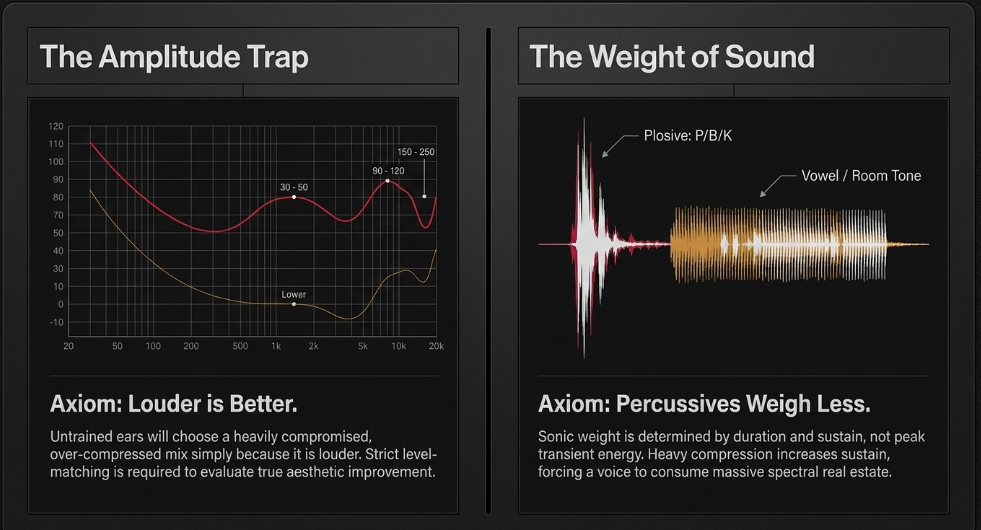
Audio engineering relies heavily upon psychoacoustics, governed prominently by the Fletcher-Munson curves of equal loudness. A foundational axiom of the discipline is that human ears inherently perceive louder audio as superior.2 An increase in volume mathematically results in an increased perception of low-frequency richness and high-frequency clarity. Consequently, untrained listeners will almost invariably select a louder mix as the "better" mix, even if its dynamic integrity has been severely compromised by over-compression.2 For the engineer, this necessitates strict level-matching during the evaluation process to ensure that processing decisions are genuinely improving the sonic character rather than merely increasing the amplitude.
Percussives Weigh Less
In the architecture of a mix, sonic "weight" is determined by the duration and sustain of a sound rather than its peak transient energy.2 This is summarized by the axiom "percussives weigh less".6 Percussive sounds, such as a sharp vocal plosive (a "P" or "B" consonant) or a drum impact, possess immense peak amplitude but last only for milliseconds, leaving the temporal space between hits largely empty.7 Conversely, sustained sounds, such as background room tone, continuous musical pads, or drawn-out vowel vocalizations, carry heavy, continuous energy that demands vast amounts of spectral real estate.2 In podcasting, heavy compression applied to a voice reduces its transient nature and increases its sustain, thereby increasing its sonic weight and causing it to consume more space in the mix.
Importance
The hierarchy of a mix is dictated by the principle of narrative importance.2 In spoken-word audio and podcasting, the dialogue must maintain absolute supremacy across all domains. Every mixing decision—from equalizing a music bed to adjusting the pre-delay of a reverberation tail—must be executed with the primary goal of supporting and highlighting the central vocal narrative.2
Natural vs. Artificial
While podcasts often aim to present authentic conversations, the engineering process relies heavily on artificial enhancements to achieve a "natural" sound. True acoustic reality—replete with room reverberations, HVAC hums, and dynamic volume fluctuations—is often perceived as amateurish and distracting through playback devices. Professional mixing utilizes hyper-realistic, artificial processing (such as noise reduction algorithms, spectral shaping, and dynamic leveling) to construct an idealized version of reality that feels intimate and pristine.2
Learning to Mix
What Makes a Great Mixing Engineer?
A professional mixing engineer possesses a unique synthesis of technical mastery, acoustic physics knowledge, and refined interpersonal skills.2 The ability to evaluate sounds critically, maintaining an objective distance from the emotional content of the audio to assess its frequency and phase relationships, is paramount.2 A great engineer also possesses a distinct "mixing vision," allowing them to hear the final, polished product in their mind before a single fader is moved.
The Ability to Work Fast
In the modern commercial landscape, efficiency is as critical as sonic fidelity.2 The ability to work fast demonstrates a deep internalization of the toolset, allowing the engineer's subconscious intuition to guide macro-adjustments without being bogged down by analytical paralysis.2 Speed also prevents ear fatigue, ensuring that the engineer's perspective remains fresh throughout the critical evaluation phases.
Methods of Learning
The acquisition of mixing skills requires a multifaceted approach. While reading theoretical texts provides the necessary vocabulary and understanding of signal flow, auditory training is the most critical component. The methodology of "technical ear training" involves daily exercises, practicing the identification of specific frequency bands, compression artifacts, and stereo width variations.9 Tools like pink noise generators and specialized software aid in bridging the gap between theoretical knowledge and instant auditory recognition.9
Mixing Analysis
Critical listening involves the deconstruction of existing, high-quality audio productions.2 By actively analyzing top-tier podcasts, an engineer can reverse-engineer the decisions made regarding vocal equalization, ambient sound layering, and dynamic consistency. This process moves the listener from passive consumption to active, analytical dissection.2
Reference Tracks
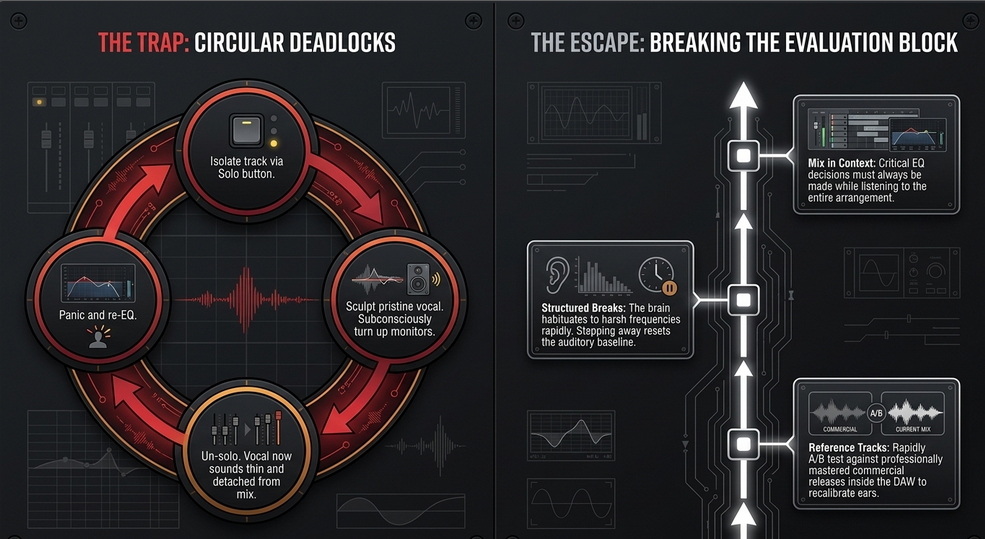
The utilization of reference tracks is an indispensable practice.2 Reference tracks are professionally mastered commercial releases that are imported directly into the digital audio workstation (DAW) alongside the active project. By rapidly A/B testing between the active mix and the reference, the engineer can recalibrate their ears to a known standard of excellence, circumventing the acoustic anomalies of their specific mixing room and preventing their subjective perception from drifting.
The Process of Mixing
The Arrangement
In podcasting, the arrangement dictates the pacing and flow of the narrative. It involves the strategic placement of dialogue, musical stingers, advertisements, and ambient soundscapes.2 A dense arrangement requires aggressive frequency sculpting to prevent masking, whereas a sparse arrangement (e.g., a single voice) exposes every microscopic flaw in the recording, demanding pristine noise reduction and gentle, transparent processing.2
The Recordings
The mixing process begins with a rigorous evaluation of the raw recordings.2 The quality of the microphones, preamps, and acoustic environment dictates the boundaries of what post-production can achieve. An engineer must assess the signal-to-noise ratio, identifying broad issues such as clipping, excessive room reverberation, or electrical interference before any aesthetic mixing begins.1
Editing
Audio editing is the foundational step preceding the mix. This involves reviewing the raw files to cut irrelevant discussions, eliminate excessive pauses, and smooth awkward narrative transitions.2 Furthermore, detailed microscopic editing is required to manage obtrusive breath sounds, mouth clicks, and cross-talk between multiple microphones.10
Sequenced Music
For podcasts utilizing sequenced or synthesized music beds, the engineer must ensure that the instrumentation does not clash with the fundamental frequencies of the human voice. This often involves applying aggressive high-pass filters to sequenced elements or utilizing ducking techniques to ensure the sequenced music dynamically yields to the dialogue.
Where to Start
The mix must always begin with the most important element—the dialogue.2 Establishing the primary vocal track at a healthy nominal level provides the anchor around which all other elements are balanced. The engineer then systematically introduces secondary voices, sound effects, and music, building the mix incrementally.2
Milestones
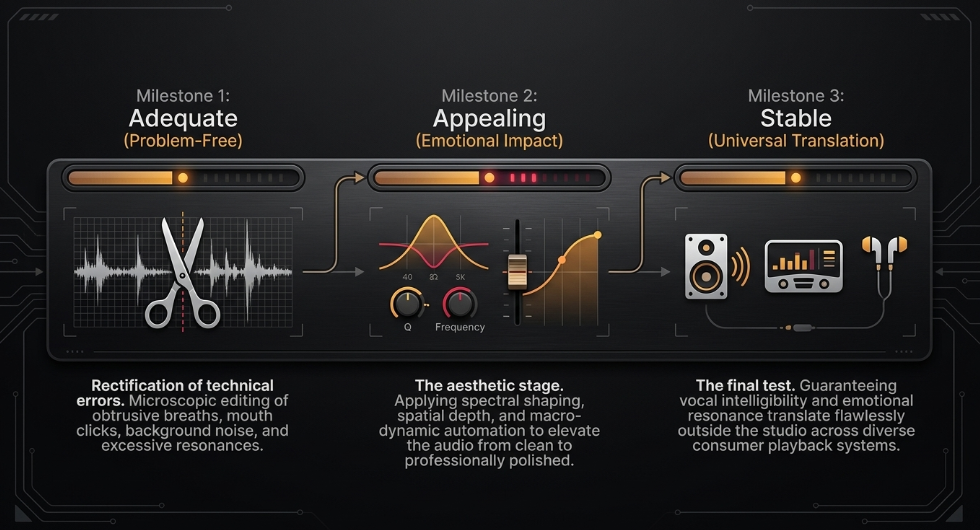
The process of mixing is tracked through three primary milestones:
Adequate (Problem-Free): The stage where all technical errors, such as background noise, clicks, and excessive resonances, have been rectified.
Appealing: The stage where aesthetic processing is applied to create interest, depth, and emotional weight, elevating the mix from merely clean to professionally polished.
Stable: The final milestone, ensuring the mix translates flawlessly outside the studio environment across various playback systems.4
Finalizing and Stabilizing the Mix
Stabilization involves an iterative "coarse-to-fine" approach, moving from broad fader balances to microscopic automation and spatial refinement.4 Because a mix is highly dependent on the "sweet spot" of the studio monitors, finalizing the audio requires checking the playback on smartphones, in vehicles, and on consumer earbuds to guarantee that the narrative remains intelligible despite acoustic variations.4
Mix Edits
As the mix nears completion, structural mix edits may be required. This involves globally adjusting the levels of entire sections (e.g., bringing up the entire music bed during an outro sequence) to ensure the macro-dynamics of the episode maintain listener engagement over long durations.2
Mastering
Mastering is the final, distinct stage of audio post-production, serving as the bridge between the mixed audio and consumer distribution.3 While mixing focuses on the internal balance of individual tracks, mastering focuses on the holistic frequency balance, dynamic range limitation, and strict loudness normalization of the final stereo file.3 The objective is to ensure that the podcast matches the industry-standard loudness levels dictated by platforms like Apple Podcasts and Spotify, preventing the listener from needing to adjust their volume when transitioning between different shows.
DIY Mastering
With the advent of powerful software plugins, many podcast engineers perform "DIY mastering" directly on the master bus of their mixing session.2 This involves a streamlined chain typically consisting of a gentle mix-bus compressor for "glue," a linear-phase equalizer for final tonal balance, and a true-peak brickwall limiter to achieve the final Loudness Units relative to Full Scale (LUFS) targets.2
Related Issues
How Long Does It Take?
The time required to mix a podcast varies exponentially based on the quality of the raw recordings and the density of the sound design.2 A well-recorded, single-voice monologue may require minimal processing, while a complex narrative documentary featuring multi-track interviews, archival audio, and layered soundscapes requires meticulous, time-consuming automation and spatial manipulation.
Deadlocks
During the mixing process, engineers frequently encounter psychological and technical "deadlocks".2 The Evaluation Block occurs when an engineer senses an inherent flaw in the mix but lacks the objectivity to pinpoint the specific frequency or dynamic issue causing it.2 The Circular Deadlock is an endless loop of counter-productive adjustments; for example, boosting the high frequencies of a vocal to improve clarity, which subsequently makes the vocal sound too loud, requiring a fader reduction, which then buries the vocal's low-end warmth, prompting further equalization.7
Breaks
To combat deadlocks and auditory fatigue, taking frequent, structured breaks is an absolute necessity.2 The human ear habituates to frequencies rapidly; prolonged exposure to a harsh, resonant frequency will cause the brain to naturally filter it out, leading the engineer to make wildly inaccurate equalization choices. Stepping away from the monitors resets the auditory baseline.
The Danger with Solos
A primary contributor to circular deadlocks is the misuse of the solo button.2 Equalizing or compressing a track in complete isolation removes the critical context of the mix.2 A vocal stripped of all its low-midrange frequencies might sound exceptionally clean and pristine while soloed, but when folded back into a music bed, it will sound brittle, thin, and entirely detached from the arrangement.2 Furthermore, soloing tracks can lead to "monitor level creep," where the engineer subconsciously turns up their speakers while working in solo, ultimately skewing their perception of the global balance when the solo is disengaged.2 Thus, critical processing decisions must be executed while listening to the entire arrangement.
Mono Listening
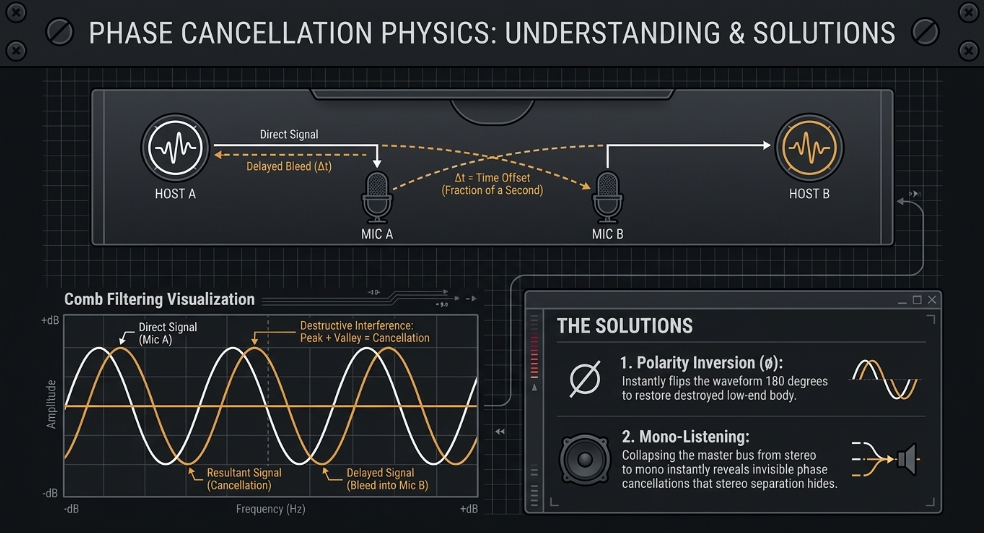
Regularly collapsing the master bus from stereo to mono is a vital housekeeping practice.2 Mono listening immediately reveals phase cancellations that stereo separation might disguise.4 If a sound effect or a specific voice loses substantial volume or tonal integrity when the mix is summed to mono, it indicates a severe phase correlation issue that will negatively impact listeners using single-speaker smart devices.4
Housekeeping
Rigorous session housekeeping—such as color-coding tracks, implementing intuitive naming conventions, and creating organized routing folders—is crucial for maintaining the speed and efficiency required by the "Dual Process Theory" of mixing.2 A cluttered workspace severely impedes the rapid execution of intuitive mixing decisions.
Mixing and the Brain
Dual Process Theory
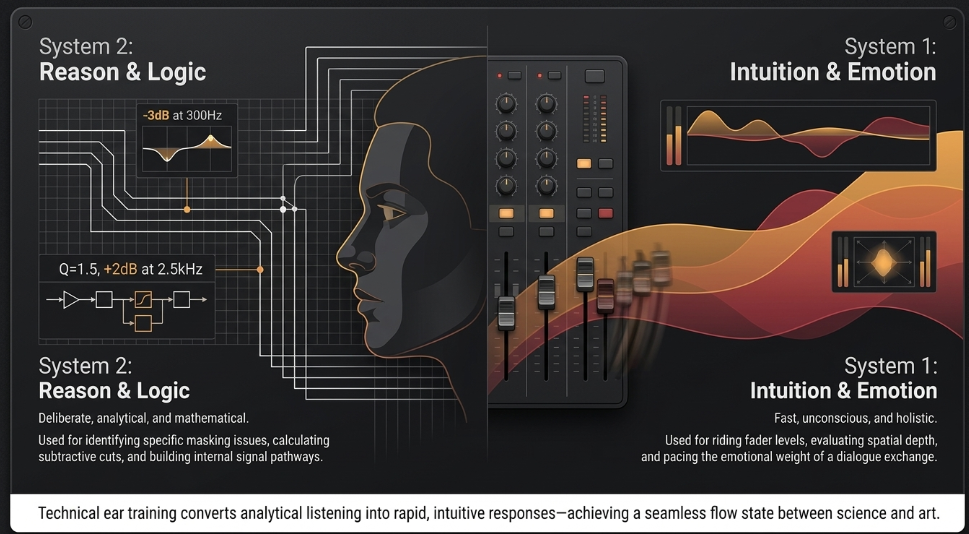
The cognitive mechanisms of mixing are perfectly encapsulated by Dual Process Theory, which posits that human thought is governed by two distinct systems.15 System 1 represents fast, intuitive, and unconscious processing, while System 2 involves slow, deliberate, and analytical reasoning.15 In audio engineering, these manifest as two modes: mixing-by-intuition and mixing-by-reason.12
The Power of the Unconscious
When an engineer relies on System 2, they engage in deliberate problem-solving: identifying a masking issue at 300 Hz and mathematically calculating a subtractive equalizer cut.12 However, the most profound aesthetic decisions are driven by System 1.15 The power of the unconscious allows seasoned professionals to make rapid, holistic judgments regarding spatial depth, emotional weight, and narrative pacing without conscious deliberation.2
Intuition and Thinking Without Thinking
Technical ear training serves to bridge the gap between these two systems, converting slow, analytical listening into rapid, intuitive responses.2 Achieving a "flow state" in mixing requires a seamless oscillation between these modes—utilizing System 2 to set up complex routing matrices, and System 1 to intuitively ride faders and balance the emotional impact of a dialogue exchange.
Emotions, Change, and Creativity
Audio mixing is ultimately an emotional manipulation.2 The tone of a voice, shaped by harmonic saturation and equalization, inherently dictates how the listener perceives the speaker's authority, intimacy, and sincerity. Furthermore, the human brain is wired to notice change.2 A stagnant mix will rapidly lose the listener's attention; therefore, the engineer must introduce subtle creative changes—altering the density of the reverb, shifting the panning of environmental sounds, or automating volume swells—to maintain continuous narrative interest.2
Mixing Domains and Objectives
Mixing Objectives and Definition
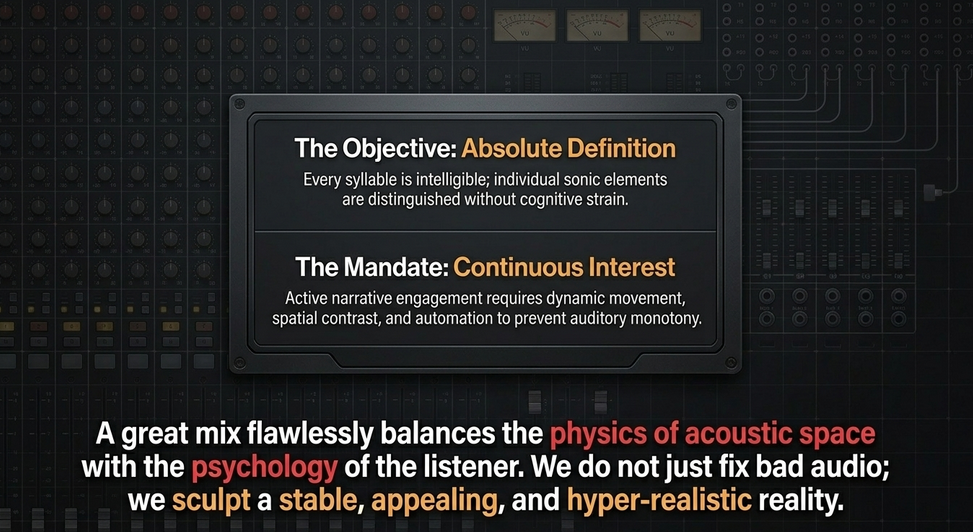
The primary objective of a podcast mix is absolute definition.2 Definition ensures that every syllable is intelligible and that individual sonic elements can be easily distinguished without cognitive strain.18
Interest
A mix must also generate interest. While ambient or background music can be designed to be "ignorable," a podcast narrative demands active engagement, requiring dynamic movement and spatial contrast to prevent auditory monotony.18
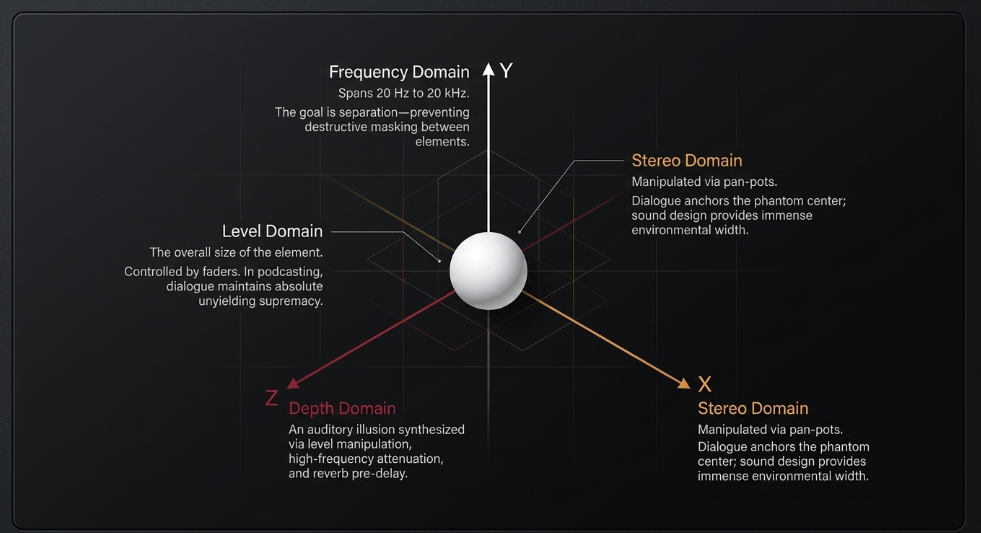
These objectives are achieved by balancing four distinct dimensions, or "domains," of audio:
Frequency Domain
Often considered the most difficult aspect to master, the frequency domain concerns the vertical axis of sound, spanning the limits of human hearing from 20 Hz to 20 kHz.18 The goal in this domain is separation; ensuring that no two elements occupy the same spectral space to the point of destructive masking.2
Level Domain
The foundational axis of mixing, the level domain is controlled primarily via faders and dynamic processors.18 Level dictates the absolute hierarchy of elements.19 In podcasting, the vocal dialogue must maintain unyielding supremacy in the level domain.
Stereo Domain
The horizontal axis, manipulated via panning controls.18 While traditional interview podcasts anchor voices strictly to the phantom center, narrative podcasts exploit the stereo domain to create immense width and environmental realism through sound design.19
Depth
The front-to-back axis of the mix.18 Depth is an auditory illusion synthesized through a combination of level manipulation, frequency attenuation, and reverberation.18 High frequencies are naturally absorbed by air over long distances due to friction losses; thus, applying a high-shelf EQ cut mimics physical distance.21 Adjusting the pre-delay of a reverb tail further pushes elements backward or pulls them forward in the psychoacoustic space.
Tools
Monitoring
How Did We Get Here?
The history of studio monitoring represents a constant pursuit of "flat" or uncolored frequency response, moving from rudimentary single-driver loudspeakers to highly complex, active crossover nearfield systems designed to provide the engineer with absolute clinical truth regarding their audio.22
Choosing Monitors
Selecting studio monitors is an intensely personal decision for an engineer, governed by budget and physical space constraints.22 High-quality nearfield monitors are designed to be placed closely to the listener (typically within 1 to 2 meters) to maximize the ratio of direct sound to reflected room sound.22
The Room Factor and Positioning Monitors
Monitors are highly susceptible to the "room factor".4 Untreated acoustic spaces introduce comb filtering, early reflections, and standing waves (room modes) that severely color the frequency response.4 If a room naturally amplifies 100 Hz due to physical dimensions, the engineer will incorrectly cut 100 Hz in the mix, resulting in a thin, weak podcast when played elsewhere.4 Proper positioning—creating an equilateral triangle between the two monitors and the listening position, and isolating the speakers from the desk surface—is essential for accurate stereo imaging and mitigating phase issues.4
Headphone Mixing
Headphones bypass the room's acoustic interference entirely, offering unparalleled analytical detail.22 They are strictly essential for spotting microscopic edits, background hiss, and transient clicks. However, because sound in the right channel only reaches the right ear, headphones present an exaggerated stereo field and an artificial center image.13 This unnatural physical separation often leads engineers to under-pan elements or misjudge reverberation densities.13 Advanced software emulations (such as the Slate VSX system) attempt to combat this by utilizing complex algorithms to artificially replicate the crossfeed and acoustic signature of professional mixing rooms within the headphone environment.
Meters
Amplitude vs. Level
Metering provides the visual representation of electrical audio signals.2 It is critical to distinguish between raw amplitude (the absolute electrical voltage of a waveform) and perceived level (how loud the human brain interprets that waveform to be).2
Mechanical and Bar Meters
Historically, meters utilized mechanical needles (such as VU meters) designed with specific ballistic ballistics that naturally smoothed out rapid transients, providing a reading closer to human perception.2 Modern DAWs utilize high-resolution digital bar graphs to convey this data instantaneously.7
Peak Meters
Peak meters measure the absolute instantaneous transient spikes of the waveform.2 They react with zero latency and are essential for protecting the digital architecture, alerting the engineer immediately if the signal exceeds 0 dBFS and enters destructive digital clipping.2
Average Meters
Average (or RMS) meters measure the sustained energy of the audio over a specific temporal window (typically 300 milliseconds).2 Because human hearing integrates sound over time, average meters provide a visual representation that much more accurately reflects perceived loudness than peak meters do.2
Phase Meters
Phase meters (or vectorscopes) provide a visual representation of the stereo width and phase correlation between the left and right channels, instantly indicating if a mix will suffer from destructive cancellation when summed to mono.
Mixing Consoles
Buses, Processors vs. Effects, and Signal Flow
The mixing console, whether physical or digital, is the central nervous system of post-production. It routes audio via "buses"—internal pathways that sum multiple signals together.7 The console architecture distinguishes between processors (such as equalizers and compressors, which are placed as "inserts" directly in the signal path to alter the entire sound) and effects (such as reverbs and delays, which are placed on auxiliary sends to run in parallel with the dry signal).7 Understanding basic signal flow diagrams is paramount; knowing exactly where a signal is traveling prevents catastrophic routing errors and gain-staging issues.7
Groups, In-Line Consoles, and The Monitor Section
Consoles utilize Audio Groups and Voltage Controlled Amplifier (VCA) groups to consolidate massive track counts into manageable sub-mixes.7 For example, all host microphones can be routed to a "Dialogue Group," allowing the engineer to compress and level the entire conversation with a single fader.7 The architecture traces back to traditional in-line consoles, which separated the recording path from the monitoring path.7 The monitor section dictates what the engineer hears without affecting the actual recorded signal.7
Correct Gain Structure
Maintaining correct gain structure ensures the signal remains robustly above the noise floor while safely below the clipping ceiling across every stage of the console's signal path.7
The Digital Console and Console Emulation
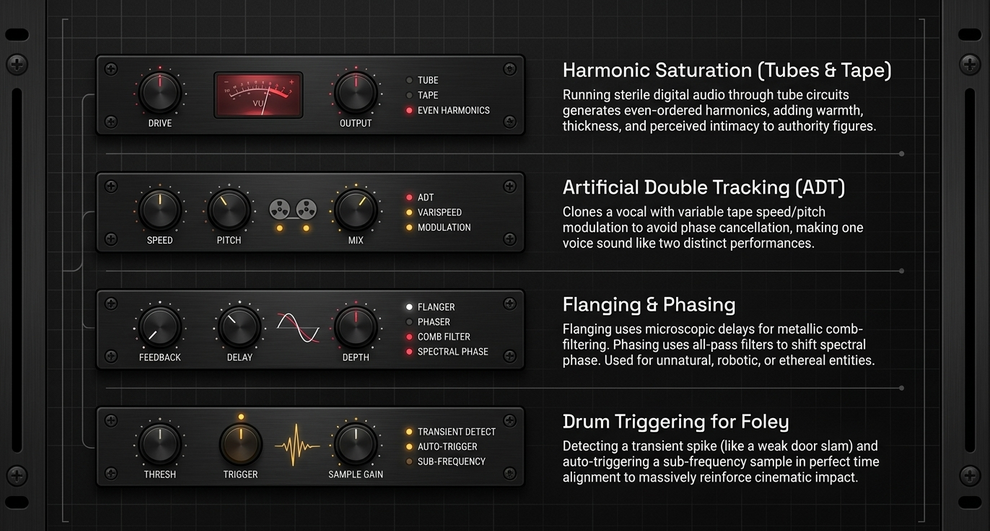
Modern digital consoles replicate this architecture entirely within DSP processing.7 Because digital math is inherently clean and sterile, engineers rely heavily on console emulation plugins.2 These tools use non-linear modeling to impart the subtle harmonic saturation, crosstalk, and phase anomalies of classic analog desks (such as SSL or Neve consoles), adding highly desirable "warmth" and analog depth to clinical digital dialogue recordings.
Software Mixers
Tracks, Mixer Strips, and Routing
The digital audio workstation (DAW) unifies the multitrack sequence window and the mixer strip into a single application.2 Creating an audio track automatically generates a corresponding software mixer strip replete with inserts, auxiliary sends, and faders.2 Software mixers provide virtually limitless routing capabilities via internal digital buses.2
The Internal Architecture
The mathematical backbone of the software mixer relies heavily on floating-point notation (e.g., 32-bit or 64-bit float).2 Unlike older integer-based systems that hard-clipped at 0 dBFS, floating-point architecture provides virtually infinite internal headroom.2 This guarantees that even if an individual channel strip is pushed deep into the red, it will not suffer permanent digital distortion, provided the master output fader is attenuated before the final digital-to-analog conversion.2
Phase
What is Phase?
Phase refers to the precise time relationship between two or more interacting sound waves.4
Problems
In podcasting, catastrophic phase problems typically occur when multiple microphones are utilized simultaneously in the same room.24 Because sound travels at approximately 343 meters per second, the voice of Host A will reach their own microphone instantly, but will bleed into Host B's microphone a few milliseconds later. When these two signals are summed together in the software mixer, the microscopic time delay causes comb filtering—where phase interference causes specific frequencies to nullify each other, resulting in a hollow, thin, or "robotic" sound.24
Tricks
To rapidly rectify severe phase cancellation, engineers utilize polarity inversion (often mislabeled as a "phase flip" switch, denoted by the "ø" symbol).24 Inverting the polarity flips the mathematical positive and negative values of the waveform by 180 degrees, which can instantly restore low-end body that was destroyed by microphone bleed.24 For perfect phase coherence, manual time-alignment of the waveforms down to the sub-millisecond sample level is often required.
Faders
Types, Scales, and Working with Faders
The fader is the primary tool for establishing the level domain.4 Hardware faders utilize conductive plastic sliding potentiometers, VCA circuits, or motorized mechanisms for automation.2 Fader scales are distinctly logarithmic, designed to mirror the human ear's non-linear perception of loudness.2 The scale is optimized so that the fader provides the highest degree of sub-decibel physical resolution around the "0" (unity gain) mark, and becomes exponentially coarser as it is pulled downward toward negative infinity.2
Panning
How Stereo Works and Pan Controls
Stereo perception relies on interaural time differences and interaural intensity differences—how the brain decodes sound arriving slightly earlier and louder at one ear compared to the other.4 Pan controls manipulate the intensity difference across the Left and Right output buses.4 To prevent a sound from perceptually doubling in volume when panned to the phantom center, software mixers employ pan-laws (typically applying a -3dB or -4.5dB attenuation at the center position).4
Types of Track and Panning Techniques
Standard dialogue tracks are strictly monophonic and anchored dead-center to anchor the narrative focus.20 Stereo tracks are utilized for ambient room tones, music beds, and sound effects.20 Narrative panning techniques involve dynamically automating pan-pots to track the movement of a character (e.g., footsteps walking from left to right) or hard-panning contrasting elements to create immense width and separation.
Beyond Pan-Pots
Advanced spatialization goes beyond simple intensity panning, utilizing psychoacoustic processors that manipulate phase and micro-delays to push sounds outside the physical boundaries of the left and right speakers, creating three-dimensional binaural illusions.4
Equalizers
Applications and The Frequency Spectrum
Equalization (EQ) is the principal tool for sculpting the frequency domain, addressing both corrective surgical cleaning and broad aesthetic enhancement.2 The frequency spectrum spans from 20 Hz to 20,000 Hz, and understanding its divisions is paramount for podcasting.29
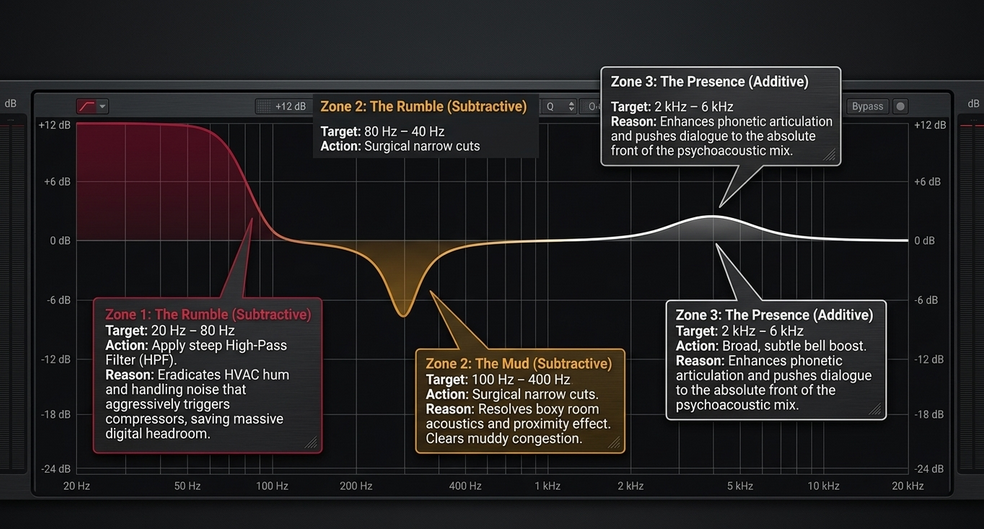
The fundamental frequencies of the human voice rarely extend below 80 Hz.30 Consequently, applying a steep high-pass filter (HPF) around 70–80 Hz effectively eradicates non-musical low-frequency rumble, handling noise, and HVAC hum without stripping the vocal of its natural resonance.30 This is critical because low frequencies consume massive amounts of digital headroom, forcing dynamic compressors to react aggressively to inaudible rumble.8
Types and Controls
The two primary types of EQs are Graphic and Parametric.28 Graphic equalizers utilize a fixed bank of sliding faders representing predetermined frequency bands.2 Parametric equalizers, the standard in modern DAWs, provide absolute mathematical precision, offering control over three continuous parameters per band:
Frequency: The specific target center point.
Gain: The amount of decibel boost or attenuation.
Q (Bandwidth): The width of the bell curve affecting adjacent frequencies.28
In Practice: Equalizing Various Instruments
For podcast dialogue, subtractive EQ is deployed first.30 A narrow cut between 100–300 Hz reduces the "boxy" or "boomy" artifacts caused by poor room acoustics or the proximity effect (the artificial bass boost caused by speaking too close to a directional microphone).30 A cut in the 300–400 Hz range resolves "muddy" congestion.30 Once cleaned, broad additive EQ provides aesthetic polish. A wide, subtle boost in the "presence" range—typically between 2 kHz and 6 kHz—enhances phonetic articulation and pushes the dialogue to the absolute front of the mix.
Introduction to Dynamic Range Processors
Dynamic Range and Dynamics
The dynamic range is the mathematical difference, measured in decibels, between the loudest peak of a signal and the quietest noise floor.31 Spoken dialogue is inherently highly dynamic, fluctuating wildly between intimate whispers and explosive, transient laughter.31
Dynamic Range Processors in a Nutshell
Without dynamic processing, listeners in noisy environments (such as a moving vehicle) would be forced to continuously ride their volume dials to comprehend quiet speech without being deafened by sudden shouts.31 Dynamic range processors act as automated, high-speed faders that manipulate this range by instantly applying variable gain control based on the input signal's amplitude.31
Compressors
The Course of History and The Sound of Compressors
Historically designed as protective limiters for broadcast transmitters, compressors have evolved into the most relied-upon aesthetic tool in audio engineering.31 Different compressor topologies (VCA, FET, Opto, Vari-Mu) impart distinct sonic characteristics, ranging from ultra-fast, transparent gain reduction to slow, harmonically rich "glue".4
Principle of Operation and Core Controls
A compressor reduces the dynamic range from the top down by attenuating the loudest peaks.31 The core parameters are:
Threshold: The specific decibel level at which the compressor engages. Signals below the threshold remain entirely unaffected.
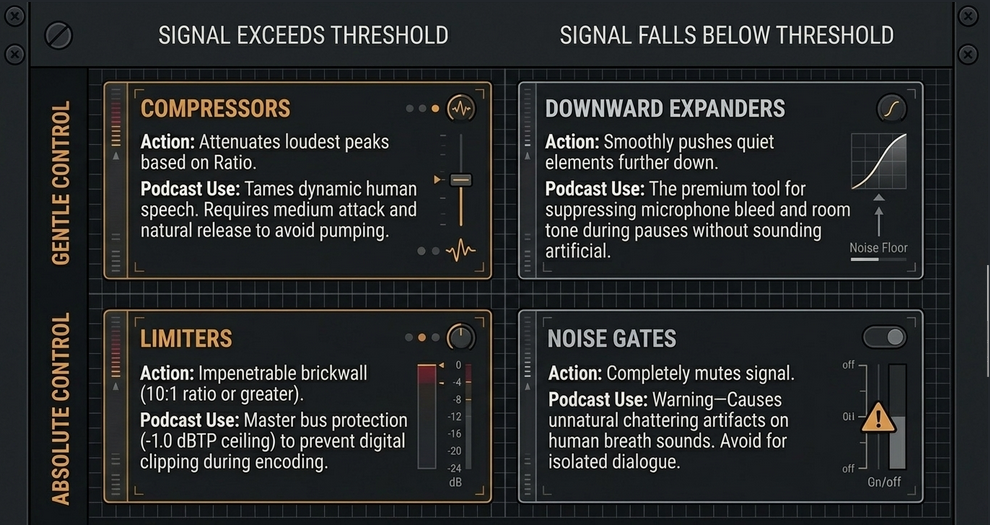
Ratio: The severity of the gain reduction. A 3:1 ratio dictates that for every 3 dB the signal exceeds the threshold, only 1 dB is permitted to pass.32
Attack: The time it takes for the compressor to clamp down after the threshold is crossed.
Release: The time it takes for the compressor to cease gain reduction once the signal drops back below the threshold.
Makeup Gain: The static post-amplification used to restore the overall level lost during the peak reduction process.31
Additional Controls, Practice, and Applications
Additional controls include the "Knee," which dictates whether the transition into compression is immediate (hard knee) or gradual (soft knee).33 In practice, compressing podcast dialogue requires moderate settings: a soft knee, a medium attack to ensure the natural punch of phonetic consonants is not obliterated, and a natural release that breathes with the cadence of the speech, preventing the background noise from audibly "pumping" between words.
Tricks and More on Compressors
Advanced tricks include parallel compression, where a heavily smashed, distorted vocal is blended beneath a completely uncompressed signal, resulting in immense vocal thickness without sacrificing transient clarity.34
Limiters
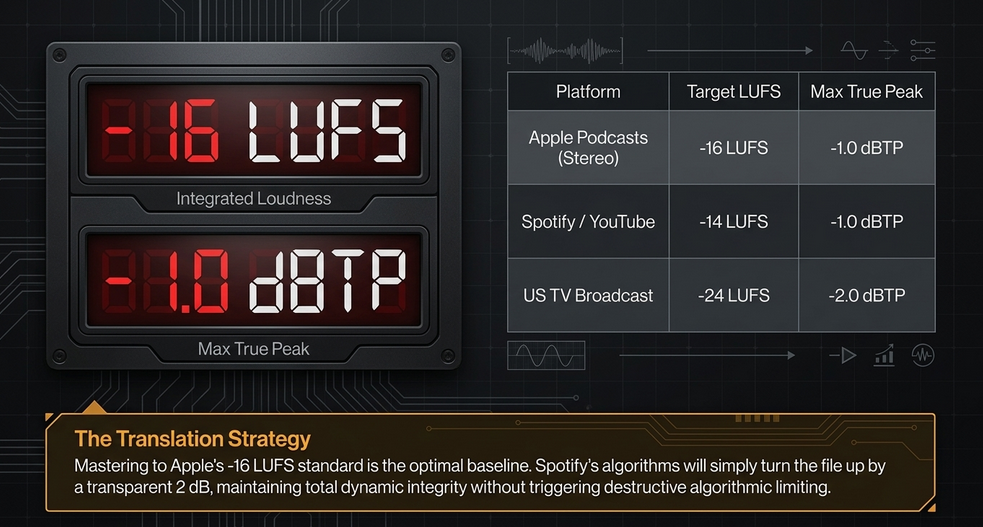
A limiter is effectively a compressor utilizing an extreme ratio of 10:1 or greater.8 It acts as an impenetrable brick wall that absolutely forbids the audio from exceeding a designated dynamic ceiling.8 Limiters are deployed at the very end of the master bus mastering chain.8 The ceiling is strictly set to -1.0 dBTP (True Peak) to ensure that inter-sample peaks do not cause digital clipping and distortion during the final MP3 or AAC encoding process.8 If the master limiter is constantly engaging and working heavily, the mix's internal compression stages are fundamentally flawed and require recalibration.8
Gates
Controls, Applications, Practice, and Tricks
A noise gate is a dynamic processor that manages the noise floor by completely muting the audio signal when it falls below a designated threshold.4 Its controls mirror a compressor's attack and release, alongside a "Hold" parameter that dictates how long the gate remains open.36 While useful for isolating individual drum hits, utilizing a hard noise gate on isolated podcast dialogue can sound extremely unnatural, resulting in chattering artifacts as breath sounds rapidly trigger the gate open and closed.36
Expanders
Controls, In Practice, and Upward Expanders
Expanders offer a superior solution for spoken-word audio.32 While a gate applies absolute muting, a downward expander smoothly and proportionately attenuates the signal when it drops below the threshold, effectively increasing the dynamic range by pushing the quiet elements further down.32 This is the premium tool for minimizing microphone bleed between multiple hosts, rejecting headphone spill, and gently suppressing ambient HVAC hiss during pauses in speech without sounding artificial.37
Conversely, an upward expander increases dynamic range by actively amplifying signals that rise above the threshold.32 While highly specialized, upward expansion can be used to dramatically accentuate the transient impact of dynamic elements without utilizing parallel compression.32
Duckers
Operation and Controls, Applications
A ducker operates using a sidechain input circuit, where the amplitude of one track directly triggers the gain reduction of another.4 In podcasting, ducking is utilized exclusively for music beds.4 By routing the dialogue track into the sidechain input of a compressor placed on the music track, the music will automatically and smoothly dip in volume ("duck") the moment the host begins speaking, and swell back to full volume during pauses, eliminating the need for tedious manual fader rides.
Delays
Delay Basics, Types, Practice, and Applications
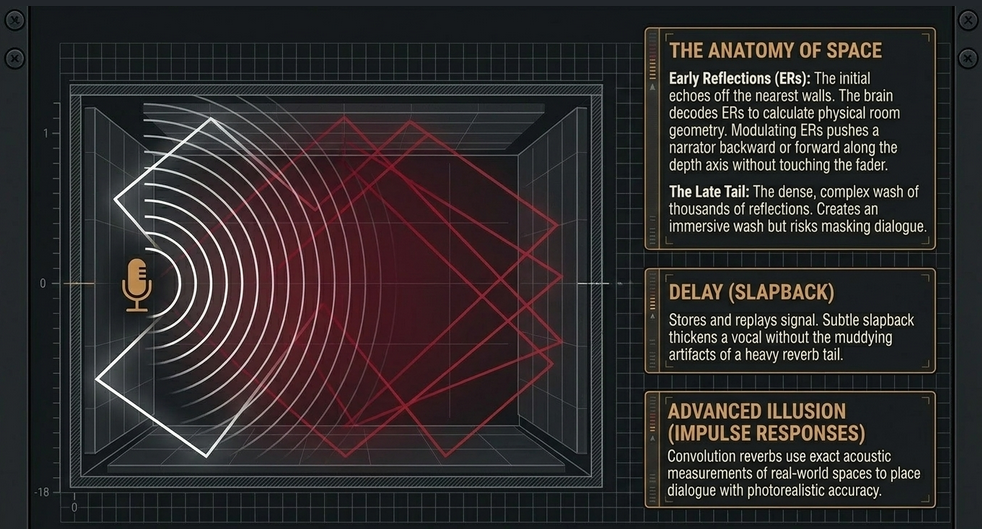
Delay is the fundamental building block of all time-based spatial effects.27 It stores an audio signal and replays it after a specific millisecond interval, creating a distinct, rhythmic echo.39 Types range from pristine digital delays to analog tape delay emulations that naturally degrade and filter the high frequencies of successive echoes. In narrative podcasts, delays are utilized to simulate vast environments, such as shouting across a canyon, or applied subtly as "slapback" to thicken a vocal without the muddying artifacts of heavy reverberation.27
Other Modulation Tools
Vibrato, ADT, Chorus, Flanging, Phasing, Tremolo
Modulation tools create psychoacoustic movement by duplicating the signal, altering its pitch or timing via a Low-Frequency Oscillator (LFO), and mixing it back with the dry signal.39
Vibrato / Tremolo: Vibrato modulates pitch, while tremolo modulates amplitude.41
Chorus: Utilizes slightly longer delays (15–30 ms) paired with pitch modulation to create a thick, shimmering effect.39
Flanging: Utilizes extremely short delays (1–10 ms) mixed with the dry signal to create severe, sweeping comb-filtering effects, producing a metallic "jet engine" sound.40
Phasing: Instead of time delays, phasers utilize complex networks of all-pass filters to shift the phase relationship across the spectrum, creating a swirling effect.40
ADT (Artificial Double Tracking): Invented at Abbey Road Studios, ADT uses variable tape speed emulation to clone a vocal and randomly modulate its pitch and timing, avoiding phase cancellation and making a single voice sound like two distinct performances.43
In audio drama, cascading these modulation tools synthesizes unnatural, imposing character voices (e.g., robotic, demonic, or ethereal entities).
Reverbs
What is Reverb? Applications and Types
Reverberation (reverb) simulates the highly complex acoustic phenomenon of thousands of sound waves reflecting off physical surfaces in an enclosed space.4 It provides the brain with vital cues regarding the size, texture, and geometry of an environment. Different reverb programs—such as Hall, Room, Plate, and Spring—offer entirely different acoustic signatures.4
Reverb Properties, Parameters, and Early Reflections (ERs)
Reverb is structurally divided into two main components: Early Reflections (ERs) and the Late Tail.21 ERs are the initial, distinct echoes that bounce off the walls nearest to the sound source; the human brain intuitively analyzes these micro-delays to calculate the physical dimensions of the room.21 By isolating and modulating the ERs independently of the dense reverb tail, an engineer can precisely push a narrator backward or forward along the depth axis without touching the volume fader.21
Reverbs and Stereo, Other Types, and Practice
Stereo reverbs create an immersive wash that wraps around the listener.20 Advanced convolution reverbs utilize "impulse responses"—actual acoustic measurements of real-world spaces (e.g., a specific church or subway station)—allowing the podcast engineer to place dialogue with photorealistic acoustic accuracy.4
Distortion
Background, Basics, and Ways to Generate Distortion
Distortion is frequently viewed as an engineering failure, yet in professional mixing, controlled harmonic distortion (saturation) is a highly desirable aesthetic enhancement tool.48 Saturation alters the original waveform by introducing overtones (harmonics) that were not present in the original recording.49
Running a sterile, clinical digital voice recording through a high-voltage tube saturation circuit generates even-ordered harmonics, which the human ear inherently perceives as thick, warm, and musical.48 Furthermore, aggressive distortion and bit-crushing generation are fundamental to creative sound design; for example, synthesizing a lo-fi "telephone effect" or a degraded World War II radio broadcast.51
Drum Triggering
Methods of Drum Triggering
While originally designed for replacing poorly recorded drum sets in music production via transient detection algorithms, drum triggering software is highly adaptable for podcast post-production.53 In audio dramas, Foley impacts (such as a door slam or a punch) that lack low-end energy can be routed into a triggering plugin. The plugin detects the transient spike and automatically triggers a secondary, sub-frequency sample in perfect time alignment, massively reinforcing the cinematic impact without manual editing.53
Other Tools
MS (Mid-Side) Processing
Mid-Side (MS) processing is a highly sophisticated spatial tool.57 Unlike traditional Left/Right stereo linked processing, an MS matrix separates the audio into two distinct channels: the "Mid" (the sum of the left and right channels, L+R, containing the mono center image) and the "Side" (the difference between the channels, L-R, containing the wide stereo information).57
In podcasting, MS EQ is an unparalleled rescue tool.58 If an interview features dialogue buried beneath a wide, muddy ambient soundscape, the engineer can apply a high-pass filter strictly to the Mid channel, instantly clearing the central vocal clarity without stripping the immersive low-end width of the Side channel's ambient atmosphere.58
Pitch Shifters, Harmonizers, Exciters, and Enhancers
Pitch shifters alter frequency independent of time, essential for character voice manipulation.60 Exciters and enhancers operate by generating phase-shifted, high-frequency harmonic distortion, injecting artificial brilliance and "air" into muffled recordings that cannot be salvaged by standard equalization.4
Transient Designers
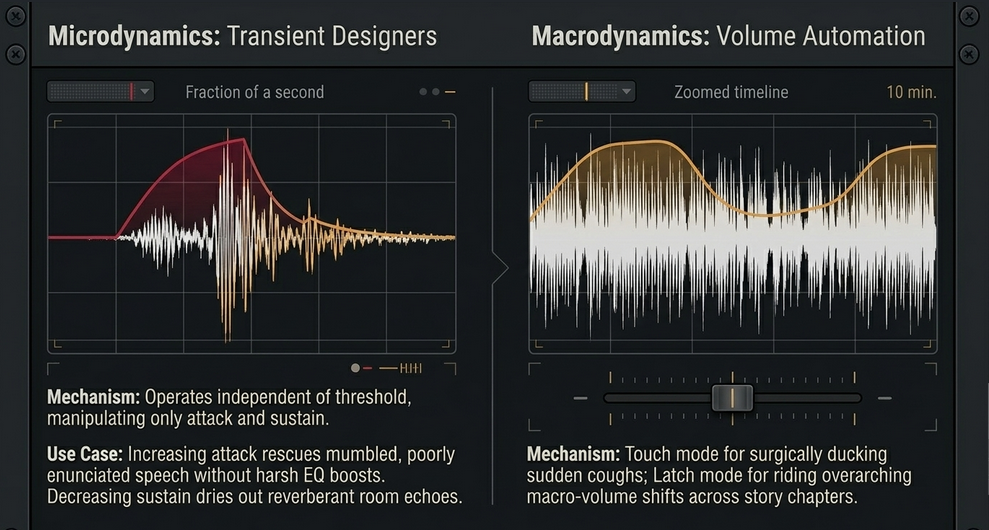
While standard compressors react to the overall amplitude envelope, a Transient Designer (or transient shaper) utilizes sophisticated envelope followers to isolate and manipulate the attack and sustain phases of a sound entirely independent of the signal's input level.34
For podcast dialogue, transient designers are revolutionary.50 If a host suffers from poor, mumbled enunciation, increasing the attack parameter can dramatically enhance the transient clarity of hard consonants (T, K, P sounds), radically improving speech intelligibility without introducing the harsh phase anomalies associated with massive high-frequency EQ boosts.50 Conversely, if a microphone has captured severe plosive energy, slightly reducing the attack cleanly removes the physical thump.50 Modifying the sustain parameter acts as a localized downward expander, allowing the engineer to instantly dry out the reverberant room tail of a poorly treated recording space.
Automation
Automation Engines and The Automation Process
Even the most meticulously calibrated chain of dynamic range processors cannot adequately account for the macro-level volume shifts of a long-form podcast conversation. A host leaning away from the microphone or transitioning from a highly energetic introduction into a subdued, intimate interview must be addressed via volume automation.65
Automation engines allow the DAW to record, store, and flawlessly reproduce the physical movements of faders, pan-pots, and plugin parameters over the timeline.66 The process relies on several primary modes:
Automation Alternatives and Control Surfaces
Writing detailed automation with a computer mouse is incredibly tedious and disconnected from the rhythm of the audio.65 Engineers utilize motorized hardware control surfaces to physically "ride" the faders in real-time, responding intuitively to the emotional contour of the dialogue.65 As the industry moves forward, AI-assisted orchestration systems are emerging as powerful alternatives, capable of automatically parsing vocal transcripts and dynamically leveling multi-track dialogue to a specified target, saving immense amounts of manual leveling time.66
Delivery Standards and Loudness Normalization
The final step of the automation and mastering process is ensuring the podcast complies with the strict delivery standards mandated by global streaming platforms.14 The industry has universally adopted the LUFS (Loudness Units relative to Full Scale) measurement system, which employs a K-weighting filter to account for the human ear's sensitivity to specific frequencies, providing a highly accurate numeric representation of perceived human loudness.71
If a podcast fails to meet these specific targets, platform algorithms will forcibly alter the audio—either applying destructive digital limiting to boost a quiet file, or turning down a loud file, resulting in an inconsistent listening experience.14 The master limiter must be carefully calibrated to satisfy the following industry specifications:
Apple Podcasts serves as the dominant standard-bearer for the medium, setting the baseline at -16 LUFS for stereo podcast files.14 Because platforms like Spotify and YouTube normalize to a slightly louder -14 LUFS, a podcast properly mastered to Apple's -16 LUFS target will simply be turned up by a transparent 2 dB by Spotify's algorithm, maintaining total dynamic integrity and resulting in an optimal, universally translatable auditory experience.14
Works cited
The Ultimate Guide to Podcast Audio Engineering | by Virgil | Medium, accessed April 30, 2026, https://medium.com/@virgilthetrue/the-ultimate-guide-to-podcast-audio-engineering-4666e388425
Mixing Audio: Concepts, Practices, and Tools 9781032219448 ..., accessed April 30, 2026, https://dokumen.pub/mixing-audio-concepts-practices-and-tools-9781032219448-9781032300191-9781003303077-1032219440.html
Mastering Soundscapes: A Comprehensive Guide to Audio Engineering - AutoTune, accessed April 30, 2026, https://www.antarestech.com/community/comprehensive-guide-to-audio-engineering
Mixing Audio; Concepts, Practices, and Tools; 4, accessed April 30, 2026, https://api.pageplace.de/preview/DT0400.9781000883978_A46030541/preview-9781000883978_A46030541.pdf
Mixing audio : concepts, practices, and tools - Dartmouth Libraries, accessed April 30, 2026, https://search.library.dartmouth.edu/discovery/fulldisplay?docid=alma991034074401305706&context=L&vid=01DCL_INST:01DCL&lang=en&adaptor=Local%20Search%20Engine&tab=All&query=sub%2Cexact%2CSongs&offset=180
Toward a Systematic Understanding of “Heaviness” in Metal Music Production - Taylor & Francis, accessed April 30, 2026, https://www.tandfonline.com/doi/pdf/10.1080/19401159.2022.2109358
Mixing Audio, accessed April 30, 2026, http://orga.blog.unq.edu.ar/wp-content/uploads/sites/72/2019/09/Mixing.Audio_.Concepts.Practices.And_.Tools_.pdf
Podcast Audio Mixing: The Complete Production Guide (2026) | Ruah Creative House, accessed April 30, 2026, https://ruahcreativehouse.org/blog/podcast-audio-mixing/
Sound engineering / post-production e-learning course (or other learning materials) - seeking advice : r/podcasting - Reddit, accessed April 30, 2026, https://www.reddit.com/r/podcasting/comments/ubr92l/sound_engineering_postproduction_elearning_course/
Audio Engineering for Podcasting: Tips and Techniques for Producing Engaging Podcasts, accessed April 30, 2026, https://www.mi.edu/in-the-know/audio-engineering-podcasting-tips-techniques-producing-engaging-podcasts/
VoiceAssist Explained. A Detailed Look At The Tool Built For Dialogue Workflows, accessed April 30, 2026, https://noiseworksaudio.com/voiceassist-explained-a-detailed-look-at-the-tool-built-for-dialogue-workflows/
Mixing Techniques for Audio - Routledge, accessed April 30, 2026, https://www.routledge.com/rsc/downloads/Mixing_Techniques_for_Audio_-_FINAL.pdf
Headphone mixing versus room calibration/monitor mixing : r/audioengineering - Reddit, accessed April 30, 2026, https://www.reddit.com/r/audioengineering/comments/1r8np0r/headphone_mixing_versus_room_calibrationmonitor/
Podcast Loudness Standards 2026: Spotify, Apple, YouTube Requirements, accessed April 30, 2026, https://sone.app/blog/podcast-loudness-standards-2026-spotify-apple-youtube
Dual Process Thinking In Peak Performance, accessed April 30, 2026, https://humanperformance.ie/dual-process-thinking/
Dual Process Theory: Embodied and Predictive; Symbolic and ..., accessed April 30, 2026, https://pmc.ncbi.nlm.nih.gov/articles/PMC8979207/
Dual- Process Theories - Bertram Gawronski, accessed April 30, 2026, http://bertramgawronski.com/documents/GLC2024DPT.pdf
Mixing Audio: Concepts, Practices, and Tools [Paperback ed.] 1138859788, 9781138859784 - DOKUMEN.PUB, accessed April 30, 2026, https://dokumen.pub/mixing-audio-concepts-practices-and-tools-paperbacknbsped-1138859788-9781138859784.html
Exploring the Three Dimensions of Mixing: Depth, Width, and Height | AMP Music Lab, accessed April 30, 2026, https://www.ampmusiclab.com/blog/exploring-the-three-dimensions-of-mixing-depth-width-and-height/
Mixing in Stereo: Adding Width and Depth to Your Recordings - Universal Audio, accessed April 30, 2026, https://www.uaudio.com/blogs/ua/studio-basics-mixing-stereo
Adding Depth: How to Bring your Audio Mix to Life - sonible, accessed April 30, 2026, https://www.sonible.com/blog/adding-depth/
Monitors vs Headphones for Mixing - Audient, accessed April 30, 2026, https://audient.com/tutorial/monitors-vs-headphones-for-mixing/
Mastering on Headphones vs Monitors: Not a Compromise | Alexander Wright Mastering, accessed April 30, 2026, https://alexanderwright.com/blog/mastering-headphones-vs-monitors
What Is Phase In Audio? - Nail The Mix, accessed April 30, 2026, https://www.nailthemix.com/what-is-phase-in-audio
Fixing Phase Problems In The Mix: Saving Phase - Gearnews.com, accessed April 30, 2026, https://www.gearnews.com/fixing-phase-problems-studio/
So is there a phase relationship between every microphone in the drums? Can my kick mic weaken the sound of my tom mic? My Overheads weaken my snare so on? Do I check everything? : r/audioengineering - Reddit, accessed April 30, 2026, https://www.reddit.com/r/audioengineering/comments/13e4vbr/so_is_there_a_phase_relationship_between_every/
Creating a Wide and Immersive Mix: Advanced Stereo Imaging and Spatial - Carvin Audio, accessed April 30, 2026, https://carvinaudio.com/blogs/audio-education/creating-a-wide-and-immersive-mix-advanced-stereo-imaging-and-spatial-effects
Audio Compression and EQ for Podcasters | Enhance Your Sound - Listen2It, accessed April 30, 2026, https://www.getlisten2it.com/blog/audio-compression-and-eq-for-podcasters-enhance-your-sound/
A Guide to Audio Processing and FX For Podcasting (US) - RØDE, accessed April 30, 2026, https://rode.com/en-us/about/news-info/a-guide-to-audio-processing-and-fx-for-podcasting
How to EQ a Podcast - YouTube, accessed April 30, 2026, https://www.youtube.com/watch?v=rFaXb1NCMM8
Level Up Your Podcast with Audio Processing Tools: Compressors, Equalizers & More, accessed April 30, 2026, https://www.sweetwater.com/insync/best-podcast-audio-processing-upgrades/
Audio dynamics 101: compressors, limiters, expanders, and gates - iZotope, accessed April 30, 2026, https://www.izotope.com/en/learn/audio-dynamics-101-compressors-limiters-expanders-and-gates
Expander controls in Final Cut Pro for Mac - Apple Support, accessed April 30, 2026, https://support.apple.com/guide/final-cut-pro-logic-effects/expander-lgexae564950/mac
Transient Shaping 101: The Absolute Best Guide for Producers - Unison Audio, accessed April 30, 2026, https://unison.audio/transient-shaping/
Phase Tricks, EQ and Compression Hacks, and etc. That Made you go “WOW!” - Reddit, accessed April 30, 2026, https://www.reddit.com/r/audioengineering/comments/1guysth/phase_tricks_eq_and_compression_hacks_and_etc/
Downward compression - upward comp. and expansion and gate - what is the difference?? : r/audioengineering - Reddit, accessed April 30, 2026, https://www.reddit.com/r/audioengineering/comments/avbqzv/downward_compression_upward_comp_and_expansion/
Expanders/Noise Gate Help... : r/audioengineering - Reddit, accessed April 30, 2026, https://www.reddit.com/r/audioengineering/comments/14jdwa/expandersnoise_gate_help/
Upward Compression: The Hidden Gem of Dynamic Sound Design - Unison Audio, accessed April 30, 2026, https://unison.audio/upward-compression/
Sound Design Tutorial: From Basics to Advanced Audio Creation - BassGorilla.com, accessed April 30, 2026, https://bassgorilla.com/sound-design-tutorial/
Instant Phaser Mk II Classic Tape Flanging Plug-in | Eventide Audio, accessed April 30, 2026, https://www.eventideaudio.com/plug-ins/instant-phaser-mk-ii/
Sound Design – Music Production Tips | AudioServices Studio, accessed April 30, 2026, https://audioservices.studio/category/sound-design
Surrealism Through Sound Design: The Squish Engine Manifesto, accessed April 30, 2026, https://klangmag.co/surrealism-through-sound-design-the-squish-engine-manifesto/
Powered By Faust - Faust Programming Language - Grame, accessed April 30, 2026, https://faust.grame.fr/community/powered-by-faust/
What is your dream plugin? : r/audioengineering - Reddit, accessed April 30, 2026, https://www.reddit.com/r/audioengineering/comments/uopfyj/what_is_your_dream_plugin/
Abbey Road Reel ADT – Artificial Double Tracking Plugin - Waves Audio, accessed April 30, 2026, https://www.waves.com/plugins/reel-adt
8 Tips for Creating Depth And Height In The Mix - Mastering The Mix, accessed April 30, 2026, https://www.masteringthemix.com/blogs/learn/8-tips-for-creating-depth-and-height-in-the-mix
Depth Modulation: Composing motion in immersive audiovisual spaces | Organised Sound, accessed April 30, 2026, https://www.cambridge.org/core/journals/organised-sound/article/depth-modulation-composing-motion-in-immersive-audiovisual-spaces/26C0514E7A070CADD2F7913CDCEB7855
VO Studio Basics - More Distortion - JustAskJimVO, accessed April 30, 2026, https://justaskjimvo.studio/more-distortion/
What is Distortion & How Metal Producers Master It - Nail The Mix, accessed April 30, 2026, https://www.nailthemix.com/what-is-distortion
Is the SPL Channel One mk3 the Best Channel Strip for Voice Over? - YouTube Music, accessed April 30, 2026, https://music.youtube.com/podcast/wc7DGcP60dM
How to create the phone effect - Mixing and Mastering Service, accessed April 30, 2026, https://mixandmastermysong.com/how-to-create-the-phone-effect/
Make recording sound like its from WWII : r/audioengineering - Reddit, accessed April 30, 2026, https://www.reddit.com/r/audioengineering/comments/6igagz/make_recording_sound_like_its_from_wwii/
How To Replace & Reinforce Recorded Drums, accessed April 30, 2026, https://www.soundonsound.com/techniques/how-replace-reinforce-recorded-drums
Drum Triggering - Sound On Sound, accessed April 30, 2026, https://www.soundonsound.com/techniques/drum-triggering
Best drum triggers: Give your kit a fresh twist - MusicRadar, accessed April 30, 2026, https://www.musicradar.com/news/best-drum-triggers
Drum Sample Replacement using Logic Pro - YouTube, accessed April 30, 2026, https://www.youtube.com/watch?v=9klC3loD-Ug
Make your tracks WIDE - Easy Mid/Side processing tutorial : r/audioengineering - Reddit, accessed April 30, 2026, https://www.reddit.com/r/audioengineering/comments/g73xoy/make_your_tracks_wide_easy_midside_processing/
Things to be aware of with Mid-Side Processing? : r/audioengineering - Reddit, accessed April 30, 2026, https://www.reddit.com/r/audioengineering/comments/1n2cm27/things_to_be_aware_of_with_midside_processing/
Can we talk about mid-side processing? : r/audioengineering - Reddit, accessed April 30, 2026, https://www.reddit.com/r/audioengineering/comments/7esqxn/can_we_talk_about_midside_processing/
Creative Pitch Processing - Sound On Sound, accessed April 30, 2026, https://www.soundonsound.com/techniques/creative-pitch-processing
What Is A Transient? Your Key to Punchy Metal Mixes, accessed April 30, 2026, https://www.nailthemix.com/what-is-a-transient
Sonible entropy:EQ+ Plug-in - What To Know & Where To Buy | Equipboard, accessed April 30, 2026, https://equipboard.com/items/sonible-entropy-eq-plug-in
is SPL de-verb still worth it in 2022? : r/audioengineering - Reddit, accessed April 30, 2026, https://www.reddit.com/r/audioengineering/comments/tsxheb/is_spl_deverb_still_worth_it_in_2022/
Mix Rescue: St.Vitus - Sound On Sound, accessed April 30, 2026, https://www.soundonsound.com/techniques/mix-rescue-stvitus
behringer x touch one universal control surface Workflow Guide for Modern Studios, accessed April 30, 2026, https://inairspace.com/blogs/learn-with-inair/behringer-x-touch-one-universal-control-surface-workflow-guide-for-modern-studios
STEPHEN STREICH - Relationship One, accessed April 30, 2026, https://media.relationshipone.com/media/Marketing+Content+/Inspired-Marketing-Magazine-Issue-10-Winter-2023.pdf
Essential Sound Techniques for Filmmaking | PDF | Sampling (Signal Processing) - Scribd, accessed April 30, 2026, https://www.scribd.com/document/816386619/SOUND-Techniques
Auto Complete, accessed April 30, 2026, https://www.soundonsound.com/techniques/auto-complete
r/bootstrapstartup - Reddit, accessed April 30, 2026, https://www.reddit.com/r/bootstrapstartup/
The Ultimate Guide to Streaming Loudness (LUFS Table 2026) - Soundplate.com, accessed April 30, 2026, https://soundplate.com/streaming-loudness-lufs-table/
What are LUFS? Complete Guide for Music, Podcasts & Broadcast | NUGEN Audio, accessed April 30, 2026, https://nugenaudio.com/what-are-lufs/
Loudness (LUFS) | Podcasting Articles - Audio Audit, accessed April 30, 2026, https://audioaudit.io/articles/podcast/loudness-lufs