The Strategic Architecture of Pre-Production
The conceptualization, execution, and sustained growth of a professional podcast require a highly structured pre-production methodology. Long before technical equipment is evaluated or studio space is acquired, the production must be grounded in a rigorously defined strategy that dictates its format, target audience, and measurable return on investment (ROI). In the contemporary digital landscape, pre-production serves as the architectural blueprint for the entire broadcast, ensuring that capital expenditures on studio facilities and engineering personnel align seamlessly with overarching corporate, brand, or independent objectives.
Defining Purpose, Audience, and the Core Objective
The foundation of any sustainable audio series is a clearly articulated purpose, commonly referred to within the industry as the production's "why"1. This driving force—whether intended for internal corporate communications, external brand authority, community building, or direct monetization—dictates every subsequent production and marketing decision1. Establishing a highly specific niche allows the production to attract a dedicated and engaged audience, which in turn simplifies marketing efforts by maintaining a consistent and easily repeatable core message3. Productions that attempt to appeal to a universal demographic frequently result in vague, diluted messaging, thereby squandering high-end production values on unengaged listeners who lack a compelling reason to return3.
Understanding the target audience requires deep, proactive research. Utilizing advanced analytics, social listening tools, and existing market data, producers must identify listener demographics, behavioral habits, and primary pain points2. Evaluating competitor broadcasts within the same niche highlights market gaps and opportunities for strategic differentiation, allowing a new show to offer unique value rather than replicating existing content2. Furthermore, reviewing Q&A platforms, industry-specific forums, and social media comments can provide a wealth of primary data regarding the exact questions the target demographic is currently asking, which serves as a highly effective engine for generating a sustainable topic pipeline4.
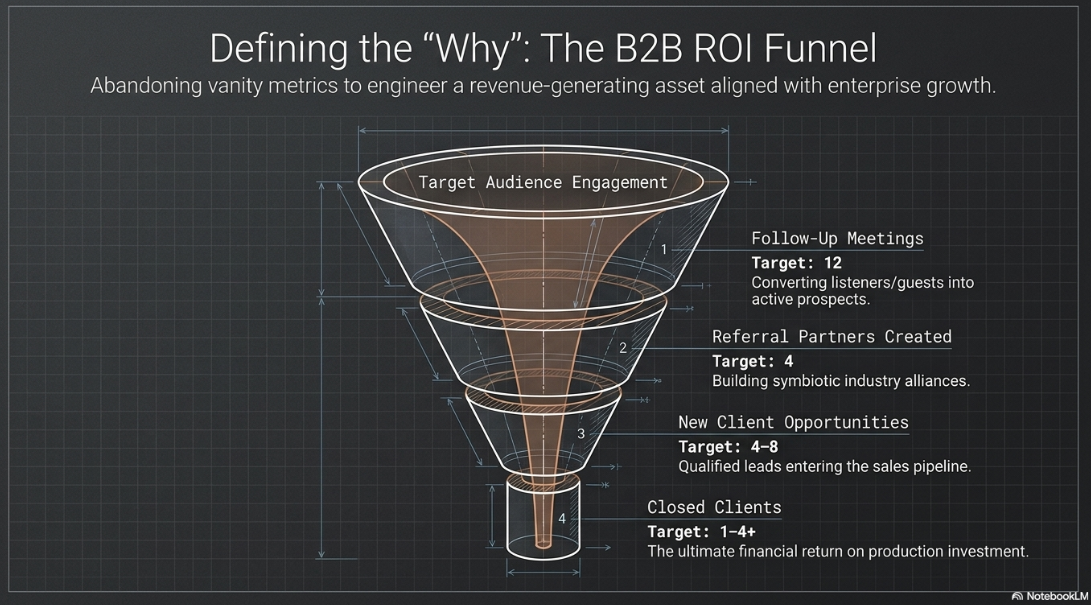
For corporate and B2B (business-to-business) productions, defining success requires moving beyond vanity metrics such as raw download numbers or chart rankings. A robust B2B podcast marketing strategy necessitates setting annual targets for tangible, revenue-generating business outcomes. Modern executives and thought leaders increasingly utilize podcasts to align their personal brand with their corporate brand, establishing an authoritative voice that directly supports enterprise growth, wins enterprise clients, and attracts institutional investors5.
To effectively measure the ROI of a B2B podcast, production teams should track specific business development metrics over an annual cycle.
Setting SMART goals—Specific, Measurable, Attainable, Realistic, and Time-based—ensures that the production team has clear objectives to aim for, which is crucial for sustaining the production over the long term and preventing creator burnout1.
Concept Validation and the Idea Bank
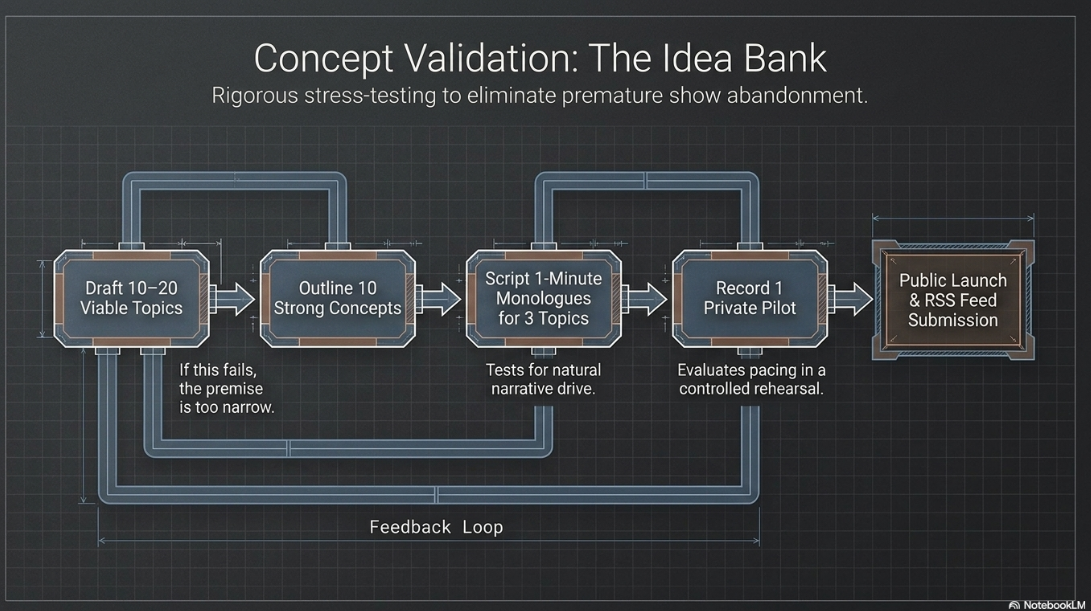
To rigorously validate the show's concept before committing capital to a public launch, producers should employ an "idea bank" methodology. This stress-testing exercise requires the creative team to draft 10 to 20 viable episode ideas and fully outline the strongest ten3. If reaching ten solid concepts proves difficult, or if the topics feel stretched, the underlying premise is likely too narrow or poorly defined, indicating a high risk of "podfade" (premature abandonment of the show)3.
Furthermore, testing the concept by writing a one-minute opening monologue for three different topics can instantly reveal if the show's premise sounds forced, unnatural, or lacks narrative drive3. Producing a "private pilot"—an unreleased rehearsal episode recorded in a controlled environment—allows the production team to critically evaluate pacing, eliminate redundant segments, and refine the audio branding before committing to a public launch and submitting the RSS feed to major hosting platforms1.
Format Design and Content Structuring
Once the audience and objectives are established, the structural framework of the show must be architected. This involves determining the host configuration (solo, co-hosted, or panel), the release cadence, and the optimal episode length7.
Calibrating Episode Length and Cadence
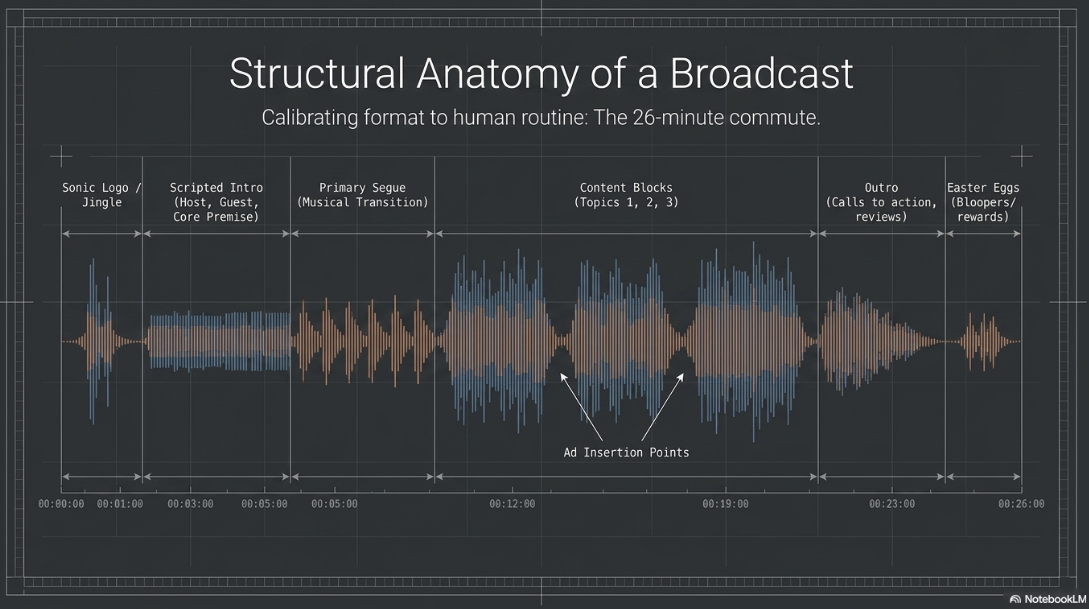
Episode length should ideally be reverse-engineered from the target audience's daily routines and listening habits. For instance, if demographic analytics suggest the primary audience listens during a morning commute, episodes should generally not exceed the average commute time of 26 minutes to prevent listener abandonment mid-episode4. Industry data compiled by podcast analytics platforms suggests specific length recommendations correlated with release cadence. Daily podcasts are most effective when kept brief, typically between 1 and 15 minutes7. Weekly podcasts offer more narrative breathing room and generally run between 15 and 60 minutes, while bi-weekly and monthly shows can successfully sustain listener attention for 60 to 90 minutes, provided the content density remains high7.
The Structural Backbone: Scripting vs. Outlining
Consistency in episode structure provides the production with a distinct identity, helps develop the audio brand, and sets clear expectations for the listener7. While fully scripted podcasts exist—primarily in the narrative audio-drama, true crime, or historical documentary genres—most interview and discussion-based shows operate on a hybrid model or an outline system1.
A standard episode outline relies on a series of carefully researched "talking points" rather than a verbatim script. This methodology preserves the charm, authenticity, and spontaneity of the host while ensuring the conversation remains focused and adheres to the established time constraints1. To maintain listener retention over longer durations, episodes are frequently broken into distinct, recognizable segments, such as topical news reviews, listener feedback sections, or rapid-fire Q&A rounds7.
A professional podcast outline generally adheres to the following chronological structure, which can be templated for consistency across a series: First, the episode opens with a sonic logo or a brief musical jingle to establish immediate brand recognition1. This is immediately followed by the introduction, which operates as a scripted, monologue-style tag introducing the host, the guest, and the core topic of the episode1. Crucially, this introduction should also include a brief, standardized description of the show's overarching premise to orient new listeners who may be discovering the program for the first time1.
Following the introduction, a primary segue—achieved via a musical transition, sound effect, or vocal bridge—leads the listener into the core content blocks1. These content blocks (representing Topics 1, 2, and 3) are time-stamped segments where specific issues are discussed for a predetermined number of minutes, separated by secondary segues to maintain narrative momentum1.
Within this structure, production teams designate specific points for ad insertion, allowing for sponsor messages to be either pre-recorded and inserted during post-production or delivered dynamically by the host in a conversational style1. Finally, the episode concludes with closing remarks (the outro). The outro serves multiple strategic functions: thanking the audience and guests, delivering clear calls to action (such as requesting platform reviews or directing listeners to social media channels), and teasing future episodes1. Strategic productions also utilize the outro to plant "Easter eggs," such as bloopers or special promotional offers, rewarding highly engaged listeners who complete the entire episode7.
Strategic Episode Titling
The titling of individual episodes requires acute strategic intent, balancing search engine optimization (SEO) with human curiosity. Titles must immediately spark interest while clearly communicating the core topic, avoiding overly vague or esoteric phrasing that fails to set proper expectations1. Utilizing news headline-style formats often yields high click-through rates, and for interview-based shows, placing the guest's name at the very end of the title is a proven tactic to maximize visual impact and enhance credibility on digital podcast platforms1.
Guest Acquisition and Pre-Interview Workflows
For interview-format productions, the process of securing, vetting, and preparing guests is a critical pre-production workflow that directly impacts the final audio quality. Initial research is paramount to ensure the guest aligns with the show's specific goals and possesses the capability to provide valuable, actionable insights to the target audience4.
Outreach remains most effective via personalized email rather than automated direct messaging4. The outreach strategy hinges on crafting compelling subject lines that incentivize the recipient to open the message, followed by personalized pitches that clearly outline the mutual benefits of the appearance4. To minimize friction, the pitch should make it exceptionally easy for the guest to respond, ideally requiring only a simple affirmative or negative reply rather than a detailed logistical response during the initial contact4. Because high-value guests are frequently inundated with media requests, persistent and professional follow-up is mandatory4.
To streamline the booking process and elevate the perceived professionalism of the podcast, production teams frequently utilize a "one-pager." This digital press kit operates as a highly condensed marketing document containing the show’s listenership statistics, demographic data, website performance metrics, and social media reach1. The one-pager serves to sell the platform to high-profile guests, proving that their time investment will yield a tangible return in audience exposure1.
Once a guest is secured, rigorous pre-interview preparation is required. Guests must be thoroughly briefed on microphone technique, speaking cadence, and camera framing (if the production utilizes video) to ensure the technical quality of the recording is not compromised by user error2. During the recording session, the host must execute advanced interview techniques, including active listening, building immediate rapport, utilizing open-ended follow-up questions, and asking for clarification on complex topics to ensure the audience is never left behind1.
Acoustic Science: Demystifying Isolation and Treatment
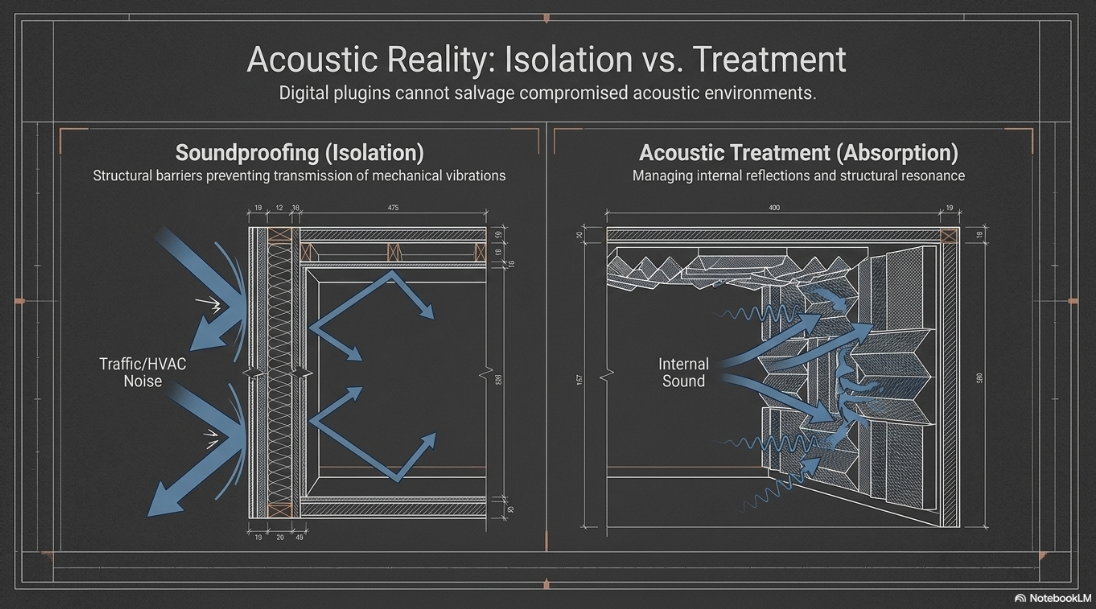
With the strategic framework and content strategy established, the physical environment required to capture broadcast-quality audio must be rigorously evaluated. The acoustic integrity of a recording space is a non-negotiable parameter; digital software, noise-gate plugins, and post-production equalization cannot fully salvage audio that has been recorded in a compromised, highly reflective, or noisy environment. To understand studio selection, one must first delineate between two distinct acoustic engineering principles that are frequently conflated by laypersons and amateur producers: soundproofing (isolation) and acoustic treatment (absorption and diffusion)8.
The Mechanics of Soundproofing (Isolation)
Soundproofing is the engineering of physical structural barriers designed to prevent the transmission of sound energy between separate spaces9. Its primary function is twofold: it prevents external environmental noise (such as street traffic, HVAC mechanical systems, or adjacent office conversations) from infiltrating the recording environment, while simultaneously preventing internal studio sound from leaking into neighboring areas9. Isolation is strictly a construction-led endeavor relying on physical structural modifications.
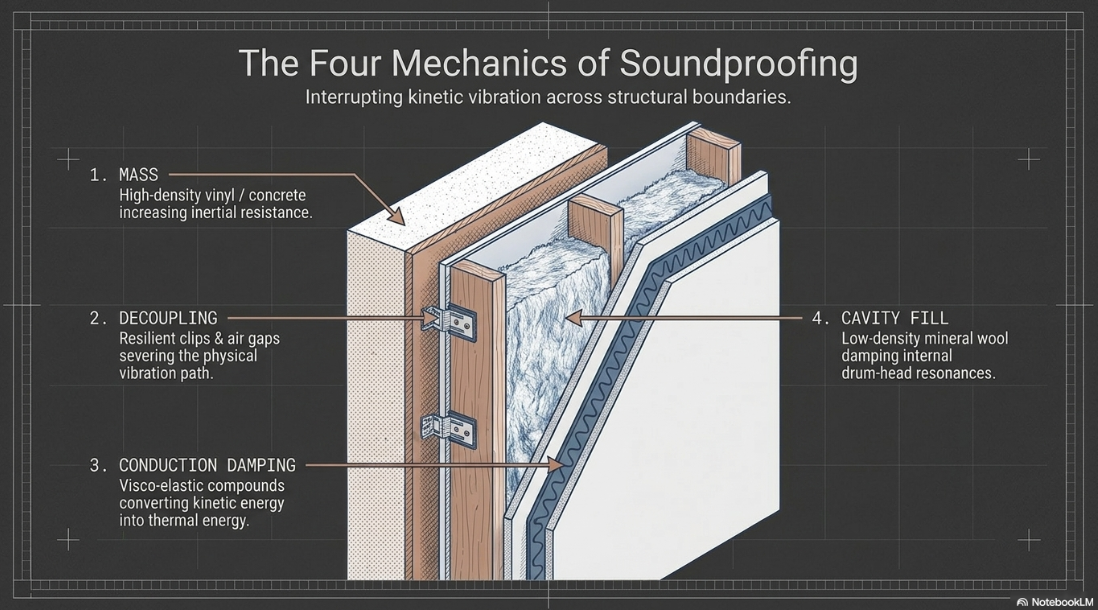
Sound is fundamentally a mechanical vibration traveling through mediums such as air, wood, concrete, and steel. Effective soundproofing requires interrupting these vibrations as they attempt to pass through structural boundaries9. Professional noise reduction relies on four fundamental mechanical principles to achieve this interruption.
First, isolation requires Mass. This involves utilizing heavy, highly dense materials such as mass-loaded vinyl (MLV), solid concrete blocks, or multiple layers of type-X gypsum board10. High mass increases the inertial resistance of the barrier; the heavier the wall, the more acoustic energy is required to force it into vibration10.
Second, and perhaps most importantly, true isolation requires Decoupling. Decoupling creates physical mechanical breaks in the construction pathway to prevent structural vibrations from conducting across adjacent surfaces10. In standard construction, sound hits drywall, vibrates the wooden stud, and vibrates the drywall on the other side. Decoupling severs this path using resilient isolation clips, hat channels, or by constructing completely independent double-stud walls separated by an isolated air gap10. The ultimate architectural expression of decoupling is the "room-within-a-room" or floating room topology, where the inner studio shell (walls, floor, and ceiling) has absolutely no rigid physical contact with the outer building structure11.
Third, modern isolation employs Conduction Damping. This involves applying specialized visco-elastic damping compounds (such as Green Glue) between rigid layers of mass (e.g., between two sheets of drywall). These compounds act as a mechanical shear layer, converting the kinetic vibrational energy traveling through the drywall into microscopic amounts of thermal energy, thereby dissipating the sound wave before it can transmit10.
Finally, isolation systems utilize Absorption Cavity Fill. This requires filling the internal air gaps of decoupled walls with low-density mineral wool or fiberglass insulation. This insulation serves to damp internal cavity resonances and prevents the "drum-head" resonance effect that can inadvertently amplify specific low frequencies trapped within the wall cavity10.
Evaluating Isolation: STC Ratings and Real-World Limitations
The architectural standard for measuring isolation is the Sound Transmission Class (STC), a single-number integer rating quantifying how efficiently a building partition attenuates airborne sound10. The STC scale provides a useful, albeit flawed, baseline for comparing structural barriers.
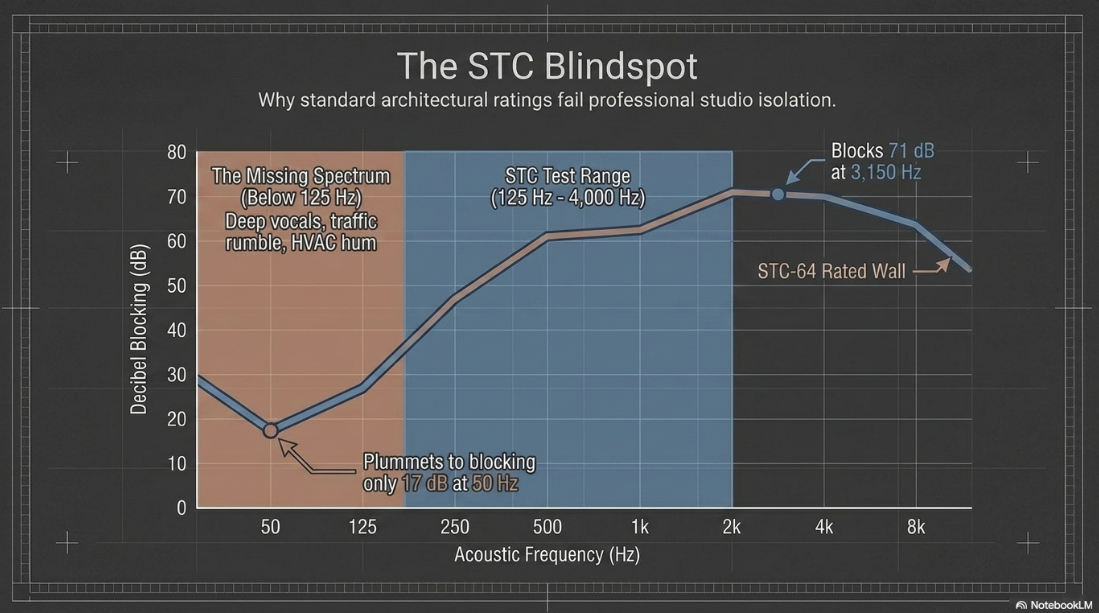
While STC is widely used by architects, it possesses a critical flaw in the realm of acoustic engineering: the rating is calculated solely using frequency data between 125 Hz and 4,000 Hz, heavily weighting the human mid-frequency vocal range12. The STC rating contains absolutely zero data regarding a partition's ability to block frequencies below 125 Hz13. This missing spectrum includes the most problematic studio noises: deep male vocals, subwoofers, heavy traffic rumble, and HVAC mechanical hum13.
Acoustic laboratory testing reveals the severity of this limitation. A heavily decoupled wall utilizing isolation clips may achieve a highly impressive rating of STC 6413. At 3,150 Hz, this wall blocks an extraordinary 71 decibels of sound13. However, at 80 Hz, it only blocks 36 dB, and at 50 Hz—sitting in the resonance valley common to double-leaf walls—it blocks a mere 17 dB13. This represents a staggering 47-point performance gap between the marketing number on the spec sheet and the wall's actual measured performance against low-frequency bass energy13. Consequently, professional studio designers never design low-frequency-sensitive rooms based on STC ratings, relying instead on full-spectrum transmission loss data and physics13.
The Mechanics of Acoustic Treatment
Once external noise is successfully barred via soundproofing, the studio's internal acoustic reflections must be managed. This is the domain of acoustic treatment. Without treatment, even a perfectly isolated room will produce recordings colored by severe room resonances, flutter echoes, and extended reverberation12. The primary metric utilized here is the Noise Reduction Coefficient (NRC), which rates a material's ability to absorb sound within a space on a scale from 0 (perfect reflection, like glass) to 1.0 (perfect absorption, like an open window)11. Professional recording studios typically utilize materials such as high-density fiberglass panels or specialized acoustic foam boasting NRC values between 0.75 and 1.0011.
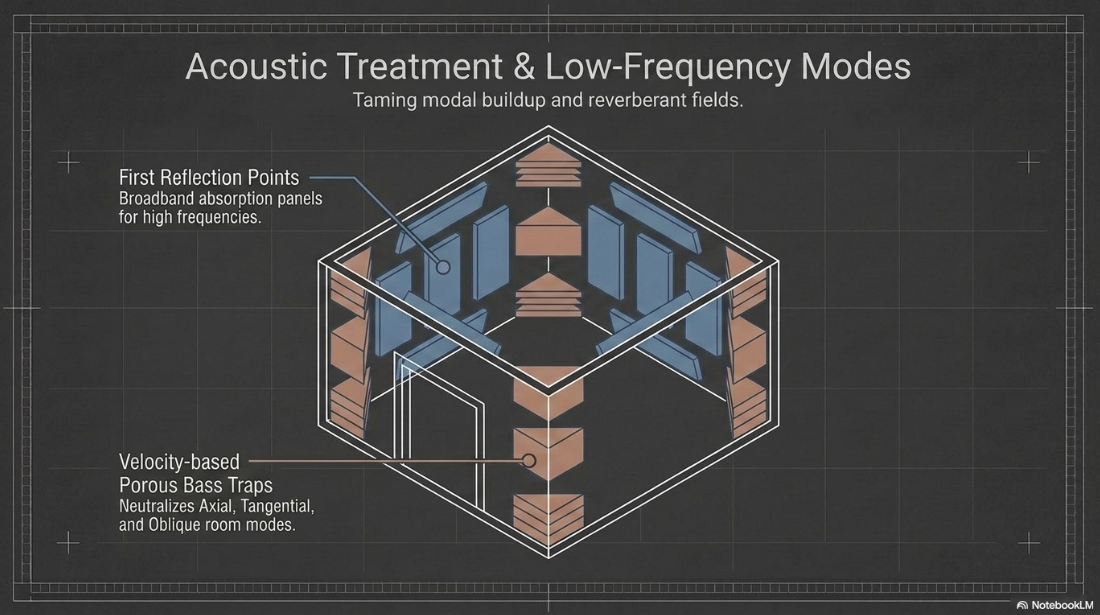
A properly treated podcast studio aims to achieve an RT60 (the time it takes for a sound to decay by 60 decibels) of roughly 0.3 to 0.5 seconds, providing a tight, controlled, and dry vocal recording12. To achieve this, broadband absorption panels are placed at "first reflection points"—the specific locations on the side walls, ceiling, and floor where sound waves from the speakers or human voice bounce exactly once before reaching the microphone or listener's ears12.
More challenging than high-frequency reflection is the management of low-frequency modal buildup. Low frequencies possess massive wavelengths that pass through standard walls with little attenuation, yet they accumulate densely in the structural boundaries and corners of a room12. These room modes manifest in three distinct topological forms: First, Axial Modes bounce relentlessly between two opposing parallel surfaces (e.g., front-to-back or side-to-side). These contain the highest concentration of acoustic energy and cause the most severe frequency distortions10. Second, Tangential Modes loop around the perimeter of the room, involving four reflecting surfaces and carrying roughly half the energy of axial modes10. Third, Oblique Modes involve all six surfaces of the room, possessing the lowest energy but contributing heavily to a muddy overall reverberant field10.
Because acoustic pressure is twice the room average where two walls meet, and up to eight times the room average in the tri-corners (where two walls intersect with the ceiling or floor), studios must deploy velocity-based porous bass traps in these zones10. These traps, often constructed of thick, triangular stacks of mineral wool or fiberglass, operate by capturing air molecules at their maximum velocity as they attempt to move away from the rigid corner boundary, thereby smoothing out the room's low-frequency response10.
HVAC and Mechanical Infrastructure
A fundamental paradox of studio design is that a completely sealed, soundproofed room quickly becomes uninhabitable without constant air exchange, yet standard residential or commercial ventilation systems introduce severe mechanical noise and act as direct flanking paths for sound leakage11. Professional studio designs resolve this by mandating specialized, independent HVAC systems11.
These systems require oversized, low-velocity ductwork designed to minimize the audible hiss of air turbulence11. Flexible connections are utilized between the ducts and the mechanical equipment to prevent motor vibrations from transferring into the studio's structural frame11. Furthermore, inline attenuators (silencers) and acoustically lined plenum chambers are strategically installed to absorb mechanical noise before the air enters the room11. Without these substantial infrastructure investments, the studio's Noise Criterion (NC) rating will be severely compromised by ambient mechanical hum, rendering the space unsuitable for professional broadcast recording.
Broadcast Engineering and Equipment Standards
With the acoustic environment optimized, the hardware utilized to capture, process, and route the audio signal determines the ultimate fidelity of the podcast. A professional setup must move beyond consumer-grade USB devices, utilizing discrete, broadcast-grade components that offer redundancy, superior signal-to-noise ratios, and advanced routing capabilities.
Core Audio Hardware
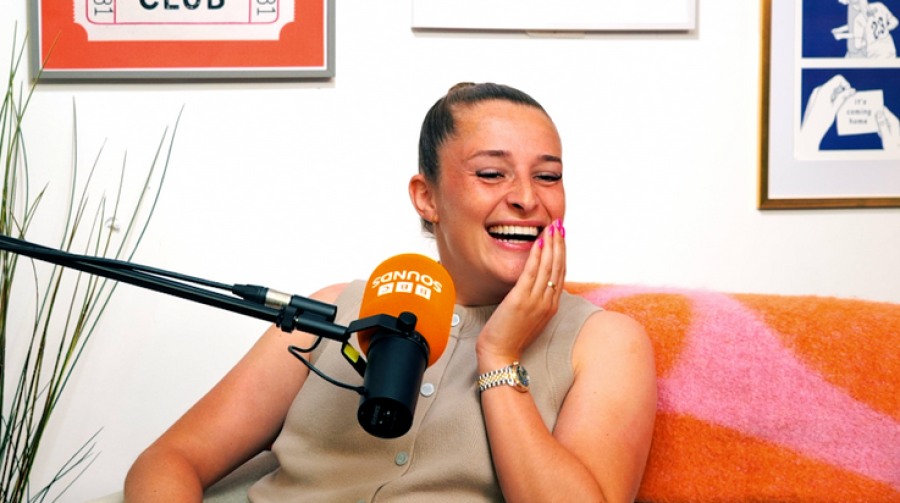
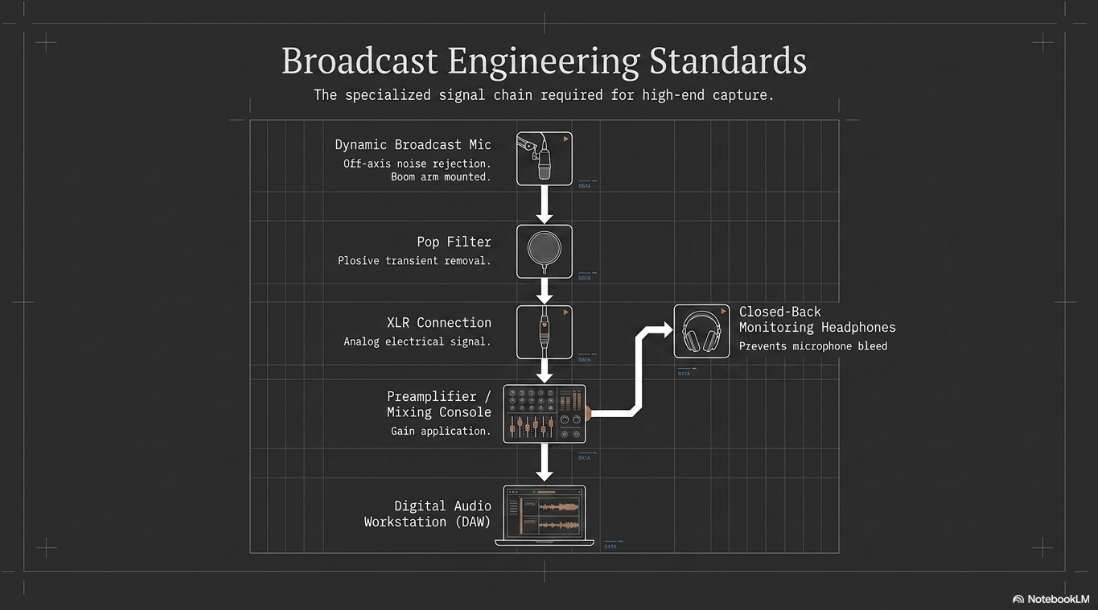
The standard signal chain for high-end podcasting requires a specific array of specialized elements. Dynamic broadcast microphones are the industry standard due to their excellent off-axis noise rejection and their ability to capture rich, proximity-effect vocal tones even in imperfectly treated rooms4. Prominent models utilized universally across high-end studios include the Shure SM7B, the updated Shure SM7db, the Neumann TLM 103, the Earthworks Ethos, and the RØDE Procaster16.
These microphones must be paired with pop filters to eliminate plosive transients—sharp bursts of low-frequency air resulting from hard consonants like "p" and "b"4. Microphones are mounted on static boom arms or heavy desk stands; holding a microphone in the hand introduces severe handling noise that is nearly impossible to remove in post-production4.
Because professional dynamic microphones utilize XLR connections and require substantial gain, they must feed into dedicated preamplifiers housed within an audio interface or a mixing console4. The interface converts the analog electrical signal into a digital format for processing within a Digital Audio Workstation (DAW)4. During recording, closed-back monitoring headphones (such as the KRK 6400 or AKG models) are required for all participants. These allow the hosts to hear the mix in real-time without the audio bleeding from the headphones back into the sensitive microphones, which would create phase cancellation or feedback loops4.
The Engineering Complexity of the "Mix-Minus"
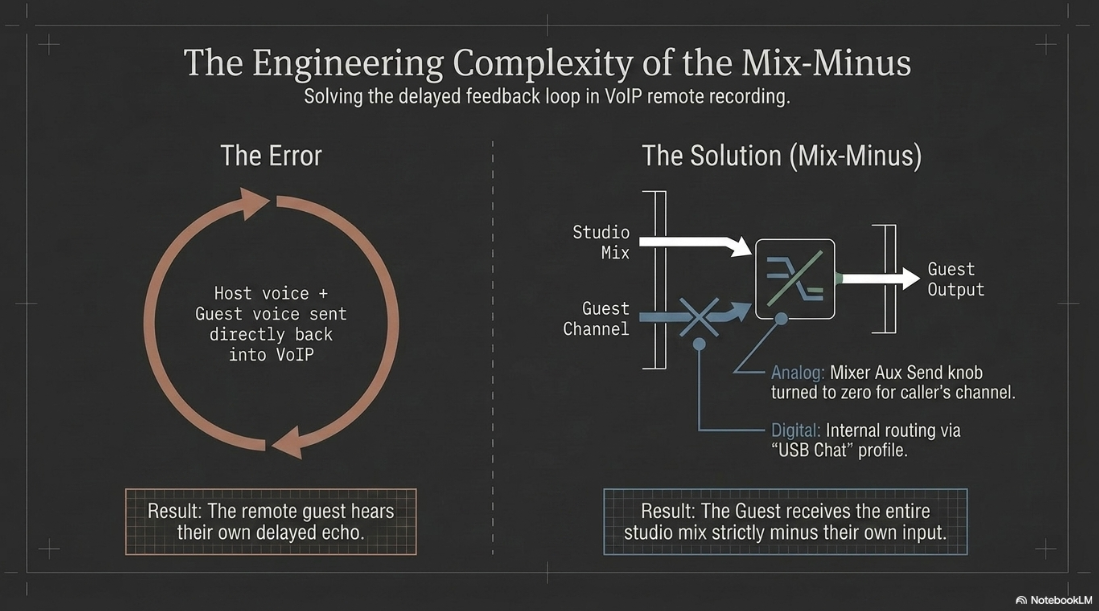
One of the most profound technical challenges in podcast production is seamlessly integrating remote guests via VoIP software (e.g., Skype, Zoom, Riverside) alongside local studio hosts. If the audio from a remote caller is simply piped into the main studio mixer so the local host can hear them in their headphones, a critical error occurs: when the engineer sends the entire master mix back out to the VoIP software, the remote caller receives a feed containing their own voice returned to them on a slight digital delay21. This delayed feedback loop renders it nearly impossible for the remote guest to speak coherently.
The engineering solution to this phenomenon is the Mix-Minus. A mix-minus configuration allows the remote caller to hear the entire studio mix (the local hosts, soundboard effects, and any other remote guests) minus their own microphone input21.
Analog Mix-Minus Execution
In a traditional analog mixing console (such as the Soundcraft Signature series or Yamaha MG series), executing a mix-minus relies on manipulating the Auxiliary (Aux), FX, or Monitor send buses22. The local host's microphone is plugged into a primary channel, such as Channel 1. The remote guest's incoming audio from the studio computer is routed into a separate channel on the mixer, such as Channel 3. On the mixing board, the Aux send knobs dictate precisely what audio is sent out of a dedicated Aux Output jack. The audio engineer turns up the Aux knob on the host's channel (Channel 1), but ensures the Aux knob on the caller's channel (Channel 3) is turned completely down to zero22.
A specific physical cable is then required—often a Hosa CMP-105—which features a 1/4-inch mono plug on one end and a 1/8-inch TRS plug on the other22. This cable takes the mono audio from the mixer's Aux Output and feeds it into the computer's microphone input, splitting the mono signal to hit both the left and right inputs of the computer's soundcard22. This ensures the VoIP software, which typically only looks at the left channel for input, receives the host's voice clearly, avoiding phase or drop-out issues caused by cheap, poorly wired computer soundcards22.
Digital Mix-Minus Architecture
Modern digital podcast consoles, most notably the RØDECaster Pro II, have revolutionized this process by handling mix-minus routing internally via complex software matrices21. The RØDECaster Pro II utilizes an advanced USB architecture featuring three distinct audio devices accessible via two physical USB-C ports: 'USB Main', 'USB Chat', and 'USB Secondary'23.
To execute a mix-minus on this digital device, the primary recording computer running the DAW is connected to USB 1. A secondary device (or communication app on the same computer) utilizes the 'USB Chat' profile. This specific profile is heavily optimized for VoIP applications and inherently handles mix-minus processing without the need for auxiliary routing cables23. For highly complex routing involving dual computers (one dedicated solely to recording, one dedicated solely to communications), the engineer accesses the digital routing matrix on the device21. By default, the output sent to the computer is the 'Main Mix'21. The engineer simply selects the USB output dedicated to the chat application and switches the routing parameter from 'Main Mix' to 'Mix Minus', or creates a 'Custom Routing Mix' to individually toggle specific channels on or off for that precise digital output21.
Despite the efficiency of digital routing and software-in-the-box (ITB) mixing, many professional studios still feature massive, large-format analog mixing consoles. Beyond providing tactile control and immediate visual feedback of channel status, these large boards serve a critical psychological function known as the "client effect"25. Corporate clients paying premium hourly rates of $300 or more expect to walk into a facility that looks like a traditional broadcast studio; an imposing mixing board with flying faders establishes immediate visual authority and trust in the facility's professionalism, even if the actual audio routing is handled digitally25.
Visual Podcasting and Multi-Camera Integration
The rapid integration of video into the podcasting medium has fundamentally transformed studio hardware requirements. Traditional audio-only booths are rapidly being supplanted by sprawling, highly stylized audiovisual spaces designed to generate content for visual platforms like YouTube, TikTok, and Spotify Video.
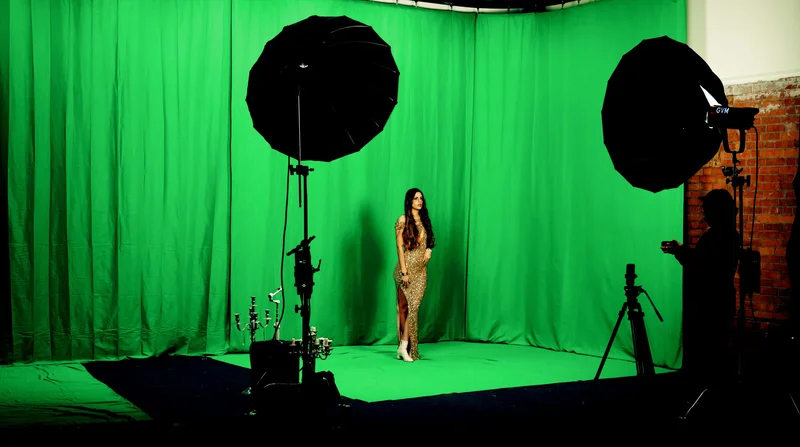
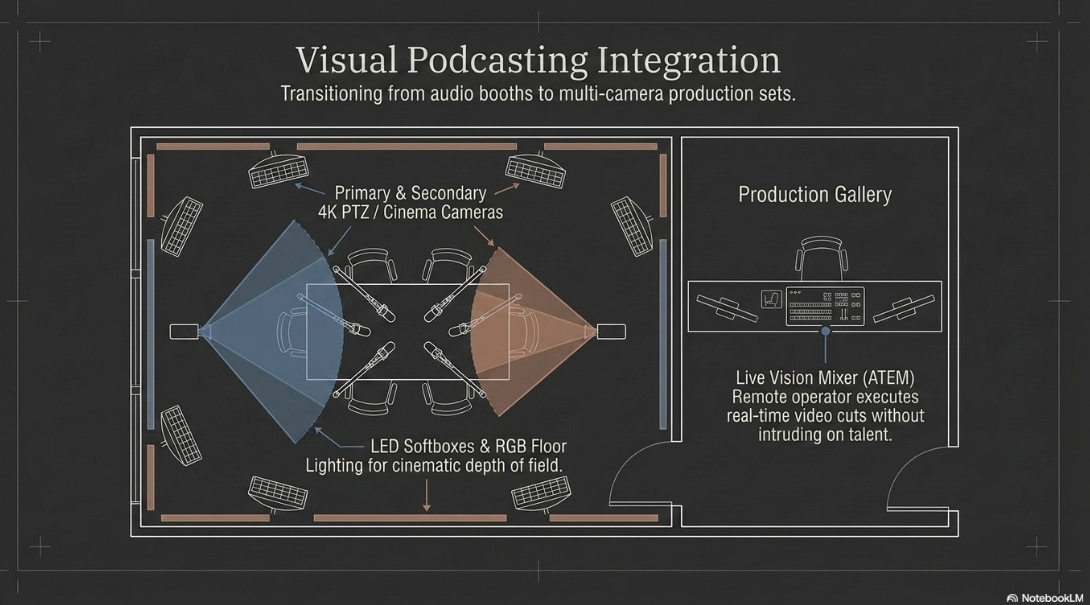
Professional video podcasting strictly avoids basic webcams in favor of cinema-line cameras or broadcast PTZ (Pan-Tilt-Zoom) rigs. Standard configurations across high-end London studios now include multi-angle setups utilizing cameras such as the Sony FX30, Sony A7IV, or Blackmagic Pocket Cinema 6K15. True broadcast-level facilities often deploy arrays of Panasonic 4K PTZ cameras (such as the UE150), which allow a single operator to remotely control framing, pan, tilt, and focus from a completely separate production gallery without intruding on the talent in the recording room27.
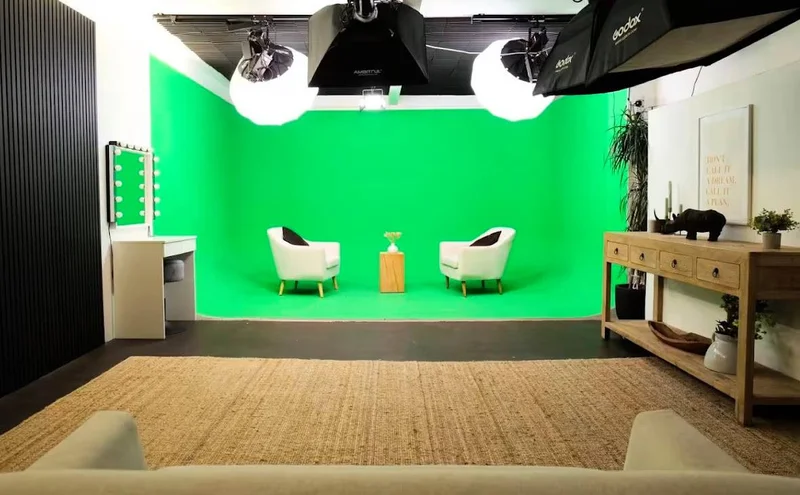
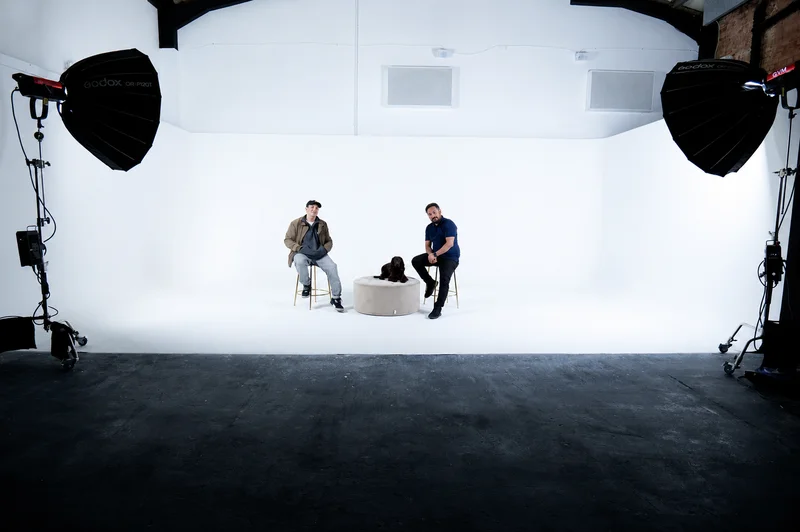
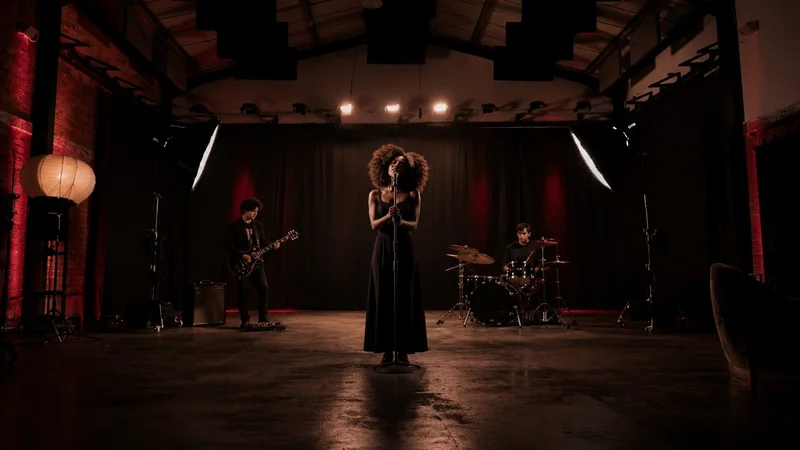
These sophisticated visual setups require integrated lighting grids featuring professional LED softboxes and customizable RGB floor lighting to achieve a cinematic depth of field17. Furthermore, visual studios utilize live hardware vision mixers, such as the ATEM Mini Extreme ISO17. A live vision mixer allows the studio engineer—or occasionally the host themselves—to cut seamlessly between the various camera angles in real-time. This live-switching workflow drastically reduces post-production video editing requirements, provides an immediate draft edit upon the session's conclusion, and facilitates flawless live streaming directly to external platforms17.
Comprehensive Market Analysis of Studio Hire Providers
Selecting the appropriate facility requires balancing geographic convenience, technical specifications, acoustic isolation guarantees, and stringent budgetary constraints. A deep analysis of the London studio market—one of the most dense and mature podcast production hubs globally—reveals a highly segmented industry comprising three distinct tiers of service providers: Budget/Self-Service, Mid-Range/Flexible, and Premium/Broadcast Concierge29.
Tier 1: Budget and Self-Service Studios
These facilities primarily target hobbyists, independent creators, and early-stage startups. They provide acoustically treated environments and functional, name-brand equipment, but they rely entirely on the user's technical competence to operate the gear, troubleshoot issues, and manage file transfers.
London Podcast Studios (Whitechapel): Offers highly competitive a la carte pricing starting from £69 per hour for basic audio and video capabilities17. For frequent independent creators, they offer a subscription model at £199/month, providing 6 hours of recording time alongside mentoring, technical support, and community events17.
PodShop Studios (Liverpool Street): Operating near the financial district, this is a highly functional self-service operation where basic audio recording starts at just £50/hour (+VAT), boasting weekend off-peak discounts of up to 25% to maximize studio utilization17. Audio and video options are available from £100 to £108/hour, with professional technical support available only as a paid optional add-on29.
Nostars Studios (Wood Green): Representing the extreme budget tier of the market, this facility offers basic podcast rooms at an incredibly low £30/hour, which notably includes complimentary basic filming—an outlier value proposition for creators with severe budget restrictions29.
Tier 2: Mid-Range and Flexible Studios
This tier represents the "sweet spot" for corporate communications, brand marketing teams, and serious career podcasters. These studios provide high-end cinema cameras, automated video switching, aesthetically pleasing set design, and the critical option to either operate the studio self-serve or hire a dedicated on-site engineer.
Outset Studio (Locations in London Bridge and Shoreditch/Hoxton) Outset has aggressively captured the mid-market by operating on a highly transparent, modular pricing structure with zero hidden equipment surcharges31. Their facilities are explicitly designed for users with zero technical experience, providing a mandatory, comprehensive setup walkthrough covering mic technique, camera framing, and software operation upon arrival15.
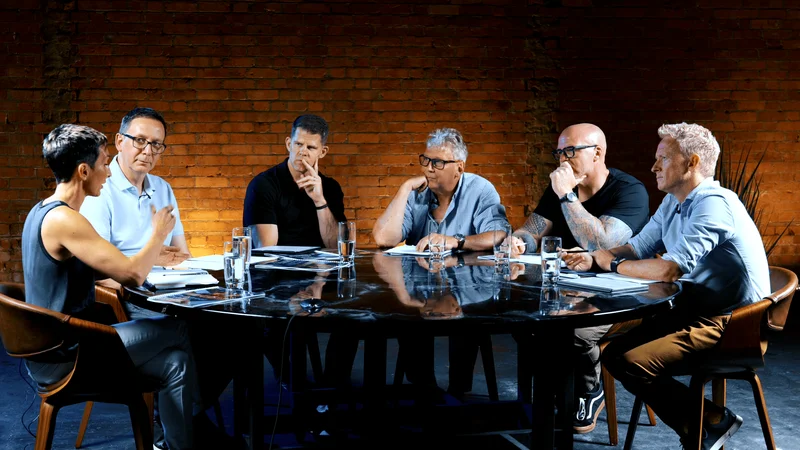
Facilities: The Shoreditch location is a boutique 420 sq ft space designed for smaller creative teams and branded content, featuring step-free access15. The central London Bridge location features Studio B (500 sq ft, calibrated for focused 4-person panels) and the flagship Studio A (750 sq ft)15. Studio A is one of the largest dedicated podcast spaces in London, featuring a separate production booth, live vision mixing, and accommodating up to 12 people for large panel discussions15.
Equipment: Broadcast microphones (up to 4 per standard session), full acoustic treatment, multitrack recording interfaces, and multiple Sony FX30 4K cameras paired with professional LED film lighting rigs15.
Outset's modular model allows clients to construct their ideal production team a la carte, offering sound engineers at £24/hr, videographers at £48/hr, teleprompters at £60/session, or discreet lapel lavalier microphones for a cleaner visual aesthetic at £12/mic15.
Premiere Podcast Studios (Shoreditch) Located in East London, Premiere targets the B2B, agency, and regular podcaster market by prioritizing a high-touch "concierge service" approach29. Unlike many mid-tier competitors where technical help is an add-on, Premiere's standard pricing includes an on-site engineer present for the entire duration of the recording, mitigating all technical risk for the client18.
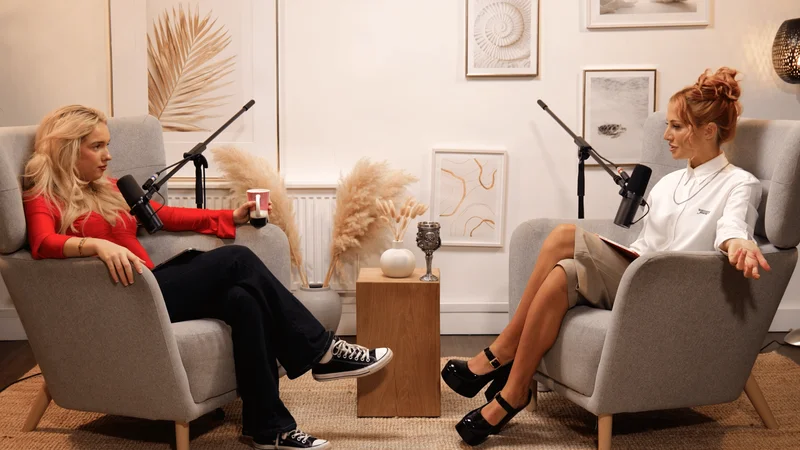
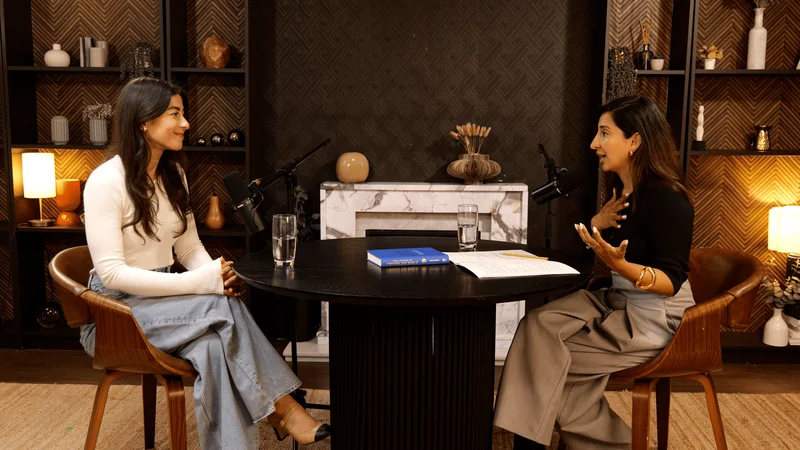
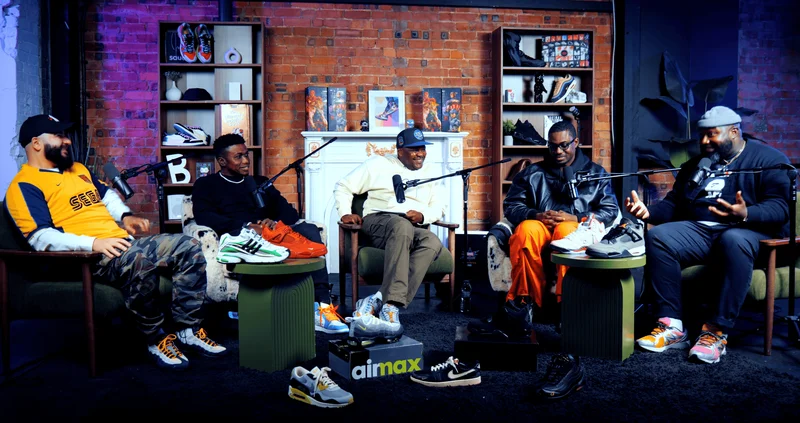
Facilities: Features distinct visual aesthetics, including intimate 'Fireside' setups for casual interviews and professional 'Desk' setups for traditional news-style broadcasts30.
Equipment: A formidable array including Shure SM7B/SM7db microphones, RØDECaster Pro II or Universal Audio Apollo X8 interfaces, and an impressive multi-camera rig of up to four Sony FX30 or A7IV 4K cameras with premium G-Master lenses18.
Premiere further incentivizes corporate clients with block-booking discounts (reducing the rate to £105/hr for audio-only sessions exceeding four hours) and offers extensive in-house post-production editing services, ranging from basic audio edits at £90/hr to signature multi-camera video edits at £600/hr18.
Tier 3: Premium and Broadcast-Grade Studios
The top echelon of the market is reserved for celebrity-hosted properties, major terrestrial broadcast networks, and heavily funded corporate entities. These spaces operate far more like traditional television galleries or high-end music recording studios than typical podcast booths.
Spiritland Studios (King's Cross) Spiritland provides a peerless audiophile environment, operating out of a facility that doubles as a high-end café and bar featuring a world-class Living Voice sound system36. The production suite is a fully functioning radio studio custom-built for highly visual podcasts, live radio shows, and complex content creation27.
Equipment: The technical specifications rival major networks, featuring a Dante networked system capable of routing 16 channels of audio, Studer broadcast consoles, three Panasonic 4K PTZ cameras, redundant Hyperdeck 12G backup recorders, and a 2ME UHD video switcher for live line-cutting and graphical overlays27. It seamlessly supports remote high-fidelity guest integration via Riverside and physical ISDN lines19.
Pricing: Due to the elite broadcast nature of the facility, pricing operates strictly on session blocks rather than hourly rates. Studio 3 starts at £300 for a 3-hour minimum; Studio 2 at £600 for a 3-hour minimum; and the flagship Studio 1 commands £900 to £1,250 per session19.
TYX Studios (Tileyard, King's Cross) Situated within a major creative hub, TYX offers a hybrid model that combines high-end broadcast capabilities with community-focused memberships.
Facilities: Features heavily acoustically treated rooms with 4K multi-camera capture. High-end sessions include on-site engineers, video editors, social-clip producers, and luxury perks such as a complimentary car service from King's Cross Station for high-profile clients and guests3.
Pricing: Standard ad-hoc bookings range from £100 to £170 per hour (plus VAT) with a strict two-hour minimum29. However, they offer a highly disruptive and attractive membership model: for £300/month (billed annually), members receive virtually unlimited studio time (subject to fair use policies such as 4-hour block maximums and advance booking limits). For high-volume producers releasing weekly content, this model drastically reduces the effective hourly rate19.
International Context: The Corporate Ecosystem in Dubai
While London represents a densely populated, fiercely competitive market catering heavily to independents and mid-size agencies, emerging global business hubs display a markedly different operational model. In regions like Dubai and Abu Dhabi, agencies such as Poddster offer deep corporate integration, operating 16 fully equipped studios across the UAE and Singapore38.
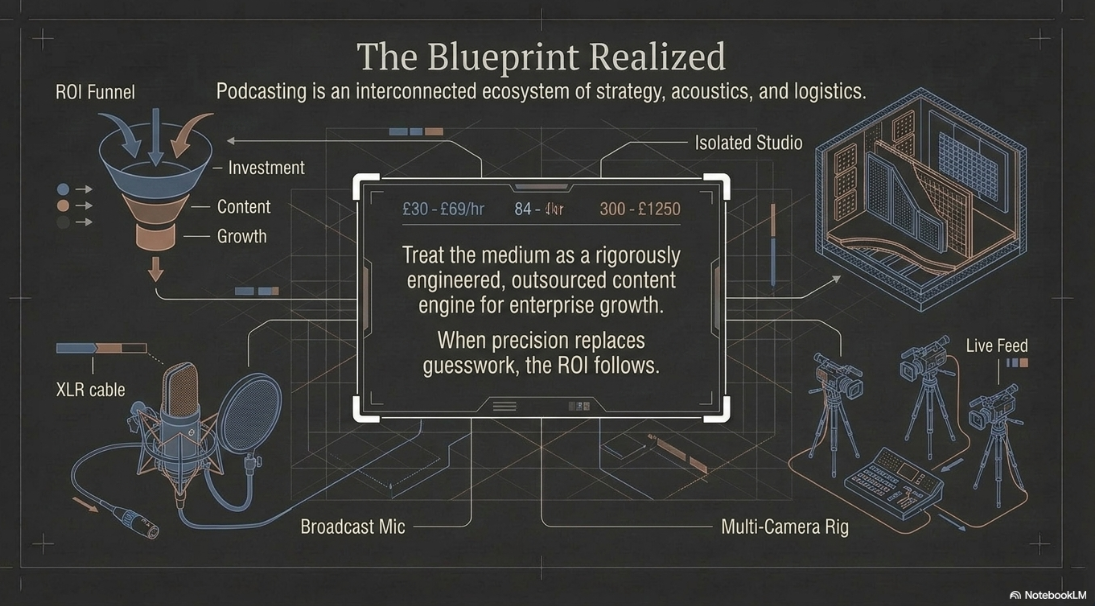
Rather than functioning merely as hourly rental spaces (which typically range from 300 to 490 AED/hour in the region), these studios operate as full-service personal branding agencies38. They combine strategic front-end consulting, end-to-end studio production with dedicated operators, and long-term post-production asset generation designed specifically to boost executive visibility on platforms like LinkedIn and YouTube5. This reflects a broader global trend of enterprise clients treating podcast facilities not merely as acoustic spaces to rent, but as outsourced content generation engines vital to corporate reputation management.
Contractual Logistics and Risk Mitigation
Securing premium studio time involves navigating legally binding service agreements that carry substantial financial implications. Studio booking contracts dictate financial liabilities, intellectual property handoffs, equipment damage protocols, and behavioral compliance. Production teams must meticulously review the fine print regarding cancellation matrices, data transfer fees, and force majeure clauses to avoid unexpected financial penalties that can derail a production budget.
Cancellation and Rescheduling Matrices
Studio time represents highly perishable inventory; a vacant studio hour cannot be warehoused and resold once the clock has ticked past it. Consequently, professional studios enforce strict cancellation matrices to protect their revenue streams. Generally, a facility will only seek to recover the exact amount it stands to lose, and these policies scale in severity based on the proximity of the cancellation to the scheduled session40.
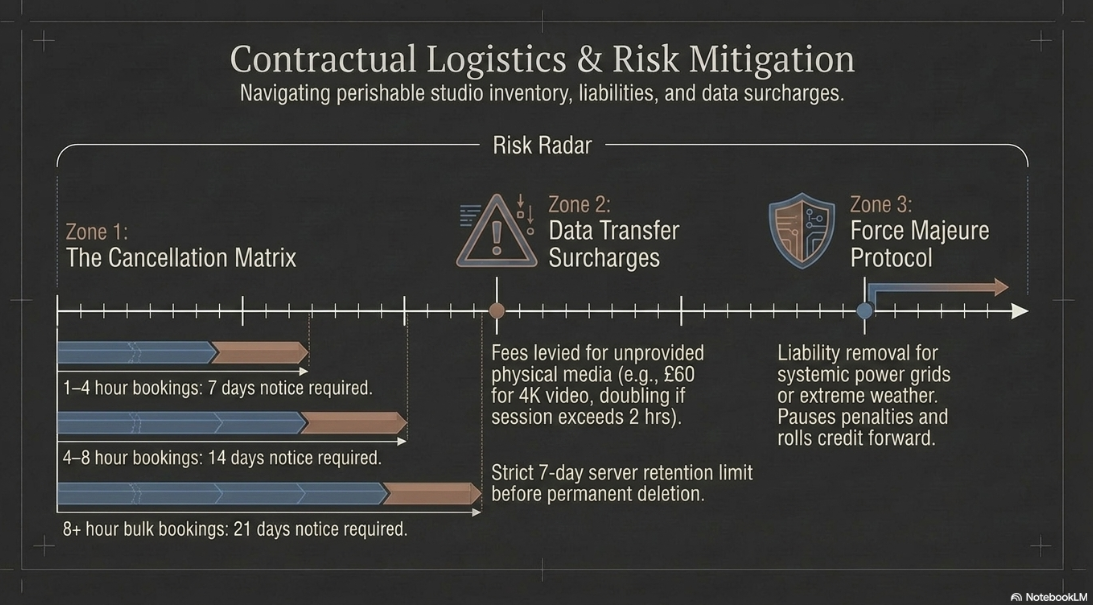
A standard tiered policy, such as the one employed by London Podcast Studios, allows for free cancellation or rescheduling within 48 hours of booking, provided it is at least 7 days before the session41. Cancellations that breach this window forfeit the booking fee entirely.
Premiere Podcast Studios utilizes a more complex sliding scale based on the total volume of hours booked. This reflects the operational reality that it is exponentially more difficult for a studio to find a replacement client for an 8-hour block booking than it is for a 1-hour session42:
Furthermore, even when refunds are successfully granted within the allowable cancellation window, premium studios will frequently levy administration charges (ranging from 10% to 15% of the total refund value) to cover unrecoverable credit card transaction fees and administrative labor42.
Force Majeure and Unforeseen Interruptions
To protect both the client and the studio from catastrophic external events, professional studio contracts feature "Force Majeure" clauses. This legal provision removes liability for both parties if contractual obligations cannot be fulfilled due to events strictly beyond reasonable control, such as natural disasters, extreme weather severely disrupting traffic, pandemic-related statutory lockdowns, or systemic power grid failures40.
In these instances, the standard industry protocol is to pause all financial penalties and require the parties to find alternative arrangements to reschedule the booking40. If a force majeure event occurs during a session (for example, a power outage midway through a recording), the studio typically retains the costs incurred up to the point of cancellation (including the pro-rated room rental) but will refund or credit a portion of the remaining balance, allowing the client to reschedule the lost time without penalty44.
Data Management, File Transfers, and Hidden Surcharges
A vital, yet frequently overlooked, component of the contracting phase is understanding data retention and file transfer policies. The raw multitrack WAV audio stems and multiple streams of 4K video files generated during a professional session are massive, often representing hundreds of gigabytes of data per hour.
To expedite turnaround times and minimize their own server overhead, many facilities strongly mandate that clients supply their own high-capacity SD cards or external solid-state drives35. If a client fails to provide physical media, the studio is forced to utilize its own bandwidth and cloud infrastructure to transfer the files.
This incurs a "File Transfer Fee," which is frequently buried in the optional extras or terms and conditions of a booking contract. For example, Premiere Podcast Studios charges £45 to transfer HD video files and £60 to transfer 4K video files for up to two hours of recording. If the recording session exceeds two hours, the sheer volume of data causes the transfer fee to double to £90 (HD) and £120 (4K)35.
Furthermore, data retention is strictly limited to clear server space for subsequent clients. Studios generally only guarantee the local storage of raw files for 7 days post-session; after this extremely narrow window, the files are permanently deleted, and the facility holds no legal or financial liability for the lost data42.
Finally, strict adherence to the clock is ruthlessly enforced. Studio profit margins rely on tight, seamless turnovers between clients. Clients arriving late are still responsible for the full payment of the scheduled time45. Conversely, clients running over their allotted slot are billed incrementally—usually in punitive 30-minute blocks—at premium rates to discourage schedule overruns42.
Works cited
How to Create a Podcast Plan: A Step-by-Step Strategy Guide for 2025 - Voices.com, https://www.voices.com/blog/planning-your-podcast/
The Complete Podcast Production Guide: From Concept to Launch - Cue Productions, https://www.cueproductions.com/post/the-complete-podcast-production-guide
How to Create a Podcast in 2026: Full Guide & Checklist - TYX Studios, https://tyxstudios.com/blog/how-to-create-a-podcast
How to Produce a Podcast: The Complete Guide to Podcast Production - Castos, https://castos.com/podcast-production/
Top 10 Personal Branding Agencies in Abu Dhabi (2025), https://www.bluelinks.agency/personal-branding/listicles/personal-branding-agencies-in-abu-dhabi/
https://rise25.com/lead-generation/b2b-podcast-marketing-strategy-roi/
Planning Makes Perfect: 5 Podcast Pre-Production Tips from Wistia Studios, https://wistia.com/blog/podcast-pre-production-tips
Soundproofing vs Acoustic Treatment: 3 Costly Mistakes, https://www.acousticsinsider.com/blog/home-studio-soundproofing-3-big-mistakes-to-avoid
Podcast Studio Soundproofing: What Actually Works | Sound Zero, https://sound-zero.com/podcast-studio-soundproofing/
Acoustic Room Treatment: How to Build a Better Mixing Space - ACE Studio, https://acestudio.ai/blog/acoustic-room-treatment/
Soundproof Studios: Experience Unmatched Sound Isolation - SRS Denver, https://www.srsdenver.com/blog/soundproof-studios-experience-unmatched-sound-isolation
Recording Studio Soundproofing | Studio Isolation & Acoustic Treatment - New York Soundproofing, https://newyorksoundproofing.com/recording-studio-soundproofing
Soundproof Your Studio - Apple Podcasts, https://podcasts.apple.com/fi/podcast/soundproof-your-studio/id1618807531
Sound Isolation and STC (Sound Transmission Class) - Auralex Acoustics, https://auralex.com/blog/sound-isolation-and-stc-sound-transmission-class/
Podcast Studio Hire | London & Manchester | From £84/hr, https://outsetstudio.com/podcast-studio-hire/
Shoreditch Video Podcast Studio | Boutique & Customisable, https://outsetstudio.com/east-london-podcast-studio-shoreditch/
11 Best Podcast Studios London to Hire in 2026 - Saspod, https://saspod.com/blog/post/best-podcast-studios-london
Podcast Studio Hire in Central London | Premiere Studios, https://premierepodcaststudios.com/podcast-studio-london/
Best Podcast Studios in London (Updated for 2026), https://tyxstudios.com/blog/best-podcast-studios-in-london
Podcast Recording Studio - Premiere Podcast Studios - Event Venue Hire - Tagvenue.com, https://www.tagvenue.com/rooms/london/47205/premiere-podcast-studios/podcast-recording-studio
Rodecaster Pro 2 | Mix Minus Setup & Explanation - Kettner Creative, https://kettnercreative.com/audio-mixer/rodecaster-pro-2-mix-minus-setup-explanation/
How to Set up a Mix Minus for Recording Skype - The Podcasters' Studio, https://thepodcastersstudio.com/how-to-setup-a-mix-minus/
RØDECaster Pro II | A Guide to Setting up USB Connections on the RØDECaster Pro II | RØDE (FR), https://rode.com/en-fr/user-guides/rodecaster-pro-ii/a-guide-to-setting-up-usb-connections-on-the-rodecaster-pro-ii
Rodecaster Pro 2 | Mix Minus Setup & Explanation - YouTube, https://www.youtube.com/watch?v=z3hjIHkO5_s
Why do podcast studios use mixing boards? - Reddit, https://www.reddit.com/r/podcasting/comments/kefipm/why_do_podcast_studios_use_mixing_boards/
Studio 2 | Premiere Podcast Studios in Shoreditch, London, https://premierepodcaststudios.com/podcast-studio-2/
Podcast Studio London | Studio Hire, Recording & Production - Spiritland Productions, https://spiritlandproductions.com/studio/
Outset Studio - London Bridge - Event Venue Hire - Tagvenue.com, https://www.tagvenue.com/rooms/london/81324/outset-studio-london-bridge/studio-a-london-bridge
How much does it cost to rent a podcast studio London? - Finchley Studios, https://www.finchley.co.uk/finchley-learning/how-much-does-it-cost-to-rent-a-podcast-studio-london
7 podcast studios in London for your next recording - Fallow, Field & Mason, https://www.fallowfieldmason.com/blog/8-podcast-studios-in-london-for-your-next-recording
London Podcast Studios from £84/hr | London Bridge & Shoreditch - Outset Studio, https://outsetstudio.com/podcast-studios-in-london/
London Bridge Podcast Studio | 750 & 500 sqft, https://outsetstudio.com/podcast-studio-london-bridge/
Premiere Podcast Studios, https://premierepodcaststudios.com/
Premiere Podcast Studios Venue Hire in London | Reviews, Photos & Prices - Tagvenue, https://www.tagvenue.com/venues/london/22812/premiere-podcast-studios
Premiere Podcast Recording Studios, London | Production | Peerspace, https://www.peerspace.com/pages/listings/651ae8de1eb1a00022798d0b
Hire Private Hire, Spiritland, London - HeadBox, https://www.headbox.com/spaces/16637-book-private-hire-spiritland-london
Spiritland King's Cross, https://spiritland.com/website/wp-content/uploads/2019/10/Spiritland-KX-Christmas.pdf
Poddster - Podcast Production Studios in Dubai, https://www.poddster.com/
Архивы Guides - Страница 5 из 5 - SkyLight Studio, https://slstudio.ae/blog/category/guides/page/5/
Music Studio Cancellations: Managing Policies & Fees - Bandspace, https://www.bandspace.info/post/music-studio-cancellation
Membership Terms and Conditions — London Podcast Studio | The Home of Podcasting!, https://www.londonpodcaststudios.co.uk/membership-terms-and-conditions
Terms and Conditions - Premiere Podcast Studios, https://premierepodcaststudios.com/termsandconditions/
Studio and Equipment Rental Agreement - Apex Photo Studios, https://apexphotostudios.com/pages/agreement
Studio Terms and Conditions | Real World Studios, https://realworldstudios.com/studio-terms-and-conditions/
Booking Contract / Studio Rules, https://thekitchenrecordingstudio.com/booking-contract-studio-rules/