The landscape of audio post-production for spoken-word media has evolved precipitously from a niche broadcasting discipline into a highly sophisticated technical domain. The modern professional podcast requires the same rigorous acoustic engineering, dynamic control, and psychoacoustic optimization historically reserved for commercial music production and cinematic sound design. A podcast is not merely a recorded conversation; it is an engineered acoustic event meticulously designed to deliver maximum intelligibility, narrative engagement, and psychological resonance across a myriad of hostile playback environments. From the application of advanced spectral matching algorithms to the psychoacoustic principles governing listener fatigue, contemporary audio engineering demands a profound understanding of both the physics of sound and the cognitive processing of the human brain. This comprehensive report delineates the theoretical foundations, psychoacoustic principles, and practical methodologies of professional podcast audio engineering, synthesizing the most advanced techniques currently utilized in the digital audio workspace.
Music and Mixing
The integration of music into a spoken-word podcast serves critical narrative, aesthetic, and structural functions. Music acts as a transitionary device, an emotional underscore, and a pacing mechanism. However, mixing human dialogue with complex musical arrangements presents significant frequency masking challenges.1 Both the human voice and the fundamental melodies of most background tracks occupy the critical mid-range of the frequency spectrum, creating immediate and severe acoustic conflict.1
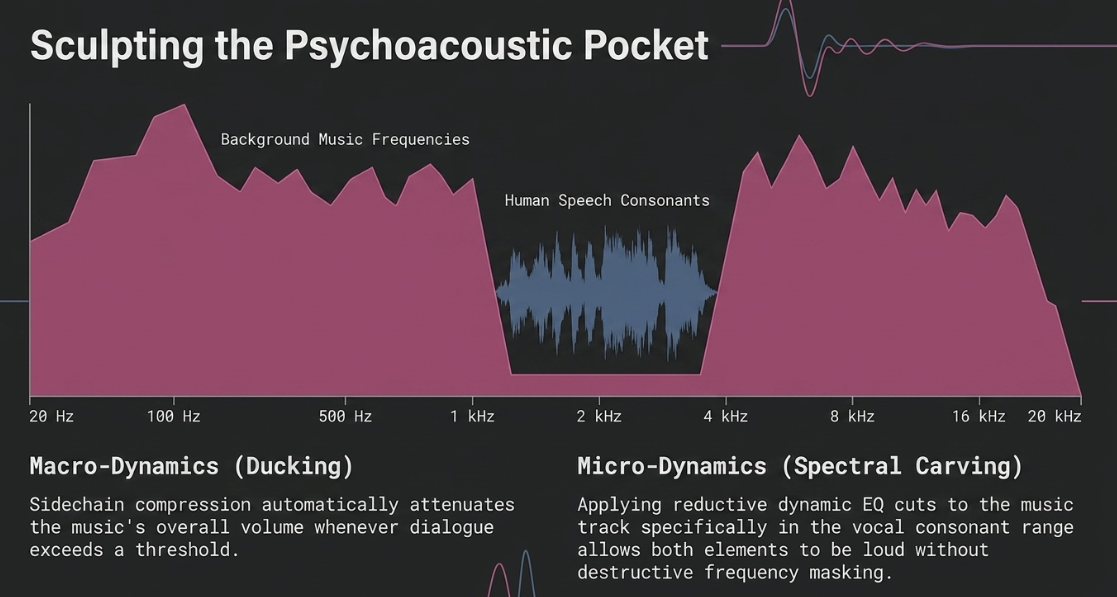
To resolve this spectral overlap, audio engineers employ a dynamic volume control technique known as "ducking," which is typically achieved through sidechain compression.1 By routing the primary dialogue track to the sidechain input of a compressor situated on the music bus, the music's amplitude is automatically attenuated—or "ducked"—whenever the dialogue exceeds a predetermined threshold.1 This ensures that the background music remains present and audible during pauses in speech but instantly recedes to prevent interference with vocal intelligibility.1 When configured correctly with appropriate attack and release times, sidechain compression performs this volume automation imperceptibly, effectively allowing both the narrative voice and the emotional score their respective times to shine.1
While volume automation via sidechain compression handles the macro-dynamics of the mix, spectral carving is strictly required to ensure micro-dynamic clarity.2 Using parametric equalizers such as the Channel EQ in Final Cut Pro or iZotope's Ozone 11 EQ, engineers analyze the precise frequency spectrum of the voice talent and apply specific, narrow cuts to the music track within that exact spectral range.2 Human speech intelligibility relies heavily on the frequency band spanning from roughly 1 kHz to 4 kHz, where crucial consonant sounds are formed and articulated.3 By applying a dynamic EQ or a static reductive cut to the music in this specific band, the audio engineer creates a psychoacoustic "pocket" for the voice to sit comfortably within the mix.2 This technique allows the music to maintain its perceived power in the low and high frequencies while yielding the critical mid-range to the dialogue, negating the need for extreme overall volume reduction.
Furthermore, advanced tonal balancing techniques increasingly rely on "Tilt" equalizers to shape the overall frequency spectrum of both music and voice.4 Tilt EQs operate by applying a broad, linear slope across the entire frequency spectrum, pivoting around a central axis point.4 Engineers frequently utilize pink noise curves as a reference target for this balancing act.4 Because pink noise features equal acoustic energy per octave, its natural roll-off closely mirrors the frequency response most pleasing to the human ear.6 Modern plugins, such as FabFilter Pro-Q 4, PSPaudioware Tilt-Q, or Waves Curves Equator, allow engineers to morph the frequency curve of a mix to match this pink noise roll-off, simultaneously taming excessive resonances while ensuring the tonal balance between the dialogue and the musical underscore feels cohesive and professionally polished.
Some Axioms and Other Gems
The discipline of professional audio engineering is governed by a set of foundational heuristics—axioms and rules of thumb that serve as guiding principles for decision-making in the recording studio. These adages compress decades of acoustic research, analog hardware operation, and practical trial-and-error into highly digestible maxims that inform daily engineering workflows.
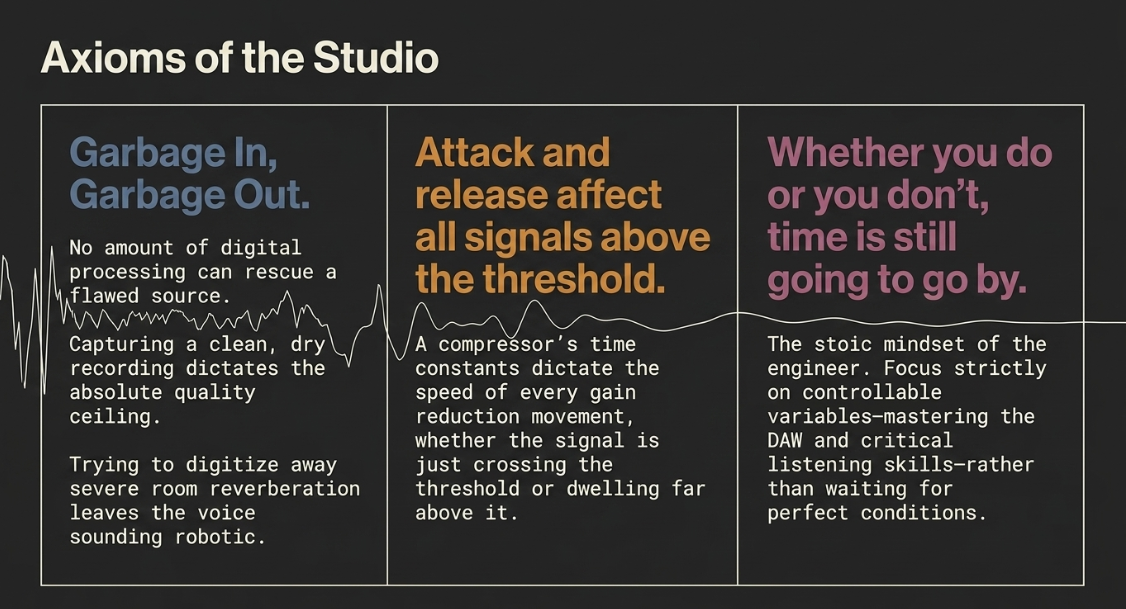
Perhaps the most universally acknowledged axiom in audio production is the concept of "garbage in, garbage out".7 This principle dictates that no amount of advanced digital signal processing, equalization, or mastering can fully rescue a fundamentally flawed source recording.7 The acoustic properties of the recording space, the precision of microphone placement, and the integrity of analog gain staging dictate the absolute ceiling of the final mix's quality.7 A clean, dry recording captured in an acoustically treated environment requires minimal subtractive equalization and restorative processing, thereby preserving the natural timbre and transient response of the human voice. Conversely, attempting to remove severe room reverberation (the cascading reflections of sound waves bouncing off untreated walls) or high noise floors introduces digital artifacts that inherently degrade the signal, leaving the voice sounding hollow or robotic.7
Another fundamental technical axiom relates directly to the mechanical behavior of dynamic processors, specifically compressors. As commonly stated among seasoned engineers: "Attack and release affect all signals above the threshold".9 This rule clarifies that a compressor's time constants dictate the speed of every gain reduction movement the compressor makes, regardless of whether the signal is just crossing the threshold or already dwelling significantly above it.9 Understanding this absolute rule prevents the frequent amateur mistake of misconfiguring a compressor's ADSR (Attack, Decay, Sustain, Release) envelope, which can inadvertently crush the natural transients of human speech or induce unnatural "pumping" artifacts.
From a career and developmental perspective, industry veterans and authors, such as Bobby Owsinski in The Mixing Engineer's Handbook, often emphasize philosophical axioms regarding discipline, focus, and the relentless nature of time.10 As frequently noted in professional development circles, "whether you do or you don't, time is still going to go by".13 This mindset encourages consistent, incremental practice over the paralysis of seeking immediate acoustic perfection.13 It aligns closely with broader philosophical frameworks, including Stoic axioms, which advocate for focusing strictly on controllable variables—such as one's mastery of the Digital Audio Workstation (DAW) and critical listening skills—rather than fixating on external industry pressures.14
Similarly, historical adages regarding industry entry have evolved significantly. The traditional axiom—"to get your foot in the door, you have to be in the right place at the right time"—has fundamentally shifted in the digital era.15 Historically, the "right place" was considered a geographical location, such as Los Angeles, Nashville, or New York.15 Today, the "right place" is defined by a state of technical preparedness, digital presence, and the ability to execute complex mixes remotely. The modern corollary to this rule is that "it's too late to prepare once you start the race," emphasizing that technical fluency in tools like iZotope RX or FabFilter Pro-Q must be achieved before high-stakes client work is undertaken.
Learning to Mix
The pedagogy of audio engineering, particularly for adults entering the podcasting space from adjacent disciplines such as journalism or video production, relies heavily on the principles of andragogy—the theory of adult learning articulated by Malcolm Knowles.16 Adult learners are fundamentally motivated by immediate relevance, internal goals, and problem-solving.16 Therefore, learning to mix is rarely accomplished through abstract acoustic theory alone; it requires applied, project-based learning methodologies that yield tangible auditory results.18
The cognitive process of acquiring mixing skills involves connecting prior knowledge with continuous acoustic feedback.19 Neuroplasticity allows the adult brain to continually adapt to critical listening tasks, building new neural pathways that can identify subtle frequency anomalies, phase cancellations, or compression artifacts.16 However, the initial cognitive load of understanding signal routing, frequency spectrums, and dynamic range can be overwhelming. Beginners are often encouraged to compartmentalize the mixing process into standardized learning pathways. Educational podcasts, beginner guides, and resources from institutions like NPR Training or Transom routinely emphasize starting with fundamental concepts: microphone selection, recording environment analysis, and understanding the basic signal flow of a DAW.17
As technical proficiency increases, learners must transition from rote mechanical operations to intuitive critical listening. The concept of the "soundbox"—a theoretical three-dimensional space where audio elements are placed using panning (width), frequency (height), and temporal effects (depth)—is a crucial paradigm for visualizing a mix.12 To master this, resources such as Mike Senior's Mixing Secrets for the Small Studio serve as invaluable textbook alternatives.23 Senior's work helps bridge the gap between amateur trial-and-error and professional methodologies, acting as a surrogate for the traditional, year-long studio apprenticeships that are increasingly rare in the modern era.23
These texts underscore that mixing is a continuous scientific cycle of hypothesis testing: applying an equalization cut, toggling the bypass switch to A/B the result, and critically evaluating whether the change improved the signal clarity or degraded it.23 The ultimate goal of learning to mix is not to memorize arbitrary plugin settings or mimic visual curves on a screen, but to develop an intuitive, highly trained ear capable of instantly identifying acoustic problems and instinctively reaching for the correct topological solution.
The Process of Mixing
The actual execution of a podcast mix follows a stringent, highly repeatable order of operations. Deviating from this established signal chain often exacerbates audio problems rather than solving them. A professional workflow ensures that the audio is cleaned, balanced, shaped, and polished in a logical, cumulative sequence.28
Signal Flow and Gain Staging
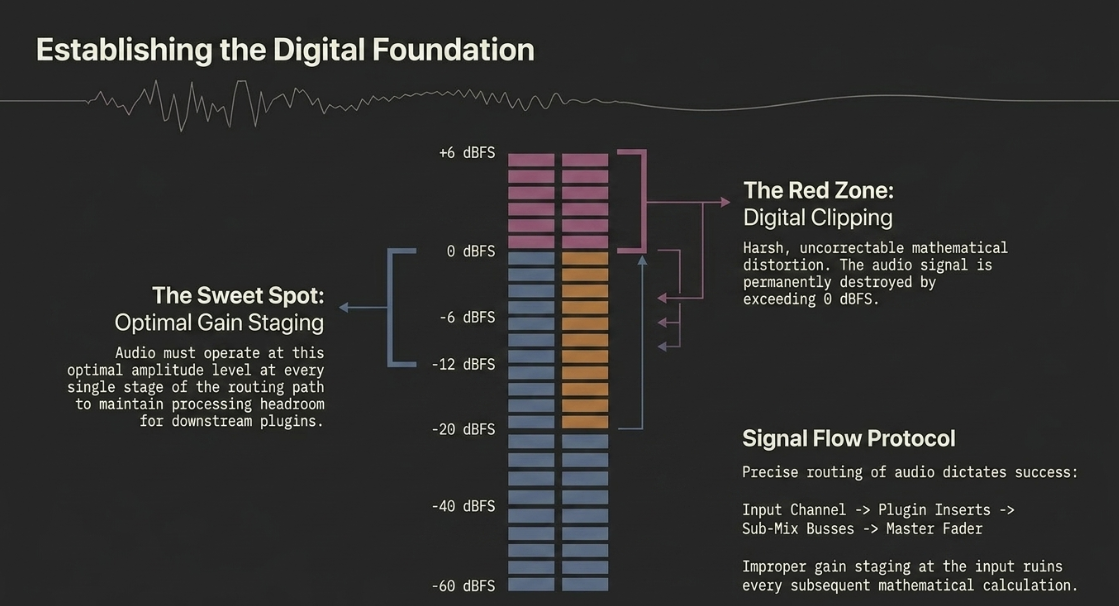
Before any creative or corrective processing occurs, the engineer must establish proper signal flow and gain staging.29 Signal flow dictates the precise routing of audio from the input channel, through inserts (where plugins are applied), into auxiliary sends or sub-mix busses, and finally to the master output fader.29 Gain staging is the foundational process of ensuring that the audio signal is operating at an optimal amplitude level at every stage of this path.30 In a digital environment, the audio should typically peak between -12 dBFS (Decibels Full Scale) and -6 dBFS.33 This ensures adequate headroom is maintained for downstream processing, preventing any possibility of digital clipping—a harsh, uncorrectable distortion that occurs when a signal exceeds 0 dBFS.33
The Order of Operations
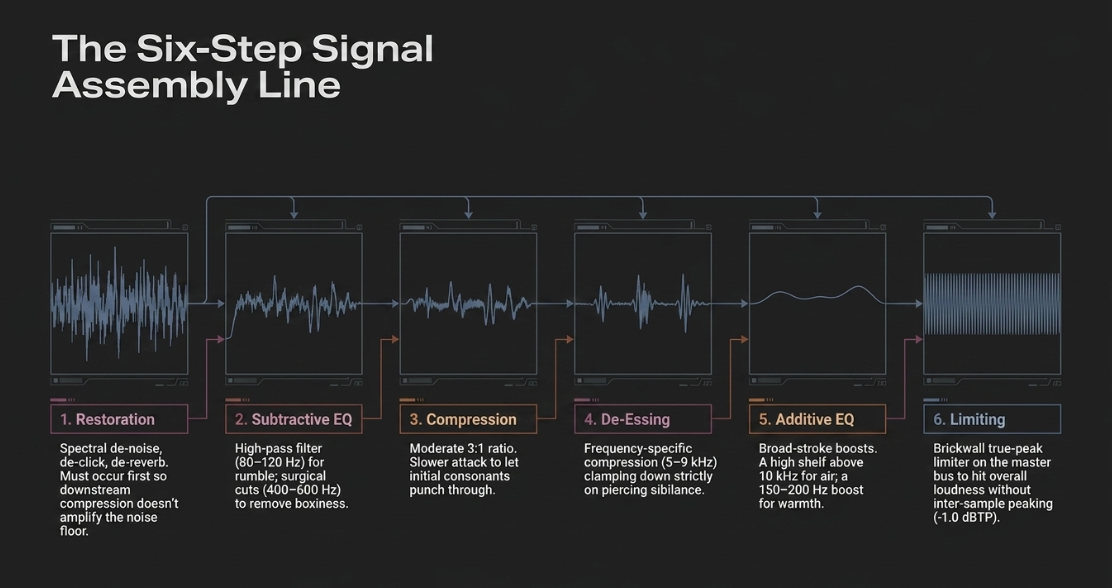
A standard, professional vocal processing chain for podcasting proceeds through the following sequential stages:
Audio Restoration and Cleanup: The absolute first step is repairing the raw audio. This includes using specialized spectral de-noisers (such as iZotope RX) to remove constant broadband background hiss (e.g., HVAC noise or computer fans), de-clickers to eliminate distracting mouth noises and saliva clicks, and de-reverb algorithms to attenuate unwanted room reflections.34 Crucially, this restorative work must occur first, as downstream compression will artificially amplify the noise floor, making hiss and room echo much more prominent if left unaddressed.35
Corrective Subtractive Equalization: Following restoration, a high-pass filter (often referred to as a low-cut filter) is engaged, typically set between 80 Hz and 120 Hz with an 18 to 24 dB/octave slope.37 This filter aggressively removes subsonic rumble, microphone handling noise, and the extreme low-end energy of plosives without affecting the fundamental frequencies of the human voice.37 Subsequently, surgical parametric cuts are made to remove "boxiness" (often localized between 400 Hz and 600 Hz) and harsh, ringing room resonances.35
Dynamic Control (Compression): Human speech is inherently highly dynamic, characterized by rapid fluctuations in volume.38 A compressor is utilized to reduce this dynamic range, bringing the quietest whispers and the loudest laughter closer together in average volume. A standard vocal compression setting for podcasting might utilize a moderate 3:1 or 4:1 ratio, a slightly slower attack time to allow the initial consonant transients to punch through for clarity, and a release time timed to the natural cadence of the speaker.9
De-Essing: After compression, a frequency-specific compressor known as a De-Esser targets the high-frequency range, typically between 5 kHz and 9 kHz.38 This processor clamps down exclusively on harsh sibilance (the piercing "S", "T", and "Sh" sounds) that may have been inadvertently exaggerated by the makeup gain of the primary compressor.38
Additive / Tonal Equalization: Once the audio signal is clean, controlled, and free of masking frequencies, gentle, broad-stroke EQ boosts are applied to enhance the character of the voice.38 This might involve adding a high-frequency shelf above 10 kHz for "air" and presence, or a slight, warm boost around 150 Hz to 200 Hz to add authority to a thin voice.38
Limiting and Mastering: The final stage of the mix involves routing all processed dialogue, music busses, and sound effects through a master output bus.35 A brickwall true-peak limiter is applied to raise the overall integrated loudness of the entire program to the specific target standard required by distribution platforms (e.g., -16 LUFS) while strictly preventing any inter-sample audio peaks from exceeding a True Peak limit (typically -1.0 dBTP or -2.0 dBTP).42
Advanced Spectral Matching
In documentary, journalistic, or narrative podcasts, engineers frequently encounter the challenge of mixing audio recorded in disparate environments utilizing mismatched microphones (e.g., cutting from a pristine studio vocal to a compressed telephone interview or a noisy field recording).36 To create a cohesive, non-distracting listening experience, "EQ Match" or spectral balancing plugins are heavily utilized.36
These advanced tools—such as Accentize SpectralBalance, FabFilter Pro-Q 4, or iZotope RX's EQ Match module—operate by capturing the precise frequency spectrum profile of a high-quality reference clip.45 The plugin then analyzes the target audio clip and applies a highly complex, multi-band equalization curve that forces the timbre of the inferior recording to match the reference.45 By instantly correcting boxiness, proximity issues, and frequency imbalances, spectral matching significantly reduces the jarring nature of cutting between completely different acoustic spaces, ensuring narrative continuity.
Related Issues
Beyond the core creative mixing process, audio engineers must navigate a host of physical acoustic problems inherent in recording, as well as the strict technical delivery specifications required for digital distribution.
Acoustic Challenges in Recording
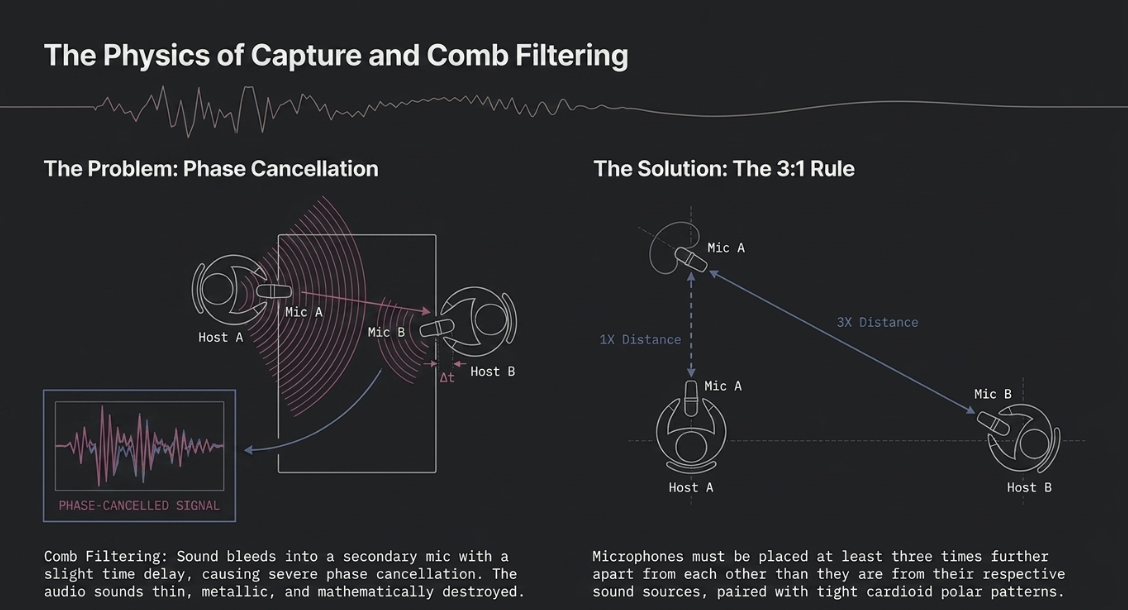
When multiple participants are recorded simultaneously in the same room, microphone bleed and phase cancellation become major acoustic liabilities.49 If Host A's voice enters their dedicated microphone, and simultaneously bleeds into Host B's microphone a few milliseconds later, a severe problem arises. When these two tracks are summed to mono or panned close to the center, the slight time delay causes certain frequencies to amplify while others completely cancel each other out.49 This destructive acoustic phenomenon is known as "comb filtering," which drastically hollows out the frequency spectrum, leaving the audio sounding thin, metallic, and phase-shifted.49
To mitigate this, engineers rely on strict physical protocols, primarily the "3:1 rule." This rule dictates that microphones should be placed at least three times further apart from each other than they are from their respective sound sources.49 Additionally, utilizing dynamic microphones with tight cardioid or supercardioid polar patterns (which actively reject off-axis sound) and ensuring the speakers are placed in each other's acoustic "dead zones" are critical steps to isolating the audio.49 While recording with mismatched microphones—particularly a mix of consumer USB microphones and professional XLR microphones—is possible, it introduces significant impedance, gain, and clock-syncing issues, making an audio interface and uniform XLR dynamic microphones the preferred professional standard.50
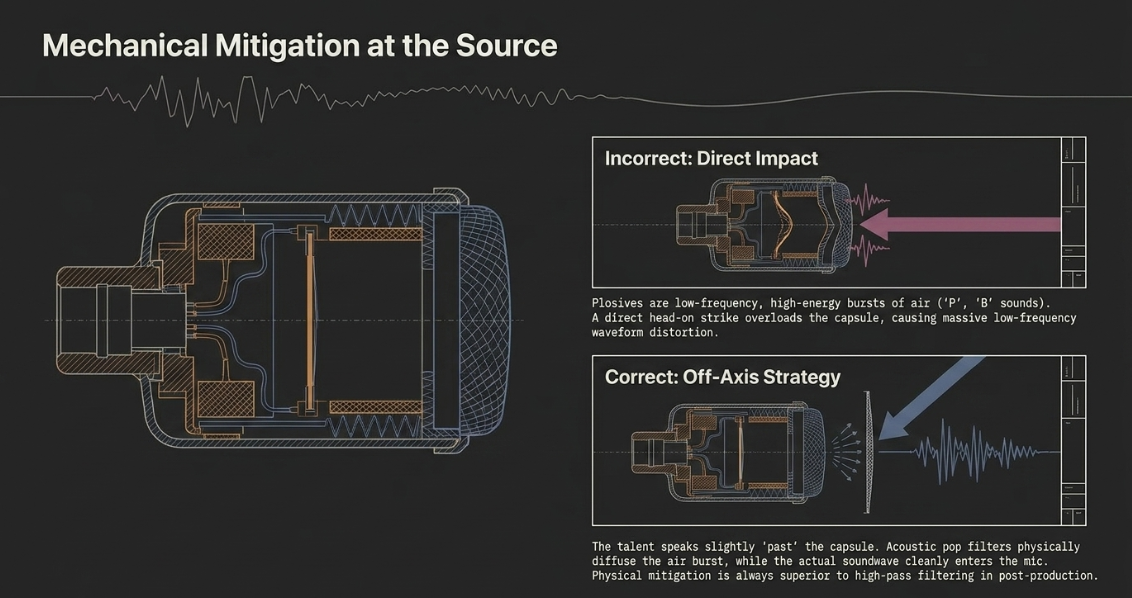
Plosives represent another persistent physical recording issue.56 Plosives are low-frequency, high-energy bursts of air caused by the articulation of hard consonants (like 'P' and 'B') striking the sensitive diaphragm of the microphone capsule.56 While aggressive high-pass filtering in post-production can mitigate the rumble, physical mitigation at the source is vastly preferred. This involves training the talent to speak slightly off-axis—speaking "past" the capsule rather than directly into it—and utilizing acoustic pop filters, nylon rings, or thick foam socks to diffuse and redirect the blast of air before it impacts the hardware.56
Technical Delivery Standards
The final deliverable of a podcast must conform strictly to the digital distribution standards dictated by RSS aggregators and streaming platforms. While uncompressed, high-resolution WAV files (typically 24-bit / 48 kHz or 96 kHz) are used throughout the recording and mixing phases to preserve mathematical precision and plugin processing headroom, the final file is generally encoded as a compressed MP3 or AAC file for public distribution.58
The technical specifications for these files must strike a delicate balance between preserving audio fidelity and minimizing file sizes for rapid mobile downloading.60
Additionally, professional delivery requires precise ID3 Tagging.63 These metadata tags are embedded directly into the header of the MP3 file, carrying vital information including the Episode Title, Artist Name, Album (Podcast Show Title), Year, and Cover Artwork.63 Proper ID3 tagging is not merely an aesthetic consideration; it is a functional requirement. It ensures accurate display on legacy offline media players, aids significantly in SEO discoverability on major search engines, and maintains absolute brand consistency when the file is shared directly outside of controlled podcast applications.
Mixing and the Brain
Audio engineering is inherently an exercise in applied human biology and psychology. The complex discipline of psychoacoustics—the scientific study of how the human auditory system and the brain physically receive, interpret, and emotionally respond to sound—dictates nearly every technical decision made at the mixing console.65
Psychoacoustic Principles
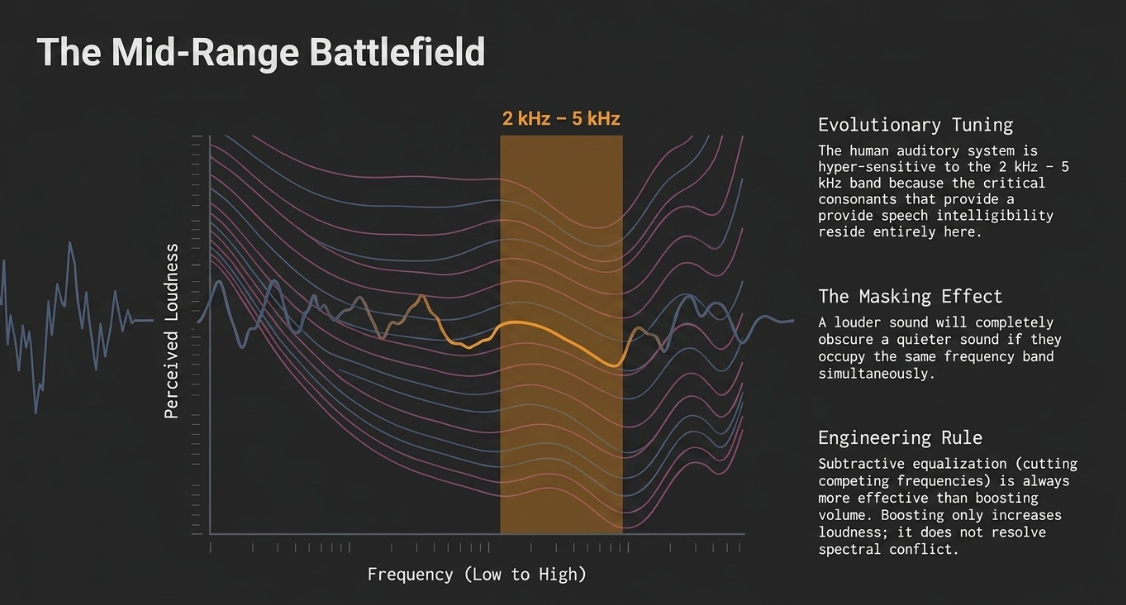
The human ear is not a perfect, linear microphone; it actively filters and prioritizes sound based on evolutionary adaptations.66 According to the Fletcher-Munson equal-loudness contours, our auditory system is hyper-sensitive to mid-range frequencies (roughly spanning 2 kHz to 5 kHz).66 This specific sensitivity exists because the most critical elements of human speech—the consonants that provide intelligibility—reside in this band.68 Conversely, extreme low and high frequencies require significantly more acoustic energy to be perceived at the same apparent loudness.66
Engineers must account for this non-linear sensitivity by ensuring the critical mid-range remains entirely uncluttered, employing the principles of auditory masking.66 Masking dictates that a louder sound will completely obscure a quieter sound if they occupy the same critical frequency band or occur simultaneously in time.66 Therefore, cutting competing frequencies in background tracks (subtractive EQ) is vastly more effective for achieving clarity than simply boosting the volume of the dialogue, which only increases overall loudness without resolving the spectral conflict.66
Furthermore, biological mechanisms like cochlear tonotopy (how specific frequencies map to physical locations and nerve fibers on the basilar membrane) and temporal coding allow humans to perceive pitch, localization, and spatial depth.67 Engineers exploit these mechanisms, alongside psychoacoustic phenomena like the Haas effect (the precedence effect), to create a sense of stereo width or physical space. By delaying a duplicate signal by a few milliseconds (under 40ms), the brain fuses the sounds together, perceiving a wider soundscape without registering a distinct, distracting echo.
Cognitive Load and Listener Fatigue
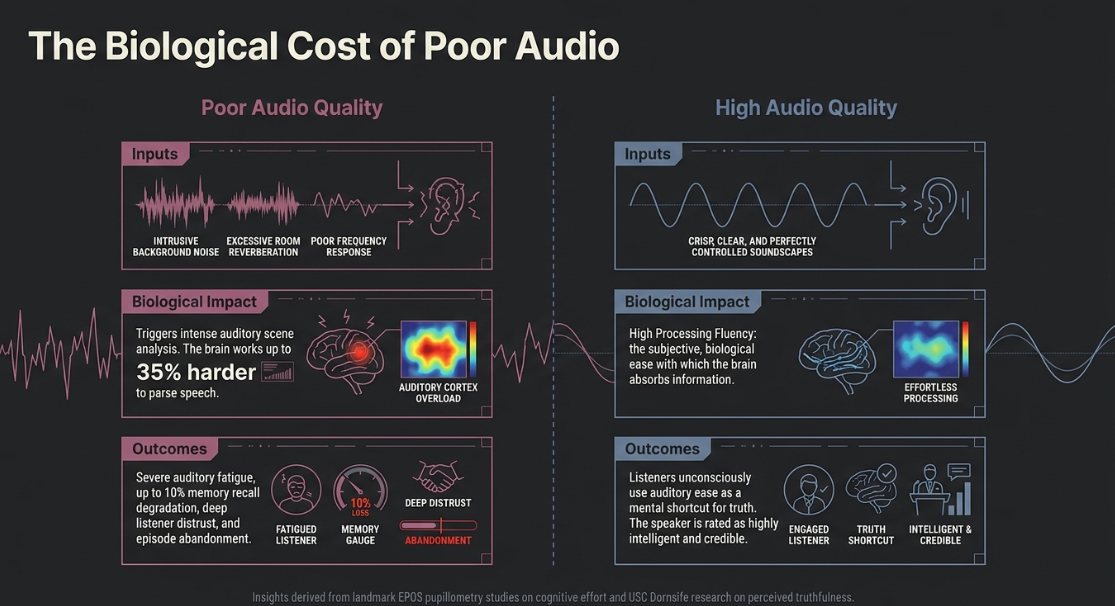
The technical quality of a podcast's audio has a direct, measurable impact on the listener's neurological performance and physical endurance. A landmark psychoacoustic study conducted by EPOS demonstrated that poor audio quality—characterized by intrusive background noise, excessive room reverberation, and poor frequency response—forces the brain to perform intense, continuous "auditory scene analysis".71 In order to parse the primary speech signal from the interfering noise, the brain is subjected to cognitive overload, working up to 35% harder to interpret the information.72
Over the duration of a long-form podcast, this cognitive strain manifests as severe auditory fatigue.71 The EPOS study, utilizing pupillometry tracking to measure cognitive effort, revealed that listeners subjected to poor audio experience degraded memory recall (by up to 10%), struggle with reading comprehension, and are significantly more likely to abandon the episode entirely.72
For podcasts focused on relaxation, focus, or sleep, engineers purposely manipulate the frequency spectrum to provide consistent masking of environmental intrusions without triggering this cognitive fatigue. While standard "white noise" contains equal energy across all frequencies, it often sounds unnaturally bright, hissy, and harsh to the human ear.76 Instead, engineers synthesize "pink noise" (which decreases in power by 3 dB per octave, mimicking natural ambient sound) and "brown noise" (which decreases by 6 dB per octave, heavily emphasizing deep, soothing low frequencies).76 These colored noises blanket the auditory system, promoting relaxation and focus without demanding active cognitive processing.76
The Psychology of Trust and Credibility
Perhaps the most striking and consequential impact of professional audio engineering lies in the psychology of credibility. Extensive research conducted by USC Dornsife established a direct, undeniable link between audio quality and perceived truthfulness.81 The study isolated the psychological concept of "processing fluency"—defined as the subjective ease with which information is absorbed and processed by the brain.81
When audio is crisp, clear, and easy to hear (representing high fluency), listeners unconsciously utilize this ease as a mental shortcut for evaluating truth. They rate the speaker as more intelligent, more likable, and the scientific or journalistic information presented as more credible and important.81 Conversely, when the exact same speech is presented with poor audio quality, listeners immediately exhibit deep distrust toward both the speaker and the claims being made.81 In an era fraught with misinformation, professional audio engineering is not just an aesthetic luxury; it is a fundamental prerequisite for establishing journalistic integrity, emotional intimacy, and narrative authority.84
Preventing Engineer Ear Fatigue
The audio engineer is equally susceptible to devastating auditory fatigue, which can entirely compromise a mix. Prolonged exposure to sound, especially at elevated volumes, causes a temporary threshold shift in the cilia of the inner ear, reducing sensitivity to high frequencies and severely skewing mix decisions.27 To combat this, professionals adhere strictly to monitor volume management, typically mixing at a moderate, conversational level of 75 to 85 dB SPL.27 At this specific volume, the frequency response of the ear is at its flattest and most accurate.69 Furthermore, taking 10-to-15-minute breaks of complete silence every 60 to 90 minutes, utilizing reference tracks to constantly recalibrate perspective, and frequently alternating between studio monitors and headphones are considered mandatory practices to preserve objectivity and protect long-term hearing health over grueling post-production sessions.
Mixing Domains and Objectives
The technical objectives of a final podcast mix are ultimately governed by the rigid standardization of the platforms hosting the content and the hostile environments in which the audio will ultimately be consumed. Understanding how to hit these targets without compromising the integrity of the audio is the final hurdle of audio engineering.
Loudness Normalization (LUFS)
Before the widespread adoption of modern loudness standards, the audio broadcasting industry suffered from the "loudness wars," where engineers ruthlessly pushed audio levels to the absolute digital limit using aggressive brickwall limiters, thereby destroying all dynamic range in an effort to be the loudest track on the radio.30 Today, broadcasting networks and digital streaming platforms rely on LUFS (Loudness Units relative to Full Scale), an advanced algorithm that measures the perceived average loudness of audio over time, taking the Fletcher-Munson equal-loudness contours into account.33
When an audio file is uploaded to a platform, its integrated LUFS value (the average loudness from the first second to the last) is measured.33 If the file exceeds the platform's strict target, the platform's algorithm will automatically apply a negative gain reduction, penalizing the track and often causing it to sound weak compared to properly mastered material.44 Apple Podcasts, universally recognized as the dominant authority in the podcasting space, has established a standard target of -16 LUFS for stereo files, with a ±1 dB tolerance (making -17 LUFS to -15 LUFS the ideal target window).43
To ensure absolute compliance with these targets, engineers utilize specialized metering plugins, such as NUGEN Audio's VisLM, alongside precision True Peak limiters (like ISL) that catch inter-sample peaks that standard peak meters miss.44 This guarantees that the audio meets distribution specifications without digital clipping or platform rejection.
Dynamic Range (LRA) and Playback Environments
While hitting the overall integrated loudness target is critical for platform compliance, the internal variation of that loudness—measured as Loudness Range (LRA)—is what ultimately determines the listener's comfort and experience.39 LRA mathematically quantifies the statistical difference between the quietest and loudest parts of a program in Loudness Units (LU), excluding the extreme top 5% and bottom 10% to prevent anomalous spikes from skewing the data.43
In a cinematic film mix intended for a sound-treated, quiet movie theater, an expansive LRA of 15 to 20 LU is highly desirable.39 This massive dynamic range allows for the dramatic contrast between whispered dialogue and explosive, low-frequency sound effects.39 However, podcasts are almost exclusively consumed in highly compromised, hostile acoustic environments: inside moving cars competing with highway rumble, on noisy subway commutes, or through generic earbuds fighting dense urban noise.37 If a podcast features a cinematic, high LRA, the listener will be forced into constant, frustrating interaction with their device's volume dial—turning it up to decipher quiet whispers over engine noise, and ripping their earbuds out in pain when the hosts suddenly laugh loudly.91
Therefore, professional podcast engineering demands heavily restricted dynamic range. The objective is an extremely tight LRA, typically targeted between 3 and 5 LU.38 Achieving this highly controlled target without making the audio sound unnaturally "squashed," distorted, or fatigued requires the meticulous application of cascaded compression.39 Instead of relying on a single heavy limiter to smash the audio, engineers use a series of compressors with gentle ratios (e.g., 2:1 and 3:1) working in tandem, shaving off transient peaks incrementally to create a dense, highly intelligible, and unwavering block of audio.39
The precise target LRA also varies slightly depending on the specific genre of the podcast. A standard, unscripted interview, news dispatch, or comedy talk-show demands heavy leveling to maintain absolute vocal consistency (aiming closer to an LRA of 3 LU) so that every word cuts through the background noise of a daily commute.38 Conversely, a highly produced narrative audio drama—which relies heavily on immersive spatial design, intricate foley artistry, and varying theatrical vocal performances to simulate physical space—may tolerate a slightly wider LRA to preserve the emotional dynamics of the story.91 However, even in audio drama, the ultimate noise floor of the anticipated playback environment must be respected, ensuring that the quietest dramatic moments remain strictly audible above the roar of everyday life.91
Works cited
What is Audio Ducking and How to Do It in Music Production - iZotope, accessed May 7, 2026, https://www.izotope.com/en/learn/what-is-audio-ducking
Mixing Dialogue and Music, How to do it in a relatively professional way? : r/audioengineering - Reddit, accessed May 7, 2026, https://www.reddit.com/r/audioengineering/comments/1ah6683/mixing_dialogue_and_music_how_to_do_it_in_a/
Mix Dialogue & Music with EQ Carving and Audio Ducking - YouTube, accessed May 7, 2026, https://www.youtube.com/watch?v=lB0F6nO1Heo
DIY Mastering Made Easy, accessed May 7, 2026, https://www.soundonsound.com/techniques/diy-mastering-made-easy
PSPaudioware announce PSP Tilt-Q, accessed May 7, 2026, https://www.soundonsound.com/news/pspaudioware-announce-psp-tilt-q
Curves Equator: A Deep Dive into Every Feature For Perfect Resonance Suppression | Blog, accessed May 7, 2026, https://www.waves.com/curves-equator-a-deep-dive-into-every-feature-for-perfect-resonance-suppression
The Complete Guide To Podcast Recording - Podigy, accessed May 7, 2026, https://www.podigy.co/podcast-recording
How to Start Your Podcast in 2018. | by Riley Byrne | Medium, accessed May 7, 2026, https://medium.com/@rileybyrne/how-to-start-your-podcast-in-2018-65b19b77032c
Just had a breakthrough on what compressor attack and release really mean - Reddit, accessed May 7, 2026, https://www.reddit.com/r/audioengineering/comments/nmqpjp/just_had_a_breakthrough_on_what_compressor_attack/
The Professional Musician: The Music the Business the Career the Life - Everand, accessed May 7, 2026, https://www.everand.com/book/524233489/The-Professional-Musician-The-Music-the-Business-the-Career-the-Life
The Bloomsbury Handbook of Music Production 1501334026, 9781501334023 - DOKUMEN.PUB, accessed May 7, 2026, https://dokumen.pub/the-bloomsbury-handbook-of-music-production-1501334026-9781501334023.html
Mixing Music | PDF | Entertainment (General) | Science - Scribd, accessed May 7, 2026, https://www.scribd.com/document/507810900/Mixing-Music
Episode 172: New Year, New Goals: Prioritizing Your Art, Consistency, and Taking Immediate Action with Nomad - Modern Musician, accessed May 7, 2026, https://www.modern-musician.com/podcast-episode-172-nomad
Entrepreneurs of Reddit, which books do you recommend as *must reads* and have directly had an impact on your business?, accessed May 7, 2026, https://www.reddit.com/r/Entrepreneur/comments/56sa96/entrepreneurs_of_reddit_which_books_do_you/
Get On Tour | Sound Design Live, accessed May 7, 2026, https://www.sounddesignlive.com/wp-content/uploads/edd/2018/09/Get-on-Tour.pdf
Learn/Perform Mixtape - Apple Podcasts, accessed May 7, 2026, https://podcasts.apple.com/us/podcast/learn-perform-mixtape/id1485794950
Basics of Audio Processing : r/podcasting - Reddit, accessed May 7, 2026, https://www.reddit.com/r/podcasting/comments/an8m7s/basics_of_audio_processing/
Enrich your Classroom Teaching with Podcasts | Academic Technology Solutions, accessed May 7, 2026, https://academictech.uchicago.edu/2025/03/18/teaching-with-podcasts/
Foundations of Course Design: Building Learning Pathways - Trefny Center, accessed May 7, 2026, https://trefnycenter.mines.edu/resources/learning-pathways/
The Beginner's Guide to Educational Podcasting - COD Learning Technologies, accessed May 7, 2026, https://www.codlearningtech.org/2016/06/21/the-beginners-guide-to-educational-podcasting/
Eight steps to the perfect mix, accessed May 7, 2026, https://npr.brightspotcdn.com/dd/e4/4c73d7c74227a94967e00362b73a/npr-training-audio-mixing-checklist.pdf
The Producer's Handbook to Mixing Audio Stories : r/podcasting - Reddit, accessed May 7, 2026, https://www.reddit.com/r/podcasting/comments/9to6wz/the_producers_handbook_to_mixing_audio_stories/
Mike Senior: Mixing Secrets for the Small Studio (book) - Tape Op, accessed May 7, 2026, https://tapeop.com/reviews/gear/91/mixing-secrets-for-the-small-studio-book
RSR253 – Mike Senior – Best Free Plugins For A Pro Mix In Your Studio, accessed May 7, 2026, https://recordingstudiorockstars.com/rsr253-mike-senior-best-free-plugins-for-a-pro-mix-in-your-studio/
'Mixing secrets for the small studio ' - Book Review — DJ Leandro - Producer & DJ, accessed May 7, 2026, https://www.djleandro.net/blog/2018/9/19/mixing-secrets-for-the-small-studio-book-review
Spill Can Be Your Friend! | Podcast, accessed May 7, 2026, https://www.soundonsound.com/techniques/spill-can-be-your-friend-podcast
Preventing Ear Fatigue when Mixing & Mastering Music - MasteringBOX, accessed May 7, 2026, https://www.masteringbox.com/learn/ear-fatigue-when-mixing
My Process For Cleaning Up & Mixing Dialog For PODCASTS & YOUTUBE, accessed May 7, 2026, https://www.youtube.com/watch?v=pvM-A76gA68
Signal chain: order of operations - iZotope, accessed May 7, 2026, https://www.izotope.com/en/learn/signal-chain-order-of-operations
Home Mastering Guide: Master Music in the Box Like a Pro | NearStream Official, accessed May 7, 2026, https://www.nearstream.us/blog/mastering-in-the-box-home-studio-guide
Inside The Recording Studio - Podbean, accessed May 7, 2026, https://feed.podbean.com/insidetherecordingstudio/feed.xml
Mastering Advanced Audio Signal Routing in DAWs for Engineers: Techniques & Tips, accessed May 7, 2026, https://www.departuremusic.com/mastering-advanced-audio-signal-routing/
A Massively Oversimplified Guide to Loudness - The Simplecast Blog, accessed May 7, 2026, https://blog.simplecast.com/a-massively-oversimplified-guide-to-loudness
Order of Operations (OOO) for Mixing Interviews : r/editors - Reddit, accessed May 7, 2026, https://www.reddit.com/r/editors/comments/kqk4el/order_of_operations_ooo_for_mixing_interviews/
Unlock Pro-Level Clarity: Mastering EQ and Dynamics for Cleaner Mixes - YouTube, accessed May 7, 2026, https://www.youtube.com/watch?v=WfuDOm0X5LQ
How To Match Audio From Different Sound Sources - iZotope, accessed May 7, 2026, https://www.izotope.com/en/learn/how-to-match-audio-from-different-sound-sources
A quick, simple guide to mixing your podcast - Reddit, accessed May 7, 2026, https://www.reddit.com/r/podcasting/comments/b3fjx0/a_quick_simple_guide_to_mixing_your_podcast/
What should the dynamic range be for a podcast? : r/audioengineering - Reddit, accessed May 7, 2026, https://www.reddit.com/r/audioengineering/comments/b5eyyr/what_should_the_dynamic_range_be_for_a_podcast/
How to Balance Loudness & Dynamics (LUFS, LRA, Film/TV vs YouTube), accessed May 7, 2026, https://www.youtube.com/watch?v=cRa6TH8VSzc
Anyone have a good work flow for mixing podcasts they'd like to share? - Reddit, accessed May 7, 2026, https://www.reddit.com/r/audioengineering/comments/bsaxqu/anyone_have_a_good_work_flow_for_mixing_podcasts/
Make Your Podcast Sound Professional with Mixing and Mastering - YouTube, accessed May 7, 2026, https://www.youtube.com/watch?v=oGG8fVljQdg
Podcast Ad Specs & Requirements | Spotify Ads, accessed May 7, 2026, https://ads.spotify.com/en-US/ad-specs/podcast-ad-specs/
A Guide to podcast Compression and Loudness - Reddit, accessed May 7, 2026, https://www.reddit.com/r/podcasting/comments/nlrlp5/a_guide_to_podcast_compression_and_loudness/
Broadcast Loudness Made Simple - NUGEN Audio, accessed May 7, 2026, https://nugenaudio.com/broadcast-loudness-made-simple/
EQ Matching Plugin – Match reference EQ settings Automatically - Accentize, accessed May 7, 2026, https://www.accentize.com/eq-match-plugin/
Can You Make Mics Sound The SAME? Pro-Q 4 EQ Match - YouTube, accessed May 7, 2026, https://www.youtube.com/watch?v=dOcrCAE8JAk
How to Match Audio from Different Sound Sources | iZotope RX - YouTube, accessed May 7, 2026, https://www.youtube.com/watch?v=0Um7qkHd-2w
RX (11): Ambience & EQ Match Module - YouTube, accessed May 7, 2026, https://www.youtube.com/watch?v=dG1LiCxVBTY
Fixing Phase Cancellation Issues in Audio Recording - MasteringBOX, accessed May 7, 2026, https://www.masteringbox.com/learn/phase-cancellation-audio-recording
Rocking the Podcast Setup for Two: Nailing the Art of Recording with Multiple Microphones, accessed May 7, 2026, https://www.nextdaypodcast.com/blog/podcast-setup-for-two-nailing-the-art-of-recording-with-multiple-microphones
How To Solve Phase Problems In A Mix - YouTube, accessed May 7, 2026, https://www.youtube.com/watch?v=JfuFkksXUOY
How do I keep two mics from picking up the other person's voice? : r/podcasting - Reddit, accessed May 7, 2026, https://www.reddit.com/r/podcasting/comments/1hqgws2/how_do_i_keep_two_mics_from_picking_up_the_other/
Using 2 Mics for Podcasting: Best Podcast Microphone Setup & Tips - Maono, accessed May 7, 2026, https://www.maono.com/blogs/news/using-2-mics-for-podcasting-best-podcast-microphone-setup-tips
Record a Podcast with Multiple Microphones on one Computer - YouTube, accessed May 7, 2026, https://www.youtube.com/watch?v=hOTVyJfeXGs
Doing a two person interview/podcast, best way to match two different mics? - Reddit, accessed May 7, 2026, https://www.reddit.com/r/audioengineering/comments/8bxp6s/doing_a_two_person_interviewpodcast_best_way_to/
The Complete Guide to Microphone Technique for Podcasters - Buzzsprout, accessed May 7, 2026, https://www.buzzsprout.com/blog/mic-technique-podcasting
7 Effective Techniques for Minimizing Plosives - Pro Audio Files, accessed May 7, 2026, https://theproaudiofiles.com/plosives/
Audio requirements - Apple Podcasts for Creators, accessed May 7, 2026, https://podcasters.apple.com/support/893-audio-requirements
203: What Actually Happens When You Choose a Sample Rate? (feat. Ian Stewart), accessed May 7, 2026, https://podcasts.apple.com/gb/podcast/203-what-actually-happens-when-you-choose-a-sample/id1551795483?i=1000717286374
Audio Quality Guidelines for podcast episodes - Support : RSS.com Knowledge Base, accessed May 7, 2026, https://help.rss.com/en/support/solutions/articles/44002371360-audio-quality-guidelines-for-podcast-episodes
Audio file formats for Spotify, accessed May 7, 2026, https://support.spotify.com/us/artists/article/audio-file-formats/
16-bit vs. 24-bit - Less noise or more detail? - Audio Masterclass, accessed May 7, 2026, https://www.audiomasterclass.com/blog/16-bit-vs-24-bit-less-noise-or-more-detail
Podcast Glossary: Podcasting Terms for Beginners | B&H eXplora - B&H Photo, accessed May 7, 2026, https://www.bhphotovideo.com/explora/pro-audio/tips-and-solutions/podcast-glossary-podcasting-terms-for-beginners
The Ultimate Guide to ID3 Tagging for Podcasts: Why It's Critical for SEO, Discoverability & Branding, accessed May 7, 2026, https://impact4brands.com/the-ultimate-guide-to-id3-tagging-for-podcasts/
Psychoacoustics - Wikipedia, accessed May 7, 2026, https://en.wikipedia.org/wiki/Psychoacoustics
Psychoacoustics for the Practical Engineer: Leveraging Auditory ..., accessed May 7, 2026, https://solidskillsy.com/2025/08/19/psychoacoustics-for-the-practical-engineer-leveraging-auditory-perception-for-superior-mixes/
Psychoacoustic Overview - Masking Effect - Ircam, accessed May 7, 2026, https://support.ircam.fr/docs/AudioSculpt/3.0/co/Masking%20Effect%20Intro.html
Psychoacoustic Secrets For Mixing Music: Learn How To Hear What's Really There!, accessed May 7, 2026, https://audiouniversityonline.com/masking/
How do you prevent ear fatigue when mixing? : r/mixingmastering - Reddit, accessed May 7, 2026, https://www.reddit.com/r/mixingmastering/comments/1esc3rl/how_do_you_prevent_ear_fatigue_when_mixing/
Psychoacoustic Masking in Audio Processing - Emergent Mind, accessed May 7, 2026, https://www.emergentmind.com/topics/psychoacoustic-masking
Auditory Fatigue: The Hidden Link to Cognitive Strain - Ear Works Audiology, accessed May 7, 2026, https://earworksaudiology.com/posts/what-is-auditory-fatigue/
Poor Audio Causes our Brains to Work 35% Harder to Interpret Information, EPOS Study Finds - Demant, accessed May 7, 2026, https://www.demant.com/about/latest-news/2022_row-4-poor-audio-causes
Poor Audio Causes our Brains to Work 35% Harder to Interpret Information, EPOS Study Finds, accessed May 7, 2026, https://www.eposaudio.com/en/us/contact/pressroom/press-releases/poor-audio-causes-our-brains-to-work-35-harder-to-interpret-information-epos-study-finds
Listening Effort: How the Cognitive Consequences of Acoustic Challenge Are Reflected in Brain and Behavior - PMC, accessed May 7, 2026, https://pmc.ncbi.nlm.nih.gov/articles/PMC5821557/
How Does Sound Quality Affect Our Hearing Health? - Qobuz Community, accessed May 7, 2026, https://community.qobuz.com/blog/how-sound-quality-affects-our-hearing-health
A Complete Guide to Different Colored Noises and What They Do - BetterSleep, accessed May 7, 2026, https://www.bettersleep.com/blog/a-complete-guide-to-colored-noise-exploring-the-sound-spectrum-in-colors
Exploring the Different Kinds of Colored Noise - Manta Sleep, accessed May 7, 2026, https://mantasleep.com/blogs/sleep/different-kinds-of-colored-noise
The Ultimate White Noise Player — Design Your Own Color - myNoise, accessed May 7, 2026, https://mynoise.net/NoiseMachines/whiteNoiseGenerator.php
Go Beyond White Noise: The Science Behind How To Choose the Best Sleep Sound for You, accessed May 7, 2026, https://www.hatch.co/blog/science-of-sleep-sounds
Colors of Noise - Krisp, accessed May 7, 2026, https://krisp.ai/blog/colors-of-noise/
Audio quality influences whether you believe what you hear, accessed May 7, 2026, https://dornsife.usc.edu/news/stories/norbert-schwarz-research-links-sound-quality-belief/
Why we believe something: The quality of audio matters - USC Today, accessed May 7, 2026, https://today.usc.edu/why-we-believe-something-audio-sound-quality/
The Psychological Impact of Voice and Sound Design in Podcasts - Modern Stoa, accessed May 7, 2026, https://modernstoa.co/the-psychological-impact-of-voice-and-sound-design-in-podcasts/
The Psychology of Audio: Why Listeners Connect with Quality Sound - Podcast Provisions, accessed May 7, 2026, https://podcastprovisions.com/blogs/news/the-psychology-of-audio-why-listeners-connect-with-quality-sound
accessed May 7, 2026, https://podcastprovisions.com/blogs/news/the-psychology-of-audio-why-listeners-connect-with-quality-sound#:~:text=The%20Subconscious%20Trust%20Factor,the%20actual%20content%20being%20delivered.
Why Your Brain Loves Listening — Part 2: The Research Behind the Science - uStudio, accessed May 7, 2026, https://ustudio.com/blog/podcasting/why-your-brain-loves-listening-part-2-the-research-behind-the-science/
Mix Fatigue Is Real, Here's How to Avoid It - Mastering.com, accessed May 7, 2026, https://mastering.com/mixing-fatigue-is-real-heres-how-to-avoid-it/
The hidden key to great mixes: how to fight ear fatigue and stay sharp - Sienna Sphere Blog, accessed May 7, 2026, https://siennasphere.acustica-audio.com/blog/how-to-avoid-ear-fatigue-while-mixing/
How to Prevent Ear Fatigue When Mixing Audio - iZotope, accessed May 7, 2026, https://www.izotope.com/en/learn/how-to-prevent-ear-fatigue-when-mixing-audio
Loudness (LUFS) | Podcasting Articles | Audio Audit, accessed May 7, 2026, https://audioaudit.io/articles/podcast/loudness-lufs
Dynamic Range Processing in Audio Post Production - Auphonic Blog, accessed May 7, 2026, https://auphonic.com/blog/2019/08/19/dynamic-range-processing/
How to Optimize Your Car's Sound System for Podcasts and Audiobooks - Jensen Mobile, accessed May 7, 2026, https://jensenmobile.com/how-to-optimize-your-cars-sound-system-for-podcasts-and-audiobooks/
Wireless earbuds for noisy commute & important calls - need advice! - Tom's Guide Forum, accessed May 7, 2026, https://forums.tomsguide.com/threads/wireless-earbuds-for-noisy-commute-important-calls-need-advice.569997/
What are the key differences between Podcast editing compared to editing for an Audio Drama : r/audiodrama - Reddit, accessed May 7, 2026, https://www.reddit.com/r/audiodrama/comments/103prvb/what_are_the_key_differences_between_podcast/
The Ear, the Eye, and the Arm: Audio Writing - Uncanny Magazine, accessed May 7, 2026, https://www.uncannymagazine.com/article/the-ear-the-eye-and-the-arm-audio-writing/