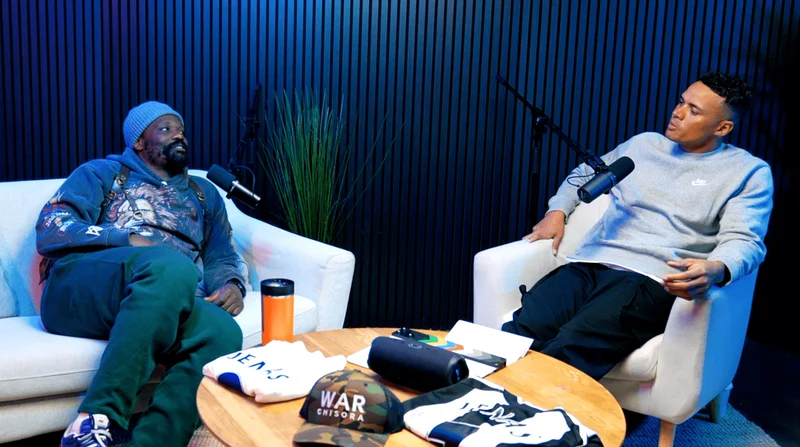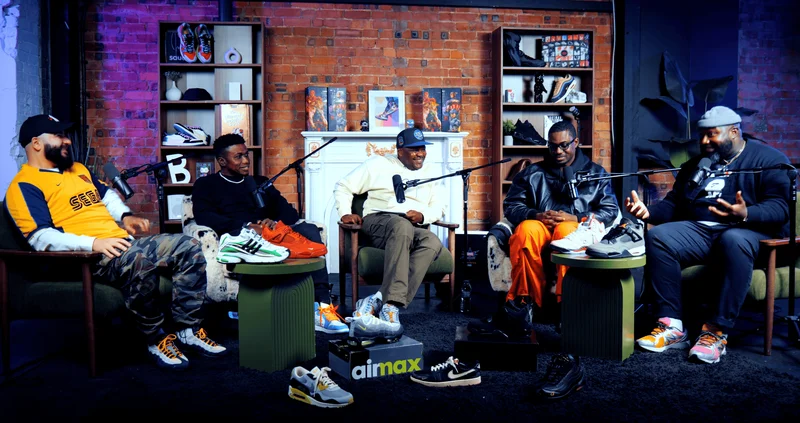
The global media landscape is undergoing a structural realignment driven by the rapid transformation of the podcasting medium1. What once began as an auditory niche centered on syndicated feeds has matured into a multi-billion-dollar, multi-modal powerhouse that directly challenges linear television, streaming services, and traditional radio for consumer screen and ear time1. This shift is characterized by a dramatic transition toward video-first production and consumption, altering how audiences interact with creators, how search engines discover content, and how brands monetize attention2.
Definitional Boundaries: What Podcasting Is and Is Not
Historically, podcasting was defined strictly by its distribution architecture, specifically decentralized delivery via Really Simple Syndication (RSS)4. While RSS remains the bedrock of open distribution—allowing seamless syndication across directories like Apple Podcasts and Spotify—the definition of podcasting in 2026 has expanded beyond strict protocol boundaries6. Today, a podcast represents a cohesive, conversational, and highly structured episodic narrative that spans multiple formats, including traditional audio, video-first formats, highly optimized short-form social clips, and indexable text transcripts6.
Understanding the distinction between a video podcast (often termed a "vodcast"), a standard YouTube video, and a televised talk show is critical for professional execution2. A televised talk show is distributed via linear or streaming networks, driven by tightly scripted segments and high-production-value environments tailored for broad broadcast distribution4. Conversely, standard YouTube videos are heavily algorithmic, visual-first, and generally optimized for rapid visual pacing and immediate click-through engagement5.
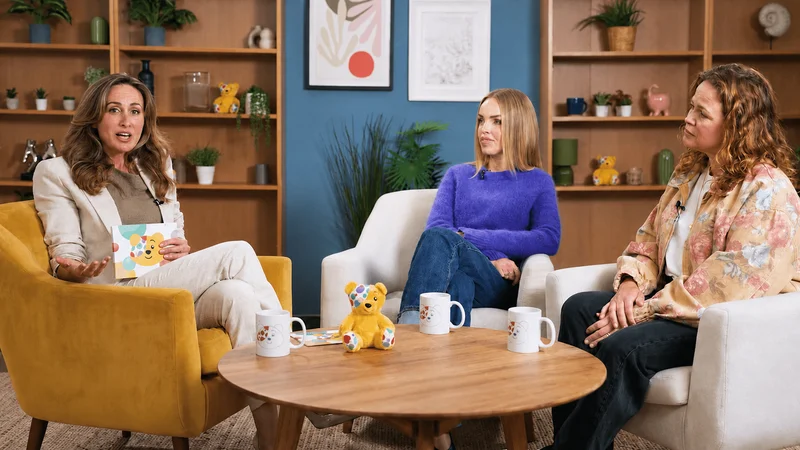
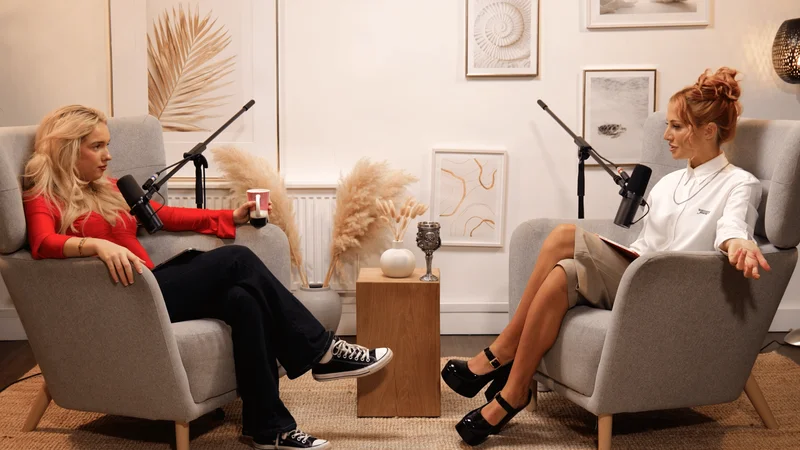
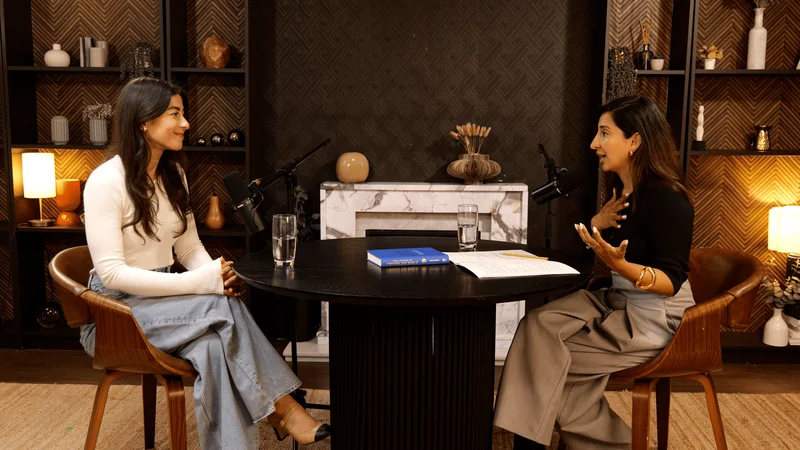
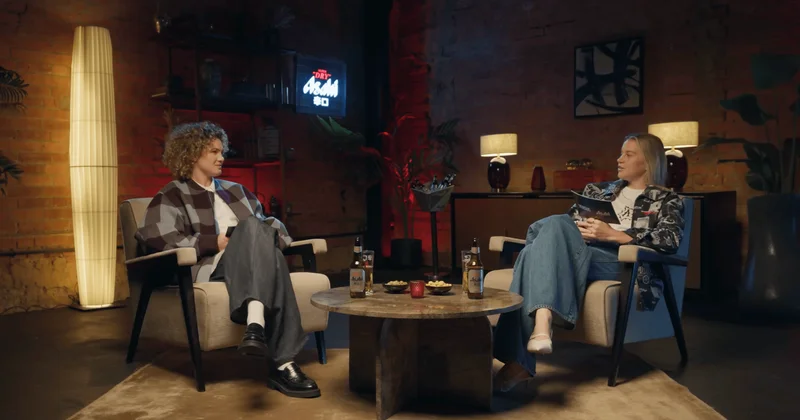
A video podcast, in contrast, preserves the core identity of podcasting: it is conversational, long-form, and less edited, designed to foster a deep, intimate relationship between the hosts and the audience5. However, a professional video podcast is not merely a camera pointing statically at a microphone9. The visual layer of a video podcast must actively enhance the conversational experience through dynamic elements such as multiple camera angles, split-screen compositions, facial reactions, and high-quality on-screen captions9.
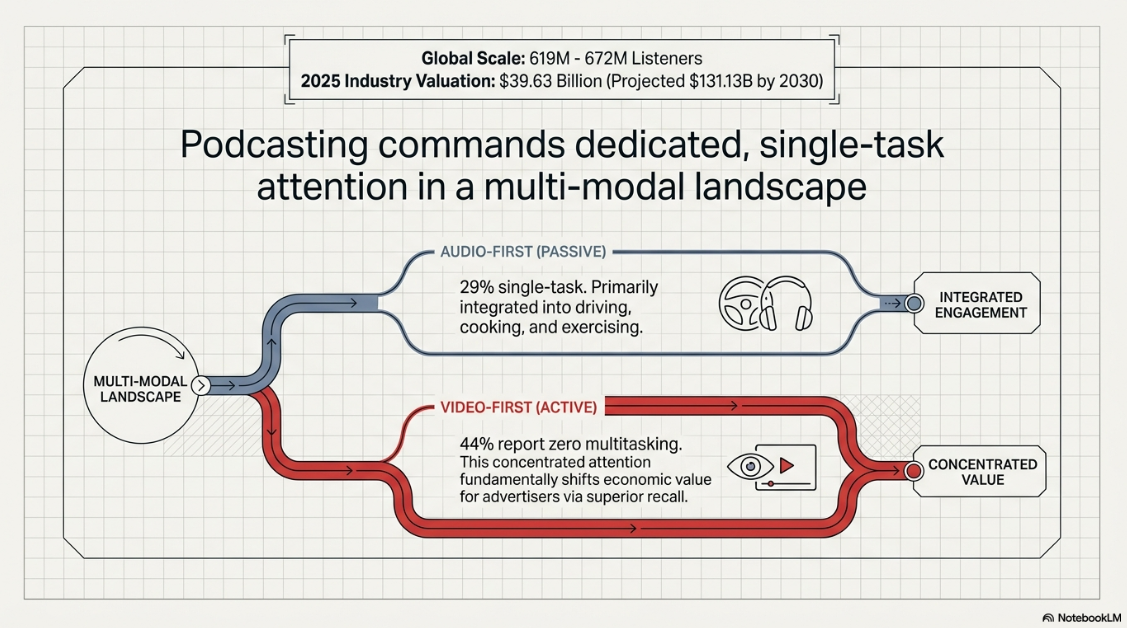
At the heart of the medium's current evolution is the fundamental difference between the audio-first and video-first experience5. Audio-first podcasting is designed to integrate seamlessly into the user's daily life, functioning as a secondary activity during driving, cooking, cleaning, or exercising5. Video-first podcasting demands dedicated, single-task attention, with approximately 44% of video podcast viewers reporting that they never multitask while watching, compared to only 29% of traditional audio-only listeners2. This concentration of attention yields significantly higher viewer engagement and recall, fundamentally shifting the economic value of the visual format for advertisers10.
Macro Growth and Demographic Divergence
The global expansion of the podcasting audience demonstrates exponential growth patterns. The global monthly listener base has nearly tripled over the past seven years, climbing from 274 million in 2019 to an estimated 619 million to 672 million in 20261. Concurrently, the global industry valuation has grown significantly, rising from $30.72 billion in 2024 to approximately $39.63 billion in 2025, with projected growth reaching $131.13 billion by 2030, representing a compound annual growth rate of 27%13. Another data source places the global market at $18.5 billion in 2024, scaling to $28.6 billion in 20261.
An analysis of the underlying supply of podcast content reveals a stabilizing market. While the total number of registered podcast feeds globally stands between 4.4 million and 4.7 million1, filtering for active feeds reveals a more focused landscape of approximately 3.7 million shows14. The trajectory of new show creations has leveled off from a high of approximately 751,000 in 2021 to a stable baseline of roughly 198,000 per year across 2024 and 202514. However, active creator consistency has increased dramatically: in 2025, a record 660,000 different podcasts published at least one episode, compared to only 227,000 in 202414. Approximately 340,000 shows published an episode in the past 30 days, while 479,000 shows published in the past 90 days, demonstrating a highly active core of professionalized creators13.
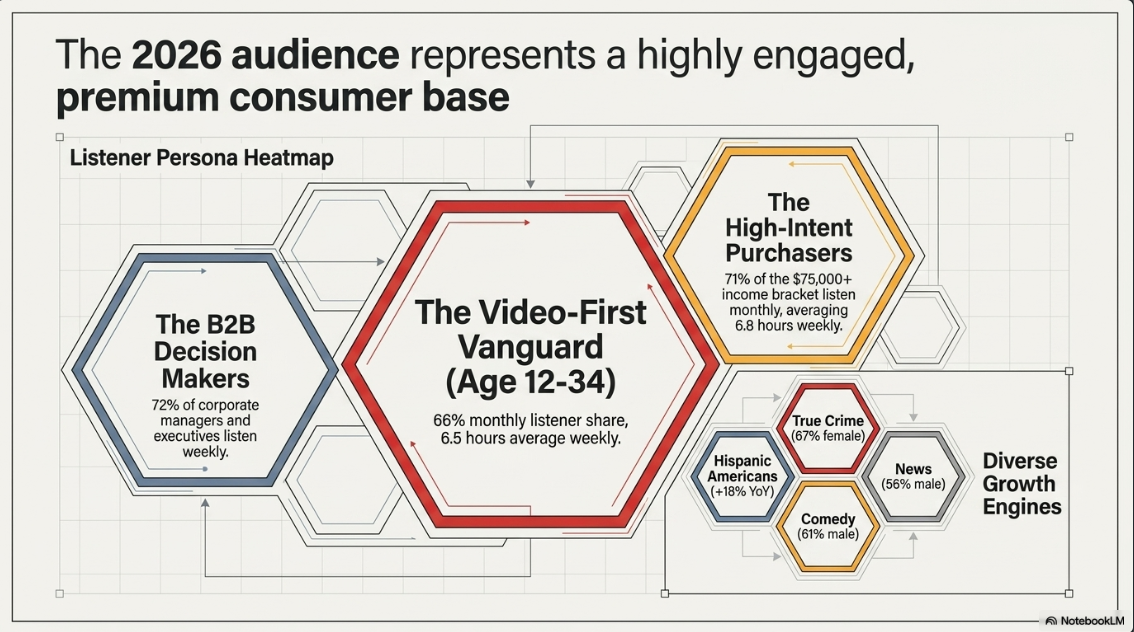
Demographically, the podcast audience represents a premium, highly diverse consumer profile1. In the United States, 67% of the population aged 12 and older listen to podcasts at least monthly, with weekly listenership reaching an all-time high of 40%1.
The audience exhibits significant ethnic diversity: 51% of Black Americans and 58% of Latino Americans aged 12 and older are monthly podcast consumers, with Hispanic Americans representing the fastest-growing listener demographic in the United States, up 18% year-over-year1. From an educational and professional standpoint, monthly listeners are highly educated, with college students representing the most active group, averaging 6.8 hours of listening per week1. Furthermore, 72% of corporate managers and executives listen to podcasts weekly, making the medium highly effective for B2B marketing1.
The distribution of content across genres shows a clear concentration of consumer attention17. News remains the most dominant category, capturing 25% of all downloads, followed by True Crime at 19%, Comedy at 13%, Society & Culture at 9%, and Sports at 7%17. Interestingly, these genres exhibit stark demographic splits: True Crime audiences are heavily female (67%), while Comedy (61%) and News (56%) skew predominantly male17.
The Living Room Paradigm and Co-Viewing Dynamics
One of the most profound structural shifts in audience behavior is the transition of video podcasts into the shared living space18. In the United Kingdom, which has taken the global lead in video podcast viewing, a staggering 84% of monthly podcast consumers actively watch video podcasts, surpassing the United States at 62% and Canada at 75%18. This phenomenon is driven directly by the rise of the Connected and Smart TV2.
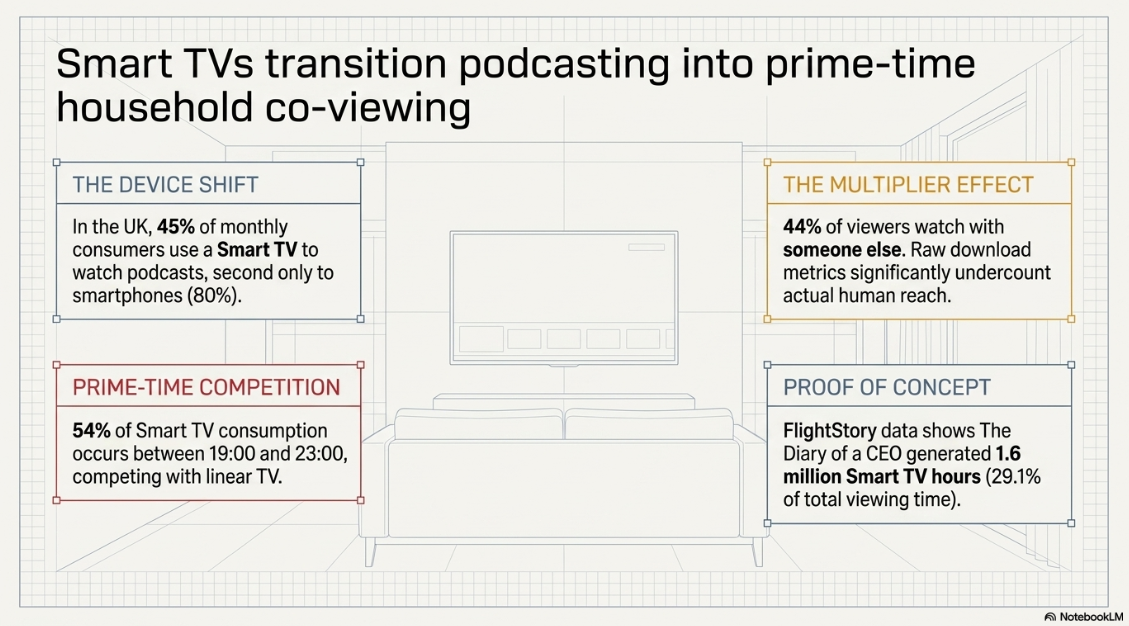
Historically, the planning assumptions for podcast media buying were built on a solitary, isolated user model: "one listener, one pair of headphones, one commute"18. The emergence of Smart TV podcast apps has dismantled this assumption18. In the UK, 45% of monthly podcast consumers use a Smart TV to watch podcasts, making it the second most popular device behind smartphones (80%) and ahead of both tablets (44%) and computers (44%)18.
Furthermore, 54% of video podcast consumption on Smart TVs occurs during prime time between 19:00 and 23:00, placing the medium in direct competition with linear television and premium streaming services18. This shift is highly social; approximately 44% of viewers report watching video podcasts with someone else18. Consequently, traditional headline download metrics significantly undercount the actual human reach of these shows, creating a massive opportunity for advertisers to capture high-attention household impressions18.
The transition to living-room consumption is validated by empirical data from leading publishers18. For instance, the global media network FlightStory reports that the prominent podcast The Diary of a CEO generated over 1.6 million hours of watch time on Smart TVs alone, accounting for 29.1% of its total 5.5 million viewing hours across all devices18. Similarly, the relationship-focused show We Need to Talk generated 87,337 Smart TV hours out of 270,567 total hours, representing 32.3% of its total viewership18. Across all FlightStory content, Smart TVs consistently rank as the second most-used consumption device, mirroring national survey findings18.
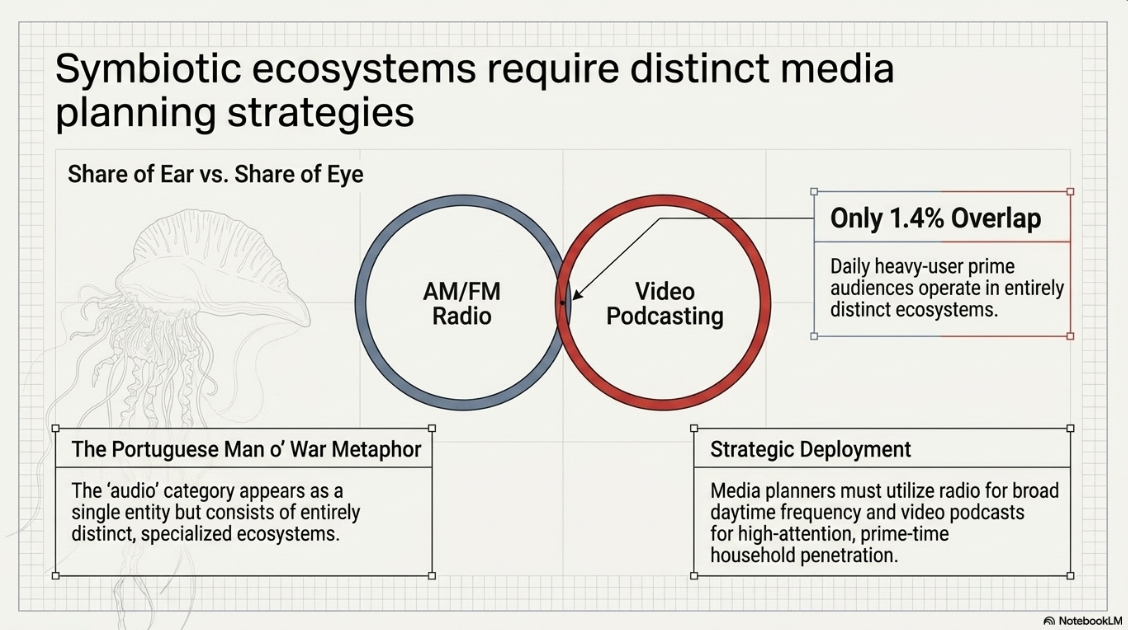
This paradigm shift does not represent a cannibalization of traditional audio listening19. Rather, video podcasts on Smart TVs are capturing share-of-ear and share-of-eye by replacing traditional linear television and streaming video consumption19. This dynamic is best understood through the ecological metaphor of the Portuguese Man o' War, popularized by audio researcher Tom Webster19. Although AM/FM radio and podcasting appear to be a single "audio" category, their daily heavy-user ("Prime") audiences overlap by only 1.4%19. They are distinct media ecosystems operating symbiotically19. Media planners must buy both channels to maximize cumulative reach, using radio for broad daytime frequency and podcasts for high-attention, prime-time household penetration11.
Technical Video Execution: Multi-Camera Studio and Engineering Blueprint
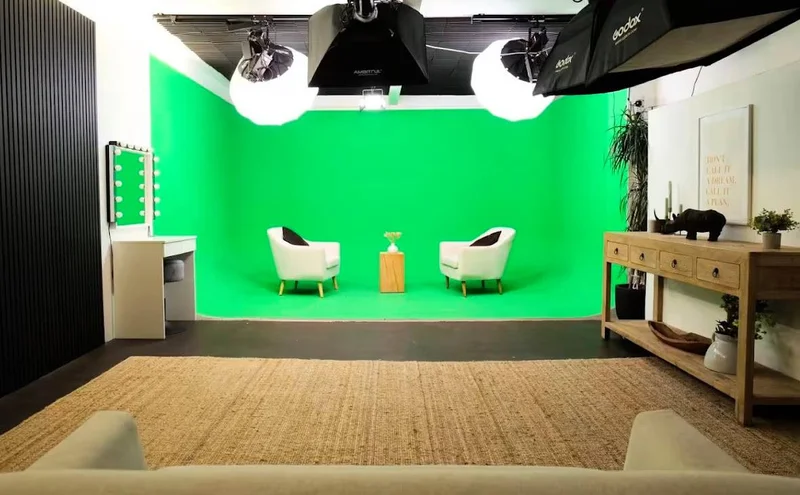
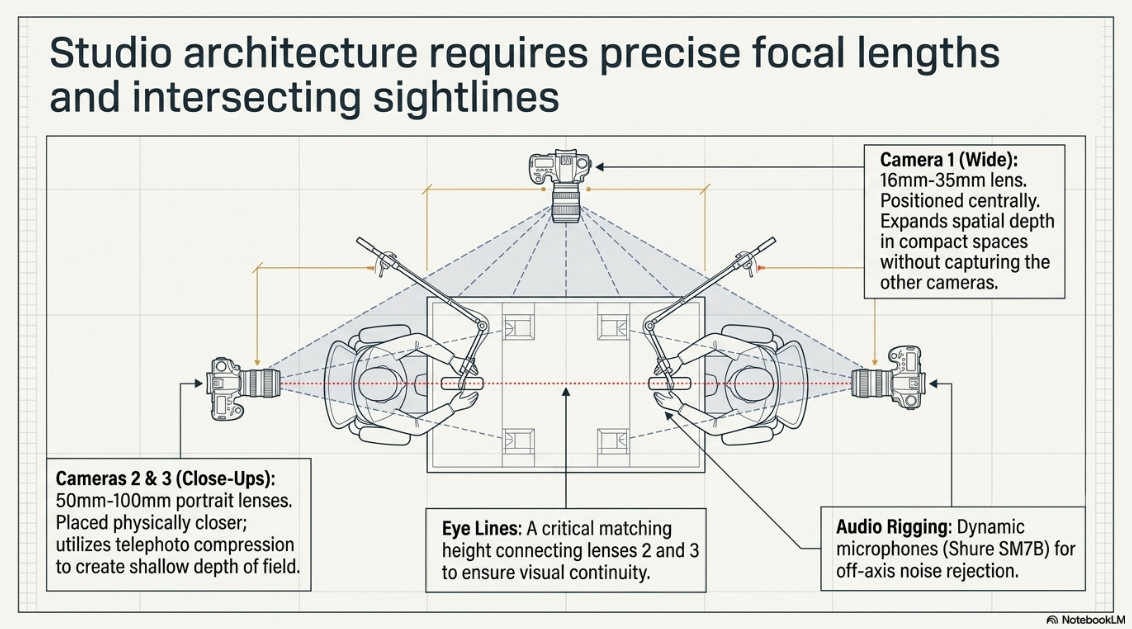
Executing a professional-grade video podcast requires a strict adherence to technical and spatial design principles20. A single locked-off camera forces the viewer to stare at a static frame for 30 to 60 minutes, leading to immediate visual fatigue and drop-off22. Multi-camera setups solve this by introducing visual structure, allowing editors to cut between angles every 20 to 40 seconds to mirror the natural cadence of human conversation20.
For a professional two-person interview format, the industry-standard baseline is a three-camera configuration20:
Camera 1 (Wide Angle): Captures both speakers and enough of the studio set to establish spatial context20. To prevent capturing the individual close-up cameras in this wide shot within compact studio spaces (under 100 square feet), a wide-angle lens (typically 16mm to 35mm focal range) is utilized, allowing the camera to be positioned close to the talent while artificially expanding the depth of the room20.
Camera 2 (Host Close-up) & Camera 3 (Guest Close-up): Positioned to capture facial expressions, micro-emotions, and spontaneous reactions20. These cameras are typically equipped with portrait-length lenses (50mm to 100mm, or up to 150mm) to compress the background and create a flattering, shallow depth of field20.
[Guest Set Piece] [Host Set Piece]
\ /
\ /
\ /
\ /
[Camera 3] [Camera 2]
(Guest Close-Up) (Host Close-Up)
50mm-100mm Lens 50mm-100mm Lens
\ /
\ /
\ /
\ /
[Camera 1 (Wide)]
16mm-35mm Lens
To maintain visual continuity, all close-up cameras must match eye lines and be positioned at identical heights; mismatched angles immediately signal a non-professional production to the viewer20.
In multi-camera video execution, quality output requires recording at a minimum resolution of 1080p at 30 frames per second (fps). For shows involving physical demonstrations, product reviews, or highly dynamic movement, recording at 60 fps is preferred to ensure smooth motion and prevent motion blur across cuts. The cameras must also be carefully matched in their internal settings, establishing identical white balance, exposure, and color profiles prior to recording to prevent jarring visual shifts during angle cuts.
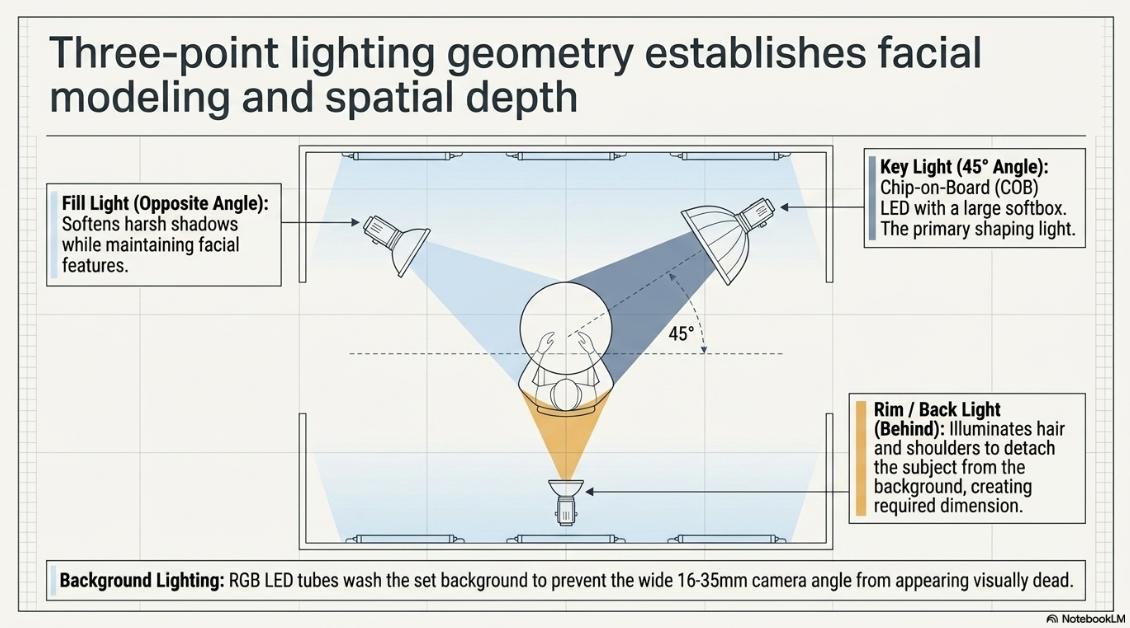
Lighting is often more critical to perceived production value than camera sensor technology20. A standard three-point lighting structure provides flattering facial modeling and spatial depth:
Key Light: The primary shaping light, positioned at a 45-degree angle to the subject's face20. Professional setups often use Chip-on-Board (COB) LED fixtures paired with large softboxes to create a soft, even light source21.
Fill Light: Placed on the opposite side to soften harsh shadows without flattening facial features completely20.
Back/Rim Light: Positioned behind the subject to illuminate the hair and shoulders, creating a distinct boundary between the speaker and the background, thereby establishing dimension20.
Additionally, RGB LED tubes and soft panels are frequently deployed to light the set background evenly, ensuring the wide camera angle does not appear dark or visually "dead"20.
Rich, natural vocal tone is paramount, and professional studios rely heavily on dynamic broadcast microphones, such as the Shure SM7B or RØDE PodMic21. Dynamic microphones are preferred in non-treated or semi-treated environments because of their excellent off-axis background noise rejection21. All microphones must feed into a dedicated multi-channel audio interface or mixer (such as the RODECaster Duo or Zoom LiveTrak L-8), enabling isolated track recording and real-time level monitoring21. The recording space itself should be architecturally treated with wall-mounted acoustic panels at ear level, bass traps in the corners to control low-end reflections, and ceiling clouds to damp overhead echo24.
Post-Production Workflows: Synchronization, Color Science, and Short-Form Repurposing
Post-production on multi-camera projects introduces significant technical complexity regarding file storage, processing overhead, and asset management22. A single hour of 4K footage captured across three separate cameras generates massive file volumes that require high-performance computing hardware and structured storage protocols22.
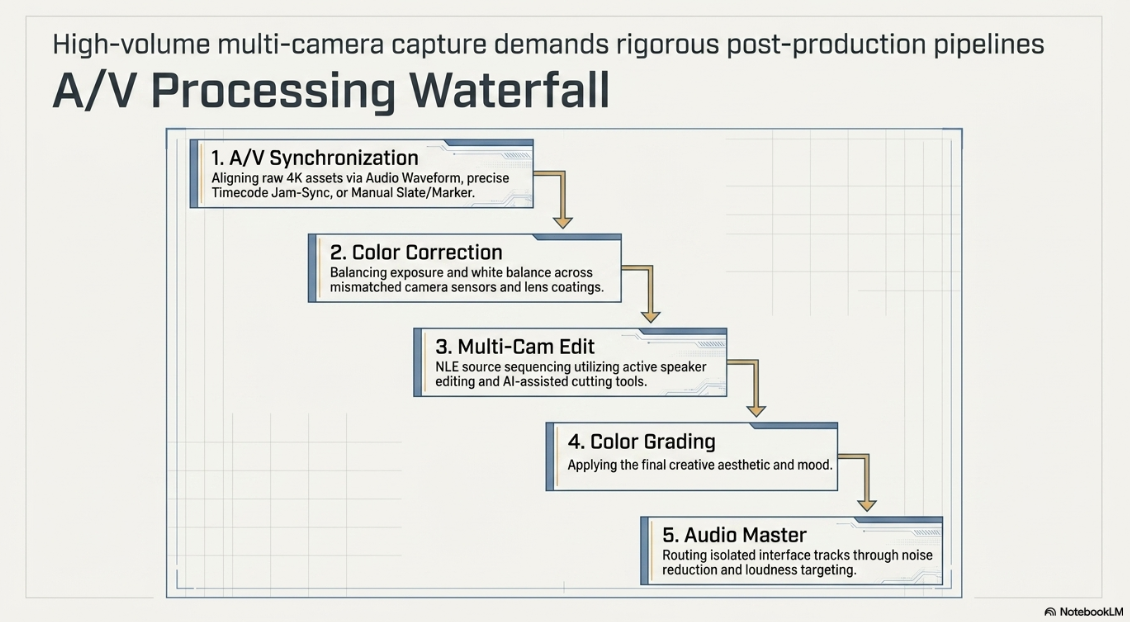
Before editing can commence, all video and audio assets must be perfectly aligned20. The three primary methodologies include:
Audio Waveform Sync: Editing platforms analyze the audio waveforms captured by each camera’s internal microphone and align them to a master external audio track25. This is the most common real-world method due to its speed and simplicity25.
Timecode Jam-Sync: Professional productions write a matching electronic timecode to all cameras and audio recorders on set20. This is the fastest, most precise method, automatically aligning clips down to the individual frame25.
Manual Marker/Slate: When digital options fail, a visual and auditory "slate" (such as a clapperboard or a physical hand clap) provides a distinct point of synchronization for the editor20.
Once synchronized, assets are nested into a Multi-Camera Source Sequence in non-linear editors (NLEs) like Adobe Premiere Pro or DaVinci Resolve25. This interface displays all angles simultaneously on a multi-view grid, allowing editors to cut between cameras in real time during playback by pressing keyboard shortcuts (typically keys 1 through 9)25. Increasingly, AI-powered plugins such as Premiere Assistant or Descript automate this process by detecting which speaker is active based on transcript analysis and generating rough cuts instantly26.
Because different camera sensors, lens coatings, and angles capture light and color differently, editors must color-match all footage to ensure visual continuity21. This involves a two-step process: color correction, which balances exposure, white balance, and contrast across all angles to make the footage look natural; and color grading, which applies a creative aesthetic style to establish a specific mood28. Adjusting color properties inside the source sequence ensures that all downstream cuts inherit the corrections automatically25.
[Raw Multicam Footage]
|
v
[A/V Synchronization] <--- Waveform, Timecode, or Slate
|
v
[Color Correction] <--- Exposure & White Balance Matching
|
v
[Multicam Cut / Edit] <--- Active Speaker Editing / AI Swaps
|
v
[Color Grading] <--- Creative Look Application
|
v
[Audio Mixing & Master] <--- Noise Reduction, Dynamics, Loudness Target
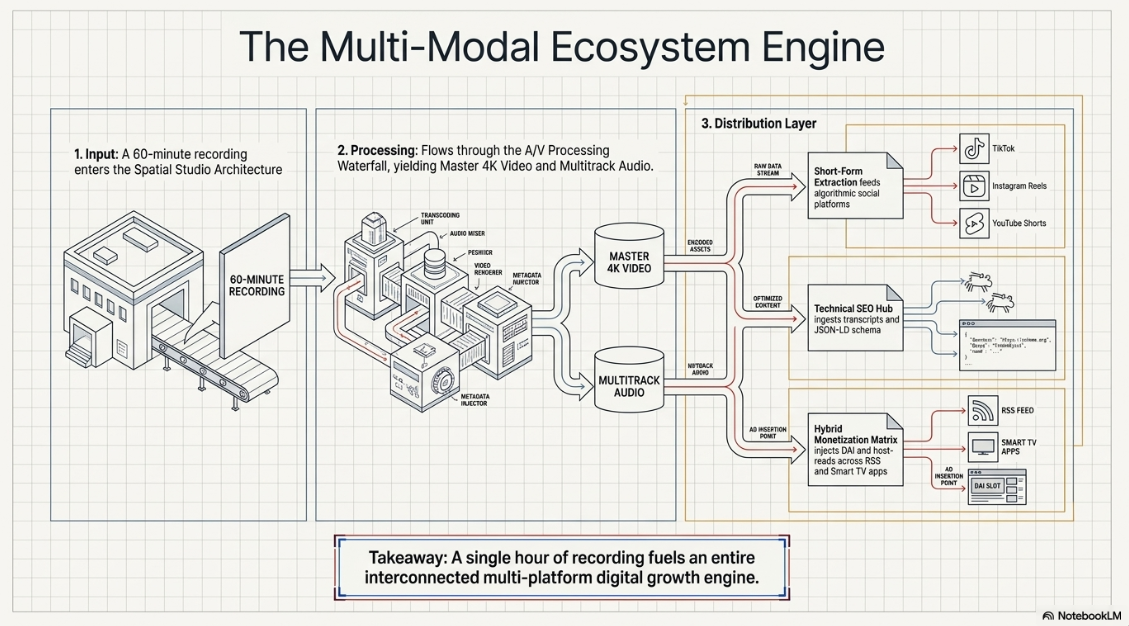
The modern podcast distribution model dictates that long-form episodes serve as raw material for a broader content ecosystem6. Creators utilize AI-powered clipping tools (such as Opus Clip, Descript, Vizard, and WaveGen) to scan transcript files, analyze emotional audio peaks, identify transitions, and automatically extract high-potential vertical clips27. These clips must be formatted to a 9:16 vertical aspect ratio (1080x1920) for platforms like TikTok, Instagram Reels, and YouTube Shorts29.
Successful short-form pieces are designed around specific parameters: they must open within the first 3 seconds with a "scroll-stopping" visual or verbal hook, deliver standalone value, be under 60 seconds in length, and feature highly styled, centered kinetic captions to engage the vast majority of mobile viewers who watch without sound.
Technical Search Engine and Answer Engine Optimization (SEO & AEO)
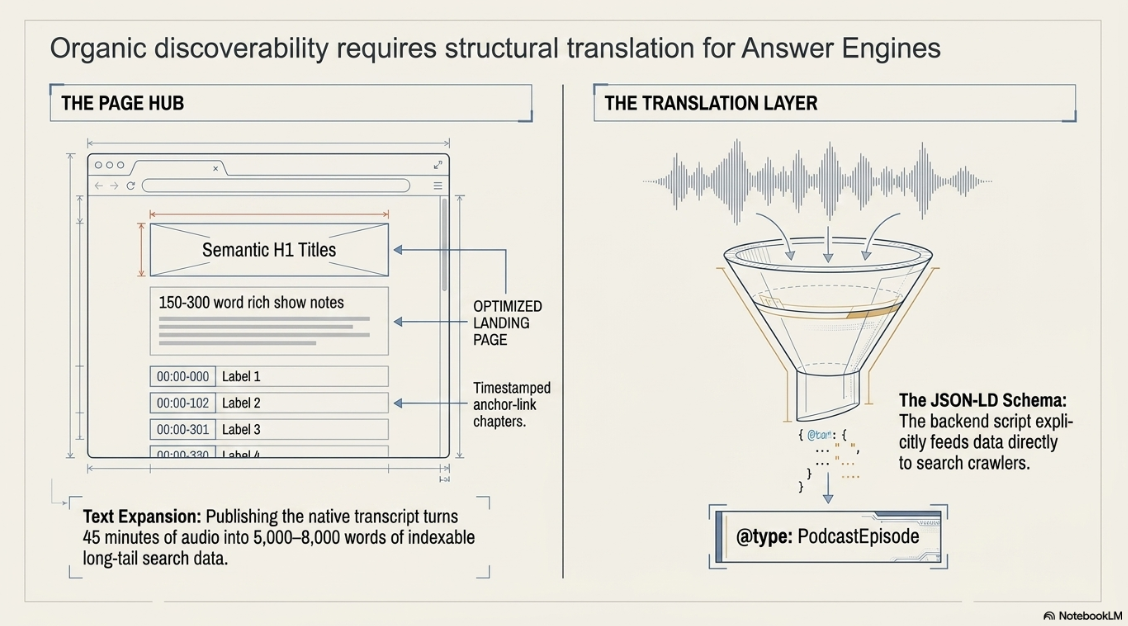
A critical structural insight for modern podcasting is that traditional search engines cannot crawl or index raw audio files directly33. Consequently, true organic search discoverability occurs on a dedicated website domain controlled by the creator, rather than within closed directories like Apple Podcasts or Spotify33. Each episode must have a dedicated, crawlable landing page that functions as a topical cluster hub33.
To ensure feed integrity and ensure that syndicated episodes publish correctly across all endpoints, creators must deploy RSS verification tools35. Platforms like Podbase and Cast Feed Validator analyze feed syntax, checking for formatting errors, missing image tags, or incorrect category declarations before the feed is crawled by platforms35. Once verified, these feeds syndication paths are locked36.
To maximize indexing by Google and modern AI-driven search tools (Answer Engine Optimization or AEO), the on-page content architecture must be structured intentionally34:
Semantic Headings: The page title should be mapped to an H1 tag, utilizing intent-driven, keyword-rich language rather than vague numbering34.
Rich Show Notes: A summary of 150 to 300 words that highlights key takeaways and incorporates primary search queries naturally35.
Timestamped Chapters: Structured outlines mapped to anchor links, enhancing both user navigation and platform indexing36.
Text Transcripts: Clean, edited transcriptions of the entire conversation published directly as live, crawlable on-page text (not as a downloadable PDF)33. This converts 30 to 60 minutes of spoken dialogue into 5,000 to 8,000 words of indexable text, capturing long-tail search intent effortlessly34.
Structured Schema Data: The integration of PodcastEpisode schema markup using JSON-LD metadata34. This script explicitly declares the episode name, description, duration, and transcript URL directly to search crawlers38.
JSON
{
"@context": "https://schema.org",
"@type": "PodcastEpisode",
"name": "Episode 47: How to Scale a B2B SaaS Podcast in 2026",
"description": "An in-depth analysis of technical SEO, platform algorithms, and monetization strategies for corporate podcasts.",
"duration": "PT42M30S",
"url": "https://example.com/podcast/episode-47",
"associatedMedia": {
"@type": "MediaObject",
"contentUrl": "https://example.com/audio/episode-47.mp3"
},
"transcript": "The full crawlable transcript text is embedded directly within this metadata block..."
}
With over 1 billion monthly podcast viewers, YouTube has become the primary search surface for podcast discovery7. The platform’s advanced search algorithm indexing operates synergistically with Google because both are managed by Alphabet, causing YouTube video uploads to appear heavily in standard Google search carousels7. To optimize for YouTube's algorithmic surface, creators must upload video files with descriptive, keyword-rich titles under 60 characters, utilize high-contrast custom-designed thumbnails rather than auto-generated video frames, and paste interactive timestamps in the description field, which YouTube automatically parses into searchable chapters on the video timeline7.
The Economics of Monetization: Advertising Models, CPM Tiers, and Conversion Metrics
The corporate monetization of podcasting operates on a multi-tiered spectrum that balances audience volume against niche audience alignment40. While massive networks leverage scale to aggregate millions of downloads, independent and niche shows utilize direct sponsorships, listener-supported subscriptions, and high-value business-to-business (B2B) lead-generation pipelines3.
The standard pricing mechanism for podcast advertising is built on the Cost Per Mille (CPM) model, denoting the flat rate paid per 1,000 downloads or impressions11. This rate is heavily influenced by the placement of the advertisement within the episode11:
Pre-Roll Ads (15-30 seconds): Placed in the opening minute11. Typical CPM ranges from $15 to $3011. While reach is high, skip rates are elevated as listeners are not yet fully immersed in the content11.
Mid-Roll Ads (60-90 seconds): Inserted into the core narrative when listener focus peaks11. Mid-rolls command a steep premium, ranging from $25 to $50+ CPM11. This format is the hardest to skip and accounts for 64% of total industry ad revenue, generating 2x to 3x higher click-through rates compared to pre-rolls11.
Post-Roll Ads (15-30 seconds): Placed at the conclusion of the episode, carrying the lowest entry cost and CPM ($10 to $20) due to low listener retention at the end of episodes11.
Host-read ads are highly effective because they leverage the established relationship of trust between the host and the listener, yielding a 71% higher brand recall compared to generic pre-produced commercial spots1. Consequently, direct-sold host-read ads command a massive premium across global markets11.
In contrast, programmatic advertising utilizes Dynamic Ad Insertion (DAI) to serve automated, pre-recorded, producer-read spots across a broad network of shows based on target audience demographics, geographic location, and listening behavior3. Programmatic CPM rates are significantly cheaper, ranging from $5 to $1811. In 2026, the dominant corporate strategy is a hybrid model, pairing programmatic pre-rolls for broad brand awareness with premium host-read mid-rolls to drive conversions and customer acquisitions3.
The economic value of this direct consumer connection is supported by empirical ad performance benchmarks12. According to audio research studies, approximately 76% of weekly podcast consumers report taking direct action after hearing an ad—including visiting a website, utilizing a promo code, or making a physical purchase43. Further surveys indicate that 57% of listeners visit an advertiser’s website, and 28% execute a purchase41.
This translates to a standard response rate (defined as the share of unique reached listeners who visit a designated URL or redeem a promo code) of 2.29%, outperforming standard digital display averages12. Furthermore, reallocating a portion of standard digital ad spend to podcasting can significantly boost audience reach43. Nielsen Podcast Fusion media mix modeling indicates that reallocating a portion of a standard media budget to podcasts lifts reach among adults aged 18 to 54 by up to 41% without increasing overall spend, confirming the efficiency of the medium43.
To understand the difference in advertising efficiency, it is valuable to compare programmatic audio costs against premium host-read buys in the same market11.
While open exchange dynamic ad insertion represents an accessible entry point for testing and brand-awareness campaigns, direct host-read placements remain the primary driver of customer acquisition11. This pricing tier distinction reflects the high cost of host exclusivity and the premium attention commanded by native integrations, which are perceived by 62% of listeners as less intrusive than standard digital ads1.
Beyond advertising, professional monetization has evolved to incorporate direct listener support and private subscription layers17. Platforms like Supporting Cast on Spotify enable publishers to gate premium video content behind subscription walls, offering ad-free episodes, bonus segments, and archive access directly inside the primary listening app40. This subscription model provides predictable recurring revenue streams, allowing independent creators to cover production costs ($1,400 to $5,000 for standard multi-camera studios) and de-risk their reliance on the traditional advertising market23.
Synthesis and Strategic Recommendations
The data and technical insights presented in this analysis demonstrate that professional podcasting is no longer an emerging digital trend; it is a mature, highly integrated, and multi-modal ecosystem6. The convergence of Connected TVs, multi-camera studio execution, AI-driven post-production workflows, and technical SEO requires media brands and independent creators to adopt a systems-based approach to content development6.
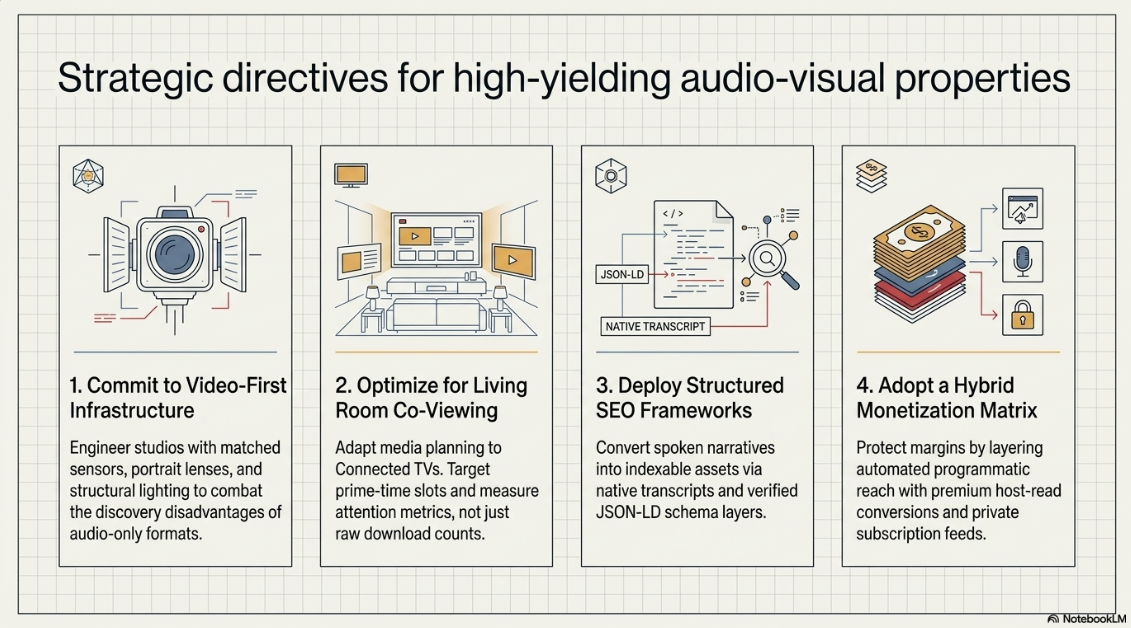
To maintain competitiveness and build sustainable, high-yielding audio-visual properties, professional practitioners must execute the following strategic directives:
Commit to a Multi-Format, Video-First Infrastructure: Standard audio-only formats are increasingly disadvantaged in discovery environments3. Studios must be engineered for multi-camera video capture using matched camera sensors, portrait-length lenses to establish spatial depth, and soft three-point LED lighting to ensure professional visual continuity20.
Optimize for Living Room Co-Viewing: Media planning must adapt to the Connected TV paradigm18. Because 44% of Smart TV video podcast consumption is shared, content must be structured to appeal to broader household groups during prime-time slots, and brand partners must assess campaign performance using attention-focused metrics rather than standard raw download counts12.
Deploy Technical SEO and Structured Data Frameworks: Crawlers and Answer Engines cannot read raw audio waves33. To rank in modern search interfaces, each episode must reside on an optimized website landing page containing clear semantic headings, verified RSS metadata, timestamped chapters, crawlable text transcripts, and properly formatted PodcastEpisode JSON-LD schema markup34.
Adopt a Hybrid Monetization Matrix: Relying solely on raw programmatic CPMs is economically risky40. Professional operations should layer automated programmatic DAI for top-of-funnel reach, direct-sold host-read integrations for premium conversion, and private premium subscription feeds to secure high-margin, recurring listener support6.
Works cited
Podcast Statistics 2026 | 80+ Facts & Data Points - Searchlab, https://searchlab.nl/en/statistics/podcast-statistics-2026
Video podcasts dominate: Opportunity for brands, competition for traditional video - Deloitte, https://www.deloitte.com/us/en/insights/industry/technology/technology-media-and-telecom-predictions/2026/video-podcasts-reach.html
Podcast Trends Shaping Sponsorships in 2026 | ThoughtLeaders Blog, https://www.thoughtleaders.io/blog/podcast-trends-2026
What's the difference between a "video podcast" and a "talk show"? - Hacker News, https://news.ycombinator.com/item?id=41772043
Podcasting vs. YouTube Channel: Why They're Not the Same | Heidy De La Cruz, https://www.heidydelacruz.com/podcasting-vs-youtube-channel
Podcasting Trends & Predictions for 2026: What Creators Need to Know | Podcast.co, https://blog.podcast.co/inspire/podcasting-trends-predictions-2026
Spotify vs Apple Podcasts vs YouTube: Where to Distribute Your Podcast in 2026, https://johnisaacson.co.uk/spotify-vs-apple-podcasts-vs-youtube-podcast-distribution-2026/
Video interviews vs podcasts – what do you need to know? - Angels Media, https://www.angelsmedia.co.uk/news_features/video-interviews-vs-podcasts-E28093-what-do-you-need-to-know
Video Podcasting: Why it's not just a talk show | Future Media Hubs, https://www.futuremediahubs.com/audiences-formats-hub/news/video-podcasting-why-its-not-just-talk-show
The Rise of Video Podcasting: Statistics and Trends 2026 - Podbean Blog, https://blog.podbean.com/video-podcast-statistics-2026/
How Much Does Podcast Advertising Cost? A Complete 2026 Pricing Guide - Media Bodies, https://mediabodies.com/blog/podcast-advertising-cost-2026-guide/
2026 Podcast Advertising: What the Numbers Show - Stack Influence, https://stackinfluence.com/blog/2026-podcast-advertising-what-the-numbers-show
33 Podcast Statistics 2026 (Number of Podcasts & Viewership), https://podcastatistics.com/
Podcast statistics & trends in 2026 - Beamly - The Podcast Website Builder, https://beamly.com/podcast-statistics/
The Podcast Consumer 2025 - SSRS, https://ssrs.com/insights/the-podcast-consumer-2025/
Podcast Statistics You Need To Know in 2026 - Backlinko, https://backlinko.com/podcast-stats
Podcast Statistics: The Current State of Podcasting - RSS.com, https://rss.com/blog/the-current-state-of-podcasting/
"Real implications" for brands as UK takes global lead for video podcast viewing, smart TVs surge - Prolific North, https://www.prolificnorth.co.uk/news/real-implications-for-brands-as-uk-takes-global-lead-for-video-podcast-viewing-smart-tvs-surge/
Podcasts Hit U.K. Prime-Time , News From Podcast Show London, & More - Sounds Profitable, https://soundsprofitable.com/the-download/podcasts-in-uk-primetime/
Your Multi Camera Podcast Setup: A Pro-Level Guide, https://flexworkstudios.com/multi-camera-podcast-setup/
Building a Simple Multicam Podcasting Kit - CVP.com, https://cvp.com/resources/articles/insights/building-a-simple-multicam-podcasting-kit
Multi-Camera Podcast Setup: Why It Matters for Your Brand - Krisha Studio, https://www.krishastudio.com/multi-camera-podcast-setup-production/
Multicam 2-Person Video Podcast and Live Streaming Setup Gear Guide, https://pss.media/blog/multicam-2-person-video-podcast-and-live-streaming-gear
The Complete Guide: Setting Up a Video Podcast Studio in 2025 - NearStream, https://www.nearstream.us/blog/how-to-setup-video-podcast
Premiere Pro Multicam Editing: Complete 2026 Workflow Guide - Pixflow.Net, https://pixflow.net/blog/premiere-pro-multicam-editing-workflow/
Premiere Pro Multicam Editing: Tools & Tips Guide - Cutback, https://cutback.video/blog/the-ultimate-guide-to-multicam-editing-in-premiere-pro-best-tools-tips-workflows
Best AI Content Repurposing Tools 2026 (Tested & Compared) | WaveGen, https://wavegen.ai/best-ai-content-repurposing-tools
Video Post Production Workflow: Our Ultimate Guide (Step-by-Step) - Simon Says AI, https://www.simonsaysai.com/blog/video-post-production-workflow
Repurpose Podcast Clips for Reels & TikTok Fast - Cutback, https://cutback.video/blog/the-fastest-way-to-repurpose-podcast-clips-for-instagram-and-tiktok-(proven-method)
8 Best AI Video Repurposing Tools for Podcasters: 2026 Edition, https://quso.ai/blog/best-video-repurposing-tools-for-podcasters
Best Video Repurposing Tools for 2025: Stay Ahead of the Curve - OpusClip Blog, https://www.opus.pro/blog/best-video-repurposing-tools
8 Best Practices for Repurposing Video Content - Exemplary AI, https://exemplary.ai/blog/best-practices-repurposing-video-content
SEO for Podcasts: 2026 Ultimate Guide - SpearPoint Marketing, https://www.thespearpoint.com/blog/seo-for-podcasts
Podcast SEO 2026: be found in Google & AI, Springcast Blog, https://www.springcast.io/en/blog/podcast-seo/
Podcast SEO: How to Rank #1 on Spotify, Google & Apple Podcasts in 2026, https://www.jigsawkraft.com/post/podcast-seo-how-to-rank-1-on-spotify-google-apple-podcasts-in-2026
Podcast SEO: How to Get Your Show Found in 2026 (and Beyond) - Saspod, https://saspod.com/blog/post/podcast-seo
Audio-Visual SEO: Why Your Agency Should Be Optimizing for Listen-Through Rates, https://www.dubseo.co.uk/insights/audio-visual-seo-trends
Podcast SEO: How AI-Generated Transcripts Boost Your Search Rankings | SparkPod, https://sparkpod.ai/blog/podcast-seo-ai-transcripts
Video SEO Best Practices for 2026 - Levitate Media, https://levitatemedia.com/learn/video-seo-best-practices-2026-advanced-strategies-for-maximum-visibility
How to monetize a podcast in 2026: the five revenue models, https://www.springcast.io/en/blog/how-to-monetize-a-podcast/
Podcast Monetization: Strategies and Tools (2026) - Shopify UK, https://www.shopify.com/uk/blog/podcast-monetization
Podcast CPM rates 2026: what ads pay, Springcast Blog, https://www.springcast.io/en/blog/podcast-cpm-rates/
The Podcast Consumer 2026 - Edison Research at SSRS, https://www.edisonresearch.com/the-podcast-consumer-2026/
New Gated Video on Spotify, UK Smart TV Podcasting, & More - Sounds Profitable, https://soundsprofitable.com/the-download/new-gated-video-on-spotify/