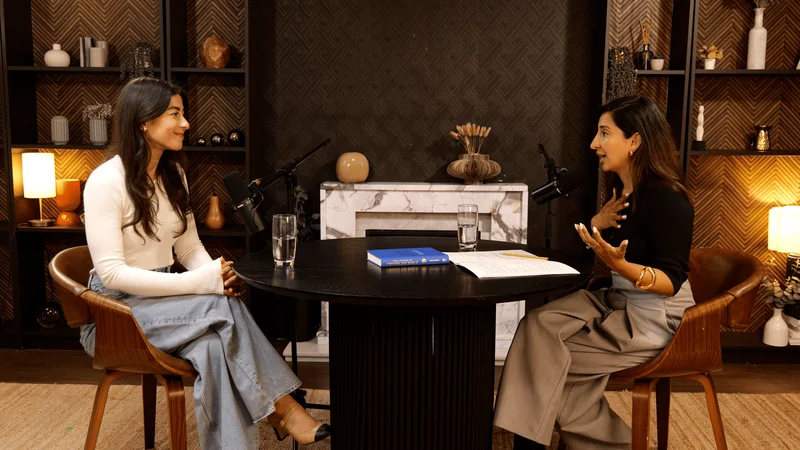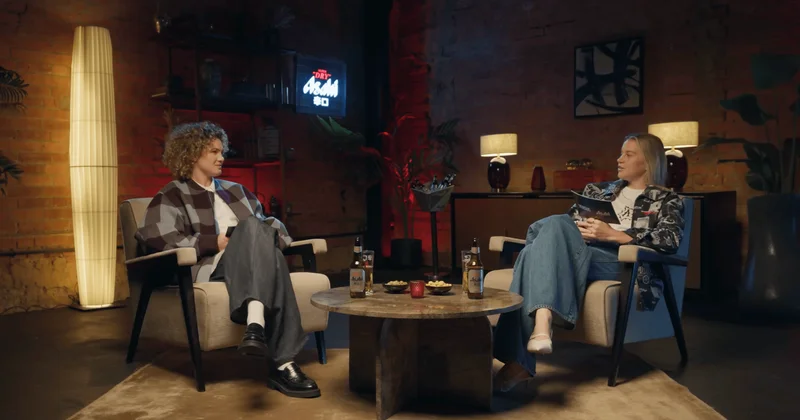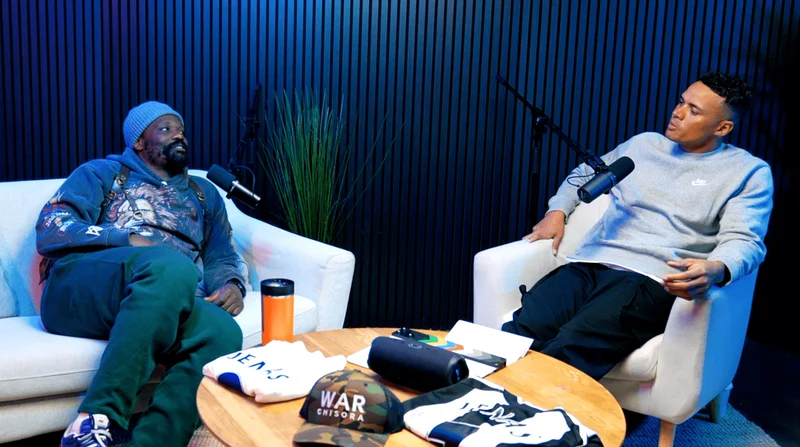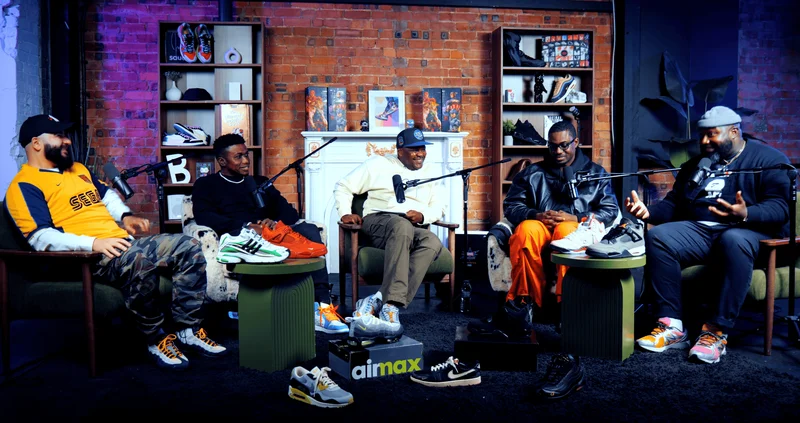
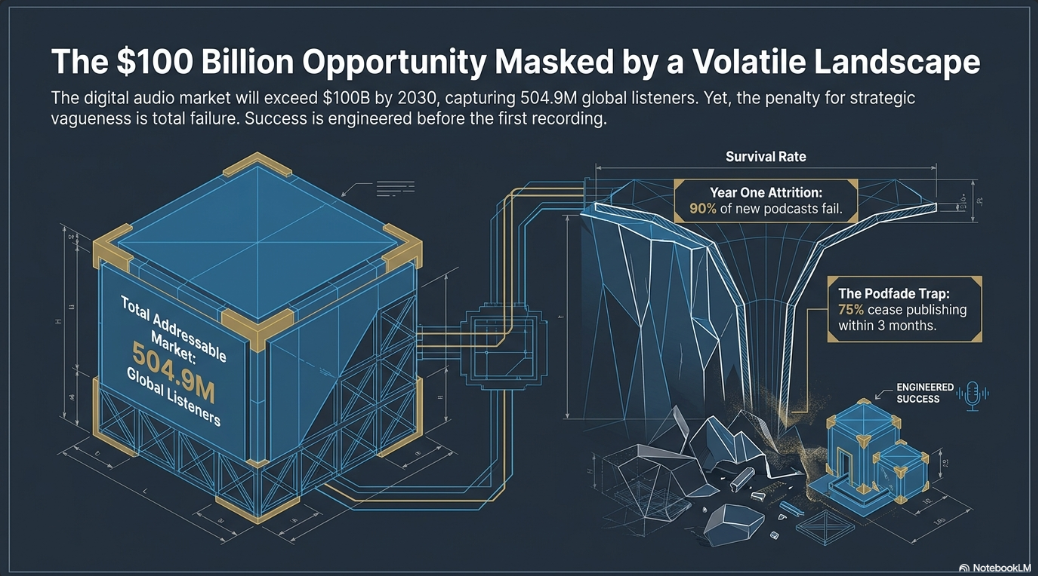
The podcasting medium has transitioned from a fragmented, hobbyist distribution channel into a sophisticated, multi-billion-dollar global media ecosystem. With industry projections indicating that the total addressable market for podcasting will exceed a $100 billion valuation by 2030, capturing a share of the 504.9 million regular global listeners requires unprecedented strategic rigor1. However, the deceptive accessibility of the medium masks a highly volatile landscape. Industry analyses demonstrate that approximately 90% of new podcasts fail within their first year, and 75% of creators succumb to "podfade"—the gradual cessation of publishing—within just three months of launch2.
The primary differentiators between the rare 10% of shows that compound into highly profitable, enterprise-scale media assets and the vast majority that fade into obscurity are established long before the first recording session takes place. Success in modern digital audio is engineered exclusively in the strategic pre-production phase. This critical preparatory period demands an exhaustive architectural blueprint that answers fundamental questions regarding editorial identity, audience cultivation, format selection, and the operational sustainability of the production engine. This report provides a comprehensive, data-driven analysis of the strategic pre-production lifecycle, offering actionable frameworks for formulating a compelling message, cultivating a high-intent pre-launch audience, determining the optimal podcast format, and architecting a defensible media business.
Architecting the Editorial Identity and Unique Value Proposition
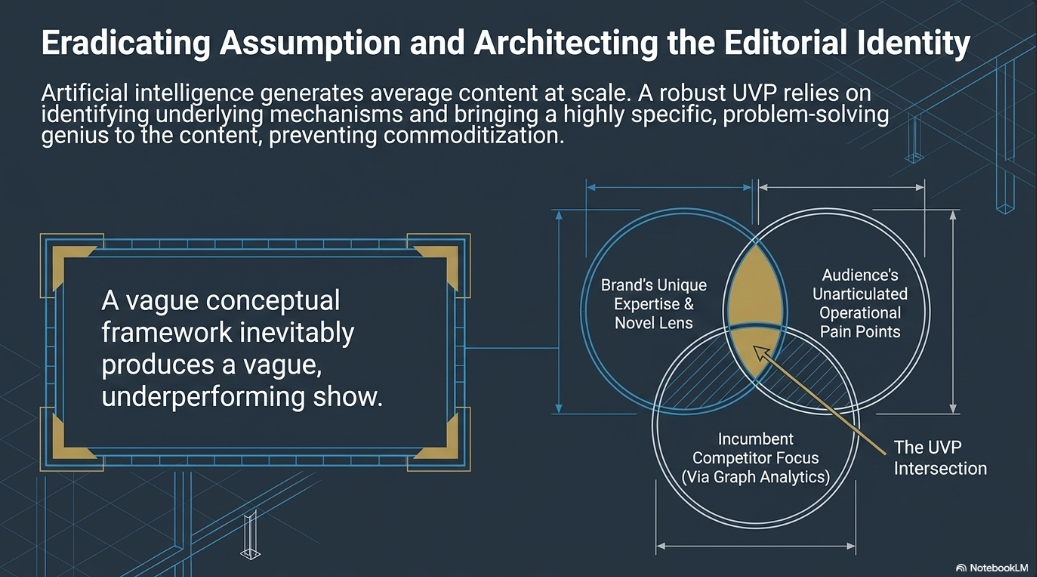
The most critical decision in podcast pre-production involves establishing a rigorous, uncompromising editorial identity. The foundational rule of digital media development dictates that a vague conceptual framework inevitably produces a vague, underperforming show4. A professional podcast must operate with a highly specific business objective—whether that entails audience development, brand awareness, direct lead generation, or establishing thought leadership in a niche market4.
The Threat of Commoditization and the Necessity of the UVP
In an era where artificial intelligence allows for the generation of average content at scale, remaining conceptually average is the most dangerous operational position a brand can occupy6. To counteract this commoditization, strategists must develop a powerful Unique Value Proposition (UVP). A UVP is a definitive statement describing the specific benefit of the podcast, the precise mechanism by which it solves a listener's needs, and the qualitative factors that distinguish it from incumbent shows7.
Differentiation in saturated markets rarely stems from merely increasing production volume or chasing transient trends; rather, it emerges from uncovering unaddressed audience pain points and presenting specialized information through a novel, highly authoritative lens6. The competitive advantage lies in identifying the exact intersection between a brand's unique expertise and the audience's unarticulated needs. For instance, a robust B2B podcast UVP might bypass general industry news to promise exclusive insights from elusive C-suite executives, actionable frameworks for specific operational headaches, or transparent, unauthorized post-mortems of corporate failures9. Marketing strategist Todd Brown emphasizes that true direct-response differentiation requires identifying underlying mechanisms and bringing a highly specific, problem-solving genius to the content10.
Competitor Auditing and Graph Analytics
Developing a durable UVP requires a systematic, empirical approach to competitor analysis. Strategists must map the competitive landscape by identifying similar podcasts using audience graph tools, such as Rephonic, to visualize audience overlap and discover adjacency in listening habits7.
Once a cluster of relevant shows is identified, producers must conduct an active auditory audit. This involves sampling a cross-section of episodes and grading them across multiple vectors, including audio fidelity, average runtime, segment formatting, host pacing, and sound design7. By logging these variables into a structured matrix, creators can identify exploitable gaps in the market. If incumbent shows universally utilize a standard 60-minute interview format, a new entrant might differentiate by launching a highly produced, 20-minute multi-story documentary format7. The objective is not to replicate success, but to identify the specific elements—such as pacing, guest caliber, or thematic focus—where the new podcast can establish immediate superiority.
Eradicating Assumption: The Customer Discovery Protocol
A pervasive strategic error in podcast pre-production is assuming the market desires a specific type of content without securing empirical validation. Steven Bartlett, host of The Diary of a CEO, attributes the rapid scaling of his media empire to a core philosophy: assuming one does not know the right answer and actively "killing guessing" across all instances of production11. By removing creative romance and replacing it with rigorous data, producers prevent the creation of content that fails to resonate with the target demographic11.
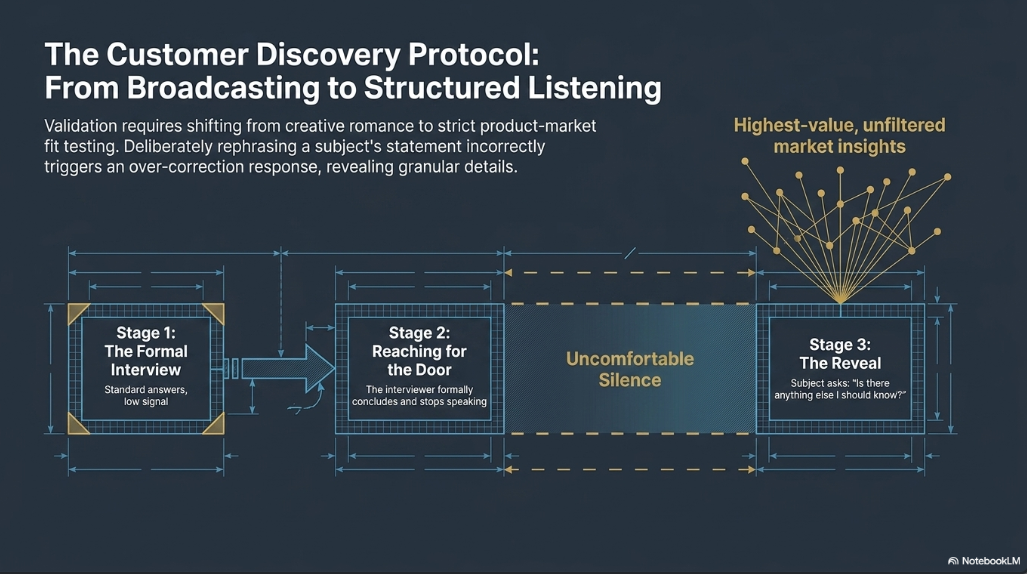
Validation must mirror strict product-market fit testing, shifting the creator's role from broadcasting to structured listening12. Employing deep customer interview techniques, such as those outlined by Michele Hansen in Deploy Empathy, can uncover the profound gap between what a creator intends to solve and the audience's actual operational realities12.
Effective discovery interviews strictly prohibit pitching. Instead, the interviewer employs specific psychological triggers to elicit honest feedback. One highly effective tactic is the "reaching for the door" question. The interviewer formally concludes the session, thanks the subject, and then pauses, allowing an uncomfortable silence before asking, "Is there anything else you think I should know?" This conversational gap consistently produces the most valuable, unfiltered insights12. Additionally, deliberately rephrasing a subject's statement incorrectly can trigger an over-correction response, revealing granular process details that straightforward questioning fails to surface12. If potential listeners refuse to even engage in a discovery conversation about the proposed podcast topic, it serves as a stark empirical signal that the underlying problem is not painful enough to sustain a dedicated, long-term audience12.
Cultivating a High-Intent Audience Prior to Launch
The traditional pre-launch marketing playbook for digital products heavily relies on generating superficial hype and building massive email waitlists. However, contemporary marketing analytics reveal that a large waitlist is not synonymous with actual market traction13. Because signing up for a standard waitlist requires zero financial or temporal commitment, the resulting metric often predicts almost nothing about actual listener engagement or conversion on launch day13. Strategic pre-launch marketing must pivot from vanity metrics to the cultivation of high-intent, highly engaged micro-communities.
Anticipation Marketing and the Six-Step Framework
A strategic pre-launch phase should be temporally bounded to four to eight weeks, focusing exclusively on meaningful audience interactions rather than raw email capture13. The objective is to make the eventual launch a highly anticipated event for a dedicated cohort, rather than broadcasting a new RSS feed into a digital void. This outcome is achieved through "Anticipation Marketing," a strategic methodology that systematically builds audience belief in the problem being addressed, belief in the proposed solution, and belief in the host's fundamental authority to deliver that solution14.
To execute this, pre-production teams should utilize a sequential, six-step framework:
Direct Problem Interrogation: Engage twenty individuals who actively experience the pain point the podcast addresses. This unscalable, uncomfortable work yields the highest signal-to-noise ratio13.
Build in Public: Document the development of the podcast transparently. By the time the show ships, early observers feel a vested psychological investment in its success13.
Deploy a Singular Landing Page: Create a highly focused landing page utilizing the exact verbiage extracted from the initial twenty interviews13.
Infiltrate Existing Communities: Show up consistently in niche forums, subreddits, or LinkedIn groups where the target audience already congregates. Answer questions and build a reputation without linking to the upcoming show, transforming the eventual launch announcement into a trusted recommendation rather than a cold advertisement13.
Target Early Adopters: Focus energy on individuals with a proven track record of testing new media formats and providing constructive feedback13.
Humanize Email Communication: Eschew automated, corporate newsletters in favor of sending short, personal notes detailing the build process, the technical failures, and the lessons learned. This ensures the audience actually remembers the creator when the launch email is eventually deployed13.
During this phase, success is not measured by the aggregate number of signups, but by the volume of unprompted conversations, the reply rate to developmental emails, and the specificity of audience inquiries regarding the launch date13.
The Efficacy of Private Podcasts as High-Converting Lead Magnets
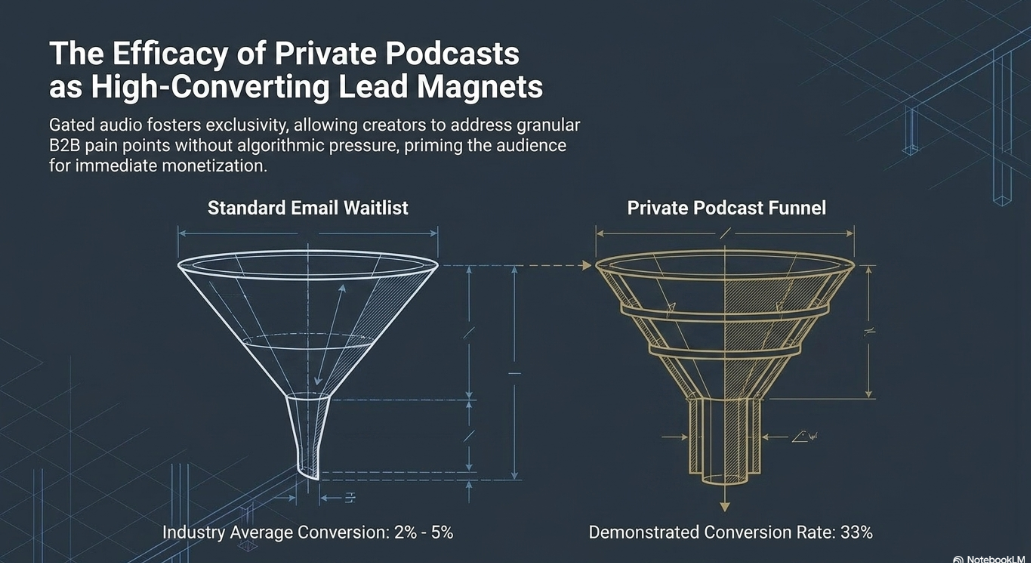
An emerging and highly effective tactic for cultivating a pre-launch audience is the deployment of a private, gated podcast. A private podcast requires users to explicitly exchange their email address for a secure RSS feed or a unique access link, effectively acting as a high-value, auditory lead magnet15.
Private podcasts foster a profound sense of exclusivity and intimacy. Because the content is explicitly curated for a highly targeted group—such as prospective buyers of a high-ticket B2B service or an upcoming digital cohort—it allows creators to address granular pain points and showcase deep expertise without the pressure of appealing to a broad algorithmic audience15.
The conversion metrics associated with this strategy are exceptional. While average landing page conversion rates across industries hover between 2% and 5%, well-architected private podcast funnels can yield exponentially higher returns. For example, digital marketing strategist Emily Reagan utilized a limited-series private podcast (hosted via Hello Audio) to nurture her waitlist for a premium marketing assistant program, achieving an astonishing 33% conversion rate from lead to buyer15. This strategy not only builds a highly qualified email list prior to the launch of a public show but also primes the audience for immediate monetization by delivering linear, step-by-step, actionable value15.
Launch Day Execution and Guest Network Leverage
When the public podcast is finally ready for algorithmic distribution, launching with a single episode is a critical tactical error. Both platform algorithms and listener psychology heavily favor immediate binge consumption. Publishing three to five episodes simultaneously on launch day is the industry standard for maximizing initial engagement16. This multi-episode drop signals to the audience that the show possesses depth, satisfies immediate curiosity, and provides enough aggregate listening time to trigger favorable placements in directory charts, such as Apple Podcasts' "New and Noteworthy" section16.
Furthermore, the launch must be supported by a highly coordinated distribution of rich media, deployed across the host's and guests' respective networks. To minimize friction and guarantee guest compliance, creators must supply a comprehensive digital asset package on launch day16. This package should include customized audiograms, striking quote graphics, universal tracking links (via platforms like PodFollow or PodLink), and pre-written social media copy tailored to the guest's tone16. Tagging relevant corporate entities and leveraging the guest's existing credibility serves as a form of "borrowed trust," bypassing the skepticism typically directed at cold advertising17.
Architectural Blueprint: Determining the Podcast Format
The format of a podcast must never be selected based on arbitrary industry trends; it must flow organically from the Unique Value Proposition and the operational realities of the production team5. The structural configuration determines the pacing, the required technical resources, the monetization potential, and the listener demographic19.
Analyzing Primary Podcast Formats and Market Dominance
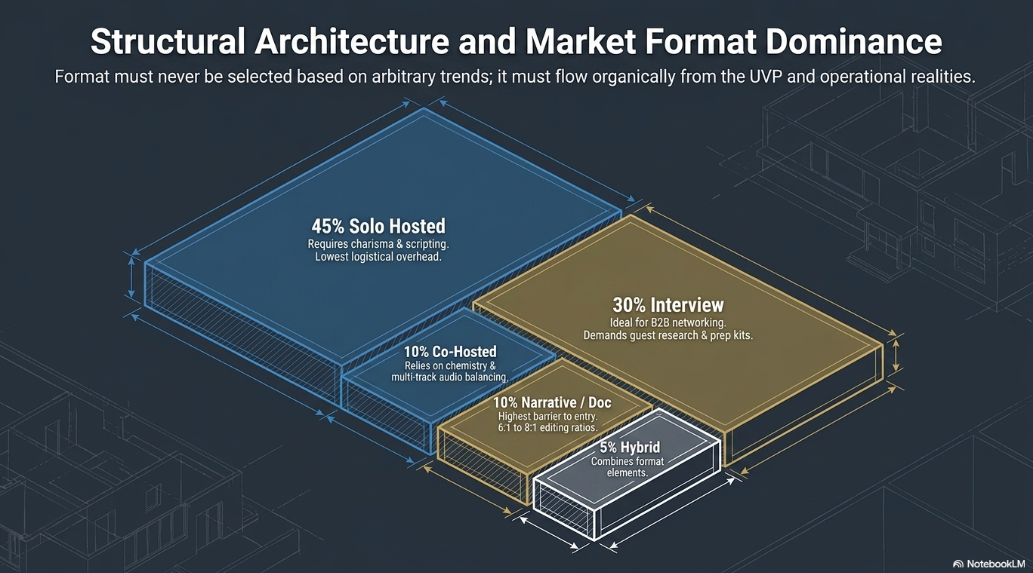
Market data analyzing high-impression shows provides clear benchmarks regarding format viability and audience preferences20.
Data reflecting format prevalence among high-impression podcasts20.
The dominance of the solo format (45%) among high-impression shows underscores the market's robust appetite for unfiltered, direct expertise and efficient problem-solving20. However, interview shows (30%) remain a highly strategic choice for B2B networking, lead generation, and audience cross-pollination20.
When executing an interview format, standardizing guest management is an absolute necessity. A professional pre-production workflow requires sending a comprehensive prep kit to guests well in advance. This kit must include logistical details (recording links, time zones), strict technical guidelines (mandatory use of external microphones and headphones to prevent audio bleed), a thematic outline rather than a rigid script to encourage natural flow, and a detailed audience profile so the guest can tailor their technical vernacular accordingly9.
Optimizing Episode Length: Cognitive Commitment vs. Depth
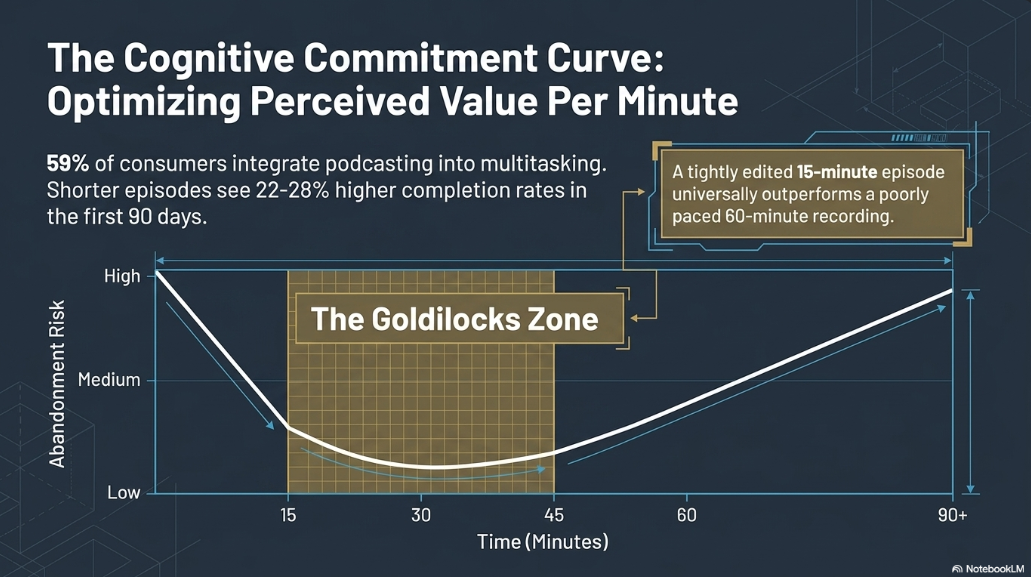
Episode length is a highly debated variable, but behavioral analytics reveal clear patterns governing listener retention. The ideal duration is dictated by the concept of "perceived value per minute" and cognitive commitment21. When a listener is presented with a 60-minute episode, the mental contract is substantial; if the initial pacing is slow or the content does not immediately justify that massive temporal commitment, abandonment is highly likely21.
Industry benchmarks suggest that episodes running between 20 and 40 minutes achieve the optimal balance of topical depth and completion rates21. Shorter episodes (under 30 minutes) consistently demonstrate completion rates 22 to 28 percentage points higher than longer formats, particularly during the first 90 days of a show's lifecycle when listener loyalty is still actively forming21. Furthermore, a 20-to-40-minute window aligns perfectly with average daily commute times, fitness routines, and domestic chores, which is crucial given that 59% of podcast consumers integrate listening into these multitasking activities23.
Conversely, long-form podcasts (60 to 180+ minutes) sacrifice broad, top-of-funnel completion rates in favor of generating intense, cult-like audience loyalty22. Long-form content builds deep trust and habituation, making it highly attractive for premium sponsorships and high-ticket B2B conversions, provided the content density justifies the extensive runtime22. Ultimately, the runtime must serve the content; a tightly edited, high-density 15-minute episode will universally outperform a rambling, poorly paced 60-minute recording22. If analytics reveal that an audience consistently bails at the 25-minute mark, the production team must ruthlessly trim the episode down to match that behavioral reality22.
The Audio vs. Video Dilemma: Analyzing Costs, Algorithms, and Conversions
As of 2026, the strategic discourse surrounding podcasting is overwhelmingly dominated by the convergence of audio and video. Major streaming platforms have heavily incentivized video integration, and empirical data suggests that 75% of weekly podcast listeners now prefer some form of video component25. Furthermore, YouTube has cemented itself as the primary discovery engine for new podcasts, capturing 33% of the global market share for podcast consumption and serving as the primary discovery platform for 84% of Gen Z listeners1. However, treating video simply as an inexpensive bolt-on to an audio strategy is a severe operational miscalculation that routinely breaks production budgets.
Production Economics: The Hidden Costs of Visuals
Adding a video component fundamentally alters the economics and operational cadence of a podcast. Market analysis reveals that integrating video increases the cost per hour of audience attention by a staggering 77% and triples the required post-production time per episode25.
Data sourced from industry production pricing benchmarks25.
An audio-only edit for a standard one-hour interview typically requires two to four hours of audio engineering time. Adding multi-camera sync, color grading, lower thirds, and platform-specific visual exports adds an additional six to twelve hours of highly technical labor25. Furthermore, the assumption that a long-form video automatically yields highly engaging short-form social clips (Shorts, Reels, TikToks) without additional cost is flawed. Extracting, re-framing for vertical orientation, captioning, and optimizing short-form content requires dedicated editorial oversight, often costing between $75 and $200 per individual clip25.
Completion Rates vs. Commercial Conversion
The decision between executing an audio-only or a video-first strategy ultimately rests on a complex trade-off between absolute content retention and direct commercial conversion.
Audio remains the undisputed champion of deep, sustained retention. Because audio seamlessly integrates into passive, multitasking environments—such as driving, working, or exercising—it commands an average episode completion rate of roughly 80%23. In contrast, video podcasts demand active, foreground cognitive attention. Consequently, long-form video podcasts suffer from steep drop-offs, with average watch-through rates hovering between 12% and 60%, depending heavily on the platform and visual dynamism25.
However, when analyzing bottom-line business metrics—specifically lead generation, trust building, and sales conversions—video vastly outperforms audio28.
Data reflecting B2B conversion benchmarks and platform advertising standards28.
The mechanism driving this conversion disparity is physiological and highly situational. Video accelerates the establishment of trust; research from MIT indicates that humans form baseline trustworthiness assessments within 100 milliseconds of viewing a face28. By the time a host finishes their video introduction, the viewer has subconsciously decided if they trust the brand28. More practically, a viewer watching a video podcast is already stationed at a device with a screen, making the friction to click a call-to-action (CTA) link in the description nearly nonexistent. Conversely, an audio listener driving a vehicle cannot safely execute a click-through, leading to massive attribution loss and a much longer sales cycle for audio-only campaigns28.
Therefore, the strategic recommendation is nuanced: If the objective is deep thought leadership, maximum auditory retention, and sustainable production on a lean corporate budget, audio-only is vastly superior25. If the objective is rapid algorithmic discoverability via YouTube, aggressive B2B lead generation, and the creation of a multi-platform micro-content engine, the immense capital expenditure of video is easily justified by its superior ROI28.
The Illusion of Short-Form ROI and Algorithmic Advertising
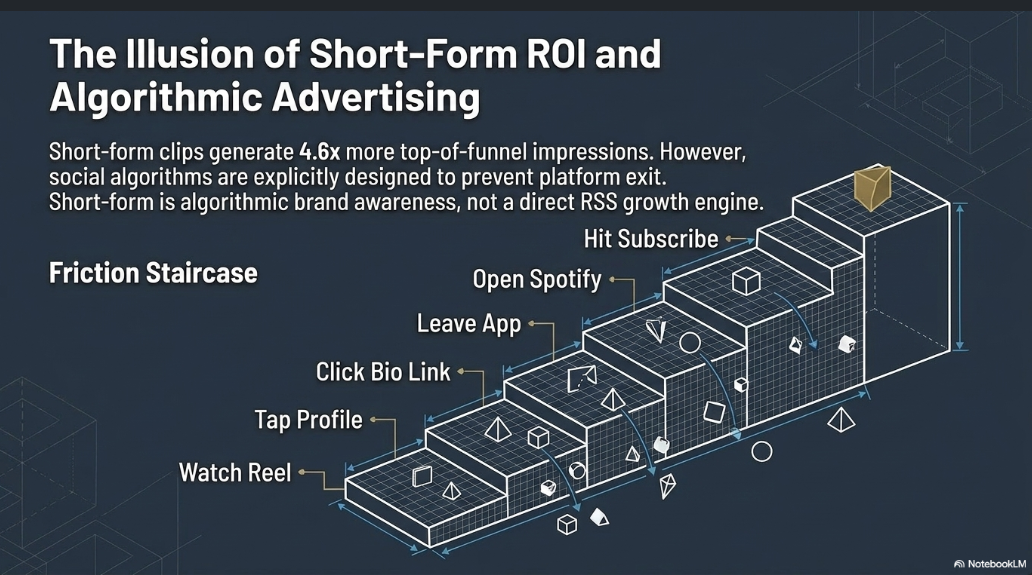
It is critical to address a pervasive myth in modern podcasting: the belief that short-form vertical clips will seamlessly convert social media scrollers into long-form podcast loyalists. While clipping a video podcast into 60-second segments for TikTok, YouTube Shorts, or Instagram Reels is exceptional for generating raw top-of-funnel impressions (often yielding 4.6x more total impressions than full episodes), the conversion rate from a short-form view to a long-form audio stream is notoriously poor24.
Social media algorithms are explicitly designed to retain users within their respective applications. The user journey required to convert a short-form viewer—watching a clip, tapping a profile, clicking a bio link, leaving the app, opening Spotify or Apple Podcasts, initiating a 45-minute episode, and deciding to subscribe—introduces immense friction24. Very few users complete this journey. Short-form video should be viewed strictly as algorithmic advertising and brand awareness, not as a reliable, direct growth engine for the core RSS feed24. As data indicates, video podcasts repurposed into Shorts generate massive engagement on the host platform (driving 8.3% of channel engagement for smaller creators), but they serve a fundamentally different psychological need than long-form audio, which builds habit and depth24.
Operationalizing Production, Financial Modeling, and Avoiding Podfade
The industry graveyard is filled with podcasts that possessed brilliant editorial concepts but lacked the operational stamina to survive. Execution is where shows die, as podcasting is an unrelenting, weekly commitment that exposes any fragility in a team's workflow31.
The Realistic Timeline, Editing Ratios, and Financial Modeling
A sustainable podcast operation must map its workflow against realistic timelines and accurate financial modeling. A standard pre-production phase requires two to four weeks for conceptualization, guest outreach, and script development32. The recording phase requires a one-to-two-week buffer to account for technical failures and inevitable guest cancellations32. Post-production typically spans three to five days per episode, followed by a dedicated week for publishing, marketing, and distribution32.
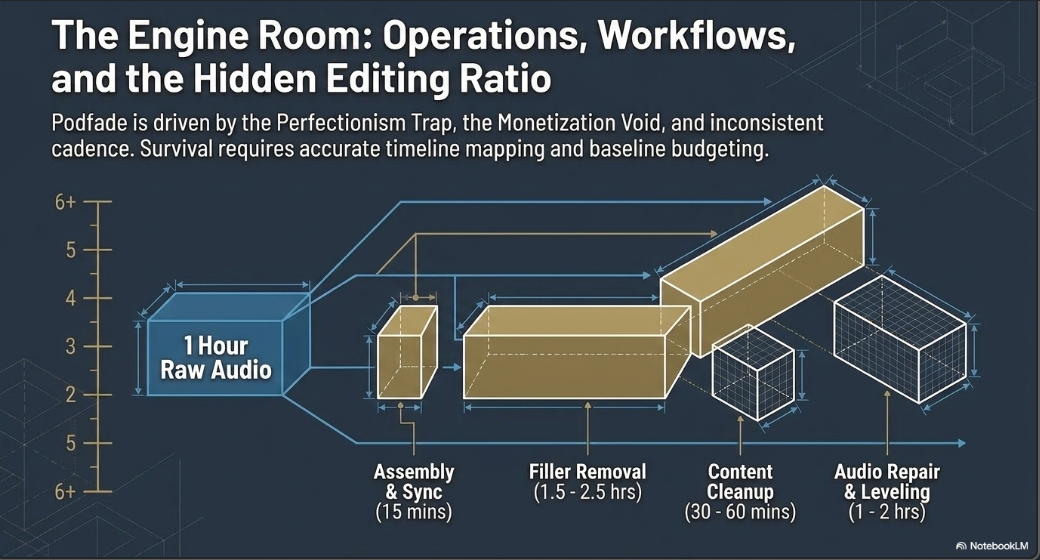
The most severely underestimated variable in this timeline is the editing ratio. Industry data reveals that the absolute minimum ratio for a basic conversational audio podcast is 1.5:1 (one and a half hours of editing for every hour of raw audio)33. However, the median ratio is generally 2:1 to 4:1, and complex narrative or multi-camera video formats routinely demand ratios of 6:1 to 8:133.
For a standard 30-minute episode, an editor utilizing Digital Audio Workstations (DAWs) like Reaper, Audacity, or Adobe Audition will typically spend 15 minutes on track assembly and synchronization, 1.5 to 2.5 hours meticulously removing filler words (ums, ahs) and unnatural pauses, 30 to 60 minutes on content cleanup (cutting off-topic tangents), and an additional 1 to 2 hours on audio repair (fixing hums, hisses, plosives, and leveling)35. While AI tools like Descript have accelerated text-based rough cutting, and hardware solutions like the Dugan Automixer drastically reduce phase cancellation across multiple microphones, professional-grade polishing still requires intensive manual oversight33.
When outsourcing this labor, strategists must accurately forecast budgets. Typical freelance producer rates vary by complexity: basic editing and mixing costs $25–$50 per hour, advanced editing and sound design costs $50–$100 per hour, and full-service production runs $75–$150 per hour36. A realistic baseline monthly budget for a weekly, 30-minute B2B audio podcast (comprising 3 hours of editing per episode at $50/hr and 1 hour of show notes at $35/hr) equates to roughly $740 per month, exclusive of hosting, marketing, and distribution costs36.
Diagnosing and Mitigating the Root Causes of Podfade
Understanding why creators quit is essential for building defensive operational moats. Beyond simple time and budget constraints, the primary drivers of podfade include:
The Perfectionism Trap: Many novice hosts expect to possess elite broadcasting skills on day one. The pursuit of flawless audio and presentation paralyzes publication. A highly valuable, moderately polished episode will always outperform a perfectly polished episode that remains unpublished due to editorial gridlock2.
The Monetization Void (Lack of Immediate ROI): Podcasting is a slow-burn medium. Data indicates that 61% of podcasters earn under $100 per month directly from their show, and meaningful CPM-based monetization typically requires a threshold of at least 10,000 downloads per episode37. Creators who launch with the expectation of immediate advertising revenue inevitably succumb to frustration38.
Inconsistent Cadence: Committing to an overly ambitious release schedule (e.g., bi-weekly or daily) without the requisite post-production infrastructure leads to missed deadlines, loss of momentum, and eventual abandonment38. To mitigate burnout, strategists recommend "batching"—recording multiple episodes in a single consolidated session to create a content buffer9.
Measurement, Analytics, and Advertising Efficacy
As a podcast matures, subjective assessments of success must be replaced by rigorous data analytics. The podcasting industry has standardized around the IAB (Interactive Advertising Bureau) v2.1 Measurement Guidelines, which enforce strict rules for counting legitimate downloads. These guidelines require de-duplicating IP addresses and user agents within a 24-hour window, and they mandate that a request must fetch at least one minute of audio to be officially counted as a "listen"39.
The Spotify Conversion Funnel and Retention Analytics
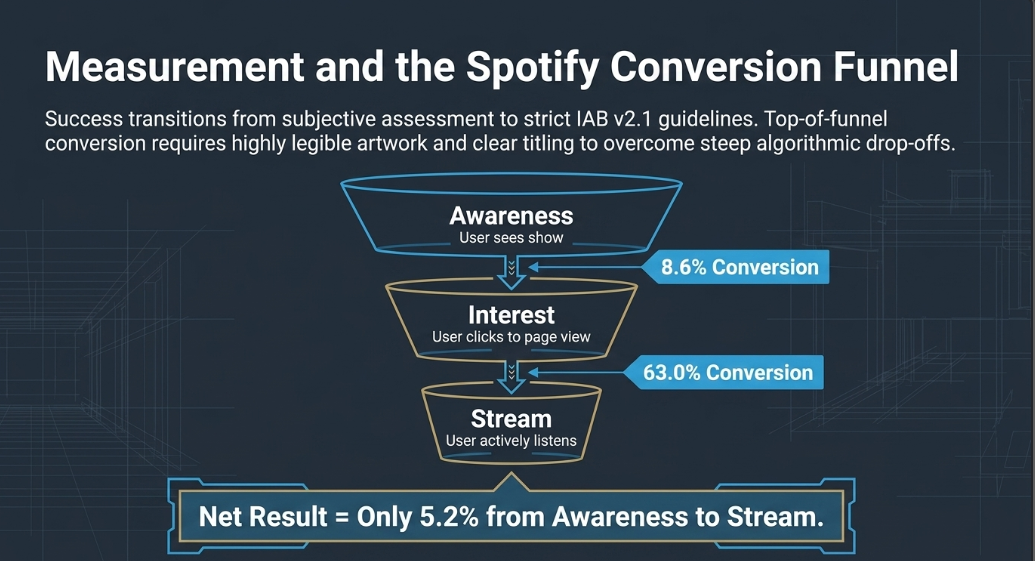
Platforms like Spotify provide granular data mapping the user journey from discovery to consumption. Analyzing Spotify's podcast impression benchmarks reveals a steep conversion funnel: the median conversion rate from a user seeing a show (Awareness) to engaging with its page (Interest) is 8.6%20. From that point, the conversion rate from Interest to actively streaming the episode is 63.0%, resulting in an overall Awareness-to-Stream conversion rate of just 5.2%20. This data underscores the critical importance of highly legible, legitimate artwork and clear titling to maximize top-of-funnel click-throughs20.
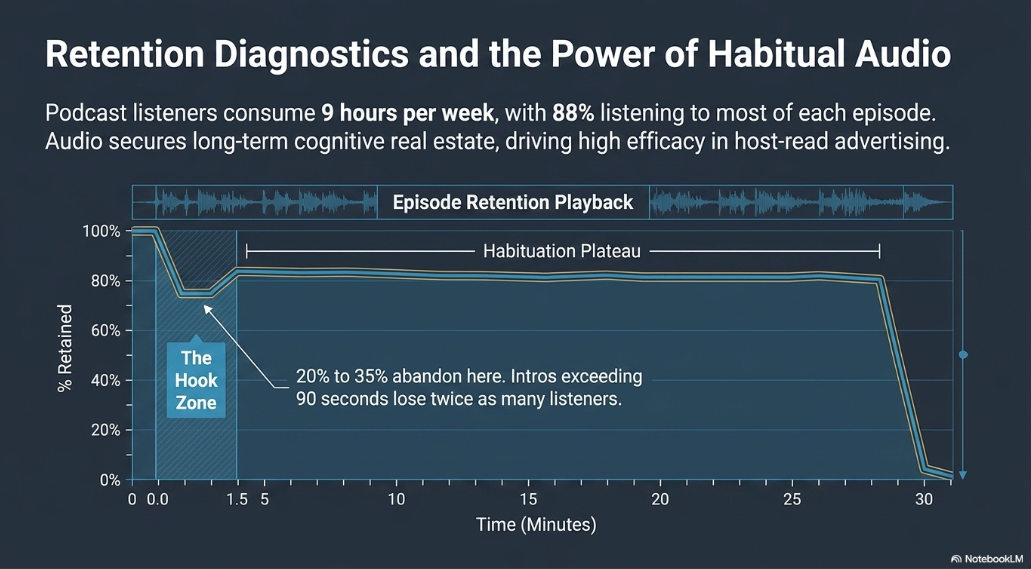
Once a user is streaming, retention analytics become paramount. The industry average for episode completion hovers around 80%23. If an episode's completion rate plummets below this benchmark, the retention curve usually points to a specific structural failure. Data shows that 20% to 35% of listeners will abandon an episode within the first five minutes if the introduction fails to hook them; specifically, intros exceeding 90 seconds lose nearly twice as many listeners as concise 30-to-60-second openings26.
RAJAR MIDAS Data and The Power of Habitual Audio
Broader market data, such as the UK's RAJAR MIDAS (Measuring Internet and Digital Audio Services) survey, reinforces the medium's profound depth and habitual integration into daily life. The 2025/2026 data indicates a highly stable 24% to 27% weekly reach among UK adults, with podcast listeners consuming an average of 9 hours of content per week40.
Furthermore, this engagement is deep; 88% of UK podcast listeners report listening to all or most of each episode they start40. While connected audio and on-demand streaming grow rapidly among younger demographics, live radio still dominates total time spent due to its role in providing companionship42. However, podcasts increasingly serve similar "need states," particularly for relaxation and staying informed, cementing audio as a medium that secures habitual, long-term cognitive real estate43.
Advertising Placements and Efficacy
When inserting advertising into this highly engaged medium, placement and measurement are critical. Pre-roll advertisements generally capture the highest volume of ears, as listeners have just initiated the stream44. However, mid-roll ad placements offer superior retention, as they are harder for savvy listeners to skip and lend themselves naturally to authentic, host-read endorsements integrated directly into the narrative flow44.
The efficacy of these ads is exceptionally high, particularly among younger demographics such as Gen Z, who report high levels of brand interest and site visitation following podcast advertisements45. When tracking this efficacy, platforms like Spotify Pixel report conversions across multiple attribution windows (e.g., 1-day post-click, 7-day post-impression). Because audio is typically consumed while multitasking, ads show significantly stronger view-through (post-impression) attribution than immediate click-through attribution, proving that the creative is driving delayed action even if immediate clicks are low29.
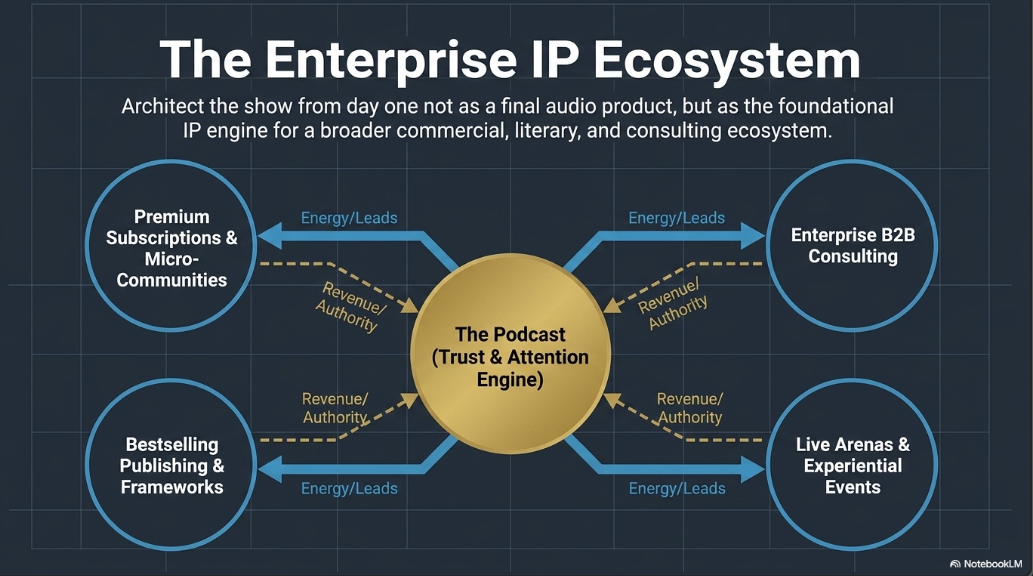
Architecting Media Empires: Enterprise Case Studies
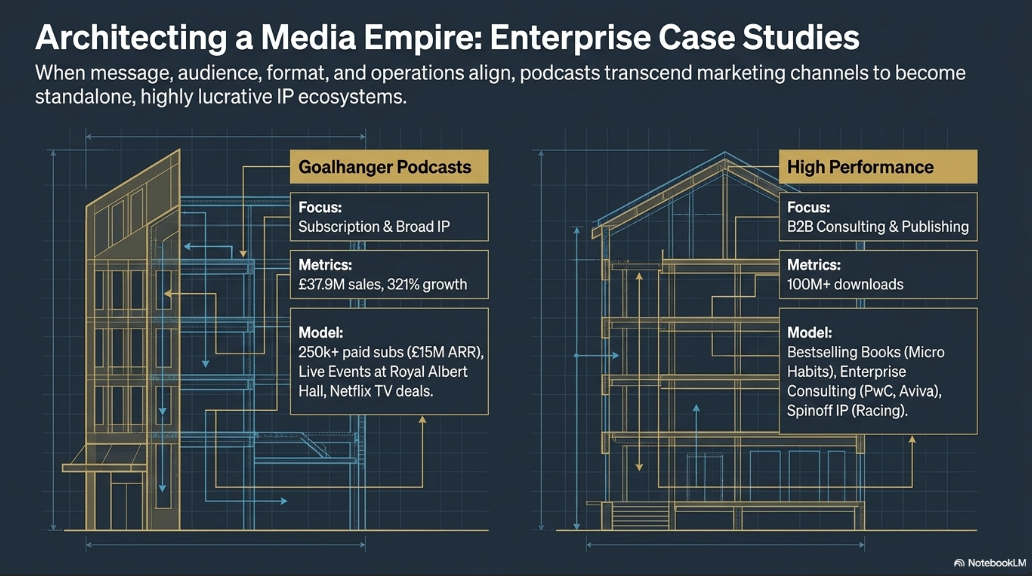
When the pillars of message, audience, format, and production are perfectly aligned, podcasts transcend simple marketing channels and evolve into standalone media empires. Two prominent UK examples illustrate the pinnacle of podcast monetization, scale, and intellectual property (IP) expansion.
Goalhanger Podcasts: The Subscription and IP Ecosystem
Co-founded by Gary Lineker, Tony Pastor, and Jack Davenport, Goalhanger has rapidly scaled into the UK's fastest-growing private company, reporting £37.9 million in sales in 2025 and an astonishing 321% three-year average growth rate46. Generating over 750 million full-episode streams annually, their strategic brilliance lies in diversifying revenue streams beyond standard advertising47.
Goalhanger successfully implemented a direct-to-consumer subscription model, creating intense fandoms around distinct niches with shows like The Rest Is History and The Rest Is Politics46. As of January 2026, the company surpassed 250,000 paying members across its "Club" offerings, with users paying an average of £60 per year for ad-free feeds, early access, and Discord community integration47. This membership base generates an estimated £15 million in high-margin, recurring annual revenue before a single corporate advertisement is sold47.
Furthermore, Goalhanger views its audio feeds not as final products, but as incubators for broader IP. Following a minority investment from The Chernin Group (TCG) in 2026, the company is actively extending its audio-first IP into television, film, and massive live events, exemplified by their multi-million-pound deal with Netflix to broadcast The Rest Is Football during the 2026 World Cup, and premium live shows at the Royal Albert Hall46.
High Performance: Translating Audio into B2B Consulting
Hosted by sports broadcaster Jake Humphrey and organizational psychologist Damian Hughes, the High Performance podcast exemplifies the power of a hyper-focused editorial mission52. By deeply exploring the "trademark behaviours" and non-negotiable standards of elite performers across sports and business, the show carved out a definitive UVP in a crowded sector54.
The creators utilized the podcast's massive reach (over 100 million views and downloads) to build a sophisticated commercial ecosystem. The audio IP was synthesized into a Sunday Times bestselling book, High Performance: Lessons from the Best on Becoming Your Best, and adapted into a daily actionable format with their 2026 publication, Micro Habits53. Beyond publishing, the hosts leverage the show's authority to secure highly lucrative corporate speaking and organizational development consulting engagements with enterprise clients like PwC, Aviva, and PepsiCo55. Furthermore, they have utilized their established audience trust to launch spinoff IP, such as High Performance Racing, featuring former F1 Team Principal Otmar Szafnauer and Race Engineer Rob Smedley, instantly capturing the lucrative motorsport demographic56.
The success of High Performance underscores a fundamental principle of modern pre-production: a podcast is most potent when architected from day one as the foundational IP engine for a broader commercial, literary, and consulting ecosystem.
Works cited
State of Video Podcasts 2025: Key Trends, Insights & Strategies - Sweet Fish Media, https://www.sweetfishmedia.com/blog/the-2025-state-of-video-podcasts
TPU 55 - 5 Reasons Why Podcasts Fail and How to Fix them!, https://thepodcastinguniversity.com/why-podcasts-fail/
Why 90% of Podcasts Fail in the First Year (And How to Make Sure Yours Doesn't) [Ep. 292], https://mamaturnedmompreneur.com/why-podcasts-fail/
What Is a Podcast Content Strategy? The B2B Guide for 2026 - Rep Cap, https://repcap.com/b2b-content-marketing-insights/podcast-content-strategy
Podcast Strategy for Entrepreneurs - Your Podcast Producer, https://www.yourpodcastproducer.com/strategy
The Power of Differentiation with Barry LaBov - The Podcast Interview Marketing Show, https://www.podcastinterviewmarketing.com/the-power-of-differentiation/
Blog Post: How to Find Your Podcast's UVP, https://www.quillpodcasting.com/blog-posts/uvp
Podcaster Strategies for Content Differentiation in Saturated Niches - CacheFly, https://www.cachefly.com/news/podcaster-strategies-for-content-differentiation-in-a-saturated-niche/
Master Your Podcast Production Workflow - Fame.so, https://www.fame.so/post/podcast-production-workflow
TCC Podcast #313: Meaningful Differentiation: How to Stand Out in a Crowded Market with Todd Brown - The Copywriter Club, https://thecopywriterclub.com/direct-response-marketing-todd-brown/
Steven Bartlett - Podcast Business Journal, https://podcastbusinessjournal.com/interviews/stephen-bartlett/
5 Customer Interview Tactics for Finding Product-Market Fit | SaaS Club, https://saasclub.io/podcast/geocodio-michele-hansen-308/
Pre Launch Marketing: How to Build an Audience Before You Launch (2026) - StartupBase, https://startupbase.io/blog/pre-launch-marketing
Why Your Launch Feels So Hard … - The Amy Porterfield Show - Apple Podcasts, https://podcasts.apple.com/us/podcast/why-your-launch-feels-so-hard-and-what-youre-missing/id594703545?i=1000750141069
How to Use a Private Podcast in Your Launch Strategy - Emily Reagan, https://emilyreaganpr.com/private-podcast-waitlist-launch-strategy/
How to Promote Your New Podcast: 10 Effective Strategies to Try - Buffer, https://buffer.com/resources/promote-a-podcast/
How to Market Your Podcast: Your Perfect Launch Checklist - Message Heard, https://messageheard.com/mediahub/how-to-market-your-podcast-your-perfect-launch-checklist
How to Use Podcasts to Grow Interest in Your Brand | KickoffLabs, https://kickofflabs.com/blog/use-podcasts-grow-interest-brand/
How to Format a Podcast - Broadcast Revolution, https://www.broadcastrevolution.co.uk/how-to-format-a-podcast
Spotify Podcast Conversion Rate Benchmarks - Podcast Marketing Academy, https://podcastmarketingacademy.com/spotify-podcast-conversion-rate-benchmarks/
How Long Should a Podcast Episode Be for Maximum Retention? - NextMedia London, https://nextmedia.london/podcast-length-for-retention/
Do Short-Form Podcasts Perform Better Than Long-Form? The Data Says, https://weeditpodcasts.com/short-form-podcasts-vs-long-form-podcasts/
Podcast Statistics 2026: Powerful Audience Data - SQ Magazine, https://sqmagazine.co.uk/podcast-statistics/
Why short-form video is often a poor ROI for podcasters - Reddit, https://www.reddit.com/r/podcasting/comments/1qeoqhx/why_shortform_video_is_often_a_poor_roi_for/
Audio-Only vs Video Podcast: A True Cost Breakdown for B2B | Resonate Recordings, https://resonaterecordings.com/podcast-for-businesses/audio-only-vs-video-podcast-cost-breakdown/
Checklist for Analyzing Episode Completion Rates - Podgagement, https://podgagement.com/checklist-for-analyzing-episode-completion-rates/
100+ Video Podcast Growth Statistics for 2026 - Zebracat AI, https://www.zebracat.ai/post/video-podcast-growth-statistics
Why Video Podcasts Convert Better Than Audio-Only: The Data, https://www.podcaststudioglasgow.com/podcast-studio-glasgow-blog/why-video-podcasts-convert-better-than-audio-only-the-data
Spotify Ads Analytics: Complete Guide for Performance Marketers (2026) - Improvado, https://improvado.io/blog/spotify-ads-analytics
Audio vs Video Podcast: Which Is Best for Your Business? | Nuflux Media, https://nuflux.net/audio-vs-video-podcast-which-is-best-for-your-business/
Why Podcasts Fail: The 4 Reasons Most Shows Never Make It | SLAM Agency, https://slamagency.com/why-podcasts-fail/
Podcast Production Timescale: What You Need to Know - Cue Productions, https://www.cueproductions.com/post/podcast-production-timescale
I analyzed 50+ responses: Here's exactly how long podcast editing REALLY takes and some key takeaways - Reddit, https://www.reddit.com/r/podcasting/comments/1mahyy7/i_analyzed_50_responses_heres_exactly_how_long/
How much time does it take to podcast?, https://theaudacitytopodcast.com/how-much-time-does-it-take-to-podcast-tap188/
Podcast Editing Time: What's Realistic for a 30-Minute Episode? - Trevor O'Hare, https://www.trevorohare.com/blog/podcast-editing-time-whats-realistic-for-a-30-minute-episode
Podcast Production Hourly Rates - Twine Blog, https://www.twine.net/blog/podcast-production-hourly-rates/
How to make sure your podcast survives | Rachel Corbett, https://rachelcorbett.com.au/blog/podfade/
Why Podcasters Quit: Avoid Burnout and Stay Consistent - Podbean Blog, https://blog.podbean.com/why-podcasters-quit-podcast-burnout/
IAB 2.1 Podcast Measurement Guidelines - Audioboom Help, https://support.audioboom.com/hc/en-us/articles/360008948377-IAB-2-1-Podcast-Measurement-Guidelines
UK Podcast Listening Holds Steady at 24% of Adults, RAJAR Autumn 2025 MIDAS Shows, https://www.podcastvideos.com/uk-podcast-listening-steady-rajar-autumn-2025/
Audio Report 2026 - Ofcom, https://www.ofcom.org.uk/siteassets/resources/documents/research-and-data/data/statistics/2026/audio-listening-in-uk/audio-report-2026.pdf?v=418128
What Midas Autumn 2025 reveals about how people use audio - RedTech, https://www.redtech.pro/midas-autumn-2025-audio-listening/
New UK Audio Listening Trends: RAJAR & MIDAS Insights - AdTonos, https://www.adtonos.com/new-uk-audio-listening-trends-rajar-midas-insights/
Ultimate Guide – Plus Tips for Podcasters to get Advertisers - Captivate.fm, https://www.captivate.fm/podcast-monetization/demystifying-podcast-advertising
2026 Podcast Advertising Guide: Effectiveness, Statistics & More - Ad Results Media, https://www.adresultsmedia.com/news-insights/is-podcast-advertising-effective/
Gary Lineker's Goalhanger named UK's fastest-growing business | Media | The Guardian, https://www.theguardian.com/media/2026/jun/05/gary-lineker-goalhanger-fastest-growing-business-podcasts
TCG Buys Stake in Goalhanger // Signals Market Shift in Podcast M&A Strategy - RockWater, https://wearerockwater.com/tcg-invests-in-goalhanger/
About Goalhanger | Podcast Network, Shows & Hosts, https://goalhanger.com/
Goalhanger exceeds 250000 paying subscribers - Press Gazette, https://pressgazette.co.uk/paywalls/goalhanger-subscribers/
Goalhanger Crosses 250,000 Paid Subscribers - Podnews, https://podnews.net/press-release/goalhanger-250k
Goalhanger - Wikipedia, https://en.wikipedia.org/wiki/Goalhanger
Best business growth podcasts to grow and scale - Innovate UK Business Connect, https://iuk-business-connect.org.uk/perspectives/best-business-growth-podcasts/
15 Best Business Podcasts UK: Our 2026 Shortlist | Earworm, https://earworm.co/blog/best-business-podcasts-uk
High Performance by Jake Humphrey and Damian Hughes | Book Summary - Toby Sinclair, https://www.tobysinclair.com/post/high-performance-jake-humphrey-and-damian-hughes-book-summary
Jake Humphrey, Speaker | Sports Broadcaster & Entrepreneur - PepTalk, https://getapeptalk.com/experts/jake-humphrey-speaker
High Performance Racing - Apple Podcasts, https://podcasts.apple.com/us/podcast/high-performance-racing/id1893097174
High Performance Racing - Apple Podcasts, https://podcasts.apple.com/us/podcast/high-performance-racing/id1893097174?l=pt-BR