The Macroeconomics of the Podcasting Attention Economy
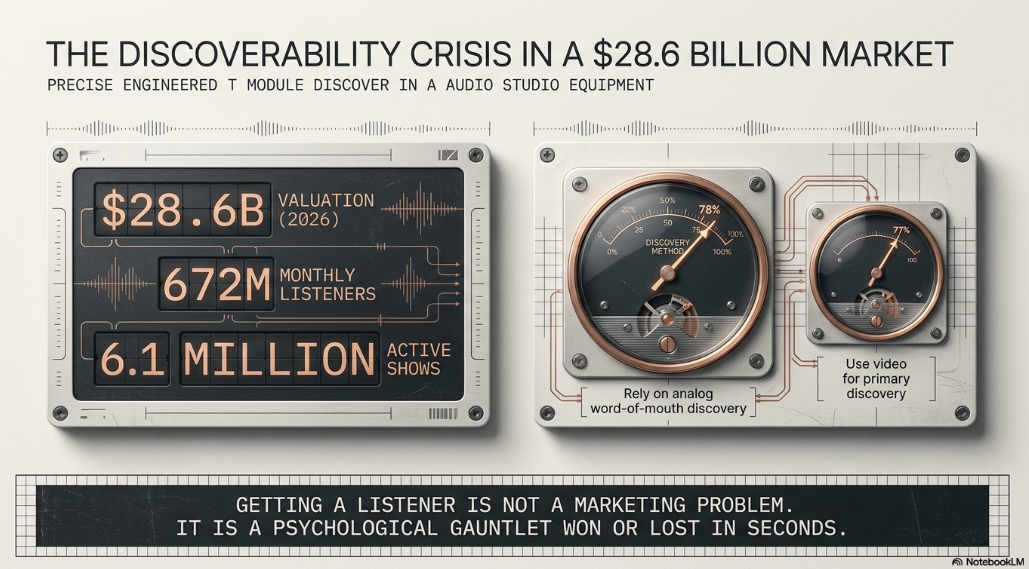
The global podcasting ecosystem has matured into a highly industrialized and intensely competitive digital marketplace. As of 2026, the industry has achieved a valuation of $28.6 billion, fueled by a staggering 672 million monthly listeners worldwide, representing a 145% growth trajectory since 20191. In the United States alone, the medium has reached unprecedented saturation, with 80% of the population over the age of twelve having consumed a podcast, and 58% qualifying as active monthly listeners2. The demographic base is simultaneously broadening and aging upward, with monthly online audio listening among Americans aged 55 and older surging by nearly twenty percentage points in just two years, while the 18 to 24 demographic continues to exhibit the highest adoption rate at 78%1.
This explosive macroeconomic growth, which includes a projected $4.2 billion in United States podcast advertising revenue for 2026, has precipitated a severe crisis of discoverability1. With over 6.1 million active podcast shows competing for cognitive bandwidth, the barriers to audience acquisition have never been higher1. Despite the proliferation of sophisticated algorithmic recommendation engines, audience acquisition remains heavily reliant on high-friction, analog methodologies. Recent data from Edison Research indicates that 78% of podcast consumers still discover new shows through word-of-mouth referrals from friends and family, while only a small fraction rely on in-app search functionalities3. Furthermore, visual media has become a primary driver of audio consumption; 77% of first-time podcast consumers utilize video formats for discovery, with 72% subsequently converting to audio-only listening after the initial visual exposure4.
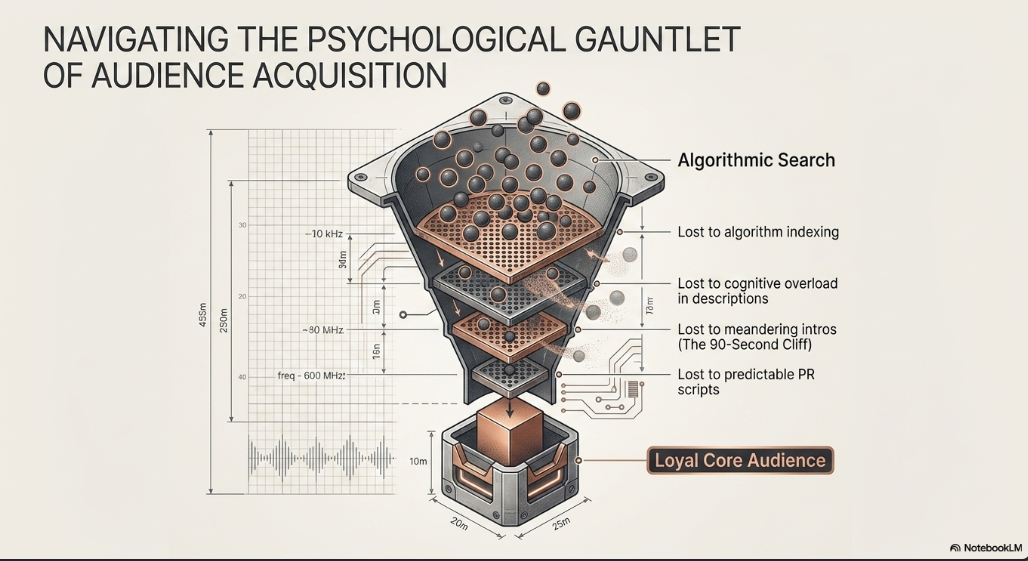
For a professional podcast production, these market dynamics dictate that the success or failure of an episode ultimately reduces to the capacity to compel a prospective listener to click the play button and, subsequently, to remain engaged through the entirety of the runtime6. This critical phase of podcast marketing and audience retention is conceptualized within the industry as "Running the Gauntlet"6. The majority of the battle to win over listeners is won or lost in the first few seconds of contact with an episode, representing a high-stakes psychological threshold where the consumer calculates the cognitive cost of engagement against the promised intellectual or entertainment value6.
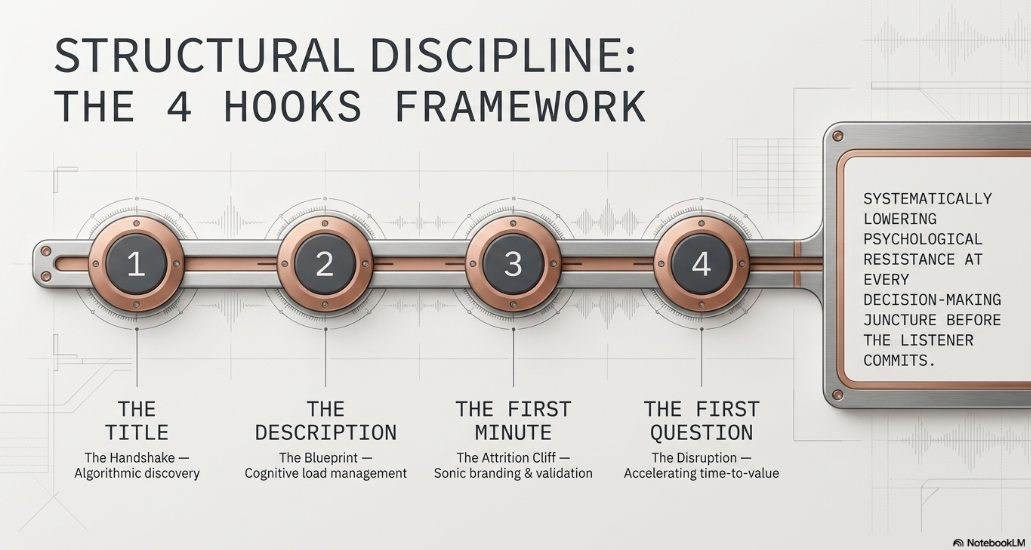
To navigate this gauntlet, producers must abandon ad-hoc content creation in favor of rigorous, strategically engineered pre-production. Central to this strategy is the "4 Hooks Framework," a structural methodology designed to address potential listeners at the four primary decision-making points during the evaluation of a new episode6. The objective at each juncture is to entice the user to take just one more step down the conversion funnel, systematically lowering psychological resistance6. The framework consists of the Title, the Episode Description, the First Minute, and the First Question6. Mastering these four elements requires dedicating as much time to their refinement as to the recording of the episode itself, recognizing that before a show earns long-term loyalty, it must win the listener's attention episode by episode, dozens of times over6.
Hook 1: The Title - The Vanguard of Algorithmic and Psychological Discovery
The episode title represents the digital handshake between the podcast and the potential listener. It is tasked with two ostensibly simple but highly demanding jobs: to seize the listener's attention and to generate a sufficient surplus of curiosity to compel a click-through6. In an environment where the average consumer rapidly scrolls through densely populated feeds on mobile devices, the title operates as the primary variable determining whether an episode is indexed by search algorithms or ignored by human psychology.
Search Engine Optimization and Algorithmic Parsing
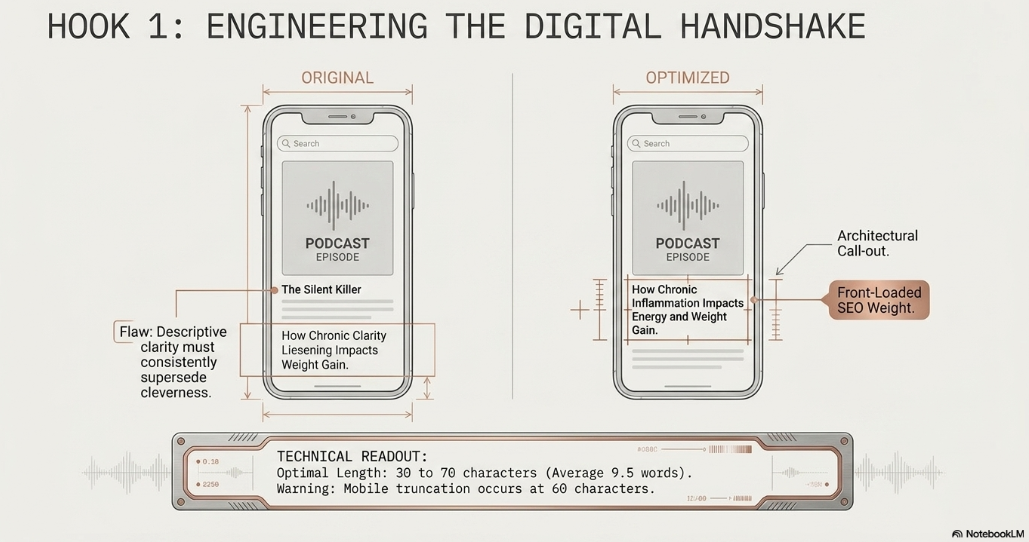
Podcast discoverability begins with titles that are engineered symmetrically for both human cognition and machine-learning search algorithms. Search engines embedded within major platforms such as Apple Podcasts, Spotify, and Google parse episode titles heavily to match content with listener search intent7. The fundamental rule of episode titling is that descriptive clarity must consistently supersede cleverness or ambiguity7. Vague, overly artistic titles that fail to communicate the core subject matter will be inevitably buried by algorithms. A title such as "The Silent Killer" provides zero contextual metadata for the algorithm, whereas a revised title like "How Chronic Inflammation Impacts Energy and Weight Gain" immediately indexes the episode for high-value, high-volume health queries7.
To maximize SEO weight and click-through rates, target keywords must be placed as close to the beginning of the title as possible7. This front-loading strategy serves a dual purpose. Algorithmically, platforms assign higher relevance to leading terms, treating them as the primary subject matter9. Visually, it protects the most critical information from being truncated on mobile displays. Most podcast applications truncate titles after 60 to 70 characters, leaving potential listeners in the dark if the value proposition is buried at the end of a sentence7. Quantitative analysis of top-performing podcast titles reveals that the optimal length falls strictly within the range of 30 to 70 characters, averaging approximately 56 characters or 9.5 words11. By excising filler words and avoiding the repetitive inclusion of the show's name or episode numbers—which are already displayed elsewhere in the application's user interface—producers can maximize the impact of this limited digital real estate10.
The Psychology of the Click: Curiosity, Promises, and Sentiment
Beyond keyword optimization, an effective title must promise a clear, tangible solution to a felt need or a concrete problem experienced by the target demographic12. Titles that leverage psychological triggers such as actionable promises, numerical lists, and compelling questions consistently outperform generic conversational labels9.
The integration of numbers within a title is a particularly potent tactic for managing listener expectations. Research indicates that list-based structures and titles containing specific digits can increase click-through rates by up to 37%9. Numbers provide a cognitive scaffold, setting clear expectations about the content's structural organization and the time required to extract value9. Transitioning a title from "Social Media Tips" to "10 Social Media Tips to Skyrocket Your Growth" transforms a passive topic into a dynamic, quantifiable asset that respects the listener's time9.
Similarly, the utilization of active verbs—such as "Learn," "Discover," "Master," or "Unlock"—instills a sense of urgency and agency, inviting the listener to take immediate control of their learning process9. Posing a rhetorical question within the title leverages the human psychological instinct for cognitive closure. Questions spark immediate curiosity and carry an unspoken promise that the ensuing audio will provide authoritative answers9.
Despite the necessity of generating intrigue, analysis of elite podcasts reveals that the vast majority of high-performing titles maintain a neutral or positive sentiment11. Overly aggressive clickbait or sensationalized language that overpromises and underdelivers severely damages audience trust, leading to high initial clicks but catastrophic drop-off rates and permanent brand erosion10. The title must serve as an accurate, albeit highly optimized, reflection of the audio content.
Case Study: The Titling Architecture of Steven Bartlett
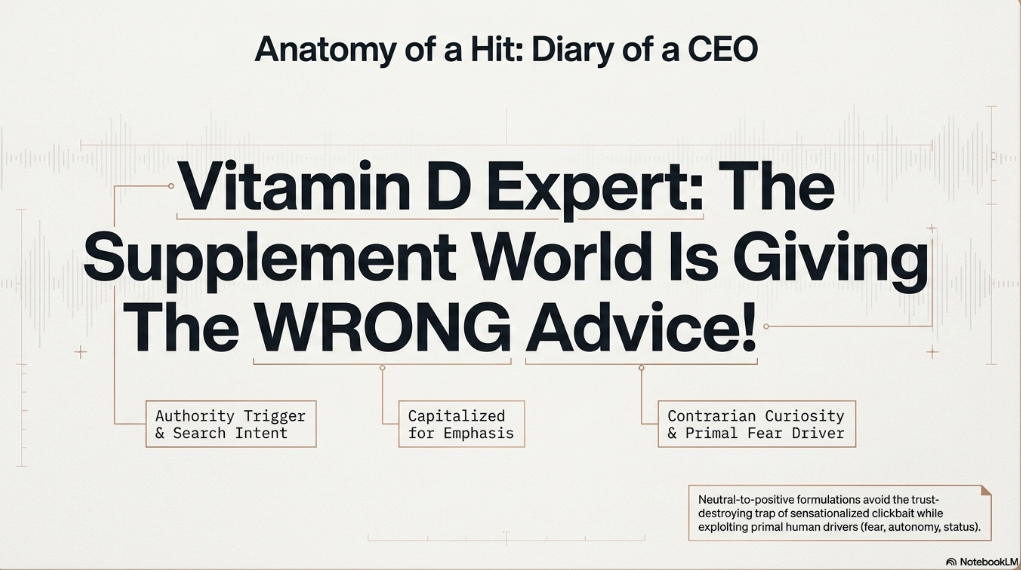
A masterclass in sophisticated titling architecture is observable in Steven Bartlett's "The Diary of a CEO," a production that consistently dominates global charts. Bartlett's strategy meticulously avoids the pitfalls of generic interview labeling. Rather than a sterile title such as "An Interview with Dr. Stasha Gominak," the episode is engineered as, "Vitamin D Expert: The Supplement World Is Giving The WRONG Advice!"14.
This construction is an exemplary execution of the first hook. It immediately establishes authority ("Vitamin D Expert"), introduces a contrarian and alarming premise ("The Supplement World Is Giving The WRONG Advice!"), and targets a massive demographic of health-conscious consumers. Other titles in Bartlett's catalog, such as "The 7 Big LIES About Exercise, Sleep, Running, Cancer & Sugar!" or "The Man Who Made $100M Before 32: The Secret Was To Stop Letting Them Control Me," aggressively utilize capitalization for emphasis, numerical lists for structure, and the promise of hidden knowledge14. This approach ensures that the title functions not merely as an identifier, but as a high-converting micro-pitch that exploits primal human drivers, including the fear of disease, the desire for autonomy, and the pursuit of status16.
Hook 2: The Episode Description and Show Notes - Managing Cognitive Load and Search Intent
Upon successfully securing the initial click via the title, the user transitions to the episode description. The second hook must seamlessly build upon the foundation established by the title6. Its primary function is to provide sufficient context and relevance to convince the ideal listener that the upcoming audio is genuinely worth the substantial time investment required, while simultaneously escalating the narrative stakes of the conversation6.
Copywriting Frameworks: PAS and AIDA
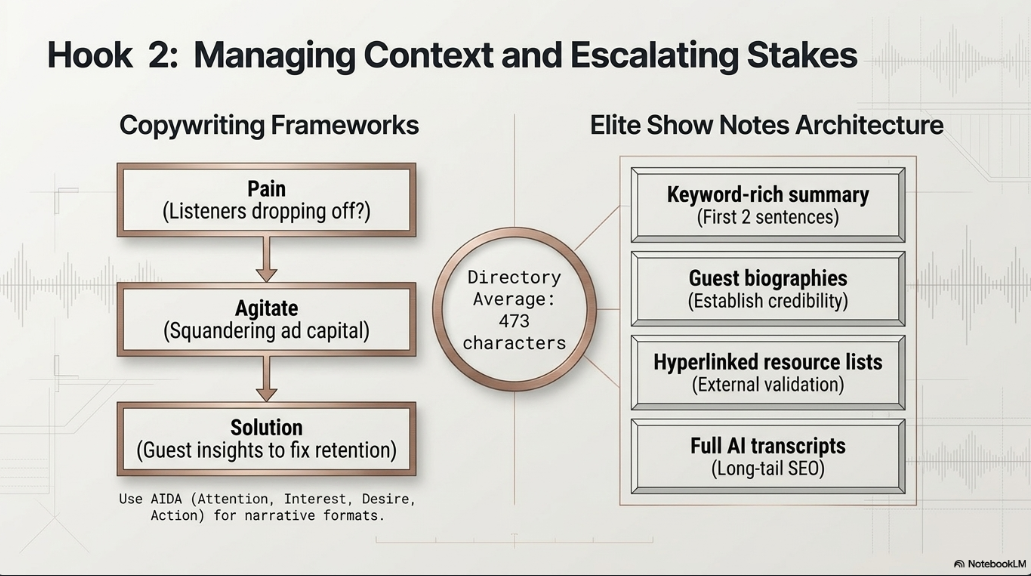
The construction of an effective episode description should rely on proven copywriting frameworks rather than disorganized summarization. Two highly effective models adapted for audio marketing are the AIDA framework (Attention, Interest, Desire, Action) and the PAS framework (Pain, Agitate, Solution)17.
In the context of educational, business, and self-improvement podcasting, the PAS framework is exceptionally potent for driving conversion. The description begins by identifying a specific pain point the target audience faces. For instance, a podcast targeting marketers might open with, "Are your podcast listeners dropping off?"18. The copy then agitates that pain by highlighting the systemic consequences of inaction, such as explaining that an inability to hold attention prevents brand growth and squanders advertising capital19. Finally, it presents the episode as the definitive solution, outlining exactly how the guest's insights will resolve the listener's dilemma.
Conversely, the AIDA framework is highly effective for narrative or interview-driven shows. The goal is to capture immediate Attention with a bold statistical claim, build Interest by detailing the guest's unique background, foster Desire by teasing transformative insights, and conclude with a clear Action command to press play. Regardless of the chosen framework, the opening sentences are critical. Because many directories truncate descriptions after a few lines, the primary value proposition and the core target keywords must be woven naturally into the first two sentences to ensure both algorithmic indexing and immediate human comprehension7.
The Structural Blueprint of Elite Show Notes
A deep-dive analysis conducted by Edison Research into the top 50 United States podcasts reveals that industry elites do not rely on brief, cryptic descriptions. The average description length for top-performing shows is 473 characters, providing substantive depth without overwhelming the mobile reader21. Furthermore, elite shows average 51,000 reviews and maintain a 4.6-star rating, utilizing the description area to encourage social proof that validates the show's quality to search algorithms21.
When hosted on a dedicated website, show notes must expand significantly beyond the 473-character directory limit to act as a comprehensive hub of information, enhancing both the listener experience and domain SEO22. A professional show notes template includes several distinct, highly structured sections22. The document opens with a punchy, keyword-rich summary highlighting the core themes, followed by detailed guest biographies that establish credibility22. Crucially, professional notes must include exhaustive lists of resources, books, and studies referenced during the audio, complete with hyperlinks to external sources23. This provides proper attribution and establishes the podcast as a rigorous, trustworthy node of information.
The inclusion of a full audio transcript has also transitioned from an optional enhancement to a standard requirement. Transcripts serve dual strategic purposes: they make the content accessible to individuals with auditory impairments and provide a massive injection of long-tail keywords that search engine crawlers can index, driving organic web traffic for years after the episode's initial publication23. Finally, clear Call to Actions (CTAs) must be embedded, directing listeners to subscribe, join a newsletter, or utilize affiliate discount codes, thereby driving measurable commercial return on investment23.
Technical Navigation: ID3 Tags, Podcasting 2.0, and Chapter Metadata
One of the most vital components of the second hook is the inclusion of detailed timestamps and chapter markers. Modern podcast consumption is highly non-linear; listeners frequently seek specific insights rather than committing to a sequential, hours-long broadcast. By providing time-coded outlines, producers respect the listener's time, reduce friction, and drastically improve the overall user experience22.
From a technical perspective, timestamps can be executed in multiple formats. The simplest iteration is text-based timecodes placed directly in the episode description, which platforms like Apple Podcasts and Spotify now automatically parse into clickable links25. However, premium productions utilize embedded metadata to create seamless, visually rich chapter markers that display inside the podcast player.
There are currently four primary standards for chapter implementation:
Producers utilizing tools like ID3 Editor or specialized software like PodChapters can embed precision timestamps, images, and URLs that appear dynamically on the listener's screen28. This metadata transforms a passive audio stream into an interactive multimedia experience, allowing listeners to visually navigate the architecture of the conversation.
The Neuroscience of Reading and Listening: Dual Coding and AI Integration
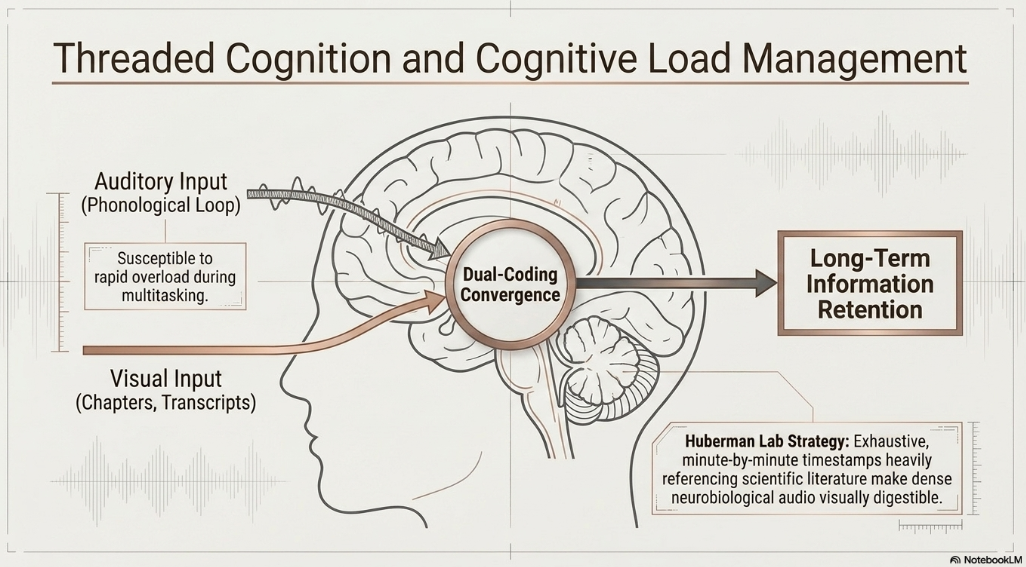
The implementation of detailed show notes and chapters extends beyond mere convenience; it is a vital tool for cognitive load management. Neuroscience studies grounded in Threaded Cognition Theory and the Modal Model of Memory indicate that while humans are highly adept at processing spoken information, continuous listening requires sustained working memory capacity31. The phonological loop, which processes auditory information, can become rapidly overloaded when instructional demands exceed capacity, particularly when listeners are engaged in multitasking behaviors like driving or exercising32. Complex, dense podcasts can quickly overwhelm this capacity, leading to cognitive fatigue and attention drift32.
Providing a visual outline via show notes, transcripts, and chapter markers creates a phenomenon known as "dual coding"—stimulating both visual and auditory pathways simultaneously33. This pre-organizes the incoming information into digestible chunks, reduces extraneous cognitive load, and vastly improves long-term information retention33. The integration of artificial intelligence into podcast players further amplifies this effect. AI-powered interactive transcripts and dynamic chat features allow listeners to engage in active retrieval practice, querying the AI for immediate clarification on complex concepts without pausing the audio33. This shifts the listener from passive consumption to active, metacognitive engagement.
The "Huberman Lab" podcast exemplifies the mastery of cognitive load management. Dr. Andrew Huberman's episodes frequently exceed two hours and delve into dense neurobiological mechanisms. To mitigate cognitive fatigue and prevent abandonment, the show notes provide exhaustive, minute-by-minute timestamps (e.g., 00:24:56 How Can You Prove Vitamin D Deficiency Causes Disease?) alongside heavily referenced scientific literature14. This rigorous structure allows the audience to navigate the scientific discourse efficiently, effectively transforming a dauntingly long audio file into an accessible, searchable database of knowledge that supports the listener's cognitive processing24.
Hook 3: The First Minute - Sonic Branding and Immediate Value Affirmation
When the user transitions from reading the description to initiating audio playback, the psychological dynamic undergoes a radical shift. The podcast has successfully earned the click, but it has not yet earned the listen. The first minute of audio is the most perilous phase of the listener journey, representing the third hook in the framework. Its singular goal is to immediately validate the listener's decision to press play by pulling them straight into high-value content, thereby arresting the natural impulse to skip to another show6.
Surviving the Ninety-Second Attrition Cliff
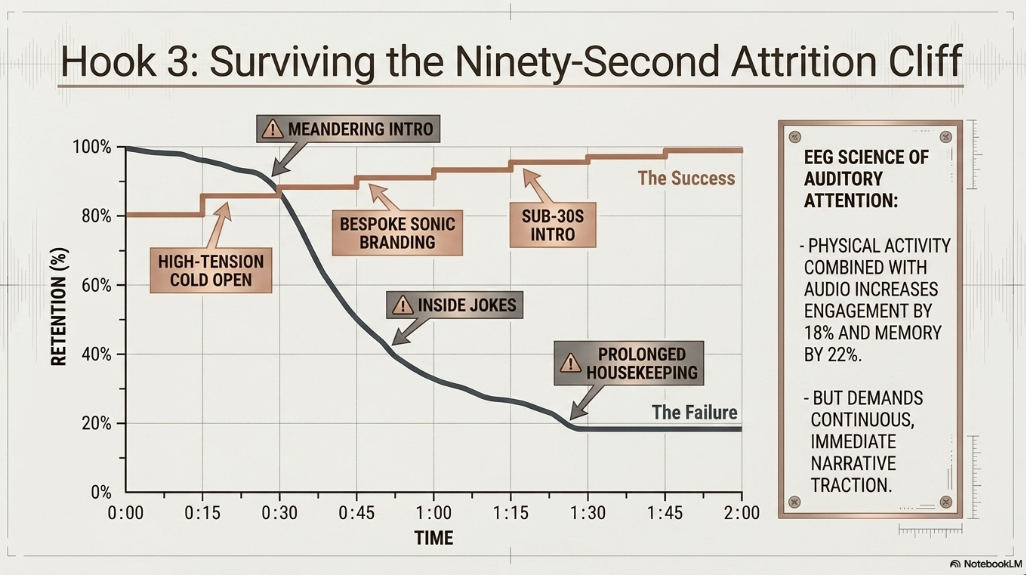
Audio analytics consistently demonstrate that episode drop-off curves are steepest in the first two minutes. A sudden decline from 100% to 80% or lower indicates normal sampling behavior—listeners briefly evaluating if the host's voice and topic align with their current mood35. However, a sheer cliff-like drop suggests that the introduction is actively repelling the audience36. Listeners decide whether to stay within the first ninety seconds, and episodes that drift aimlessly in the opening moments lose their audience irreversibly by minute three39. Consequently, listener retention curves follow structural discipline far more closely than they follow the inherent quality of the subsequent conversation39.
To combat early attrition, professional podcasts rely on a rigid five-part structural framework: Hook, Intro, Body, Transition, and Close39.
The audio hook itself is typically a "cold open" that plays before the introductory music39. This must never be a dry summary of the episode; it is a meticulously selected teaser. It may be a provocative claim, a surprising statistic, a hypothetical scenario, or a highly emotional quote pulled directly from the climax of the conversation18. For example, opening an episode with, "Today we're exploring why the common advice to 'follow your passion' is the worst career move you can make," immediately challenges the status quo and forces the listener to stick around for the resolution of that intellectual tension18.
Following the 30- to 60-second cold open, the episode transitions to the formal intro. The most effective intros run strictly under 30 seconds39. Their purpose is to establish show identity, introduce the host, and state the episode's value proposition without meandering18. Excessive banter, inside jokes, or prolonged housekeeping announcements at the top of the show are primary drivers of early listener abandonment36. A swift, narrated introduction that builds on the tension established in the title and cold open acts as a psychological on-ramp, smoothly accelerating the listener into the core body of the episode6.
The Cognitive Science of Auditory Attention
The demand for a tight, engaging introduction is rooted in the neuroscience of auditory attention. A multimodal evaluation of podcast learning utilizing electroencephalography (EEG) on medical trainees demonstrated that podcast listening maintains equivalent attention network activation scores to focused textbook reading33. Interestingly, this high level of cognitive engagement persists even when the listener is engaged in secondary physical tasks, such as exercising on a treadmill40.
This phenomenon is explained by "low-involvement processing." A mildly active body keeps the brain alert, preventing the mind-wandering that often plagues static auditory learning41. A BBC Global News neuroscience study found that listening to podcasts while active resulted in 18% higher engagement, 40% higher emotional intensity, and a 22% increase in long-term memory encoding compared to passive listening41. However, because audio is transient—listeners cannot easily skim or visually backtrack as they can with text—the medium demands continuous, active attention to follow the narrative thread41. If the first minute fails to establish a clear, compelling narrative trajectory, the listener's attentional networks disengage, and they abandon the episode to reduce cognitive dissonance.
Strategic Sonic Branding: Establishing an Emotional Audio Signature
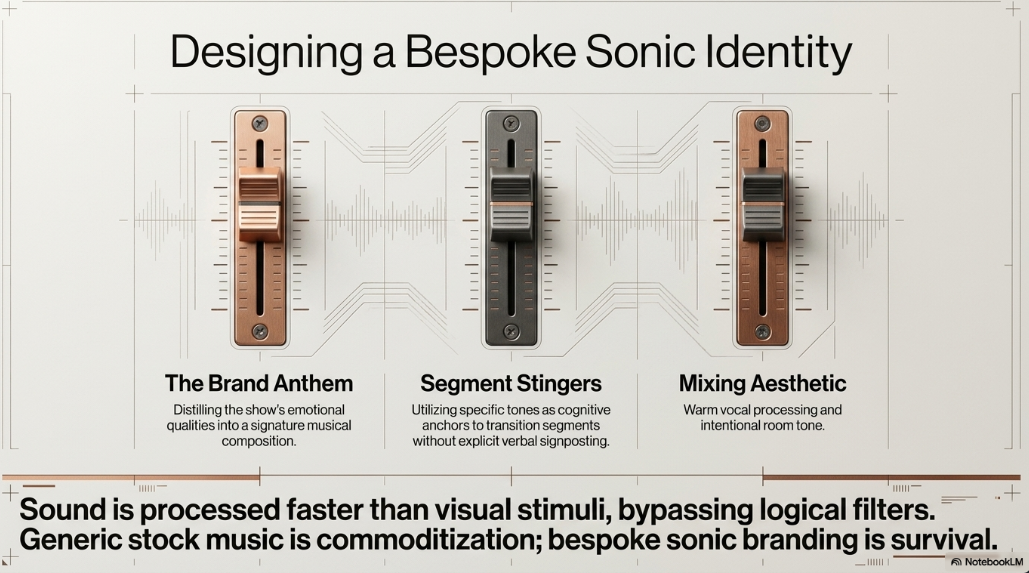
The effectiveness of the first minute is not dictated solely by the spoken word; it is profoundly influenced by the podcast's sonic identity. Audio branding encompasses the intro and outro music, transition stingers, segment beds, and the overall mixing aesthetic—such as the warmth of the host's vocal processing and the presence or absence of room tone42.
Most amateur podcasts rely on generic stock music libraries, resulting in a commoditized sound that fails to distinguish the show from thousands of competitors42. Conversely, bespoke sonic branding ensures that the show sounds unmistakably distinct, compounding brand recognition over time42. The process of developing this identity requires an audio style guide, beginning with a brand audit that distills the show's intangible emotional qualities into a signature musical composition, often referred to as a brand anthem44. This anthem is then deconstructed into a toolkit of audio logos and stingers44.
Neuroscientific research reveals that sound is processed faster than visual stimuli, bypassing logical filters to immediately activate emotional and memory centers in the brain45. When a listener hears a meticulously designed sonic cue—such as a specific bell tone signaling a new segment, or a recurring, low-frequency atmospheric bed underlying a tense interview moment—it acts as a cognitive anchor43. These sonic signatures help the listener orient themselves within the episode's structure without requiring explicit verbal signposting43.
Consistency in this audio environment is what translates disparate sound choices into a trusted, premium brand42. In an era of screenless interactions via smart speakers and wearable devices, a robust sonic identity is the sole mechanism for ensuring the brand thrives rather than vanishes46. The first minute must deploy these bespoke sonic elements with precision, using music and sound design to elevate the perceived production value and establish an immersive psychological state before the host even finishes speaking.
Hook 4: The First Question - Disrupting the Script and Accelerating Time-to-Value
For interview-based and conversational podcasts, the fourth and final hook occurs the moment the formal introduction concludes and the host addresses the guest. The conventional, amateur approach to interviewing involves a chronological recitation of the guest's resume, followed by softball inquiries such as, "Tell us how you got started." This approach is fundamentally flawed. It squanders the momentum generated by the first three hooks, stalls the narrative, and forces the listener to endure a prolonged warm-up period of rehearsed, predictable dialogue36.
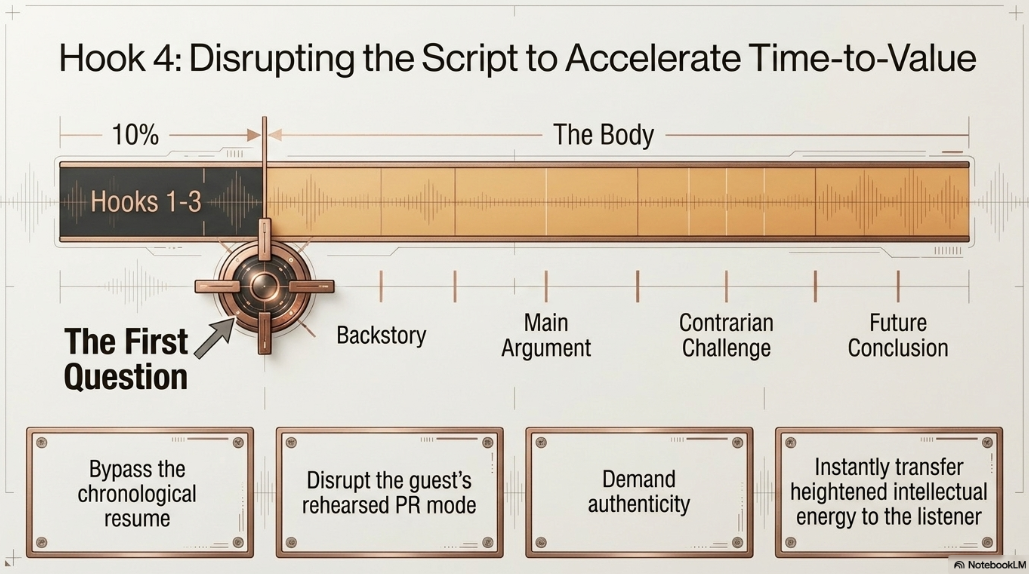
The 4 Hooks Framework dictates that the first question must bypass the fluff and jump straight into "juicy territory"6. A unique, highly specific, and compelling opening question serves multiple strategic functions simultaneously6.
The Anatomy of the Unpredictable Inquiry
First, an aggressive or highly targeted opening question signals profound respect for the listener's time. By accelerating the time-to-value, the host demonstrates that the episode has been intentionally constructed to deliver maximum insight per minute, validating the listener's decision to stay past the introductory phase6.
Second, it immediately disrupts the guest's standard "PR mode." High-profile guests, authors, and industry experts are accustomed to delivering the same canned anecdotes on every media appearance. They possess deeply ingrained conversational scripts. An unexpected, deeply researched opening question forces the guest out of their routine, prompting genuine, unscripted cognitive engagement. When the guest is surprised and intellectually stimulated by the quality of the inquiry, that heightened energy is immediately transferred to the listener.
Elite interviewers understand that the goal is not merely information extraction, but psychological revelation. Returning to the methodology of Steven Bartlett on "The Diary of a CEO," one observes a masterclass in the opening question. Bartlett frequently bypasses his guests' recent commercial achievements to inquire about foundational childhood traumas, systemic insecurities, or specific, highly vulnerable moments of failure. By doing so, he demands authenticity, immediately hooking the listener with the promise of raw, unfiltered truth rather than a polished corporate press release16.
Segment Mapping and the Five-Part Episode Structure
The first question effectively sets the trajectory and tone for the entire body of the episode. Interview shows typically allocate 80 to 90 percent of their runtime to the body39. The host's responsibility is to keep the body moving through three to four distinct, pre-planned segments—such as the guest's backstory, the main argument, a contrarian challenge, and a future-facing conclusion39.
If the first question successfully cracks the guest's facade and establishes intellectual rigor, the ensuing 40 to 60 minutes will flow with a natural, compelling momentum. Conversely, if the opening question is weak, the host will spend the next half-hour attempting to salvage the energy of the conversation. The structure decides whether the listener finishes the episode and returns for the next one; the first question is the linchpin of that structure.
Analytics and The Mathematics of Listener Retention
Understanding and implementing the 4 Hooks Framework is only the initial phase of pre-production; mastering it requires a commitment to rigorous, data-driven iteration. The ultimate measure of a podcast's structural success is its listener retention curve, primarily quantified by the completion rate (or listen-through rate)36.
While download metrics merely indicate that a file was requested, completion rates reveal true engagement36. A download is a knock on the door; completion rate measures who actually stayed for dinner36. The formula for determining this critical metric is straightforward:

Benchmarking Success Across Formats
What constitutes a "good" completion rate is highly dependent on the episode's length and format. A tight, highly edited solo monologue must be held to a vastly different standard than an unscripted, two-hour conversational deep dive36.
A 50% completion rate on a two-hour interview signifies that the average listener surrendered a full hour of their attention—a massive victory in the modern attention economy36. However, that same 50% on a ten-minute daily brief indicates a catastrophic failure in content delivery36.
Diagnosing the Drop-Off Curve
The aggregate completion percentage provides a useful headline, but the true diagnostic power lies in mapping the drop-off curve against the chronological deployment of the four hooks36. By analyzing timestamped analytics available through hosting platforms or tools like Apple Podcasts Connect and Podgagement, producers can conduct a forensic examination of audience behavior20.
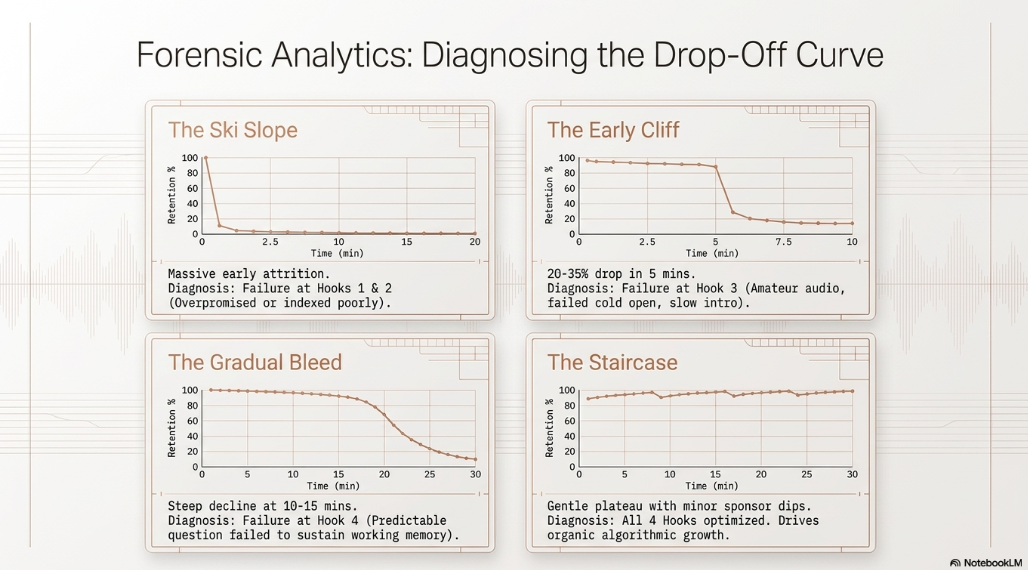
If the episode's performance graph resembles a steep "ski slope" with massive attrition early on, the pre-production hooks are failing.
Failure at Hook 1 & 2 (Title and Description): If download numbers are exceptionally low despite marketing efforts, or if listeners abandon the episode within ten seconds, the packaging is flawed. The title and description either failed to generate initial curiosity, indexed poorly in search algorithms, or promised value that the audio clearly did not possess.
Failure at Hook 3 (First Minute): A massive drop-off (e.g., losing 20% to 35% of the audience) within the first five minutes indicates a critical failure of the cold open, the intro, or the sonic branding37. The audio is perceived as amateurish, or the host spent too much time on irrelevant housekeeping, causing listeners to abandon the stream.
Failure at Hook 4 (First Question): A gradual but steepening decline within the first 10 to 15 minutes suggests that the interview failed to achieve liftoff36. The opening questions were likely too broad or predictable, resulting in an unengaging narrative that could not sustain working memory and attention.
Conversely, if the graph resembles a "staircase" with minor, localized dips around sponsor reads, or a gentle, sustained plateau, the hooks are optimized38. The retention curve stabilizes into a natural decline, representing inevitable biological and scheduling interruptions rather than structural failure. A podcast that consistently achieves 80% completion with 500 listeners possesses a highly engaged, loyal core audience that will organically drive growth through algorithmic favorability and word-of-mouth recommendations19. In stark contrast, a show with 2,000 listeners but a 25% completion rate is suffering from a structural hemorrhage; allocating marketing capital to such a show is mathematically futile19.
Conclusion
The modern podcast listener navigates a landscape defined by hyper-abundance and possesses a historically low tolerance for inefficient media. In this saturated environment, relying on spontaneous conversation, charismatic hosting, or exceptional audio fidelity alone is insufficient for survival. Audience acquisition and long-term retention are battles fought and won in the margins of pre-production, utilizing calculated, data-driven psychology.
The 4 Hooks Framework—comprising the Title, Episode Description, First Minute, and First Question—provides a comprehensive, scientifically grounded blueprint for guiding a listener from passive algorithmic discovery to deep, sustained cognitive engagement. By front-loading immense value, crafting irresistible curiosity, utilizing proven copywriting structures, and engineering a premium, bespoke sonic identity, podcast producers can systematically dismantle the modern listener's natural skepticism. Adherence to this rigorous framework transforms a podcast from a mere recording of a conversation into a meticulously designed media product, uniquely positioned to capture attention, command loyalty, and ultimately thrive within a multi-billion-dollar global audio economy.
Works cited
Podcast Statistics 2026 | 80+ Facts & Data Points - Searchlab, https://searchlab.nl/en/statistics/podcast-statistics-2026
The Infinite Dial® 2026 - Edison Research at SSRS, https://www.edisonresearch.com/the-infinite-dial-2026/
Podcast vs YouTube for Financial Advisors: The Data Behind the Debate - Medium, https://medium.com/@mrandrewmurdoch/podcast-vs-youtube-for-financial-advisors-the-data-behind-the-debate-071e37745a37
Vodcasts – from the golden age of narrative podcasts to the talk show gold rush - iMEdD Lab, https://lab.imedd.org/en/vodcasts-from-the-golden-age-of-narrative-podcasts-to-the-talk-show-gold-rush/
As Listeners Reshape Podcasting, Are You Ready for a New Era - SiriusXM Media, https://www.siriusxmmedia.com/insights/as-listeners-reshape-podcasting-are-you-ready-for-a-new-era
The 4 Hooks Framework: The Key to Winning Over New Podcast Listeners, https://podcastmarketingacademy.com/4-hooks-framework/
Podcast SEO 101: How to Write Titles and Descriptions That Get You Found -, https://commandyourbrand.com/podcast-seo-101-how-to-write-titles-and-descriptions-that-get-you-found/
How to Write Titles for Podcast Episodes: 4 Tips To Get Clicks | Claricast, https://claricast.com/how-to-write-titles-for-podcast-episodes/
The Ultimate Guide to Crafting Attention-Grabbing Podcast Episode Titles 🎙️ - WhisperTranscribe, https://www.whispertranscribe.com/blog/how-to-create-title-for-podcast
Strategies for Naming Podcast Episode Titles - Recast Studio, https://recast.studio/blog/strategies-naming-podcast-episode-titles
How to Write Click-Worthy Podcast Titles Without Using Clickbait (Based On Data Research), https://www.tunepocket.com/how-to-write-podcast-episode-title/
How to Make Your Podcast Episodes Irresistible - Jordan Lee Dooley, https://jordanleedooley.com/how-to-make-your-podcast-episodes-irresistible/
The Diary Of A CEO with Steven Bartlett: Episode Summaries, Insights, and Commentary, https://www.shortform.com/podcast/the-diary-of-a-ceo-with-steven-bartlett
The Diary Of A CEO with Steven Bartlett - Podcast - Apple Podcasts, https://podcasts.apple.com/gt/podcast/the-diary-of-a-ceo-with-steven-bartlett/id1291423644
The Diary Of A CEO with Steven Bartlett - Apple Podcasts, https://podcasts.apple.com/us/podcast/the-diary-of-a-ceo-with-steven-bartlett/id1291423644
Diary of a CEO Podcast Summary, Overview & Show Notes | TubeOnAI, https://tubeonai.com/diary-of-a-ceo-podcast-summaries/
AIDA vs PAS - Which Framework Leads to Better Conversion? - YouTube, https://www.youtube.com/shorts/Zb32q3U8L3U
Podcast Intro Examples: How to Hook Audiences (+ Templates) - Goldcast, https://www.goldcast.io/blog-post/podcast-intro-examples
Grow a podcast: 100 to 10,000 listeners, Springcast Blog, https://www.springcast.io/en/blog/grow-podcast-100-to-10000/
4 Key Signs Your Podcast is Resonating (or Getting Skipped) - PodLaunch HQ, https://www.podlaunchhq.com/blog/is-your-podcast-engaging-listeners
Ausha x Edison Research : The Anatomy of the Most Successful US Podcasts, https://www.ausha.co/blog/anatomy-most-successful-us-podcasts-edison-research-ausha/
Podcast Show Notes: What to Include + 7 Examples & Template, https://amplify.matchmaker.fm/podcast-show-notes/
Podcast Show Notes: How to Write Them [+Examples], https://www.ausha.co/blog/podcast-show-notes-examples/
How to Create Podcast Show Notes (Template + Examples) - Hello Audio, https://helloaudio.fm/podcast-show-notes/
Chapter type support across apps - RSS.com, https://help.rss.com/en/support/solutions/articles/44002628416-chapter-type-support-across-apps
Chapters on Apple Podcasts, https://podcasters.apple.com/support/5482-using-chapters-on-apple-podcasts
Standards: Audio - ID3 Metadata Tagging - The Broadcast Bridge, https://www.thebroadcastbridge.com/content/entry/21824/standards-id3-metadata-tagging
ID3 Editor vs. PodChapters - Best podcast chapters app?, https://podchapters.com/comparisons/id3-editor-vs-podchapters
Podcast-Standards-Project/PSP-1-Podcast-RSS-Specification - GitHub, https://github.com/Podcast-Standards-Project/PSP-1-Podcast-RSS-Specification
Chapters | Podcasting Articles - Audio Audit, https://audioaudit.io/articles/podcast/chapters
The impact of driving versus undistracted listening on podcast knowledge acquisition and retention using a driving simulator: A randomized, cross-over trial | PLOS One, https://journals.plos.org/plosone/article?id=10.1371/journal.pone.0331299&
Cognitive Load and Working Memory in Multimedia Video Podcasts: Effects of Elaborative and Seductive Details - MDPI, https://www.mdpi.com/2079-3200/14/5/74
AI-powered Podcast Features Improve Information Retention - Listening, https://www.listening.com/blog/ai-powered-podcast-features-improve-information-retention
Are episode show notes available? - Huberman Lab, https://www.hubermanlab.com/faq/are-episode-show-notes-available
Retention Rate analyses : r/podcasting - Reddit, https://www.reddit.com/r/podcasting/comments/1lgvf0z/retention_rate_analyses/
Podcast completion rate: what a good number looks like, Springcast Blog, https://www.springcast.io/en/blog/podcast-completion-rate/
How to Track Listener Retention for Podcast Episodes - Podgagement, https://podgagement.com/how-to-track-listener-retention-for-podcast-episodes/
Understanding your episode performance | by Anchor - Medium, https://medium.com/anchor/understanding-your-episode-performance-c5a8280eddd6
Podcast Structure: How to Plan Episodes That Hold Listeners - Resonate Recordings, https://resonaterecordings.com/general/podcast-structure/
(PDF) A Multimodal Evaluation of Podcast Learning, Retention, and Electroencephalographically Measured Attention in Medical Trainees - ResearchGate, https://www.researchgate.net/publication/365280133_A_Multimodal_Evaluation_of_Podcast_Learning_Retention_and_Electroencephalographically_Measured_Attention_in_Medical_Trainees
Why Your Brain Loves Listening — Part 2: The Research Behind the Science - uStudio, https://ustudio.com/blog/podcasting/why-your-brain-loves-listening-part-2-the-research-behind-the-science/
Bespoke Sonic Branding - The Podcast Coach, https://thepodcastcoach.co.uk/services/bespoke-sonic-branding/
Podcast Audio Branding: Why Every Show Needs a Recognisable Sound, https://www.thestudentpocketguide.com/2026/07/student-life/education-career/podcast-has-a-sound/
The Audio Branding Process | Audio Production - SoundWise, https://soundwise.audio/the-audio-branding-process/
The Art of Sonic Branding: Finding Your Brand's Voice - Ad Results Media, https://www.adresultsmedia.com/news-insights/the-art-of-sonic-branding/
Why Sonic Branding Matters More Than Ever | MassiveMusic, https://massivemusic.com/soundboard/why-sonic-branding-matters-more-than-ever-in-2026
The Diary Of A CEO with Steven Bartlett | No.1 Podcast, https://stevenbartlett.com/doac/