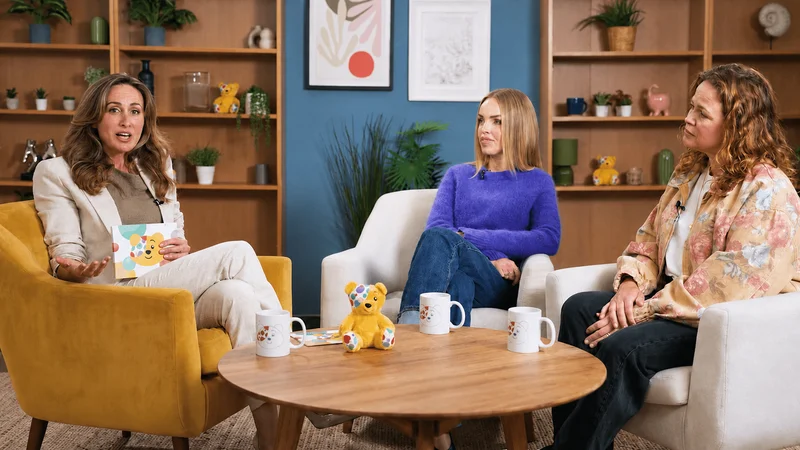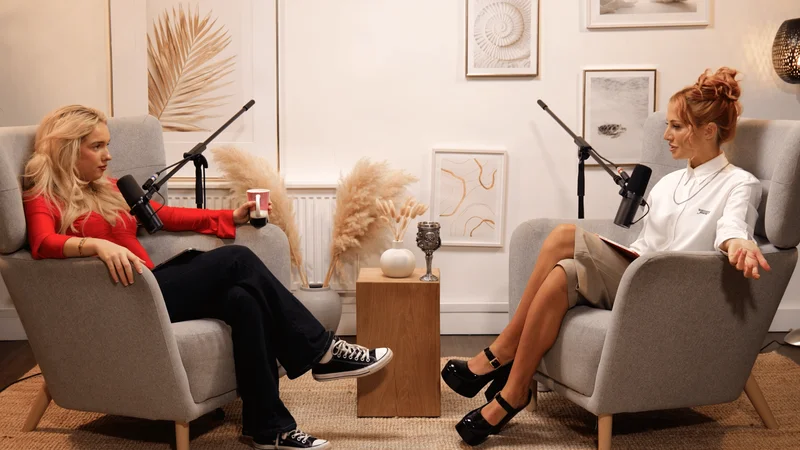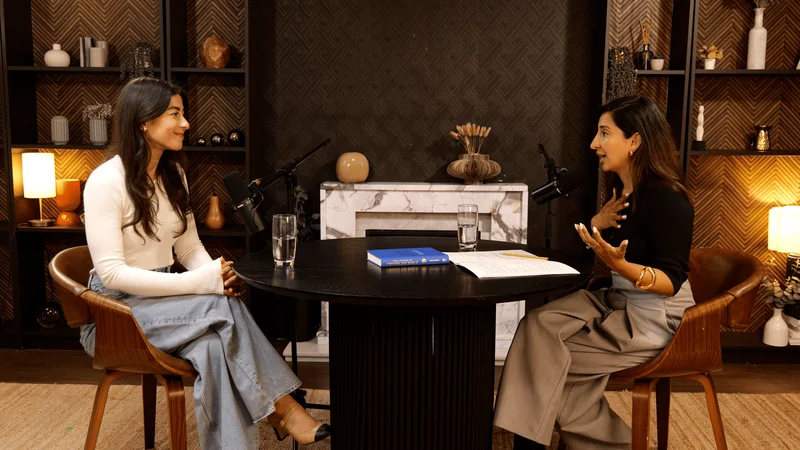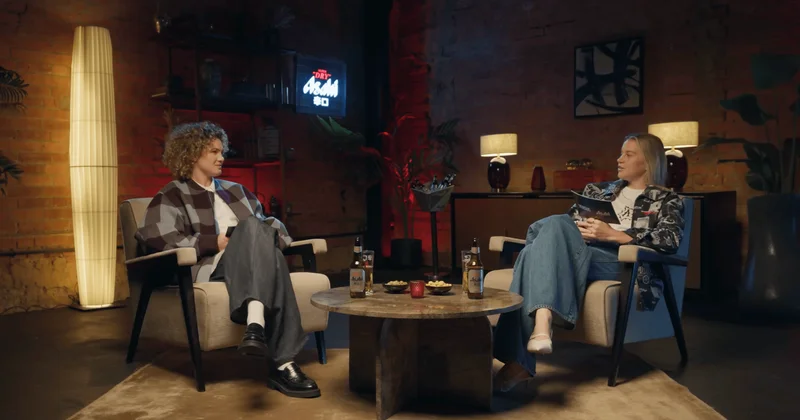
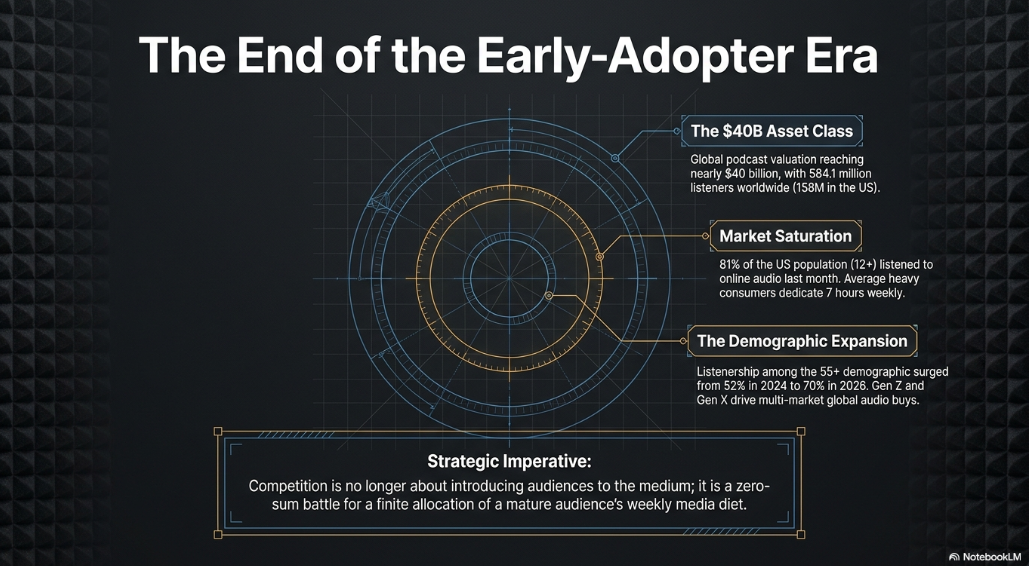
The podcasting medium has transitioned from a decentralized, niche audio curiosity into a dominant, centralized pillar of modern digital media, commanding unprecedented cultural pull and commercial investment. By 2026, the landscape is defined by massive scale, evolving consumption habits, and a fundamental convergence of audio and visual formats. The global podcast market achieved a valuation of nearly $40 billion by the end of 2025, reaching an estimated 584.1 million listeners worldwide, with United States listenership alone exceeding 158 million individuals1. The structural maturity of the medium dictates that modern podcast pre-production can no longer be executed as a casual, hobbyist endeavor. Surviving the highly saturated digital attention economy requires treating a podcast as an enterprise-grade media asset from its inception.
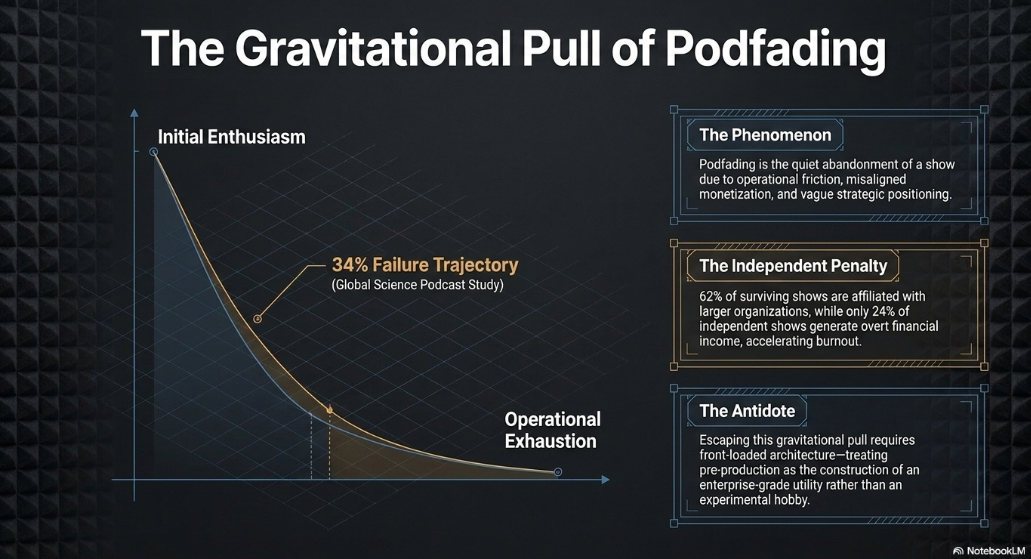
Despite an infrastructure capable of reaching hundreds of millions, the vast majority of new podcasts fail to achieve commercial or editorial viability. They succumb to a phenomenon known as "podfading"—the quiet abandonment of a show due to operational friction, misaligned monetization models, and a fundamental lack of strategic positioning2. Escaping the gravitational pull of podfading requires an exhaustive, front-loaded pre-production phase. A robust pre-production architecture demands the synthesis of a compelling editorial message, the precise cultivation of a target listener base through demographic analysis, and the implementation of commercial, technical, and legal frameworks designed for long-term sustainability and asset capitalization.
The Macro-Economics of Audience Attention and Demographic Expansion
Before formulating a content strategy, producers must understand the macro-economic reality of the audience they intend to capture. The total addressable market for podcasting has reached historic highs, fundamentally altering the demographic profile of the average listener. According to the Edison Research Infinite Dial 2026 report—the industry's longest-running survey of digital media consumer behavior—81% of the United States population aged 12 and older (roughly 233 million people) listened to online audio in the past month, while 80% (230 million) have consumed a podcast at some point in their lives4.
Crucially, the medium is no longer reliant solely on early-adopter millennials. The edges of the demographic map are expanding rapidly. In the United States, podcast consumption among the 55+ age demographic experienced a massive surge, jumping from 52% monthly listenership in 2024 to 70% in 2026—a gain of nearly 20 percentage points in just 24 months5. Simultaneously, international markets are seeing Gen Z and Gen X cohorts driving multi-market audio buys, particularly in the United Kingdom, Australia, Germany, and France, presenting immediate expansion opportunities for global brands6.
This mainstream adoption means producers are no longer competing to introduce audiences to the medium; they are competing for a finite allocation of a mature audience's weekly media diet. On average, highly engaged listeners consume approximately seven hours of podcast content per week, demonstrating a level of deep engagement that is exceedingly rare in modern digital media1.
To capture this attention, producers must analyze existing consumption patterns across genres. Triton Digital's comprehensive global measurement data reveals distinct genre preferences and demographic skews that should directly influence a new show's commercial positioning and potential advertiser appeal1.
Understanding these baselines allows production teams to identify market gaps. For example, while women create only about 27% of the over two million active podcasts, data indicates that female listeners consume podcasts for 20% longer durations than their male counterparts2. This statistical asymmetry highlights a profound undervaluation of female purchasing power in the medium, presenting a lucrative arbitrage opportunity for networks that actively develop content catering to this highly loyal, high-retention demographic2.
Formulating the Core Message and Editorial Identity
The most critical decision made during the pre-production of a professional podcast has nothing to do with recording equipment; it concerns the establishment of a rigorous editorial identity7. The phrase "we should do a podcast" does not constitute a strategy7. A vague conceptual foundation inevitably produces a directionless show that drifts into the background noise, functioning as the corporate equivalent of elevator music7. A program that cannot articulate exactly what its purpose is, and precisely whom it serves, rarely survives its first ten episodes7.
The Unique Value Proposition and Competitive Density
With millions of active podcasts populating major directories, securing listener attention requires a highly differentiated Unique Value Proposition (UVP). The UVP is a definitive statement that articulates the specific benefit the podcast provides, how it solves the listener's intellectual or entertainment deficit, and what explicitly distinguishes the program from existing alternatives8.
Before committing to a format, a comprehensive competitive analysis must be executed to identify and exploit market gaps. This process involves identifying the closest parallel shows—often mapped using audience overlap mapping tools like Rephonic's Podcast Audience Graph—and conducting a systematic audit of their attributes8. Analysts must dissect competitors' average episode length, audio fidelity, structural formatting, guest calibers, and thematic approaches8. By auditing the competitive density of a specific niche, producers can identify elements to hybridize or pivot away from. If the top five podcasts in a specific sector rely entirely on long-form, unstructured, hour-long interviews, a strategic opportunity emerges to capture market share through highly scripted, narrative-driven documentary formats or heavily edited, twenty-minute multi-story episodes8.
Constructing the Audience-Challenge-Theme Framework
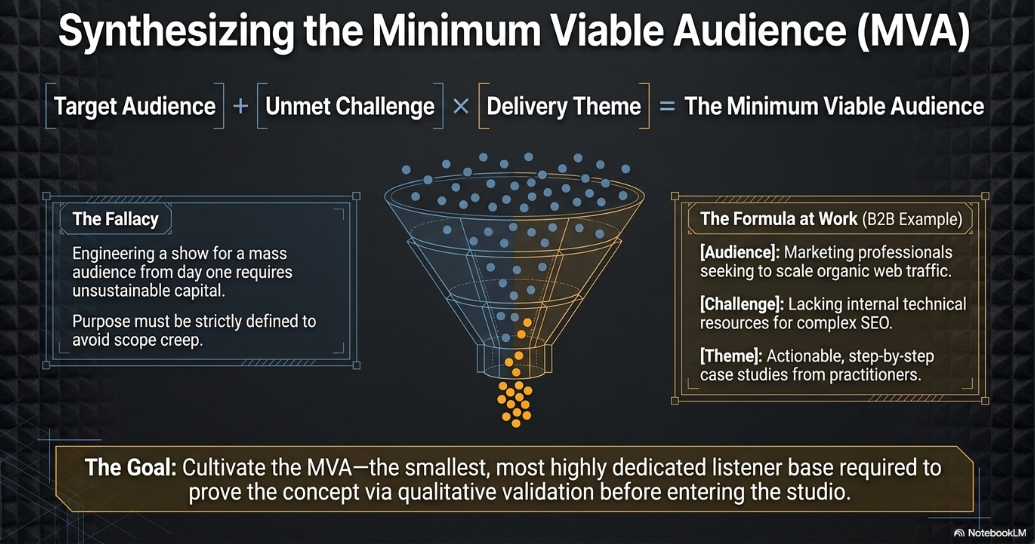
A positioning statement serves as the centralized, unshakeable goal of the podcast. It acts as the internal compass for all subsequent booking, scripting, and marketing decisions9. Without a strictly defined positioning statement, shows inevitably experience scope creep, diluting their appeal by attempting to serve too broad an audience. Attempting to engineer a podcast for a mass audience from day one is a strategic fallacy that requires massive, often unsustainable, capital investment to overcome10. It is exponentially more effective to create an indispensable show for a highly targeted, niche group10.
Effective positioning statements are synthesized by answering three fundamental questions: Who is the exact target audience? What is their specific challenge or pain point? How will the podcast provide a tangible solution to that challenge?9. A highly effective framework for synthesizing these variables is the Audience-Challenge-Theme equation. This formula is structured as follows: We connect with people who [Audience], but [Challenge], by [Theme]9.
The "Audience" variable narrows down the demographic and psychographic profile of the listener, establishing the foundation for their pain points9. The "Challenge" variable identifies the friction in the audience's life or professional workflow, highlighting a need that they cannot currently address effectively on their own9. Finally, the "Theme" outlines the specific mechanism, educational campaign, or entertainment vehicle the podcast will utilize to resolve the identified challenge9.
For example, a B2B marketing podcast might explicitly state: "We connect with people who want to scale their organic web traffic (Audience), but lack the internal technical resources to execute complex SEO strategies (Challenge), by delivering highly actionable, step-by-step case studies from industry practitioners (Theme)"9. This singular sentence dictates the exact caliber of guests required and the tactical nature of the conversations to be recorded, preventing the show from devolving into generic entrepreneurial cheerleading.
To validate this positioning, producers must construct a comprehensive listener avatar. Similar to a buyer persona, a listener avatar is a semi-fictional representation of the ideal audience member, constructed from empirical data regarding age, occupation, professional aspirations, and daily routines9. Validating this hypothesis before launch is crucial. Producers should define a "Minimum Viable Audience"—the smallest group of highly dedicated listeners required to prove the concept—and conduct qualitative interviews with ideal listeners to validate their pain points before ever entering the recording studio12.
Structural Formats, Talent Dynamics, and the Economics of Habit
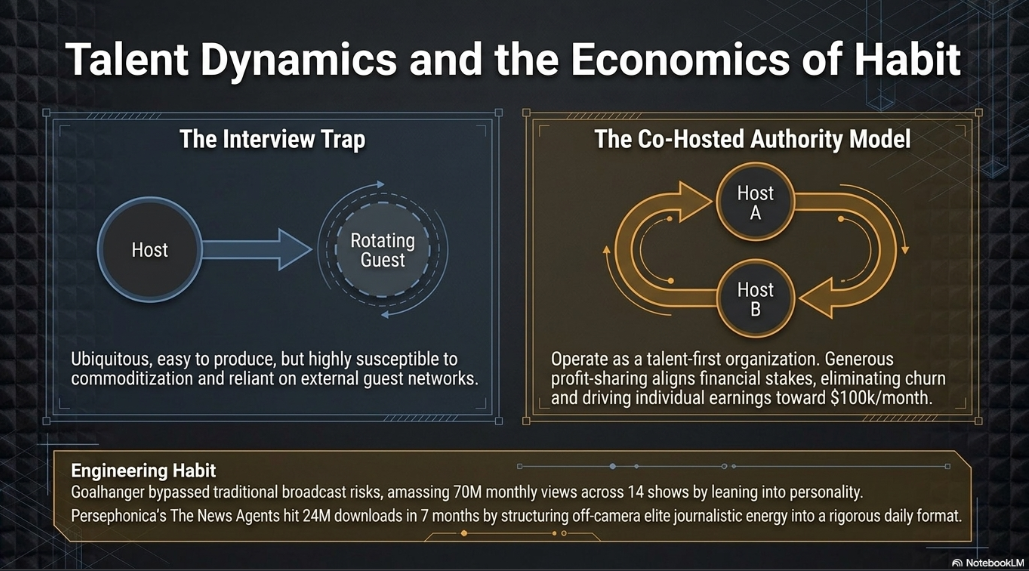
The format of a podcast must serve its core concept and positioning statement, not the other way around7. While interview-based shows remain the most ubiquitous format due to the relative ease of production and the inherent cross-promotional benefits of guest networks, they are highly susceptible to commoditization13. To stand out in a saturated market, leading media networks have refined alternative structures, most notably the co-hosted conversational format, which leverages the chemistry and authority of its talent to build habitual consumption patterns.
The Co-Hosted Authority Model: The Goalhanger Phenomenon
The absolute dominance of the co-hosted format in the European market is best exemplified by the meteoric rise of Goalhanger, a UK-based production company co-founded by Gary Lineker and Tony Pastor14. Originally a television documentary production house, Goalhanger pivoted to podcasting in 2018 to deliberately bypass the slow-moving, risk-averse nature of traditional television commissioning and the constraints of standard broadcast schedules15. By 2026, their portfolio of "The Rest Is..." podcasts (including The Rest Is History, The Rest Is Politics, and The Rest Is Entertainment) had transformed the business of popular history and political commentary, amassing over 70 million full-length episode views and listens per month across their 14 regular shows13.
The structural genius of the Goalhanger model relies on matching two highly credentialed, authoritative hosts who possess natural chemistry and contrasting perspectives, allowing them to dissect complex topics in an accessible, conversational manner13. For example, The Rest Is History, hosted by historians Tom Holland and Dominic Sandbrook, consciously eschews dry, moralistic historical lectures in favor of enthusiastic, highly engaging dialogue regarding events ranging from the sinking of the Titanic to the Apollo lunar missions15. The format succeeds because it leans heavily into personality and storytelling rather than rigid, formulaic interviewing13.
Goalhanger's strategy proves that in the modern audio landscape, audiences return primarily for the hosts, not necessarily the subject matter19. Casting is the single most critical variable in this model. To retain top-tier talent and ensure total alignment, Goalhanger operates unapologetically as a "talent-first" organization, implementing highly generous profit-sharing models19. By giving hosts a direct financial stake in the podcast's commercial success, the talent becomes deeply invested in the show's editorial direction and its promotional advocacy, virtually eliminating talent churn20. This economic alignment allowed The Rest Is History to achieve 11 million downloads a month and 1.2 million monthly YouTube views by 2024, generating estimated individual earnings of nearly $100,000 per month for its co-hosts18.
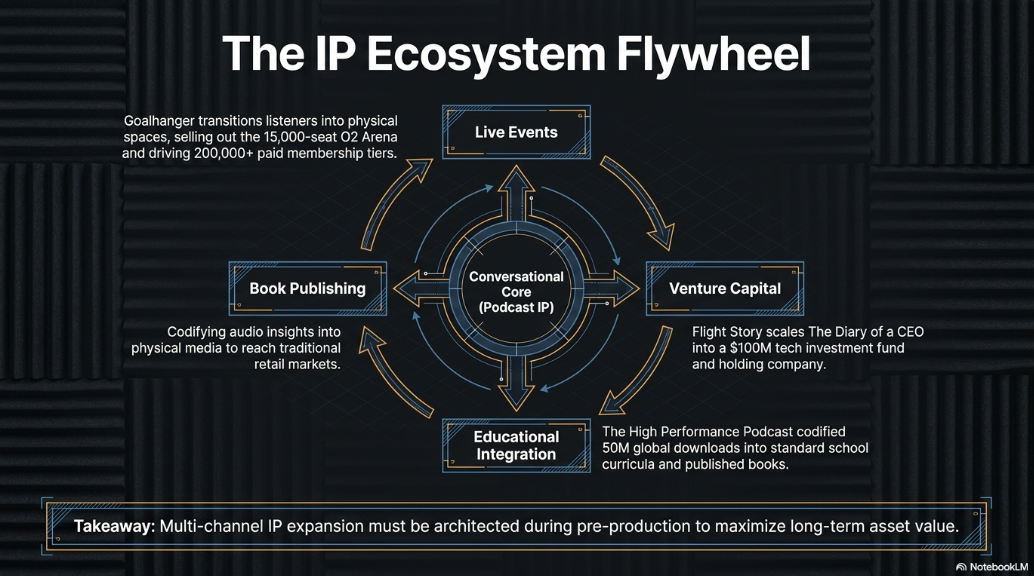
Furthermore, this model transcends digital distribution, translating directly into massive live-event revenue. Goalhanger successfully transitioned its audio community into physical spaces, culminating in selling out the 15,000-seat O2 Arena in London for a live podcast recording—demonstrating that podcast listeners are not passive consumers, but highly invested community members16. This emotional bond is monetized further through a dedicated membership tier, which boasts over 200,000 paying subscribers who fund the network in exchange for early access and ad-free listening16. Goalhanger's evolution from a podcast producer to a full-fledged digital broadcaster is further evidenced by securing deals to broadcast The Rest Is Football during the 2026 FIFA World Cup, proving the format's elasticity17.
Independent Production and Editorial Innovation: Persephonica and Flight Studio
Similarly, independent production companies have demonstrated how specialized editorial formats can capture massive, highly engaged audiences by engineering the mechanics of habit. Persephonica, founded by Dino Sofos, built its entire thesis on the premise that audience loyalty is deeply structural rather than merely topical21. Sofos, credited with ushering in a podcasting revolution during his tenure at the BBC (where he created Brexitcast and Newscast, amassing 85 million downloads), understood that the gap between occasional publishing and daily listening habits is where most budgets disappear21.
Persephonica's flagship creation, The News Agents, co-hosted by elite journalists Emily Maitlis, Jon Sopel, and Lewis Goodall, rapidly became the UK's most downloaded daily news podcast, hitting 24 million downloads within its first seven months21. The pre-production strategy relied on taking the informal, off-camera energy of traditional broadcast journalists and structuring it into a rigorous daily format21. Furthermore, Persephonica's expansion into Gen Z-focused current affairs shows (such as Noted, in partnership with The News Movement) and its strategic expansion into Sheffield to partner with the BBC Audio Lab proves that younger demographics possess a deep appetite for nuanced deep-dives into complex topics—such as disability, contraception, and geopolitics—provided the delivery mechanism aligns with their specific consumption habits24.
Parallel to this, creators like Steven Bartlett have utilized the podcast format as the foundation for massive corporate empires. Bartlett's The Diary of a CEO serves as the core intellectual property for Flight Story, a venture combining media production (Flight Studio) and a $100 million investment fund26. Bartlett's utilization of AI advisors for vetting technology investments and his ability to secure an eight-figure investment round from entities like Slow Ventures and Apeiron Investment Group (marking the largest fundraising round by a European creator holding company) illustrates the unprecedented enterprise value that a successfully scaled podcast can generate26.
Similarly, The High Performance Podcast, hosted by Jake Humphrey and Damian Hughes, demonstrates how podcast intellectual property can be translated across multiple mediums. Having achieved over 50 million global downloads by interviewing elite performers, the hosts codified their insights into a physical book, Game Plan, which was further developed into a whole-school approach to careers education and personal growth intended for integration into standard educational curricula27. This multi-channel IP expansion must be considered during the initial pre-production phase to maximize long-term asset value.
The Visual Podcast Mandate and Atomization Strategy
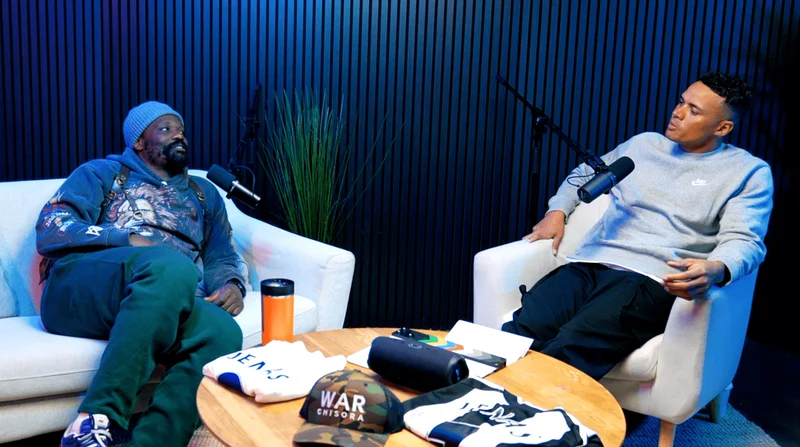
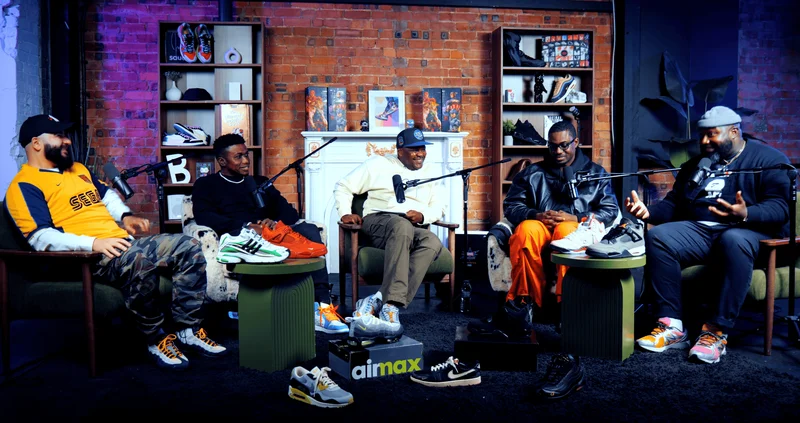
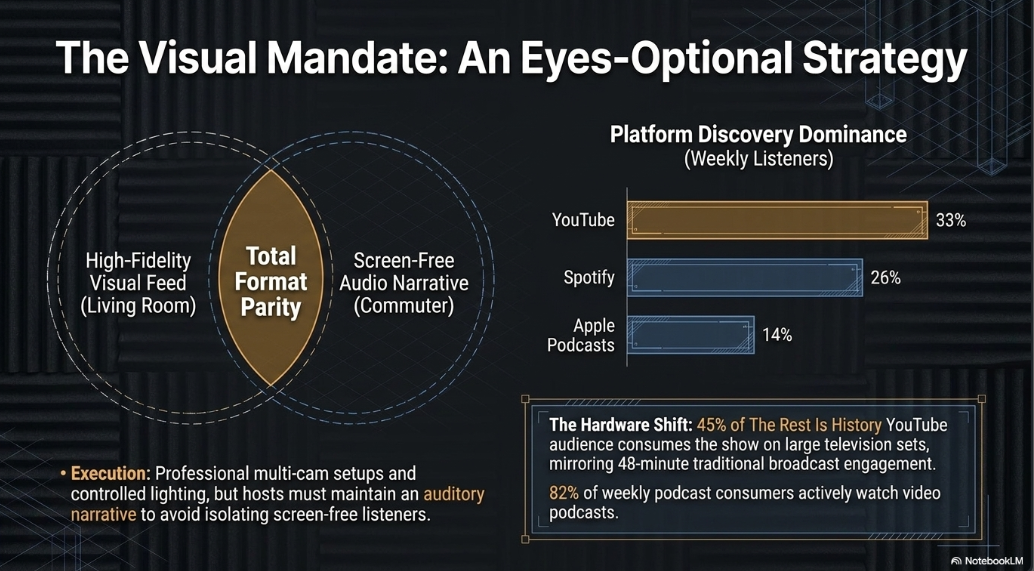
A podcast strategy developed in 2026 that ignores video is fundamentally obsolete. Distributing audio-only content leaves the vast majority of organic algorithmic discovery on the table7. The industry has reached total format parity: 57% of all Americans aged 12 and older have both listened to and watched a podcast, while 82% of weekly podcast consumers actively watch video podcasts5. YouTube has firmly established itself as the primary discovery engine for the medium, capturing 33% of weekly podcast listeners in the United States, significantly outpacing Spotify (26%) and Apple Podcasts (14%)1.
This visual revolution dictates that modern pre-production must incorporate a hybrid "eyes-optional" strategy from day one16. The content is engineered to function perfectly as a standalone, screen-free audio experience for commuters and multitaskers, yet it provides a compelling, high-fidelity visual feed for those who choose to watch16. This shift is changing hardware usage; nearly 45% of The Rest Is History's YouTube audience consumes the show on large television sets, signaling that audiences are settling in for 48-minute visual engagement sessions that rival traditional television programming17.
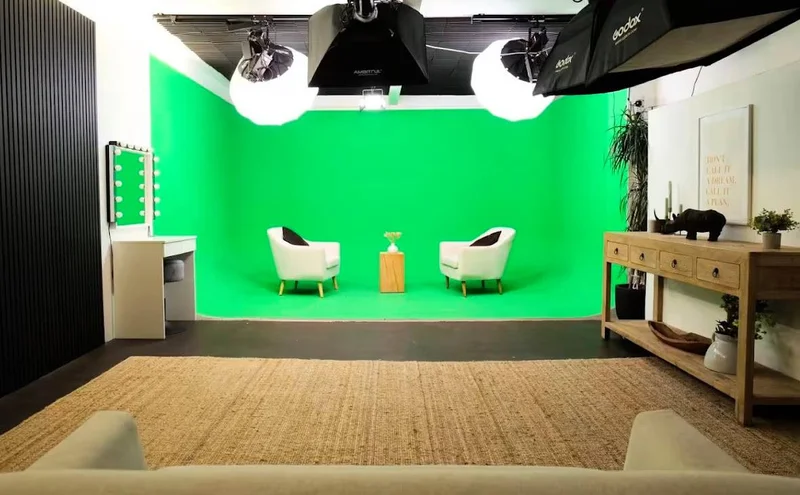
Producing a visual podcast requires investing in professional multi-camera setups, controlled studio lighting, and high-quality remote recording software (such as Riverside), while ensuring the hosts remain focused on the auditory narrative rather than relying on visual gags that isolate audio-only listeners7. While elevating an investigative or narrative audio drama into a visual format requires immense capital investment and crews, standard conversational formats can achieve visual excellence with relatively low maintenance31.
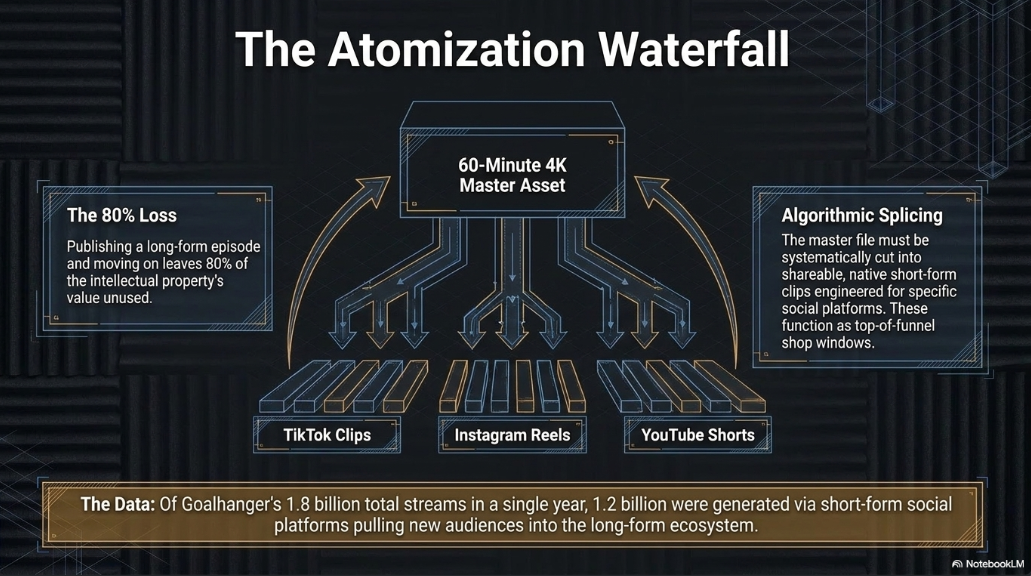
Crucially, the visual component allows production teams to execute a strategy of "atomization." Publishing a 60-minute episode and moving on is leaving 80% of the asset's value behind7. The full-length video file must be systematically spliced into highly shareable, native short-form clips tailored for TikTok, Instagram Reels, and YouTube Shorts7. These algorithmic platforms act as vital top-of-funnel "shop windows." In a single year, of the 1.8 billion total streams Goalhanger achieved, approximately 1.2 billion were generated via these social platforms, proving that atomized short-form video is the primary driver for drawing new audiences into the long-form ecosystem17.
Operational Blueprinting to Combat Podfading
The leading cause of podcast failure is rarely a lack of initial creative enthusiasm. Instead, it is the result of operational exhaustion, unrealistic production schedules, and a failure to map the project's long-term logistical and financial demands3. Podcasting requires a marathon mentality; it takes a minimum of six to twelve months to establish listener habits and build a sustainable, measurable audience11. Without a rigorous operational blueprint, the continuous, compounding pressure to secure guests, conduct research, and execute meticulous post-production inevitably crushes the creator, leading to podfading34.
The economics of independent audio production can be brutal. Creators producing complex formats, such as audio dramas or highly edited documentaries, often face massive out-of-pocket expenses. Annual costs for website hosting, essential software subscriptions, and specialized audio plug-ins (often requiring physical security dongles and expensive licensing fees) can easily exceed thousands of dollars35. Because podcasts do not automatically generate revenue per download upon launch, creators are forced to rely on external crowdfunding or platforms like Patreon to survive35. However, Patreon models require the creator to produce even more exclusive content to satisfy subscribers, accelerating burnout and causing the scope of the project to grow too large for a small team to maintain35.
This phenomenon is observable across all genres. A comprehensive quantitative study of global English-language science podcasts revealed that 34% of science series failed to maintain a dedicated subject focus, and single-term exponential decay curves perfectly modeled the rate at which these shows were abandoned36. The study highlighted that 62% of science podcasts were affiliated with larger organizations, allowing them to produce significantly more episodes on average than independent creators, largely because only 24% of the analyzed shows generated any overt financial income36.
Constructing the Show Bible
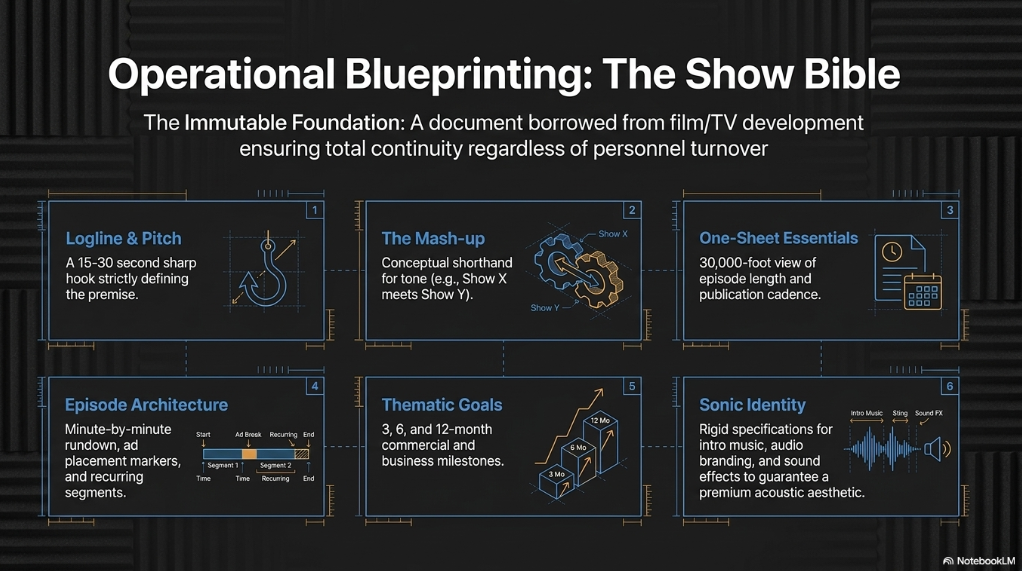
To insulate a production against scope creep, creative drift, and operational burnout, professional networks utilize a foundational document known as the "Show Bible." Borrowed directly from television and film development, a Show Bible serves as the definitive, immutable blueprint for the podcast38. It acts as a reference manual for the host, external editors, and marketing teams, ensuring total continuity regardless of personnel turnover38.
A comprehensive Show Bible includes several critical components:
Cadence, Batching, and Setting Boundaries
To maintain consistency and prevent the onset of podfade, the publication cadence must be ruthlessly realistic. While weekly publication is considered ambitious and highly effective for maintaining algorithmic momentum on platforms like YouTube, a biweekly (fortnightly) cadence is often the minimum viable commitment for sustainable audience building7. Monthly publication, by contrast, frequently results in a loss of listener momentum and habituation7.
Producers can safeguard their schedule through "batching"—the process of recording multiple episodes during a single, highly focused studio session32. This efficient workflow creates a content buffer, ensuring that the production pipeline is protected against unforeseen guest cancellations, host illness, or technical failures3. By maintaining a stockpile of pre-recorded episodes scheduled weeks in advance, the publisher is never scrambling to meet a deadline, preserving both the quality of the content and the psychological bandwidth of the team32. Furthermore, hosts must set healthy expectations; if an episode is inevitably delayed due to technical failure, acknowledging the delay transparently to the audience builds trust and humanizes the brand, which is vastly preferable to abandoning the project out of frustration3.
Commercial Infrastructure, IAB Measurement, and Dynamic Ad Insertion
In the maturation of the podcasting industry, the business models supporting content creation have shifted dramatically. The historical model of podcasting often relied on producing episodic series with the hope of eventually optioning the intellectual property to film or television networks20. However, the industry has fundamentally reoriented toward high-volume, always-on productions supported heavily by advertising revenue and direct audience monetization20. In 2026, U.S. podcast advertising spending returned to a multibillion-dollar growth trajectory, reflecting deep advertiser trust and demand2.
To capitalize on this environment, podcasts must be architected for commercial integration during the pre-production phase. The era of the "baked-in" advertisement—where a host reads a sponsor message that becomes permanently etched into the final MP3 audio file—is rapidly becoming obsolete42. The modern commercial standard is Dynamic Ad Insertion (DAI).
The Mechanics of Dynamic Ad Insertion (DAI)
DAI is a sophisticated server-side technology that separates the advertising audio from the core episodic content. When a listener streams or downloads an episode, the hosting platform's software identifies pre-designated time markers within the audio file and dynamically stitches targeted advertising into those exact slots at the very moment of playback42.
This technology radically transforms the commercial viability and yield of a podcast asset. With baked-in ads, a sponsor message recorded in 2023 remains in the file forever, generating absolutely no additional revenue when a new listener discovers the back catalog in 202643. DAI, conversely, turns an entire historical archive into live, perpetually monetizable inventory43. A single advertising campaign can be deployed across hundreds of past episodes simultaneously, ensuring that every download, regardless of when the episode was originally published, carries a current, revenue-generating sponsor message43. Furthermore, if a campaign expires, the system seamlessly swaps in a new advertiser without the producer ever having to re-edit or re-upload the original episode files42.
Structuring for Pre-Roll, Mid-Roll, and Post-Roll
For DAI to function seamlessly, the podcast's structural format (as codified in the Show Bible) must include natural breaks specifically engineered for ad insertion. These ad markers are universally categorized into three positions42:
Pre-Roll: Advertisements placed at the very beginning of the audio file, prior to the main content. Pre-roll slots boast incredibly high completion rates, as the listener has just initiated playback and has not yet dropped off. They are optimal for short, punchy, 15-to-30-second brand awareness messages43.
Mid-Roll: Interspersed within the core content, ideally at a natural conversational or thematic break. Mid-roll is universally recognized as the most valuable and highest-yielding advertising slot. A listener who reaches the midpoint of an episode is highly engaged and far more likely to listen through the advertisement without skipping43.
Post-Roll: Placed after the primary content has concluded. While post-roll slots suffer from higher listener drop-off rates, they remain a highly cost-effective inventory space for secondary calls-to-action, softer plugs, or internal network cross-promotion43.
Programmatic vs. Direct-Sold and IAB Standardized Measurement
DAI allows publishers to manage two distinct revenue streams: direct-sold and programmatic. Direct-sold advertisements are secured by the podcast's internal sales team or agency, commanding premium rates for custom, host-read endorsements tailored specifically to the show's audience46. Programmatic advertising relies on digital ad exchanges (such as AdsWizz, DAX, or the Triton Advertising Platform) to automatically fill unsold inventory with pre-recorded brand messages at scale46. Programmatic insertion allows for sophisticated geographical and demographic targeting, ensuring that a listener in London receives a different advertisement than a listener in Sydney, all from the exact same episode file45.
Underpinning this entire commercial infrastructure is strict adherence to standardized measurement. Media buyers and advertisers demand absolute transparency regarding reach, frequency, and performance. Consequently, elite podcast hosting platforms and industry rankers comply strictly with the Interactive Advertising Bureau (IAB) Podcast Measurement Technical Guidelines v2.248. Under IAB v2.2 standards, a "download" is not simply counted when a file is requested from an RSS feed. The server must rigorously filter out bot traffic, data centers, spiders, and multiple requests originating from the exact same IP address and user agent within a specific timeframe48. Furthermore, a download is only validated if a minimum of one minute of content is successfully transferred to the user's device48.
This level of stringent measurement is reflected in global reporting tools like the Triton Digital Podcast Rankers, which not only track IAB-certified downloads but utilize tools like Demos+ to index audience characteristics. For instance, Demos+ data can prove to an advertiser that listeners of a specific True Crime podcast are 25% more likely than the average population to purchase a new car (an index of 125), transforming a broad audio buy into a highly targeted, data-driven transaction48. Designing episodes that hook the listener instantly is therefore not just an editorial best practice, but a strict commercial necessity to ensure downloads meet the one-minute IAB monetization threshold.
Legal Defensibility and Technical Baselines
The final pillar of a robust pre-production strategy involves securing the legal defensibility and technical quality of the asset. Failing to execute proper legal releases or ignoring broadcast-standard audio mastering can expose a production company to severe financial liability, copyright infringement lawsuits, and brand degradation.
The Podcast Guest Release Form
A common and highly dangerous oversight in independent podcast production is relying on verbal agreements or informal email chains to record and distribute guest interviews. In the professional arena, an exhaustive Guest Release Form is a non-negotiable requirement before the microphones are activated50.
It is vital to distinguish between a Podcast Guest Contract and a Guest Release Form. A Guest Contract encompasses broader, complex business terms (such as payment schedules, enterprise compliance, sponsorship stipulations, and confidentiality clauses), usually reserved for highly compensated appearances53. A Guest Release Form, however, serves a highly specific, universal legal purpose: it unconditionally secures the producer's right to record, edit, monetize, and distribute the guest's physical and intellectual contributions54. Without a signed release form in a two-party consent jurisdiction, a disgruntled guest retains the legal leverage to demand the removal of an episode, dictate editorial changes post-production, or file defamation and right-of-publicity claims if they feel their words were misrepresented52.
A standard, legally binding Guest Release Form must contain several critical clauses:
These forms should be integrated seamlessly into the pre-production workflow, often automated via scheduling software (e.g., DocuSign, Typeform, or Jotform) immediately upon booking to establish clear, professional boundaries well in advance of the recording date55.
Technical Audio Standards
While compelling storytelling can occasionally mask minor technical flaws, professional podcasting requires strict adherence to audio mastering standards to ensure a uniform listener experience across highly diverse hardware ecosystems (smartphones, car stereos, and smart speakers). Wild fluctuations in audio levels severely damage listener retention, as audiences are forced to constantly adjust their volume dials between the host, the guest, and dynamically inserted programmatic advertisements.
To eradicate this friction, audio engineers adhere to Loudness Units relative to Full Scale (LUFS) targets. The universally accepted industry standard for podcast distribution—mandated by major directories like Apple Podcasts—dictates mastering the final audio file to an integrated loudness of -16 LUFS for stereo files, or -19 LUFS for mono files, while utilizing true-peak limiters to prevent any digital distortion or clipping58. Ensuring all incoming audio—from remote guest tracks recorded via web platforms to pre-produced intro music—is meticulously normalized to these precise LUFS standards during the post-production assembly guarantees a broadcast-quality aesthetic that achieves parity with elite digital media networks.
Strategic Synthesis for Long-Term Viability
The successful launch and sustained capitalization of a professional podcast in the modern digital economy requires far more than charismatic talent and a high-quality microphone. The medium has matured into a highly sophisticated, multi-channel ecosystem where the traditional boundaries between audio broadcasting, visual streaming, educational curriculum development, and live event commercialization have effectively vanished.
Achieving longevity demands an exhaustive, highly disciplined pre-production phase. Producers must define a razor-sharp editorial identity, validate their Unique Value Proposition against a densely crowded market, and leverage deep demographic insights to cultivate a loyal audience. They must architect their content to forge habitual relationships with a clearly defined Minimum Viable Audience, recognizing that deep engagement and high retention rates far outweigh superficial reach. Furthermore, by embracing the "eyes-optional" visual format to dominate algorithmic discovery, integrating Dynamic Ad Insertion logic into the episode's structural DNA to maximize yield, establishing a rigid operational Show Bible to combat the compounding threat of podfading, and executing unassailable legal release frameworks, creators can construct an insulated, highly monetizable media asset.
Ultimately, podcasting is no longer an experimental, decentralized frontier; it is a foundational pillar of modern, enterprise-scale media strategy. Those who approach the medium with a disciplined, systems-based architecture will successfully cultivate and monetize a hungry audience, while those who rely on improvisation will inevitably fade into the algorithmic background noise.
Works cited
Podcast Statistics: The Current State of Podcasting - RSS.com, https://rss.com/blog/the-current-state-of-podcasting/
Invest in Ossa - StartEngine, https://www.startengine.com/offering/ossa
Podcast Editorial Calendar: How to Stay Consistent and Avoid Podfading - Castos, https://castos.com/podcast-editorial-calendar/
The Infinite Dial - SSRS, https://ssrs.com/ssrs-solutions/the-infinite-dial/
The Infinite Dial® 2026 - SSRS, https://ssrs.com/insights/the-infinite-dial-2026/
New Global Podcast Study Sets the Standard for 2026 Audio Planning - Podnews, https://podnews.net/press-release/global-podcasting-ad-compass-26
What Is a Podcast Content Strategy? The B2B Guide for 2026 - Rep Cap, https://repcap.com/b2b-content-marketing-insights/podcast-content-strategy
Blog Post: How to Find Your Podcast's UVP, https://www.quillpodcasting.com/blog-posts/uvp
How to Craft a Podcast Positioning Statement [3 Easy Steps] - Pepperland Marketing, https://www.pepperlandmarketing.com/blog/podcast-positioning-statement
6 Core Tenets Of Making A Successful Podcast - Pacific Content, https://pacific-content.com/what-makes-a-good-podcast/
How to Start a Podcast: Complete Beginner's Guide - Libsyn, https://libsyn.com/how-to-start-a-podcast/
Podcast Audience Growth Tactics: 4 Phases - SocialSellinator, https://socialsellinator.com/the-ultimate-guide-to-podcast-audience-growth-tactics/
How to Format a Podcast - Broadcast Revolution, https://www.broadcastrevolution.co.uk/how-to-format-a-podcast
Gary Lineker's Goalhanger named UK's fastest-growing business | Media | The Guardian, https://www.theguardian.com/media/2026/jun/05/gary-lineker-goalhanger-fastest-growing-business-podcasts
The Inside Story of Gary Lineker's Goalhanger Podcast Revolution - Esquire, https://www.esquire.com/uk/culture/a62679143/goalhanger-the-rest-is-podcast-profile/
Podcasting Has Grown Up (And Brands Should Pay Attention) - Snap, https://snap.je/insights/podcasting-has-grown-up-and-brands-should-pay-attention
Inside Goalhanger's shift from podcast producer to screen studio - Digiday, https://digiday.com/media/inside-goalhangers-shift-from-podcast-producer-to-screen-studio/
The Rest Is History (podcast) - Wikipedia, https://en.wikipedia.org/wiki/The_Rest_Is_History_(podcast)
Tony Pastor discusses entrepreneurship, podcasting and risk at Christ Church, https://www.chch.ox.ac.uk/news/tony-pastor-discusses-entrepreneurship-podcasting-and-risk-christ-church
Podcasting needs its own JIC – Jack Davenport, Goalhanger CEO - The Media Leader, https://uk.themedialeader.com/podcasting-needs-its-own-jic-jack-davenport-goalhanger-ceo/
Dino Sofos | Podcast Producer & Persephonica Founder Keynote Speaker, https://www.speakersassociates.com/speaker/dino-sofos/
Dino Sofos – Keynote Speaker, https://londonspeakerbureau.com/speaker-profile/dino-sofos/
Dino Sofos - Podcast Pioneer, CEO at Persephonica - Speaker Agency, https://www.speakeragency.co.uk/speakers/dino-sofos
The News Movement partners with Persephonica for move into audio - Press Gazette, https://pressgazette.co.uk/podcasts/news-movement-podcasts-persephonica/
Rising BBC talent heads North to join Dua Lipa's Sheffield podcast team - 'we're adding serious firepower', https://www.prolificnorth.co.uk/news/rising-bbc-talent-heads-north-to-join-dua-lipas-sheffield-podcast-team/
Steven Bartlett: Discover Inspiring Quotes & Episodes from Podcasts as Guest & Host, https://podcasts.musixmatch.com/speaker/steven-bartlett-01hekan4jbnw36epbsx866jjr8
Game Plan By Jake Humphrey | Easons.com, https://www.easons.com/game-plan-jake-humphrey-damian-hughes-9780241734445
The Podcast Consumer 2026 from Edison Research at SSRS - YouTube, https://www.youtube.com/watch?v=7Lfe5RsOl_c
Audio continues to break listening records: 2026 Infinite Dial Report | National Public Media, https://www.nationalpublicmedia.com/insights/articles/audio-continues-to-break-listening-records-2026-infinite-dial-report/
The Infinite Dial 2025 - Edison Research at SSRS, https://www.edisonresearch.com/the-infinite-dial-2025/
Podcasting Goes Visual: How Video Can Help Investigative Storytelling Reach New Audiences, https://gijn.org/stories/visual-podcasting-help-investigative-storytelling-reach-new-audiences/
When to release your podcast: Best day, time, and frequency to deliver your podcast, https://resonaterecordings.com/general/when-to-release-your-podcast/
PODCASTING - Sovrn, https://www.sovrn.com/wp-content/uploads/2019/06/publishers-guide-to-podcasting.pdf
Learn to Podcast - - Podcast Hero, https://podcasthero.com/learn-to-start-a-podcast/
Why does Audio Drama cost so much? Why does it take so long to release? : r/audiodrama, https://www.reddit.com/r/audiodrama/comments/qq6jxd/why_does_audio_drama_cost_so_much_why_does_it/
Science Podcasts: Analysis of Global Production and Output From 2004 to 2018 - bioRxiv, https://www.biorxiv.org/content/10.1101/298356v8.full.pdf
Science Podcasts: Analysis of Global Production and Output From 2004 to 2018, https://www.researchgate.net/publication/346976423_Science_Podcasts_Analysis_of_Global_Production_and_Output_From_2004_to_2018
How to Define (and Refine) Your Podcast with a Show Bible, https://podcastmovement.com/resources/creation/how-to-define-and-refine-your-podcast-with-a-show-bible/
Podcast and Broadcast Show Bible with Episode Rundowns in 5, https://trustur.ai/skills/podcast-and-broadcast-show-bible-with-episode-rundowns/
Badass Podcast Intros | Professional Audio Branding & Sound Design & Elite Podcast Intros & Outros — Ed Bishop Creative | Voiceover | Podcast Production & Intros | Sonic Branding, https://www.edbishopcreative.com/podcast-intros
Master Your Podcast Production Workflow - Fame.so, https://www.fame.so/post/podcast-production-workflow
Dynamic Ad Insertion for Podcast Advertising - DAI - Content Monsta, https://contentmonsta.com/podcast-dynamic-ad-insertion-dai/
Dynamic ad insertion explained (DAI), Springcast Blog, https://www.springcast.io/en/blog/dynamic-ad-insertion-explained/
What is Dynamic Ad & Content Insertion in Podcasting? - Captivate.fm, https://www.captivate.fm/podcast-monetization/sponsorship/what-is-dynamic-ad-insertion
Dynamic Ad Insertion (DAI) | Connect Media Group, https://connectmediagroup.uk/glossary/channels/radio-audio/podcasts/dynamic-ad-insertion-dai/
Dynamic Ad Insertion Explained Simply - Apple Podcasts, https://podcasts.apple.com/nz/podcast/dynamic-ad-insertion-explained-simply/id1223819466?i=1000542723895
Dynamic Ad Insertion for Podcasts - Triton Digital, https://help.tritondigital.com/docs/advertising-on-podcasts-in-omny-studio
US Podcast Ranker - Top Podcasts By Weekly Average Downloads - December 2022, https://tritonrankers.com/rankers/us/podcasts-weekly-downloads/2022/12
Australian Podcast Ranker - Top Podcasts - January 2026 - Triton Digital Podcast Rankers, https://tritonrankers.com/rankers/au/podcasts/2026/1
Strategic Pre-Production for a Professional Podcast - Finchley Studios, https://www.finchley.co.uk/finchley-learning/visual-podcast/strategic-pre-production-for-a-professional-podcast
Finding the Perfect Podcast Guest, https://blubrry.com/manual/creating-podcast-media/finding-the-perfect-podcast-guests/
Starting A Podcast To Market Your Business Template (Free Word), https://www.business-in-a-box.com/template/starting-a-podcast-to-market-your-business-D13212/
Free Podcast Contract Template – AI-Powered Editing, https://go-legal.ai/template/podcast-contract/
Podcast Guest Release Form: Free Template and Guide - Content Allies, https://contentallies.com/learn/podcast-guest-release
8 Best Podcast Guest Release Form Templates (Copy & Use) - Talks.co, https://talks.co/p/podcast-guest-release-form/
Free Podcast Guest Release Form Template | Download & Customize - Agreements.AI, https://www.agreements.ai/templates/podcast-guest-release-form
Podcast Guest Release Form Template - Jotform, https://www.jotform.com/form-templates/podcast-guest-release-form
LUFS Meter — Broadcast Loudness Measurement - Studio Six Digital, https://studiosixdigital.com/lufs-meter/