The Evolving Audio and Video Ecosystem
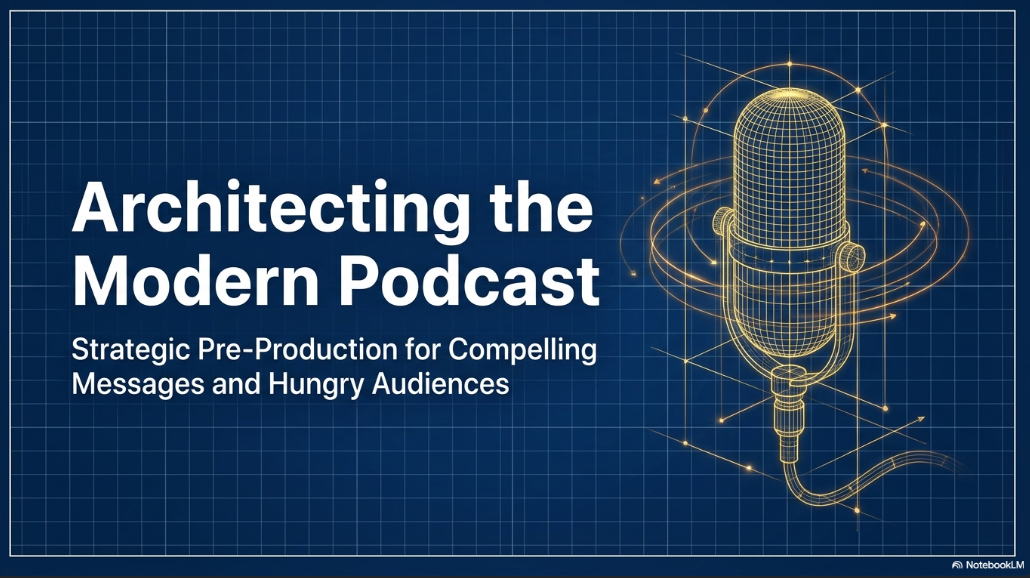
The podcasting medium has transitioned from an experimental digital niche into a highly systematized, multibillion-dollar pillar of the global entertainment and business communications sectors. As of 2026, the global podcast audience has expanded to an estimated 672 million monthly listeners, representing a staggering 145% growth trajectory since 20191. The industry's global value has reached $28.6 billion, encompassing over 4.4 million active podcasts1. Within the United States alone, 58% of the population over the age of 12 consumes a podcast on a monthly basis, translating to approximately 167 million individuals, while 45% of the population, or roughly 130 million people, are classified as weekly consumers2.
This massive scale has fundamentally altered the strategic requirements for launching and sustaining a professional podcast. The demographic distribution of this audience reveals deep penetration across previously untapped sectors. For instance, adoption among adults aged 55 and older has surged to 70%, while Hispanic Americans represent the fastest-growing demographic with an 18% year-over-year increase1. Furthermore, podcasting commands attention in high-income brackets, with 71% of individuals earning over $75,000 listening monthly1.
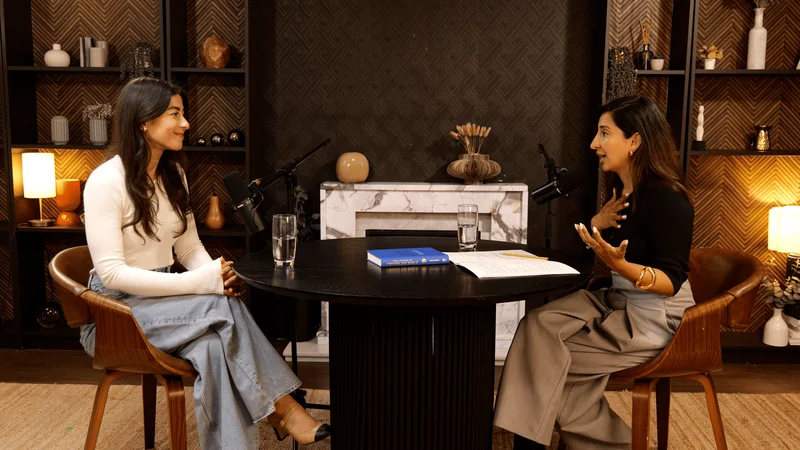
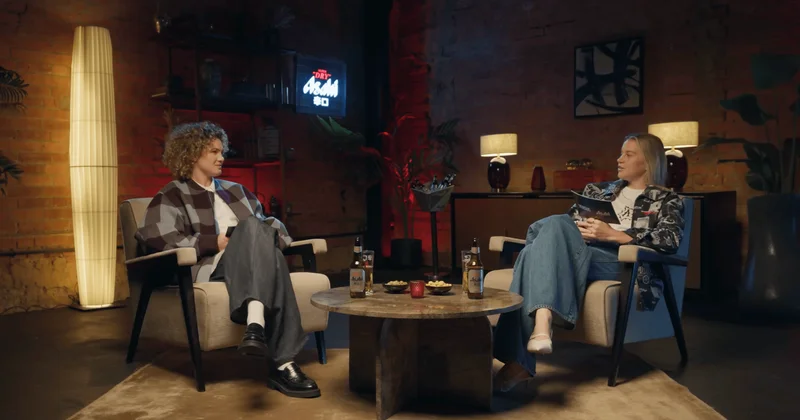
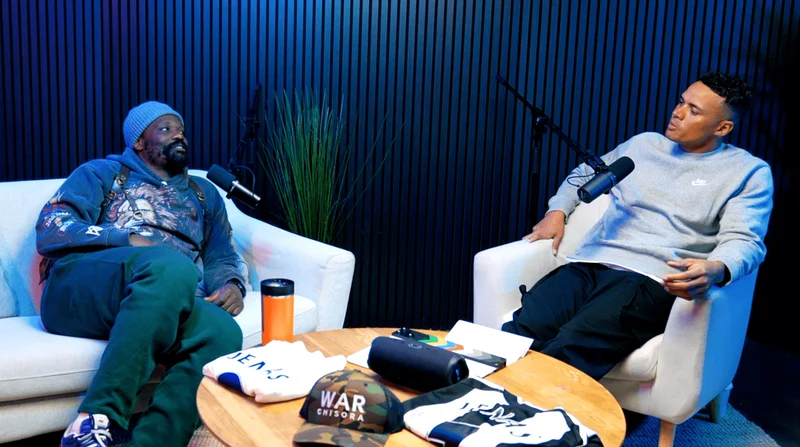
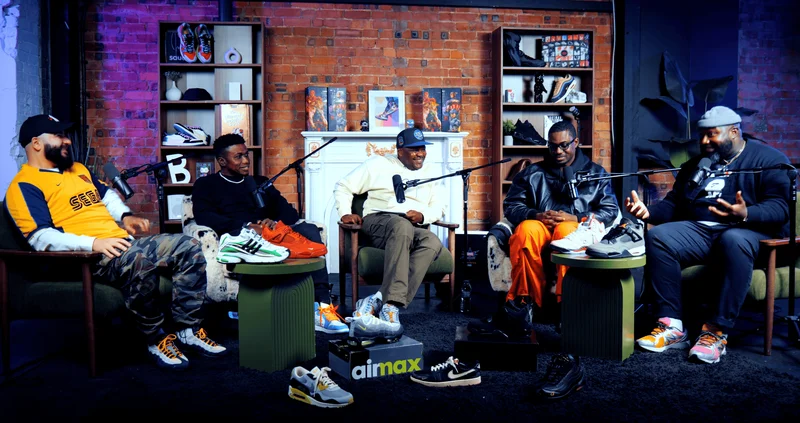
A profound shift within this landscape is the migration from audio-exclusive consumption to a hybrid audio-visual paradigm. Data from Edison Research’s Podcast Consumer 2026 study indicates that 57% of podcast consumers now alternate seamlessly between listening and watching behaviors, depending on their environment2. Consequently, YouTube has usurped traditional audio applications to become the primary podcast platform for 37% of weekly listeners2. Furthermore, consumption environments have shifted dramatically. While the industry previously optimized for mobile environments—such as highway commutes or gym sessions—two-thirds of weekly consumers now engage with podcasts in the home, heavily utilizing smart televisions, desktop monitors, and connected home media centers2.
This visual and domestic shift dictates that pre-production can no longer be limited to audio equipment procurement. Professional productions must account for visual quality, lighting consistency, set design, and multi-platform distribution frameworks. When 38% of business-to-business (B2B) podcast consumers engage with video formats, the production must be architected as a holistic media property rather than a simple audio feed5. In a saturated environment where 72% of advertising revenue is captured by the top 10% of shows, merely recording a conversation is insufficient1. The modern podcast requires rigorous strategic pre-production, focusing heavily on message formulation, competitive differentiation, audience psychology, and algorithmic optimization.
Establishing the Foundational Architecture: From Topic to Premise
A podcast represents a significant ongoing investment of organizational capital, human resources, and time. Therefore, the fundamental message must be aggressively validated prior to any recording6. Novice producers routinely fail because they build shows around broad topics, such as marketing, leadership, or entrepreneurship. Because topics are inherently commodified, a topic-driven show offers no unique intellectual property and forces the creator to compete purely on volume and celebrity access. Strategic pre-production demands a shift from exploring a topic to exploring a premise7.
The concept of the premise is defined as the core idea informing all subsequent creative and business decisions. It is a specific, defensible assertion pulled from a unique perspective that guides all creative choices and dictates the show's reputation7. A premise provides an insightful reframe on a familiar topic, handing the audience a new lens through which to view their industry or personal challenges. To validate this during pre-production, producers utilize the "XY Premise Pitch" formula, where X represents the commodified topic and Y represents the proprietary premise. The pitch is structured as follows: "This is a show about X. Unlike other shows about X, only we Y."7.
For example, a generic show might position itself as a podcast about B2B marketing. A premise-driven show, however, would state that it is a show about B2B marketing, but unlike others, it asserts that the obsession with best practices is destroying creativity, and it investigates how to harness intuition instead9. This assertion creates a distinct intellectual moat. It is specific, defensible, and kinetic, meaning the audience experiences an immediate shift in perspective upon encountering the concept7.
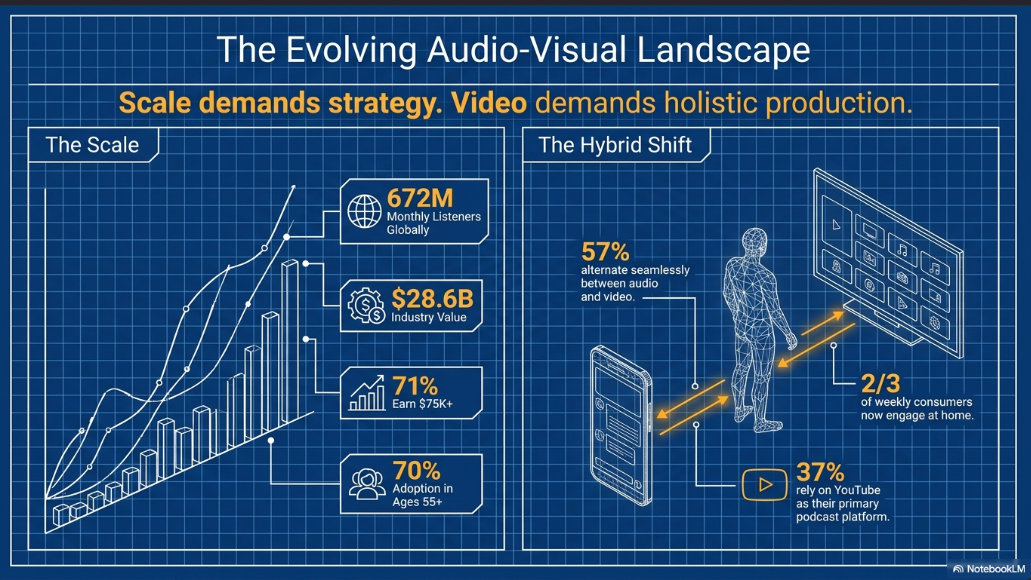
Cultivating this premise requires mastering the triad of process, posture, and practice8. Process involves identifying lived experiences and laying a narrative structure over them. Posture dictates how the host sees themselves in the world, defining their tone of voice and perspective. Practice is the commitment to showing up on a recurring deadline to refine the premise publicly8.
Furthermore, to ensure this premise translates into a coherent production architecture, producers construct a formal podcast mission statement. This statement acts as the show's internal compass, dictating guest selection, episode ideation, and marketing directives6. The optimal framework follows a structured semantic format stating that the podcast helps a clearly defined target audience solve a specific problem by achieving a designated goal in each episode6. By defining the audience aggressively and narrowly—engaging in hyper-niche psychographic profiling—producers insulate the show from topic drift, a phenomenon where unstructured podcasts slowly lose their thematic identity and alienate their core listeners6.
Structuring the Narrative: The Laddering Down Framework
Once the premise is established, the host must learn to communicate it in a way that generates resonance over reach. High-impact communicators do not overwhelm their audience with raw facts; instead, they architect a clear, memorable, and differentiated message by securing micro-agreements7. This is achieved through a three-part storytelling framework known as "Laddering Down," which guides the listener from their current state of mind to the adoption of the host's premise7.
The first rung of the ladder is "Align," which focuses on establishing what the audience already wants. Because the audience has not undergone the same experiential journey as the host, the host must secure a critical moment of agreement on a worthy objective the listener already desires to achieve. This establishes a baseline of trust and psychological permission to proceed7.
The second rung is "Assert," which introduces what the audience actually needs. Here, the host deploys the core premise. Logically bridging from the alignment phase, the host demonstrates that to achieve the desired outcome, a specific action, mindset shift, or approach is required. This is where analysts and subject matter experts often fail, diluting their message with too many options instead of making a single, bold, and clear assertion7.
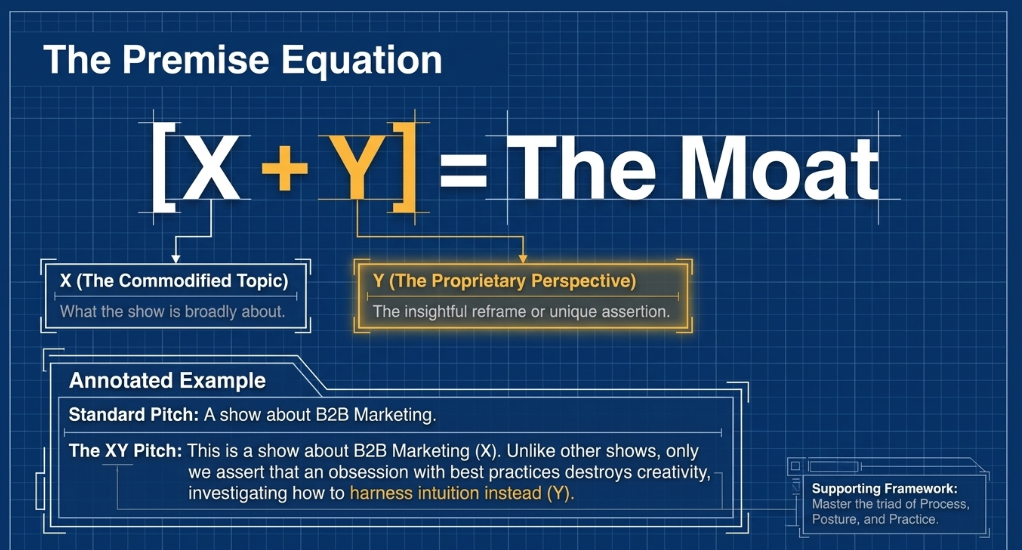
The final rung is "Aspire," which outlines the shared hope. The host paints a vivid picture of the best-case outcome, demonstrating what becomes possible because of the premise and what the host and audience might attain together. This solidifies the emotional weight of the message and provides the audience with highly repeatable language that they can carry into their own networks7. In execution, this narrative structure often relies on signature stories, where the host shares an anecdote and bridges it to the core premise using transitional phrasing such as, "that's the thing about..." followed by the episode's insight10.
Competitive Analysis and the Unique Value Proposition
Before finalizing the narrative structure, rigorous market research and competitive analysis must occur. Podcasting operates in a zero-sum attention economy where a listener choosing one show explicitly means they are ignoring another. Defining a Unique Value Proposition (UVP) requires answering a foundational question regarding why listeners should tune into this specific show over others covering similar content5.
The standard process for UVP identification involves leveraging analytics tools, such as Rephonic's Podcast Audience Graph, to map the competitor ecosystem11. Pre-production teams must listen to a cross-section of competitor episodes, cataloging their format, audio quality, average length, sound design, guest selection, and thematic focuses11. By mapping this data into a centralized matrix, producers identify market gaps. If all competitors utilize a standard 60-minute interview format, a massive opportunity may exist for a highly produced, 20-minute multi-story documentary format11.
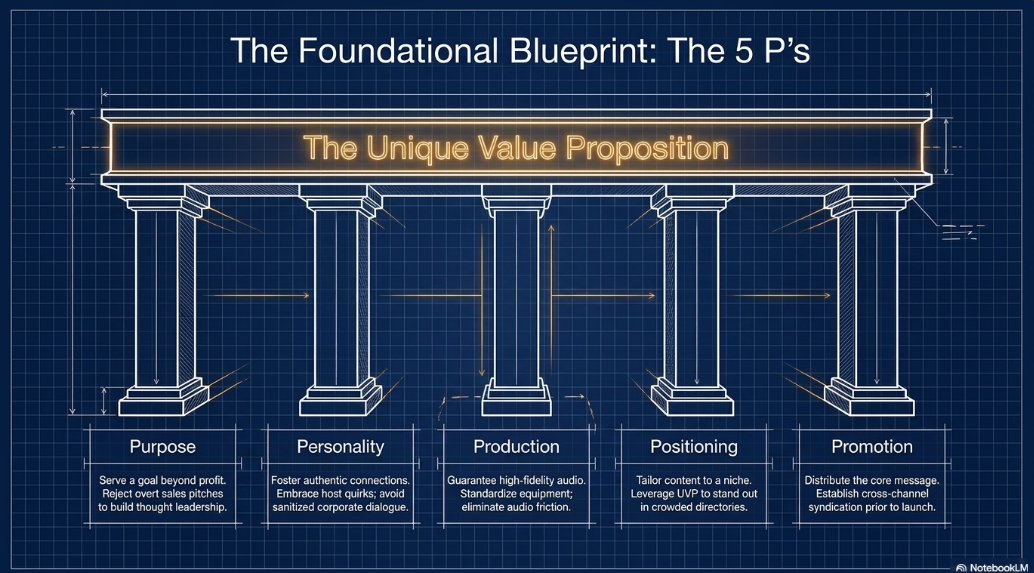
The UVP is subsequently stress-tested against the foundational "Five P's of Podcasting," which dictate the overarching strategy12.
Codifying the Vision: The Podcast Show Bible
A critical methodology borrowed from the television and film industries is the creation of a "Show Bible." Because a podcast represents long-term, serial storytelling, a Show Bible acts as the architectural blueprint of the series. It ensures consistency, prevents format drift, and facilitates seamless onboarding for new editors, producers, or co-hosts13. Historically utilized to pitch series funding to network executives, the show bible has been adopted by major and independent audio producers as a mandatory reference manual13.
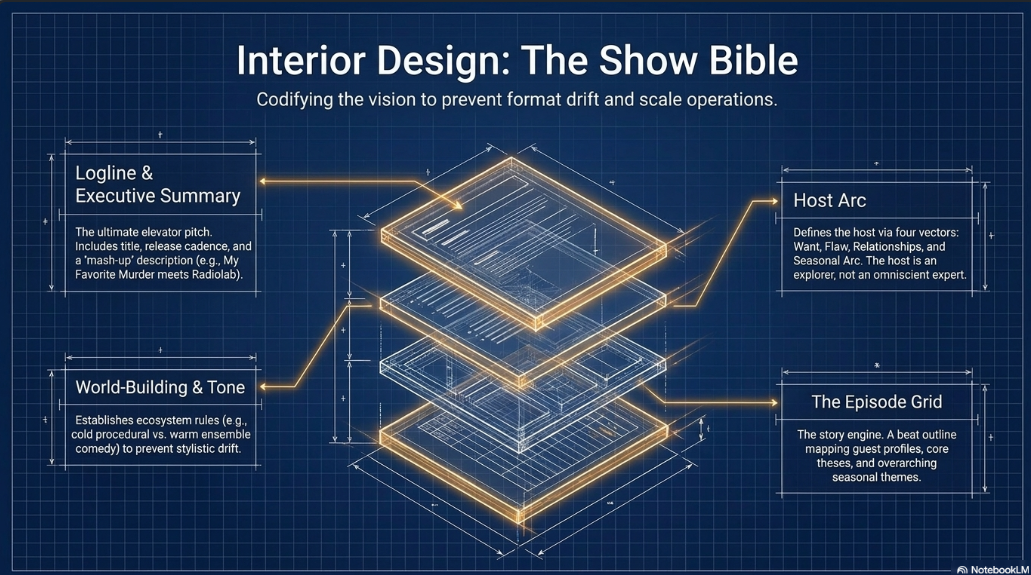
An exhaustive podcast Show Bible typically ranges from 5 to 15 pages and contains several highly structured sections13.
The Logline and Executive Summary
The document opens with a logline, which is a single, heavily refined sentence that names the protagonist or host, the engine that drives the series, and the central tension or hook14. For a non-fiction or business podcast, the logline serves as the ultimate elevator pitch. Following the logline is a one-sheet executive summary detailing the podcast title, expected episode length, release cadence, and a high-level "mash-up" description to rapidly convey the format. For example, a show designed to examine disastrous mornings might be described as My Favorite Murder meets Radiolab13.
World-Building and Emotional Tone
Before introducing specific characters or hosts, the bible establishes the setting, the rules of the ecosystem, and the emotional atmosphere of the show14. The tone must be explicitly named to prevent stylistic drift between different audio engineers or guest bookers. A producer must clarify whether the show is a cold, analytical procedural, a warm ensemble comedy, or a highly produced narrative thriller14.
Character and Host Development
Even in journalistic or interview-based podcasts, the host acts as a character navigating a narrative landscape. The Show Bible outlines the host's core attributes using a specific framework focusing on four elements: the "Want" (what they are chasing and the engine of their decisions), the "Flaw" (the internal friction that keeps getting in their way), their "Relationships" (how they bond with guests or co-hosts), and their "Arc" (how they change or refuse to change across a season)14. The most compelling audio features hosts who are not omniscient experts descending from a mountaintop, but rather relentless explorers pursuing answers to questions that genuinely frustrate or intrigue them8.
The Engine and The Episode Grid
To prove the show has an "engine" capable of generating stories without forcing them, pre-production requires mapping out the first season14. This section defines the mechanism that generates a fresh story each episode, whether it is a new business case study, a new cultural threat, or a specific industry challenge14. The episode grid includes a detailed beat outline of the pilot episode (establishing the inciting incident and hook) and a row for subsequent episodes outlining the topic, the guest profile, the core thesis, and how it advances the broader themes of the season14.
The 4 Hooks Framework and Episode Architecture
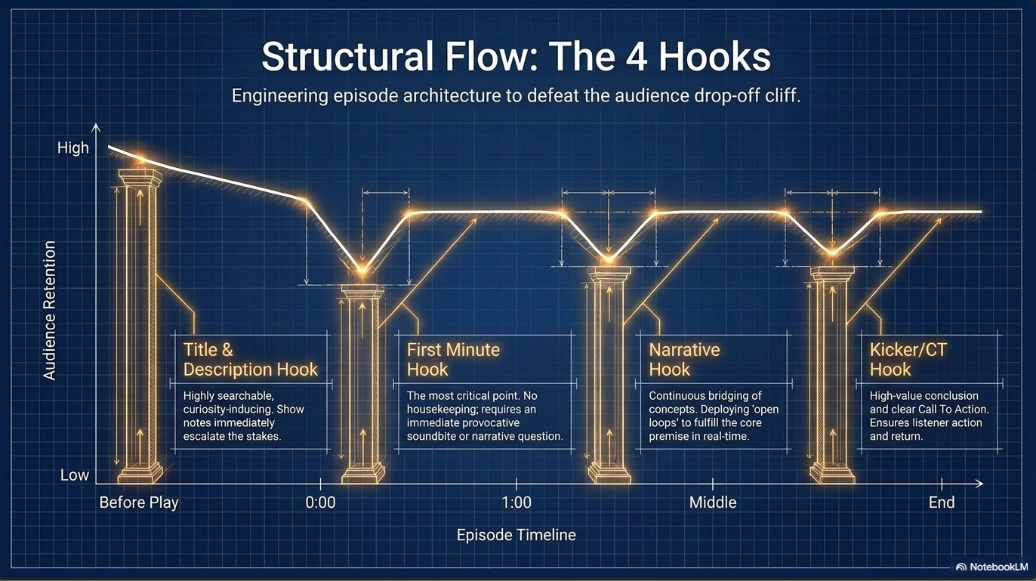
Within the Show Bible, producers must meticulously detail the structural flow of a standard episode. A format is the overall style of the show (e.g., solo, interview, panel, storytelling), while the structure is the sequential flow within a single episode18. To optimize listener acquisition and retention within this structure, producers deploy the "4 Hooks Framework"6.
The first hook is the Title Hook. Episode titles must be highly searchable, curiosity-inducing, and free of clickbait, directly communicating the episode's value6. The second is the Description Hook. Show notes must escalate the stakes, providing immediate context as to why the listener must invest their time6.
The third and most critical element is the First Minute Hook. Audio retention curves reveal massive audience drop-offs in the first 60 seconds if the host engages in administrative housekeeping, weather banter, or lengthy guest biographies. The episode must open immediately with a provocative soundbite, an energetic tease, or a compelling narrative question to affirm the listener's choice to click play6. Finally, the Narrative Hook requires the host to continuously bridge concepts and deploy open loops throughout the episode to maintain momentum and ensure the core premise is actively fulfilled in real-time6.
Audience Psychology: Parasocial Interaction and Listener Retention
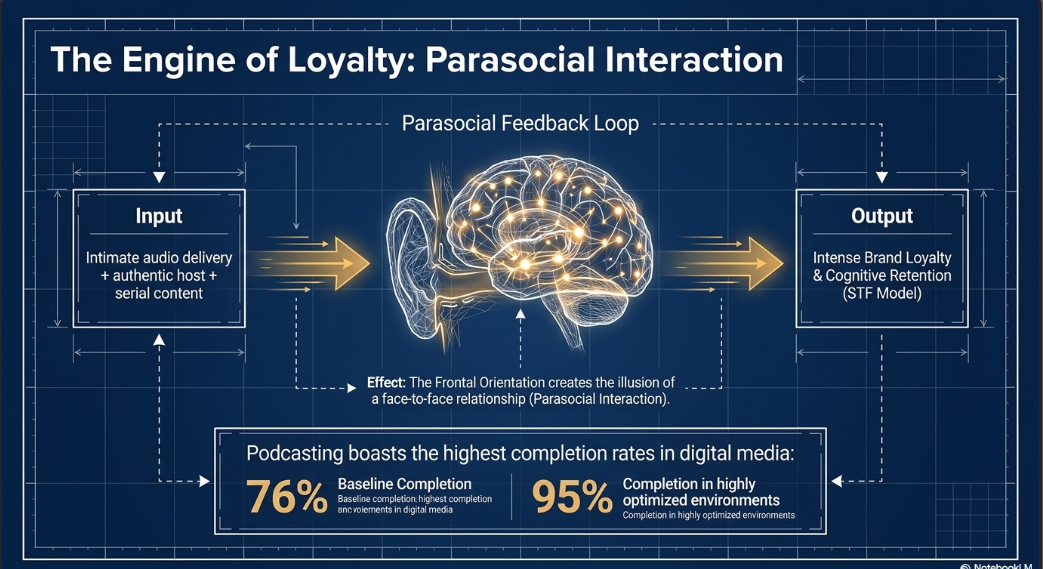
The ultimate objective of podcast pre-production is to engineer an environment that fosters deep listener retention and intense brand loyalty. This is achieved through the psychological phenomenon known as Parasocial Interaction (PSI) and Parasocial Relationships (PSR).
First defined by Horton and Wohl in 1956, parasocial interactions describe the one-sided, mediated illusion of a face-to-face relationship between an audience and a media performer20. Podcasting is uniquely positioned to accelerate this dynamic due to several medium-specific characteristics: the intimacy of the audio being delivered directly into the listener's ear, the authentic aesthetic of the host, the serial nature of the content, and the high degree of focused attention required to consume spoken-word audio21.
Academic research analyzing uses and gratifications theory indicates that podcast stickiness—the extent to which listeners commit to a show over the long term—is positively correlated with the STF model: storytelling transportation, edutainment, and social engagement23. When listeners experience the podcast as an intimate conversation or exchange, their frequency and duration of listening increase significantly, and the illusion of physical proximity and frontal orientation enhances cognitive retention21. This bond effectively transitions a listener from a casual consumer to an active community member, drastically increasing their likelihood of purchasing host-endorsed products, attending live events, or subscribing to premium channels20.
Because of these intense parasocial bonds, podcasting boasts the highest completion rates of any digital media format. According to Edison Research and Spotify data, 76% of podcast consumers finish most or all of an episode they subscribe to1. For branded or corporate podcasts, a 60% completion rate serves as a healthy baseline, though well-produced B2B shows regularly exceed 70%25. In highly optimized environments, such as Lululemon's internal employee podcast produced by JAR Audio, completion rates have reached an astonishing 95%25. These retention rates contrast sharply with video platforms like YouTube, where 30-minute educational videos often struggle to maintain a 14% completion rate27.
The Ad-Avoidance Fallacy and Monetization Reality
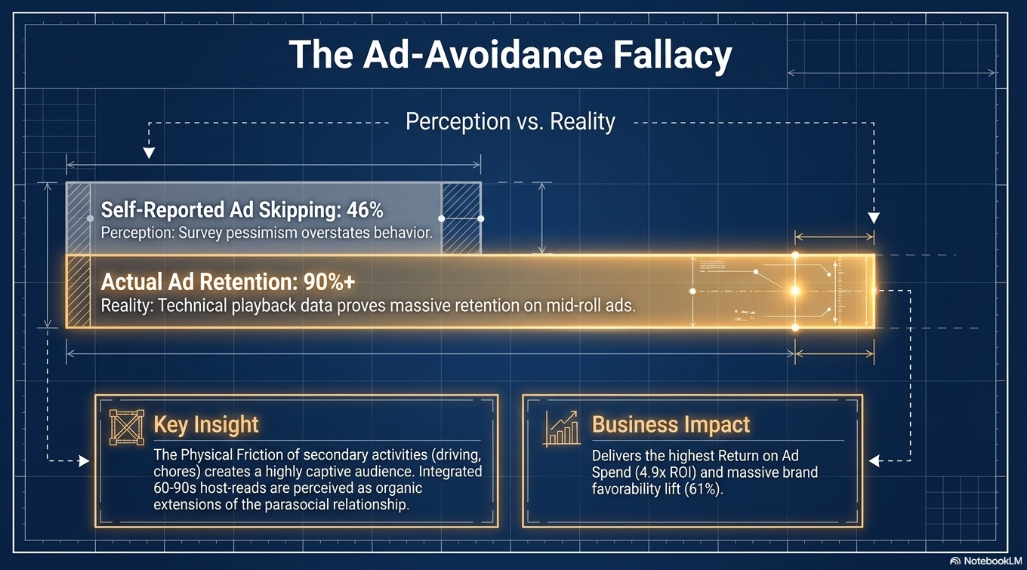
The parasocial trust cultivated by strategic pre-production directly impacts the monetization and advertising efficacy of the podcast. Traditional survey data often paints a pessimistic view of ad avoidance. For example, studies by Sounds Profitable indicated that 46% of listeners claimed to always or often skip ads, while the Canadian Podcast Listener study found 18% claimed to skip ads all the time19.
However, technical playback data utilizing digital signal processing to analyze retention histograms reveals a vastly different reality. Data from podcast analytics firm Bumper shows that actual ad retention rates routinely exceed 90%19. When listeners are asked hypothetical questions, they tend to over-report ideal behaviors. In reality, the physical friction required to skip an ad while driving, exercising, or performing household chores creates a highly captive audience28. Furthermore, when ads are relevant to the niche and delivered seamlessly via a host-read format, they are perceived not as interruptions, but as organic extensions of the parasocial relationship1.
The critical factor for maintaining this high retention is the duration of the advertisement. Bumper's analysis of hundreds of ad breaks plotted on scatterplots indicates that shorter, focused breaks of 60 to 90 seconds perform significantly better than multi-minute, clustered ad blocks19.
Algorithmic Seeding and Search Engine Optimization
A pristine premise and an engaging format are useless if the target audience cannot discover the show. Pre-production must include a comprehensive understanding of Podcast Search Optimization (PSO), particularly regarding the algorithms governing Apple Podcasts and Spotify.
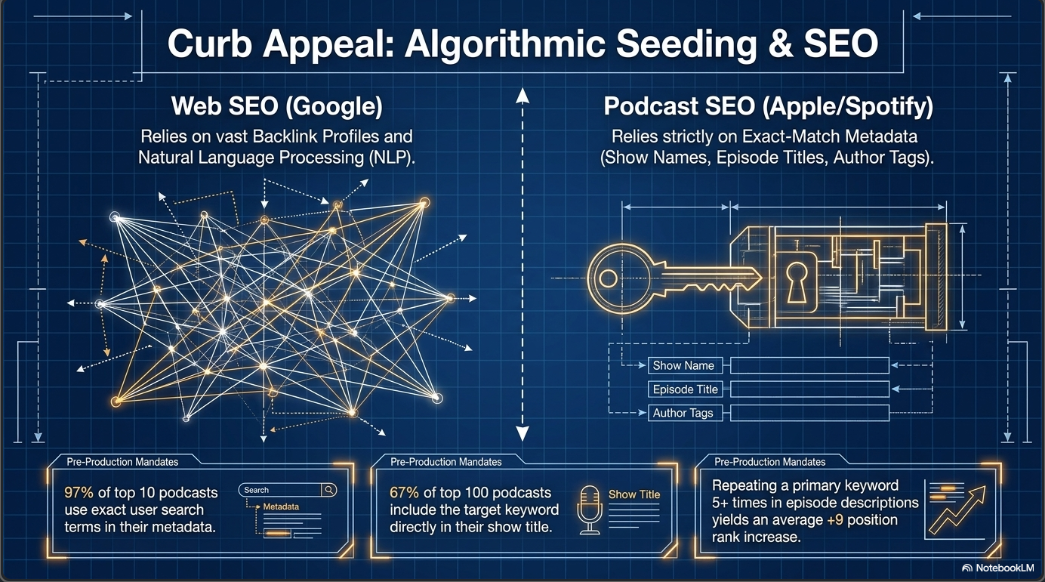
Unlike Google, which utilizes advanced natural language processing and vast backlink profiles, podcast search algorithms are heavily reliant on exact-match metadata31. The algorithms scan the podcast show name, channel name, episode titles, and author tags to match user queries33.
Research by Ausha, which analyzed over 100,000 search results encompassing 7 million podcast episodes, reveals the outsized impact of keywords:
97% of podcasts ranking in the top 10 search results include the primary user search term at least once in their metadata31.
67% of top 100 podcasts include the target keyword directly in their show title, and this jumps to 74% for the top 1032.
Shows that repeat their primary keyword five or more times in episode descriptions rank, on average, 9 positions higher31.
Consequently, the naming convention of the podcast and the structural template for episode titles must be locked in during pre-production. A title should ideally be under 20 characters to prevent mobile truncation, but must integrate core keywords naturally to avoid algorithmic penalties for keyword stuffing6. Furthermore, Apple Podcasts now analyzes automatic episode transcriptions, meaning the actual spoken words within the audio file contribute to the show's SEO footprint, making scripting and vocabulary critical pre-production considerations32.
The Three-Episode Launch Strategy
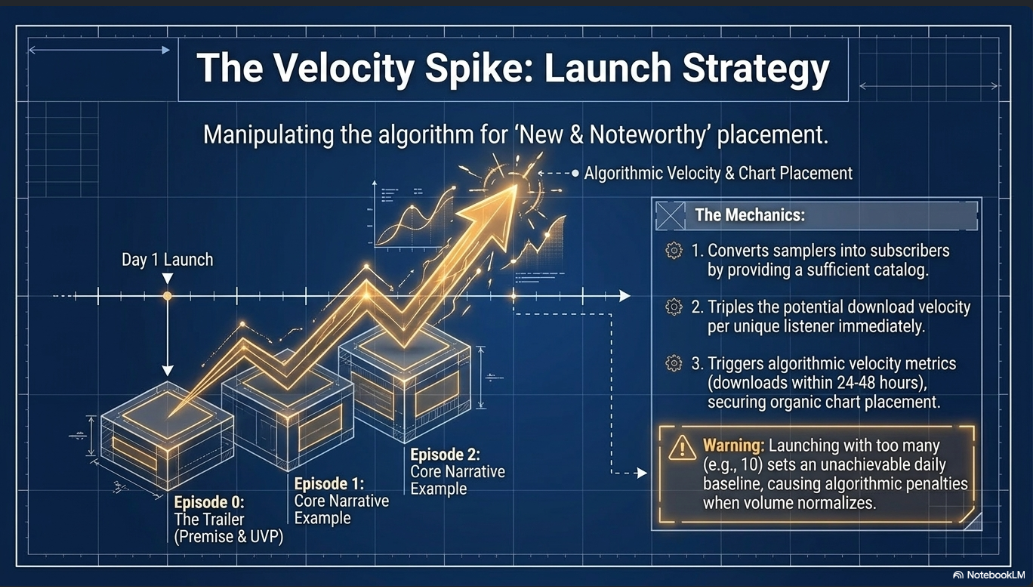
To manipulate the algorithmic charts upon launch, an industry-standard best practice is the "Three-Episode Launch Strategy"35. Rather than releasing a single premiere episode, a show launches with an Episode 0—a trailer or manifesto outlining the show's premise and UVP—alongside Episodes 1 and 235.
This strategy serves multiple functions. First, it provides new listeners with a sufficient catalog to sample, giving them a comprehensive understanding of the format, tone, and host personality before they make the critical decision to follow or subscribe35. Second, it immediately triples the potential download volume per unique listener35. Finally, Apple Podcasts’ algorithm heavily weighs velocity—specifically, the number of new followers, downloads, and completion rates acquired within a 24- to 48-hour window33. Generating three downloads per user instead of one creates a rapid algorithmic spike, signaling that the content is highly popular, thus triggering organic placement in Apple's "Top Charts" or "New & Noteworthy" sections34.
However, launching with an excessive number of episodes (e.g., dropping 10 at once) is highly counterproductive. It establishes an artificially high daily download benchmark that the show will invariably fail to meet in subsequent weeks. The algorithm interprets this normalization as a catastrophic loss of momentum, subsequently burying the show in the rankings35.
Engagement Signals and Smart Banners
Beyond metadata, platform algorithms prioritize active engagement signals: play-through rates, follower conversions, and completion rates31. To funnel traffic effectively, pre-production marketing plans must implement tools like Apple Smart Banners on the podcast's central website. A single line of code allows iOS visitors to follow the show with a single tap, drastically improving the conversion rate of web traffic to app-based followers. Case studies from agencies like Pacific Content show that implementing Smart Banners leads to immediate and sustained bumps in downloads and algorithmic chart rankings33.
Furthermore, publishing consistency acts as a long-term algorithmic signal. Podcasts that publish at least once every 15 days gain an average of 5 positions in search results compared to erratic publishers32. For Spotify specifically, the sheer total volume of published episodes correlates with a +7 position gain in search results, rewarding longevity and consistency32.
Pre-Production Logistics, Equipment, and Workflow
The final pillar of pre-production is establishing a sustainable operational workflow. The framework of "Ideate, Create, Distribute" demands extreme tactical focus to prevent host burnout and ensure the high-fidelity production standards expected by modern audiences37.
Technical Standardization and Audio Optimization
Poor audio quality introduces cognitive friction, derailing even the most compelling premise. Pre-production must mandate specific equipment and environmental standards. Industry-standard reliable hardware includes dynamic microphones such as the Shure SM58, which offers excellent sound quality and durability, paired with external recorders like the Zoom H512. For remote video and audio capture, platforms like Riverside are universally recommended to bypass internet compression artifacts37.
Beyond hardware, advanced production teams optimize their operating systems during pre-production to prevent digital recording failures. Verified technical optimizations include:
Disabling Windows Search Indexing: Excluding project asset folders from indexing reduces background disk I/O by 41% on NVMe SSDs, preventing audio dropouts38.
Power Management: Setting macOS Energy Saver to prevent automatic sleeping during rendering; default settings on Apple Silicon can trigger 2.3-second audio dropouts38.
Peripheral Management: Disabling Bluetooth on Windows/Linux when using USB audio interfaces eliminates 2.1 to 3.8 milliseconds of USB packet jitter, preventing crackles during real-time monitoring38.
Furthermore, to manage the complex licensing of sound design, efficient teams utilize semantic versioning for their music libraries. By storing music in a Git LFS repository with .gitattributes enforcing WAV/FLAC-only commits, teams ensure that mood tags, BPM, and time-limited license expirations are meticulously tracked in a searchable JSON file38.
The Acquired Podcast Workflow Model
An elite example of rigorous production workflow is the Acquired podcast, hosted by Ben Gilbert and David Rosenthal. Generating over $20 million in revenue with 90% profit margins and a lean team of three, Acquired relies on an exhaustive pre-production research process to maintain their dominance39.
For their multi-hour corporate histories, the hosts do not rely on off-the-cuff banter. The pre-production involves consuming up to 40 primary and secondary sources per episode, compiling pages of raw notes over months of preparation39. Critically, to maintain authenticity and natural discovery during the recording, the hosts coordinate macro-level directions beforehand but intentionally avoid discussing specific opinions or detailed facts with each other prior to hitting record40.
Their workflow dictates taking raw bullet points and translating them into structured narrative chapters (Act I, Act II, Act III) in the hours immediately preceding the recording40. This transforms the raw data into a compelling, theatrical narrative arc. Post-production involves ruthless editing; entire sections or conversational rabbit holes that fail to serve the core premise are wholesale cut40. This intense focus on preparation, combined with their Acquired Capital venture fund model that invests back into show sponsors, creates a self-reinforcing loop of premium content and massive profitability39.
Post-Production Resource Allocation
Corporate and professional teams must anticipate the significant resource drain of post-production. Producing a standard 30-minute episode typically requires 4 to 8 hours of post-production labor25. This encompasses:
Audio Assembly & Editing: Trimming filler words, applying noise reduction, equalizing vocal tracks, and ensuring crisp delivery37.
Legal and Asset Prep: Locking in rights for music, generating episode-specific artwork, and finalizing visual assets37.
Content Writing: Generating SEO-optimized show notes, transcriptions, and metadata tags for RSS feeds37.
Distribution and Repurposing: Embedding web players, executing email newsletters, and carving the primary file into short-form vertical video assets for algorithmic platforms like LinkedIn, TikTok, and YouTube Shorts25.
Organizations must decide during pre-production whether to adopt an in-house model, which requires dedicated personnel, or an outsourced hybrid model. In a hybrid setup, the corporate client records the audio to maintain brand voice control, while a specialized agency handles editing, show notes, distribution, and growth strategy25.
The Creator Gap and the Future Trajectory of Podcasting
As podcasting continues to mature globally, data highlights both massive opportunities and systemic challenges. While ad spending is projected to grow by 37% to reach $3.7 billion in the US by 2029, and global consumption is expanding rapidly in Tier-2 markets like France, Germany, and Australia, a distinct creator gap has emerged42.
According to Sounds Profitable's "The Creators 2025" study, the demographic makeup of podcast creators does not reflect the diversity of the audience. Currently, 15% of male podcast consumers are creating their own podcasts, compared to only 8% of women44. Furthermore, while 17% of 18-to-34-year-olds are creating content, only 4% of Americans aged 55 and older are doing the same44. Interestingly, while women are half as likely to start a podcast, they boast a higher retention rate (69%) than men (67%) once they begin45. This indicates an entry-barrier problem, potentially exacerbated by the industry's increasing demands for complex, multi-camera video setups that add significant production friction44.
To sustain the industry's growth, pre-production strategies must evolve to lower these barriers to entry while maintaining high narrative standards. Ultimately, the success of a modern podcast hinges not on the volume of content produced, but on the strategic rigor applied before a microphone is ever activated. By formulating a distinct premise, codifying a Show Bible, understanding the psychological drivers of parasocial retention, and executing a technically flawless, SEO-optimized launch strategy, creators can bypass the noise of 4.4 million competitors. In doing so, they transition from commodity content creators to influential media operators, cultivating a hungry, deeply loyal audience that drives measurable business outcomes.
Works cited
Podcast Statistics 2026 | 80+ Facts & Data Points - Searchlab, https://searchlab.nl/en/statistics/podcast-statistics-2026
Edison Research 2026 Report Shows Video Reshaping Global Podcast Audience Trends, https://www.podcastvideos.com/edison-research-2026-video-podcast-audience-trends/
Podcast reach hits record highs as video viewing grows - Digital Content Next, https://digitalcontentnext.org/blog/2026/06/16/podcast-reach-hits-record-highs-as-video-viewing-grows/
The Infinite Dial 2026: Takeaways for Advertisers - SiriusXM Media, https://www.siriusxmmedia.com/insights/the-infinite-dial-takeaways-for-advertisers
How to Create a Business Podcast That Listeners Can't Ignore, https://www.quillpodcasting.com/blog-posts/business-podcast-listeners-cant-ignore
Resonance Over Reach: Part 1—Turn Your Expertise into a Powerful Premise You Own, https://jayacunzo.com/blog/resonance-part1-premise
Jay Acunzo on Why Marketers Should Act More Like Stand-Up Comics, https://managingeditor.com/jay-acunzo-why-marketers-should-act-more-like-stand-up-comics/
How I Broke Through: The Messy Process I Used to Develop a Differentiated Premise, https://jayacunzo.com/blog/how-i-broke-through-the-unavoidably-messy-process-to-develop-my-premise
What's Your Premise? The Missing Piece Helping You Differentiate and Resonate, https://jayacunzo.com/blog/whats-your-premise-the-missing-piece-helping-you-differentiate-and-resonate
Blog Post: How to Find Your Podcast's UVP, https://www.quillpodcasting.com/blog-posts/uvp
The Five P's of Podcasting: A Comprehensive Guide | Adelaide Business Hub, https://adelaidebusinesshub.com.au/learning-content/the-5-ps-of-podcasting
How to Define (and Refine) Your Podcast with a Show Bible, https://podcastmovement.com/resources/creation/how-to-define-and-refine-your-podcast-with-a-show-bible/
How to Write a TV Series Bible (With a Template Outline) - Slima, https://slima.ai/en/how-to-write-a-tv-series-bible
How to create a TV show bible - SCRIPTFELLA, https://www.scriptfella.com/articles/how-to-create-a-tv-show-bible
PODCAST - How To Write a TV Bible - WriteYourScreenplay, https://www.writeyourscreenplay.com/blog/2016/02/11/podcast-how-to-write-tv-bible/
10 Easy Steps to Developing Your TV Show Bible - Final Draft, https://www.finaldraft.com/blog/10-easy-steps-to-developing-your-tv-show-bible
15 Best Podcast Formats 2026 Guide: Types, Ideas, Pros/Cons + Template - Talks.co, https://talks.co/p/podcast-formats/
Podcast ad skipping isn't nearly as bad as I worried, https://wearebumper.com/blog/podcast-ad-skipping-isnt-nearly-as-bad-as-i-worried
Full article: Corporate Communication Through Podcasts: The Impact of Voice-Fit and Attention During Listening on Parasocial Interaction with the Host and Persuasive Effects - Taylor & Francis, https://www.tandfonline.com/doi/full/10.1080/19376529.2024.2396840
The Role of Parasocial Interactions for Podcast Backchannel Response - ResearchGate, https://www.researchgate.net/publication/352480360_The_Role_of_Parasocial_Interactions_for_Podcast_Backchannel_Response
Aural Parasocial Relations: Host-Listener - HeinOnline, https://heinonline.org/hol-cgi-bin/get_pdf.cgi?handle=hein.journals/jradstud29§ion=32
Hooked on audio! Unveiling the secrets of podcast stickiness through social identity and uses and gratification theories - ResearchGate, https://www.researchgate.net/publication/375784225_Hooked_on_audio_Unveiling_the_secrets_of_podcast_stickiness_through_social_identity_and_uses_and_gratification_theories
Podcasts and Informal Learning: Exploring Knowledge Acquisition and Retention - MDPI, https://www.mdpi.com/2227-7102/14/10/1129
Corporate Podcast: How to Launch an Internal or External Company Show, https://thepodcastconsultant.com/blog/corporate-podcast
Podcast vs YouTube for Financial Advisors: The Data Behind the Debate - Medium, https://medium.com/@mrandrewmurdoch/podcast-vs-youtube-for-financial-advisors-the-data-behind-the-debate-071e37745a37
Understanding Podcast Ad Retention and Skipping Data for Digital Content Creators, https://www.podcastvideos.com/podcast-ad-retention-skipping-data-analysis/
Identifying Podcast Ad Skips, PM Heads to NYC, & More - Sounds Profitable, https://soundsprofitable.com/the-download/identifying-podcast-ad/
The Audio Advantage | National Public Media, https://www.nationalpublicmedia.com/insights/reports/audio-advantage/
Top Apple Podcasts of 2026: The Most Popular Shows Right Now - Ausha, https://www.ausha.co/blog/top-apple-podcasts/
Mastering the Apple Podcasts and Spotify Algorithms to Maximize Your Visibility - Ausha, https://www.ausha.co/academy/podcast-search-optimization/apple-spotify-algorithms/
How to Rank Higher on Apple Podcasts (Data‑Backed Guide) - Buzzsprout, https://www.buzzsprout.com/blog/podcast-seo
Apple Podcasts Charts: Your Ultimate Guide to Climbing the Ranks, https://www.ausha.co/blog/apple-podcasts-charts/
128: Top 7 Strategies: How to grow your podcast audience | EOFire, https://www.eofire.com/top-7-strategies-how-to-grow-your-podcast/
How to Launch and Grow a Revenue-Generating B2B Podcast | EP 95, https://www.einblick.co/podcast/ep-95-harry-morton-b2b-podcasting/
Podcast Production Framework: From Idea to Impact - The Gem Club, https://thegemclub.com/podcast-production-framework/
How to Find Music for Your Podcast: Evidence-Based, Low-Risk Workflow - LifeTips, https://lifetips.alibaba.com/tech-efficiency/how-to-find-music-for-your-podcast
Cash Machines - Apple Podcasts, https://podcasts.apple.com/eg/podcast/cash-machines/id1504044930
Reverse Interview: Acquired Strategy w/ Nathan Baschez of Divinations (formerly Gimlet, Substack) | ACQ2, https://www.acquired.fm/acq2-episodes/reverse-interview-acquired-strategy-with-nathan-baschez-of-divinations-former-gimlet-media-substack
The Complete Podcast Production Guide: From Concept to Launch - Cue Productions, https://www.cueproductions.com/post/the-complete-podcast-production-guide
Podcasts Are Projected to Capture 40% of Digital Audio Ad Revenue by 2029: Streaming Helping Fuel the Growth - ADOPTER Media, https://adopter.media/podcast-revenue-growth-streaming/
New Global Podcast Study Sets the Standard for 2026 Audio Planning - Podnews, https://podnews.net/press-release/global-podcasting-ad-compass-26
The Inventory And The Scale - Sounds Profitable, https://soundsprofitable.com/article/the-inventory-and-the-scale/
The Gap In Podcasting That Should Concern Us - Sounds Profitable, https://soundsprofitable.com/article/the-gap-in-podcasting-that-should-concern-us/