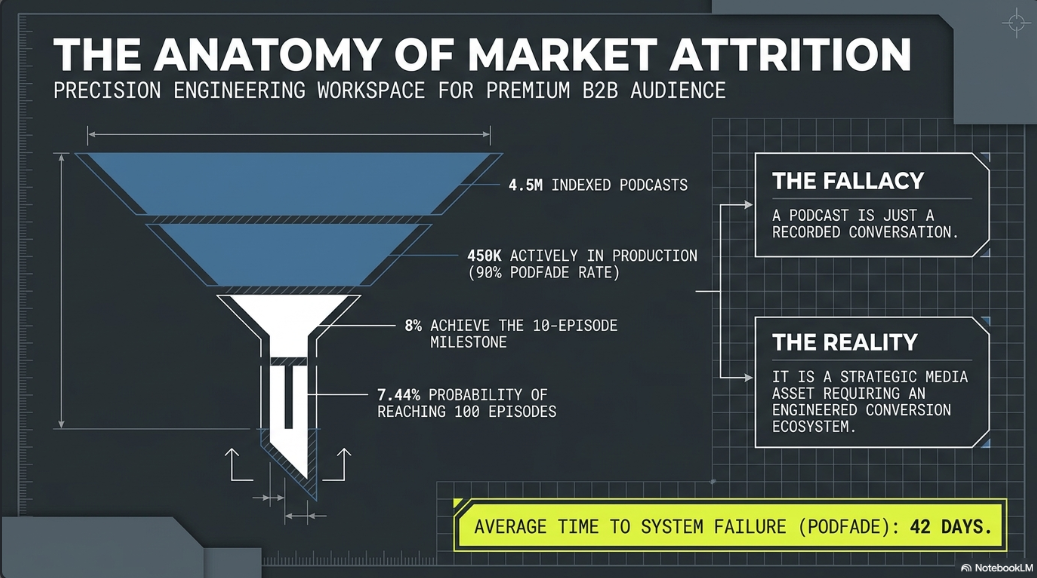
The podcasting ecosystem has matured from an experimental audio medium into a foundational pillar of modern digital architecture. With over 672 million monthly listeners globally and an industry valuation projected to reach $28.6 billion by 2026, the medium offers unparalleled access to highly engaged demographics1. Despite this staggering growth, the underlying reality of podcast production is characterized by a severe attrition epidemic. Of the approximately 4.5 million indexed podcasts, only 450,000 remain actively in production, representing a 90% "podfade" rate2. Data indicates that nearly 47% of all podcasts cease production before reaching their fourth episode, and a mere 8% achieve the ten-episode milestone3. For an independent creator or corporate brand, the statistical probability of reaching 100 episodes is roughly 7.44%, with the average time before podfade occurring at just 42 days4.
This systemic failure is rarely a consequence of inadequate audio equipment or poor vocal delivery. Rather, it is the direct result of launching without a rigorous pre-production strategy. A podcast is not merely a recorded conversation; it is a strategic media asset that requires an exhaustively defined editorial identity, a quantifiable understanding of listener psychology, and a meticulously engineered conversion ecosystem5. The subsequent analysis deconstructs the architectural requirements for launching a professional podcast, providing a comprehensive framework for market positioning, audience cultivation, and algorithmic dominance.

Formulating the Editorial Identity and Unique Value Proposition
The foundational misstep in media development is the assumption that a broad thematic focus paired with an interview format constitutes a competitive strategy. Without a highly specific editorial identity, a podcast descends into the background noise of millions of similar offerings5. The most crucial pre-production mandate is defining a Unique Value Proposition (UVP)—a clear, concise statement describing the specific benefit the podcast offers, how it solves listener needs, and what distinguishes it from competing media8.
Strategic positioning requires producers to move beyond broad Total Addressable Market (TAM) definitions. Defining a target audience as "mid-market revenue leaders" is insufficient for content creation; the definition must be granular enough to visualize a specific individual navigating a distinct professional challenge10. This requires identifying the broader niche and subsequently claiming a highly specific sub-niche, alongside three to five core thematic focus areas that the show will consistently explore6.
The Value Proposition Canvas and Job Architecture
To systematically align the podcast's UVP with the audience's psychological and practical requirements, strategists deploy the Value Proposition Canvas, developed by Dr. Alexander Osterwalder11. This framework maps the relationship between the target listener's profile and the creator's value map, ensuring that the content being produced directly addresses verified market demands11.
The integration of the "Jobs to Be Done" (JTBD) framework further refines this approach. The JTBD theory posits that consumers do not consume media based on demographic correlations, but rather they "hire" a product to complete a specific job or make progress in a given circumstance14. For example, a listener does not hire a business podcast because they are a 35-year-old executive; they hire it to reduce operational chaos, stay ahead of industry trends, or cultivate conversational capital for upcoming board meetings15.
The architecture of these listener jobs spans multiple dimensions that must be addressed during pre-production.
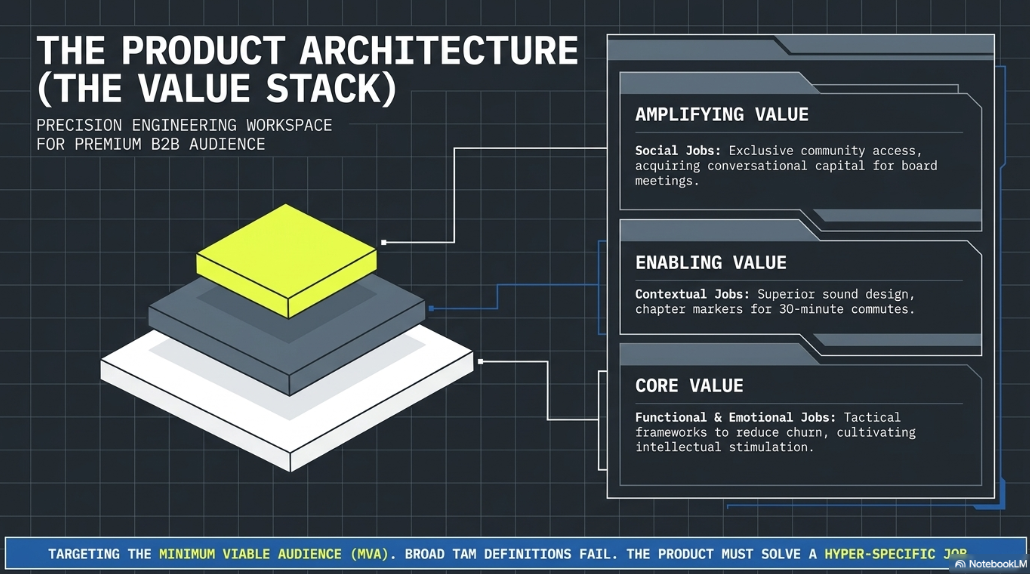
By mapping these dimensions, producers can design a layered Value Stack14. The Core Value represents the fundamental problem solved better than any competitor, serving as the strategic moat17. The Enabling Value consists of the delivery mechanisms—such as superior sound design or chapter markers—that make the core value accessible. Finally, the Amplifying Value encompasses unexpected benefits, such as access to an exclusive listener community or networking opportunities17. When the Value Map perfectly intersects with the Customer Profile, product-market fit is achieved, ensuring the podcast resonates deeply with its intended audience13.
Competitive Topography and Gap Analysis
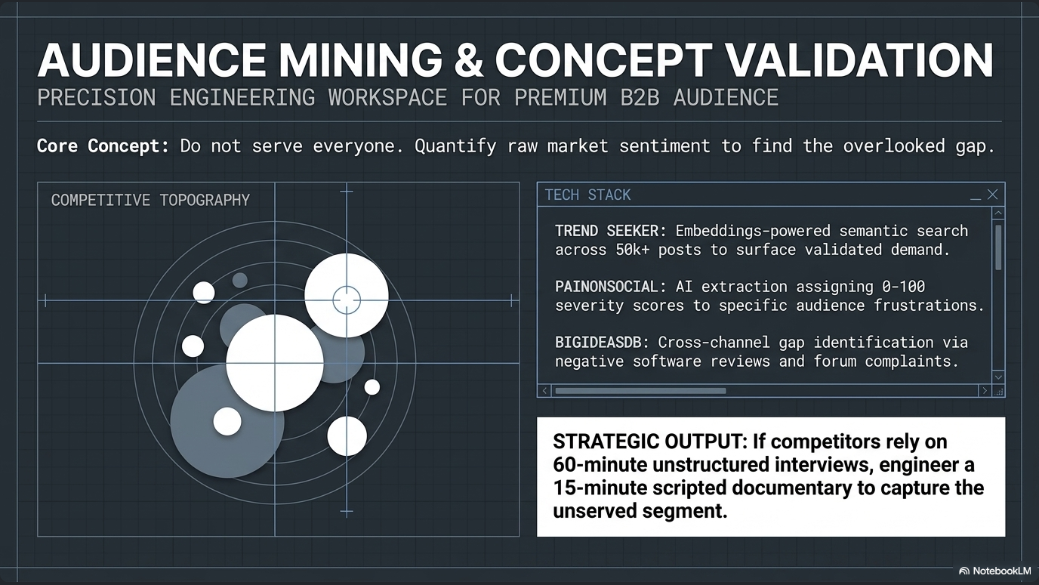
A robust UVP must be stress-tested against the existing market. Competitors in the podcasting space should be viewed as overlapping spheres of listener attention8. Sophisticated pre-production involves mapping this competitive topography using specialized audience graph tools to identify adjacent media properties8.
Tools such as Rephonic and SparkToro allow strategists to analyze audience overlap by inputting job titles, social followings, or competing podcast names to generate a visualization of shared listenership8. By analyzing these adjacencies, producers can audit competitors across key vectors: assessing the baseline audio and video quality required to compete, identifying structural length gaps, evaluating narrative formats, and documenting thematic focus to identify overlooked contrarian viewpoints8. If all competitors utilize 60-minute unstructured interviews, a 15-minute highly scripted documentary format may capture an entirely unserved segment of the market8.
Cultivating a Hungry Audience: Demographics and Psychological Drivers
Cultivating a dedicated audience requires transitioning a podcast from an occasional media choice to an ingrained behavioral habit. This necessitates a profound understanding of who is listening and the psychological gratifications they seek.
Demographic Realities of the Modern Listener
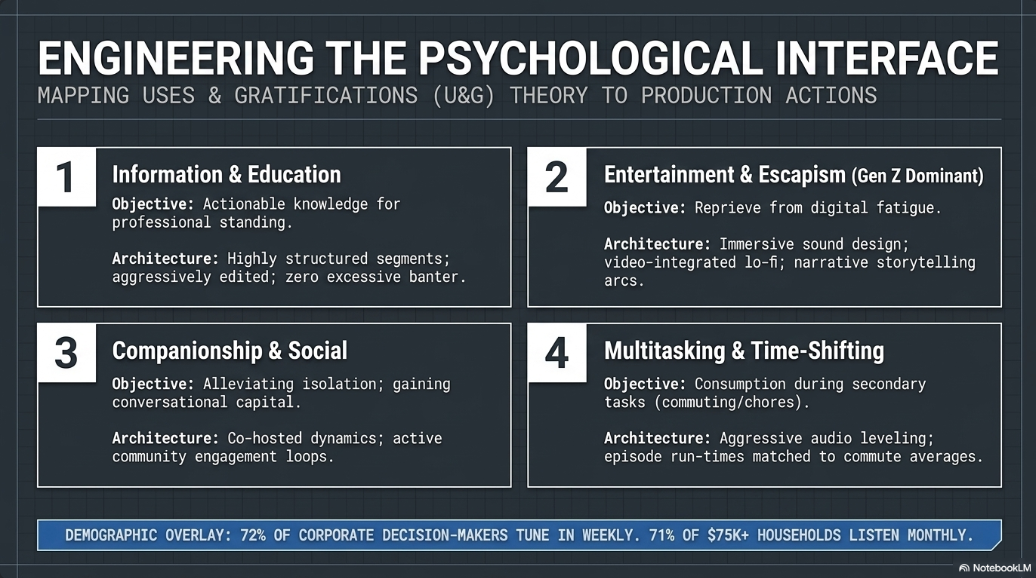
The contemporary podcast listener represents a highly valuable demographic for brands and advertisers. Statistical analyses reveal that 67% of the American population aged 12 and older listens to podcasts at least monthly, with daily global listeners reaching 168 million1. This audience is disproportionately educated and affluent. Approximately 71% of individuals with an annual household income exceeding $75,000 are monthly podcast listeners, compared to 48% of those earning under $35,0001. Furthermore, 72% of corporate decision-makers tune in weekly, making the medium an exceptionally potent tool for B2B marketing and thought leadership1.
Generation Z is driving exponential growth in specific formats. Studies utilizing the Uses and Gratifications framework indicate that Gen Z listeners exhibit a strong preference for video-integrated podcasts and lo-fi or comedy genres, primarily seeking entertainment and escapism to combat digital overload22. Conversely, older demographics and professional cohorts lean heavily toward educational and narrative content, seeking information and audio platform superiority21.
Uses and Gratifications (U&G) Theory
Academic research examining podcast consumption frequently utilizes Uses and Gratifications (U&G) theory, which assumes that audiences actively select media to satisfy particular intrinsic needs rather than passively receiving broadcasts21. Empirical analyses of podcast listeners have identified several dominant motivational drivers that must be embedded into the pre-production strategy.
Parasocial Interactions and Enduring Relationships
The profound intimacy of podcasting—often consumed via headphones directly into the listener's ears—fosters unique psychological phenomena known as Parasocial Interactions (PSI) and Parasocial Relationships (PSR)23.
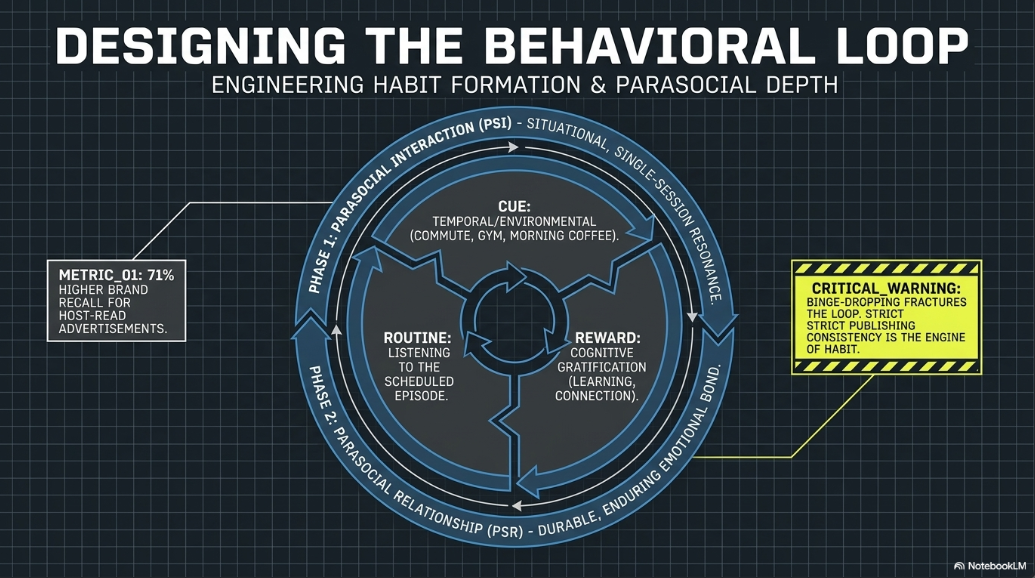
PSI refers to the immediate, situational sense of interacting with a media figure during a single listening session29. When a host shares personal anecdotes, speaks directly to the listener, or exhibits authenticity and vulnerability, cognitive resonance occurs, simulating a reciprocal social interaction despite its unilateral nature24. Over time, repeated exposure to these episodic interactions compounds into a Parasocial Relationship (PSR)—a durable, enduring emotional bond wherein the listener perceives the host as a trusted companion28.
Research indicates that the intensity of these parasocial bonds directly correlates with listener retention, brand affinity, and commercial conversion rates24. Empirical studies have demonstrated that podcast listeners exhibit a 71% higher brand recall for host-read advertisements compared to pre-produced spots, driven largely by the parasocial trust established by the host1. Listeners demonstrate higher tolerance for errors, are more likely to forgive transgressions, and exhibit a strong willingness to follow the host to new platforms or purchasing decisions29.
Crucially, relying heavily on the solo educational format—rather than depending exclusively on rotating celebrity guests—often strengthens the parasocial bond with the host, ensuring the audience remains loyal to the creator rather than transient visitors31. The data corroborates this: listeners rank "hearing from celebrities" as the least important factor in their consumption choices (32%), whereas "listening to discussions on topics of interest" commands 83% importance31.
Engineering the Behavioral Habit Loop
Cultivating an audience requires designing content that embeds itself into the listener's routine, operating on the psychological principles of the habit loop: the cue, the routine, and the reward33.
In podcasting, the cue is environmental or temporal—such as a morning commute, a workout session, or performing household chores23. The routine is the act of listening to the episode, and the reward is the cognitive gratification received (e.g., learning a new skill or feeling parasocial connection)23. Pre-production strategy must intentionally design for this loop by maintaining strict publishing consistency5. Releasing episodes on a specific day and time establishes reliability, allowing the podcast to seamlessly integrate into the listener's existing biological or schedule-based cues36. A failure to maintain this cadence disrupts the habit loop, leading directly to podfade and audience abandonment3.
Audience Mining and Data-Driven Concept Validation
The pursuit of mass appeal is a primary catalyst for media failure; attempting to serve everyone reliably results in serving no one6. Strategic pre-production embraces the concept of the Minimum Viable Audience (MVA)—identifying the smallest, most specific cohort of people necessary to sustain and grow the project36. Cultivating an MVA requires raw, unfiltered data regarding audience pain points, sourced directly from the digital ecosystems where the target demographic congregates.
Historically, platforms like Reddit have served as critical repositories for unvarnished market sentiment41. Following the shutdown of established research platforms such as GummySearch in late 2025 due to API commercial licensing restrictions, a new generation of automated audience research tools has emerged to fill the void41. These platforms are deployed during pre-production to extract, score, and cluster recurring complaints and questions from specific niche communities, transforming qualitative frustration into structured content roadmaps42.
By deploying these analytical tools, producers can identify the exact questions their target audience is asking in digital private spaces—often the inquiries that remain inadequately addressed by existing media—and engineer podcast episodes that directly resolve these high-tension topics6. This ensures the podcast acts as a precise solution rather than speculative content.
Structuring the Show for Market Fit
With the audience's pain points quantified and the UVP established, the pre-production phase moves to structural execution. The format of the show must flow directly from the value proposition6.
Format selection dictates the production workload, the required technical infrastructure, and the listener experience. While the interview format remains the most common, it is highly saturated and heavily dependent on guest coordination and internet stability5. Conversely, narrative or documentary formats—which weave voiceovers, archival audio, and sound design—boast significantly higher emotional stickiness and completion rates, though they require a highly skilled production team and substantial budget6. Co-hosted conversational formats demand excellent chemistry and careful topic mapping to ensure equal speaking time, while solo formats offer complete scheduling freedom and establish deep, direct thought leadership authority6.
The Guest-Led Growth Pipeline
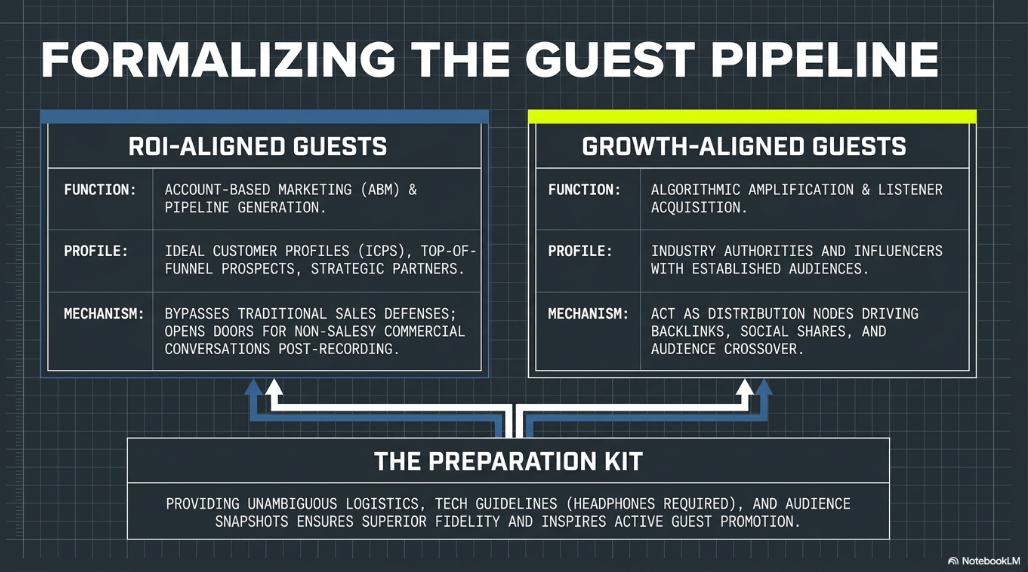
For B2B organizations and professional services, the podcast serves as an unparalleled networking and account-based marketing (ABM) lever. Pre-production must establish a formalized guest strategy that categorizes outreach into two distinct functions6.
First, ROI-Aligned Guests include top-of-funnel prospects, strategic partners, and ideal customer profiles (ICPs). Extending a podcast invitation bypasses traditional sales defenses; individuals who routinely ignore cold emails will frequently accept an invitation to speak on a professional platform6. Giving them a microphone builds rapport and naturally opens the door to non-salesy commercial conversations post-recording6.
Second, Growth-Aligned Guests are industry authorities and influencers with established audiences. These guests act as distribution nodes, amplifying the episode across their networks to drive backlinks, social shares, and new listener acquisition6.
To maximize the efficacy of this pipeline, producers must supply guests with a comprehensive preparation kit. This kit should include unambiguous logistical details, technical guidelines for remote recording (e.g., the necessity of wearing headphones and minimizing room echo), a snapshot of the audience profile, and a loose guide of potential discussion topics46. This professionalism ensures superior audio quality and inspires the guest to actively promote the final asset46.
Architecting the Pre-Launch and Conversion Engine
Audience growth does not spontaneously generate upon the publication of the first episode; it is engineered meticulously during the pre-launch window7. This phase is designed to build suspense, capture early subscribers, and signal strong initial momentum to directory algorithms49.
The Podcast Trailer vs. "Episode 0"
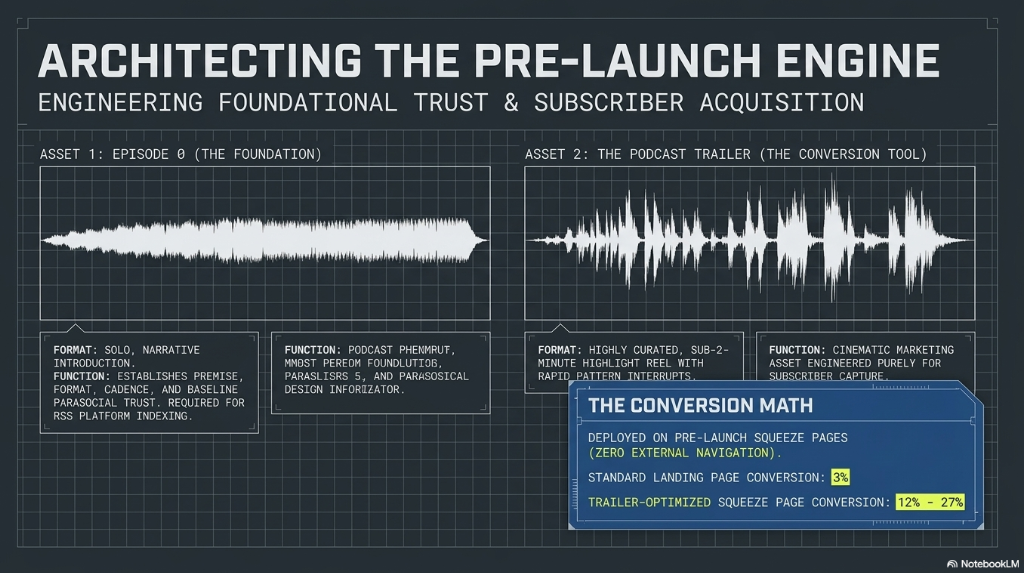
A critical component of pre-launch architecture is the auditory introduction to the show. While frequently conflated, a "Podcast Trailer" and an "Episode 0" serve distinct strategic functions and must be treated as separate assets50.
An Episode 0 acts as a foundational, solo introductory episode. It introduces the host's background, outlines the show's premise, sets expectations for format and cadence, and provides the initial audio file required for RSS submission and indexing on major platforms50. It is designed primarily to establish trust and parasocial connection with the listener51.
A Podcast Trailer functions as a high-impact marketing and conversion asset. Similar to a cinematic preview, it utilizes dynamic audio visualization, highly curated highlight reels, and rapid pattern interrupts to hook potential listeners and communicate the UVP in under two minutes50. When deployed on highly optimized pre-launch landing pages (frequently referred to as "squeeze pages" lacking external navigation links), trailers drive significant audience capture. Analytical data indicates that well-optimized squeeze pages featuring multimedia elements like trailers, clear offers, and trust signals can achieve conversion rates between 12% and 27%, substantially outperforming the 3% benchmark of standard landing pages54.
Production Economics and Freelance Retainers
Establishing professional production quality from day one is non-negotiable; sound quality impacts listener retention more severely than the show's topic56. Modern production requires specialized hardware, such as the Shure SM7dB or Rode PodMic USB, paired with audio interfaces like the Focusrite Scarlett series for multi-guest environments57. Software stacks typically include Riverside or SquadCast for high-fidelity remote recording, and Descript for text-based editing and AI-assisted correction5.
For organizations opting to outsource, the freelance podcast production market in 2026 is highly stratified. Independent creators generally seek basic audio editing and hosting uploads, while enterprise brands require comprehensive editorial strategy, guest booking, and multi-platform content repurposing58.
The Fallacy of the Binge-Drop Strategy
A frequent misstep in podcast launching is the "binge-drop" methodology—releasing a massive batch of episodes simultaneously under the assumption that listeners will consume them consecutively50. While effective for serialized, true-crime narratives, this strategy is highly detrimental to ongoing business or educational podcasts.
Releasing all content at once fractures the primary engine of long-term audience growth: consistency50. Steady weekly or bi-weekly drops train the audience's habit loop, generate sustained algorithmic signals over time, and create recurring touchpoints for social media distribution and email marketing5. A steady cadence signals reliability to both the audience and the platform algorithms, whereas a binge-drop creates a momentary spike followed by a precipitous drop in algorithmic relevance37. Pre-recording a buffer of 3 to 8 episodes before launch is highly recommended to ensure this consistency is maintained regardless of unforeseen production delays6.
Algorithmic Discovery and Ecosystem Distribution
Discoverability in the contemporary podcast landscape requires an intricate understanding of platform-specific algorithms. A podcast must be optimized differently depending on whether it is targeting audio-centric directories or video-first recommendation engines.
Decoding Audio Algorithms: Spotify vs. Apple Podcasts
The duopoly of Spotify and Apple Podcasts—which together command over 60% of the audio listening share—operate on fundamentally divergent algorithmic philosophies37.
The Ascendancy of Video Podcasting and YouTube Retention
Ignoring video distribution is a critical strategic failure in modern pre-production. Data indicates that YouTube has overtaken traditional platforms, serving as the primary consumption hub for 42% of weekly podcast listeners by late 2025, compared to Spotify at 20% and Apple Podcasts dropping to single digits for overall reach5. For video podcasts, YouTube's algorithm evaluates creators identically to standard channels, ruthlessly prioritizing retention rates, viewer satisfaction signals, and average view duration (AVD)61.
A steep drop in retention within the first 30 seconds signals a weak hook or misleading title, causing the algorithm to immediately suppress the video's reach61. Benchmark studies analyzing tens of thousands of videos reveal that only one in six videos surpasses 50% retention, with the average sitting at just 23.7%62. However, videos maintaining a 65% to 70% retention rate at the 30-second mark receive significant algorithmic promotion, yielding up to 58% higher overall average view durations61.
To optimize for YouTube, producers must implement specific architectural techniques from the scripting phase. This includes utilizing powerful hook structures in the first 30 seconds—such as the bold claim, the result preview, the contrarian take, the question loop, or the curiosity gap61. Furthermore, visual pattern interrupts—changing camera angles, inserting b-roll, or adding text graphics—must be deployed every 60 to 90 seconds to reset the viewer's attention61. For vertical formats like YouTube Shorts, employing circular narratives where the end of the video seamlessly loops back into the beginning can drive completion rates over 100%, triggering massive algorithmic distribution62.
Content Atomization and the Compounding Ecosystem
Producing an episode and moving on abandons the vast majority of the content's intrinsic value5. The most resilient and profitable media properties operate as compounding content ecosystems, rather than isolated audio files.
A definitive model of this ecosystem architecture is demonstrated by Lenny Rachitsky's franchise. Transitioning from a tech industry professional to a full-time creator, Rachitsky leveraged deep industry research and a highly structured editorial identity to build a media empire generating an estimated $4 million annually in subscriptions and sponsorships64.
The growth of this ecosystem was not accidental; it was engineered through strategic distribution mechanics. By utilizing Substack's recommendation engine, where 78% of new subscribers originate from cross-promotions with other writers, the podcast and newsletter grew symbiotically64. Furthermore, Rachitsky executed a paradigm shift in content atomization by releasing over 300 podcast transcripts and articles as an AI-readable Markdown dataset, complete with an official Model Context Protocol (MCP) server and GitHub repository65. Rather than hiding content behind traditional paywalls, this "content as API" approach allowed developers and community members to build over 50 secondary applications—including gamified RPGs, AI chat assistants, and knowledge bases—directly on top of the podcast's proprietary data65. This level of atomization exponentially expanded the brand's reach and deepened audience entrenchment.
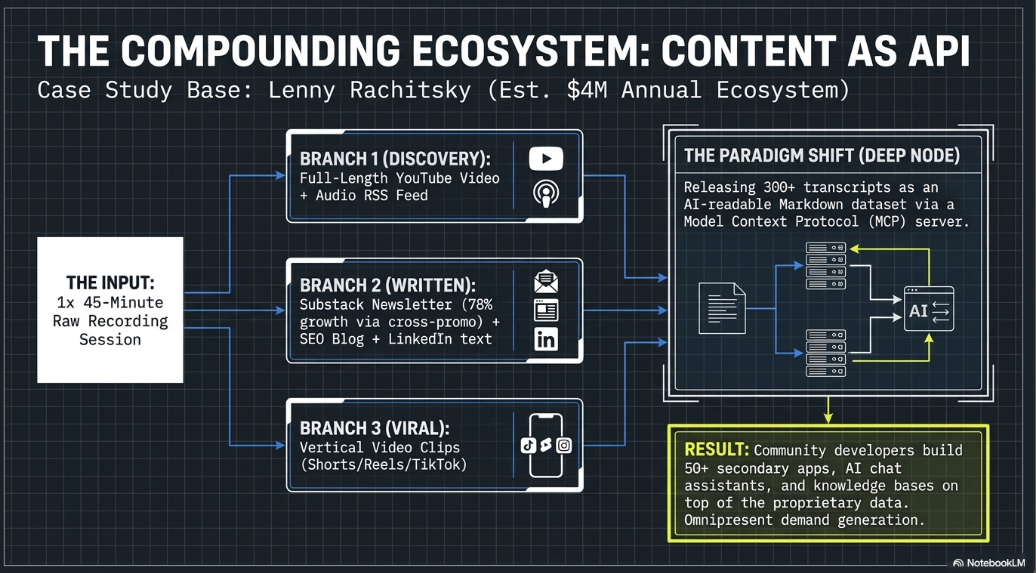
To replicate this ecosystem approach, corporate and independent pre-production workflows must incorporate a strict, templated atomization pipeline5. A single 45-minute recording session must be systematically processed through a five-stage pipeline to yield a full-length YouTube video, an audio RSS feed, a comprehensive SEO-optimized blog post or newsletter, multiple short-form vertical video clips (Shorts/Reels/TikTok), and several text-based LinkedIn posts5. This multifaceted distribution ensures the podcast acts as an omnipresent demand generation engine, capturing audiences across all digital surfaces.
Tracking the success of this ecosystem requires abandoning vanity metrics in favor of outcome-driven data5. Producers must monitor leading indicators, such as episode completion rates (>70%) and month-over-month subscriber growth (5-15%), alongside lagging indicators like CRM pipeline influence, inbound leads, and video-influenced revenue6.
Ultimately, the successful launch and sustained growth of a professional podcast is an exercise in meticulous pre-production and strategic restraint. By crystallizing a Unique Value Proposition, utilizing the Jobs to Be Done framework to define a Minimum Viable Audience, tapping into digital sentiment analysis to identify acute pain points, and engineering content that respects the psychological drivers of parasocial relationships, creators can build a formidable media asset. When this foundational strategy is coupled with a rigorous understanding of algorithmic distribution and a disciplined, atomized workflow, a podcast transcends traditional broadcasting to become a highly lucrative, compounding engine for audience capture and commercial growth.
Works cited
Podcast Statistics 2026 | 80+ Facts & Data Points - Searchlab, https://searchlab.nl/en/statistics/podcast-statistics-2026
Podcast Affiliate Automation: Scale to $300/Month (12-Month Plan, https://medium.com/write-a-catalyst/podcast-affiliate-automation-scale-to-300-month-in-12-months-b1476f8ba867
Why Podcasters Quit: Avoid Burnout and Stay Consistent - Podbean Blog, https://blog.podbean.com/why-podcasters-quit-podcast-burnout/
Podcasting Industry Report Specifically for Independent Podcasters - PodMatch, https://podmatch.com/report
What Is a Podcast Content Strategy? The B2B Guide for 2026 - Rep Cap, https://repcap.com/b2b-content-marketing-insights/podcast-content-strategy
B2B Podcast Strategy: Complete Guide To Planning, Launching, And Growing A High-ROI Show - Fame.so, https://www.fame.so/post/podcast-strategy
Audience Growth Starts Before Episode One | JAR Podcast Solutions, https://jarpodcasts.com/audience-growth-starts-before-episode-one/
Blog Post: How to Find Your Podcast's UVP, https://www.quillpodcasting.com/blog-posts/uvp
What Is a Value Proposition? (Examples & Templates) - Canva, https://www.canva.com/docs/value-propositions/
Defining Your Audience Before You Launch a Podcast - MarketScale Help Center, https://help.marketscale.com/en/articles/9962902-defining-your-audience-before-you-launch-a-podcast
A guide to using a value proposition canvas - LogRocket Blog, https://blog.logrocket.com/product-management/value-proposition-canvas/
What is the Value Proposition Canvas? - B2B International, https://www.b2binternational.com/experience/methods/faq/what-is-the-value-proposition-canvas/
The Value Proposition Canvas: Ultimate Guide and Download - Vaughan Broderick, https://vaughanbroderick.com/value-proposition-canvas-customer-centric-innovation/
Jobs to Be Done (JTBD) in UX Research - User Interviews, https://www.userinterviews.com/ux-research-field-guide-chapter/jobs-to-be-done-jtbd-framework
Jobs to be done for Product Managers, https://www.mindtheproduct.com/jobs-to-be-done-for-product-managers/
The Jobs-to-be-Done Framework — Romain Pechayre — Tech Bits, https://pechay.re/jobs-to-be-done
11. Value Proposition Framework: Transforming Problems into Irresistible Value | by The Systemist | Seismic Times | Medium, https://medium.com/seismic-times/11-value-proposition-framework-transforming-problems-into-irresistible-value-293f1250e8e4
Podcast | Using the Value Proposition Canvas in L&D | MAAS, https://www.maas-marketing.co.uk/podcast/value-proposition-canvas/
Podcast Cross-Promotion: How to Trade Audiences With Other Shows, https://thepodcastconsultant.com/blog/podcast-cross-promotion
Documentation & Reference for SparkToro's Features - Kalyna Marketing, https://kalynamarketing.com/blog/sparktoro-guide-reference
Full article: Examining the Motives of Podcast Users, https://www.tandfonline.com/doi/full/10.1080/19376521003719391
Gen Z and Podcasts: What They're Listening to and Why in the Digital Age: A Uses and Gratifications Theory Approach - ResearchGate, https://www.researchgate.net/publication/401936594_Gen_Z_and_Podcasts_What_They're_Listening_to_and_Why_in_the_Digital_Age_A_Uses_and_Gratifications_Theory_Approach
Why people listen: Motivations and outcomes of podcast listening - PMC, https://pmc.ncbi.nlm.nih.gov/articles/PMC8985929/
The Role of Parasocial Interactions for Podcast Backchannel Response - ResearchGate, https://www.researchgate.net/publication/352480360_The_Role_of_Parasocial_Interactions_for_Podcast_Backchannel_Response
College Students' Motivations for Using Podcasts - DigitalCommons@URI, https://digitalcommons.uri.edu/cgi/viewcontent.cgi?article=1153&context=jmle
(PDF) Motivations for Using Podcasts: A Systematic Literature Review - ResearchGate, https://www.researchgate.net/publication/379416461_Motivations_for_Using_Podcasts_A_Systematic_Literature_Review
Five Stars Because They Tell It Like It Is: A Parasocial Examination of Mainstream, Conservative and Far-right Reviews on Apple Podcasts, https://isoj.org/research/five-stars/
(PDF) Parasocial Intimacy, Change, and Nostalgia in Podcast Listener Reviews, https://www.researchgate.net/publication/387121891_Parasocial_Intimacy_Change_and_Nostalgia_in_Podcast_Listener_Reviews
Characterising the Influence of Parasocial Experience on the Media Figures' Audiences: A Scoping Review - MDPI, https://www.mdpi.com/2076-328X/16/5/808
The impact of podcast guest–host destination interactions on viewers' inspiration and sharing intentions: the role of parasocial interaction - Emerald Publishing, https://www.emerald.com/ihr/article/doi/10.1108/IHR-11-2024-0053/1271604/The-impact-of-podcast-guest-host-destination
Podcast vs YouTube for Financial Advisors: The Data Behind the Debate - Medium, https://medium.com/@mrandrewmurdoch/podcast-vs-youtube-for-financial-advisors-the-data-behind-the-debate-071e37745a37
Podmastery: podcasting insights and advice for indie creators - Captivate, https://feeds.captivate.fm/podmastery-podcasting-insights-with-the-podmaster/
The Habit Loop: Cue, Routine, and Reward - YouTube, https://www.youtube.com/shorts/oi4K6B1jK40
Podcast #1,050: How to Hack the Habit Loop to Build a Better Life | The Art of Manliness, https://www.artofmanliness.com/character/self-improvement/podcast-1050-how-to-hack-the-habit-loop-to-build-a-better-life/
The 7‑Day Habit Reset: Start Today, Feel Different By Next Week - Mel Robbins, https://www.melrobbins.com/episode/episode-347/
Podcast Pre-Launch Checklist - Motor City Woman Studios, https://motorcitywoman.com/podcast-pre-launch-checklist/
Podcast SEO: How to Rank #1 on Spotify, Google & Apple Podcasts in 2026, https://www.jigsawkraft.com/post/podcast-seo-how-to-rank-1-on-spotify-google-apple-podcasts-in-2026
6 Core Tenets Of Making A Successful Podcast - Pacific Content, https://pacific-content.com/what-makes-a-good-podcast/
Build a Minimum Viable Audience Before Launch - AI Solopreneur, https://www.solopreneur.global/posts/build-minimum-viable-audience-before-launch
Podcast Appearances - Business Advice Coach | Alan Wick, https://www.alanwick.com/podcast-appearances
Best GummySearch Alternative for Reddit Audience Research in 2026 - BigIdeasDB, https://bigideasdb.com/gummysearch-alternative
Best Reddit Research Tools After GummySearch Shut Down (2026) - Subreddit Signals, https://www.subredditsignals.com/blog/reddit-research-tools-2026-gummysearch-alternatives
GummySearch Review (2026): Features, Pricing & Status - Redreach: AI, https://redreach.ai/directory/reddit-tools/gummysearch
GummySearch Alternatives: Reddit Research Tools (2026) - Trend Seeker, https://trend-seeker.app/blog/gummysearch-alternative
Best GummySearch Alternative for Reddit Market Research in 2026 - PainOnSocial Blog, https://painonsocial.com/blog/gummysearch-alternative
Master Your Podcast Production Workflow - Fame.so, https://www.fame.so/post/podcast-production-workflow
The 10 Best Birmingham Podcast Agency Picks For 2026 - Fame.so, https://www.fame.so/post/best-birmingham-podcast-agency
The Complete Podcast Production Guide: From Concept to Launch - Cue Productions, https://www.cueproductions.com/post/the-complete-podcast-production-guide
Podcast Launch Strategy: Complete Checklist & Tips - Progressive Success, https://progressivesuccess.co.uk/podcast-launch-strategy-your-complete-guide-to-a-successful-debut/
PodSchool - Captivate.fm, https://feeds.captivate.fm/podschool/
As It Relates to Podcasting with Simona Costantini - Captivate, https://feeds.captivate.fm/as-it-relates-to-podcasting/
Disambiguation - Fusebox, https://app.fusebox.fm/data/show/QVxl3AyWEO/feed
Podcast Growth Maturity Benchmark for SMBs - Dots Loves Marketing, https://www.dotslovesmarketing.com/editor-picks/podcast-growth-maturity-benchmark-for-smbs
21 High-Converting Squeeze Page Examples in 2026 - SeedProd, https://www.seedprod.com/squeeze-page-examples/
10 Best B2B LinkedIn Ads: Examples & Guide (2026) - Vidico, https://vidico.com/news/best-linkedin-video-ad-examples/
Podcast Statistics 2026: 99+ Stats & Insights [Expert Analysis] - Marketing LTB, https://marketingltb.com/blog/statistics/podcast-statistics/
How to Grow, Monetize & Scale Your Podcast in 2026 Using AI - NextMedia London, https://nextmedia.london/ai-podcast-growth/
Podcast Production Freelancing — Equipment, Rates & Client Guide 2026 - Jobbers, https://www.jobbers.io/podcast-production-freelancing-equipment-rates-client-guide-2026/
Mastering the Apple Podcasts and Spotify Algorithms to Maximize Your Visibility - Ausha, https://www.ausha.co/academy/podcast-search-optimization/apple-spotify-algorithms/
Spotify vs Apple Music Algorithm: Key Differences - Dynamoi, https://dynamoi.com/learn/spotify-algorithm/spotify-algorithm-vs-apple-music
How the YouTube Algorithm Actually Works in 2026: Retention, Satisfaction, and the Metrics That Matter | John Isaacson, https://johnisaacson.co.uk/how-youtube-algorithm-works-2026/
YouTube Algorithm for Faceless Channels: Retention, Hooks & What Triggers Distribution, https://virvid.ai/blog/faceless-youtube-algorithm-retention-2026
Mastering YouTube Hooks to Maximize Audience Retention - Apple Podcasts, https://podcasts.apple.com/us/podcast/mastering-youtube-hooks-to-maximize-audience-retention/id1779147242?i=1000756811675&l=vi
Lenny Rachitsky: The Man Who Built His Email List to Over 377k - Growth In Reverse, https://growthinreverse.com/lenny/
Lenny's Newsletter Dataset + MCP Server: Integration Guide - YouMind Blog, https://youmind.com/blog/lenny-rachitsky-newsletter-dataset-mcp-server-ai
Video Production Services for B2B Teams - VID.co, https://vid.co/services