Introduction: The Pre-Production Paradigm in Business Media
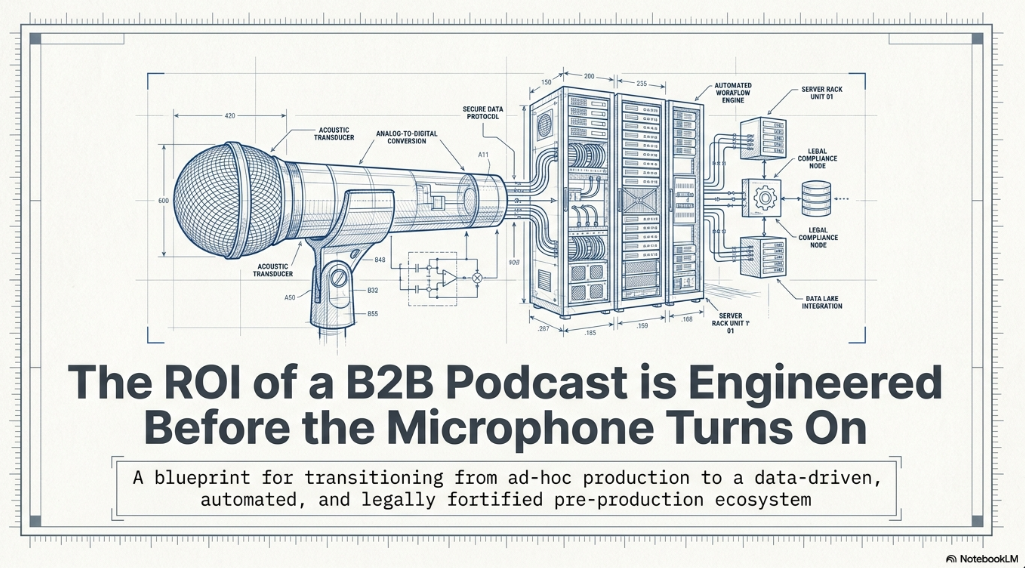
The evolution of podcasting from an informal hobbyist medium to a highly sophisticated mechanism for business-to-business (B2B) demand generation has fundamentally altered the standards of audio production1. In the contemporary corporate media landscape, a professional podcast operates as a central content pillar that fuels entire marketing ecosystems, turning singular conversations into pipeline-generating assets1. However, the strategic efficacy of a podcast is rarely determined at the microphone. Instead, the ultimate impact and return on investment (ROI) are decided during the pre-production phase3.
Strategic podcast production relies on a foundational, three-phase framework: Ideate, Create, and Distribute3. Within the initial "Ideate" phase, the dual components of core message alignment and strategic guest acquisition serve as the critical variables for success. Selecting the right guest and tailoring the message transforms an episode from a passive listening experience into an active pipeline accelerator2. Conversely, systemic mistakes—such as starting without a defined guest strategy, executing poor guest selection, or failing to secure guest referrals—dilute brand authority, waste production resources, and ultimately alienate the target demographic5.
This comprehensive research report provides an exhaustive analysis of strategic pre-production, focusing heavily on guest acquisition and message delivery. It explores the methodologies for mapping Ideal Customer Profiles (ICPs) to prospective guests, the psychological and statistical mechanics of outreach, rigorous vetting protocols, the essential legal architectures needed to protect intellectual property, ethical compliance regarding the Federal Trade Commission (FTC), and the workflow automation systems required to sustain production at scale.
Phase I: Strategic Guest Selection and the ICP Framework
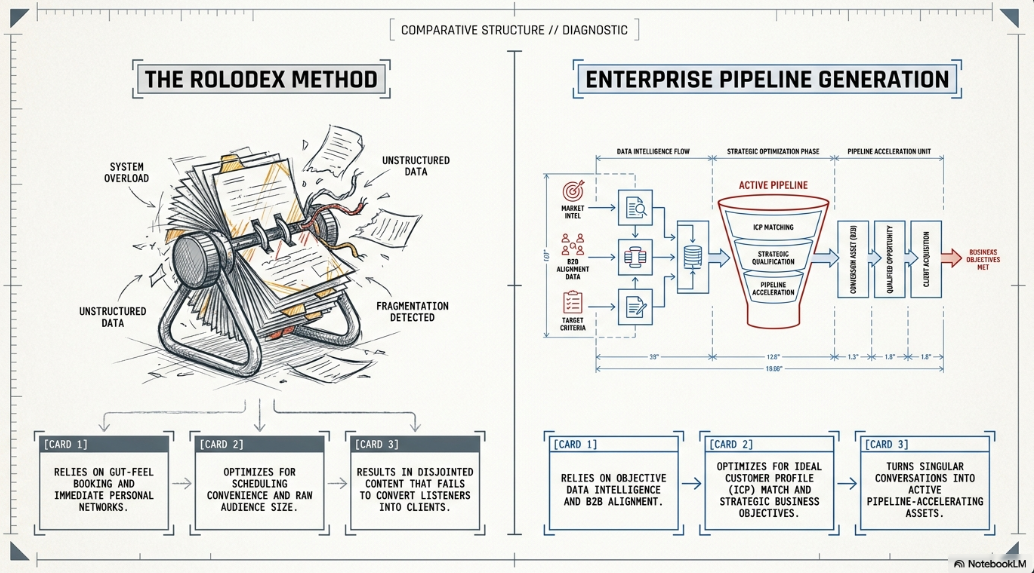
Historically, podcast guest booking relied upon the "Rolodex method," wherein hosts invited contacts from their immediate network or accepted inbound requests based strictly on raw audience size or generic subject matter expertise4. Strategic pre-production rejects this ad-hoc model in favor of deep alignment with the host organization's overarching business objectives1. The most pervasive failure in podcast guest acquisition is relying on gut feeling rather than objective data4. When podcasts lack a structured guest strategy, producers often optimize for volume or scheduling convenience rather than strategic fit, leading to disjointed content that fails to convert listeners into clients2.
Moving Beyond Gut-Feel Booking
Strategic pre-production demands that the guest selection process begins with a clearly defined Ideal Customer Profile (ICP)4. By establishing the precise company profile, industry classification, revenue range, and specific organizational roles that match the enterprise's ideal client or strategic partner, producers can utilize advanced B2B data intelligence platforms4. Tools such as Apollo, ZoomInfo, or LinkedIn Sales Navigator allow producers to identify specific individuals who match these exact parameters and exhibit active market signals4.
This data-driven approach ensures that the targeted guest has lived experience with the exact pain points the podcast's audience faces, holds a role with buying influence or decision-making power, and possesses a professional network that overlaps significantly with targeted buyers4.
Identifying "People in Motion"
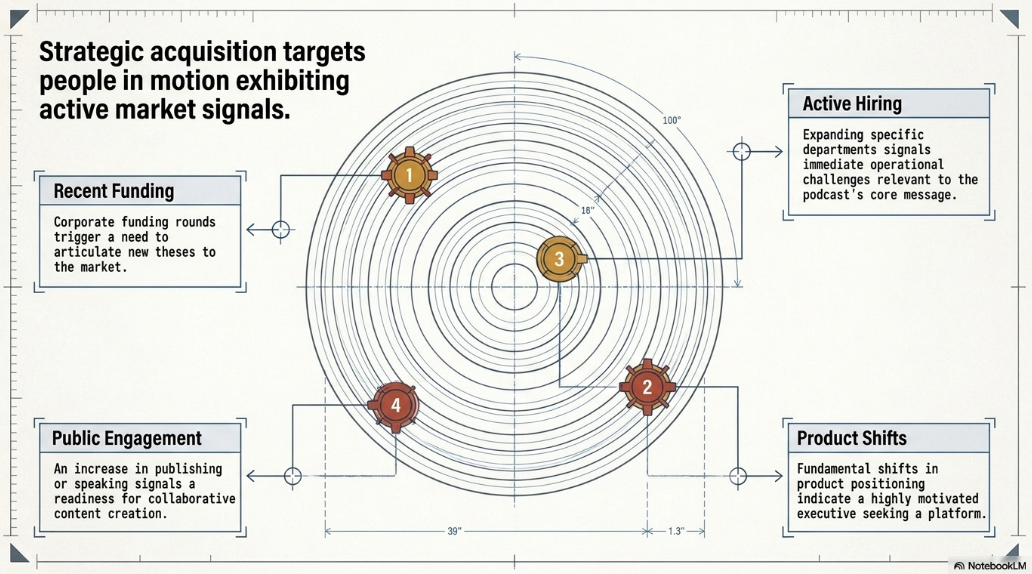
Identifying an ICP match is only the foundational step; the subsequent requirement is identifying timing. Strategic guest acquisition looks for real-time market signals that confirm a prospective guest is actively navigating challenges relevant to the podcast's core message4. These signals—referred to in the industry as identifying "people in motion"—include recent corporate funding rounds, active hiring in specific departments, fundamental shifts in product positioning, or an increase in public publishing and speaking engagements4.
When a guest is in motion, they are highly motivated to articulate their thesis and experiences to the broader market. Inviting them to speak precisely at the moment they are navigating a corporate transition produces a highly relevant, deeply engaging interview4. Furthermore, because the guest is actively attempting to solve an organizational problem, they are statistically more likely to see the value in the host's platform, services, or software, thereby organically accelerating the underlying business development goals of the podcast4.
The Structured Guest Architecture
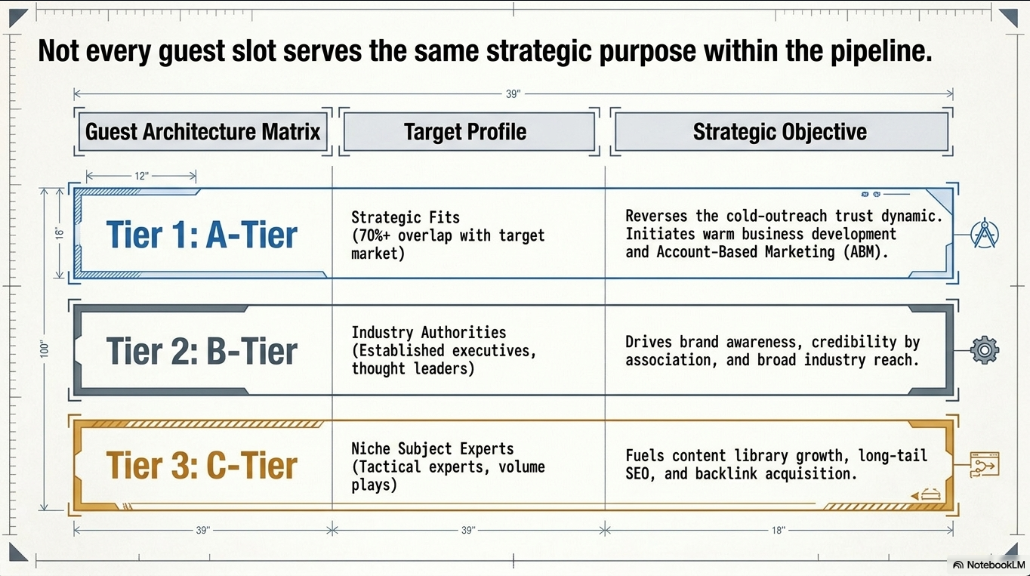
To operationalize ICP alignment, leading podcast production agencies employ a structured, multi-tiered guest framework. Not every guest slot serves the same strategic purpose, and a healthy pipeline requires a carefully curated mix of appearances designed to achieve disparate objectives2.
Strategic pre-production involves mapping a seasonal or quarterly content calendar that balances these three tiers. In the early stages of a podcast's lifecycle, a higher reliance on Tier 3 guests is common to build a credible backlog of content and establish technical competence4. As the show matures, Tier 1 and Tier 2 guests must increasingly dominate the schedule to drive pipeline influence, secure top-tier brand positioning, and facilitate meaningful revenue generation4.
Phase II: Message Positioning and Content Alignment
A ubiquitous error among founders, chief executives, and podcast guests is the reliance on a singular, generic narrative. Many executives tell the exact same origin story, share the identical lessons learned, and distribute the same generic advice regardless of the podcast's specific audience2. Strategic podcast pre-production fundamentally opposes this homogenization.
Show-Specific Message Tailoring
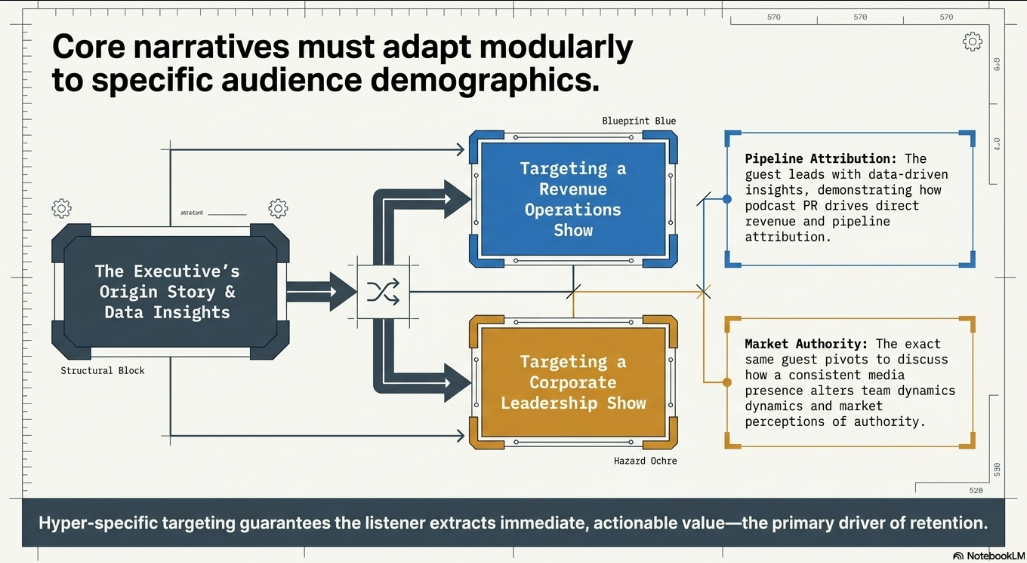
Delivering the core message requires positioning it to align seamlessly with the host's established content themes and the specific demographics of the listenership2. A modular approach to messaging ensures that the content never sounds rigidly scripted, while simultaneously preventing the guest from wasting valuable airtime on tangents that do not serve their strategic goals2.
If an executive is appearing on a podcast focused on revenue operations, the pre-production strategy dictates that they must lead with data-driven insights, such as how podcast public relations (PR) drives pipeline attribution2. Conversely, if the exact same executive appears on a show dedicated to corporate leadership, the narrative must pivot to discuss how a consistent media presence alters team dynamics and market perceptions of authority2. This hyper-specific targeting guarantees that the listener extracts immediate, actionable value from the episode, which is the primary driver of audience retention and conversion2.
Outlining the Narrative Structure
To ensure the core message is delivered effectively, pre-production workflows heavily utilize structured outlines and templates. Developing a podcast script or outline requires defining the episode's direction, clarifying the target audience's needs, and establishing clear goals for what the listener should walk away with3.
Effective episode planning requires identifying the core topics, drafting specific questions for the guest, and planning the structural flow of the episode3. This structure generally includes an immediate verbal hook to capture listener attention, a recognizable musical jingle to set the tonal brand, and a brief, compelling introduction to the subject matter6. By utilizing organizational tools such as Google Docs for collaborative simplicity, Notion for relational database systems, or ClickUp for broader project management integration, production teams can streamline this complex outlining process3.
Furthermore, pre-planning must account for environmental and temporal factors. Producers must analyze audience research to determine the optimal length of the episode, keeping in mind where the audience will be listening and the average duration of their commute7. This analysis dictates the editing constraints, reminding producers that recording an hour of content does not necessitate publishing an hour of content; trimming the episode to maximize information density is critical7.
Phase III: The Mechanics of Outreach and Strategic Pitching
Once the target guest list is established and the core messaging modules are developed, the pre-production workflow shifts to active outreach. The dynamic of pitching a guest—or conversely, pitching a host to accept an executive client as a guest—requires a nuanced understanding of mutual value exchange and professional gatekeeping8. The distance between an outreach email that is ignored and one that secures a top-tier booking is dictated entirely by personalization, relevance, and the mitigation of friction9.
Statistical Realities of Podcast PR
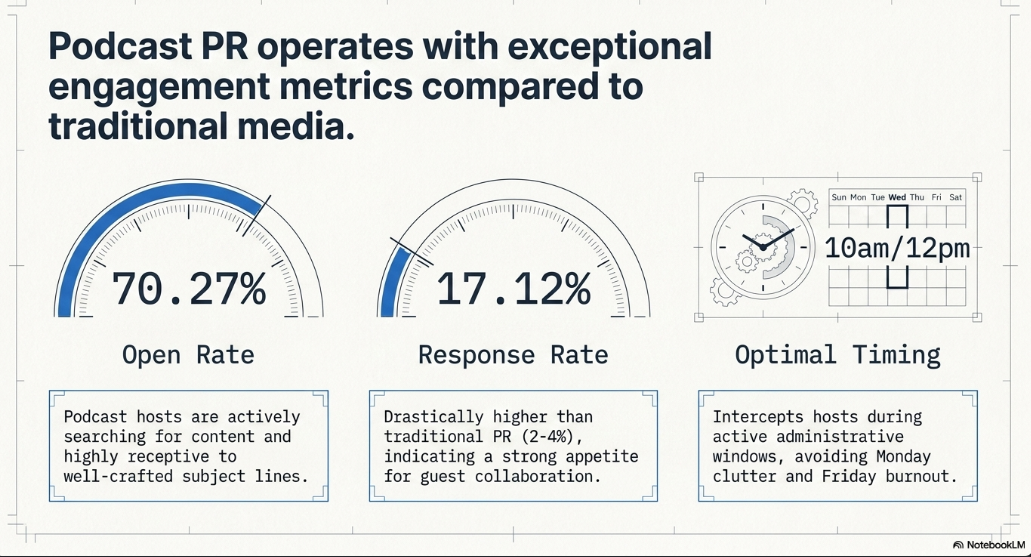
The podcast PR landscape is highly active, and understanding the statistical behaviors of hosts and gatekeepers provides a distinct competitive advantage. A comprehensive study analyzing over 9,000 podcast PR pitches revealed exceptionally high engagement rates for this medium compared to traditional media outreach10.
The Pitching Spectrum: Mitigating the Spam Risk
The majority of podcast pitches fail because they are fundamentally generic, reading like self-serving press releases rather than invitations for compelling conversation9. Podcast hosts are fiercely protective of their audiences; booking the wrong guest risks listener churn9. Therefore, a pitch must demonstrate that the guest's appearance will elevate the show's quality, rather than merely serving as a promotional vehicle for the guest's credentials9.
To optimize resources while maintaining high conversion rates, modern outreach strategies utilize a spectrum of personalization based on the guest tier:
AI-Assisted Drafts (Volume/Tier 3): For volume-driven outreach where the match is acceptable but not mission-critical, AI systems can blend the target's public profile with the podcast's overarching themes to generate baseline pitches11. These drafts require human review to inject judgment and nuance, but they allow for speed and scale without sacrificing baseline relevance11.
Smart Templates (Strategic/Tier 2): For exact ICP fits, outreach relies on structured frameworks that are heavily customized11. The writer controls the foundational structure, but utilizes dynamic merge fields to inject highly specific variables—such as a reference to a recent company announcement, a nuanced industry challenge, or a shared mutual connection11. The focus is on framing the invitation around a specific, timely angle rather than a generic request to "share expertise"4.
Full Manual (Whale/Tier 1): For industry titans and dream guests, automation and templates are entirely abandoned11. Outreach is written meticulously from scratch, often leveraging warm introductions from mutual connections2. The producer must listen to recent episodes (specifically from the last month, not legacy content) to identify current thematic trends and propose an intersection between the guest's expertise and the show's active explorations11.
Structure and Follow-Up Cadence
A high-converting pitch adheres to a strict structural discipline. It must remain concise—ideally under 150 words—to respect the recipient's time and attention span2. The architecture of the pitch should feature a brief, one-to-two sentence introduction, a direct explanation of why the guest is a perfect fit for the audience, two or three highly tailored topic ideas that provide immediate listener value, and a low-friction conclusion featuring relevant links8.
Following up is an essential component of the outreach workflow, but it requires tactical restraint. Mass pitching and aggressive, value-less follow-ups burn relationships rapidly, as PR professionals and producers build reputations that travel within the tight-knit podcasting community11. A professional follow-up should introduce new hooks—such as mentioning a recent article published by the guest, or tying the invitation to breaking industry news11. Two to three follow-ups over a multi-week period is the professional standard; beyond this threshold, the outreach becomes counterproductive noise, and the opportunity should be parked for several months11.
Phase IV: Rigorous Vetting and Pre-Interview Protocols
Securing a guest's agreement to appear is not the conclusion of the acquisition phase; it marks the commencement of the vetting and preparation phase. To guarantee the quality of the final audio product and ensure that the core message is delivered with maximum impact, producers must implement strict pre-interview protocols12.
The Essential Screening Call
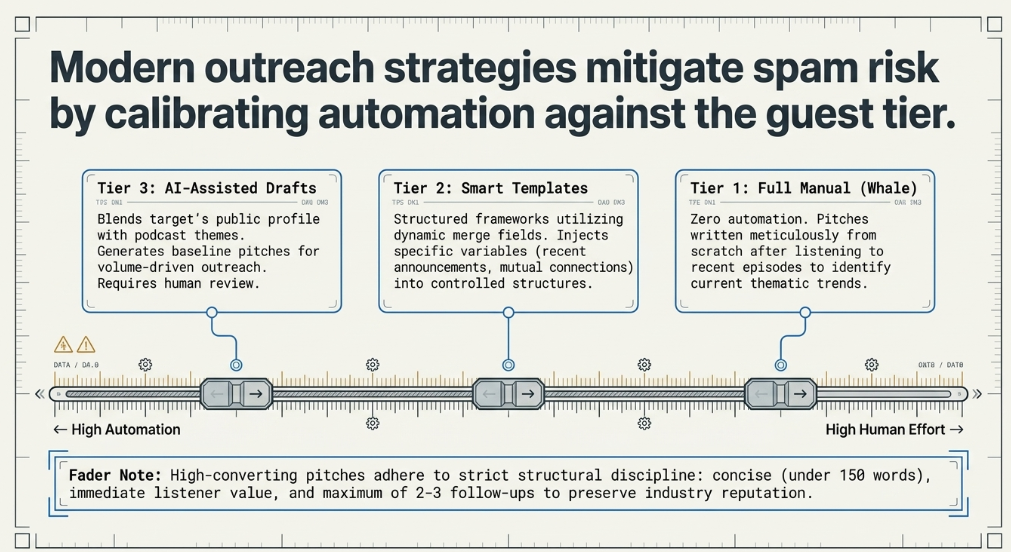
The screening call is an indispensable mechanism in professional podcast pre-production. Typically lasting 15 to 30 minutes, this initial interaction serves multiple strategic and technical purposes that cannot be fulfilled through email correspondence12.
First, the screening call functions as an auditory and technical audit. The producer can accurately assess the guest's microphone quality, internet bandwidth stability, and the acoustic properties of their recording environment12. For example, condenser microphones capture rich, highly detailed audio but are incredibly sensitive to ambient noise, requiring a quiet, soundproof environment15. Furthermore, standard computer or webcam microphones are universally deemed insufficient for professional production15. Identifying technical deficiencies during a screening call allows the producer to intervene—such as shipping a dynamic microphone to the guest or advising them on acoustic room treatments—weeks before the actual recording, thereby preventing catastrophic audio failures.
Second, the screening call serves as an editorial audition. It provides the host or producer with the opportunity to assess the guest's communication skills and enthusiasm12. In a remote work environment, the ability to explain complex, technical concepts clearly and concisely is paramount12. If a guest tends to ramble, speaks in a flat monotone, or demonstrates a lack of interpersonal chemistry with the host, the producer can proactively pivot the format—perhaps opting for a shorter segment rather than a full hour—or, in extreme cases, cancel the recording to protect the show's quality standards.
Combating Advanced Threats: AI and Deepfakes
In the modern digital landscape, the screening call has taken on a new dimension of security: verifying identity. The proliferation of artificial intelligence (AI) has made it increasingly possible for bad actors to generate highly convincing audio deepfakes16. Advanced platforms, such as those developed by Symphonic Labs (e.g., ReadTheirLips.com), have published AI models capable of auto-translating speech from any well-captured video of a person's lips moving into text with over 90% accuracy, highlighting the ease with which audio and visual data can be manipulated16.
Furthermore, social engineering tactics utilizing AI tools like Kaiden.AI present a legitimate risk to high-profile B2B podcasts, where competitors or malicious actors might attempt to impersonate executives16. Consequently, visual screening calls utilizing video platforms are now a critical security measure to verify that the guest is, in fact, human and accurately represents their stated identity16.
Questionnaires and Guest Briefing Documents
To supplement the screening call and ensure the guest is fully prepared, professional productions utilize guest briefing documents and pre-interview questionnaires17. A guest briefing document serves as a professional roadmap, signaling to the guest that the production is highly organized while simultaneously reducing pre-interview anxiety18.
A comprehensive guest briefing document typically includes:
Logistical Details: Exact recording dates, software links (e.g., Riverside for high-quality localized audio and video capture), and technical requirements3.
Audience Avatar and Tone: A description of who is listening, enabling the guest to tailor their language and examples to the correct demographic, ensuring they provide the specific outcomes promised to the listener3.
Thematic Outline: A list of core topics and potential questions, allowing the guest to mentally prepare their strongest anecdotes and avoiding the rigidity of a scripted response3.
Ethical and Behavioral Guidelines: Reminders regarding active listening, transparency, and the avoidance of making false claims or exaggerating capabilities—principles often mirrored in corporate booth support and PR training17.
By utilizing intake software tools like Google Forms, producers can easily gather necessary collateral such as professional bios, high-resolution headshots, and social media handles, centralizing the data required for both the interview and the subsequent marketing assets3.
Phase V: Legal Architecture and Intellectual Property Protection
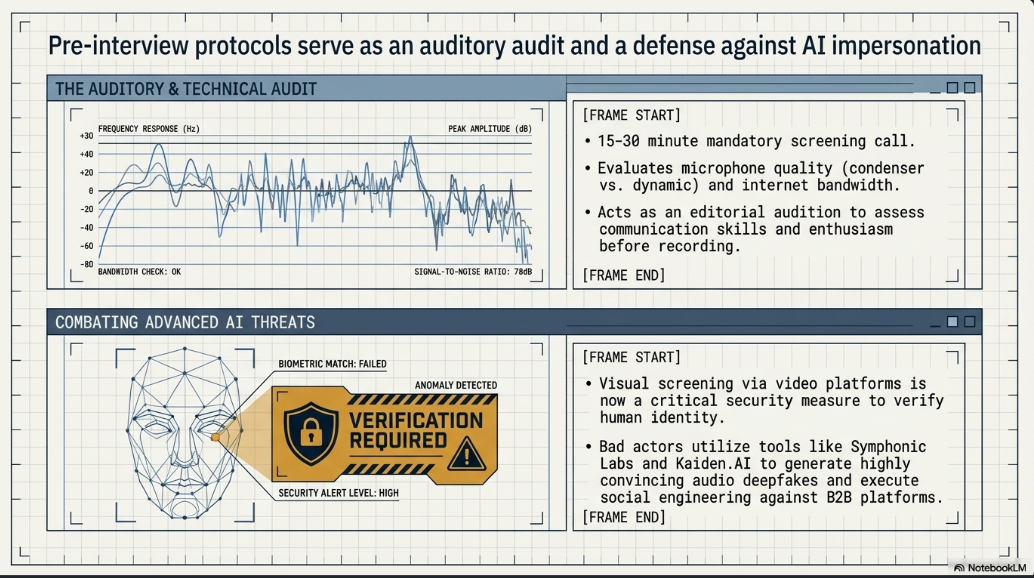
As podcasts generate substantial and highly valuable intellectual property (IP), the legal framework governing guest appearances has become a critical component of pre-production. The informal, verbal agreements that characterized the early, hobbyist days of podcasting represent an unacceptable level of operational and financial risk for modern corporate media entities21. The cornerstone of this defensive legal architecture is the Guest Release Form (interchangeably referred to as a Media Release Agreement or Talent Release Form)22.
The Necessity of the Guest Release Form
When two or more individuals contribute to an audio or video recording, copyright laws dictate that a joint work is created, and it is not automatically clear who holds the exclusive authority to dictate how that work is used or distributed24. A guest holds inherent legal rights to their own likeness, voice, and the original expressions they contribute during the interview. Without the explicit, documented transfer of these rights, a podcast host operates in a state of severe legal vulnerability21.
If a guest becomes dissatisfied with how an episode is edited, claims their views were twisted or misrepresented, or subsequently decides they no longer want to be associated with the host's brand, they could legally demand the episode be removed from distribution21. Without a signed release form, the host has no legal recourse and may be compelled to comply, resulting in wasted production costs, lost SEO value from dead links, and a compromised content library. In more severe scenarios, the guest could initiate costly litigation for copyright infringement, defamation, or the unauthorized use of their right of publicity, potentially demanding financial compensation21.
Core Clauses of a Standard Release Form
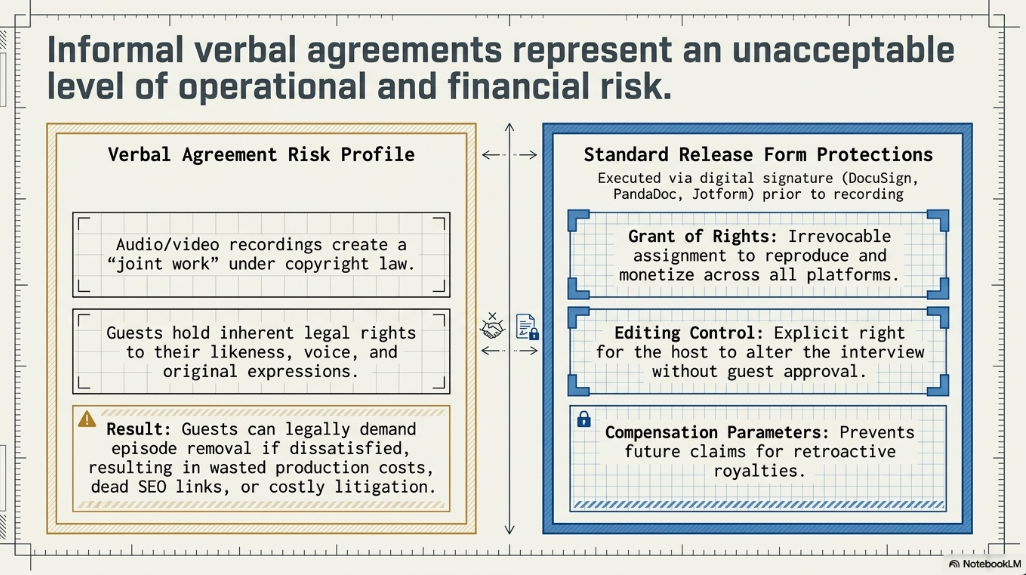
To mitigate these risks entirely, pre-production workflows must incorporate the execution of a release form before any recording equipment is activated21. Standardized through digital signature platforms (e.g., DocuSign, HelloSign, PandaDoc, or Jotform), these forms ensure a frictionless signing experience while embedding non-negotiable legal protections24.
An effective Guest Release Form must include the following clauses:
While verbal agreements—where the host reads the terms on tape and the guest verbally consents—can offer a baseline of protection, they are highly susceptible to challenges in court and represent an unprofessional standard that damages brand credibility with elite guests21. The written or digitally executed release form acts as a definitive legal shield, protecting the show's content, reputation, and financial stability21. Furthermore, for shows involving third-party editors or agencies, Producer Agreements must be executed to outline compensation, schedules, and work-for-hire intellectual property transfers26.
Phase VI: Ethics, Compliance, and the Pay-to-Play Controversy
As the commercial value and reach of podcast guest appearances have skyrocketed, the industry has experienced a significant rise in "pay-to-play" models, where guests pay hosts a fee for the privilege of being interviewed. Investigative reports have indicated that some high-profile podcasts charge up to $50,000 for a single guest appearance28. This practice introduces severe ethical, reputational, and legal challenges that must be navigated carefully during strategic pre-production and outreach29.
FTC Regulations and Endorsement Disclosures
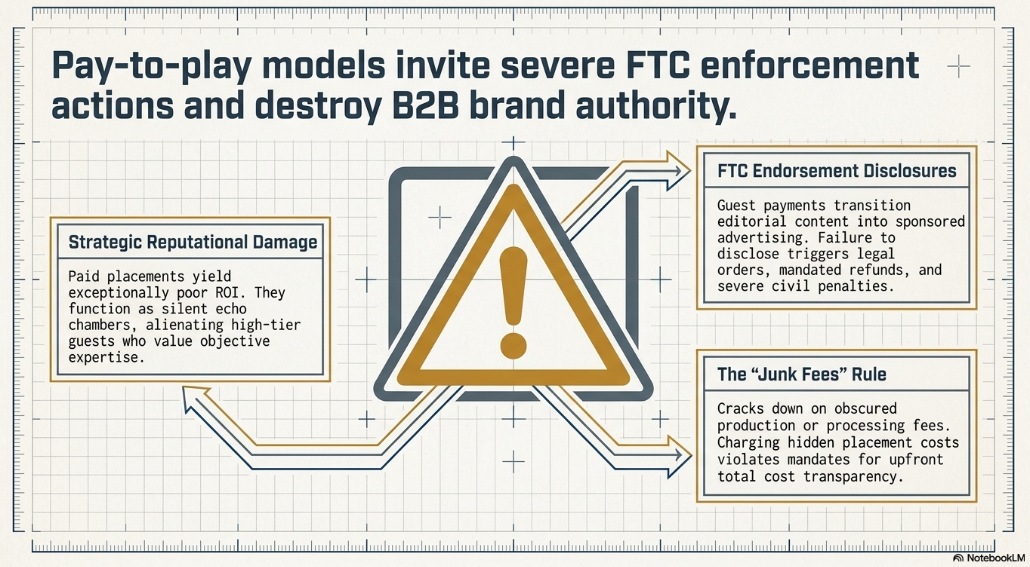
The Federal Trade Commission (FTC) enforces strict guidelines against deceptive advertising and marketing practices. If a guest pays to appear on a podcast, that appearance legally transitions from independent editorial content to a sponsored advertisement28. The FTC mandates clear and conspicuous disclosure to the audience whenever content is sponsored or when a material financial connection exists between the host and the guest28.
Failing to disclose a pay-to-play arrangement upfront leaves both the host and the paying guest highly vulnerable to FTC enforcement actions. These actions can include legally binding orders to bring practices into compliance, mandates to refund money to consumers, and the imposition of severe civil penalties28. Beyond legal jeopardy, the reputational damage associated with being exposed for undisclosed paid interviews can irreparably destroy the trust a podcast has built with its audience. In B2B environments, where authority, authenticity, and objective expertise are the primary currencies, the discovery of a pay-to-play scheme renders the content functionally worthless and alienates future high-tier guests28.
The Implications of the FTC "Junk Fees" Rule
The regulatory landscape regarding financial transparency is tightening rapidly across all digital commerce sectors. Recently, the FTC implemented the Trade Regulation Rule on Unfair or Deceptive Fees, colloquially known as the "Junk Fees Rule"29. While this specific, bipartisan rule primarily targets the live-event ticketing and short-term lodging industries by mandating the upfront disclosure of all mandatory fees, its underlying legal philosophy signals a broader FTC crackdown on bait-and-switch pricing, negative option billing, and hidden financial arrangements across the entire digital economy29.
For podcast production agencies and B2B media networks, the aggressive enforcement posture of the FTC underscores the absolute necessity of financial transparency33. If a podcast employs a model where guests are asked to cover "production fees," "processing fees," or "convenience fees" to expedite their appearance, these costs cannot be hidden or obscured until the end of the booking process29. The FTC requires that businesses advertising pricing tell consumers the whole truth upfront regarding total costs32. Furthermore, concerning subscription or agency models, the FTC is actively targeting negative option billing practices—where silence or inaction is treated as acceptance of an offer—demanding that cancellation processes be as accessible and simple as enrollment processes34.
Strategic Stance on Paid Guesting
From a purely strategic standpoint, leading podcast producers and PR professionals strongly advise against participating in pay-to-play models, either as a host charging guests or as a brand paying to place executives on shows28. Paying to be a guest generally yields an exceptionally poor return on investment28. Podcasts that rely on this revenue model rarely possess the highly engaged, specific niche audiences that drive genuine business results; they function more as silent echo chambers than active conversion channels28. Resources are vastly better allocated to building out a robust, organic outreach strategy that secures placements based on the true merit of the guest's expertise and the precise alignment of the ICP30.
Phase VII: Post-Appearance Activation and KPI Tracking
While pre-production is the focus of this analysis, it is critical to note that the strategic framework of guest acquisition anticipates and plans for post-appearance activation. The interview itself represents merely 20% of the total value generated; the remaining 80% is derived from what is done with the asset after it airs2.
A comprehensive pre-production strategy ensures that every recorded episode becomes a multi-channel asset1. One high-quality audio and video recording should be engineered to yield 15 to 30 ancillary assets featuring human faces, usable across various social platforms and at every stage of the marketing funnel1. This includes pulling social media clips from the strongest 60 to 90 seconds of the interview, creating dedicated blog posts optimized for AI-search and SEO, drafting email sequences that utilize the appearance as a credibility proof point, and optimizing custom YouTube thumbnails for discoverability1.
Furthermore, pre-production planning must define the Key Performance Indicators (KPIs) that will measure the success of the guest strategy2. Tracking every appearance in a structured system is vital to measure ROI2.
Essential metrics that must be tracked include:
Direct Traffic and Referrals: Measured using UTM-tagged links embedded in the show notes and the guest's call to action2.
Backlink Acquisition: Tracking the SEO value gained from high-authority podcast websites linking back to the guest's corporate domain2.
Pipeline Influence and Sales Cycle Acceleration: Monitoring how a guest appearance moves Tier 2 strategic accounts through the sales funnel2.
Brand Search Volume: Increases in organic searches for the guest or their company following an episode release2.
Speaking and Partnership Invitations: Secondary opportunities generated by the exposure2.
A critical operational mistake frequently made in this phase is failing to follow up properly. Maintaining the relationship by sending a thank-you note within 24 hours and asking the guest for referrals to other high-caliber individuals in their network is essential for sustaining a healthy guest pipeline2.
Phase VIII: CRM Systems and Workflow Automation
The theoretical frameworks of guest tiering, rigorous vetting, customized pitching, and legal compliance are impossible to execute at scale without sophisticated data management systems. A common, fatal pitfall in podcast pre-production is attempting to manage guest acquisition utilizing decentralized spreadsheets, disjointed email threads, and siloed document notes35. As a show scales, this manual infrastructure inevitably collapses, resulting in missed follow-ups, lost recording dates, degraded guest experiences, and severe professional embarrassment36.
The "Blank Canvas" Dilemma: Notion vs. Purpose-Built CRM
To centralize operations and streamline the workflow, producers frequently turn to relational databases like Notion or dedicated Customer Relationship Management (CRM) platforms like HubSpot35.
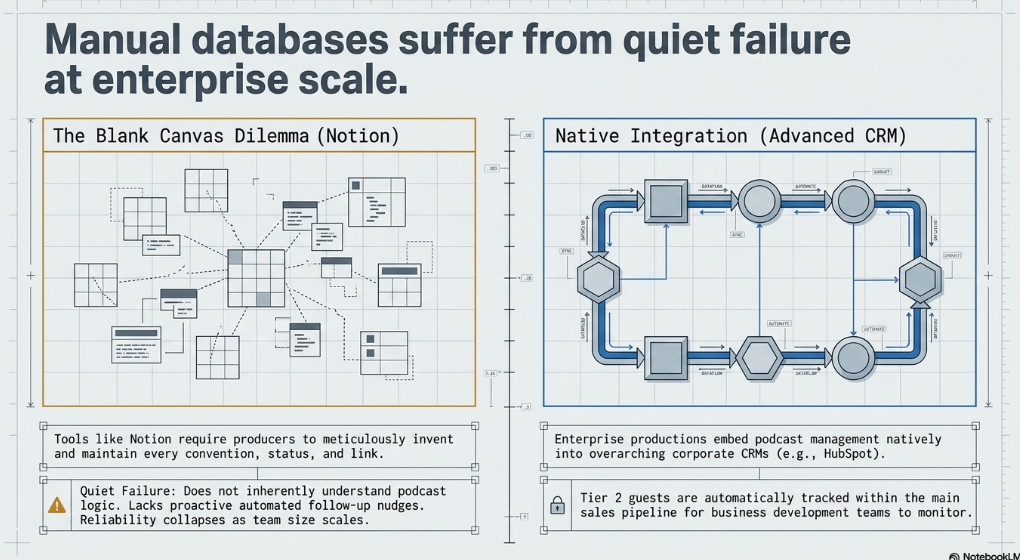
Notion offers immense structural flexibility, allowing producers to build customized digital studios36. A well-architected Notion workspace features interconnected databases, such as linking a "Guests" database (storing names, roles, contact info, and social links) directly to an "Episodes" database35. It allows for Kanban board views to track the guest pipeline through logical progressions: Invited → Confirmed → Recorded → Published35. Producers can also integrate modules for tracking high-priority tasks, marketing campaigns, sponsor contract values, and monthly production expenses39.
However, analytical reviews of podcast workflow management indicate that Notion suffers significantly from the "blank canvas" dilemma36. Because Notion is a generalized productivity tool, it does not inherently understand the logic of a podcast36. It requires the producer to build, invent, and meticulously maintain every convention, status, and relational link36. Most critically, Notion suffers from "quiet failure"—if a producer forgets to check the system on a Friday, Notion does not proactively send automated follow-up nudges or alert emails36. The system only works as long as the user feeds it; the database is only as reliable and honest as the producer's daily discipline, which often strains as a show grows or new team members are onboarded36.
Advanced Automation and Native Integration
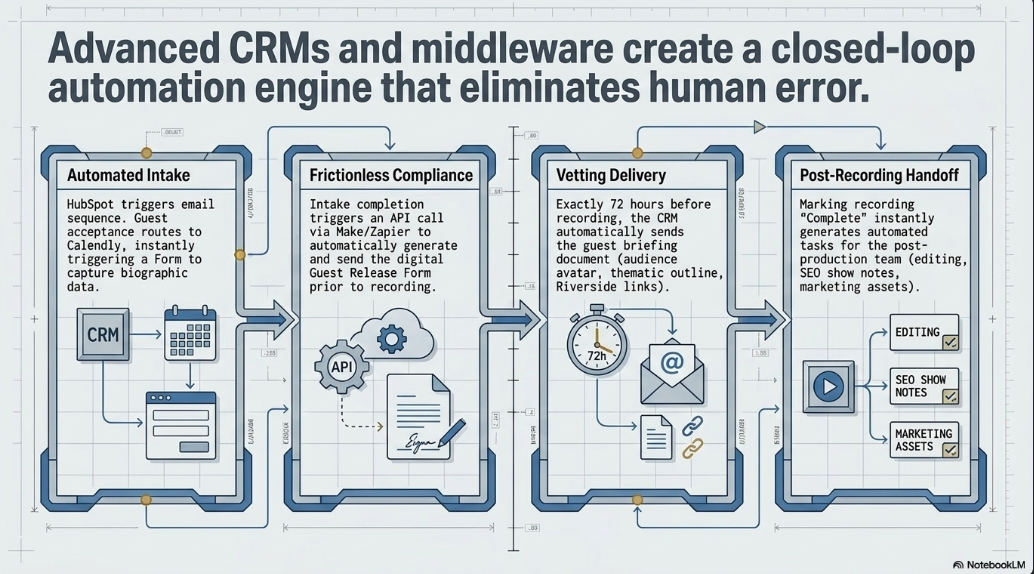
To transcend the limitations of passive databases and eliminate human error, enterprise-level podcast productions utilize advanced CRMs (such as HubSpot) integrated tightly with automation middleware (such as Make or Zapier)19.
A fully automated pre-production workflow shifts the burden of memory from the producer to the system, encompassing the following technical architecture:
Automated Outreach & Intake: Automated email sequences are triggered directly from the CRM. Upon a guest's acceptance, a scheduling link (e.g., Calendly) is generated, which subsequently triggers an automated intake questionnaire via Google Forms or native HubSpot Forms3. This eliminates the manual email ping-pong traditionally required for scheduling and captures all necessary biographic data instantly3.
Frictionless Legal Compliance: The completion of the intake form acts as a trigger event, initiating an API call to a digital signature platform (e.g., DocuSign or Jotform) to automatically generate and send the Guest Release Form to the guest24. This ensures legal compliance is an unavoidable, automated prerequisite prior to recording21.
Vetting & Preparation Delivery: CRM automations are programmed to send the guest briefing document, technical requirements, and pre-interview screening links exactly 72 hours before the scheduled recording17. This ensures the guest is fully prepared, substantially reducing audio issues and elevating the narrative quality3.
Post-Recording Handoff: Once the screening call or actual recording is marked as "Complete" within the CRM pipeline, automated tasks are instantly generated for the post-production team, alerting them to begin audio editing, drafting SEO show notes, and generating marketing assets1.
By embedding podcast guest management within a broader corporate CRM ecosystem like HubSpot, the podcast ceases to operate as an isolated media project19. It becomes fully integrated into the organization's overarching marketing, sales, and service architecture19. Guests who fall into the Tier 2 prospect category are automatically tracked within the main sales pipeline, allowing business development teams to monitor the relationship and engage strategically at the optimal moment following the episode's publication1.
Conclusion
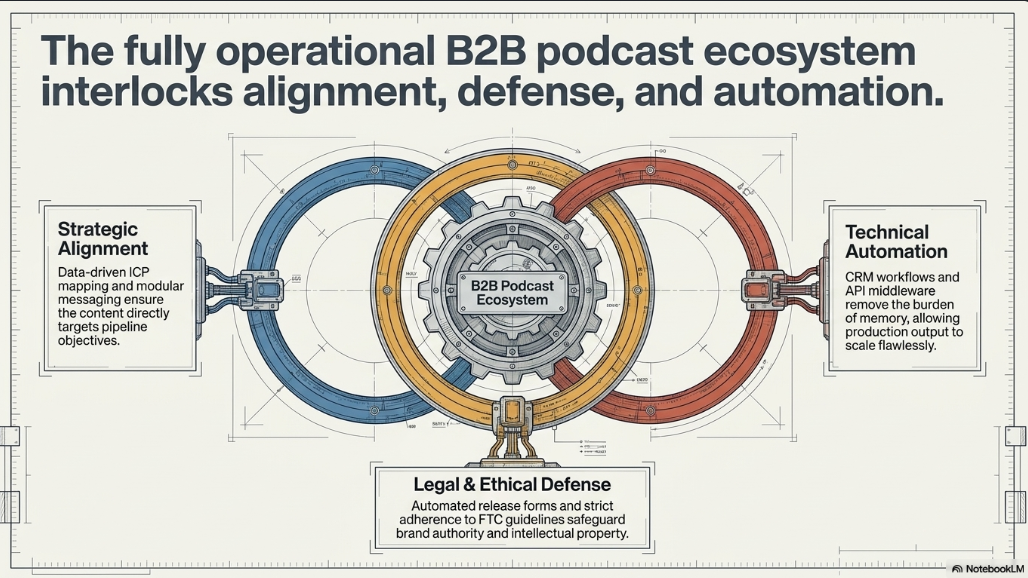
The strategic pre-production of a professional podcast requires a highly disciplined, multidisciplinary approach that extends far beyond standard audio engineering and casual conversation. The long-term commercial success and cultural relevance of the medium are predicated entirely on the producer's ability to consistently acquire, vet, and integrate high-caliber guests who perfectly align with the host organization's Ideal Customer Profile4. By discarding gut-feel booking and volume-chasing in favor of a data-driven, three-tiered guest architecture, producers can transform a podcast from a mere content exercise into a potent, revenue-generating engine for account-based marketing and industry thought leadership2.
However, this strategic alignment must be supported by rigorous operational mechanics. The psychological nuances of personalized pitching9, the technical and narrative auditing conducted during mandatory screening calls12, and the implementation of automated CRM workflows19 are the precise elements that allow a podcast to scale its output without suffering a catastrophic degradation in quality.
Crucially, this operational infrastructure must be fortified by a bulletproof legal and ethical framework. The mandatory execution of Guest Release Forms protects the intellectual property and financial stability of the show from post-production disputes21. Simultaneously, strict adherence to FTC guidelines regarding endorsement disclosures, transparent pricing, and the total avoidance of deceptive pay-to-play models safeguards the brand's ethical reputation in a market that demands absolute authenticity28.
Ultimately, a professional podcast is a direct reflection of the backend systems that build it. When guest acquisition is treated not as a logistical chore, but as a deeply strategic, legally compliant, and systemically automated process, the podcast fulfills its highest organizational potential. It becomes capable of delivering a core message that resonates with the target market, accelerates the sales cycle, and solidifies unshakeable brand authority.
Works cited
Podcast Capabilities | Hexagroup, https://www.hexagroup.com/b2b-podcast-capabilities
Podcast Guest Placement Strategy: How Founders Turn Appearances Into Pipeline -, https://commandyourbrand.com/podcast-guest-placement-strategy/
Podcast Production Framework: From Idea to Impact - The Gem Club, https://thegemclub.com/podcast-production-framework/
Podcast Guest Strategy for B2B: Turn Your Guest List Into Your Pipeline List - Micme, https://micme.com/podcast-guest-strategy/
What Do Podcast Production Services Include? A Complete Breakdown For B2B Companies - Rise 25, https://rise25.com/lead-generation/what-do-podcast-production-services-include-a-complete-breakdown-for-b2b-companies/
17 Best Podcast Strategy Templates: Examples, Checklist + 2026 Guide - Talks.co, https://talks.co/p/podcast-strategy-template/
Podcast Roadmap for Success - PAVILION | DINFOS Online Learning, https://pavilion.dinfos.edu/Article/Article/3251297/podcast-roadmap-for-success/
Podcast pitching 101: How podcasts can help provide the boost your PR strategy is missing, https://www.thesocialagency.ca/podcast-pitching-101-how-podcasts-can-help-provide-the-boost-your-pr-strategy-is-missing/
The Art of Pitching Podcasts: Tips for PR Professionals - - Command Your Brand, https://commandyourbrand.com/the-art-of-pitching-podcasts-tips-for-pr-professionals/
Free Guide - How to craft the perfect podcast PR pitch - Propel AI, https://propel-ai.com/research/free-guide-how-to-craft-perfect-podcast-pr-pitch
How to Pitch Clients to Podcasts: A PR Pro's Guide - Podseeker, https://www.podseeker.co/blog/how-to-pitch-clients-to-podcasts
Insights for Software Developers and Early-Stage Startups | Wajusoft Blog, https://www.wajusoft.com/blog
How to Prepare for Your First Podcast Interview As A Guest, https://yourexpertguest.com/prepare-for-your-first-podcast-interview/
Ask HN: Who is hiring? (October 2016) - Hacker News, https://news.ycombinator.com/item?id=12627852
The Ultimate Checklist for Becoming a Sought-After Podcast Guest, https://www.smoothbusinessgrowth.com/becoming-a-sought-after-podcast-guest/
r/physicalredteam - Reddit, https://www.reddit.com/r/physicalredteam/
Student Booth Engagement Guidelines | PDF - Scribd, https://www.scribd.com/document/843988645/Booth-Support-guide-1
Keep Moving Forward: An Inventory - Rob Farquhar, Host and Presenter, https://robf.com.au/2015/02/10/keep-moving-forward-inventory/
Podcast Guest Briefing Template, https://offers.hubspot.com/view/podcast-guest-briefing-template
Continuing Education (CE) Eligible Articles For Advisors - Kitces.com, https://www.kitces.com/ce-eligible/
8 Best Podcast Guest Release Form Templates (Copy & Use) - Talks.co, https://talks.co/p/podcast-guest-release-form/
Strategic Pre-Production for a Professional Podcast - Finchley Studios, https://www.finchley.co.uk/finchley-learning/visual-podcast/strategic-pre-production-for-a-professional-podcast
Avoid Legal Issues with This Media Release Agreement Template - A Self Guru, https://aselfguru.com/media-release-agreement/
Why and When to Use a Podcast Release Form for Your Guests (with Template) - Castos, https://castos.com/podcast-release-form-guest/
Sample Podcast Release Form Template - Jotform, https://www.jotform.com/form-templates/sample-podcast-release-form
Legal Things to Consider: Podcasting | by Golden Goose Creative | Medium, https://medium.com/@goldengoosecreative/legal-things-to-consider-podcasting-a33b14a1af8d
How to Start a Podcast With No Audience (10 Easy Steps!) - A Self Guru, https://aselfguru.com/how-to-start-a-podcast-with-no-audience/
Never Pay to Be a Guest on a Podcast : r/buzzsprout - Reddit, https://www.reddit.com/r/buzzsprout/comments/1i91zei/never_pay_to_be_a_guest_on_a_podcast/
The Rule on Unfair or Deceptive Fees: Frequently Asked Questions, https://www.ftc.gov/business-guidance/resources/rule-unfair-or-deceptive-fees-frequently-asked-questions
Why You Should Never Pay to Be on a Podcast - Inc. Magazine, https://www.inc.com/joe-procopio/you-should-never-pay-to-be-on-a-podcast/91110523
Legit Podcast Pro on Steno.fm, https://www.steno.fm/show/c3b90bf7-10f4-5423-a118-b23b7d113791
Federal Trade Commission Announces Bipartisan Rule Banning Junk Ticket and Hotel Fees, https://www.ftc.gov/news-events/news/press-releases/2024/12/federal-trade-commission-announces-bipartisan-rule-banning-junk-ticket-hotel-fees
Podcast - Hidden Fees in the Live-Event Ticketing and Short-Term Lodging Industries, https://www.hklaw.com/en/insights/media-entities/2025/01/podcast---hidden-fees-in-the-live-event-ticketing-and-short-term
Podcast - The FTC and Consumer Online Transactions | Insights - Holland & Knight, https://www.hklaw.com/en/insights/media-entities/2026/04/podcast-the-ftc-and-consumer-online-transactions
Podcast Guest CRM Template | Notion Marketplace, https://www.notion.com/templates/podcast-guest-crm-n4b
Notion for Podcast Guest Management: Does It Hold Up? - PodGlue, https://podglue.com/blog/notion-for-podcast-guest-management
Best CRM Templates from Notion | Notion Marketplace, https://www.notion.com/templates/category/crm
HubSpot CRM and Notion Integration | Workflow Automation - Make, https://www.make.com/en/integrations/hubspotcrm/notion
Podcast Workflow Management Studio Template | Notion Marketplace, https://www.notion.com/templates/podcast-workflow-management-studio