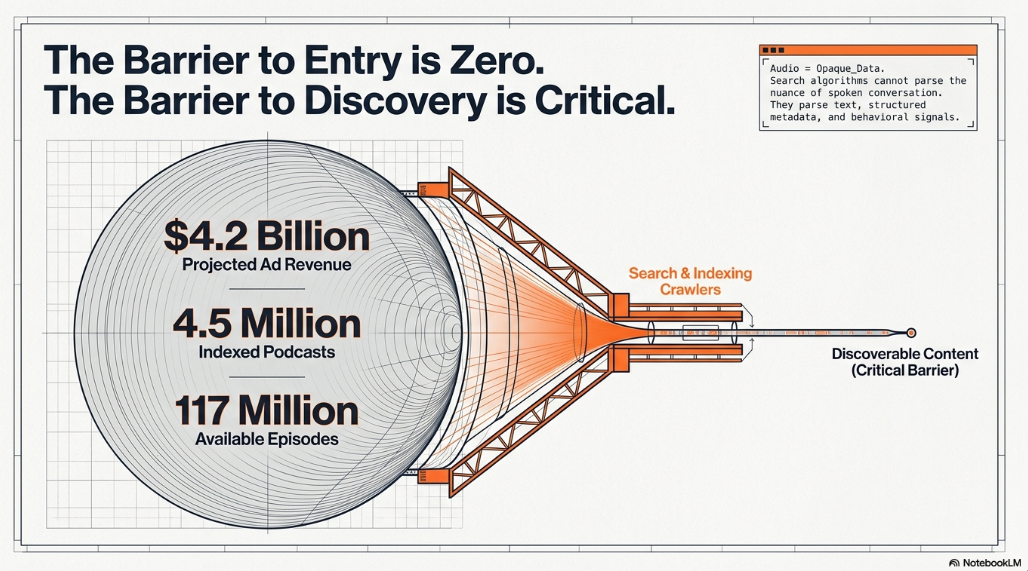
The podcasting industry has transformed from a niche digital broadcasting medium into a cornerstone of the global media diet, characterized by vast audiences and substantial capital investment. By 2025, global podcast listenership reached an estimated 584.1 million, with projections indicating a rise to 630.9 million by the end of the year and 651.7 million by 20271. Concurrently, global podcast advertising revenue surged to approximately $4.2 billion in 2026, representing a 19% year-over-year growth rate that outpaces traditional digital display advertising3. This economic maturation has fundamentally altered the competitive landscape. With over 4.5 million podcasts indexed globally and more than 117 million episodes available on platforms like Apple Podcasts alone, the barrier to entry remains low, but the barrier to discoverability has never been higher1.
The foundational challenge of podcast discoverability lies in the opacity of the medium itself. Audio, in its raw format, is invisible to search engine crawlers and algorithmic discovery mechanisms4. Search engines and platform algorithms parse text, metadata, and user engagement signals, not the nuance of spoken conversation4. Consequently, an episode's reach is dictated almost entirely by the strategic architecture of its text-based assets—specifically, the show notes, transcripts, metadata, and web presence built during and immediately following pre-production5.
Structuring content to maximize reach requires a sophisticated, multidimensional approach that navigates the proprietary ranking algorithms of closed directories like Apple Podcasts and Spotify, the open-web indexing of search engines like Google, the video-centric environment of YouTube, and the rapidly emerging paradigm of Generative Engine Optimization (GEO)6. This report details the comprehensive strategies required to optimize podcast content architecture, ensuring maximum visibility across all contemporary discovery vectors.
The Dual Environment of Podcast Search Algorithms
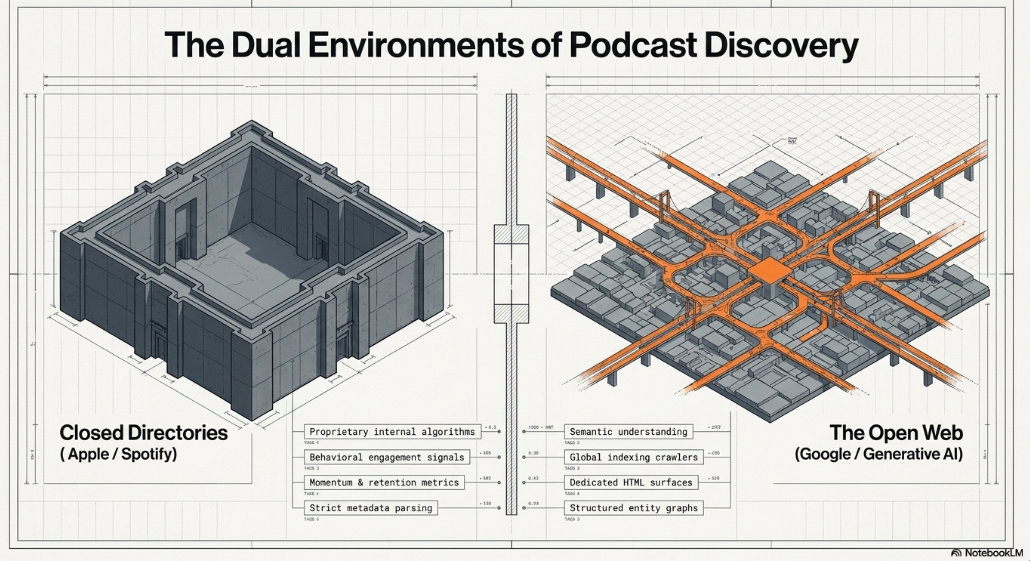
Podcast discoverability operates across two distinct search environments, each governed by fundamentally different rules: platform-native search within closed directories, and general-purpose search on the open web6. Navigating these environments requires an understanding of how platforms weight metadata versus behavioral signals.
Platform-Native Algorithms: Apple Podcasts and Spotify
Within closed ecosystems, the ranking systems are proprietary, closed-source, and highly sensitive to listener behavior6. Apple Podcasts and Spotify dominate this space, yet their algorithmic priorities diverge significantly.
Spotify utilizes a sophisticated algorithm driven by machine learning, content analysis, and collaborative filtering7. However, its internal search engine is less semantically advanced than Google's, functioning primarily as a direct keyword-matching system10. This mechanical reality requires creators to place exact-match primary keywords in the podcast title and episode descriptions, avoiding vague or overly creative naming conventions10. Beyond text, Spotify's ranking algorithm is heavily weighted toward absolute engagement metrics. The platform prioritizes the "completion rate," specifically tracking whether an episode hooks a listener within the first 60 seconds10. Furthermore, Spotify tracks granular behavioral signals that indicate genuine value, such as episodes saved to a user's library, direct shares, additions to custom playlists, and repeat listens7. Algorithmically, Spotify also rewards high-frequency consistency; maintaining a publication cycle of at least once every 15 days signals to the system that the podcast is active, thereby boosting its baseline ranking7.
Apple Podcasts, which serves as the foundational catalog feeding numerous downstream directories, places a premier emphasis on listener retention and the velocity of audience growth6. While Spotify rewards the sheer volume of interactive clicks, Apple's algorithm mathematically favors shows that retain listeners through the entirety of an episode7. More importantly for new content, Apple's system heavily weights subscription velocity and review velocity—specifically tracking how rapidly a show accumulates subscribers and positive ratings within the first eight weeks of launch10. Consistency is equally enforced; Apple favors predictable, weekly publishing schedules over sporadic, binge-style releases, often ranking a consistent show higher than an inconsistently published show with objectively superior content10.
General-Purpose Search and the Open Web
While Apple and Spotify dominate in-app listening, reliance solely on these directories abandons the vast potential of open-web search. Google has directly indexed podcast episodes since 2019, theoretically utilizing automatic speech recognition (ASR) to parse audio6. However, the direct algorithmic weight of ASR text remains publicly unconfirmed by Google, making optimized text surfaces—such as dedicated episode webpages and meticulously structured show notes—the undisputed drivers of search visibility5. A podcast that exists only as an RSS feed distributed to listening apps operates at a severe deficit. Establishing a dedicated website hub allows search engines to index the podcast as a robust content entity, driving organic traffic that compounds over months and years5.
The Architecture of Episode Notes and Metadata
Episode notes, often relegated to an administrative afterthought, serve as the primary textual interface between a podcast and the algorithms indexing it. Properly structured episode notes must function simultaneously as compelling marketing copy for human readers and as structured data for search crawlers12.
The optimal structure for episode notes follows an article-style hierarchy. The content must begin with a strong summary that immediately states the episode's value proposition while naturally integrating primary search keywords5. Following the hook, the notes should feature a bulleted list of key takeaways, which allows human readers to quickly scan for relevance and provides search engines with dense, easily parsed semantic relationships5. Timestamped chronological chapters must be included to map the episode's progression, and comprehensive external links to referenced resources and guest websites must be provided to build outbound authority5. Finally, the notes must conclude with clear calls to action (CTAs), directing listeners to subscribe, share, or engage, thereby feeding the behavioral algorithms of Spotify and Apple5.
Technical Constraints: Character Limits and HTML Encapsulation
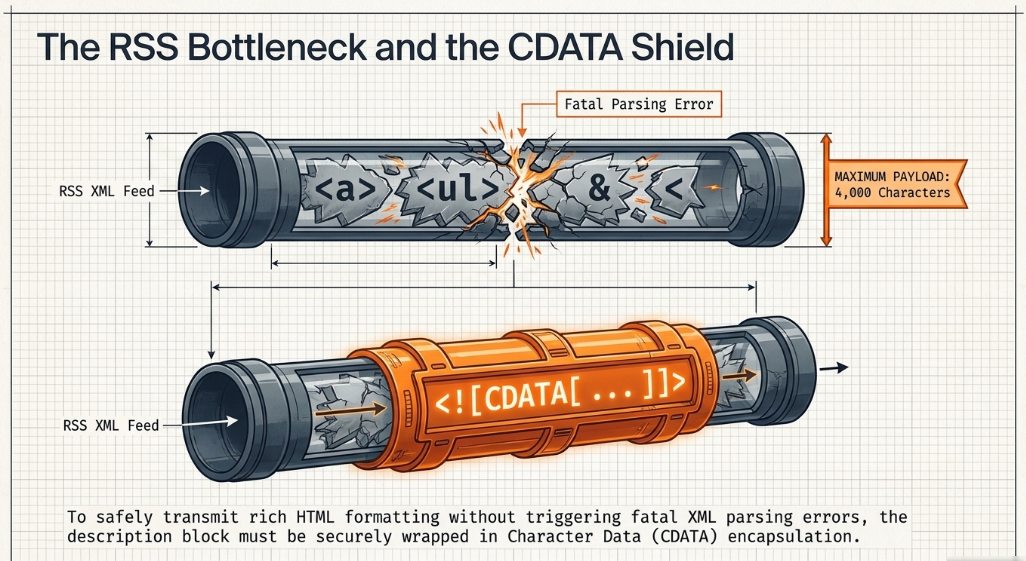
Syndicating these perfectly structured notes across the global podcast ecosystem introduces severe technical constraints. The foundational technology of podcasting is the RSS (Really Simple Syndication) feed, an XML-based document6. When writing episode notes, creators must navigate strict character limits to ensure cross-platform compatibility. The industry standard limit for episode notes is 4,000 characters; exceeding this frequently results in truncated descriptions on platforms like Spotify, or complete feed validation failures17. While Apple Podcasts allows up to 10,000 characters when entering data directly into their Apple Podcasts Connect portal, the 4,000-character limit remains the safest baseline for universal RSS syndication19.
The implementation of HTML formatting within these notes requires precise technical execution. Most major platforms, including Spotify, support a limited subset of HTML tags to format text, including standard headers, unordered lists, ordered lists, paragraph breaks, and hyperlinks restricted exclusively to the HTTPS protocol20. However, because the RSS feed relies on XML, directly embedding raw HTML or special characters frequently causes fatal parsing errors22.
In XML parsing, characters such as the ampersand and angle brackets are strictly reserved for defining markup elements24. If an episode description contains an unescaped ampersand (e.g., "News & Politics"), the parser interprets it as the beginning of an entity reference, causing the entire feed to break24. To safely transmit rich HTML formatting and special characters within the <description> or <content:encoded> fields of an RSS feed, the entire text block must be wrapped in a CDATA (Character Data) section26. The syntax <![CDATA[ ... ]]> instructs the XML parser to treat everything inside the brackets as literal, raw character data rather than executable XML markup26.
Failing to properly encapsulate HTML within CDATA sections or failing to encode standalone special characters represents one of the most common reasons podcasts disappear from directories or suffer from corrupted episode displays22.
Transcripts: The Ultimate SEO Multiplier
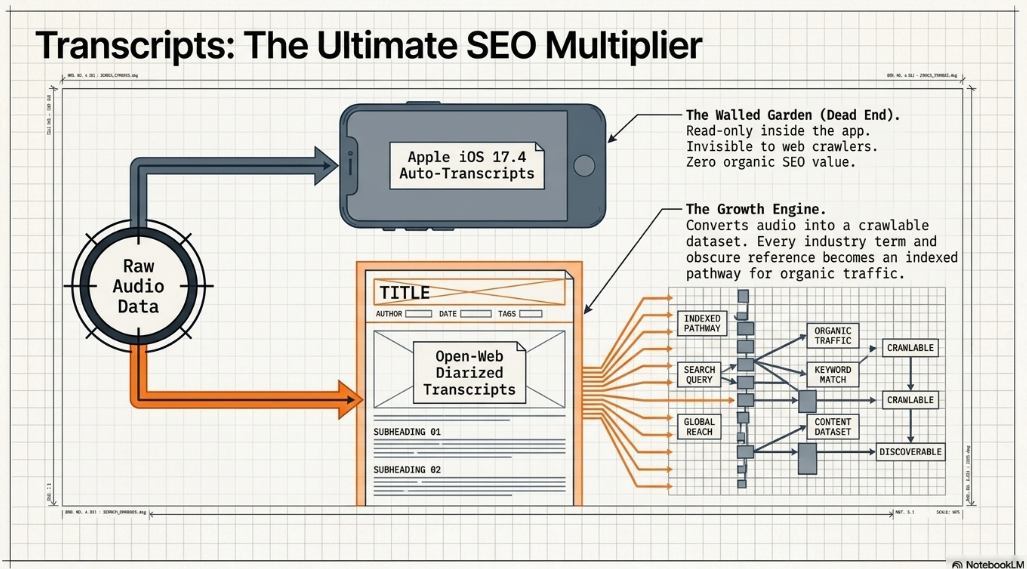
While episode notes provide a high-level summary, complete episode transcripts represent the most powerful mechanism for maximizing search visibility. Audio is fundamentally opaque; transcripts convert that audio into a massive, crawlable dataset, bridging the gap between spoken content and search engine discovery9.
The podcast industry is currently experiencing a divergence in how transcripts are handled. Closed platforms are aggressively building proprietary transcription engines. In iOS 17.4, Apple Podcasts introduced auto-generated transcripts, allowing listeners to read along with synchronized highlighting, search the text for specific words, and tap any sentence to initiate playback from that exact moment31. While creators can supply their own highly accurate VTT or SRT files to override the auto-generated versions, Apple's transcripts are fundamentally walled-garden assets. They exist purely as a read-only feature inside the iOS application and cannot be exported, copied, or, most importantly, indexed by Google's web crawlers33.
To harness the true SEO value of a transcript, it must be published on the open web5. Spoken conversation naturally generates a vast array of long-tail keywords that perfectly mirror the conversational queries users type into search engines30. However, publishing a raw, unedited text dump often results in a poor user experience, leading to high bounce rates that signal low quality to search engines30. The optimal strategy involves processing the transcript through speaker diarization to clearly identify who is speaking, adding strategic subheadings, and formatting the text into a readable blog post14.
By publishing these structured transcripts on a dedicated domain, creators ensure that every obscure reference, industry term, or specific question answered during the recording becomes an indexed pathway for organic traffic, measurable directly through tools like Google Search Console30.
Advanced Web Discoverability: JSON-LD and Schema Markup
Merely placing text on a webpage is no longer sufficient for dominating modern search engine results pages (SERPs). To guarantee that search engines and AI models accurately interpret the context of a podcast, the underlying HTML must be augmented with structured data35. Schema markup serves as a standardized vocabulary developed collaboratively by major search engines to explicitly define the entities, relationships, and attributes within a webpage37.
Google mandates that structured data be implemented using JSON-LD (JavaScript Object Notation for Linked Data)35. Unlike older microdata formats that interleave attributes directly into visible HTML tags—creating messy, error-prone code—JSON-LD isolates the metadata within a clean <script type="application/ld+json"> block, typically placed in the header of the document35. This separation of data and presentation allows for complex, nested definitions that are highly resilient to layout changes35.
Architecting the Podcast Entity Graph
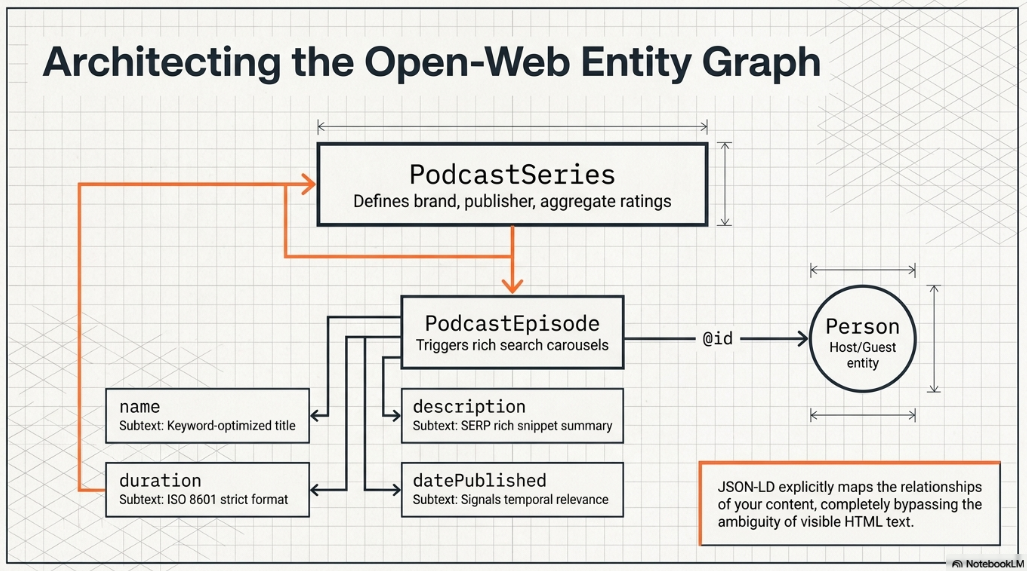
A highly optimized podcast website leverages JSON-LD to build a comprehensive entity graph, utilizing the @id property to link related objects without duplicating data41. The architecture relies on several interconnected Schema.org types:
The foundational entity is the PodcastSeries schema, which is applied to the show's main directory page. It defines the overarching brand, the publisher, aggregate review ratings, and the primary categories37.
Each individual episode page must then be wrapped in the PodcastEpisode schema37. As a subtype of AudioObject, PodcastEpisode communicates granular details directly to search indexers, making the content eligible to appear in rich search features, such as Google's specialized podcast carousels37. To fully optimize this schema, specific properties must be mapped meticulously:
By implementing this structured data architecture, a podcast ensures that automated systems, including voice search assistants, can instantly parse the context of an episode, extract its duration, identify its participants, and serve it accurately to users querying related topics37.
Video Integration: YouTube Optimization and Chapter Markers
The integration of video into the podcasting ecosystem has reshaped consumption habits. Research indicates that YouTube has surpassed traditional audio applications as the primary podcast discovery platform in several major markets2. Furthermore, the rise of connected televisions (CTV) has shifted podcast consumption into the living room, solidifying video-first formats as critical components of audience growth48.
Optimizing a podcast for YouTube involves different mechanics than RSS syndication. YouTube's algorithm prioritizes click-through rates (CTR) on thumbnails, average view duration, and overall watch time7. However, textual optimization within the video description remains paramount, specifically through the strategic deployment of Chapter Markers49.
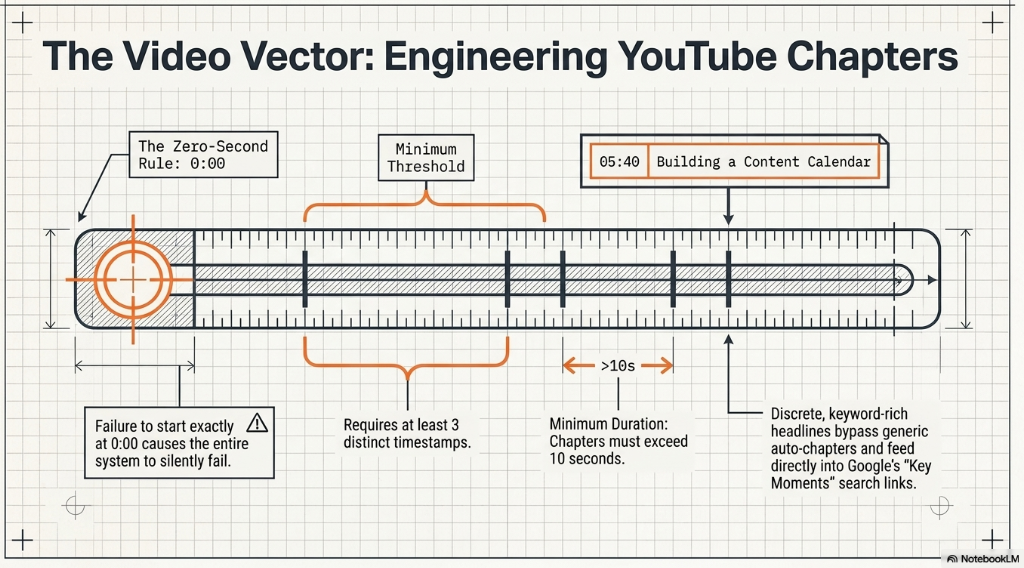
Chapters segment a long-form video into easily navigable sections, allowing viewers to jump directly to topics of interest51. More importantly for discoverability, YouTube feeds these chapter titles directly into Google Search. When a user searches for a highly specific query, Google can return a "Key Moments" result, deep-linking the user directly to the exact timestamp in the video where the answer begins52.
To activate chapters, creators must bypass automatic generation—which often yields generic, non-optimized titles—and format timestamps manually in the description box52. The technical parsing rules for YouTube chapters are unforgiving:
The Zero-Second Rule: The first timestamp in the list must be formatted exactly as 0:00 or 00:00. If the list begins at 0:05 or 1:00, the entire chapter system will silently fail to activate49.
Minimum Threshold: The description must contain a minimum of three distinct timestamps49.
Minimum Duration: Every individual chapter must be at least 10 seconds in length49.
Chronological Order: Timestamps must be listed in strictly ascending order49.
The titles appended to these timestamps dictate their SEO value. Instead of using generic labels like "Introduction" or "Interview Segment," creators must write chapter titles as discrete, keyword-rich headlines (e.g., "05:40 Building a Content Calendar") that accurately describe the segment's core topic, maximizing the probability of appearing in long-tail search results52.
Podcasting 2.0: Decentralizing the RSS Namespace
Historically, the podcasting industry has operated almost entirely on the Apple iTunes XML namespace (e.g., <itunes:author>, <itunes:image>)56. While this created early standardization, it ultimately centralized control and stifled technical innovation, tying the entire medium to the development roadmap of a single corporation58.
In response, the open-source community launched the Podcasting 2.0 initiative and the Podcast Index58. The goal of Podcasting 2.0 is to decentralize the medium by introducing a new, community-authored namespace (xmlns:podcast="https://podcastindex.org/namespace/1.0") that extends the capabilities of the RSS feed without breaking backward compatibility with legacy applications57.
Adopting these tags during pre-production prepares a podcast for next-generation listening applications and significantly expands the richness of the metadata transmitted to directories. The current adoption rates indicate rapid industry acceptance, with over 6.2 million episodes utilizing namespace transcripts and over 62,000 podcasts employing namespace chapters64.
The strategic implementation of key Podcasting 2.0 tags includes:
<podcast:person>: This tag revolutionizes how credits and guests are attributed. Utilizing the standardized Podcast Taxonomy Project, creators can assign precise roles to individuals (e.g., "host," "guest," "audio engineer," "composer")66. By linking a person's name to a specific URL (href) and an avatar (img), podcast apps can create rich, cross-referenced databases, allowing listeners to search the ecosystem for every appearance a specific expert has made66.
<podcast:transcript>: Rather than relying on a platform to generate closed captions internally, this tag points the RSS feed directly to a self-hosted SRT, VTT, HTML, or JSON transcript file69. This guarantees that independent podcast apps can display synchronized, creator-controlled captions across all devices, ensuring accessibility and metadata indexing parity69.
<podcast:chapters>: This tag points to an external JSON file containing an episode's chapter markers, titles, URLs, and associated imagery58. By decoupling chapter data from the ID3 tags embedded directly within the heavy MP3 audio file, creators can dynamically update, correct, or expand chapter information instantly over the web without the costly requirement of re-rendering and re-uploading media files58.
<podcast:location>: For investigative journalism or local history podcasts, this tag allows creators to define the precise geographical focus of an episode using standardized GeoURIs (e.g., geo:30.2672,97.7431) and OpenStreetMap identifiers72. This introduces spatial discoverability to the medium, allowing users to search for audio content related to specific physical locations72.
<podcast:locked> and <podcast:funding>: The locked tag provides a security mechanism, explicitly signaling to directories that a feed cannot be migrated or imported by unauthorized third parties, reducing podcast piracy73. The funding tag, alongside the associated Value-for-Value tags, provides a standardized pathway for listeners to send micropayments (often via the Lightning Network) or navigate directly to Patreon pages natively within their podcast player58.
Generative Engine Optimization (GEO): The Future of Search
As major search providers transition from traditional index ranking to Large Language Model (LLM) interfaces—such as Google's AI Overviews, Perplexity, and ChatGPT—the nature of discoverability is undergoing a profound paradigm shift. These systems, defined as Generative Engines, do not simply present users with a list of blue links to click; they actively retrieve, synthesize, and summarize information from multiple sources to generate definitive, citation-backed responses8.
For podcast creators, this shift is highly disruptive. Traditional Search Engine Optimization (SEO) practices, which rely heavily on matching exact keywords and building backlinks, are increasingly insufficient in an environment where AI models act as intermediaries between the content and the user76. To ensure that podcast transcripts and show notes are utilized as source material by these AI models, creators must adopt Generative Engine Optimization (GEO)8.
GEO focuses on engineering text for "machine scannability and justification"76. Research benchmarks, such as the GEO-Bench protocol, indicate that generative engines exhibit a systematic bias toward content that is structured, authoritative, and fact-dense76. To maximize the probability that an LLM will select and cite a podcast's content, episode notes and web copy must implement specific, evidence-based structural modifications77:
Statistics Addition: Generative models inherently favor quantitative data as a means of grounding their responses in fact77. Replacing vague statements in show notes with precise numerical data provides the LLM with extractable value. For instance, rather than summarizing an episode by stating, "The podcast industry is growing rapidly," the text should state, "The global podcast market is projected to reach $81.32 billion by 2031, growing at a 4.41% CAGR"1. This strategy has been shown to be one of the most effective methods for boosting AI visibility77.
Quotation Addition: LLMs prioritize expert insight. By extracting exact, highly relevant quotes from the episode transcript and placing them prominently within the show notes, creators provide pre-packaged, authoritative snippets that generative engines can easily synthesize and cite77.
Fluency Optimization and Authoritative Style: Content must be grammatically flawless, clear, and written with a definitive tone. Simplification of complex language and improvements to textual flow allow the parsing mechanisms of LLMs to ingest the content with less computational friction77.
Source Citation: When discussing external data in an episode, linking to credible third-party reports within the show notes acts as a strong credibility signal. Generative engines evaluate the network of citations to determine the reliability of the source text77.
Conversely, traditional tactics like keyword stuffing have been proven highly ineffective—and potentially detrimental—when optimizing for generative engines77. The optimal GEO content template for a podcast episode page requires placing the most direct, atomic answer or summary at the very beginning of the text, immediately supported by a concrete statistic and an expert quotation, followed by a clear, simple explanation of the broader context77.
Conclusion
The strategic pre-production of a professional podcast requires an architecture that extends far beyond the recording of audio. Maximizing discoverability in a fragmented digital landscape demands that creators satisfy the retention-based algorithms of Apple Podcasts and Spotify, utilizing exact-match metadata and flawlessly formatted XML feeds protected by CDATA encapsulation. It requires establishing a robust presence on the open web, deploying structured JSON-LD schema markup and comprehensive, diarized transcripts to capture long-tail organic search traffic. Furthermore, adapting to visual and decentralized paradigms necessitates strict adherence to YouTube's chapter formatting rules and the adoption of the Podcasting 2.0 namespace to enrich syndication metadata. Ultimately, as search evolves toward AI-driven synthesis, creators must engineer their text-based assets using Generative Engine Optimization, prioritizing statistical density, authoritative formatting, and precise quotations. By executing this comprehensive, multi-environment strategy, a podcast transitions from an opaque audio file into a highly discoverable, infinitely indexable digital asset.
Works cited
The Podcast Revolution: A Data-Driven Deep Dive into the Audio Transformation Reshaping Media - BotTalk, https://bottalk.io/learn-with-bottalk/the-podcast-revolution-a-data-driven-deep-dive-into-the-audio-transformation-reshaping-media/
33 Podcast Statistics 2026 (Number of Podcasts & Viewership), https://podcastatistics.com/
The State of Podcast Advertising in 2026: Market Size, Listener Data, CPM Rates, and What the Numbers Say | CastFox, https://www.castfox.net/blog/state-of-podcast-advertising-2026
Podcast SEO 2026: be found in Google & AI, Springcast Blog, https://www.springcast.io/en/blog/podcast-seo/
The Ultimate Podcast SEO Guide To Rank Higher In 2025 - Fame.so, https://www.fame.so/post/podcast-seo
Podcast SEO: How to Make Your Show Discoverable Online, https://podcastingauthority.com/podcast-seo/
Algorithms Expained: A Deep Dive - PodcastVideos.com, https://www.podcastvideos.com/algorithm-explainer/
GEO: Generative Engine Optimization - arXiv, https://arxiv.org/html/2311.09735v3
SEO for Podcasts: 2026 Ultimate Guide - SpearPoint Marketing, https://www.thespearpoint.com/blog/seo-for-podcasts
Podcast SEO: How to Rank #1 on Spotify, Google & Apple Podcasts in 2026, https://www.jigsawkraft.com/post/podcast-seo-how-to-rank-1-on-spotify-google-apple-podcasts-in-2026
Master Podcast SEO: Rank on Apple, Spotify & Google, https://evolvedpodcasting.com/post/rank-podcast-on-apple-spotify-google
Podcast SEO: How to Get Your Show Found on Google, Spotify & Apple Podcasts, https://www.paragoncreativestudios.co.uk/podcast-seo-how-to-get-your-show-found-on-google-spotify-apple-podcasts/
7 Podcast SEO Best Practices for Explosive Growth in 2025 - Fame.so, https://www.fame.so/post/7-podcast-seo-best-practices-for-explosive-growth-in-2025
Mastering Podcast Show Notes For SEO And Engagement - PodBrief, https://blog.podbrief.io/podcast-show-notes/
Podcast RSS feed requirements - Apple Podcasts for Creators, https://podcasters.apple.com/support/823-podcast-requirements
Understanding the 4000-Character Limit for Podcast and Episode Notes - Support, https://help.rss.com/en/support/solutions/articles/44002278172-understanding-the-4000-character-limit-for-podcast-and-episode-notes
Spotify Uploading Podcast: Complete Guide for 2026, https://podcastmonkey.co/blogs/news/spotify-uploading-podcast
Create an episode - Apple Podcasts for Creators, https://podcasters.apple.com/support/825-how-to-create-an-episode
Formatting your show notes - Spotify Support, https://support.spotify.com/us/creators/article/formatting-your-show-notes/
Spotify now supports HTML formatting in show notes of podcasts, https://podcasthub.in/spotify-now-supports-html-formatting-in-show-notes-of-podcasts/
RSS Feed Errors: Common Problems & How to Fix Them (With Examples) | RSS Validator, https://rssvalidator.app/rss-feed-errors
Podcast Import HTML escapes original feed text contents and produce invalid XML · Issue #3182 - GitHub, https://github.com/ampache/ampache/issues/3182
Escape Ampersands in XML to Rendered as Entities - GeeksforGeeks, https://www.geeksforgeeks.org/html/how-to-escape-ampersands-in-xml-to-rendered-as-entities/
Spotify Content Requirements - Podbean Support, https://help.podbean.com/support/solutions/articles/25000013464-spotify-content-requirements
Escaping markup with CDATA - mina86.com, https://mina86.com/2026/escaping-markup-with-cdata/
Using Special Characters in XML, https://docs.oracle.com/cd/A97335_02/apps.102/bc4j/developing_bc_projects/obcCustomXml.htm
CDATA sections being escaped · Issue #280 · rometools/rome - GitHub, https://github.com/rometools/rome/issues/280
Post with CDATA block produces invalid RSS feed? - #9 by Mittineague - Discourse Meta, https://meta.discourse.org/t/post-with-cdata-block-produces-invalid-rss-feed/53362/9
Audio Content SEO: Transcripts, GSC, and GA4 Strategy - BrassTranscripts, https://brasstranscripts.com/blog/audio-content-seo-transcripts-gsc-ga4-strategy
What did they say? iOS 17.4 gives you full podcast transcripts in Apple Podcasts, https://www.laptopmag.com/phones/iphone/what-did-they-say-ios-174-gives-you-full-podcast-transcripts-in-apple-podcasts
iOS 17.4: Using Apple's New Podcast Transcript Feature - MacRumors, https://www.macrumors.com/how-to/view-search-transcripts-podcasts-app/
How to Transcribe Apple Podcasts Episodes (2026 Guide) | Podtyper Blog, https://www.podtyper.com/blog/how-to-transcribe-apple-podcasts
Podcast SEO: How To Optimize Your Podcast For Search, https://jarpodcasts.com/podcast-seo-optimization/
A beginners guide to JSON-LD Schema for SEOs - SALT.agency, https://salt.agency/blog/json-ld-structured-data-beginners-guide-for-seos/
Structured Data 101: The Simplest Fix for AI Search Visibility - Cassie Clark, https://cassieclarkmarketing.com/structured-data-101/
How to Use Schema Markup for Your Podcast - Outcast AI, https://outcast.ai/blog/how-to-use-schema-markup-for-your-podcast/
Schema.org - Schema.org, https://schema.org/
Intro to How Structured Data Markup Works | Google Search Central | Documentation, https://developers.google.com/search/docs/appearance/structured-data/intro-structured-data
What Is JSON-LD & How Can It Help You Achieve Higher Rankings?, https://ignitevisibility.com/everything-to-know-about-json-ld-for-seo/
Annotated JSON-LD Structured Data Examples - nystudio107, https://nystudio107.com/blog/annotated-json-ld-structured-data-examples
JSON-LD for SEO: Implementation Guide for Rich Snippets - ClickForest, https://www.clickforest.com/en/blog/json-ld-implementation-guide
JSON-LD Schema Markup: The Complete Implementation Guide for SEO and AI Visibility, https://www.seostrategy.co.uk/schema-structured-data/json-ld-guide/
Release listing - schema.org, https://schema.org/docs/releases.html
Schema Markup for a Podcast Listing Page, https://wpschema.com/docs/schema-markup-for-a-podcast-listing-page/
PodcastEpisode - Schema.org Type, https://schema.org/PodcastEpisode
Metadata: JSON-LD - Parse.ly Documentation, https://docs.parse.ly/installation-resources/parsely-integration/metadata/metadata-jsonld/
2025-2026 State of Podcasting Outlook Report - Thursday Labs, https://www.thursdaylabs.co/2025-2026-state-of-podcasting-outlook-report
How to Add Chapter Markers to YouTube Videos (2026 Guide) - Blitzcut, https://blitzcutai.com/blog/how-to-add-chapter-markers-youtube
How to Add Chapters to YouTube Videos [+ WordPress Embed Guide] - WP Manage Ninja, https://wpmanageninja.com/how-to-add-chapters-to-youtube-videos/
How to Add Chapters to YouTube Videos (And Why Your Website Videos Need Them Too), https://wistia.com/blog/youtube-chapters
YouTube Chapters: How to Use Them & Why They Matter (2026), https://humbleandbrag.com/blog/youtube-chapters
YouTube Chapters/ Timestamps How and Why You should use them | by Andrew Kan, https://medium.com/@AndrewKanFilm/youtube-chapters-timestamps-how-and-why-you-should-use-them-eec5ffaf6751
How to add chapters to youtube video and boost engagement - BeyondComments, https://beyondcomments.io/blog/add-chapters-to-youtube-video
How to add chapters on YouTube videos and why you definitely should - TubeBuddy, https://www.tubebuddy.com/blog/video-chapters/
Podcast-Standards-Project/PSP-1-Podcast-RSS-Specification - GitHub, https://github.com/Podcast-Standards-Project/PSP-1-Podcast-RSS-Specification
The new podcast namespace | podcastnamespace.org, https://podcastnamespace.org/
podcast-namespace/podcasting2.0.md at main - GitHub, https://github.com/Podcastindex-org/podcast-namespace/blob/main/podcasting2.0.md
Podcasting 2.0 - Blubrry Podcasting, https://blubrry.com/support/podcasting-2-0-introduction/
Podcasting 2.0 for podcasters, https://podcasting2.org/podcasters
Podcasting 2.0: What it Means for Brands and Creators - CoHost, https://cohostpodcasting.com/resources/podcasting-2-0-what-it-means-for-brands-and-creators
Podcasting 2.0 Explained: RSS Enhancements for the Independent Podcaster - Captivate.fm, https://www.captivate.fm/podcast-industry-news/podcasting-2-0-explained-rss-enhancements-independent-podcaster
RSS Namespace Extension for Podcasting (Tag Specification), https://podcasting2.org/docs/podcast-namespace/1.0
Podcast Industry Insights Relaunches with Deeper Data, 7-Year Historical Charts, and New Apple Podcasts Category Explorer - Podnews, https://podnews.net/press-release/podcast-industry-insights-relaunches
Podcasting 2.0 Features, https://podcastindustryinsights.com/podcasting-2-0-statistics
Person - Podcast Namespace - Podcasting 2.0, https://podcasting2.org/docs/podcast-namespace/tags/person
What is Podcast Taxonomy? - Podchaser Help Center, https://support.podchaser.com/en/articles/5163823-what-is-podcast-taxonomy
podcast:person | podcastnamespace.org, https://podcastnamespace.org/tag/person
Add Transcripts to Your Podcast - Podcasting 2.0, https://podcasting2.org/docs/guides/how-to-add-transcripts-to-your-podcast
Transcript - Podcast Namespace, https://podcasting2.org/docs/podcast-namespace/tags/transcript
Why You Should Be Using Podcast Chapters - Podnews, https://podnews.net/article/why-to-use-podcast-chapters
Location - Podcast Namespace - Podcasting 2.0, https://podcasting2.org/docs/podcast-namespace/tags/location
Podcasting 2.0 - TechDistortion, https://techdistortion.com/articles/podcasting-2-0/
Introducing Podcast 2.0 Support - Castos, https://castos.com/introducing-podcast-2-0-support/
[2311.09735] GEO: Generative Engine Optimization - arXiv, https://arxiv.org/abs/2311.09735
[2509.08919] Generative Engine Optimization: How to Dominate AI Search - arXiv, https://arxiv.org/abs/2509.08919
Generative Engine Optimization (GEO) Lessons From the Original Research Paper (Simple, Beginner Friendly Breakdown) - Sourin, https://heysourin.medium.com/generative-engine-optimization-geo-lessons-from-the-original-research-paper-simple-beginner-fb69efee389a