The Algorithmic Maturation of the Podcasting Economy
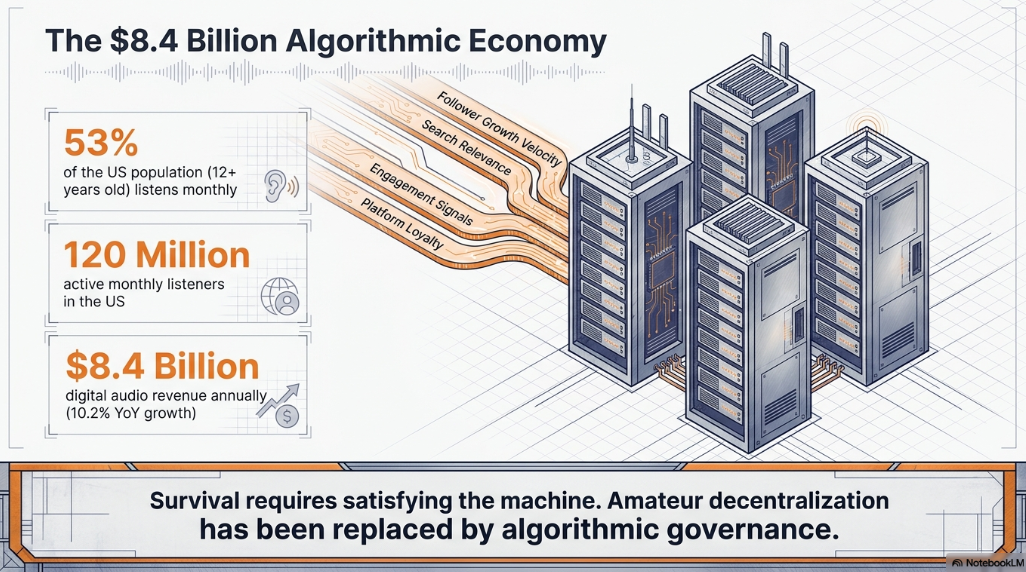
The global podcasting ecosystem has transitioned from a decentralized landscape of amateur audio distribution into a highly professionalized, algorithmically governed sector of the digital media economy. Industry analytics reveal a medium that has achieved mass cultural penetration, with recent data indicating that 53% of the United States population aged 12 and older consumes podcasts on a monthly basis, equating to an unprecedented 120 million active monthly listeners in the United States alone1. Furthermore, the financial infrastructure supporting this consumption has scaled proportionally. Commissioned research from the Interactive Advertising Bureau (IAB) and PwC demonstrates that digital audio revenue—encompassing podcasts, streaming music, and digital radio—has surged to $8.4 billion annually, representing a year-over-year growth trajectory of 10.2%2.
Within this hyper-competitive environment, launching and sustaining a successful podcast requires substantially more than compelling conversational skills. Modern platforms such as Apple Podcasts, Spotify, and YouTube employ sophisticated recommendation algorithms that evaluate content based on follower growth velocity, search relevance, engagement signals, and platform loyalty3. To satisfy these algorithmic demands, production teams must implement rigorous pre-production frameworks. These frameworks demand a strategic approach to content structuring, the enforcement of publishing consistency, and the operational integration of content batching workflows to prevent creator burnout.
This report provides an exhaustive, data-informed analysis of strategic podcast pre-production. It explores the architectural development of the show bible, the psychological engineering of episode structures, the implementation of content batching methodologies utilized by top-tier creators, the technical standards for broadcast audio, and the organizational matrices required to manage professional production teams.
The Architectural Blueprint: Developing the Show Bible
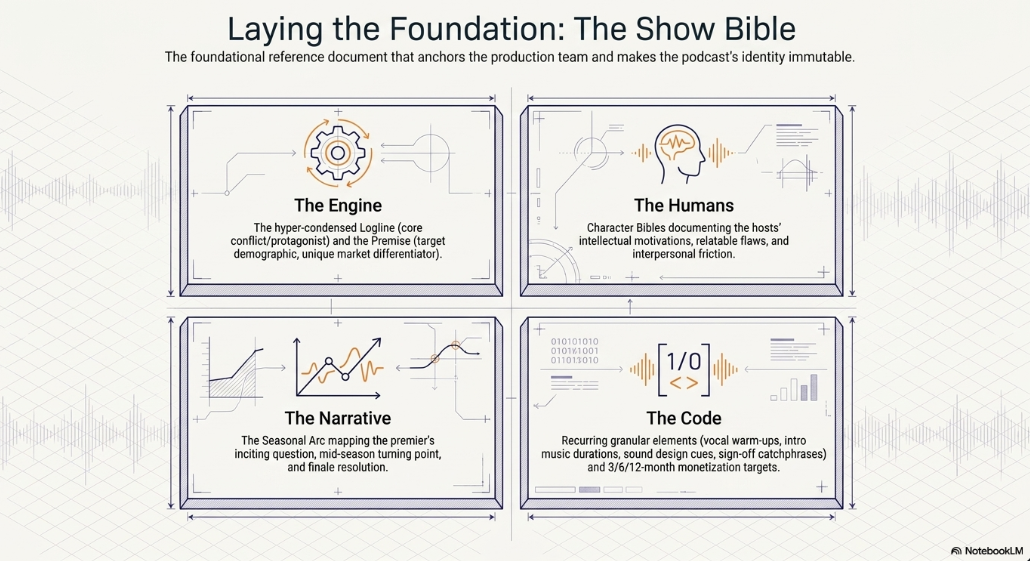
Professional television and film productions rely on a "Show Bible" to maintain narrative and tonal consistency across seasons and writing rooms. In the contemporary podcasting industry, the show bible serves an identical purpose, acting as the foundational reference document that anchors the production team, guides editorial decisions, and facilitates the seamless onboarding of new hosts, producers, or audio engineers5.
The construction of the show bible begins with the logline and the premise. The logline is a hyper-condensed, single-sentence summary designed to hook a potential listener or advertiser by immediately establishing the show's core conflict, protagonist, and driving engine5. Accompanying the logline is the one-paragraph premise, which widens the narrative lens to explicitly define the target demographic, the unique market differentiator, and the thematic justification for the show's long-term sustainability5. Production strategists often employ a comparative "mash-up" technique within the premise to rapidly convey format and tone, such as describing a new historical comedy podcast as a synthesis between established properties with known audience expectations6.
Beyond the conceptual summary, the show bible must codify the human elements that drive parasocial engagement. Character bibles are drafted for the primary hosts, articulating their intellectual motivations, their relatable flaws, and the interpersonal friction or complementary expertise that defines co-host relationships5. For narrative or investigative podcasts, the bible meticulously charts the seasonal arc, identifying the inciting question posed in the premier episode, the mid-season turning point, and the thematic resolution anticipated by the finale5.
Crucially, the show bible acts as an operational roadmap. It must document production goals segmented into three-month, six-month, and one-year horizons, ensuring the team remains aligned on growth metrics and monetization targets6. Furthermore, it catalogs the granular, recurring elements that breed audience familiarity, including specific vocal warm-up rituals, designated intro music durations, sound design cues, and recurring sign-off catchphrases6. By housing these details in a centralized document, the production team guarantees that the podcast's identity remains immutable, regardless of personnel changes or creative fatigue.
Algorithmic Retention: The Architecture of Episode Structuring
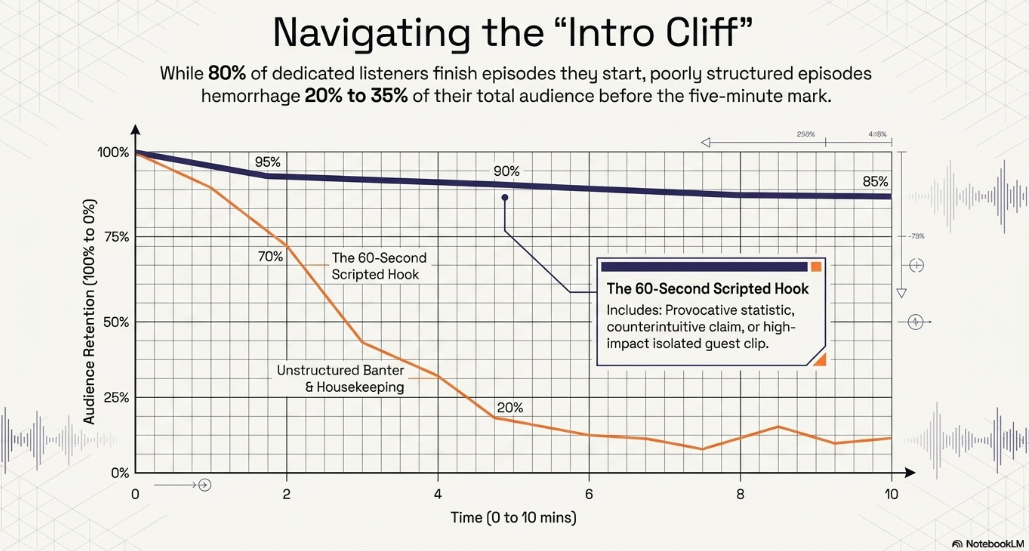
Platform algorithms heavily weight audience retention as a primary proxy for content quality. Analytics from major hosting providers indicate that 80% of dedicated listeners will finish all or most of the episodes they start, but this metric is heavily skewed by the survival rate of the first five minutes1. Data from public broadcasters reveals that a poorly structured episode will hemorrhage between 20% and 35% of its total audience before the five-minute mark8. Consequently, the architecture of the episode is the most critical variable in algorithmic success.
Navigating the Intro Cliff
The initial seconds of a podcast represent a highly vulnerable retention window known as the "intro cliff." A steep drop-off curve during this period indicates that the opening sequence is actively repelling listeners9. The primary culprits responsible for the intro cliff are extensive administrative housekeeping, prolonged sponsor reads placed before value delivery, and unstructured banter that delays the episode's core promise9.
To optimize this window, producers must engineer a scripted hook10. The hook functions as a 60-second retention mechanism that utilizes a provocative statistic, a counterintuitive claim, or an isolated, high-impact audio clip from the guest to immediately validate the listener's decision to press play10. By delivering immediate intrigue, the hook bridges the listener across the vulnerable opening minutes and into the primary narrative arc.
Narrative Sequencing and Drop-Off Analysis
Every podcast episode, regardless of its genre, must be structured around a defined narrative arc comprising a beginning, middle, and end10. The setup builds suspense and introduces the central problem; the delivery provides the educational or entertaining core where the problem is dissected; and the conclusion resolves the tension, summarizes the frameworks discussed, and delivers a singular, focused call-to-action (CTA)10.
Advanced audience analytics provide granular visibility into how listeners interact with this structure. By analyzing drop-off curves, producers can identify structural failures. A sudden mid-episode abandonment often correlates with an overly long dynamic ad insertion or a conversational tangent that strayed too far from the episode's premise9. Conversely, clusters of rewinds indicate a highly valuable data point that listeners wish to absorb fully, while skip clusters often highlight repetitive segments or tedious transitions9.
Structural Blueprints by Format
To maintain pacing and manage listener expectations, professional productions rely on standardized structural templates tailored to their specific format.


The Psychological Progression of the Interview
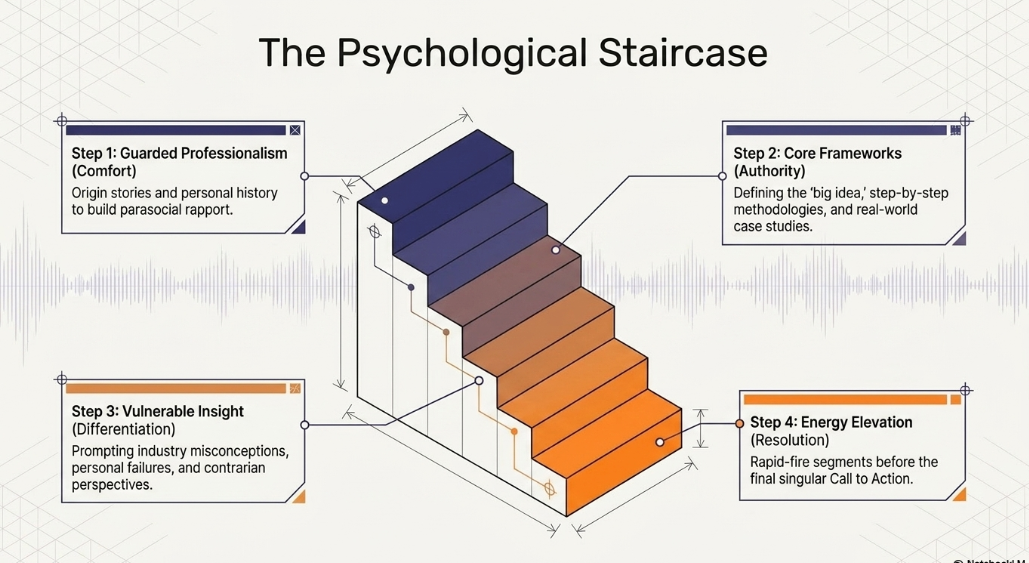
For interview-based podcasts, generating compelling audio requires moving beyond superficial biographical questions. Producers must draft a question progression that psychological guides the guest from a state of guarded professionalism into deep, vulnerable insight.
The sequence begins with warm-up questions designed to build comfort, focusing on personal history or origin stories16. Once rapport is established, the host introduces the core frameworks, asking the guest to define a big idea, followed by probing requests for specific, step-by-step methodologies and real-world case studies16. To differentiate the content from other media appearances, the host must inquire about industry misconceptions or personal failures, prompting the guest to provide contrarian or highly vulnerable perspectives16. The interview concludes with a rapid-fire segment to elevate the energy before the final call-to-action is delivered16.
Podcasting Frequency, Consistency, and Content Batching
Algorithmic visibility on major platforms is inextricably linked to publishing consistency. The algorithms powering Apple Podcasts and Spotify evaluate a show's "Follower Growth Velocity" and listener habituation patterns to determine its placement in recommendations and search results3. Erratic publishing schedules signal unreliability to both the algorithm and the audience, severely depressing long-term growth.
Statistical Baselines for Frequency and Duration
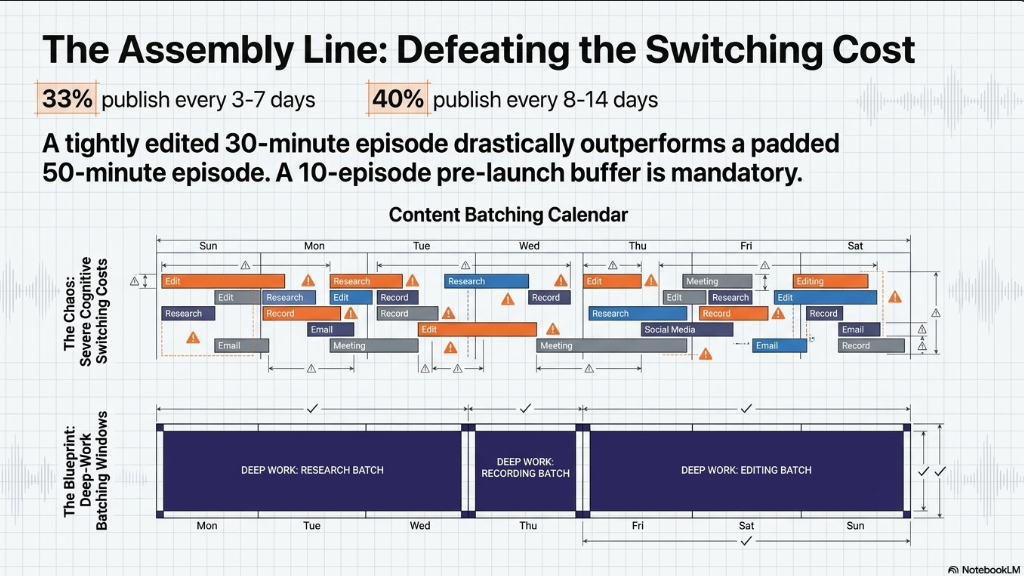
Industry data provides a clear baseline for optimal publishing cadences. Currently, 33% of active podcasts maintain a frequency of publishing every 3 to 7 days, while the largest cohort, at 40%, publishes every 8 to 14 days1. Attempting to exceed these frequencies without adequate operational infrastructure inevitably leads to creator burnout and a degradation in content quality.
Regarding episode duration, the data suggests that brevity and density are rewarded. Over 50% of all published episodes range between 20 and 60 minutes, with the 20 to 40-minute window representing 32% of the market1. The fundamental rule of professional audio editing is to edit to the story, not to a predetermined runtime. Analytics consistently demonstrate that a tightly edited, dense 30-minute episode will drastically outperform a padded 50-minute episode in both completion rates and algorithmic favorability9.
The Mechanism of Content Batching
To maintain the relentless consistency required by platform algorithms without succumbing to fatigue, elite podcast producers deploy rigorous content batching methodologies. Batching is the operational practice of consolidating identical tasks—such as guest research, recording, or audio editing—into dedicated, uninterrupted blocks of time17. This practice eliminates the severe cognitive switching costs associated with shifting between creative, administrative, and technical tasks on a daily basis17.
The efficacy of content batching is best exemplified by the workflows of industry-leading hosts such as Tim Ferriss and Dr. Andrew Huberman. Their approach to pre-production relies on intense thematic consolidation and cognitive mind allocation. By grouping interviews that explore similar domains into highly concentrated recording windows, the host remains deeply immersed in a specific intellectual context, allowing for vastly superior, nuanced follow-up questions17.
This methodology requires robust knowledge management systems. Producers utilizing batching rely heavily on software architectures like Evernote for clipping and categorizing raw data, and Scrivener for structuring complex research documents and episode outlines20. These tools allow the host to aggregate disparate data points, identify outliers, and construct narrative arcs long before the microphone is activated20.
Furthermore, batching dictates the broader operational calendar. A professional launch strategy mandates the pre-recording of a substantial content buffer—often the first ten episodes—prior to public release. This backlog insulates the production team from unexpected scheduling conflicts and technical failures, guaranteeing that the critical algorithmic requirement of publishing consistency is maintained flawlessly during the crucial early months of audience acquisition21. The scheduling of these batching sessions is also optimized for the host's chronotype; for example, leveraging nocturnal writing or deep-work sessions to ensure the conceptual frameworks of the episodes are drafted with maximum cognitive clarity20.
Guest Onboarding, Research, and Technical Preparedness
Securing high-profile industry experts requires a frictionless, highly professionalized onboarding experience. A chaotic pre-interview workflow directly translates into guarded guest performances, severe audio degradation, and potential legal liabilities.
The Research Template and Briefing Dossier
The pre-production process necessitates the creation of a comprehensive research document for the host. Using structured templates, producers aggregate the guest's background, recent publications, contrarian quotes, and specific thought starters22. This internal document ensures the host is armed with the insights necessary to drive the narrative arc.
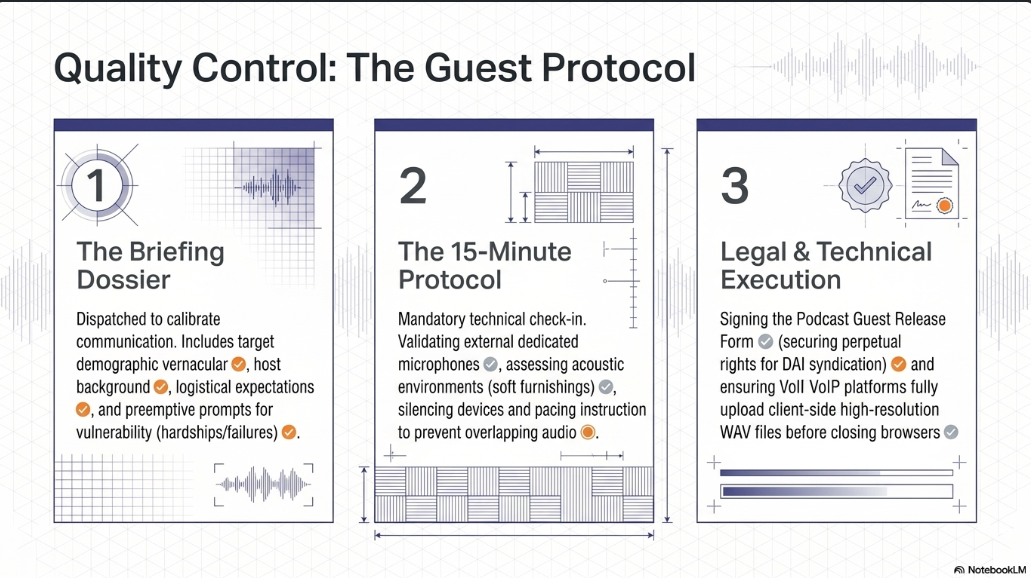
Simultaneously, the production team must dispatch a confidential Guest Briefing Dossier to the interviewee23. This document aligns expectations and calibrates the guest's communication style. It explicitly defines the podcast's target demographic, allowing the guest to adjust their vernacular for the intended audience23. The dossier introduces the host's background to establish parasocial rapport prior to the recording, outlines the logistical expectations for the call, and provides thematic thought starters23. Critically, the dossier sets a precedent for vulnerability by preemptively asking the guest to prepare anecdotes regarding personal hardships or professional failures, ensuring the interview transcends superficial success narratives23.
The 15-Minute Technical Protocol
Remote interviews introduce immense technical risk. To mitigate connectivity and audio failures, professional producers enforce a mandatory 15-minute technical check-in immediately preceding the recording16.
During this window, the producer verifies the integrity of the guest's hardware, ensuring the utilization of an external, dedicated microphone rather than inferior built-in laptop audio16. The acoustic environment is assessed, advising the guest to record in spaces with soft furnishings to absorb unwanted reverberations16. Crucial operational protocols are established: mobile devices must be silenced, unnecessary bandwidth-consuming browser tabs closed, and instructions provided regarding conversational pacing to prevent audio overlap, which renders post-production editing impossible16.
For productions utilizing advanced VoIP platforms like Zencastr or Riverside, the technical protocol includes explicit instructions regarding post-interview behavior. Guests must be instructed not to close their browser windows immediately upon the interview's conclusion, as the platform requires time to upload the high-resolution, client-side WAV files to the cloud servers16.
Legal Compliance: The Guest Release
No professional media asset is complete without securing intellectual property rights. Prior to recording, the guest must execute a formal Podcast Guest Release Form25. This legally binding document secures the producer's right to record the guest's voice and performance, grants permission to edit and modify the content for clarity and brevity, and establishes the producer's perpetual right to distribute, syndicate, and monetize the resulting audio file across all current and future technological platforms25.
Audio Engineering Standards and LUFS Compliance
The perceived authority of a podcast is intrinsically linked to its audio fidelity. An episode characterized by drastic volume fluctuations induces listener fatigue and prompts immediate abandonment. To prevent this, the final phase of pre-production and post-production must adhere strictly to global broadcast loudness standards.
Mastering to Human Perception: LUFS
Traditional audio metering relied on Decibels Relative to Full Scale (dBFS), which measures the absolute electrical peak of an audio signal27. However, dBFS fails to account for human auditory perception. To solve this, the industry adopted Loudness Units relative to Full Scale (LUFS). LUFS integrates both signal intensity and human frequency sensitivity over time, providing a highly accurate measurement of how loud a piece of audio actually feels to the listener27.
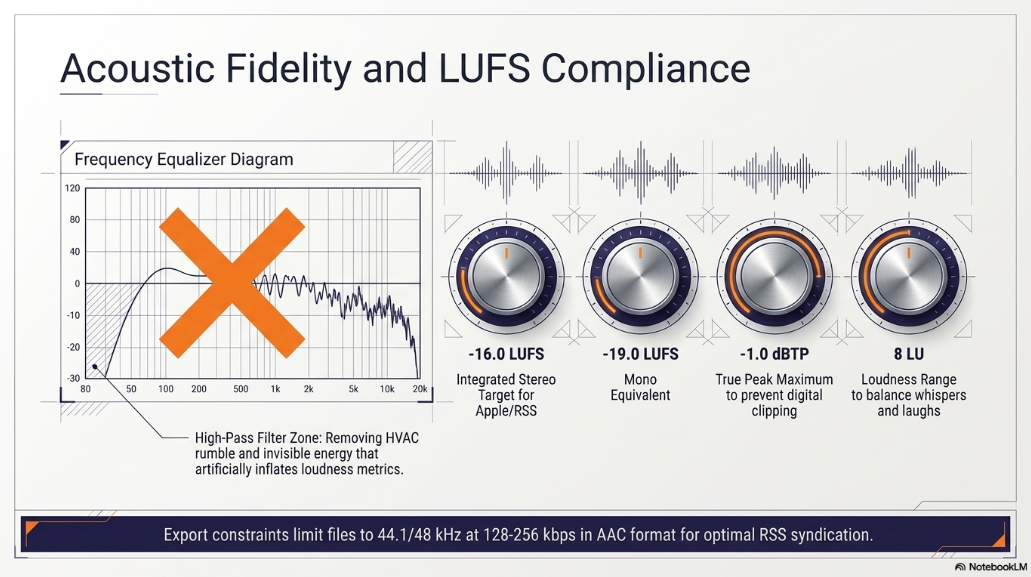
Major platforms mandate specific LUFS targets to ensure that a podcast does not sound jarringly quiet or dangerously loud when played alongside music or other media. The universally accepted standards for spoken-word podcasts are explicit.


Frequency Management and Export Specifications
To achieve these LUFS targets without crushing the dynamic life out of the recording via heavy limiters, engineers employ strategic equalization. Applying a high-pass filter between 80 Hz and 200 Hz eliminates low-frequency rumble (such as HVAC noise or desk bumps)30. Because human speech generates virtually no useful acoustic data below 85 Hz, this filtering removes invisible audio energy that artificially inflates LUFS readings, allowing the actual voice to be mastered louder and cleaner30.
The final audio asset must be exported to meet platform enclosure specifications. While WAV and FLAC offer lossless quality, RSS distribution relies on compressed formats to minimize server loads and user data consumption. Apple Podcasts requires MP3 or AAC files, preferring AAC as it delivers superior audio fidelity at equivalent bitrates32. Professional standards dictate exporting stereo files at a sample rate of 44.1 kHz or 48 kHz, utilizing a bitrate between 128 kbps and 256 kbps32.
Monetization Infrastructure: Baked-In vs. Dynamic Ad Insertion
Monetization strategy must be engineered into the podcast's structure during the pre-production phase, as the chosen advertising model dictates the placement of segment breaks and the longevity of the audio file's revenue potential. The industry operates on two primary advertising architectures: Baked-In Advertising and Dynamic Ad Insertion (DAI).
The Authenticity of Baked-In Advertising
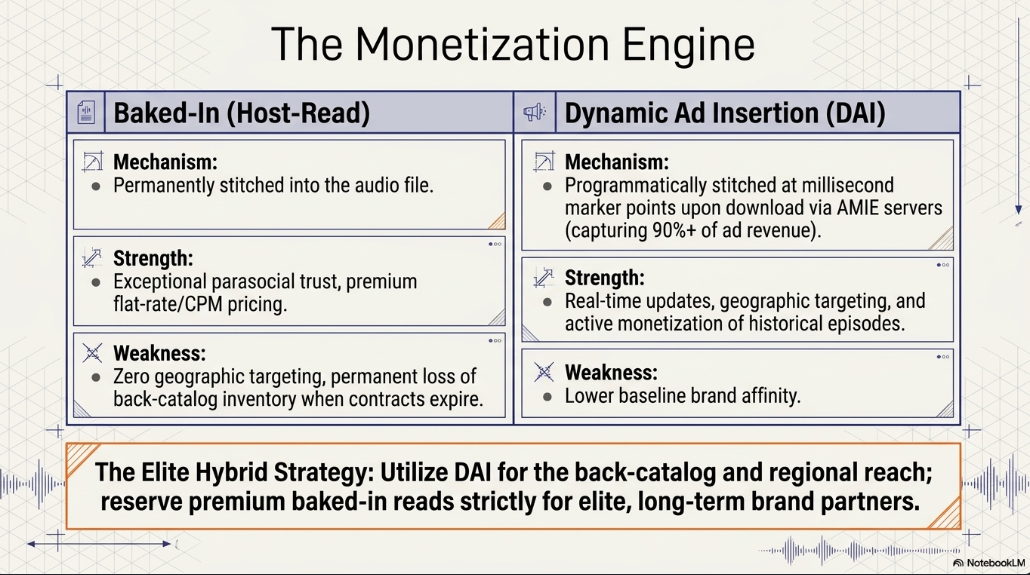
Baked-in advertisements, frequently referred to as host-read ads, are recorded directly into the primary audio file and permanently stitched into the episode33. This model trades heavily on the parasocial trust established between the host and the audience. Because the host delivers a personalized endorsement that matches the tone of the surrounding content, baked-in ads generate exceptionally high brand affinity and conversion rates, allowing creators to command premium flat-rate or CPM (Cost Per Mille) pricing from niche advertisers21.
However, baked-in ads suffer from severe scalability issues. They offer no geographic or behavioral targeting capabilities34. More critically, once an advertiser's contract expires, their promotional messaging remains permanently embedded in the episode. As the podcast acquires new listeners who delve into the back catalog, the original advertiser receives free, ongoing impressions, while the creator is unable to resell that highly valuable auditory real estate33.
The Scalability of Dynamic Ad Insertion (DAI)
To resolve the limitations of baked-in advertising, the industry has aggressively pivoted toward Dynamic Ad Insertion (DAI), a technology that now commands over 90% of all podcast ad revenues36. DAI utilizes sophisticated server-side technology to programmatically stitch audio advertisements into designated marker points at the precise millisecond a listener downloads or streams an episode33.
This infrastructure grants advertisers unprecedented flexibility. Campaigns can be updated in real-time, time-sensitive promotions can be rotated, and listeners can be served highly relevant ads based on their geographic location or device type21. For production teams, DAI is transformative. It converts a stagnant back catalog of historical episodes into actively monetizable inventory21. As new audiences consume older content, they are served current, paying advertisements, generating a continuous stream of passive revenue21.
To implement DAI, hosts must naturally structure their conversations during pre-production to include clear "mid-roll" transition points. Post-recording, the audio engineer embeds digital markers within the waveform on hosting platforms equipped with Audio Monetization and Integration Engines (AMIE), signaling to ad exchanges precisely where to inject the programmatic audio33. Elite podcasts increasingly employ a hybrid revenue strategy: leveraging DAI to monetize the extensive back catalog and execute targeted regional campaigns, while reserving premium, baked-in host reads for elite, long-term brand partners to maintain audience trust21.
Analytics, IAB Standardization, and ROI Measurement
Because podcasts are distributed via an open ecosystem of RSS feeds, measuring audience behavior is significantly more complex than on closed platforms like YouTube. Measurement relies heavily on server-side logfile analysis, parsing the requests made by podcast applications for audio enclosures39. To calculate the true return on investment (ROI)—which industry data suggests averages a robust $6.20 for every $1.00 spent on audio marketing—production teams must utilize sophisticated analytics and attribution models42.
IAB Tech Lab Measurement Guidelines v2.3
To combat the inflation of download metrics and establish a transparent market for advertisers, the Interactive Advertising Bureau (IAB) Tech Lab continuously refines its Podcast Technical Measurement Guidelines39.
The transition to Version 2.3 of these guidelines introduced critical updates to how server-side logs are parsed. Most notably, the guidelines mandate strict filtering of invalid traffic, forcing IAB-certified hosting platforms to automatically exclude server bots, duplicate IP requests, and Apple watchOS anomalies8. Under these protocols, if a user downloads the same episode multiple times within a specific window to resume listening, the system deduplicates the requests, recording only a single, verified download8. Furthermore, Version 2.3 officially shifted the industry terminology from "listener" to "podcast consumer," establishing a foundational framework to account for the explosive growth of streaming video podcasts distributed via RSS41.
Producers track these certified downloads via prefix services (such as OP3 or Podtrac) that count the requests for audio file addresses, or via logfile services (like Triton Podcast Metrics) which analyze the total data transferred by the audio servers39. However, it is vital to understand that a "download" merely indicates that a file was delivered to a device; it does not guarantee consumption. Data reveals that approximately 13% of all downloaded podcasts remain entirely unplayed39. Therefore, total downloads represent potential reach, not actual engagement.
Tracking Engagement and Growth Metrics
To assess the true health of a podcast, producers must calculate week-over-week growth and monitor deep engagement metrics.

[cite: 46]
While hosting dashboards provide download data, platform-specific analytics (such as Apple Podcasts Connect) reveal actual consumption behavior, allowing producers to track the percentage of the audience that completes an episode8. Monitoring these granular metrics allows the production team to identify precise drop-off points, correlate them to specific structural decisions (such as an overly aggressive ad break or a weak interview question), and ruthlessly refine the content architecture for future recordings13.
The Organizational Architecture: The Podcast RACI Matrix
The execution of a data-driven, algorithmically optimized podcast requires a highly coordinated team of specialists. As productions scale, roles frequently blur, resulting in skipped technical checks, missed publishing deadlines, and degraded audio quality. To enforce operational discipline, professional studios implement a RACI Matrix (Responsible, Accountable, Consulted, Informed) to explicitly delineate team responsibilities across the entire production lifecycle47.
Defining Production Roles
The modern podcast team comprises several distinct disciplines:
Executive Producer (EP): The primary architect of the show's strategic vision. The EP defines the show bible, establishes the monetization strategy, oversees the production budget, and ensures all output aligns with the broader brand identity47.
Host: The parasocial anchor of the property. The host is responsible for executing the pre-production research, guiding the interview narratives, delivering ad reads, and maintaining high energy levels during recording sessions47.
Podcast Producer / Coordinator: The operational core of the team. This role manages the day-to-day production calendar, enforces content batching schedules, coordinates recording software, and guarantees that publishing deadlines are strictly met47.
Outreach Manager / Guest Coordinator: Tasked with identifying and securing high-value experts. This individual manages the CRM pipeline, conducts cold outreach, and distributes the briefing dossiers prior to technical check-ins47.
Audio Engineer / Editor: The technical specialist responsible for transforming raw audio into broadcast-quality assets. The engineer removes background noise, applies LUFS normalization, inserts DAI markers, and edits the narrative for maximum pacing and algorithmic retention47.
Distribution & Marketing Manager: Ensures the final asset is syndicated across all platforms with highly optimized, SEO-rich show notes. This role also extracts micro-content for social media distribution and monitors the IAB-certified analytics47.
Applying the RACI Framework
The RACI matrix prevents operational chaos by assigning a specific authority level to every task48. "Responsible" individuals execute the work, while the "Accountable" individual provides the final authorization. "Consulted" experts provide necessary input prior to execution, and "Informed" team members are updated on the task's completion to trigger subsequent workflows48.
By institutionalizing this matrix, a podcasting operation transitions from a reactive, personality-driven endeavor into a highly scalable, resilient media production capable of sustained growth.
Works cited
Podcast Statistics and Data [September 2024] - Buzzsprout, https://www.buzzsprout.com/blog/podcast-statistics
Podcasts Get Measurement Guidelines From IAB Tech Lab - MediaPost, https://www.mediapost.com/publications/article/416688/podcasts-get-measurement-guidelines-from-iab-tech.html?edition=143345
https://www.jigsawkraft.com/post/podcast-seo-how-to-rank-1-on-spotify-google-apple-podcasts-in-2026
The Algorithm Has Changed. How to Grow on Apple, Spotify & Youtube in 2026, https://podcasts.apple.com/ie/podcast/the-algorithm-has-changed-how-to-grow-on-apple/id1840086977?i=1000757100044
How to Write a TV Series Bible (With a Template Outline) - Slima, https://slima.ai/en/how-to-write-a-tv-series-bible
How to Define (and Refine) Your Podcast with a Show Bible, https://podcastmovement.com/resources/creation/how-to-define-and-refine-your-podcast-with-a-show-bible/
How to Make a TV Show Bible With Free Series Bible Template - StudioBinder, https://www.studiobinder.com/tv-show-bible-examples/
8 Podcast Analytics to Track + Tips and Tools (2026) - Shopify Singapore, https://www.shopify.com/sg/blog/podcast-analytics
Podcast completion rate: what a good number looks like, Springcast Blog, https://www.springcast.io/en/blog/podcast-completion-rate/
Podcast Structure: How to Create One + Examples and Templates - Riverside, https://riverside.com/blog/podcast-structure
A Podcast Episode Planning Template That Actually Works, https://contesimal.ai/blog/podcast-episode-planning-template/
How to Structure Your Podcast in 5 Steps - Buzzsprout, https://www.buzzsprout.com/blog/podcast-structure
Podcast Analytics That Matter: Understanding Your Metrics for Growth, https://thepodcastconsultant.com/blog/podcast-analytics-that-matter
Podcast Completion Rate - TAGLAB, https://taglab.net/marketing-metrics/podcast-completion-rate/
Checklist for Analyzing Episode Completion Rates - Podgagement, https://podgagement.com/checklist-for-analyzing-episode-completion-rates/
9 Best Podcast Interview Templates (Copy & Use) + Examples & Guide - Talks.co, https://talks.co/p/podcast-interview-template/
End the Year With A "Past Year Review" | Tim Ferriss & Dr. Andrew Huberman - YouTube, https://www.youtube.com/watch?v=E1Z9Lt1T-ko
How Batching Can Help You Maximize Your Productivity | Tim Ferriss - YouTube, https://www.youtube.com/watch?v=ghVdzAeX0bg
Tim Ferriss: How to Learn Better & Create Your Best Future - Huberman Lab, https://www.hubermanlab.com/episode/tim-ferriss-how-to-learn-better-and-create-your-best-future
Tim Ferriss: How to Learn Better & Create Your Best Future | Huberman Lab Podcast, https://podcastnotes.org/huberman-lab/tim-ferriss-how-to-learn-better-create-your-best-future-huberman-lab-podcast/
Dynamic Ad Insertion vs. Baked-In Ads: A Revenue Comparison - Modern Stoa, https://modernstoa.co/dynamic-ad-insertion-vs-baked-in-ads-a-revenue-comparison/
Podcast Research Template - Assemble, https://www.onassemble.com/template-library/podcast-research-template
Template - Guest Briefing - Impact, https://www.hashtagimpact.com/wp-content/uploads/2019/10/Template-Guest-Briefing-impact-Information-Sheet-Template-for-Guests.pdf
Podcast Interview Checklist - Get Your Guest Ready to Record - East Coast Studio, https://eastcoaststudio.com.au/podcast-interview-pre-flight-checklist/
PODCAST GUEST RELEASE FORM PRODUCER - Columbia University Libraries, https://library.columbia.edu/content/dam/libraryweb/about/Podcast-Guest-Release-Form.pdf
What are LUFS? Complete Guide for Music, Podcasts & Broadcast | NUGEN Audio, https://nugenaudio.com/what-are-lufs/
HOW LOUD SHOULD YOUR PODCAST BE? LUFS AND DB EXPLAINED, https://content.sport-social.co.uk/blog/how-loud-should-your-podcast-be
Quantifying Podcast Audio Dynamics - produce New Media, https://producenewmedia.com/quantifying-podcast-audio-dynamics
Podcasting Levels: Tips and Standards for Publishing | B&H eXplora, https://www.bhphotovideo.com/explora/pro-audio/tips-and-solutions/podcasting-levels-tips-and-standards-for-publishing
Loudness (LUFS) | Podcasting Articles - Audio Audit, https://audioaudit.io/articles/podcast/loudness-lufs
Audio requirements - Apple Podcasts for Creators, https://podcasters.apple.com/support/893-audio-requirements
Dynamic Ad Insertion Explained Simply - Apple Podcasts, https://podcasts.apple.com/nz/podcast/dynamic-ad-insertion-explained-simply/id1223819466?i=1000542723895
Dynamic Ad Insertion vs. Bake-In Advertising: Which is Better for Your Ad Needs?, https://accesstomedia.com/advertising/dynamic-ad-insertion-vs-bake-in-advertising-which-is-better-for-your-ad-needs/
Is there a cost difference to be had between baked-in vs. dynamically inserted ads? - Reddit, https://www.reddit.com/r/podcasting/comments/qgnti0/is_there_a_cost_difference_to_be_had_between/
Dynamic Ad Insertion vs Baked-In Ads: Performance and Perception Analysis - Mynt Agency, https://articles.myntagency.com/dynamic-ad-insertion-vs-baked-in-ads/
Dynamic Ad Insertion 101 - The Simplecast Blog, https://blog.simplecast.com/dynamic-ad-insertion-101
Beginner's Guide To Podcast Advertising | Acast Learning Center, https://learn.acast.com/en/articles/7238912-beginner-s-guide-to-podcast-advertising
How to understand podcast stats - Podnews, https://podnews.net/article/understanding-podcast-statistics
Podcast Measurement Technical Guidelines - IAB Tech Lab, https://iabtechlab.com/standards/podcast-measurement-guidelines/
IAB Tech Lab releases updated Podcast Measurement Guidelines to improve industry standards for audio and video podcasts - MediaNews4U, https://www.medianews4u.com/iab-tech-lab-releases-updated-podcast-measurement-guidelines-to-improve-industry-standards-for-audio-and-video-podcasts/
Podcast Analytics: A Complete Guide for Marketers - Compose.ly, https://www.compose.ly/content-strategy/podcast-analytics
Podcast Measurement Technical Guidelines Version 2.1 - Podnews, https://podnews.net/uploads/iab-v2.1-and-v2.2.pdf
IAB Tech Lab releases podcast technical measurement guidelines V2.3 for public comment, https://www.adgully.com/post/18404/iab-tech-lab-releases-podcast-technical-measurement-guidelines-v23-for-public-comment
IAB Tech Lab Releases Podcast Technical Measurement Guidelines v2.3 for Public Comment - PR Newswire, https://www.prnewswire.com/news-releases/iab-tech-lab-releases-podcast-technical-measurement-guidelines-v2-3-for-public-comment-302830182.html
Podcast team roles - Rivet360, https://www.rivet360.com/blogs/podcast-team-roles
RACI matrix: gain insight into roles and responsibilities - EZ Factory, https://ezfactory.nl/en/knowledge-base/raci-matrix-gain-insight-into-roles-and-responsibilities/
What does a podcast producer do? (5 essential roles) - Resonate Recordings, https://resonaterecordings.com/podcast-production/what-does-a-podcast-producer-do/
10 Jobs in the Podcast Industry (Including Duties and Salaries) | Indeed.com, https://www.indeed.com/career-advice/finding-a-job/jobs-in-podcast-industry
How to Build a Podcast Team (Team Roles and Tips) | Castos, https://castos.com/how-to-build-a-podcast-team/
Job Titles for a Podcaster - Canyon, https://www.usecanyon.com/job-titles/podcaster
Podcast roles and responsibilities - Caspian Studios, https://www.caspianstudios.com/caspian-blog/podcast-roles-and-responsibilities