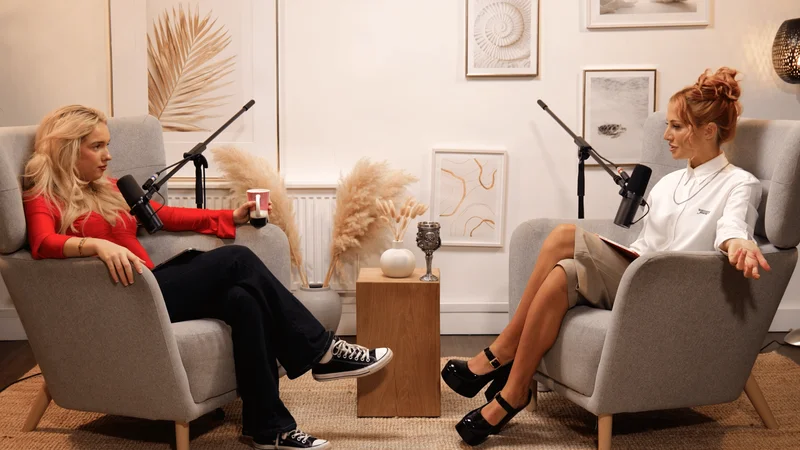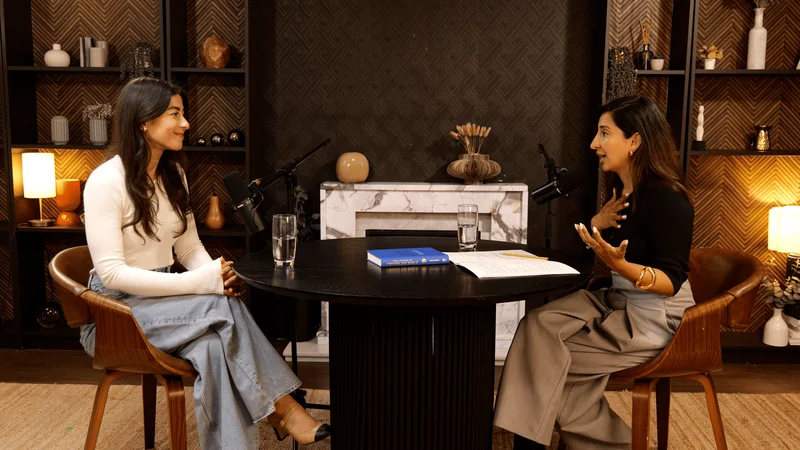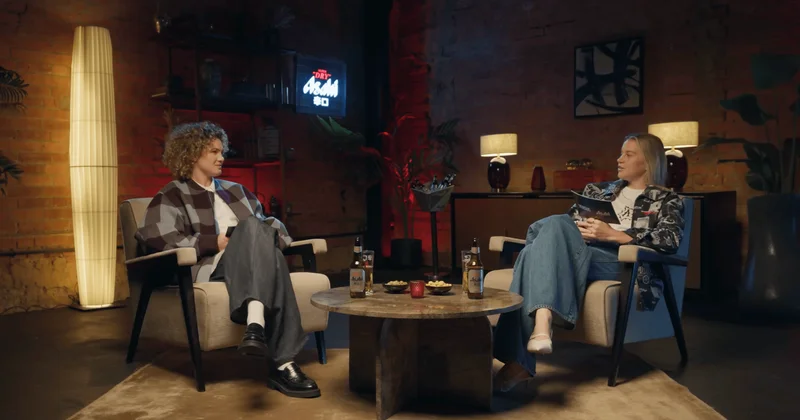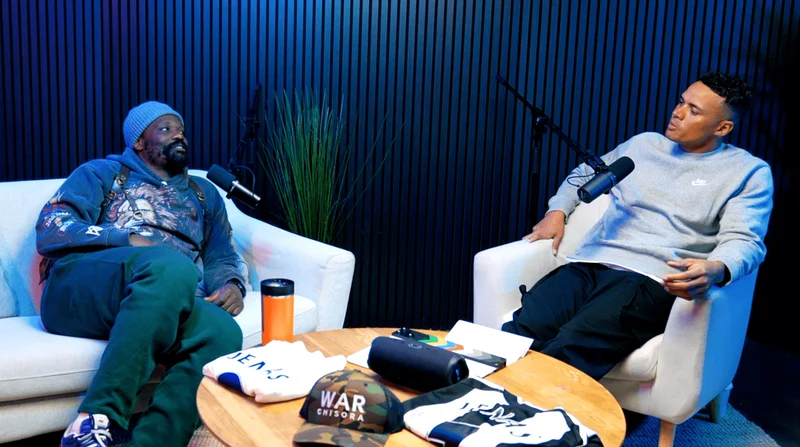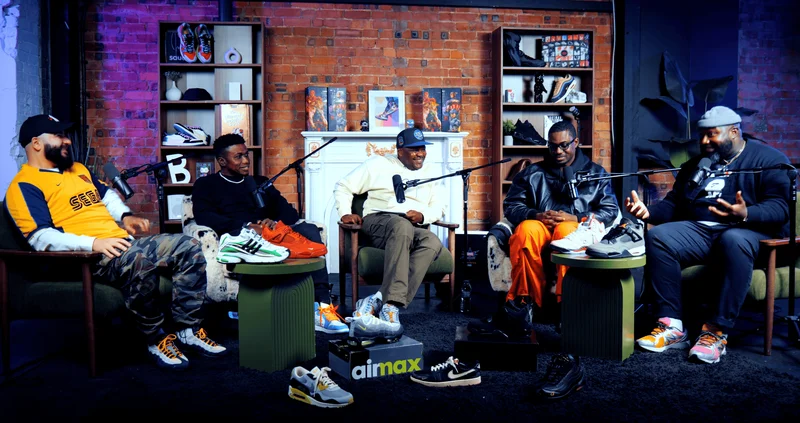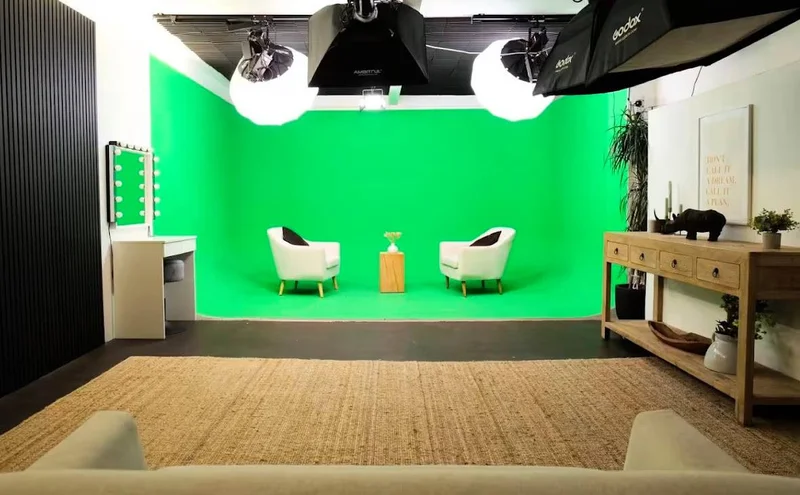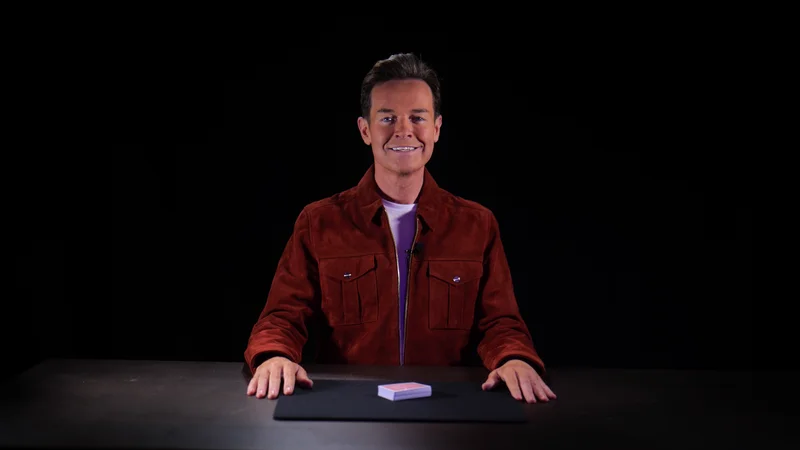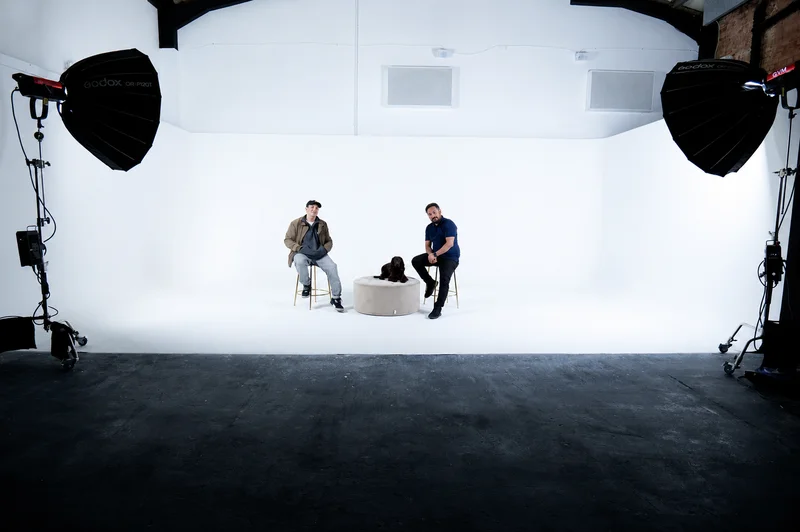
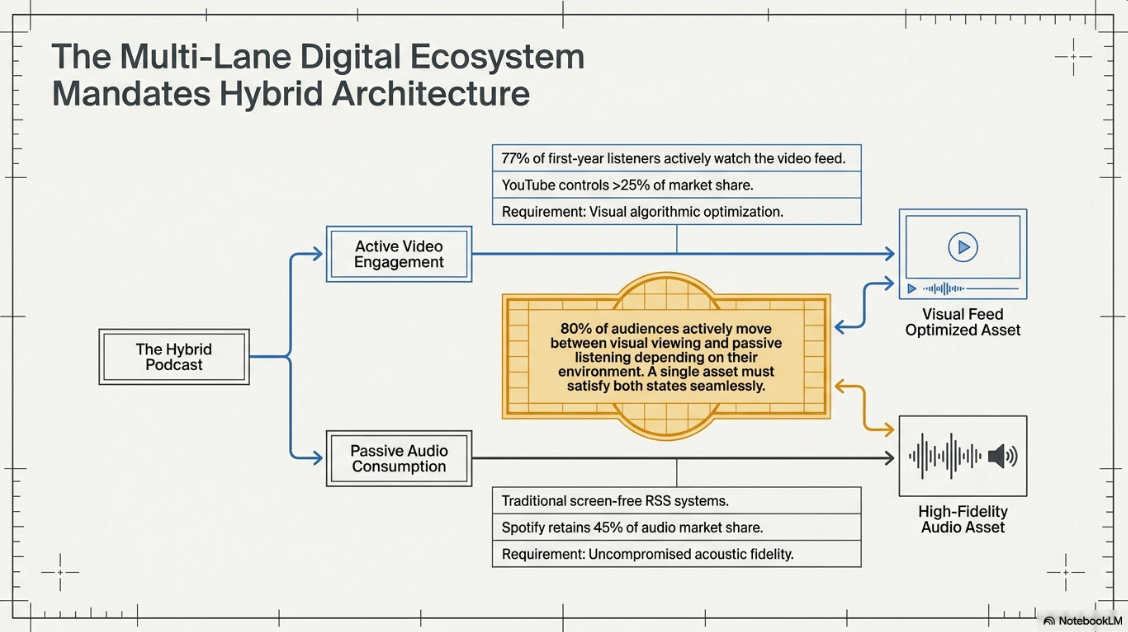
The structural evolution of digital spoken-word media has driven a shift in audience behavior and technical broadcast standards, transitioning podcasting from an audio-only format to a hybrid, multi-lane digital ecosystem1. Statistical analysis indicates that seventy-three percent of the United States population aged twelve and older has consumed a podcast, with weekly and monthly consumption metrics consistently reaching record highs1. Crucially, seventy-seven percent of newer listeners actively watch the video feed while listening, establishing visual engagement as a core driver of audience acquisition and retention1. Because eighty percent of audiences move between active viewing and passive listening depending on their immediate physical environment, professional media production must utilize a hybrid "two-lane" technical strategy1. This approach satisfies both the visual requirements of algorithmic video engines and the screen-free, passive accessibility of traditional RSS audio distribution systems1.
Executing this standard requires a pre-production framework where physical, visual, and acoustic variables are carefully planned and calibrated before recording starts1. Meticulous planning during pre-production prevents fifty to seventy percent of downstream operational and technical issues on set2. This prevents common production problems and keeps projects aligned with budgets and delivery schedules2.
Strategic Pre-Production Systems and Content Outlining
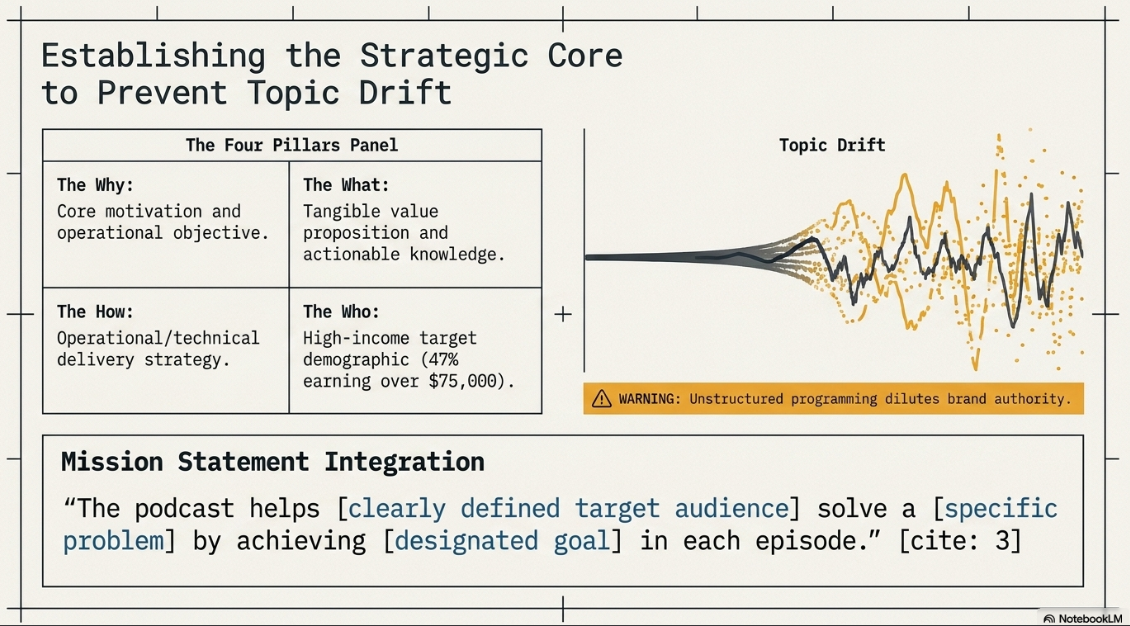
To transition a podcast from a casual recording to a professional media asset, creators must establish a clear strategic thesis during the pre-production phase to prevent topic drift3. Topic drift occurs when unstructured programming gradually loses its thematic focus, dilutes brand authority, and alienates core listeners3.
To build a reliable structure for the show, producers must evaluate four strategic areas before investing in production equipment3:
The "Why": The underlying purpose, motivation, and operational objective behind the show3.
The "What": The tangible value proposition and actionable knowledge provided to the listener3.
The "How": The operational and technical strategy used to deliver that value3.
The "Who": A detailed psychographic and demographic analysis of the target audience and competitive landscape3.
This strategic focus is crystallized through a formal Podcast Mission Statement, which uses a specific semantic structure to guide episode ideation, guest selection, and technical execution3:
Producers must also establish a consistent formatting model3. Maintaining a consistent episode length and structural layout is critical, as listeners integrate specific shows into their daily routines3. Dynamic adjustments to this structure can disrupt these listening habits and lower retention rates3.
Content planning must rely on data-driven research rather than intuition3. Using professional Search Engine Optimization and social listening tools—such as Semrush, Ahrefs, Moz Keyword Explorer, and Google Keyword Planner—allows producers to target specific, high-volume, long-tail search terms3. This research helps them select episode titles, build evergreen content roadmaps, and identify sequel opportunities from past high-performing episodes3.
This keyword strategy is supported by a structured outline designed to prevent meandering conversations3. This outline sequences a single episode objective, research notes, narrative transitions, and a clear, unified Call to Action3.
Producers must also use structural hooks throughout the episode to sustain listener engagement3:
The Title Hook: Grabs attention and generates curiosity using optimized keywords3.
The Description Hook: Uses the show notes to establish clear value and justify the listener's time investment3.
The First Minute Hook: Replaces long, dry host introductions with a compelling tease or a highlights clip from the interview3.
The Narrative Hook: Bridges conceptual segments throughout the episode to reinforce the show’s core mission statement3.
Technical Auditing of Physical Sites and Recording Environments
Selecting and prep-lighting a physical studio space requires a structured technical site survey, commonly known as a studio recce4. This process evaluates physical, optical, mechanical, and electrical variables to identify and address environmental challenges before production begins4. Conducting a detailed recce prevents unexpected on-set issues and keeps productions on schedule4.
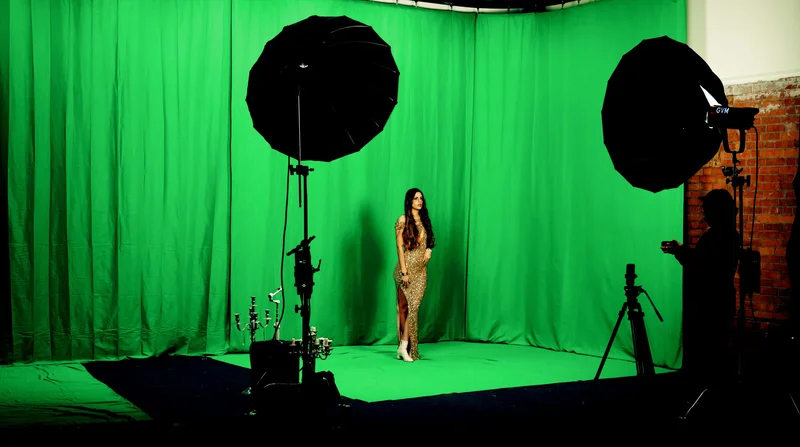
The studio's physical dimensions must be large enough to house the cast, crew, and production gear without creating a cluttered or unsafe environment5. High ceilings, such as the five-meter clearance found in commercial warehouse studios, are highly advantageous6. They allow for overhead lighting truss grids, which keep floor areas clear for camera movement and minimize physical trip hazards on set5.
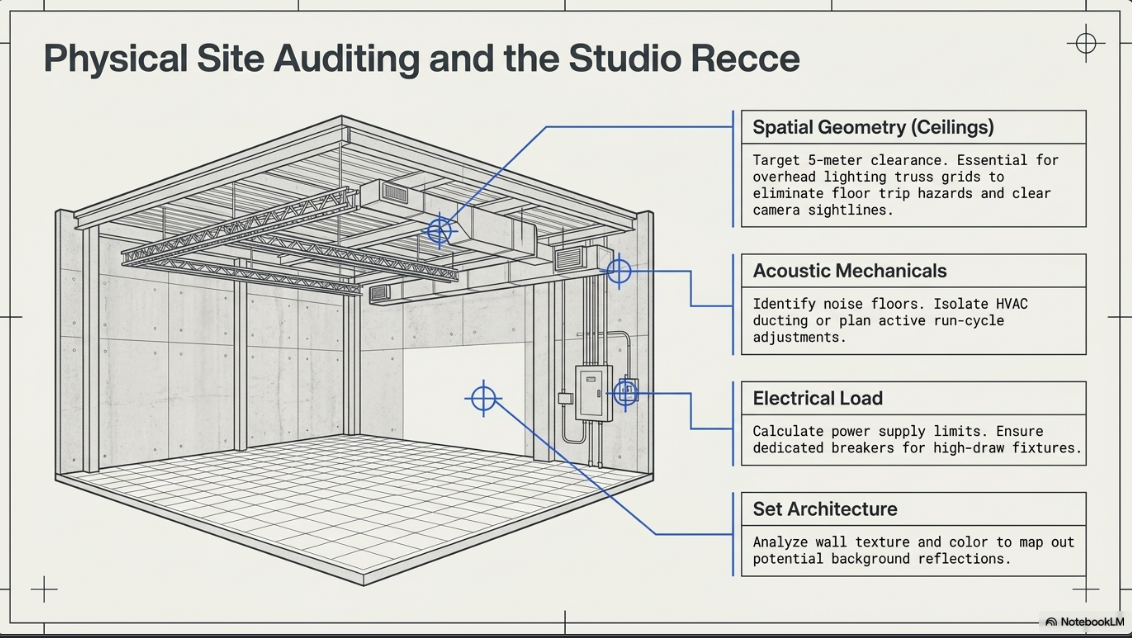
Additionally, the technical team must audit the electrical system to ensure there is sufficient power to sustain continuous lighting and audio arrays without tripping circuit breakers4. The site survey must also identify external noise issues, such as environmental traffic or electrical hums4. Identifying these challenges early allows the team to modify the HVAC cycles, add physical acoustic isolation barriers, or select microphones with highly directional pickup patterns4.
Systems Engineering of Production Lighting Designs
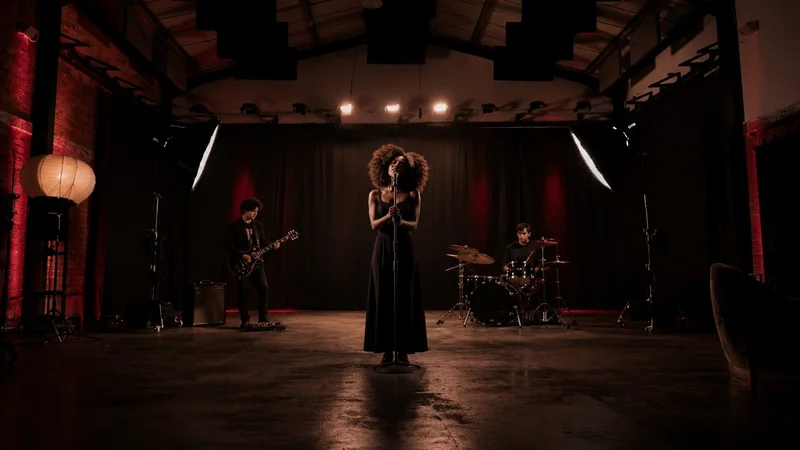
Lighting design is a key visual differentiator, elevating standard multi-camera captures to a cinematic standard1. Rather than relying on expensive, traditional broadcast configurations, achieving this aesthetic requires an understanding of how to control light to create spatial depth, highlight facial features, and separate the subject from the background1.
[ Back Light / Hair Light ] (Off-Camera Overhead)
\
\ (Creates Halo Separation)
\
[ Subject Face ]
/ \
/ \
(Key Light Axis) (Fill Light Axis)
/ \
/ \
[ Key Light Unit ] [ Fill Light Unit ]
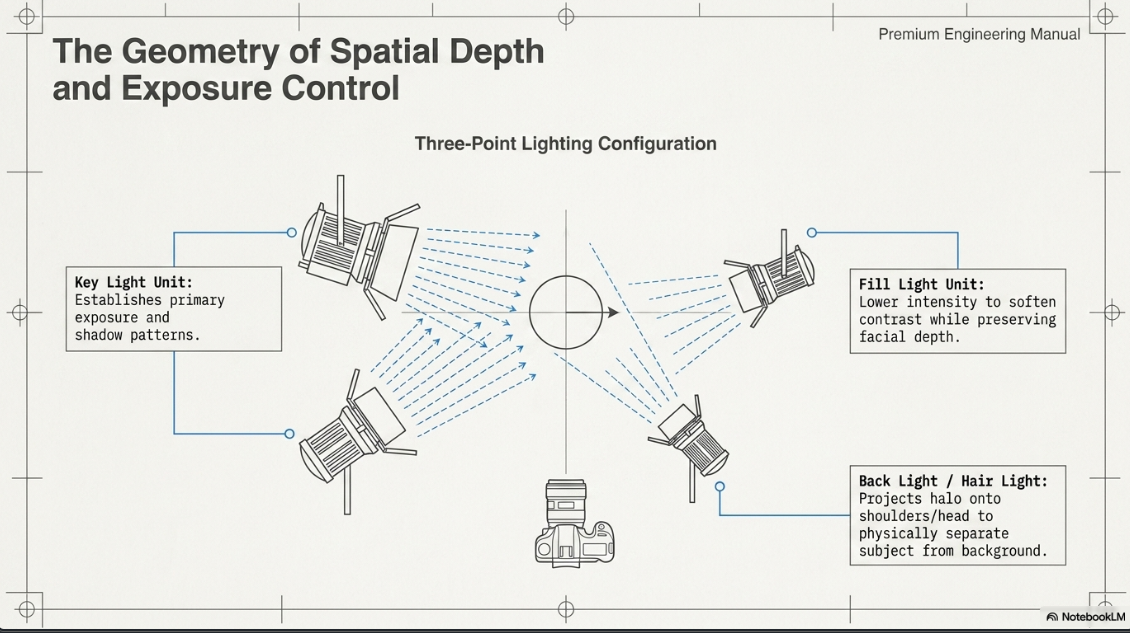
The Three-Point Lighting Configuration
To balance visual exposure, minimize harsh shadows, and define physical facial details, the classic three-point lighting setup serves as the primary standard1:
The Key Light: Placed forty-five degrees off-axis relative to the subject-to-camera vector, this light establishes the primary exposure and shadow patterns, setting the overall visual mood of the scene1.
The Fill Light: Placed opposite the key light, this light is set to a lower intensity to soften high-contrast shadows while preserving natural facial depth1.
The Back Light (or Hair Light): Positioned behind the subject and outside the camera's frame, this light projects onto the shoulders and the back of the head1. This creates a thin, luminous rim of light that physically separates the subject from the background1.
Technical Application of Multi-Subject Cross-Lighting
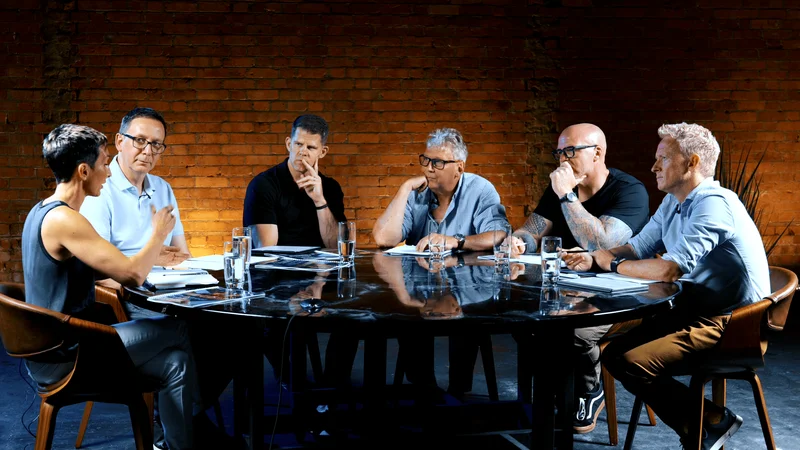
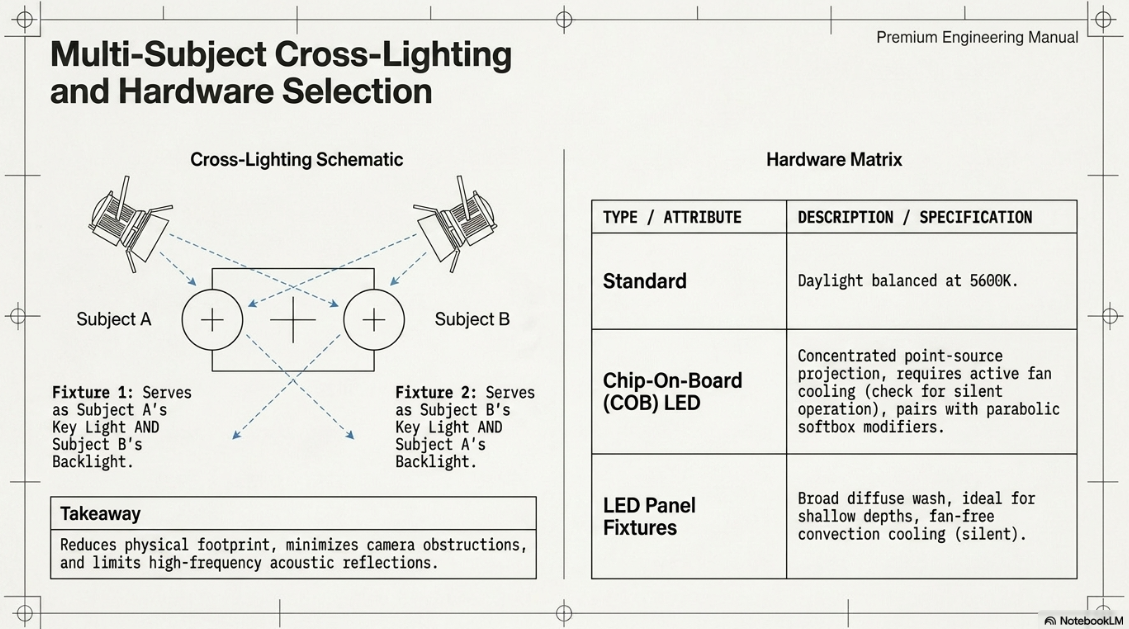
In two-person interview or roundtable setups, the cross-lighting technique is an efficient method for lighting multiple subjects with minimal equipment9. In a classic two-light cross-lit configuration, each fixture performs two roles: the light serving as the key light for Subject A passes behind Subject B to act as their backlight, while the second fixture serves as the key light for Subject B and the backlight for Subject A9. This approach is useful in small studio environments9. It reduces the need for multiple stands and fixtures, creating a cleaner physical footprint that minimizes camera obstructions and avoids reflecting high-frequency acoustic waves into vocal microphones7.
Daylight-balanced setups should be calibrated to a standard color temperature of , matching professional post-production color profiles10. Softbox diffusion modifiers are also critical: parabolic modifiers focus light on the subject while preventing spill onto acoustically treated walls, whereas lantern modifiers provide soft, even, omnidirectional room fill10.
Sound Design Engineering and Electro-Acoustic Calibration
Although video integration is critical for modern distribution, podcasting remains an audio-first medium1. Audiences will tolerate minor visual imperfections, but they will quickly abandon content with poor, distorted, or echoing audio1. Consequently, audio systems design must be prioritized during pre-production, focusing on physical acoustics, electro-acoustic microphone selection, and digital gain architecture7.
Acoustic Room Isolation and Absorption
In an untreated environment, sound waves from a speaker's voice reflect off hard, parallel surfaces (such as plaster walls, glass windows, or hardwood floors)7. These reflections bounce back into the microphone capsule with a physical time delay, creating phase cancellation and a muddy, echoing sound7.
Controlling this acoustic energy requires specific structural configurations:
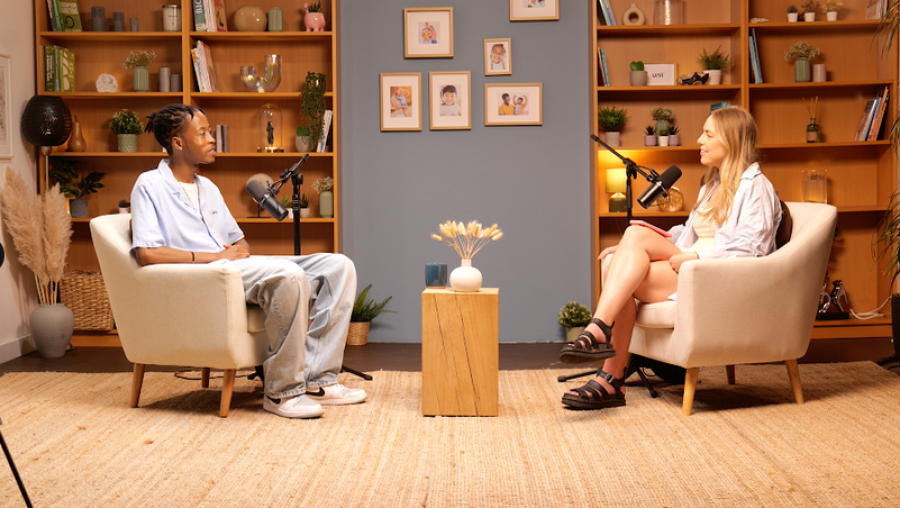
Geometry Modification: Small, square rooms should be avoided, as parallel walls can trap acoustic waves and create standing wave resonances7. Using rooms with asymmetrical surfaces or adding irregular furniture (such as loaded bookshelves) helps randomize and diffuse acoustic reflections7.
Mechanical Wave Absorption: Hard surfaces must be treated with dense acoustic panels, heavy curtains, or thick carpets to absorb acoustic energy7. Professional video studios utilize integrated acoustic panels to control reflections while providing a clean visual background for the cameras12.
Transducer Technology: Condenser versus Dynamic Capsules
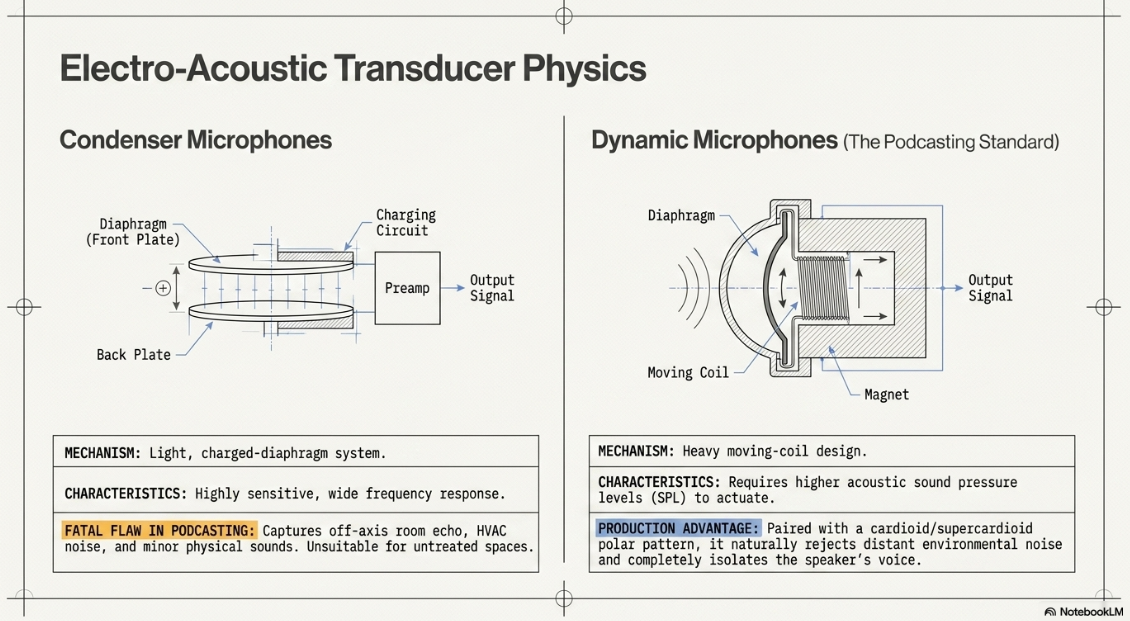
Selecting the right microphone transducer is critical for managing environmental noise. Condenser microphones use a light, charged-diaphragm system that is highly sensitive13. While this provides a wide frequency response, it also captures minor background noises and off-axis room echo, making them difficult to use in untreated spaces13.
Conversely, dynamic microphones (such as the Shure SM58 or Sennheiser e945) are ideal for podcasting7. They use a heavier moving-coil design that requires higher acoustic sound pressure levels to actuate, making them less sensitive to distant environmental noise7. When paired with a cardioid or supercardioid polar pattern, dynamic microphones naturally reject off-axis room reflections and background noise, isolating the speaker's voice7.
Vocal Source (On-Axis / Cardioid Sweet Spot)
\
\ (5 to 15 cm Distance)
\
[ Cardioid Pattern ]
[ Mic Capsule ]
[ Spider Shock Mt ] <-- Dampens Physical Vibrations
|
|
[ Off-Axis Noise Rejection ]
(HVAC Hum, Reflections, Fan Noise)
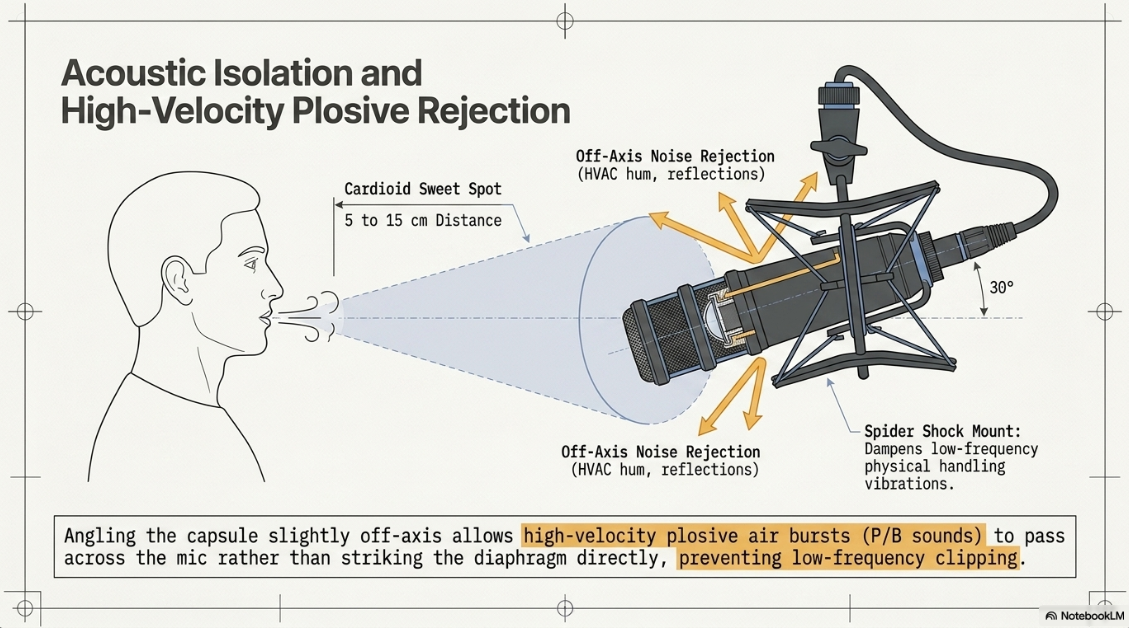
To capture a clean signal, the microphone must be physically isolated and properly positioned:
Physical Isolation: The microphone must be mounted on a sturdy stand equipped with a elastic spider shock mount7. This setup dampens low-frequency rumble and physical vibrations from handling7. Additionally, a mic sock or windshield should be used to protect the capsule from breath moisture and high-velocity plosive air bursts7.
Capsule Placement: The microphone should be placed five to fifteen centimeters away from the speaker’s mouth7. Angling the capsule slightly off-axis allows high-velocity air bursts from plosive consonants (such as "P" and "B" sounds) to pass across the mic rather than hitting the diaphragm directly, preventing low-frequency clipping7.
The Mathematics of Digital Auditioning
During recording, the continuous analog voltage from the microphone is converted into a discrete digital format using Pulse-Code Modulation7. This digital conversion operates across two primary physical axes: time (sample rate) and amplitude (bit depth)7.
According to the Nyquist-Shannon sampling theorem, to reconstruct an analog audio signal containing frequencies up to without introducing digital aliasing, the sampling rate () must satisfy:
The nominal range of human hearing extends to approximately . Therefore, a sample rate must be at least double this frequency to prevent digital distortion7. While serves as the baseline for spoken-word audio, is the professional broadcast standard for synchronizing audio with video frames7.
Bit depth defines the vertical resolution of each sample, dictating the dynamic range () in decibels as a function of the bit depth ():
A comparison of standard dynamic ranges reveals the technical advantages of high-resolution tracking:
Tracking at a 24-bit depth expands the available amplitude values from to over million per sample7. This provides a dynamic range of approximately , ensuring a negligible digital noise floor and extensive headroom to protect against clipping during sudden peaks in volume7.
To maintain audio quality, producers must decouple the production file format from the final distribution format7. All tracking, editing, and mixing should be executed using uncompressed, lossless WAV files to avoid generational compression degradation during editing7.
Once mixing is complete, the final master is exported as a Mono MP3 at a Constant Bit Rate of to for standard spoken-word distribution7. This approach centers the voices in the listener's head, prevents phase cancellation issues, and reduces file sizes to facilitate progressive downloads over RSS feeds7.
Audio Sound Check and Gain Architecture Calibration
A systematic sound check is required to verify the integrity of the signal chain before recording7. This workflow begins with vocal testing ("Sound Check... 1... 2") to assess the voice’s dynamic range and make adjustments for individual speaking volumes7.
Vocal Peak Input (+6 to +12 dB headroom)
|
v
[ Preamp Gain Stage ] <-- (Presonus Studio 24c)
|
v
[ Digital Conversion ] <-- (24-bit PCM / -18 dBFS target)
|
v
[ Closed-Back Headphone Monitor ] <-- Isolates audio bleed
To set these parameters, producers should use professional preamps and audio interfaces, such as the Presonus Studio 24c7. Preamp gain must be calibrated to position average speaking levels around on digital meters7. This target level provides a safety buffer of of digital headroom7. This headroom accommodates natural human expressions, such as sudden laughter or elevated speaking volumes, preventing digital clipping and distortion7.
Additionally, both hosts and guests must wear professional, closed-back monitoring headphones during tracking11. Headphones allow participants to monitor their volume and mic technique in real-time11. Crucially, closed-back headphones isolate sound, preventing headphone bleed from leaking back into active vocal microphones and causing phase distortion or echo11.
Audio Post-Production Processing and Gain Dynamics
Once recording is complete, the raw WAV files enter the post-production stage to clean up the sound, balance the tracks, and meet broadcast standards1. This workflow uses noise reduction, surgical equalization, and dynamic range compression to deliver a polished, commercial sound1.
Raw WAV Ingest --> [ Noise Gate / De-Noise ] --> [ Parametric EQ ] --> [ Dynamic Compressor ] --> Mastering Limiter
Noise Reduction: Applying a clean noise gate or expander attenuates signals below a set threshold, eliminating low-frequency HVAC rumble, electrical hums, and minor background noise1.
Parametric Equalization (EQ): Used to carve out resonant frequencies and balance different host and guest vocal tones1. A high-pass filter is typically applied to roll off frequencies below to remove low-end rumble, while selective mid-range cuts reduce nasality, and gentle high-frequency boosts enhance vocal clarity1.
Dynamic Range Compression: evens out volume variations by clamping down on loud peaks, ensuring a consistent level so listeners do not have to constantly adjust their volume1.
To maintain consistency, engineers can create standardized project templates that save these EQ, compression, and gating settings, ensuring a cohesive sound across different episodes and recording sessions1.
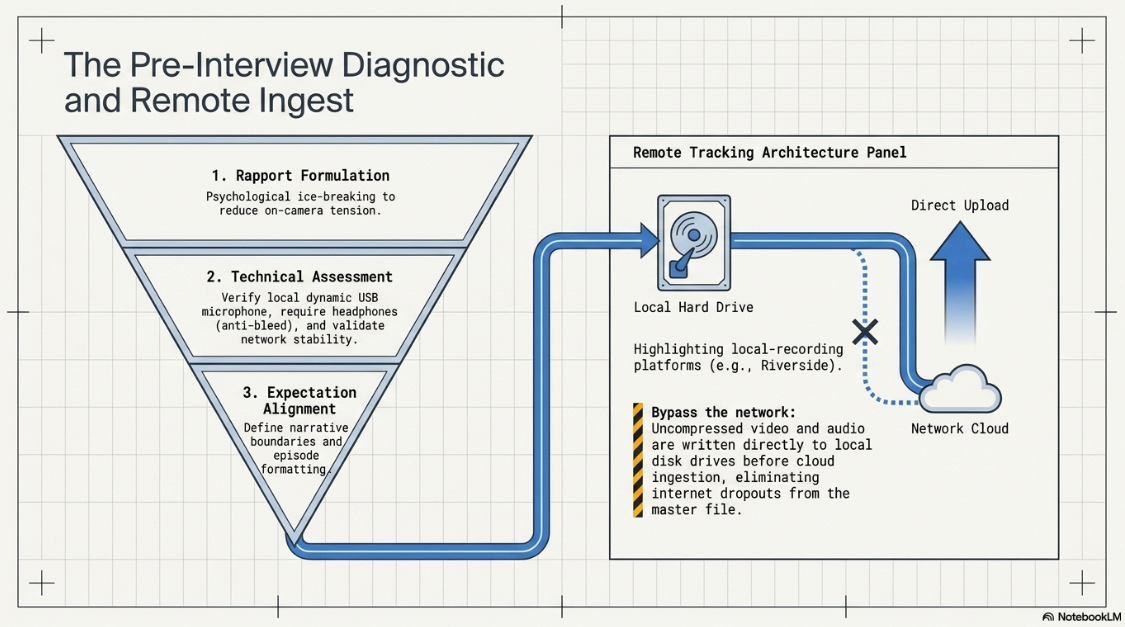
Pre-Interview Logistics and Guest Onboarding System
Managing guest acquisition and preparation is essential for maintaining production quality and a consistent release schedule3. Standardizing your outreach process with a clear value proposition and maintaining a consistent publishing history helps attract high-caliber guests3.
A key part of this process is the pre-interview diagnostic call, which acts as a technical and content gate before recording day3. A guest's refusal to participate in this pre-interview is a critical early warning sign of potential production or technical difficulties3.
Establishing rapport during this call helps put the guest at ease before recording starts, reducing on-camera tension3. This pre-interview also allows the production team to test the guest’s remote recording environment3. Producers can ensure the guest has a dynamic USB microphone, check that they are wearing headphones to prevent audio bleed, and verify their internet connection3.
To protect the recording against network dropouts, the team can use local recording platforms like Riverside11. These systems record uncompressed video and audio files locally on each participant’s computer, then upload them to the cloud11. This approach prevents remote internet glitches from degrading the quality of the final master files11.
Technical Interview Execution and Narrative Direction
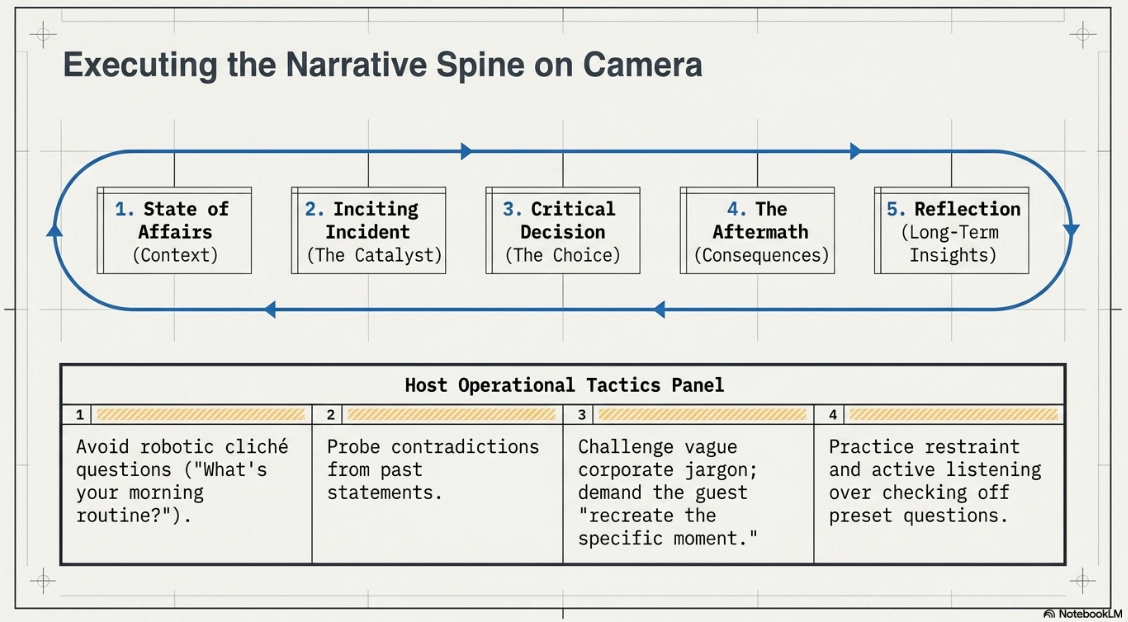
During recording, the host must keep the conversation focused and engaging, guiding the guest along a clear narrative spine rather than asking simple chronological questions3.
[ 1. State of Affairs ] --> [ 2. Inciting Incident ] --> [ 3. Critical Decision ] --> [ 4. The Aftermath ] --> [ 5. Reflection ]
The State of Affairs: Establishes the context, background, and environment before a major development3.
The Inciting Incident: Identifies the catalyst or specific event that disrupted the status quo3.
The Critical Decision: Explores the pivotal choice, trade-off, or action taken by the guest3.
The Aftermath: Details the immediate results and consequences of that choice3.
The Reflection: Examines the long-term lessons, insights, and takeaways3.
To keep the conversation natural and engaging, the host should avoid cliché questions like "what is your morning routine?" or "what inspired your journey?"3. These questions often trigger rehearsed, robotic answers that lower listener engagement3. Instead, the host should research obscure details beyond the first page of search results to ask original, insightful questions3.
Furthermore, the host should probe contradictions and paradoxes in the guest's past statements, or ask them about a time they changed their mind3. This approach helps prompt candid, unscripted responses3.
The host must also practice active listening, focusing on the guest's actual answers rather than waiting for their turn to read the next pre-written question3. Respectfully challenging vague, corporate jargon and asking the guest to "recreate the specific moment" helps reveal authentic details3. Finally, the host should practice restraint by keeping their focus on the guest and avoiding the urge to constantly relate the guest's experiences to their own stories3.
Technical Integration of Post-Production Systems and Delivery Specs
Modern video podcast post-production requires a structured, non-destructive editing pipeline to manage files efficiently, keep audio and video in sync, and ensure compliance across different distribution channels16. This process begins by importing raw assets into a non-linear editor, using clear naming conventions and structured metadata to prevent file management issues16.
The editing process moves through three main stages16:
Assembly: The preliminary arrangement of selected video and audio files into a chronological timeline16.
Rough Cut: A refined version where the pacing is established, unnecessary pauses or mistakes are removed, and the narrative flow is tested16.
Fine Cut: The final polish where transitions, graphics, audio leveling, and color correction are applied16.
For color grading, the video signal must be calibrated to meet standard broadcast specifications, such as the ITU-R BT.709-5 and EBU R103 standards, to ensure consistent colors across different screens16.
To deliver a high-quality video file, the final master must be formatted to meet platform-specific ingestion specifications1. The universally accepted container format is MP4, encoded using the H.264 High Profile or H.265/HEVC codec, which ensures broad compatibility across mobile and desktop devices1.
The file should be exported at a resolution of or using a widescreen aspect ratio1. Target bitrates should be set to for files and for files, using standard broadcast frame rates of 1.
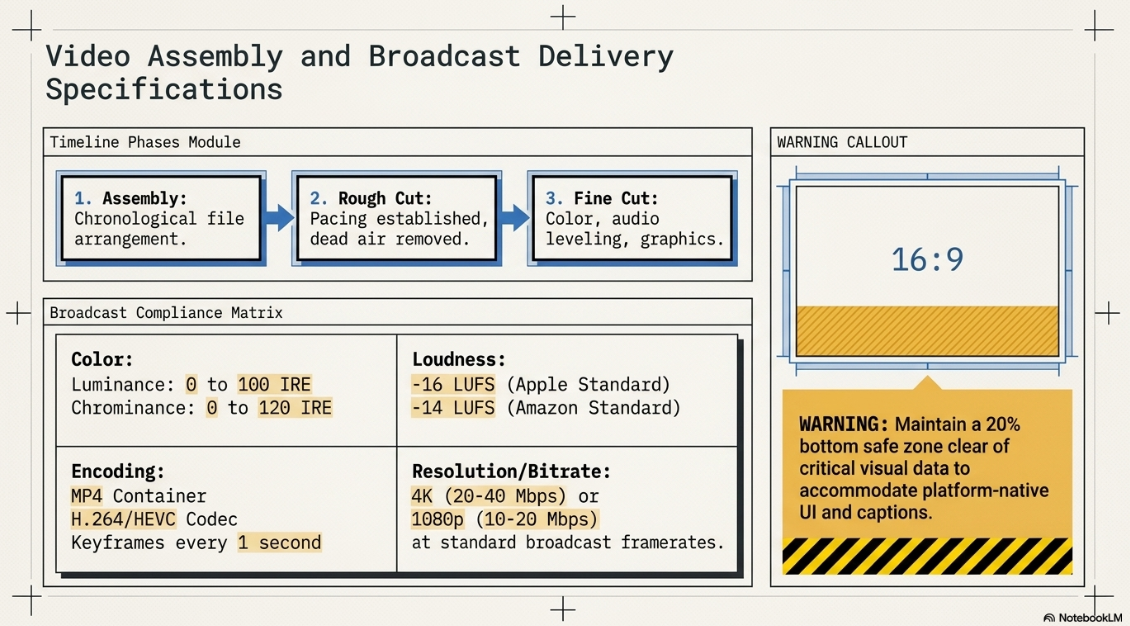
Additionally, keyframes should be generated at a rate of one per second to ensure stable scrubbing on video players1. The bottom of the video frame must be kept clear of critical visual information to prevent important details from being blocked by platform-native captions, playback scrubbers, or Call-to-Action overlays1. Use these standardized settings to ensure your video podcast displays correctly across all major streaming platforms1.
Works cited
Video Execution of a Professional Podcast - Finchley Studios, https://www.finchley.co.uk/finchley-learning/visual-podcast/video-execution-of-a-professional-podcast
From Concept to Camera: The Power of Pre-Production Planning, https://175productions.com/the-power-of-pre-production-planning/
Strategic Pre-Production for a Professional Podcast - Finchley Studios, https://www.finchley.co.uk/finchley-learning/visual-podcast/strategic-pre-production-for-a-professional-podcast
Why a studio recce is important - Tooting Film Studios, https://www.tootingfilmstudios.co.uk/blog/why-a-studio-recce-is-important
Mastering the Studio Recce, https://www.broadley.tv/mastering-studio-recce/
The Brick Studio Set | London's Top Content Studio - Finchley Studios, https://www.finchley.co.uk/services/brick-warehouse-studio
Audio Execution for a Professional Podcast - Finchley Studios, https://www.finchley.co.uk/finchley-learning/visual-podcast/audio-execution-for-a-professional-podcast
Finchley Production Studio, https://www.finchley.co.uk/
Two Person Budget Lighting Setup That Makes Your Videos Look GOOD! - YouTube, https://www.youtube.com/watch?v=Logv0Z7sBjg
Best Podcast Lighting Setup Budget to Pro + Exact Placement Tips - YouTube, https://www.youtube.com/watch?v=JeNr4_3S23A
Podcast Setup: Beginners Guide. - YouTube, https://www.youtube.com/watch?v=1np3pFW8mU4
Acoustic Treatments in Recording Studios Why It Matters - Finchley Studios, https://www.finchley.co.uk/finchley-learning/acoustic-treatments-in-recording-studios-why-it-matters
Podcast beginner looking for gear recommendations - Reddit, https://www.reddit.com/r/podcasting/comments/1tvdvdu/podcast_beginner_looking_for_gear_recommendations/
SOURCEBOOK 2025 - Broadcast Supply Worldwide, https://bswusa.com/content/BSW_2025SB.pdf
Audio Engineering in a Professional Podcast Post-Production - Finchley Studios, https://www.finchley.co.uk/finchley-learning/visual-podcast/audio-engineering-in-a-professional-podcast-post-production
Video Engineering in a Professional Podcast Post-Production - Finchley Studios, https://www.finchley.co.uk/finchley-learning/visual-podcast/video-engineering-in-a-professional-podcast-post-production
Finchley Learning | Video Engineering in a Podcast Post-Production, https://www.finchley.co.uk/video-engineering-in-a-podcast-post-production