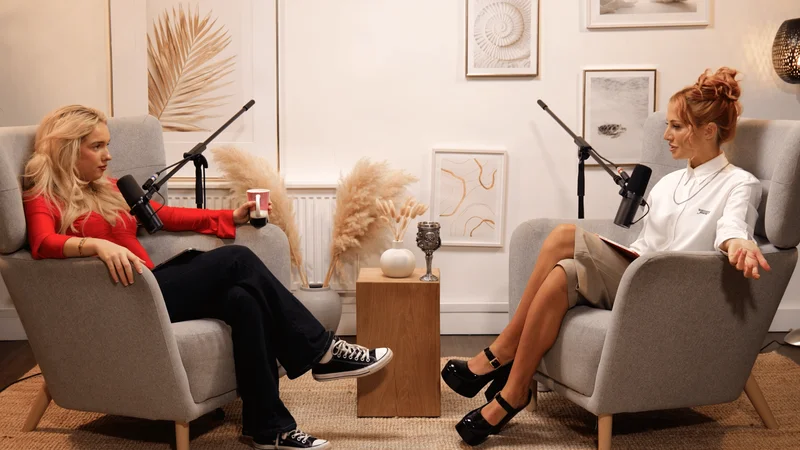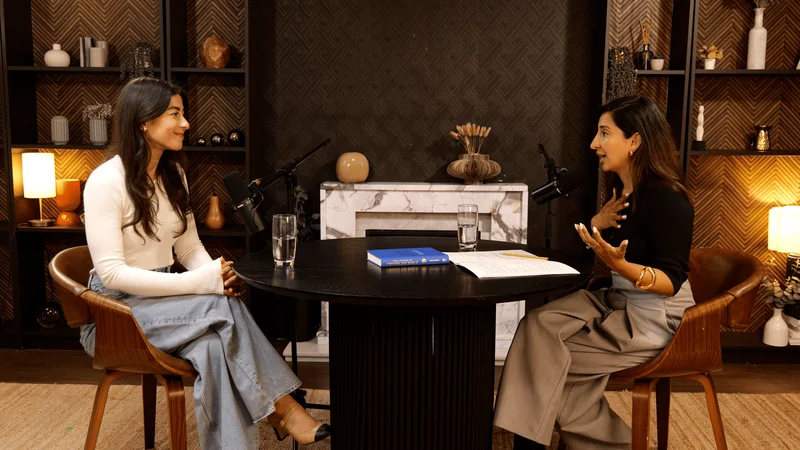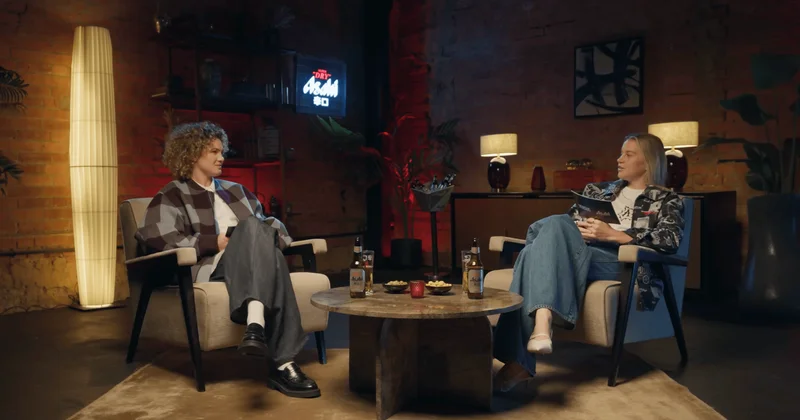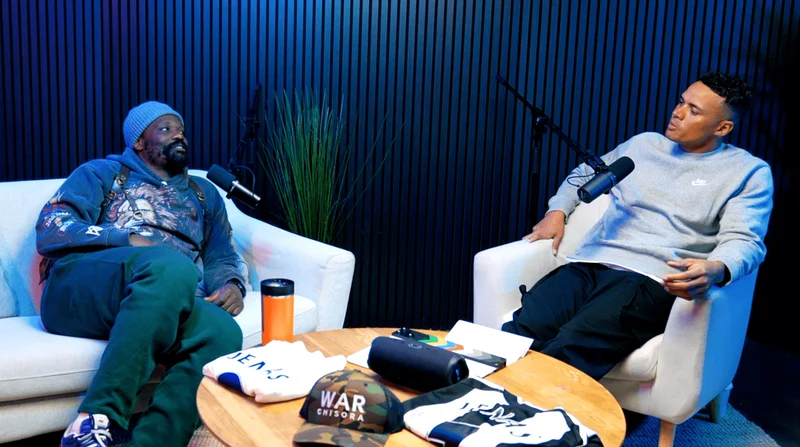
The Multi-Format Paradigm and Audience Dynamics
The digital media landscape has undergone a tectonic structural transition, shifting podcasting from a decentralized, audio-only distribution medium into a highly integrated, multi-format digital broadcast ecosystem1. Consumer tracking data indicates that seventy-three percent of the United States population aged twelve and older has consumed a podcast, with active monthly and weekly consumption rates achieving historic peaks of fifty-five percent and forty percent, respectively1. This audience base is exceptionally lucrative for enterprise brand strategists, with forty-seven percent of monthly consumers earning in excess of $75,000 annually, compared to forty-three percent of the general population1. Demographically, seventy percent of online adults under fifty-four consume podcasts on a recurring basis, and sixty-five percent hold higher education degrees, establishing a highly educated and engaged market segment1.
The rapid integration of video, or vodcasting, has redefined audience consumption paradigms, converting passive listeners into active, multi-lane visual viewers1. Audience metrics distinguishing between new consumers, termed First-Years, and established listeners, termed Longtimers, demonstrate that seventy-seven percent of newer audiences actively watch the video feed while listening, proving that visual engagement is no longer merely supplementary but central to audience acquisition1. This visual migration has driven a battle for platform supremacy1. YouTube has emerged as a primary engine for podcast discovery, reporting over one billion monthly podcast viewers, capturing more than twenty-five percent of overall United States consumption, and operating adjacent to Spotify, which commands a forty-five percent market share1.
This structural shift dictates that a successful podcasting strategy must be purposefully hybrid, requiring the creation of a two-lane show1. Because an estimated eighty percent of audiences seamlessly shift between active watching and passive listening based on their physical environment, the content and engineering must satisfy both the visual demands of search engine algorithms and the passive accessibility of traditional audio RSS syndication1.
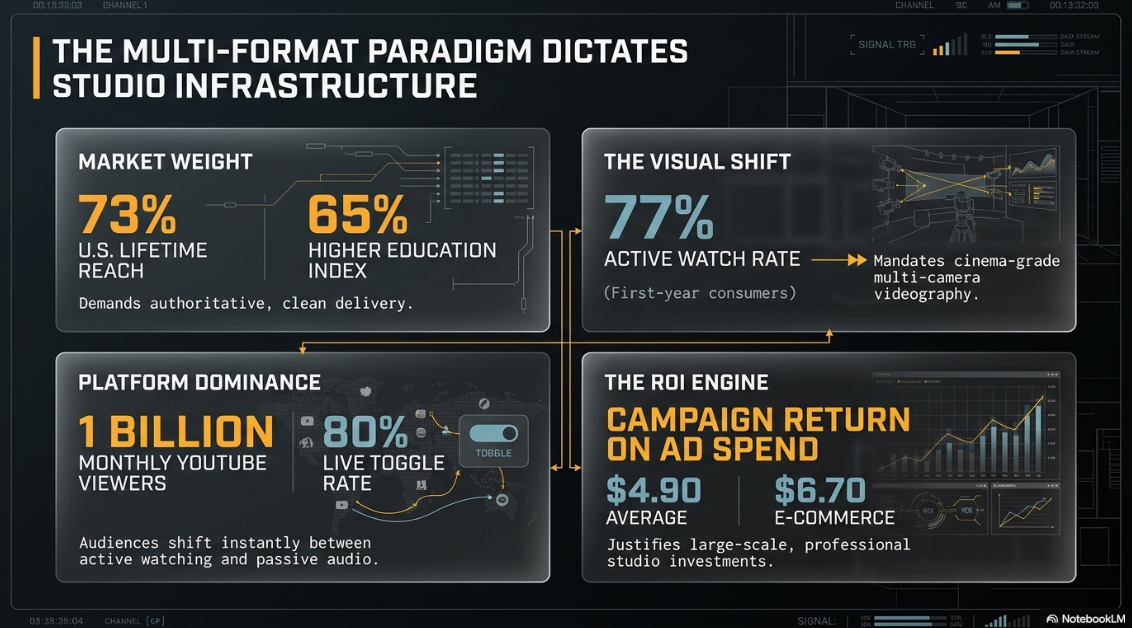
When presenting the business case for podcasting to corporate stakeholders, the medium must be positioned as a centralized content engine that establishes deep industry authority, dominates search engine optimization, and generates a vast reservoir of short-form marketing collateral from a single recording session1. In B2B marketing, long-form discussion clarifies complex value propositions that cannot be adequately conveyed in traditional short-form advertising, yielding an average Return on Ad Spend (ROAS) of $4.90, which escalates to $6.70 for e-commerce brands1.
Strategic Pre-Production: Content Planning, Scripting, and Logistics
Executing a professional video podcast requires transitioning from a hobbyist mindset to that of a disciplined media director, prioritizing systematic planning long before recording equipment is powered on1. Strategic pre-production begins with content validation and the creation of a formal podcast mission statement, which acts as an internal compass guiding episode ideation, guest selection, and technical execution4. Content planning must move beyond raw intuition and leverage data-driven methodologies, utilizing advanced search engine optimization keyword tools such as Semrush, Ahrefs, Moz, or Google Keyword Planner to identify high-volume, long-tail search queries within the target niche4. This allows production teams to reverse-engineer topics based on active audience inquiries, ensuring that each episode serves as a direct solution to existing market demands4.
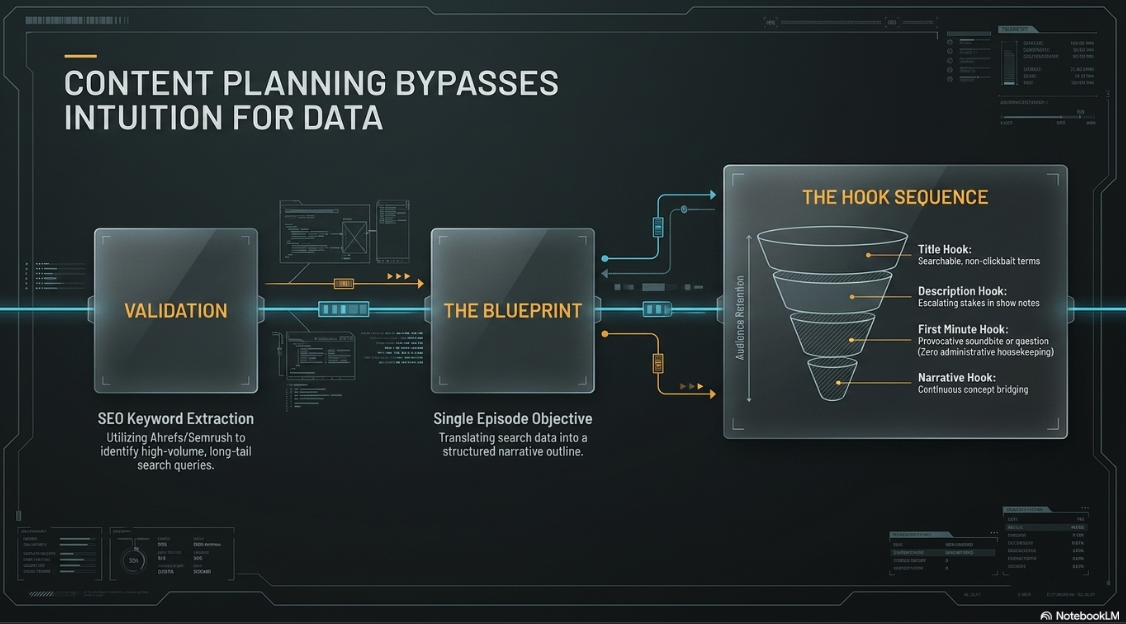
An architectural blueprint, or structured outline, is the greatest defense against meandering, unfocused content4. This blueprint starts with a single, defined episode objective, sequences transitions, incorporates gathered research, and leads to a single, powerful Call to Action4. To retain audience attention across scroll-based digital feeds, the script must utilize a sequence of psychological hooks4. The Title Hook grabs attention and incorporates searchable terms without resorting to clickbait4. The Description Hook escalates the stakes within the show notes, proving the episode is worth the time investment4. The First Minute Hook opens with an energetic tease, a compelling question, or a provocative guest soundbite rather than administrative housekeeping or lengthy biographies4. Finally, the Narrative Hook requires the host to continuously bridge concepts throughout the recording4.
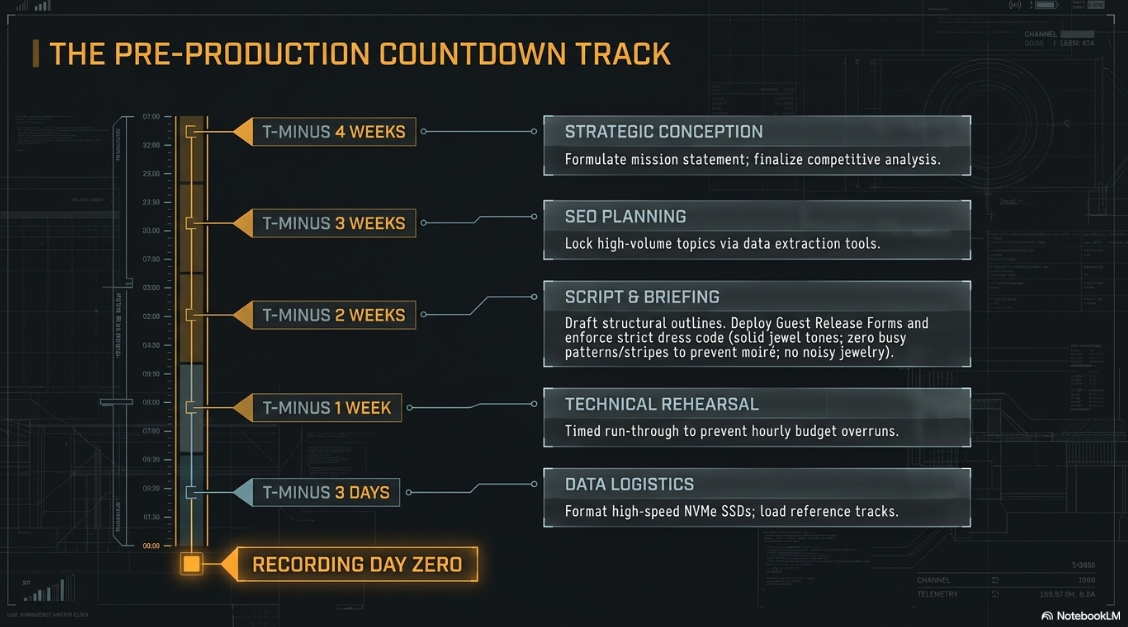
On the physical level, pre-production logistics dictate that co-hosts and guests receive outlines, specific questions, and logistical details at least two weeks before the session5. A timed rehearsal is critical to verify that the planned runtime aligns with the booked studio duration, preventing budget overruns in professional environments that bill strictly by the hour or minute5. Furthermore, attire guidelines must be explicitly communicated to participants prior to shooting5. To avoid visual artifacts, subjects must avoid busy patterns and fine stripes that cause a moiré effect on high-resolution camera sensors5. Solid, jewel-toned colors look best on camera, while all-black or all-white garments are avoided because they present exposure and lighting challenges in a controlled studio environment5. Guests must also be advised against wearing noisy jewelry, such as dangling earrings or bracelets, which are easily captured by sensitive condenser or dynamic microphones, corrupting the multi-track audio recording5.
Pre-visualization is further enhanced through storyboarding and shot listing8. Storyboards allow the director, cinematographer, and videography editor to visually map out scene construction, framing, transitions, and camera movements before a single camera is powered on8. This collaborative reference ensures that the filmed content matches the unified director's vision, reducing the need for redundant communication in post-production and significantly accelerating the editing timeline8. A signed Guest Release Form is also a vital legal pre-production step, granting the producer the perpetual right to use the guest's voice and likeness across all media and preventing potential legal demands to take down episodes retroactively6.
The Applied Physics and Engineering of Studio Illumination
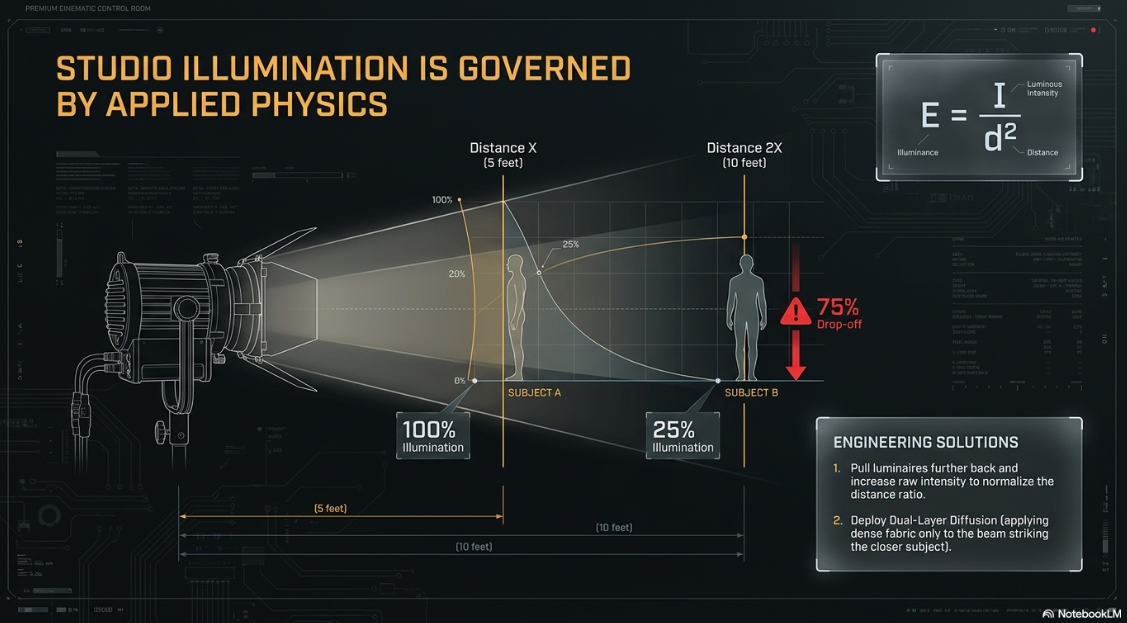
Achieving a high-end visual aesthetic depends on a deep technical understanding of the physics of light propagation and colorimetry12. Within confined podcast studio spaces, the behavior of light is governed by the Inverse Square Law, a physical principle establishing that the illuminance of a surface is inversely proportional to the square of its distance from the light source, represented as:

where 


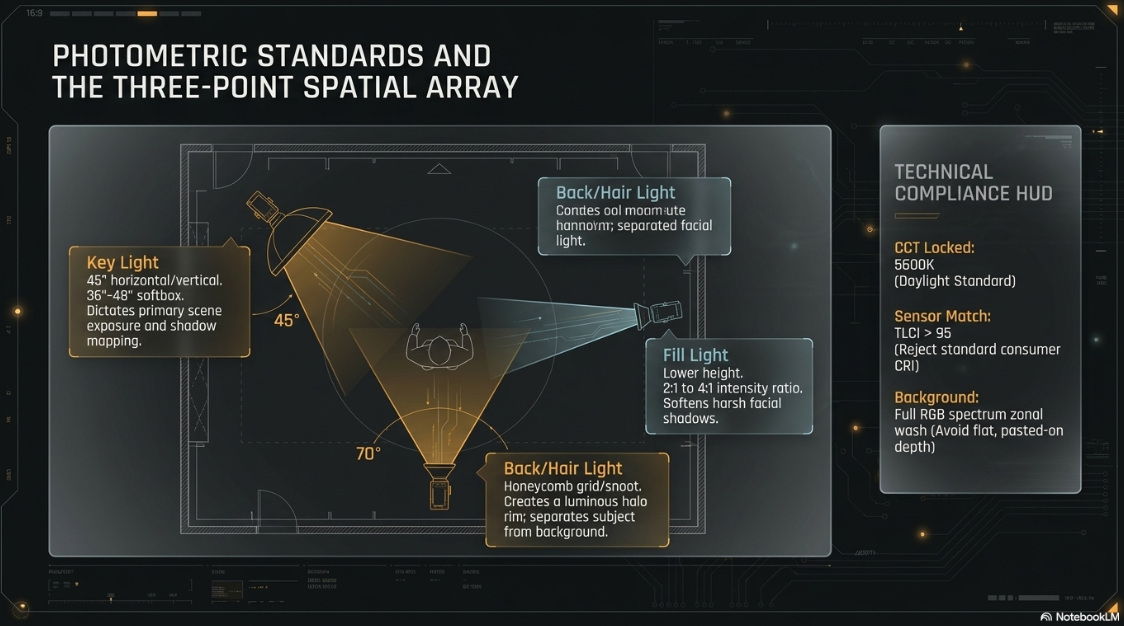
Modern video podcasting has transitioned away from hot, inefficient tungsten and fluorescent fixtures to advanced LED ecosystems1. These fixtures offer high output, adjustable color temperatures, and low power draw1. However, standard consumer metrics like the Color Rendering Index (CRI) are insufficient for professional video, as they were designed around human eye perception and fail to accurately measure the R9 (red) spectral values critical for skin tone reproduction12. Instead, broadcast engineers utilize the Television Lighting Consistency Index (TLCI), which calculates the exact color response when light interacts with a standardized digital CMOS sensor12. The TM-30 standard provides even more granular data, scoring color fidelity (

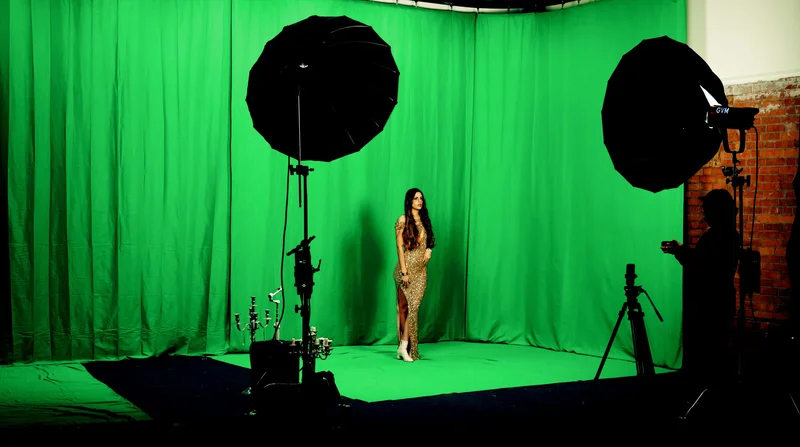
The physical layout of standard studio lighting is anchored on the classic three-point setup1. The key light acts as the primary source of illumination, typically positioned at a forty-five-degree angle to the subject and forty-five degrees up1. This dictates overall exposure and establishes directional shadows, defining the facial structure1. The fill light is placed on the opposite side of the key light at a lower intensity to soften harsh shadows without removing dimensional depth1. The back or hair light is positioned behind the subject, outside the camera frame, striking the shoulders and back of the head1. This creates a luminous rim that separates the subject from the background, which is essential for a cinematic aesthetic1.
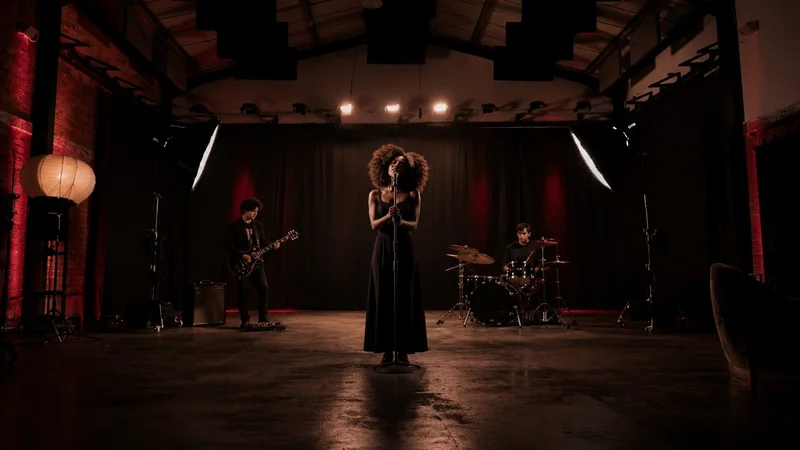
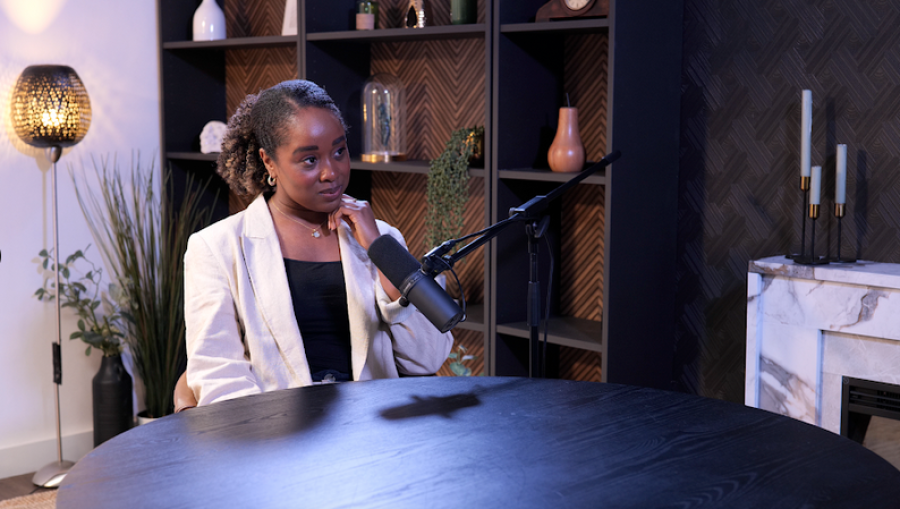
For professional background design, designers integrate zonal atmosphere lighting, indirect lighting, and practical props to add depth18. Projecting soft, diffused color tones using full-color RGB LED panels onto background walls or textures creates visual separation and helps avoid a flat, pasted-on look18. Color psychology is utilized to establish sub-conscious connections; cool tones like blue or purple evoke contemplative atmospheres, while warm tones like orange or yellow cultivate cozy environments18.
Acoustic Design and the Capture of High-Fidelity Audio
Despite the rapid integration of high-definition video, podcasting remains fundamentally an audio-first medium1. Viewers will routinely tolerate mediocre video quality if the content is compelling, but they will immediately abandon a stream afflicted by distorted, echoing, or unbalanced audio1. To master execution, one must understand the fundamental physics of the medium: acoustic audio is the propagation of mechanical wave energy through a compressible medium, most commonly atmospheric air19. Room acoustics dictate the boundaries of what post-production can achieve, meaning that physically reducing background noise through acoustic room treatment and sound-absorbing panels improves quality far faster and more permanently than any software or hardware upgrade1.
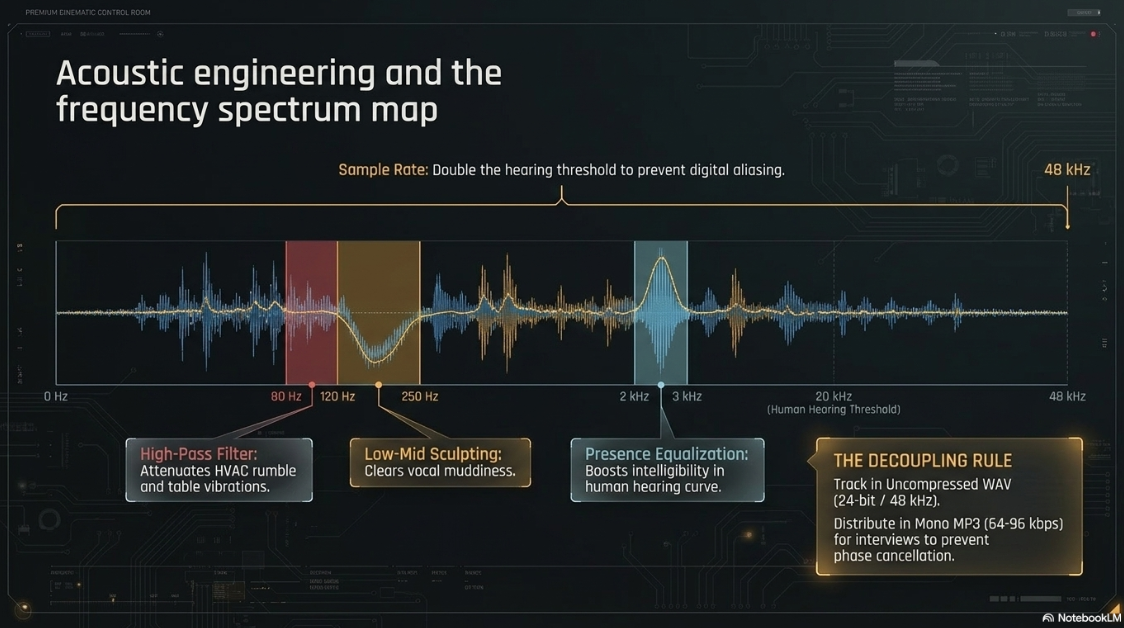
Professional spoken-word audio tracking must occur at a sample rate of 44.1 kHz or 48 kHz, paired with a bit depth of 24-bit to maximize dynamic range and maintain extensive headroom before the final mix is dithered down to a 16-bit format for distribution19. Because the threshold of human hearing extends up to approximately 20 kHz, the sample rate must be at least double this frequency to prevent digital aliasing19. A fundamental rule of podcast engineering is to decouple the production format from the distribution format19. Tracking, editing, and mixing must occur using uncompressed WAV files, preserving the highest possible fidelity throughout the digital signal processing chain19.
The spatial configuration of the podcast must align with its narrative intent19. Mono (monaural) audio consolidates all acoustic data into a single channel, meaning the listener hears the exact same signal in both ears, preventing phase cancellation issues during playback19. For interview podcasts, any stereo tracks must be split and mixed down to mono19. Once the mix is finalized, spoken-word shows should be exported as a Mono MP3 at a Constant Bit Rate (CBR) of 64 kbps to 96 kbps, while music-heavy or immersive narrative shows should be exported as a Stereo MP3 at 128 kbps to 192 kbps19.
Hardware selection must prioritize professional-grade dynamic microphones, such as the Shure SM7B, Shure SM7dB, or Sennheiser e945, over high-sensitivity condenser models19. Dynamic microphones are naturally less sensitive to distant room reflections and background noise, and their tight cardioid or supercardioid polar patterns actively reject off-axis room acoustics19.
To capture clean signals, hosts and guests must position their mouths between two and six inches from the microphone, angling the capsule at forty-five degrees to the face to allow fast-moving plosive air bursts (such as 'p' and 'b' sounds) to bypass the capsule, eliminating pop artifacts and mouth clicks7.
For processing, engineers utilize a structured signal flow consisting of:
High-Pass Filtering: Cutting frequencies below 80 Hz to 120 Hz to eliminate physical rumble7.
Presence Boosting: Elevating the 2 kHz to 3 kHz range to enhance vocal intelligibility7.
Low-Mid Sculpting: Attenuating the 100 Hz to 250 Hz range to clear up vocal muddiness and boomy resonance7.
Dynamic Range Compression: Applying a 3:1 ratio with a fast attack and moderate release to balance levels2.
-
Subsequent Bouncing: Writing heavily processed tracks down to raw WAV files to relieve the computer CPU of real-time digital signal processing (DSP) calculations, preventing playback stuttering and timeline crashes19.
Cinematic Videography: Camera Systems, Lensing, and Blocking Staging
Selecting appropriate camera systems depends on the operational model, budget, and desired visual aesthetic1. While flagship smartphones (such as the iPhone 11 Pro and above, or Samsung Galaxy S20 and newer) offer 4K recording capabilities, dedicated mirrorless hybrid systems or compact cinema cameras, such as the Sony FX3, Sony A7IV, or Canon C70, remain the standard for premium productions1. These cameras feature large, full-frame image sensors that produce a shallow depth of field, keeping the host in sharp focus while pleasantly blurring the background1. This optical isolation instantly elevates the perceived production value1.
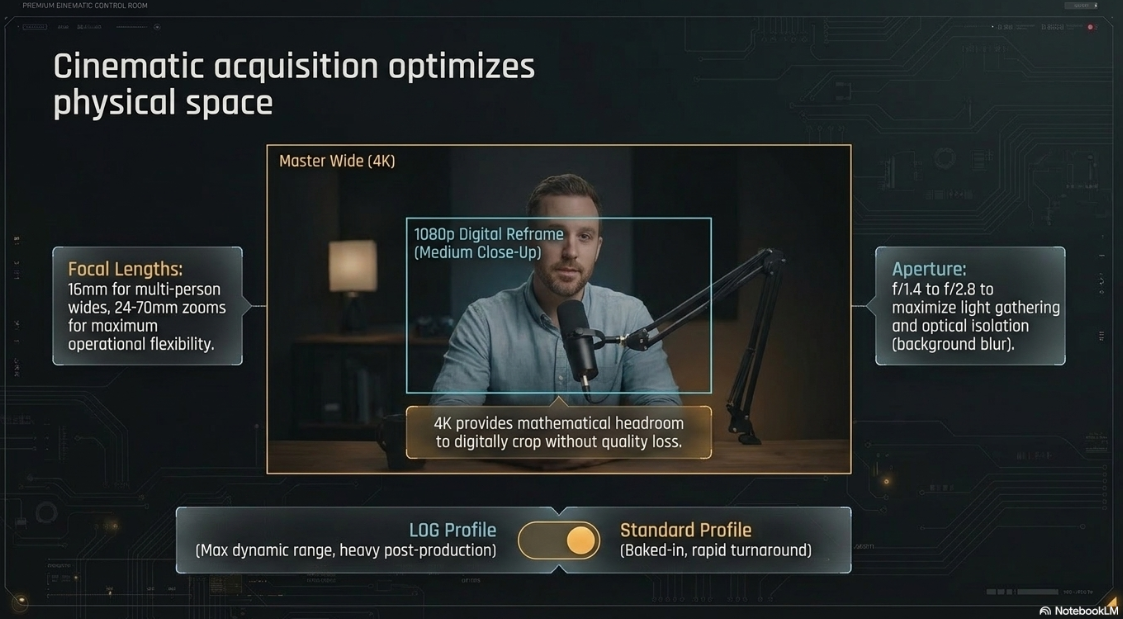
Lenses are equally vital to visual quality1. Versatile zoom lenses with focal lengths between 24mm and 70mm provide operational flexibility, while wide-aperture prime lenses (f/1.4 to f/2.8) maximize light-gathering capabilities and enhance the background blur effect1. When choosing a lens, make sure it is interchangeable with the camera platform, utilizing wider focal lengths down to 16mm to capture all participants in multi-person sets22.
Acquiring raw footage in 4K resolution is standard operating procedure, even if the final delivery format is 1080p high-definition1. Filming in 4K provides editors with the crucial mathematical ability to digitally reframe, crop, zoom, and punch in on subjects in post-production without any perceptible loss of quality1. This effectively allows a single static 4K camera to act as both a wide establishing shot and a medium close-up, maximizing production efficiency in limited spaces1.
Furthermore, production teams must choose between shooting in a flat LOG profile or a baked-in standard profile17. A flat LOG profile preserves maximum dynamic range and color information, providing maximum flexibility for cinematic color grading, though it demands more post-production time17. Standard profiles are faster and easier to export, making them suitable for rapid turnaround, frequent content release schedules, and productions with limited post-production pipelines17.
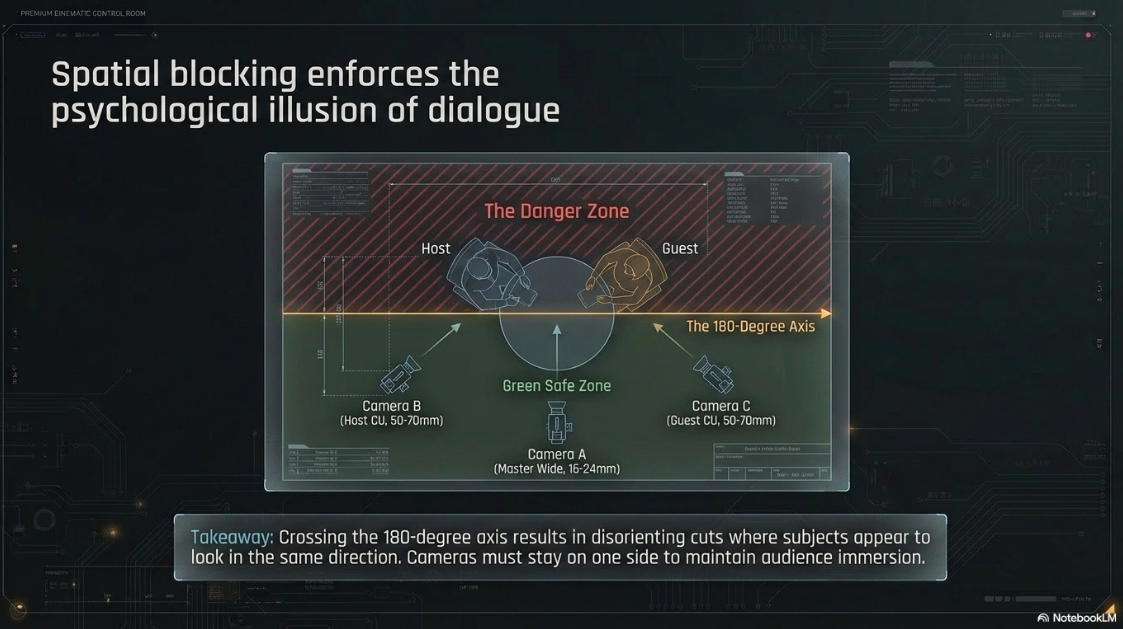
Camera blocking and staging organize physical space in relation to the lens23. Staging two-person sets typically utilizes three distinct cameras to capture the dialogue dynamically17. The systems and angles are categorized in the table below.
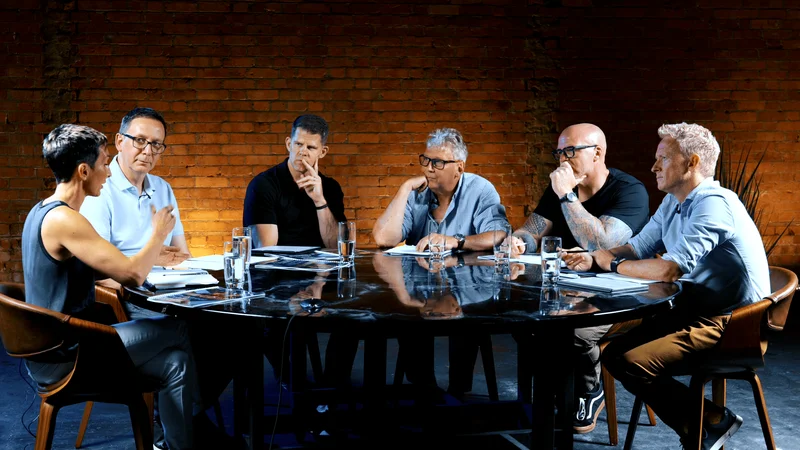
Staging errors can break audience immersion and make a professional production look amateur23. One common error is "flat staging," where the host and guest are placed on the exact same physical plane, equidistant from the camera, resulting in a flat, two-dimensional appearance23. Productions should introduce depth and levels, utilizing foreground objects, placing subjects at slightly varied distances from the camera, and positioning seats along diagonal axes23.
Another common error is ignoring eyelines and screen direction23. Cameras must strictly adhere to the 180-degree rule, which dictates that an imaginary straight line connects the two subjects23. All camera placements must remain on one side of this line23. Crossing this axis results in disorienting cuts where the subjects appear to be looking in the same direction rather than at each other, breaking the psychological illusion of real-time face-to-face conversation23.
Finally, camera movement must always be motivated23. Unmotivated tracking, zooming, or panning feels arbitrary and distracts the viewer23. To add polished kinetic energy, productions can integrate motorized sliders or remote-controlled PTZ cameras1. These systems provide slow, programmed movements that maintain visual engagement during long conversational segments without requiring additional camera operators on the studio floor1.
Tapeless Acquisition, Hardware Switching, and Temporal Synchronization
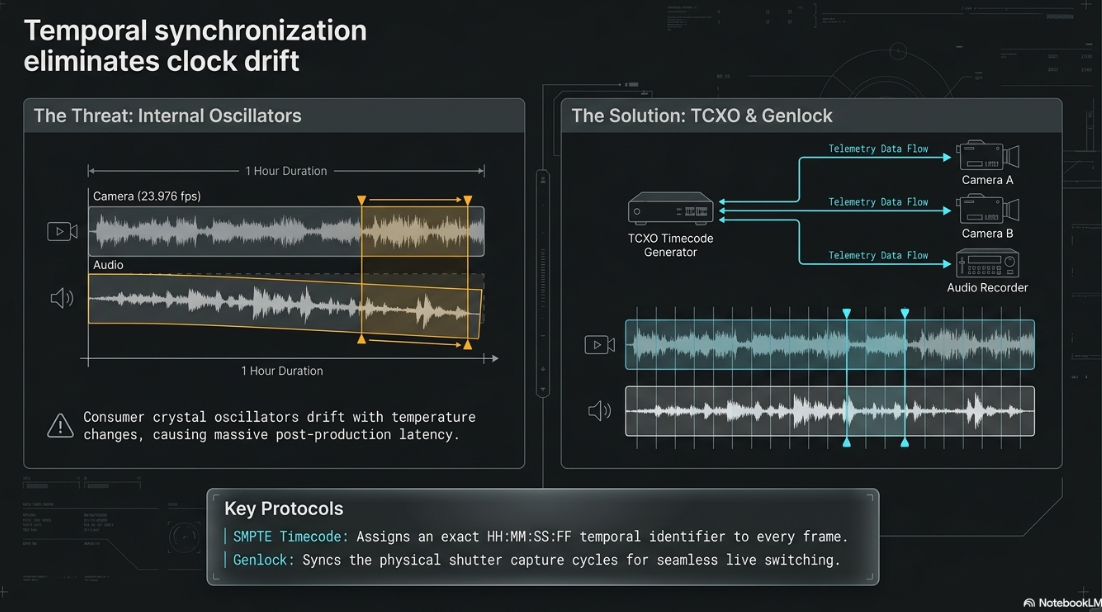
In multi-camera videography, media synchronization is a critical technical factor25. When multiple cameras and audio systems record independently, they write separate files with mismatched start times28. In post-production, manual alignment or standard audio waveform matching introduces significant latency and editing costs28.
Furthermore, standard camera internal clocks are highly susceptible to drift, particularly during long recording sessions28. Because consumer-grade cameras use simple internal crystal oscillators that fluctuate with temperature changes, one camera recording at 23.976 frames per second and an audio recorder operating on a different clock can drift apart by several frames over an hour-long recording, resulting in noticeable audio-to-video desynchronization28.
To mitigate clock drift and streamline post-production, professional studios deploy SMPTE Timecode protocols29. SMPTE timecode assigns a unique temporal identifier to each frame of video and audio in the format of hours:minutes:seconds:frames29. Multi-camera productions utilize external high-precision timecode generators built around Temperature-Compensated Crystal Oscillators (TCXO)29.
These compact generators are "jam-synced" to a master clock and attached to each camera and audio recorder, maintaining frame-accurate synchronization over forty-eight hours29. For cameras lacking dedicated timecode input ports, the generator can output the timecode as an audible signal recorded onto an unused audio track29. This audio timecode is later converted into metadata during post-production to instantly align the timeline29.
For live broadcast and high-end studio applications, genlock is used alongside timecode26. While timecode ensures that frames share identical timestamps, genlock synchronizes the physical shutter and sensor capture cycles of all cameras, ensuring frame-perfect alignment during live multi-camera switches26.
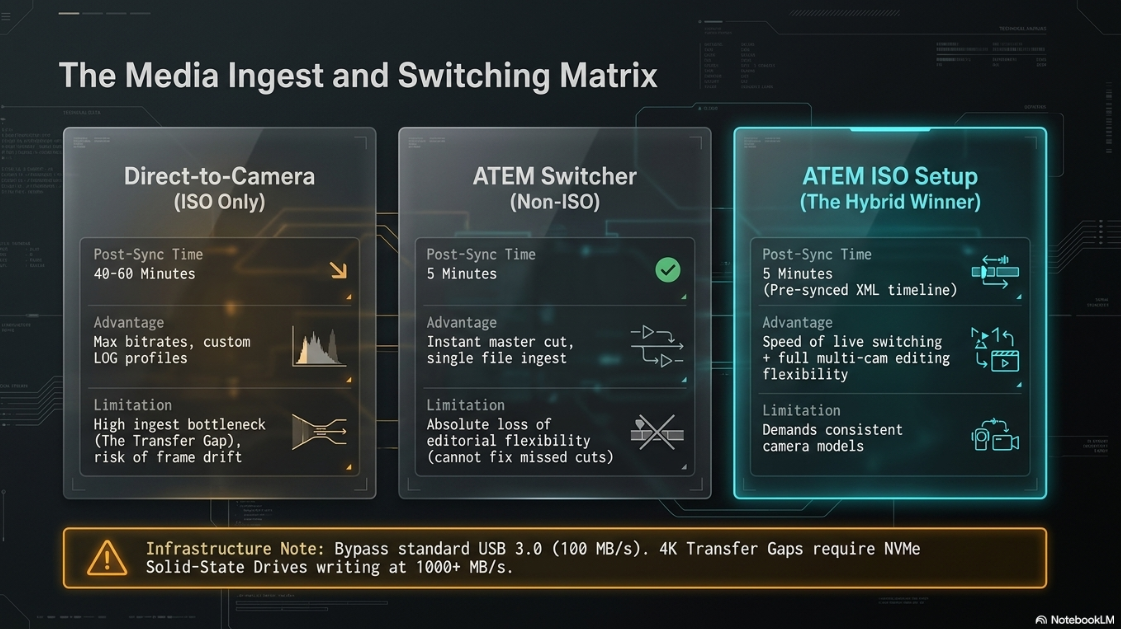
Producers must also choose between direct-to-camera ISO recording and hardware live switching25. Direct-to-camera workflows require extracting physical media cards from each system and manually ingesting several large video files28.
For 4K productions, this creates a major data bottleneck, known as the "transfer gap"6. Recording a two-hour session across three 4K cameras generates between 100 GB and 300 GB of raw media6. Moving this data via standard USB 3.0 storage drives running at 100 MB/s requires nearly an hour6.
To minimize this bottleneck, production teams must use high-speed NVMe solid-state drives writing at 1000 MB/s, reducing the transfer gap to mere minutes6.
The integration of advanced multi-camera switchers, such as the ATEM Mini Pro ISO or ATEM Mini Extreme ISO, has transformed these workflows1. These devices connect all camera inputs via HDMI or SDI, allowing a technical director to live-switch the angles in real-time to generate a nearly finished master cut by the end of the recording session25.
Importantly, "ISO" switchers simultaneously record the individual, unedited camera feeds alongside the switched master program file onto a single external SSD, generating a pre-synchronized DaVinci Resolve or XML timeline project file1. This combines the speed of live switching with the creative flexibility of multi-camera post-production, allowing editors to easily correct missed cuts or adjust pacing28.
Post-Production Integration: Editorial Grammar, Signal Compliance, and Platform Delivery
The visual language of a video podcast is built upon a standard nomenclature of shot sizes and descriptions3. A Close-Up (CU) frames the face from the forehead to the chin, capturing micro-expressions with intense intimacy3. A Medium Close-Up (MCU) frames the subject from the chest up, balancing facial expression with natural body language3. A Medium Shot (MS) frames from the waist up, establishing the subject's relationship with the immediate set environment3.
The videography editor acts as the final gatekeeper, discarding compromised media to protect the integrity of the project3. Focus is the singular technical factor that cannot be artificially corrected in post-production; soft-focus footage contains no latent data to recover and must be discarded3.
The editing workflow follows a structured, linear progression to prevent data mismanagement and creative bottlenecks:
Acquisition: The ingestion of raw media files, external audio, and graphics3.
Organization: Rigorous metadata management, bin structures, and ISO 8601 formatting3.
Assembly: Arranging selected clips into a chronological sequence to build the narrative skeleton3.
Rough Cut: Establishing pacing, testing narrative flow, and removing visual filler3.
Fine Cut: Making micro-adjustments to frame timing to ensure seamless transitions3.
Picture Lock: The critical milestone where sequence timing and clip durations are locked, and finishing begins3.
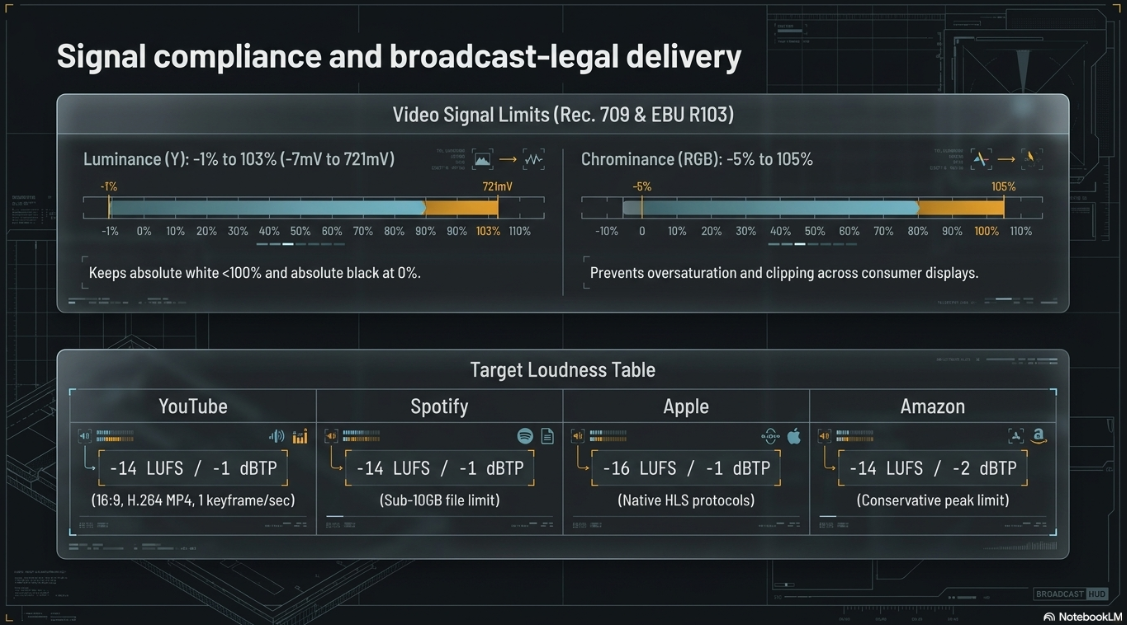
During color grading and technical finishing, the video signal must conform to Rec. 709-5 and EBU R103 standards to guarantee broadcast-legal compliance3. On hardware scopes, Luminance (
For final distribution, standard video podcasts must conform to precise technical parameters to ensure compatibility with Apple Podcasts, Spotify, and YouTube1. Widescreen files must be delivered in H.264 MP4 format with a locked 16:9 aspect ratio, targeted at a bitrate of 25 Mbit/second for 1080p and 35 Mbit/second for 4K1. The Group of Pictures (GOP) size must be set to approximately one keyframe per second to ensure stable playback scrubbing across platforms1.
Platform-specific target loudness levels and peak requirements must be strictly maintained, as summarized in the table below.
When repurposing long-form footage into short-form vertical assets (9:16 aspect ratio) for social media, designers must follow strict visual safe zones to avoid text obstruction1.
The Top Band (150 to 200 pixels high) must remain free of graphic information, as it is routinely obscured by platform usernames, audio labels, and device status bars1.
The Right Edge (approximately 120 pixels wide) is covered by native interactive icons, including likes, comments, and shares1.
The Bottom Area (250 to 300 pixels deep) is blocked by native platform captions and Call to Action buttons, requiring critical visual elements and subtitle graphics to be centered within a clean, unobstructed middle frame1.
Technical Conclusions and System Design Blueprint
The execution of a professional video podcast requires transitioning from a fragmented, manual approach to a highly integrated, automated broadcast system6. High-quality video podcasting is achieved through strict operational standards during pre-production, production, and technical finishing1. The following strategic recommendations are provided for media teams establishing professional digital broadcast pipelines:
Implement High-Precision Synchronization (TCXO & Genlock): To prevent post-production latency and eliminate audio-to-video drift, do not rely on standard internal camera clocks28. Multi-camera setups must utilize TCXO-based external timecode generators to write matched SMPTE timecode to all recording devices29. For live multi-camera switched environments, genlock must be deployed to synchronize the camera sensor capture cycles, ensuring frame-perfect transitions26.
Transition to ISO Live-Switching Switchers: To reduce post-production turnaround times, media teams should replace direct-to-camera workflows with hardware-based live switchers like the ATEM Mini Extreme ISO28. These systems capture synchronized individual isolated video tracks and master program files directly to a single SSD, generating an instantly editable XML or DaVinci Resolve timeline that eliminates manual alignment1.
Mandate Spectral and Photometric Standards: Avoid relying on casual visual inspection for studio illumination12. Studio environments must be designed as hybrid micro-soundstages, specifying lights with a TLCI of 95 or higher to avoid color casts12. Correlated Color Temperature must be locked to 5600K, and lighting designs must utilize the Inverse Square Law to manage light fall-off and dual-layer diffusion, ensuring even exposure across multi-camera angles12.
Standardize Data offloading and the Media Pipeline: To eliminate the transfer gap when offloading large, high-bitrate 4K files, studio workflows must bypass standard USB 3.0 storage media6. Production kits must require high-speed NVMe solid-state drives writing at a minimum of 1000 MB/s6.
Enforce Platform Loudness and Signal Limits: Technical finishing must strictly conform to platform loudness guidelines1. Spoken-word programs must be calibrated to -16 LUFS for Apple Podcasts and -14 LUFS for Spotify and YouTube, maintaining true peak levels at -1 dBTP to prevent digital clipping across consumer devices1. Finally, luminance and chrominance signals must be mapped to Rec. 709 and EBU R103 broadcast limits before final platform delivery3.
Works cited
Video Execution of a Professional Podcast - Finchley Studios, https://www.finchley.co.uk/finchley-learning/visual-podcast/video-execution-of-a-professional-podcast
Audio Engineering in a Professional Podcast Post-Production - Finchley Studios, https://www.finchley.co.uk/finchley-learning/visual-podcast/audio-engineering-in-a-professional-podcast-post-production
Video Engineering in a Professional Podcast Post-Production - Finchley Studios, https://www.finchley.co.uk/finchley-learning/visual-podcast/video-engineering-in-a-professional-podcast-post-production
Strategic Pre-Production for a Professional Podcast - Finchley Studios, https://www.finchley.co.uk/finchley-learning/visual-podcast/strategic-pre-production-for-a-professional-podcast
How to Prepare for Your First Recording Studio Session: A Complete Checklist, https://www.finchley.co.uk/finchley-learning/visual-podcast/how-to-prepare-for-your-first-recording-studio-session-a-complete-checklist
Your Local London Podcast Studio Solution: Professional Audio & Video Studio Facilities in the North - Finchley Studios, https://www.finchley.co.uk/finchley-learning/visual-podcast/your-local-london-podcast-studio-solution-professional-audio-video-studio-facilities-in-the-north
A Day in the Life: What Happens During a Session at Our Podcast Studio London?, https://www.finchley.co.uk/finchley-learning/a-day-in-the-life-what-happens-during-a-session-at-our-podcast-studio-london
Storyboarding for Successful Videography Editing Projects - Finchley Studios, https://www.finchley.co.uk/finchley-learning/storyboarding-for-successful-videography-editing-projects
Cinematic Videography Ideas: Turning Concepts into Stunning Creations - Finchley Studios, https://www.finchley.co.uk/finchley-learning/cinematic-videography-ideas-turning-concepts-into-stunning-creations
Essential Videography Techniques for Fashion Content Creators - Finchley Studios, https://www.finchley.co.uk/finchley-learning/essential-videography-techniques-for-fashion-content-creators
The Art of Videography Editing Techniques for Visual Storytelling - Finchley Studios, https://www.finchley.co.uk/finchley-learning/the-art-of-videography-editing-techniques-for-visual-storytelling
The Comprehensive Architecture of Video Podcast Studio Lighting - Finchley Studios, https://www.finchley.co.uk/finchley-learning/visual-podcast/the-comprehensive-architecture-of-video-podcast-studio-lighting
Article: Lighting fundamentals - KitPlus, https://kitplus.com/articles/lighting-fundamentals/1314
How to Master the Three-Point Lighting Setup | No Film School, https://nofilmschool.com/3-point-lighting
Maximize Your Visual Impact: The Importance of Lighting in Video & Photo Projects - Viva Studios, https://vivastudios.ca/blog/visual-impact-lighting-video-photo-projects
Stage lighting overview & guide | igus® Engineer's Toolbox, https://toolbox.igus.com/motion-plastics-blog/stage-lighting-overview-guide/
Professional Podcast Equipment | CVP, https://cvp.com/explore/podcasting
Podcast Background Lighting Ideas: Add Ambiance & Depth to Your Studio - GVM, https://gvmled.com/podcast-studio-lighting-guide/
Audio Execution for a Professional Podcast - Finchley Studios, https://www.finchley.co.uk/finchley-learning/visual-podcast/audio-execution-for-a-professional-podcast
Best Podcast Equipment in 2026: What to Buy at Every Budget - Riverside, https://riverside.com/blog/podcast-equipment
Everything you need for a video podcast setup - Videomaker, https://www.videomaker.com/how-to/shooting/camera-equipment/everything-you-need-for-a-video-podcast-setup/
Camera Movement and Blocking: Master Visual Story - BlockReel DAO, https://blockreeldao.com/blog/the-definitive-guide-to-camera-movement-and-blocking
Film Blocking Masterclass: Elevate Your Visual Storytelling - YouTube, https://www.youtube.com/watch?v=OMd7pQM7HLU
Your Multi Camera Podcast Setup: A Pro-Level Guide, https://flexworkstudios.com/multi-camera-podcast-setup/
Optimizing a Multi-Camera Setup for Seamless Video Production - Ikan International, https://ikancorp.com/optimizing-multi-camera-setup/
(Reading) Recommendations for Camera Blocking / Scene Design - Roger A. Deakins, https://www.rogerdeakins.com/forums/topic/reading-recommendations-for-camera-blocking-scene-design/
Why Recording Direct-to-Camera Is a podcast Post-Production Nightmare (And How to Avoid It), https://www.podcaststudioglasgow.com/podcast-studio-glasgow-blog/why-recording-direct-to-camera-is-a-podcast-post-production-nightmare-and-how-to-avoid-it
Mastering Timecode: Sync Your Audio and Video Like a Pro - PodcastVideos.com, https://www.podcastvideos.com/timecode-audio-video-sync-guide/
Timecode for Multiple Cameras - Deity Microphones, https://deitymic.com/blog/timecode-for-multiple-cameras/
Professional Equipment for Audio and Video Recording - VOXPOD Studio, https://voxpod.studio/equipment/
Podcast Marketing for a Professional Show - Finchley Studios, https://www.finchley.co.uk/finchley-learning/visual-podcast/podcast-marketing-for-a-professional-show