The High-Value Hybrid Landscape and Market Economics
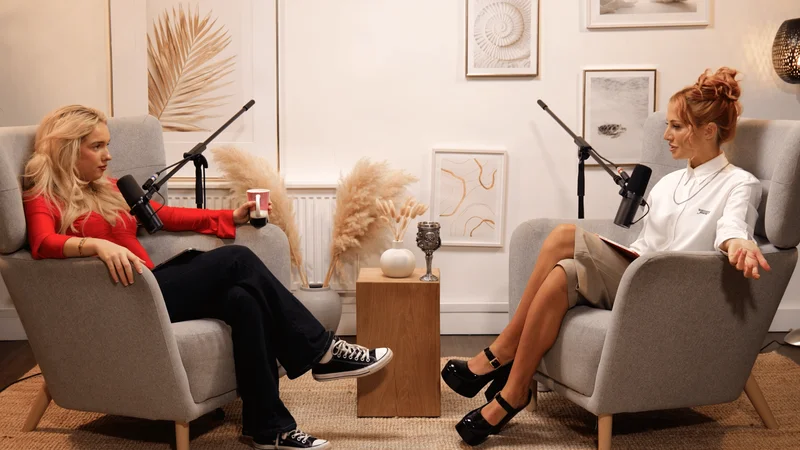
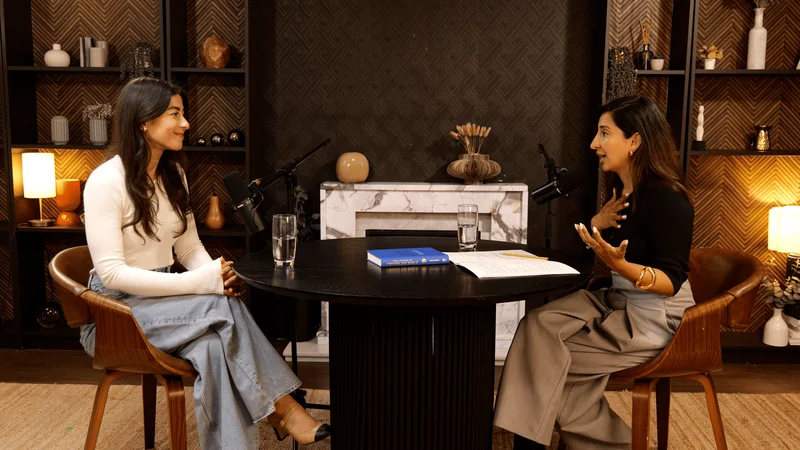
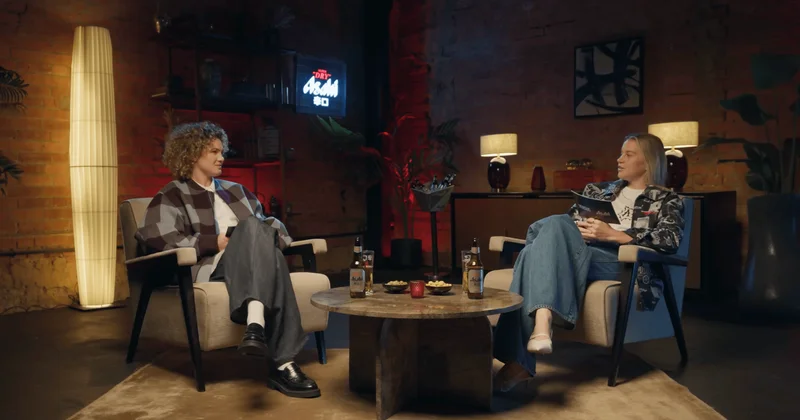
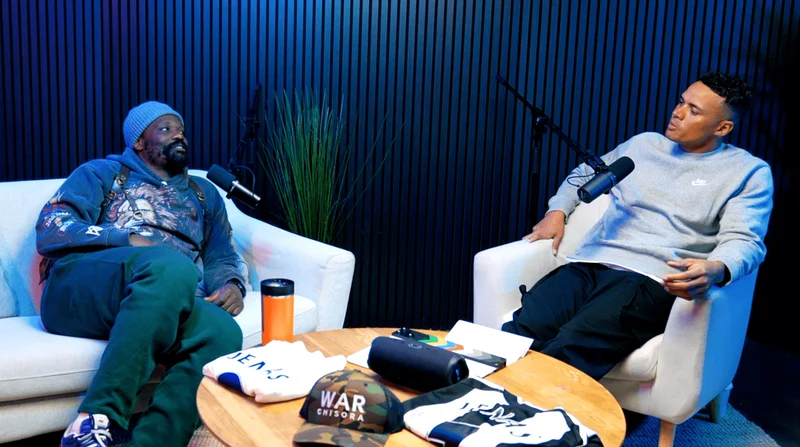
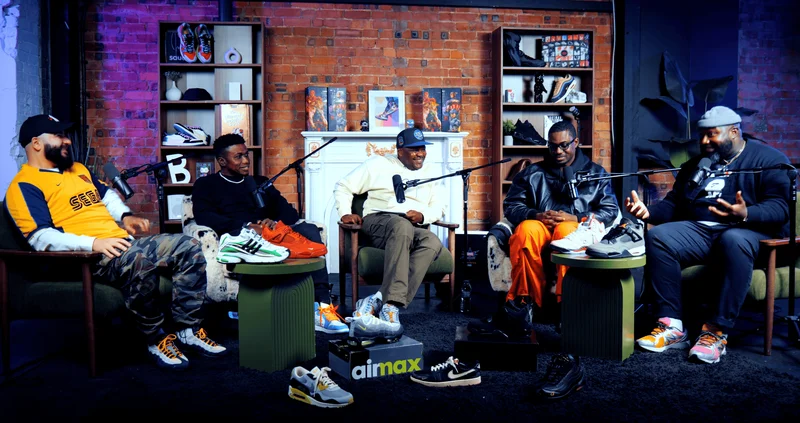
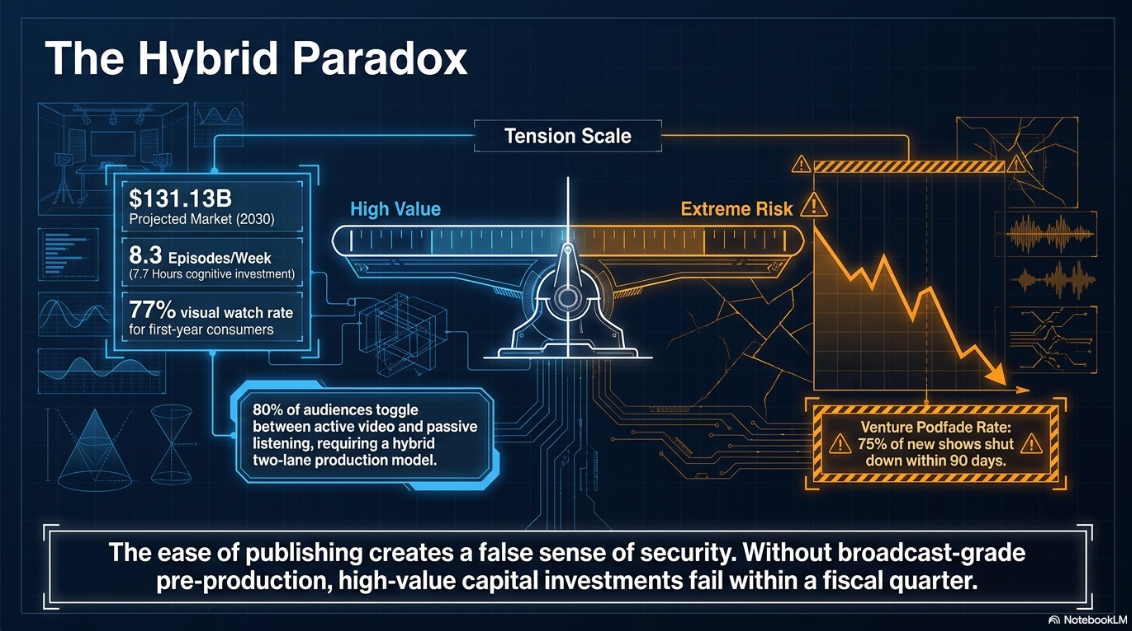
The digital media landscape has undergone a major transition, shifting long-form spoken-word content from basic audio recordings into highly engineered visual assets1. Visual podcasts are now a key driver of modern media consumption, challenging traditional television programming and capturing substantial living room audiences3. Demographic analyses indicate that the global podcast market is projected to expand from an estimated $39.63 billion in 2025 to a staggering $131.13 billion by 20304. This rapid growth is supported by shifts in audience behavior, particularly on home streaming devices3. Approximately 34% of visual podcast consumers stream episodes via Netflix, 30% utilize Amazon Prime Video, and 11% access shows through Apple TV3. This migration to large-format, high-definition displays requires media properties to adopt strict broadcast-quality technical, acoustic, and visual standards to maintain viewer retention3.
Audience research reveals a hybrid, multi-lane consumption pattern where an estimated 80% of consumers toggle between active video viewing and passive listening depending on their immediate physical environment3. This shift highlights a clear distinction between new consumers ("First-Years") and established fans ("Longtimers")3. While established listeners may rely on traditional RSS feeds, 77% of newer audiences actively watch the video feed while listening, indicating that visual integration is central to audience acquisition3.
This intentionality makes podcasting a valuable corporate tool3. Long-form audio and video require a deliberate decision from the user to press play, resulting in highly attentive audiences5. Highly engaged weekly listeners consume an average of 8.3 episodes per week, representing roughly 7.7 hours of dedicated listening time5. For B2B marketing and corporate operations, this sustained cognitive investment provides an effective avenue to clarify complex value propositions and build deep brand authority3.
Despite these opportunities, the ease of publishing has created a hyper-competitive space where approximately 75% of new shows experience "podfade" and shut down within 90 days5. To protect ongoing capital investments and prevent creative bottlenecks, organizations must treat production not as a casual experiment, but as a professionally managed media property governed by a comprehensive pre-production phase3.
The Stage-Gate Governance Model and Go/No Go Decision Gates
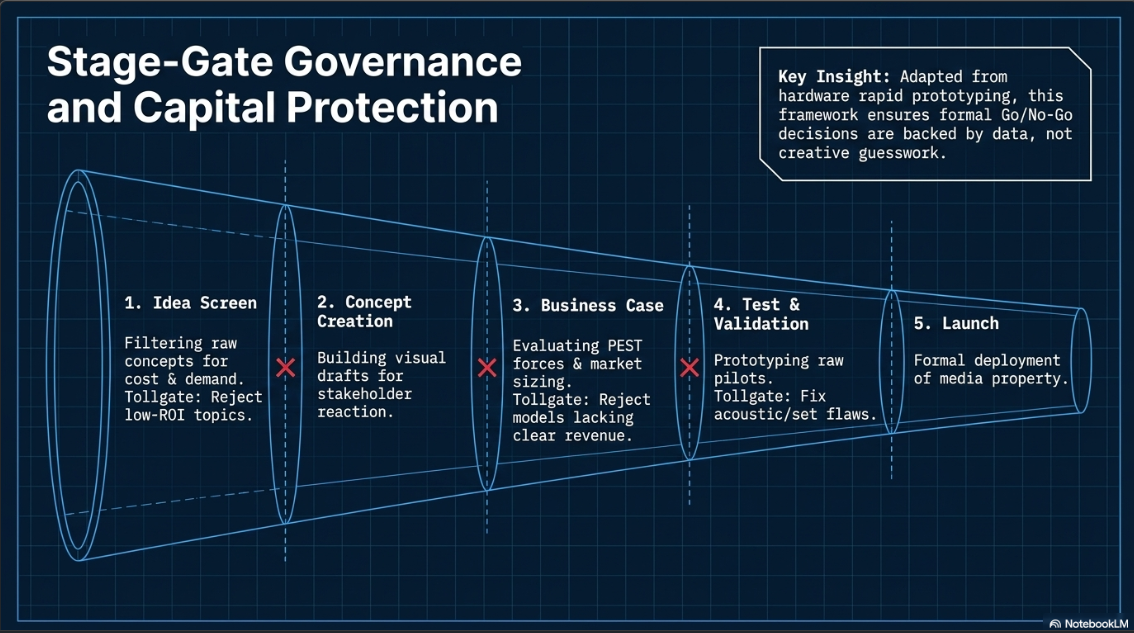
To mitigate high production overhead and protect organizational capital, professional media teams use a "Go/No Go" testing framework adapted from hardware rapid prototyping and stage-gate product development methodologies9. This framework screens out unviable concepts before significant resources are committed11.
┌─────────────────┐ ┌───────────────────┐ ┌─────────────────┐ ┌─────────────────────┐ ┌──────────────┐
│ 1. Idea Screen ├────>│2. Concept Creation├────>│3. Business Case ├────>│4. Test & Validation ├────>│ 5. Launch │
└─────────────────┘ └───────────────────┘ └─────────────────┘ └─────────────────────┘ └──────────────┘
The first phase, the Idea Screen, filters down a large pool of brainstorming concepts based on production cost-effectiveness and audience demand11. Concepts that pass this screen enter Concept Creation, where they are built into visual drafts to test initial audience and stakeholder reactions11.
The third phase is the Business Case, which evaluates market sizing, competitive dynamics, PEST forces, and revenue potential11. To justify production costs, organizations choose between three main commercial strategies:
The "Build" Strategy: Developing a proprietary podcast channel for long-term thought leadership8.
The "Borrow" Strategy: Leveraging the reach of existing shows by booking executives as guests8.
The "Buy" Strategy: Sponsoring established programs to reach specific target audiences8.
The fourth phase is Product Development and Prototyping, where raw pilot episodes are recorded and tested in focus groups10. This moves directly into Test and Validation, which runs a structured pre-production pilot with a larger test audience11.
This phase allows the production team to identify technical issues, test set designs, and verify that the content meets standard legal guidelines11. This stage-gate process ensures that the formal "Go/No Go" decision is backed by solid research rather than creative guesswork, helping avoid costly post-production mistakes10.
Strategic Branding, Narrative Architecture, and Cognitive Touchpoints
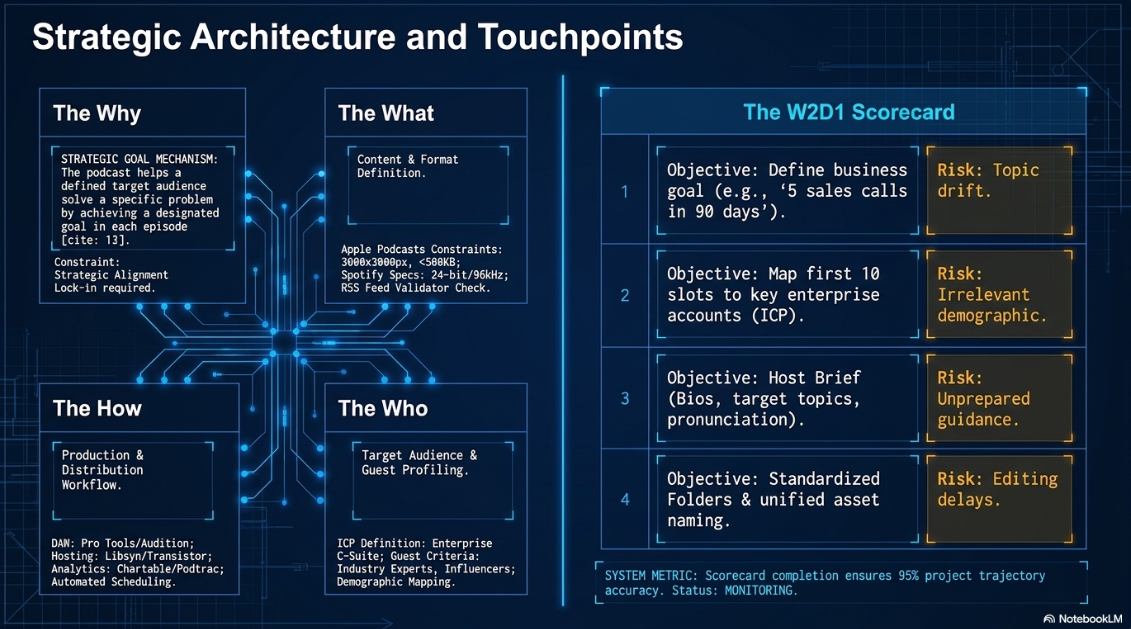
A professional podcast requires a clear strategic thesis to guide content choices and prevent topic drift13. Formulating this thesis requires answering four foundational questions:
The "Why": The clear business or brand objective behind the program13.
The "What": The specific, high-value information provided to the audience13.
The "How": The technical and structural plan to deliver that value13.
The "Who": The target audience profile and competitive landscape13.
Producers use this strategic foundation to draft an internal podcast mission statement13. This statement acts as a guide for episode topics, guest selection, and promotional assets13. The statement uses a standardized semantic structure:

Visual branding, acoustic styling, and naming structures establish the show's overall identity13. Cover art must meet strict platform requirements, particularly Apple Podcasts' guidelines for a square image measuring 

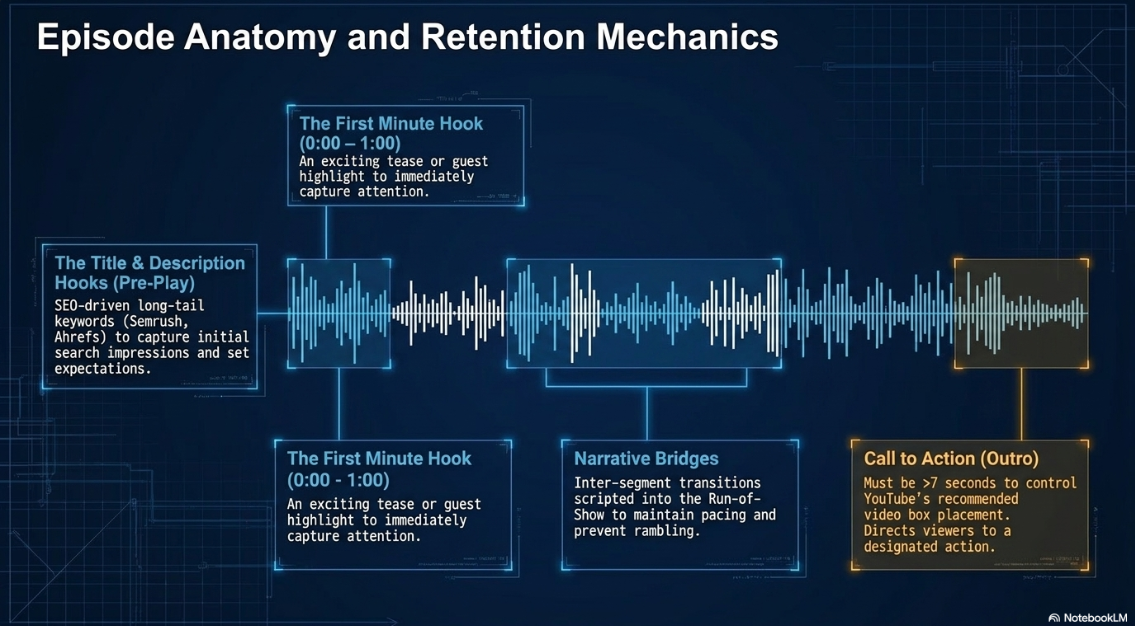
To generate relevant episode topics, teams shift away from simple intuition and use data-driven keyword research13. Using SEO platforms (such as Semrush, Ahrefs, Moz, or Google Keyword Planner), producers identify long-tail search queries and content gaps within their niche13. Individual episodes are mapped out using a structured rundown to prevent rambling and maintain clear pacing7.


Maintaining a consistent release schedule is critical to building a loyal audience and driving organic discoverability13. To keep up with this schedule, organizations use content batching, recording multiple episodes over a few consecutive days13. Additionally, the editing workflow should follow a strict three-round amendment process to ensure reviews are completed on time without delaying the release16.
Environmental Physics, Acoustic Control, and Electro-Acoustic Capture
Acoustics is the study of mechanical sound wave propagation through atmospheric air20. Managing room acoustics and technical capture settings is essential, as poor recording quality is a primary reason audiences abandon shows3.
Applied Room Acoustics
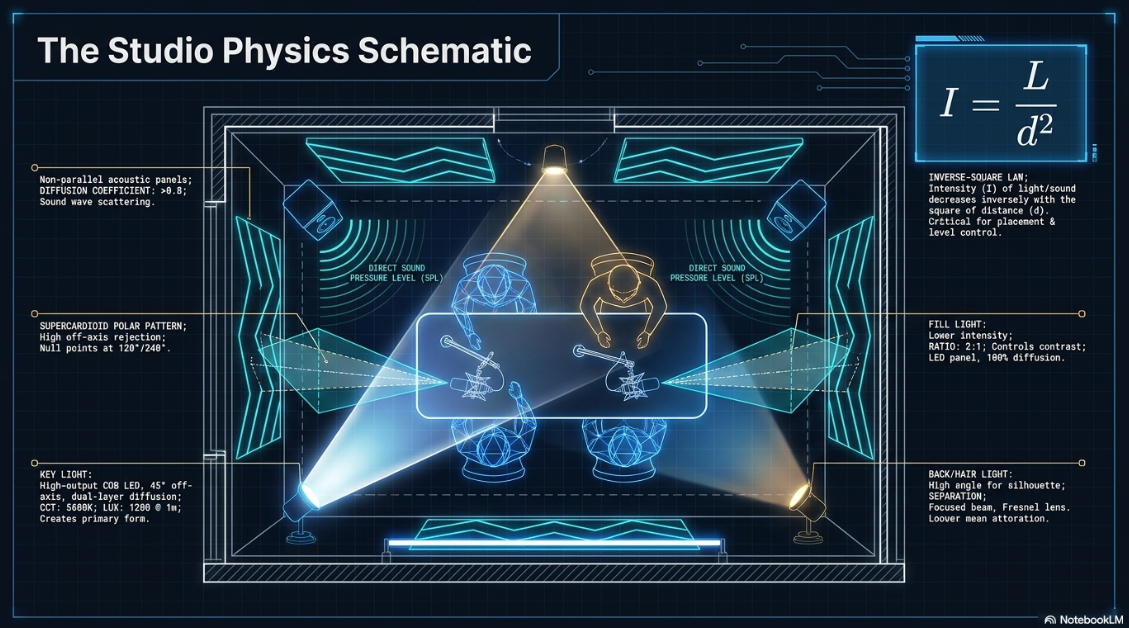
Unmanaged reflections off parallel walls, hard floors, and ceilings create flutter echoes and phase interference20. Pre-production acoustic design aims to capture dry, direct vocal signals by minimizing these reflections20.
Rooms with non-parallel surfaces help scatter sound waves20. Installing acoustic foam panels, bass traps, and heavy drapes helps absorb high- and mid-frequency reflections19. In temporary or home setups, heavy area rugs and soft furniture can help isolate the recording environment19.
To bypass environmental noise, productions use dynamic microphones (such as the Sennheiser e945) rather than highly sensitive condenser microphones20. Dynamic microphones require higher sound pressure levels to engage, meaning they ignore distant background noises like HVAC hums or street traffic20. Using supercardioid or hypercardioid polar patterns ensures high off-axis rejection, picking up only the speaker directly in front of the capsule20. Microphones should be mounted on spider shock mounts to decouple the capsule from physical desk vibrations20.
Digital Audio Capture Standards
To capture clean, professional audio, technical directors must establish standard recording guidelines before hitting record20:
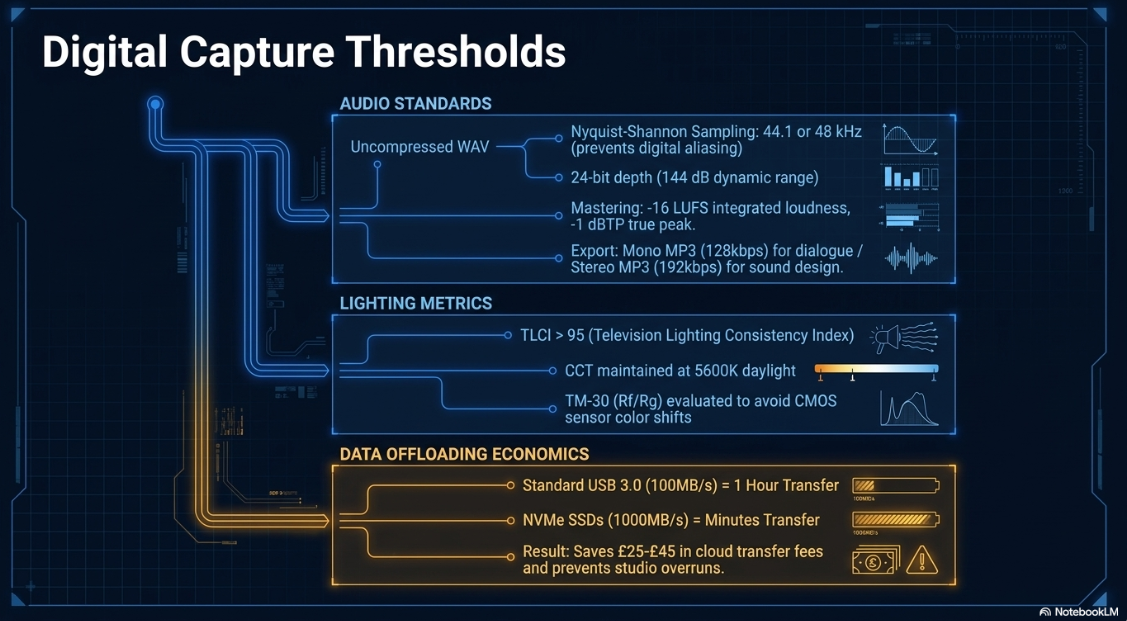
Uncompressed WAV Recording: Spoken-word dialogue should be captured in uncompressed WAV format20. Using compressed formats (like MP3) introduces lossy compression artifacts that compound when equalizers and compressors are applied in post-production20.
Nyquist-Shannon Sampling: The sampling rate must be at least double the highest frequency of human hearing to prevent digital aliasing20. Standard spoken-word tracking uses a sample rate of

Bit Depth and Headroom: Tracking at a


Post-Production DSP Management: Applying heavy processing (such as dynamic range compressors, equalizers, and surgical noise reduction) increases CPU load20. To optimize system performance, engineers bounce heavily processed tracks to raw, consolidated WAV clips to prevent playback errors20.
Distribution Formatting: For final delivery, spoken-word files are converted to Mono MP3s at a Constant Bit Rate (CBR) between


Mastering Specifications: Stereo masters must target an integrated loudness of


Photometrics, Colorimetry, and Multi-Camera Lighting Design
In confined studio environments, managing lighting photometrics is essential to achieving a clean, cinematic look on camera3. Illuminance behaves according to the Inverse-Square Law22:

This formula states that the physical illuminance (


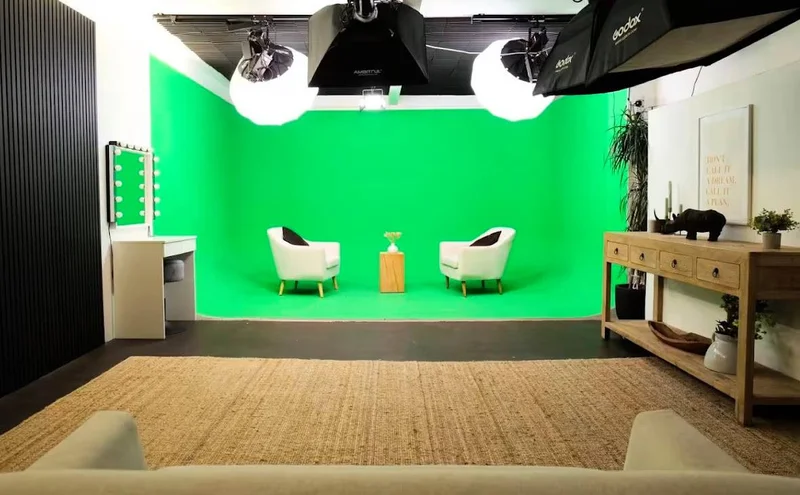
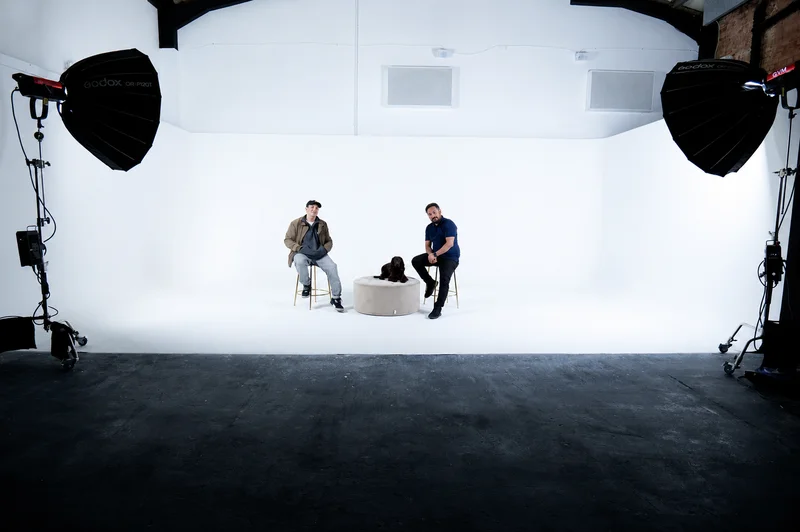
To manage this, cinematographers use dual-layer diffusion techniques22. By placing different layers of diffusion fabric over a single high-output source (such as a Nanlite 120B), engineers can "cheat" the Inverse-Square Law22. Applying denser diffusion over the half of the light striking the closer subject, and a lighter grid diffusion over the half striking the further subject, balances exposures across both participants22.
High-end video production uses several standard metrics to evaluate color rendering and performance:
Color Rendering Index (CRI): Historically used to measure how accurately a light source reproduces color relative to human visual perception, scored out of

Television Lighting Consistency Index (TLCI): The modern standard for digital broadcast22. TLCI uses software modeling to calculate how a light source's spectrum interacts with a digital camera's CMOS sensor22. Professional studios require fixtures with a TLCI rating of

TM-30 Metrics: This standard evaluates both color fidelity (


Spectral Similarity Index (SSI): Scores how closely a light source matches a reference standard22.
Correlated Color Temperature (CCT): Measures the color temperature in degrees Kelvin (


Professional multi-camera spaces rely on the standard Three-Point Lighting geometry to build depth3:

Guest Management Frameworks and Diagnostic Pre-Interviewing
An interview-based program relies heavily on its guest workflow7. Booking, briefing, and technical logistics must be managed through structured systems7.
Sourcing and Pre-Interviewing
Sourcing high-value guests begins with the "Dream 200 Model" to identify industry leaders and subject-matter experts who align with the show's strategic thesis6. Initial outreach must be professional and concise, clearly outlining the theme of the show, estimated recording times, and the value proposition for the guest7.
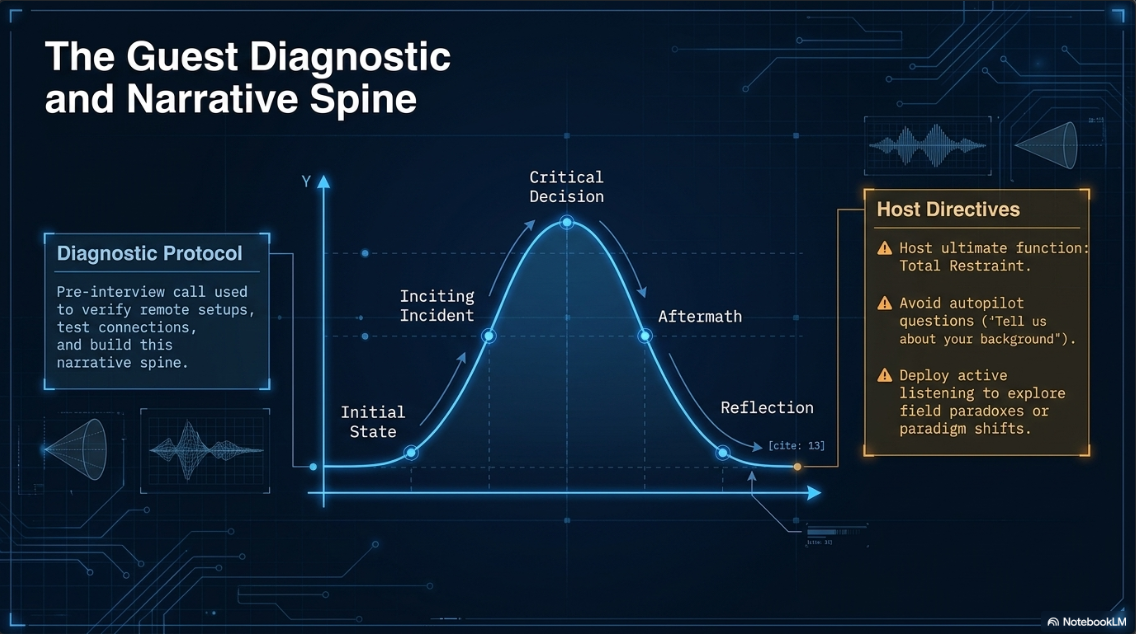
Once a guest is booked, the producer schedules a brief pre-interview call7. This briefing serves as an essential diagnostic tool for both technical and creative prep7.
Technically, the call allows the team to verify the guest's remote setup—testing their microphone, camera angle, lighting, and internet connection before recording day7.
Creatively, the pre-interview helps the host identify the guest's strongest stories and build a detailed narrative structure7.
Building the Narrative Spine
The host should guide the guest through a structured "narrative spine" to extract an engaging, natural story13. This spine outlines five key chronological phases:

┌──────────────┐ ┌───────────────────┐ ┌───────────────────┐ ┌─────────────┐ ┌────────────┐
│1. Initial │────>│ 2. Inciting │────>│ 3. Critical │────>│4. Aftermath │────>│5.Reflection│
│ State │ │ Incident │ │ Decision │ │ │ │ │
└──────────────┘ └───────────────────┘ └───────────────────┘ └─────────────┘ └────────────┘
Hosts must avoid generic, standard questions (like "Tell us about your background"), which often trigger rehearsed, autopilot responses13. Instead, they should ask about specific events, paradoxes in the guest's field, or times they fundamentally changed their mind13. Hosts must practice active listening, challenging vague or abstract corporate answers by asking the guest to paint a clear picture of specific moments13. The host's goal is to elevate the guest, maintaining absolute restraint and keeping the focus on the guest's experience13.
Local Logistics, Physical Preparedness, and Studio Operations
A meticulous pre-production phase is an essential financial strategy to maximize the return on investment of a studio session7. Managing logistical risks prevents expensive delays during recording24.
Strategic Transport and Real-World Examples
Logistical planning must account for transportation volatility to avoid expensive overruns24. In major media hubs like London, transport delays can disrupt tight studio schedules24.
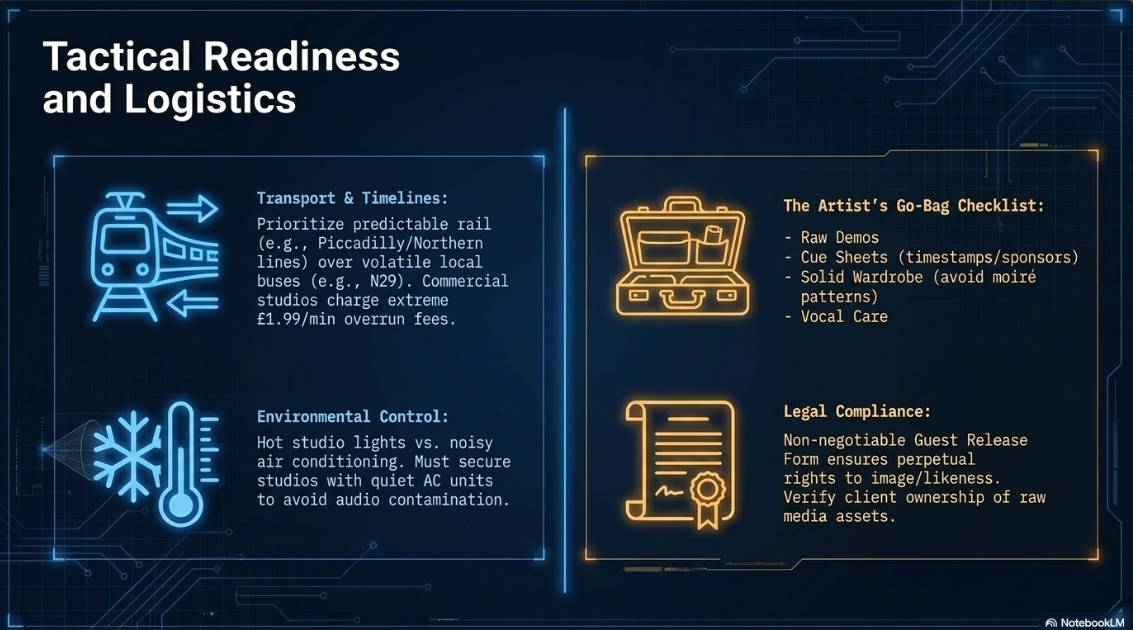
For example, when using North London facilities, rail routes are often more predictable than buses24. Taking the Piccadilly line to Wood Green or the Northern line to Finchley provides reliable timing, whereas relying on local bus routes (such as the N29 from Central London) can easily add 35 minutes or more due to traffic24.
Because high-end commercial studios charge strict overrun fees—with rates as high as £1.99 per minute—producers should advise guests to arrive 15 to 20 minutes early24. If participants are driving, parking should be pre-booked or arranged via parking applications (such as RingGo) to avoid last-minute delays24.
The Artist's Go-Bag Checklist
Production teams use an "Artist's Go-Bag" checklist to ensure all essential gear and materials are on hand for the shoot18:
Raw Demos & Reference Tracks: High-quality audio files and reference mixes to align on tone with the studio engineer18.
Structured Outlines & Cue Sheets: Printed scripts detailing segment timestamps, sponsor placements, and transition notes18.
Wardrobe Changes: Clean, solid-colored clothing options to avoid moiré patterns and visual conflicts on camera18.
Comfort and Vocal Care: Bottled water, throat lozenges, and personal items18.
Studio Comfort and Amenities
A comfortable guest gives a better interview, making on-site amenities an important factor in studio selection7. Small recording booths get hot quickly under studio lighting, making quiet, functional air conditioning essential24. Noisy air conditioning units can ruin audio tracks, forcing producers to choose between sweating under hot lights or capturing contaminated recordings24.
Producers should also research local amenities—such as independent cafes on Stroud Green Road in Finsbury Park—to serve as comfortable pre-show meeting spots24.
Legal Compliance and Asset Rights
Before recording begins, producers must collect a signed Guest Release Form from every participant24. This document grants the production team perpetual rights to use the guest's image, likeness, and voice across all media24.
Without this release, a guest can later request to have an episode taken down, risking the entire production investment24. Additionally, producers must verify the studio's contract terms to ensure the client retains complete ownership of the raw media assets24.
Data Management and Offloading
Managing large 4K files requires fast external storage to avoid transfer delays at the end of a session24. A standard two-hour multi-camera 4K shoot can generate $100\text{ GB}$ to $300\text{ GB}$ of raw data24. Transferring this over a standard USB 3.0 drive at $\approx 100\text{ MB/s}$ can take nearly an hour, extending booking times and increasing costs24.
To avoid these delays, production teams use high-speed NVMe SSDs (such as the Samsung T7 Shield) that write at $\approx 1000\text{ MB/s}$, reducing transfer times to minutes24. This also avoids extra cloud transfer fees, which can run between £25 and £4524.
Software Pipeline Orchestration and Editing Workflows
Choosing the right software stack helps streamline team workflows and reduce tool fatigue19. Research shows that 94% of corporate workers prefer a single unified platform over multiple scattered tools19.
┌─────────────────────────────────────────────────────────────┐
│ DESCRIPT ASSET ENGINE │
├────────────────────────────────┬────────────────────────────┤
│ 1. Logo & Captions Template │ Branding & Captions │
├────────────────────────────────┼────────────────────────────┤
│ 2. Autogenerated Captions Note │ Visual Disclaimer │
├────────────────────────────────┼────────────────────────────┤
│ 3. Outro Template (7+ Seconds) │ Retention / Outro CTA │
└────────────────────────────────┴────────────────────────────┘
To optimize the workflow, editors use distinct project templates in platforms like Descript before starting post-production15:
The Logo and Captions Overlay Template: Places the corporate logo in the top left or top right of the video frame, leaving the lower third open for automated captions15. This layout ensures captions remain visible on mobile feeds, where many users watch with the sound turned off15.
The Autogenerated Captions Note Template: Displays a brief visual notice near the start of the video, informing viewers that the captions are automatically generated15.
The Outro Template: Creates a visual outro that must be at least 7 seconds long15. This duration ensures that when YouTube displays recommended video boxes, they appear within the brand's own video space rather than switching to competitive content15.
Remote recording setups use platforms like Riverside to capture high-quality local files26. Editors export the "Full Frame AI" track from Riverside, which automatically toggles the visual focus to the active speaker15. This file is then imported into Descript for polishing and transcription15.
When cleaning up dialogue, editors must use filler-word removal tools carefully to keep the conversation sounding natural15. Rather than deleting words like "uh" or "um" from the audio track entirely—which can create unnatural jumps—editors use Descript's text correction tool15. This replaces filler words in the transcript and on-screen captions with blank space while keeping the original, continuous audio path intact15.
This structured integration of strategy, logistics, and software workflows ensures that every recording session runs smoothly, helping media properties scale consistently and build a loyal audience3.
Works cited
Audio Engineering in a Professional Podcast Post-Production - Finchley Studios, https://www.finchley.co.uk/finchley-learning/visual-podcast/audio-engineering-in-a-professional-podcast-post-production
Video Engineering in a Professional Podcast Post-Production - Finchley Studios, https://www.finchley.co.uk/finchley-learning/visual-podcast/video-engineering-in-a-professional-podcast-post-production
Video Execution of a Professional Podcast - Finchley Studios, https://www.finchley.co.uk/finchley-learning/visual-podcast/video-execution-of-a-professional-podcast
Your Actionable B2B Podcast Template Script For Success - Fame.so, https://www.fame.so/post/podcast-template-script
Podcast Marketing for a Professional Show - Finchley Studios, https://www.finchley.co.uk/finchley-learning/visual-podcast/podcast-marketing-for-a-professional-show
B2B Podcast Production Checklist: 10 Steps From Recording to Revenue, https://rise25.com/lead-generation/b2b-podcast-production-checklist/
A Day in the Life: What Happens During a Session at Our Podcast Studio London?, https://www.finchley.co.uk/finchley-learning/a-day-in-the-life-what-happens-during-a-session-at-our-podcast-studio-london
How London Brands Use a Podcast Studio for Marketing, https://www.finchley.co.uk/finchley-learning/how-london-brands-use-a-podcast-studio-for-marketing
video Execution of a Professional Podcast: The Pre-Production Phase, https://www.finchley.co.uk/finchley-learning/visual-podcast/video-execution-of-a-professional-podcast-the-pre-production-phase
Rapid Prototyping Services - Fresh Consulting, https://www.freshconsulting.com/services/hardware/rapid-prototyping/
Stage Gate New Product Development - B2B Frameworks, https://www.b2bframeworks.com/frameworks/stage-gate-new-product-development
Executing Zero Downtime Updates on Pega Cloud for Mission-Critical Apps, https://community.pega.com/blog/executing-zero-downtime-updates-pega-cloud-mission-critical-apps
Strategic Pre-Production for a Professional Podcast - Finchley Studios, https://www.finchley.co.uk/finchley-learning/visual-podcast/strategic-pre-production-for-a-professional-podcast
Planning Makes Perfect: 5 Podcast Pre-Production Tips from Wistia Studios, https://wistia.com/blog/podcast-pre-production-tips
10-Minute Podcast Editing Using Riverside.fm and Descript - MoreBusiness.com, https://www.morebusiness.com/podcast-editing-riverside-fm-and-descript/
A helpful guide to creating a successful business podcast - AMBITIOUS PR, https://www.ambitiouspr.co.uk/a-helpful-guide-to-creating-a-successful-business-podcast/
The Pre-Production Checklist B2B Teams Skip (and What It Costs) - W2D1 Media, https://w2d1.media/blog/pre-production-checklist/
How to Prepare for Your First Recording Studio Session: A Complete Checklist, https://www.finchley.co.uk/finchley-learning/visual-podcast/how-to-prepare-for-your-first-recording-studio-session-a-complete-checklist
Top 10 Podcast Collaboration Tools for Remote Production Teams - Content Allies, https://contentallies.com/learn/top-podcast-collaboration-tools
Audio Execution for a Professional Podcast - Finchley Studios, https://www.finchley.co.uk/finchley-learning/visual-podcast/audio-execution-for-a-professional-podcast
Podcast Production and Podcast Training - MIC media, https://micmedia.co.uk/podcast-services/podcast-training/
The Comprehensive Architecture of Video Podcast Studio Lighting - Finchley Studios, https://www.finchley.co.uk/finchley-learning/visual-podcast/the-comprehensive-architecture-of-video-podcast-studio-lighting
Podcast Production Template - B2B PodcastPros, https://b2bpodcastpros.com/podcast-production-template-597996/
Your Local London Podcast Studio Solution: Professional Audio & Video Studio Facilities in the North - Finchley Studios, https://www.finchley.co.uk/finchley-learning/visual-podcast/your-local-london-podcast-studio-solution-professional-audio-video-studio-facilities-in-the-north
A Content Management Tool Built For Podcasters w/ Northflow Co-Founders Fran and Taly Melo, https://thepodcasthaven.com/?podcast=northflow-a-content-management-tool-built-for-podcasters-w-northflow-co-founders-fran-and-taly-melo
Descript vs Riverside - Swell AI, https://www.swellai.com/blog/descript-vs-riverside
Descript vs. Riverside: Choose the Right Tool for Your Workflow - OpusClip Blog, https://www.opus.pro/blog/descript-vs-riverside
9 Essential Apps for Podcast Producers - Wistia Blog, https://wistia.com/learn/production/top-tools-for-podcast-producers
Questions on the Podcast production process - Reddit, https://www.reddit.com/r/podcasting/comments/14riwbe/questions_on_the_podcast_production_process/