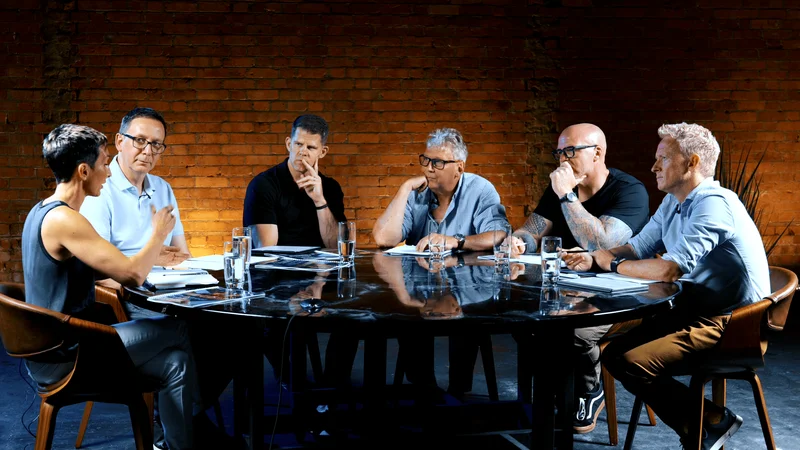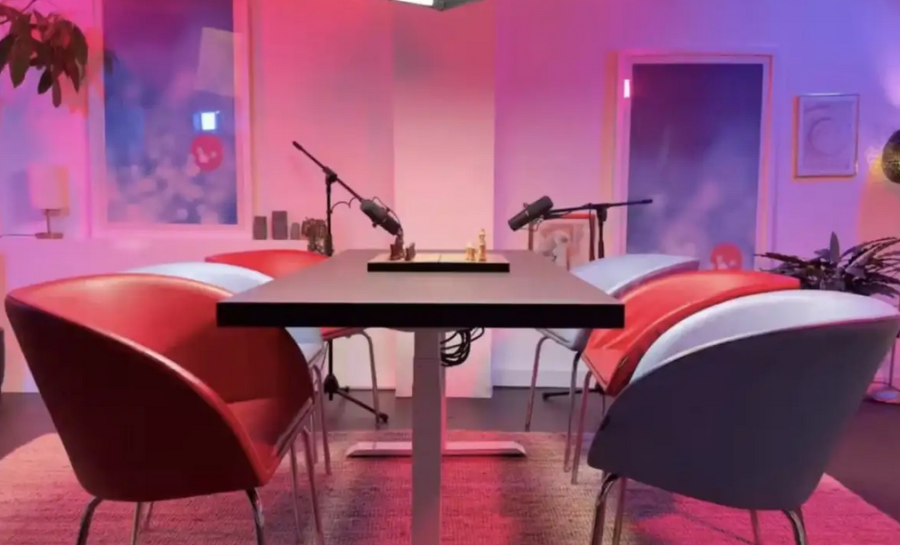
The execution of a professional podcast requires a fundamental deconstruction of modern media consumption paradigms, shifting away from the passive broadcasting models of the twentieth century toward the active, hyper-selective, and on-demand frameworks that define the digital era. By 2026, the medium of podcasting has matured from a decentralized, niche hobbyist community into a highly corporatized, multi-billion-dollar global industry characterized by advanced algorithmic distribution, cinematic production standards, and highly measurable audience engagement. Understanding the audience entails recognizing that the modern listener is not a captive recipient of a broadcast signal, but rather an active participant who willfully dedicates prolonged periods of deep cognitive attention to specialized subject matter. This audience utilizes spoken-word audio as a mechanism for continuous education, parasocial connection, and ambient companionship. Successfully navigating this landscape demands a granular comprehension of macroeconomic listener trends, the psychological drivers of audience retention, the strategic integration of audio into broader corporate marketing objectives, and an exhaustive mastery of the underlying hardware, software, and distribution technologies that power the modern podcast ecosystem.
What’s Happening: Growth and Trends
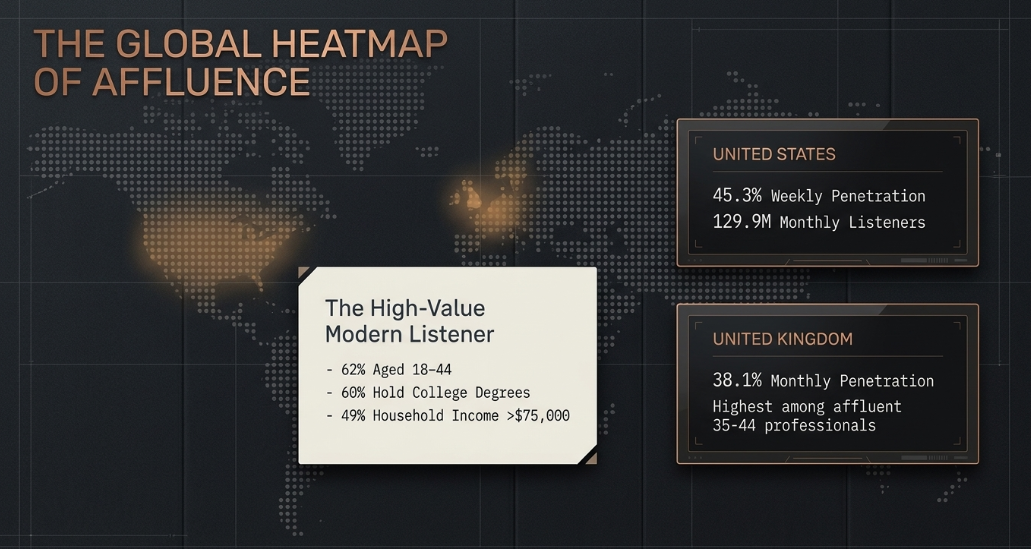
The trajectory of global podcast consumption continues to outpace historical media adoption curves, demonstrating sustained, robust expansion that is transitioning the industry from a period of hyper-growth into a phase of mature, compounding capitalization. The total global listener base reached 619.2 million individuals in 2026, reflecting a 6.01% year-over-year increase from 584.1 million in 2025.1 This macroeconomic trajectory is projected to continue, with forecasts anticipating a global audience of 651.7 million by 2027.2 The United States remains a foundational pillar of this industry, with 55% of the population aged 12 and older—approximately 158 million people—consuming podcast content on at least a monthly basis.3 More critically for advertisers, the weekly consumption metric in the U.S. has reached 45% of the population, effectively replacing older, lower baselines and signaling that podcast listening is now a habitual, weekly routine for nearly half of the American public.
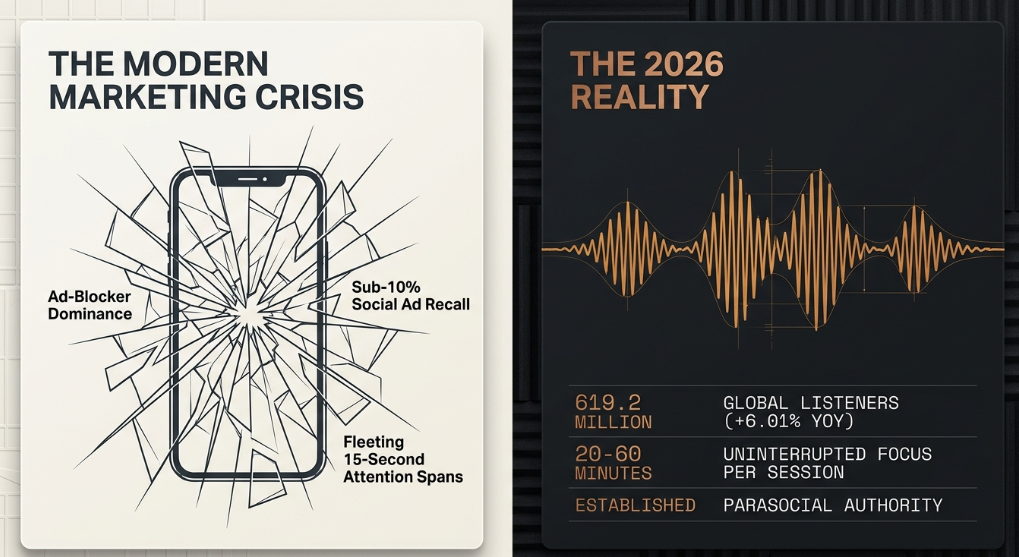
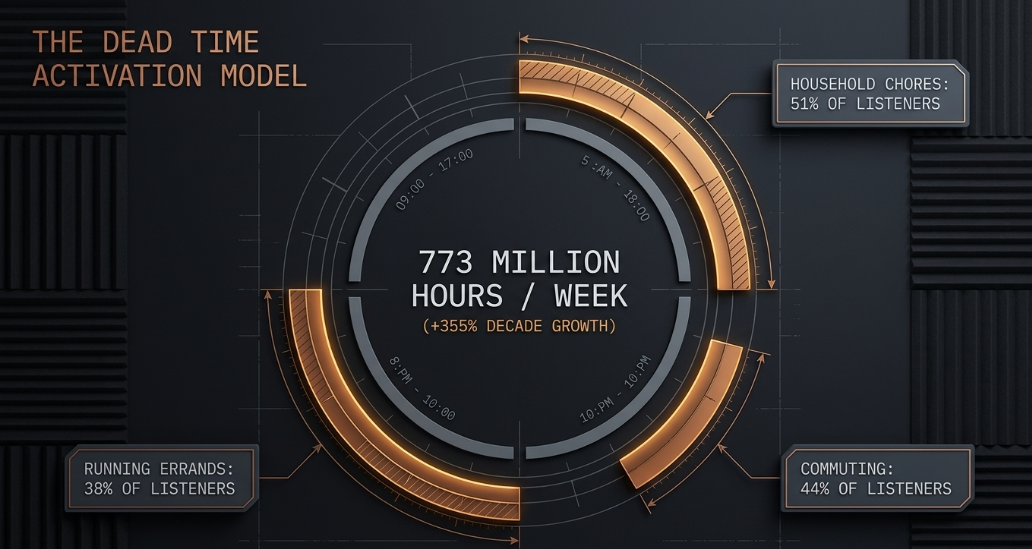
The expansion of the audience is not merely a function of population growth, but rather a structural shift in how media is consumed during previously unmonetizable hours. Total global listening time has expanded to an astonishing 773 million hours per week, representing a 355% growth over the past decade.1 This expansion is driven by the unique capability of audio to integrate seamlessly into the listener's daily routine without demanding visual exclusivity. Research indicates that 51% of listeners consume podcasts while performing household chores, 44% during daily commutes, 38% while running errands, and 27% while cooking.1 These statistics highlight the medium's unparalleled ability to capture "dead time," transforming routine physical tasks into highly engaged intellectual or entertainment experiences.
The geographical distribution of this audience reveals a rapidly globalizing medium. While North America traditionally dominated the sector, emerging markets and established European hubs command massive, dedicated listener bases.
Demographically, the podcast audience presents a highly lucrative target for enterprise brands, advertisers, and thought leaders. The medium skews heavily toward younger, affluent, and highly educated cohorts. In the United States, 62% of the audience falls within the 18–44 age bracket, 60% hold college degrees, and 49% report an annual household income exceeding $75,000.1 The United Kingdom market mirrors this trend of premium demographic concentration. Weekly reach in the UK is heavily concentrated among affluent professionals, with 30% of adults aged 35–44 tuning in weekly, establishing them as the highest-listening cohort, closely followed by 28% of adults aged 25–34.4 Conversely, podcast penetration remains lowest among older demographics, with only 12% of UK adults aged 65 and older consuming podcasts weekly, though this represents a gradual increase from previous years.
Content preferences are simultaneously evolving to reflect broader cultural shifts and the maturation of the format. Globally, listening share is led by Comedy at 33%, followed by True Crime at 19%, and News and Current Affairs at 14%.1 However, the emergence of the AI and Technology category, which now commands a 7% share, reflects a growing consumer appetite for specialized, professional knowledge.1
The platform ecosystem dictating how these audiences access content is currently undergoing massive disruption, fundamentally altering the definition of the medium. Historically, Apple Podcasts maintained a monolithic grip on the industry, relying entirely on open RSS architecture. However, by 2026, YouTube has emerged as the most disruptive player in the space. In the United States, YouTube commands a 33% share of podcast listeners, followed by Spotify at 26%, and Apple Podcasts trailing at 14%.2 When looking at preferred platforms, 42% of U.S. monthly podcast consumers identify YouTube as their platform of choice.6 This dominance highlights the most significant structural change in the industry: the transition to dual-format, video-first podcasting.
According to the 2026 Edison Infinite Dial report, 26% of Americans now both listen to and watch podcasts weekly, which is twice the number of those who consume audio exclusively (13%), and significantly higher than those who watch exclusively (6%).7 The integration of Google's podcast functionality into YouTube and YouTube Music has turned "vodcasts" into a mainstream format, growing YouTube's global podcast audience by 68% year-over-year.8 Audiences display a multi-modal pragmatism; they prefer video formats when at home on connected screens to deepen parasocial attachments through facial expressions and body language, but revert to audio-only formats when commuting, running, or multitasking.7 Consequently, podcasting is no longer an audio-exclusive medium; video has expanded the tent, forcing publishers to integrate high-quality visual production into their standard workflows.
How to Explain Podcasting to Your Clients
When translating the strategic value of podcasting to corporate clients, the narrative must immediately decouple podcast metrics from standard social media or short-form video advertising paradigms. Clients often mistakenly equate the success of a podcast with viral TikTok views or fleeting Instagram impressions, leading to fundamental misalignments in expectations. The core value proposition of a podcast is "earshare"—the percentage of total audio time a listener spends in deep, focused engagement with a brand's message over prolonged periods.9 A podcast listener typically spends 20 to 60 minutes with a single episode, generating an unmatched depth of attention that cultivates profound authority and long-term brand equity.10
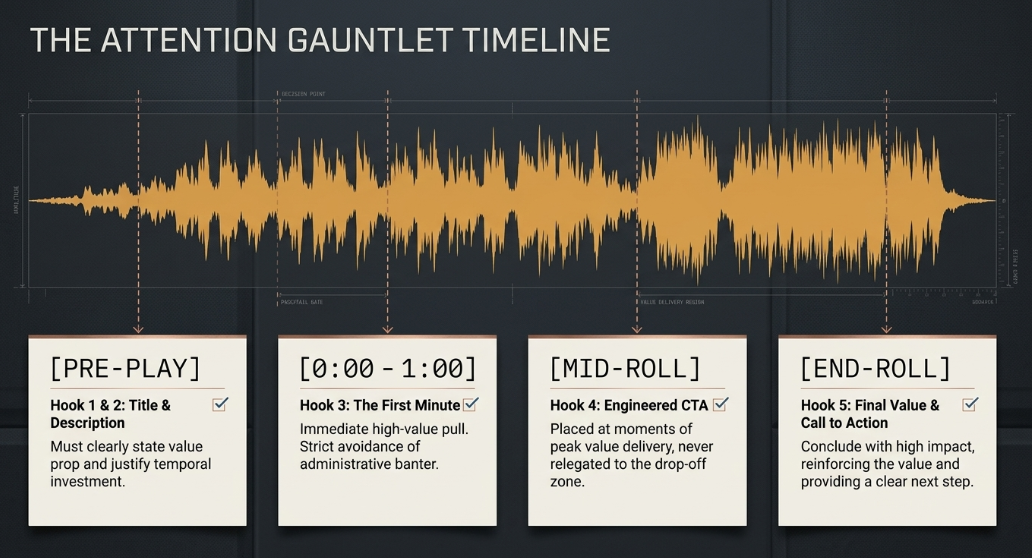
To effectively explain the mechanics of acquiring and retaining this attention, strategists utilize the "4 Hooks Framework." This framework breaks down the listener's journey through critical psychological decision points, ensuring that the episode successfully navigates the "gauntlet" of user attention. The first hook is the Title, which must immediately seize attention and clearly state the specific value proposition or outcome the listener will gain. The second hook is the Episode Description, which builds upon the title by providing contextual relevancy, establishing the stakes of the episode, and convincing the ideal listener that the content warrants a temporal investment. The third hook is the First Minute of the audio itself. This critical opening window must immediately affirm the listener's decision to press play by pulling them directly into high-value content, strictly avoiding prolonged, irrelevant banter or excessive administrative announcements. The fourth and final hook is the Call to Action (CTA). Rather than relegating CTAs to the very end of an episode—where listener drop-off naturally occurs—high-impact episodes engineer conversions by placing CTAs during moments of peak value delivery, such as immediately after a host outlines a tactical framework or resolves a core problem.11
For enterprise and B2B clients, Return on Investment (ROI) must be fundamentally reframed away from vanity metrics. Metrics such as broad download numbers or total subscriber counts are insufficient indicators of whether a show is generating meaningful pipeline revenue.11 Instead, clients must understand the "Two-Class ROI Framework," which measures both short-term relationship-driven ROI and long-term audience-driven ROI. Short-term ROI is achieved by utilizing the podcast as a high-level strategic networking platform. By inviting ideal target accounts, prospective corporate clients, or strategic referral partners as guests, a B2B podcast can achieve cash-positive status within its first year by closing just one or two major contracts resulting directly from these curated conversations.
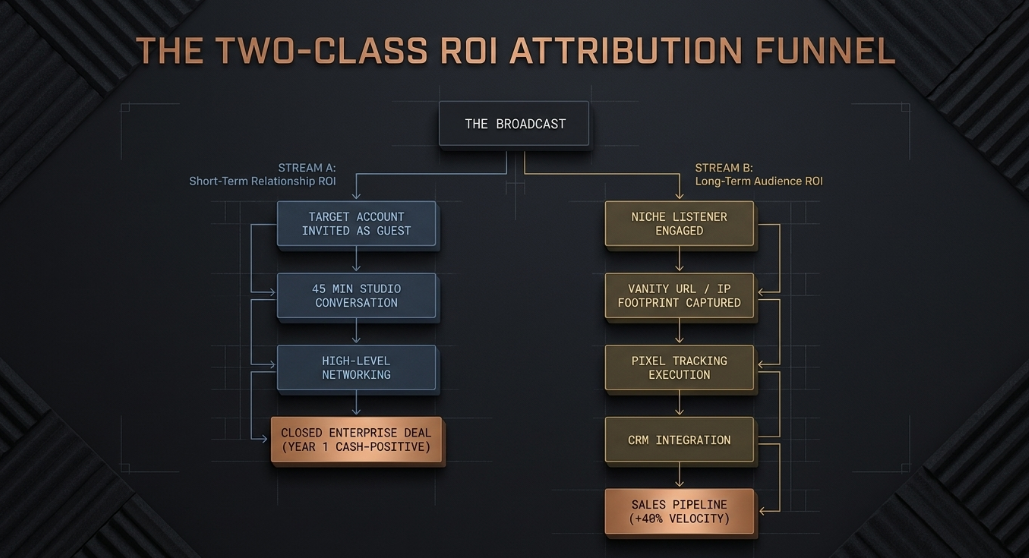
Long-term ROI is measured through an advanced attribution funnel that connects listener engagement directly to CRM systems. This requires moving beyond basic hosting analytics and implementing multi-touch attribution models. Sophisticated strategies capture digital footprints, track episode-specific vanity URLs, and utilize pixel-based tracking to measure how podcast exposure influences website activity.9 Evidence demonstrates that prospects who engage with a company's podcast progress through the sales pipeline up to 40% faster than non-listeners, as the necessary foundational trust has already been established through the parasocial relationship with the host.11
Furthermore, the advertising economics of podcasting underscore its premium nature. Host-read advertisements remain the most effective format in digital media, commanding premium CPMs (Cost Per Mille) ranging from $25 to $50, and up to $120 for top-tier titles, compared to programmatic dynamic ad insertions which sit between $15 and $25.16 This price delta is justified by measurable recall advantages: host-read ads generate a 60% to 70% ad recall rate—and sometimes up to 88%—dramatically outperforming programmatic insertions and absolutely eclipsing the sub-10% recall rates typical of social media feeds.9 Consumers explicitly find podcasts 23 times more trustworthy than social media platforms, viewing hosts as authentic experts rather than paid influencers, thereby granting brands a channel built on credibility rather than interruption.9
When to Use Podcasting
Podcasting is an exceptionally powerful operational tool when deployed under the right strategic conditions, specifically when a brand seeks to establish long-term thought leadership, build deep audience trust, and cultivate a community of highly targeted, niche listeners. A brand should invest in podcasting when its marketing architecture involves multi-year planning and relies on compounding frequency to capture market authority. Success in this medium depends on achieving consistent earshare, becoming a reliable, integrated component of a listener's weekly routine over multiple fiscal quarters.9
In B2B environments, podcasting is the optimal strategy when targeting high-value decision-makers. Rather than chasing millions of passive views, effective enterprise strategies focus precisely on the 5% of listeners who hold actual budget authority and purchasing power within specific industry verticals.11 The medium excels when complex products, nuanced services, or philosophical industry shifts require long-form explanation and educational deep-dives that cannot be effectively condensed into a 15-second social media reel or a static infographic.
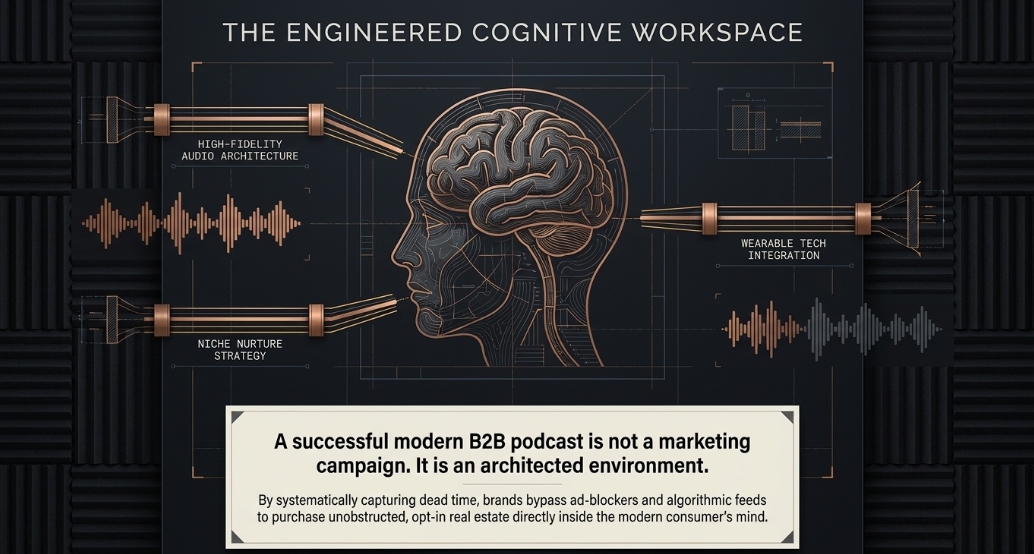
Podcasting should also be utilized when an organization wishes to elevate its internal subject matter experts—typically a CEO, founder, or lead researcher—into recognized industry thought leaders. In the modern digital economy, people follow human beings with distinct points of view, not faceless corporate entities.19 A podcast humanizes a brand, allowing executives to share personal stories, debate strong industry takes, and project clear expertise through their natural voice.19 Furthermore, it is the ideal medium for generating high-quality, zero-party qualitative data. Through advanced psychographic targeting and interactive integrations, organizations can map listener interests, values, and behavioral signals to inform broader corporate strategies.9 For brands targeting affluent, highly educated demographics who actively deploy ad-blockers and are historically resistant to traditional outbound marketing, podcasting provides an unobstructed, opt-in channel directly into the consumer's cognitive workspace.
When Not to Use Podcasting
Despite its profound advantages, podcasting is not a universal marketing panacea and is highly prone to failure if misapplied or misunderstood. Brands should absolutely not initiate a podcast if their primary, immediate objective is short-term, direct-response sales or rapid customer acquisition within a single financial quarter. Podcasting is fundamentally a top-of-funnel strategy designed for brand awareness and relationship building; attempting to utilize it as a mid-funnel or bottom-of-funnel direct sales mechanism inevitably transforms the content into an extended, unlistenable infomercial.21 Audiences possess a remarkably low tolerance for corporate self-promotion. If an episode lacks intrinsic educational merit, narrative tension, or genuine entertainment value, listener retention will plummet, and the brand will actively alienate its target demographic.21
Furthermore, an organization should not launch a podcast if it is unwilling to commit dedicated financial and personnel resources to both production and promotion. The pervasive philosophy of "if you build it, they will come" is a verified fallacy within the digital audio ecosystem.21 Creating high-fidelity audio is only a fraction of the necessary investment. Without a robust, funded marketing apparatus—including paid social amplification, email newsletter integrations, programmatic audio ads, and cross-promotional guest appearances on other established shows—the podcast will fail to achieve critical discoverability.21 If a brand views the podcast as an inexpensive, low-effort side project managed on a "shoestring budget" by junior staff, the resulting low-quality audio and erratic publishing schedule will actively damage the brand's reputation, signaling a lack of professionalism and a distinct disregard for the audience's time.10
Finally, podcasting should be avoided if the organization lacks the internal discipline to maintain consistency and respect the full production cycle. Podcasting is not a rapid-response medium like micro-blogging; each episode requires a comprehensive cycle of topic selection, angle development, guest preparation, recording, meticulous editing, and metadata distribution.10 If the podcast is treated merely as an ancillary marketing task running on leftover time, episodes will inevitably be delayed, planning will become reactive rather than strategic, and the critical habit-forming momentum required to retain an audience will instantly break down.
How Does it All Come Together?
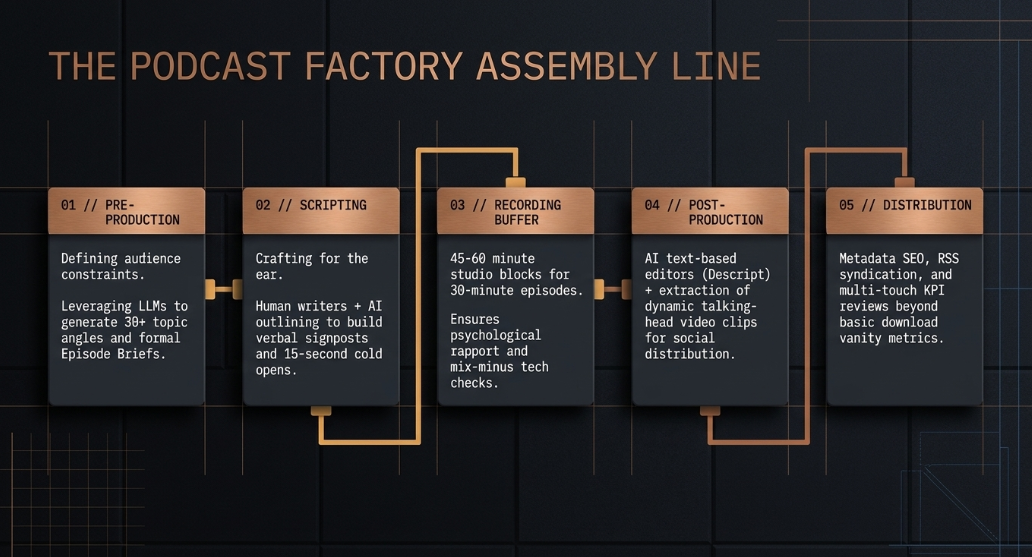
Executing a professional podcast requires systematizing a rigorous, end-to-end production workflow to prevent creator burnout, ensure consistent broadcast quality, and guarantee that the content aligns seamlessly with overarching business objectives. The modern podcast production pipeline functions as a highly optimized "Podcast Factory," relying on a structured sequence that blends human editorial creativity with advanced technological efficiency and artificial intelligence automation.24
The workflow begins with critical Pre-Production and Idea Generation. Before a microphone is ever activated, creators must define a comprehensive "Show Blueprint," establishing firm guardrails for the program. This document explicitly defines the target audience, the core promise delivered to the listener, the formatting structure (solo, interview, panel, or narrative), the tonal style, and the production cadence constraints.24 Utilizing this blueprint, production teams maintain a constant backlog of at least 30 episode concepts. Advanced workflows in 2026 heavily leverage Large Language Models (LLMs) to transform broad industry trends and pain points into specific, highly focused episode angles, scoring them based on relevance, uniqueness, and timeliness.24 The top concepts are elevated into formal Episode Briefs, which detail the working title, the specific listener problem addressed, a one-sentence takeaway, and three core supporting arguments.24
The second phase is Scripting and Preparation. Unlike written prose intended for visual reading, podcast scripts must be meticulously tailored "for the ear." Human writers, often assisted by AI outlining tools, draft structures that rely on short, punchy sentences and clear verbal "signposts" to guide the listener's attention.24 A highly optimized script structure typically features a gripping 10-to-20-second cold open, a rapid introduction, distinct segments dedicated to problem identification and resolution, a discussion of common pitfalls, and a singular, focused Call to Action.24 Preparation also includes deep research into guests, resulting in targeted interview questions and a pre-show alignment to ensure maximum value delivery during the recording session.25
The third phase is Recording. A standard 30-minute podcast episode generally requires 45 to 60 minutes of dedicated studio time.25 This buffer is essential; it accommodates pre-show microphone and audio interface technical checks, establishes psychological rapport between the host and the guest, and allows for a natural, unhurried conversational flow.25
The fourth phase is Post-Production, which remains the most resource-intensive segment of the workflow, routinely requiring two to three hours per episode.25 The objective of professional editing is not to achieve sterile perfection, but rather "easy listening." Editors surgically remove awkward pauses, mitigate excessive filler words, integrate subtle music beds for emotional pacing, balance multi-track volumes, and apply Equalization (EQ) to ensure vocal clarity.24 In the modern era, this phase also demands the creation of video-first elements, extracting high-quality, talking-head clips and insight-dense soundbites optimized with dynamic captions for distribution across social media platforms like TikTok, YouTube Shorts, and LinkedIn.19
The final phase involves Publishing, Distribution, and Measurement. The finalized media file must be paired with meticulously prepared metadata, including SEO-optimized titles, comprehensive show notes, chapter markers, and platform-specific cover art.24 The file is submitted via RSS to major directories, accompanied by targeted promotional campaigns. Following publication, teams engage in a rigorous review of Key Performance Indicators (KPIs), moving past basic downloads to analyze listener retention graphs, episode completion rates, qualified website traffic generated via tracking links, and the specific expansion of the brand's thought leadership footprint.
What Podcasting Is and Is Not
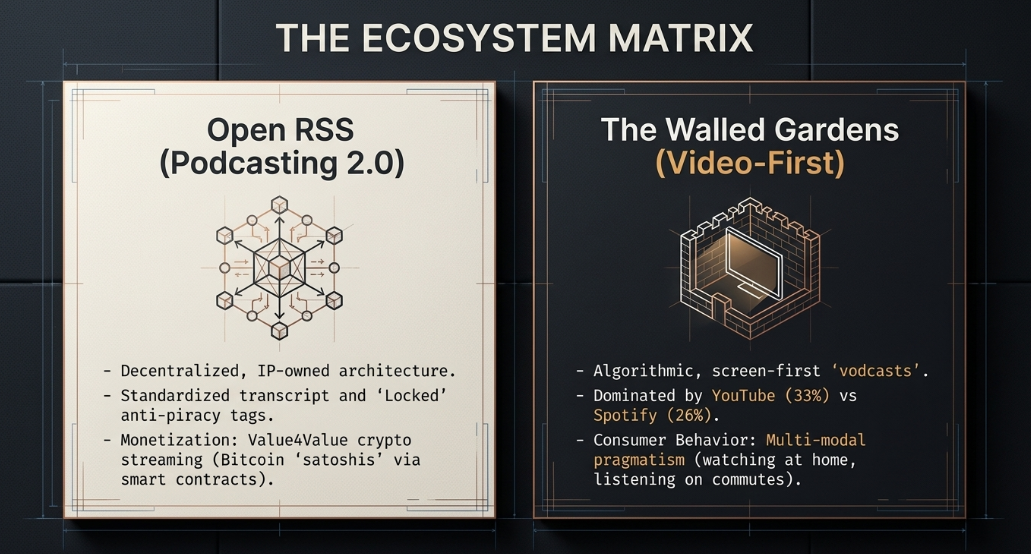
To execute effectively within this medium, one must establish a strict ontological definition of the technology. Podcasting is not merely the act of uploading audio files to a corporate website, nor is it synonymous with algorithmic music streaming. At its foundational core, traditional podcasting is defined by an open, decentralized distribution ecosystem powered by Really Simple Syndication (RSS) feeds.26 This open standard is critical; it ensures that content creators retain ultimate ownership of their intellectual property and their distribution channels, preventing any single corporate aggregator from arbitrarily restricting access to their audience or manipulating the feed.26
However, the industry landscape in 2026 is fracturing into two distinct definitions. One remains the historic, open RSS-based medium. The other is a platform-native, screen-first format—highly produced, video-centric shows that look and talk like podcasts, but behave entirely like streaming television content locked within the walled algorithmic gardens of YouTube, Spotify, and Netflix.27
Simultaneously, the open ecosystem is being aggressively defended, upgraded, and expanded through the "Podcasting 2.0" initiative. Podcasting 2.0 introduces a new, standardized namespace that upgrades the legacy RSS architecture, allowing for rich, interactive, and protective features previously unavailable to independent creators.28 This includes standardized transcript tags to enhance accessibility for hearing-impaired audiences and boost organic SEO, location tagging to attract regional sponsorships, and robust "Locked" tags that protect original content from unauthorized cloning, rehosting, and piracy.28
Most revolutionarily, Podcasting 2.0 introduces the "Value4Value" (V4V) crypto-monetization model. This decentralized economic framework fundamentally circumvents traditional advertising gatekeepers. Value4Value allows listeners to seamlessly stream cryptocurrency—specifically Bitcoin fractions known as "satoshis" (sats)—directly to creators in real-time as they consume the audio.29 Listeners can donate a specific number of sats per minute listened, or send "boostgrams," which are financial donations attached to personalized text messages.29 Because the system is decentralized, transaction fees are negligible and covered by the donor, and smart contracts allow revenues to be instantly and automatically split among the host, guest, editor, and hosting provider.
The Clear Understanding of the Technology
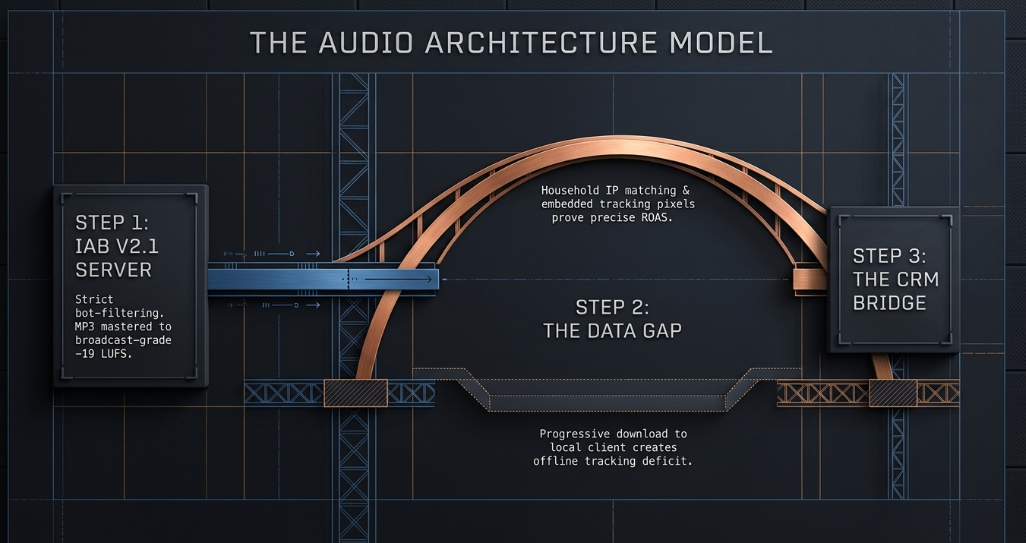
The underlying technical architecture of podcast delivery fundamentally dictates the complexities of how audience behavior is tracked, measured, and monetized. Unlike streaming media environments—such as YouTube videos or web-based radio platforms—where continuous, active internet connections allow central servers to track granular, second-by-second user interactions, traditional podcasts operate via progressive downloading.30 A user's podcast application (the client) requests the MP3 media file from a hosting server, downloads it, and stores it locally on the device for time-shifted, offline playback.30
This architectural reality creates a massive data deficit. The host server registers that a file was successfully downloaded, but it intrinsically has no mechanism to determine if the user ever actually pressed play, if they listened to the entire episode, or if they skipped the embedded advertisements.30 To combat this ambiguity and provide advertisers with reliable metrics, the Interactive Advertising Bureau (IAB) established the Podcast Measurement Technical Guidelines v2.1. These guidelines mandate rigorous, server-side filtering logic. Compliant servers must execute complex algorithms to differentiate between a true human download, an automated bot ping, or a partial byte-range request initiated by a smartphone merely preparing to play an episode.30 Only by strictly conforming to these IAB standards can publishers provide legitimate audience sizing and ad delivery metrics that enterprise advertisers will trust.30
To bridge the gap between a downloaded file and actual sales conversion, the industry has developed advanced pixel-based attribution and digital footprinting. By embedding tracking pixels on an advertiser's website and utilizing household IP address matching, third-party attribution providers can identify when a device that downloaded a specific podcast episode subsequently visits the sponsor's website to make a purchase, thereby establishing a precise Return on Ad Spend (ROAS) in an otherwise opaque medium.9
Technical execution also demands rigorous adherence to audio mastering standards. Professional podcasts must maintain strict loudness normalization to prevent jarring volume disparities between episodes, hosts, and dynamically inserted advertisements. Utilizing tools like Auphonic or specialized limiters within Digital Audio Workstations, engineers master files to strict targets, typically -19 LUFS (Loudness Units relative to Full Scale) for mono files and -16 LUFS for stereo files, ensuring a seamless, broadcast-grade auditory experience across highly diverse playback devices.
Technology Choices
While the barrier to entry for acceptable audio has significantly lowered, achieving the broadcast-grade fidelity expected by 2026 audiences requires highly deliberate investments in both hardware and software infrastructure.
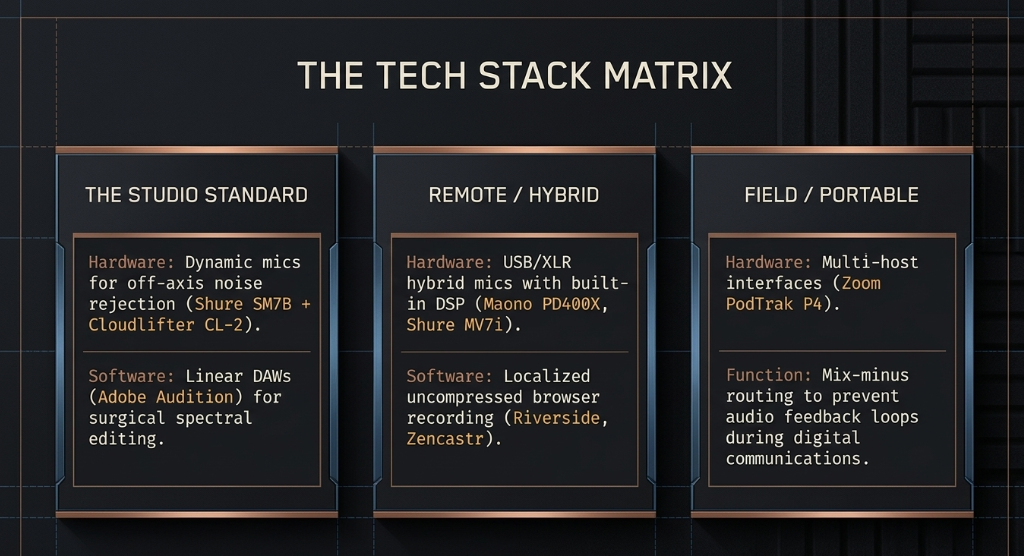
The microphone serves as the primary and most critical interface between the host's voice and the digital realm. In untreated, acoustically compromised environments—such as standard corporate offices or home studios—dynamic microphones are universally preferred over highly sensitive condenser microphones due to their superior off-axis background noise rejection.
The Industry Standard: The Shure SM7B remains the pinnacle of professional broadcast microphones, universally revered for its rich, warm, and instantly recognizable "radio" tone.31 However, dynamic microphones of this caliber are notoriously gain-hungry. To operate optimally without introducing electrical hiss, they require an inline preamplifier, such as the Cloudlifter CL-2, which utilizes phantom power to provide up to +25dB of transparent, clean gain before the analog signal reaches the audio interface.33
Modern USB/XLR Hybrids: For creators seeking professional quality without the complexity of external preamps and mixing consoles, hybrid microphones like the Maono PD400X, the Rode NT-USB Mini, and the Shure MV7i have become indispensable.31 These units provide built-in digital signal processing (DSP), automatic gain control, and real-time noise reduction, offering both direct USB-C connectivity to laptops and legacy XLR analog outputs for future studio scaling.32
Mobile Interfaces: For remote recording, field interviews, or multi-host setups, devices like the Zoom PodTrak P4 offer unmatched versatility. Featuring multiple XLR inputs and vital mix-minus technology, these interfaces ensure that remote guests participating via digital communication software do not experience disorienting audio feedback loops.33
The software infrastructure driving post-production has bifurcated into traditional linear editing and AI-assisted workflows.
Traditional DAWs: Adobe Audition remains the industry-standard Digital Audio Workstation (DAW) for professional sound engineers, offering surgical spectral frequency displays and advanced audio restoration tools, making it particularly favored by enterprise teams already operating within the Adobe Creative Cloud ecosystem.36 Alternatives such as Logic Pro, Hindenburg, and REAPER offer comparable, highly customizable multitrack environments.36
AI-Assisted Editors: Platforms like Descript have revolutionized the editing process by allowing producers to edit multi-track audio and video simply by manipulating an AI-generated text transcript, drastically reducing the temporal burden of post-production.24
Remote Recording: Browser-based platforms such as Riverside and Zencastr are mandatory for capturing high-fidelity remote interviews. These services record uncompressed, localized audio and 4K video directly on the guest's machine before uploading it to the cloud, entirely circumventing the data compression and dropouts inherent in standard internet video conferencing.24
Voice Generation: The integration of synthetic voices is managed through platforms like Qwen3-TTS Studio, which allows for the responsible cloning of a host's voice or the generation of multi-speaker synthetic narration for news briefs and automated updates.24
Portable Players
While smartphones currently account for approximately 86.1% of all podcast listening devices 2, the audiophile, privacy-conscious, and fitness-oriented markets are driving a significant resurgence in dedicated portable media hardware. Following Apple's discontinuation of the iPod Touch in 2022, a vacuum was created for dedicated music and spoken-word players. This void has been aggressively filled by manufacturers of high-resolution Digital Audio Players (DAPs), which have engineered devices that vastly outperform legacy consumer hardware in every measurable audio metric.38
Modern DAPs cater to listeners who demand pristine signal purity and zero digital distractions. The internal audio architecture of a modern smartphone is highly congested; its System on a Chip (SoC) must simultaneously manage cellular 5G radios, GPS processing, high-refresh-rate displays, and background applications. This electrical congestion inevitably introduces jitter and interference into the analog audio signal.38 Conversely, dedicated DAPs utilize standalone, premium Digital-to-Analog Converters (DACs). For example, devices like the HIFI WALKER H2 Mini utilize an ESS9218PC DAC capable of 32-bit/384kHz lossless playback—a staggering technological leap from the 16-bit/44.1kHz limitations of legacy iPods.38 These audiophile devices often feature balanced 4.4mm or 2.5mm headphone outputs to drastically reduce channel crosstalk, alongside expandable MicroSD storage supporting up to 2TB, allowing users to carry massive libraries of uncompressed FLAC, WAV, and DSD files offline.38 Furthermore, their reliance on tactile, physical buttons allows for "eyes-free" operation, establishing them as the true spiritual successors to the iPod Classic for commuters and runners.
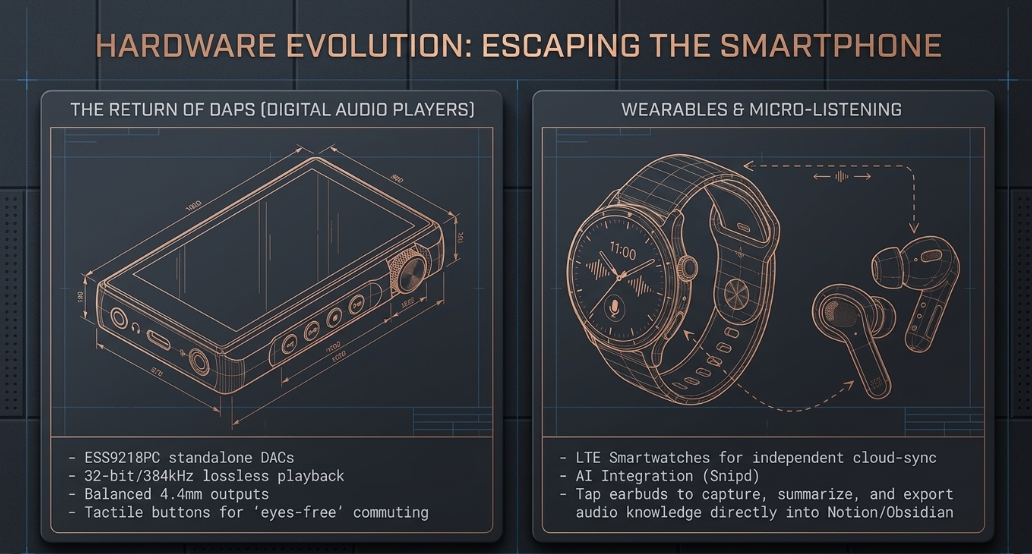
For the hyper-mobile consumer, wearable technology is fundamentally decoupling the podcast experience from the smartphone entirely. Smartwatches running dedicated applications like Overcast on Apple watchOS and Wear Casts on Android Wear OS allow users to download episodes directly to their wrist via Wi-Fi or stream them dynamically via standalone LTE connections.39 This capability has catalyzed the "micro-listening" trend, wherein active users consume brief, 5-to-10-minute insight-driven episodes during exercise routines without the physical burden or distraction of carrying a phone.40 The integration across devices is highly sophisticated; premium applications like Pocket Casts Plus precisely synchronize the play-state across cloud infrastructure, allowing a user to pause a podcast on their smartwatch during a run and seamlessly resume it on a desktop browser upon returning to the office without missing a syllable.39
Simultaneously, portable software is integrating heavy artificial intelligence. Applications like Snipd allow listeners to physically tap their wireless earbuds during playback to capture a "snip." The app's AI immediately transcribes the captured segment, summarizes the core concepts, and seamlessly exports the synthesized knowledge directly into personal productivity databases like Notion or Obsidian, transforming passive listening into active knowledge management.
Other Players
The expansion of the podcast listening environment has extended far beyond individual, headphone-isolated experiences, integrating deeply into domestic infrastructure and automotive systems.
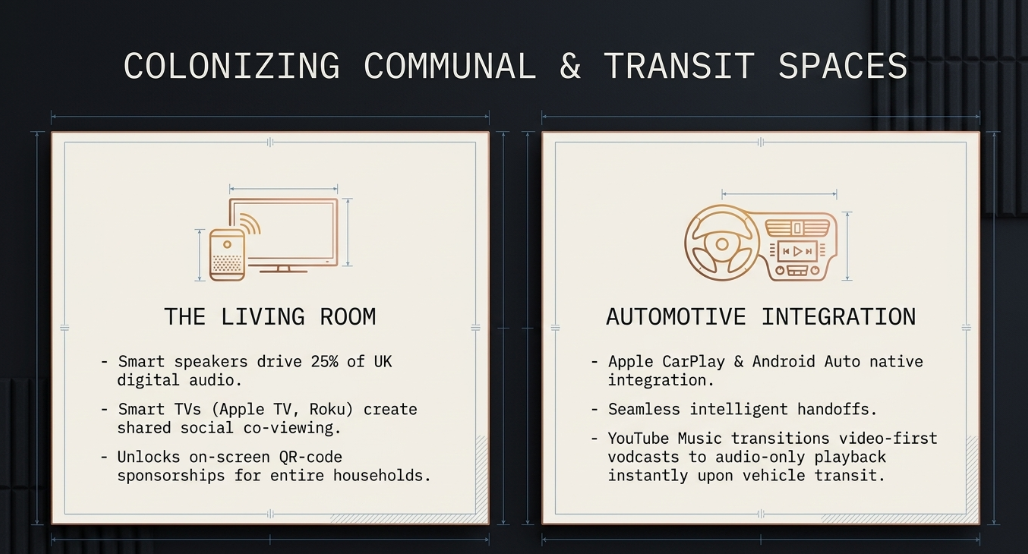
Smart Speakers and The Living Room: Smart speakers—powered by voice assistants such as Amazon Alexa, Google Assistant, and Apple's Siri—have transformed podcasts into an ambient, shared audio experience. In the United Kingdom, smart speakers now account for 25% of all digital radio and audio listening hours, with 64% of smart speaker owners utilizing the devices specifically for spoken-word audio and 38% consuming podcasts at least once a month via the interface.41 Devices such as the Sonos Era 100, which offers room-filling, high-fidelity sound and multi-ecosystem voice support, allow users to seamlessly transition audio from their mobile devices into a communal space.42 This shift toward the living room is further accelerated by the rapid rise of Smart TVs and streaming boxes like Roku and Apple TV.40 As video-first podcasts (vodcasts) dominate platform algorithms, families and groups increasingly co-view this content on large screens, transforming what was once a solitary, intimate activity into a shared social experience. This visual transition introduces lucrative new advertising opportunities, including dynamic on-screen sponsorships and QR-code integrations that target entire households.40
Automotive Integration: The daily commute remains a foundational cornerstone of podcast consumption. Modern vehicle infotainment systems, specifically Apple CarPlay and Android Auto, have integrated deeply with third-party podcast applications, effectively turning the car into a rolling media hub. Applications like Pocket Casts provide highly stable integration, featuring high-contrast, large-button interfaces designed specifically to minimize driver distraction and prioritize safety.39 For older vehicles lacking modern screen interfaces, applications such as Podbean feature dedicated "Car Modes" that rely on simplified UIs and heavy voice command integration.39 The transition toward video podcasts even influences automotive software; YouTube Music now operates natively within Android Auto, serving as the intelligent bridge that allows video-first content to transition seamlessly into audio-only playback during vehicular transit, ensuring continuity of the user experience.
The Road Ahead
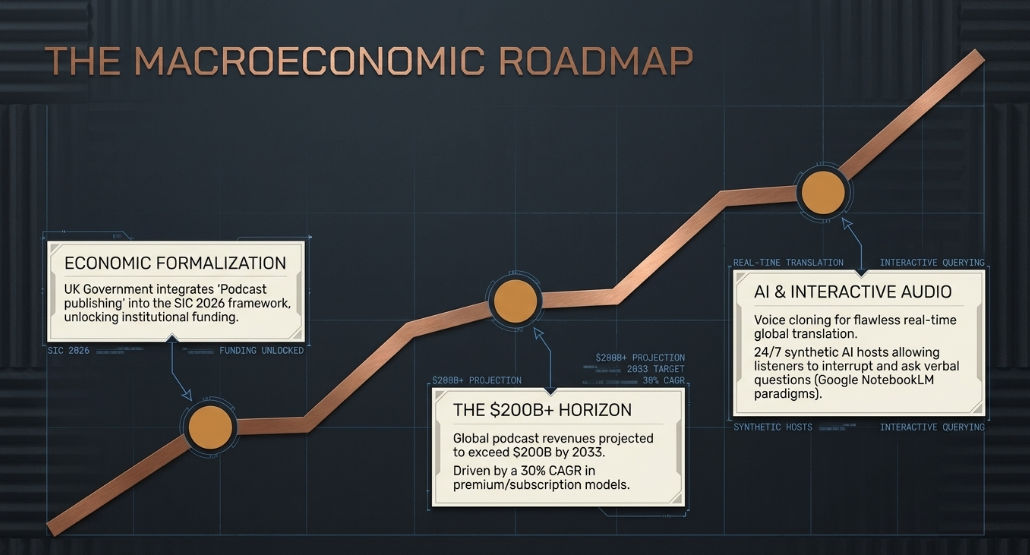
The next decade of podcasting will be defined by the intersection of artificial intelligence, fully interactive audio paradigms, and vast global financial scaling. The macroeconomic projections for the industry are staggering; market analysts estimate that global podcasting revenues will easily exceed $200 billion by 2033, with the most bullish models from Acumen Research and Consulting forecasting an expansion to $384.7 billion.43 This explosion in value will be driven by a compound annual growth rate (CAGR) of over 30% specifically within subscription and premium monetization models, as audiences increasingly demand ad-free, highly specialized, and exclusive content.43
Artificial intelligence is the primary catalyst accelerating this technological and financial growth. The AI-in-podcasting sub-sector alone is projected to reach a market valuation of $4.8 billion by 2027.13 Beyond mere operational efficiencies—such as automated transcription, noise reduction, and algorithmic ad targeting—AI is fundamentally altering the geographic and linguistic boundaries of the medium. Advanced machine learning models are enabling real-time translation and voice cloning, allowing creators to deploy AI-dubbed versions of their content globally. A podcast recorded in English can instantly be distributed to Latin American or Asian markets in flawless Spanish or Japanese, retaining the emotional cadence and exact tonal quality of the original host without the need to record multiple linguistic tracks.13
By 2027, the traditional, static, one-way broadcast model of podcasting will face intense competition from fully interactive, dynamically generated audio paradigms. Technologies like Google's NotebookLM are already beta-testing interactive, AI-hosted podcasts that blur the line between media and personalized education.45 In this emergent model, synthetic AI hosts engage in natural, banter-filled dialogue concerning complex documents, research papers, or corporate training materials uploaded by the user.45 Listeners are no longer passive recipients; they possess the ability to actively interrupt the audio stream, pose verbal questions to the AI hosts, and receive immediate, context-aware explanations before the podcast seamlessly resumes its narrative flow.45 This illusion of humanity, complete with synthesized pre-show banter and cognitive pauses, transforms the podcast from a static recording into a real-time, personalized, 24/7 educational companion.
Finally, the maturation of the podcasting industry is being formalized at the highest levels of global economic infrastructure. In May 2026, the UK Government officially recognized "Podcast and other audio publishing activities" within the Standard Industrial Classification (SIC) 2026 framework.47 This integration into official national economic data signifies that the medium is no longer miscategorized alongside outdated broadcast radio or generic digital publishing models. It provides a distinct, formalized identity that allows commercial lenders, government policymakers, and massive financial institutions to accurately measure, fund, and support podcasting as a distinct, multi-billion-dollar pillar of the modern creative economy.47
The execution of a professional podcast has evolved far beyond the simple capture of an audio recording; it is now the deployment of a highly engineered, globally distributed media asset. Success in this hyper-competitive arena requires precise psychographic audience targeting, rigorous technological infrastructure, and the strategic foresight to adapt to a medium that is rapidly moving from static audio files to dynamic, interactive, and visually integrated digital experiences.
Works cited
Podcast Statistics 2026: Powerful Audience Data - SQ Magazine, accessed May 14, 2026, https://sqmagazine.co.uk/podcast-statistics/
33 Podcast Statistics 2026 (Number of Podcasts & Viewership), accessed May 14, 2026, https://podcastatistics.com/
Podcast Statistics 2026: Listeners, Spend & Demographics | OOB - Our Own Brand, accessed May 14, 2026, https://ourownbrand.co/podcast-statistics
Podcast Statistics 2026: Number of Listeners & Viewership - Limelight Digital, accessed May 14, 2026, https://www.limelightdigital.co.uk/podcast-statistics/
Top podcast listening trends from our research - Ofcom, accessed May 14, 2026, https://www.ofcom.org.uk/media-use-and-attitudes/media-habits-adults/top-podcast-listening-trends-from-our-research
Podcast Statistics You Need To Know in 2026 - Backlinko, accessed May 14, 2026, https://backlinko.com/podcast-stats
The changing shape and new economics of news podcasting: From ..., accessed May 14, 2026, https://reutersinstitute.politics.ox.ac.uk/changing-shape-and-new-economics-news-podcasting-listening-watching-podcasts-shows
Podcast Statistics 2026 | 80+ Facts & Data Points - Searchlab, accessed May 14, 2026, https://searchlab.nl/en/statistics/podcast-statistics-2026
Enterprise Podcast Advertising: The Blueprint for Growth [2026], accessed May 14, 2026, https://articles.myntagency.com/podcast-advertising-blueprint-2026/
The Biggest Mistakes Brands Make When Starting a Podcast - Resonate Recordings, accessed May 14, 2026, https://resonaterecordings.com/general/the-biggest-mistakes-brands-make-when-starting-a-podcast/
The Definitive Guide To Measuring B2B Podcast ROI And Pipeline ..., accessed May 14, 2026, https://www.fame.so/post/measuring-b2b-podcast-roi-and-pipeline
The 4 Hooks Framework: The Key to Winning Over New Podcast ..., accessed May 14, 2026, https://podcastmarketingacademy.com/4-hooks-framework/
Future of Podcasting: AI — Message Heard, accessed May 14, 2026, https://messageheard.com/media-hub-new/future-of-podcasting-ai
B2B Podcast Marketing Strategy: Measuring ROI Without Chasing Vanity Metrics - Rise 25, accessed May 14, 2026, https://rise25.com/lead-generation/b2b-podcast-marketing-strategy-roi/
2026 Podcast Advertising Guide: Effectiveness, Statistics & More - Ad Results Media, accessed May 14, 2026, https://www.adresultsmedia.com/news-insights/is-podcast-advertising-effective/
Podcast Statistics 2026: 130+ Advertising Data Points - Digital Applied, accessed May 14, 2026, https://www.digitalapplied.com/blog/podcast-statistics-2026-advertising-data
Vodcast vs Short Ads - BBF Digital, accessed May 14, 2026, https://bbf.digital/vodcast-vs-short-ads-which-one-delivers-better-roi-for-brands-in-2026
Podcast Marketing in 2026: 9 Reasons Brands Are Still Investing - CMS Wire, accessed May 14, 2026, https://www.cmswire.com/digital-marketing/podcast-marketing-advantages-cmos-should-not-ignore/
The Ultimate 2026 B2B Podcast Strategy Checklist for Brands, accessed May 14, 2026, https://weeditpodcasts.com/2026-b2b-podcast-strategy-checklist/
A Brand's Guide to Podcast Measurement in 2026 - CoHost, accessed May 14, 2026, https://www.cohostpodcasting.com/resources/podcast-measurement-for-brands
5 Reasons You Should NOT Make A Branded Podcast | by Steve ..., accessed May 14, 2026, https://medium.com/pacific-content/5-reasons-you-should-not-make-a-branded-podcast-cac086aa58ad
Branded Podcasts in 2025: Build Authority or Risk Wasting Resources?, accessed May 14, 2026, https://www.mahdlo.net/blog/brand-podcasts-opportunity
Why You Shouldn't Start a Podcast (and 4 Reasons You Should!) - Podcircle, accessed May 14, 2026, https://podcircle.com/why-you-shouldnt-start-a-podcast-and-4-reasons-you-should/
Creating Podcasts with AI: A Practical End‑to‑End Workflow (Ideas ..., accessed May 14, 2026, https://bytebridge.medium.com/creating-podcasts-with-ai-a-practical-end-to-end-workflow-ideas-script-voice-edit-9b2b0a2780df
Master Your Podcast Production Workflow - Fame.so, accessed May 14, 2026, https://www.fame.so/post/podcast-production-workflow
What is a Podcast in 2026? Can My Cat Be a Podcast? - Alitu, accessed May 14, 2026, https://alitu.com/creator/content-creation/what-is-a-podcast/
Podcasting in 2026. The year “a podcast” stops meaning one thing - Baird Media, accessed May 14, 2026, https://baird.media/podcasting-in-2026-the-year-a-podcast-stops-meaning-one-thing/
Podcasting 2.0 for podcasters, accessed May 14, 2026, https://podcasting2.org/podcasters
Podcasting 2.0 Features Explained: Transcripts, Value4Value, and ..., accessed May 14, 2026, https://www.podcastvideos.com/articles/podcasting-2-0-features-value4value-transcripts/
IAB Podcast Measurement Technical Guidelines Version 2.1Updated, accessed May 14, 2026, https://iabtechlab.com/wp-content/uploads/2021/01/IABTechLab_Podcast_Measurement_v2.1_Updated_Jan-2021.pdf
10 Best Microphones for Podcasting [2026] - Projet Home Studio, accessed May 14, 2026, https://www.projethomestudio.fr/en/microphones-podcast-radio/
Don't Buy the Wrong Mic | SM7B vs PD400X - YouTube, accessed May 14, 2026, https://www.youtube.com/watch?v=U1JrKjSDY3k
8 Essential Podcast Equipment For 2 In 2026, accessed May 14, 2026, https://podcastmonkey.co/blogs/news/podcast-equipment-for-2
Top Podcast Gear to Buy in 2026 for Professional Creators - Digi Tech Trading, accessed May 14, 2026, https://digitech.tv/blog/post/top-podcast-gear-for-professional-creators
The Best Podcast Equipment We've Tested for 2026 | PCMag, accessed May 14, 2026, https://www.pcmag.com/picks/the-best-podcast-equipment
The 13 Best Editing Software For Podcasts In 2026 - Fame.so, accessed May 14, 2026, https://www.fame.so/post/best-editing-software-for-podcasts
Walk Me Through Your Podcast Workflow – From Idea to First Guest - Reddit, accessed May 14, 2026, https://www.reddit.com/r/podcasting/comments/1ilu8gt/walk_me_through_your_podcast_workflow_from_idea/
MP3 Players vs iPods 2026: Which Wins for Audio? - HiFi WALKER, accessed May 14, 2026, https://hifiwalker.com/blogs/dap-guides-tips/mp3-players-vs-ipods-2026-modern-audio-device-comparison
Best Podcast Software & Listening Apps (2026) - BuzzMaven, accessed May 14, 2026, https://buzzmaven.com/best-podcast-software
Which Devices Are People Using to Listen to Podcasts in 2025? - - Command Your Brand, accessed May 14, 2026, https://commandyourbrand.com/which-devices-are-people-using-to-listen-to-podcasts-in-2025/
RADIO LISTENING AVERAGE HOURS PER LISTENER DIGITAL PLATFORMS PLATFORM SHARE OF ALL RADIO LISTENING LISTENING VIA LOCATION DI - RAJAR, accessed May 14, 2026, https://www.rajar.co.uk/docs/news/RAJAR_DataRelease_InfographicQ42025.pdf
Best Smart Speakers of 2026 - Business Insider, accessed May 14, 2026, https://www.businessinsider.com/guides/tech/best-smart-speakers
Podcasting revenue forecast to exceed $200bn in next decade ..., accessed May 14, 2026, https://tomorrowspublisher.today/monetisation/podcasting-revenue-forecast-to-exceed-200bn-in-next-decade/
The Future of Podcasting: How Technology is Shaping the next Era - Reflect Podcast, accessed May 14, 2026, https://reflectpodcast.com/f/the-future-of-podcasting-how-technology-is-shaping-the-next-era
NotebookLM's Interactive Podcast Feature: Revolutionizing ..., accessed May 14, 2026, https://jakemiller.net/notebooklms-interactive-podcast-feature-revolutionizing-learning-through-conversation/
AI Gen Podcasts | Atrivity, accessed May 14, 2026, https://www.atrivity.com/ai-gen-podcasts
Podcasting and Audio Officially Recognised in UK SIC 2026 ..., accessed May 14, 2026, https://podnews.net/press-release/podcasting-officially-recognised-uk