The contemporary digital landscape has undergone a profound transformation in media consumption, permanently altering the economics of human attention. In an era defined by fractured focus and highly saturated visual feeds, audio has emerged as a uniquely powerful mechanism for capturing and retaining deep audience engagement. Recent empirical data from Edison Research reveals that individuals now spend an average of four hours per day immersed in audio environments, traversing music, talk radio, and, increasingly, podcasts.1 Unlike its visual counterparts—which are often consumed passively while scrolling—audio commands attention through the distinct uniqueness of the human voice, the artful manipulation of pacing, and the deeply imaginative, parasocial bonds it unlocks within the listener's mind.
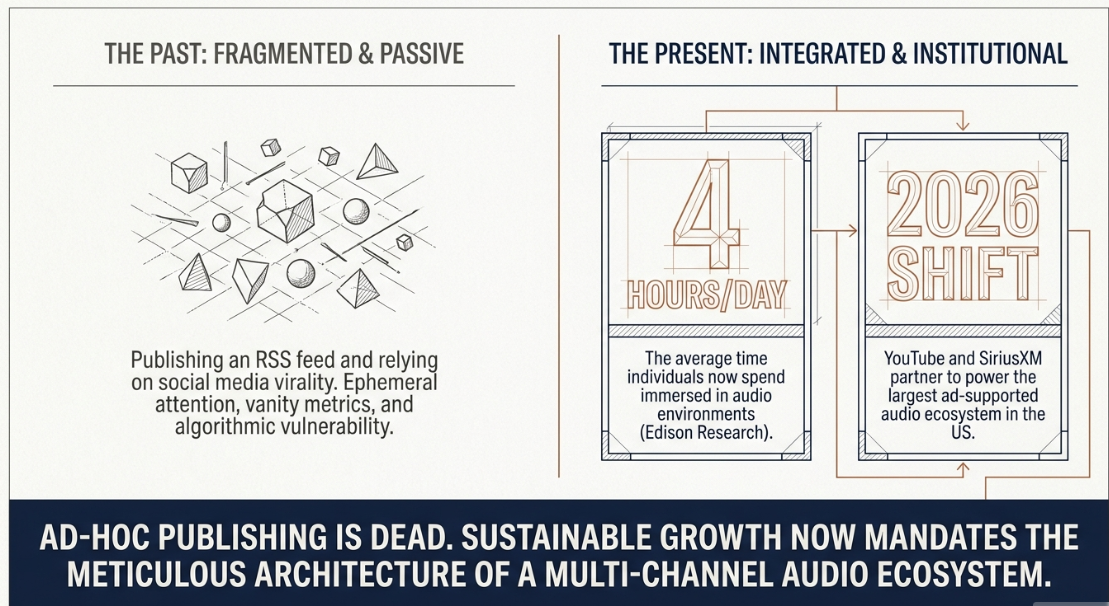
However, the proliferation of the podcasting medium has led to extreme market saturation. Consequently, achieving sustainable commercial growth is no longer merely a function of recording conversations and publishing an RSS feed. It requires the meticulous architecture of an integrated, multi-channel audio ecosystem. The maturation of the industry is perhaps best exemplified by recent massive infrastructural shifts, such as the 2026 partnership wherein YouTube—recognized as the world's leading podcast platform—selected SiriusXM Media to power the largest ad-supported audio ecosystem in the United States.2 This level of institutional investment indicates that podcasting is no longer a hobbyist endeavor; it is a primary growth engine for enterprise organizations, media conglomerates, and thought leaders.
Building such an ecosystem mandates a structural departure from ad-hoc promotional tactics in favor of rigorous, systems-thinking frameworks. By treating a podcast as the central operational hub of a broader content and sales architecture, creators can systematically transform transient, top-of-funnel attention into enduring subscriber loyalty and highly measurable revenue. The comprehensive analysis that follows explores the foundational frameworks of strategic podcast marketing, the mechanical components of the Podcast Growth Engine, the deployment of Hub and Spoke content distribution, the strict application of enterprise-grade analytics, and the specific strategic playbooks utilized by the industry's most dominant shows to achieve exponential, multi-million-dollar scale.
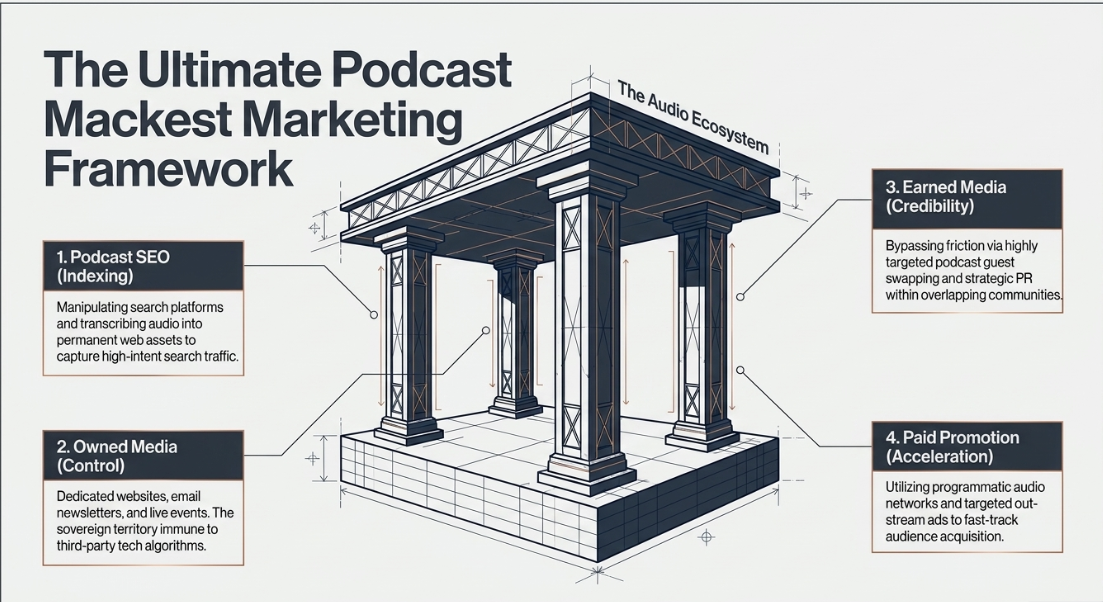
The Ultimate Podcast Marketing Framework
The structural foundation of a highly successful audio ecosystem rests upon a battle-tested strategy that synthesizes organic discovery methodologies with targeted paid acceleration.3 The Ultimate Podcast Marketing Framework categorizes these promotional and growth efforts into four distinct, interdependent pillars: Podcast Search Engine Optimization (SEO), Owned Media, Earned Media, and the Podcast Advertising Growth Framework.3 When these pillars are orchestrated cohesively, they create a self-sustaining loop of acquisition, audience retention, and monetization that insulates the creator from algorithmic volatility.
The Nuanced Science of Podcast Search Engine Optimization (SEO)
For over a decade, the podcasting industry approached discoverability as a function of social media virality, largely overlooking the compounding, long-term interest generated by search engines. As of 2026, the algorithms governing major audio platforms have evolved dramatically, shifting podcast SEO from a niche administrative task to a high-return, foundational growth imperative.4 The most critical paradigm shift within this domain is that discoverability is no longer constrained merely to show titles and brief episodic descriptions; major search platforms now actively index the actual spoken content via automated transcriptions.5 Google, for instance, has expanded its audio indexing capabilities to the point where AI-powered search assistants now pull specific answers directly from podcast-derived content to satisfy voice and text queries.5
The optimization required to achieve market dominance is not uniform across the ecosystem. Each primary distribution directory utilizes a proprietary algorithm driven by distinct user engagement signals, which marketers must actively manipulate to achieve high search rankings.
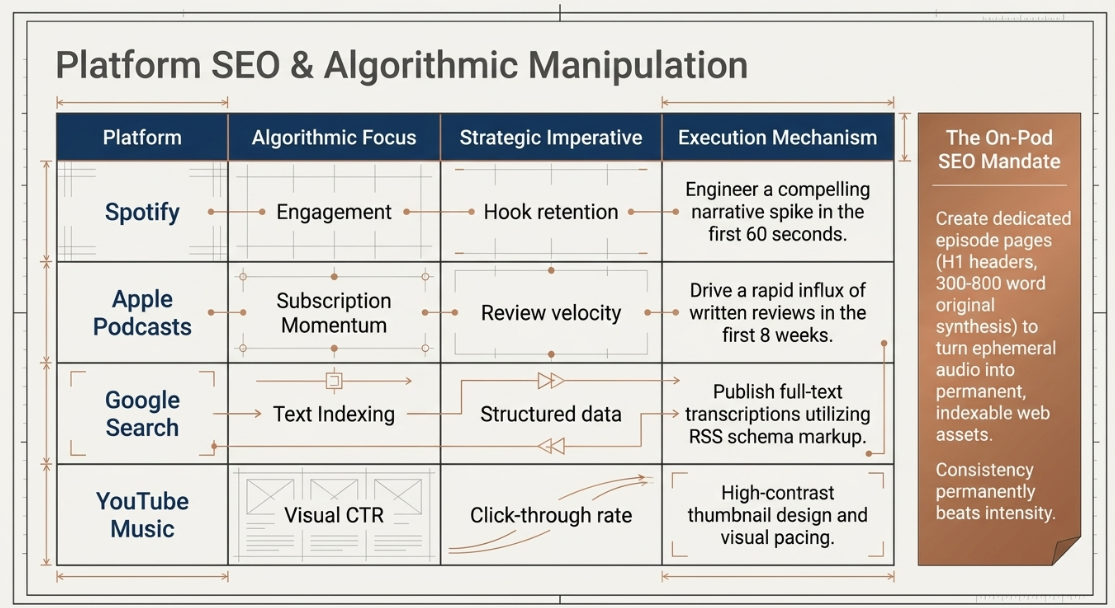
The foundation of modern podcast SEO extends far beyond the audio directories, centering heavily on the creator's owned digital real estate. Historically, podcasters provided simple embedded players on their websites, accompanied by merely three sentences of descriptive text.5 In the current highly competitive ecosystem, the single highest-impact SEO maneuver a creator can execute is the architecture of a dedicated, content-rich episode page.5 This architecture requires a properly formatted H1 heading, a 300 to 800-word original article synthesizing the episode's core themes, a complete written transcript, and a strategic internal link architecture directing users to related episodes and core business services.3 By adopting this comprehensive approach, an ephemeral audio file is permanently transformed into an enduring web asset, capable of capturing high-intent search traffic indefinitely. Furthermore, research indicates that incorporating highly detailed show notes within the audio application itself can elevate listener engagement metrics by up to thirty percent.3
On-pod SEO further requires hosts to actively utilize the power of their own voices. This involves verbally articulating targeted industry keywords throughout the recording and delivering explicit calls-to-action that instruct listeners on exactly how to search for the brand across various platforms.3 This intentional verbal indexing, combined with external structural data, ensures that the podcast is algorithmically linked to the exact search queries being executed by the target demographic. As industry analysts note, discoverability is now the defining competitive advantage that separates fast-growing shows from those that permanently stagnate.5 Furthermore, when executing these strategies, the golden rule of podcast SEO remains immutable: consistency universally beats intensity. Search algorithms heavily favor a reliable, weekly release schedule over sporadic, high-volume content binges.
Cultivating Owned Media Assets
Owned media constitutes the sovereign territory within the audio ecosystem—digital platforms where the creator or enterprise maintains absolute, unmediated control over distribution, completely immune to algorithmic adjustments by third-party tech conglomerates.3 A podcast's proprietary website, its email newsletter, and its owned community channels must function as a seamlessly synchronized conversion funnel.3 The ultimate goal of owned media is to nurture passive listeners into raving fans and, eventually, paying customers.
The email newsletter operates as the most vital organ within the owned media body. It serves as a direct, algorithmic-free conduit to the audience, enabling the consistent distribution of exclusive content, behind-the-scenes material, and new episode announcements.3 Because exposure alone is economically insufficient, audience members must be incentivized to surrender their email addresses. Marketers execute this by offering valuable, gated freebies—such as downloadable cheat sheets, extended interview segments, or highly curated playlist strategies.3 According to email marketing experts, deploying automated email sequences is a proven methodology for increasing direct sales, with properly executed campaigns capable of multiplying email-attributed revenue by a factor of five.7
In addition to digital channels, owned events play a critical role in solidifying the ecosystem. Hosting live podcast recordings at industry events, book fairs, or proprietary summits serves a dual strategic purpose: it builds localized, in-person momentum and deeply engages the community, while simultaneously capturing highly authentic raw material that can be subsequently repurposed into future episodes and short-form social snippets.3
Maximizing Earned Media and Strategic Partnerships
Conversely, earned media leverages third-party credibility to capture net-new audiences without direct financial expenditure.3 A modern podcast growth strategy is increasingly relationship-first, rather than algorithm-first.7 This approach prioritizes integration into established communities that already exhibit a high affinity for the specific subject matter and the audio format itself.
The most frictionless and statistically effective method of audience acquisition within the earned media pillar is podcast guest swapping.8 Because the target demographic is already composed of individuals who actively listen to podcasts, pitching content via guest interviews directly circumvents the behavioral friction of convincing non-listeners to download an audio application. By appearing on shows with a highly overlapping audience profile, creators achieve a subscriber conversion rate that vastly outperforms thousands of paid web ad impressions.8 Cross-promotional trailer drops—where two shows embed each other's promotional audio within their standard feeds—also serve as highly efficient, zero-cost acquisition engines.8
Strategic earned media also necessitates active public relations efforts. This includes securing placements in industry trade publications by pitching newsworthy press releases regarding new season launches, executing media partnerships with complementary external businesses, and sponsoring relevant niche events.3 Securing a listing on established podcast networks can also exponentially expand an independent show's footprint.3 Furthermore, actively submitting the podcast for free-to-enter industry awards instantly generates third-party credibility, which can then be prominently leveraged across the show's owned channels to build trust with skeptical prospective listeners.3
Crucially, earned media must be supported by a highly clarified internal format. A compelling case study regarding the power of strategic alignment involves a business podcast that possessed high-quality audio but failed to drive enterprise growth. By shifting the host from a passive "interviewer" mode into an active "thought leader" mode, highlighting proprietary frameworks, and rigorously aligning the episodic content with specific client pain points, the podcast achieved a 61 percent increase in organic downloads.9 This underscores the reality that earned media exposure only yields growth if the underlying content architecture is fundamentally sound.
The Paid Promotion Accelerator and Programmatic Audio
While organic SEO, owned media, and earned media establish a durable foundation of authority and compounding trust, organic growth is inherently slow. To bypass algorithmic latency and aggressively scale market share, the framework incorporates the Podcast Advertising Growth Framework—a highly targeted paid approach designed to fast-track audience acquisition.3
This paid acceleration is bifurcated into two distinct operational segments: in-stream advertising and out-stream promotion. In-stream advertising involves the insertion of promotional material directly inside the audio of other relevant podcasts.3 The most premium iteration of this is the host-read advertisement, which relies on the deep parasocial trust and persuasive, personalized delivery of the existing host.3 Conversely, programmatic audio advertising utilizes highly automated, data-driven ad exchanges to target specific listener demographics, psychographics, and interests at scale across vast networks.1 Platforms like AdsWizz provide the robust streaming infrastructure required for this, offering bulletproof publishing capabilities, sophisticated inventory yield management, and advanced targeting that respects user privacy preferences while delivering localized messaging.1
The second segment, out-stream podcast promotion, involves advertising the podcast outside of native audio environments.3 This utilizes visual and interactive ad creatives—often featuring built-in audio players—deployed across websites, mobile applications, social media feeds, and video channels via platforms like Facebook Ads or Google Ads.3
Within the broader paid acquisition ecosystem, the industry is also grappling with the mechanics of rewarded user acquisition (UA). Advanced platforms offer incentivized mechanisms to drive rapid app downloads and podcast subscriptions; however, industry experts emphasize that the future of programmatic audio and rewarded UA must prioritize long-term listener retention over sheer, immediate reach.11 Evaluating vendor selection, addressing Know Your Customer (KYC) fraud challenges, and demanding strict data transparency are critical to ensuring that paid advertising budgets yield high-intent, loyal users rather than highly transient, low-value clicks.
The Podcast Growth Engine (PGE) Model
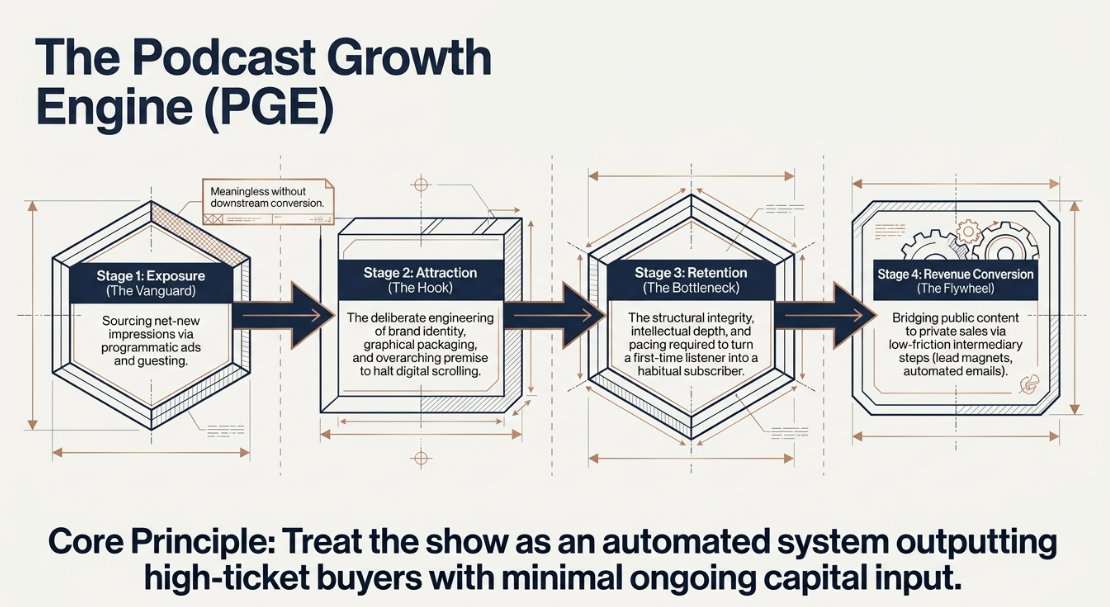
The transition from a casual content creator to an architect of a sustainable, revenue-generating business requires the implementation of a comprehensive systems architecture. Industry strategist Jeremy Enns codifies this transition through the Podcast Growth Engine (PGE) model—a sophisticated, six-part marketing and sales schematic that actively blends creative craft with rigorous systems thinking.12
At its operational core, the PGE is designed to eradicate marketing inefficiencies. It functions as an automated system that outputs a consistent, predictable flow of high-ticket buyers with minimal ongoing inputs of time, mental bandwidth, and capital.12 The model operates under the fundamental premise that the vast majority of creators entirely misunderstand the role a podcast should play within a business; most treat the show as the final product, whereas the PGE dictates that the podcast is merely an intermediary mechanism designed to systematically convert skeptical audience members into red-hot leads.12
To achieve this, the audio property must efficiently and continuously perform three non-negotiable jobs: it must Attract ideal prospects, Retain their attention over extended periods, and deliver contextualized Sales messages.15 The architecture of the PGE structures these jobs across four primary operational phases: Exposure, Attraction, Retention, and Revenue Conversion.
Exposure and Attraction: The Vanguard of Acquisition
The initial stage of the engine is Exposure, which defines the mechanical processes utilized to consistently place the podcast in front of net-new demographics.16 This component relies heavily on the organic and paid tactics outlined previously, including podcast guesting, discovery newsletter pitches, and programmatic advertising.16 However, the foundational philosophy of the PGE asserts that exposure existing in a vacuum is fundamentally flawed. Accumulating millions of passive impressions is economically meaningless if that attention cannot be converted into behavioral action. Focusing purely on exposure without optimizing the downstream funnel is akin to continuously pouring fuel into a vehicle that completely lacks a functional engine.16
Consequently, the Exposure component must be seamlessly and intrinsically linked to the Attraction component.16 Attraction represents the deliberate engineering of the show’s outward presentation—its overarching premise, its brand identity, its graphical packaging, and its topical relevance. The singular objective of the Attraction mechanism is to establish a conceptual hook so compelling that it forces the ideal listener to halt their digital scrolling and initiate the very first audio playback.16
Retention: The Ultimate Growth Bottleneck
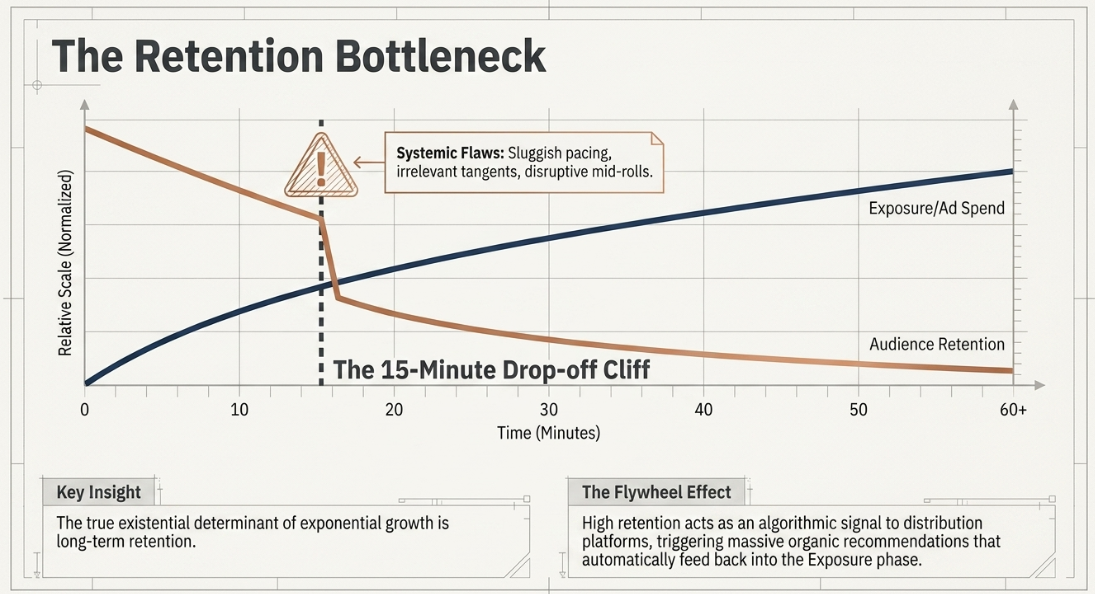
The absolute fundamental truth of audio ecosystem management is that convincing a new listener to press play for the first time is merely the initial point of friction; the true, existential determinant of exponential growth is long-term Retention.15 The PGE model categorically states that if a podcast cannot successfully convert a transient, first-time listener into a habitual, deeply committed subscriber, overall show growth will inevitably stall, completely regardless of the vast marketing budgets applied to the Exposure phase.16
Retention is exclusively a function of the content's structural integrity and the host's creative prowess. Once playback is initiated, the intellectual depth of the ideas explored, the narrative framework, the audio fidelity, and the structural pacing must immediately deliver undeniable value.15 Industry data highlights specific behavioral thresholds within audio retention; for instance, analyzing average consumption rates often reveals sharp listener drop-offs precisely at the 15-minute mark.17 This specific telemetry indicates systemic flaws, such as overly long introductions, poor pacing, or the disruptive placement of mid-roll advertisements that shatter the listener's immersion.17 By identifying and rectifying these drop-off points, producers enhance retention. High retention rates subsequently act as a powerful algorithmic signal to distribution platforms, triggering organic recommendations that exponentially feed back into the Exposure component, thereby creating a closed-loop, self-perpetuating growth cycle.
Low-Friction Sales and the Revenue Flywheel
The terminal stage of the PGE is the extraction of commercial value, a process that relies heavily on a Low-Friction Sales System.14 A highly retained audience develops deep, parasocial trust in the host, making them extraordinarily receptive to contextualized sales messaging.15 However, the PGE cautions against aggressive, high-pressure pitching directly within the audio feed, which can severely erode trust.
Instead, the model advocates building the sales system around one or more attractive, no-pressure intermediary steps that bridge the free public content and the private sales process.14 The podcast acts as a trust-building conduit, directing engaged listeners to an owned digital asset—such as an automated email sequence, a private community forum, or a high-value lead magnet. This transition opens up direct, bilateral communication between the host and prospective clients who require further nurturing before making a high-ticket purchasing decision.14
Once this listener loyalty is successfully converted into revenue, the final phase of the engine dictates that this capital must be strategically reinvested back into the marketing ecosystem. By utilizing revenue to fund more aggressive programmatic exposure campaigns, upgrade production hardware, or hire editors, the creator accelerates the velocity of the entire flywheel, unlocking a state of near-infinite, sustainable growth.16 To pour further fuel on the fire, creators with sufficient bandwidth can integrate additional supplementary content channels—such as YouTube and targeted SEO blogging—to further augment the system.
Hub and Spoke Architecture and the Content Flywheel
To maintain the continuous stream of top-of-funnel exposure required by the PGE without inevitably succumbing to severe creator burnout, sophisticated media operations deploy a Hub and Spoke content distribution strategy.18 This framework fundamentally reorganizes how digital content is conceptualized, produced, and distributed. It resolves the inherent tension between the necessity for deep, highly authoritative long-form analysis and the modern algorithmic requirement for omnipresent, daily social media visibility.18
Mitigating Risk via Owned versus Rented Platforms
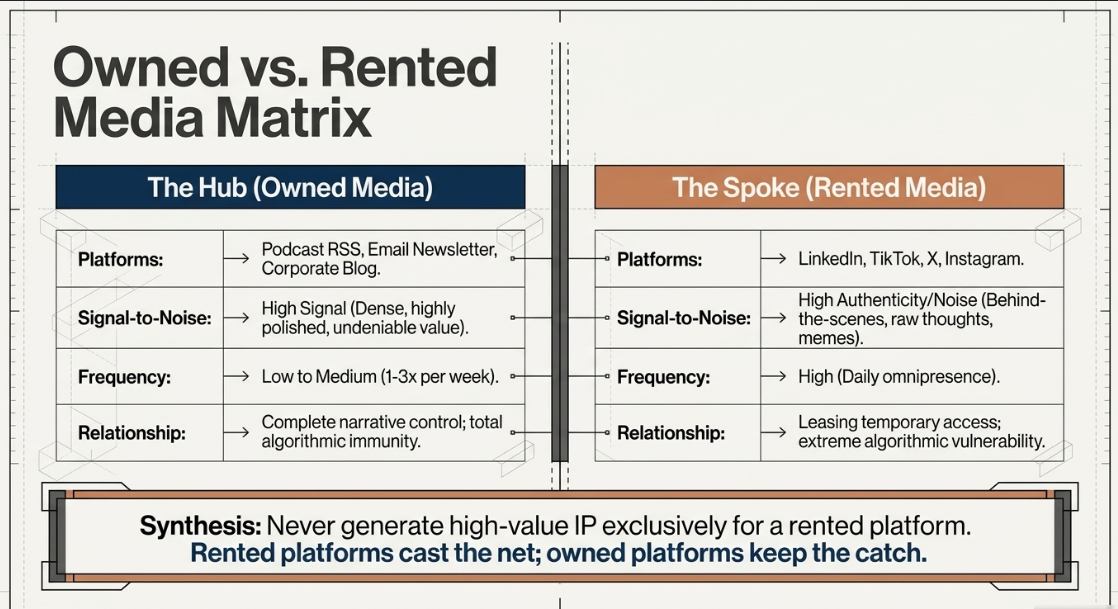
The central operating philosophy of the Hub and Spoke model is the strict, unwavering delineation between "owned" platforms and "rented" (or borrowed) platforms.18 Professional B2B content creators must manage a constant, delicate trade-off between these two environments to ensure both immediate reach and long-term platform security.18
Owned platforms represent digital real estate where the creator maintains a direct, unmediated relationship with a smaller, but intensely engaged, group of loyal fans.18 These platforms include podcast RSS feeds, proprietary email newsletters, and self-hosted corporate blogs.18 On owned platforms, the creator completely controls both the narrative and the distribution mechanics, entirely insulated from algorithmic suppression. These assets serve as the "Hubs."
Conversely, rented platforms are the algorithmic social networks—such as LinkedIn, Twitter (X), Instagram, TikTok, and Twitch.18 In these environments, the creator is merely leasing temporary access to a massive audience. The creator only reaches a fraction of their followers, as content distribution is ruthlessly dictated by algorithms explicitly designed to optimize for "time on site" rather than serving the creator's best interests.18 These volatile, high-reach networks serve as the "Spokes".18
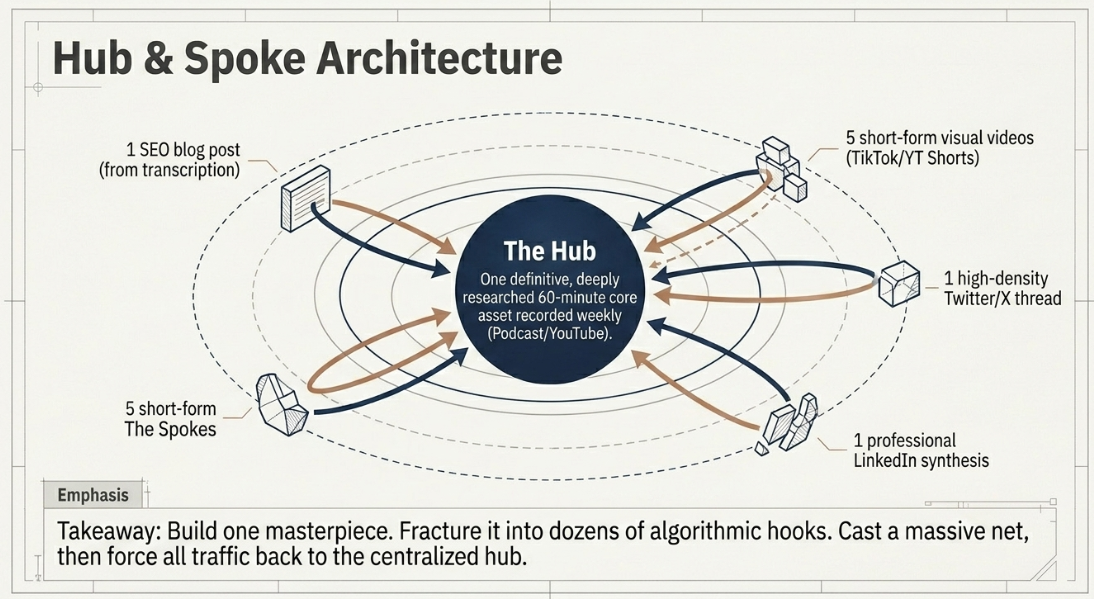
The operational mechanics of this strategy dictate that an enterprise should never generate high-value content exclusively for a rented platform. Instead, resources are heavily concentrated on producing one definitive, exceptionally high-quality piece of Hub content—such as a deeply researched, 60-minute podcast episode—on a weekly or bi-weekly basis.18
This master Hub asset is then systematically deconstructed and reformatted into dozens of smaller, highly contextualized Spoke assets designed specifically for the unique culture of each rented platform.8 A single audio recording is transcribed and rewritten into an extensive SEO blog post, sliced into five highly visual short-form videos for TikTok and YouTube Shorts, synthesized into a high-density Twitter thread outlining the core thesis, and summarized as an insightful professional update on LinkedIn.18
This methodology ensures that every major piece of intellectual property is born multi-channel. The Spokes cast a massive net across diverse demographics, capturing fleeting attention and explicitly funneling that traffic directly back to the centralized Hub.18 Furthermore, this architecture provides ultimate distribution security; if a social media platform alters its algorithm or loses market relevance, the creator's core business remains unharmed because the true audience is safely anchored within the owned ecosystem.
Navigating Signal-to-Noise and Authenticity
The deployment of the Hub and Spoke model aligns closely with the strategic management of a creator's "signal-to-noise" ratio.18 The model dictates distinctly different tonal approaches depending on the platform type:
Note: While authenticity is the standard for Spoke channels, some elite creators utilize a distinct growth hack by treating rented platforms (like Twitter) as secondary Hubs, posting strictly high-signal, low-authenticity content to drive rapid, authoritative growth.18 Additionally, for individual B2B creators, YouTube frequently functions as a primary Hub due to its massive search capabilities, a strategy that is increasingly adopted as traditional web SEO faces structural collapse.18
The F.L.Y.W.H.E.E.L. Execution Framework
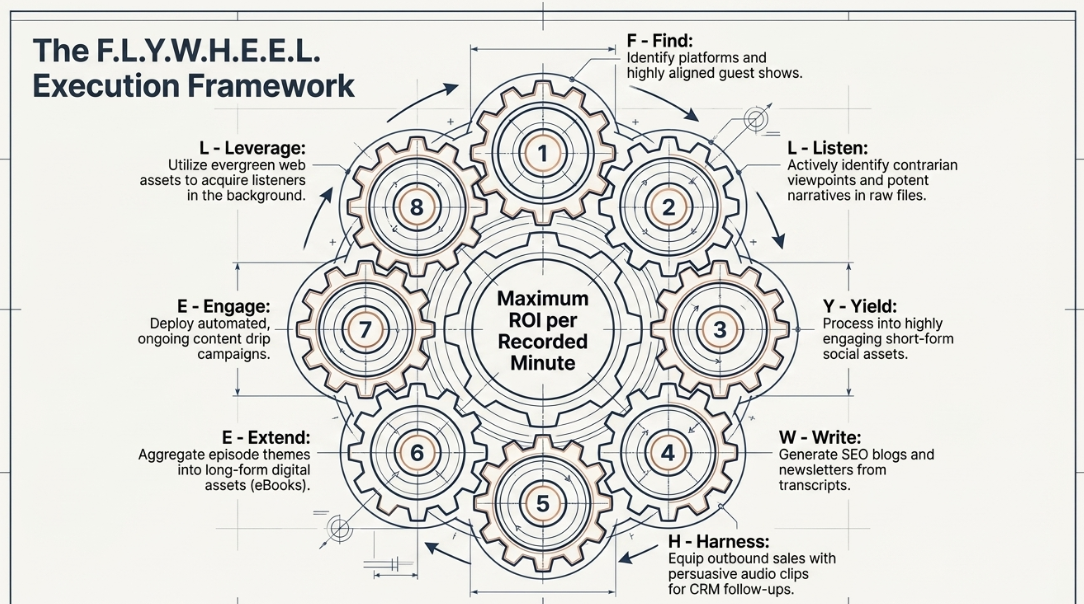
The mechanical transformation of a single audio recording into a perpetual content marketing engine is formalized through the F.L.Y.W.H.E.E.L. framework, a sequential execution model that maximizes the return on investment for every minute recorded 21:
First, the creator must Find the correct platforms and highly aligned shows that precisely match their target audience profile.21 Once the audio is recorded, the production team must rigorously Listen back to the raw files to actively identify and highlight the most potent narratives, contrarian viewpoints, and actionable insights.21 These highlights are then processed to Yield highly engaging, short-form video and audio assets tailored specifically for the rapid consumption habits of social media.21 Simultaneously, the team must Write detailed, SEO-optimized blog posts and extensive newsletter content derived directly from the audio transcripts.21
To drive direct commercial value, the sales organization must Harness the most persuasive audio clips and analytical frameworks for use in outbound sales conversations and CRM follow-ups.21 The lifespan of the content is then maximized as producers Extend the intellectual property into long-form digital assets—such as comprehensive industry guides or downloadable eBooks—by aggregating themes across multiple episodes.21 The brand must continuously Engage the captured audience through automated, ongoing content drip campaigns.21 Finally, the overarching system must Leverage the evergreen nature of the optimized web assets to guarantee that the episodes keep circulating and acquiring net-new listeners in the background, long after their initial publication date.21
By executing this flywheel, enterprise marketers entirely bypass the traditional, linear marketing funnel. In its place, they establish a cyclical, continuous process of attraction, engagement, and automated repurposing that drastically reduces the marginal cost of content creation while simultaneously multiplying digital touchpoints across the Google "Messy Middle" consumer journey.
Measuring Enterprise Success: The Four-Layer KPI Ecosystem
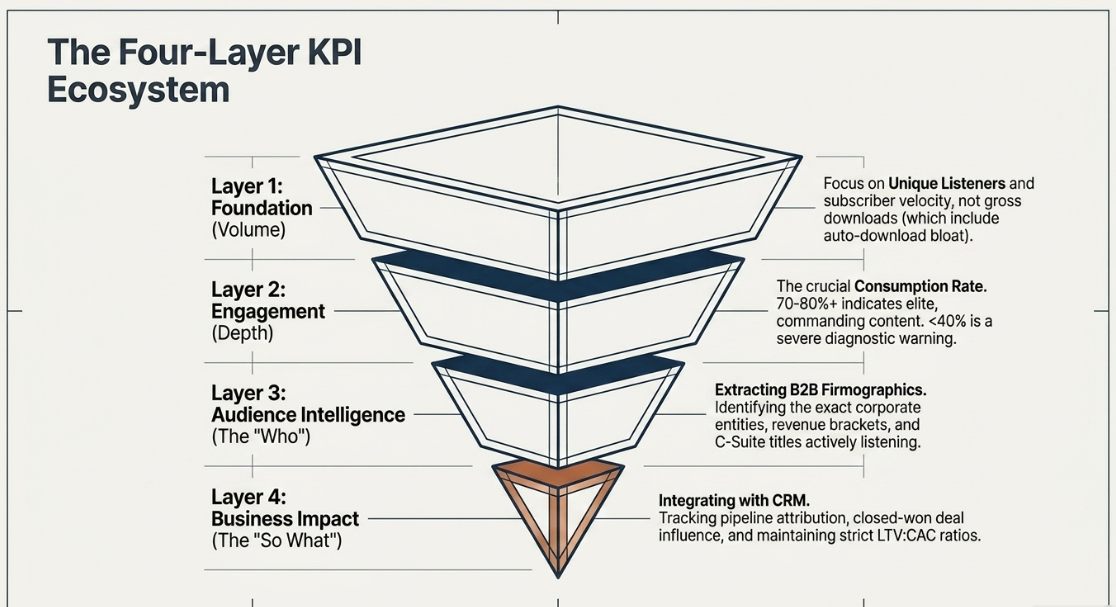
The maturation of podcasting into a primary B2B marketing engine has fundamentally altered how success is measured and justified to executive stakeholders. Historically, creators relied almost exclusively on surface-level vanity metrics, such as gross download counts, to validate their efforts. In the modern enterprise ecosystem, analytics must connect audio engagement directly to financial value, customer retention, and unit economics.24 This requires tracking a highly sophisticated hierarchy of Key Performance Indicators (KPIs) categorized into four distinct measurement layers: Foundation, Engagement, Audience Intelligence, and Business Impact.24
Layer 1: Foundation Metrics (The Volume Layer)
The Foundation layer provides the baseline parameters of the show's overall reach. While these metrics are necessary starting points for analyzing volume, they are heavily prone to misinterpretation and must never be treated as the ultimate "north star" of a campaign.24
Layer 2: Engagement Metrics (The Depth Layer)
The Engagement layer interrogates the actual behavioral interaction between the listener and the audio, validating whether the content is truly resonating or merely being ignored.24 Within B2B marketing, retention is demonstrably more valuable than mere acquisition.25
The single most critical indicator of audio quality is the Consumption Rate (or average listening duration), which measures the exact percentage of an episode that the average audience member completes before abandoning the file.24 In the context of branded podcasts, a consumption rate maintaining 70 to 80 percent or higher indicates an exceptionally strong format that commands attention.24 Conversely, a metric falling below 40 to 50 percent is a severe diagnostic warning, signaling systemic flaws such as sluggish pacing, irrelevant guests, or poor audio fidelity.24 By analyzing specific dropoff timestamps, producers can execute surgical creative adjustments to eliminate structural friction.26 Furthermore, tracking Reviews, Ratings, and Social Shares provides qualitative insights into which episodes strike a deep psychological nerve, with active sharing on platforms like LinkedIn serving as critical proof that buyers are publicly endorsing the brand's content.
Layer 3: Audience Intelligence (The "Who" Layer)
For B2B marketing and high-ticket sales environments, achieving mass reach is entirely irrelevant if the audience does not strictly map to the company's Ideal Customer Profile (ICP). The Audience Intelligence layer transforms anonymous download numbers into actionable demographic and firmographic profiles.24
Advanced podcast analytics platforms (such as CoHost or B2B Analytics dashboards) now capture granular Audience Demographics, detailing psychographic attributes, household income, age brackets, and lifestyle preferences.24 More importantly for enterprise growth, these tools extract precise Listener Firmographics. This technology reveals the specific corporate entities consuming the podcast, breaking down the data by company name, industry classification, employee headcount, and revenue bracket.24 Crucially, it also identifies the specific departmental affiliations (e.g., Marketing, Finance, Engineering) and seniority levels (e.g., Director, C-Suite) of the listeners.26 This intelligence allows Account-Based Marketing (ABM) teams to verify if their highly targeted accounts are actively engaging with the content.24
Layer 4: Business Impact (The "So What" Layer)
The final measurement layer is required to justify capital expenditure to executive leadership by linking audio consumption directly to financial returns.24 As marketing leaders emphasize, retention marketing is an interconnected ecosystem; if it does not get measured, it does not get done, and unit economics such as the Lifetime Value to Customer Acquisition Cost (LTV:CAC) ratio must guide all strategic decisions.25
To prove ROI, organizations track CRM and Pipeline Attribution. Advanced analytics allow the bidirectional flow of podcast firmographic data directly into Customer Relationship Management systems like Salesforce.24 This integration provides outbound sales teams with warm, highly contextual data, showing them exactly which target accounts are listening to specific episodes, serving as an ideal conversational opener.24 Marketing operations can definitively track the percentage of closed-won deals that were influenced by the podcast prior to conversion.24 Additionally, organizations monitor Branded Search and Direct Traffic Lift, measuring the quantifiable increase in direct website traffic and branded Google searches that correlate with episode releases.24 Because podcasts operate fundamentally as a slow-build, trust-generating medium, analysts require a minimum six-month measurement window to accurately capture these delayed pipeline attribution cycles.24
Architecting the Audio Ecosystem: Vanguard Case Studies in Extreme Scaling
The theoretical frameworks of organic SEO, the Hub and Spoke content flywheel, and the Podcast Growth Engine are best understood through their precise application in the market. An extensive analysis of the industry's most dominant and financially successful podcasts reveals exactly how structural engineering, intense niche focus, and extreme format differentiation drive exponential scale.
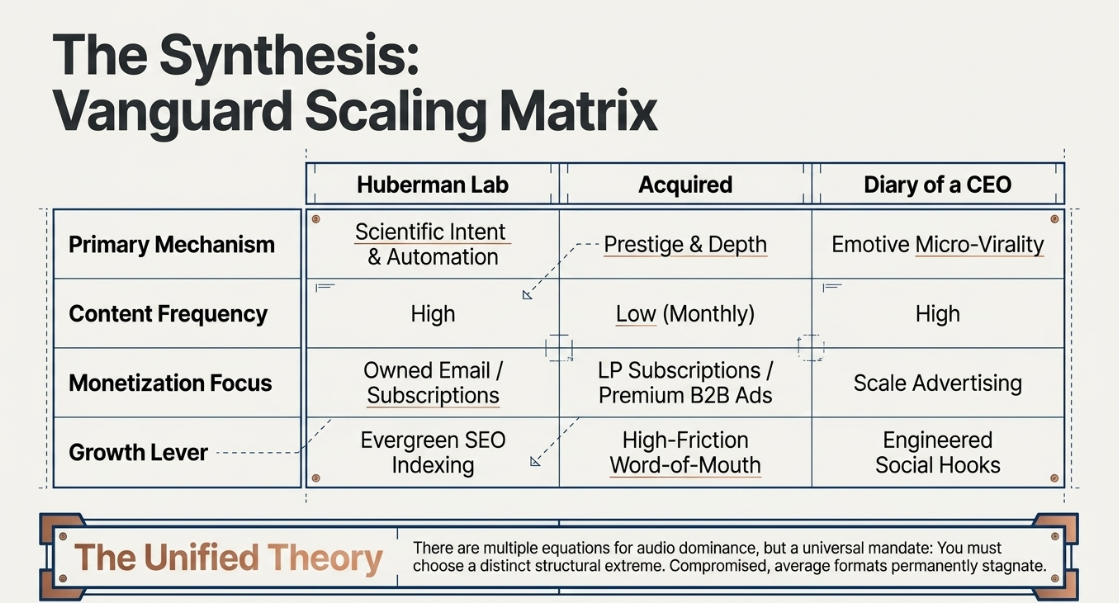
Huberman Lab: Information Architecture and Automated Capitalization
The Huberman Lab, hosted by Stanford neuroscientist Dr. Andrew Huberman, stands as the premier industry masterclass in audience capitalization, workflow automation, and sophisticated information architecture.28 The podcast routinely produces incredibly dense scientific explorations lasting upwards of two and a half hours, generating massive volumes of complex data and 40 to 80 pages of transcriptions per episode.28 Recognizing the inherent vulnerability of relying solely on algorithm-driven platforms like YouTube and Spotify, the production team (led by Scicomm Media) executed a total structural overhaul to completely "own" their audience relationship.28
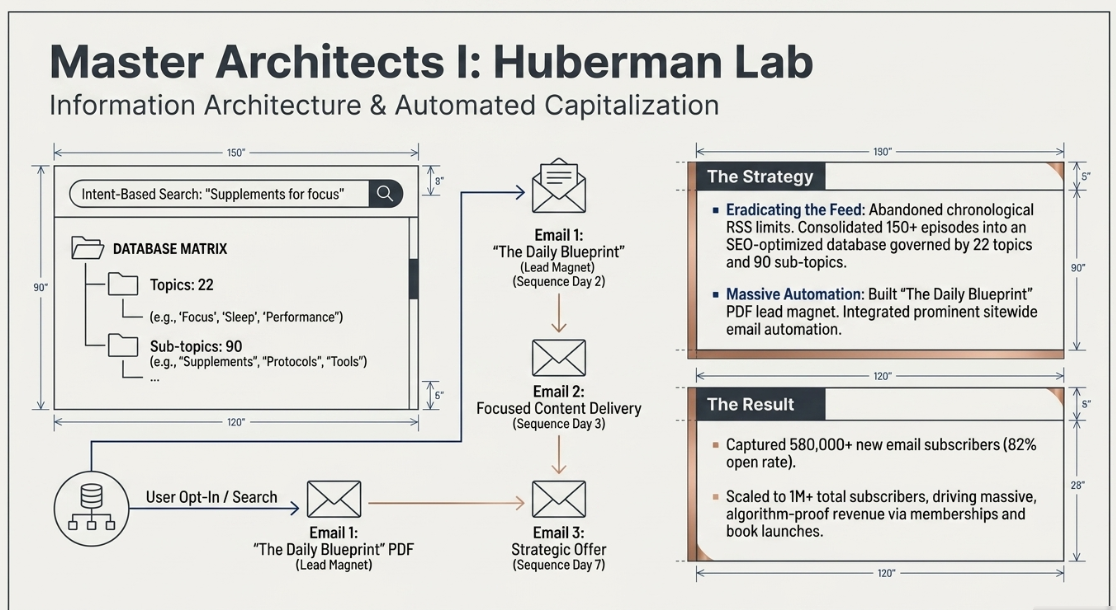
The Eradication of Chronological Feeds and Intent-Driven SEO Historically, podcasts are consumed in a strict chronological format, which rapidly depreciates the SEO and discoverability value of older, evergreen episodes.29 Recognizing that users sought specific scientific protocols rather than linear broadcast history, the Huberman Lab reconstructed its entire owned website architecture.29 The team consolidated over 150 full-length episodes, live AMAs (Ask Me Anything), and a year's worth of newsletters into a meticulously indexed database governed by 22 primary topics and over 90 sub-topics.29
By abandoning chronological browsing in favor of scalable, topic-based matrices, a user searching for "sleep" is immediately presented with a consolidated, SEO-optimized page containing all relevant episodes, exact audio timestamps, and written articles relating exclusively to that subject.29 Furthermore, the site's search engine was upgraded to prioritize visitor intent; searching for "supplements for focus" bypasses exact-keyword matching to intelligently surface highly specific scientific compounds (such as L-tyrosine, acetyl L-carnitine, or Alpha GPC) discussed across disparate episodes.29 This structural masterstroke ensures that the entirety of the vast back catalog remains highly discoverable, combating misinformation while continuously generating organic search traffic.
Automated Lead Generation at Massive Scale To convert this captured organic traffic into owned audience assets, the Huberman Lab deployed aggressive, highly automated digital email systems utilizing Kit software.28 Understanding the absolute necessity of a compelling Attraction mechanism within the PGE, Dr. Huberman synthesized data to create "The Daily Blueprint"—an exclusive, highly actionable PDF lead magnet detailing his exact personal daily routine.28
Rather than hiding the email sign-up in a footer, the conversion forms were granted prominent, highly visible sitewide placement across the homepage, all specific episode pages, and the dedicated book launch page.28 Utilizing visual automation architecture, the delivery of this blueprint and the subsequent welcome sequence was fully automated to run continuously 24/7 without requiring manual administrative oversight.28
The empirical results of this specific mechanism were unprecedented within the scientific media niche. The lead magnet alone captured over 580,000 new email subscribers, maintaining an extraordinary 82 percent open rate and a 54 percent click-through rate on the automated emails.28 Combined with Kit Recommendations—a feature that created an organic referral loop by cross-promoting aligned creators, netting an additional 72,000 subscribers—the Huberman Lab rapidly scaled its owned email database from 6,000 to over one million highly engaged subscribers.28 This massive list now functions as the core economic engine of the brand. It drives direct revenue through premium Supercast memberships (which were seamlessly integrated into the main website, resulting in a 100 percent increase in weekly sales), secures premium independent newsletter sponsorships, and provided massive, algorithm-proof leverage for the launch of Dr. Huberman's book, Protocols.28
Acquired: Defying Conventional Wisdom to Build Prestige and Community
If the Huberman Lab demonstrates the immense power of technological architecture and automation, the Acquired podcast—hosted by venture capitalists Ben Gilbert and David Rosenthal—illustrates the economic triumph of extreme qualitative depth, long-term thinking, and community ownership.30 Acquired meticulously details the histories, corporate playbooks, and strategic maneuvers of the world's most significant companies, and its growth trajectory radically contradicts almost every standard piece of podcasting advice.30
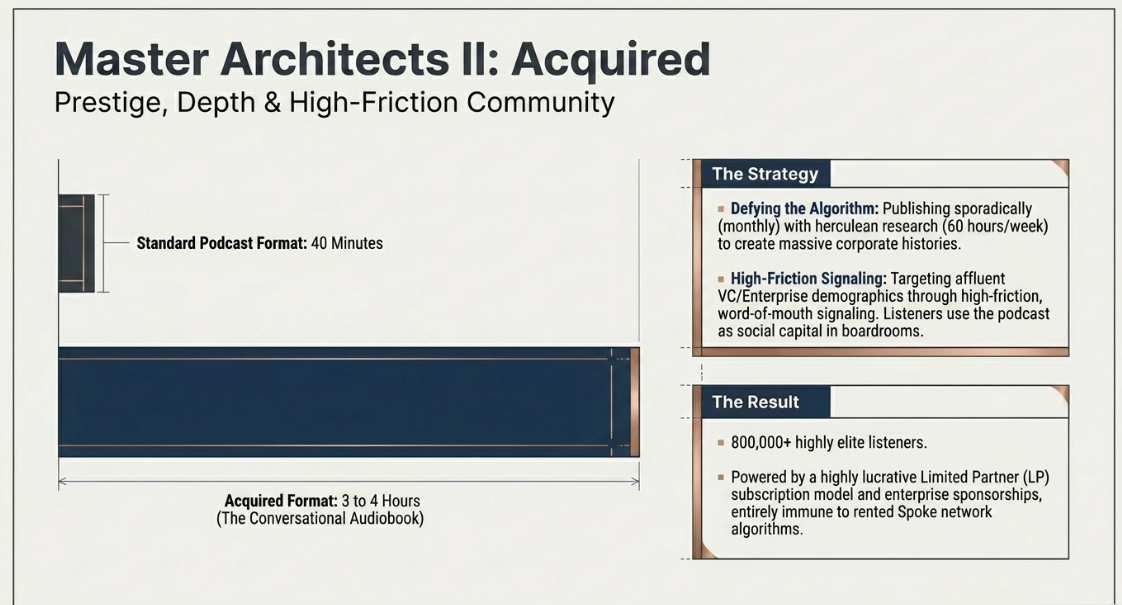
The Economics of the Conversational Audiobook Conventional digital marketing doctrine mandates the production of short, highly frequent content designed to appease rapid-fire social algorithms—typically 40-minute episodes published on a strict weekly basis.30 Acquired completely ignores this established framework. Instead, the hosts publish sporadically—roughly once a month—releasing massive, deeply immersive three-to-four-hour cinematic explorations of corporate history, covering giants like Visa, Costco, and the NFL.30 The format functions less like a standard interview podcast and more like a highly polished, "conversational audiobook".30
The strategic rationale behind this extreme length is the deliberate capture of a specific psychological whitespace: deep intellectual immersion.30 By undertaking herculean research processes—often dedicating 60 hours a week for an entire month to read historical financial filings, analyze books, and conduct off-the-record background interviews with industry insiders and historians—the hosts synthesize a level of business analysis that significantly surpasses standard business school case studies or dry, narrative-less sell-side research reports.30 This uncompromising rigor deliberately targets a highly educated, affluent demographic of founders, executives, and institutional investors who actively recoil at "dumbed-down" business content and crave nuanced, objective narratives.30 The success of this model is so profound that Harvard Business School authored a formal case study on the podcast's operational scaling and business strategy in 2025.36
Community as the Ultimate Growth Engine Because the content demands such a significant time investment from the listener, the audience develops an intense, unparalleled parasocial trust in the hosts.30 The growth of Acquired (reaching over 800,000 listeners) is not driven by algorithmic virality or rented Spoke networks, but by high-friction, highly credible word-of-mouth.31 Listeners actively accrue social capital by recommending the dense episodes to intelligent peers in private Slack channels, corporate boardrooms, and exclusive networking groups, essentially utilizing the podcast as a signaling mechanism for their own intellectual curiosity and business acumen.31
This qualitative depth translates directly into unprecedented economic leverage. The podcast operates a "Limited Partner" (LP) subscription model, generating substantial capital directly from a fiercely loyal community.30 Furthermore, because the audience is comprised almost entirely of high-net-worth enterprise decision-makers, the show commands massive sponsorship premiums. The hosts maintain strict integrity, relying primarily on inbound leads from listeners who run companies, and readily turn down highly lucrative advertisers that present a conflict of interest with their personal venture capital investments.30 Looking toward the future of the audio ecosystem, the Acquired model demonstrates that a property with sufficiently powerful distribution does not need to rely solely on ad revenue; the hosts are actively exploring ownership models, possessing the capability to acquire or launch subsidiary B2B businesses and utilize the podcast purely as the ultimate, zero-cost top-of-funnel acquisition channel.
The Diary of a CEO: Micro-Virality and Curated Authority
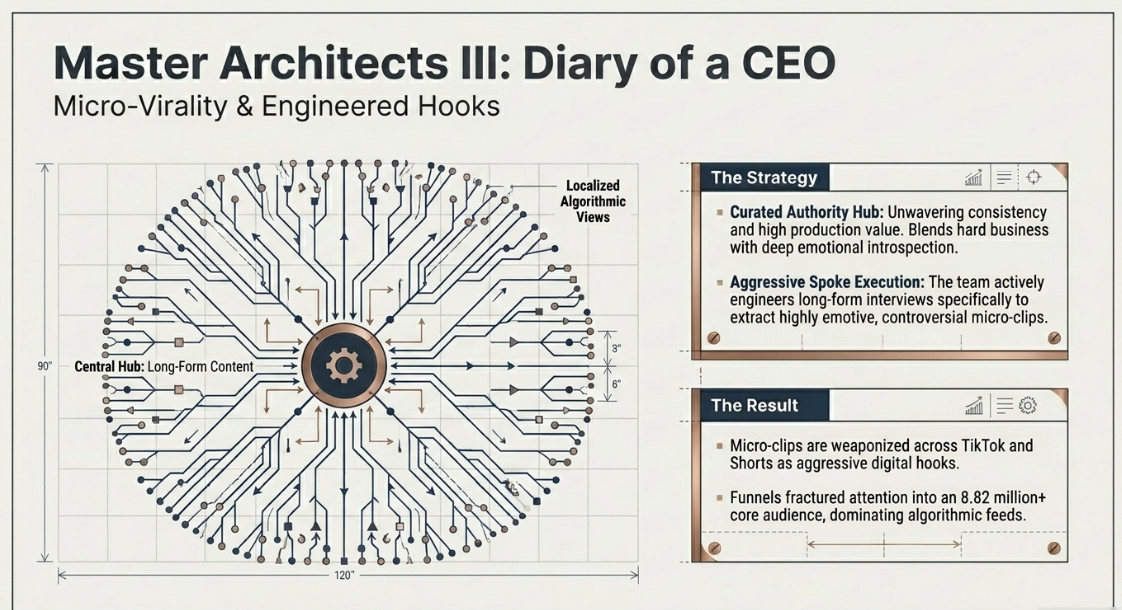
Contrasting the slow, massive, monthly releases of Acquired, Steven Bartlett’s The Diary of a CEO (DOAC) utilizes rapid execution, relentless consistency, and high-velocity emotional resonance to dominate both global audio charts and rented social media feeds.38 Amassing an audience of over 8.82 million, the growth engine of DOAC relies on an incredibly aggressive, masterfully executed Hub and Spoke model.38
The core Hub strategy hinges on unwavering predictability, releasing highly produced, long-form interviews that seamlessly blend hard business acumen with deep emotional, psychological, and therapeutic introspection.38 Bartlett's guest selection operates as a primary growth lever; he meticulously curates individuals who possess either massive pre-existing authority, extreme emotional relatability, or intense curiosity, ensuring a massive Total Addressable Market (TAM) for every single upload.38
Crucially, the success of the DOAC ecosystem is inextricably linked to its Spoke distribution strategy. The production team actively engineers the long-form interviews to contain highly emotive, controversial, or profoundly revelatory moments. These moments are subsequently extracted, meticulously edited into highly engaging, cinematic micro-clips and trailer drops, and deployed en masse across algorithmic platforms like TikTok, Instagram, and YouTube Shorts.38 These engineered viral snippets act as aggressive digital hooks within rented networks, capturing fractured attention spans and explicitly funneling millions of users back into the core, long-form audio Hub.38 By mastering both the high signal-to-noise requirements of the long-form Hub and the authentic, viral demands of the rented Spokes, the podcast maintains perpetual cultural relevance.
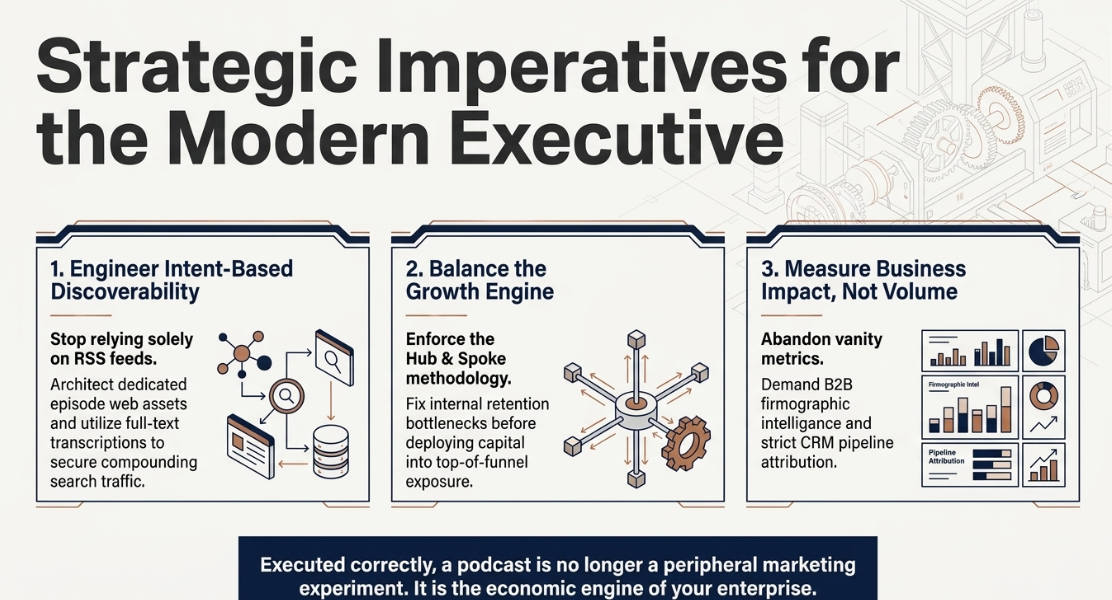
Strategic Imperatives for the Modern Executive
The comprehensive analysis of the current digital audio environment unequivocally demonstrates that isolated content creation—publishing audio files without a surrounding infrastructure—is highly vulnerable to systemic algorithmic changes, audience fatigue, and economic stagnation. Achieving dominance and sustainable ROI in this space requires the deliberate construction of a resilient, multi-layered audio ecosystem.
The core strategic imperatives for scaling a podcast property revolve around migrating from passive distribution to active, structural engineering. Enterprise organizations and thought leaders must prioritize advanced SEO architectures, recognizing that full-text transcriptions, dedicated episodic web pages, and intent-based search optimization are strictly non-negotiable for ensuring long-term, compounding discoverability.
Furthermore, the mechanisms of the Podcast Growth Engine must be meticulously balanced. Vast capital expenditures on programmatic exposure campaigns and rewarded user acquisition are financially ruinous if the underlying audio format fails to immediately hook the listener, sustain long-term retention, or provide a low-friction pathway to eventual revenue conversion. To immunize a brand against the extreme volatility of rented social media algorithms, the Hub and Spoke content flywheel must be rigidly enforced. High-signal, authoritative audio must serve as the primary foundational asset, from which all short-form social content is systematically derived, perpetually driving audiences back to owned digital properties and email databases.
Finally, the corporate validation of these expansive ecosystems requires the total abandonment of surface-level vanity metrics. Success must be measured through granular engagement statistics like consumption rates, the extraction of B2B firmographics to identify ideal customer profiles, and closed-loop CRM attribution to prove direct pipeline influence. By adopting these rigorous, systemic frameworks, modern organizations can elevate their podcasts from peripheral, experimental marketing assets into self-sustaining, highly lucrative economic engines.
Works cited
Navigating the Programmatic Audio Ecosystem - AdsWizz, accessed June 11, 2026, https://www.adswizz.com/navigating-the-programmatic-audio-ecosystem/
Press Releases - Sounds Profitable, accessed June 11, 2026, https://soundsprofitable.com/press-release/
The Ultimate Podcast Marketing Framework — Dots Loves ..., accessed June 11, 2026, https://www.dotslovesmarketing.com/editor-picks/the-ultimate-podcast-marketing-framework
Podcast SEO: How to Rank #1 on Spotify, Google & Apple Podcasts ..., accessed June 11, 2026, https://www.jigsawkraft.com/post/podcast-seo-how-to-rank-1-on-spotify-google-apple-podcasts-in-2026
Podcast SEO in 2026: Get Discovered Without Paying for Ads - J-Delmas Studios, accessed June 11, 2026, https://jdelmasstudios.com/podcast-seo-2026-get-discovered/
Podcast SEO Guide 2026 - More Listeners Through Better, accessed June 11, 2026, https://sone.app/blog/podcast-seo-guide-maximum-visibility
How to Promote Your Podcast to Get More Clients with Amanda Bennett - Copywriter Megan Kachigan | Values First Marketing, accessed June 11, 2026, https://www.megankachigan.com/promote-your-podcast-to-get-more-clients-amanda-bennett
Can small content creators grow without paid ads? - Quora, accessed June 11, 2026, https://www.quora.com/Can-small-content-creators-grow-without-paid-ads
Is Strategic Podcasting Still Worth It In 2025? Here's The Truth, accessed June 11, 2026, https://leahbryantco.com/podcast/why-strategic-podcasting-still-works/
Podcast Growth and SEO Strategies for Entrepreneurs | Podcasting Problem Solver, accessed June 11, 2026, https://www.deezer.com/show/1001883551
Apptivate podcast: The future of rewarded user acquisition - Remerge, accessed June 11, 2026, https://www.remerge.io/podcast/ep-212-the-future-of-rewarded-user-acquisition
The Podcast Growth Engine Model - Podcast Marketing Academy, accessed June 11, 2026, https://podcastmarketingacademy.com/podcast-growth-engine-model/
Who do you actually follow for podcast growth / marketing tips? - Reddit, accessed June 11, 2026, https://www.reddit.com/r/podcasting/comments/1ppqldo/who_do_you_actually_follow_for_podcast_growth/
The Podcast Growth Engine Model - Podcast Marketing Academy, accessed June 11, 2026, https://podcastmarketingacademy.com/podcast-growth-engine-model-overview/
The Podcast Growth Engine: Optimizing Your Podcast, accessed June 11, 2026, https://podcastmarketingacademy.com/podcast-growth-engine-podcast/
Podcast Growth Engine - Podcast Marketing Academy, accessed June 11, 2026, https://podcastmarketingacademy.com/podcast-growth-engine/
How to Measure Podcast Success: the Ultimate Checklist - Castmagic, accessed June 11, 2026, https://www.castmagic.io/post/how-to-measure-podcast-success
The Hub+Spoke Content Strategy of 100k+ follower B2B creators, accessed June 11, 2026, https://dx.tips/hubspoke-strategy
Adopting a Hub and Spoke Content Strategy - Willow Marketing, accessed June 11, 2026, https://willowmarketing.com/2020/04/22/adopting-a-hub-and-spoke-content-strategy/
Build Your Content Marketing Strategy Around a Hub & Spoke Model - IDX, accessed June 11, 2026, https://www.idx.inc/newsroom/build-your-content-marketing-strategy-around-hub-spoke-model
The Thought Leader's Flywheel: How to Turn Podcast Appearances ..., accessed June 11, 2026, https://kitcaster.com/the-thought-leaders-flywheel-how-to-turn-podcast-appearances-into-content-gold/
The Content Flywheel Behind a 7-Figure Education Business ft. Timothy Moser, accessed June 11, 2026, https://tropicalmba.com/episodes/content-flywheel-behind-7-figure-business
The B2B Content Flywheel: How to Use Events to Drive Growth - Goldcast, accessed June 11, 2026, https://www.goldcast.io/blog-post/content-flywheel
11 KPIs Branded Podcasts Should Track to Prove ROI in 2026, accessed June 11, 2026, https://www.quillpodcasting.com/blog-posts/kpi-metrics-branded-podcasts-should-monitor
The Data Room - Apple Podcasts, accessed June 11, 2026, https://podcasts.apple.com/gb/podcast/the-data-room/id1583234022
The Podcast Analytics That Actually Matter - CoHost, accessed June 11, 2026, https://cohostpodcasting.com/resources/podcast-analytics-that-matter
The Ins and Outs of Strategic Retention Marketing With Jess Chan - Elumynt, accessed June 11, 2026, https://www.elumynt.com/podcast/the-ins-and-outs-of-strategic-retention-marketing-with-jess-chan
How Andrew Huberman scaled to 1M subscribers with Kit, accessed June 11, 2026, https://kit.com/resources/blog/andrew-huberman-case-study
Huberman Lab | Case Study - DoubleUp, accessed June 11, 2026, https://www.doubleup.agency/case-study/huberman-lab
The making of 'Acquired,' the No. 1 tech podcast sensation, accessed June 11, 2026, https://www.fastcompany.com/90927453/acquired-number-1-tech-podcast-sensation
Acquired's Success Secret: Ben Gilbert's Quality Approach - Guy Kawasaki, accessed June 11, 2026, https://guykawasaki.com/acquireds-success-secret-ben-gilberts-quality-approach/
Acquired - Podcast - Global Player, accessed June 11, 2026, https://www.globalplayer.com/podcasts/42Kq5a/
Visa - Acquired Podcast, accessed June 11, 2026, https://www.acquired.fm/episodes/visa?91f65ec8_page=2
Costco - Acquired Podcast, accessed June 11, 2026, https://www.acquired.fm/episodes/costco?96ed0d79_page=2
All Episodes | Acquired Podcast, accessed June 11, 2026, https://www.acquired.fm/episodes
The Acquired Podcast: Scaling the Mic - Case - Faculty & Research, accessed June 11, 2026, https://www.hbs.edu/faculty/Pages/item.aspx?num=68094
How Acquired became the No. 1 Tech podcast - Substack, accessed June 11, 2026, https://substack.com/home/post/p-147810407?utm_campaign=post&utm_medium=web
Case Study: The Diary of a CEO #001 | by Rahaman Bin Ujit - Medium, accessed June 11, 2026, https://rahamanbinujit.medium.com/case-study-the-diary-of-a-ceo-001-afb62db1aead
Advertise on podcast: The Diary Of A CEO with Steven Bartlett - Podvertise.fm, accessed June 11, 2026, https://podvertise.fm/1291423644
A Realistic Day in the Life of a Podcast CEO in London - YouTube, accessed June 11, 2026, https://www.youtube.com/watch?v=C2-Uqmu2N28