The contemporary business-to-business (B2B) marketing landscape has undergone a structural and permanent transformation, driven by a highly fragmented digital media environment, the obsolescence of legacy tracking methodologies, and the rise of autonomous, self-directed buyer journeys. As of 2026, the cross-industry B2B marketing budget median sits at 9.1% of company revenue, representing a strategic redirection of capital away from inefficient, broad-reach demand generation and toward sophisticated account-based marketing (ABM), artificial intelligence tooling, and high-fidelity content infrastructures.1 This reallocation is not an austerity measure but a necessary adaptation to a complex procurement environment. Buying committees now average 11.2 stakeholders for enterprise deals exceeding $50,000, and self-directed journeys account for 67% of the purchasing cycle, meaning buyers are operating highly independently before ever initiating contact with a sales representative.1 In fact, enterprise buyers consume an average of 13.4 pieces of content prior to their first vendor interaction, up from 11.6 pieces in 2024.
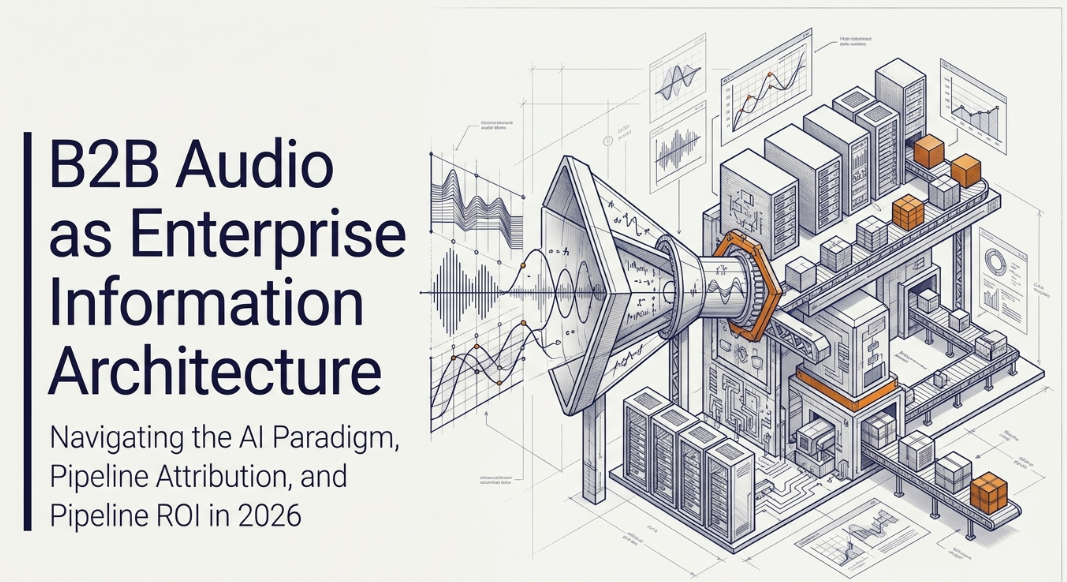
Simultaneously, the economic efficiency of traditional outbound marketing is deteriorating rapidly. Research indicates that 95% of B2B buyers are not actively in the market for a solution at any given time, meaning aggressive outbound methodologies frequently waste capital pursuing uninterested prospects.2 Conversely, inbound marketing methodologies—where buyers organically discover branded content—cost between $75 and $150 per lead, compared to the $200 to $500 cost associated with outbound generation, and convert at nearly double the rate.2 Within this economic and structural redirection, podcasting has evolved from a peripheral, experimental brand awareness exercise into a foundational, high-ROI pillar of the modern revenue engine. Professional brands are systematically leveraging the intimacy, nuance, and sustained engagement of audio to capture executive attention, build asynchronous champions across the buying committee, and accelerate extended sales cycles.
This comprehensive report provides an exhaustive, multi-dimensional analysis of the B2B podcast marketing ecosystem in 2026. It examines macro-industry growth metrics, advanced pipeline attribution methodologies, the application of Search Everywhere Optimization (SEO), the mechanics of Generative Engine Optimization (GEO) via artificial intelligence, the integration of programmatic dynamic ad insertion, and the severe governance challenges associated with synthetic media and voice cloning.
The 2026 Global Audio Economy: Market Capitalization and Structural Dynamics
The global podcast market has demonstrated exponential and sustained growth, transforming into one of the most heavily consumed and heavily capitalized media segments worldwide. Both audience scale and economic valuation reflect a mature ecosystem that presents unique, asymmetric advantages for enterprise marketing strategies.
Macro-Market Valuation and Global Listenership Growth
By the close of 2026, the worldwide podcast listener base is projected to reach between 619.2 million and 672 million monthly listeners.3 This represents an 11% year-over-year increase from 2025 and an extraordinary 145% expansion since 2019, when the global audience sat at just 274 million.4 Furthermore, there are currently 464 million weekly listeners globally, generating a daily active listening base of 168 million people.4 This unprecedented growth is primarily driven by an increasing consumer demand for highly niche-specific, on-demand professional content that traditional broadcast media cannot supply.
Correspondingly, the economic valuation of the global podcast industry is estimated to reach $28.6 billion in 2026, marking a 55% growth from $18.5 billion in 2024.4 Advertising capital has aggressively followed this audience migration. Global podcast ad spend is projected to exceed $5.5 billion by 2026, with the B2B-specific advertising sub-sector accounting for a massive influx of $4 billion.3 In the United States—which remains the dominant market regarding monetization—advertising revenues are projected to climb past $4.2 billion, representing a 31% growth from 2024.4 However, international markets are expanding at accelerated rates. European podcast ad spend has reached $2.9 billion, a 61% growth from 2024, driven by a 24% annual market expansion rate that far outpaces the 8% growth rate in the United States.4
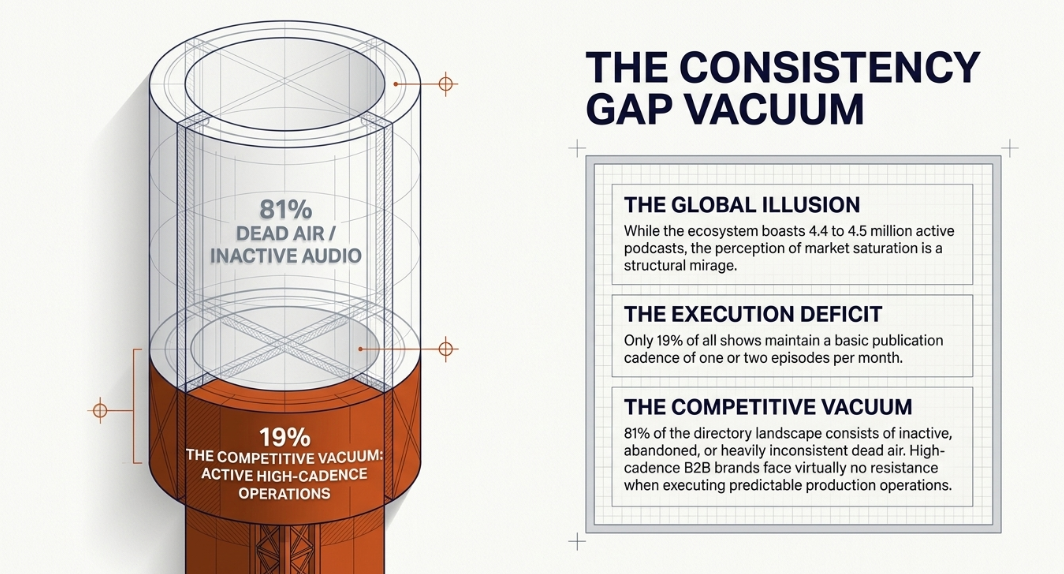
Despite the apparent saturation of 4.4 million to 4.5 million active podcasts globally, structural production inefficiencies remain that agile professional brands can exploit.3 Analysis indicates a profound "consistency gap" across the directory landscape. Only 19% of all shows publish a new episode once or twice a month.3 Consequently, 81% of the entire podcast ecosystem consists of inactive, abandoned, or highly inconsistently published shows.3 This presents a massive competitive vacuum for B2B brands capable of deploying predictable, high-cadence production operations.
Structural Audience Behaviours: The Executive Listener Profile
The strategic value of podcasting for B2B brands lies less in aggregate, global scale and entirely in demographic density and executive penetration. The medium inherently self-selects for an affluent, highly educated, and professionally senior audience. In the United States, 68% of listeners hold a bachelor's degree or higher, and 56% of monthly podcast listeners report an annual household income exceeding $75,000.3 Furthermore, the average podcast listener earns 22% more than the average non-listener.
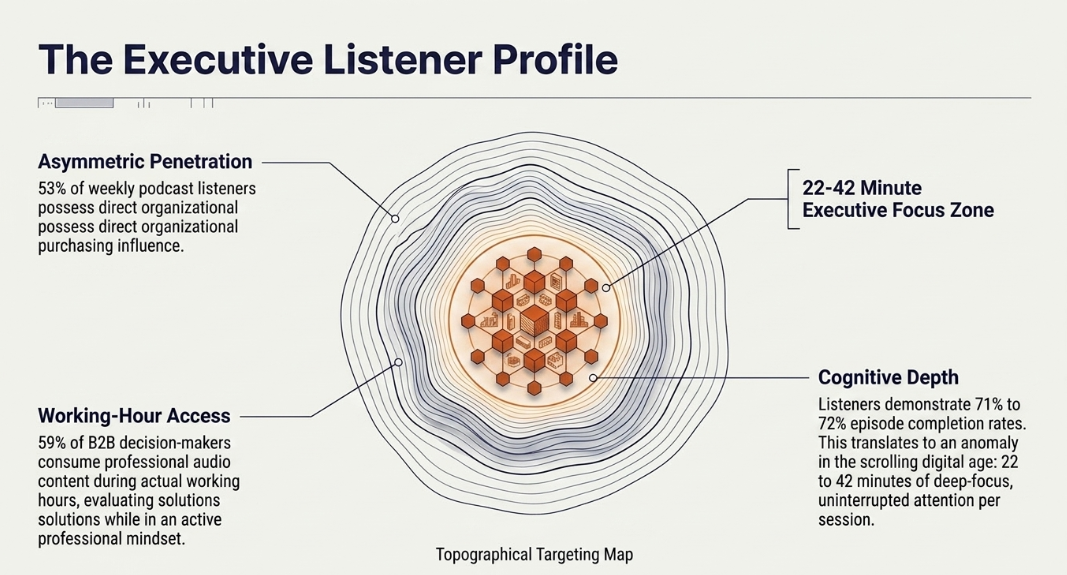
Crucially, podcasts penetrate the senior executive tier efficiently, reaching Chief Marketing Officers, Chief Financial Officers, founders, and department heads who are otherwise heavily gated against traditional outreach. Approximately 53% of weekly podcast listeners state they possess direct influence over purchasing decisions at their organizations.3 Furthermore, 59% of B2B decision-makers consume audio content during actual working hours, allowing brands to interface with prospects precisely when they are in a professional mindset and actively evaluating business solutions.3
Consumption behaviors further underscore the medium's psychological efficacy. Podcast listeners exhibit exceptional completion rates and depth of engagement. Approximately 71% to 72% of listeners consume episodes in their entirety, translating to an average of 22 to 42 minutes of uninterrupted, deep-focus attention per session.3 Listeners tune in for an average of 5.2 hours per week, consuming an average of 4.2 episodes across roughly 6 different shows.4 This depth of cognitive engagement is an anomaly in the modern digital marketing landscape, which is heavily defined by brief, scrolling interactions. Audio allows for complex B2B value propositions, nuanced thought leadership, and intricate product narratives to be articulated without the constraints of short-form media.
Furthermore, platform consumption has shifted dramatically. While traditional audio-only directories remain vital, YouTube has emerged as the clear frontrunner for podcast consumption, capturing 33% of U.S. listeners, driven heavily by Gen Z professionals, 31% of whom utilize video-podcasting as their primary format.3 Spotify occupies the second position with 26% of the market share, followed by Apple Podcasts.
The Privacy Paradigm: Cookie Deprecation and Contextual Audio Real Estate
The rise of podcast marketing is simultaneously being accelerated by macroscopic shifts in global data privacy regulations and the degradation of third-party tracking infrastructure. The digital advertising ecosystem is undergoing a seismic pivot toward privacy-first operations, driven by legislative mandates such as the California Consumer Privacy Act (CCPA), the California Privacy Rights Act (CPRA), and the European Digital Markets Act (DMA).6 These frameworks enforce strict user consent mechanisms, transforming how consumer data is collected, processed, and utilized for targeted advertising.6
While Google ultimately reversed its absolute mandate to completely deprecate third-party cookies in Chrome—opting instead for an informed choice model that allows users to seamlessly opt out of tracking across their web browsing—the broader industry trajectory remains irreversibly pointed toward a cookie-less reality.8 Traditional digital marketing methodologies that rely heavily on third-party cookies to build lookalike audiences, execute cross-site remarketing campaigns, and monitor granular browsing habits are facing severe limitations.6
In this increasingly restricted environment, B2B marketers are forced to pivot from rented, third-party data to owned, first-party data strategies.7 Podcasts offer an optimal solution to this privacy dilemma. Because podcast advertising operates heavily on contextual targeting rather than behavioral tracking, it is inherently privacy-compliant.8 Furthermore, an owned podcast builds a direct, opt-in relationship with a subscriber base, generating high-intent, first-party data and brand affinity that is entirely immune to browser-level cookie restrictions or ad-blocking software. The medium allows brands to establish a robust digital footprint and build community without relying on the fragile infrastructure of invasive digital tracking.
The B2B Podcast Maturity Curve and Amplified Marketing Architecture
Historically, many B2B organizations treated podcasts as experimental, isolated assets—recording conversations, uploading audio files to a directory, and hoping for organic discovery. This approach is rapidly failing. The brands realizing substantial ROI in 2026 operate at the peak of the "B2B Podcast Maturity Curve," a framework that traces the evolution from basic audio experimentation to sophisticated, integrated content systems.9
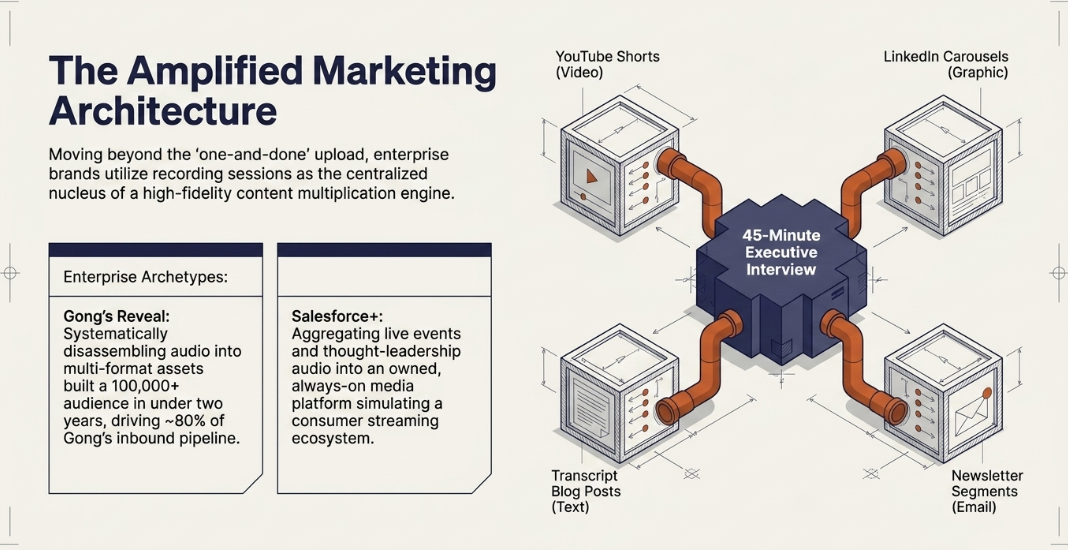
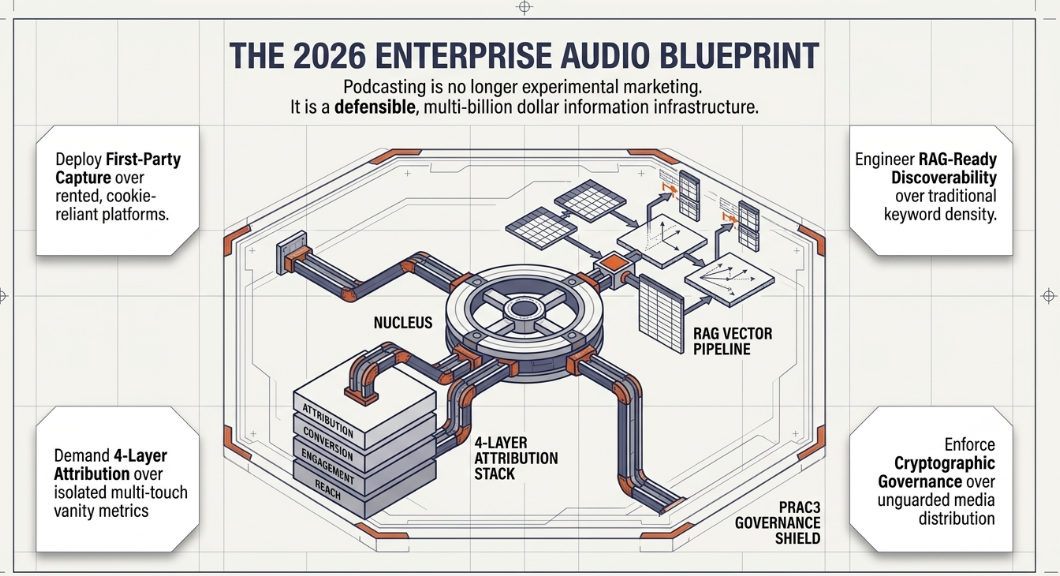
At the apex of this curve is "Amplified Marketing".9 Rather than treating podcasts as standalone, one-and-done episodes, leading organizations utilize the podcast recording as the nucleus of a comprehensive content multiplication engine.11 For example, a single 45-minute executive interview is systematically disassembled into three weeks of multichannel content. This includes short-form video clips optimized for LinkedIn and YouTube Shorts, fully fleshed-out blog posts derived from the transcript, dedicated email newsletter segments, and actionable framework graphics.11
Case Studies in Enterprise Audio Architecture
Gong’s Reveal: The Revenue Intelligence Podcast serves as the definitive archetype for this Amplified Marketing strategy.10 By rigorously repurposing their podcast interviews into bite-sized, multichannel assets, Gong built an audience of over 100,000 listeners in less than two years.14 More importantly, this multi-format approach to audio content reportedly contributes to approximately 80% of Gong's inbound pipeline, demonstrating the sheer revenue power of treating podcasts as a centralized content engine rather than an isolated channel.11
The evolution of B2B audio is further evidenced by the development of proprietary corporate media streaming platforms. Salesforce launched Salesforce+, an always-on, business-focused media platform designed to emulate the user experience of consumer streaming giants like Netflix or Disney.15 Rather than relying solely on point-in-time physical events, Salesforce+ aggregates live event broadcasts, original series, thought leadership programs, and dedicated B2B podcasts into a centralized, owned ecosystem.15 By offering viewers the ability to customize their content feeds based on their specific professional roles, industries, or immediate business challenges, Salesforce cultivates deeply trusted relationships and an ongoing sense of community, fundamentally altering how enterprise software is marketed and consumed.
High-Fidelity Content Frameworks: Customer Stories and Executive Thought Leadership
To capture the attention of a skeptical, highly educated buying committee, the content of the podcast itself must move beyond generic industry commentary. Successful B2B podcasts function essentially as asynchronous consultants, providing immense value rather than operating as extended sales pitches.19 Thought leadership is a powerful commercial catalyst; 75% of B2B decision-makers state that thought leadership content has directly led them to research a product or service they had not previously considered, viewing it as a vastly more trustworthy assessment of a company's capabilities than traditional promotional materials.20
Within the B2B podcast landscape, the "Customer Story" or case study format has proven exceptionally potent.20 In 2024, 78% of B2B marketers utilized case studies, recognizing that buyers demand tangible proof of efficacy.20 B2B podcasts leverage "How They Did It" interviews, bringing real customers onto the show to detail their specific challenges, their decision-making processes, and the measurable outcomes they achieved.20 Because podcast audio achieves extraordinarily high message recall—with 7 in 10 listeners accurately remembering brand messaging—these customer narratives resonate deeply, building profound trust and systematically accelerating the buyer's evaluation process.20
This strategy is mirrored across the broader B2B landscape, with elite marketing podcasts such as The B2B Playbook, Exit Five, Revenue Vitals, and The Long Game demonstrating how sustained, high-density professional audio content compounds over time to build undeniable brand authority and industry dominance.21
Deconstructing the Dark Funnel: The Failure of Traditional Attribution
The most persistent barrier to executive investment in B2B podcasting has been the perceived inability to measure Return on Investment (ROI) and translate audience consumption metrics into tangible pipeline contributions.24 Because podcast consumption largely occurs in decentralized, untrackable environments—such as native mobile applications (Apple Podcasts, Spotify), connected vehicles, smart speakers, and offline downloads—traditional digital marketing measurement models routinely fail to capture the medium's commercial impact.4
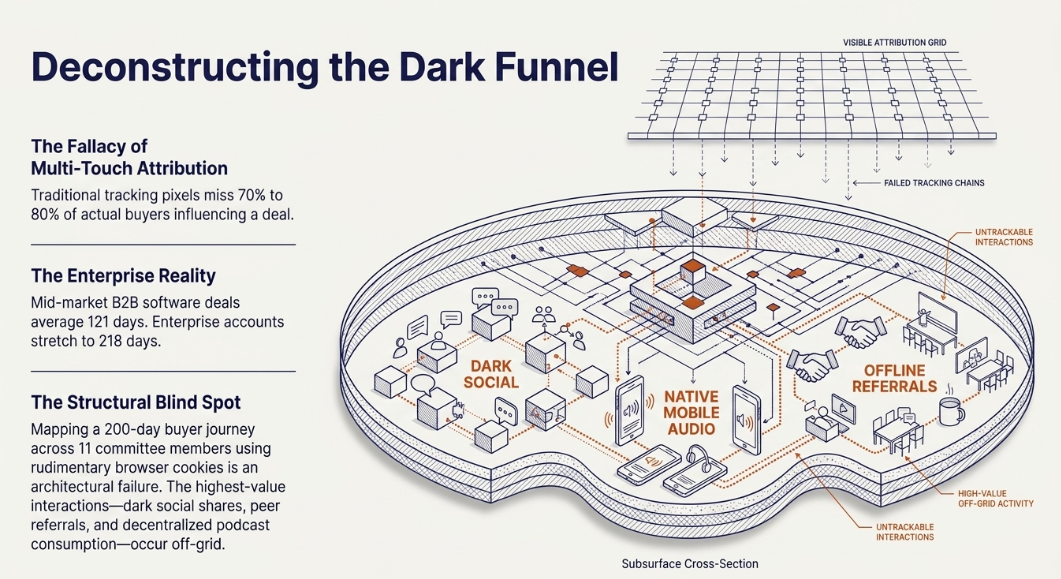
Podcasts operate as a primary vector for "dark social" and the "dark funnel"—the invisible web of digital communications where modern buyers actually share content, solicit recommendations, and form opinions outside of trackable software infrastructure.25 Research indicates that traditional multi-touch attribution (MTA) models, which rely on tracking pixels and cookies, fail to track 70% to 80% of the actual buyers influencing a deal.25 B2B deals average 121 days for mid-market software and stretch to 218 days for enterprise accounts.1 The assumption that rudimentary digital tracking can accurately map a 200-day buyer journey across 11 different committee members, accurately attributing value to a podcast listened to during a morning commute, is an architectural fallacy.
The Four-Layer Revenue Attribution Stack
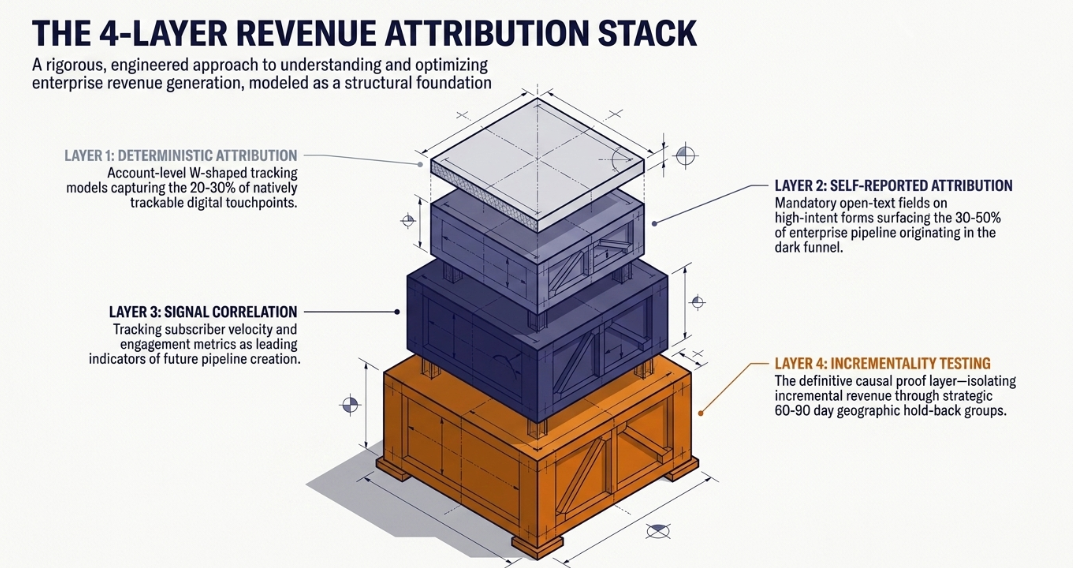
To accurately quantify podcast ROI and align it with overall revenue operations, elite enterprise marketing teams in 2026 have abandoned single-source attribution in favor of a synchronized, four-layer attribution stack.25 This layered architecture compensates for the inherent blind spots of traditional tracking, generating a holistic view of audio-driven pipeline 25:
Layer 1: Deterministic Attribution (The Trackable Layer): This foundation relies on traditional multi-touch attribution configured strictly at the account level. It utilizes W-shaped models to distribute revenue credit across trackable first-touch, lead-creation, and opportunity-creation events via platforms like Dreamdata or HockeyStack. However, modern revenue leaders recognize that this layer only captures the 20% to 30% of the buyer journey that organically passes through natively trackable digital environments. It is a baseline, not a comprehensive truth.25
Layer 2: Self-Reported Attribution (The Dark Funnel Visibility Layer): This layer operationalizes dark social measurement by requiring a mandatory, open-text field (e.g., "How did you first hear about us?") on all high-intent conversion forms (such as demo requests or pricing inquiries). This simple mechanism is the primary instrument for surfacing podcast-driven revenue. Aggregated data consistently reveals that 30% to 50% of enterprise pipeline originates from channels that digital tracking cannot monitor—most notably, podcast mentions, Slack community recommendations, and peer-to-peer referrals.25
Layer 3: Signal Correlation (The Leading Indicator Layer): Rather than attempting to attribute past conversions retroactively, this layer tracks leading indicators that statistically correlate with future pipeline creation. By monitoring proxy signals—such as podcast subscriber velocity, episode download consistency, and deep listening engagement metrics—organizations can measure the momentum of brand awareness months before it materializes into direct, trackable revenue.25
Layer 4: Incrementality Testing (The Causal Proof Layer): Widely regarded as the definitive standard for modern media measurement, incrementality testing isolates true causal impact. Organizations will systematically suppress or amplify a specific channel for a designated period. For example, a company may cease all podcast promotion and advertising targeted at a specific geographic subset of target accounts for 60 to 90 days. By comparing the conversion rates of this hold-back group against a control group, marketers can isolate the exact, incremental revenue generated by the podcast program, immune to the blindness of the dark funnel.25
By aggregating these four layers, B2B marketers can definitively prove the financial viability of their podcast investments, shifting internal narratives away from vague top-of-funnel brand awareness metrics toward hard, closed-won revenue figures.
Empirical Revenue Realization: High-Fidelity B2B Case Studies
The transition from theoretical attribution to empirical realization is evidenced by organizations that have integrated podcasting tightly into their revenue architecture. Data reveals that B2B podcasting yields two distinct classes of ROI: short-term, relationship-driven ROI generated through strategic guest networking, and long-term, audience-driven ROI achieved through sustained listener acquisition and brand affinity.24
The Guest-Side Profitability Framework
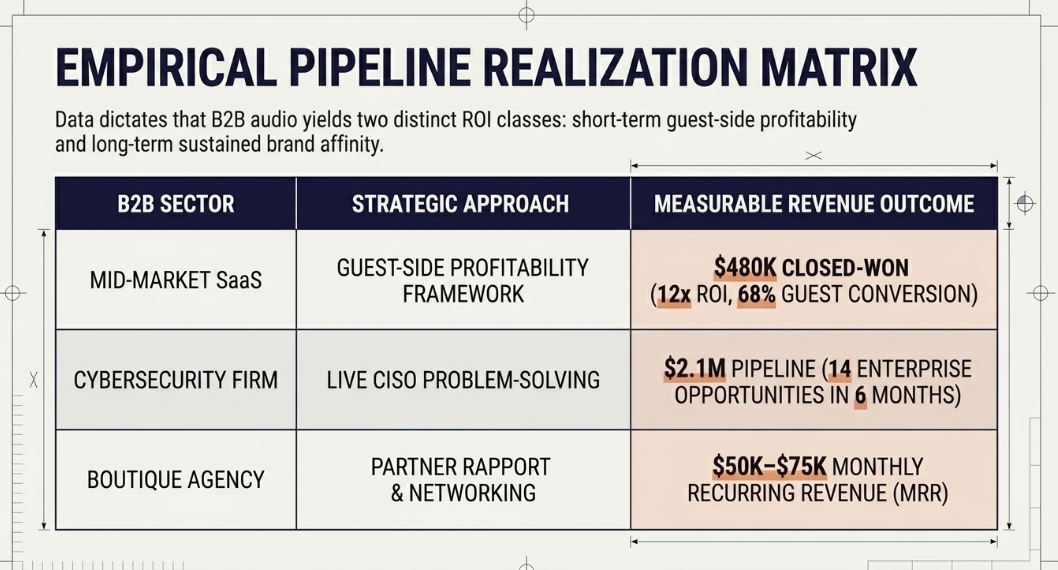
One compelling demonstration of short-term, relationship-driven revenue occurred within a mid-market Software-as-a-Service (SaaS) platform that executed a highly specific "guest-side profitability" framework.26 Rather than pursuing broad, generic thought-leadership interviews aimed at maximizing download counts, the organization pivoted entirely to tactical problem-solving sessions featuring executives explicitly chosen from their target account lists.26
Starting with exactly $0 in attributed pipeline and a modest audience of merely 200 downloads per episode, this highly targeted networking initiative yielded profound results. Within nine months, the organization secured $480,000 in closed-won revenue sourced directly from podcast deals.26 The conversion mechanism was remarkably efficient: by inviting potential customers as guests and maintaining authentic post-interview relationships without aggressive sales pitching, 68% of the executives invited onto the show eventually converted into active, inbound sales conversations.26 This represented a staggering 12x ROI, tracked through a hybrid of UTM-tagged calls-to-action and self-reported attribution data gathered during discovery calls.
Accelerating Enterprise Deal Cycles
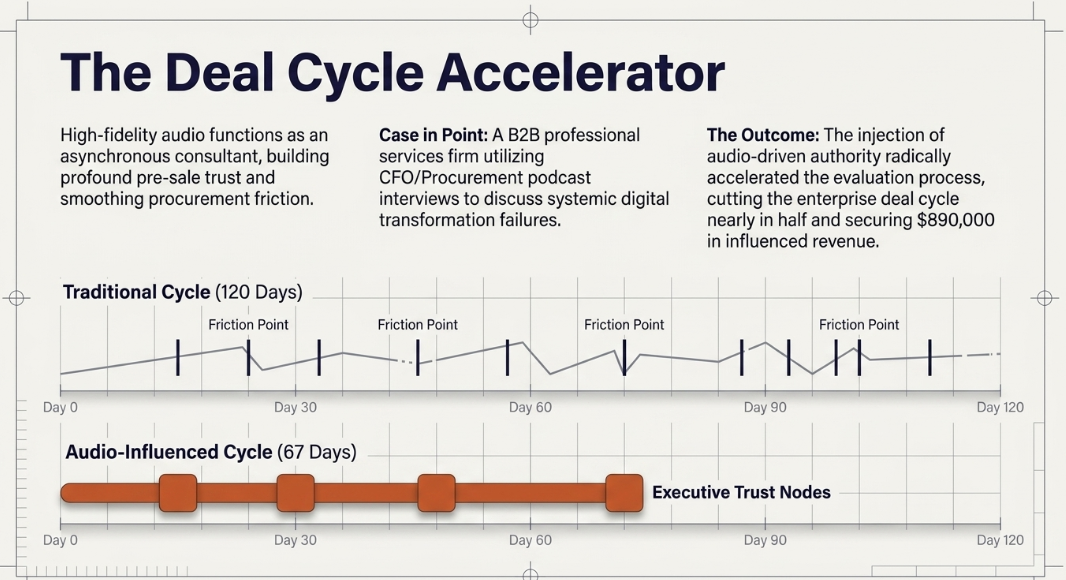
Independent implementations across varied professional sectors further validate this trajectory. A B2B professional services firm, historically struggling to penetrate decision-maker networks, launched a podcast specifically inviting procurement leaders and CFOs to discuss systemic failures in digital transformation.26 This targeted approach not only built brand authority but dramatically reduced friction in the sales process, dropping their average enterprise deal cycle from 120 days down to 67 days for podcast-influenced opportunities, resulting in $890,000 in accelerated revenue.26
Similarly, a relatively unknown cybersecurity firm competing against Fortune 500 incumbents launched a podcast interviewing Chief Information Security Officers (CISOs) to solve complex security challenges live on air.26 Within six months, the show averaged 3,200 downloads per episode and generated 14 massive enterprise opportunities representing $2.1 million in active pipeline.26 Boutique agencies echo these economics; industry leaders like Samir report generating nearly $1 million in revenue within a single year through network expansion via their podcast, while executives like Dean Dutro attribute between $50,000 and $75,000 in Monthly Recurring Revenue (MRR) directly to the trust and rapport fostered through audio engagement.27 Furthermore, marketers like Todd Taskey have demonstrated that generating massive listener bases is unnecessary if the content is hyper-targeted to reach a niche, high-quality audience of buyers and partners.27
Search Everywhere Optimization (SEO): The Fractured Search Ecosystem
As the global podcast market surges past 4.4 million active shows, sheer volume dictates that organic discoverability has become the primary operational bottleneck for new B2B audio.3 Simply publishing high-quality content is insufficient; audio must be engineered for algorithmic retrieval. Consequently, modern digital marketing strategy has expanded far beyond traditional web indexing to embrace "Search Everywhere Optimization"—a comprehensive, multichannel methodology designed to address the highly fractured nature of modern search behavior.28
Modern B2B consumers no longer rely exclusively on linear, text-based search engines like Google to fulfill their informational intent. Searches are decentralized across distinct platforms, including YouTube, TikTok, LinkedIn, Amazon, ChatGPT, and native podcast directories.4 Search Everywhere Optimization categorizes podcasts as critical "underdog" or emerging platforms.28 By meticulously optimizing a brand's organic presence across these varied ecosystems, organizations create resilience against algorithmic volatility on any single platform, engage users who prefer audio-first formats natively, and dramatically increase their total digital real estate footprint.
Voice Search Optimization (VSO)
The proliferation of over 4 billion voice-activated assistants—such as Amazon Alexa, Google Assistant, and Apple Siri—necessitates a paradigm shift toward Voice Search Optimization (VSO).29 Voice queries are fundamentally different from typed search queries; they are highly conversational, long-tail, and interrogative.29 When a user types a query, they may input "B2B marketing statistics." When a user speaks a query to a smart speaker, they will ask, "Alexa, what are the latest B2B marketing statistics for podcasts?".29
Optimizing audio for voice retrieval requires embedding natural language questions directly into episode titles, descriptions, and transcripts.29 Aligning podcast metadata with the syntactic structure of human speech significantly increases the probability of algorithmic retrieval, allowing smart devices to seamlessly recommend and play the podcast hands-free.29
Algorithmic Directory Indexing and Metadata Strategy
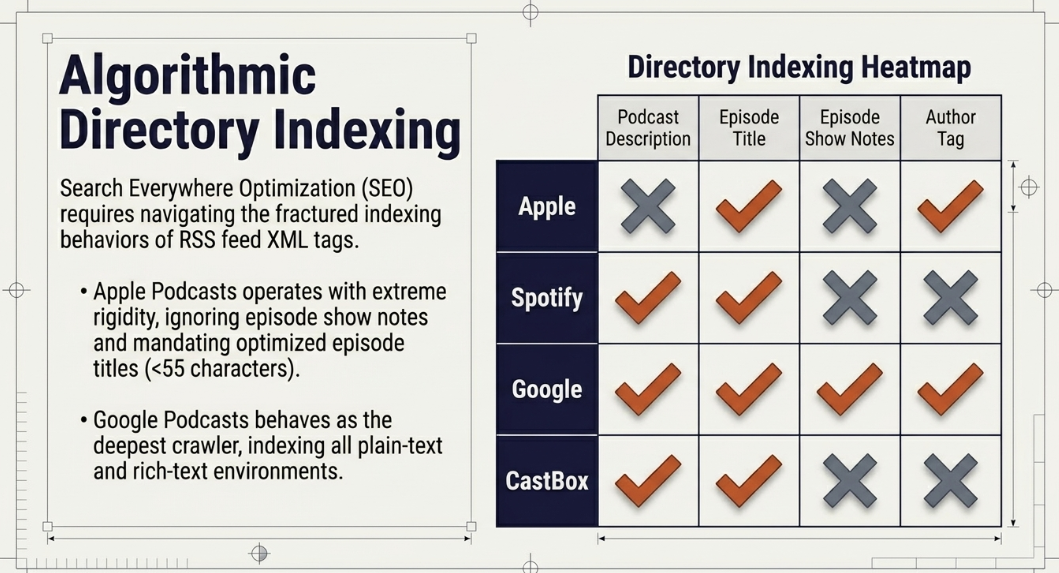
Strategic audio optimization requires an acute, deeply technical understanding of how different podcast directories parse, crawl, and index Extensible Markup Language (XML) tags within a podcast's Really Simple Syndication (RSS) feed. Indexing behaviors are highly fragmented and inconsistent across the major platforms, requiring a nuanced metadata strategy.31
Analysis of directory behavior reveals that Apple Podcasts enforces highly restrictive, rigid search algorithms.31 Apple relies almost exclusively on the show's title, episode titles, and author tags, actively ignoring both podcast-level descriptions and episode-level show notes for search indexing.31 To achieve organic visibility on Apple, episode titles must be ruthlessly optimized, keeping character counts strictly under 55 characters to prevent truncation on mobile displays, while ensuring primary long-tail keywords are front-loaded.32
Conversely, Google Podcasts operates as the most comprehensive and "hungriest" search engine in the audio ecosystem. Google actively crawls and indexes podcast descriptions, plain-text episode descriptions, and highly detailed rich-text show notes.31 Therefore, generating extensive, keyword-rich show notes and publishing verbatim, timestamped episode transcripts on dedicated, fully branded website pages remains an absolute necessity to capture cross-platform organic search traffic, satisfy Google's deep-indexing parameters, and drive inbound pipeline.
The Artificial Intelligence Paradigm: Generative Engine Optimization (GEO)
In 2026, the integration of Artificial Intelligence (AI) has fundamentally altered the architecture of digital discoverability, dictating how audio content is retrieved, summarized, and recommended to users. Forrester reports that 94% of B2B buyers now utilize AI search engines during vendor research and evaluation.34 Consequently, Generative Engine Optimization (GEO)—also known as Answer Engine Optimization (AEO)—has emerged as a distinct, vital discipline running parallel to traditional SEO, ensuring that B2B brands are cited as authoritative sources by Large Language Models (LLMs).34
Retrieval-Augmented Generation (RAG) Mechanics
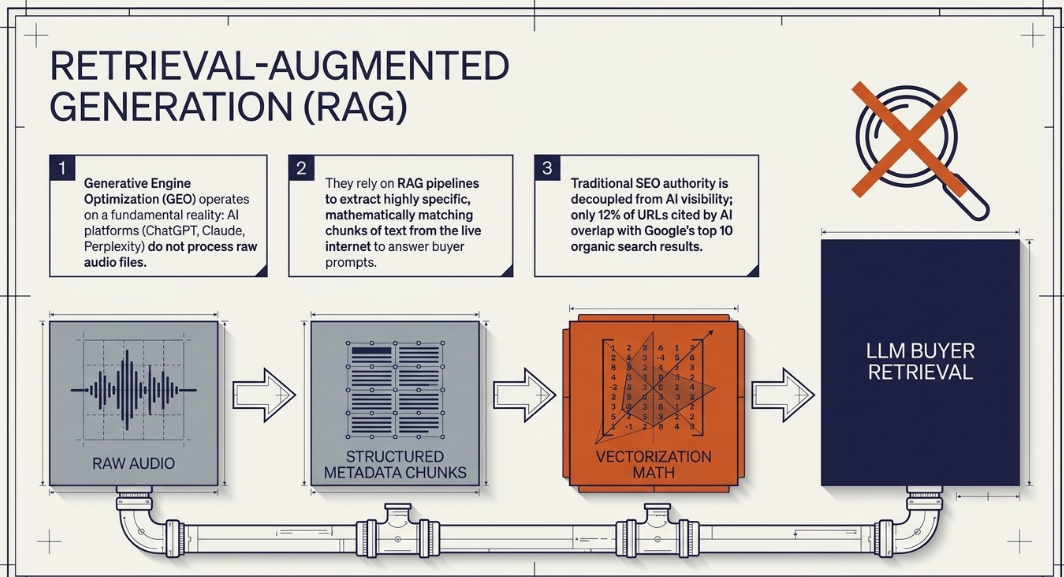
A fundamental reality of AI optimization is that platforms such as ChatGPT, Google Gemini, Anthropic's Claude, and Perplexity do not process or "listen" to raw audio files.35 Instead, they read, analyze, and synthesize the text-based metadata, transcripts, structured episode data, and dedicated website pages surrounding the audio.36
These sophisticated platforms utilize Retrieval-Augmented Generation (RAG), an architectural system that forces the underlying LLM to query an external, real-time database of authoritative knowledge before formulating a response to a user.34 RAG relies on numeric vector embeddings, mathematically converting user queries into vectors to find and retrieve semantically similar blocks of text from the internet.34 Because RAG operates and extracts data at the passage level rather than the whole-page level, traditional SEO metrics—such as overarching domain authority, keyword density, and backlink volume—do not guarantee AI visibility.34 In fact, empirical research demonstrates that only 12% of the URLs actively cited by AI tools overlap with Google's traditional top 10 organic search results, highlighting a massive divergence in how AI values information.
Divergent AI Citation Patterns
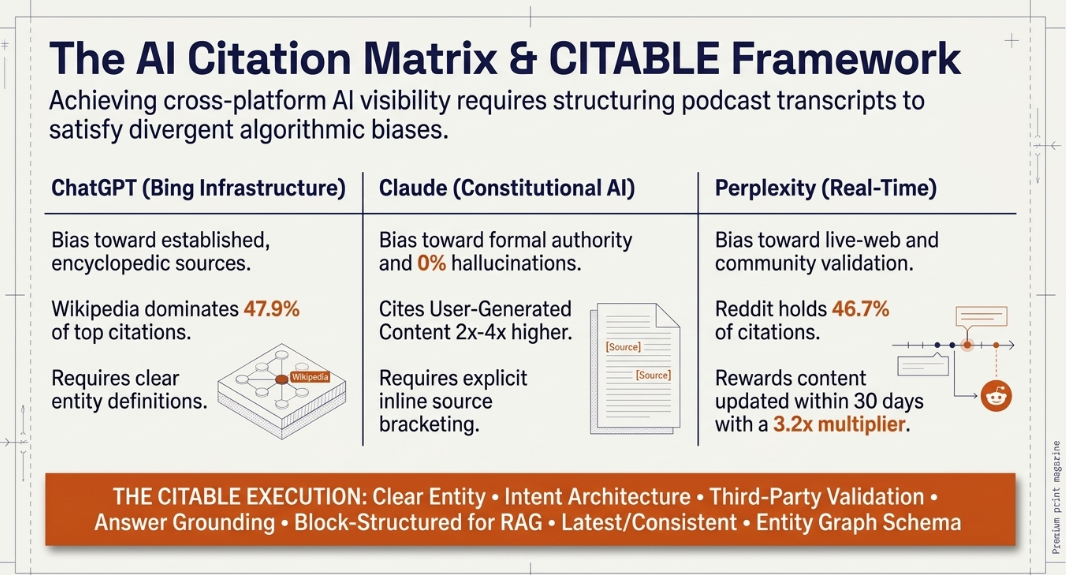
Achieving cross-platform AI visibility requires tailoring podcast transcripts and supplementary written content to the unique, occasionally conflicting architectural biases of the major LLMs 34:
ChatGPT (Bing-Powered): Showing an 87% alignment with Bing's top search results, ChatGPT relies heavily on Microsoft's search infrastructure. It demonstrates a profound algorithmic bias toward highly established, encyclopedic sources. Wikipedia dominates its ecosystem, accounting for 47.9% of all top 10 citations. To penetrate ChatGPT, content must feature crystal-clear entity definitions and read with an encyclopedic tone, as the platform displays citations as numbered footnotes linked to open-access data.34
Claude (Constitutional AI): Governed by Anthropic's highly conservative Constitutional AI framework, Claude strongly biases toward technical accuracy, formal authoritative tones, and explicitly sourced, trustworthy information.34 It natively utilizes a specialized Citations API that grounds answers directly in source documents, effectively reducing hallucinations to 0%.34 Crucially, across various sectors, Claude cites user-generated content (UGC) and reviews at 2 to 4 times the rate of other models.38 It utilizes inline brackets to cite sources directly where the information is introduced.34
Perplexity (Real-Time Retrieval): Operating primarily as a real-time answer engine, Perplexity continually crawls the live web. It places a massive algorithmic premium on community-validated user-generated content, with Reddit accounting for an astounding 46.7% of its top 10 citations, followed by YouTube at 13.9%.34 Perplexity favors high-velocity, recently updated content, making it highly responsive to fresh podcast episodes and timely industry commentary.34
The CITABLE Framework for Audio Content Transformation
To systematically optimize podcast transcripts, highly detailed show notes, and associated blog posts for AI retrieval, modern B2B marketing teams utilize the rigorous CITABLE framework. This system structures content specifically for machine ingestion (vector similarity in RAG pipelines) while retaining engaging readability for human audiences 34:
C - Clear Entity and Structure: Content must immediately begin with a "Bottom Line Up Front" (BLUF) spanning 2 to 3 sentences. This section must explicitly name the entity (the brand, the product, or the core concept) and state the answer immediately. RAG systems extract context from opening paragraphs; vague, slow-building storytelling fails algorithmic retrieval.34
I - Intent Architecture: Podcast pages should not merely summarize the episode. They must structurally answer the primary search query, alongside 3 to 5 adjacent, follow-up questions that a B2B buyer might logically ask next. AI models heavily favor comprehensive, all-in-one sources that address multiple queries in a single retrieval step.34
T - Third-Party Validation: Because AI models inherently distrust brand-owned promotional claims, podcast pages must reference and interlink external validation. Citing G2 reviews, analyst reports, or highly upvoted Reddit industry discussions builds the requisite digital authority and algorithmic trust needed for citation.34
A - Answer Grounding: Every factual claim, statistic, or market prediction made within the podcast must be explicitly anchored to a verifiable external source or data point to mitigate the LLM's risk of hallucination.34
B - Block-Structured for RAG: Transcripts and show notes must be systematically organized into discrete 200 to 400-word sections utilizing clear semantic headings (H2/H3), bulleted lists, and comparison tables. RAG systems do not ingest whole documents; they extract highly specific, mathematically matching "chunks." Structured units are vastly more retrievable.34
L - Latest and Consistent: Content must feature highly visible timestamps (e.g., "Updated June 2026"). Perplexity, in particular, heavily biases toward temporal freshness, rewarding content updated within the last 30 days with a staggering 3.2x citation multiplier.34 Furthermore, cross-platform entity data (pricing, features) must be perfectly consistent to prevent AI confusion.34
E - Entity Graph and Schema: The deployment of robust Schema markup (such as Organization, Product, VideoObject, and FAQ schema) on the backend of podcast landing pages explicitly signals entity relationships to AI crawlers, mathematically connecting the audio brand to broader industry topics.34
Programmatic Audio Monetization: Dynamic Ad Insertion (DAI)
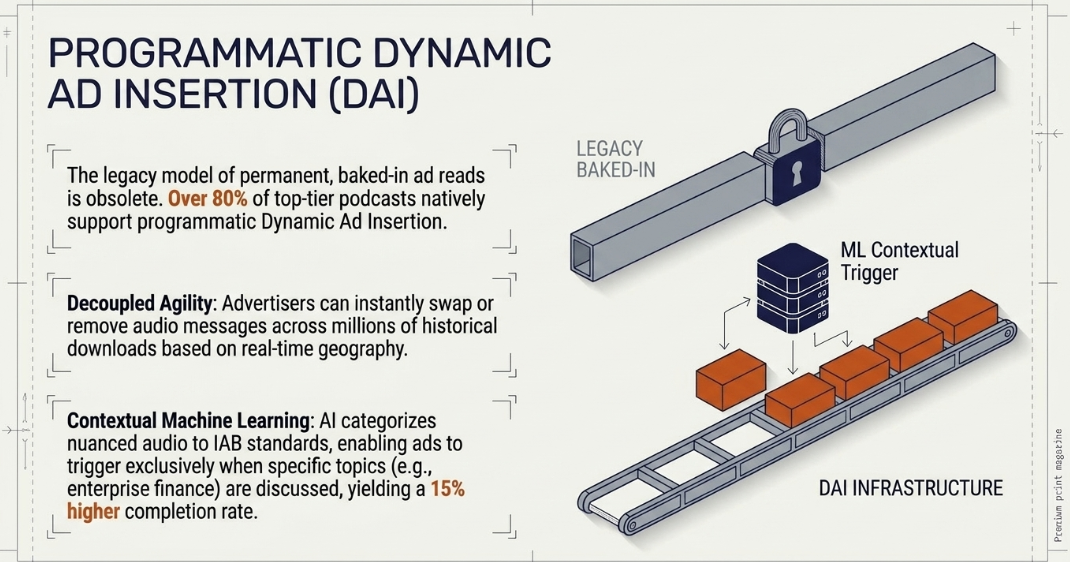
Beyond organic discoverability and AI citation, artificial intelligence is driving an evolutionary leap in podcast monetization, advertising operations, and commercial strategy. The legacy model of podcast advertising—wherein hosts record static, "baked-in" promotional reads that remain embedded in the audio file permanently—is rapidly being rendered obsolete by the agility of Dynamic Ad Insertion (DAI).
Real-Time Relevance and Programmatic Execution
By 2026, programmatic architecture dominates the medium, with over 80% of top-tier podcasts natively supporting Dynamic Ad Insertion, according to Magellan AI benchmarks.40 DAI enables advertisers to instantly program, swap, update, or completely remove audio advertisements without ever altering the original underlying content file.40 This profound decoupling of content and commercial messaging facilitates unprecedented agility and speed-to-market. A B2B enterprise launching a new software product or executing a sudden flash sale can deploy a highly targeted audio campaign in real-time across millions of downloads, dictating parameters based on listener geography, time of day, or breaking industry news.39
The resulting commercial efficacy of this programmatic approach is substantial. Industry analytics confirm that dynamic, highly relevant, and timely campaigns experience a 15% higher completion rate compared to stale, baked-in advertisements.40 Furthermore, by dynamically rotating creative assets and pacing ad delivery, DAI actively combats ad fatigue, preserving the listener's user experience while ensuring optimal engagement and conversion metrics for the brand.39
Contextual Targeting via Machine Learning
The integration of machine learning into the audio ad tech stack elevates DAI from simple demographic or geographic targeting to hyper-precise contextual targeting. Major audio networks, such as Audacy, have deployed advanced AI systems capable of accurately transcribing millions of hours of podcast audio at scale, categorizing the nuanced content with granular, targetable tags (e.g., 'enterprise finance,' 'cybersecurity,' 'supply chain logistics,' 'leadership') entirely in accordance with Interactive Advertising Bureau (IAB) standards.41
This breakthrough allows B2B brands to programmatically insert their marketing messages into highly specific, contextually relevant moments within an episode. Predictive analytics further augment this capability, processing historical performance data to forecast engagement parameters, optimal bid values, and conversion probabilities before a campaign is even launched.42 Consequently, an advertisement for enterprise resource planning (ERP) software is delivered exclusively when the podcast discussion actively pivots to organizational scaling, financial operations, or efficiency bottlenecks. This ensures the brand message is highly additive and resonant, rather than intrusive to the consumer's cognitive flow, radically increasing the likelihood of lead capture and pipeline generation.41
The Threat Vector: Synthetic Media, Audio Deepfakes, and Voice Governance
While the proliferation of advanced AI in the audio sector optimizes discoverability and ad insertion, it simultaneously introduces severe, asymmetric security, ethical, and reputational risks to professional brands. The emergence of neural network-driven voice cloning—categorized widely as synthetic speech or audio deepfakes—allows malicious actors to seamlessly replicate an individual's unique tonal qualities, pacing, accent, and emotional inflection.43
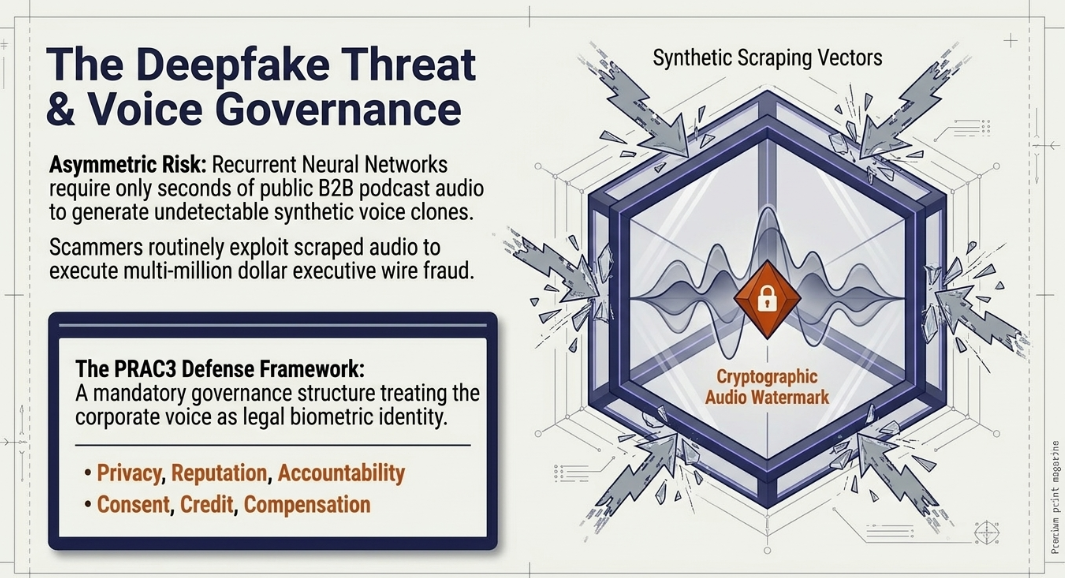
The mechanics of this technology are deeply sophisticated. Voice cloning utilizes Recurrent Neural Networks (RNNs) and Generative Adversarial Networks (GANs) to analyze sequential audio inputs.43 Employing architectures such as WaveNet, text-to-speech (TTS) systems utilize text analysis models to convert input into linguistic features, acoustic models to extract target voice parameters, and vocoders to generate the final vocal waveforms.43 Alarmingly, advanced systems require only a few seconds of publicly available sample audio—such as a brief snippet scraped from a branded B2B podcast, a corporate webinar, or a TikTok video—to generate a highly convincing, undetectable clone.43 These deepfakes are categorized into replay-based attacks, synthetic-based speech generation, and imitation-based voice conversion, each presenting unique detection challenges.43
Exploitation Vectors and Societal Risk
The persistent inability of human listeners to reliably detect high-fidelity synthetic voices has catalyzed a surge in advanced, highly targeted fraud.43 Threat actors routinely exploit podcast audio to execute devastating corporate wire fraud schemes. In documented instances, scammers have successfully cloned the voices of senior corporate executives—utilizing audio scraped directly from their media appearances—to deceive subordinate finance teams into executing unauthorized, multi-million dollar wire transfers, with one UK energy executive wiring $240,000 to a fraudulent account under the explicit belief he was speaking to his CEO.43 Furthermore, cloned voices have been successfully utilized by journalists and researchers to entirely bypass biometric voice-recognition security protocols deployed by major global financial institutions.43
Beyond direct financial theft and the proliferation of cruel "grandparent scams" targeting civilians, synthetic audio poses a profound, systemic threat to corporate reputation and political stability.43 Cloned voices of public figures, executives, and politicians have been actively weaponized in coordinated misinformation campaigns to spread defamatory remarks, incite civil unrest, distribute far-right propaganda, and execute sophisticated election interference, as seen in the cloning of Senator Marco Rubio's voice in 2025.43 The sheer severity and scale of these threats have prompted the U.S. Federal Trade Commission (FTC) to launch initiatives like the Voice Cloning Challenge, signaling an aggressive regulatory intent to curb deceptive practices and penalize bad actors.
The PRAC3 Governance Framework and Audio Watermarking
As the volume and accessibility of synthetic audio expand exponentially, the B2B marketing industry faces a critical imperative to adopt robust, standardized voice AI governance. Recognizing that a human voice is not merely data, but constitutes a legal biometric identity, a creative asset, and a fundamental component of trust, leading security researchers advocate for the immediate adoption of the PRAC3 framework to manage synthetic voice utilization securely 43:
Privacy: Ensuring biometric voice data is rigidly protected from unauthorized, automated harvesting across digital platforms and corporate directories.43
Reputation: Legally safeguarding the professional and personal identity of individuals from unauthorized algorithmic mimicking that could result in defamation or loss of credibility.43
Accountability: Mandating the integration of resilient audio watermarking to ensure the persistent traceability of synthetic content back to its precise point of origin, ensuring creators can be identified.43
Consent: Establishing rigorous protocols for explicit, revocable, and continuous permission regarding how, when, and where an individual's voice may be digitally synthesized.43
Credit: Ensuring transparent, unavoidable attribution is universally applied whenever synthetic generation or voice cloning is utilized in commercial or public media.43
Compensation: Developing structured financial and legal frameworks to fairly remunerate individuals whose vocal biometric data is employed to train models or execute commercial campaigns.43
To operationalize these principles effectively, software developers and corporate media teams must embed resilient cryptographic watermarks directly into their audio files at the point of creation.43 Implementing robust local detection (identifying synthetic segments within a file) and global detection (evaluating the entire clip) architectures imposes significant friction and cost on malicious actors.43 While no security measure is impenetrable, establishing these protocols acts as a critical technical deterrent against the unauthorized extraction, manipulation, and weaponization of B2B podcast assets.43
Strategic Conclusions
The strategic imperative of podcast marketing for professional brands in 2026 fundamentally transcends elementary brand awareness or vanity metrics. The medium has rapidly matured into a multi-billion dollar enterprise channel characterized by deeply engaged, highly affluent decision-makers. As traditional outbound marketing efficiency collapses and B2B marketing budgets shift toward targeted, high-fidelity inbound engagements, podcasts provide the intimate narrative space required to navigate increasingly complex, multi-stakeholder sales cycles. Furthermore, as global privacy regulations and cookie deprecation erode the efficacy of third-party tracking, podcasts offer a resilient, privacy-compliant engine for generating invaluable first-party data and contextual relevance.
However, achieving commercial viability and realizing pipeline ROI requires a rigorous departure from legacy marketing operations. B2B organizations must discard simplistic, single-touch attribution metrics in favor of an advanced, four-layer attribution stack capable of illuminating the profound impact of dark social sharing and signal correlation. Content strategies must pivot away from isolated episodes toward "Amplified Marketing," multiplying core audio assets into omnipresent campaigns across interconnected digital ecosystems.
Simultaneously, discoverability must be engineered at the architectural level. Optimizing for traditional text-based search engines is no longer sufficient. Brands must embrace Search Everywhere Optimization, tailoring metadata to navigate the divergent indexing behaviors of Apple, Spotify, and Google. More critically, organizations must structure their podcast transcripts and rich-text show notes according to the strict parameters of the CITABLE framework, ensuring their thought leadership is successfully retrieved, verified, and recommended by advanced RAG-based AI engines like ChatGPT, Perplexity, and Claude.
Finally, as programmatic dynamic ad insertion maximizes commercial precision and AI accelerates production workflows, organizations must remain fiercely vigilant regarding the existential risks of synthetic media. Implementing robust PRAC3 voice governance and supporting global audio watermarking standards will be paramount to protecting corporate reputation, financial security, and biometric identity in a landscape increasingly defined by artificial intelligence. By seamlessly integrating these complex technical, analytical, and creative paradigms, B2B brands can definitively transform their podcast initiatives from experimental audio projects into highly measurable, predictable, and defensible engines of enterprise revenue.
Works cited
B2B Marketing Statistics 2026: 180+ Essential Data Points - Digital Applied, accessed June 5, 2026, https://www.digitalapplied.com/blog/b2b-marketing-statistics-2026-essential-data-points
The 12 Best B2B Inbound Marketing Examples That Actually Drove Revenue - MagicLibrary, accessed June 5, 2026, https://www.magiclibrary.co/blog/best-b2b-inbound-marketing-examples
B2B Podcasts by the Numbers: What the Latest Data Tells Us ..., accessed June 5, 2026, https://contentallies.com/learn/b2b-podcast-statistics
Podcast Statistics 2026 | 80+ Facts & Data Points | Searchlab, accessed June 5, 2026, https://searchlab.nl/en/statistics/podcast-statistics-2026
30 B2B Podcasting Statistics [2026] - Omniscient Digital, accessed June 5, 2026, https://beomniscient.com/blog/b2b-podcasting-statistics/
Google's changing approach to third-party cookies - Usercentrics, accessed June 5, 2026, https://usercentrics.com/knowledge-hub/google-third-party-cookies/
Third-Party Cookie Deprecation: The Ad Industry's New Dawn - CMSWire, accessed June 5, 2026, https://www.cmswire.com/digital-marketing/the-impact-of-googles-third-party-cookie-deprecation/
In a Cookie-less World: New Challenges and Opportunities - AI Digital, accessed June 5, 2026, https://www.aidigital.com/blog/in-a-cookie-less-world-new-challenges-and-opportunities
The Next Generation of B2B Content Marketing: The B2B Podcast Maturity Curve - Casted, accessed June 5, 2026, https://www.casted.us/blog/the-next-generation-of-b2b-content-marketing-the-b2b-podcast-maturity-curve
Amplified Marketing Playbook | Multimedia Content Marketing - Casted, accessed June 5, 2026, https://www.casted.us/blog/amplified-marketing
B2B Podcasting in 2025: Turn One Episode Into 20+ Content Assets - Goldcast, accessed June 5, 2026, https://www.goldcast.io/blog-post/b2b-podcasting
How Gong Used Amplified Marketing to Launch its own Category with Gong's Devin Reed, accessed June 5, 2026, https://www.casted.us/blog/how-gong-used-amplified-marketing-to-launch-its-own-category-with-gongs-devin-reed
10 Takeaways that will transform the way you sell - The Revenue AI Podcast by Gong, accessed June 5, 2026, https://podcast.gong.io/public/76/Reveal%3A-The-Revenue-Intelligence-Podcast-05b3e1e1/8a0481ce
Building a 100K Audience in Less Than Two Years with Gong's ..., accessed June 5, 2026, https://www.casted.us/blog/building-a-100k-audience-in-less-than-two-years-with-gongs-jordan-feise
Salesforce Creates Salesforce+, A New Streaming Service For B2B ..., accessed June 5, 2026, https://www.demandgenreport.com/industry-news/salesforce-creates-salesforce-a-new-streaming-service-for-b2b-professionals/6936/
Salesforce+ case study | Kaltura, accessed June 5, 2026, https://corp.kaltura.com/resources/case-studies/salesforce-unlocking-the-future-of-digital-engagement/
Salesforce+ Events, accessed June 5, 2026, https://www.salesforce.com/plus
Blazing Business Trails - Salesforce, accessed June 5, 2026, https://www.salesforce.com/uk/resources/podcasts/business-services-podcast/
12 Actionable Topics To Talk About On A Podcast For B2B Growth In 2026 - Fame.so, accessed June 5, 2026, https://www.fame.so/post/topics-to-talk-about-on-a-podcast
50 B2B Podcast Ideas for Companies in Every Industry (With Real Examples), accessed June 5, 2026, https://contentallies.com/learn/b2b-podcast-ideas
B2B Marketing Podcasts Worth Your Time in 2026, accessed June 5, 2026, https://theb2bplaybook.com/best-b2b-marketing-podcasts
The 10 Best B2B Marketing Podcasts To Listen In 2026 - Fame.so, accessed June 5, 2026, https://www.fame.so/post/b2b-marketing-podcasts
Top B2B & Marketing Podcasts to Lead You to Succeed in 2025, accessed June 5, 2026, https://www.toprankmarketing.com/blog/b2b-marketing-podcasts/
The Ultimate Guide To Measuring B2B Podcast ROI: From ... - Fame.so, accessed June 5, 2026, https://www.fame.so/post/ultimate-guide-to-measuring-b2b-podcast-roi
Is Marketing Attribution Dead? Dark Funnel & Dark Social 2026 - The Geisheker Group, accessed June 5, 2026, https://www.geisheker.com/is-marketing-attribution-dead-dark-funnel-dark-social/
The Definitive Guide To Measuring B2B Podcast ROI And Pipeline ..., accessed June 5, 2026, https://www.fame.so/post/measuring-b2b-podcast-roi-and-pipeline
Rise25 Case Studies, accessed June 5, 2026, https://rise25.com/casestudies/
Search Everywhere Optimization: Optimizing Across All Platforms, accessed June 5, 2026, https://neilpatel.com/blog/search-everywhere-optimization/
The Impact of Voice Technology on Podcast Discovery - Wavve.co, accessed June 5, 2026, https://wavve.co/the-impact-of-voice-technology-on-podcast-discovery/
What is voice AI? Inside Alexa, Siri, Google Assistant, and chatGPT | Campus Fryslân, accessed June 5, 2026, https://www.rug.nl/cf/campus-fryslan/bloggen/what-is-voice-ai-inside-alexa-siri-google-assistant-and-chatgpt?lang=en
How people find your podcast in apps - who indexes what? - Podnews, accessed June 5, 2026, https://podnews.net/article/who-indexes-what
Podcast SEO. Here are the steps you need to get more potential downloads and subscribers. - Reddit, accessed June 5, 2026, https://www.reddit.com/r/podcasting/comments/1tx5wl7/podcast_seo_here_are_the_steps_you_need_to_get/
Podcast SEO - Spreaker Help Center, accessed June 5, 2026, https://help.spreaker.com/en/articles/11130686-podcast-seo
AI Citation Patterns: How ChatGPT, Claude, and Perplexity Choose ..., accessed June 5, 2026, https://discoveredlabs.com/blog/ai-citation-patterns-how-chatgpt-claude-and-perplexity-choose-sources
accessed June 5, 2026, https://weeditpodcasts.com/your-b2b-podcast-ai-search-geo/#:~:text=Generative%20Engine%20Optimisation%20tools%20like,to%20your%20audio%20files%20directly.
Your B2B Podcast Isn't Showing Up in AI Search. Here's Why – And ..., accessed June 5, 2026, https://weeditpodcasts.com/your-b2b-podcast-ai-search-geo/
Mastering AI Citations: The Ultimate GEO Playbook | Frase.io, accessed June 5, 2026, https://www.frase.io/blog/how-to-get-cited-by-ai-search-engines-the-complete-geo-playbook
How ChatGPT, Perplexity, Gemini, and Claude Actually Decide What to Cite | Yext, accessed June 5, 2026, https://www.yext.com/blog/how-chatgpt-perplexity-gemini-claude-decide-what-to-cite
Dynamic Ad Insertion - Blubrry Podcasting, accessed June 5, 2026, https://blubrry.com/services/dynamic-podcast-advertising-insertion/
Stop Baking, start Shaking: Why You Should Start Advertising with Dynamic Ad Insertion in Podcasts - DMEXCO, accessed June 5, 2026, https://dmexco.com/stories/dmexco-column-stop-baking-start-shaking-why-you-should-start-advertising-with-dynamic-ad-insertion-in-podcasts/
Audacy Launches Dynamic AI Contextual Advertising for Podcasts, accessed June 5, 2026, https://audacyinc.com/press/audacy-launches-dynamic-ai-contextual-advertising-for-podcasts/
AI in advertising: How it's transforming marketing in 2026 - StackAdapt, accessed June 5, 2026, https://www.stackadapt.com/resources/blog/ai-advertising
Voice Cloning Risks, Audio Deepfake Detection & Why AI Leaders ..., accessed June 5, 2026, https://roysamuelson.com/voice-cloning-risks-audio-deepfake-detection-why-ai-leaders-must-care/
Preventing the Harms of AI-enabled Voice Cloning | Federal Trade Commission, accessed June 5, 2026, https://www.ftc.gov/policy/advocacy-research/tech-at-ftc/2023/11/preventing-harms-ai-enabled-voice-cloning
AI generated podcasts: we are on the cusp of something truly awful - Reddit, accessed June 5, 2026, https://www.reddit.com/r/podcasts/comments/1hk4ogu/ai_generated_podcasts_we_are_on_the_cusp_of/