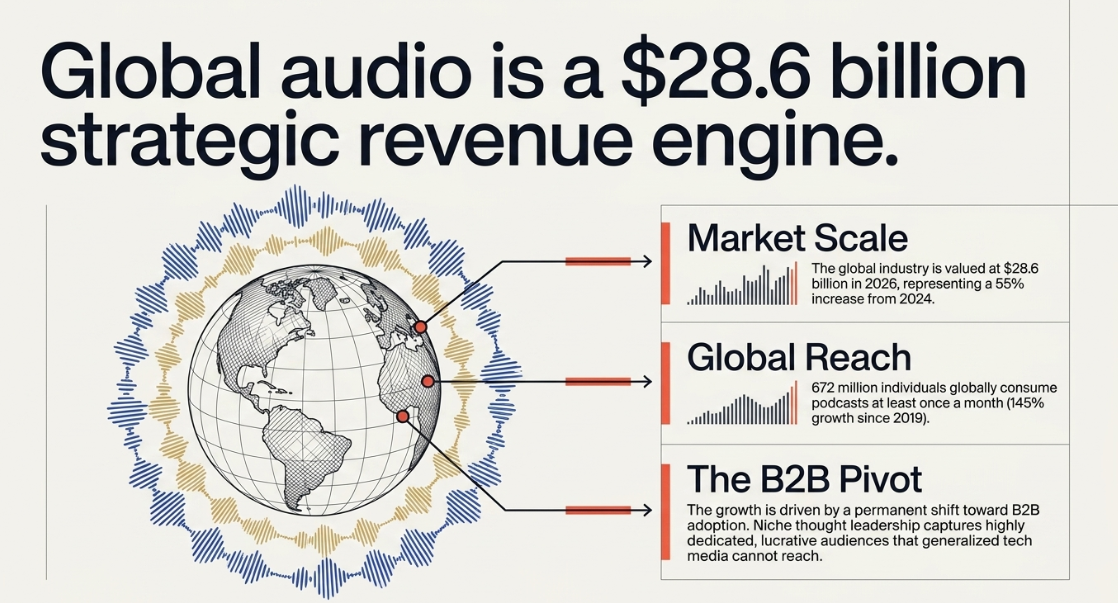
The digital media landscape of 2026 reflects a profound structural shift in how enterprise organizations communicate, capture attention, and drive revenue. Enterprise audio, historically relegated to an experimental top-of-funnel marketing tactic, has rapidly matured into a sophisticated, programmatic, and highly measurable business development engine. The global podcasting industry, valued at an estimated $28.6 billion in 2026 and projected to expand substantially by 2035, represents one of the fastest-growing and most resilient media segments worldwide.1 This expansion is heavily driven by strategic business-to-business (B2B) adoption, technological integration, and a permanent pivot toward video-first audio.1
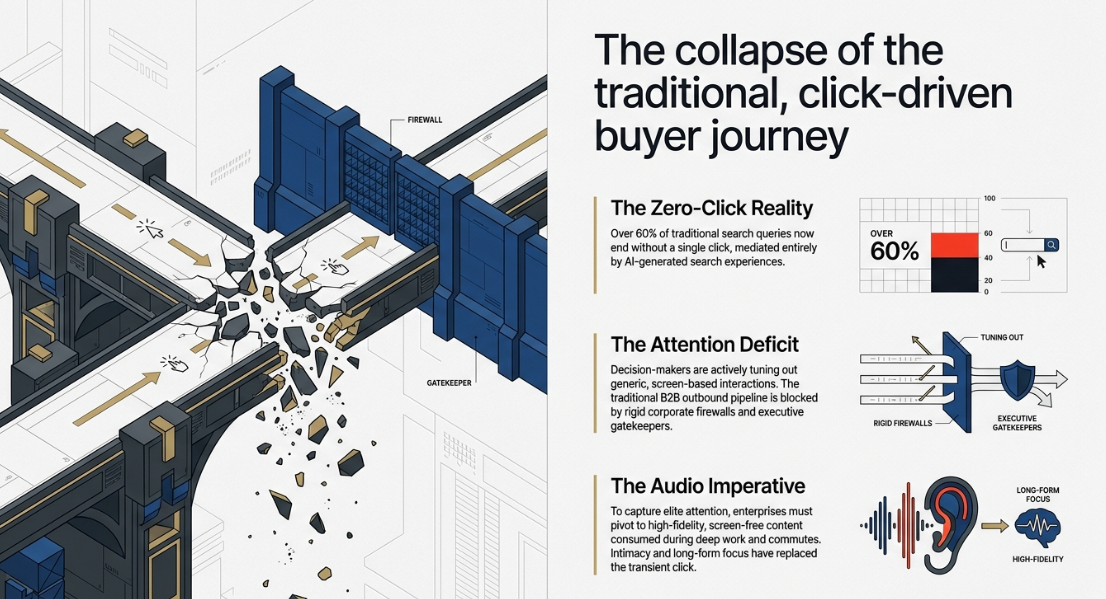
As traditional search engine architectures pivot toward AI-mediated, zero-click experiences, the traditional B2B buyer journey has become increasingly fragmented.3 Decision-makers are actively seeking high-fidelity, screen-free content, minimizing their reliance on generic, click-driven digital interactions. Audio marketing provides an intimate, long-form medium capable of retaining focus during away-from-desk moments, daily commutes, and immersive work sessions.3 This comprehensive analysis evaluates the strategic business case for enterprise podcasting, deconstructs the operational economics and technological infrastructure required for sustainable deployment, and projects the macroeconomic trends that will dictate audio strategy from 2026 onward.
Constructing the Business Case: The Return on Investment (ROI) of Enterprise Podcasting
The justification for enterprise audio investments relies on transcending superficial metrics, such as raw download counts, and establishing a measurable, empirical connection to pipeline velocity, revenue attribution, and brand equity. In a sophisticated corporate environment, a podcast cannot function as an isolated side project; it must operate as a strategic content engine and a credibility mechanism designed to yield compounding commercial returns.4
Top-of-Funnel Brand Lift and Engagement Mechanics
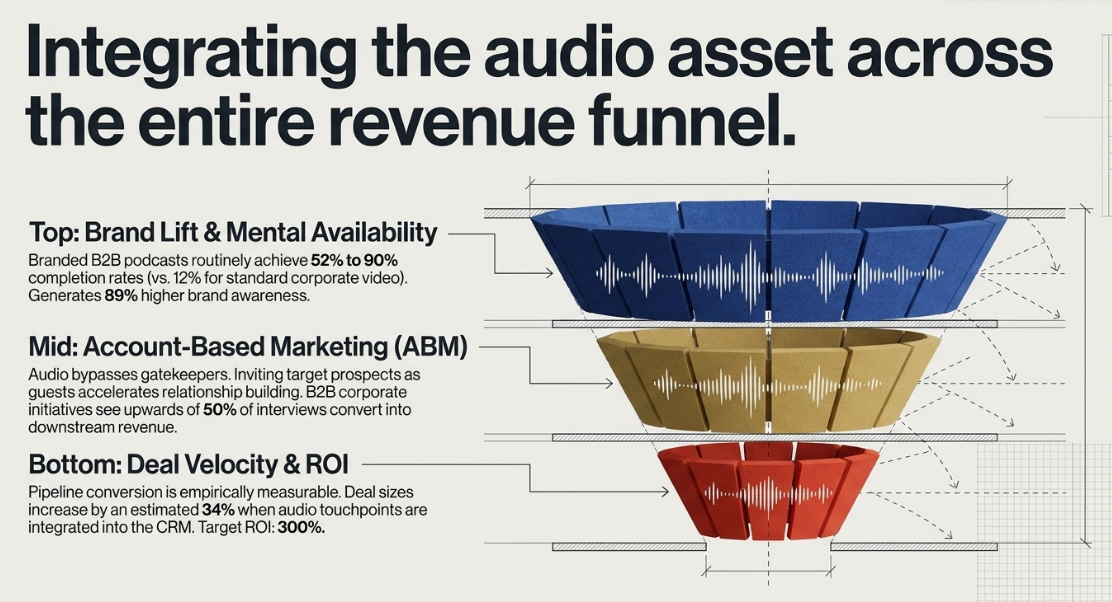
At the awareness level, enterprise podcasts deliver engagement depths that fundamentally outpace other digital mediums. While standard promotional video content on corporate channels typically experiences completion rates hovering around 12%, branded B2B podcasts routinely achieve completion rates ranging from 52% to 90%.5 This sustained, uninterrupted attention translates into substantial brand lift. Organizations deploying branded podcasts report an 89% higher brand awareness, a 57% increase in brand consideration, and a 14% uplift in recorded purchase intent among their listener base.7
Podcast listeners exhibit a uniquely high tolerance for deep, nuanced industry conversations, making the medium ideal for complex enterprise sales environments and sophisticated thought leadership. Industry data indicates that 59% of directors and C-suite executives regularly engage with audio thought leadership.6 By addressing specific, niche industry pain points—such as "AI for Biotech Ops," "Ticketless Enterprises" by Digitate, or "CFO Automation Weekly"—brands establish a recognizable editorial identity that fosters trust much faster than generalized, mass-market content.7
The transition from broad messaging to niche positioning is critical for audience retention. Programs like SAP's "The Kinetic Enterprise" or Joe Pine and Mark Stiving’s "The Soul of Enterprise" demonstrate that specialized, rigorous conversations regarding economic transformations and systemic operational shifts secure dedicated listenerships that highly generic technology podcasts fail to capture.10 Niche targeting allows enterprises to deliver deeper impact with fewer, but vastly more valuable, listeners.
Mid-Funnel Account-Based Marketing (ABM) Integration
The second-order operational impact of a strategic podcast is its utility as an Account-Based Marketing (ABM) networking and lead-generation tool. Rather than deploying traditional outbound sales tactics, which are increasingly blocked by corporate firewalls and executive assistants, enterprise podcasters utilize the show as a vehicle to invite target accounts and industry decision-makers for interviews.6 By shifting the outreach proposition from an overt sales pitch to an invitation for thought-leadership amplification, brands bypass traditional gatekeepers and initiate warm relationships.
This methodology dramatically accelerates relationship building and pipeline generation. Studies of B2B podcasting reveal that targeted guest booking strategies routinely convert high-level executives into warm pipeline leads.13 For instance, corporate podcasting initiatives have seen upward of 50% of podcast interviews convert directly into downstream revenue opportunities.6 In this context, the podcast serves as a high-value touchpoint within the buyer journey. It is reported that B2B buyers are nearly 70% through their decision-making process before ever engaging a sales representative; a podcast educates, frames the narrative, and influences these buyers during this critical, invisible evaluation phase.6
Specific corporate case studies illustrate this efficacy. Content Allies facilitated Meta’s Business Engineering team to exceed their initial download targets by seven times within the first six months.13 Similarly, the brand Tonkean leveraged its audio strategy to become the top-ranked operations podcast on Apple platforms, increasing reach by over 174% in a single quarter.7 Enterprise HR firm Sagemark HR secured nine new enterprise clients within twelve months of launching their show, while N2N Services successfully evolved their audio program into a live event format, engaging over 40 higher-education executives.
Bottom-of-Funnel Revenue Attribution and Deal Velocity
Measuring the definitive Return on Investment (ROI) of an enterprise podcast requires aligning the audio strategy intimately with CRM data and revenue operations. Advanced tracking methodologies in 2026 allow marketers to group performance into specific bottom-of-funnel conversion metrics.6 When podcast touchpoints are integrated into the buyer journey, average deal sizes increase by an estimated 34%.5 Furthermore, enterprise Software-as-a-Service (SaaS) providers have discovered that up to 47% of their closed enterprise deals included a podcast touchpoint during the nurturing phase.5
To quantify this financial impact, organizations utilize a standard ROI calculation: Subtracting the annual podcast costs from the attributable revenue, dividing by the annual costs, and multiplying the result by 100.6 A well-optimized B2B podcast can regularly achieve a 300% ROI based solely on attributable revenue, exclusive of the intangible benefits of brand equity, relationship network expansion, and multi-channel content repurposing.6
Advanced Integration: Programmatic Audio and the ABM Technology Stack
The evolution of podcast advertising has transitioned away from static, broad-reach media buying toward programmatic, highly targeted digital architecture. Once viewed primarily as an experimental brand awareness play, audio is now measurable and deeply integrated with enterprise ABM technology stacks.
Dynamic Creative Optimization (DCO) and Role-Based Messaging
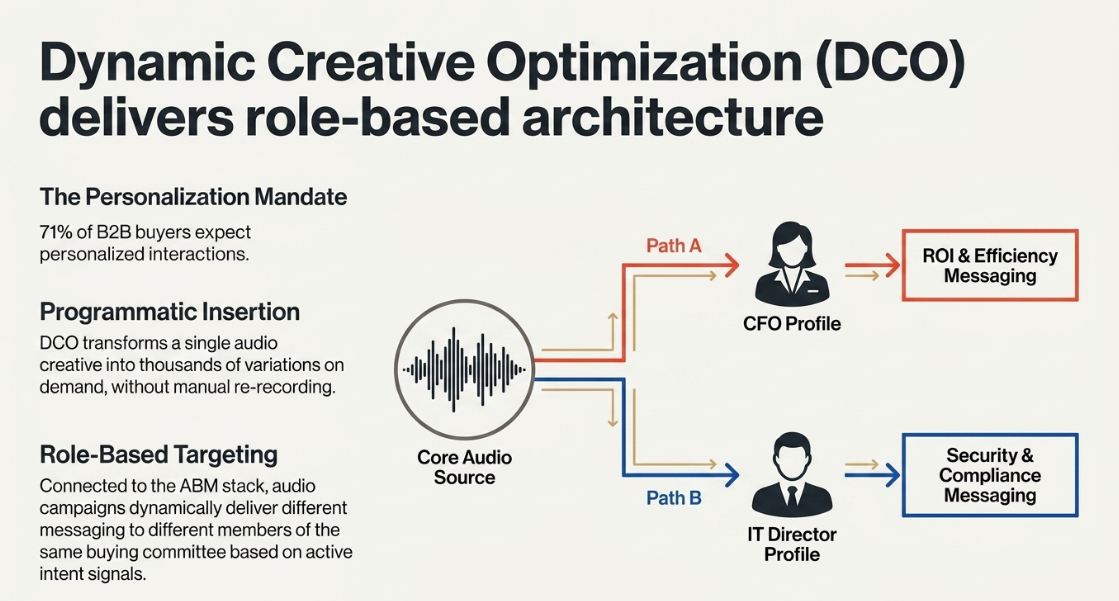
Advances in Dynamic Creative Optimization (DCO) allow audio campaigns to deliver role-based, industry-specific, or account-context personalization in real-time without requiring voice actors to manually record hundreds of distinct ad variations.3 DCO systems transform a single foundational audio creative into thousands of personalized variations on demand.3
This capability facilitates role-based messaging, enabling marketers to speak directly to different members of a complex buying committee based on their unique professional pain points. For example, a programmatic campaign targeting a specific Fortune 500 account can dynamically deliver a return-on-investment-focused audio advertisement to finance leaders during their morning commute, while seamlessly serving deep technical capability specifications to IT directors within the same organization.3 This execution involves creating modular scripts with interchangeable components that maintain narrative flow regardless of the data dynamically inserted.3 Meeting these personalization demands is critical; consulting data indicates that 71% of B2B buyers expect personalized interactions, and 76% express acute frustration when digital experiences feel generic.
Cross-Channel Orchestration and Zero-Click Attribution
Modern programmatic audio platforms integrate directly with Customer Relationship Management (CRM) and Marketing Automation Platforms (MAP). The audio platform pulls active intent signals and third-party firmographic data to determine which message variation a listener receives, tracking which specific target accounts engaged with the audio ads.3
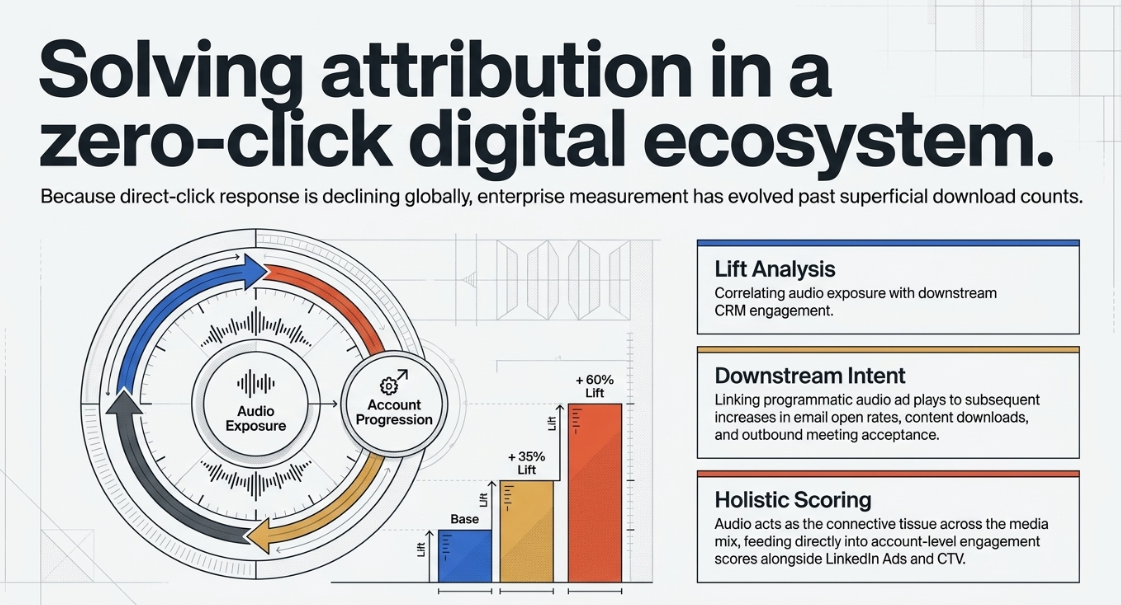
In this sophisticated ecosystem, audio acts as the connective tissue across the media mix. ABM technology stacks allow seamless data sharing so that audio is orchestrated alongside display networks, social channels like LinkedIn Ads, and Connected TV (CTV) to reinforce a consistent, sequential narrative.3 If analytics indicate a decision-maker exhibits high engagement with podcast content but ignores standard display advertisements, automated systems can dynamically shift marketing budget toward programmatic audio to maximize mental availability.3
Because direct-click response is declining globally—with over 60% of traditional search queries ending without a click due to AI-generated search experiences—measurement has evolved from click-through rates to zero-click attribution.3 Enterprise ABM stacks measure this via lift analysis, correlating audio exposure with downstream engagement increases such as higher email open rates, content downloads, and outbound sales meeting acceptance rates.3 Account-level engagement scores combine audio exposure data with other intent signals to calculate a holistic view of an account's progression through the buying cycle.3 Platforms like Madison Logic have pioneered this space, projecting the programmatic audio market's growth to $2.26 billion as it solidifies its status as a mandatory B2B channel.
Advanced Monetization and IP Repurposing Strategies
For media networks, niche creators, and enterprise divisions structured as distinct profit centers, basic podcast monetization (such as flat-fee sponsorships) falls short of delivering scalable ROI in 2026. The industry is experiencing declining Cost Per Mille (CPM) rates for generic programmatic ads due to oversaturation, alongside severe listener ad fatigue.7 Consequently, sophisticated shows are diversifying revenue streams and leveraging intellectual property (IP) repurposing.
Dynamic Ad Insertion (DAI) vs. Host-Read Sponsorships
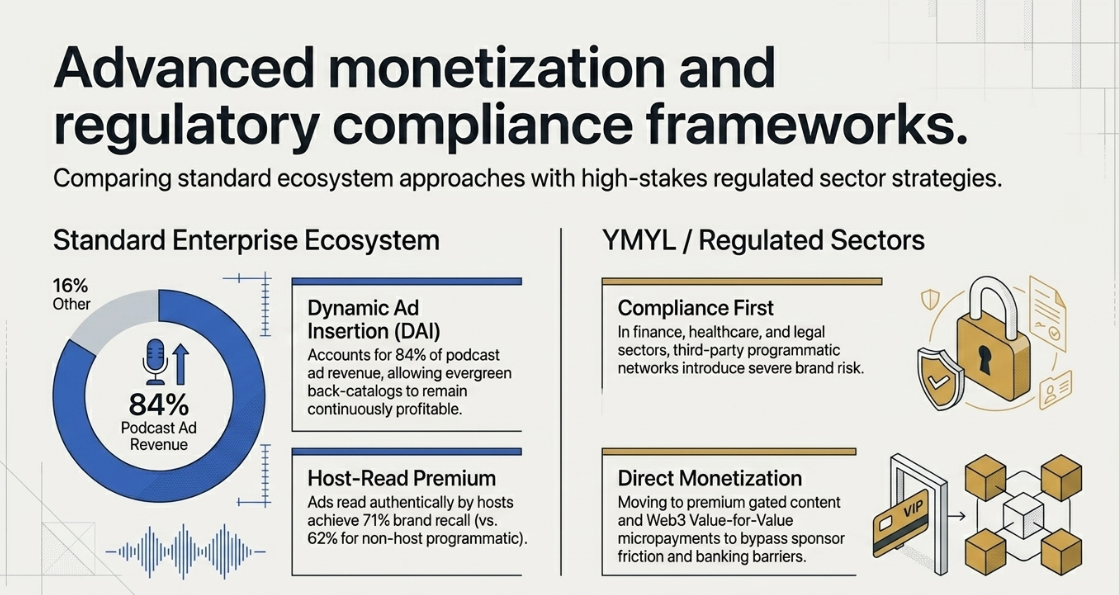
Dynamic Ad Insertion (DAI) has become the infrastructural standard, accounting for 84% of podcast ad revenue.7 DAI serves ads into podcast episodes at runtime, allowing older evergreen content in back-catalogs to remain continuously profitable.7 Platforms such as AdsWizz, Acast, Spotify Ad Studio, and Blubrry enable hyper-targeted insertions based on real-time listener data, including geography, weather, and device type.7
However, despite the scale of DAI, host-read sponsorships maintain a premium value. Nielsen research demonstrates that ads read authentically by the podcast host achieve 71% brand recall, significantly outperforming the 62% recall rate of non-host-read programmatic inserts.7 The optimal architecture for mid-tier and enterprise shows in 2026 is a hybrid model: leveraging host-read mid-roll advertisements for premium sponsors, supplemented by programmatic pre-roll insertions handled by automated exchanges.
YMYL Compliance and Direct Monetization
In heavily regulated "Your Money or Your Life" (YMYL) sectors—which include finance, healthcare, and legal services—traditional third-party sponsorships introduce severe compliance risks.7 Organizations cannot risk brand association with unverified claims made by automated third-party ad networks. In these sectors, direct monetization models are significantly safer and more lucrative.
Creators and enterprise thought leaders are moving toward premium subscription models, gated content, and interactive workshops.7 Approximately 38% of podcast listeners globally express a willingness to pay for subscriptions to highly specialized shows.7 Furthermore, emerging Web3 and cryptocurrency technologies are facilitating Value-for-Value micropayments. Listeners stream Bitcoin or stablecoins directly to creators in real-time as they consume the audio, bypassing traditional banking barriers and enabling seamless international monetization.7
Intellectual Property (IP) Repurposing and Merchandise
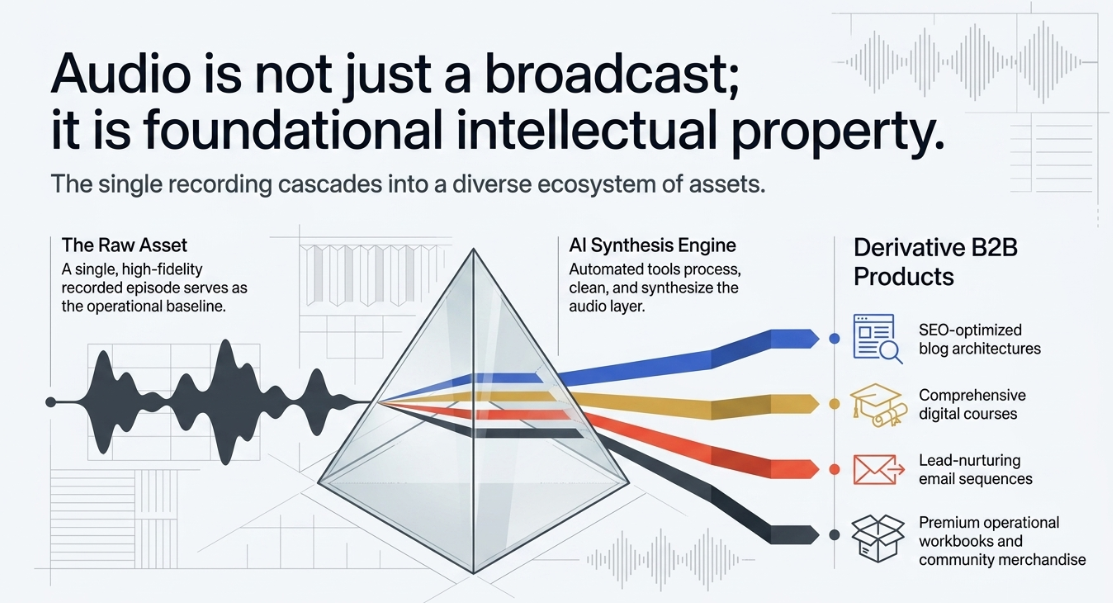
Enterprise podcasts are utilizing their audio not merely as a broadcast medium, but as foundational intellectual property. A single recorded episode generates a cascade of derivative digital products. Automated transcription tools like Trint process the audio, which is then synthesized into SEO-optimized blog posts, newsletters, and lead-nurturing emails.7 Deeper repurposing involves packaging the insights into comprehensive digital courses via platforms like Thinkific, or utilizing ghostwriting services to transform a season of podcast interviews into a published book.7
Physical and digital branded merchandise is also entering the B2B space. While historically reserved for comedy or true-crime shows, B2B podcasts are successfully monetizing via branded resources, premium operational workbooks, and exclusive physical items that reinforce community loyalty and translate passive listeners into active brand advocates.
Operational Economics and Production Cost Modeling
A primary point of failure for corporate audio initiatives is the systemic miscalculation of operational economics. The assumption that podcasting requires merely a microphone and basic hosting software fundamentally ignores the intensive labor, strategic planning, and software infrastructure demands of producing enterprise-grade media.15 Financial modeling must meticulously account for production tiers, hidden executive opportunity costs, and recurring software expenditures.
Production Cost Frameworks and Retainer Models
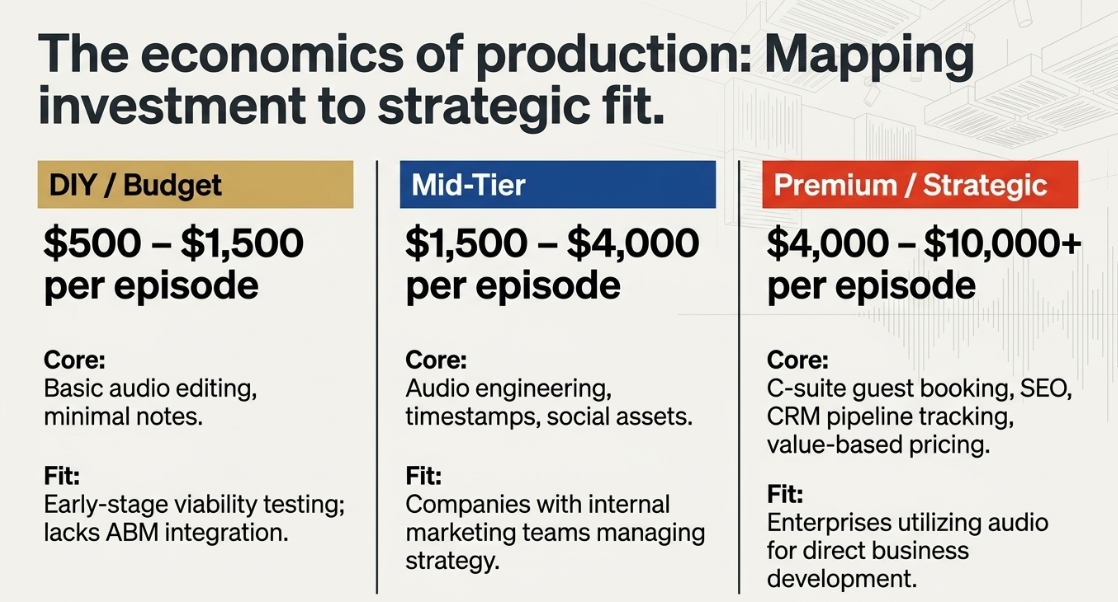
The market for podcast production services is heavily stratified, reflecting a vast variance in strategic depth, technical polish, and marketing support capabilities.
At the enterprise level, audio production is almost exclusively managed via comprehensive monthly retainers to ensure continuous relationship momentum. Retainers typically range from $3,000 to over $25,000 per month.16 A $15,000 monthly retainer, for instance, provides fully outsourced operations, including the acquisition of high-value "Dream 200" C-suite targets, advanced search engine optimization (SEO), and a dedicated strategy consultant mapping content directly to CRM revenue metrics.16 Value-based pricing is also emerging, where top-tier agencies align their production fees directly with the downstream business outcomes and revenue generated by the show.16
From the perspective of the production agencies themselves, maintaining this level of service is capital intensive. In 2026, running a premium podcast production service requires tight control over labor and software costs, with monthly operating expenses (OpEx) for agencies starting around $25,000 to $30,000.17 To survive until break-even, agency operators must secure substantial cash buffers, frequently exceeding $500,000, underscoring the high costs of specialized audio labor and technology.
Hidden Variables: Executive Opportunity Cost and Approval Overheads
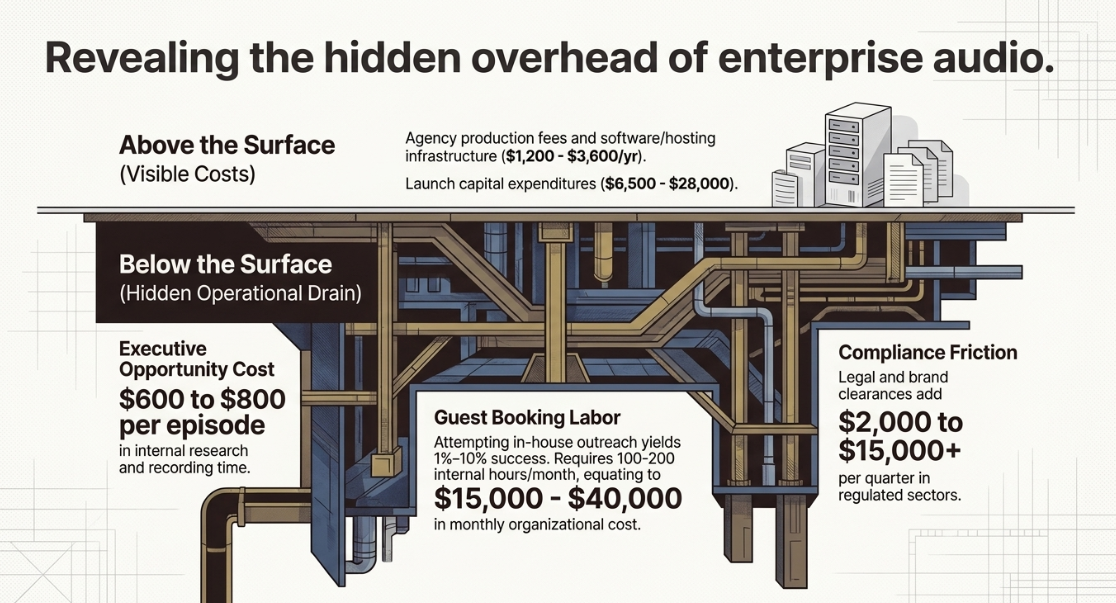
Budgeting models that focus solely on hard agency fees frequently overlook massive internal capital outlays. The most significant hidden cost is executive opportunity time. For a self-produced or internally managed show, a business executive typically spends 4 to 8 active hours per episode on research, recording, and operational coordination.16 Given standard executive compensation, this equates to an opportunity cost of $600 to $800 per episode—an operational drain that frequently leads to host burnout and erratic publishing schedules.16
Guest booking represents another severe hidden expense. Attempting to secure high-profile decision-makers via in-house cold outreach usually yields a conversion rate of merely 1% to 10%.16 Securing four targeted guests a month can require contacting up to 400 prospects, consuming 100 to 200 hours of internal staff time monthly. This represents an estimated $15,000 to $40,000 in monthly organizational opportunity cost.16 By contrast, specialized professional booking agencies, which command $1,000 to $3,000 monthly, utilize refined relationship networks to achieve 20% to 40% booking success rates, presenting a vastly superior economic model.16
Furthermore, enterprise podcasts operate within heavily regulated environments. The necessity of brand compliance checks, legal clearances, and accessibility audits introduces significant "approval workflow overhead." In highly regulated sectors such as SaaS, healthcare, and finance, this friction can add $2,000 to $15,000+ in soft labor costs per quarter.13
Technology, Infrastructure, and Launch Investments
Beyond labor, a sustainable audio strategy requires dedicated capital for infrastructure. Launching an enterprise podcast—encompassing strategic positioning, brand asset creation, website integration, and initial promotional velocity—requires an upfront capital expenditure of $6,500 to $28,000.16 Integrating the dedicated hosting structure directly into a corporate website carries an independent cost of $1,000 to $5,000.16
Ongoing recurring expenses for software infrastructure are also mandatory. Enterprise hosting fees, high-fidelity remote recording platforms (like SquadCast), music licensing, and analytics software typically add $1,200 to $3,600 per year to the operating budget, independent of episode production fees.16 Specialized background music licensing alone can account for $500 annually.18 Failure to proactively model these recurring line items inevitably results in mid-year budget shortfalls, scope reductions, and a loss of the consistency necessary to build audience trust.
Structuring the Enterprise Podcast Team and Operations
An enterprise podcast cannot be managed by a single marketing generalist utilizing consumer-grade software. It requires a highly structured, multi-disciplinary team capable of managing audio engineering, strategic alignment, legal compliance, and multi-platform distribution simultaneously. Organizations must actively decide between building an in-house studio, entirely outsourcing to an agency, or adopting a hybrid operational model.20
Agency and Hybrid Team Architectures
While some organizations choose full in-house production, the capital required to build an internal studio, establish editorial processes, and construct a post-production workflow from scratch is often prohibitive and distracts from core business functions.8 Consequently, specialized B2B podcast production agencies have emerged to service complex enterprise needs.
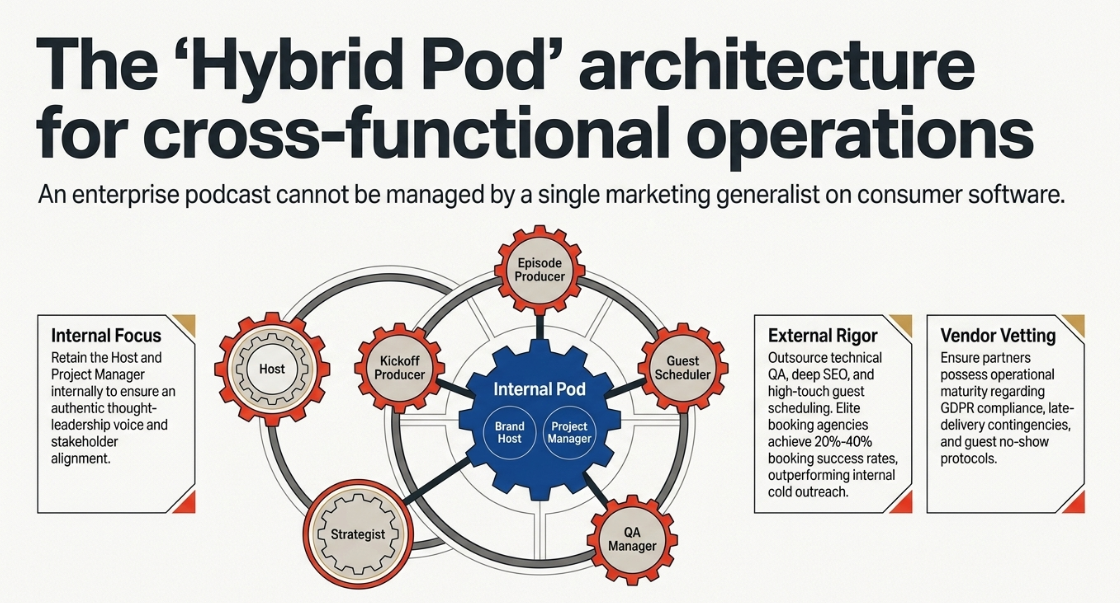
When partnering with an elite enterprise agency, clients are assigned a cross-functional pod, typically structured to handle speed, consistency, and rigorous collaboration 13:
Kickoff Producer: Responsible for the initial onboarding, technical setup, platform migration, and overarching launch strategy.
Episode Producer: Functions as the showrunner, managing individual episode narratives, scripting, and editorial direction.
Production Manager: Oversees the logistical pipeline, timelines, asset management, and rigorous Quality Assurance (QA).
Guest Scheduler: Manages high-touch communication, targeted research, and calendar coordination to secure Fortune 500 executives.
Strategist: Ensures the audio content directly supports broader business goals, ABM campaigns, and revenue attribution metrics.
The Hybrid Approach is increasingly favored by mid-market and enterprise teams. In this model, the organization retains the Host and a Project Manager internally to ensure authentic brand voice and internal stakeholder alignment.20 However, highly technical tasks—such as audio/video editing, mastering, show note copywriting, and multi-channel asset creation—are outsourced to an agency partner.20 This allows the internal team to focus purely on relationship building and thought leadership rather than technical troubleshooting.
Evaluating Vendor Resilience and Compliance Workflows
Selecting the right production partner requires moving beyond simple pricing evaluations to assess operational maturity and risk mitigation. When evaluating vendors, enterprises must probe the agency’s contingency planning.
Additionally, enterprise agencies must operate within established corporate, brand, and information security frameworks. Operating in environments where EU regulators routinely issue massive GDPR fines dictates that agencies build out workflows that meet strict data policies and accessibility standards (such as providing accurate text transcripts and audio descriptions).7 Top agencies possess proven track records of managing this compliance at scale, ensuring that legal teams can verify sponsor messaging and review calls-to-action prior to publication.
Enterprise Hosting, Security, and Internal Communications Infrastructure
While external podcasts are utilized for outbound marketing and demand generation, enterprise podcasting infrastructure is equally vital for internal corporate communications. Distributed workforces, remote employees, and global organizational structures require secure, high-performance methods of disseminating leadership updates, cultural alignment, and training materials.
Architecting Internal Knowledge Hubs
Enterprise hosting platforms—such as Cincopa, CoHost, Libsyn Pro, Captivate, RSS.com, and Transistor—provide the specific architectural backbone required for secure corporate audio.22 These platforms differ fundamentally from consumer-grade hosts by prioritizing uptime, granular access controls, custom corporate branding, and deep integration into existing corporate software ecosystems.22 For instance, CoHost offers updated B2B analytics explicitly designed to improve listener and lead identification, tying audio metrics back to corporate ROI.24
Audio and video hubs serve several highly practical internal use cases:
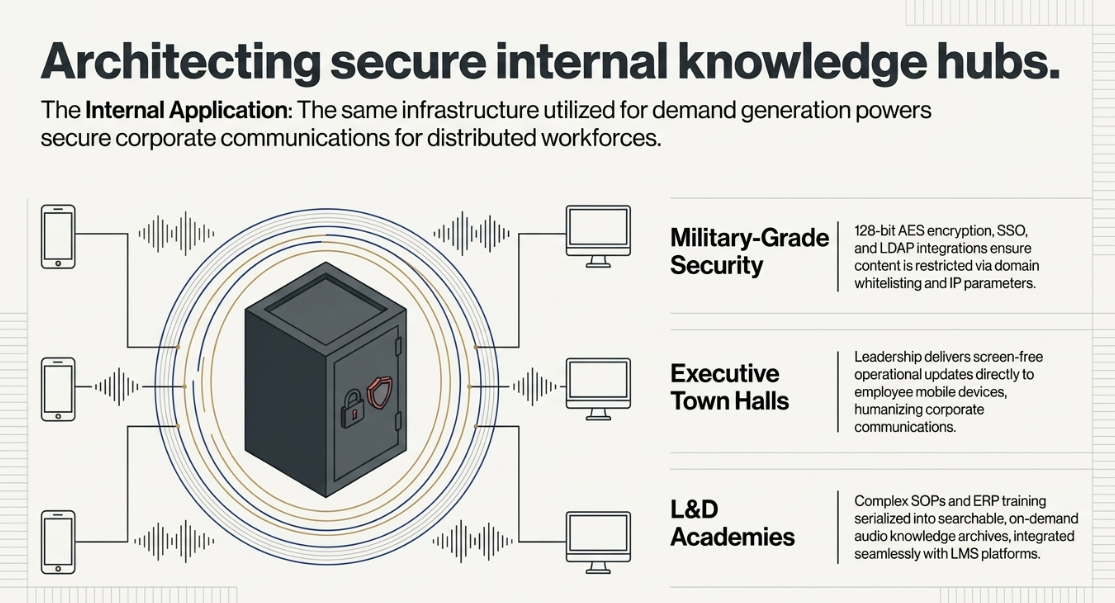
Executive Thought Leadership and Town Halls: Leadership teams can distribute weekly operational briefs or quarterly financial updates directly to employee mobile devices.23 This format humanizes leadership and provides a screen-free alternative to endless internal email memos.
Learning and Development (L&D) Academies: Complex standard operating procedures (SOPs), ERP training, and internal software walkthroughs can be serialized into episodic audio and video formats.23 These structured podcast galleries act as a searchable, on-demand knowledge archive, preventing vital operational knowledge from being lost in ephemeral chat threads.23
Targeted Departmental Feeds: Utilizing sub-account isolation, organizations can create distinct, secure podcast feeds for specific departments (e.g., an exclusive sales enablement podcast for account executives, or a compliance update feed for HR personnel).23
Security Protocols and API Integrations
Internal podcasts contain highly sensitive, proprietary corporate data. Therefore, enterprise podcast hosting solutions deploy military-grade security frameworks to prevent unauthorized access and data leakage.23
Content is typically stored on secure media servers (such as AWS) and delivered globally via encrypted Content Delivery Networks (CDNs) or eCDNs using 128-bit AES encryption and Secure Sockets Layer (SSL) protocols.23 To manage access at scale, platforms integrate Single Sign-On (SSO) and Lightweight Directory Access Protocol (LDAP). This ensures that only active, authenticated employees can access the private RSS feeds or embedded web players.
Furthermore, advanced enterprise platforms utilize proprietary streaming protocols, domain whitelisting, and IP/Geographic restriction parameters to ensure content cannot be played outside approved corporate environments.23 Administrators can disable file downloads entirely or restrict access to specified internal IP ranges.23
The utility of these platforms is maximized through robust integrations with broader corporate software ecosystems. Enterprise audio platforms seamlessly connect with Content Management Systems (CMS) and Learning Management Systems (LMS) to inject multimedia directly into employee workflows.
These integrations, particularly developer tools like Flutter and React Native, allow enterprises to build custom native mobile applications for their workforces, tracking video and audio performance via unique resource identifiers.23
Global Podcast Market Dynamics and Regional Trajectories
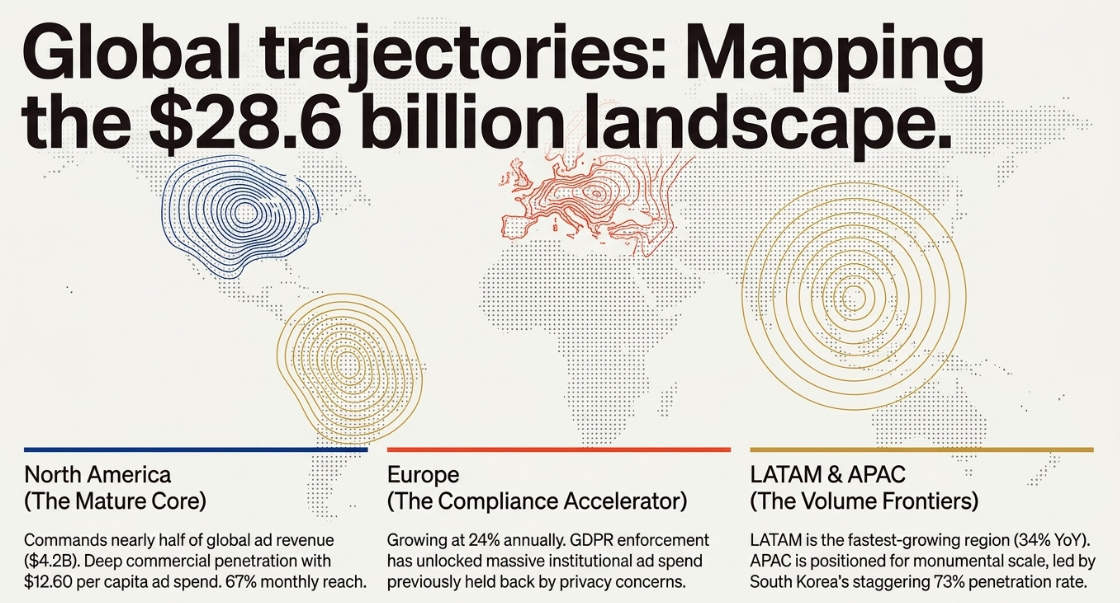
The economic viability of enterprise podcasting is supported by a massive and rapidly expanding global audience. By 2026, the global podcast industry is projected to reach an estimated value of $28.6 billion, representing a 55% increase from its $18.5 billion valuation in 2024.1 This revenue surge is mirrored by an explosion in content availability, with 4.4 million active podcasts and over 214 million episodes distributed worldwide.1
Listener engagement is at unprecedented levels. In 2026, 672 million individuals globally consume podcasts at least once a month, a 145% growth trajectory since 2019.1 English-language podcasts currently command 62% of the global listening time, making it the dominant language for international B2B outreach.1 However, the geographic distribution of podcast consumption reveals distinct regional maturity curves and emerging opportunities for global enterprises.
North America and Europe: The Mature Cores
The United States remains the most lucrative and mature market, holding an estimated 38% to 40% of the global market share.2 In 2026, 67% of the US population aged 12 and older listens to podcasts monthly.1 Despite representing only a quarter of global listeners, the US commands nearly half of global podcast ad revenue, projected to reach $4.2 billion in 2026 (a 31% increase from 2024).1 Advertising spend is heavily concentrated in financial services, consumer packaged goods, and healthcare.26 Furthermore, the per capita ad spend in the US sits at a robust $12.60, indicating deep commercial penetration.1
Conversely, the European market is exhibiting accelerated commercialization, growing at a rate of 24% annually—three times faster than the US growth rate of 8%.1 European podcast advertising spend is forecast to hit $2.9 billion in 2026.1 This growth is heavily supported by the enforcement of GDPR-compliant programmatic ad targeting, which has legitimized the channel for institutional advertisers who previously avoided the space due to data privacy concerns.27 Within Europe, the UK maintains a per capita ad spend of $8.10, while Germany sits at $5.00.
Asia-Pacific and Latin America: The Growth Frontiers
The true volume growth of the industry is occurring outside Western markets. Latin America represents the fastest-growing region globally, expanding at a remarkable 34% year-over-year.1 Driven largely by high smartphone penetration in Brazil and Mexico, the region is projected to become a massive consumer base, expected to account for over 32% of the global audience share by the late 2020s.1
The Asia-Pacific (APAC) region is positioned for monumental long-term expansion. Currently representing approximately 24% of the global market share, the region is accelerating at a Compound Annual Growth Rate (CAGR) of over 29.5%.29 South Korea leads the entire world in adoption, boasting an incredible 73% monthly podcast penetration rate.1 High mobile listening rates (71%), aggressive adoption of regional language content, and robust infrastructure development position APAC to reach an astonishing market volume of $28.3 billion by 2030, with Japan acting as a critical growth engine.29
Future-Proofing the Audio Strategy: Trends for 2026 and Beyond
To maintain a competitive advantage, enterprise marketing and operations leaders must align their audio strategies with the technological and behavioral trends defining the late 2020s. The convergence of video streaming, artificial intelligence, and spatial audio formats is fundamentally rewriting the operational rules of podcasting.
The Absolute Necessity of Video and Smart TV Integration
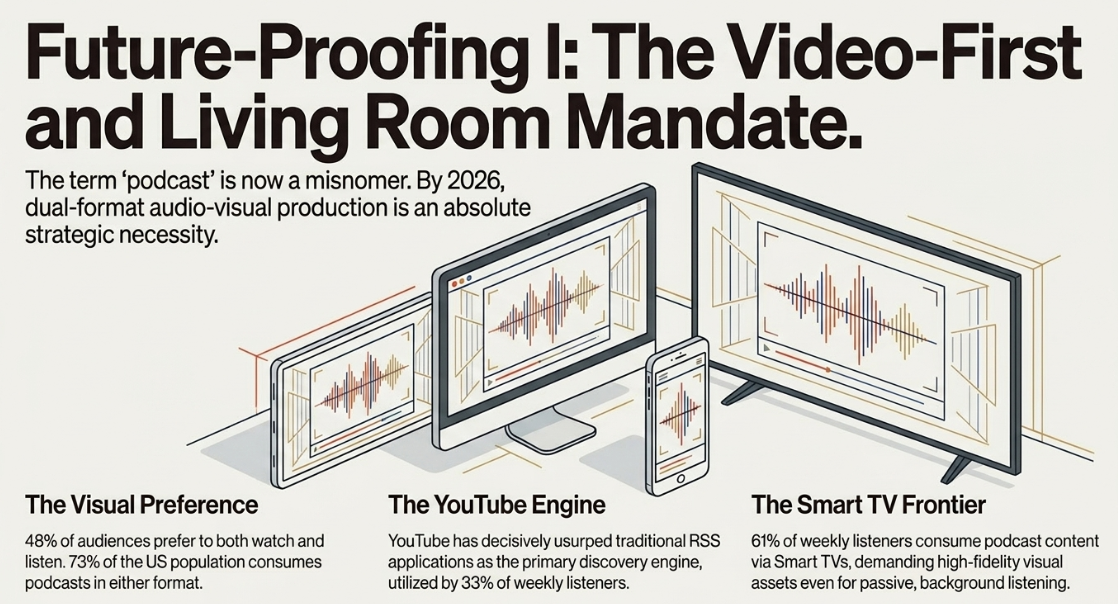
The term "podcast" is increasingly a misnomer, as the medium transitions irrevocably toward a dual-format audio-visual experience. By 2026, video podcasts have shifted from a luxury add-on to an absolute strategic necessity.7 Consumer behavior metrics demonstrate that 48% of audiences now prefer to both watch and listen to their favorite shows, and an estimated 73% of the US population consumes podcasts in either audio or video format.7
YouTube has decisively usurped traditional RSS applications (like Apple Podcasts) as the primary discovery engine for podcasts. Approximately 33% of weekly listeners utilize YouTube as their primary podcast platform, capturing a massive 16% of the global podcast platform market share.1 Consequently, enterprise brands launching podcasts in 2026 must default to video-first production. This requires investing heavily in set design, on-camera executive coaching, and multi-cam post-production workflows using tools like Adobe Premiere Pro, Apple Final Cut Pro X, or Davinci Resolve.7
Furthermore, the living room has become a primary consumption environment. In the US, 61% of weekly listeners use Smart TVs to consume podcast content, even if they are merely passively listening to the audio while performing other tasks.7 Shows that lack high-fidelity visual assets or engaging video components suffer severe disadvantages in algorithmic discovery and audience retention.7
The Role and Limits of AI in Production Workflows
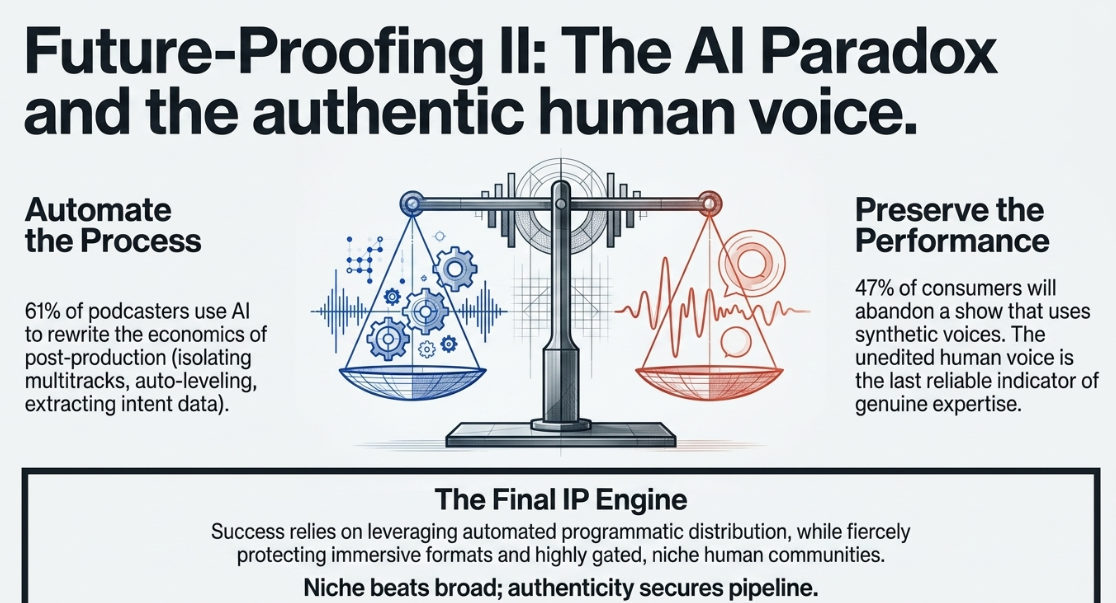
Artificial Intelligence has fundamentally altered the economics of post-production. In 2026, over 61% of podcasters plan to integrate AI into their workflows.32 Generative AI and machine learning tools—such as Descript, Adobe Podcast, Auphonic, and Podcastle.ai—are universally utilized to automate tedious logistical tasks: isolating multitrack audio, removing background noise, auto-leveling varying microphone inputs, and generating SEO-optimized show notes.7
Advanced technological applications are pushing these boundaries further. Platforms like AudioShake utilize high-fidelity multi-speaker separation to isolate voices and clean up dialogue, rescuing messy remote recordings.34 Moreover, AI tools are bridging the gap between podcasting and broader corporate intelligence by providing deep company insights, funding histories, and intent data to streamline B2B prospecting efforts alongside podcast distribution.35
However, the proliferation of AI presents a paradox for enterprise trust. While AI is invaluable for background operations, audiences fiercely reject AI-generated creative execution. Listener survey data indicates that 47% of consumers would immediately abandon a favored podcast if it transitioned to using synthetic, AI-generated voices.7 This trend is mirrored in the adjacent audiobook market, where consumer willingness to try AI-narrated audiobooks dropped significantly from 70% in 2025 to 61% in 2026, with AI-voiced audiobooks generating a negligible 0.03% of sales revenue.36 In a B2B landscape saturated with automated emails and AI-written articles, the unedited, authentic human voice remains one of the last reliable indicators of genuine expertise.3 Consequently, successful enterprises use AI to optimize the process but strictly preserve the human element in the performance.
Immersive Audio Formats and Niche Community Building
The audio landscape is also expanding technologically through spatial and interactive formats. Immersive audio technologies such as Dolby Atmos and Sony 360 Reality Audio are gaining massive traction, with more than 50 million tracks available in spatial audio formats by 2026.37 These emerging interactive formats present new opportunities for audio engineers to build multidimensional soundscapes, particularly for branded storytelling or highly immersive corporate training simulations.34
As the global catalog surpasses 4.4 million active shows, mass-market generalist podcasts are failing to secure traction. The prevailing strategic thesis for 2026 is that "niche beats broad".7 Listeners, fatigued by endless choices, crave hyper-relevance. B2B shows that target highly specialized segments yield superior retention rates, build trust faster, and deliver substantially higher ROI per listener than broad-reach business shows.7
Alongside niche targeting, audience engagement is moving off-platform. Recognizing that 59% of listeners trust podcast hosts more than traditional social media influencers, creators are establishing private, gated communities on platforms like Discord, Slack, or custom corporate intranets.7 These communities serve as proprietary feedback loops, where highly engaged listeners dictate future content, provide product feedback, and ultimately form a loyal, highly valuable brand ecosystem.7
By meticulously modeling operational economics, architecting a cross-functional production team, ensuring strict regulatory compliance, and embracing the paradigm shifts of video and programmatic distribution, enterprises can future-proof their communication strategies and transform passive audio consumption into a verifiable, compounding commercial advantage.
Works cited
Podcast Statistics 2026 | 80+ Facts & Data Points - Searchlab, accessed June 11, 2026, https://searchlab.nl/en/statistics/podcast-statistics-2026
Podcasting Market Size to Hit USD 115.57 Billion by 2035 - Precedence Research, accessed June 11, 2026, https://www.precedenceresearch.com/podcasting-market
5 Audio Advertising Trends for 2026 - Madison Logic, accessed June 11, 2026, https://www.madisonlogic.com/blog/audio-advertising-trends/
B2B Podcast Strategy: Complete Guide To Planning, Launching, And Growing A High-ROI Show - Fame.so, accessed June 11, 2026, https://www.fame.so/post/podcast-strategy
B2B Podcast ROI: Why Podcasting Is Business Infrastructure 2026, accessed June 11, 2026, https://kazcm.com/b2b-podcast-roi/
The ROI of B2B Podcasting: Metrics That Matter for Business Growth ..., accessed June 11, 2026, https://contentallies.com/learn/roi-b2b-podcasting-metrics
Podcasting Trends 2026: What Every Marketing Leader Needs to ..., accessed June 11, 2026, https://contentallies.com/learn/podcasting-trends
14 Top Enterprise Podcast Production Companies (2026 Guide) - Fame.so, accessed June 11, 2026, https://www.fame.so/post/enterprise-podcast-production
The Intelligent Enterprise Podcast – Building AI, Beyond Algorithms - Digitate, accessed June 11, 2026, https://digitate.com/podcast/buidling-ai-beyond-algorithms/
Business Podcast Archive and Shows — The Soul of Enterprise, accessed June 11, 2026, https://www.thesoulofenterprise.com/tsoe
Media Appearances - Impact Pricing, accessed June 11, 2026, https://impactpricing.com/media-appearances/
The Kinetic Enterprise: Built to Evolve - A Podcast Series | Deloitte | Technology, accessed June 11, 2026, https://www.deloitte.com/zm/en/alliances/sap/perspectives/sap-the-kinetic-enterprise-podcast-series.html
Enterprise Podcast Production Guide for B2B Brands — Content Allies, accessed June 11, 2026, https://contentallies.com/learn/enterprise-podcast-production-guide
Podcast Trends Shaping Sponsorships in 2026 - Thoughtleaders.io, accessed June 11, 2026, https://www.thoughtleaders.io/blog/podcast-trends-2026
Podcast Production Costs For All Budgets (2026 Pricing Guide) - Talks.co, accessed June 11, 2026, https://talks.co/p/podcast-production-costs/
Podcast Production Pricing: B2B Packages, Costs & ROI | Rise25, accessed June 11, 2026, https://rise25.com/lead-generation/podcast-production-pricing/
Calculating Monthly Running Costs for Podcast Production Services - Financial Models Lab, accessed June 11, 2026, https://financialmodelslab.com/blogs/operating-costs/podcast-production
B2B Podcast Production Cost: 2026 Pricing Guide - ThePod.fm, accessed June 11, 2026, https://thepod.fm/resources/blog/podcast-production-cost-for-businesses
Set up your workflow & learn how to make a video podcast - Motion, accessed June 11, 2026, https://motionagency.io/set-up-your-workflow-learn-how-to-make-a-video-podcast/
How to Build a Podcast Team That Actually Works | Lower Street, accessed June 11, 2026, https://lowerstreet.co/how-to/build-a-podcast-team
Enterprise Podcast Production: How to Give Your Company a Voice - Podigee, accessed June 11, 2026, https://www.podigee.com/en/blog/enterprise-podcast/
Top 15 Enterprise Podcast Solutions in 2026 — Content Allies - The ..., accessed June 11, 2026, https://contentallies.com/learn/top-enterprise-podcast-solutions
Enterprise Podcast Hosting | Internal Comms & Executive Leadership, accessed June 11, 2026, https://www.cincopa.com/media-platform/podcast-player
Press Releases - Sounds Profitable, accessed June 11, 2026, https://soundsprofitable.com/press-release/
Podcasting Market Size And Share | Industry Report, 2030 - Grand View Research, accessed June 11, 2026, https://www.grandviewresearch.com/industry-analysis/podcast-market
Podcast Statistics 2026: 130+ Advertising Data Points - Digital Applied, accessed June 11, 2026, https://www.digitalapplied.com/blog/podcast-statistics-2026-advertising-data
Podcasting Market Size Growth & 2031 Industry Trends - Mordor Intelligence, accessed June 11, 2026, https://www.mordorintelligence.com/industry-reports/podcast-market
Podcasting Market Size, Share, Trends | CAGR of 27.8%, accessed June 11, 2026, https://market.us/report/podcasting-market/
Podcast Market Growth Driven by 8.9% CAGR by 2035, accessed June 11, 2026, https://www.globalgrowthinsights.com/market-reports/podcast-market-122632
Asia Pacific Podcasting Market Size & Outlook, 2025-2030, accessed June 11, 2026, https://www.grandviewresearch.com/horizon/outlook/podcasting-market/asia-pacific
The Podcast Landscape 2025 Part One: Core Podcast Metrics - Sounds Profitable, accessed June 11, 2026, https://soundsprofitable.com/research/the-podcast-landscape-2025/
How Many Podcasts Are There in 2026? (Listeners Stats) - DemandSage, accessed June 11, 2026, https://www.demandsage.com/podcast-statistics/
Podcast Marketing Trends in 2026: What Brands Need to Know - Podmuse, accessed June 11, 2026, https://www.podmuse.com/post/podcast-marketing-trends-in-2026-what-brands-need-to-know
AudioShake Blog, accessed June 11, 2026, https://www.audioshake.ai/blog
Top 15 AI Tools for B2B Marketing Teams in 2025 - KeyScouts Blog, accessed June 11, 2026, https://blog.keyscouts.com/ai-tools-for-marketing
Research Surveys Press Release — Homepage - Audio Publishers Association, accessed June 11, 2026, https://www.audiopub.org/surveys
Audio Streaming Market - Share, Size and Industry Analysis - Coherent Market Insights, accessed June 11, 2026, https://www.coherentmarketinsights.com/market-insight/audio-streaming-market-620
Broadcasting & Internet Radio: Trends, Challenges & Opportunities for the Next Five Years, accessed June 11, 2026, https://www.airtime.pro/broadcasting-internet-radio-trends-challenges-opportunities/