Introduction: The Macroeconomic Crisis of the Attention Economy
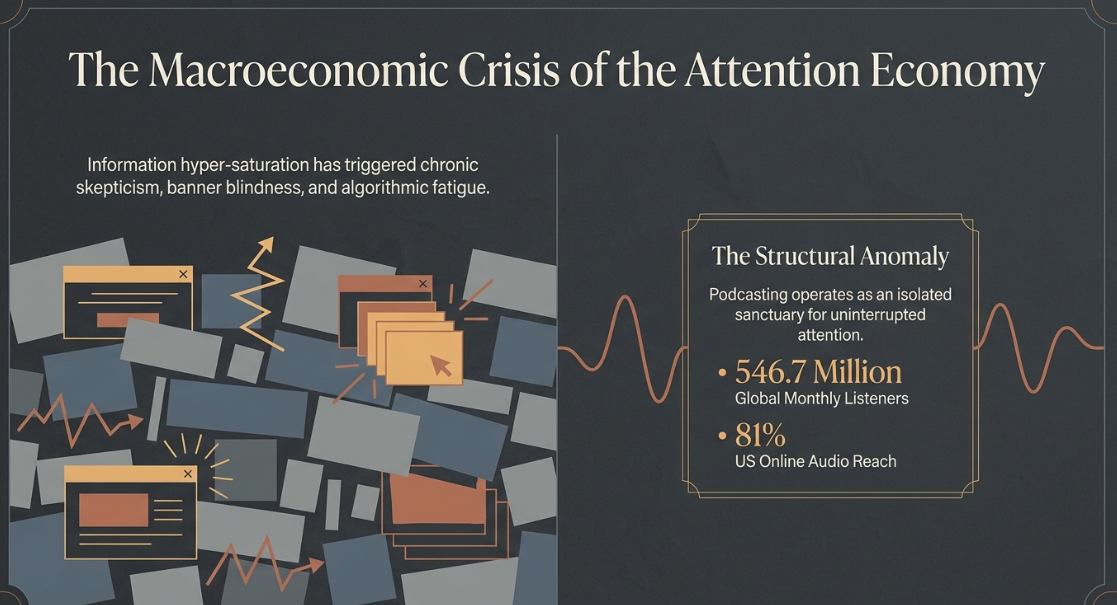
In the contemporary macroeconomic landscape of digital media, the fundamental currency of commerce is no longer merely attention; it is trust. Over the past two decades, the global marketing ecosystem has undergone a profound structural shift. The digital landscape has transitioned from a state of information scarcity to one of chronic hyper-saturation. Consumers and business-to-business (B2B) buyers alike are subjected to an unrelenting, algorithmically optimized barrage of short-form video content, programmatic display advertising, and automated outbound solicitations. This saturation has precipitated a profound crisis of skepticism. Traditional marketing channels are increasingly met with sophisticated psychological defenses, manifesting as banner blindness, aggressive ad-blocking, high bounce rates, and a baseline cognitive assumption of corporate disingenuousness. As a result, the cost of acquiring and retaining consumer attention across legacy digital platforms has skyrocketed, yielding diminishing returns on capital investment.
Within this hostile, highly fragmented environment, the podcasting medium has emerged as a remarkable structural anomaly. Far from being a peripheral audio channel, podcasting represents an isolated sanctuary for authentic, uninterrupted, and long-form intellectual engagement. Global monthly podcast listeners surpassed 546.7 million in 2024 and are projected to exceed 580 million by the end of 2025.1 Furthermore, Edison Research’s Infinite Dial report places online audio consumption at 81% of Americans aged 12 and older, representing approximately 233 million people listening monthly, with 76% tuning in on a weekly basis.2 These metrics do not reflect a niche subculture; they rival traditional broadcast radio's historical reach figures while offering far more precise digital targeting capabilities.
However, the defining metric of the podcasting medium is not its absolute reach, but its psychological resonance. The financial returns of professional podcasting are directly downstream of a psychological phenomenon entirely unique to the medium: deep, parasocial trust. As digital audiences retreat from the algorithmic manipulation and dopamine-driven fatigue of visual social media, they are increasingly seeking the curated intimacy and intellectual nourishment of long-form audio. The resulting dynamic positions the podcast host not merely as a content creator, but as a "Narrative Influencer" whose authority frequently rivals that of traditional journalism and institutional thought leadership. This report provides an exhaustive, data-driven analysis of the psychological mechanisms driving podcast trust, the resulting commercial impact on direct-response and brand advertising, the compounding nature of the media "halo effect," and the strategic imperative of podcasting in accelerating complex B2B sales cycles.
The Psychology Behind Podcast Trust
The Auditory Architecture of Intimacy and Narrative Transportation
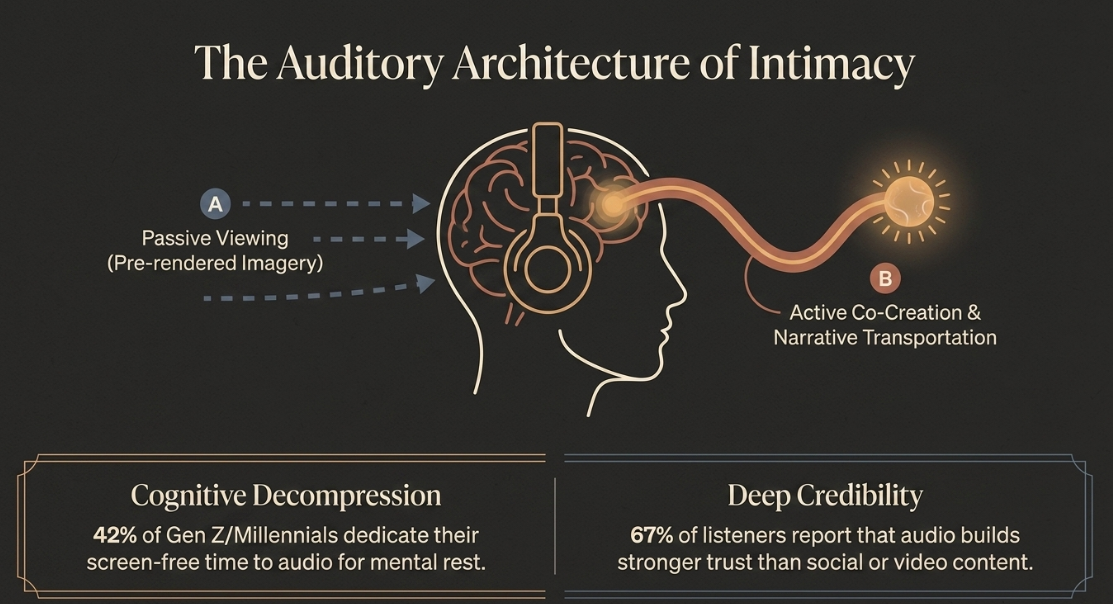
The commercial efficacy of podcasting is fundamentally rooted in the neuroscience and evolutionary psychology of auditory processing. Voice is humanity’s oldest and most effective storytelling tool.3 When a narrative is delivered purely through audio, it requires the listener to actively co-create the experience by visualizing the subject matter. This cognitive process demands a higher degree of neural engagement than the passive consumption of video, where the visual cortex is simply fed pre-rendered imagery. Decades of media-psychology research demonstrate that when listeners are immersed in a story world—a mechanism known academically as "narrative transportation"—their feelings, beliefs, and attitudes can shift in ways that are deeply consistent with the narrative.4 This mechanism helps explain why audio formats can feel profoundly absorbing, allowing the listener to savor the content in a psychologically safe environment.4
The extended session times characteristic of podcasts create an intimacy that visual social media simply cannot match. Young demographics, in particular, are increasingly utilizing podcasts as a form of cognitive decompression. Globally, 42% of Gen Z and Millennials’ total screen-free time is now dedicated to audio consumption, using the medium as a "mental rest" from screens while remaining engaged in learning and the consumption of ideas.5 Because the host's voice is literally piped directly into the listener's ear via headphones for hours each week, audiences form a psychological bond that mimics the proximity and warmth of real-world friendship.6 This focused attention represents a paradigm shift from the distracted, rapid-fire scrolling typical of digital behavior. As early as 2004, analysts intuited that combining the intimacy of voice with digital delivery would reconfigure narrative reception, shifting the paradigm from passive viewing to active "storylistening".7
Consequently, the medium commands unparalleled trust. Data reveals that 67% of listeners report that audio builds stronger trust than social or video content, primarily because audio's intimacy creates an emotional credibility that visual media struggles to replicate.
Demographic Expansion and the Normalization of Audio
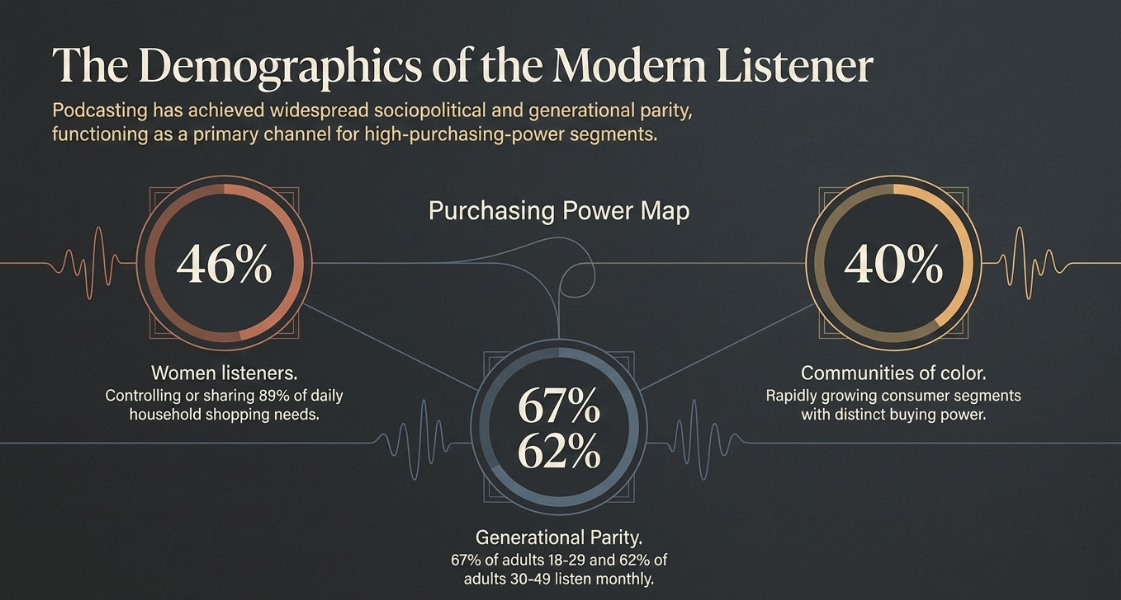
The psychological pull of the medium has driven rapid demographic expansion, moving podcasting away from its historical associations with niche technological or "bro" cultures into a universally adopted medium.9 Pew Research data from 2025 illustrates widespread generational adoption: 67% of adults aged 18 to 29 listen to podcasts monthly, followed closely by 62% of adults aged 30 to 49, 50% of those aged 50 to 64, and 33% of adults aged 65 and older.10
Furthermore, the medium has achieved remarkable demographic and sociopolitical parity. Women now constitute 46% of monthly podcast listeners, bringing female listenership to an all-time high.9 This is a critical commercial metric, considering that women control or share 89% of daily shopping needs in consumer households.9 Similarly, communities of color make up nearly 40% of listeners, and 3% of monthly consumers identify as nonbinary, representing vast, highly engaged audiences with trillions in collective purchasing power.9 Politically, the US listener base has narrowed significantly, currently sitting at 37% Democrat and 30% Republican, demonstrating that podcasting now attracts a politically broad and ideologically diverse mainstream audience.5
Parasocial Interactions and the Illusion of Peer-to-Peer Intimacy
The intimacy of the auditory experience serves as the biological catalyst for a powerful psychological mechanism known as "parasocial interaction." Originally formulated in 1956 by sociologists Horton and Richard Wohl to describe the one-sided emotional connections viewers developed with television personalities, the concept has found its ultimate realization in the podcasting medium.12 A parasocial relationship is a non-reciprocated, non-dialectical bond that creates a profound "illusion of intimacy," wherein the listener neurologically processes the relationship with the host as a genuine, reciprocal friendship.12
In the podcasting ecosystem, this dynamic is amplified by the unscripted, highly conversational nature of the content. Hosts routinely share personal anecdotes, authentic reactions, vulnerabilities, and unfiltered opinions, systematically lowering the listener's defensive barriers. The psychological weight of this bond cannot be overstated. Listeners place immense emphasis on maintaining socioemotional bonds with these hosts, leading to deep behavioral loyalty, high message acceptance, and profound influence over personal attitudes.
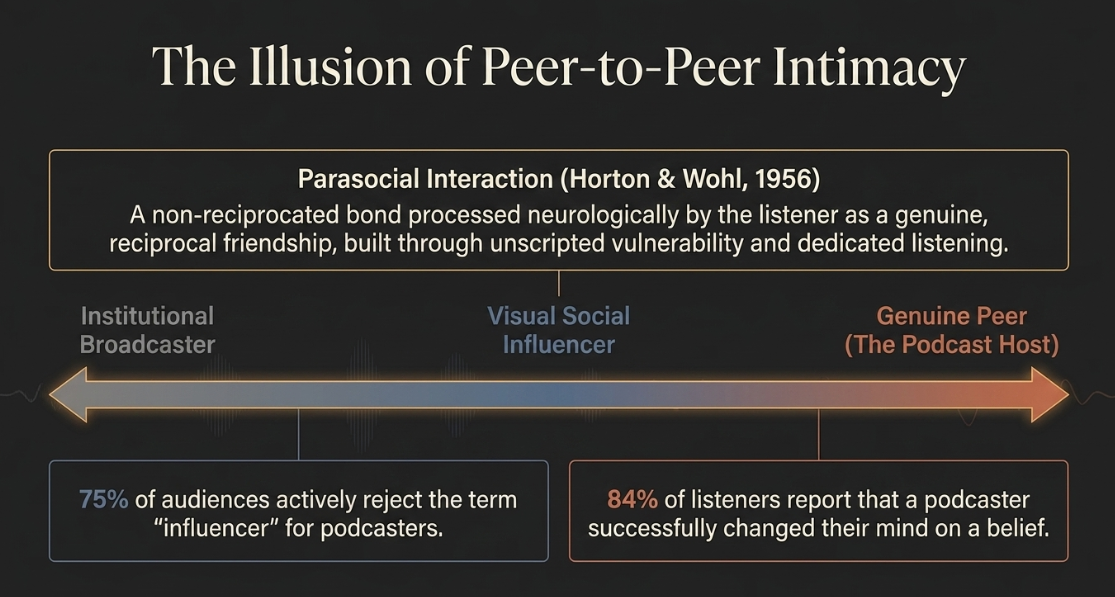
The trust generated by these parasocial bonds heavily eclipses the influence of visual social media personalities. Listeners actively reject the term "influencer" when describing podcasters. According to the Acast Podcast Pulse 2025 report, 75% of audiences do not view podcasters as influencers at all; rather, they see hosts as genuine, honest, and captivating peers.8 This trust is so potent that 84% of listeners report that a podcaster has successfully changed their mind about a previously held belief.8
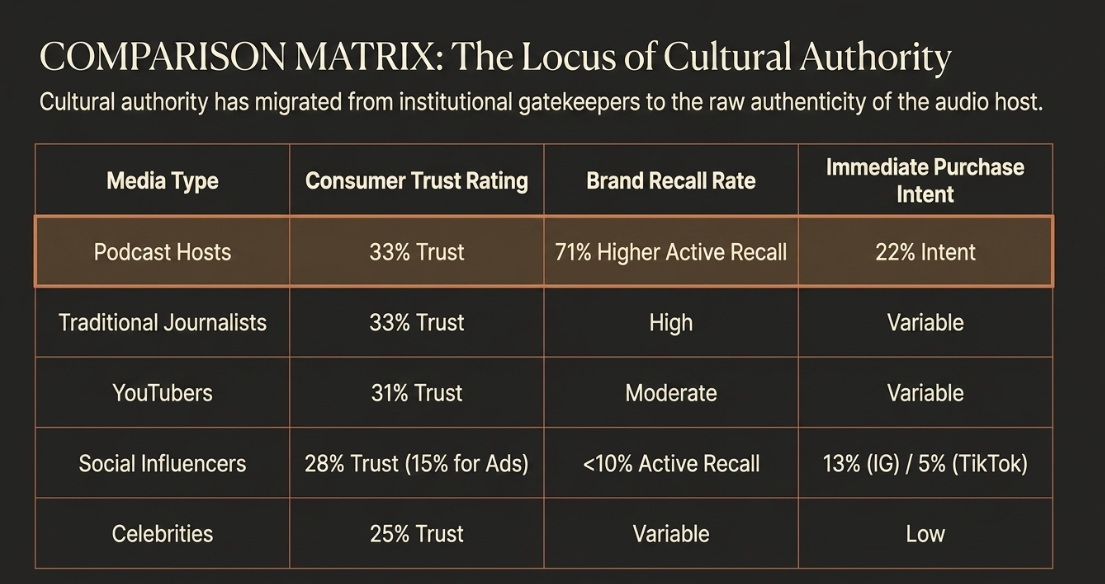
When evaluating credibility for product recommendations, consumers now rank podcasters (33%) and traditional journalists (33%) as equally trustworthy.8 This places them significantly ahead of YouTubers (31%), social media influencers (28%), and traditional celebrities (25%).8 For marketers, this indicates a massive shift: the locus of cultural authority has moved from institutional gatekeepers and highly produced visual influencers to the raw, unpolished authenticity of the audio host.
This stark dichotomy in trust is vividly reflected in advertising receptivity. A 2025 SuperListeners Study revealed that 62% of podcast fans report trusting advertisements read by their favorite hosts, compared to a mere 15% who trust social media influencers.
The Reciprocity Principle: Advertising as a Fair Exchange
A secondary, yet equally critical, psychological driver of podcast monetization is the implicit social contract established between the host and the audience. In traditional broadcast television and digital web browsing, advertising is inherently disruptive, entirely non-consensual, and largely resented by the consumer. However, the podcast ecosystem operates on a psychological principle of reciprocity. Because listeners deeply value the socioemotional bond with the host and actively appreciate the long-form educational or entertainment value of the content, they exhibit a highly receptive mindset toward the monetization required to sustain that content.
Research from Edison Research indicates that 88% of weekly podcast consumers agree that hearing advertisements is a "fair exchange" for free content.18 This metric demonstrates that the audience is not merely tolerating advertising; they are actively accepting it as an integral, necessary component of the media ecosystem. Furthermore, consumer loyalty translates directly into commercial support: 78% of listeners support the inclusion of additional advertisements on their favorite shows if it enables the creators to continue producing high-quality content.
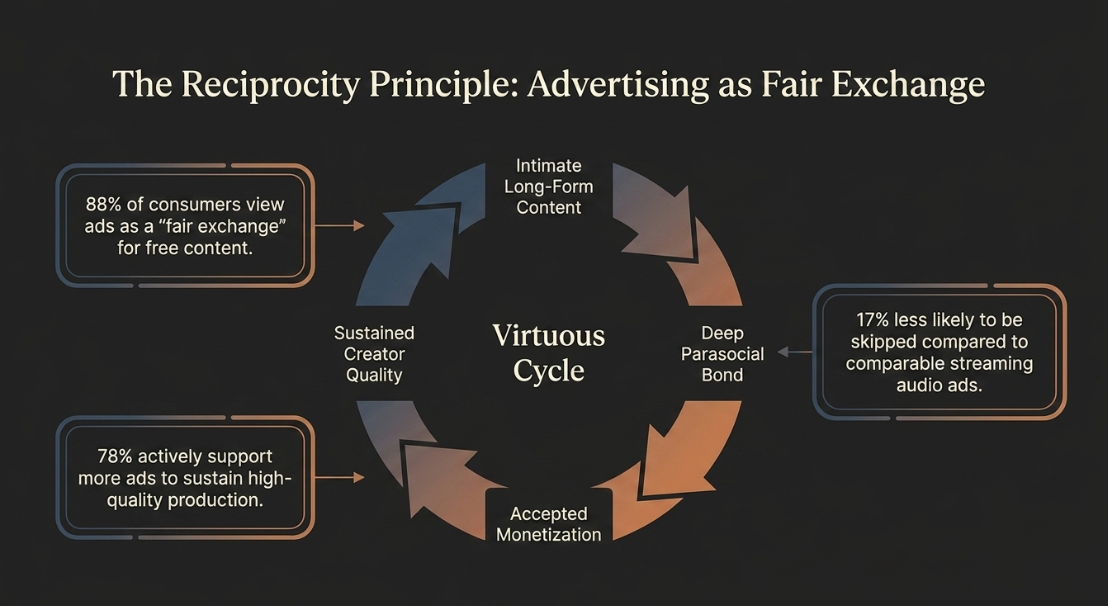
This high tolerance is fundamentally a function of the delivery format. Host-read ads tend to sound like a natural extension of the ongoing conversation rather than an aggressive interruption that forces itself into the audio feed.18 Instead of reading a strict, legally mandated script, hosts are typically given a brief and trusted to translate the advertiser's message into their own unique vernacular, weaving in personal anecdotes that keep the audience engaged.20 Consequently, 76% of listeners perceive that there are fewer ads on podcasts compared to other media channels, effectively neutralizing ad fatigue and preserving the host's persuasive authority.20 This lack of friction ensures that podcast ads are 17% less likely to be skipped than comparable audio advertisements placed in streaming music.20
Commercial Impact of Podcast Trust
Direct-Response Advertising Effectiveness
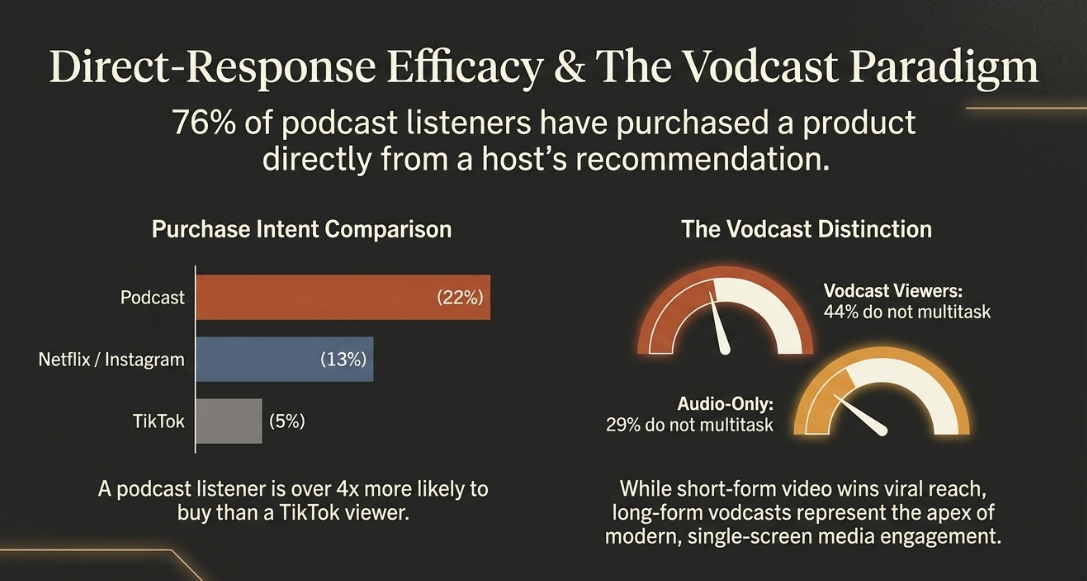
The commercial impact of this parasocial trust is profound, particularly within the highly measurable domain of direct-response advertising. The modern consumer's path-to-purchase is heavily guarded by skepticism, yet the endorsement of a trusted podcast host effortlessly bypasses these traditional defenses. Exhaustive research indicates that 76% of podcast listeners have purchased a brand or product directly resulting from a host's recommendation.19
This exceptional conversion rate is fundamentally driven by the authenticity of the delivery. When a podcast host endorses a financial service, consumer packaged good, or software platform, the commercial message is processed by the listener's brain as actionable advice from a trusted peer rather than a generic corporate broadcast.20 This dynamic transforms the host into an audio influencer capable of driving immediate behavioral shifts. In comparative studies measuring immediate purchase intent, 22% of monthly podcast listeners made an immediate purchase after hearing an ad, drastically outperforming competitive visual networks such as Netflix/Instagram (13%), YouTube (12%), and TikTok (5%).24 Statistically, a podcast listener is over four times more likely to execute an immediate purchase than a TikTok viewer after ad exposure.
The efficacy of podcast advertising has resulted in notable shifts in aggregate consumer behavior and pipeline generation. Overall, 81% of listeners reported taking measurable action after hearing a podcast ad in 2026, marking an upward trajectory from 76% in 2024.21 For performance marketers grappling with skyrocketing Cost Per Mille (CPM) rates on saturated search and social platforms, the podcast medium offers a critical lifeline: high-intent buyers who skew toward higher household incomes and possess a high propensity for comprehensive product research prior to conversion.21
Marketers utilize three primary formats to capture this demand:
Host-Read Ads: The host reads the script live or records it natively. These are the gold standard, achieving the highest conversion rates because listeners trust the host's personal endorsement. They command premium pricing but deliver unparalleled ROI.16
Produced Ads: Pre-recorded audio spots inserted programmatically. These sound like traditional radio ads. While they cost less and scale easily, conversion rates are comparatively lower due to the absence of the host's parasocial influence.21
Programmatic Audio Ads: Dynamically inserted ads served via programmatic platforms based on listener demographics, life stage, or geography. While offering precise targeting, this format entirely removes the host-read advantage.21
To optimize performance, sophisticated direct-response campaigns typically initiate with host-read mid-roll advertisements on 5 to 10 carefully vetted shows to validate creative fit and leverage parasocial trust. Once validated, they scale utilizing programmatic insertion or network-wide formats like Acast's "Sponsorship Plus"—which runs host-read style ads across a wider network—to capture the medium's broader reach.
Cognitive Retention and Superior Brand Recall
Beyond immediate, trackable conversions, the intimacy of the audio format ensures superior cognitive retention and brand awareness. In visual digital environments, consumers have developed highly sophisticated filtering mechanisms to ignore display ads and skip pre-roll videos. Conversely, the "lean-in" nature of podcast listening commands active, sustained attention. Edison Research reports that 71% of podcast listeners pay active attention to podcast advertisements.16
Consequently, host-read advertisements achieve a 71% higher brand recall rate than pre-produced, generic audio spots.6 This metric is dramatically higher than the sub-10% recall rate associated with social media advertisements that users passively scroll past in their algorithmic feeds.6 Overall, podcast ads rank as the most recalled type of advertisement in the digital landscape, with 86% of listeners remembering an ad, compared to 80% for social media and 79% for general websites.9
A 2025 study by Claritas quantified this disparity, finding that podcast advertisements generate up to three times higher brand recall and 1.5 times higher conversion rates than traditional digital audio formats.16 This level of engagement means the brand message is not merely heard; it is internalized and reinforced, drastically lowering the long-term customer acquisition cost.
The Vodcast Paradigm and Focused Attention
The integration of visual components into the podcasting ecosystem—colloquially termed "vodcasting" or video podcasting—has introduced entirely new dimensions to audience engagement. The modern marketing landscape is currently divided between proponents of short-form vertical video (e.g., TikTok, Instagram Reels, YouTube Shorts) and advocates of long-form vodcasts. While global ad spending on short-form video is massive, projected to reach $1.04 trillion in 2026, vodcast and podcast advertising is experiencing rapid, highly scrutinized growth, hitting $5 billion—a 20% year-over-year increase.6
While short-form video offers unmatched viral reach, vodcasts dominate in attention quality and intent. Deloitte reports that vodcast viewers consume 1.5 times more content than audio-only listeners.6 Critically, 44% of vodcast viewers report that they do not multitask while watching, compared to just 29% of audio-only listeners.6 This focused, single-screen attention represents the absolute apex of modern media engagement: an audience that actively watches and cognitively processes brand messaging rather than relegating it to background noise while executing household chores or commuting.6 Acast data supports this dual-consumption trend, noting that video and social platforms serve as powerful extensions for reach, but the core audio feed remains the definitive source of deep trust that anchors the campaign's effectiveness.8
Authority and Halo Effect
The Mechanics of Institutional Trust Transfer
While direct host-read endorsements represent the gold standard for measurable, bottom-of-funnel performance, the authority generated by the podcast medium profoundly impacts brand awareness and top-of-funnel consideration. The mere presence of a brand within a highly trusted podcast ecosystem creates a thoroughly documented "halo effect".25
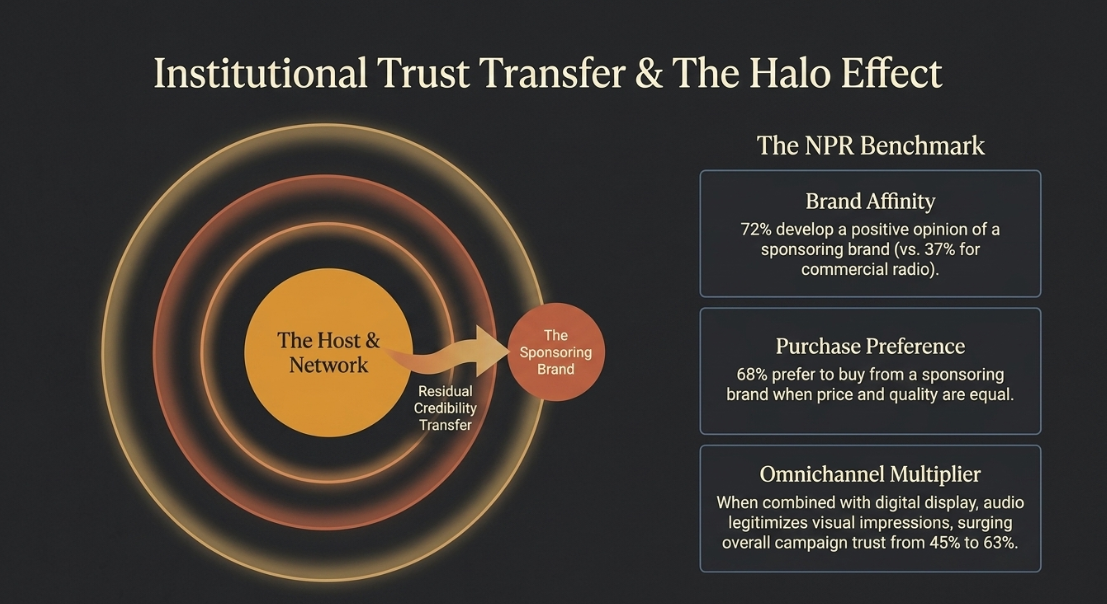
The halo effect is a cognitive bias wherein the positive perception of a platform, institution, or personality intrinsically bleeds into the perception of associated entities. In the realm of podcasting, this means that even pre-produced, dynamically inserted advertisements perform significantly better on podcasts than on other digital mediums simply because they inherit the residual trust, intimacy, and credibility established by the host and the platform.28 When a consumer deeply respects a host's intellect, humor, or journalistic integrity, that respect provides a powerful psychological buffer of credibility for any brand that sponsors the show. As a direct result of this halo effect, listeners on premium networks are calculated to be twice as likely to purchase products advertised within their favorite shows compared to standard digital and broader podcast benchmarks.
The NPR Benchmark: A Definitive Case Study in Premium Halo Effects
The mechanics and commercial value of the halo effect are best illustrated by analyzing institutional publishers that have cultivated decades of audience trust. National Public Radio (NPR) serves as the definitive global benchmark for institutional trust transfer in audio media. For over half a century, NPR has utilized its public broadcasting format and rigorous journalistic standards to foster an intensely loyal listener base. WDET, an NPR affiliate, reports that its audience is so loyal they donate more than $2.6 million annually to support programming they could otherwise consume for free.31
According to Kantar's State of Sponsorship Survey, the NPR halo effect generates an environment where brand messaging achieves unparalleled resonance.32 Because NPR operates in a relatively uncluttered, "facts over flash" audio environment, tune-out during sponsorship messages is virtually non-existent, ensuring maximum message penetration.31 The data reveals profound shifts in consumer preference due to this association:
Personal Importance: 78% of NPR listeners agree that the station's programming is personally important to them, compared to 58% of commercial radio listeners.32
Brand Affinity: 72% of listeners agree their overall opinion of a business becomes more positive when they discover it sponsors an NPR station, a stark contrast to the 37% metric observed for commercial radio advertisers.32
Purchase Preference: 68% of listeners prefer to purchase products from companies that sponsor NPR programming when price and quality are equal, dwarfing the 36% metric seen in commercial radio.32
Consumer Action: 97% of NPR podcast listeners agree they are likely to buy groceries or snacks from brands that support the network.34 Overall, 82% of podcast listeners have taken direct action based on an NPR sponsorship message.32
The strength of this halo effect is so potent that it requires rigorous brand alignment. Because listeners borrow goodwill from the institution, they react aggressively when sponsors misalign with the network's perceived values. For instance, when ExxonMobil utilized house ads simply featuring their logo adjacent to NPR climate change reporting, the juxtaposition triggered immediate listener friction, underscoring that audiences view sponsorship as a tacit endorsement by the network itself.35
When executed correctly, however, the results are staggering. By vetting the appropriateness of the sponsorship rather than demanding heavy-handed promotional copy, premium networks allow brands to seamlessly borrow institutional credibility. A custom audio campaign for MassMutual, utilizing NPR's native storytelling approach, yielded a conversion rate 18% higher than standard 30-second mid-roll placements, proving conclusively that restrained, high-trust messaging vastly outperforms aggressive solicitation.
Omnichannel Amplification and the Marketing Multiplier
The trust established through audio does not exist in a vacuum; it acts as a dynamic force multiplier for a brand's entire omnichannel strategy. While video and social platforms are necessary extensions for broad, top-of-funnel reach, the audio feed remains the source of deep attention that anchors the broader campaign's effectiveness.8
When podcasting is integrated into a wider digital marketing mix, it generates vital incremental reach by capturing younger demographics (18-34) who have broadly abandoned traditional broadcast media, thereby maximizing budget efficiency and avoiding duplicative audience buying.20 More importantly, it amplifies the efficacy of concurrent media channels. Exhaustive survey data from Acast demonstrates that combining podcast advertising with other media forms improves overall campaign effectiveness by 21% to 40%.20
The synergistic effects are highly specific: when combined with a traditional radio campaign, the listener response indicating "it tells me something new about the brand" increases by 34%.20 Most critically, when combined with digital display advertising, trust levels in the overall campaign surge from 45% to 63%.20 This highlights the unique capacity of the audio medium to legitimize visual brand impressions that would otherwise be dismissed as corporate spam.
Professional Services and Thought Leadership
Navigating the Extended B2B Buying Cycle
While direct-response consumer brands heavily leverage podcasting for immediate retail conversions, the strategic, long-term application of the medium reaches its absolute zenith within the Business-to-Business (B2B) sector and professional services. In B2B environments, sales cycles are notoriously long, inherently complex, and entirely reliant on the perceived intellectual expertise and operational competence of the vendor.36
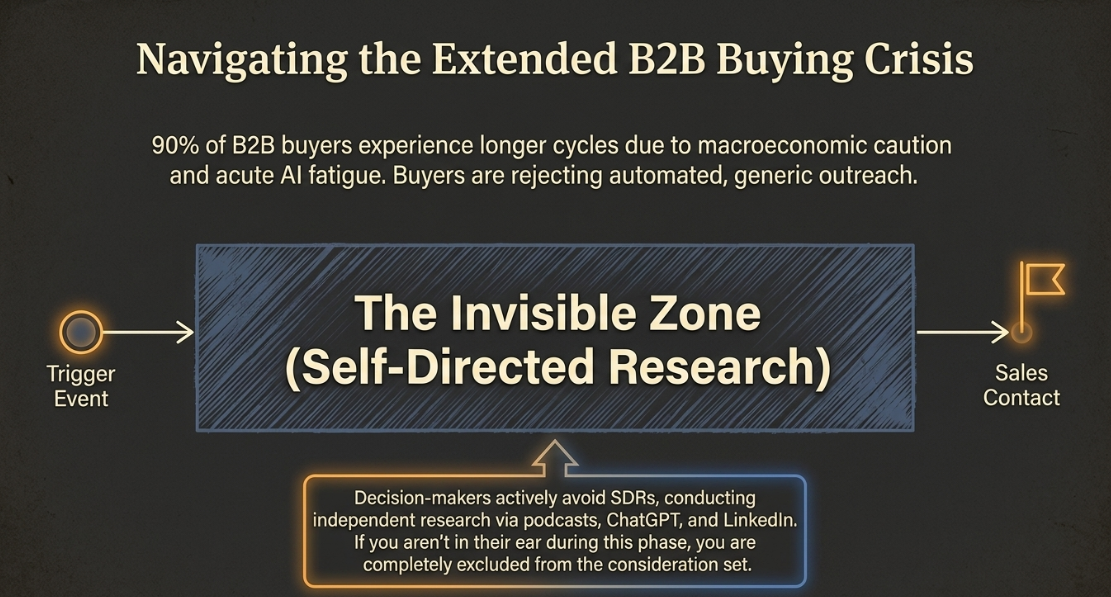
The contemporary B2B purchasing journey has become increasingly hostile to traditional sales and marketing tactics. In 2024, a staggering 90% of B2B buyers reported experiencing longer purchase cycles, driven by a multiplicity of stakeholders, macroeconomic caution, and an overwhelming saturation of digital information.38 Buyers are currently suffering from acute "AI fatigue." They are not rejecting artificial intelligence itself, but rather the flood of low-value, automated, generic content it produces. Consequently, they are desperately seeking distinct points of view and credible, human authorship to guide their decisions.39
Because of this overwhelming noise, decision-makers are actively avoiding early interactions with sales representatives. Most B2B buyers conduct extensive independent research—navigating Google, LinkedIn, industry podcasts, and AI engines like ChatGPT—long before a vendor is ever formally contacted.36 If a professional services firm is not highly visible during this invisible, self-directed research phase, they are effectively excluded from the buyer's consideration set entirely.
The Architecture of Executive Authority: Framemaking and Sensemaking
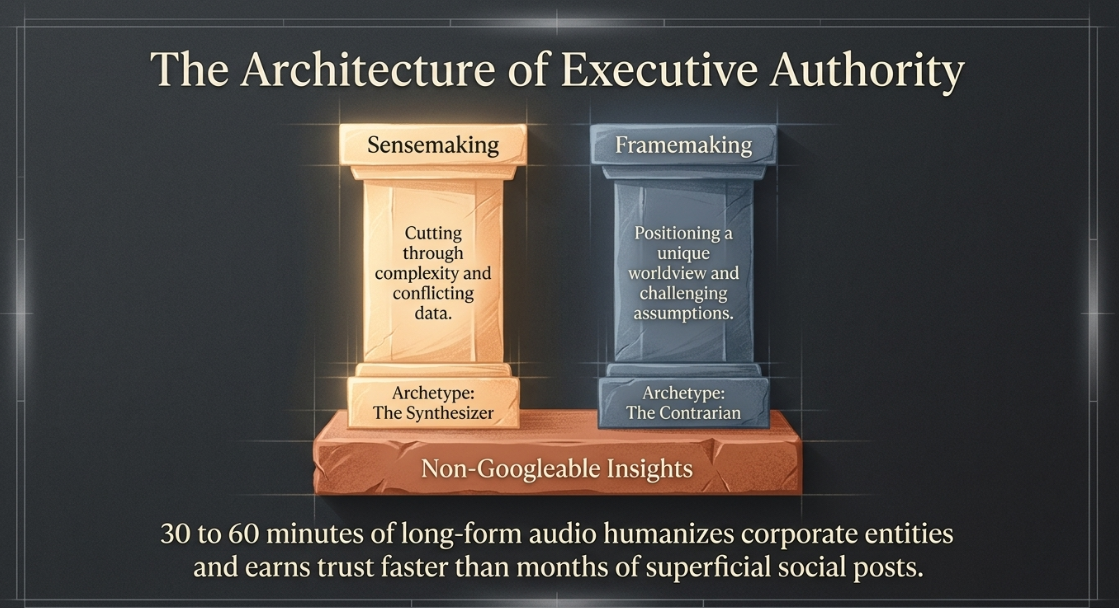
To combat this buyer isolation, heads of marketing, product developers, and executive leadership are utilizing B2B podcasts to establish sustained, non-googleable thought leadership.42 Thought leadership in this context is not merely a buzzword; it is distinct from generic brand awareness or ego-driven personal branding. True thought leadership is the strategic dissemination of original insights, data-backed opinions, and forward-looking market analysis that decisively positions the firm as a trusted industry authority.36
In the modern buying cycle, B2B podcasts provide an unparalleled platform for two critical cognitive functions identified by sales researchers: "Sensemaking" and "Framemaking".44 Buyers do not need more information; they need trusted experts to help them cut through the complexity, avoid pitfalls, and make sense of conflicting data.44 By dedicating thirty to sixty minutes to exploring nuanced operational strategies, a Vice President or senior consultant generates more organic trust than a month of highly curated, superficial social media posts.37 The long-form conversational nature of a podcast humanizes the business, transforming abstract corporate entities into familiar voices and trusted advisors well before a formal sales pitch ever occurs.37
B2B thought leaders typically inhabit distinct strategic archetypes to carve out a unique cognitive space in the buyer's mind. The "Contrarian," for instance, challenges prevailing industry narratives and challenges assumptions, while the "Synthesizer" connects disparate ideas from different fields to offer holistic solutions.36 By adopting these frameworks, firms move beyond selling a product; they sell a superior way of thinking. This consistent demonstration of expertise builds the familiarity necessary to lower buyer resistance, turning cold prospects into warm inbound leads who have already bought into the firm's overarching worldview.46
Furthermore, this thought leadership is highly effective internally. Data shows that 69% of professionals agree that thought leadership serves as an effective internal communication tool for engaging colleagues and aligning corporate strategy.38
The Guest-as-Prospect Mechanism: Redefining Pipeline Generation
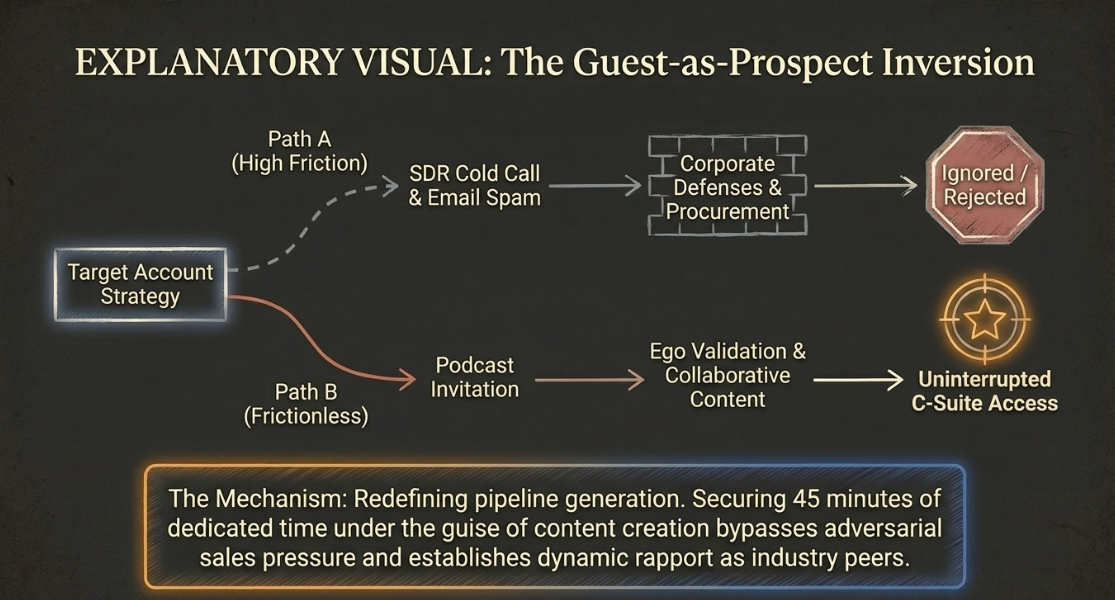
While passive thought leadership draws inbound leads, perhaps the most potent application of B2B podcasting is the inversion of traditional outbound lead generation through the "guest-as-prospect" strategy. Rather than deploying Sales Development Representatives (SDRs) to cold-call target accounts—a tactic yielding diminishing returns—B2B organizations invite the executive leadership of their exact target accounts to be guests on their branded podcasts.45
This mechanism brilliantly circumvents standard corporate defense systems. It provides dedicated, uninterrupted time with C-suite decision-makers under the guise of collaborative content creation, rather than an adversarial sales solicitation.45 The psychological shift is profound: the prospect feels valued and respected as an industry peer, their ego is validated, and rapport is established dynamically.
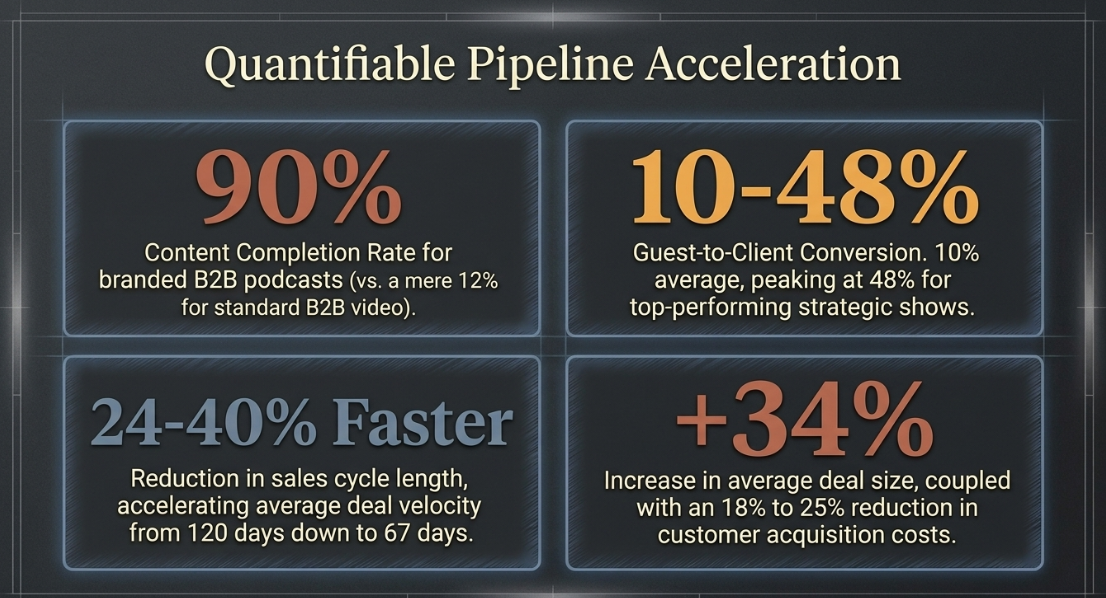
The empirical results of this strategy demonstrate an exceptional return on investment (ROI). Industry data reveals that top-performing B2B shows convert up to 48% of strategically selected podcast guests from target accounts into active pipeline opportunities, maintaining an average guest-to-client conversion rate of 10%.45 When executed correctly, maintaining post-interview relationships without immediate pitching drives millions in attributed revenue.
Quantifiable Pipeline Acceleration and Deal Velocity
The injection of podcast-derived trust into the B2B pipeline drastically alters the velocity of the sales cycle. Because the prospect has already consumed hours of the vendor's thought leadership—or has collaborated with them personally on an episode—the traditional "prove it" phase of the sales cycle is entirely eliminated.46 The sales representative steps into a conversation with a buyer who already understands and deeply respects the firm's methodology.
This relationship acceleration yields stark, quantifiable benefits. Case studies of strategic B2B podcasts reveal that podcast-influenced deals exhibit 24% to 31% faster sales cycles and 18% to 25% lower customer acquisition costs.45 In specific implementations, organizations tracking podcast-sourced deals documented average deal cycles dropping dramatically from 120 days to 67 days—a 40% reduction in sales cycle length—resulting in nearly $890,000 in accelerated revenue for a single initiative.47 Another firm utilizing tactical problem-solving sessions with target account executives closed $480,000 in revenue strictly from podcast-sourced deals, converting 68% of guests to sales conversations.47
Furthermore, average deal sizes increase by 34% when podcast touchpoints are integrated into the buyer's journey.45 Tracking mechanisms reveal that 47% of enterprise deals involve podcast touchpoints that traditional attribution software often misses, proving that podcasts function as powerful relationship accelerators.45
The medium commands an astounding 90% completion rate for branded B2B podcasts, compared to a mere 12% completion rate for B2B video content.45 This metric alone ensures that the complex value propositions and nuanced thought leadership of professional services firms are actually absorbed by the target audience, cementing the podcast as the ultimate B2B growth engine.
Strategic Imperatives and Future Trajectories
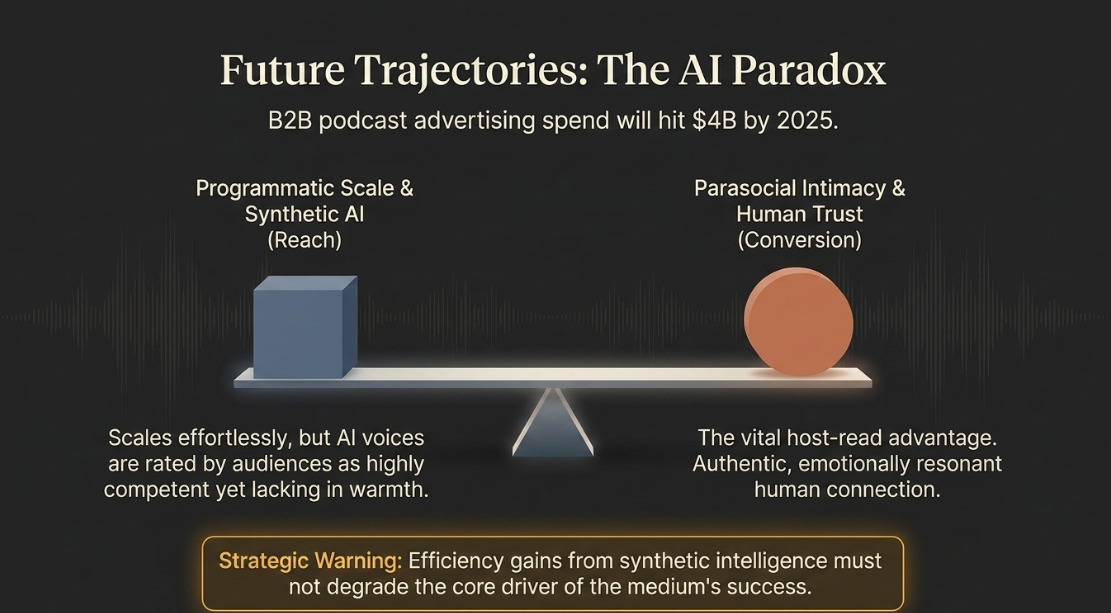
As the digital landscape evolves into the late 2020s, the podcasting medium is undergoing a sophisticated technological transformation while fiercely striving to maintain its core psychological advantages. Podcast ad spending is projected to reach $4.46 billion in 2025, with B2B-specific advertising accounting for a massive $4 billion of that total.45
The integration of Programmatic Audio and dynamic ad insertion allows advertisers to target audiences by content genre, purchase behavior, life stage, and geographic market with the exact precision of traditional digital display.21 Programmatic podcast buying, predicted to capture 10% of all podcast buying by 2024, is rapidly scaling.48 However, brands must navigate this transition delicately; while programmatic ads scale effortlessly across thousands of episodes, they entirely remove the host-read advantage, sacrificing conversion efficacy for sheer reach.21 The organic nature of conversations on podcasts is the perfect environment for authentically inserted topical ads, and removing the host voice risks degrading the parasocial bond.48
Furthermore, the advent of artificial intelligence (AI) in audio generation presents a unique "parasocial paradox." While 58% of audio industry professionals anticipate AI having a positive impact on podcasting, psychological studies suggest a bifurcated consumer response.24 Audiences tend to view AI voices as highly competent but substantially less warm.49 The deployment of voice-cloned or synthetic AI hosts for ad reading will require rigorous attention to relational framing; efficiency gains will only translate to commercial success if the synthetic interaction successfully maintains the complex, emotionally resonant parameters of human parasocial intimacy.49
Ultimately, the future of media influence is definitively moving away from institutional authority and raw follower counts, pivoting aggressively toward intimacy, personality, and curation.14 In an era where algorithmic feeds overflow with commoditized, AI-generated text and video, audio provides the last bastion for genuine human perspective.
Conclusion
The ascendance of the podcasting medium is a direct, measurable response to the psychological exhaustion of the modern consumer. In a macro attention economy defined by intense skepticism, sophisticated ad-blockers, and heavily fragmented digital consumption, deep human trust remains the only viable commercial currency. Podcasts facilitate a unique neurological environment where narrative transportation, the historical intimacy of the human voice, and unscripted dialogue forge parasocial bonds that legitimately rival real-world friendships.
This psychological foundation translates directly into unmatched commercial efficacy. Direct-response advertisers achieve exceptional brand recall and immediate purchase intent by leveraging the host as an authentic audio influencer whose endorsement functions as a peer-to-peer recommendation. Simultaneously, enterprise brands harness the halo effect of premium networks like NPR to transfer institutional credibility onto their own messaging, dramatically boosting omnichannel marketing performance and legitimizing their broader digital footprints.
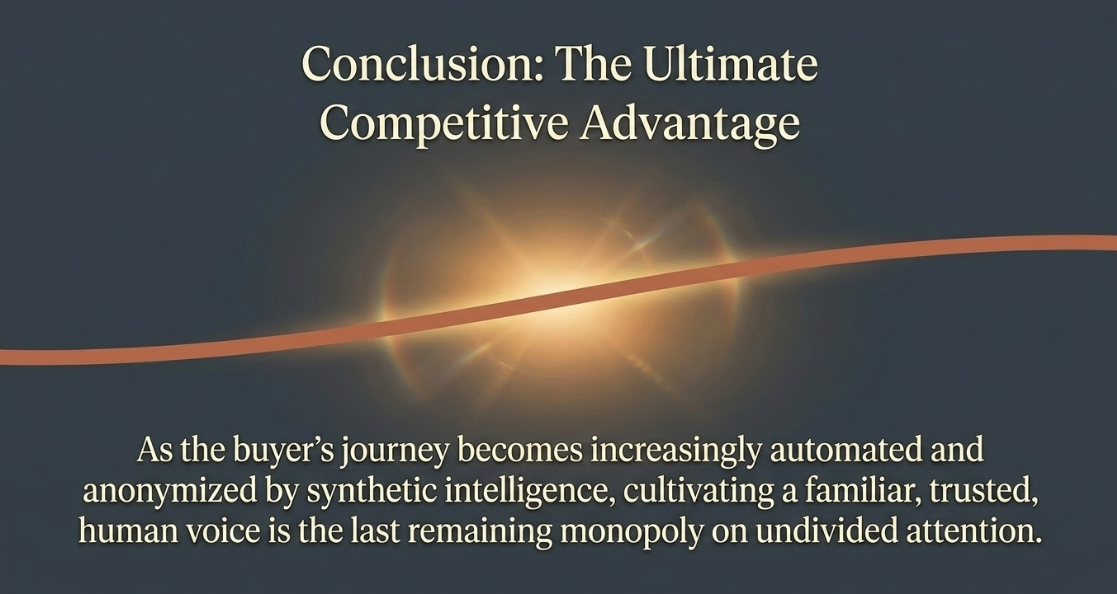
For the B2B sector and professional services firms, podcasting has transcended its origins as a mere content distribution channel to become a structural imperative for revenue generation. By establishing definitive, non-replicable thought leadership and utilizing the guest-as-prospect mechanism, organizations are systematically compressing complex, multi-month sales cycles, bypassing traditional procurement friction, and driving measurable, high-value pipeline velocity. As digital marketing continues to automate and anonymize the buyer journey with synthetic intelligence, the organizations that cultivate familiar, trusted, human voices will monopolize the ultimate competitive advantage: the undivided, deeply loyal attention of their market.
Works cited
Video, Audio, and Authenticity: Multimedia Storytelling for West Des Moines Businesses, accessed May 21, 2026, https://members.wdmchamber.org/news/details/video-audio-and-authenticity-multimedia-storytelling-for-west-des-moines-businesses-04-13-2026
Audio Advertising in 2026: Stats, Trends and Opportunities - AudioGo, accessed May 21, 2026, https://www.audiogo.com/blog/audio-advertising-in-2026
The Power of Podcasting: Telling Stories Through Sound 9780231557603 - dokumen.pub, accessed May 21, 2026, https://dokumen.pub/the-power-of-podcasting-telling-stories-through-sound-9780231557603.html
Why Romance Audiobooks Deeply Resonate With Women (and What the Data Says) | by Recommendedaudiobooks | Medium, accessed May 21, 2026, https://medium.com/@recommendedaudiobooks/why-romance-audiobooks-deeply-resonate-with-women-and-what-the-data-says-a35f99a6d0eb
99 Future-Shaping Podcast Industry Stats & Trends (2026 ..., accessed May 21, 2026, https://www.learningrevolution.net/podcast-stats/
Vodcast vs Short Ads: Which One Delivers Better ROI for Brands in 2026? - BBF Digital, accessed May 21, 2026, https://bbf.digital/vodcast-vs-short-ads-which-one-delivers-better-roi-for-brands-in-2026
(PDF) From Storytelling to Storylistening: How the Hit Podcast S-Town Reconfigured the Production and Reception of Narrative Nonfiction - ResearchGate, accessed May 21, 2026, https://www.researchgate.net/publication/357164640_From_Storytelling_to_Storylistening_How_the_Hit_Podcast_S-Town_Reconfigured_the_Production_and_Reception_of_Narrative_Nonfiction
Podcasting's powerful resonance: Acast's Podcast Pulse 2025 proves unique audience connection drives commercial impact - Podnews, accessed May 21, 2026, https://podnews.net/press-release/acast-podcast-pulse-2025
3 Steps to Unlocking the Power of Podcasters to Connect With Your Consumers, accessed May 21, 2026, https://advertisingweek.com/3-steps-to-unlocking-the-power-of-podcasters-to-connect-with-your-consumers/
Podcasts and News Fact Sheet | Pew Research Center, accessed May 21, 2026, https://www.pewresearch.org/journalism/fact-sheet/podcasts-and-news-fact-sheet/
Podcasts, Platforms, and Attention Spans: Where Audio Content Is Headed in 2026 - Rupp, accessed May 21, 2026, https://rupp-pr.com/podcasts-platforms-in-2026/
The impact of podcast guest–host destination interactions on viewers' inspiration and sharing intentions: the role of parasocial interaction - Emerald Publishing, accessed May 21, 2026, https://www.emerald.com/ihr/article/doi/10.1108/IHR-11-2024-0053/1271604/The-impact-of-podcast-guest-host-destination
Parasocial Relationships with Podcast Hosts - PDXScholar, accessed May 21, 2026, https://pdxscholar.library.pdx.edu/cgi/viewcontent.cgi?article=1960&context=honorstheses
Podcasters now as trusted as journalists and twice as persuasive - Mediaweek, accessed May 21, 2026, https://www.mediaweek.com.au/podcasters-now-as-trusted-as-journalists-and-twice-as-persuasive/
Podcast Pulse 2025 | Acast, accessed May 21, 2026, https://podcastpulse2025.com/
2025 Podcast Advertising Data: Reach, ROI, and Listener Behavior -, accessed May 21, 2026, https://commandyourbrand.com/2025-podcast-advertising-data-reach-roi-and-listener-behavior/
Everyone Has a Podcast. Should You? — The Herald Group | Public Affairs & Strategic Communications Firm, accessed May 21, 2026, https://theheraldgroup.com/blog/everyone-has-a-podcast
Podcast Marketing in 2026: 9 Reasons Brands Are Still Investing - CMS Wire, accessed May 21, 2026, https://www.cmswire.com/digital-marketing/podcast-marketing-advantages-cmos-should-not-ignore/
The Strategic Imperative of Podcast Marketing for Professional, accessed May 21, 2026, https://www.finchley.co.uk/finchley-learning/visual-podcast/the-strategic-imperative-of-podcast-marketing-for-professional-brands-industry-landscape-and-roi-realization
Building Brand Trust Through Podcast Advertising - Acast, accessed May 21, 2026, https://advertise.acast.com/news-and-insights/building-brand-trust-through-podcast-advertising
Podcast Advertising in 2026: The Complete Guide for Performance Marketers - Improvado, accessed May 21, 2026, https://improvado.io/blog/podcast-advertising
Study: 76% Buy After Podcast Host Recommendations, accessed May 21, 2026, https://news.radio-online.com/articles/n48328/Study-76-Buy-After-Podcast-Host-Recommendations
Money Talks: Podcasts Are a Sound Investment for FinServ Advertisers - SiriusXM Media, accessed May 21, 2026, https://www.siriusxmmedia.com/insights/money-talks-podcasts-are-a-sound-investment-for-finserv-advertisers
Audio Advertising in 2026: Stats, Trends and Opportunities - AudioGo, accessed May 21, 2026, https://www.audiogo.com/blog/audio-advertising-in-2026?hs_amp=true
Podcast Advertising: The Ultimate Guide [2026] - Acast, accessed May 21, 2026, https://advertise.acast.com/news-and-insights/podcast-advertising-the-ultimate-guide
As podcast audiences broaden, so should advertiser engagement with listeners - Nielsen, accessed May 21, 2026, https://www.nielsen.com/insights/2021/as-podcast-audiences-broaden-so-should-advertiser-engagement-with-listeners/
Podcast Industry Statistics | 2026 Data & Trends | AMW® - AMW Group, accessed May 21, 2026, https://amworldgroup.com/statistics/podcast-industry-statistics
Audio Creator Impact Study: 76% of Podcast Listeners Buy From ..., accessed May 21, 2026, https://audacyinc.com/insights/audio-creator-impact-study-76-of-podcast-listeners-buy-from-host-recommendations/
It's 2025… Just Add Programmatic Audio - SiriusXM Media, accessed May 21, 2026, https://www.siriusxmmedia.com/insights/its-2025-just-add-programmatic-audio
Why Audio Hosts Are the Fastest-Growing Power in the Creator Economy - Audacy Inc., accessed May 21, 2026, https://audacyinc.com/insights/why-audio-hosts-are-the-fastest-growing-power-in-the-creator-economy/
WDET Broadcast Partners Program, accessed May 21, 2026, https://wdet.org/partners/
New research confirms NPR's halo effect for brands | National Public ..., accessed May 21, 2026, https://www.nationalpublicmedia.com/insights/articles/new-research-confirms-nprs-halo-effect-for-brands/
How NPR's audience-first approach drives advertising success - Digital Content Next, accessed May 21, 2026, https://digitalcontentnext.org/blog/2023/11/30/how-nprs-audience-first-approach-drives-advertising-success/
Effective NPR radio and podcast creative: Insights for CPG brands | National Public Media, accessed May 21, 2026, https://www.nationalpublicmedia.com/insights/articles/effective-npr-radio-and-podcast-creative-insights-for-cpg-brands/
The challenge of oil companies as NPR sponsors | GBH - WGBH, accessed May 21, 2026, https://www.wgbh.org/news/national/2024-01-12/the-challenge-of-oil-companies-as-npr-sponsors
Thought Leadership in B2B: Build Authority That Converts | Sprints & Sneakers, accessed May 21, 2026, https://www.sprintsandsneakers.com/insights/thought-leadership-b2b
Branded Podcasts for B2B Thought Leadership & Brand Growth - Krisha Studio, accessed May 21, 2026, https://www.krishastudio.com/branded-podcasts-for-b2b-thought-leadership/
18 Thought Leadership Statistics You Should Know - DSMN8, accessed May 21, 2026, https://dsmn8.com/blog/thought-leadership-statistics-you-should-know/
Beyond B2B Marketing - Apple Podcasts, accessed May 21, 2026, https://podcasts.apple.com/us/podcast/beyond-b2b-marketing/id1813484883
Thought Leadership in B2B: Build Authority That Converts | Sprints & Sneakers, accessed May 21, 2026, https://sprintsandsneakers.com/insights/thought-leadership-b2b/
Cracking the Code of B2B Thought Leadership with Bill Sherman - LeadG2, accessed May 21, 2026, https://leadg2.thecenterforsalesstrategy.com/blog/cracking-the-code-of-b2b-thought-leadership-with-bill-sherman
Top B2B Marketing Trends for Professional Services in 2025 - Reputation Ink, accessed May 21, 2026, https://www.rep-ink.com/inksights/top-b2b-marketing-trends-for-professional-services-in-2025/
Marketing Thought Leadership For B2B Growth: A Complete Guide - Fame.so, accessed May 21, 2026, https://www.fame.so/post/marketing-thought-leadership
The B2B Roundtable (hosted by Brian Carroll) - Apple Podcasts, accessed May 21, 2026, https://podcasts.apple.com/us/podcast/the-b2b-roundtable-hosted-by-brian-carroll/id1247566955
B2B Podcast ROI: Why Podcasting Is Business Infrastructure 2026 - KazCM, accessed May 21, 2026, https://kazcm.com/b2b-podcast-roi/
Podcasting For Lead Generation: A Practical B2B Playbook | ThePod.fm, accessed May 21, 2026, https://thepod.fm/resources/blog/podcasting-for-lead-generation
The Definitive Guide To Measuring B2B Podcast ROI And Pipeline Impact In 2025 - Fame.so, accessed May 21, 2026, https://www.fame.so/post/measuring-b2b-podcast-roi-and-pipeline
Benefits of Audio Advertising in 2025 - Ad Results Media, accessed May 21, 2026, https://www.adresultsmedia.com/news-insights/benefits-of-audio-advertising/
The Parasocial Paradox: Why AI Podcast Hosts Might Actually Work (But Not How You Think) - Sounds Profitable, accessed May 21, 2026, https://soundsprofitable.com/article/the-parasocial-paradox/
(PDF) The Talking Dead: Voice-Cloning Yourself to AI Afterlife Services.: Analysis of Representation Authenticity and Social Implications - ResearchGate, accessed May 21, 2026, https://www.researchgate.net/publication/399552239_The_Talking_Dead_Voice-Cloning_Yourself_to_AI_Afterlife_Services_Analysis_of_Representation_Authenticity_and_Social_Implications
Four lessons from Podcast Pulse 2025, and why they matter for your next campaign - Acast, accessed May 21, 2026, https://advertise.acast.com/news-and-insights/four-lessons-from-podcast-pulse-2025-and-why-they-matter-for-your-next-campaign