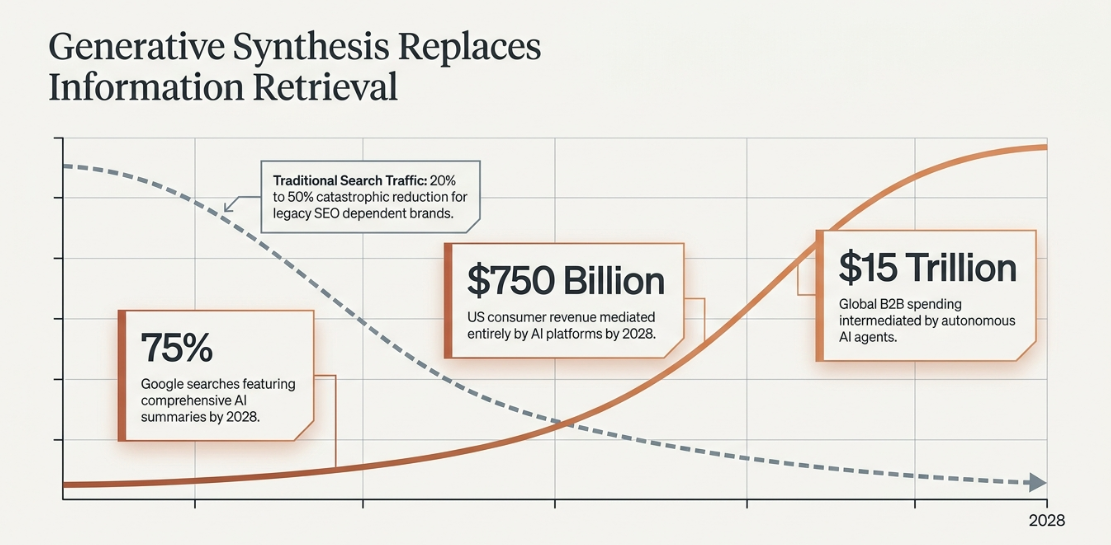
The discoverability architecture of the internet is undergoing a seismic restructuring, transitioning the global digital economy from an era of information retrieval into an era of generative synthesis. For the past two decades, brand visibility was governed by the algorithmic ranking of "ten blue links" on a search engine results page. By 2026, traditional Google search is being decisively replaced by generative artificial intelligence engines, including ChatGPT, Perplexity, Gemini, and Google’s own AI Overviews.1 This structural evolution is fundamentally altering how human audiences seek information, evaluate authority, and ultimately finalize purchasing decisions. Approximately 50% of consumers now intentionally use AI-powered search engines as their primary discovery mechanism, with projected consumer spending through these AI-mediated platforms expected to reach a staggering $750 billion in United States revenue by the year 2028.
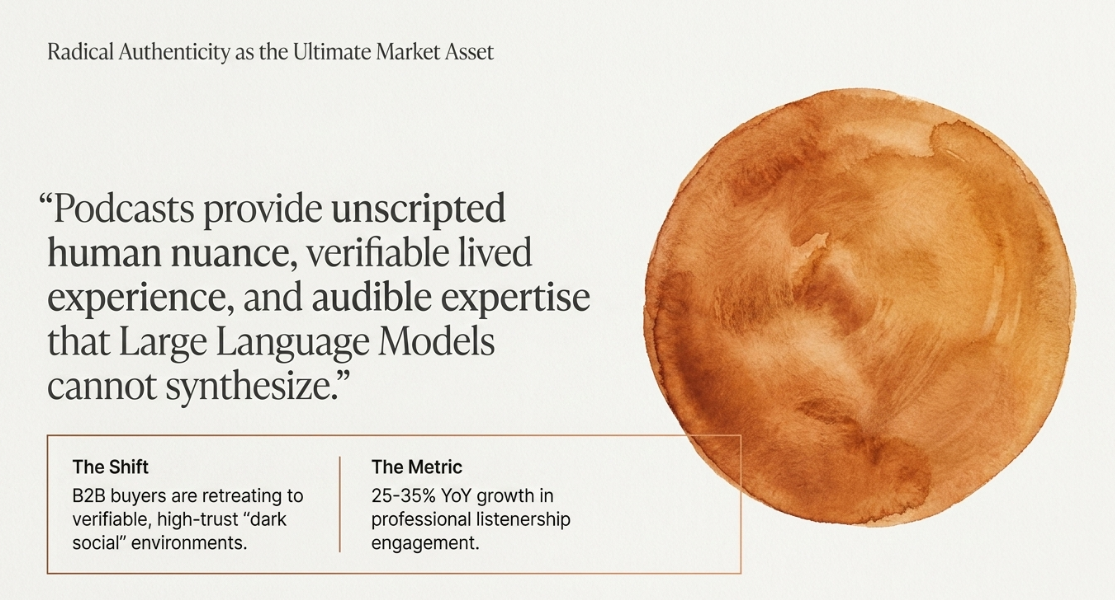
This macroeconomic shift requires a fundamental rewrite of podcast search engine optimization and broader digital marketing strategies. As artificial intelligence models scale the production of synthetic text to unprecedented volumes, the digital environment has become critically oversaturated.1 Consequently, business-to-business buyers and mainstream consumers are retreating into high-trust, verifiable environments—often referred to as "dark social" spaces—seeking authentic human connection.1 Within this context, the podcast medium has emerged as a profoundly powerful asset. Because podcasts are inherently rooted in the nuance of unscripted human conversation and audible expertise, they provide a layer of radical authenticity that autonomous agents cannot seamlessly replicate. However, if a podcast remains locked within a purely audio format without the necessary technical structuring, it remains invisible to the very artificial intelligence engines that now dictate market discoverability. Therefore, optimizing podcast marketing for the artificial intelligence paradigm is no longer an ancillary tactic; it is the central strategic imperative for professional brands seeking to secure market share in the modern citation economy.
Industry Landscape and ROI Realization
The broader economic environment in 2026 is characterized by the explosive commercialization and deep systemic integration of generative artificial intelligence across all industry verticals. The market potential for generative artificial intelligence is projected to reach $400 billion by 2031, while autonomous artificial intelligence agents are forecast to intermediate more than $15 trillion in global business-to-business spending by 2028.3 In European markets alone, organizational spending on artificial intelligence infrastructure and deployment is expected to reach $133 billion by 2028, expanding at a robust compound annual growth rate of 30.3%.4 The revenue generated directly from these technologies is experiencing exponential scaling; forecasts indicate that potential revenue driven by generative artificial intelligence will escalate from $45 billion in 2024 to approximately $1.1 trillion in 2028.5
This macroeconomic reality dictates a new framework for return on investment realization for marketing initiatives. Historically, marketing return on investment was largely calculated through attribution models tied to top-of-funnel organic search traffic and direct response advertising. However, the integration of artificial intelligence into consumer search habits disrupts this traditional funnel. Trend analyses project that by 2028, more than 75% of all Google searches will feature comprehensive artificial intelligence summaries.2 For brands that remain strictly dependent on legacy search engine optimization methodologies, this shift threatens a catastrophic decline in organic traffic, with unprepared organizations facing potential traffic reductions ranging from 20% to 50%.2 As artificial intelligence search systems successfully intercept and resolve zero-click and top-of-funnel informational queries, the nature of the remaining traditional search traffic fundamentally changes.6
Return on investment realization in this new landscape relies entirely on pre-search influence and the cultivation of brand trust. Thought leadership, particularly when delivered through the intimate medium of podcasting, acts as a mechanism to significantly shorten the business-to-business sales cycle by establishing respect and recognized expertise before a prospect ever initiates contact with a sales representative.9 Podcasts demonstrate exceptional engagement depth; listenership within key professional demographics has experienced 25% to 35% year-over-year growth, with the extended listening durations creating a caliber of trust that short-form social media formats cannot match.6 Therefore, the strategic return on investment of podcast marketing is realized through its ability to bypass algorithmic chaos, directly penetrate the buyer's psychological shortlist, and provide the definitive, structured expertise required to dominate the emerging artificial intelligence citation economy.
Search Everywhere Optimization (SEO) and the AI Paradigm
To navigate the intelligence era, marketing professionals must accept that the fundamental nature of the customer journey has changed. The legacy assumption that a buyer's journey commences on a blank search engine results page is demonstrably obsolete.11 By the time a modern buyer inputs a query into Google, they almost invariably possess a mental shortlist of preferred brands or solutions.11 This shortlist is meticulously constructed across decentralized, off-search environments: specialized Reddit threads, private Facebook groups, algorithmic video feeds, expert-led LinkedIn commentary, and trusted industry podcasts.11 Consequently, traditional search engines have been relegated from discovery platforms to confirmation tools, utilized primarily for narrow, navigational queries designed to validate assumptions that were formed elsewhere.11
To address this behavioral shift, the discipline of search engine optimization must evolve into Search Everywhere Optimization. The core premise of Search Everywhere Optimization is that achieving competitive visibility requires establishing a pervasive brand presence in the exact environments where peer-to-peer shortlists are formulated, long before a formal search query occurs.11 The dual objectives of a Search Everywhere Optimization campaign are to achieve direct visibility within these sub-communities and to ensure deep "Engine Comprehension"—a state where artificial intelligence models repeatedly associate a brand with specific industry problems and solutions.11
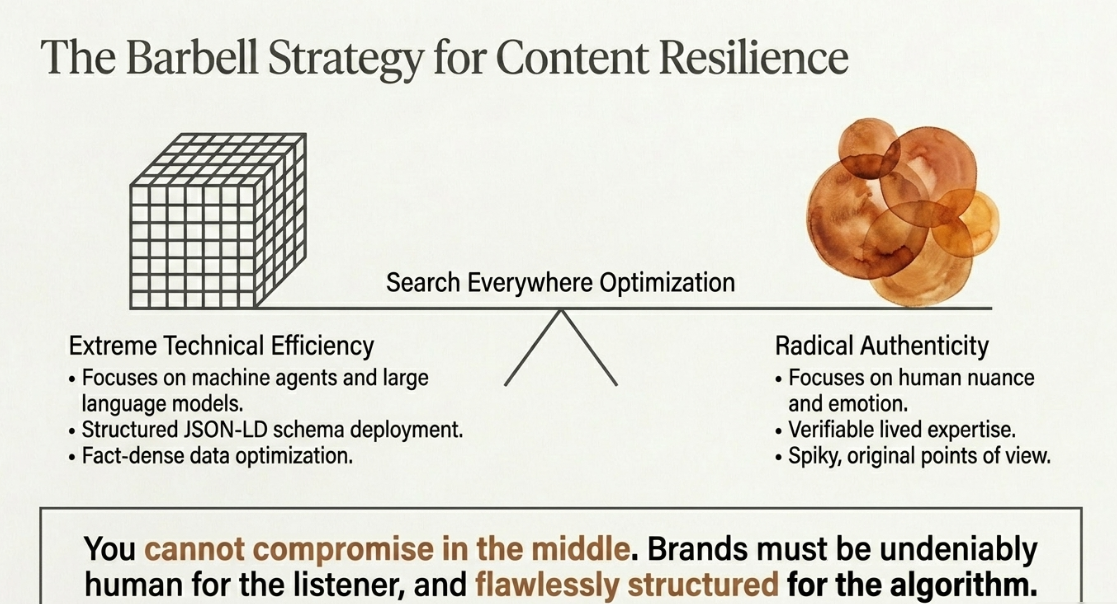
This strategic pivot requires the implementation of a "Barbell Strategy," an operational framework engineered for content resilience in an age of automated saturation.1 The Barbell Strategy demands a radical bifurcation of organizational efforts. On one side, brands must deploy extreme technical efficiency—optimizing their digital footprint specifically for the machine agents and large language models that now control discoverability.1 On the other side, brands must invest heavily in radical authenticity, producing verifiable, deeply human, and emotional content experiences that artificial intelligence algorithms are incapable of synthesizing.1
Implementing Search Everywhere Optimization requires a highly structured execution model. Teams must initiate deep research sprints to document the exact vernacular used by their ideal customer profiles across niche platforms.11 They must utilize artificial intelligence-filtered alerts to monitor high-priority conversations across the web, engaging daily to build baseline brand mention volume.11 Ultimately, owned content, such as a corporate blog or podcast, is placed at the very top of the strategic pyramid, functioning as a repository of unique, high-value insight that feeds the distribution layers positioned below it.
Evolution of Podcast SEO
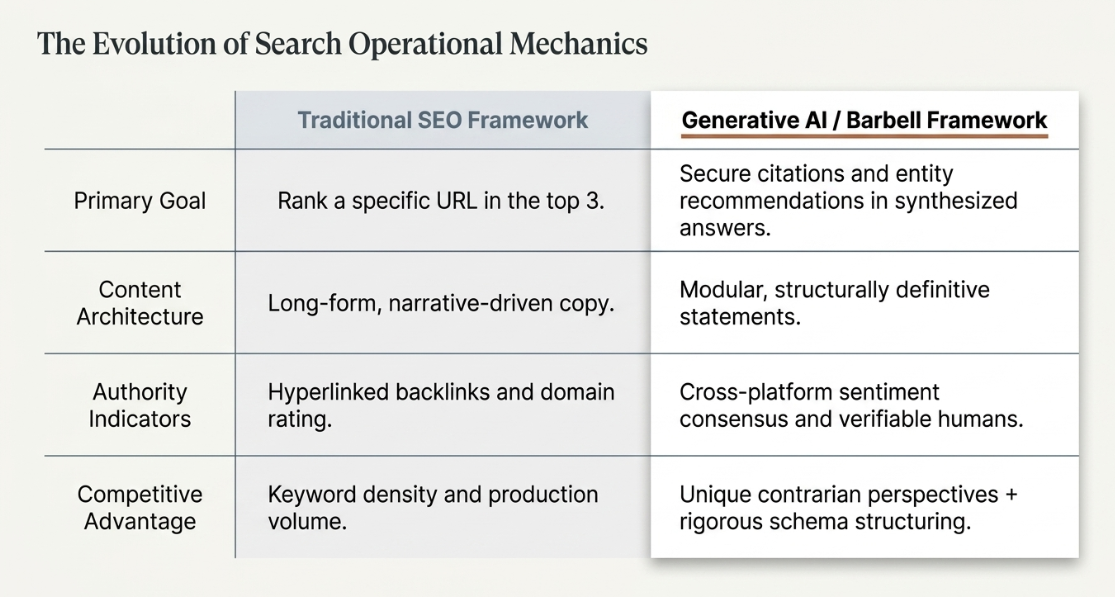
The transition to Search Everywhere Optimization forces a comprehensive reevaluation of how audio content is categorized, distributed, and discovered. Historically, podcast SEO relied on a rudimentary set of tactics: optimizing episode titles with exact-match keywords, generating basic, keyword-rich show notes, and relying on directory algorithms within Apple Podcasts or Spotify to drive organic discovery. While foundational SEO authority—such as maintaining strong site architecture, internal linking practices, and topical depth—remains an important baseline for digital operations, it is demonstrably insufficient in an AI-first landscape.11 The mechanics of discovery no longer depend upon matching keyword strings; they depend upon the semantic comprehension of entities, concepts, and authoritative consensus.
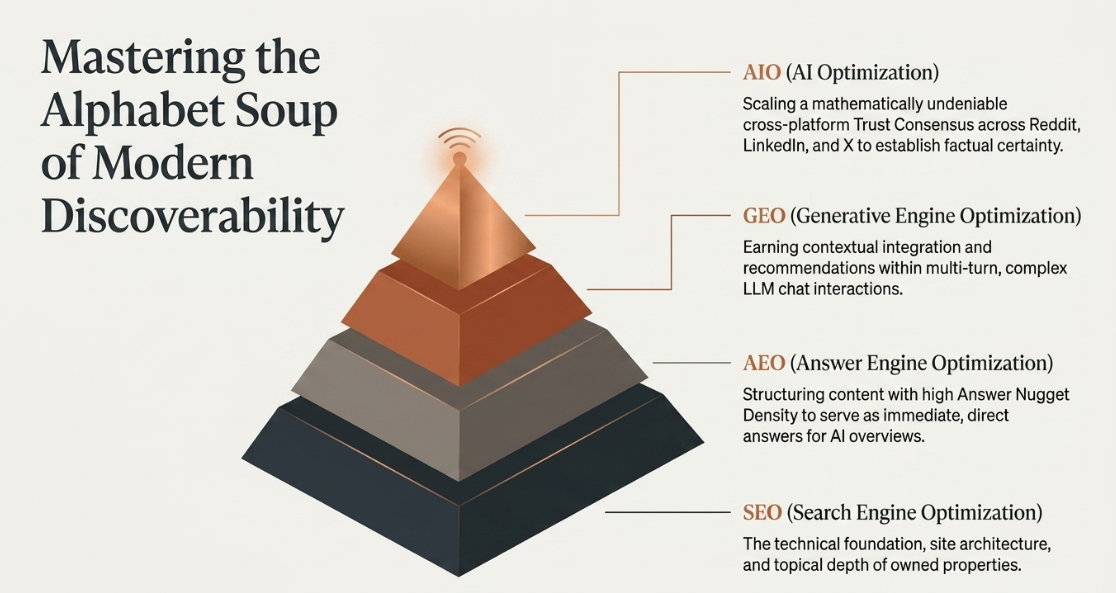
The new discipline requires mastering what industry analysts describe as the "Alphabet Soup" of modern visibility.12 This conceptual framework outlines four highly interrelated pillars that must be synchronized for a podcast to achieve maximum reach in 2026. The first pillar remains traditional Search Engine Optimization, which secures the technical foundation of the brand's owned digital properties.12 The second, and arguably most critical for audio content, is Answer Engine Optimization. Answer Engine Optimization focuses on structuring digital content to serve as the immediate, direct answer for artificial intelligence overviews, voice-activated assistants, and desktop AI agents.12
The third pillar is Generative Engine Optimization, which extends beyond direct answers to ensure a brand is actively cited, recommended, and contextually integrated into the complex, multi-turn conversations users hold with large language models.1 The final pillar is AI Optimization, which involves scaling the brand's digital footprint across disparate third-party platforms to build a massive, mathematically undeniable web presence.12 By actively seeding podcast insights, clips, and transcripts across platforms like LinkedIn, Reddit, and X, a brand creates a "Trust Consensus".12 Large language models require cross-platform corroboration to prevent hallucinations and establish factual certainty; when an AI model observes the same podcast insight validated by professional peers across multiple independent networks, the model algorithms are trained to view that podcast as a definitive, authoritative entity.12
This evolution underscores a critical reality regarding the modern public relations and marketing ecosystem: the citation economy has arrived. A comprehensive 2026 analysis of over 11,000 links cited by ChatGPT in response to complex queries from technology and healthcare executives revealed that nearly half of all artificial intelligence citations were drawn from authoritative digital public relations efforts, media placements, and clearly structured expert frameworks.10 Brands that accurately format their podcast insights into highly structured, quotable frameworks provide the exact computational material that artificial intelligence engines require to accurately represent the brand to the end user.
AI Indexing and Content Structuring
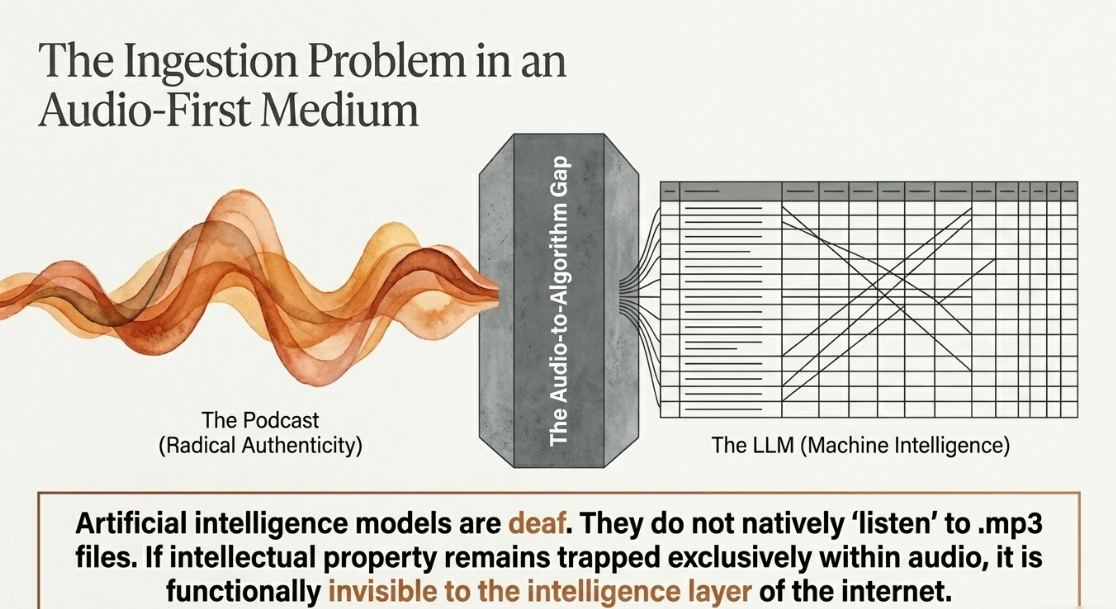
To successfully execute Answer Engine Optimization, brands must profoundly understand the ingestion and processing mechanisms of large language models. Artificial intelligence models do not natively "listen" to audio files, nor do they index raw media links in the same manner as legacy web crawlers. Instead, AI models synthesize vast quantities of machine-readable text to generate probabilistic answers.12 If a podcast’s intellectual property—its unique insights, expert interviews, and contrarian perspectives—remains trapped exclusively within an .mp3 or .mp4 file, it is functionally invisible to the intelligence layer of the internet. Podcasts must have structured, machine-readable text via high-fidelity transcriptions to bridge the gap between human audio and algorithmic ingestion.
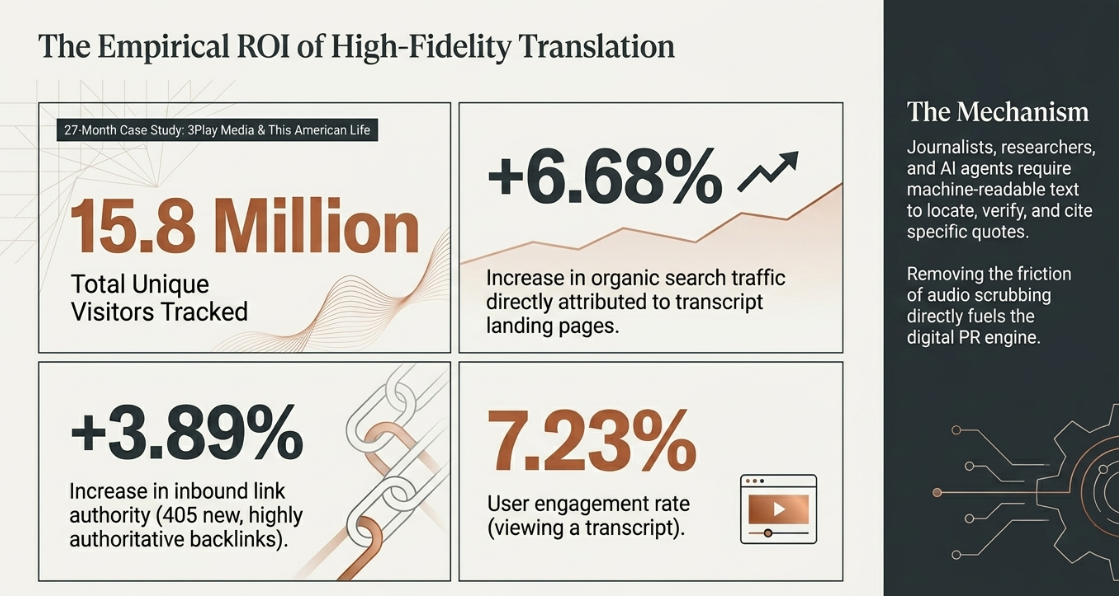
The staggering efficacy of translating audio into structured text is definitively proven by a rigorous, twenty-seven-month case study conducted by 3Play Media in collaboration with the immensely popular public radio program and podcast, This American Life.14 Prior to the transcription initiative, the This American Life website possessed a highly formidable baseline of digital authority, maintaining a Google Pagerank of 8, an Alexa Rank of 20,000, and averaging 850,000 unique monthly visitors.14 The objective of the study was to determine if transcribing the program's entire historical archive and providing free, fully indexed transcripts to the public could measurably enhance organic discovery and user engagement.14
The results of the study, which tracked over 15.8 million unique visitors, were unequivocal. By providing machine-readable transcripts, This American Life saw a 6.68% increase in organic search traffic directly attributable to users landing on transcript pages.14 The transcripts served as a massive repository of long-tail keywords and semantic concepts that traditional search engines and AI models could easily parse. Furthermore, the availability of text facilitated a 3.89% increase in external inbound links, generating 405 new, highly authoritative backlinks pointing specifically to the transcript assets.14 This occurs because journalists, academic researchers, and digital publishers require text to easily locate, verify, and cite specific quotes; providing a transcript removes the friction of manually scrubbing audio, directly fueling the digital public relations engine required for modern search visibility.14
Beyond the sheer quantitative increases in traffic and link velocity, high-fidelity transcriptions provide profound qualitative benefits. They ensure total compliance with web accessibility standards, allowing individuals with auditory processing disorders or hearing disabilities to seamlessly consume the content.14 Additionally, transcripts dramatically improve comprehension for audiences who speak English as a second language, while providing the foundational text necessary for automated, multi-language translation services to localize the podcast for global markets.14
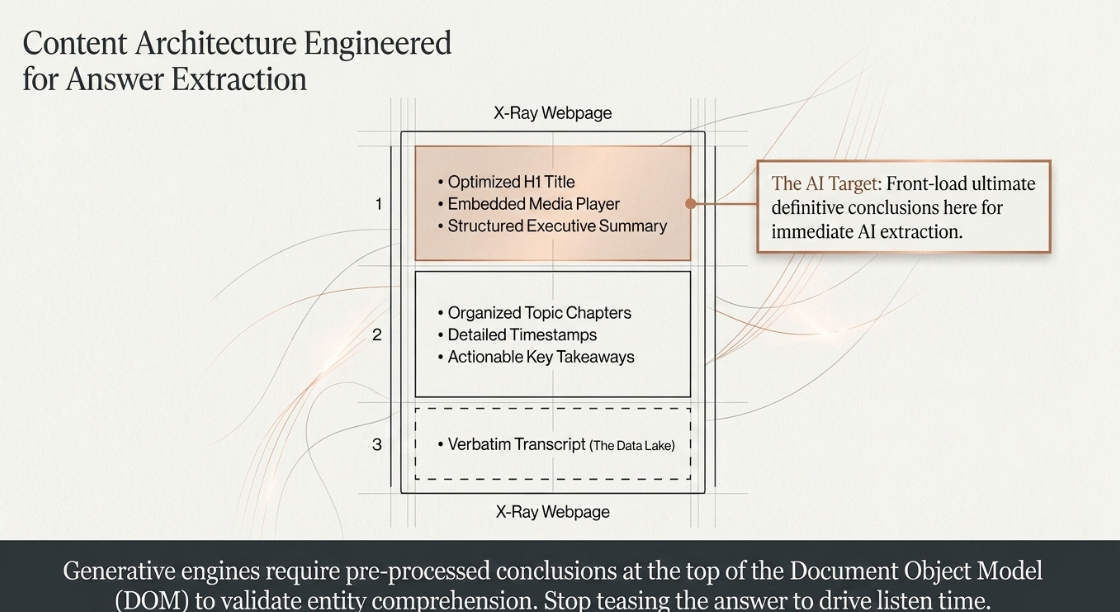
However, generating a raw block of text is only the first phase of content structuring. To optimize for generative engines, marketing teams must architect the show notes and transcript pages utilizing the "Inverted Pyramid" structural model.1 Answer engines prioritize content that features high "Answer Nugget Density"—the frequency of clear, concise, and definitive statements that directly resolve specific user inquiries.1 Therefore, podcast webpages must be meticulously structured: the page must feature a highly optimized H1 episode title, an embedded media player, and an immediate, structured executive summary that front-loads the ultimate conclusions of the episode.1 This must be followed by highly organized topic chapters, detailed timestamps, actionable key takeaways, and finally, the verbatim transcript.17 This formatting ensures that when a large language model scrapes the page, the core insights are pre-processed and ready for immediate extraction and citation.
Technical Implementation for AI Optimization
The strategic imperatives of Answer Engine Optimization cannot be realized without a flawless technical foundation. By 2026, the implementation of schema markup—specifically utilizing JavaScript Object Notation for Linked Data (JSON-LD)—is an absolute, non-negotiable requirement for AI parsing and podcast discoverability.17 Schema markup acts as a standardized, universal vocabulary that explicitly defines the entities, relationships, and structural parameters of a digital asset for search engine crawlers and large language models.17 Without this structured data, an artificial intelligence engine is forced to guess the context of a webpage, drastically reducing the probability of citation and entirely disqualifying the content from appearing in rich search results.17
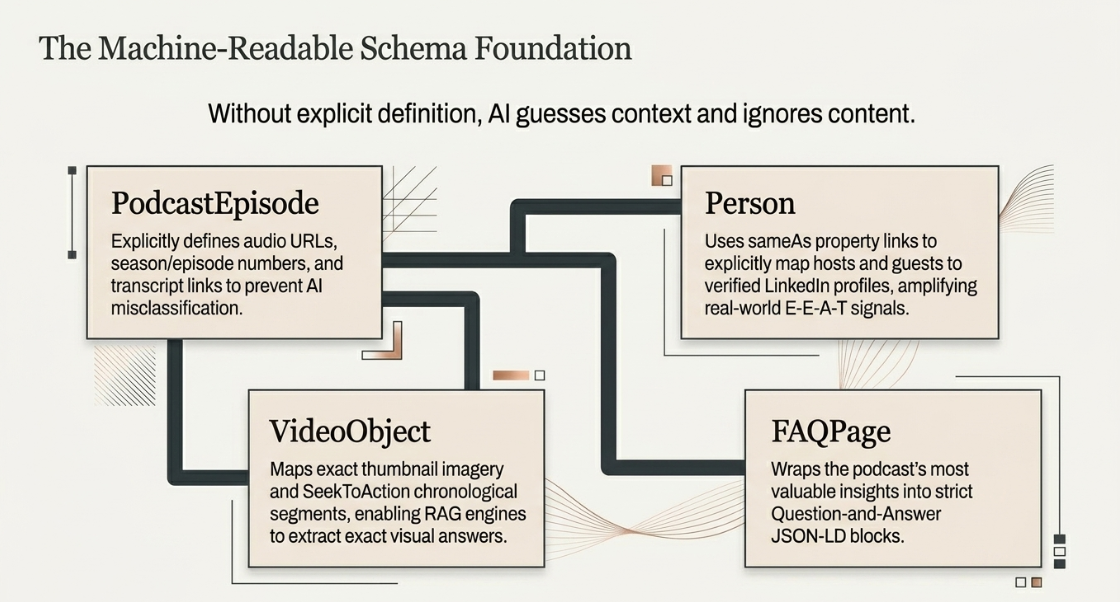
For a podcast to effectively communicate its value to an artificial intelligence engine, brands must deploy a comprehensive, multi-layered schema architecture on a dedicated, highly indexable webpage for every single episode produced.17 The essential schemas include:
PodcastEpisode and PodcastSeries Schema: The PodcastSeries markup serves as the foundational umbrella, aggregating all individual episodes under a unified brand entity, thereby establishing the macro-authority of the show.18 For individual episode pages, PodcastEpisode is mandatory. This schema clearly defines critical properties such as the episode number, the season, the overall duration, and the explicit structural relationship to the parent series.18 Most importantly, this schema must contain nested AudioObject properties that provide the precise uniform resource locator for the audio file, the encoding format, and the transcript link, ensuring the AI model explicitly recognizes the asset as an auditory production rather than a standard text article.17
VideoObject Schema: Given the immense discoverability power of video podcasts—particularly on platforms like YouTube—visual formats require the implementation of VideoObject schema.17 This markup provides artificial intelligence engines with the video URL, the specific thumbnail imagery, and the precise upload date.20 More importantly, it enables the integration of Clip or SeekToAction structured data.20 This advanced functionality allows marketing teams to explicitly define the "Key Moments" or topical segments within a video, effectively providing a chronological map for the AI. When a user asks an artificial intelligence engine a highly specific question, Retrieval-Augmented Generation systems utilize this schema to pull the exact visual segment containing the answer, driving highly qualified, intent-driven traffic directly to the brand's video asset.
Person Schema: The ultimate driver of a podcast's authority is the verified expertise of its hosts and guests. The Person schema provides the necessary structured data to map this human authority into the machine's knowledge graph.17 By utilizing sameAs property links, brands can programmatically connect the host's name to their verified LinkedIn profile, their academic credentials, and their broader digital footprint.21 This explicit mapping proves the real-world expertise of the individuals involved, dramatically amplifying the brand's Experience, Expertise, Authoritativeness, and Trustworthiness (E-E-A-T) signals.1
FAQPage Schema: Integrating FAQPage schema into the episode's show notes represents one of the most potent tactical implementations for Answer Engine Optimization.17 By distilling the podcast's most valuable insights into a concise Question-and-Answer format and wrapping that text in FAQ markup, brands create the exact structural paradigm that artificial intelligence models favor for direct-answer synthesis.21 This dramatically increases the chances of the artificial intelligence directly citing the podcast's insights, thereby cementing brand visibility at the absolute top of the user's intelligence feed.
AI Integration in Podcast Production
The intelligence era has fundamentally altered not only the distribution and discoverability of podcasts but also the foundational mechanics of their production. The integration of artificial intelligence within the podcast manufacturing process presents a profound operational duality: it offers unprecedented scalability and workflow efficiency, yet simultaneously introduces severe risks regarding brand degradation, audience fatigue, and the erosion of consumer trust.
The adoption of artificial intelligence as a backstage operational tool has achieved near-universal industry consensus. By 2026, 61% of all content creators plan to deeply integrate artificial intelligence into their production workflows, while 34% of newly launched podcasts are already actively utilizing sophisticated AI tools. These backend tools encompass a wide array of capabilities, including automated high-fidelity transcriptions, algorithmic audio leveling, dynamic mastering, and advanced voice cloning technologies. The artificial intelligence transcription market alone is expanding at an annualized rate of 15.6%, tracking toward a $19.2 billion valuation by 2034.7 For professional marketing teams executing the technical rigors of the Barbell Strategy, these operational tools are absolutely vital. They allow teams to efficiently process audio into text, generate the necessary schema markups, and scale the multi-platform distribution required for Search Everywhere Optimization without incurring prohibitive labor costs.1
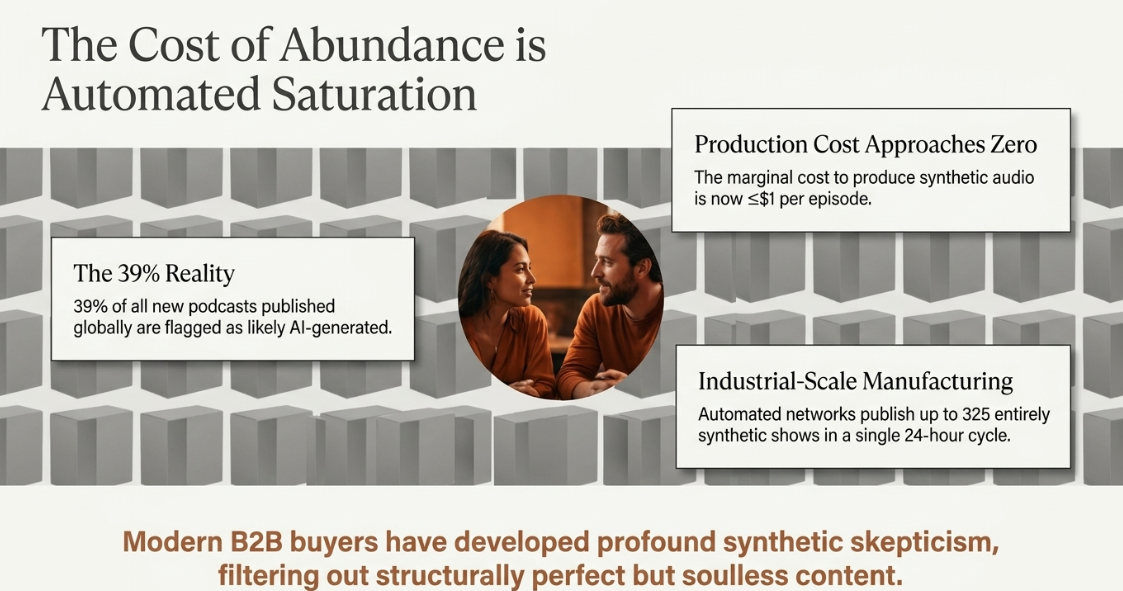
However, the application of artificial intelligence has aggressively expanded beyond workflow optimization into the autonomous generation of the creative product itself. This has led to an explosion of fully AI-generated podcasts, which currently represent 3% of the total market but are projected to capture an astonishing 15% market share by the year 2028. Recent data tracking from the Podcast Index illustrates the sheer scale of this automated saturation. In observed 24-hour windows, only 44.6% of newly created podcast feeds were classified as "likely legitimate" human productions, while 45.7% were flagged as potentially manufactured entirely by artificial intelligence.23 Over one nine-day tracking period, an estimated 39% of all new podcasts published to the global ecosystem were identified as likely AI-generated.
This tidal wave of synthetic media is driven by specialized, high-volume automated publishing entities. For example, industry trackers observed a single company, Inception Point AI, releasing 325 entirely new podcast shows in a single day, capturing nearly 20% of the entire global output of new shows for that 24-hour cycle.23 These synthetic productions are hosted by highly sophisticated, fictitious artificial intelligence personas—such as "Dr. Mara Lennox" or "Julia Cartwright"—and are designed to aggressively target high-search-volume keywords.23 Within a mere 75 minutes, automation networks can publish dozens of episodes providing sensitive medical, psychological, and wellness advice on topics ranging from codependency and gambling addiction to complex mental health interventions.23 Because the marginal cost of production has been driven down to $1 or less per episode, these networks rely on overwhelming volume rather than quality to capture algorithmic visibility.25
This industrial-scale manufacturing has resulted in a digital environment heavily polluted by "AI Slop"—a classification of content that is structurally polished and grammatically perfect, yet entirely derivative, soulless, and prone to severe technical errors.23 Because the production volume far exceeds the capacity for human editorial oversight, these automated shows frequently contain blatant hallucinations and humiliating audio artifacts. In Spanish-language literary biography podcasts generated by these networks, listeners can clearly hear the artificial intelligence host suddenly speaking in English, reading out raw system prompt errors such as, "I'm sorry, I can't assist with that," before abruptly terminating the episode.23
For professional business-to-business brands, this saturation of automated, error-prone content represents the ultimate test of brand authority. Modern consumers and enterprise buyers possess deep "synthetic skepticism".1 Having been exposed to tens of thousands of artificial intelligence outputs, audiences can immediately detect the generic, formulaic cadence of non-human content.1 The human brain functions as an advanced prediction machine; it automatically filters out and ignores information that it can easily predict.28 Furthermore, the broader business-to-business marketing sector is currently facing a profound trust deficit, caused by years of over-optimizing data points, abusing automation to scale generic messaging, and treating potential buyers as spreadsheet rows rather than nuanced human beings.
Therefore, to survive the intelligence era, professional brands must meticulously balance AI scalability with human authenticity to maintain listener trust. As artificial intelligence makes perfectly structured information universally abundant, the premium on visible human involvement, genuine expertise, and "unpolished" reality exponentially increases.1 The most successful marketing strategies of 2026 employ a strict "AI + Human framework," wherein the machine handles the predictable tasks—drafting outlines, scaling distribution, analyzing data—while human subject matter experts retain absolute control over emotional resonance, original thought, and specific brand perspective.30
To definitively separate their podcast assets from the noise floor of synthetic slop, leading brands are actively adopting the "Trust Architecture Checklist".1 This involves the rigorous implementation of Content Credentials (C2PA) to cryptographically sign digital media, thereby providing undeniable mathematical proof of human origin and editing history.1 Additionally, brands are prominently featuring "Not By AI" badging to visually signal human craftsmanship to highly skeptical audiences.1 Ultimately, in a digital landscape where artificial intelligence can instantly simulate technical perfection, a brand's verifiable human flaws, lived experiences, and spiky, contrarian perspectives become its most impenetrable competitive moat.1 By mastering the technical rigors of schema markup and generative engine optimization while simultaneously doubling down on the irreplaceable authenticity of the human voice, professional brands can leverage podcast marketing to dominate the search landscape, shorten sales cycles, and secure enduring market authority.
Works cited
Content Strategy 2026: AI, Resilience, and Your Framework, accessed May 21, 2026, https://www.arcintermedia.com/shoptalk/creating-content-in-2026-a-strategic-framework-for-content-resilience-in-the-age-of-ai/
Winning in the age of AI search | McKinsey, accessed May 21, 2026, https://www.mckinsey.com/capabilities/growth-marketing-and-sales/our-insights/new-front-door-to-the-internet-winning-in-the-age-of-ai-search
90+ Generative AI Statistics You Need to Know in 2026 | AmplifAI, accessed May 21, 2026, https://www.amplifai.com/blog/generative-ai-statistics
European Spending on Artificial Intelligence to Reach $133 Billion by 2028, According to a New IDC Spending Guide - IDC-Login, accessed May 21, 2026, https://my.idc.com/getdoc.jsp?containerId=prEUR252670624
GenAI Revenue Growth and Profitability | Morgan Stanley, accessed May 21, 2026, https://www.morganstanley.com/insights/articles/genai-revenue-growth-and-profitability
SXSW 2026 Marketing Takeaways: AI Search and Podcasts - Digital Applied, accessed May 21, 2026, https://www.digitalapplied.com/blog/sxsw-2026-marketing-takeaways-ai-rewrites-search-podcasts
22 Podcast Transcription Growth Statistics Every Content Creator Should Know in 2026, accessed May 21, 2026, https://sonix.ai/resources/podcast-transcription-growth-statistics/
Top 12 Emerging B2B Podcasting Trends in 2026 - Content Allies, accessed May 21, 2026, https://contentallies.com/learn/b2b-podcasting-trends
Thought Leadership Content for B2B Growth: The Complete 2026 Strategy Guide, accessed May 21, 2026, https://influenceflow.io/resources/thought-leadership-content-for-b2b-growth-the-complete-2026-strategy-guide/
What is AI Saying About Your Brand? - Thu., May 21, 2026 - O'Dwyer's, accessed May 21, 2026, https://www.odwyerpr.com/story/public/24757/2026-05-21/what-is-ai-saying-about-your-brand.html
The search everywhere optimization pyramid: How to build visibility ..., accessed May 21, 2026, https://searchengineland.com/the-search-everywhere-optimization-pyramid-how-to-build-visibility-before-search-478253
Search Everywhere Optimization - AEO, GEO, AIO and SEO - YouTube, accessed May 21, 2026, https://www.youtube.com/watch?v=9TVOiHuqH1o
Answer Engine Optimization (AEO): The AI Search Podcast, accessed May 21, 2026, https://podcasts.apple.com/us/podcast/answer-engine-optimization-aeo-the-ai-search-podcast/id1884409947
How Adding Transcripts Boosts Podcast SEO and Engagement, accessed May 21, 2026, https://www.3playmedia.com/case-studies/this-american-life/
What is Transcription? Improving accessibility, SEO, and UX - 3Play Media, accessed May 21, 2026, https://www.3playmedia.com/blog/what-is-transcription/
6 companies that boosted business with accessibility, accessed May 21, 2026, https://business.scope.org.uk/business-case-accessibility-6-companies-who-boosted-business-with-accessibility/
Podcast SEO in 2026: How to Get Your Episodes Found on Google ..., accessed May 21, 2026, https://secondsolstudios.com/podcast-seo-2026-google-ai/
How to Use Schema Markup for Your Podcast - Outcast AI, accessed May 21, 2026, https://outcast.ai/blog/how-to-use-schema-markup-for-your-podcast/
PodcastEpisode - Schema.org Type, accessed May 21, 2026, https://schema.org/PodcastEpisode
Video (VideoObject, Clip, BroadcastEvent) Schema Markup | Google Search Central | Documentation, accessed May 21, 2026, https://developers.google.com/search/docs/appearance/structured-data/video
Schema Made Simple: How to Become the AI Answer (From SEO to AEO) - Nextiny, accessed May 21, 2026, https://blog.nextinymarketing.com/schema-made-simple-how-to-become-the-ai-answer-from-seo-to-aeo
FAQ ( FAQPage , Question , Answer ) structured data - Google for Developers, accessed May 21, 2026, https://developers.google.com/search/docs/appearance/structured-data/faqpage
More new AI-generated podcasts than human ones - Podnews, accessed May 21, 2026, https://podnews.net/update/ai-slop-overtakes-humans
More Than a Third of All New Podcasts Are AI-Generated - Gizmodo, accessed May 21, 2026, https://gizmodo.com/more-than-a-third-of-all-new-podcasts-are-ai-generated-2000753786
AI-Generated Podcasts Boom on Audio Platforms. Are You Listening to One?, accessed May 21, 2026, https://www.inc.com/moses-jeanfrancois/ai-generated-podcasts-boom-on-audio-platforms-are-you-listening-to-one/91338876
r/generativeAI - Over the past nine days, 39% of new podcasts were likely AI-generated, according to the Podcast Index. - Reddit, accessed May 21, 2026, https://www.reddit.com/r/generativeAI/comments/1temjd7/over_the_past_nine_days_39_of_new_podcasts_were/
Trust vs AI slop: Why human-first B2B content wins - YouTube, accessed May 21, 2026, https://www.youtube.com/watch?v=3Dp8B0dOXpQ
The 5-Pillar Framework For AI Content That Audiences Actually Trust, accessed May 21, 2026, https://www.searchenginejournal.com/the-5-pillar-framework-for-ai-content-that-audiences-actually-trust/568860/
Trust & Influence in B2B Podcast - Joel Harrison, accessed May 21, 2026, https://www.joelharrisonb2b.com/podcast/
Marketing in 2026: AI + Human - The Only Formula That Works - Brillity Digital, accessed May 21, 2026, https://brillitydigital.com/blog/marketing-in-2026-ai-human-the-only-formula-that-works/
Marketing & AI Predictions That Will Shape Search, Strategy and Spend in 2026, accessed May 21, 2026, https://www.wsiworld.com/blog/marketing-ai-predictions-that-will-shape-search-strategy-and-spend-in-2026