The digital marketing and corporate communications landscape of 2026 has witnessed a fundamental paradigm shift in how business-to-business (B2B) enterprises cultivate brand authority, generate sales pipeline, and accelerate revenue velocity. Once relegated to the periphery of experimental media or niche consumer entertainment, podcasting has firmly established itself as a central, load-bearing pillar of the modern corporate demand-generation apparatus.1 The transition from transient content consumption to sustained auditory engagement requires a rigorous strategic approach, moving beyond superficial vanity metrics to integrate seamlessly with the enterprise revenue engine.3
A robust business plan for enterprise audio cannot be developed in isolation, nor can it rely on generic assumptions regarding content distribution. It must be anchored firmly in the empirical realities of demographic consumption habits, market penetration statistics, and sophisticated technological infrastructure capabilities. By analyzing the global trajectory of the podcasting industry, with a microscopic focus on the United Kingdom market—specifically the London metropolitan business hub—organizations can extract highly instructive data regarding B2B listener behaviors, content preferences, and attribution modeling.4
This comprehensive report provides an exhaustive, expert-level analysis of the strategic business case for enterprise podcasting in 2026. It delivers a nuanced operational plan optimized for measurable financial return, detailing the integration of advanced technological stacks, the deployment of artificial intelligence in production workflows, the implementation of account-based marketing (ABM) analytics, and the execution of high-yield content architectures.
Macro-Economic Context: The Global Podcasting Ecosystem in 2026
The podcasting industry has transitioned from a fragmented ecosystem of independent amateur creators into a highly consolidated, multibillion-dollar enterprise channel. The macro-economic indicators for the 2025 and 2026 fiscal periods demonstrate a medium that has achieved mainstream ubiquity while miraculously retaining the targeted demographic precision required for specialized B2B applications.
The Scale of the Global Audio Economy
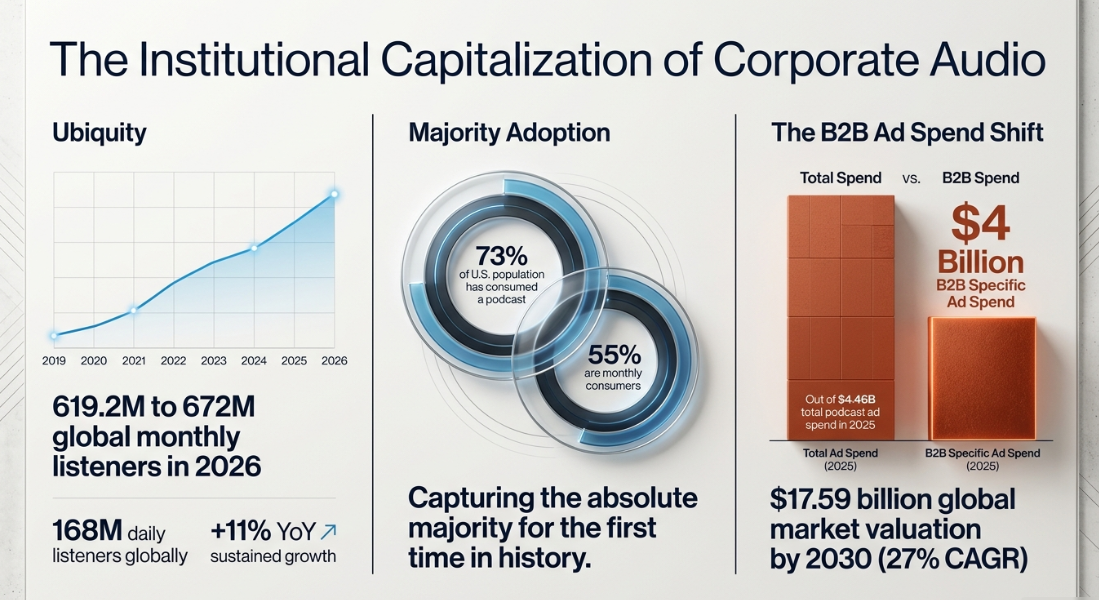
Global listener metrics illustrate a compounding growth trajectory that has persisted well beyond the initial surges of the early 2020s. The momentum has been sustained by improved platform features, an explosion of high-quality professional content, and the growing availability of podcasts through smart speakers and connected vehicles.6 The evolution of the global listener base reveals a persistent upward trend in adoption:
In the United States, which remains the largest single market, 73% of the population has consumed a podcast, and 55% are monthly consumers. This marks the first time in the medium's history that monthly consumption has captured the absolute majority of U.S. adults.2 Furthermore, daily listeners globally have reached 168 million, with 26% of the U.S. population engaging with the medium on a daily basis.6
The financial capitalization of the sector closely mirrors this audience expansion. The global podcast market is projected to reach a valuation of $17.59 billion by 2030, driven by an aggressive average annual growth rate of 27% from 2025 to 2030.2 A critical metric for enterprise strategists evaluating resource allocation is the composition of digital audio advertising spending. Of the $4.46 billion in podcast ad spending projected for 2025, a staggering $4 billion is attributed directly to B2B-specific advertising.2 This disproportionate allocation indicates that institutional capital recognizes the unparalleled efficiency of audio in reaching corporate decision-makers, fundamentally shifting ad spend away from traditional display and print media toward immersive auditory formats.
Competitive Saturation and the "Active Show" Advantage
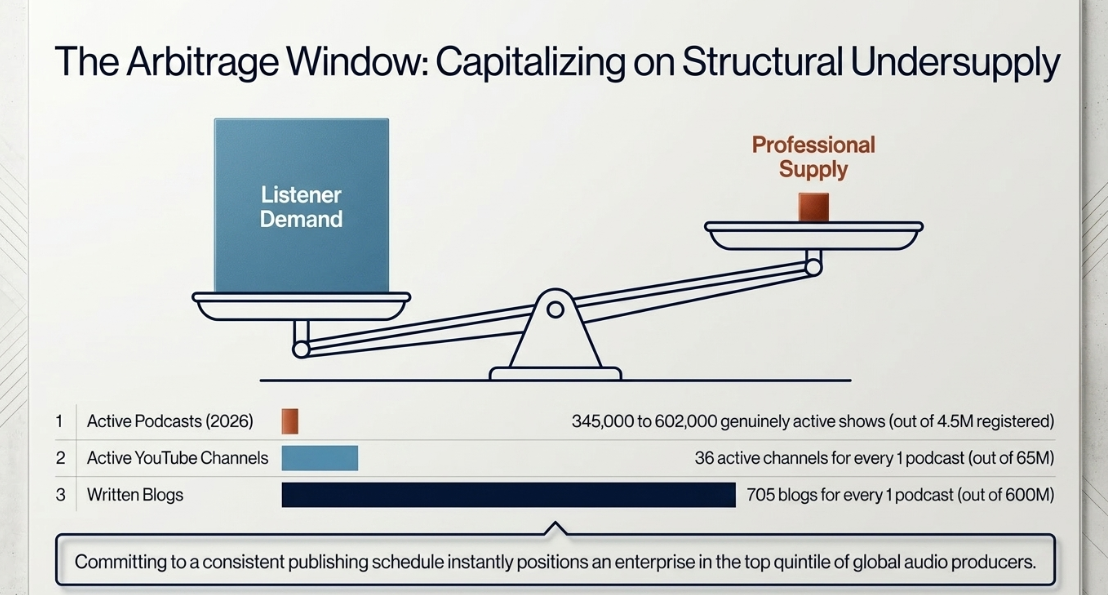
Despite the massive influx of capital and the vast expansion of the listener base, the supply side of the podcasting market presents a unique structural advantage for early-moving enterprises: low competitive saturation. While aggregate figures often cite millions of hosted podcasts, the reality of active, professional competition is vastly different. According to the Podcast Index, out of approximately 4.5 million registered RSS feeds worldwide, only 345,000 to 602,000 shows are genuinely active—defined as having released at least one new episode in recent months.1
When compared to legacy content marketing channels, the disparity in market saturation is stark and highly advantageous for audio producers. For every single active podcast operating in 2026, there are approximately 705 written blogs (out of 600 million globally) and 36 active YouTube channels (out of 65 million).1 Furthermore, the phenomenon known colloquially as "podfade"—where creators launch a show, experience initial enthusiasm, but abandon the project after publishing three or fewer episodes—eliminates a vast swath of theoretical competition.9 Roughly half of all shows ever created publish three or fewer episodes.9 Only 19% of all registered shows publish a new episode once or twice a month, leaving 81% of the directory inconsistent or entirely inactive.8
For B2B enterprises, this data suggests a rare arbitrage opportunity. By committing to a consistent publishing schedule and treating the podcast as a core operational asset rather than an experimental side project, an enterprise can immediately position itself in the top quintile of all global audio producers. This allows brands to capture highly affluent, targeted attention in a medium that is rapidly growing in audience demand but remains structurally undersupplied with consistent, high-quality, professional-grade content.
The United Kingdom Microcosm: Predicting Global B2B Audio Trends
To deeply understand the future of premium B2B audio engagement, an analysis of the United Kingdom market—and specifically the London metropolitan area—serves as a predictive and highly instructive model. The UK market exhibits high mobile penetration, extended urban commuter periods, and a highly concentrated density of corporate decision-makers, making it an ideal proving ground for understanding enterprise podcasting strategies.
UK Listener Volume, Frequency, and Time Spent
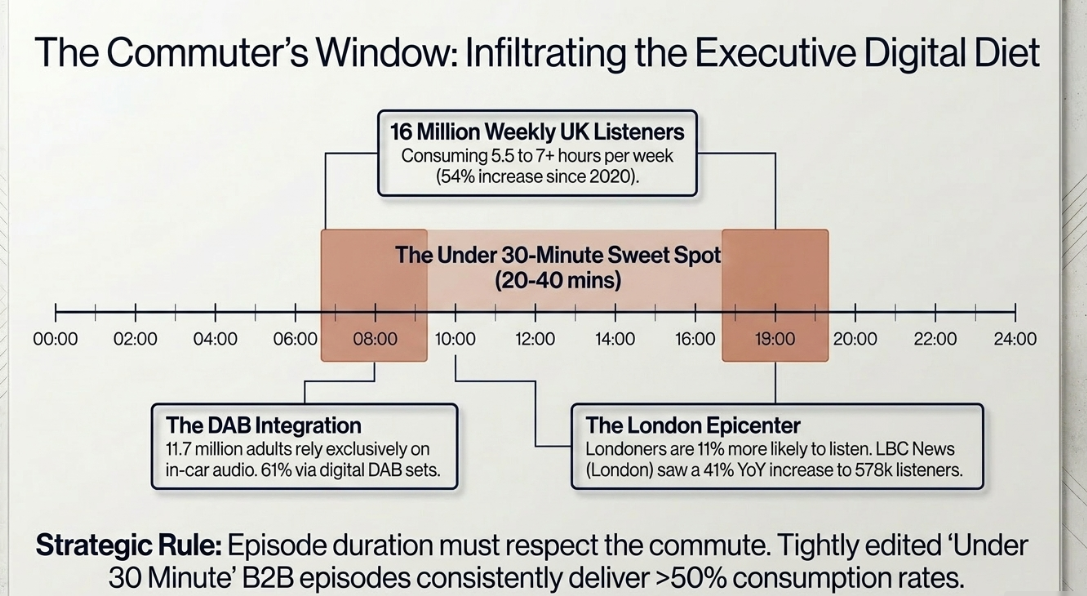
The UK market has experienced unprecedented adoption rates that outpace many other European nations. As of early 2026, 42% of all UK adults consume podcasts on a monthly basis, while regular weekly listenership hovers between 30% and 34%.5 This translates to approximately 16 million weekly listeners, representing a monumental 54% increase since the baseline year of 2020.5
The depth of this engagement is profound. UK weekly listeners consume an average of 5 hours and 27 minutes of podcast content per week, with prime B2B target demographics (aged 35 to 54) consuming upwards of 7 hours weekly.5 This is not passive background noise; it is sustained, deliberate audio consumption. The Spring 2026 MIDAS survey reveals that total audio consumption in the UK (excluding viewed video) remains exceptionally strong, reaching 96% of the adult population. The total number of weekly hours listened to audio is over 1.5 billion, representing a 7% increase since the Spring 2024 wave.11
The London Metropolitan Hub and Commuter Dynamics
The geographic distribution of podcast consumption in the United Kingdom is not uniform; it is heavily skewed toward urban centers and commuter belts, with London acting as the undisputed epicenter.4 Data indicates that podcasts are 11% more likely to be listened to by Londoners than by the general adult population of the UK.4 This geographic concentration is intricately linked to the resurgence of commuter behaviors, the return to hybrid office environments, and the deep integration of digital audio into the connected vehicle ecosystem.
Recent RAJAR (Radio Joint Audience Research) data from Q1 2026 indicates a structural shift in how professionals consume media during transit. From a baseline of 2.6 million adults in Q1 2006, the number of individuals who rely exclusively on in-car audio has grown by 350% to 11.7 million (20% of the population).12 Crucially, 61% of this in-car listening occurs via digital DAB sets, and a rapidly growing 7% occurs via online connected integrations, effectively transforming the daily commute into a captive, screen-free environment for on-demand digital audio.12 Furthermore, a fifth of all time spent listening to audio in cars is now dedicated specifically to music streaming services and podcasts, pulling significant market share away from traditional linear radio.13
The appetite for sophisticated, business-adjacent, and analytical content in the capital is further evidenced by the explosive growth of news and commentary networks. For instance, Global's LBC News (London) recorded a staggering 41% year-over-year increase in weekly reach to 578,000 listeners, with total listening hours almost doubling (up 98% quarter-on-quarter to 2.4 million hours).14 Concurrently, the LBC Brand (UK) reached a record weekly audience of 3.6 million.14 This indicates a highly engaged metropolitan audience actively seeking intellectual, news-oriented, and analytical spoken-word formats—the exact behavioral profile required for B2B podcast adoption.
Demographic Realities of the Premium UK Listener
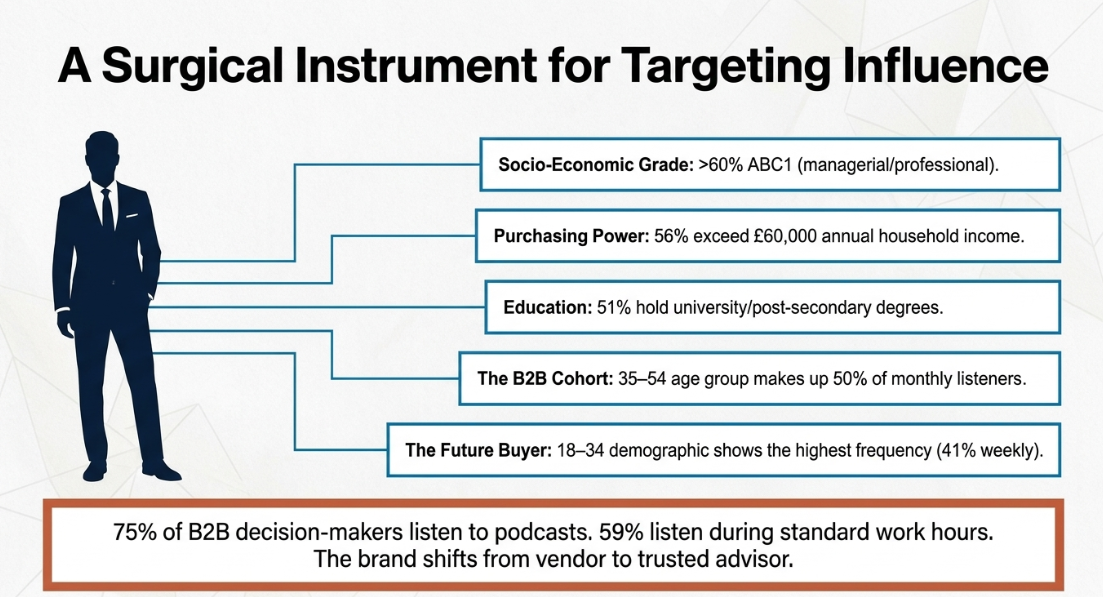
The true enterprise value of the UK podcast audience lies not merely in its absolute size, but in its exceptional socio-economic composition. Podcast listeners in the UK represent a premium demographic segment that maps perfectly onto the ideal target profiles of B2B enterprises:
This demographic reality highlights that B2B audio is not a mass-market broadcast tool, but rather a surgical instrument for reaching the affluent, educated, and influential decision-makers who control corporate budgets. By establishing a dominant audio presence in 2026, B2B brands secure brand affinity with both current C-suite executives and the rising cohort of digital-native leaders.
The Psychology of Auditory Engagement in B2B Contexts
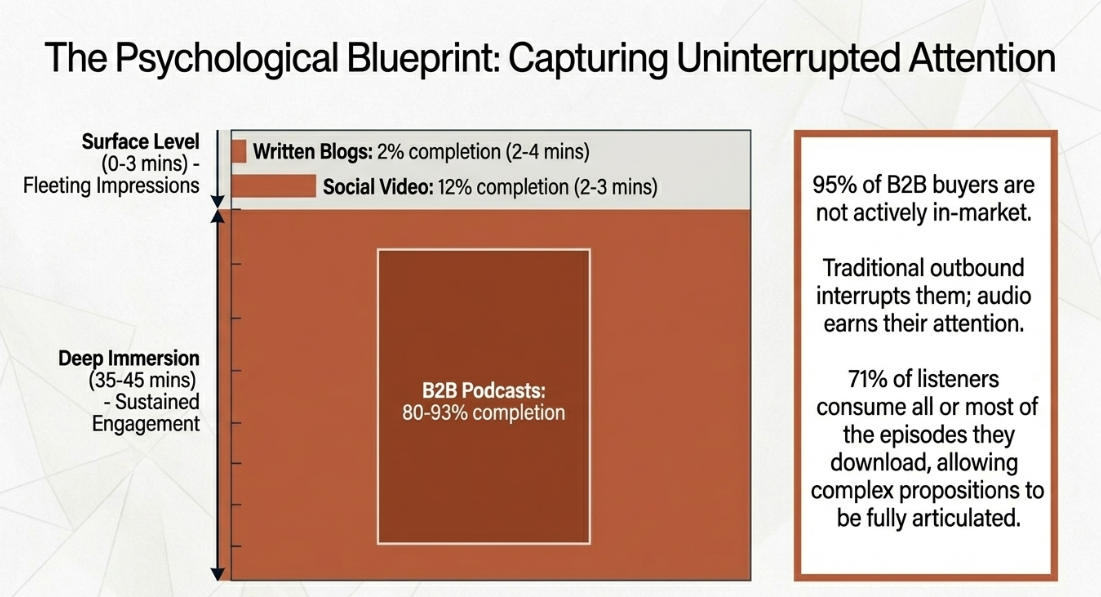
A strategic business plan must acknowledge the fundamental principle that in the digital economy, not all impressions are created equal. The core differentiator of podcasting lies in the psychology of attention and the intimate, parasocial nature of the medium. Research from the LinkedIn B2B Institute indicates that 95% of B2B buyers are not actively in the market to purchase at any given time.17 Therefore, traditional outbound marketing budgets spent interrupting these buyers are highly inefficient. Inbound marketing, driven by high-value content like podcasts, earns attention rather than buying it, proving far more effective at building latent brand preference.
Depth of Engagement vs. Fleeting Impressions
In an era characterized by fragmented attention spans, the algorithmic dominance of short-form video, and infinite scroll interfaces, B2B marketers face a severe crisis of engagement. Traditional content mediums are failing to hold the attention necessary to communicate complex enterprise value propositions. Written blog posts suffer from an abysmal average completion rate of roughly 2%, with average read times hovering between 2 and 4 minutes.1 Video content hosted on enterprise platforms or social feeds yields an average completion rate of just 12%, retaining viewers for merely 2 to 3 minutes before abandonment.1
In stark contrast, podcasting commands unprecedented, sustained attention. Industry benchmarks for 2026 reveal that B2B podcasts achieve an astonishing 80% to 93% episode completion rate.1 For an average 40-minute episode, this translates to 35 to 45 minutes of deep, uninterrupted brand exposure.1 More than seven in ten podcast listeners (71%) state that they typically consume all or most of the episodes they download.8 This remarkable duration of engagement allows complex B2B value propositions, nuanced industry challenges, and sophisticated thought leadership to be articulated fully, entirely bypassing the superficiality of traditional digital advertising.
The Decision-Maker's Digital Diet and Contextual Integration
The integration of podcasting into the professional's daily routine is deep, systematic, and highly contextual. In the global B2B landscape, 62% of B2B buyers now consume podcasts, a significant increase from 48% just four years prior.1 Even more critically for enterprise sales cycles, 75% of B2B decision-makers listen to podcasts, with 51% listening daily, and 83% of senior executives reported listening to a podcast in the past week.1
A crucial insight for operational marketing planning is the timing and context of this consumption. Data indicates that 59% of B2B decision-makers listen to podcasts during standard work hours.8 This implies that enterprise audio is no longer relegated to leisure time; it functions as an officially sanctioned, trusted source of professional development, industry intelligence, and peer benchmarking. When a Chief Information Officer, a VP of Procurement, or a Director of Human Resources tunes into a branded B2B podcast, they are actively seeking solutions to operational pain points. This active seeking renders them highly receptive to strategic messaging, seamlessly shifting the brand from the category of "vendor" to the category of "trusted advisor".2
The Empirical Business Case: Formulating Enterprise ROI
The historical impediment to enterprise podcast adoption was the industry's reliance on consumer-grade vanity metrics. For years, marketing departments attempted to justify audio investments using superficial metrics such as total download counts, chart positions, and subscriber numbers.3 In 2026, sophisticated marketing departments have entirely abandoned these vanity metrics in favor of board-level financial indicators: attributable pipeline, customer acquisition cost (CAC), lead conversion rates, and deal velocity.1
Quantitative ROI Benchmarks and Pipeline Metrics
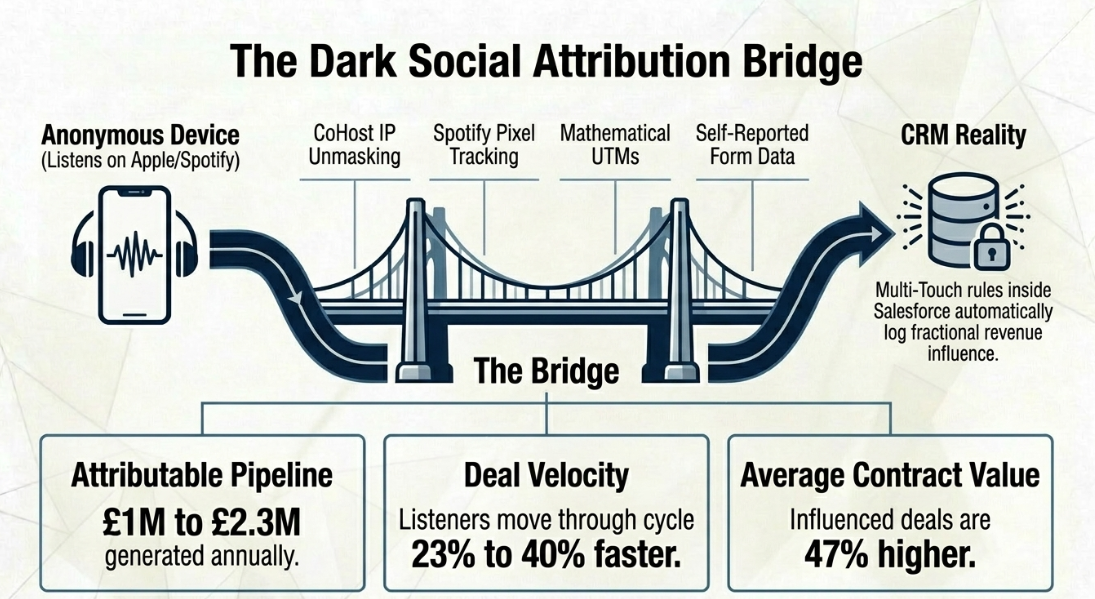
When executed systematically, a strategic B2B podcast operates as a highly efficient revenue engine. Industry benchmarks for mature, strategically aligned enterprise podcasts in 2026 demonstrate the following aggregate impacts on the corporate bottom line:
The acceleration in deal velocity and the substantial increase in Average Contract Value are primarily driven by the psychological concept of pre-education. Because the prospect has spent hours listening to the vendor articulate deep industry expertise, they arrive at the initial sales conversation with a high baseline of trust. They view the enterprise as an authoritative partner rather than a commoditized service provider, eliminating the need for prolonged educational sales cycles and minimizing price-sensitivity negotiations.
The Two-Class ROI Framework: The "Trojan Horse" Strategy
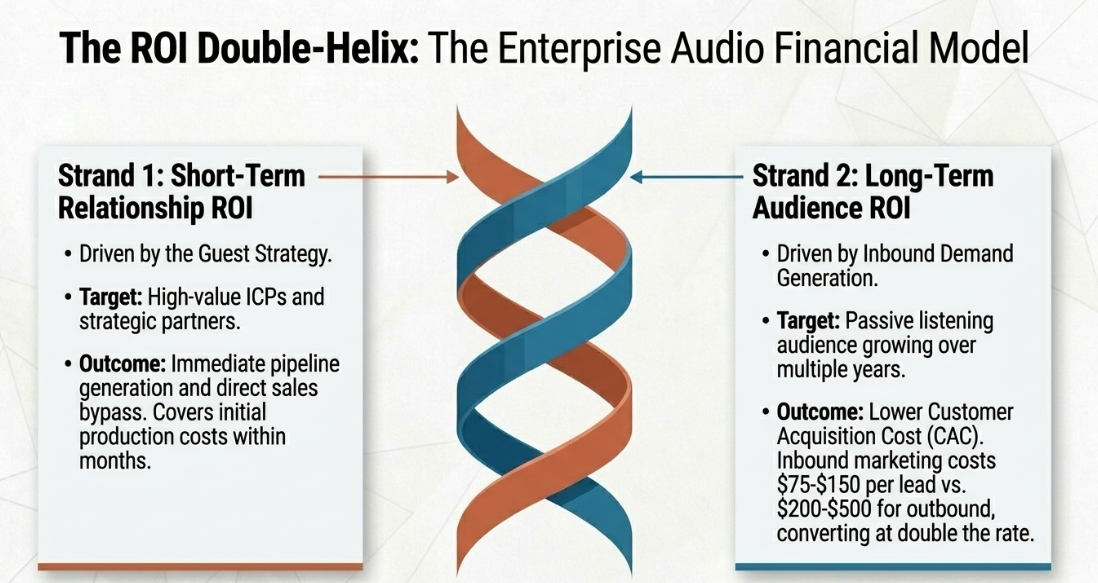
The financial modeling for a B2B podcast must be bifurcated into two distinct, parallel revenue streams, formally known in the industry as the "Two-Class ROI Framework" or the "ROI Double-Helix".3
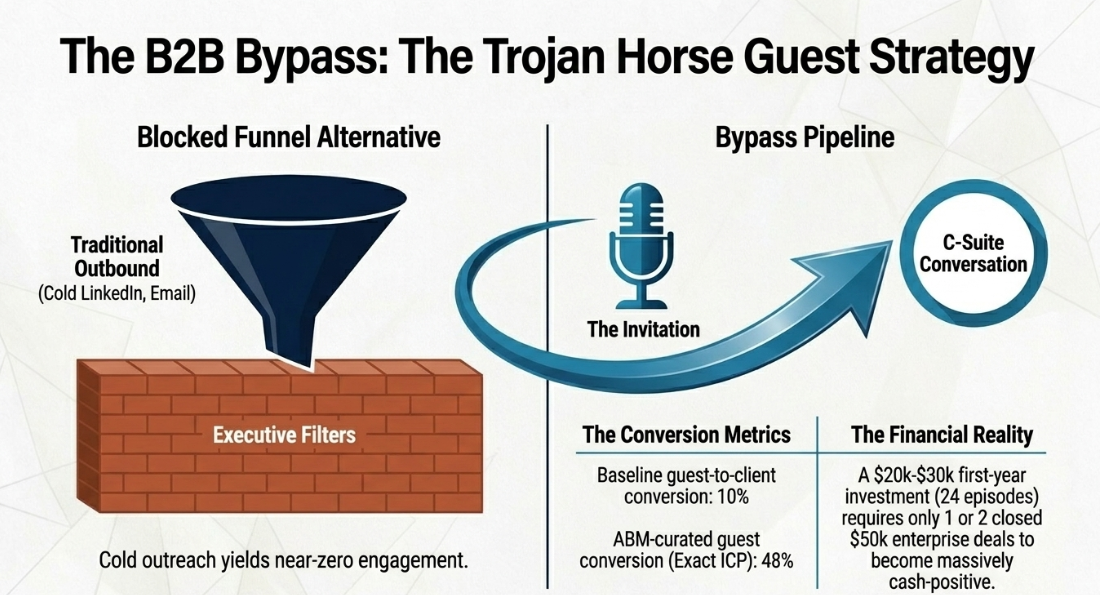
1. Short-Term Relationship-Driven ROI (The Guest Strategy) The most immediate and lucrative financial return generated by an enterprise podcast does not come from the passive listening audience, but directly from the guests featured on the show. By inviting high-value target accounts—such as ideal customer profiles (ICPs), highly sought-after prospects, or strategic integration partners—to feature as guests, the enterprise utilizes the podcast as a premium networking asset and a "Trojan Horse" for sales.2 This strategy elegantly bypasses the traditional, often-ignored cold outbound pitch. Executives who would never respond to a cold LinkedIn message or a promotional email will readily accept an invitation to share their expertise on an industry podcast.
The baseline guest-to-client conversion rate stands at a respectable 10%.1 However, when an enterprise employs a surgical Account-Based Marketing (ABM) approach to guest curation, ensuring every guest matches their exact buyer persona, this conversion rate spikes dramatically to 48%.1
To illustrate the financial mechanics: A relatively modest first-year investment of $20,000 to $30,000 that generates 24 high-quality episodes and successfully onboards 10 potential enterprise customers can achieve a massive, cash-positive state with the closure of just one or two deals.3 If the average enterprise deal size is $50,000, acquiring just two clients from the guest roster yields $100,000 in direct revenue, representing an immediate positive ROI. This mechanism renders the secondary benefit—audience building—essentially cost-free.3
2. Long-Term Audience-Driven ROI (Inbound Demand Generation)
The second vector of return is the traditional inbound marketing model. Over time, the systematic publication of high-value audio content captures a passive, growing listening audience. Through strategic content architecture and closed-loop attribution, a percentage of these listeners convert into active, highly qualified leads.
While the listener-to-lead conversion rate is nominally lower than the guest conversion rate (scaling from 0.3% to 4.8% depending on the niche precision and the clarity of the call-to-action), the aggregate volume of a growing audience yields a compounding flow of inbound requests over multiple years.3 Inbound marketing strategies anchored by rich content like podcasts consistently prove more capital-efficient than outbound methodologies. Data reveals that inbound marketing costs $75 to $150 per lead compared to $200 to $500 for outbound tactics, while converting at nearly double the rate.
Strategic Content Architecture and Format Hierarchies
The structural design of the podcast—encompassing its thematic focus, its recurring format, and its episode duration—directly dictates its ability to generate both audience retention and derivative content assets. Content architecture cannot be left to instinct; it must be engineered based on consumption data.
Episode Duration Optimization and Retention Metrics
Comprehensive behavioral data from late 2025 and early 2026 indicates a precise correlation between episode length and listener retention in the B2B sector.8 While consumer true-crime sagas or long-form comedy podcasts can luxuriously span multiple hours, the B2B audience demands intense respect for their time.
The data reveals a distinct "Under 30 Minutes" sweet spot. Episodes that are tightly edited to run under 30 minutes consistently deliver 50% or higher consumption rates among professional listeners.8 This specific duration aligns perfectly with the average urban commute, a standard calendar block between meetings, or a daily exercise routine, allowing the listener to achieve a psychological sense of completion.
The standard industry range for the majority of successful business podcasts settles between 20 and 40 minutes.8 This allows sufficient time to move beyond superficial talking points into actionable strategy without risking listener fatigue. However, highly tactical micro-formats are emerging in specific verticals. For fields like Software-as-a-Service (SaaS) customer success or daily market briefings, hyper-focused 10-to-15-minute episodes packed with immediate, actionable takeaways serve as powerful, high-frequency touchpoints.8 Conversely, longer episodes can succeed, but only if the pacing and storytelling are highly engaging. Marketers are advised to audit their hosting platform analytics to identify exact drop-off points, ensuring that critical calls-to-action (CTAs) are placed during high-retention mid-roll windows rather than saved for the outro when audiences have already begun to dissipate.
Structural Format Hierarchies
Choosing the correct format is essential for mapping content to the buyer's journey. Top-ranking enterprise podcasts typically utilize one of three primary structural formats, each serving a distinct strategic purpose:
High-performing content strategies do not rigidly adhere to a single format; instead, they mix these structures dynamically depending on message complexity, audience needs, and available production resources.8
The Content Repurposing Engine
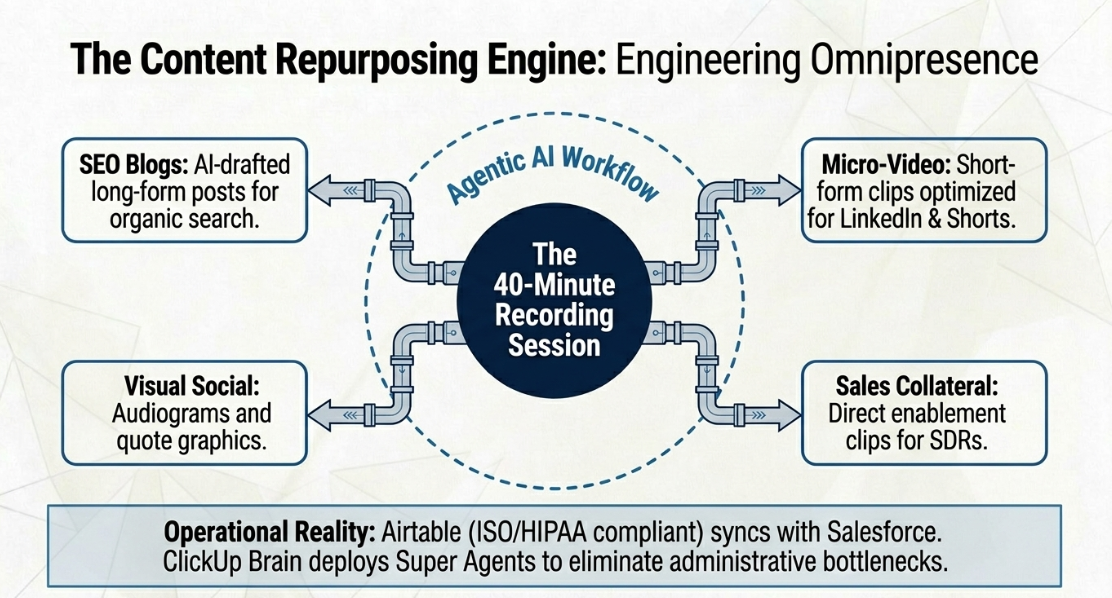
A profound operational mistake is treating a podcast episode merely as a solitary audio file. To justify the investment, the audio must function as the foundational pillar of a broader, omnipresent content ecosystem. An optimal operational plan mandates that a single 30-to-40-minute recording session is systematically atomized into multiple derivative assets.21
By utilizing AI-native workflows and dedicated production teams, a single episode is deconstructed into an SEO-optimized, long-form blog post to improve organic search discoverability; multiple short-form video clips optimized for LinkedIn, TikTok, and YouTube Shorts; audiograms and quote graphics for visual social feeds; and direct internal sales enablement collateral to be shared by SDRs during active outreach.21 This multi-channel distribution strategy ensures maximum leverage of the initial production investment, creating the illusion of content omnipresence while demanding minimal additional time from the executive hosts.
Technological Infrastructure: Building the Enterprise Audio Stack
The execution of a mature, revenue-generating enterprise podcast requires a robust, scalable, and highly integrated technological stack. The ecosystem of tools must bridge the gap between media hosting, operational project management, and CRM integration.
The Build vs. Buy Dilemma: Calculating Opportunity Cost
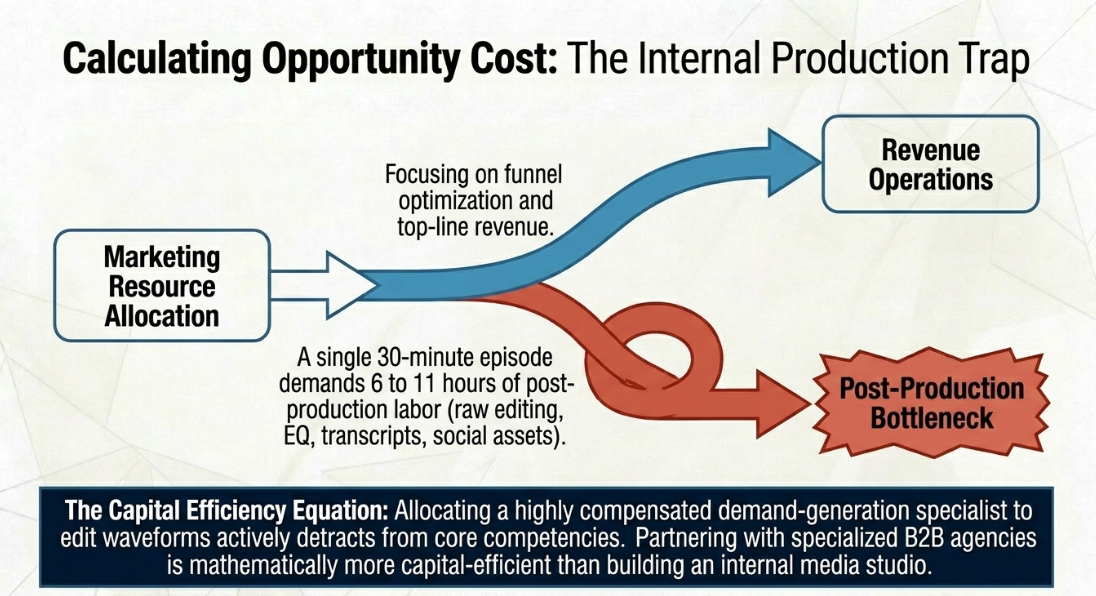
A critical initial decision for the Chief Marketing Officer or VP of Demand Generation is determining the resource allocation model: internal production versus strategic agency partnership. Many enterprise marketing departments severely underestimate the operational friction and technical demands of professional audio production, mistakenly believing that purchasing high-end microphones equates to possessing a comprehensive content strategy.22
The hidden vulnerability of in-house production is the massive, unrecorded opportunity cost associated with post-production. Empirical workflow studies demonstrate that a single 30-minute podcast episode requires between 6 and 11 hours of post-production labor.22 This exhaustive process encompasses raw audio editing, phase rotation, noise gating, EQ balancing, transcript generation, show note copywriting, and the rendering of social media assets.22
Allocating highly compensated internal marketing managers or demand-generation specialists to edit audio waveforms actively detracts from their core competencies. If an internal resource is spending ten hours a week editing audio, they are not optimizing conversion funnels, executing lead generation campaigns, or driving top-line revenue.22 For enterprises prioritizing aggressive growth, the revenue lost from pulling skilled marketers away from their primary roles far exceeds the financial cost of outsourcing. Consequently, partnering with a specialized, full-service B2B podcast agency (such as Content Allies, JAR Podcast Solutions, or Fame) is fundamentally more capital-efficient than attempting to build an internal media studio from scratch.21
Selecting the Enterprise Hosting Platform
Whether managing production internally or utilizing an agency, the choice of the primary hosting platform is foundational. The platform must prioritize infrastructure stability, programmatic ad insertion capabilities, advanced distribution controls, and deep analytics. In 2026, the leading enterprise solutions are highly specialized, catering to distinct corporate use cases:
The pricing models for these platforms vary significantly based on scale. CoHost offers structured tiers from a $31/month Lite Plan to a $170/month Premium Plan featuring Salesforce integration, scaling up to Custom Enterprise tiers exceeding $499/month for dedicated growth management.21 Libsyn prices based on uploaded audio hours, with enterprise Pro tiers heavily customized.25
Operational Workflow Management and Agentic AI
Managing the complex lifecycle of a podcast—encompassing guest booking outreach, technical pre-interviews, recording schedules, editing revisions, legal approvals, and multi-channel publishing—demands a unified operational system. Relying on disconnected spreadsheets and email threads guarantees systemic failure.
Enterprises are increasingly relying on advanced, AI-integrated collaborative databases to maintain operational velocity.
Airtable: Media teams leverage Airtable due to its relational HyperDB architecture, which easily supports hundreds of millions of records.21 It acts as a single source of truth, integrating directly with CRMs like Salesforce to align guest booking schedules directly with active sales pipelines.21 Furthermore, Airtable satisfies enterprise IT requirements through robust Role-Based Access Control (RBAC), ISO and HIPAA compliance, and secure AWS-hosted AI agents.21
ClickUp: For teams seeking to eliminate tool sprawl entirely, ClickUp deploys AI-native "Super Agents" to automate the tedious aspects of podcast production.21 By utilizing ClickUp Brain, workflows are transformed. The Intake Agent standardizes new episode kickoffs; the Content Agent autonomously drafts promotional copy based on transcripts; the Assign Agent routes editing tasks without manual intervention; and the Brief Agent generates comprehensive guest prep documents.21 Implementing these automated workflows prevents the podcast from becoming an administrative bottleneck, ensuring smooth, predictable publishing cadences.
Private Podcasting for Internal Enterprise Communications
A rapidly emerging and highly lucrative use case within the enterprise stack is the deployment of secure, private RSS feeds. Rather than relying on easily ignored, text-heavy internal newsletters or mandatory video portals, corporations utilize platforms like Transistor, Castos, or supportingcast.fm to deliver secure, authenticated audio directly to employees' mobile devices.27
Access is tied directly to individual user credentials (often via SSO) rather than easily shared URLs, ensuring strict data security.29 This technological infrastructure allows the C-suite to distribute highly confidential strategy briefings, HR training modules, or immediate sales enablement updates in a format that employees can consume asynchronously during their commute or while away from their desks. By treating internal episodes as a core part of regular communication and featuring them in existing internal feeds, enterprises significantly improve organizational alignment, culture building, and information retention.
Advanced Measurement, Analytics, and Attribution
To transition a podcast from a top-of-funnel brand awareness exercise to a rigorous, board-approved revenue generator, enterprises must deploy advanced attribution modeling. The era of evaluating audio success purely on RSS download volume is decisively over. In 2026, the technology stack must provide granular visibility into firmographics, listener behavior, and direct deal influence.
First-Party Tracking and CRM Multi-Touch Attribution
Operationalizing podcast data requires the disciplined implementation of first-party tracking mechanisms that connect auditory engagement to web behavior.
UTM Architecture: Enterprises must deploy episode-specific, mathematically distinct UTM codes on all show notes, targeted landing pages, and promotional social media posts.3 This ensures that any direct click-through traffic is perfectly attributed to the specific audio asset.
Self-Reported Attribution: To capture the vast "dark social" audience—listeners who consume the podcast on Spotify or Apple Podcasts but later navigate directly to the company website via an organic Google search—companies must integrate a required "How did you hear about us?" free-text field on inbound demo request forms.3 This qualitative data routinely proves that podcasts drive significantly more pipeline than digital tracking links alone can verify.
CRM Multi-Touch Rules: Platforms like Salesforce and HubSpot must be configured to log podcast interactions as distinct touchpoints within the buyer's journey. For example, if a prospect from a target account listens to three podcast episodes and subsequently downloads a gated whitepaper, the CRM automatically designates the eventual closed deal as "podcast-influenced pipeline," allowing for accurate fractional revenue attribution.3
Deep Firmographic Resolution and Pixel Tracking
The pinnacle of 2026 podcast measurement is the deployment of analytics platforms capable of resolving anonymous IP and device data into distinct corporate entities and individuals.
By leveraging tools like CoHost to unmask listening accounts and Spotify Ad Analytics to verify paid media efficacy, marketing leaders transform podcasting from a nebulous "brand-only" initiative into a transparent, predictable revenue operations channel.25
Enterprise Execution: Empirical Case Studies
Theoretical frameworks and technological capabilities are best validated through empirical market execution. Several global enterprises have successfully deployed podcasting to drive brand dominance, community utility, and measurable revenue. Analyzing these distinct approaches reveals the versatility of the medium.
General Electric: The Narrative Vanguard
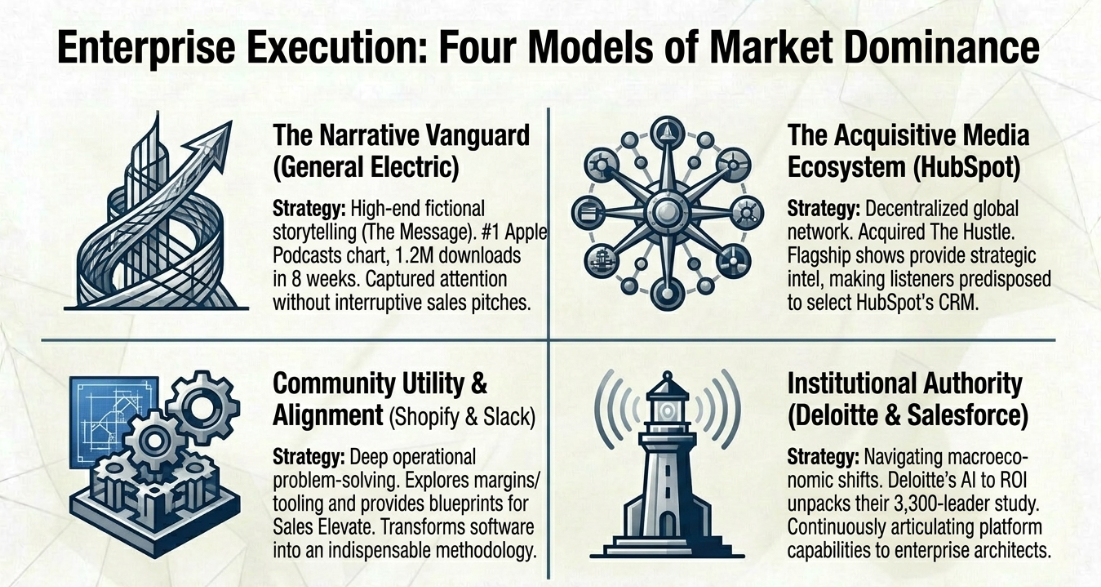
General Electric (GE) provided an early, masterful blueprint for B2B narrative podcasting with its highly acclaimed series, The Message.34 Rather than producing a dry, highly technical corporate show detailing their product catalog, GE funded an eight-episode, fully scripted science fiction audio drama. The narrative followed a team of scientists attempting to decode a mysterious alien transmission.34
The underlying technological concepts woven into the story subtly, yet powerfully, reinforced GE's positioning as a forward-thinking pioneer in advanced medical imaging and global communications technology.34 The metrics achieved were unprecedented for a branded corporate project: The Message accumulated over 1.2 million downloads in just eight weeks, successfully securing the coveted #1 position on the Apple Podcasts charts.35 By prioritizing high-value entertainment, authentic first-person narratives, and exceptional storytelling, GE captured millions of hours of consumer and enterprise attention without the friction of an overt, interruptive sales pitch.
HubSpot: The Acquisitive Media Ecosystem
HubSpot has strategically evolved far beyond its origins as a software provider to become a decentralized, global media empire.38 Recognizing that attention is the single most valuable currency in the highly competitive B2B SaaS space, the company launched the HubSpot Podcast Network, serving as an umbrella destination for top-tier business, marketing, and sales shows.38
This aggressive strategy was bolstered by the acquisition of The Hustle, pulling pre-existing, highly loyal audiences and high-performing newsletters into the HubSpot ecosystem.38 Through flagship shows like Marketing Against the Grain, hosted by the company's CMO (Kipp Bodnar) and SVP of Marketing (Kieran Flanagan), HubSpot provides transparent, high-level strategic intelligence directly to marketing practitioners worldwide.39 This cultivates profound trust; listeners who rely on HubSpot for weekly strategic education are highly predisposed to select HubSpot's CRM when evaluating procurement options. The network functions as a self-sustaining, massive top-of-funnel engine that feeds directly into their billion-dollar software pipeline, redefining the role of media in software customer acquisition.39
Shopify and Slack: Community Utility and Operational Alignment
E-commerce infrastructure giant Shopify leverages podcasting to provide hyper-specific, tactical utility to its vast network of digital merchants. Rather than producing generic motivational content, shows within the Shopify ecosystem, such as Shopify1Percent, bypass broad rhetoric in favor of executing deep, post-mortem analyses of ecommerce growth.41
These episodes function almost as internal growth reviews, discussing margins, tooling, channel mix, hiring, and lifecycle strategy with experienced founders and operators.41 Furthermore, internal Shopify teams, such as the Developer Acceleration team, utilize podcasts to transparently discuss internal operations, such as how they run developer happiness surveys to drive engineering productivity.42 By actively solving acute operational pain points for their users through audio, Shopify embeds its platform deeper into the merchant's operational identity.
Similarly, enterprise communication platform Slack utilizes its Customer Success Podcast to navigate specific industry use cases.43 Episodes detailing how their internal Customer Experience leaders and Sales AVPs utilize the platform (e.g., deeply integrating Salesforce Sales Cloud via "Sales Elevate") provide listeners with actionable, step-by-step blueprints.43 This approach seamlessly transforms a standard software tool into a dynamic, indispensable methodology for organizational productivity.
Deloitte and Salesforce: Institutional Thought Leadership
Global consulting and technology giants utilize podcasts to dissect complex macroeconomic and technological shifts, positioning their firms as the ultimate navigators of uncertainty.
Deloitte effectively utilizes multiple podcast properties. The Kinetic Enterprise series explores how organizations can transform their businesses with SAP solutions and address disruption head-on, discussing the future of mobile work and customer-centric governance.44 More recently, the AI to ROI podcast analyzed Deloitte's "2026 State of AI Report - The Untapped Edge," a comprehensive study surveying over 3,300 business leaders.45 By unpacking complex concepts like agentic AI and sovereign AI in an audio format, Deloitte establishes intellectual dominance in the emerging tech sector.45
Salesforce mirrors this strategy with highly targeted audio properties. Their Business Services Podcast, hosted by senior directors and solution engineering experts, brings in industry analysts to discuss specific verticals.46 Additionally, podcasts focusing on Salesforce integrations (e.g., The Real World of AI: Use Cases from the Front Lines) explore how AI is utilized for security within the Salesforce ecosystem.47 These focused audio initiatives ensure that the massive capabilities of the Salesforce platform are continuously articulated to a captive audience of technical buyers and enterprise architects.
Synthesis and Strategic Directives for 2026 and Beyond
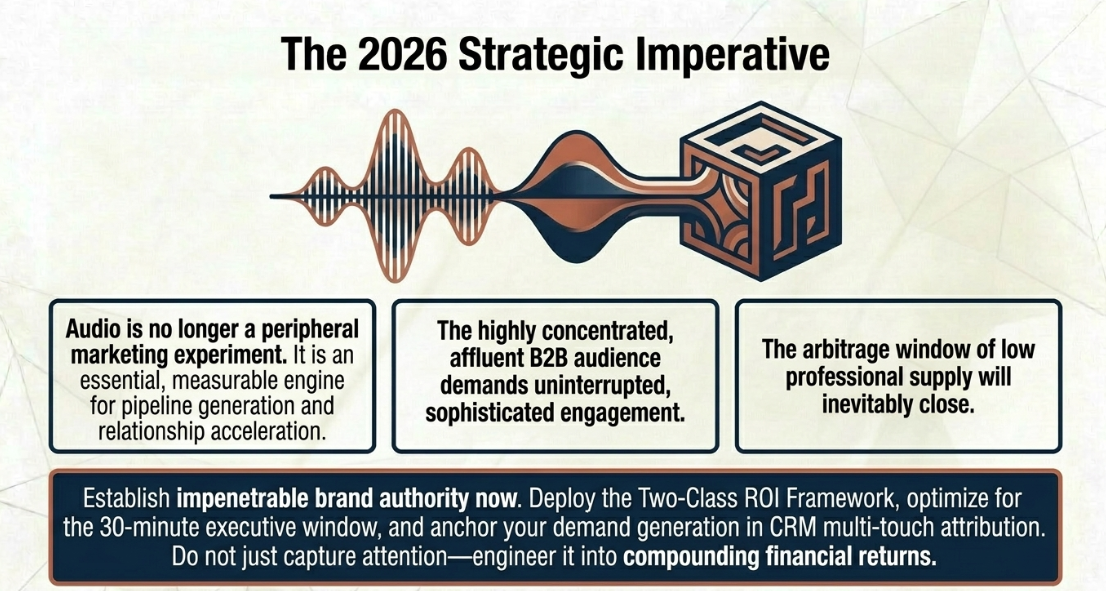
As the global business ecosystem moves through 2026 and plans for 2027, the strategic imperative of enterprise podcasting is unequivocal. The empirical data dictates that audio is no longer a peripheral marketing experiment to be tested with surplus budget; it is a highly efficient, measurable, and essential engine for pipeline generation, relationship acceleration, and brand monopolization.
The United Kingdom, anchored heavily by the London metropolitan hub, serves as a flawless microcosm of this global reality. The high concentration of ABC1 professionals consuming hours of sophisticated, targeted audio content during their increasingly digitized commutes represents an unprecedented opportunity. It allows B2B enterprises to bypass saturated visual channels, avoid the soaring costs of outbound lead generation, and secure deep, uninterrupted executive attention in a distraction-free environment.
Enterprises that delay adoption face the distinct risk of permanent exclusion. While current active podcast supply remains relatively low—providing a highly lucrative window of low competition for early movers—this arbitrage opportunity will inevitably close as more institutions realize the financial mechanics of the medium.
Developing a strategic audio capability now—anchored firmly in the Two-Class ROI Framework, optimized for the under-30-minute commuter attention span, distributed via robust enterprise-grade hosting platforms, and measured rigorously via CRM multi-touch firmographic attribution—ensures that an organization establishes impenetrable brand authority. By treating the podcast not as an isolated, creative marketing tactic, but as a core operational asset integrated entirely with the sales and revenue apparatus, B2B enterprises can command the attention of the modern decision-maker and drive compounding financial returns for the decade to come.
Works cited
Should Your B2B Start a Podcast? | Whitehat - Whitehat SEO, accessed June 5, 2026, https://whitehat-seo.co.uk/blog/why-should-i-podcast-for-my-business
B2B Podcast ROI: Why Podcasting Is Business Infrastructure 2026, accessed June 5, 2026, https://kazcm.com/b2b-podcast-roi/
The Definitive Guide To Measuring B2B Podcast ROI And Pipeline ..., accessed June 5, 2026, https://www.fame.so/post/measuring-b2b-podcast-roi-and-pipeline
Who's listening to podcasts? What are we listening to? When are we listening? - Adwanted Group, accessed June 5, 2026, https://info.uk.adwanted.com/hubfs/CS_WP_Podcasts-Jan%2021.pdf
B2B Podcasting for UK Businesses | Whitehat - Whitehat SEO, accessed June 5, 2026, https://whitehat-seo.co.uk/blog/podcasting-for-businesses
Podcast Statistics 2026 | 80+ Facts & Data Points - Searchlab, accessed June 5, 2026, https://searchlab.nl/en/statistics/podcast-statistics-2026
Podcast statistics in the UK - LRB Media's, accessed June 5, 2026, https://www.lrb-media.co.uk/podcast-statistics-in-the-uk/
B2B Podcasts by the Numbers: What the Latest Data Tells Us ..., accessed June 5, 2026, https://contentallies.com/learn/b2b-podcast-statistics
2025-2026 State of Podcasting Outlook Report - Thursday Labs, accessed June 5, 2026, https://www.thursdaylabs.co/2025-2026-state-of-podcasting-outlook-report
From Startups to Corporate Giants: Why Everyone's Investing in Podcasts Ads | Global, accessed June 5, 2026, https://global.com/advertise/knowledge-hub/why-everyones-investing-in-podcasts-ads/
RAJAR's Audio Survey 'MIDAS' Spring 2026 | News | WorldDAB, accessed June 5, 2026, https://www.worlddab.org/news/17930/rajar%E2%80%99s-audio-survey-%E2%80%98midas%E2%80%99-spring-2026
Audio Report 2026 - Ofcom, accessed June 5, 2026, https://www.ofcom.org.uk/siteassets/resources/documents/research-and-data/data/statistics/2026/audio-listening-in-uk/audio-report-2026.pdf?v=418128
Audio Listening in the UK 2025 - Ofcom, accessed June 5, 2026, https://www.ofcom.org.uk/siteassets/resources/documents/research-and-data/data/statistics/2025/audio-report-2025/audio-report-2025.pdf
RAJARs Q1 2026: GB News Radio and LBC see strong growth - Press Gazette, accessed June 5, 2026, https://pressgazette.co.uk/media-audience-and-business-data/rajars-q1-2026-gb-news-radio-and-lbc-see-strong-growth/
Podcasts: who is listening? - IAB UK, accessed June 5, 2026, https://www.iabuk.com/research/podcasts-who-listening
Podcasting Popularity: Stats from 'UK Podcast Consumer 2025' - Audere Communications, accessed June 5, 2026, https://auderecommunications.com/podcasting-popularity-stats-from-the-uk-podcast-consumer-2025
The 12 Best B2B Inbound Marketing Examples That Actually Drove Revenue - MagicLibrary, accessed June 5, 2026, https://www.magiclibrary.co/blog/best-b2b-inbound-marketing-examples
The rise of B2B podcasting: how brands are building trust and reach - ITN Business, accessed June 5, 2026, https://business.itn.co.uk/the-rise-of-b2b-podcasting-how-brands-are-building-trust-and-reach/
The ROI of B2B Podcasting: Metrics That Matter for Business Growth - Content Allies, accessed June 5, 2026, https://contentallies.com/learn/roi-b2b-podcasting-metrics
Podcasting Trends 2026: What Every Marketing Leader Needs to Know - Content Allies, accessed June 5, 2026, https://contentallies.com/learn/podcasting-trends
Top 15 Enterprise Podcast Solutions in 2026 — Content Allies - The ..., accessed June 5, 2026, https://contentallies.com/learn/top-enterprise-podcast-solutions
Enterprise podcast budgets: in-house production vs. strategic agency partner - Pendium, accessed June 5, 2026, https://pendium.ai/jarpodcasts/enterprise-podcast-budgets-in-house-production-vs-strategic
What's your tech stack and post-production workflow? : r/podcasting - Reddit, accessed June 5, 2026, https://www.reddit.com/r/podcasting/comments/qsts5b/whats_your_tech_stack_and_postproduction_workflow/
Client Case Studies – How Podcasts Drive B2B Sales?, accessed June 5, 2026, https://b2bpodcastpros.com/success-stories/
Top B2B Podcast Analytics Platforms for Measuring Enterprise ROI ..., accessed June 5, 2026, https://contentallies.com/learn/top-b2b-podcast-analytics-platforms
Enterprise Podcasting Pro Tools & Powerful Monetization - Libsyn, accessed June 5, 2026, https://libsyn.com/libsynpro-enterprise-podcasting/
The 14 Best Podcast Distribution Platforms For B2B Growth In 2026 - Fame.so, accessed June 5, 2026, https://www.fame.so/post/best-podcast-distribution-platforms
Podcast Hosting Platforms Compared: Pricing, Features & Reviews 2026 - RSS.com, accessed June 5, 2026, https://rss.com/blog/best-podcast-hosting-platforms/
10 Ways to Scale Private Podcasts for Large Enterprises - SupportingCast, accessed June 5, 2026, https://www.supportingcast.fm/post/10-ways-to-scale-private-podcasts-for-large-enterprises
Podcast hosting for internal use at companies/in enterprise? - Reddit, accessed June 5, 2026, https://www.reddit.com/r/podcasting/comments/vbfu3j/podcast_hosting_for_internal_use_at_companiesin/
Podsights is now Spotify Ad Analytics, accessed June 5, 2026, https://help.adanalytics.spotify.com/spotify-ad-analytics-faq
Spotify Acquires Podsights and Chartable To Advance Podcast Measurement for Advertisers and Insights for Publishers, accessed June 5, 2026, https://newsroom.spotify.com/2022-02-16/spotify-acquires-podsights-and-chartable-to-advance-podcast-measurement-for-advertisers-and-insights-for-publishers/
Understanding how audio ads drive action with Podsights | Spotify Advertising, accessed June 5, 2026, https://ads.spotify.com/en-GB/news-and-insights/how-audio-ads-drive-action-with-podsights/
Branded Podcasts: How to Make One (with Examples) - Riverside, accessed June 5, 2026, https://riverside.com/blog/branded-podcasts
What Is a Branded Podcast? Definition, Benefits, and Why Businesses Are Investing, accessed June 5, 2026, https://blog.podbean.com/branded-podcast-definition-benefits/
“A step in the right direction,” but “I want more…”: The industry reacts to Apple's podcast changes - Nieman Lab, accessed June 5, 2026, https://www.niemanlab.org/2017/06/a-step-in-the-right-direction-but-i-want-more-the-industry-reacts-to-apples-podcast-changes/
4 Podcast Marketing Success Stories to Inspire Your Branded Podcast - Skyword, accessed June 5, 2026, https://www.skyword.com/contentstandard/4-podcast-marketing-success-stories-to-inspire-your-branded-podcast/
HubSpot Launches New Podcast Network for Business Professionals to Listen, Learn, and Grow Their Companies, accessed June 5, 2026, https://www.hubspot.com/company-news/hubspot-podcast-network
HubSpot Launches New Podcast with Kipp Bodnar and Kieran Flanagan to Share What's Next in Marketing, accessed June 5, 2026, https://www.hubspot.com/company-news/hubspot-launches-new-podcast-with-kipp-bodnar-and-kieran-flanagan-to-share-whats-next-in-marketing
HubSpot: How to Build a Podcast Network - Lemonpie, accessed June 5, 2026, https://www.lemonpie.fm/resource/hubspot-network
The 12 Best Shopify Podcasts Every DTC Brand Should Be Listening to in 2026 - Referral Candy, accessed June 5, 2026, https://www.referralcandy.com/blog/the-12-best-shopify-podcasts-every-dtc-brand-should-be-listening-to-in-2026
How Shopify runs their developer happiness survey - DX, accessed June 5, 2026, https://getdx.com/podcast/shopify-developer-happiness-survey/
Slack's Customer Success Podcast, accessed June 5, 2026, https://slack.com/resources/slack-for-admins/customer-success-podcast
The Kinetic Enterprise™: Built to evolve - Deloitte, accessed June 5, 2026, https://www.deloitte.com/in/en/Industries/technology/about/the-kinetic-enterprise-podcast-series.html
Deloitte 2026 State of AI Report - The Untapped Edge - Benchmarkit, accessed June 5, 2026, https://www.benchmarkit.ai/ai-to-roi/deloitte-2026-state-of-ai-report---the-untapped-edge
Blazing Business Trails - Salesforce, accessed June 5, 2026, https://www.salesforce.com/uk/resources/podcasts/business-services-podcast/
The Real World of AI: Use Cases from the Front Lines - Apple Podcasts, accessed June 5, 2026, https://podcasts.apple.com/us/podcast/the-real-world-of-ai-use-cases-from-the-front-lines/id1836177317