The Strategic Imperative of Enterprise Audio in the Modern Business Landscape
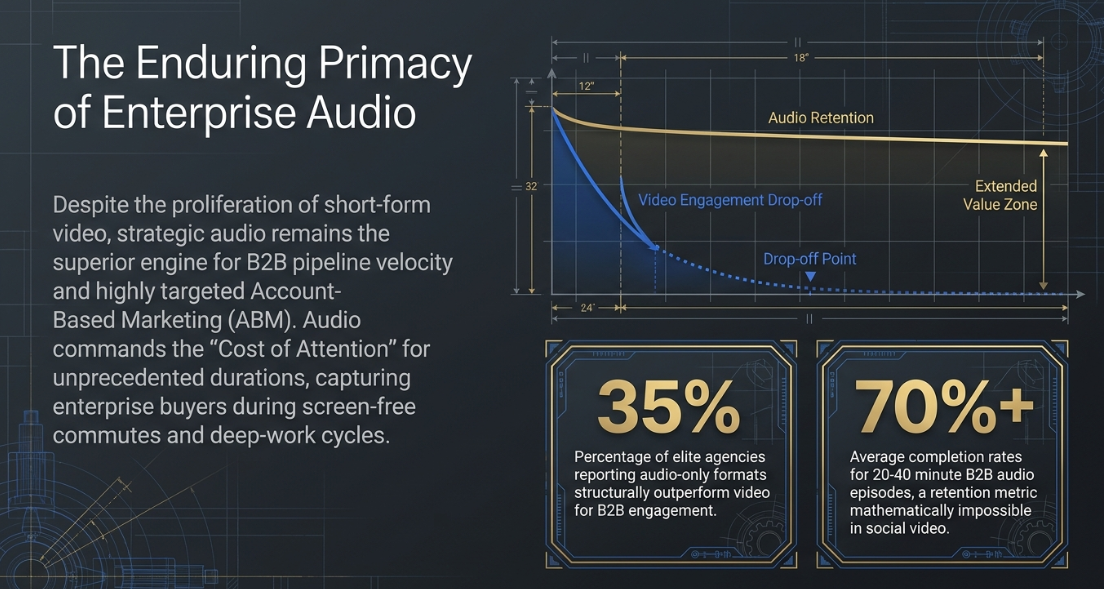
The enterprise audio landscape has undergone a profound, structural transformation over the past decade, evolving from a peripheral, experimental marketing endeavor into a core operational and revenue-generating engine. In the contemporary business-to-business (B2B) environment, strategic podcast marketing transcends traditional brand awareness paradigms, establishing itself as a multi-dimensional tool uniquely capable of driving pipeline velocity, facilitating highly targeted account-based marketing (ABM), and fortifying internal corporate communications infrastructure. Despite the rapid proliferation of short-form video formats and the broader pivot toward visual media, comprehensive industry analyses reveal that audio-only formats consistently deliver stronger overall performance and engagement metrics for enterprise brands. Approximately thirty-five percent of elite podcast production agencies assert that audio-only formats outperform video, emphasizing the enduring primacy of content quality and listener intimacy over superficial, transient format trends.1
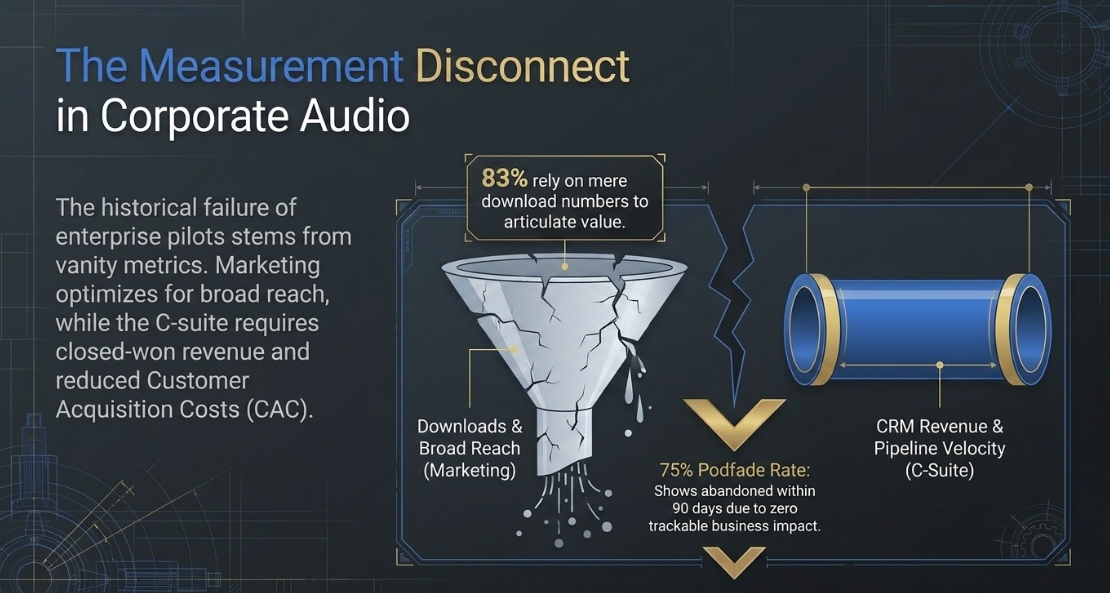
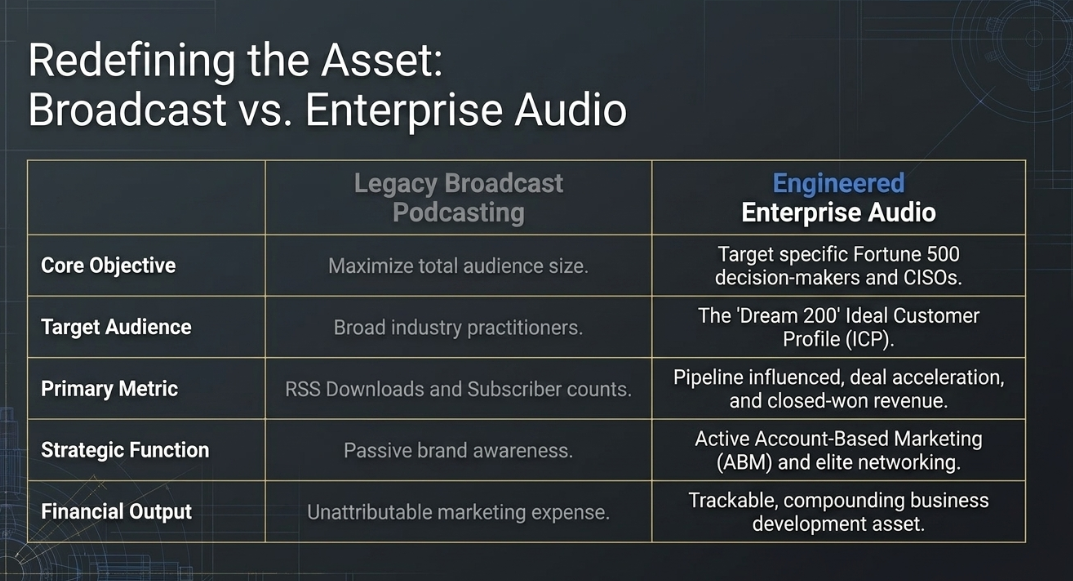
The maturation of this medium demands a rigorous, financially grounded approach to building the business case for corporate audio. Historically, the podcasting industry suffered from a massive strategic misalignment between the metrics utilized by marketers to gauge success and the actual financial outcomes required by executive stakeholders in the C-suite. The historical reliance on legacy vanity metrics—such as sheer download volume, subscriber counts, and basic completion rates—has proven wholly inadequate for justifying enterprise-level budget allocations in an era of stringent fiscal scrutiny. Entering the latter half of the 2020s, trackable return on investment (ROI) remains the single most significant constraint impacting client success within the podcast agency ecosystem, affecting a substantial portion of production initiatives and often leading to the premature cancellation of promising shows.2 Paradoxically, despite immense advancements in sophisticated analytical tools and multi-touch attribution software, an overwhelming majority of agencies—approximately eighty-three percent—and internal marketing teams continue to rely primarily on mere download numbers to articulate their value proposition to clients and leadership.
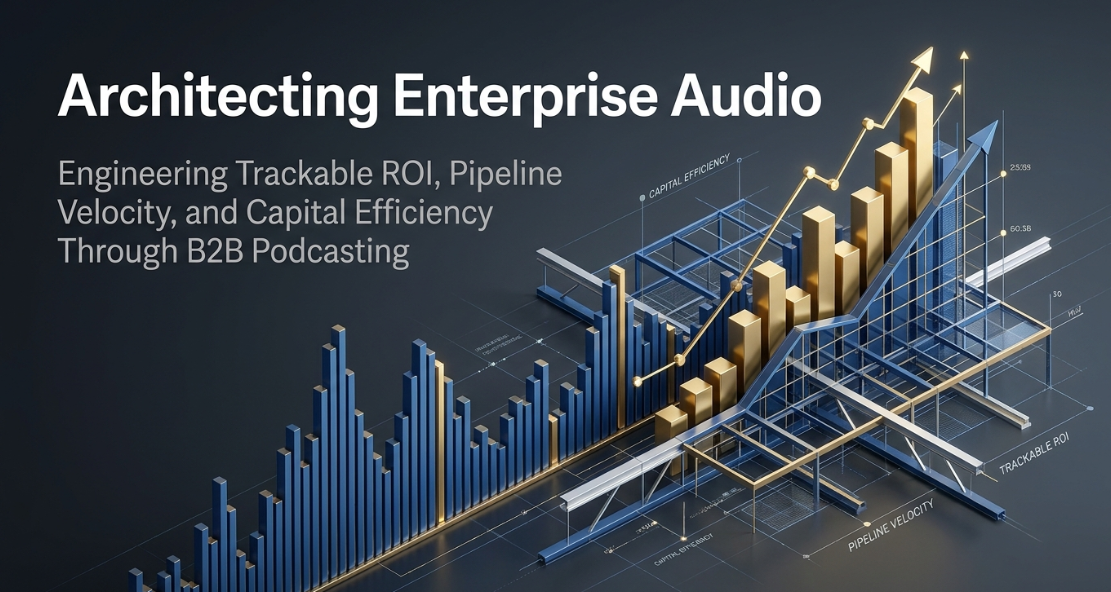
This comprehensive analysis systematically dismantles the archaic paradigms of corporate audio measurement, presenting an exhaustive, empirically backed framework for understanding the economics of enterprise podcasting. By rigorously quantifying ROI through advanced attribution models, detailing the complex cost structures of professional production, and outlining a meticulous, step-by-step operational plan, this report provides the strategic architecture necessary to secure executive buy-in. Furthermore, it explores the critical bifurcation of enterprise podcast utility, examining both external revenue-generation strategies—such as the highly lucrative practice of guest-side relationship monetization—and internal communication deployments secured via enterprise-grade hosting and single sign-on (SSO) infrastructure. The ensuing analysis demonstrates incontrovertibly that when executed with operational precision and meticulously aligned with revenue operations, a B2B podcast functions not merely as a passive broadcast channel, but as a high-yield, compounding asset for comprehensive business development.
The Economics of Corporate Audio: Cost Structures and Capital Allocation
To construct a viable and persuasive business case for enterprise audio, it is essential to first understand the capital requirements, financial models, and opportunity costs governing podcast production. The economics of corporate audio span a remarkably wide spectrum, dictated by desired production quality, publication frequency, technical infrastructure, and the extent of outsourced agency support. The failure of many enterprise pilots stems from a fundamental misunderstanding of the "cost of experiment." As observed in adjacent technological deployments, such as enterprise artificial intelligence integration, buyers are increasingly optimizing for the predictable cost of the experiment. Organizations are no longer asking how much the raw infrastructure costs; they are demanding to know the true cost of achieving a reproducible, safe, and useful business result fast enough to impact the quarterly balance sheet.4 In podcasting, optimizing for initial demo quality while ignoring the long-term economics of sustained production inevitably leads to operational fatigue and project abandonment.
Accounting Profit vs. Economic Profit in Podcast Production
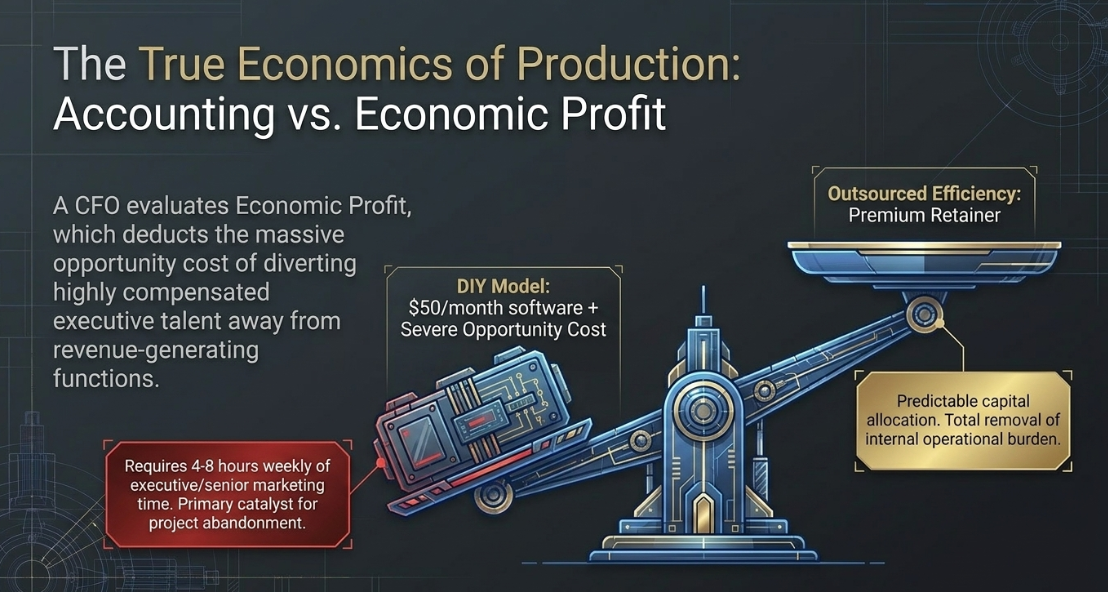
A sophisticated analysis of enterprise podcast budgets requires differentiating between accounting profit and economic profit. When utilizing an enterprise budget to forecast the viability of a corporate audio initiative, standard accounting profit calculates the total cash earnings of the enterprise minus all direct dollar costs, such as software licenses and agency retainers.5 However, economic profit—the metric that truly matters to a Chief Financial Officer (CFO)—deducts both direct dollar costs and opportunity costs from total revenue.5
The concept of opportunity cost is particularly devastating to the popular "Do-It-Yourself" (DIY) model of corporate podcasting. While a DIY approach may incur minimal accounting costs—perhaps limited to a fifty-dollar monthly software subscription—it extracts a massive opportunity cost by diverting highly compensated internal talent away from their core, revenue-generating functions.6 Internalizing the entire podcasting lifecycle is structurally less efficient than outsourcing.8 Operating a basic, internally managed podcast routinely demands four to eight hours of executive or senior marketing time per week.7 When the hourly compensation of these executives is factored into the economic model, the true, hidden cost of an internal "free" podcast frequently exceeds the monthly retainer of a premium, full-service podcast production agency. Consequently, this heavy internal burden is the primary catalyst for "podfade," a phenomenon where seventy-five percent of new shows cease production within their first ninety days.
Granular Cost Components and Production Tiers
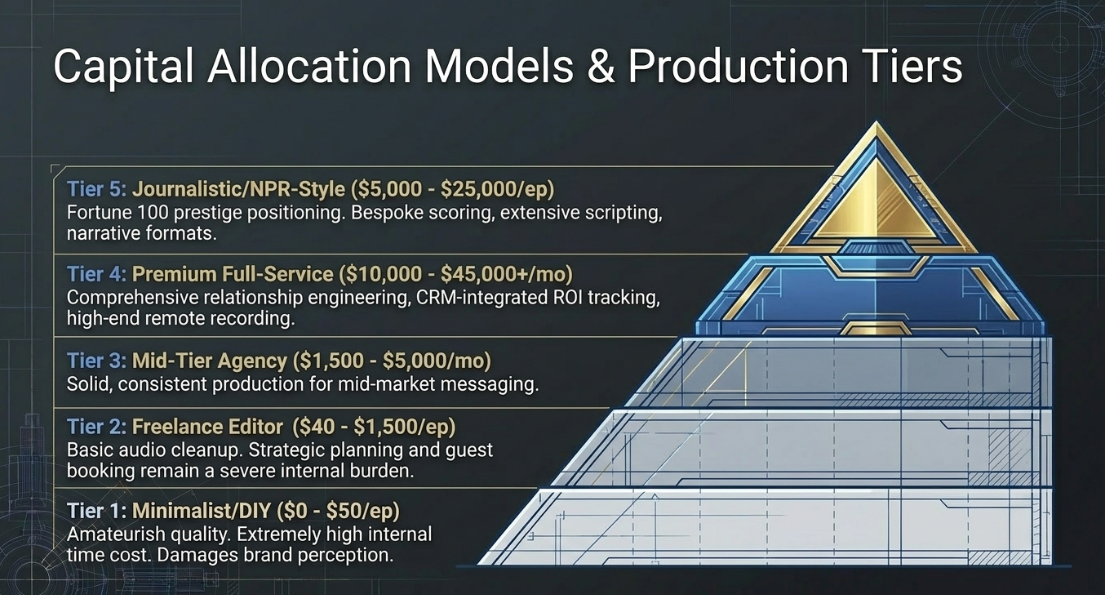
The financial landscape of B2B podcast production is generally categorized into distinct tiers, each aligning with different strategic objectives, target audiences, and resource availability. Capital allocation must reflect the desired business outcome. A show designed to build broad, general brand awareness may tolerate mid-tier production quality, whereas an ABM-aligned podcast targeting Fortune 500 Chief Information Security Officers (CISOs) or procurement leaders demands premium, broadcast-quality execution to effectively mirror the enterprise's brand equity.10
The following table provides a comprehensive breakdown of the granular cost components associated with various stages of enterprise podcast production, illustrating the vast delta between basic execution and journalistic, enterprise-grade output.6
When establishing the capital requirements for the operational plan, enterprises must also account for specific recording infrastructure. While physical studio rentals for in-person interviews range from $50 to $100 per hour (limiting geographic flexibility and increasing scheduling friction for high-level executive guests), the industry standard for B2B interviews has shifted to professional remote recording platforms.7 These platforms, which provide high-quality, uncompressed audio, separate track recording for each participant, and redundant cloud backups, typically incur software costs of $20 to $40 per month per host.
Formulating the Business Case and Overcoming the Cost of Inaction
Presenting the business case for an enterprise podcast to executive stakeholders—specifically the Chief Executive Officer (CEO), Chief Financial Officer (CFO), and Chief Revenue Officer (CRO)—requires mastering the lexicon of business impact. Executives are structurally isolated from the day-to-day nuances of content creation; they are exclusively concerned with capital allocation, market share expansion, operational efficiency, and risk mitigation.13 Approaching the C-suite with a pitch centered on "increasing brand awareness" or "fostering innovative conversations" is a guaranteed path to budget denial.15
The architecture of a successful executive pitch begins with the GOST method: defining Goals, setting SMART Objectives, developing Strategies, and identifying Tactics.16 In this framework, the podcast is merely the tactic. Its existence must directly map backward to an overarching, quantifiable corporate goal, such as reducing customer acquisition cost (CAC), accelerating complex enterprise sales cycles, or establishing thought leadership in a newly entered vertical market.16
When addressing senior decision-makers, marketers must tap into the specific drivers that appeal to the C-suite. This involves demonstrating how the podcast's relationship-building capabilities can directly infiltrate target accounts, bypass traditional procurement gatekeepers, and initiate discovery calls that raise overall revenues and market share.14 Furthermore, the podcast must be positioned as a supreme engine of cost efficiency. A single, high-level podcast interview can be systematically fractionalized and repurposed into multiple blog posts, LinkedIn micro-content, newsletter features, and dedicated sales enablement assets. This cross-channel content engine drastically reduces the need for isolated, disparate content creation expenditures across the marketing department.
Leveraging the Cost of Inaction (COI) in the Business Case
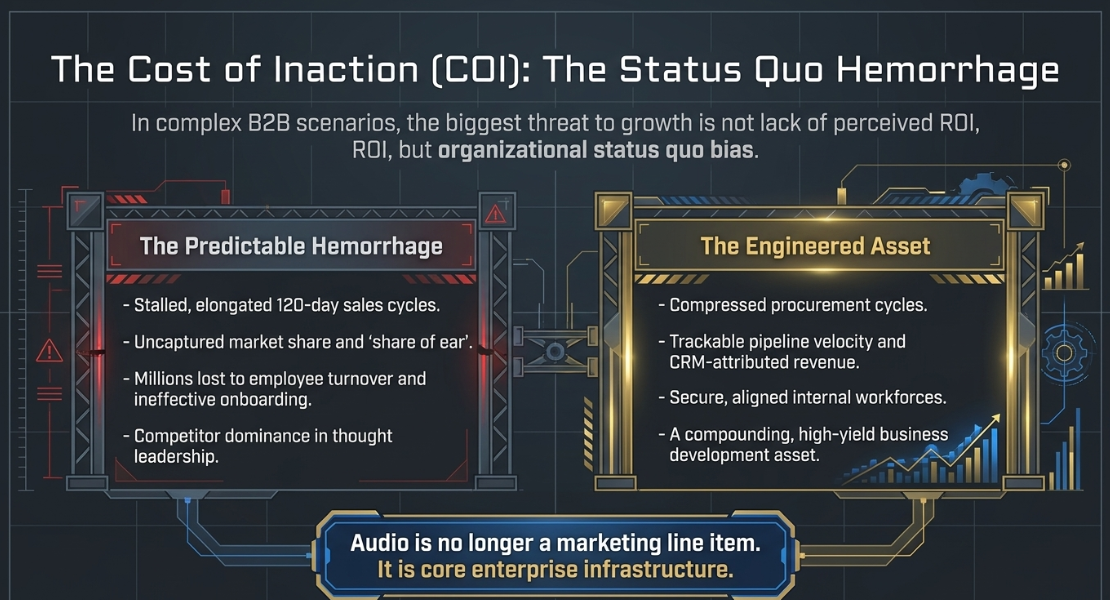
The most potent psychological and financial lever available to marketers pitching an enterprise podcast is the concept of the "Cost of Inaction" (COI). In complex B2B sales, internal procurement, and organizational change management, buyers frequently default to inaction and maintain the status quo, even when they acknowledge that organizational change is desperately needed.18 The status quo bias is the primary reason enterprise deals stall, not a lack of perceived ROI.19
When building the business case, marketers must explicitly quantify what the organization loses by failing to deploy an audio strategy while their direct competitors actively seize the market's "share of ear".16 The COI represents the hidden operational and financial waste generated by relying on outdated, fragmented marketing and communication methods.21 By contrasting the predictable financial hemorrhage of the status quo—manifested through uncaptured market share, elongated and stalled sales cycles, and competitor dominance in thought leadership—against the streamlined efficiency and relationship-building power of a centralized audio strategy, internal champions can compellingly justify the investment and overcome executive hesitation.19
The Measurement Paradigm: Deconstructing Podcast ROI Metrics
The strategic disconnect in enterprise podcasting runs deeply through its measurement frameworks. According to extensive analyses of hundreds of B2B podcasts, marketing departments frequently create content optimized for broad "industry trends" to maximize shareability and top-of-funnel reach, while their sales teams desperately need direct access to niche, enterprise-level buyers.11 They interview consultants and authors when they should be building relationships with potential customers, resulting in an operationally sound, professionally produced podcast that registers high download numbers but contributes absolutely zero attributable revenue to organizational growth.11 Overcoming this structural disconnect requires a complete paradigm shift, moving the measurement framework from foundational volume metrics to deep engagement and explicit business impact indicators.
The 11 Key Performance Indicators of Enterprise Audio
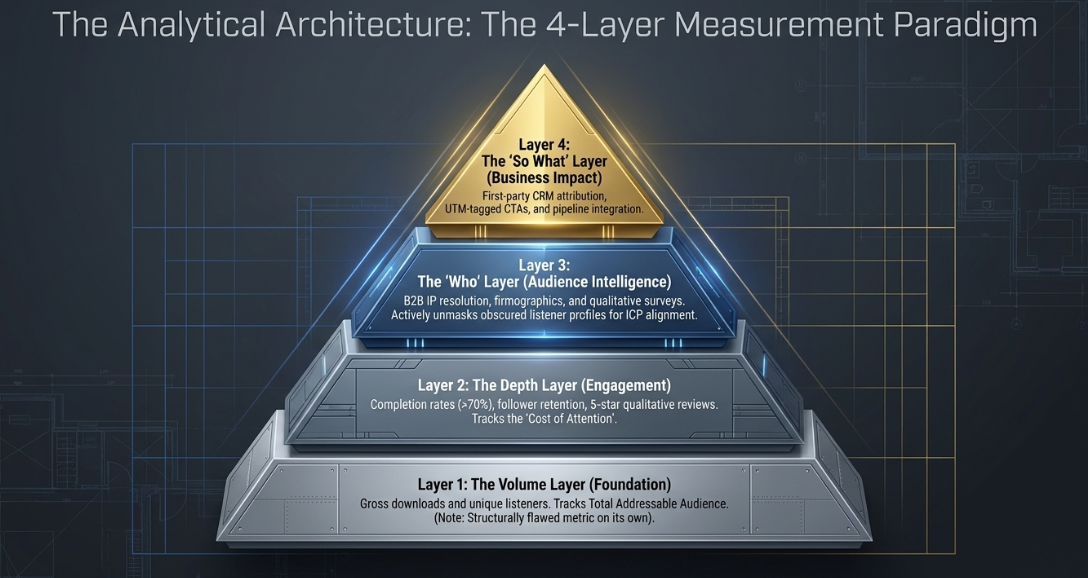
To successfully prove ROI to the C-suite in 2026, enterprise marketers must report on an elevated set of eleven Key Performance Indicators (KPIs) that track the prospect's journey from initial reach to finalized, closed-won revenue.23 These metrics are categorized into four distinct layers of analytical depth:
1. Foundation Metrics (The Volume Layer): Historically the default, metrics such as gross downloads and unique listeners represent the absolute baseline of audience reach. While necessary for understanding the total addressable audience size, a download is a fundamentally flawed metric; it merely indicates that an audio file was requested by a server, offering no guarantee that the episode was actually consumed by a human listener.23 For niche B2B podcasts targeting specific enterprise accounts, success does not require massive numbers; reaching a small, highly targeted group of fifty key decision-makers yields a vastly larger business impact than reaching ten thousand irrelevant consumers.25
2. Engagement Metrics (The Depth Layer): Assessing the "Cost of Attention" is a critical strategic advantage of the audio medium. Podcasts are highly cost-effective compared to other digital marketing mediums because they hold user attention for unprecedented durations. Average completion rates—often exceeding seventy percent for episodes lasting twenty to forty minutes—alongside detailed consumption data provided by Apple Podcasts and Spotify dashboards, reveal whether the content legitimately holds audience interest.25 Follower retention rates over time, coupled with unprompted, qualitative five-star ratings and reviews, serve as strong secondary indicators that listeners are highly engaged and developing a deep affinity for the brand.25
3. Audience Intelligence Metrics (The "Who" Layer): Because major consumer podcast platforms intentionally obscure granular demographic data (such as job titles, industries, and firmographics to protect user privacy), B2B enterprises must actively unmask their listener profiles. This is achieved through a combination of specialized B2B hosting platforms that resolve IP addresses to specific corporate entities, alongside active audience communication. Utilizing in-episode call-outs, social media community building, and qualitative listener surveys allows brands to verify they are hitting their specific target demographic and aligning with the Ideal Customer Profile (ICP).23
4. Business Impact Metrics (The "So What" Layer): The ultimate justification for the podcasting budget lies in integrating podcast engagement data directly with Customer Relationship Management (CRM) systems like Salesforce or HubSpot.11 This requires moving beyond general brand awareness and capturing first-party attribution data. By mapping listener and guest activity directly to CRM records, organizations can track multi-touch attribution, identifying instances where prospects consumed multiple episodes prior to engaging in an inbound action.11 Specific mechanisms include UTM-tagged calls-to-action (CTAs) within show notes, dedicated vanity URLs mentioned during the audio read, and self-reported attribution (e.g., adding a mandatory "How did you hear about us?" field on inbound demo request forms or addressing it directly during initial discovery calls).
Revenue Attribution, Pipeline Influence, and Deal Acceleration
A revenue-first measurement framework evaluates the corporate podcast strictly based on its direct, trackable influence on the sales pipeline. Sophisticated enterprises track the conversion of listeners and guests into qualified sales opportunities, measuring both pipeline influenced and revenue directly attributed to the show.11
Furthermore, B2B podcasts act as a powerful, scientifically proven catalyst for pipeline velocity and deal acceleration. Prospects who consistently engage with podcast content build parasocial relationships and deep psychological trust with the host, who is typically a senior executive or subject matter expert within the enterprise. This preemptive trust severely mitigates friction during the complex procurement process. Empirical data indicates that podcast-engaged prospects move through sales stages up to forty percent faster than equivalent leads acquired through standard, impersonal inbound marketing channels.11
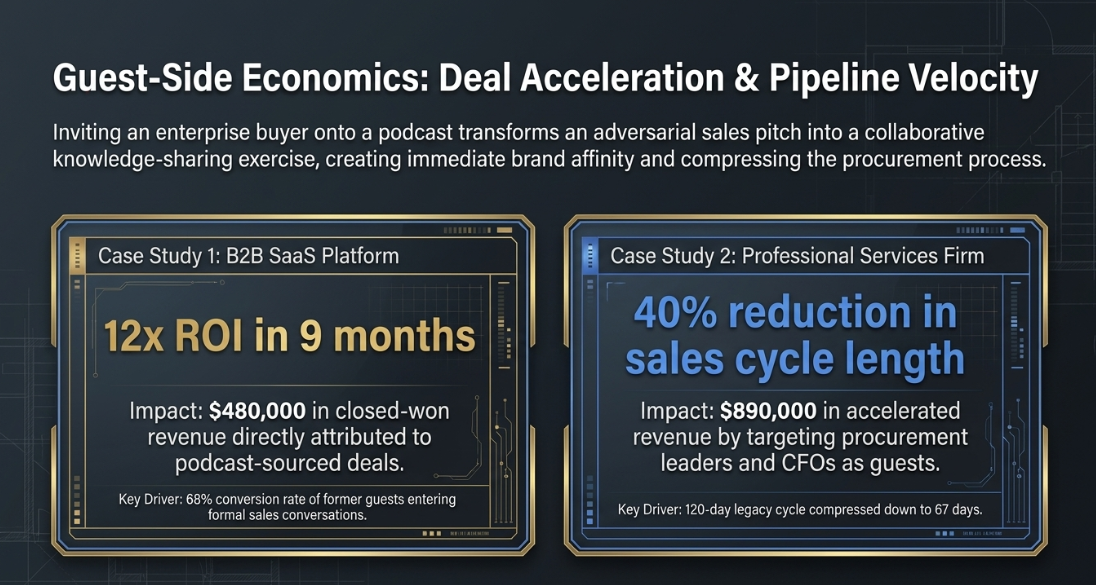
In one notable case study, a professional services firm struggling with a bloated, 120-day average sales cycle deployed a podcast to bypass traditional gatekeepers. By systematically targeting procurement leaders and CFOs as guests to discuss digital transformation, the firm compressed the buying cycle dramatically. The average deal cycle dropped to just 67 days for podcast-influenced opportunities, resulting in $890,000 in accelerated revenue and a forty percent reduction in overall sales cycle length.11 By tracking the Average Contract Value (ACV) of these podcast-sourced deals against standard marketing-qualified deals, marketers can demonstrate a clear, undeniable financial uplift that resonates perfectly with the C-suite's goals.11
The Dual-ROI Framework: Guest-Side vs. Listener-Side Value Creation
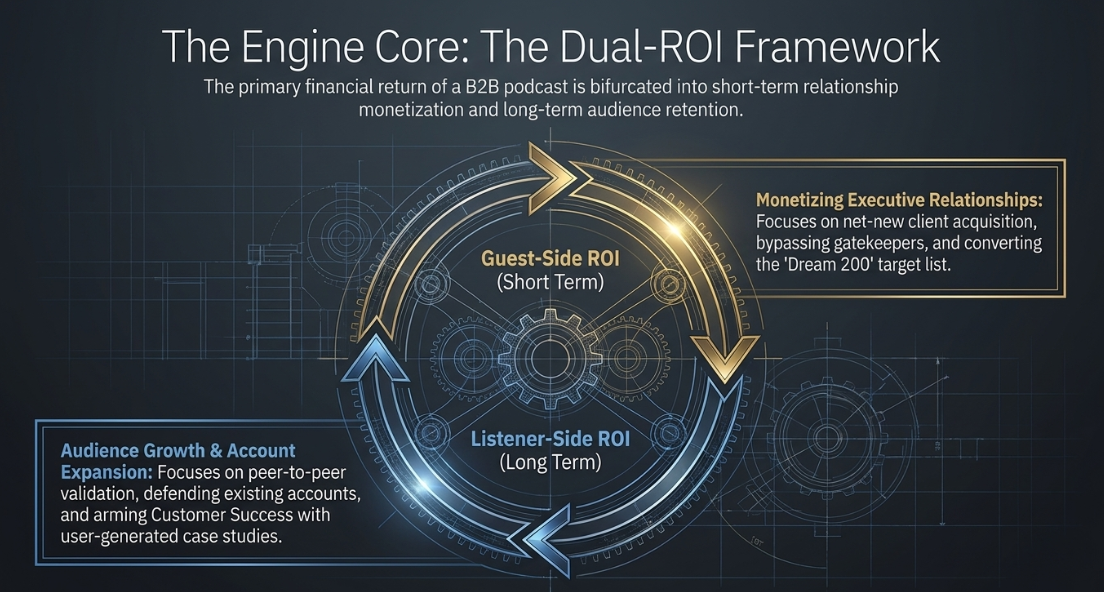
Perhaps the most profound paradigm shift in modern enterprise audio strategy is the realization that the primary financial return of a B2B podcast frequently does not derive from the listening audience, but rather from the individuals invited onto the show as guests. This realization establishes the Dual-ROI Framework, which bifurcates the economic value of the medium into short-term, relationship-driven "Guest-Side ROI" and long-term, audience-driven "Listener-Side ROI".
Monetizing Executive Relationships (Guest-Side ROI)
By shifting the operational focus from building a massive audience to building a hyper-targeted guest list, the podcast transforms from a top-of-funnel marketing broadcast into an elite, frictionless networking asset.11 This methodology, often formalized as the "Dream 200" framework, prioritizes the strategic selection of guests who match the exact ICP—potential buyers, strategic partners, and high-level decision-makers—over mass appeal.7
When an enterprise buyer is invited to share their expertise on a podcast, the dynamic immediately shifts from a defensive, adversarial sales pitch to a collaborative, flattering knowledge-sharing exercise. This creates immediate, powerful brand affinity.26 Because the barrier to profitability in B2B enterprise sales is remarkably low due to high contract values, a podcast requiring a year-one investment of $20,000 to $30,000 can become entirely cash-flow positive by converting just one or two guests into closed-won sales. Consequently, all subsequent audience-building metrics and brand awareness become essentially free byproducts of a profitable sales strategy.11
Rigorous analyses of over one hundred B2B podcasts reveal that shows prioritizing systematic guest outreach, relationship maintenance, and pipeline tracking generate twenty-five to fifty percent higher ROI within their first year compared to shows focused solely on traditional audience growth.11 A compelling example of this strategy in action is a B2B SaaS platform that achieved a staggering 12x ROI within just nine months. By utilizing a guest-centric approach and tracking self-reported data alongside UTM-tagged assets during sales calls, they attributed $480,000 in closed-won revenue directly to podcast-sourced deals. Crucially, they achieved a sixty-eight percent conversion rate of former guests entering into formal sales conversations.11 The success of this approach is entirely dependent on post-interview discipline; relationships must be nurtured without immediate, aggressive pitching, creating natural conversion opportunities that traditional content marketing simply cannot match.11
Audience Growth, Account Retention, and Expansion (Listener-Side ROI)
While Guest-Side ROI serves as the primary engine for short-term cash flow and net-new client acquisition, Listener-Side ROI builds long-term enterprise value, establishes market authority, and creates deep defensive moats around existing client accounts. While initially conceived strictly as top-of-funnel lead generation mechanisms, B2B podcasts possess immense, often overlooked utility as customer success and account expansion tools.26
A detailed case study of a specialized cybersecurity firm highlights this phenomenon beautifully. Originally launching an ABM-aligned podcast with surgical precision to generate leads among enterprise CISOs, the firm quickly discovered that the show had organically evolved into its most potent retention asset. By featuring existing clients as guests to discuss their successful software implementations and security triumphs, the firm generated a virtuous cycle of peer-to-peer validation.11 This dynamic positioned customers as industry experts, created high-value peer learning opportunities, and inadvertently generated localized "FOMO" (Fear Of Missing Out) among competing accounts listening to the show.
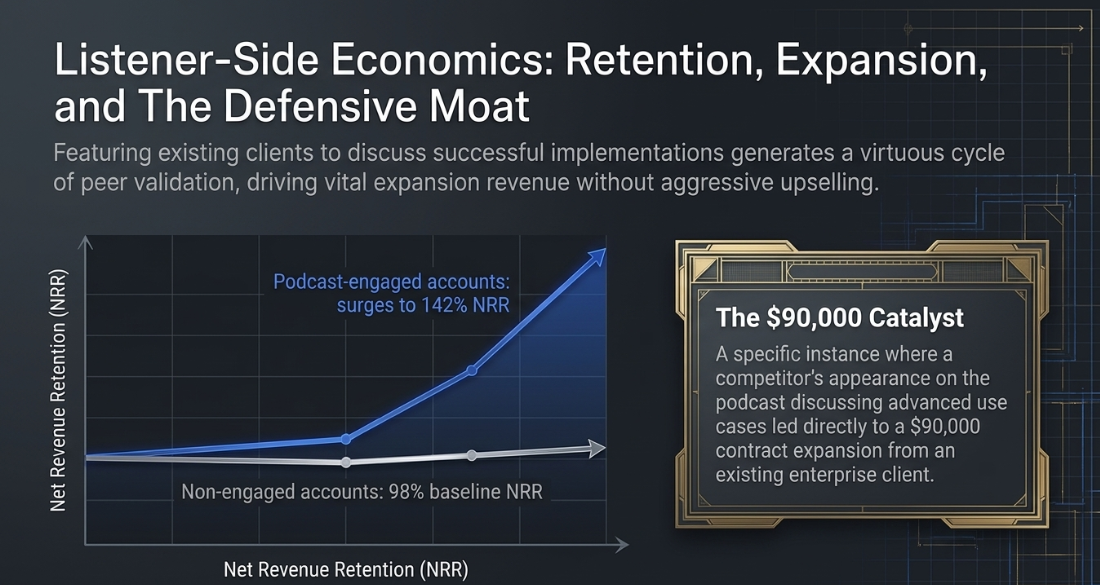
The financial impact on the cybersecurity firm's bottom line was stark and highly measurable. The Net Revenue Retention (NRR) for customers actively engaged with the podcast reached 142%, compared to a baseline of 98% for non-engaged accounts.26 Furthermore, this rich, user-generated content armed the firm's customer success division with organic, high-quality case studies, driving massive account expansion. In one highly specific instance, a competitor's appearance on the podcast discussing advanced software use cases directly led an existing enterprise client to expand their contract by $90,000.26 This comprehensive approach to podcast ROI proves that the medium extends far beyond new customer acquisition, driving vital retention uplift and expansion revenue.
Projecting Impact with the B2B Podcast ROI Calculator
To move these concepts from theoretical strategy to actionable financial projections, enterprises utilize specialized modeling tools like the B2B Podcast ROI Calculator. By inputting specific variables related to the show's operational cadence and the company's financial baselines, organizations can calculate projected revenue impact and pipeline value.11
The critical inputs required for this modeling include the planned number of episodes per month, the average anticipated downloads per episode, the company's average sales deal size (e.g., $50,000), the historical sales close rate percentage, and the total monthly podcast production cost.11 Furthermore, the model adjusts based on the guest strategy, requiring the user to select the seniority level of the guests (C-Level, VP/Senior Manager, or Individual Contributor) and whether the enterprise is explicitly targeting guests who could become customers or partners. By computing these variables, the calculator generates projected monthly leads, annual deals closed, total pipeline value, and an annualized ROI multiplier, providing the CFO with a rigorous, data-driven forecast prior to budget approval.11
Brand Lift, Advertising Economics, and Market Influence
For enterprises seeking to directly monetize their audio assets through external sponsorships, or for brands utilizing the podcast medium as an advertising channel rather than producing their own original content, the economic data heavily favors audio over traditional digital media. The intimate, opt-in nature of podcasting translates into exceptional advertising economics.
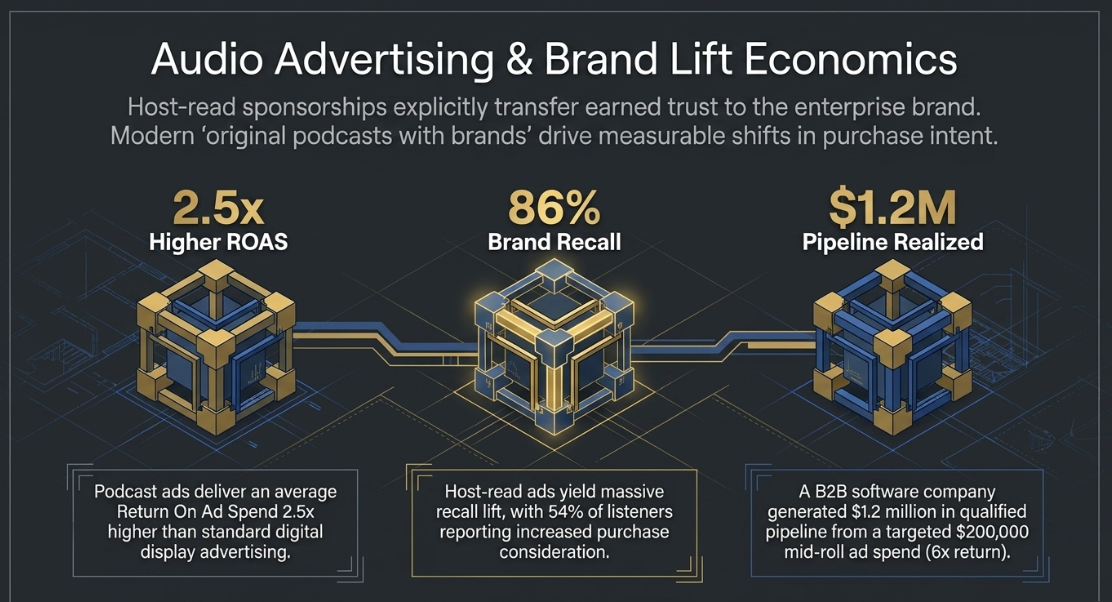
Recent industry studies demonstrate that podcast advertisements consistently deliver an average Return on Ad Spend (ROAS) that is 2.5 times higher than standard digital display advertising.27 Host-read advertisements—where the trusted voice of the podcast implicitly endorses the product—are particularly effective, yielding an eighty-six percent increase in brand recall.27 Furthermore, fifty-four percent of podcast listeners explicitly state they are more likely to consider purchasing from a brand after hearing it advertised on a podcast, generating robust conversion rates that typically hover between 1.5% and 5%, depending on industry targeting and ad placement.27
The financial returns of strategic podcast advertising are validated across diverse industry sectors:
Direct-to-Consumer (DTC) Scaling: A wellness brand invested $50,000 in highly targeted, host-read podcast advertisements. Within three months, the campaign generated a 300% ROI, resulting in over 12,000 new customer signups. Crucially, forty percent of these new customers self-reported that they first heard about the brand through the podcast sponsorship, proving the medium's top-of-funnel efficacy.27
B2B SaaS Pipeline Generation: A business software company executed a $200,000 ad spend on mid-roll podcast advertisements specifically targeting shows listened to by marketing leaders. This targeted investment generated $1.2 million in qualified pipeline revenue, representing a massive 6x return on investment.27
Nonprofit and Advocacy Impact: Utilizing podcast sponsorships to raise awareness, a nonprofit organization achieved a seventy-five percent brand lift among their target demographic, subsequently experiencing a 2.5x increase in donations within a six-month window.27
The Evolution of Branded Content: Original Podcasts with Brands
When enterprises choose to produce their own content, they often partner with elite, specialized agencies like Pacific Content (acquired by Lower Street) or Caspian Studios to craft highly narrative, emotionally resonant shows. The industry has largely moved away from the archaic term "branded podcast," which historically carried a pejorative connotation of being second-rate, thinly veiled marketing material.28 Instead, the modern paradigm focuses on creating "original podcasts with brands," emphasizing collaboration and customer-focused storytelling that rivals traditional media networks.28
The ROI of these narrative shows is measured through third-party brand lift studies, which scientifically assess how a podcast influences consumer behavior by comparing the responses of podcast listeners to a control group of non-listeners.25 This research consistently proves that branded audio drives real shifts in brand awareness, affinity, and purchase intent.25
Prominent case studies illustrate this prestige approach. Tell Me What Happened, a multiple award-winning podcast produced by Pacific Content for OnStar, chronicles inspiring true stories of people making a difference in moments of crisis, such as a hiker suffering burns in Iceland. The show reached #22 in the highly competitive US Relationships podcast chart, successfully amplifying OnStar's core brand values of safety and reliability without ever resorting to direct sales pitches.31 Similarly, Nickel & Crime, a true-crime podcast produced by Lower Street for the financial services company Early Warning, explores insidious white-collar banking corruption. By wrapping practical financial safety tips in a highly engaging, narrative true-crime format, the brand successfully captured audience attention and established deep thought leadership in the financial security sector.
Internal Communications: The Economics of Employee Engagement and Security
The application of enterprise audio extends far beyond external marketing, public relations, and sales enablement. When utilized for internal communications (IC), private corporate podcasts serve as highly effective, scalable mechanisms for organizational alignment, complex change management, and establishing authentic leadership visibility.32 As distributed workforces, hybrid models, and remote operating structures become permanently entrenched, legacy internal communication formats—such as static, difficult-to-navigate intranet portals and easily ignored mass corporate emails—suffer from severely diminishing returns and widespread employee disengagement.21
Transitioning from Vanity to Business Value in Internal Comms
Building a business case for an internal podcast requires completely pivoting away from the traditional vanity metrics beloved by legacy communications departments—such as email open rates, intranet page views, or simple "likes" on an internal social feed.21 When internal communication is viewed merely as a transactional business function evaluated by these superficial metrics, it becomes viewed by the C-suite as a cost center ripe for disruption or automation.35 The modern corporate boardroom views internal communication platforms through the lens of business impact, evaluating them as critical vectors for risk reduction, operational efficiency, and hard cost savings.21
To secure budget in 2026, IC teams must translate communication problems into financial and operational realities.21 As articulated in industry analyses of the transport sector, executives do not care if an employee simply "saw the message"; they need to know if the message resulted in measurable behavioral change.21 Effective internal audio programs are financially justified by measuring their impact on:
Safety, Compliance, and Risk Mitigation: Tracking tangible increases in digital safety or near-miss reporting. Audio allows deskless frontline workers or traveling sales representatives to consume mandatory compliance updates while commuting or working, rather than forcing them to log into a static portal, thereby closing dangerous compliance gaps.21
Employee Retention and Onboarding Velocity: Employee turnover represents a massive capital drain on the enterprise. Human-centered, scalable audio stories dramatically accelerate the onboarding process, assimilating new hires into the corporate culture, values, and operational tempo faster and more intimately than a sterile PDF handbook.32 By improving general communication and removing daily organizational friction, the internal podcast indirectly drives higher overall retention rates, saving the company millions in recruitment and training costs.21
Managerial Efficiency and Overhead Reduction: By utilizing an internal podcast as a centralized, easily accessible repository for leadership updates, learning and development (L&D) training, and sales enablement resources, organizations can reclaim thousands of hours of highly paid managerial time previously squandered on conducting repetitive, manual status briefings.21 Furthermore, digitizing communications eliminates the physical overhead of printing and distributing paper newsletters to remote sites.21
Enterprise Security and Private Hosting Infrastructure
Distributing internal corporate audio necessitates entirely different technological infrastructure compared to public-facing B2B podcasts. Consumer-grade RSS feeds are inherently public and insecure; an unlisted link can be easily forwarded, inadvertently exposing sensitive corporate data, strategic M&A pivots, or proprietary sales training material to competitors and the public domain.24 Consequently, enterprises must utilize specialized, private hosting platforms equipped with military-grade security protocols, advanced access controls, and robust IT compliance certifications.24
The security architecture of an enterprise internal podcast relies on several critical technological implementations:
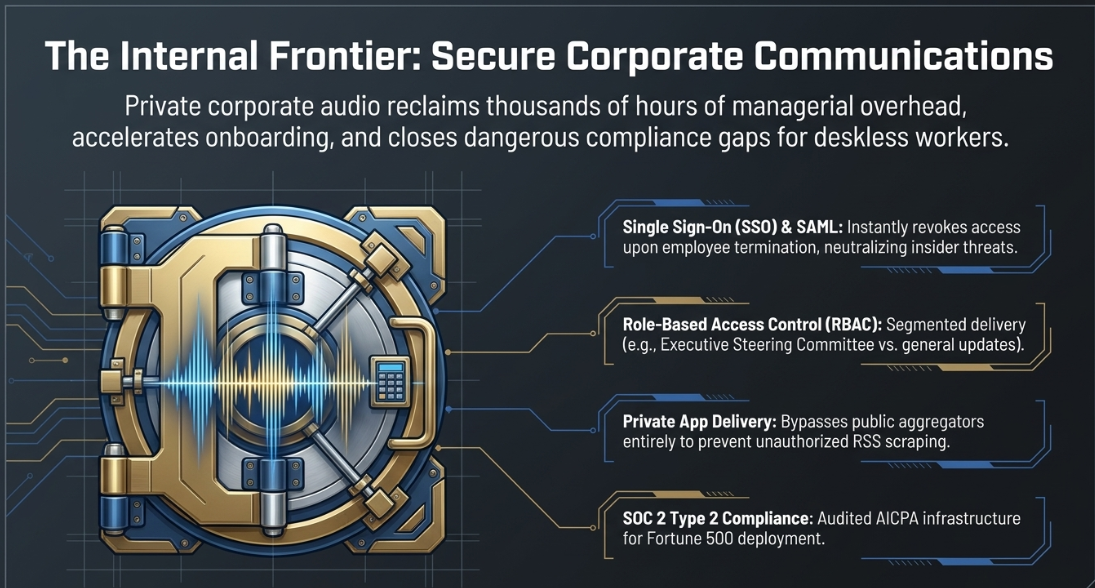
Single Sign-On (SSO): Integration via Security Assertion Markup Language (SAML) with the enterprise's existing central identity providers (e.g., Azure Active Directory, Google Workspace). SSO eliminates the need for secondary passwords, creating a seamless user experience. More importantly, it automatically revokes access to the podcast the exact moment an employee is terminated or transitions out of the company, neutralizing insider threats.24
Role-Based Access Control (RBAC): This feature allows administrators to assign granular permissions within the hosting platform based on the user's specific organizational tier or departmental function. This allows the enterprise to segment audio delivery; for example, a specialized financial briefing can be securely distributed solely to the executive steering committee, while general HR updates are broadcast company-wide.39
Private Application Delivery: To ensure maximum security, platforms like uStudio bypass traditional, consumer-facing podcast aggregators (like Apple Podcasts or Spotify) entirely. Instead, they deliver the audio content through a proprietary, branded desktop or mobile application controlled by the enterprise. This prevents unauthorized RSS feed scraping and provides a secure, distraction-free environment for consuming corporate messaging.24
SOC 2 Type 1 and Type 2 Compliance: To satisfy the rigorous IT security, legal, and procurement requirements of Fortune 500 enterprises, hosting providers must undergo third-party auditing by the American Institute of Certified Public Accountants (AICPA). Achieving SOC 2 compliance ensures the platform adheres to stringent, industry-standard protocols regarding data security, availability, and confidentiality.36
The market for secure internal audio is dominated by specialized platforms tailored to these enterprise requirements. uStudio operates a robust enterprise media cloud that heavily emphasizes private app distribution, supporting audio, video on demand, and live streaming while providing deep engagement analytics.24 Podbean Enterprise provides extensive SSO capabilities that easily accommodate large private member bases, automatically syncing with the organization's central identity provider to manage user access in real-time.24 Other platforms, such as Storyboard and Supporting Cast, offer varying degrees of app-based security and secure RSS feed management, ensuring that corporate communications remain strictly confidential.
The B2B Podcast Production and Distribution Workflow
Securing executive budget approval is merely the preliminary step; it must be immediately followed by flawless operational execution. B2B podcasts require a rigorous, standardized operational plan because poor audio quality, awkward conversational pacing, and erratic publishing schedules signal profound operational looseness to prospective buyers—the precise negative attribute vendors must avoid conveying at all costs.43 The workflow is not simply a linear content creation checklist; it is a complex, integrated business development pipeline.44
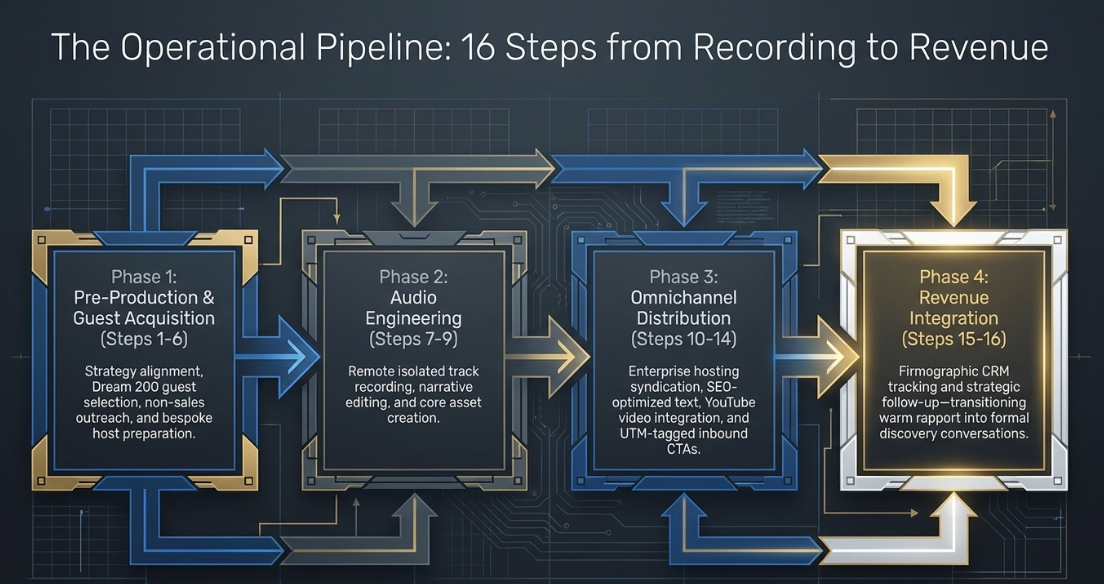
A robust enterprise podcast workflow seamlessly integrates pre-production strategic planning, high-fidelity technical recording, post-production audio refinement, and multi-channel content distribution. The industry standard workflow is broken down into a meticulous sixteen-step operational lifecycle 9:
Phase 1: Strategic Pre-Production and Guest Acquisition
Define the Strategy: Ensure the show's core thesis remains strictly aligned with the corporate business case (e.g., ABM targeting, partner co-marketing).
Plan the Topic: Identify specific, high-level themes that address the urgent pain points of the Ideal Customer Profile, avoiding generic industry fluff.
Select the Right Guest: Execute the Dream 200 methodology. Systematically target key decision-makers at prospective client organizations, procurement leaders, or influential industry partners.9
Clear Guest Outreach: Deploy highly personalized, non-sales-oriented invitations. The communication must focus entirely on elevating the guest's expertise and platforming their insights.
Run a Pre-Call Briefing: Conduct a short, preliminary meeting to establish human rapport, outline the narrative arc of the interview, and troubleshoot any technical or microphone issues prior to the actual recording day.
Prepare the Host: Equip the internal host with comprehensive, bespoke research on the guest's business and career trajectory, ensuring the conversation transcends superficial banter and provides genuine value.
Phase 2: Production and Audio Engineering 7. Record the Episode Properly: Utilize professional remote platforms (which record isolated, uncompressed local tracks) or physical studios to capture pristine audio and video.44 8. Edit for Clarity: Post-production must move far beyond simple noise reduction. Audio engineers edit to craft a compelling narrative, maintaining listener retention by aggressively removing tangential discussions, dead air, and optimizing conversational pacing.24 9. Create Core Assets: Develop the foundational episode elements, including custom branded cover art, professional intros, outros, and legally cleared musical sound design.44
Phase 3: Distribution and Omnichannel Repurposing 10. Publish the Podcast: Upload the finalized file to an enterprise-grade hosting platform for immediate syndication via RSS to Apple Podcasts, Spotify, and other major directories.44 11. Repurpose into Content: Transcribe the audio and convert the core insights into a massive content engine, generating SEO-optimized blog posts, corporate newsletters, and internal sales training documents.9 12. Create Guest Assets: Provide the guest with high-quality, pre-formatted promotional assets (such as branded quote graphics and short-form video clips) to remove all friction and facilitate organic sharing to their respective corporate networks.44 13. Promote the Episode: Distribute the content across all owned channels (company website, customer email lists) and social platforms. Given YouTube's ascendancy as a premier podcast search engine, uploading full video episodes and optimized clips is a strategic imperative for B2B brands.9 14. Add Internal CTAs: Embed internal links and specific Calls-to-Action within the show notes and promotional posts to direct inbound traffic toward designated landing pages, lead magnets, or CRM intake forms.44
Phase 4: Measurement, Follow-Up, and Revenue Integration 15. Track Performance: Continually monitor engagement depth, firmographic audience data, and attribution metrics within the marketing tech stack to evaluate ROI.44 16. Strategic Follow-Up: This is the most critical step for realizing Guest-Side ROI. The internal team must send personalized thank-you gifts to the guest, provide them with all promised assets, record useful activity within the CRM, and organically transition the warm rapport into a formal business development or discovery conversation.
The Technological Infrastructure: Hosting and Analytics
The underlying technology stack acts as the central command node for the entire enterprise audio strategy. Choosing the correct hosting and distribution platform is far more than a technical prerequisite; it is a foundational marketing decision that dictates audience reach, analytics granularity, and the scalability of the entire operation.46
Enterprise platforms diverge significantly from basic, amateur hosting solutions. CoHost (developed by the agency Quill), for instance, is purpose-built for B2B brands, providing deep listener intelligence and firmographic analytics that allow marketers to tie listenership directly to ABM initiatives and revenue alignment.47 Megaphone by Spotify offers a highly sophisticated, enterprise-level ad-tech stack, including dynamic ad insertion and programmatic sales, supported by robust team-based roles and permissions for managing complex workflows across multiple massive shows.46 Casted specializes as a comprehensive B2B suite, offering AI-powered content repurposing and advanced analytics that explicitly connect listening behavior to the sales pipeline and revenue, facilitating seamless, rapid integration with existing marketing tech stacks like HubSpot or Salesforce.36 Other legacy enterprise solutions, such as Libsyn Pro, cater to large networks prioritizing massive infrastructure, guaranteed uptime, and complex advertising workflows at scale.
Scaling the Architecture: The Enterprise Podcast Network Strategy
As enterprises scale their audio operations and seek to dominate their respective industries, managing a single, monolithic show often proves strategically insufficient for covering distinct, highly fragmented buyer personas. Attempting to address entry-level practitioners, mid-level managers, and C-suite executives within the same audio feed dilutes the content's relevance and alienates specific listener segments. To maximize authority across multiple verticals without compromising focus, forward-thinking B2B brands adopt a Podcast Network Strategy.50
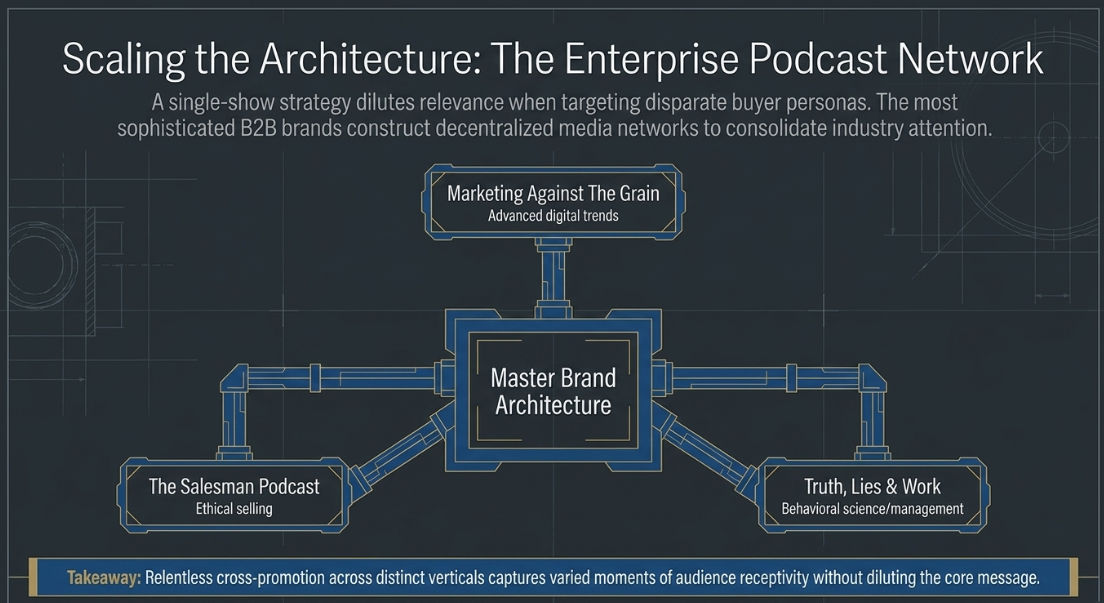
The HubSpot Podcast Network serves as the premier industry exemplar of this architectural approach. Launched in 2021, the network recognized that a single show could not adequately serve the diverse needs of modern business professionals.51 Rather than forcing a single podcast to cater to marketers, salespeople, founders, and customer success managers simultaneously, HubSpot aggressively acquired and developed a constellation of over twenty-five specialized shows.51 This includes Marketing Against The Grain (hosted by HubSpot CMO Kipp Bodnar and SVP Kieran Flanagan to discuss advanced digital trends), The Salesman Podcast (focused on modern, ethical selling techniques), My First Million (exploring market trends and entrepreneurial journeys), and Truth, Lies & Work (the UK's #1 management podcast exploring behavioral science and workplace culture).52
Each show within the network maintains a highly specific, fundamentally understood audience. This network strategy allows the enterprise to relentlessly cross-promote shows, capture varied moments of audience receptivity, and consolidate vast swaths of industry attention under a single master brand umbrella.50 Other major enterprises have successfully replicated this model; financial giant Charles Schwab operates four distinct shows to reach different demographics, while the B2B technology firm Drift manages five separate podcasts to leverage the varied expertise of their internal subject matter experts.50 By treating the enterprise not merely as a software or service vendor, but as a decentralized, multi-channel media entity, organizations can achieve unprecedented market dominance and "share of ear."
Synthesised Conclusions and Strategic Outlook
The era of viewing the corporate podcast as an experimental, low-stakes branding exercise has definitively concluded. As evidenced by the rigorous economic data, sophisticated production workflows, and advanced attribution methodologies outlined throughout this comprehensive report, enterprise audio is now a highly quantifiable, mature, and revenue-centric discipline.
The primary strategic insights shaping the future of corporate audio dictate that B2B enterprises must fundamentally optimize their podcasting operations to facilitate high-value relationships with strategic guests. By bypassing traditional procurement gatekeepers and utilizing the medium as an elite networking tool, the resulting compression of sales cycles and the acceleration of pipeline velocity easily justify the capital investment, entirely independent of mass listener adoption. Concurrently, the continued reliance on download numbers must be eradicated; integrating audio consumption data directly into CRM architecture establishes concrete, multi-touch revenue attribution, definitively proving the financial validity of the medium to the C-suite.
Furthermore, whether applied to external B2B sales acceleration or internal employee communications, the Cost of Inaction framework is vital for overcoming organizational inertia. The financial hemorrhage caused by elongated sales cycles, uncaptured market share, and employee turnover directly resulting from inferior communication strategies far outweighs the operational costs of implementing an enterprise-grade audio program. When utilized internally, the deployment of private podcasts utilizing secure, SOC 2 compliant, SSO-enabled infrastructure represents the next frontier of organizational alignment, reclaiming vast amounts of managerial time and fundamentally altering how distributed workforces consume critical corporate intelligence. To thrive in the highly competitive attention economy of the modern business landscape, organizations must treat audio with the same operational rigor and financial scrutiny applied to core software development or enterprise sales operations, transforming the podcast from a marketing line item into a compounding business development asset.
Works cited
CoHost Releases Annual Report on the State of Podcast Agencies in 2026, accessed June 5, 2026, https://soundsprofitable.com/press-release/cohost-releases-annual-report-on-the-state-of-podcast-agencies-in-2026/
CoHost Announces the Launch of the Second Annual State of Podcast Agencies Report, accessed June 5, 2026, https://podnews.net/press-release/announces-agencies-podcast-cohost-launch
The State of Podcast Agencies 2024 - CoHost, accessed June 5, 2026, https://www.cohostpodcasting.com/whitepapers-and-reports/the-state-of-podcast-agencies-2024
The One Metric That Explains Why So Many AI Pilots Never Get Off the Ground, accessed June 5, 2026, https://www.entrepreneur.com/entrepreneurs/the-one-metric-that-explains-why-so-many-ai-pilots-never-get-off-the-ground
Bulletin E-3410: Understanding Enterprise Budgets and Economic Profit, accessed June 5, 2026, https://www.canr.msu.edu/resources/bulletin-e-3410-understanding-enterprise-budgets-and-economic-profit
Podcast Production Costs For All Budgets (2026 Pricing Guide) - Talks.co, accessed June 5, 2026, https://talks.co/p/podcast-production-costs/
Podcast Production Pricing: B2B Packages, Costs & ROI | Rise25, accessed June 5, 2026, https://rise25.com/lead-generation/podcast-production-pricing/
How much does a branded podcast cost? [Guide 2022] - Intotheminds, accessed June 5, 2026, https://www.intotheminds.com/blog/en/how-much-branded-podcast-cost/
B2B Podcast Production Checklist: 10 Steps From Recording to Revenue, accessed June 5, 2026, https://rise25.com/lead-generation/b2b-podcast-production-checklist/
Podcast Production Cost for Business: 2026 Guide - ThePod.fm, accessed June 5, 2026, https://thepod.fm/resources/blog/podcast-production-cost-for-businesses
The Definitive Guide To Measuring B2B Podcast ROI And Pipeline ..., accessed June 5, 2026, https://www.fame.so/post/measuring-b2b-podcast-roi-and-pipeline
How Much Does Podcasting Cost? A Guide for B2B Companies (2026 Edition), accessed June 5, 2026, https://contentallies.com/learn/how-much-does-podcasting-cost-for-b2b-companies
Top B2B & Marketing Podcasts to Lead You to Succeed in 2025, accessed June 5, 2026, https://www.toprankmarketing.com/blog/b2b-marketing-podcasts/
Sales Podcast: Selling to C-Level and Senior B2B Decision Makers, accessed June 5, 2026, https://closingbigger.net/blog/selling-c-level-and-senior-decision-makers-b2b-sales/
B2B Marketers on a Mission - Apple Podcasts, accessed June 5, 2026, https://podcasts.apple.com/us/podcast/b2b-marketers-on-a-mission/id1518182058
Corporate Podcasting: 5 Guidelines for Launching & Producing Your Company Podcast, accessed June 5, 2026, https://www.flywheelassociates.com/blog/corporate-podcasting-guidelines
Enterprise Podcast Production Guide for B2B Brands - Content Allies, accessed June 5, 2026, https://contentallies.com/learn/enterprise-podcast-production-guide
The True Cost of Doing Nothing: How to Combat Status Quo in B2B Sales - Ecosystems.io, accessed June 5, 2026, https://www.ecosystems.io/blog/the-true-cost-of-doing-nothing-how-to-combat-status-quo-in-b2b-sales
B2B Sales Trends - Apple Podcasts, accessed June 5, 2026, https://podcasts.apple.com/us/podcast/b2b-sales-trends/id1540112247
Focusing On The Cost of Inaction to Close More Deals with Jen Allen-Knuth - YouTube, accessed June 5, 2026, https://www.youtube.com/watch?v=gDIQ7StloV8
How to build an internal comms ROI case that actually wins budget ..., accessed June 5, 2026, https://www.joinblink.com/intelligence/internal-comms-roi-tips
Scrappy ABM - Apple Podcasts, accessed June 5, 2026, https://podcasts.apple.com/us/podcast/scrappy-abm/id1693508482
11 KPIs Branded Podcasts Should Track to Prove ROI in 2026, accessed June 5, 2026, https://www.quillpodcasting.com/blog-posts/kpi-metrics-branded-podcasts-should-monitor
How to Create an Internal Company Podcast in 2026 | Lower Street, accessed June 5, 2026, https://lowerstreet.co/blog/internal-company-podcasts
The tools to keep in your metrics toolbox - Pacific Content, accessed June 5, 2026, https://pacific-content.com/whats-the-roi/
The Ultimate Guide To Measuring B2B Podcast ROI: From Downloads To Pipeline Attribution - Fame.so, accessed June 5, 2026, https://www.fame.so/post/ultimate-guide-to-measuring-b2b-podcast-roi
Podcast Advertising ROI: What the Data Says - - Command Your Brand, accessed June 5, 2026, https://commandyourbrand.com/podcast-advertising-roi-what-the-data-says/
The branded podcast as a new brand content strategy. Analysis, trends and classification proposal, accessed June 5, 2026, https://revista.profesionaldelainformacion.com/index.php/EPI/article/download/86961/63255
The ROI of Branded Podcasts in Marketing: The Untapped Goldmine, accessed June 5, 2026, https://jarpodcasts.com/roi-of-branded-podcasts-in-marketing/
The Ultimate Guide to ROI of Branded Podcasts (2024 Update) - JAR Podcast Solutions, accessed June 5, 2026, https://jarpodcasts.com/roi-of-branded-podcasts/
The Best Branded Podcasts of 2026 - Lower Street, accessed June 5, 2026, https://lowerstreet.co/blog/best-branded-podcasts
Internal Podcasts - JAR Podcast Solutions, accessed June 5, 2026, https://jarpodcasts.com/services/internal-podcasts/
Simpplr's ROI of Internal Communications Podcast Series, accessed June 5, 2026, https://www.simpplr.com/blog/2021/simpplrs-roi-of-internal-communications-podcast-series/
Stop Measuring the Wrong Things: How to Prove Internal Communications ROI, accessed June 5, 2026, https://redefiningcomms.com/blog/how-to-measure-internal-communications-roi-that-actually-matters/
IOIC, Institute of Internal Communication, Future of Internal Communication Podcast, accessed June 5, 2026, https://www.ioic.org.uk/insight-practice/podcast.html
How to Create a Private Podcast: A Step-by-Step Guide for Enterprises - uStudio, accessed June 5, 2026, https://ustudio.com/blog/podcasting/how-to-create-a-private-podcast/
Single Sign-on (SSO) for Business Accounts - Podbean Support, accessed June 5, 2026, https://help.podbean.com/support/solutions/articles/25000027958-single-sign-on-sso-for-business-accounts
Enterprise Podcast Solution - Podbean Support, accessed June 5, 2026, https://help.podbean.com/support/solutions/25000019804
Secure User Management for Your Private Podcast - uStudio, accessed June 5, 2026, https://ustudio.com/blog/podcasting/secure-user-management-for-your-private-podcast/
Podbean Achieves SOC 2 Type II Certification, Demonstrating Commitment to Enterprise-Level Data Security, accessed June 5, 2026, https://blog.podbean.com/enterprise-level-data-security/
How To Enable SSO (Single Sign On) for Business Podcast Accounts - YouTube, accessed June 5, 2026, https://www.youtube.com/watch?v=g7AlxaVWrWM
Best Private Podcast Hosting (For Companies or Memberships) - PodcastHosting.org, accessed June 5, 2026, https://podcasthosting.org/private-podcast-hosting/
B2B Podcast Strategy: The 2026 Demand Gen Guide - Podmuse, accessed June 5, 2026, https://www.podmuse.com/post/b2b-podcast-strategy
accessed June 5, 2026, https://echoworks.io/blog/b2b-podcast-production-workflow/
Podcast Pre Production - B2B PodcastPros, accessed June 5, 2026, https://b2bpodcastpros.com/podcast-pre-production-597995/
The 14 Best Podcast Distribution Platforms For B2B Growth In 2026 - Fame.so, accessed June 5, 2026, https://www.fame.so/post/best-podcast-distribution-platforms
Best B2B Podcast Agencies for SaaS Companies 2026 - Upraw Media, accessed June 5, 2026, https://www.uprawmedia.com/blog/best-b2b-podcast-agencies-saas-companies
Top 15 Enterprise Podcast Solutions in 2026 - Content Allies, accessed June 5, 2026, https://contentallies.com/learn/top-enterprise-podcast-solutions
Casted | B2B Podcast Platform | Content Marketing Strategy, accessed June 5, 2026, https://www.casted.us/
How to Start a B2B Podcast Network - Casted, accessed June 5, 2026, https://www.casted.us/blog/starting-a-podcast-network
HubSpot Creator Podcasts, accessed June 5, 2026, https://creators.hubspot.com/creators/hubspot-podcast-network
HubSpot Launches New Podcast Network for Business Professionals to Listen, Learn, and Grow Their Companies, accessed June 5, 2026, https://www.hubspot.com/company-news/hubspot-podcast-network
HubSpot Launches New Podcast with Kipp Bodnar and Kieran Flanagan to Share What's Next in Marketing, accessed June 5, 2026, https://www.hubspot.com/company-news/hubspot-launches-new-podcast-with-kipp-bodnar-and-kieran-flanagan-to-share-whats-next-in-marketing
Truth, Lies and Work - Apple Podcasts, accessed June 5, 2026, https://podcasts.apple.com/sa/podcast/truth-lies-and-work/id1636315252