The Macroeconomic Paradigm Shift in Enterprise Audio
The digital communications landscape has undergone a fundamental transformation, permanently altering how corporate decision-makers consume professional content and intellectual capital. Historically relegated to the periphery of experimental content marketing, the enterprise podcast has rapidly matured into a core, indispensable mechanism for account-based marketing (ABM), strategic demand generation, and executive thought leadership. The transition from mass-market, creator-led broadcasting to precision-targeted relationship building represents a structural shift in corporate marketing theory.
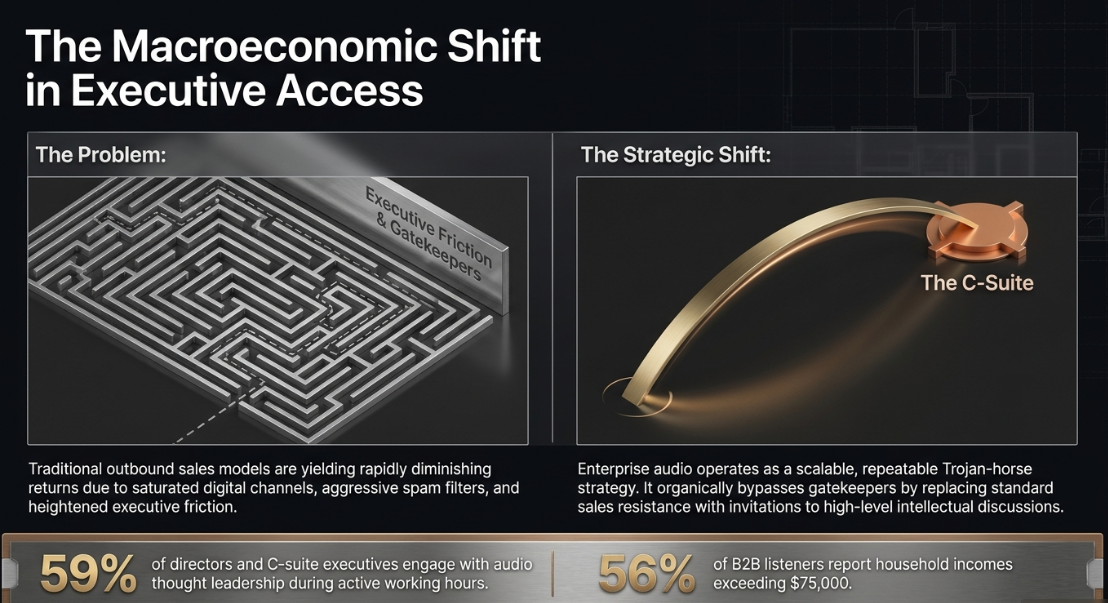
Current market data indicates that over 100 million Americans—approximately 34% of the population—now consume audio content on a weekly basis, representing a sharp escalation from previous years.1 Monthly listenership has stabilized at 47%, but the most critical metric for enterprise applications is the professional demographic penetration: 59% of directors and C-suite executives regularly engage with audio thought leadership during their active working hours.1 Furthermore, audience demographics reflect highly attractive segments for enterprise engagement, with 56% of listeners reporting household incomes exceeding $75,000, confirming the medium's capacity to reach high-value, senior professionals.1
This macroeconomic shift signifies the obsolescence of traditional outbound sales models, which currently yield diminishing returns due to saturated digital channels, aggressive spam filters, and heightened executive friction. The intimacy of the audio format serves to organically bypass conventional corporate gatekeepers. Decision-makers are increasingly tuning out traditional outbound overtures and leaning heavily into trusted, insight-led formats that deliver immediate, asynchronous value.2 The enterprise audio medium provides organizations with a scalable, repeatable mechanism to secure the attention of senior executives, effectively transforming the production studio into a high-level networking environment and business development engine.2
However, capitalizing on this medium requires organizations to completely abandon the consumer-facing tactics of the past. Success in the modern corporate audio landscape demands a highly sophisticated operational plan, a rigorously measured business case grounded in pipeline attribution, a robust technology stack for deep firmographic analytics, and a radical differentiation strategy designed to capture finite audience attention in an overwhelmingly crowded market.
Constructing the Boardroom-Ready Business Case: From Vanity Metrics to Pipeline
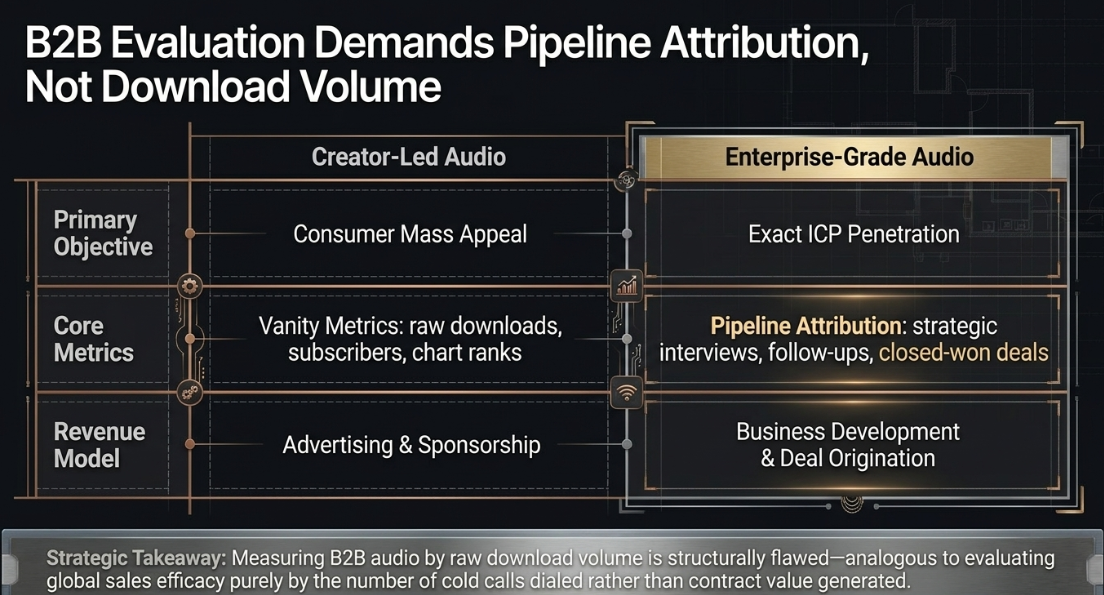
The primary vulnerability of nascent enterprise audio initiatives is the historical reliance on consumer-grade vanity metrics—specifically, raw episode downloads, subscriber counts, and arbitrary chart rankings.3 Evaluating a complex business-to-business (B2B) audio strategy purely through download volume is fundamentally flawed; it is analogous to measuring the efficacy of a global sales organization solely by the volume of cold calls placed, rather than the contract value generated.3 To secure ongoing executive sponsorship and enterprise budget allocation, the business case must pivot entirely toward pipeline attribution, relationship-driven return on investment (ROI), and verifiable commercial outcomes.
The B2B Audio ROI Framework and Relationship Capital
Comprehensive analysis of high-performing corporate audio programs reveals a profound reality: success is not strictly predicated on production quality or broad audience growth, but rather on attribution discipline, strategic guest selection, and post-interview pipeline integration.4 Organizations that implement systematic guest outreach, rigorous relationship maintenance, and customer relationship management (CRM) pipeline tracking consistently generate 25% to 50% higher ROI than organizations chasing pure audience reach.4
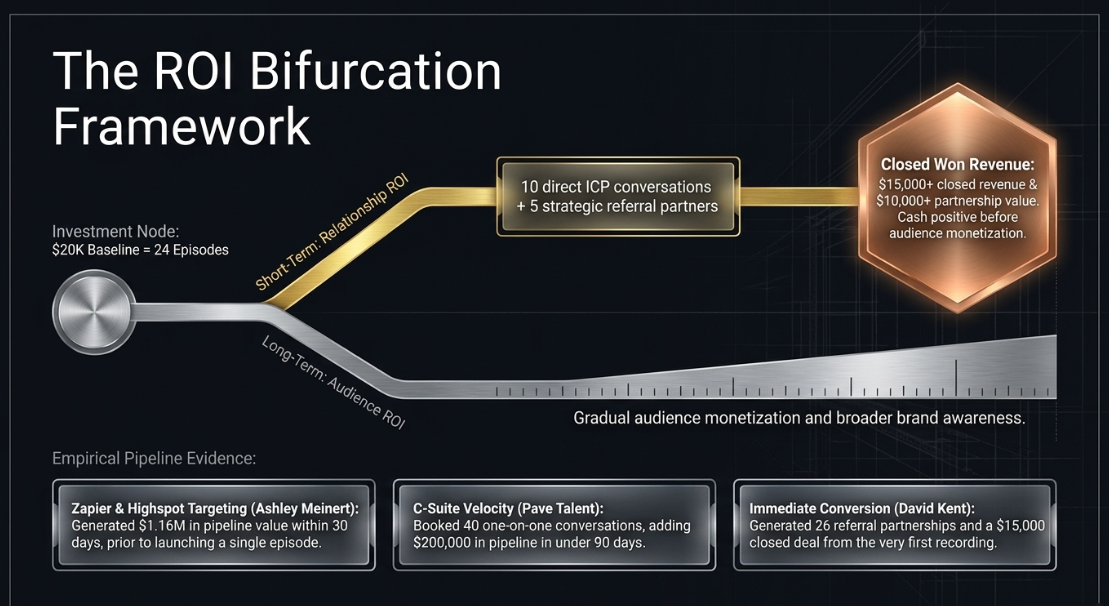
The ROI of enterprise audio is distinctly bifurcated into two interdependent classes: short-term relationship-driven ROI and long-term audience-driven ROI.3 Short-term ROI is derived directly from the relationships forged with high-value guests who perfectly match the organization's Ideal Customer Profile (ICP). For example, a $20,000 first-year investment typically yields 24 episodes. While this may generate a modest baseline of 10,000 monthly downloads, the true commercial value lies in securing direct, hour-long conversations with 10 potential enterprise customers and 5 strategic referral partners.3 With proper operational execution and sales follow-up, this strategic networking translates into direct pipeline generation, frequently yielding $15,000 or more in closed customer revenue and over $10,000 in partnership value, thereby achieving a cash-positive position purely through guest acquisition before factoring in audience monetization.3
To standardize this operational tracking, organizations must target specific, CRM-integrated metrics to prove definitive value to financial stakeholders.
Beyond these primary indicators, advanced corporate operations must track secondary pipeline metrics. These include deal velocity (measuring whether audio-engaged prospects move through the pipeline faster), the average contract value (ACV) of audio-sourced opportunities, and the guest-to-opportunity conversion rate.4
Empirical Evidence: Pipeline Generation Case Studies
The theoretical framework of podcast-led pipeline generation is heavily substantiated by empirical market data and distinct corporate case studies. By replacing standard outbound outreach with invitations to participate in high-level intellectual discussions, organizations routinely bypass traditional sales resistance.
Pre-Launch Pipeline Acceleration: The case of Ashley Meinert exemplifies the power of audio as a networking mechanism. By targeting gatekeepers at major technology corporations (such as Zapier and Highspot) with podcast invitations rather than sales pitches, she generated $1.16 million in pipeline deal size within 30 days—critically, before recording or launching a single episode.2
C-Suite Access and Velocity: The Pave Talent Podcast utilized a podcast-led system to target C-level executives, successfully booking 40 one-on-one conversations. This strategy added $200,000 in pipeline value in under 90 days and identified 25 immediate sales opportunities, proving that audio connections foster much deeper, authentic relationships than cold calling.2
Immediate Deal Conversion: David Kent's Unbottleneck podcast replaced cold outreach with curated introductions to enterprise leaders at companies like Meta and Reddit. Within 60 days, the campaign generated 26 referral partnerships, and the very first podcast recording directly converted into a $15,000 closed deal.2
Targeted ICP Engagement: BuroVentures utilized podcasting to engage their exact ICP. Within 28 days, 150 target executives agreed to a preliminary call and joined the podcast, entirely circumventing traditional sales friction and establishing immediate thought leadership.2 Similarly, the Venned Group secured their first call within 48 hours of launch, speaking directly with founders who perfectly matched their client profile.2
These case studies unequivocally demonstrate that the enterprise podcast is not merely a content distribution channel; it is a highly engineered, Trojan-horse strategy for elite business development.
Advanced Analytics and The Enterprise Audio Tech Stack
To eliminate the opacity of anonymous downloads and justify significant financial investments, enterprise brands must implement advanced B2B podcast analytics that provide granular, actionable firmographic data. Managing dozens of show placements, global campaigns, and complex attribution models requires a robust infrastructure of specialized tools.7 Enterprise brands cannot rely on manual spreadsheets to track creative distribution; a modern audio tech stack ensures every campaign phase is monitored and optimized in real-time, allowing marketing teams to focus on strategy rather than logistical administration.
Firmographic Measurement and B2B Analytics
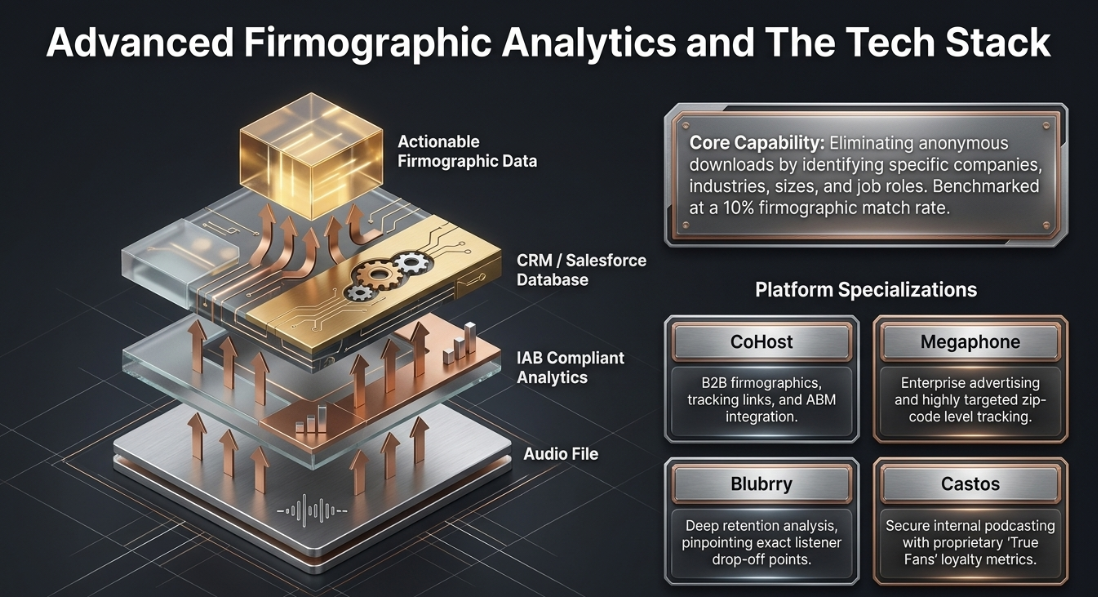
The cornerstone of the enterprise tech stack is B2B firmographic tracking. This technology identifies the specific companies, industries, company sizes, geographic locations, and job roles engaging with the audio content.8 Advanced analytics platforms integrate directly with CRMs (such as Salesforce), matching listener IP data against corporate databases to validate ICP fit.8
Industry benchmarks indicate that enterprise programs should expect firmographic company matches for approximately 10% of their total audience.8 This data is strictly IAB-compliant (adhering to IAB's Compliance Certification Guidelines V2.2) to ensure trustworthiness.8 By leveraging these insights, sales teams can visualize content-attributed revenue, identifying which accounts are heavily consuming content prior to a sales engagement, thereby allowing representatives to tailor their outreach based on the specific episodes and topics the account has consumed.8 Furthermore, this data is invaluable for securing sponsorships, as creators can share verified B2B demographic data with potential advertisers to close premium deals.8
Consumption Data and Multi-Channel Attribution
Beyond firmographics, enterprises must track consumption data to evaluate content effectiveness. This involves measuring exact episode consumption rates, average listen times, and specific listener drop-off points across platforms like Apple and Spotify.8 By pinpointing where listeners disengage, producers can optimize content structure, refine pacing, and identify which formats, guests, or topics resonate most deeply.8
Additionally, sophisticated operations utilize tracking links to measure clicks-to-downloads attribution.8 By generating unique tracking links for every marketing channel, newsletter, and guest, brands can explicitly measure which promotional vectors are driving actual downloads, allowing for precise calculation of Return on Investment (ROI) across various advertising channels.8
Evaluating Leading Enterprise Analytics Platforms
The selection of a hosting and analytics provider is a critical infrastructural decision. The market offers several enterprise-grade solutions, each with distinct technological advantages:
Competitive Intelligence and Landscape Mapping
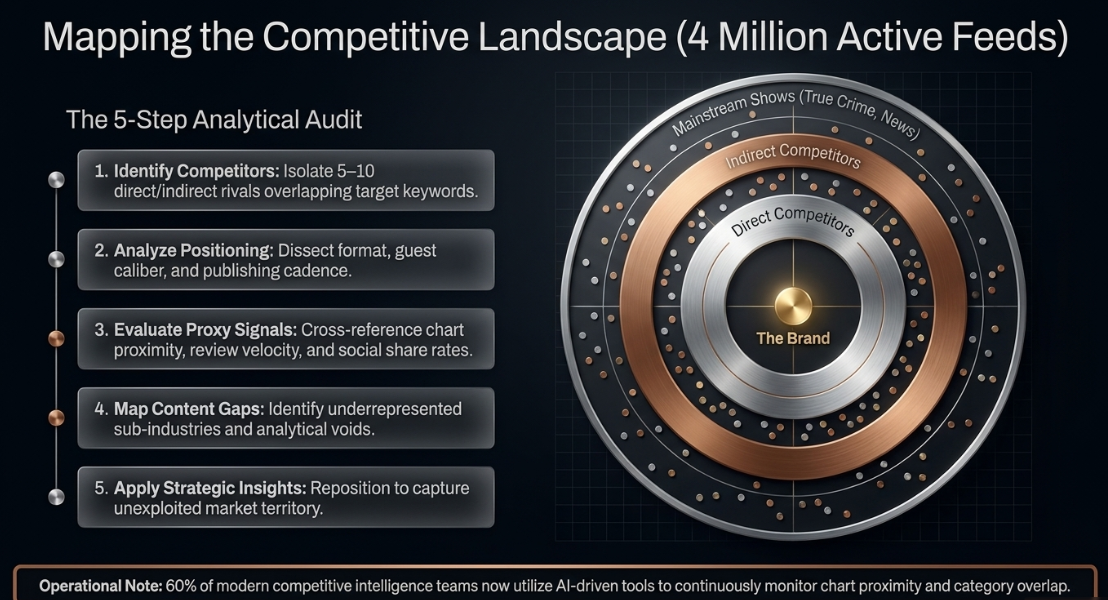
Before an organization can design a differentiated audio product, it must rigorously map the existing competitive terrain. The rapid expansion of the medium has resulted in over four million active podcast feeds.10 For corporate brands, the competitive set extends far beyond direct market rivals; an enterprise technology show actively competes for a finite commodity—listener attention—against massive true crime series, daily news briefings, and high-budget celebrity interviews.
Methodologies for Proximity and Overlap Analysis
Traditional manual research—such as compiling generic spreadsheets of top-ranking shows—is highly inefficient and rapidly becomes stale. Consequently, 60% of competitive intelligence teams now utilize AI-driven tools daily to synthesize patterns across sources, cutting data-processing time by 45%.11 The best competitive intelligence platforms go beyond mere data aggregation to deliver proactive, actionable insights.11
The core of modern competitive audio analysis relies on chart proximity and category overlap rather than generic popularity lists.12 Tools like Podstatus scan global rankings to identify shows that consistently appear adjacent to the brand's own properties, automatically refreshing as rankings update to provide a genuine, real-time competitor shortlist.12 Additional tools like Rephonic, ListenNotes, and Podchaser are utilized to map podcast audiences and cross-reference search visibility.8
Executing the Competitive Audit
A comprehensive competitive analysis requires a structured, five-step methodology to map content gaps and identify strategic opportunities 8:
Identify Competitors: Isolate 5 to 10 direct and indirect competitors that speak to the ideal corporate audience or rank for identical target keywords.8
Analyze Content and Positioning: Evaluate each competitor's editorial style, dissecting their show descriptions, episode themes, format (solo vs. interview), guest caliber, publishing cadence, and targeted keywords.8
Evaluate Proxy Signals: Because internal consumption data is proprietary, analysts must evaluate external proxy signals to gauge traction. This includes monitoring chart positions, the velocity and ratio of written reviews, social media engagement rates, cross-channel visibility (e.g., YouTube presence), and specific episode share rates.8
Map Content Gaps: Synthesize the data by asking highly analytical questions: Which sub-industries are underrepresented? Are competitors overly reliant on surface-level interviews while neglecting deep technical narratives? Where can the brand target a tighter, more lucrative niche?.8
Apply Strategic Insights: Utilize standardized tools, such as the CoHost Podcast Competitor Research Template, to benchmark performance, establish a unique voice, and reposition the corporate podcast to fill the identified market voids.8
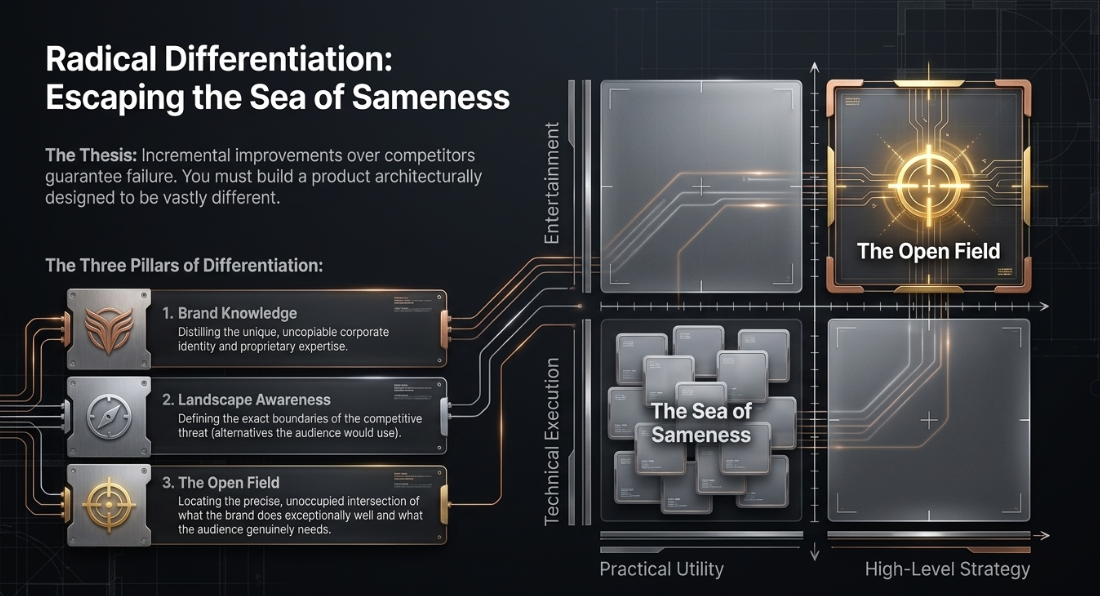
The Radical Differentiation Strategy: Escaping the Sea of Sameness
The failure rate of new corporate audio initiatives is heavily correlated with a lack of compelling, obvious differentiation. Relying merely on high production quality or incremental, marginal improvements over competitors is wholly insufficient; no show can grow without a meaningful differentiation strategy.14 Most brands default to the "sea of sameness" by employing mass-production models that result in bland, indistinguishable content.15
Radical differentiation is not merely selecting a small niche or employing transient growth hacks; it is an architectural philosophy that mandates building a product intentionally designed to be vastly different from existing category leaders.14 As articulated by innovation experts Jake Knapp and John Zeratsky in the context of the "Foundation Sprint," differentiation is the absolute number one predictor of product success.16 Startups and corporate initiatives fail not because they cannot build the product, but because they build the wrong product entirely, skipping the critical validation questions at the inception phase.
The Three-Pillar Differentiation Framework
Achieving radical separation requires a structured approach, advancing from strategic foundation to creative execution. The industry-standard framework, as outlined by Quill, mandates three sequential pillars 10:
Brand Knowledge: Organizations must first distill their unique, uncopiable corporate identity. This requires identifying what the brand genuinely stands for and defining the specific expertise, proprietary data, or unique market perspective that the enterprise possesses better than any other entity.10
Landscape Awareness: Following the competitive intelligence audit, the brand must evaluate what specific alternatives the ideal listener would turn to if the proposed show did not exist. This defines the exact boundaries of the competitive threat.10
Locating the Open Field: Utilizing a 2x2 framework (similar to Knapp's magic lenses), every competing show is plotted on a dual-axis matrix (e.g., entertainment value versus practical utility, or high-level strategy versus technical execution).10 The organization must identify the unoccupied territory on this graph and position the show at the exact intersection of what the brand does exceptionally well and what the audience genuinely needs, ensuring no other competitor is currently occupying that space.10 Furthermore, as brand strategists note, while quantitative research must inform these decisions, it should not dictate them entirely; the final positioning must intuitively resonate with the brand's core identity.17
Format Innovation: Breaking the Interview Paradigm
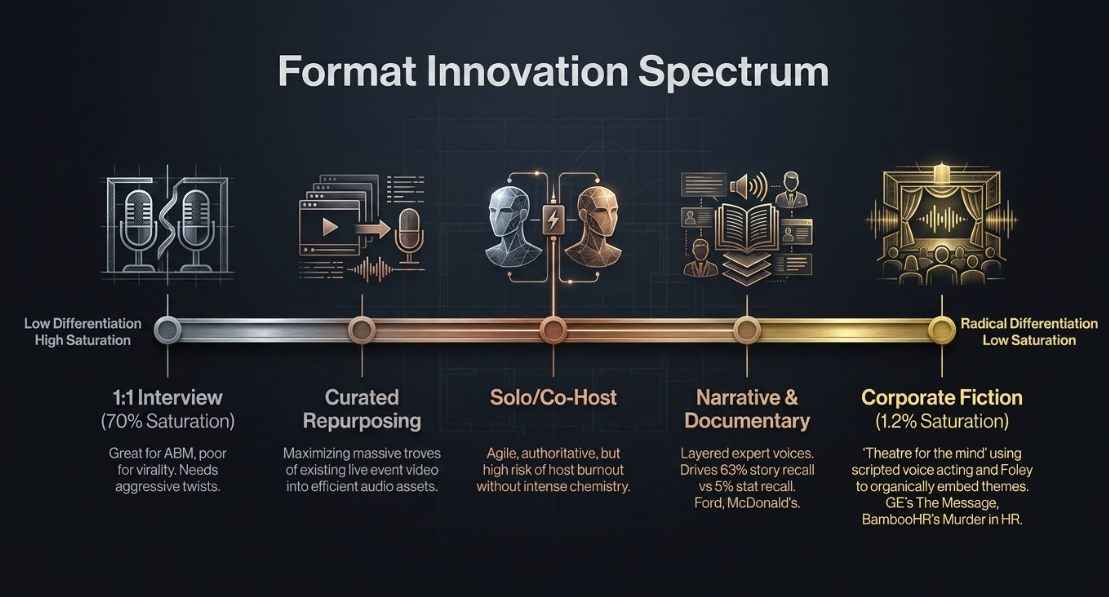
The most pervasive symptom of the "sea of sameness" is the overwhelming reliance on the traditional 1:1 interview format, which currently accounts for nearly 70% of all branded audio content.18 While highly effective for ABM relationship-building, standard corporate Q&A formats rarely capture broader audience attention or achieve viral distribution. To execute a radical differentiation strategy, enterprises must explore advanced, creative structural formats.
1. The Narrative and Documentary Format Narrative structures function as immersive audio essays, blending documentary-style journalism with brand storytelling. Instead of a single viewpoint, they layer multiple expert voices, archival audio, contextual narration, and rich sound design to construct a compelling picture.18 The psychological and cognitive impact of narrative is profound: research indicates that 63% of listeners can recall a story from a presentation, compared to a mere 5% who recall isolated statistics.18 Furthermore, data from Signal Hill Insights demonstrates that narrative shows outperform standard interviews significantly, generating a 14% higher likelihood to listen again, an 11% higher likelihood to recommend, and a 10% boost in overall brand favorability.18
Case Studies in Narrative: Ford's Bring Back Bronco traced the decades-long rise, fall, and return of the iconic vehicle, taking a highly credible journalistic approach that wove together pop culture and corporate redemption.18 Similarly, McDonald's The Sauce functioned as a documentary unpacking the bizarre, cult-like frenzy surrounding a limited-edition product, mixing fan theories and brand lore into a highly self-aware narrative.18
2. Audio Drama and Corporate Fiction The fiction format, representing an incredibly low format saturation of only 1.2% of branded shows, offers the most extreme level of differentiation available to enterprises.18 Functioning as "theatre for the mind," audio drama relies entirely on scripted dialogue, professional voice acting, Foley sound effects, and musical scoring to build an immersive narrative without any visual cues.20 This format allows brands to completely abandon direct corporate talking points and embed their core themes organically into a fictional universe.18
Case Studies in Fiction: General Electric's Life After / The Message was a bold sci-fi thriller concerning the decoding of alien transmissions. Instead of dryly discussing innovation, the brand's themes of data and technology were baked directly into the plot, building massive strategic brand association.18 Murder in HR, produced by WellHub and BambooHR, utilized a workplace comedy-meets-murder mystery to playfully highlight tech startup tropes, completely subverting the stale expectations of B2B human resources marketing.18
3. The Solo Monologue and Co-Hosted Dynamics For brands prioritizing agility and direct authority, the solo monologue format directly positions an internal host as the absolute thought leader, offering uninterrupted commentary.18 While cost-effective, it carries a severe risk of host burnout and requires exceptional charismatic delivery to prevent the content from feeling like a preachy, one-sided sales pitch.18 Programs like comedian Bill Burr's podcast or Fresh Starts Registry's Jenny Says So succeed by balancing professional authority with authentic vulnerability.18 Alternatively, the co-hosted format relies on the natural chemistry, debate, and dynamic exchange between two internal experts. This breaks the rigid interviewer-guest power dynamic and fosters a highly conversational, accessible tone that invites the listener into an intimate peer-to-peer discussion.
4. Curated Repurposing and Differentiated Interviews For organizations possessing massive troves of existing video or live event content, the curated repurposed format offers incredible efficiency, adapting existing assets for entirely new audio audiences.18 If an organization must retain the interview format, it must differentiate the execution.
Case Studies in Differentiation: The video-first show Hot Ones revolutionized the interview by forcing celebrities to answer questions while consuming progressively spicier food; the physical discomfort naturally breaks down corporate barriers, producing radically candid conversations.18 Behind the Review by Yelp pairs business owners directly with the customer who left them a standout review, giving the interview immediate emotional stakes and dual-perspective context.18 Countermeasures by Emergent BioSolutions tackled the opioid crisis not through corporate Q&As, but by blending interviews with deeply personal stories from front-line advocates, putting an immediate human face on complex medical issues.18
The Psychology of Differentiation in Corporate Enablement The efficacy of these differentiated formats extends beyond external marketing; it is deeply rooted in cognitive psychology and learning theory. Action research conducted in asynchronous learning environments demonstrates that highly specialized, differentiated audio interventions significantly increase audience self-regulation, cognitive engagement, and knowledge retention.22 By catering to diverse learning styles through format innovation (such as offering narrative choices rather than flat lectures), organizations empower their audiences, inducing higher self-efficacy.22 When applied to internal enterprise podcasts (such as employee training or sales enablement), differentiated audio formats yield remarkable enhancements in information absorption and behavioral change.
Enterprise Operational Plan and Production Workflows
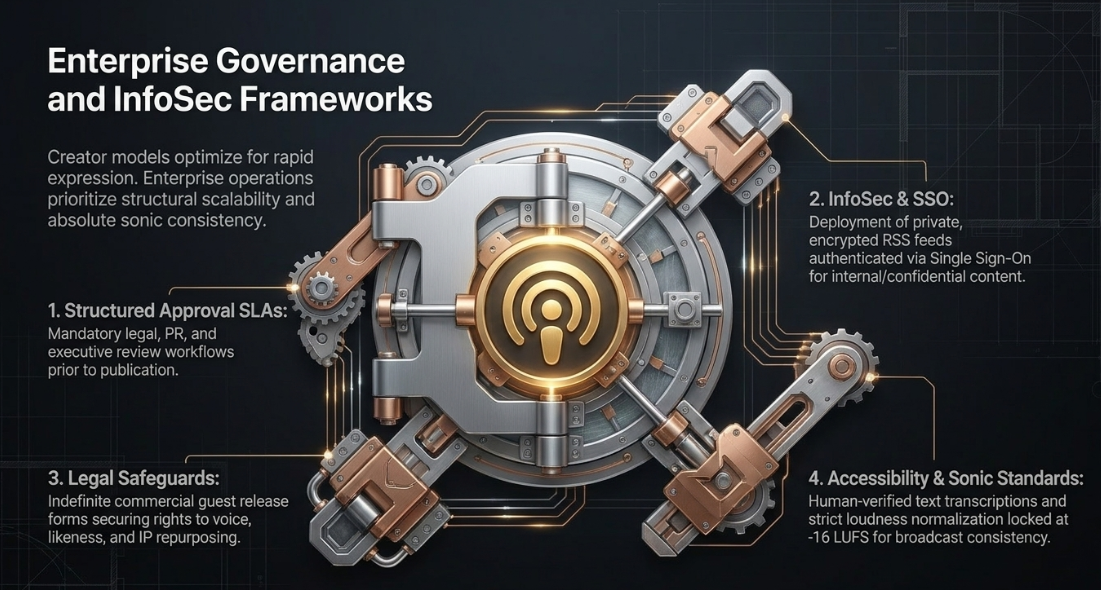
Executing these high-level audio formats requires a fundamental, structural departure from creator-led production models. Creator-led models optimize for rapid personal expression and broad direct monetization. Conversely, enterprise operations are highly structured corporate assets that must prioritize cross-departmental alignment, stringent legal compliance, structural scalability, and absolute sonic consistency.5
Compliance, InfoSec, and Governance Frameworks
Operating within regulated, publicly traded, or highly scrutinized industries necessitates rigorous governance frameworks.5 Enterprise audio operations must be managed according to defined Service Level Agreements (SLAs), strict escalation paths, and centralized accountability.5
Structured Approval Gates: Scripts, guest questions, and finalized audio files cannot be published unilaterally. They must pass through systematic legal, public relations, and executive review workflows prior to public distribution.5
Data and Information Security (InfoSec): When managing private internal communications (such as employee enablement) or handling confidential guest data, operations must strictly adhere to internal IT security policies. This frequently requires the deployment of private, encrypted RSS feeds authenticated via Single Sign-On (SSO).5
Legal Safeguards and Guest Releases: Standardized legal guest release forms are mandatory. These legally binding documents ensure the enterprise retains full commercial rights to repurpose the guest's voice, likeness, transcriptions, and intellectual property across multiple marketing channels indefinitely, protecting the organization from future litigation.5
Accessibility Standards: Enterprise-grade compliance mandates that content is universally accessible. This requires incorporating human-verified text transcriptions, utilizing appropriate media player compatibility, and maintaining accurate metadata to accommodate all user demographics.5
Team Topology and Specialized Roles
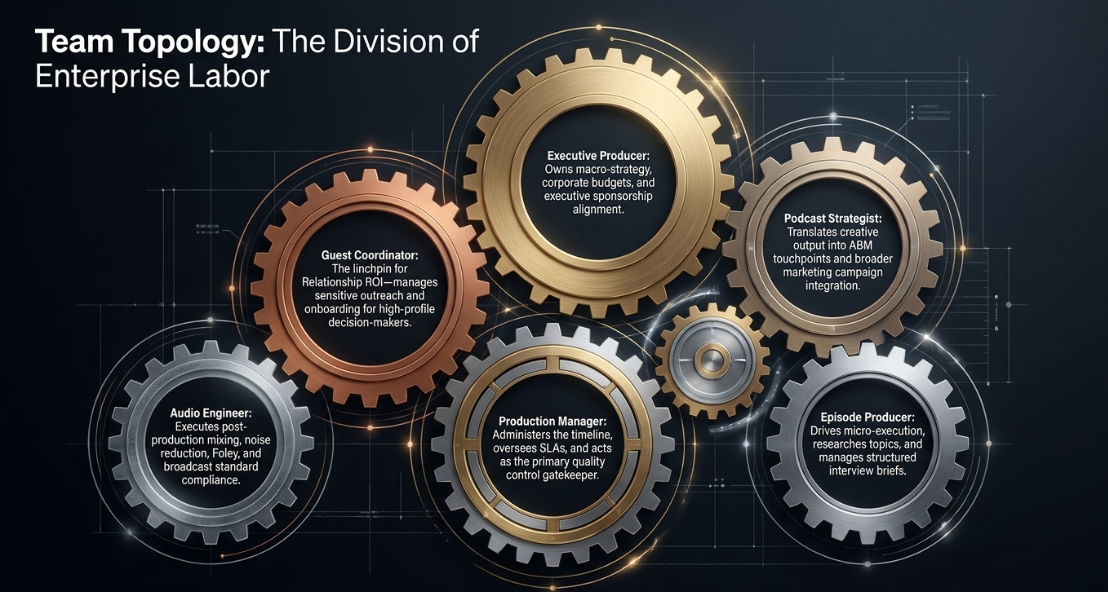
The sheer complexity of enterprise production requires a strict division of labor across specialized roles, ensuring no single individual becomes a production bottleneck.26 Providing discrete access credentials via hosting platforms ensures account security while empowering team members to execute their specific functions.27
The Launch Workflow and Sonic Consistency
Launching an enterprise program is not an instantaneous event; it requires a structured 4 to 8-week launch runway.5 This critical pre-production period is utilized to align stakeholders, finalize legal frameworks, conduct host training, and record a substantial backlog of content.5 Production teams construct a comprehensive 90-day editorial calendar that synchronizes highly produced "anchor episodes" with broader macro-marketing campaigns, while mixing in sustainable evergreen material.5
A paramount element of this workflow is the establishment of strict sonic consistency. To deliver a professional, broadcast-quality experience that does not strain the listener's ear, engineers utilize master templates for equalization (EQ) and loudness normalization. All spoken-word audio must be standardized to -16 LUFS (Loudness Units relative to Full Scale).5 Furthermore, strict timing limits are imposed on creative elements—such as restricting intro and outro music to under 15 seconds—to prevent immediate listener drop-off, a metric that is continually audited via consumption dashboards to optimize sound cues.
Enterprise Amplification: Marketing, SEO, and Employee Advocacy
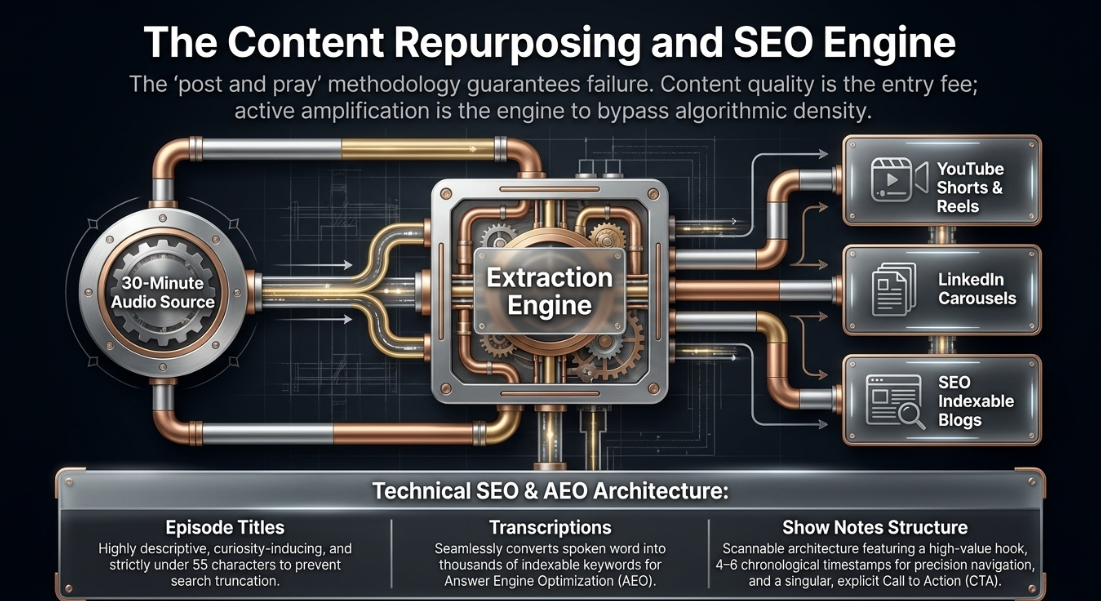
The most profound failure point in the podcasting ecosystem is the ubiquitous "post and pray" methodology—the act of publishing a high-quality episode and passively expecting organic discovery.30 Given the algorithmic density of major platforms, exceptional content quality is merely the entry fee; it is not a differentiator. Aggressive, systematized marketing is the sole engine of growth.30 The enterprise amplification stack relies on technical search engine optimization (SEO), intelligent content repurposing, and heavily mobilized employee advocacy.
Technical Audio SEO and Metadata Architecture
Unlike text-based blogs, audio files are inherently opaque to search engine web crawlers. Therefore, the metadata surrounding the audio file must be aggressively optimized to capture organic search traffic and Answer Engine Optimization (AEO) from AI platforms.31
Episode Titles: Titles must be specific, highly descriptive, and optimally under 55 characters to ensure they are not truncated in search engine result pages.31 They must incorporate long-tail keywords identified through search volume tools (like Google Keyword Planner or Ubersuggest).31 Vague, clickbait titles must be avoided in favor of clear, curiosity-inducing value propositions.32
Transcriptions: Providing full, human-verified episode transcriptions is the single most effective method for boosting organic discovery. Transcripts seamlessly convert spoken audio into thousands of indexable keywords, allowing search engines to parse the deep context of the conversation and making the content accessible to all users.33
Show Notes Structure: Show notes must be highly scannable, avoiding dense, intimidating blocks of text. The architecture should be rigorously templated for consistency across all episodes, building cognitive ease for the reader.34
The Hook: The first two sentences must capture the "big reveal" or transformation, avoiding generic, low-value filler like "In this episode we discuss...".34
Summary & Takeaways: A concise 3-4 sentence overview paired with bulleted insights that act as an enticing menu for the listener.34
Timestamps: Providing 4-6 chronological markers (e.g., [12:15]) drastically improves user experience by allowing listeners to navigate directly to highly relevant segments without blindly scrubbing the audio.34
Links and CTA: Direct, clean hyperlinks to mentioned resources and a singular, explicit Call to Action (CTA) directing subsequent user behavior (e.g., newsletter signup or software demo).34
The Content Repurposing Engine
A single 30-minute recording session must serve as the foundational input for a multitude of distinct marketing assets, maximizing the commercial output of the production process.2 Instead of constantly creating net-new content from scratch, the production team extracts the highest-value moments—selected specifically for insight density, shareability, and ICP relevance—into short-form vertical video clips optimized for LinkedIn, Instagram Reels, and YouTube Shorts.2
By publishing these clips natively, alongside automated SEO-optimized blog posts and LinkedIn articles derived from the transcript, the enterprise ensures that the core audio messaging permeates every digital channel, creating a compounding library of indexed content.2 Furthermore, creating custom tracking links for each distribution channel allows analysts to explicitly measure clicks-to-downloads, proving the ROI of specific promotional vectors and guiding future ad spend.
Mobilizing the Workforce: Employee Advocacy on LinkedIn
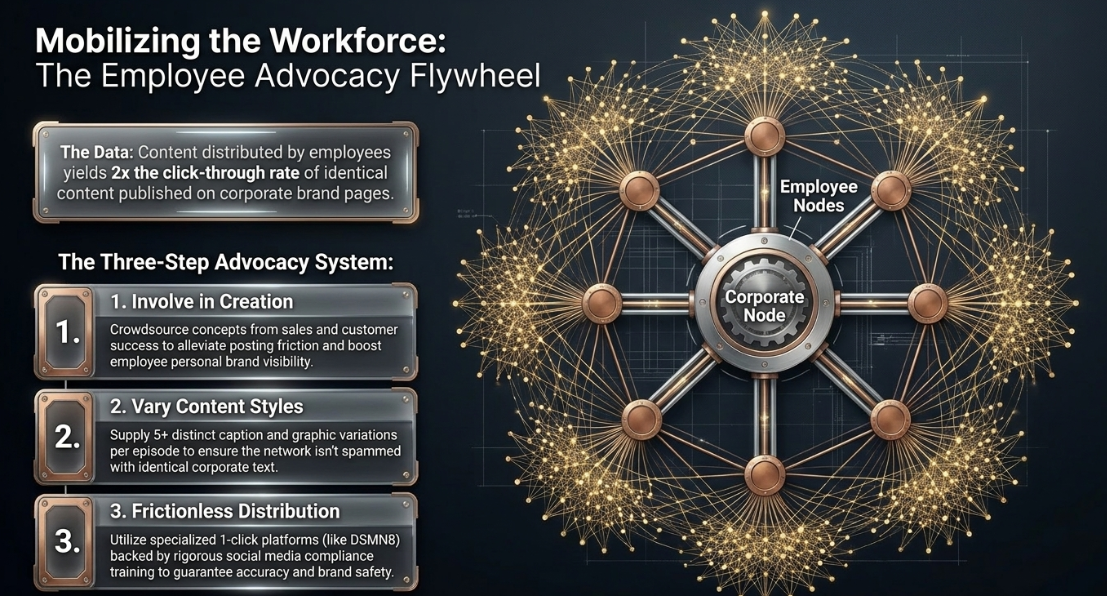
For B2B enterprises, structured employee advocacy is a highly potent, low-cost amplification strategy. Statistical data demonstrates that content shared by employees yields twice the click-through rate of identical content broadcast via corporate brand pages.35 While a corporate page provides baseline credibility, employees inject the human voice, industry expertise, and personalized context that peer buyers fundamentally trust, acting as critical pre-sales infrastructure before a buyer is ready to speak to a sales representative.36
Structuring a successful employee advocacy program requires a rigorous, data-driven three-step strategy designed to eliminate friction and foster enthusiastic participation 37:
Involve Employees in Creation: Advocacy must be a symbiotic relationship, not a corporate mandate. Organizations must alleviate the inherent fear of posting by providing clear guidelines and communicating how participation accelerates the employee's own personal brand visibility and career trajectory. Crowdsourcing ideas from the sales, customer success, and human resources departments ensures the generated content is highly relevant to specific end-user personas.37
Vary Content Styles: Marketing teams cannot simply provide a single corporate block of text. For every piece of podcast content, teams should generate at least five distinct caption variations and graphic pairings. This prevents the network from appearing spammed with identical messages and allows employees to select a tone that matches their authentic personal voice.37
Frictionless Distribution: Utilizing specialized advocacy platforms (such as DSMN8) or centralized communication channels (like dedicated Slack networks) allows employees to discover and share content with merely one or two clicks. Publicly recognizing and rewarding active advocates fosters a sustainable, highly motivated internal community.37
To mitigate corporate risk and empower staff, stringent governance and social media training must be enforced. B2B social media training must explain the "why," establish best practices, and ensure regulatory compliance.37 The 12 essential guidelines dictate that employees must strictly maintain confidentiality, respect colleagues' digital boundaries, adhere to brand style guides, meticulously verify the factual accuracy of any shared statistics (especially if utilizing AI), and never engage with hostile internet trolls.37 Interactive training workshops must be tailored to different departments, demonstrating precisely how optimizing LinkedIn profiles (with relevant SEO keywords and professional headshots) generates inbound networking opportunities that directly assist in achieving their daily sales, marketing, or recruitment targets.
The London Epicenter and Global Enterprise Agency Ecosystem
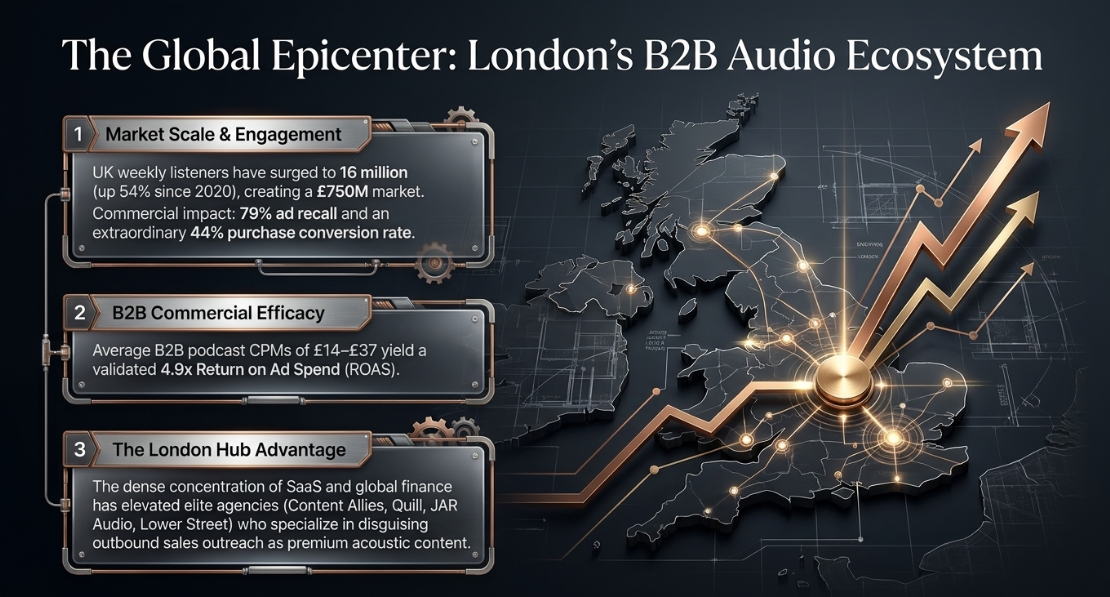
The successful implementation of these advanced strategies is visibly accelerating within mature European markets. In the United Kingdom, the corporate audio sector is experiencing unprecedented surges in capital investment, agency formation, and audience engagement. As of 2025-2026, the UK market reports 16 million weekly listeners—a massive 54% increase since 2020—fueled by a highly engaged demographic where 42% of adults listen monthly.38 Crucially, the audio advertising and production market in the UK is currently valued at £750 million, expanding at nearly 10% annually.38 Market share is dominated by Spotify (33%), followed by YouTube (20%), BBC Sounds (15-16%), and Apple Podcasts (10-13%).38
The commercial efficacy of this medium in the UK is staggering. Ad-supported and branded content reaches 43% of UK adults monthly, driving an extraordinary 79% ad recall rate and a highly lucrative 44% purchase conversion rate.39 Branded audio drives three times higher brand recall compared to standard digital display audio, resulting in an average B2B podcast Cost Per Mille (CPM) of £14 to £37, yielding a 4.9x Return on Ad Spend (ROAS).38
London as the Hub of B2B Audio Excellence
London has quietly positioned itself as one of Europe's most dominant and innovative hubs for enterprise podcasting.2 The city's dense concentration of SaaS entities, massive global consultancies, and deep-rooted financial institutions creates a fiercely competitive environment.2 Because London-based production agencies routinely interface with multinational corporations, the standard for technical audio quality, executive guest procurement, and ABM integration is exceptionally high.2
Agencies in this ecosystem specialize in marrying content creation with outbound pipeline development. They do not view podcasts in isolation but weave them directly into broader sales initiatives. This allows London-based firms to bypass traditional sales resistance by inviting target C-suite executives to participate in high-level intellectual discussions in professional business studios equipped with acoustic treatments and hybrid recording setups.29 This effectively disguises sophisticated outbound sales outreach as premium content creation.
Evaluating the Global and UK Agency Landscape
Executing at the enterprise level almost universally requires partnering with specialized production and marketing agencies. The global and UK markets feature several elite firms, each offering distinct strategic advantages 5:
Content Allies: A premier full-service partner focusing heavily on revenue-aligned podcasting and B2B tracking integrations. They manage end-to-end production, C-suite guest procurement, and SEO backlinking. Their impact is highly documented: they helped Meta's Business Engineering team reach over 170,000 downloads in six months (outperforming targets by 700%), propelled Tonkean to #1 in its Spotify category while growing its ideal audience by 174%, and secured 9 major new clients for Sagemark HR in a single year.5
Quill: Specializes in enterprise storytelling heavily backed by data, leveraging their proprietary CoHost analytics platform. They are the ideal partner for Fortune 500 brands seeking measurable growth and deep audience demographic insights.42
JAR Audio (JAR Podcast Solutions): Based out of Vancouver but operating globally, JAR excels in award-winning, purpose-driven narrative formats. They specialize in immersive audio experiences, comprehensive sound design, and documentary-style production, successfully transforming shows for massive institutions like the Royal Bank of Canada (RBC).5
StudioPod Media: Operating with a unique "extension of your team" model, they provide hands-on host coaching, format development, and strategic workshops, scaling both audio and video content for brands like Morgan Stanley and Freshworks.5
Lower Street & Fame: Lower Street dominates in high-level enterprise storytelling for brands like PepsiCo and BCG, while Fame focuses exclusively on linking B2B podcasts directly to SaaS sales pipelines, famously offering download guarantees and rigorous ROI frameworks.5
London-Specific Agencies: The local London market is supported by specialized firms such as Auddy (excelling in secure internal communications), Message Heard (focusing on purpose-led documentary workflows), Somethin' Else by Sony (handling high-visibility global launches), and dedicated facilities like Blueprint Studios and Premiere Podcast Studios which service the demanding corporate and financial sectors.41
Institutional Adoption: The "Big 4" Case Studies
The absolute maturity of the corporate audio format is best exemplified by its rapid, comprehensive adoption among the "Big 4" professional services and accounting firms, heavily anchored in London.45 These massive organizations utilize audio to distill highly complex regulatory, financial, and technological shifts into accessible, on-demand thought leadership.
Deloitte: Through flagship properties like The Green Room, Deloitte addresses massive macroeconomic challenges. For example, episode 97 explicitly tackled global supply chain fragility—exploring geopolitical unrest, extreme weather, and the application of AI and blockchain. By featuring internal partners alongside external academic experts from the University of Warwick, Deloitte positions the firm as the premier global transformational authority.46
EY (Ernst & Young): EY has constructed a sprawling, highly categorized audio ecosystem. Shows such as the Better Innovation podcast, Decoding Innovation, and EY Tech Connect provide candid strategic insights for IT executives and telecommunications leaders, reinforcing the firm's dominance in technological advisory and partner ecosystem development.48
PwC and KPMG: Both firms maintain extensive, dedicated audio series designed to navigate pressing regulatory, tax, and business issues. They utilize the medium to maintain a constant, authoritative presence in the ears of existing and prospective clients, ensuring their insights are consumed continuously between formal consulting engagements.45
By deploying sophisticated, high-fidelity audio properties, these massive institutions successfully navigate the transition from static, traditional whitepapers to dynamic, highly engaging intellectual capital.
Conclusion
The evolution of enterprise audio from a peripheral marketing experiment to a central, structural pillar of B2B corporate strategy demands a fundamental recalibration of operational methodologies. The empirical data demonstrates unequivocally that treating podcasting merely as a mechanism for broad audience accumulation is financially inefficient and strategically hollow. Organizations that persist in evaluating success through generic download metrics, or those that stubbornly employ mass-produced, undifferentiated 1:1 interview formats, will inevitably succumb to the oversaturation and aggressive competition of the modern digital landscape.
To capitalize on the profound commercial potential of this medium—evidenced by the 44% purchase conversion rates, the deep penetration into C-suite demographics, and the exponential pipeline generation observed in mature markets like London—enterprises must execute a rigorously synchronized operational plan. This begins with constructing a boardroom-ready business case anchored by advanced firmographic analytics and CRM-integrated pipeline tracking. Every piece of audio collateral must be tied directly to measurable revenue generation, strategic relationship building, and account-based marketing objectives.
Simultaneously, the content itself must be ruthlessly insulated against market noise through a strategy of radical differentiation. By deeply analyzing competitive proxy signals and utilizing frameworks like the Foundation Sprint, organizations can identify unexploited thematic territories. Transitioning toward advanced narrative architectures, corporate fiction, and immersive audio drama breaks the monotony of corporate broadcasting. These innovative formats foster deep emotional stickiness, unmatched brand recall, and cognitive engagement that traditional marketing simply cannot replicate.
Finally, the long-term sustainability of the enterprise audio initiative relies on the relentless, disciplined execution of amplification frameworks. Precision-engineered technical SEO, automated multi-channel content repurposing, and the mobilization of the internal workforce through highly governed, friction-free employee advocacy programs ensure that the content intercepts the target demographic across every digital touchpoint. When these elements—pipeline integration, radical differentiation, rigorous compliance, and systemic amplification—are executed cohesively, the enterprise podcast ceases to be a mere broadcast mechanism. It transforms into a comprehensive, high-velocity engine for pipeline development, elite executive networking, and unassailable global market authority.
Works cited
The ROI of B2B Podcasting: Metrics That Matter for Business Growth - Content Allies, accessed June 5, 2026, https://contentallies.com/learn/roi-b2b-podcasting-metrics
Top B2B Podcast Production Agencies in London (2026) | ThePod.fm, accessed June 5, 2026, https://thepod.fm/resources/top-b2b-podcast-production-agencies/london-united-kingdom
The Ultimate Guide To Measuring B2B Podcast ROI: From ... - Fame.so, accessed June 5, 2026, https://www.fame.so/post/ultimate-guide-to-measuring-b2b-podcast-roi
The Definitive Guide To Measuring B2B Podcast ROI And Pipeline Impact In 2025 - Fame.so, accessed June 5, 2026, https://www.fame.so/post/measuring-b2b-podcast-roi-and-pipeline
Enterprise Podcast Production Guide for B2B Brands — Content Allies, accessed June 5, 2026, https://contentallies.com/learn/enterprise-podcast-production-guide
B2B Podcast Marketing Strategy: Measuring ROI Without Chasing Vanity Metrics - Rise 25, accessed June 5, 2026, https://rise25.com/lead-generation/b2b-podcast-marketing-strategy-roi/
The Podcast Advertising Blueprint For Enterprise Brands [2026] - Mynt Agency, accessed June 5, 2026, https://articles.myntagency.com/podcast-advertising-blueprint-2026/
The Ultimate Guide to Competitive Analysis for Podcast Growth, accessed June 5, 2026, https://www.cohostpodcasting.com/resources/competitive-analysis-for-podcast-growth
How to Measure B2B Podcast ROI (And Why Most Brands Are Tracking the Wrong Things), accessed June 5, 2026, https://weeditpodcasts.com/how-to-measure-b2b-podcast-roi/
Why Your Branded Podcast Needs a Differentiation Strategy (+ How ..., accessed June 5, 2026, https://www.quillpodcasting.com/blog-posts/branded-podcast-differentiation-strategy
10 Best AI Tools for Competitor Analysis in 2026 - Klue, accessed June 5, 2026, https://klue.com/topics/best-ai-competitor-analysis-tools
Podcast Competitor Analysis Tool | Podstatus, accessed June 5, 2026, https://podstatus.com/features/competitors
Making the Pod: Conducting a Competitive Analysis - The Wave Podcasting, accessed June 5, 2026, https://thewavepodcasting.com/articles/making-the-pod-conducting-a-competitive-analysis
Differentiation: The Secret Behind Creating A Magnetic Podcast that Captivates Your Audience & Amplifies Your Marketing, accessed June 5, 2026, https://podcastmarketingacademy.com/podcast-differentiation/
Radical differentiation: 5 steps to make your product stand out - Wynter, accessed June 5, 2026, https://wynter.com/post/radical-differentiation
Rapidly test and validate any startup idea with the 2-day Foundation Sprint - YouTube, accessed June 5, 2026, https://www.youtube.com/watch?v=UbjAOCzpNWc
How Brands Are Built - Apple Podcasts, accessed June 5, 2026, https://podcasts.apple.com/us/podcast/how-brands-are-built/id1355941022
Interviews Aside: 5 Creative Branded Podcast Formats, accessed June 5, 2026, https://quillpodcasting.com/blog-posts/branded-podcast-format
Interviews Aside: 5 Creative Branded Podcast Formats, accessed June 5, 2026, https://www.quillpodcasting.com/blog-posts/branded-podcast-format
Audio Drama and Serials: An Introduction to Sound-Only Storytelling - Journalism University, accessed June 5, 2026, https://journalism.university/audio-podcast/audio-drama-serials-sound-storytelling/
Exploring Corporate Podcast Formats: Beyond One-on-One Interviews, accessed June 5, 2026, https://jarpodcasts.com/corporate-podcast-formats/
Optimizing differentiated podcasts to promote students' self-regulation and engagement, self-efficacy and performance in asynchronous learning | Journal of Research in Innovative Teaching & Learning - Emerald Insight, accessed June 5, 2026, https://www.emerald.com/jrit/article/17/2/368/1226742/Optimizing-differentiated-podcasts-to-promote
Optimizing differentiated podcasts to promote students' self-regulation and engagement, self-efficacy and performance in asynchronous learning Journal of Research in Innovative Teaching & Learning - ResearchGate, accessed June 5, 2026, https://www.researchgate.net/publication/381851400_Optimizing_differentiated_podcasts_to_promote_students'_self-regulation_and_engagement_self-efficacy_and_performance_in_asynchronous_learning_Journal_of_Research_in_Innovative_Teaching_Learning
Real talk on how to make differentiation less time-consuming - Truth For Teachers, accessed June 5, 2026, https://truthforteachers.com/truth-for-teachers-podcast/differentiated-teaching-strategies/
Enterprise Podcast Production & Operations | Hello Studios, accessed June 5, 2026, https://www.iamhellostudios.com/who-we-serve/enterprise/
Building a Podcast Team: 7 Essential Production Roles, accessed June 5, 2026, https://blog.podcast.co/create/podcast-team
From Solo to Scaled: How a Podcast Producer Can Build the Right Podcast Team - Libsyn, accessed June 5, 2026, https://libsyn.com/blog/from-solo-to-scaled-how-a-podcast-producer-can-build-the-right-podcast-team/
Podcast roles and responsibilities - Caspian Studios, accessed June 5, 2026, https://www.caspianstudios.com/caspian-blog/podcast-roles-and-responsibilities
Business Podcast Growth: UK Statistics & Trends 2026 - ProfileTree, accessed June 5, 2026, https://profiletree.com/business-podcast-growth-with-statistics/
Podcast Marketing Strategy: 8 Pillars Of Podcast Promotion - Fame.so, accessed June 5, 2026, https://www.fame.so/post/podcast-marketing-strategy
Podcast SEO. Here are the steps you need to get more potential downloads and subscribers. - Reddit, accessed June 5, 2026, https://www.reddit.com/r/podcasting/comments/1tx5wl7/podcast_seo_here_are_the_steps_you_need_to_get/
How to Optimize Your Podcast for SEO | RSS.com Podcast Hosting, accessed June 5, 2026, https://rss.com/blog/nine-seo-tips-for-podcasts/
Best Practices for Podcast SEO - Pilot Digital Marketing, accessed June 5, 2026, https://pilotdigital.com/blog/best-practices-for-podcast-seo/
Podcast Show Notes Made Easy - Podbean Blog, accessed June 5, 2026, https://blog.podbean.com/writing-podcast-show-notes/
How to Increase Your Content Reach and Engagement Through Employee Advocacy | LinkedIn Marketing Solutions, accessed June 5, 2026, https://business.linkedin.com/marketing-solutions/webinars/16/09/how-to-increase-your-content-reach-and-engagement-through-employee-advocacy
Employee Advocacy Is More Than Content Distribution On LinkedIn - Social Media for B2B Growth - Captivate Player, accessed June 5, 2026, https://player.captivate.fm/episode/768f8e33-a434-46fc-adef-bd073325bde5
Maximizing LinkedIn Engagement With Employee Advocacy [Podcast], accessed June 5, 2026, https://dsmn8.com/blog/maximizing-linkedin-engagement/
B2B Podcasting for UK Businesses - Whitehat SEO, accessed June 5, 2026, https://whitehat-seo.co.uk/blog/podcasting-for-businesses
UK podcast ads beat TV on reach - and 44% of listeners bought something - PPC Land, accessed June 5, 2026, https://ppc.land/uk-podcast-ads-beat-tv-on-reach-and-44-of-listeners-bought-something/
8 Best Podcast Marketing Agencies in 2026, accessed June 5, 2026, https://www.quillpodcasting.com/blog-posts/podcast-marketing-agency
The 9 Best London Podcast Agency Picks For 2026 | Fame, accessed June 5, 2026, https://www.fame.so/post/best-london-podcast-agency
Top 10 B2B Podcast Production Companies for Enterprise Brands in 2026 - Content Allies, accessed June 5, 2026, https://contentallies.com/learn/top-b2b-podcast-agencies-enterprise
B2B Podcast Production Services in London - Premiere Podcast Studios, accessed June 5, 2026, https://premierepodcaststudios.com/b2b-podcast-production/
Full-service podcast production | Branded and B2B podcasts | Blueprint Studios London, accessed June 5, 2026, https://www.blueprintstudioslondon.com/full-service-b2b-podcast-production
The Big 4 Accounting Firms Podcast, accessed June 5, 2026, https://podcasts.apple.com/us/podcast/the-big-4-accounting-firms-podcast/id1089822233
The Green Room podcast, #97: Is it time to reset supply chains? - YouTube, accessed June 5, 2026, https://www.youtube.com/watch?v=o4gUSOSBXPk
The Green Room Podcasts | Deloitte UK, accessed June 5, 2026, https://www.deloitte.com/uk/en/our-thinking/content/green-room-podcasts.html
EY Podcasts | EY - Global, accessed June 5, 2026, https://www.ey.com/en_gl/media/podcasts
Podcasts - PwC UK, accessed June 5, 2026, https://www.pwc.co.uk/podcasts.html