As the global media and digital broadcasting landscape advances into 2026, the podcasting industry occupies a position of unprecedented strength, yet profound structural complexity. The medium is no longer defined by a singular listening application, a purely audio-centric workflow, or amateur production standards. Instead, it has matured into a highly competitive, multi-platform, multi-format category where semantic search engine optimisation, video integration, community building, and diversified creator economics simultaneously dictate the growth and sustainability of a show.1
The transition from a niche broadcast alternative to a primary channel for global media consumption requires an exhausted, rigorous strategic approach. Success in this saturated market is no longer dictated by simply publishing audio files to an open RSS feed and relying on organic directory discovery. It demands an architectural understanding of production workflows, stringent quality control, algorithmic fluency, structured episode formatting, and aggressive cross-promotional strategies. The empirical evidence demonstrates that high-quality production paired with a defined, data-driven growth strategy routinely outperforms high-budget visual gimmickry or erratic publishing schedules.2 This comprehensive report provides an exhaustive analysis of the modern podcast ecosystem, examining the mechanics of production, technical engineering standards, algorithmic scheduling, listener psychology, and the commercial strategy necessary to build and sustain a high-performing audio asset in 2026.
The Macro Audio Landscape and Demographic Shifts
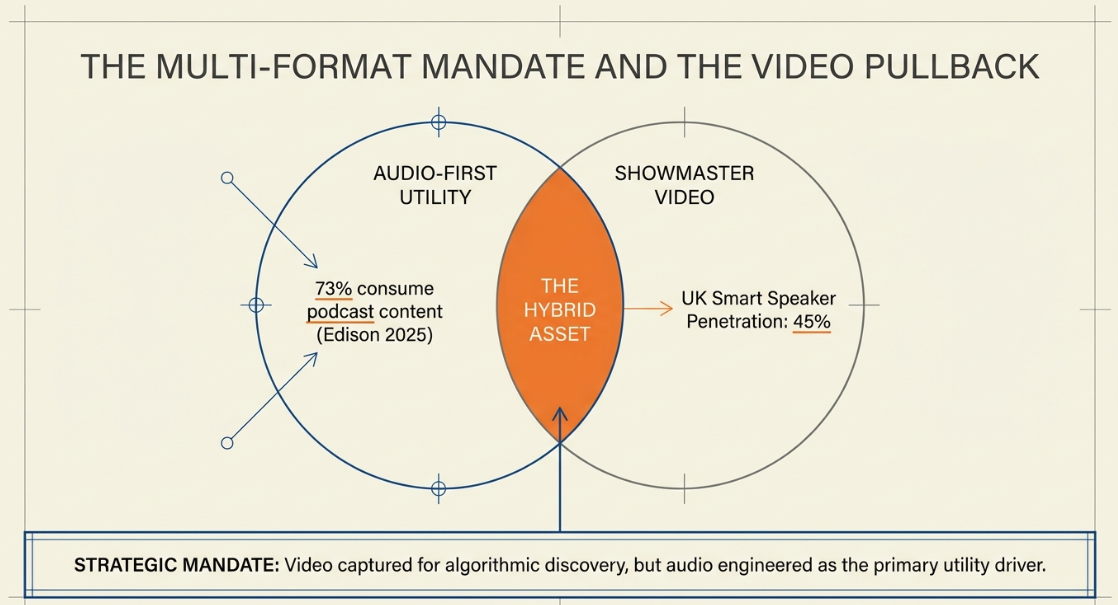
The foundational definition of a podcast has irrevocably expanded. According to Edison Research’s Infinite Dial 2025, the industry has fundamentally shifted from tracking podcast "listening" to tracking podcast "consumption".1 This semantic shift reflects a change in consumer behavior. The data indicates that 70% of Americans aged 12 and older have listened to a podcast, while 51% have watched a podcast, resulting in 73% of the population consuming podcast content in either audio or video form.1 This multi-context consumption model necessitates a multi-format distribution plan, as creators can no longer rely on a default audio-only distribution strategy to achieve maximum market penetration.
Device Integration and Behavioral Penetration
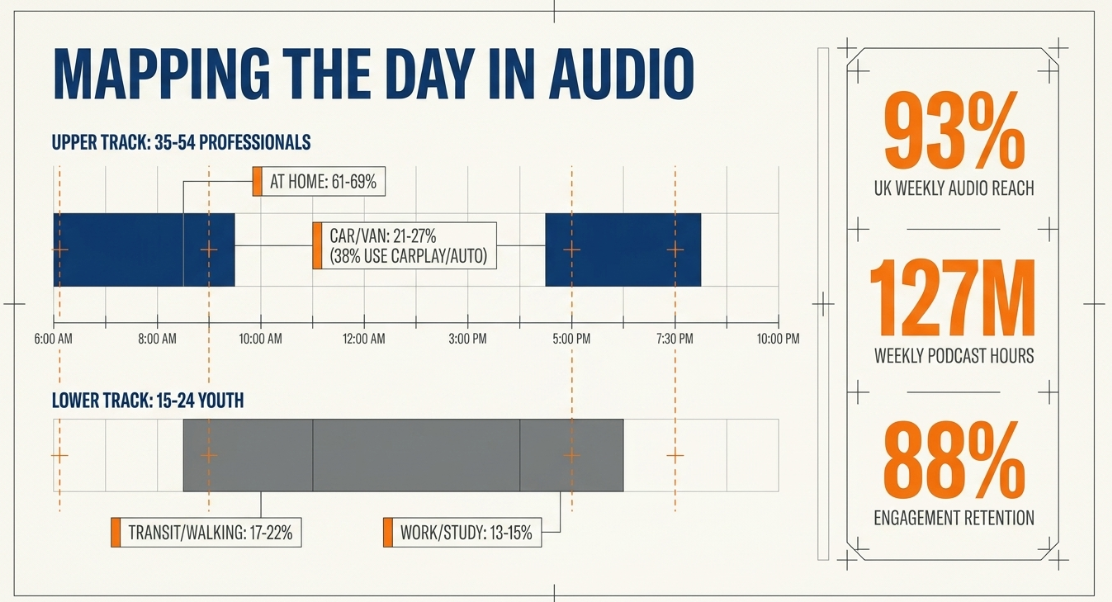
The integration of audio content into daily routines is heavily supported by the ubiquity of smart devices. In the United Kingdom, for instance, smartphone ownership rests at 97% of the adult population, while smart speaker penetration has surged to 45%, notably outpacing the United States where smart speaker ownership rests at 35%.4 Furthermore, connected in-car listening has transformed commuter habits and revived drive-time audio consumption. Among UK drivers, 38% utilize integrated systems like Apple CarPlay or Android Auto, leading directly to an increase in in-car podcast consumption.5
The RAJAR MIDAS survey data for Autumn 2025 and Spring 2026 reinforces this sustained demand, revealing that 93% of the UK population consumes some form of audio media weekly.6 Specifically, podcast listening remains highly robust, with 24% to 27% of UK adults consuming podcasts weekly.6 These listeners dedicate an average of 9.0 hours per week strictly to podcast formats, equating to approximately 127 million hours of podcast listening weekly across the UK alone.8
Furthermore, these audiences exhibit remarkable engagement retention, with 88% reporting that they listen to all or most of the episodes they initiate.8 The data also reveals distinct behavioral patterns across demographics and environments.
Data compiled from RAJAR MIDAS tracking metrics.9 Note: Variations reflect seasonal shifts between tracking periods.
The underlying trend suggests that while overall reach is expanding, the depth of listener commitment remains uniquely high compared to text or short-form video media. Younger audiences dominate transit and on-the-go listening, whereas middle-aged professionals dominate in-car and at-home environments.9 Additionally, genre preferences display demographic splits; comedy reigns as the most popular genre universally, but male listeners engage with news and political content at roughly double the rate of female listeners.
The Video Experiment and the Inevitable Pullback
Over the previous year, major distribution platforms aggressively pushed video into podcast feeds. Spotify enabled video shows globally, and YouTube announced over one billion monthly active viewers of podcast content on its platform.1 However, as the industry matures through 2026, a strategic pullback is occurring.
Audio industry analysts, including self-described radio futurologists, project that the "Big Video Experiment" has demonstrated diminishing returns for shows that do not organically benefit from visual elements.3 A clear strategic dichotomy has emerged. While video is highly effective for "showmaster" formats—such as multi-camera celebrity interviews or high-energy roundtable discussions—it often dilutes the core utility of audio-first podcasts.3 The fundamental power of the podcast is its ability to provide entertainment and education while the consumer's eyes are occupied with driving, working, or household chores.3
Creators who overinvest in visual formats at the expense of audio quality and narrative structure frequently encounter stagnant growth, mirroring historical missteps where traditional radio networks overinvested in Facebook video.3 Therefore, the modern strategy mandates a hybrid approach: recording video by default to satisfy YouTube's search-led discovery algorithms, but utilizing minimal, intentional visuals so that the audio experience remains the primary driver of long-term binge-led retention in standard podcast applications.
Architecting the Production Workflow
To sustain audience engagement and satisfy algorithmic requirements for consistency, the underlying production workflow must operate with industrial efficiency. A sustainable workflow is the definitive factor in preventing creator burnout and ensuring the longevity of a show.2 Independent podcasters and corporate teams alike must minimize friction between the ideation of an episode and its final publication.
Pre-Production: Systematizing the Creative Process
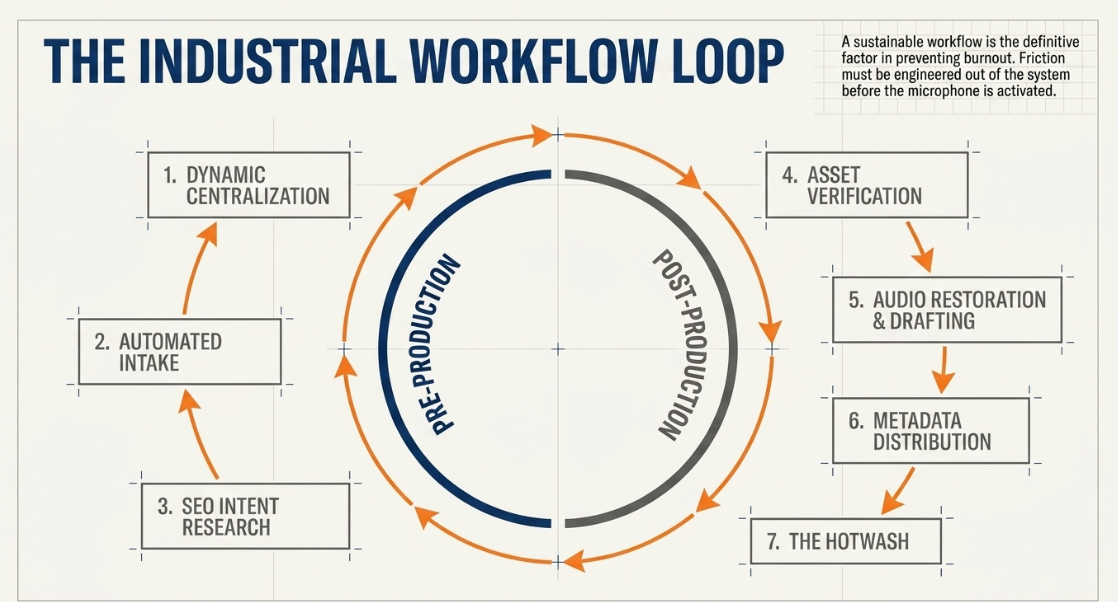
Pre-production encompasses all logistical and creative preparations before the recording hardware is activated.11 The objective is to eliminate administrative friction so that the host can focus entirely on performance, narrative delivery, and guest interaction.
Effective pre-production relies heavily on centralizing data using dynamic project management systems like Trello, ClickUp, or specialized databases.12 Establishing a standardized production grid is paramount. This grid should track episode codes (e.g., Season 3, Episode 4), working titles, guest statuses, recording dates, distribution links, and thumbnail asset readiness.11 Moving an episode through customized columns—such as "Guest Invited," "Booked," "Recorded," "Sent for Editing," "Ready for Upload," and "Published"—ensures complete visibility across the production team.11
Guest onboarding represents a critical failure point for many independent productions. Utilizing automated intake forms (such as Google Forms or CRM integrations) allows the production team to seamlessly collect guest biographies, promotional headshots, legal release agreements, and desired talking points without relying on fragmented, easily lost email chains.12 Furthermore, pre-production is the stage where initial search engine optimization (SEO) research must occur. Understanding the target audience's search intent directly informs the episode's title and the questions posed to the guest, thereby embedding discoverability into the content before a single word is spoken.
Post-Production: The Iterative Review and Archiving Process
Post-production is the phase where the raw recording is transformed into a polished, professional asset. Beyond the technical audio editing, this phase requires a rigid operational checklist to maintain quality control. Institutional frameworks, such as those utilized by military public affairs and dedicated production houses, mandate a systematic approach to finalizing content.12
The standard post-production workflow must include:
Asset Verification: Ensuring all recorded media, authorized music, and sound effects are centralized before editing begins.13
Audio Restoration: Cleaning the audio, adjusting levels, and removing unwanted noise or plosives.13
Drafting and Internal Review: Presenting a first draft to team leads or stakeholders. Iterative feedback is collected and implemented until final approval is secured.13
Metadata Preparation: Writing short episode descriptions, defining tags, and finalizing show notes.13
Distribution and Archiving: Sending the final files to appropriate distribution channels, removing redundant drafts to save server space, and securely archiving the final master files.14
The Hotwash: Conducting a post-release review (or "hotwash") to discuss lessons learned, technical failures, and areas for workflow improvement in future episodes.13
Technical Engineering, DAWs, and Loudness Standards
The choice of software and the adherence to broadcasting standards directly dictate the listener's acoustic experience. A pristine audio mix conveys authority and professionalism, whereas poor audio quality immediately signals amateurism, leading to rapid audience drop-off.
Selecting the Digital Audio Workstation (DAW)
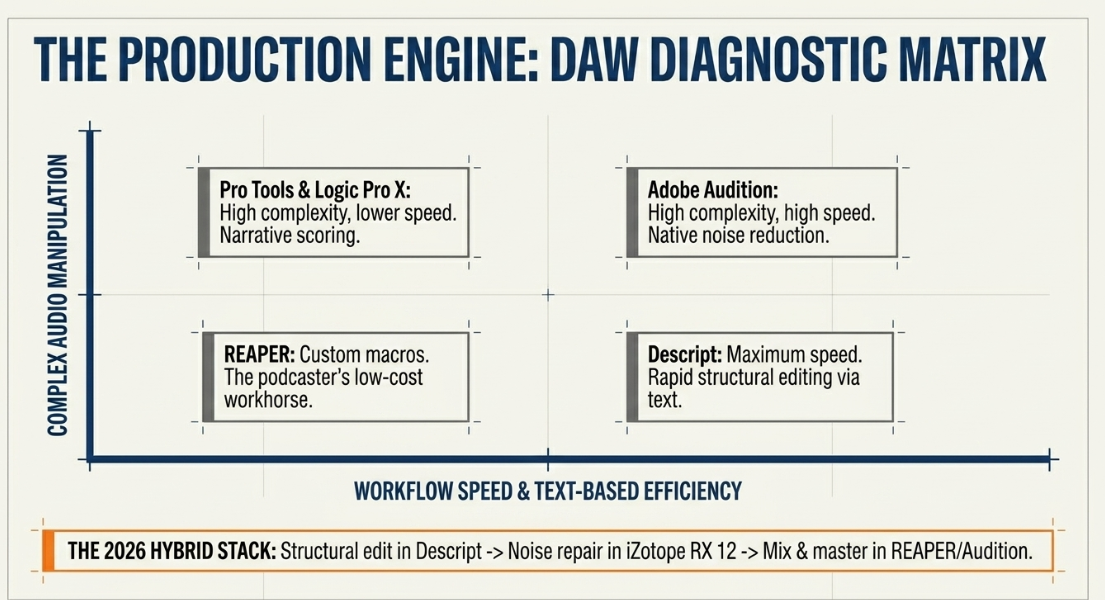
Choosing the correct Digital Audio Workstation (DAW) is a foundational decision that impacts turnaround times and final audio fidelity. While basic software exists, professional operations rely on specialized tools optimized for voice and workflow speed.
A hybrid workflow is increasingly common in 2026. Producers frequently utilize Descript for the rough structural edit (content cutting based on text), pass the audio through iZotope RX 12 for surgical noise reduction, and finalize the mix, equalization, and mastering in REAPER or Adobe Audition.18 This multi-tiered approach ensures both optimal narrative pacing and broadcast-quality acoustics.
Loudness Normalization: Mastering to LUFS Standards
Perhaps the most critical, yet frequently misunderstood, technical requirement of podcast post-production is mastering to standard loudness levels. Most major podcast distribution platforms aim for consistent playback volumes, ensuring that users do not have to constantly adjust their device volume when transitioning between different shows.21
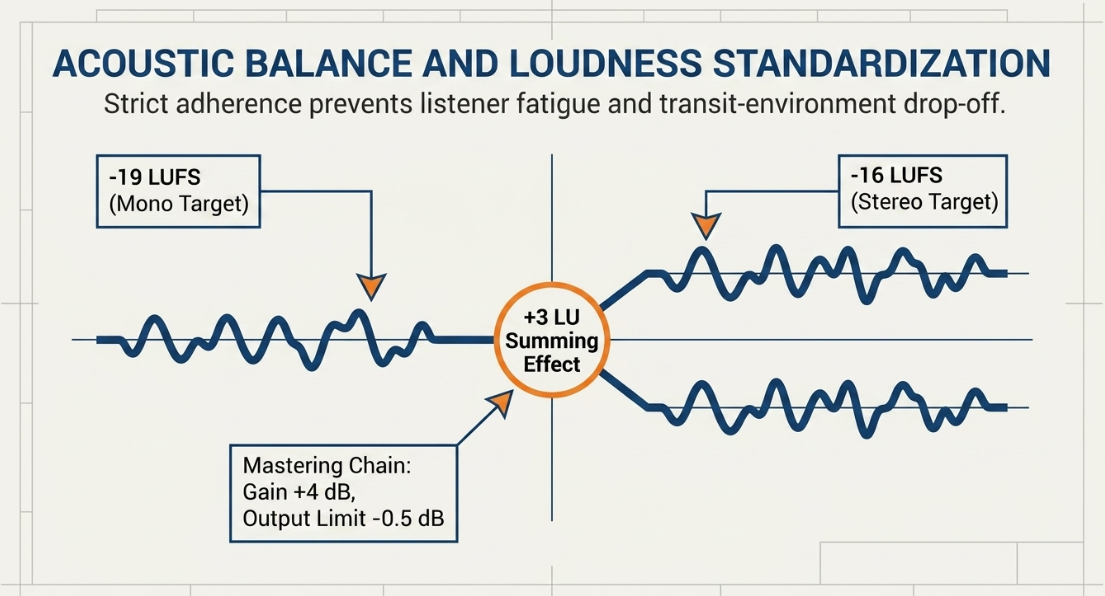
The global standard for podcast loudness is measured in Loudness Units relative to Full Scale (LUFS). The industry consensus mandates mastering stereo audio files to -16 LUFS.23 However, a vital technical distinction exists for mono files. When an audio file is exported in true mono, the playback device will duplicate that identical signal into both the left and right speakers or headphones. The physical summing of these two identical acoustic signals effectively doubles the perceived sound pressure level, increasing the acoustic output by precisely 3 Loudness Units (LU).24
To prevent mono podcasts from sounding aggressively louder than stereo podcasts upon playback, the standard dictates that mono files must be mastered 3 LU quieter, targeting -19 LUFS.21 Failure to adhere to these LKFS/LUFS standards results in a jarring listener experience. If an episode is too quiet—for example, mastered to the traditional broadcast television standard of -24 LUFS—listeners in noisy environments, such as cars or public transit, will be unable to hear the dialogue.23 Conversely, if an episode is mastered too loud, it will clip, distort, and trigger listener fatigue.
Modern producers employ limiters and dedicated LUFS meters (such as the Youlean Loudness Meter) at the end of their plugin chain.25 A standard mastering process involves applying limiters to the master track, setting the gain to +4 dB and the output level to -0.5 dB to prevent true peak clipping, and utilizing loudness normalization to hit the exact target of -16 LUFS (stereo) or -19 LUFS (mono) before the final MP3 or WAV export at 44100 Hz.25
Structural Engineering and Format Optimization
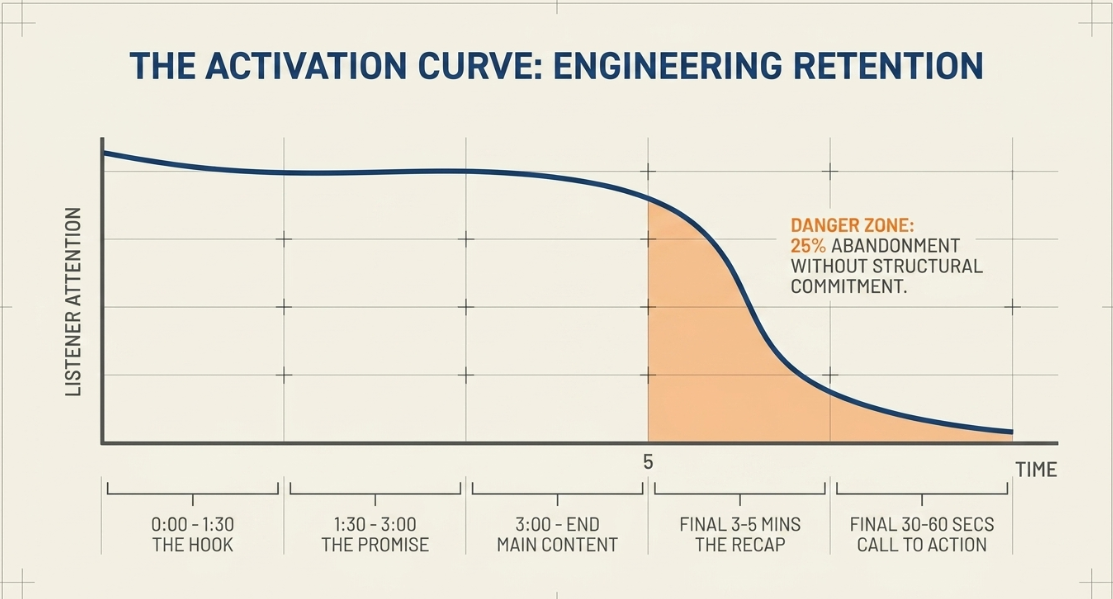
A pristine audio mix is rendered useless if the narrative structure fails to retain the audience. Because podcasting allows for extreme listener autonomy—a user can abandon an episode with a single tap—the architectural framework of the episode is paramount. Research indicates that a creator has approximately five minutes to secure a listener's commitment before one in four listeners abandon the episode.26 The format chosen directly dictates the production requirements and the listener's expectations.27
Core Podcast Formats
The podcasting ecosystem relies on several foundational formats, each with its own mechanical logic and production burden:
Interview / Guest Format: A host prepares a framework and invites a guest to speak for the majority of the episode.27 This format leverages the guest's expertise but requires excellent booking and conversational steering.
Co-host Format: Two or more hosts share the load, relying on chemistry and banter to drive engagement.27
Panel Format: Three or more rotating voices discuss a central topic, requiring heavy moderation to prevent crosstalk.27
Narrative / Scripted Format: The most resource-intensive format. Episodes are heavily written, produced with immersive sound design, and fold interviews into a larger story arc.27 Narrative podcasts generate the highest engagement and passionate fan communities, excelling in true crime, history, and investigative journalism.29 However, a single episode often requires 20 to 40 hours of production time, encompassing research, scripting, multiple interviews, and complex editing.29
Hybrid Approaches: Many networks dedicate entire seasons to high-budget narrative storytelling while utilizing standard interview formats for regular weekly episodes, allowing them to maintain publication consistency without exhausting their production teams.29
Solo Podcasting: Frameworks of Authority
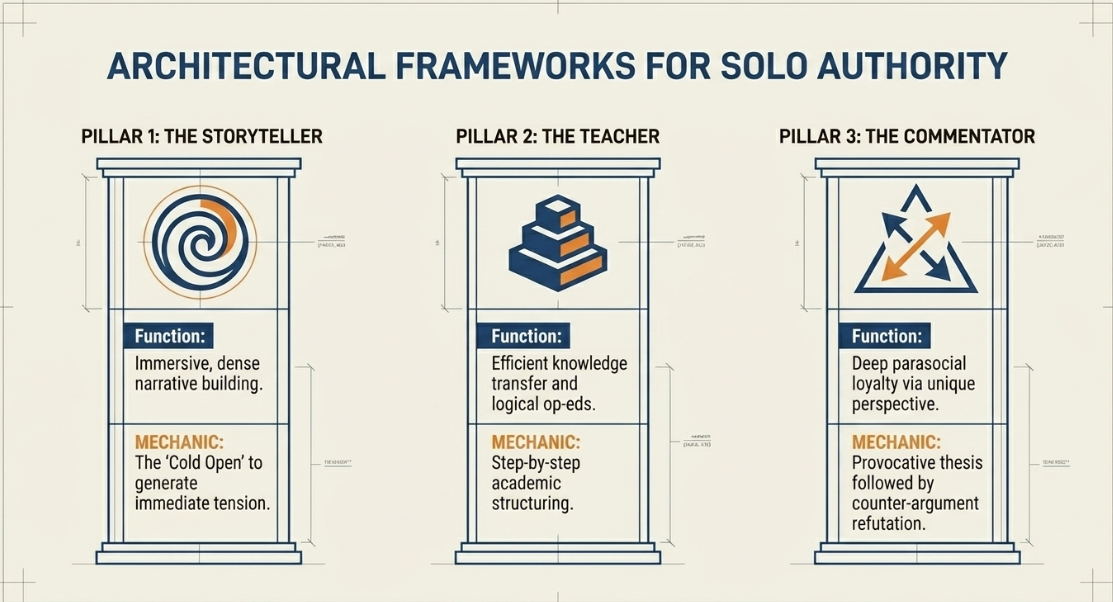
Solo podcasting presents a unique structural challenge. Without a guest to naturally dictate conversational pacing, a solo host risks meandering, which reliably leads to listener drop-off.30 To maintain momentum, solo shows generally adopt one of three specialized architectural frameworks:
The Storyteller: This format crafts a dense, immersive narrative. Rather than listing facts, the host uses descriptive language and sound design to build scenes. A key structural technique here is the "Cold Open"—launching the episode in the middle of high-stakes action to generate immediate tension before rolling the formal introduction. Sub-types include the Historical Deep Dive (e.g., Hardcore History) and Themed Narratives (e.g., Lore).30
The Teacher: Designed for efficient knowledge transfer, this format is heavily utilized by B2B brands, consultants, and educators. It discards emotional tension in favor of logical, step-by-step explanations, functioning much like an academic lecture or a structured "how-to" framework.30
The Commentator: Built entirely upon the host's unique perspective, this format demands a highly charismatic persona. The host states a provocative thesis, presents evidence, and refutes counter-arguments. It functions as a persuasive op-ed, creating deep parasocial loyalty with the audience, though it carries the risk of alienating listeners who disagree with the host's takes.30
Minute-by-Minute Episode Templates
To maximize algorithmic retention metrics (specifically on platforms like Spotify, which track drop-off rates heavily), episodes must be strictly signposted. Listeners require constant orientation regarding what they are learning, where they are in the narrative, and what is coming next.31 Outlines prevent content sprawl and respect the audience's time.32
This disciplined structure fundamentally alters how an audience perceives the show's professionalism. When a host adheres to a predictable rhythm, it respects the audience's time, fostering the trust required to transform a casual listener into a dedicated subscriber.
Strategic Scheduling and Algorithmic Visibility
The mechanics of podcast distribution require a thorough understanding of human psychology and algorithmic reward systems. The most pervasive misconception in podcast growth strategy is the assumption that a higher volume of episodes automatically yields higher audience numbers. In reality, consistency vastly outperforms frequency.33
The Psychology of Consistency
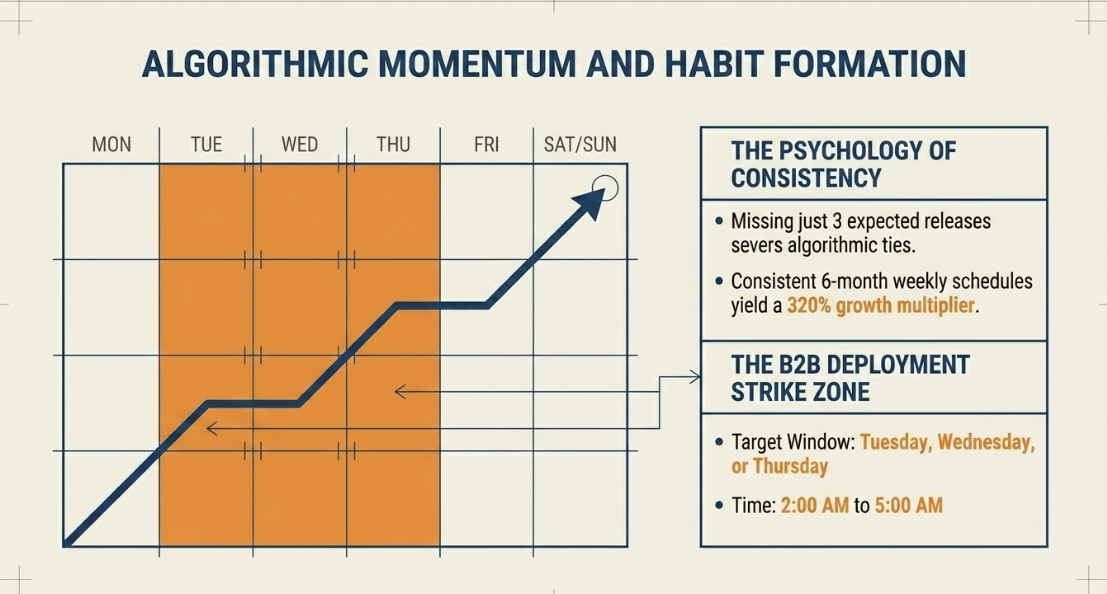
Podcast consumption is a deeply habitual activity. Audiences integrate shows into their daily routines—commuting, exercising, or performing household chores.35 If an episode is published erratically, the listener's habit is broken, leading to frustration and rapid attention erosion.36 Data sourced from major platforms reveals that missing just three expected release dates causes a measurable portion of a subscriber base to permanently drift to competing shows.37
Conversely, maintaining a predictable cadence builds trust and habit formation. Statistics indicate that podcasts maintaining consistent weekly schedules for at least six months experience 320% better audience growth than those publishing sporadically, even when the underlying content quality is identical.34
While a weekly release schedule is considered the "gold standard" because it perfectly aligns with human weekly routines, a bi-weekly (every other week) schedule can be highly successful if communicated clearly.33 Spotify's internal creator documentation acknowledges that shows publishing at least bi-weekly maintain significantly higher listener retention rates than monthly publishers.37 The cardinal rule is quality over volume: a highly polished, deeply researched bi-weekly show will permanently outperform a weekly show that sounds rushed or poorly edited.37 The ultimate signal that a publication schedule is unsustainable is if the host must apologize for a delayed release in the episode's introduction.37 Alternatively, releasing content in defined "seasons" allows creators to maintain extremely high quality, provided they stay active on social media between seasons to keep the audience warm.
Optimal Publication Timing: The B2B vs. Entertainment Divide
The specific day and time an episode is published should be tailored to the target audience's lifestyle, as algorithmic momentum relies on early listener engagement.
For business-to-business (B2B) podcasts, the target demographic consists of professionals consuming content during the standard workweek. Releasing episodes late in the week (Fridays) or on weekends severely limits early momentum, as professional audiences tune out of business content, which subsequently damages algorithmic visibility.38 The data confirms that the optimal release window for B2B and professional development podcasts is Tuesday, Wednesday, or Thursday morning between 2:00 AM and 5:00 AM in the target audience's primary time zone.38
Publishing in the early hours of the morning allows standard podcast directories sufficient time to crawl the RSS feed and update their databases. By the time the professional audience begins their morning commute (typically between 7:00 AM and 9:00 AM), the episode is readily available and pre-downloaded at the top of their feeds.38 Podchaser data reveals that Thursday historically drives the highest total download volumes as audiences attempt to catch up on their weekly queues before the weekend begins.
Deciphering the Algorithms: Spotify and Apple Podcasts
Podcast directories are no longer passive libraries; they are active discovery engines. Understanding the specific ranking factors of the dominant platforms is crucial for organic growth.
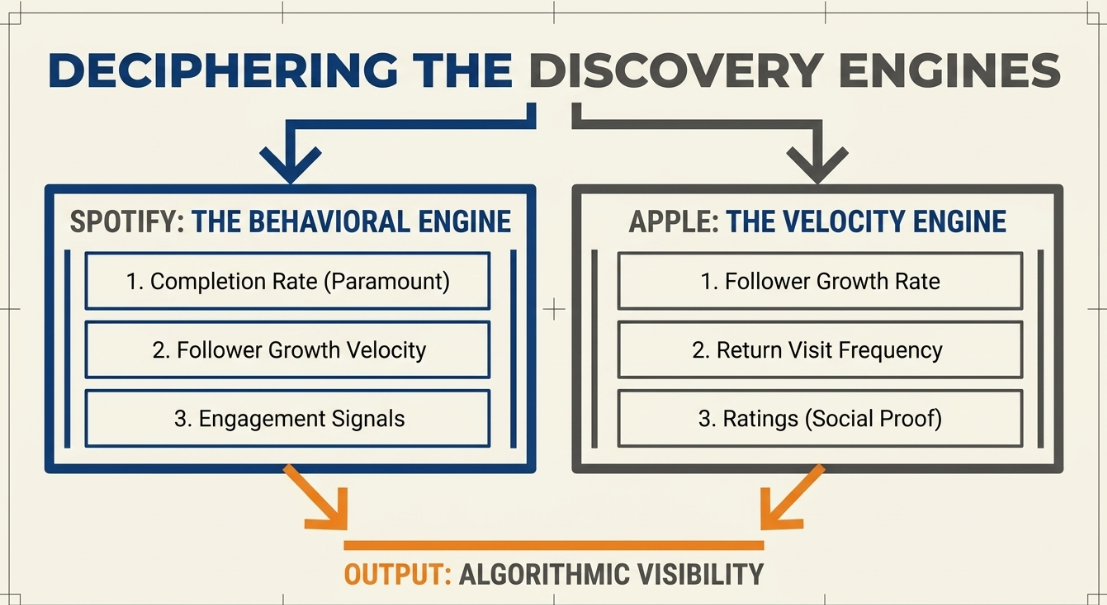
Spotify's Algorithmic Priorities: Spotify actively recommends podcasts via algorithmic curation, relying heavily on behavioral data rather than basic historical download counts.41
Completion Rate: This is the paramount metric. Spotify tracks exactly when a user stops listening. If a high percentage of users abandon an episode within the first few minutes, the algorithm flags the content as low quality and suppresses its visibility. Conversely, high completion rates signal value, triggering organic promotion across the platform.41
Follower Growth Velocity: The algorithm favors momentum. A new podcast acquiring 100 followers in a single week will outrank a legacy podcast that possesses 10,000 total followers but only acquires 10 new followers in that same week.41
Engagement Signals: Active user behaviors—such as saving an episode to a library, sharing a link, or replaying specific chapters—heavily influence search rankings.41
Platform Loyalty: Circumstantial evidence suggests Spotify slightly favors podcasts hosted using its native distribution tool (Spotify for Podcasters), rewarding platform loyalty with enhanced algorithmic placement.41
Apple Podcasts' Algorithmic Priorities: Apple Podcasts similarly rewards momentum over historical aggregation, focusing on the velocity of engagement.43
Follower Growth: The rate at which new users follow the show dictates chart placement.43
Listener Engagement: Apple tracks how much of the episode is consumed and how frequently users return to the application to listen to the specific show.43
Ratings and Reviews: While less impactful for direct search engine ranking, ratings serve as critical "social proof" that boosts a show's visibility within Apple's highly competitive curated category charts.43
Discoverability, Audio SEO, and Audience Acquisition
As the total volume of global podcasts exceeds five million active shows, relying solely on organic platform discovery is a failing strategy. Growth in 2026 demands a sophisticated integration of Audio Search Engine Optimization (SEO) and targeted cross-promotional partnerships.
The Shift to Semantic Search and Zero-Click SEO
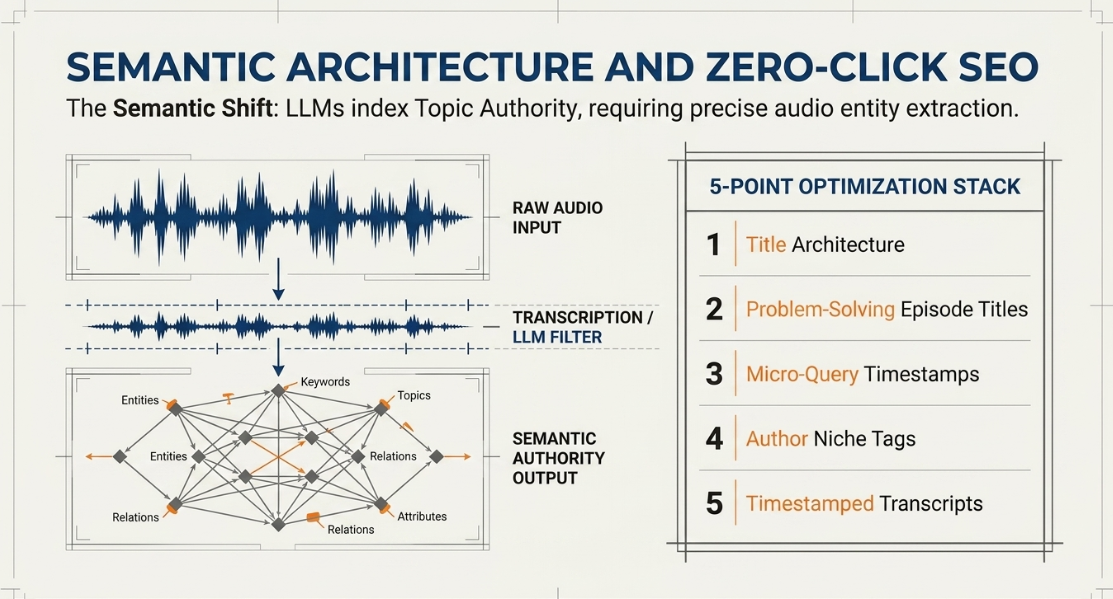
Historically, podcast SEO relied on simple keyword stuffing within the episode description. However, the integration of Large Language Models (LLMs) into search architectures—such as Google's AI Overviews, Spotify's semantic search, and YouTube's chapter parsing—has fundamentally changed how audio is indexed.45
Search engines no longer look merely for isolated phrases; they seek "Topic Authority" through semantic relationships.45 For example, if a podcast claims to be about "Digital Marketing," the AI algorithms expect to find related semantic entities within the audio transcript, such as "conversion rates," "funnel optimization," or "cost per acquisition." If these related entities are absent, the algorithm categorizes the content as superficial or AI-generated slop, suppressing its search rank.45
Furthermore, creators must optimize for "Zero-Click SEO." This concept involves providing such immense value within the search results page—through highly detailed, entity-rich episode summaries and descriptive timestamps—that the brand establishes authority before the user ever clicks to press play.45 By the time the user does click, they are already a highly qualified, warm lead.
Metadata Optimization Strategies
To ensure the podcast's RSS feed is accurately parsed by these advanced algorithms, producers must strictly optimize multiple metadata layers:
Title Architecture: The primary keyword must be positioned within the first 60 characters of the main podcast title.44 Vague, "clever" names fail algorithmically. A clear title, potentially augmented with a descriptive tagline (e.g., "Freelance Writing for Beginners: Tips to Become a Writer People Want to Hire"), signals exactly what the show is about to both human users and AI crawlers.46
Episode Titles: Avoid placeholder formatting such as "Episode 14: A Chat with Jane Doe." Episode titles must reflect the specific problem solved or the primary takeaway of the conversation (e.g., "How to Write Catchy Headlines for Blogs").44
Descriptive Timestamps: Vague chapter markers (e.g., "05:00 - Introduction") waste vital SEO real estate. Timestamps should function as micro-queries that users might search for, such as "12:45 - How to negotiate a seed round," allowing Google to index specific segments of the audio.45
Author Tag Optimization: Search algorithms weigh "by-title" and "by-author" fields equally. Appending a niche qualifier to the author name (e.g., "Jane Smith, Supply Chain Expert") captures highly specific long-tail search traffic.46
Transcripts and Website Integration: Search engines cannot natively index raw audio files, but they read text flawlessly. Publishing full, timestamped transcripts on a dedicated episode webpage converts the audio dialogue into thousands of indexable text keywords. This improves domain authority, ensures accessibility, and provides the foundation for schema markup ("PodcastEpisode" schema).44
Avoiding Duplicate Feeds: When distributing to major directories, producers must never submit their RSS feed twice to the same platform. Duplicate submissions split reviews, downloads, and SEO authority, severely hampering discoverability.46
Cross-Promotion and Social Syndication
While SEO captures listeners actively searching for solutions, cross-promotion captures passive listeners by leveraging the established trust of an adjacent audience. Because podcast listeners already possess the necessary applications and behavioral habits, converting them from one show to another is exponentially easier than converting a non-listener via standard social media advertising.49
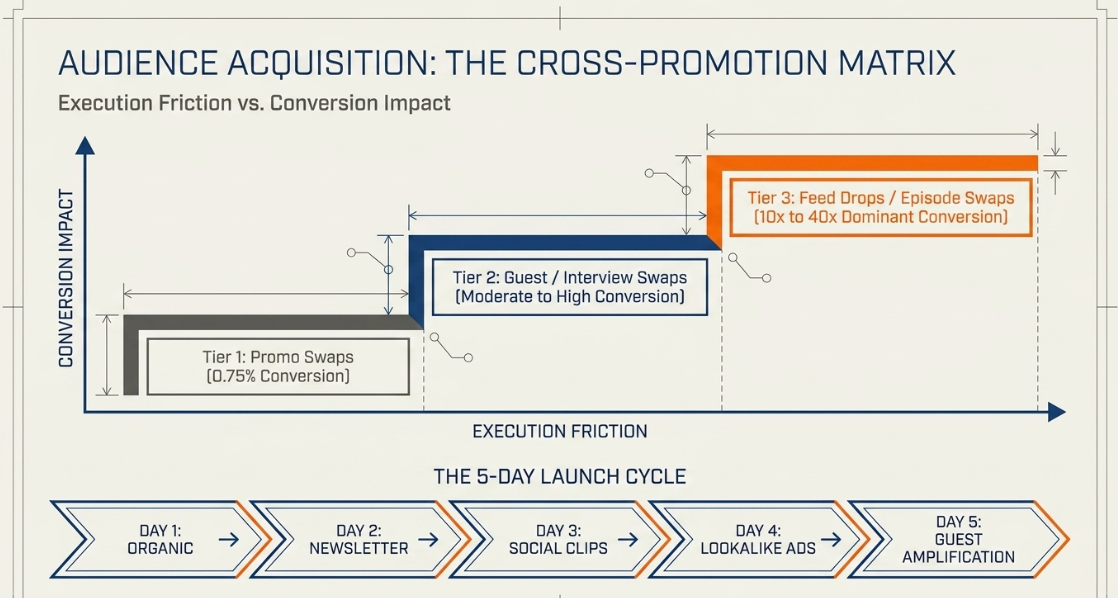
The myth of organic guest promotion—the assumption that a guest will relentlessly share an episode with their massive audience—is one of the most persistent fallacies in the industry. Data proves that guests rarely promote their appearances adequately, and expecting them to drive audience growth leads to consistent disappointment.50 True growth requires formalized, mutually beneficial cross-promotional campaigns with other creators, alongside disciplined social media syndication.
Executing these campaigns requires careful alignment. Producers utilize database tools like Rephonic or MatchMaker.fm to analyze audience demographics, gender skews, and geographic locations to ensure a high degree of listener overlap before proposing a swap.49
Furthermore, to maximize the lifespan of an episode, creators employ a staggered, multi-day promotional strategy rather than front-loading all marketing on launch day. A proven strategy involves a 5-day cycle: Day 1 allows the episode to breathe for organic listeners; Day 2 targets the email newsletter; Day 3 leverages primary social platforms with video audiograms and short clips (TikTok, Reels); Day 4 activates paid social media advertising targeted at lookalike audiences; and Day 5 relies on the guest to share the content.53 Stretching engagement over five days signals to platform algorithms that the show possesses staying power, preventing the rapid drop-off associated with launch-day spikes.
Commercial Strategy, Ecosystems, and Market Dynamics
As the medium matures, the commercial realities of sustaining a podcast operation dictate new revenue models and ecosystem strategies. The saturation of the market has fundamentally shifted the focus away from sheer download volume toward niche audience monetization and diversified commercial architectures.3
Diversifying Revenue Beyond Traditional Advertising
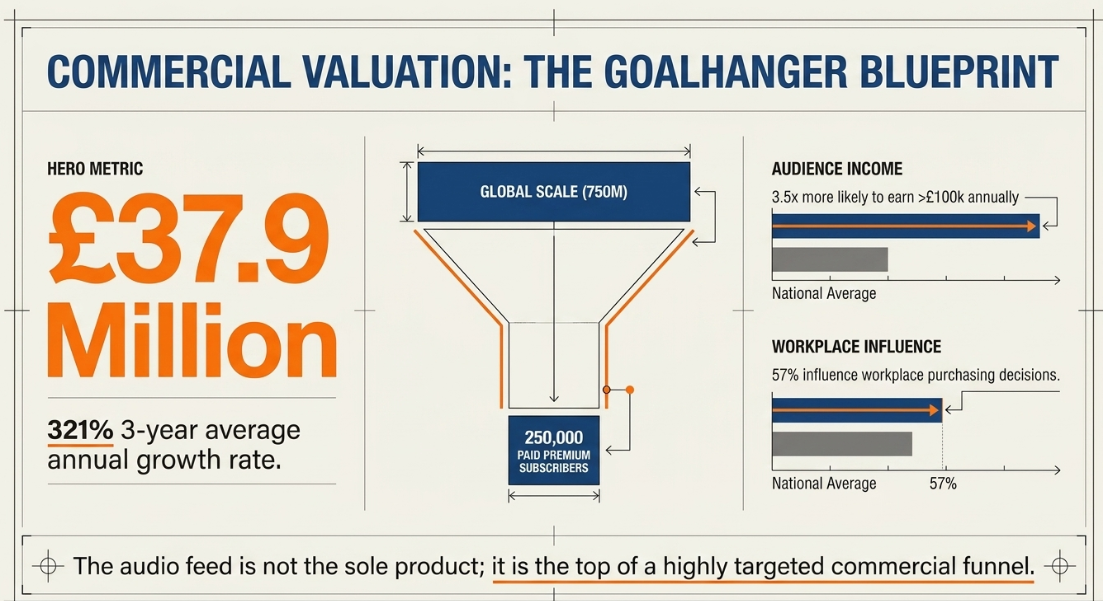
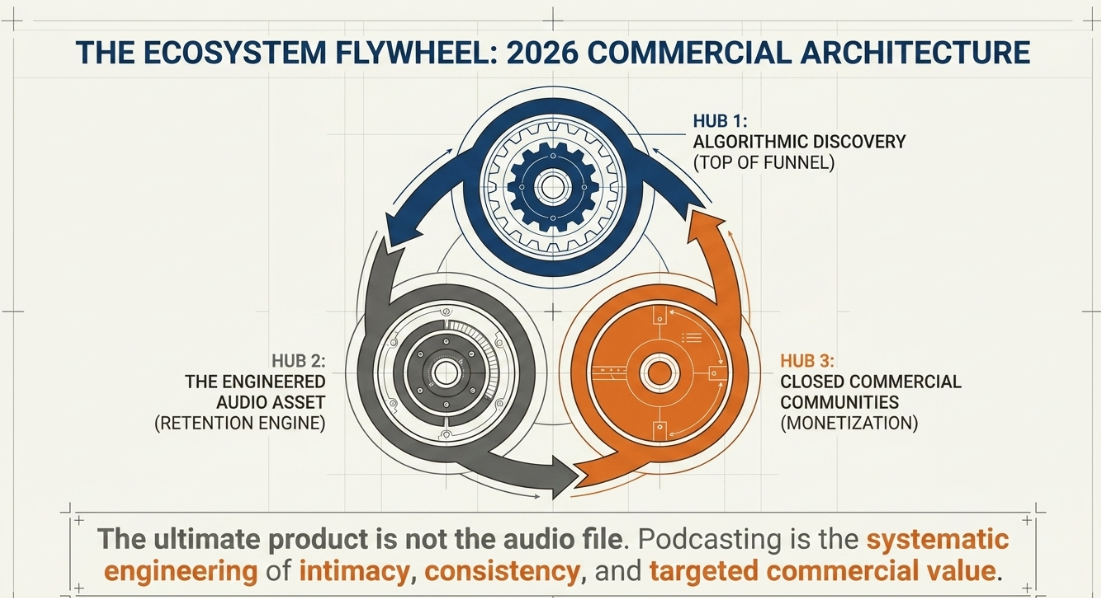
Relying exclusively on programmatic advertising or traditional CPM (Cost Per Mille) sponsorships is an inherently fragile model, particularly for independent and mid-tier creators exposed to macroeconomic advertising pullbacks.3 The most resilient podcast businesses in 2026 treat their audio feed not as the sole product, but as the top of a broader commercial funnel, focusing on tight community curation rather than chasing mass scale.3 Highly focused formats deliver conversion rates up to three times higher than generic network buys.3
A premier example of this diversified commercial strategy is Goalhanger Podcasts, a UK-based media production company. Producing dominant titles such as The Rest is History, The Rest is Politics, and The Rest is Football, Goalhanger generated £37.9 million in sales in 2025, boasting a remarkable three-year average annual growth rate of 321%.58 While they possess massive scale (over 750 million listeners globally), their commercial durability stems from converting that scale into direct-to-consumer revenue.58
Goalhanger successfully transitioned its highly engaged audience into a premium tier, securing 250,000 paid subscribers, a move estimated to generate £15 million in recurring annual revenue independent of corporate advertisers.58 Furthermore, their audience demographic acts as a massive commercial lever. Goalhanger listeners are 3.5 times more likely to earn over £100,000 annually compared to average UK adults, and 57% of their audience influences workplace purchasing decisions (compared to a national average of 25%).59 Consequently, they command premium advertising rates when they do sell inventory, noting that their listeners are 45% more likely to act on advertisements compared to industry standards.59 This model—blending audio-reach with paid memberships, live touring events, and high-net-worth demographic targeting—represents the pinnacle of modern podcast commercialization.
The Tension Between Exclusivity and the Open RSS Ecosystem
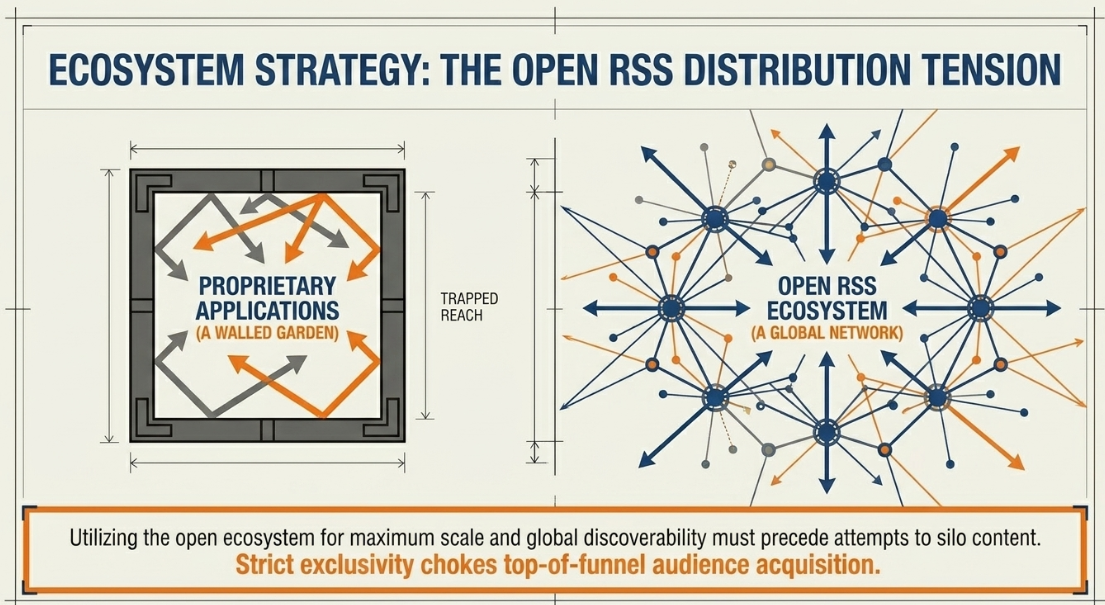
At the enterprise level, a strategic tension exists between driving audiences to proprietary, walled-garden applications and utilizing the open podcast ecosystem (Open RSS) for maximum global reach.
This dynamic is acutely visible in the strategy deployed by the British Broadcasting Corporation (BBC). Facing severe domestic funding pressures—including government funding cuts until 2024 and the impending 2027 termination of the TV licensing fee which constitutes two-thirds of its budget—the BBC has been forced to look outward for commercial survival.60
Historically, the BBC prioritized driving UK listeners to its proprietary audio app, BBC Sounds.60 To protect its domestic platform, the network utilizes windowed exclusivity, releasing premium content on BBC Sounds for a designated period (often 7 to 28 days) before allowing it to syndicate to open platforms like Apple Podcasts and Spotify.61 However, because BBC Sounds lacks the vast global penetration of the major tech platforms, the network cannot afford absolute exclusivity.60
To maximize global format growth and monetize international audiences (who receive ad-supported versions of BBC content), the network established partnerships with global distributors, ensuring their iconic programs reach audiences regardless of their preferred listening application.60 The strategic takeaway for modern networks is clear: utilizing the open ecosystem to achieve maximum scale and discoverability must precede attempts to silo content behind proprietary paywalls or exclusive applications.60 Attempting strict exclusivity without a pre-existing, deeply loyal audience inevitably chokes top-of-funnel growth, limiting both audience acquisition and eventual commercialization.
Conclusion
The evolution of the podcasting industry through 2026 confirms that audio is no longer an emerging medium; it is a mature, complex, and highly lucrative sector of the global entertainment and information economy. Building and sustaining a successful audio ecosystem requires operators to abandon outdated, single-variable growth tactics in favor of a holistic, multi-disciplinary approach.
The evidence dictates several core operational mandates. First, while multi-format consumption is rising, the foundational product remains the audio experience. Strategic operators must resist the temptation to overinvest in visual formats at the detriment of pristine audio engineering, rigorous narrative structure, and strict adherence to established mastering standards such as -16 LUFS for stereo and -19 LUFS for mono. Quality control from pre-production checklists to post-release hotwashes ensures the final product commands authority.
Second, discoverability is now a function of behavioral algorithms and semantic artificial intelligence. Producers must architect their metadata—from keyword-optimized titles to exhaustive, entity-rich transcripts—to satisfy the demands of zero-click SEO and algorithmic momentum trackers on platforms like Spotify and Apple Podcasts. An episode's structure must capture the audience within the first 90 seconds to preserve the completion rates that algorithms demand.
Finally, audience acquisition and commercial sustainability are heavily dependent on ecosystem integration and psychological habit-formation. Publishing schedules must prioritize extreme consistency to build listener routines, particularly targeting early-morning releases for professional demographics. Because organic growth is inherently slow, scaling requires aggressive, formalized cross-promotional architectures, particularly high-conversion tactics like feed drops. Furthermore, reliance on traditional advertising must be supplanted by diversified revenue streams, including premium subscriptions and live event models, effectively insulating the podcast from macroeconomic volatility. Ultimately, the creators and networks that thrive in this saturated environment are those who view podcasting not merely as the act of recording a conversation, but as the systematic engineering of intimacy, consistency, and targeted commercial value.
Works cited
Podcasting Trends & Predictions for 2026: What Creators Need to ..., accessed June 11, 2026, https://blog.podcast.co/inspire/podcasting-trends-predictions-2026
Podcasting trends of 2025 and what to focus on in 2026 - Rachel Corbett, accessed June 11, 2026, https://rachelcorbett.com.au/blog/podcasting-trends-2025/
Podcast Trends 2025 | DMEXCO Column, accessed June 11, 2026, https://dmexco.com/stories/dmecxo-column-whats-new-three-major-podcast-trends-for-2025-2026/
The Infinite Dial UK 2025 - Edison Research, accessed June 11, 2026, https://www.edisonresearch.com/wp-content/uploads/2025/05/Infinite-Dial-UK-2025-webinar-presentation-for-download.pdf
UK Consumers Embrace Smart Devices as Podcast Listening Hits New High - Podnews, accessed June 11, 2026, https://podnews.net/press-release/infinite-dial-2025-uk
Audio Report 2026 - Ofcom, accessed June 11, 2026, https://www.ofcom.org.uk/siteassets/resources/documents/research-and-data/data/statistics/2026/audio-listening-in-uk/audio-report-2026.pdf?v=418128
What Midas Autumn 2025 reveals about how people use audio - RedTech, accessed June 11, 2026, https://www.redtech.pro/midas-autumn-2025-audio-listening/
UK Podcast Listening Holds Steady at 24% of Adults, RAJAR Autumn 2025 MIDAS Shows, accessed June 11, 2026, https://www.podcastvideos.com/articles/uk-podcast-listening-steady-rajar-autumn-2025/
RAJAR's Audio Survey 'MIDAS' Summer 2025, accessed June 11, 2026, https://www.rajar.co.uk/docs/news/MIDAS%20Summer%202025.pdf
RAJAR's Audio Survey 'MIDAS' Spring 2026, accessed June 11, 2026, https://www.rajar.co.uk/docs/news/MIDAS%20Spring%202026.pdf
Podcasts: Pre and Post Production - Day by Day, accessed June 11, 2026, https://www.day-by-day.biz/post/podcasts-pre-and-post-production
Show me your Checklist that you follow for every podcast episode - Reddit, accessed June 11, 2026, https://www.reddit.com/r/podcasting/comments/phojzf/show_me_your_checklist_that_you_follow_for_every/
Guide to Podcast Post-Production > DINFOS Pavilion > Checklist, accessed June 11, 2026, https://pavilion.dinfos.edu/Checklist/Article/3066300/guide-to-podcast-post-production/
GUIDE TO PODCAST POST-PRODUCTION, accessed June 11, 2026, https://media.defense.gov/2022/Jun/27/2003025263/-1/-1/1/PAVILION%20Guide%20to%20Podcast%20Post-Production.PDF
Ultimate Guide to Podcast Production - iZotope, accessed June 11, 2026, https://www.izotope.com/community/blog/podcast-production-guide
Top 10 DAWs in 2026 and how to choose - iZotope, accessed June 11, 2026, https://www.izotope.com/community/blog/best-daws
Best DAW for podcast editing workflow? - Reddit, accessed June 11, 2026, https://www.reddit.com/r/podcasting/comments/1l532ue/best_daw_for_podcast_editing_workflow/
What Are The Best DAW And Plugins For Editing Podcasts? - Tansy Aster Academy, accessed June 11, 2026, https://tansyasteracademy.com/what-are-the-best-daw-and-plugins-for-editing-podcasts/
My Podcasting Post-Production Workflow (Ultra-Brief Overview) - YouTube, accessed June 11, 2026, https://www.youtube.com/watch?v=GxxoE-VGa6M
Industry-standard audio repair and post production with RX 12 Advanced - iZotope, accessed June 11, 2026, https://www.izotope.com/products/rx-advanced
accessed June 11, 2026, https://www.yorkshirepodcaststudios.com/post/podcast-audio-levels-guide#:~:text=Most%20podcast%20platforms%20aim%20for,%E2%80%9319%20LUFS%20for%20mono
Why Good Podcast Audio Levels Can Make or Break Your Recording, accessed June 11, 2026, https://www.yorkshirepodcaststudios.com/post/podcast-audio-levels-guide
How to do loudness: the LUFS and LKFS FAQ for podcasters - Podnews, accessed June 11, 2026, https://podnews.net/article/lufs-lkfs-for-podcasters
Lufs for Stereo & Mono : r/podcasting - Reddit, accessed June 11, 2026, https://www.reddit.com/r/podcasting/comments/1g71ws0/lufs_for_stereo_mono/
HOW LOUD SHOULD YOUR PODCAST BE? LUFS AND DB EXPLAINED, accessed June 11, 2026, https://content.sport-social.co.uk/blog/how-loud-should-your-podcast-be
Podcast Intro Examples: How to Hook Audiences (+ Templates) - Goldcast, accessed June 11, 2026, https://www.goldcast.io/blog-post/podcast-intro-examples
Podcast Format Types: Interview, Solo, Panel, and More | Podcasting Authority, accessed June 11, 2026, https://podcastingauthority.com/podcast-format-types
The Marketer's Guide to Podcast Formats: 5 Types of Podcasts You Can Produce - Wistia, accessed June 11, 2026, https://wistia.com/learn/marketing/podcast-formats
Interview vs Solo vs Roundtable: Finding Your Perfect Podcast Format - propodcastsolutions.com, accessed June 11, 2026, https://propodcastsolutions.com/interview-vs-solo-vs-roundtable-finding-your-perfect-podcast-format/
The 3 Main Formats of Solo Podcasting - StereoForest Studio, accessed June 11, 2026, https://stereoforest.com/the-3-main-formats-of-solo-podcasting/
Podcast Episode Structure Template: How to Design Engaging Episodes in 2026, accessed June 11, 2026, https://www.automateed.com/podcast-episode-structure-template
A Winning Outline for Podcast Episodes - Fame.so, accessed June 11, 2026, https://www.fame.so/post/a-winning-outline-for-podcast-episodes
How Often Should You Release Podcast Episodes? - Transcend Podcast Studio, accessed June 11, 2026, https://transcendpodcaststudio.com/blogs/news/how-often-should-you-release-podcast-episodes
Why Podcast Listeners Drop Off: 5 Proven Retention Strategies for Creators - propodcastsolutions.com, accessed June 11, 2026, https://propodcastsolutions.com/podcast-listener-retention-strategies/
Why is a consistent release schedule important? : r/podcasting - Reddit, accessed June 11, 2026, https://www.reddit.com/r/podcasting/comments/1ij955q/why_is_a_consistent_release_schedule_important/
How Often Should I Release Podcast Episodes for Real Growth - Humanise Live, accessed June 11, 2026, https://www.humanise.live/how-often-should-i-release-podcast-episodes/
Podcast Publishing Schedule: How Often Should You Release Episodes, accessed June 11, 2026, https://podcastingauthority.com/podcast-publishing-schedule/
Podcast Release Schedule: What Works for B2B (with Data) - Content Allies, accessed June 11, 2026, https://contentallies.com/learn/b2b-podcast-release-schedule
Timing Is Everything: The Best Day and Time to Publish Your Podcast - Podbean Blog, accessed June 11, 2026, https://blog.podbean.com/best-time-to-publish-your-podcast/
When to release your podcast: Best day, time, and frequency to deliver your podcast - Resonate Recordings, accessed June 11, 2026, https://resonaterecordings.com/general/when-to-release-your-podcast/
Podcast SEO: How to Rank #1 on Spotify, Google & Apple Podcasts ..., accessed June 11, 2026, https://www.jigsawkraft.com/post/podcast-seo-how-to-rank-1-on-spotify-google-apple-podcasts-in-2026
Social Media Discoverability Strategy: The Algorithm - Alice Violet Creative, accessed June 11, 2026, https://alicevioletcreative.com/social-media-discoverability-strategy/
Understanding Podcast Rankings and Apple Podcasts Algorithms - Firstory Help Center, accessed June 11, 2026, https://help.firstory.me/en/articles/13597170-understanding-podcast-rankings-and-apple-podcasts-algorithms
7 Podcast SEO Best Practices for Explosive Growth in 2025 - Fame.so, accessed June 11, 2026, https://www.fame.so/post/7-podcast-seo-best-practices-for-explosive-growth-in-2025
Mastering Zero-Click Podcast SEO: How to Rank on Google ..., accessed June 11, 2026, https://blog.podcast.co/reach/rank-with-podcast-seo
How to Optimize Your Podcast for SEO | RSS.com Podcast Hosting, accessed June 11, 2026, https://rss.com/blog/nine-seo-tips-for-podcasts/
Get Found: Improve The Discoverability of Your Show with Podcast SEO - Wistia, accessed June 11, 2026, https://wistia.com/learn/marketing/podcast-seo
Best Practices for Podcast SEO - Pilot Digital Marketing, accessed June 11, 2026, https://pilotdigital.com/blog/best-practices-for-podcast-seo/
Podcast Swaps: The New Strategy for Cross-Promotion and Listener ..., accessed June 11, 2026, https://www.premierepodcastpros.com/uncategorized/podcast-swaps-the-new-strategy-for-cross-promotion-and-listener-growth/
Why podcast guest cross-promotion as a growth strategy is a fairytale - Podmastery, accessed June 11, 2026, https://podmastery.co/episodes/why-podcast-guest-cross-promotion-as-a-growth-strategy-is-a-fairytale/
So You Want to Cross-Promote Your Podcast? - The Simplecast Blog, accessed June 11, 2026, https://blog.simplecast.com/cross-show-promotion
The Four Phases of Podcast Growth, accessed June 11, 2026, https://podcastmarketingacademy.com/phases-of-podcast-growth/
accessed June 11, 2026, https://www.budindia.com/blog/using-social-media-and-seo-together-to-promote-your-podcast.php#:~:text=Key%20strategies%20include%3A,or%20clips%20to%20targeted%20audiences.
9 Strategies to Promote Your Podcast on Social Media - Vimeo, accessed June 11, 2026, https://vimeo.com/blog/post/promote-podcast-social-media
10 Potent Podcast Marketing Strategies for Growth in 2025, accessed June 11, 2026, https://transcript.lol/blog/podcast-marketing-strategies
Podcast marketing: 12 key strategies to promote and grow your podcast - Spotify for Creators, accessed June 11, 2026, https://creators.spotify.com/resources/grow/podcast-marketing
Podcast Growth Tips? Promotion, Social Media & Ads Advice Needed - Reddit, accessed June 11, 2026, https://www.reddit.com/r/podcasting/comments/1jpmm93/podcast_growth_tips_promotion_social_media_ads/
Gary Lineker's Goalhanger named UK's fastest-growing business ..., accessed June 11, 2026, https://www.theguardian.com/media/2026/jun/05/gary-lineker-goalhanger-fastest-growing-business-podcasts
Goalhanger: Podcast Network & Advertising Platform, accessed June 11, 2026, https://goalhanger.com/
BBC signals radio's shift to the podcast market - MIDiA Research, accessed June 11, 2026, https://www.midiaresearch.com/blog/bbc-signals-radios-shift-to-the-podcast-market
BBC Renews Podcast Strategy, Spotify Focusing Video, & More - Sounds Profitable, accessed June 11, 2026, https://soundsprofitable.com/the-download/bbc-renews-podcast/
BBC Sounds - is it going away internationally? | James Cridland - radio futurologist, accessed June 11, 2026, https://james.cridland.net/blog/2024/bbc-sounds-the-strategy/