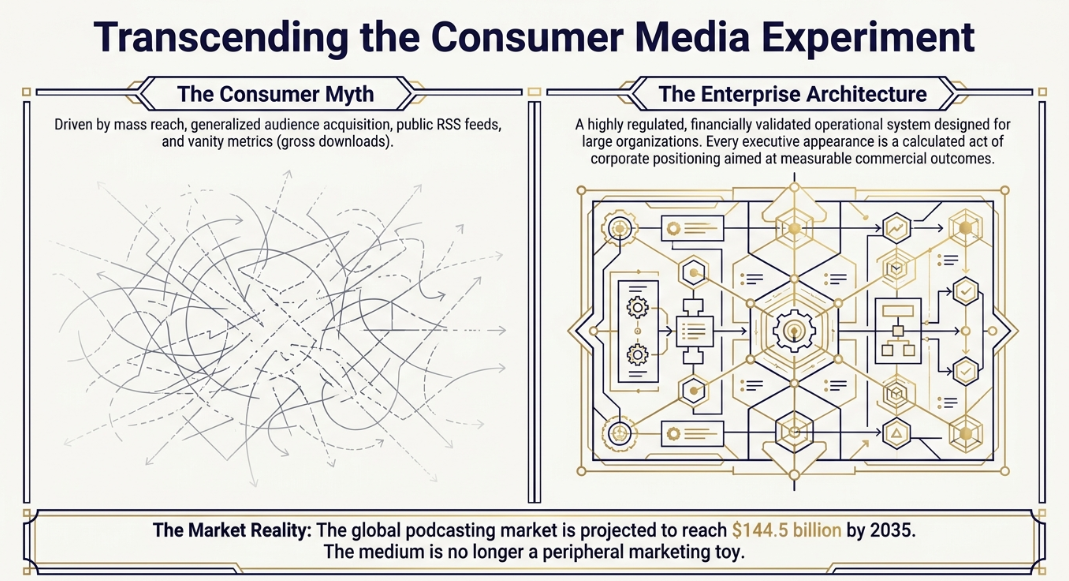
The digital media and corporate communications landscapes have undergone a profound, structural transformation over the past decade, positioning enterprise audio and corporate podcasting not merely as peripheral marketing experiments, but as foundational pillars of strategic communication. With the global podcasting market projected to reach a staggering valuation of $144.5 billion by the year 2035, the medium has definitively transcended its origins in consumer entertainment.1 It has evolved into a critical conduit for B2B business development, internal corporate alignment, and high-stakes brand positioning.1 Developing a successful, sustainable enterprise podcast strategy demands rigorous organizational planning and a fundamental departure from the pursuit of vanity metrics.2
Enterprise podcast public relations and strategic marketing constitute an entirely distinct operational system compared to traditional personal branding or consumer-grade media.3 This operating system is designed specifically for large organizations where every executive appearance is a calculated act of corporate positioning.3 In this highly regulated and scrutinized environment, an audio program must systematically defend its strategic and financial validity to boards of directors, chief financial officers, and in-house legal counsel before it ever reaches a consumer, a prospect, or a buyer.3 The modern corporate podcast requires a rigorously documented business case that aligns audio initiatives directly with overarching corporate objectives, ensuring messaging consistency across all departments and driving measurable commercial and operational outcomes.2
This exhaustive research report delineates the theoretical and psychological foundations of enterprise audio, constructs a robust framework for architecting the business case, explores the operational and financial requirements for sustainable production, and provides a meticulous blueprint for executing both internal and external corporate podcast strategies.
Part I: The Theoretical and Psychological Foundation of Enterprise Audio
To architect a compelling, bulletproof business case for enterprise podcasting, executive sponsors must first understand the underlying psychological and communicative mechanisms that make the audio medium uniquely effective compared to traditional digital marketing channels. The efficacy of podcasting is grounded in several established academic frameworks, most notably Media Richness Theory, Parasocial Interaction, Uses and Gratifications Theory, and Cognitive Load Theory.
Media Richness Theory and Corporate Communication
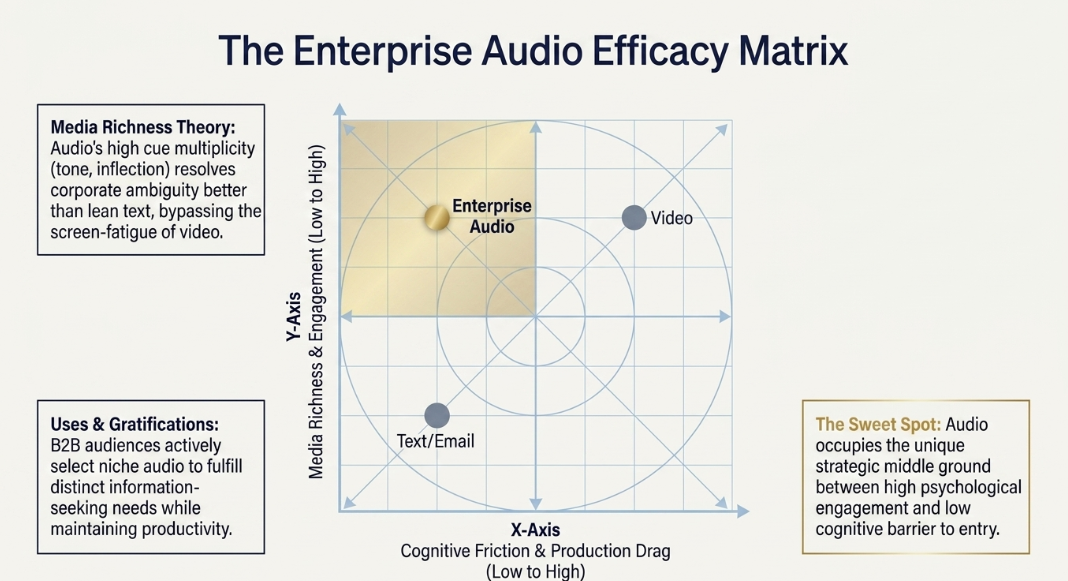
Media Richness Theory, originally conceptualized by organizational management researchers Richard Daft and Robert Lengel in the 1980s, posits that different communication channels possess varying, inherent capacities to transmit information and resolve ambiguity.5 The theory suggests that organizational communication generally aims to achieve one of two primary goals: to reduce uncertainty (addressing a fundamental lack of data) or to resolve ambiguity (addressing a lack of clear interpretation in complex situations).6 Within this theoretical hierarchy, face-to-face communication is considered the "richest" medium due to its high cue multiplicity, followed by video, synchronous audio, and finally, lean, text-based media such as emails or standard press releases.6
While video offers comprehensive visual information—such as movement, eye contact, and body language—audio-only podcasts occupy a highly strategic and highly functional middle ground in the media richness spectrum.7 Podcasts utilize cue multiplicity through the host's tone of voice, vocal inflection, pacing, and the use of natural discourse language.8 These auditory cues convey emotional nuance and subtext that text-based corporate communications inherently lack.8 By integrating podcasts into the digital communication mix, enterprises leverage this "enriched media" to clarify complex corporate narratives, thereby reducing ambiguity more effectively than lean media formats, while bypassing the high production friction and screen-fatigue associated with video.5
Parasocial Interaction and the B2B Trust Loop
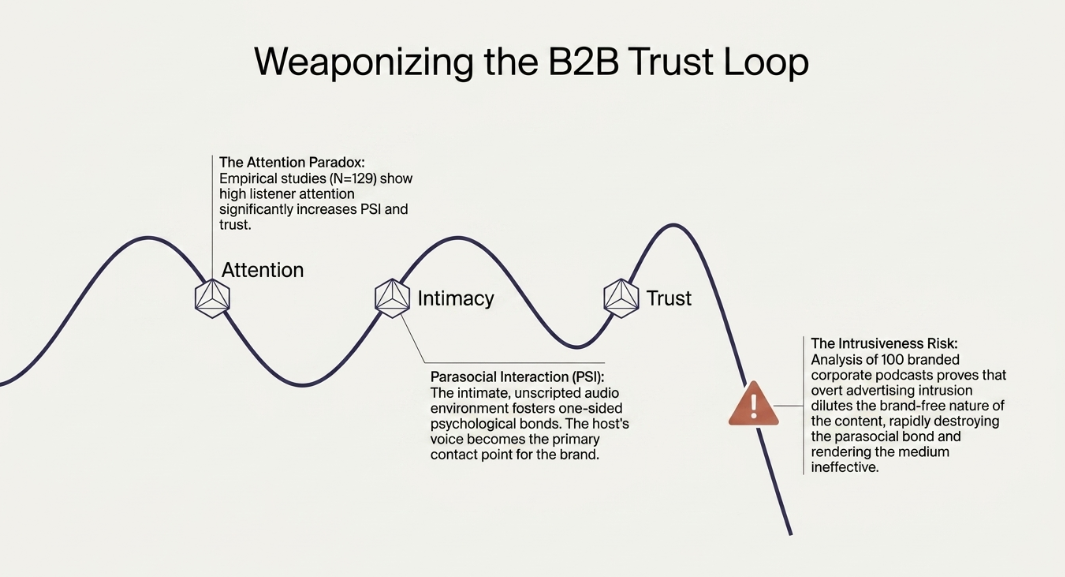
A critical differentiator of the podcast medium—and a core pillar of its business case—is its unique ability to foster Parasocial Interaction (PSI). Originally defined in a seminal 1956 paper by Horton and Wohl, parasocial relationships are one-sided psychological bonds wherein audiences develop a profound sense of intimacy, familiarity, and connection with media personalities.9 In the specific context of corporate podcasting, this psychological phenomenon is actively weaponized to build "trust loops" that traditional B2B marketing and outbound sales channels simply cannot penetrate.3
The intimate, conversational, and often unscripted environment of a corporate podcast allows corporate hosts to establish deep emotional interactions with listeners, fostering an unparalleled perception of authenticity and brand reputation.11 Recent academic research analyzing corporate communication through podcasts indicates that the host's voice acts as the primary, and sometimes sole, contact point for recipients.13 Because podcasts are frequently consumed while listeners are engaged in parallel activities (e.g., commuting, exercising), researchers have investigated the complex interplay between listener attention and the "voice-fit" of the host representing the brand.11
Empirical laboratory experiments (such as a 2x2 between-subjects study with N=129) demonstrate that high listener attention significantly increases parasocial interaction with the host.11 However, this psychological dynamic presents a strategic paradox for corporate marketers: deeper message processing resulting from high PSI can sometimes lead to negative persuasive effects if the messaging is perceived as overly intrusive or misaligned with the listener's expectations of authenticity.11 Therefore, branded podcasts must carefully and continuously balance narrative engagement with persuasive intent. As academic studies on branded content across Spain and Latin America (analyzing a sample of 100 podcasts) have shown, overt advertising intrusion dilutes the "brand-free" nature of the content and rapidly undermines the parasocial bond, turning a strategic asset into an ineffective advertising pseudo-format.
Uses and Gratifications Theory (UGT)
Uses and Gratifications Theory shifts the academic focus from what media does to people, to what people actively do with media, examining the specific psychological needs that drive media selection and consumption.14 When applied to corporate and B2B podcasts, UGT reveals that listeners actively select audio content to fulfill distinct, categorization needs: information seeking, cognitive and emotional satisfaction, and media convenience.17
B2B audiences tune into corporate thought leadership podcasts primarily for information seeking—they desire high-level industry breakdowns, insider opinions, and actionable intelligence that cannot be found in standard trade publications.17 Furthermore, the convenience of the audio medium allows listeners to remain "productive" in various physical environments, effectively integrating the educational content into their daily routines.9 This continuous, opt-in engagement generates a highly attentive audience segment that is actively seeking the exact domain expertise the enterprise is uniquely positioned to provide.
Cognitive Load Theory and Audio-First Corporate Learning
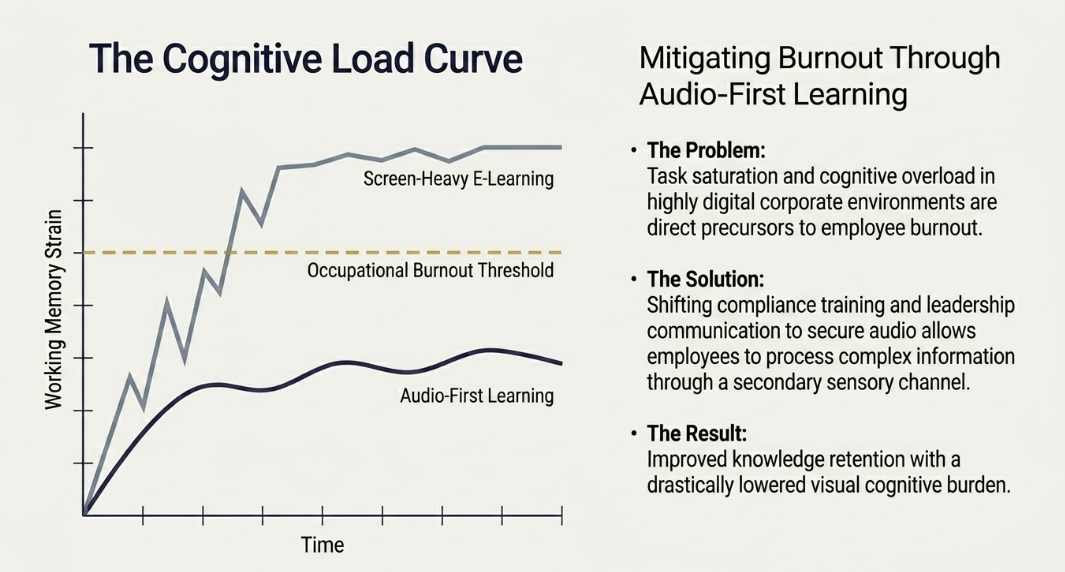
In the realm of internal corporate communications and organizational learning, audio plays a crucial, scientifically backed role in managing Cognitive Load. Cognitive Load Theory describes the finite mental effort required to process information in the human working memory.20 In modern, highly digital corporate environments, employees frequently suffer from task saturation and cognitive overload, both of which are direct, documented precursors to occupational burnout.20
Traditional corporate training modules, which are often heavily reliant on screen-based, text-dense e-learning platforms, can severely exacerbate cognitive strain.23 Adopting an "audio-first learning" approach via secure internal podcasts mitigates this issue by drastically reducing visual cognitive load and screen fatigue.20 By shifting specific types of ongoing learning, compliance training, and leadership communication to audio, organizations allow employees to absorb complex information through a secondary sensory channel, improving knowledge retention while simultaneously lowering the overall mental burden placed on the workforce.20
Part II: Architecting the Business Case and ROI Frameworks
With the theoretical mechanisms established, enterprise marketing and communications leaders must translate these psychological advantages into a rigorous, financially sound business case. This requires defining precise operational use cases, establishing highly sophisticated measurement frameworks, and shifting the strategic paradigm from mass audience acquisition to targeted relationship engineering.
Strategic Enterprise Use Cases
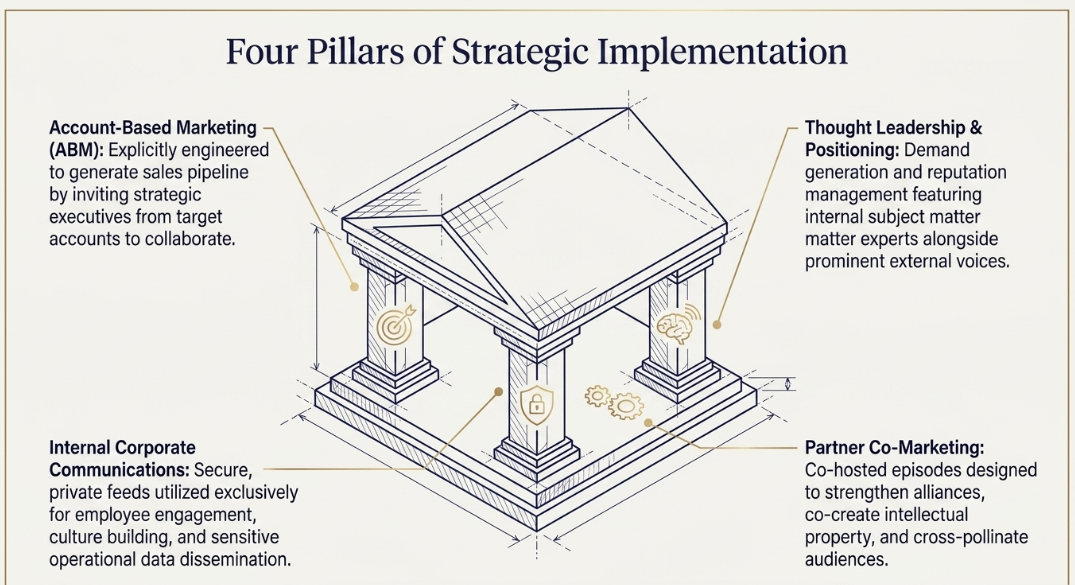
A structured approach to enterprise podcasting demands absolute clarity of purpose. Depending on the overarching corporate objectives, a podcast strategy generally falls into one of several primary architectures 2:
Account-Based Marketing (ABM) and Business Development: ABM-aligned podcasts are explicitly engineered to generate sales pipeline. Instead of broadcasting to a generalized, anonymous audience, these programs invite specific executives from strategic target accounts to appear as guests.18 This framework functions as an elite networking tool, opening doors, bypassing traditional corporate gatekeepers, and initiating high-value sales conversations under the non-threatening auspices of collaborative content creation.18
Thought Leadership and Brand Positioning: These public-facing podcasts feature internal subject matter experts alongside prominent external industry voices. The primary organizational objectives are demand generation, reputation management, and establishing the enterprise as the definitive authority in a specific sector.18
Partner Co-Marketing: Co-hosted or partner-centric episodes are strategically designed to strengthen existing alliances and extend market reach. Both organizations contribute to the intellectual property and share the resulting audio and digital content across their respective owned distribution channels, effectively cross-pollinating audiences.18
Internal Corporate Communications: Secure, private podcasts utilised exclusively for employee engagement, leadership updates, and corporate training. This model prioritizes culture building, remote workforce alignment, and the efficient, secure dissemination of sensitive operational data.24
The Dream 200 Methodology and the ROI Flywheel
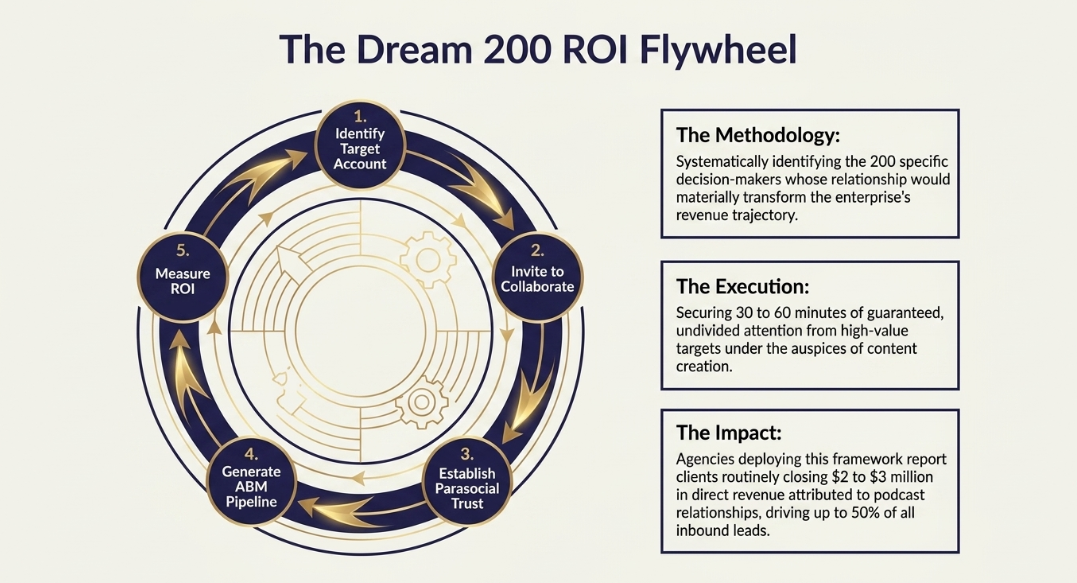
The fundamental flaw in many failed corporate podcast strategies is the reliance on consumer-grade vanity metrics, such as gross download volume or subscriber counts, to justify ongoing investment.25 For B2B enterprises, mass reach is largely irrelevant if the audience does not possess specific purchasing power. To rectify this, advanced strategic frameworks such as the "Dream 200" methodology are deployed.25
Developed to transition podcasting from a passive content marketing exercise into an active, aggressive business development engine, the Dream 200 methodology systematically identifies the 200 specific organizations, executive decision-makers, or referral partners whose relationship would materially transform the enterprise's revenue trajectory.25 By inviting these specific individuals onto the podcast, the enterprise secures guaranteed, undivided attention from its highest-value targets for 30 to 60 minutes. In this paradigm, a single strategic conversation with a Dream 200 prospect can generate significantly more measurable business pipeline than tens of thousands of generic downloads.25
This relationship-centric approach drives the "ROI Flywheel," a framework introduced in 2018 that converts B2B audio production into a repeatable system for generating partnerships and measurable revenue.25 The ROI Flywheel evaluates success based on relationship outcomes rather than audio files delivered.25 This methodology is highly effective; specialized agencies report that clients utilising these frameworks routinely close $2 to $3 million in direct revenue attributed to podcast relationships, with some brands seeing up to 50% of their inbound leads originating from their audio platforms.25 The "Monetization Ladder," a corresponding framework, maps this progression, allowing enterprises to track the journey from initial guest outreach to closed-won revenue.
Full-Funnel Measurement: Brand Lift, Incrementality, and Direct Response
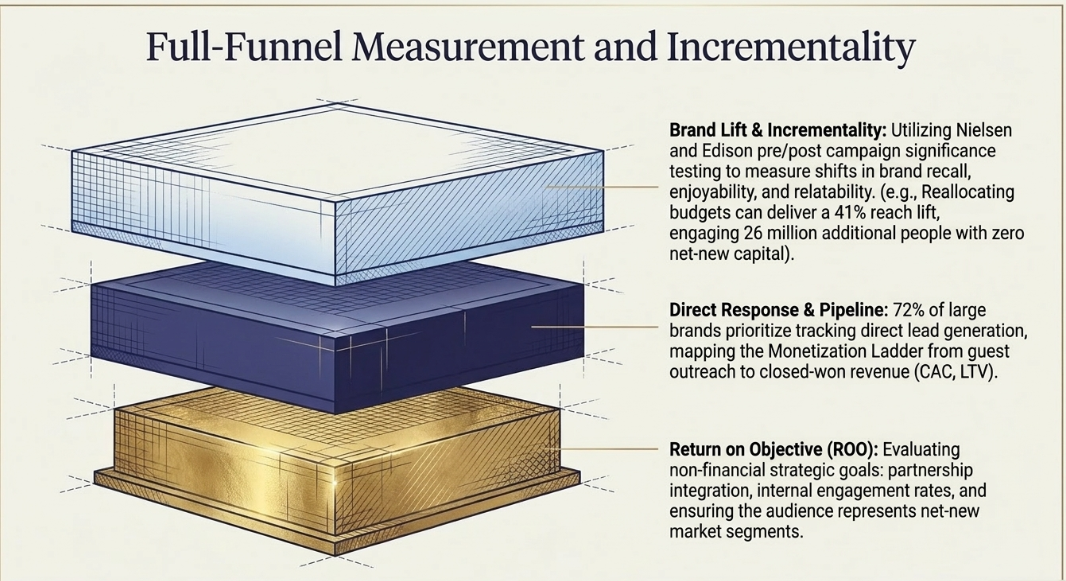
While direct-response tracking captures immediate lead generation (which 72% of large brands report as a primary benefit of their audio efforts), comprehensive, full-funnel measurement requires a blend of top-down brand lift studies and bottom-up attribution modeling.2
Sophisticated measurement tools provided by leading research institutions, such as Nielsen and Edison Research, allow enterprise advertisers to demystify the return on investment of their audio spending.19 By analyzing over 1,000 U.S. campaigns across emerging media, researchers have pinpointed five key attributes that drive positive brand perception in podcasts: brand recall, enjoyability, captivating content, relatability, and non-negativity.27
To gauge campaign efficacy accurately, enterprises utilize traditional pre- and post-campaign research methodologies.28 This involves running audio solicitations (typically host-read and strictly devoid of direct brand mentions) that direct listeners to an enterprise survey platform.28 The survey is administered before the campaign initiates and again after a designated flight (usually requiring a minimum of six weeks of consistent audio presence).28 Analysts utilize rigorous significance testing to determine if variations in audience perception are statistically valid.28 To account for sample variance, researchers apply weighting to ensure demographic parity between the pre- and post-study populations (e.g., standardizing gender ratios to 50% across both sets).28
Such methodologies prove highly effective at demonstrating the value of audio. For instance, data utilizing Nielsen Media Impact's Podcast Fusion tool demonstrated that a strategic budget reallocation toward podcast advertising delivered a 41% lift in reach among the 18-54 target demographic (reaching 26 million additional people) without requiring any net-new advertising capital, simply by shifting dollars away from traditional media.
Return on Objective (ROO)
Beyond strict financial ROI calculations, enterprise measurement matrixes must heavily encompass Return on Objective (ROO).30 ROO evaluates how effectively the podcast delivers on strategic, non-financial goals, such as shifting overarching brand perception, deepening partnership integration, educating complex markets, or humanizing corporate leadership.30
In tracking ROO, enterprise communications teams must meticulously evaluate the "incrementality" of their reach—ensuring the podcast engages net-new market segments rather than merely cannibalizing existing marketing channels or preaching to the already converted.2 As highlighted in case studies analyzing sponsorship and corporate growth, tracking ROO alongside metrics like Customer Acquisition Cost (CAC), Average Order Value (AOV), Units Per Transaction (UPT), and overall Customer Lifetime Value (LTV) ensures every audio partnership delivers compounded results.32 This holistic approach allows corporate leadership to appreciate the long-term equity built by audio assets, factoring in variables like the empirically proven increased lifetime value of audio-sourced leads, who generally exhibit higher brand loyalty and engagement than leads sourced from traditional digital channels.2
Part III: Operational Resource Allocation and Cost Structuring
A rigorously documented business case must address the precise financial modeling and resource allocation required to sustain an enterprise podcast over a multi-year horizon. Professional podcast production is not merely a discretionary marketing expense; it is the fundamental operational structure that prevents high-stakes corporate initiatives from devolving into abandoned internal projects due to resource exhaustion.35 Organizations that succeed treat audio with the exact same infrastructural seriousness as their web hosting, CRM deployment, or annual financial reporting.35
The Spectrum of Production Costs
Podcast production costs vary dramatically based on the scope of strategic support required, ranging from rudimentary audio editing to comprehensive, full-service business development retainers.25
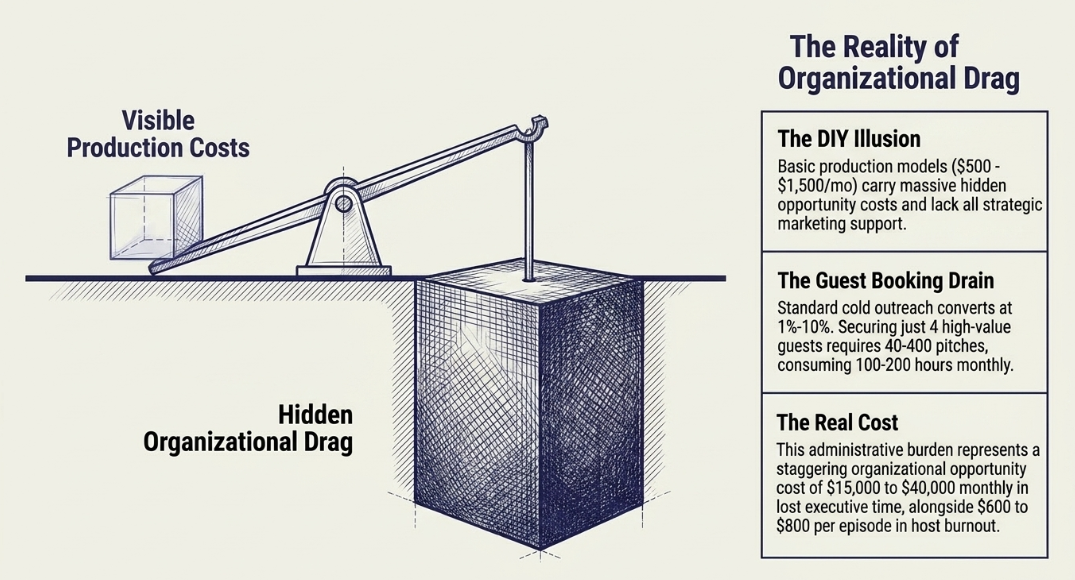
Basic / DIY Tier ($500 - $1,500 per month / $500 - $2,500 startup investment): This tier covers bare-minimum recording capabilities and highly basic audio editing.25 While it appears cost-effective on a spreadsheet and is ideal for startups experimenting with content, it carries massive hidden internal resource costs and lacks all strategic marketing support.25
Mid-Tier Production ($1,500 - $5,000 per month): Suitable for established companies looking to refine their external messaging, this tier includes enhanced editing, professional sound design, comprehensive show notes, and moderate marketing support (such as basic social media asset creation).25 However, critical elements like strategic guest booking and CRM pipeline tracking are often excluded.25
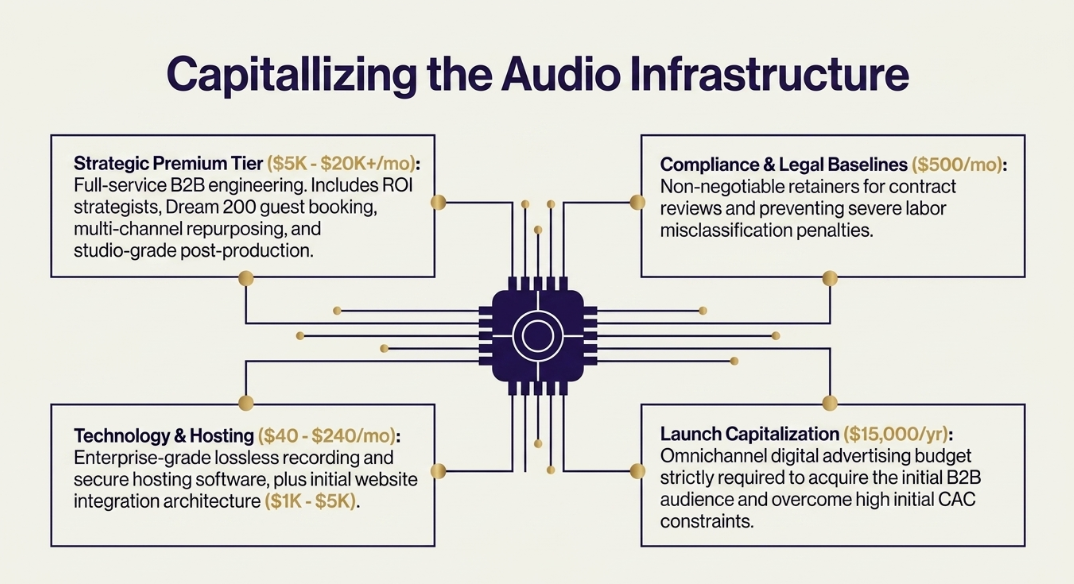
Strategic / Premium Tier ($5,000 - $20,000+ per month): Engineered specifically for B2B enterprises aiming for measurable revenue generation and tight ABM integration.25 This comprehensive, full-service model encompasses high-quality studio recording, detailed post-production, full multi-channel content repurposing (blogs, newsletters, video clips), sophisticated SEO optimization, a dedicated ROI strategist, and exhaustive guest research and booking aligned with the Dream 200.25
Opportunity Costs and Hidden Resource Drains
When enterprises attempt to execute podcasting internally to save upfront capital, they invariably encounter severe opportunity costs that erode profitability. Managing a podcast requires substantial administrative and strategic bandwidth that is frequently underestimated during the planning phase.25
For instance, identifying, researching, and booking high-caliber executive guests requires highly complex cold outreach. Standard cold outreach typically converts at a marginal rate of 1% to 10%.25 To secure just four high-value guests monthly, an internal team must pitch between 40 and 400 highly qualified prospects.25 Managing this outreach, along with the subsequent scheduling and pre-interview logistics, consumes an estimated 100 to 200 hours per month.25 Valued against executive compensation, this represents a staggering organizational opportunity cost of $15,000 to $40,000 monthly—far exceeding the cost of a premium outsourced agency retainer, which typically adds only $1,000 to $3,000 to monthly fees while leveraging established booking networks.25
Furthermore, producing a single episode in-house demands 4 to 8 hours of the executive host's time per episode.25 This represents an additional $600 to $800 in opportunity cost per recording, leading to rapid executive burnout and highly inconsistent publishing schedules.25 Consistent publishing—such as a weekly cadence yielding 52 high-value strategic conversations annually—is absolutely paramount to maintaining pipeline momentum and optimizing ROI.
Foundational Overhead, Technology, and Compliance Risk
Beyond agency production fees, enterprise audio requires foundational capital expenditures that cannot be bypassed. Compliance and legal oversight are non-negotiable baselines. A standard enterprise financial model must allocate approximately $500 monthly for specialized accounting and legal retainers specifically tied to the podcast's operational structure.37 This retainer covers essential structure maintenance, contract reviews for guests and external agencies, and complex federal/state tax preparation.37 Skipping this foundational spending to save marginal overhead exposes the enterprise to severe regulatory penalties related to labor misclassification or state registration failures, drastically overshadowing the cost of compliance.37
Additionally, a robust tech stack must be provisioned. Ongoing software and technology fees for enterprise-grade podcast hosting run between $20 and $200 per month, while specialized lossless recording platforms require an additional $20 to $40 per month.25 Properly integrating the podcast ecosystem into the enterprise's existing website architecture to ensure SEO benefits typically requires an initial investment of $1,000 to $5,000.25 Finally, launching a podcast requires an upfront marketing capitalization. Initial marketing budgets (e.g., an allocation of $15,000 annually or $1,250 monthly) are strictly required for acquiring the initial audience, driving early momentum, and executing digital advertising campaigns.37 Given that the initial Customer Acquisition Cost (CAC) in specialized digital advertising can be as high as $500 per new client, this budget must be deployed strategically across omnichannel networks to ensure the podcast reaches its intended B2B demographic without immediate budget exhaustion.2
Part IV: The Infrastructure of Secure Internal Podcasting
While external B2B marketing podcasts are designed to generate revenue and market presence, an equally critical—and rapidly expanding—application of enterprise audio is internal corporate communication. However, adapting the podcast medium for internal use fundamentally shifts the operational and technological paradigm from maximizing global distribution to mandating strict, unbreakable access control.
The Security Architecture of Internal Audio
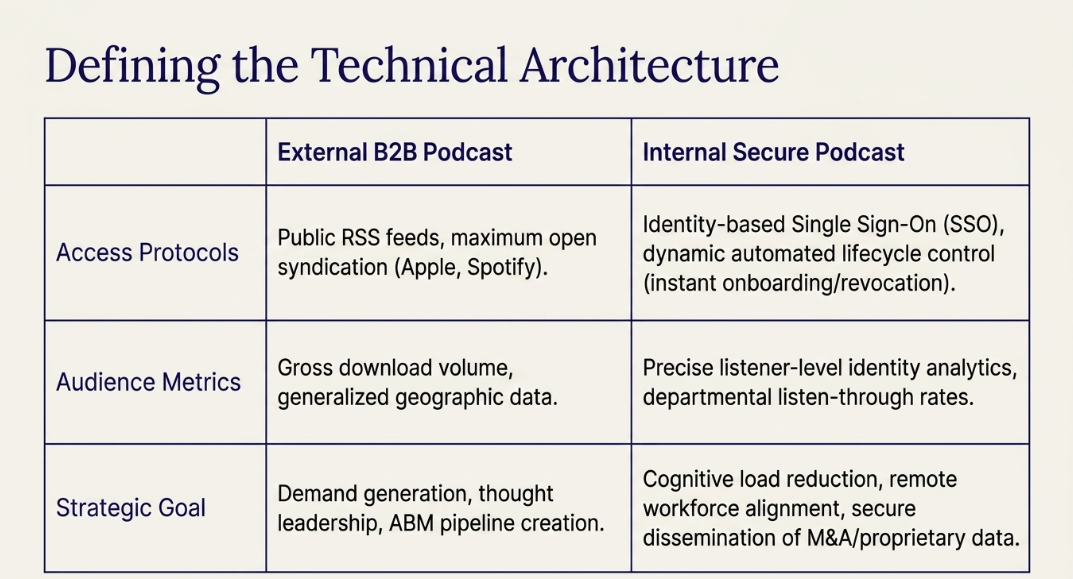
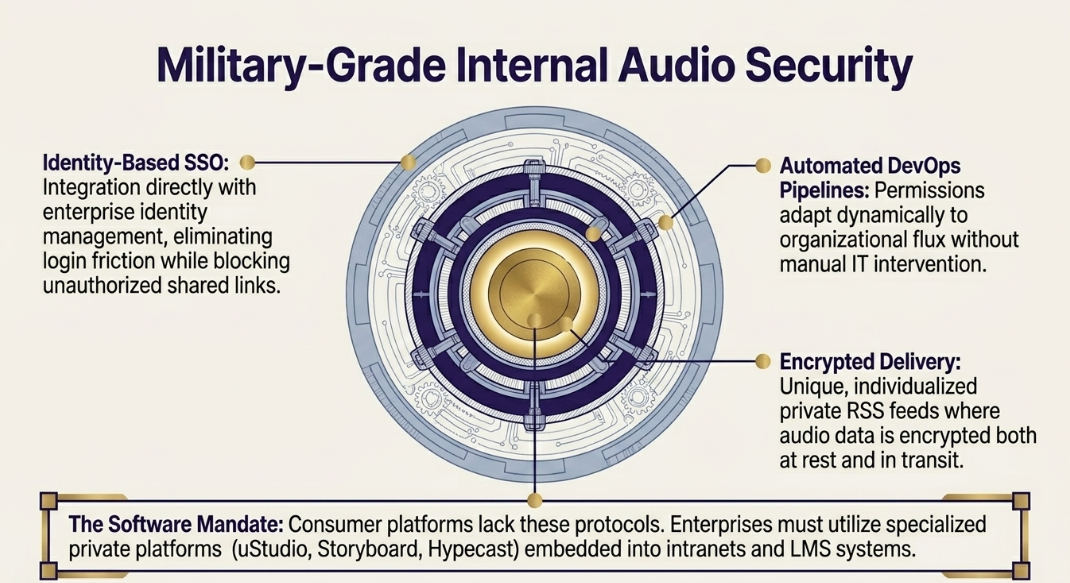
Consumer-grade podcast distribution platforms are built inherently on public RSS feeds designed for maximum discoverability and open syndication across platforms like Apple Podcasts and Spotify.24 This open architecture is entirely incompatible with sensitive internal communications involving executive leadership updates, proprietary product training, M&A discussions, and organizational strategy.24 Internal podcasts require a completely distinct ecosystem capable of serving major institutions—such as healthcare and global finance—through military-grade encryption and automated DevOps pipelines.38
Secure enterprise hosting relies on multiple overlapping, highly sophisticated security layers:
Identity-Based Access and SSO: Rather than relying on easily compromised shared links or simple password protection, secure platforms integrate directly with the enterprise's existing Single Sign-On (SSO) and identity management systems.24 This unifies credentials, allowing employees to access private feeds seamlessly without creating new accounts, thereby eliminating login friction while maintaining absolute security.24
Automatic Lifecycle Control: Permissions must adapt dynamically to organizational flux.24 When a new employee is onboarded, they are automatically granted access to specific internal podcasts based on their role, seniority, or department.24 Conversely, when an employee is terminated or transitions to a different department, their access to the private RSS feed is revoked instantaneously without requiring manual IT intervention.24
Private Feeds and Encrypted Delivery: Each authorized listener receives a unique, individualized private RSS feed that operates behind the scenes.24 These feeds integrate invisibly into standard consumer apps or proprietary corporate players.24 The audio data itself is encrypted both at rest and in transit during streaming, ensuring that even if files are somehow intercepted, the proprietary corporate information remains unreadable.24
Listener-Level Analytics: Traditional external podcasts track gross downloads and generalized geographic data. Secure internal platforms, however, track consumption at the precise individual identity level.24 This allows internal communications teams to measure exact listen-through rates per employee, identify which departments are highly engaged, and optimize training content based on empirical consumption data rather than guesswork.24
Comparative Hosting Ecosystems: Consumer vs. Enterprise
Selecting the appropriate infrastructure is a vital decision that dictates the viability of the program. Consumer-focused platforms are highly effective for hobbyists or standard external marketing podcasts, offering robust features tailored for public growth. For example, RSS.com offers IAB analytics certification and 1-click audio-to-video conversion; Podbean provides programmatic ad insertion and built-in AI tools for noise reduction; and Buzzsprout offers proprietary "Magic Mastering".40 However, these platforms inherently lack the robust SSO and identity-based security protocols required for safeguarding internal corporate data.40
For internal audio, enterprises must utilize specialized private hosting platforms such as uStudio, Storyboard, or Hypecast.39 These platforms are specifically engineered from the ground up for corporate communications. They provide advanced restricted access, identity-level audience analytics, and custom-branded media players that embed directly into existing corporate intranets, learning management systems (LMS), and collaborative tools like Microsoft Teams or Slack.
Operational Use Cases for Internal Audio
When executed securely and strategically, internal podcasts dissolve the friction of corporate alignment and significantly boost employee engagement.24
Distributed Sales Enablement: For organizations with heavily distributed field teams, audio provides a hands-free method to consume critical product updates, leadership messages, and competitive intelligence while commuting or traveling, directly supporting commercial alignment.34
Leadership Updates and Culture Building: Routine town halls, CEO updates, and sensitive internal discussions can be recorded asynchronously. This removes the massive logistical nightmare of scheduling synchronous meetings across multiple global time zones, allowing employees to consume leadership messages when it suits their workflow.24
Onboarding and Training: Structured educational content can be archived sequentially and easily revisited, improving the consistency of knowledge transfer for new hires while directly managing the cognitive load associated with dense onboarding manuals.24
Part V: Empirical Case Studies in Enterprise Audio
The theoretical mechanisms, ROI frameworks, and operational architectures outlined above are not merely hypothetical; they are currently yielding highly measurable, transformative outcomes across top-tier global enterprises. An analysis of major corporate audio deployments illustrates the versatility and profound impact of the medium across diverse sectors.
Internal Alignment: Sales, Training, and Culture
Global enterprises are increasingly turning to internal podcasting to solve complex logistical and cultural challenges.
Incyte (Distributed Sales Enablement): To align a highly dispersed U.S. sales force, the pharmaceutical company Incyte deployed the "MIQE" podcast using a secure corporate audio platform provided by Hypecast.34 Designed specifically for sales enablement, this voice-first channel delivered vital business updates, leadership priorities, and new product indications directly to representatives while they were on the road.34 The initiative achieved remarkable metrics that text-based communication could not match: a 98% organizational sign-up rate and an 89% listen-through rate across 1,800 total plays, demonstrating massive engagement without adding friction to the sales team's daily workflow.34
Samsung (Retail Partner Training): Facing the daunting challenge of training 3,000 retail partners across hundreds of locations in Germany without tying them to screens, Samsung utilized an enterprise audio solution.45 By integrating a custom audio player directly into their web-based training platform via an API, they created a centralized dashboard to manage training audio.45 This ensured consistent corporate branding, 100% remote training capability, and a seamless learning experience for the partners.45
E.ON (Standardized Corporate Infrastructure): To prevent the emergence of a fragmented landscape of disparate communication tools and inconsistent user experiences, the multinational energy company E.ON implemented a singular, standardized podcast infrastructure.46 By integrating the audio platform natively into their corporate social intranet, E.ON empowered over 100 internal content creators to publish consistently.46 The result was the creation of 50 active internal podcasts generating 30,000 plays with an exceptional 80% engagement rate, effectively transforming audio into a foundational communication infrastructure across the enterprise.46
External Thought Leadership and B2B Positioning
Major consulting firms and financial institutions leverage podcasting extensively to manifest thought leadership, navigate complex market transformations, and execute ABM strategies.
PwC (Business in Focus): PricewaterhouseCoopers (PwC) UK utilizes its comprehensive "Business in Focus" podcast to guide client organizations through systemic global challenges such as cyber resilience, finance transformation, and sustainability.48 By featuring diverse, high-profile voices—ranging from internal PwC partners to global executives like the CEO of Virgin Group and the Chief Client Officer of WPP—the firm positions itself perfectly at the nexus of technological innovation and corporate strategy.50 The podcast effectively deconstructs macroeconomic trends (such as projecting digital consumption in the TMT sector to reach 100 billion by 2026) while subtly demonstrating the firm's elite consultative expertise to a highly targeted listener base.52
Deloitte (The Green Room): Deloitte's award-winning corporate podcast, "The Green Room," tackles critical, high-level business inquiries spanning climate change, technological inclusion, and the future of work.53 Episodes feature nuanced discussions on making data-driven metrics meaningful, bringing together guests like the CEO of the Science Based Targets Initiative alongside Deloitte's own Vice Chair.53 This format reinforces Deloitte's brand positioning as a primary architect of sustainable corporate transformation and regulatory compliance.
Barclays Corporate Banking: Barclays utilizes client-focused podcasting (such as their "In the frame" series) to highlight successful banking partnerships and big-picture financial strategies.56 Through immersive audio case studies featuring prominent brands like Brora, Bluestone National Park Resort, and Hovertravel, the institution illustrates its holistic approach to fostering expansion, operational innovation, and sustainability within the highly competitive UK market.56
Public Sector and Social Enterprises: Beyond pure corporate profit, audio is utilized to demonstrate systemic value. In the UK, entities like Tap Social Movement and Community Dental Services utilize narrative audio case studies to demonstrate productivity, job creation, and the reduction of reoffending rates, acting as operational blueprints for government objectives.57 Similarly, public sector organizations leverage innovation showcases to demonstrate how low-capital solutions (like Robotic Process Automation or AI in social work) deliver meaningful citizen outcomes even in highly resource-constrained environments.58
Part VI: The Operational Blueprint and Launch Sequence
Transforming a theoretical business case into a live, fully operational enterprise podcast requires a meticulous, unyielding implementation plan. A structured 120-day (approximately 16-week) launch sequence ensures that strategy, production, compliance, and marketing are perfectly synchronized before the first episode is ever broadcast.3 This sequence is typically delineated into four distinct, sequential phases.
Phase 1: The Pre-Production Deep Dive (Weeks 1–4)
The foundational phase requires aggressive strategic clarity and absolute alignment with the business case.
Defining Goals and Audience: The communications team must identify the primary objective (e.g., ABM lead generation, internal engagement, or broad thought leadership) to ensure ROI and ROO can be accurately measured from day one.59 A highly specific listener persona is constructed, moving beyond broad categories into focused, highly targeted sub-niches (e.g., shifting from "general technology" to "cyber-resilience for enterprise healthcare").59
The Dream 200 Mapping: For B2B podcasts, this crucial phase involves meticulously identifying the 200 target accounts, industry leaders, and strategic partners that will form the guest pipeline.25
Format and Cadence Selection: The enterprise must decide on the episode length (data indicates 20–30 minutes is optimal for B2B engagement and cognitive load management) and the release schedule (weekly, bi-weekly, or monthly).59 Consistency in cadence is prioritized heavily over sheer frequency.63
Content Architecture: Developing a compelling one-sentence hook that instantly communicates the show's value proposition.63 The team drafts working titles, structures episode themes, and begins initial guest outreach to ensure a robust runway of content exists post-launch.59
Phase 2: Branding, Infrastructure, and Setup (Weeks 5–7)
With the core strategy locked, the physical and digital infrastructure is established.
Visual and Sonic Branding: High-quality cover art is developed to ensure legibility across all devices and professional aesthetic alignment with the broader corporate identity.59 Intro and outro music, alongside standardized voiceover components, are finalized to create a cohesive, recognizable sonic brand.59
Platform and Hosting Selection: The enterprise evaluates hosting architectures. External podcasts procure public distribution platforms optimized for SEO and multi-channel syndication.40 Internal podcasts necessitate the procurement and complex IT integration of secure, SSO-enabled enterprise platforms.24
Digital Real Estate: A dedicated, branded website or centralized landing page is constructed.62 This digital hub houses episode archives, highly detailed show notes, guest biographies, and subscription links, establishing professional credibility and enhancing discoverability through organic search optimization.65
Phase 3: Production and Recording (Weeks 8–10)
The operational execution of content creation begins in earnest.
Workflow Standardization: The team decides on the recording environment—whether utilizing remote, browser-based studios (which absolutely require lossless local audio tracking to maintain quality) or on-site physical corporate studios.46
Batch Recording: To prevent workflow bottlenecks and maintain the strict publishing schedule, the initial 4 to 8 episodes are recorded in rapid succession.59 This stage includes conducting pre-interviews with guests, finalizing scripts, and navigating the inevitable, complex logistical challenges of executive scheduling.60
Phase 4: Post-Production, Compliance, and Omnichannel Amplification (Weeks 11–16)
The raw audio is refined, and the enterprise marketing apparatus is fully activated.
Audio Engineering: Professional post-production involves editing for pacing, utilizing AI or manual tools to remove background noise and filler words, balancing audio levels to strict broadcast standards, and seamlessly integrating the sonic branding.40 This stage typically requires 3 to 5 days of lead time per episode.60
Legal and Compliance Review: In highly regulated industries (such as finance or pharmaceuticals), the polished episodes must undergo stringent internal legal and compliance review before any public dissemination.3
Asset Repurposing and Omnichannel Marketing: An enterprise podcast should never exist in a vacuum; it is the nucleus of an omnichannel content strategy.2 The pristine audio is transcribed and repurposed into comprehensive SEO-optimized blog posts, newsletters, and internal memos.25 AI tools are frequently utilized to generate promotional short-form video clips (audiograms) from the full episodes for targeted distribution across social platforms like LinkedIn.40
Launch Strategy: The podcast is officially launched with a highly coordinated promotional push, leveraging paid digital advertising, existing email lists, partner networks, and internal corporate channels.60 Compelling podcast trailers are released prior to the main episodes to establish credibility, set listener expectations, and drive initial subscription rates, while audience feedback mechanisms (like social polls) are integrated to guide future content.65
Conclusion
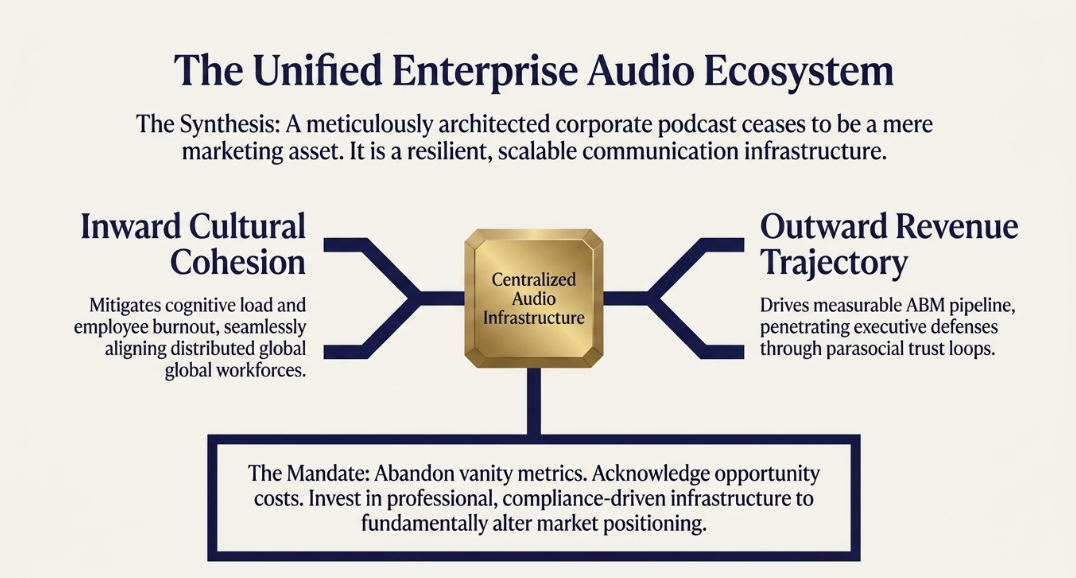
The architecture of a successful, sustainable enterprise podcast strategy rests upon a delicate, meticulously planned synthesis of psychological understanding, rigorous financial modeling, and uncompromising operational execution. By leveraging established frameworks like Media Richness Theory and Parasocial Interaction, organizations can cultivate profound, impenetrable trust loops with both external executive prospects and internal employees. However, this theoretical potential can only be actualized if the program completely abandons consumer-grade vanity metrics in favor of structured business objectives, such as the relationship-driven Dream 200 methodology, advanced brand lift analytics, and definitive Return on Objective criteria.
Whether deployed externally as an elite account-based marketing engine to drive measurable pipeline, or internally via secure, SSO-gated platforms to mitigate employee cognitive load and seamlessly align a distributed global workforce, enterprise audio demands significant upfront capital and strategic investment. Organizations must respect the inherent, massive opportunity costs of attempting in-house production and instead allocate resources toward professional, compliance-driven infrastructure and specialized agency support. Ultimately, when guided by a robust 120-day launch sequence and a clear financial mandate, an expertly architected corporate podcast ceases to be a mere marketing asset; it becomes a resilient, scalable communication infrastructure capable of fundamentally altering the enterprise's market positioning, revenue trajectory, and internal operational alignment.
Works cited
How Much Does Podcasting Cost? A Guide for B2B Companies (2026 Edition), accessed June 5, 2026, https://contentallies.com/learn/how-much-does-podcasting-cost-for-b2b-companies
The Podcast Advertising Blueprint For Enterprise Brands [2026] - Mynt Agency, accessed June 5, 2026, https://articles.myntagency.com/podcast-advertising-blueprint-2026/
Enterprise Podcast PR: The Strategic Framework for Senior Communications Teams, accessed June 5, 2026, https://commandyourbrand.com/enterprise-podcast-pr/
Strategic Podcast Marketing: Building the Business Case and, accessed June 5, 2026, https://www.finchley.co.uk/finchley-learning/visual-podcast/strategic-podcast-marketing-building-the-business-case-and-operational-plan-for-enterprise-audio
Podcasting for e-learning, communication, and delivery - ResearchGate, accessed June 5, 2026, https://www.researchgate.net/publication/235265131_Podcasting_for_e-learning_communication_and_delivery
Applying Media Richness Theory to Social Media and Organizations - Journalism University, accessed June 5, 2026, https://journalism.university/social-media-and-society/applying-media-richness-theory-social-media/
Enriched media: the key to better digital communications - Blog - Calaméo, accessed June 5, 2026, https://blog.calameo.com/6459/enriched-media-better-digital-communications/
Inspiring and Informing Citizens Online: A Media Richness Analysis of Varied Civic Education Modalities - Oxford Academic, accessed June 5, 2026, https://academic.oup.com/jcmc/article/20/5/504/4067579
Podcasts and Productivity: A Qualitative Uses and Gratifications Study - Merrimack ScholarWorks, accessed June 5, 2026, https://scholarworks.merrimack.edu/com_facpub/22/
Podcasts and Parasociability | 2021-2022 | University Writing Program, accessed June 5, 2026, https://www.brandeis.edu/writing-program/write-now/2021-2022/feuerman/index.html
Corporate Communication Through Podcasts: The Impact of Voice-Fit and Attention During Listening on Parasocial Interaction with - Taylor & Francis, accessed June 5, 2026, https://www.tandfonline.com/doi/pdf/10.1080/19376529.2024.2396840
www.ssoar.info Make your brand heard: A qualitative study on the use of corporate podcasts as a branding tool, accessed June 5, 2026, https://www.ssoar.info/ssoar/bitstream/handle/document/81818/ssoar-2022-beck_et_al-Make_your_brand_heard_A.pdf?sequence=1&isAllowed=y
Corporate Communication Through Podcasts: The Impact of Voice-Fit and Attention During Listening on Parasocial Interaction with the Host and Persuasive Effects - Taylor & Francis, accessed June 5, 2026, https://www.tandfonline.com/doi/abs/10.1080/19376529.2024.2396840
Corporate Communication Through Podcasts: The Impact of Voice ..., accessed June 5, 2026, https://www.tandfonline.com/doi/full/10.1080/19376529.2024.2396840
The branded podcast as a new brand content strategy. Analysis, trends and classification proposal | Profesional de la información, accessed June 5, 2026, https://revista.profesionaldelainformacion.com/index.php/EPI/article/view/86961
Branded Podcast Classification Proposal Based on Brand Presence in the Narrative: From Brand-Free to Persuasive - ResearchGate, accessed June 5, 2026, https://www.researchgate.net/publication/381768210_Branded_Podcast_Classification_Proposal_Based_on_Brand_Presence_in_the_Narrative_From_Brand-Free_to_Persuasive
Beyond the game: How social interaction and emotional gratification drive Chinese sports podcast engagement - PMC, accessed June 5, 2026, https://pmc.ncbi.nlm.nih.gov/articles/PMC12571283/
Enterprise Podcast Production Guide for B2B Brands - Content Allies, accessed June 5, 2026, https://contentallies.com/learn/enterprise-podcast-production-guide
As podcast advertising grows, brand lift data can help brands demystify the ROI of their spending | Nielsen, accessed June 5, 2026, https://www.nielsen.com/insights/2023/as-podcast-advertising-grows-brand-lift-data-can-help-brands-demystify-the-roi-of-their-spending/
Cognitive Load and Burnout: Uncovering the Connection - ASHP, accessed June 5, 2026, https://www.ashp.org/Professional-Development/ASHP-Podcasts/Wellness-Wednesday/2026/Cognitive-Load-and-Burnout-Uncovering-the-Connection
ELC 055: What You Need to Know About Cognitive Load - The eLearning Coach, accessed June 5, 2026, https://theelearningcoach.com/podcasts/55/
Your Capacity for Growth Is Dependent on This Factor - Cognitive Load Theory, accessed June 5, 2026, https://podcasts.apple.com/us/podcast/your-capacity-for-growth-is-dependent-on-this-factor/id955596067?i=1000718573156
What are your favorite books, podcasts, … in 2026? : r/elearning - Reddit, accessed June 5, 2026, https://www.reddit.com/r/elearning/comments/1tmc1fo/what_are_your_favorite_books_podcasts_in_2026/
Secure Podcast Hosting for Internal Teams - SupportingCast, accessed June 5, 2026, https://www.supportingcast.fm/post/secure-podcast-hosting-for-internal-teams
Podcast Production Pricing: B2B Packages, Costs & ROI | Rise25, accessed June 5, 2026, https://rise25.com/lead-generation/podcast-production-pricing/
Podcast Research - Edison Research at SSRS, accessed June 5, 2026, https://www.edisonresearch.com/solutions/podcast-research/
Nielsen reveals key Brand Lift drivers for emerging media channels, accessed June 5, 2026, https://www.nielsen.com/news-center/2023/nielsen-reveals-key-brand-lift-drivers-for-emerging-media-channels/
Podcast Brand Lift Studies - Edison Research at SSRS, accessed June 5, 2026, https://www.edisonresearch.com/podcast-brand-lift-studies/
Reallocating Ad Dollars to Podcasts Can Deliver 41% Growth in Reach - Edison Research, accessed June 5, 2026, https://www.edisonresearch.com/reallocating-ad-dollars-to-podcasts-can-deliver-41-growth-in-reach/
How to Measure Event ROI: Calculate ROI Beyond Profit - Wiz Team, accessed June 5, 2026, https://wiz-team.com/measuring-event-roi-guide/
How To Measure Event ROI | A Conversation With Ex Cisco CMO - Lumix, accessed June 5, 2026, https://www.lumix.co/blog/how-to-measure-event-roi
ROO: Beyond ROI - Measuring Objective Outcomes - Apple Podcasts, accessed June 5, 2026, https://podcasts.apple.com/us/podcast/roo-beyond-roi-measuring-objective-outcomes/id1815957908?i=1000709423459
The SponsorshipX Podcast Launches with Thorne's Mary Beech, accessed June 5, 2026, https://www.sponsorshipx.com/news/jjr91j8boqqa2f7svcuqpektjzy3zo
Incyte Success Story: Voice-First Sales Communication with Hypecast, accessed June 5, 2026, https://www.hypecast.one/best-practices/incyte
Corporate Podcast Production in Scotland: What £300/Month Actually Gets You, accessed June 5, 2026, https://www.podcaststudioglasgow.com/podcast-studio-glasgow-blog/corporate-podcast-production-in-scotland-what-300month-actually-gets-you
Podcast Production Cost for Business: 2026 Guide - ThePod.fm, accessed June 5, 2026, https://thepod.fm/resources/blog/podcast-production-cost-for-businesses
Calculating Monthly Running Costs for Podcast Production Services - Financial Models Lab, accessed June 5, 2026, https://financialmodelslab.com/blogs/operating-costs/podcast-production
Enterprise Case Study: Secure Flutter Migration & Audio Architecture - Acme Software, accessed June 5, 2026, https://acmesoftware.com/case-studies/podcast
Comprehensive Guide to Private Podcasting - uStudio, accessed June 5, 2026, https://ustudio.com/comprehensive-guide-to-private-podcasting/
The 13 Best Podcast Hosting Platforms in 2026, accessed June 5, 2026, https://www.quillpodcasting.com/blog-posts/podcast-hosting-platform
Podcast Hosting Platforms Compared: Pricing, Features & Reviews 2026 - RSS.com, accessed June 5, 2026, https://rss.com/blog/best-podcast-hosting-platforms/
Best Podcast Hosting Platforms in 2026: Compared & Ranked - Transistor, accessed June 5, 2026, https://transistor.fm/best-podcast-hosting-platform/
Best Podcast Hosting in 2026? I Compared 5 Platforms (Honest Review) - YouTube, accessed June 5, 2026, https://www.youtube.com/watch?v=KLxsLbW4Nu0
The Best Practices for Launching an Internal Corporate Podcast - GrodMedia, accessed June 5, 2026, https://grodmedia.com/the-best-practices-for-launching-an-internal-corporate-podcast/
Samsung Best Practice: Retail Partner Training With Podcasts via ..., accessed June 5, 2026, https://www.hypecast.one/best-practices/samsung
E.ON Best Practice: Internal Podcasts as a New Comms Channel ..., accessed June 5, 2026, https://www.hypecast.one/best-practices/eon
Success Stories — Corporate Podcast Case Studies | Hypecast, accessed June 5, 2026, https://www.hypecast.one/resources/success-stories
Business in Focus - Apple Podcasts, accessed June 5, 2026, https://podcasts.apple.com/gb/podcast/business-in-focus/id1506955257
Business in Focus: Bringing you the best of PwC, accessed June 5, 2026, https://www.pwc.co.uk/industries/business-in-focus.html
Business in Focus Podcast Series - PwC UK, accessed June 5, 2026, https://www.pwc.co.uk/industries/business-in-focus/podcast.html
Listen to Business in Focus podcast - Deezer, accessed June 5, 2026, https://www.deezer.com/en/show/5557097
Trust, technology and transformation: The TMT trends affecting us all - PwC UK, accessed June 5, 2026, https://www.pwc.co.uk/industries/business-in-focus/podcast/trust-technology-transformation-tmt-trends.html
The Green Room podcast, #88: How can we put more meaning into our metrics? - YouTube, accessed June 5, 2026, https://www.youtube.com/watch?v=OG0irqxI0X8
The Green Room Podcast - Episode 88 | Deloitte UK, accessed June 5, 2026, https://www.deloitte.com/uk/en/our-thinking/content/green-room-podcasts/episode-88.html
Making it matter in the Green Room | Deloitte UK, accessed June 5, 2026, https://www.deloitte.com/uk/en/about/story/impact/green-room-podcast.html
Client Stories | Barclays Corporate Banking, accessed June 5, 2026, https://www.barclayscorporate.com/client-experience/client-stories/
Social enterprise case studies from across our membership, accessed June 5, 2026, https://www.socialenterprise.org.uk/case-studies/
Case Studies in Public Sector Impact: Delivering Meaningful Outcomes with Limited Resources - Insights, accessed June 5, 2026, https://publicsectornetwork.com/insight/improving-public-sector-impact-delivering-meaningful-outcomes-with-limited-resources
A Timeline for Starting a Corporate Podcast - Listening Dog Media, accessed June 5, 2026, https://listeningdogmedia.com/corporate-podcast-launch-timeline/
Podcast Production Timescale: What You Need to Know, accessed June 5, 2026, https://www.cueproductions.com/post/podcast-production-timescale
Build an Engaged Audience: 4 Steps of a Successful Podcast Launch Plan - Jay Allyson, accessed June 5, 2026, https://jayallyson.com/successful-podcast-launch-plan/
Creating a Podcast Launch Plan: A Beginner's Checklist - The Simplecast Blog, accessed June 5, 2026, https://blog.simplecast.com/creating-a-podcast-launch-plan-a-beginners-checklist
The Ultimate Podcast Launch Checklist: Go From Zero to Chart-Topping Success, accessed June 5, 2026, https://www.trevorohare.com/blog/the-ultimate-podcast-launch-checklist-go-from-zero-to-chart-topping-success
The Ultimate Guide To, accessed June 5, 2026, https://f.hubspotusercontent20.net/hubfs/5753226/The%20Ultimate%20Guide%20to%20Podcast%20ROI%20-%20JAR%20Audio.pdf
Podcast Marketing Powerpoint Ppt Template Bundles CRP - SlideTeam, accessed June 5, 2026, https://www.slideteam.net/podcast-marketing-powerpoint-ppt-template-bundles-crp.html