The Macroeconomic Evolution of B2B Audio Media
The structural evolution of the business-to-business (B2B) digital marketing ecosystem over the past half-decade has been characterized by a profound transition in how professional audiences allocate their attention. What was once considered an experimental, consumer-centric entertainment format has rapidly matured into a foundational pillar of corporate communication infrastructure. As organizations navigate an increasingly saturated digital environment defined by algorithmic unpredictability, textual content fatigue, and diminishing returns on traditional outbound sales efforts, podcasting has emerged as a strategic imperative. For professional brands, the medium offers a unique confluence of long-form cognitive engagement, hyper-targeted niche reach, and asynchronous relationship-building that legacy marketing channels can no longer reliably replicate.
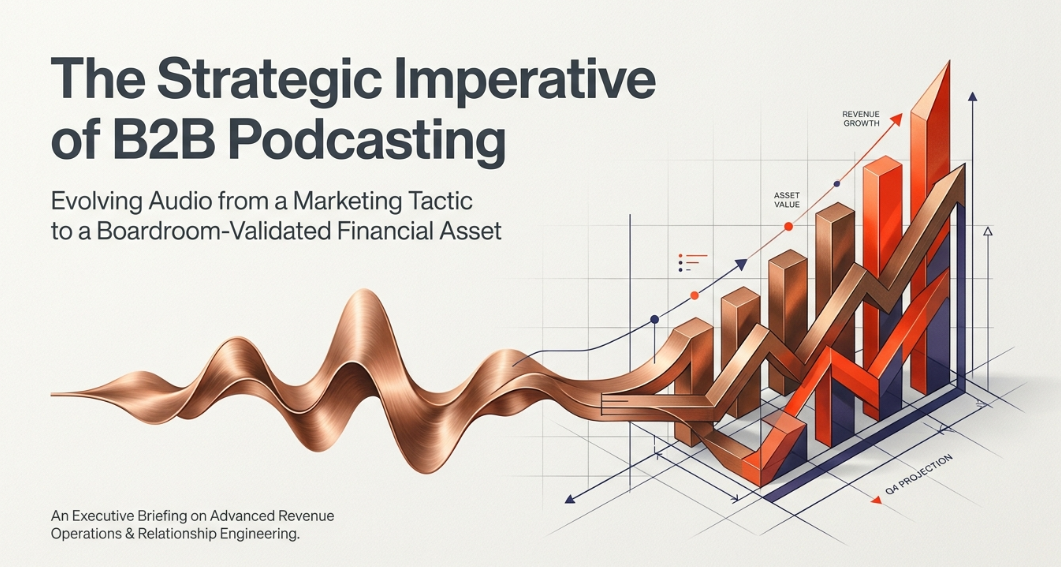
The statistical trajectory of the global audio industry underscores this paradigm shift in media consumption. In 2025, the global podcast audience reached an unprecedented 584.1 million listeners, representing a robust 6.8% year-over-year growth rate.1 Forecasting models indicate a sustained surge, projecting global listenership to reach 619.2 million by 2026 and eventually scale to 651.7 million by 2027.2 This global expansion represents a 15% aggregate growth in listenership over a five-year period, effectively cementing the medium's mainstream status.2 Within the United States, market penetration has reached historic milestones. Current data reveals that 73% of Americans have consumed a podcast at least once, while 55% identify as monthly listeners.2 This marks the first instance in the medium's history where monthly podcast consumption has crossed into the statistical majority of the adult U.S. population, with 40% of the demographic engaging with the medium on a weekly basis.2
The United Kingdom market mirrors this momentum, reflecting a high-growth environment poised for rapid institutional and advertiser investment. In 2024, the UK podcasting market generated USD 1,787.9 million in revenue, accounting for a highly influential 5.8% of the total global market share.5 Projections indicate an explosive compound annual growth rate (CAGR) of 26.3% between 2025 and 2030, which is anticipated to catapult the UK market valuation to USD 7,411.0 million by the end of the decade.5 Consequently, the advertising infrastructure supporting this content is scaling proportionally. Global podcast advertising expenditure is projected to hit USD 4.46 billion in 2025, with B2B-specific advertising commanding an astonishing USD 4 billion of that total.1 In the UK alone, estimates of current ad spend reflect this transitional phase; while some forecasts place 2025 spend at £56 million, the Interactive Advertising Bureau (IAB) recorded UK podcast advertising reaching £90 million in 2024, with long-term macroeconomic projections pointing toward a massive £1.85 billion valuation by 2030.6 This influx of institutional capital signals the medium's transition from an emerging marketing tactic to a boardroom-validated financial asset. Regionally, the broader European market is also experiencing synchronized acceleration; Germany is projected to lead the regional market in revenue by 2030, while France represents the fastest-growing European market, expected to reach USD 5,700.8 million by 2030.5
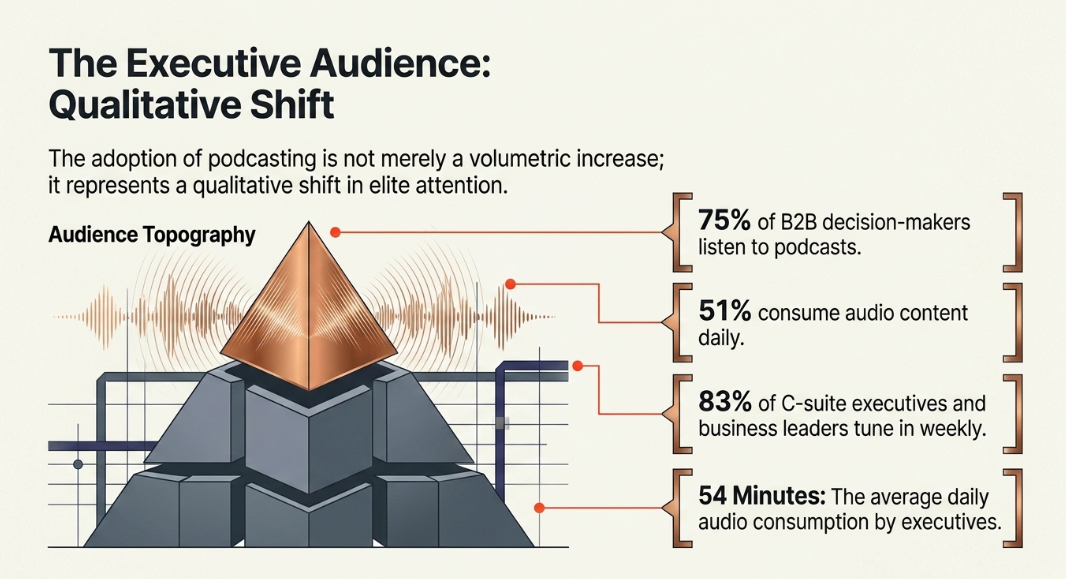
A deeper, second-order analysis of this quantitative data reveals a critical demographic realignment that holds profound implications for B2B marketers. The adoption of podcasting is not merely a volumetric increase; it represents a qualitative shift in who is actively listening. Current behavioral data indicates that 75% of B2B decision-makers listen to podcasts, with an astonishing 51% consuming audio content daily.2 Furthermore, 83% of C-suite executives and business leaders tune in weekly, dedicating upwards of 54 minutes per day to audio consumption.2 In the UK, 42% of adults listen monthly, predominantly driven by the core 25–34 demographic, though audiences aged 65 and over are rapidly adopting the medium, transforming it into a truly cross-generational communication channel.
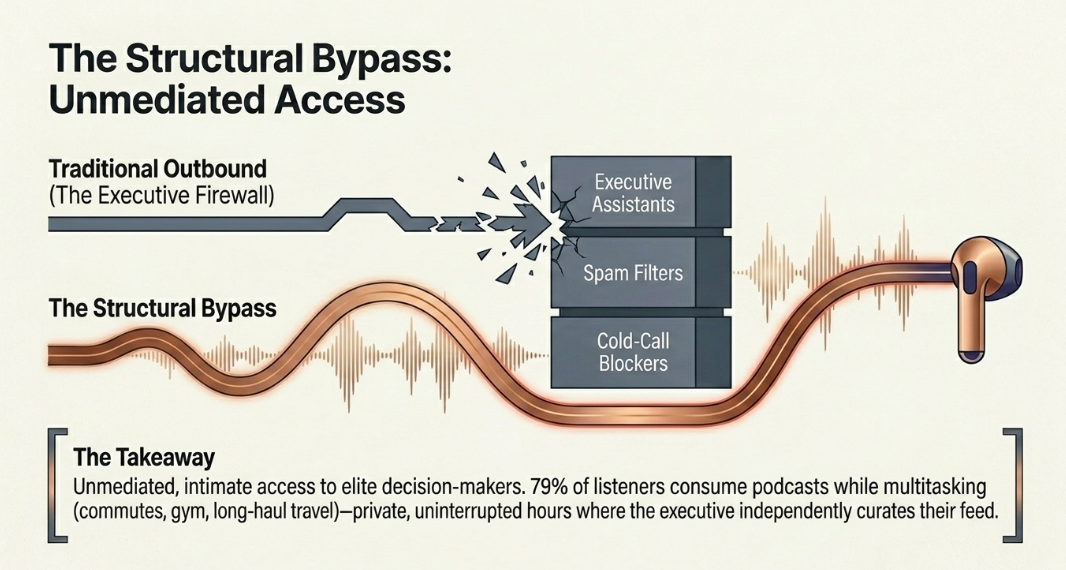
The third-order implication of this executive attention is structural bypass. In traditional enterprise sales environments, an executive assistant or sophisticated email filtering software will screen cold calls and outbound marketing literature. However, executives independently curate their podcast feeds during private, uninterrupted hours—such as during commutes, exercise routines, or long-haul travel.9 According to Edison Research, 79% of listeners consume podcasts while executing other tasks, integrating the content into their daily operational habits.9 This provides brands with unprecedented, unmediated access to elite decision-makers, effectively bypassing the organizational gatekeepers that stymie traditional sales motions.
The Neuroscience and Sociology of Parasocial Digital Communities
To understand the precise mechanisms through which podcasting generates outsized returns in complex B2B markets, one must analyze the psychological phenomenon of parasocial relationships. Originally defined in 1956 by American sociologists Donald Horton and R. Richard Wohl to describe the unique psychological bonds audiences formed with early television personalities, a parasocial relationship is a one-sided connection wherein an audience member develops genuine feelings of familiarity, trust, and intimacy toward a media figure who remains entirely unaware of their existence.10 While historically confined to broadcast celebrities, the intimacy of the audio medium—delivered directly into the listener's ear—has weaponized this sociological concept for B2B brand building.
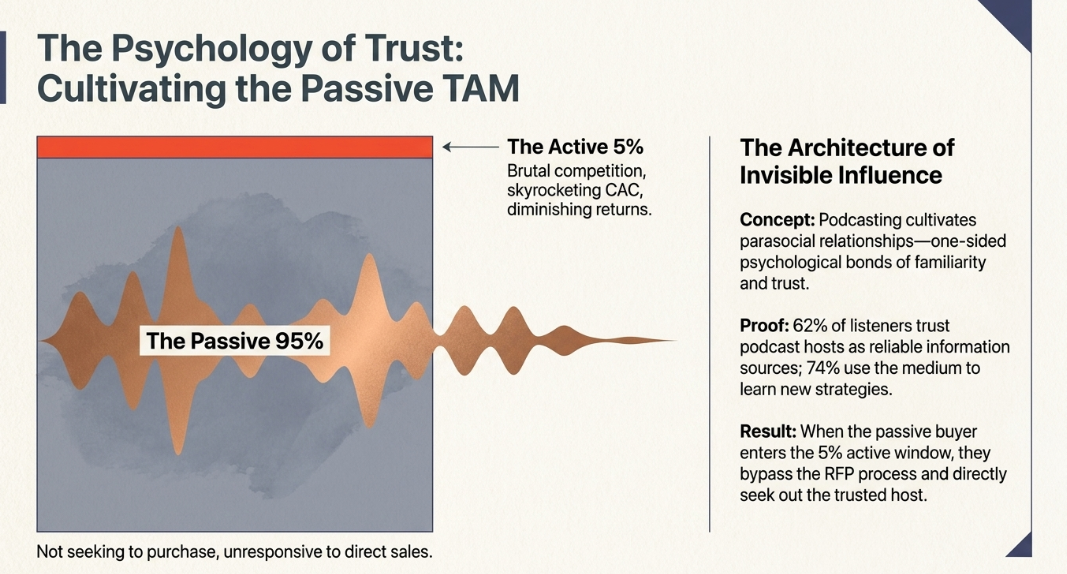
In the context of complex B2B procurement, the cultivation of parasocial relationships is arguably the most potent mechanism for navigating the modern sales landscape. At any given moment, statistical models suggest that 95% of a brand's potential Total Addressable Market (TAM) is entirely passive; they are not actively experiencing an acute pain point and are therefore not seeking to purchase a solution.12 Traditional outbound sales methodologies futilely force marketers to compete brutally for the remaining 5% of active buyers, resulting in diminishing returns, exorbitant Customer Acquisition Costs (CAC), and severe market friction.12 Podcasting, conversely, targets the passive 95% through an architecture of what industry strategists term "invisible influence".12 By consistently appearing in a prospect's digital feed over a period of months or years, a podcast host transitions from an unknown corporate vendor to a highly trusted industry advisor. Listeners perceive the host's vocal cadence, hear their spontaneous reactions to industry news, and deeply internalize their operational philosophies.
This psychological dynamic yields profound, quantifiable commercial benefits. Research demonstrates that 62% of podcast listeners view podcast hosts as trustworthy sources of information, while 78% of audiences generally find the medium itself to be trustworthy.8 Furthermore, 74% of listeners explicitly state they utilize podcasts to learn new concepts and strategies.8 When a passive listener eventually encounters an operational hurdle that pushes them into the active 5% buying window—for instance, realizing their cost per acquisition is rising unstoppably—they bypass the traditional vendor evaluation and request-for-proposal (RFP) phases. Instead, they actively seek out the podcast host's organization.12 The parasocial bond effectively eliminates the need for a "hard sell." The sales process becomes incredibly warm because the prospect has essentially "sold themselves" before the first discovery call is ever scheduled, dramatically shortening the sales cycle and creating enthusiastic brand advocates.
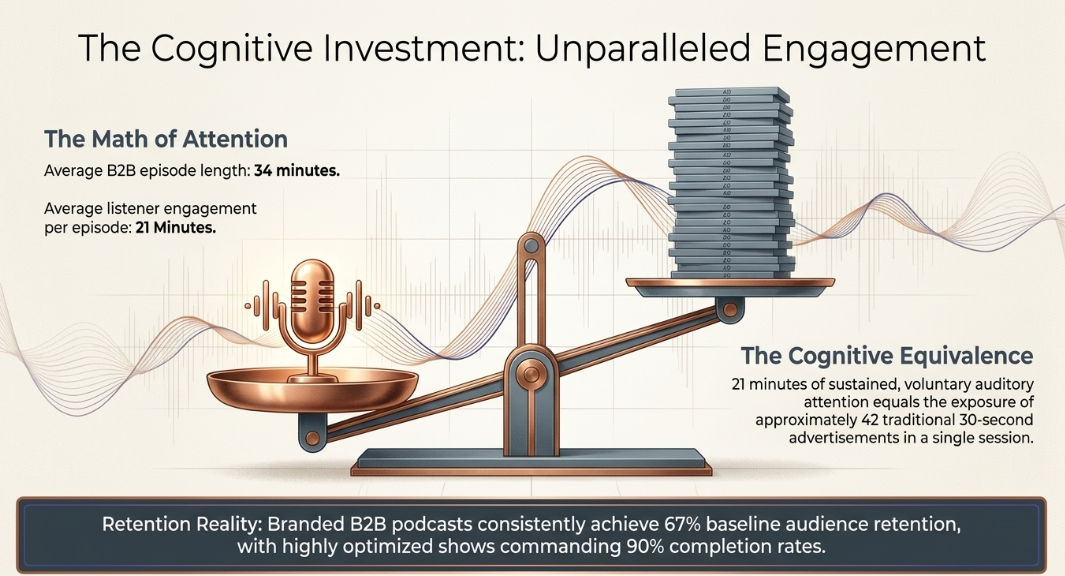
The efficacy of this psychological bonding is empirically validated by audience retention and completion metrics, which vastly outperform other digital mediums. Unlike short-form video or textual content, podcasting demands and routinely receives sustained, long-form attention. Branded B2B podcasts consistently achieve average audience retention rates of 67%, with top-performing, highly optimized shows commanding up to 90% completion rates.1 According to data from Share Your Genius, the average B2B podcast episode length is 34 minutes, translating to an average listener spending approximately 21 minutes deeply engaged with a single brand message.14 To place this cognitive investment in perspective, 21 minutes of sustained auditory attention is equivalent to exposing a prospect to approximately 42 traditional 30-second advertisements in a single session.15
This sustained engagement fosters a community built on shared professional challenges rather than mere transactional intent. The strategic creation of a community requires brands to carefully audit their content to prevent early listener drop-off. By analyzing data from tools like Podbean and Descript, producers can identify exact moments of churn—often resulting from poor audio quality, unbalanced volume levels, or long-winded introductions.16 Consequently, mastering the "30-second hook" to immediately establish value, alongside maintaining a rigorous publishing consistency, serves as the primary defense against audience attrition.
Architecting the Digital Ecosystem: Podcasts vs. Traditional Marketing Channels
As B2B buyers increasingly demand sophisticated, consumer-like purchasing experiences, they dictate the terms of engagement. McKinsey's comprehensive 2024 B2B Pulse Survey—which analyzed responses from nearly 4,000 decision-makers across 34 sectors—identified the "rule of thirds" as a fundamental truth of modern sales. At any given stage of the complex buying journey, one-third of customers desire in-person interactions, one-third prefer remote human communications, and one-third demand entirely digital, self-serve options.18 To address this multi-faceted demand, marketing in 2026 cannot rely on a singular monolithic channel; it requires a highly coordinated, multi-touch ecosystem.19
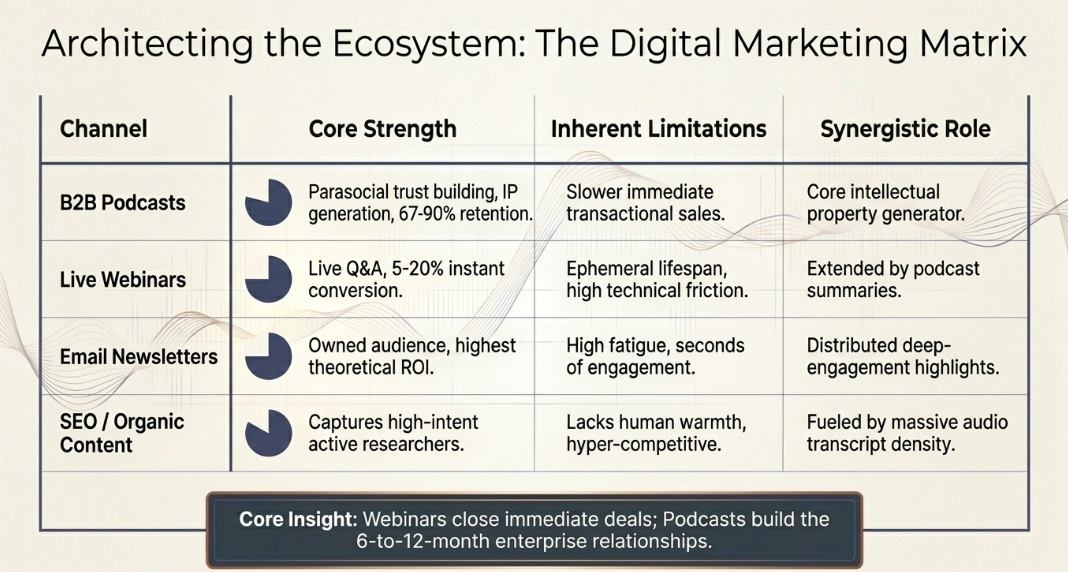
Podcasts do not replace legacy digital channels; rather, they function as a strategic multiplier that amplifies the efficacy of Search Engine Optimization (SEO), email marketing, LinkedIn thought leadership, and live webinars. Understanding the comparative retention rates, ROI, and strategic deployment of these formats is essential for modern revenue orchestration.
A direct comparison between webinars and podcasts is particularly illuminating, as both are long-form, knowledge-dense formats. The market for webinars is massive, projected to reach USD 134.2 billion by 2032 with a 13.9% CAGR.22 Currently, 89% of businesses utilize webinars, and 80% of B2B experts consume webcast content monthly.8 Furthermore, 73% of B2B marketers assert that webinars deliver their highest quality leads, primarily because 67% of attendees highly value live Q&A interactions, allowing for immediate product demonstrations and real-time objection handling.8 However, webinars suffer from severe content decay. They are high-friction events requiring scheduled attendance, and their engagement drops precipitously once the live session concludes.13
Podcasts, conversely, represent evergreen intellectual property. While they may not immediately close a transactional software license on a Tuesday afternoon, they excel in complex enterprise environments with 6-to-12-month sales cycles.20 Because podcast listeners consume the content on their own schedules, the format achieves a significantly higher long-term retention rate. B2B customers acquired via podcasting channels inherently demonstrate higher lifetime value (LTV) and stronger buyer commitment due to the extended, asynchronous relationship-building phase.20 When organizations integrate these channels—using morning webinars (which data shows are 93% more effective than evening sessions 22) to demonstrate complex software, and utilizing podcasts to explore the high-level industry philosophy behind the software—they satisfy all segments of the McKinsey "rule of thirds".
Advanced Revenue Operations: Pipeline-to-Podcast Attribution Frameworks
The historical impediment to the widespread institutional adoption of corporate podcasting has been the misapplication of consumer-market metrics to B2B realities. Organizations traditionally evaluated podcast success through the deeply flawed lens of vanity metrics—total global downloads, chart rankings, and the pennies generated by programmatic dynamic ad insertion.2 In a complex B2B context, this framework is fundamentally destructive. A specialized professional services firm providing commercial real estate data 24 does not require one million generic listeners to achieve a transformative financial return; it requires the sustained attention of three hundred specific property developers and institutional lenders. The strategic pivot, therefore, is transitioning the corporate mindset from audience monetization to pipeline acceleration.
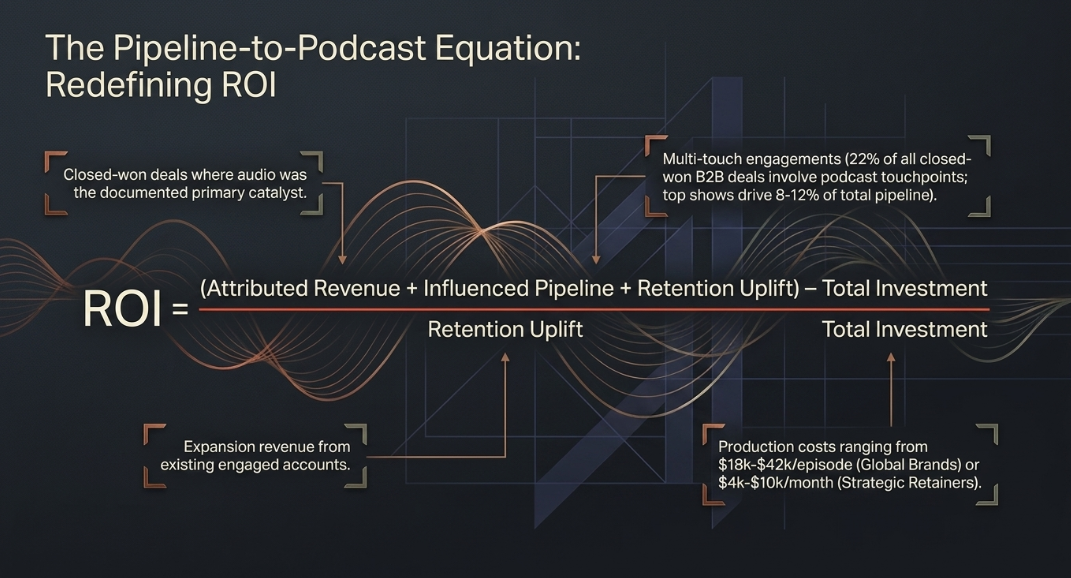
Advanced revenue operations teams are abandoning native hosting analytics in favor of sophisticated attribution models to quantify the actual pipeline value generated by audio assets. The most robust methodology currently utilized by industry leaders is the Pipeline-to-Podcast Attribution Model, which eschews superficial download counts in favor of CRM-integrated touchpoint tracking.25 To calculate the true fiscal impact of a branded podcast, enterprise analysts rely on a comprehensive, boardroom-ready ROI equation:

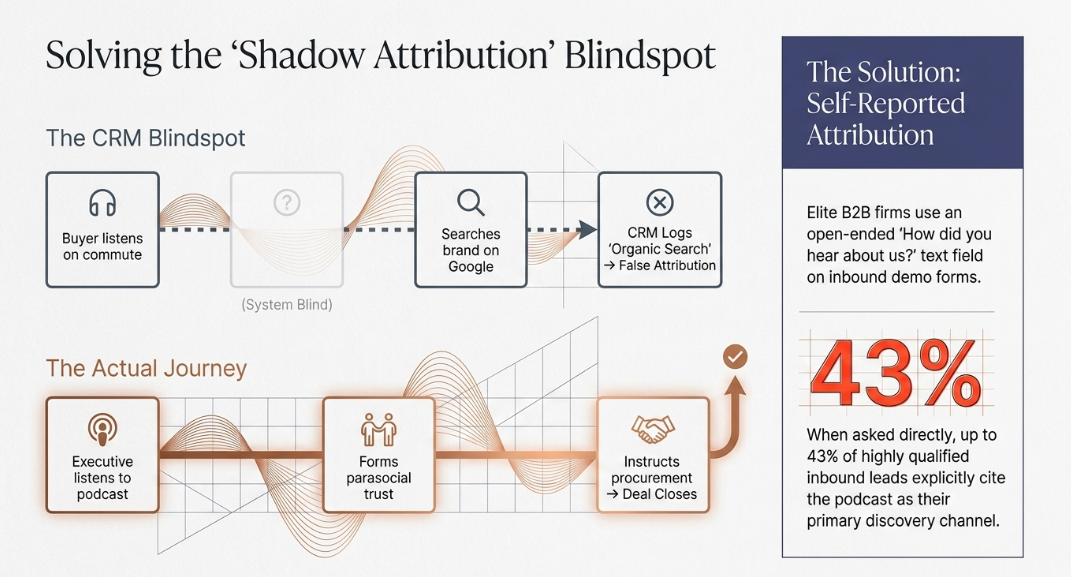
In this framework, Attributed Revenue isolates closed-won deals where the podcast was a documented, primary catalyst.25 Capturing this data, however, exposes a significant technological hurdle: the "shadow attribution" problem.25 Traditional last-touch marketing attribution software frequently fails to capture audio consumption. If a Chief Financial Officer listens to an episode on Apple Podcasts while driving, and two weeks later instructs their procurement team to search for the brand directly on Google, traditional analytics will falsely attribute the million-dollar deal to "Organic Search" rather than the podcast.
The complexity of mapping digital identity at an enterprise scale exacerbates this issue. As seen in integration challenges between massive platforms like HubSpot and Shopify, customer identity fragments rapidly as organizations scale.26 Buyers use guest checkouts, mix personal and corporate email addresses, and operate across multiple overlapping storefronts, making a simple "email equals unique customer" matching logic completely obsolete.26 To circumvent this technological blind spot in podcast attribution, elite B2B firms have implemented self-reported attribution mechanisms. By adding a mandatory, open-ended "How did you hear about us?" text field to inbound demo request forms, organizations capture qualitative data that software misses. Empirical testing reveals that when asked directly, up to 43% of highly qualified inbound leads explicitly cite the brand's podcast as their primary discovery channel.
Influenced Pipeline tracks multi-touch engagements across prolonged enterprise sales cycles. This metric assigns weighted value to deals where decision-makers engaged with podcast content prior to entering the active sales pipeline.25 When podcast touchpoints are systematically integrated into the buyer journey, the macroeconomic impacts are staggering. Industry data reveals that 22% of all closed-won B2B deals involve podcast touchpoints, and top-performing shows routinely drive 8% to 12% of a company's total revenue pipeline.2
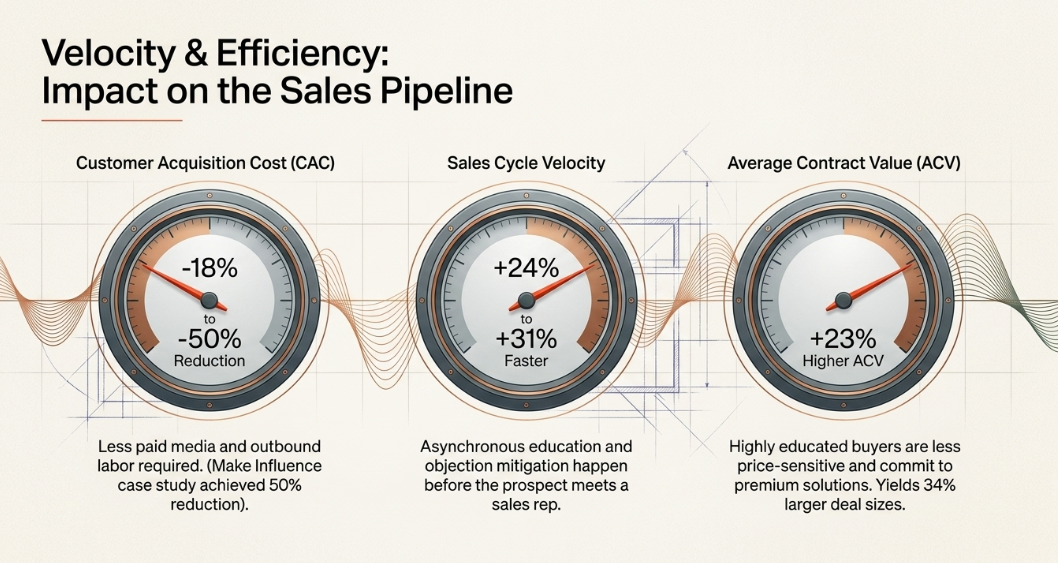
More importantly, the integration of audio content radically alters sales cycle velocity. Organizations report a 24% to 31% acceleration in the speed at which deals close.2 This acceleration occurs because the arduous, high-friction process of buyer education, objection mitigation, and trust-building is completed asynchronously before the prospect ever interfaces with a human sales representative. Consequently, B2B firms experience an 18% to 25% reduction in Customer Acquisition Cost (CAC), as inbound podcast leads require significantly less paid media expenditure and outbound sales labor to convert.2 This mirrors the operational efficiencies achieved by startups like Make Influence, who utilized scalable CRM hubs to reduce their overall acquisition costs by 50% while expanding across European markets.27 Furthermore, prospects nurtured through deep audio storytelling yield a 23% higher Average Contract Value (ACV) and 34% larger average deal sizes, indicating that highly educated buyers are inherently less price-sensitive and far more willing to commit to comprehensive, premium solutions.2
The Total Investment denominator encompasses the holistic financial burden of producing the podcast. For premium global brands, production costs average between $18,000 to $42,000 per episode, whereas highly specialized B2B strategic retainers typically range from $4,000 to $10,000 per month.15 When juxtaposed against the generated pipeline, the returns justify the expenditure. Direct podcast advertising independently delivers a 4.9x return on ad spend 8, while audio advertisements generate 37% more active listener actions than standard streaming audio formats.
Brand Equity, Share of Voice, and Advanced Measurement Mechanics
Beyond direct, trackable revenue attribution, podcasting acts as an unparalleled catalyst for holistic brand equity and market positioning. Measuring this qualitative impact requires organizations to transcend basic awareness metrics and implement rigorous Share of Voice (SoV) and Brand Lift methodologies.
Share of Voice provides a macroeconomic picture of a brand's visibility relative to its competitors within industry discussions.29 However, PR professionals note that the most common mistake in SoV measurement is treating all coverage equally; a casual mention on an obscure blog does not carry the same psychological weight as an hour-long feature on a premier industry podcast reaching dedicated decision-makers.29 To accurately assess the SoV generated by a podcast, analysts must integrate sentiment analysis, audience reach, and message pull-through alongside traditional pipeline data.29
To quantify the granular impact of audio content on a listener's psyche, sophisticated marketers deploy advanced audio Brand Lift studies. These studies utilize unexposed control groups, clean first-party data, and real-time post-exposure surveys to track movement across five key pillars: Awareness, Recognition, Consideration, Intent, and Favorability.31 The results consistently prove the superiority of the audio format.
A comprehensive study conducted by the BBC quantified the brand lift generated by branded podcasts, revealing a massive 89% increase in brand awareness, a 57% rise in brand consideration, and a 24% surge in brand favorability.32 Crucially, listener purchase intent increased by 14%, and memory encoding—the neurological process through which consumers retain brand messaging—was 12% higher than in competing digital content formats.32 This cognitive superiority is corroborated by Nielsen data, which demonstrates that podcast listeners are 2.4 times more likely to purchase a product or service promoted on a show compared to general internet audiences.8 In highly specific, specialized niches, advertising within podcasts can elevate purchase intent by a staggering multiplier of 2.8, while podcast advertisements exhibit the highest recall rate of any digital advertisement format, reaching up to 86%.8
For brands seeking to benchmark their performance against industry standards, data from Share Your Genius provides a realistic framework. Unlike consumer entertainment shows that chase millions of downloads, a successful B2B podcast is highly targeted. Across thousands of B2B episodes, typical performance benchmarks include 321 downloads within the first seven days of release, an average of 460 monthly downloads, and a baseline of 1,003 dedicated subscribers per show.14 These figures, combined with a 67% retention rate, confirm that a highly engaged, niche audience is exponentially more valuable to a B2B organization than a massive, uninvested general audience.
Relationship Engineering and The "Dream 200" Methodology
Beyond audience cultivation and brand lift, the most sophisticated and lucrative deployment of B2B podcasting involves weaponizing the medium as a direct business development tool through a discipline known as "Relationship Engineering." This methodology fundamentally reframes the podcast from a passive broadcast mechanism into an elite, structured networking platform, intentionally designed to facilitate intimate conversations with a predetermined list of high-value corporate targets.
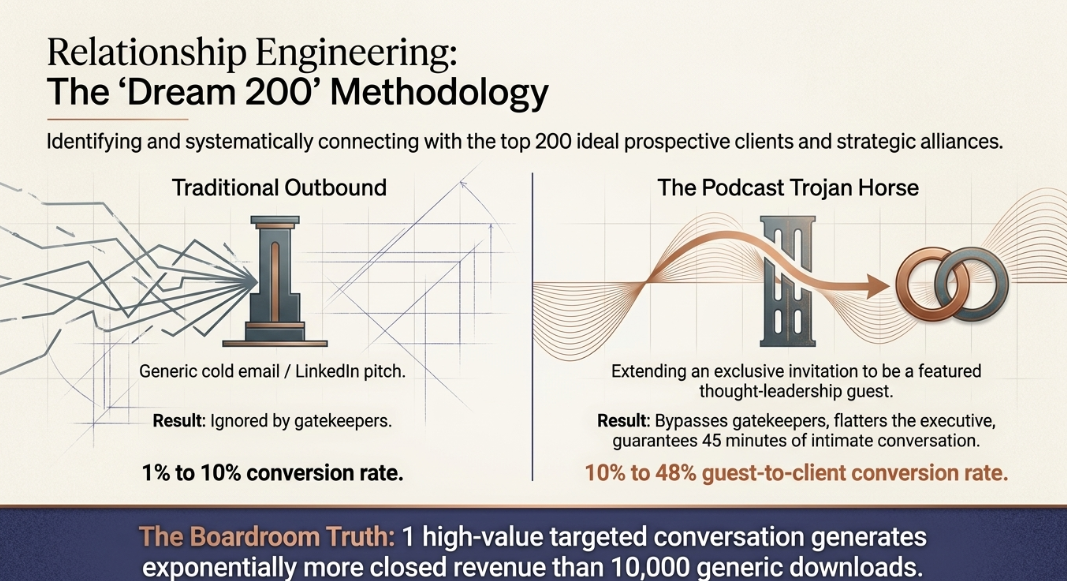
This strategic approach is best formalized through the "Dream 200" framework, a concept pioneered in 2016 by B2B strategists John Corcoran and Dr. Jeremy Weisz.28 The framework posits that identifying and systematically connecting with a company's top 200 ideal prospective clients, referral partners, and strategic alliances will radically and permanently transform its revenue trajectory.28 Under this model, the podcast serves as a prestigious Trojan horse. Instead of subjecting a C-suite executive to a generic cold outreach email or LinkedIn message—which suffers from a dismal 1% to 10% conversion rate—the brand extends an exclusive invitation for the executive to be a featured guest on an industry podcast to share their thought leadership.28
This invitation flatters the prospect, entirely bypasses administrative gatekeepers, and guarantees 45 minutes of uninterrupted, highly engaged conversation with an ideal buyer. The strategic value of this interaction is profound. The underlying philosophy of the Dream 200 methodology asserts that one high-value conversation generates far more measurable business impact than 10,000 generic downloads. For example, a niche B2B podcast that generates only 300 downloads but successfully facilitates four target "Dream 200" conversations per month will consistently outperform a 10,000-download podcast lacking strategic relationships by a factor of 10x to 20x in actual closed revenue.28
The empirical outcomes of the guest-to-client conversion strategy unequivocally validate its superiority over traditional outbound sales methods. The average guest-to-client conversion rate for strategically aligned B2B podcasts sits at an impressive 10%, while elite, relationship-engineered programs can convert up to 48% of their strategic guests into active pipeline opportunities.2 This high conversion rate is fueled by the rapport built during the pre-interview briefing, the shared intellectual creation during the recording, and the natural post-interview follow-up that seamlessly segues from content approval into a collaborative business discussion.
Implementing relationship engineering requires strict structural alignment in podcast production and pricing. The industry is stratified into distinct tiers based on the execution of these strategic outcomes rather than the mere technical manipulation of audio files:
Outcome-based pricing models utilized in the Strategic tier do not scale linearly. The immense labor required to research, pitch, book, and prepare a highly protected Fortune 500 executive is identical whether the agency publishes two or six episodes a month.28 Consequently, premium agencies operate on monthly retainers, acting as fractional business development and revenue operations extensions rather than traditional content producers. Organizations utilizing this relationship-driven methodology report that these shows generate a 25% to 50% higher financial ROI than programs blindly chasing mass audience metrics.
Customer Expansion, Retention, and Internal Brand Culture
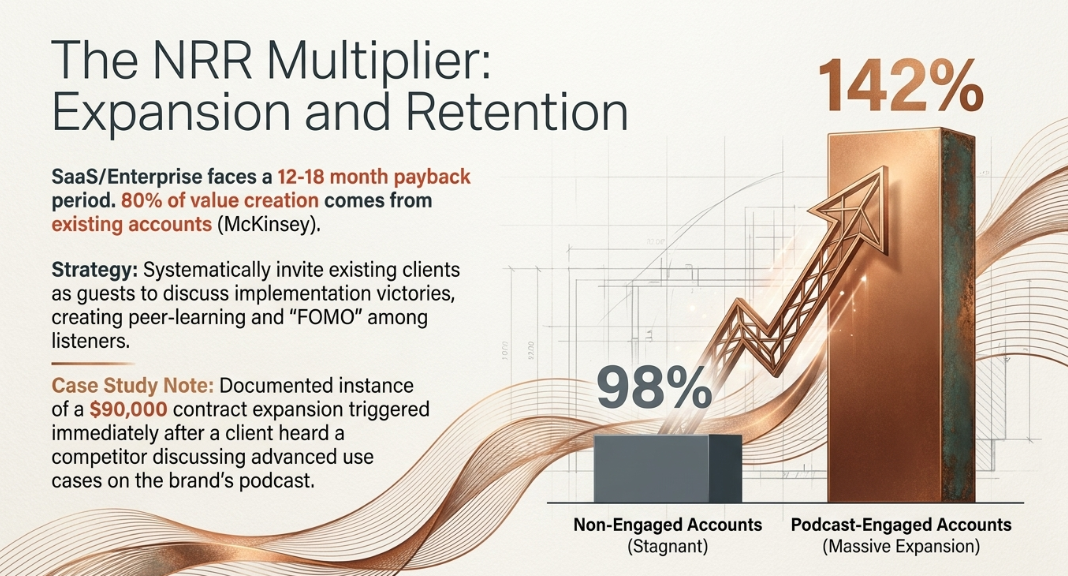
While net-new acquisition pipelines dominate the discourse surrounding podcast ROI, an exhaustively modeled corporate strategy also leverages the medium for customer expansion (upselling) and long-term retention. In the Software-as-a-Service (SaaS) and enterprise service sectors, customer acquisition costs are notoriously high. As highlighted by industry leaders examining SaaS economics, organizations face a grueling 12-to-18-month payback period before a newly acquired client becomes marginally profitable.34 Therefore, extending Customer Lifetime Value (CLV) and maximizing Net Revenue Retention (NRR) is critical for maintaining sustainable unit economics. According to McKinsey, 80% of the value creation within successful companies is derived from generating new revenue from existing accounts.35
Podcasting serves as a highly scalable, emotionally resonant customer success vehicle. By systematically inviting existing clients to participate as guests on the brand's podcast to discuss their implementation victories and industry best practices, the organization solidifies a deeply emotional, public-facing partnership. This positioning strokes the client's ego, establishing them as an industry expert, while simultaneously creating peer-learning opportunities and generating "fear of missing out" (FOMO) among other listeners who lack those advanced capabilities.25
The financial impact of this retention strategy is easily quantifiable through tracking customer retention rates and NRR metrics. Analytical models indicate that organizations employing podcast-driven customer success frameworks witnessed the NRR for podcast-engaged accounts surge to an incredible 142%, compared to a stagnant 98% for non-engaged accounts.25 This dramatic uplift is primarily driven by expansion revenue. For example, in a documented case study, an enterprise client expanded their existing software contract by $90,000 immediately after hearing a direct competitor appear on a podcast discussing advanced, high-tier use cases of the platform.25 This dynamic yields a 2.5x ROI derived purely from account retention and contract expansion, entirely isolated from the costs of net-new customer acquisition.25
Beyond external stakeholders, internal brand equity represents a frequently overlooked tertiary ROI metric. In heavily distributed, multinational, or hybrid workforce environments, maintaining cultural alignment and communicating complex corporate visions is exceedingly challenging. Corporate-neutral, high-production internal podcasts allow executive leadership to communicate nuance, emotional tone, and strategic vision far more effectively than dense, easily ignored company-wide emails. By defining the "job" of the podcast, targeting a specific internal audience, and utilizing engagement dashboards, organizations can track how effectively the audio reduces communication overload and builds workplace empathy.32 Furthermore, an external podcast serves as an "always-on" recruitment asset. Prospective talent can consume hours of authentic dialogue, internalizing the organization's culture, methodologies, and intellectual rigor prior to the interview process. This ensures a higher caliber of culturally aligned applicants, fundamentally reducing the friction and cost of corporate recruitment.2 Brands like Slack have historically utilized similar philosophies—focusing deeply on culture, micro-experiences, and empathy as their primary growth drivers—proving that a highly humanized B2B brand creates sustainable, long-term market dominance.
The Anatomy of "Podfade": Operational Realities and Mitigation Strategies
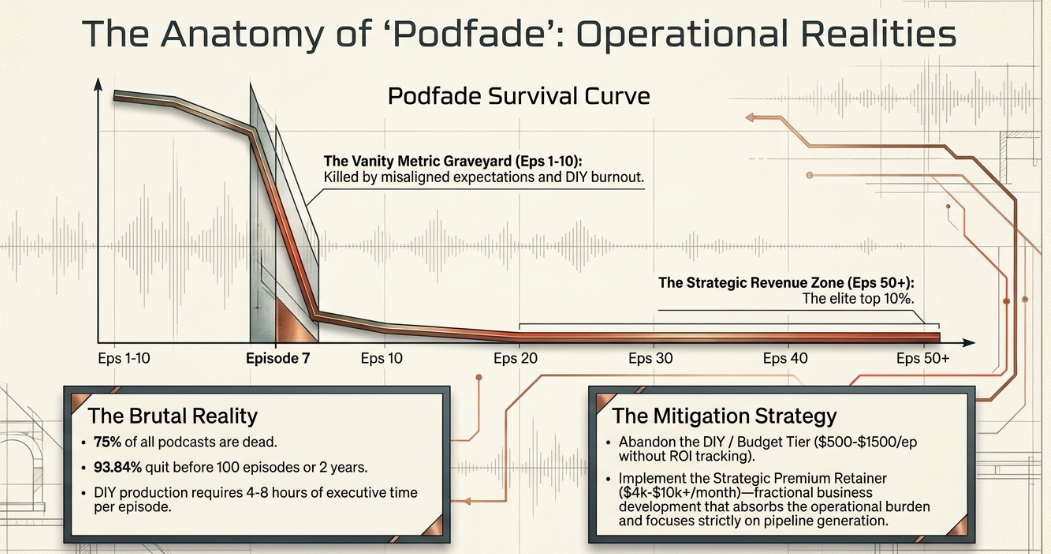
Despite the overwhelming strategic advantages and proven ROI models, the podcasting ecosystem is characterized by an alarming attrition rate. The phenomenon colloquially known within the industry as "podfade" describes the rapid abandonment and cessation of a podcast shortly after its launch. Statistical analysis reveals the brutal reality of digital media production: of the 4.52 million podcasts currently indexed globally across directories like Apple Podcasts and Spotify, only approximately 15% remain actively in production.3
The failure curve is exceptionally steep. Industry data aggregated from platform analytics indicates that 75% of all podcasts are no longer in production, and an astounding 93.84% of podcasters quit before reaching the critical milestone of 100 episodes or two years of continuous production.38 Anecdotal and statistical consensus shows that the vast majority of shows do not survive past episode seven or ten.17 To contextualize this attrition, merely publishing 8 episodes places a show in the top 38.13% of all podcasts globally, while reaching 50 episodes elevates it to the top 10%, and surviving to 100 episodes places a show in the elite top 6.16%.38
The primary catalyst for podfade within the B2B sector is a profound misalignment of expectations. Organizations frequently approach the medium with the "lottery ticket" mentality of consumer influencers, expecting immediate viral reach, thousands of instantaneous downloads, and immediate ad monetization.2 When a highly specialized B2B show—perhaps focusing on commercial real estate insurance data 24 or niche supply-chain logistics—inevitably yields only 150 to 300 downloads per episode in its first quarter, executive leadership misinterprets the data as a catastrophic failure and swiftly withdraws funding. They fail to conceptualize that 300 highly targeted, relevant industry professionals represent a packed convention hall of ideal buyers.14
A secondary, equally destructive driver of podfade is severe resource exhaustion. Organizations attempting the DIY production route frequently underestimate the temporal and technical burden of the medium. Producing a high-quality interview requires an estimated 4 to 8 hours of executive and operational time per episode.28 This encompasses guest research, pre-interview scheduling, technical setup, recording, precise audio engineering, authoring SEO-optimized show notes, and generating social media repurposing assets. Without a sustainable, scalable operational infrastructure or agency support, this intense workload rapidly degrades core business focus, leading inevitably to executive burnout.28
To structurally mitigate podfade, organizations must implement preemptive continuity strategies before the first microphone is ever turned on. Publishing consistency is statistically the highest predictor of a podcast's long-term survival.17 Strategic frameworks dictate that brands must record and bank a buffer of 2 to 3 fully produced, pre-recorded episodes prior to the official launch to absorb the inevitable scheduling conflicts or technical failures that arise during normal business operations.39 Furthermore, organizations must define a highly specific niche and refine their value proposition to stand out among the millions of active feeds, ensuring listeners immediately understand the unique utility of the content.41 Finally, shifting the organizational KPI from "total downloads per week" to "Dream 200 relationships initiated per quarter" recalibrates leadership expectations, aligning the podcast's performance evaluation with its true, proven function as a long-cycle pipeline generator and relationship accelerant.
The Omnichannel Future: Video Integration, AI, and Answer Engine Optimization
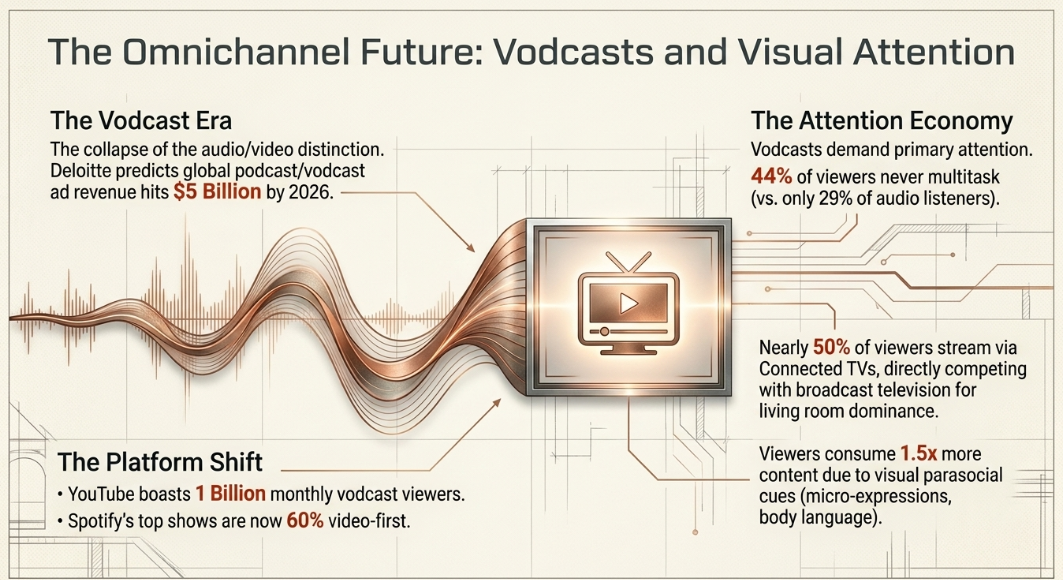
As the global podcasting industry scales toward its projected USD 17.59 billion valuation by 2030 (fueled by a 27% average annual growth rate from 2025 to 2030), the format itself is undergoing a radical morphological shift.2 The rigid, historical distinction between audio and video has entirely collapsed, giving rise to the "Vodcast" (video podcast) era. Deloitte predicts that annual global advertising revenues specifically for podcasts and vodcasts will reach approximately USD 5 billion in 2026, representing a nearly 20% year-over-year increase.44 By 2026, the global marketplace demands an omnichannel presence, heavily pivoting toward video-first podcast consumption.44
The vanguard of this visual shift is YouTube. Despite entering the dedicated podcasting interface arena relatively late in 2022, YouTube has rapidly eclipsed legacy audio directories. By early 2025, the platform boasted one billion monthly vodcast viewers, and in August of 2025, it set a Guinness World Record by hosting 1.3 million concurrent live viewers for a single vodcast episode.44 Spotify has aggressively matched this trajectory, seamlessly integrating video feeds directly into its user interface; by mid-2025, over 60% of Spotify's top-performing shows featured a primary, monetized video component.44
This visual evolution fundamentally alters the psychological consumption environment. Unlike pure audio, which is frequently consumed as a secondary, multitasking media format, vodcasts command primary, undivided attention. Data indicates that 44% of U.S. vodcast viewers never multitask while watching, compared to only 29% of audio-only listeners who claim the same focused attention.44 Furthermore, viewers who watch vodcasts consume 1.5 times more content than audio-exclusive audiences.44 This increased consumption is driven by the deeper parasocial connection facilitated by observing a host's micro-expressions, body language, and physical environment. Consequently, vodcasts are actively colonizing the living room; nearly half of all podcast viewers now stream content via connected televisions, placing B2B corporate content in direct, unprecedented competition with traditional broadcast television and premium streaming services for finite screen time.44 Roughly a quarter of US podcast watchers (and more than a third of Gen Z and millennials) report that they often purchase products advertised on the vodcasts they follow.44
Simultaneously, the rapid proliferation of Artificial Intelligence (AI) is redefining how podcasts are discovered, repurposed, and consumed. While AI is heavily utilized in post-production workflows for automated editing and social media clip generation (with 42% of marketers currently utilizing AI for audio/video editing 46), its most profound impact lies in the realm of Answer Engine Optimization (AEO).
Traditional Search Engine Optimization (SEO) historically relied on strict keyword matching and backlink generation. However, as B2B buyers increasingly utilize Large Language Models (LLMs) and conversational Answer Engines—such as ChatGPT, Claude, Perplexity, and Gemini—to conduct complex vendor research and market analysis, brands must optimize their content for algorithmic ingestion. Podcasts serve as the ultimate AEO asset. A single 45-minute episode generates massive volumes of natural language, long-form conversational text, and structured, nuanced topic breakdowns.2 When an AI engine scrapes the internet to formulate an answer regarding industry best practices, it inherently prioritizes the dense, highly contextualized, human-verified knowledge found in podcast transcripts over superficial, SEO-stuffed blog posts. Consequently, the podcast acts as a foundational data layer that trains the AI algorithms to cite, recommend, and elevate the host's brand above competitors.
Looking toward 2026 and beyond, AI will further dismantle global communication barriers through real-time auto-translation and lip-syncing technologies. This will allow a B2B podcast recorded in English to be seamlessly consumed in localized, high-growth markets such as India, Brazil, and Germany without any loss of parasocial intimacy or vocal inflection.44 Furthermore, the integration of Agentic AI and Dynamic Creative Optimization (DCO) will personalize the listener journey at scale, dynamically inserting hyper-relevant case studies, geographically specific advertisements, or tailored product pitches based on the listener's IP address and verified corporate data, effectively merging the scale of broadcast media with the precision of account-based marketing.45 By operating a podcast as a "content factory," B2B brands generate a continuous "flywheel" of long-form audio, video clips, and AEO-optimized text, ensuring omnipresence across every digital touchpoint.2
In conclusion, the strategic imperative of podcast marketing for professional B2B brands is an empirically validated engine for pipeline acceleration, relationship engineering, and enduring brand equity. As global listenership scales beyond 600 million and advanced attribution models prove definitive ROI, the medium has solidified its position as a primary pillar of corporate infrastructure. Success, however, demands rigorous operational discipline, a rejection of vanity metrics, and a commitment to cultivating the profound, compounding trust of a highly curated digital community.
Works cited
30 B2B Podcasting Statistics [2026] - Omniscient Digital, accessed June 5, 2026, https://beomniscient.com/blog/b2b-podcasting-statistics/
B2B Podcast ROI: Why Podcasting Is Business Infrastructure 2026, accessed June 5, 2026, https://kazcm.com/b2b-podcast-roi/
B2B Podcasts by the Numbers: What the Latest Data Tells Us - Content Allies, accessed June 5, 2026, https://contentallies.com/learn/b2b-podcast-statistics
2026 Podcast Advertising Guide: Effectiveness, Statistics & More - Ad Results Media, accessed June 5, 2026, https://www.adresultsmedia.com/news-insights/is-podcast-advertising-effective/
UK Podcasting Market Size & Outlook, 2025-2030 - Grand View Research, accessed June 5, 2026, https://www.grandviewresearch.com/horizon/outlook/podcasting-market/uk
Should Your B2B Start a Podcast? - Whitehat SEO, accessed June 5, 2026, https://whitehat-seo.co.uk/blog/why-should-i-podcast-for-my-business
The rise of B2B podcasting: how brands are building trust and reach - ITN Business, accessed June 5, 2026, https://business.itn.co.uk/the-rise-of-b2b-podcasting-how-brands-are-building-trust-and-reach/
Webinar vs Podcast: ROI, Stats, Difference + Checklist (Guide 2026), accessed June 5, 2026, https://talks.co/p/webinar-vs-podcast/
The Power of Podcasts for B2B: Build Trust, Thought Leadership & ROI - Acorn Marketing, accessed June 5, 2026, https://acornmktg.com/power-of-podcasts/
Podcasts and Parasociability | 2021-2022 | University Writing Program, accessed June 5, 2026, https://www.brandeis.edu/writing-program/write-now/2021-2022/feuerman/index.html
Using Parasocial Relationships as a Bridge For Real Community Instead of a Replacement For It - Apple Podcasts, accessed June 5, 2026, https://podcasts.apple.com/us/podcast/using-parasocial-relationships-as-a-bridge-for-real/id1650876530?i=1000708576674
Want Warmer Leads? Build a Parasocial Relationship with Your ..., accessed June 5, 2026, https://blog.propllr.com/parasocial-relationship
Five Reasons Why Podcasts Outperform Webinars for B2B Marketing - BrandUp Strategy, accessed June 5, 2026, https://brandupstrategy.com/grow-your-business/five-reasons-why-podcasts-outperform-webinars-for-b2b-marketing/
B2B Podcast Benchmarks: What the Data Really Means for Your Show, accessed June 5, 2026, https://shareyourgenius.com/b2b-podcast-benchmarks-what-the-data-really-means-for-your-show/
Podcast Statistics 2026: 130+ Advertising Data Points - Digital Applied, accessed June 5, 2026, https://www.digitalapplied.com/blog/podcast-statistics-2026-advertising-data
Podcast Retention Strategies To Reduce Drop-Off And Build Loyalty | ThePod.fm, accessed June 5, 2026, https://thepod.fm/resources/blog/podcast-retention-strategies
Podcast Statistics 2026: 99+ Stats & Insights [Expert Analysis] - Marketing LTB, accessed June 5, 2026, https://marketingltb.com/blog/statistics/podcast-statistics/
McKinsey B2B Pulse 2024, accessed June 5, 2026, https://www.mckinsey.com/capabilities/growth-marketing-and-sales/our-insights/five-fundamental-truths-how-b2b-winners-keep-growing
Top B2B Marketing Channels Compared to Podcasting, accessed June 5, 2026, https://ringmaster.com/top-b2b-marketing-channels-compared-to-podcasting/
Webinar vs podcast: which format generates better quality leads in 2026?, accessed June 5, 2026, https://www.getcontrast.io/learn/webinar-vs-podcast
Email Marketing Benchmarks & Industry Statistics - Mailchimp, accessed June 5, 2026, https://mailchimp.com/resources/email-marketing-benchmarks/
42 Webinar Statistics You Need to Know in 2026 | Cvent Blog, accessed June 5, 2026, https://www.cvent.com/en/blog/events/webinar-statistics
2025 B2B Podcasting Trends: Data, Insights, And What Actually Moves the Needle | Fame, accessed June 5, 2026, https://www.fame.so/post/b2b-podcasting-trends-data
How do you actually grow an audience in a niche B2B space? Asking for real advice. : r/podcasting - Reddit, accessed June 5, 2026, https://www.reddit.com/r/podcasting/comments/1sbrulc/how_do_you_actually_grow_an_audience_in_a_niche/
The Ultimate Guide To Measuring B2B Podcast ROI: From ... - Fame.so, accessed June 5, 2026, https://www.fame.so/post/ultimate-guide-to-measuring-b2b-podcast-roi
How HubSpot-Shopify integration powers ecommerce automation - Celigo, accessed June 5, 2026, https://www.celigo.com/blog/hubspot-shopify-integration/
HubSpot for Startups Case Study - Make Influence, accessed June 5, 2026, https://www.hubspot.com/startups/case-studies/make-influence
Podcast Production Pricing: B2B Packages, Costs & ROI | Rise25, accessed June 5, 2026, https://rise25.com/lead-generation/podcast-production-pricing/
What is Share of Voice? How to Measure & Increase Brand SoV - Cision, accessed June 5, 2026, https://www.cision.com/resources/articles/what-is-share-of-voice/
Leveraging Share of Voice Metrics as a Top Business Leader - Forbes Books, accessed June 5, 2026, https://books.forbes.com/blog/share-voice-metrics
Moving the Needle: How Modern Marketers Measure Audio Brand Lift - Consumable, accessed June 5, 2026, https://consumable.com/2024/11/07/how-to-measure-audio-brand-lift/
Brands, Here's How to Measure Podcast ROI - JAR Podcast Solutions, accessed June 5, 2026, https://jarpodcasts.com/brands-heres-how-to-measure-podcast-roi/
Establishing the Proper Share of Voice in Podcasting - Market Enginuity, accessed June 5, 2026, https://blog.marketenginuity.com/establishing-the-proper-share-of-voice-in-podcasting
Ep#38: The Art of Customer Success at HubSpot ft. Jonathan Corbin (Global VP of Customer Success and Strategy) - Hyperengage, accessed June 5, 2026, https://hyperengage.io/podcast/ep38-the-art-of-customer-success-at-hubspot-ft-jonathan-corbin-global-vp-of-customer-success-and-strategy
Key B2B Customer Retention Metrics and how to Measure them - DynamicWeb, accessed June 5, 2026, https://dynamicweb.com/resources/insights/blog/key-b2b-customer-retention-metrics-and-how-to-measure-them
How Slack Built a Human B2B Brand That People Love - Column Five, accessed June 5, 2026, https://www.columnfivemedia.com/how-slack-built-a-human-b2b-brand-that-people-love/
Podcast Statistics 2026 - Our Own Brand, accessed June 5, 2026, https://ourownbrand.co/podcast-statistics
Podcasting Industry Report Specifically for Independent Podcasters - PodMatch, accessed June 5, 2026, https://podmatch.com/report
What is Podfade?: Tips for new and seasoned podcasters - Buzzsprout, accessed June 5, 2026, https://www.buzzsprout.com/blog/podfade
What is the average number of episodes someone makes before stopping? : r/podcasting, accessed June 5, 2026, https://www.reddit.com/r/podcasting/comments/15c8axd/what_is_the_average_number_of_episodes_someone/
How To Build a B2B Podcast Content Strategy (That Converts) - Sweet Fish Media, accessed June 5, 2026, https://www.sweetfishmedia.com/blog/how-to-build-a-b2b-podcast-content-strategy-that-converts
6 Proven Content Strategies for B2B Podcast Success - Podigy, accessed June 5, 2026, https://www.podigy.co/6-proven-content-strategies-for-b2b-podcast-success
The 12 Best Ways to Grow Your B2B Podcast's Audience and Retention in 2026, accessed June 5, 2026, https://ringmaster.com/the-12-best-ways-to-grow-your-b2b-podcasts-audience-and-retention-in-2026/
Video podcasts reach | Deloitte Insights, accessed June 5, 2026, https://www.deloitte.com/us/en/insights/industry/technology/technology-media-and-telecom-predictions/2026/video-podcasts-reach.html
Podcasting in 2026: Acast People Share Their Predictions, accessed June 5, 2026, https://advertise.acast.com/news-and-insights/podcasting-in-2026-acast-people-share-their-predictions
2026 Marketing Statistics, Trends, & Data - HubSpot, accessed June 5, 2026, https://www.hubspot.com/marketing-statistics
Why Podcasting Is the Fastest-Growing Trend in 2026 - ICP Cast, accessed June 5, 2026, https://icpcast.com/blog/ai-podcasting-trends-2026