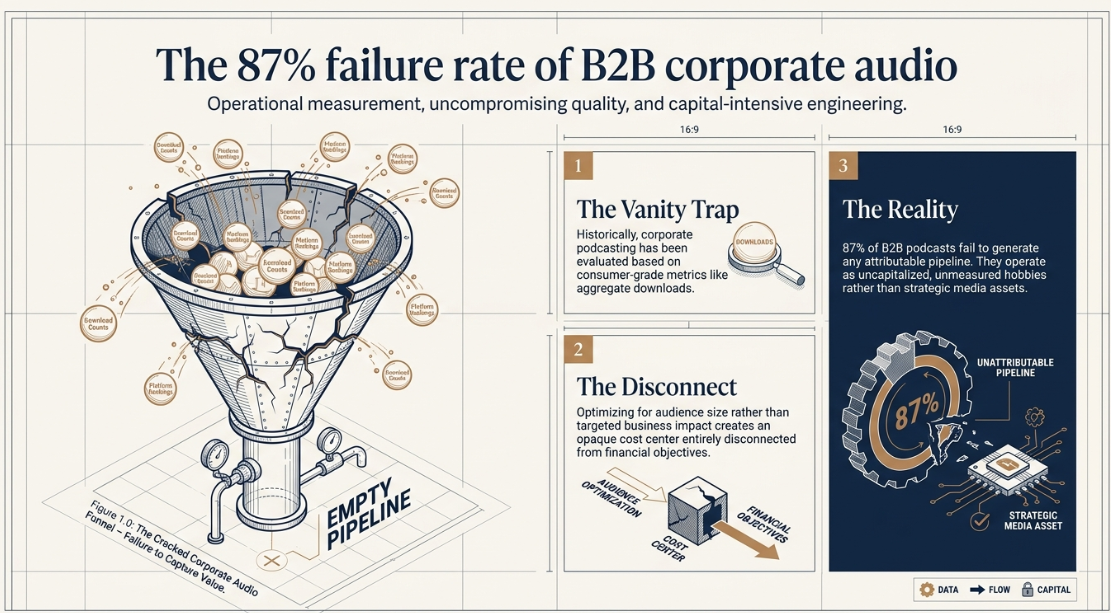
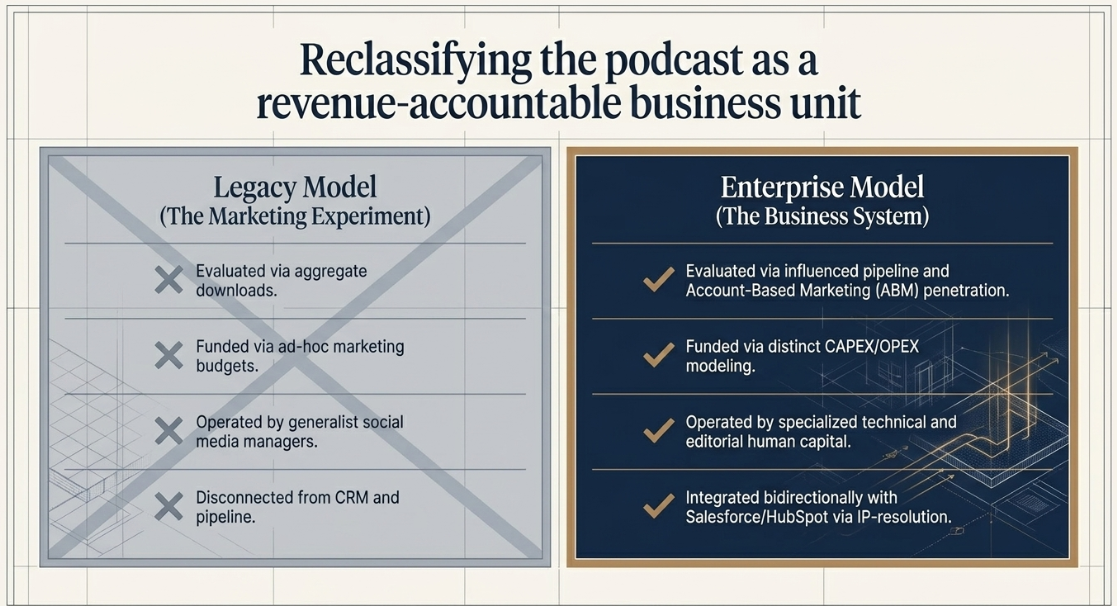
The enterprise audio landscape has undergone a profound transformation, evolving from a peripheral corporate communications exercise into a sophisticated, highly measurable revenue-generation engine. Historically, corporate podcasting initiatives were evaluated based on superficial vanity metrics, most notably aggregate download counts and platform rankings. This paradigm created an environment where the strategic value of audio content was frequently misunderstood or entirely disconnected from corporate financial objectives. Empirical data reveals an uncomfortable reality for marketing executives: an estimated 87% of business-to-business (B2B) podcasts fail to generate any attributable pipeline precisely because their operators optimize for audience size rather than targeted business impact.1 To rectify this systemic failure, modern organizations must architect a business case rooted in rigorous operational economics, high-fidelity production infrastructure, and advanced multi-touch attribution frameworks that align seamlessly with Account-Based Marketing (ABM) strategies.
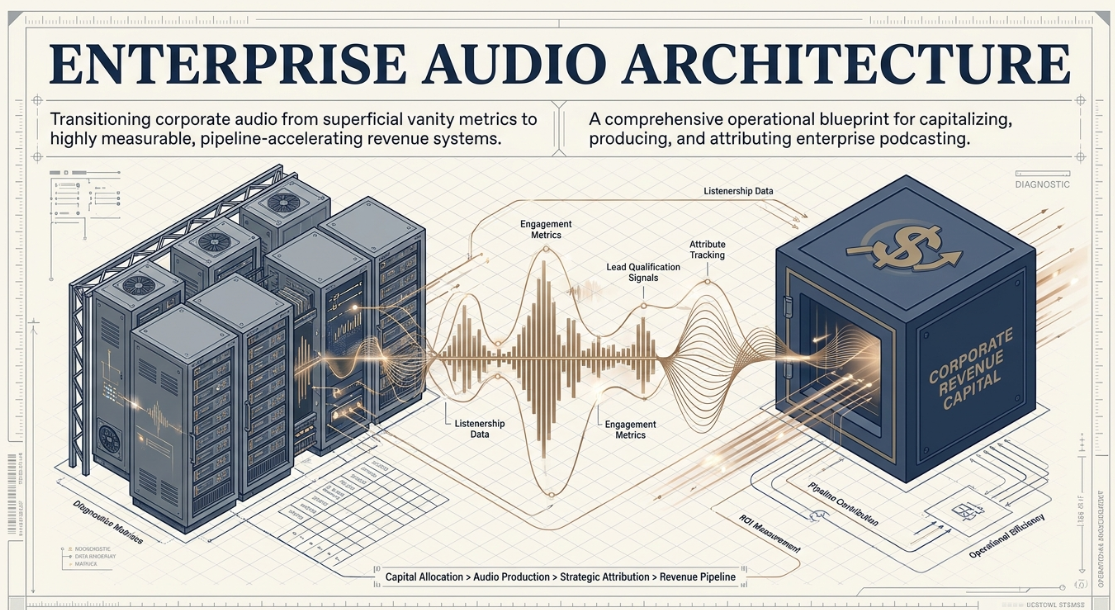
Building a sustainable enterprise podcast requires significantly more than securing consumer-grade recording equipment. It necessitates the structural integration of specialized human capital, cutting-edge software stacks, and enterprise-grade information security protocols. Furthermore, a successful deployment hinges on a transition from opaque cost centers to verifiable revenue streams. This requires leveraging deep Customer Relationship Management (CRM) integrations to track a prospect's journey from their initial audio consumption to a closed-won deal.1 This comprehensive report dissects the macro and micro operational economics of enterprise podcast production, the architectural design of the production team, the technological infrastructure required for broadcast-quality audio, and the analytics frameworks necessary to prove boardroom-level return on investment (ROI).
The Macro-Economics of Enterprise Audio: Capital and Operational Expenditures
The financial architecture of an enterprise podcasting initiative is categorized into upfront Capital Expenditures (CAPEX) for studio infrastructure and ongoing Operational Expenditures (OPEX) for human capital, marketing, distribution, and software licensing. Establishing accurate, reality-based financial models is the foundational step in the business case, directly dictating whether an organization should build an internal production studio, bootstrap a lean operation, or outsource operations entirely to a specialized agency.
Financial Modeling: Startup Costs and the Break-Even Runway
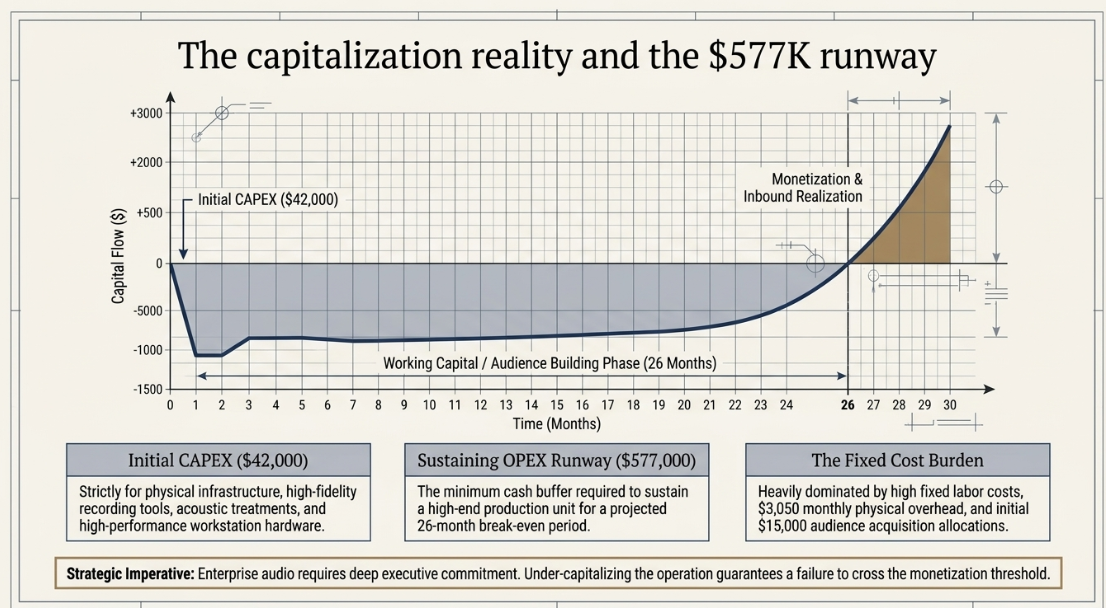
Launching a high-caliber podcast production operation—whether conceptualized as a standalone media subsidiary, a dedicated internal enterprise department, or an outsourced service provider—requires substantial initial capitalization. Rigorous financial models constructed for professional podcast production services indicate that an initial CAPEX of approximately $42,000 is necessary to establish a professional recording environment.2 This budget strictly covers the essential physical infrastructure, high-fidelity recording tools, acoustic treatments, and high-performance workstation hardware required before a single episode is recorded or distributed.2
However, the most critical vulnerability in the economic model is not the initial hardware purchase, but rather the working capital required to sustain operations during the audience-building phase. Due to the delayed monetization curve inherent in content marketing and the high fixed labor costs associated with specialized audio talent, operations often experience a prolonged period before reaching break-even. Comprehensive financial projections reveal that a sophisticated production unit may require a minimum cash buffer of up to $577,000 to sustain operations.2 This substantial runway is designed to cover high fixed labor costs, monthly rent, and utility expenses over a projected 26-month period until the break-even point is achieved.2
Within this model, labor represents the dominant OPEX burden. High fixed salaries, which may include a $100,000 executive founder or showrunner salary coupled with a $75,000 lead audio engineer salary, represent the largest financial hurdles during the initial two years of operation.2 Furthermore, initial fixed operating expenses for physical premises run approximately $3,050 monthly, supplemented by a requisite $15,000 allocation for first-year marketing and audience acquisition efforts.2 These figures underscore the reality that enterprise podcasting is a capital-intensive media operation, requiring deep executive commitment and realistic timelines for ROI materialization.
Evaluating Production Models: In-House vs. Outsourced Agency Tiers
Given the substantial OPEX, human capital requirements, and cash-flow risks associated with building a premium internal production team, the majority of mid-market and enterprise B2B organizations opt for outsourced or hybrid production models. The market for podcast production services is highly stratified, offering distinct tiers of strategic intervention, editorial oversight, and post-production fidelity designed to match varying corporate maturity levels.
At the lower end of the operational spectrum, basic external production or freelance support costs between $50 and $500 per episode.4 This tier functions merely as an audio processing commodity, suitable only for hobbyists or organizations with severely restricted budgets where the primary goal is simply to make raw audio listenable.6 These entry-level producers generally do not provide extensive creative input, promotional support, or strategic alignment with corporate goals.6
As strategic requirements escalate, organizations enter the mid-tier, where retainers spanning $1,500 to $5,000 per month become the standard operating parameter.5 A typical $5,000 monthly retainer generally encompasses the full production of four episodes, alongside vital operational support such as guest research, booking coordination, pacing adjustments for clearer storytelling, and the provision of social media snippets.6 This tier is highly functional for companies seeking consistency and professional polish without the overhead of a full creative agency.
For sophisticated B2B marketers, the "Full-Service Agency" tier, ranging from $3,000 to $8,000 monthly, is where audio content begins to intersect directly with revenue generation.9 At this level, production partners do not merely edit audio; they provide editorial strategy, manage executive-level guest outreach programs, and deliver comprehensive business outcome reporting.9 The highest echelon of the market encompasses enterprise branded podcasts and highly produced narrative or documentary shows, which command budgets of $8,000 to over $20,000 per month.9 Full-season high-end productions, characterized by multi-episode narratives, meticulous sound design, and original music scoring, easily scale into the $40,000 to $100,000+ range.6
When constructing financial models for per-episode expenditures, enterprise leaders must also account for dynamic rate adjustments and hidden complexity fees. Standard industry pricing models dictate that episodes exceeding a standard 60-minute duration incur a length premium of 15% to 30% per additional 15 minutes.9 Furthermore, demanding a same-day or next-day rush turnaround adds a 25% to 50% premium to the baseline cost.9 Finally, highly technical recordings or panel formats involving four or more speakers introduce severe mixing challenges, typically resulting in a 20% to 30% complexity surcharge.
Architecting the Human Capital and Production Team
The transition from a basic interview show to a pipeline-accelerating enterprise asset requires the deployment of highly specialized human capital. The production architecture must account for both technical engineering and editorial direction, ensuring that the content not only sounds pristine but strategically aligns with the organization's overarching market positioning. A common fallacy among corporate marketing departments is assuming that a generalist content marketer or social media manager can effectively absorb podcast production duties; in reality, audio production requires a distinct, highly trained discipline.
Core Roles, Strategic Functions, and Deliverables
A high-functioning enterprise podcast team relies on a strict division of labor that separates technical execution from narrative strategy and overall project management. The primary roles include:
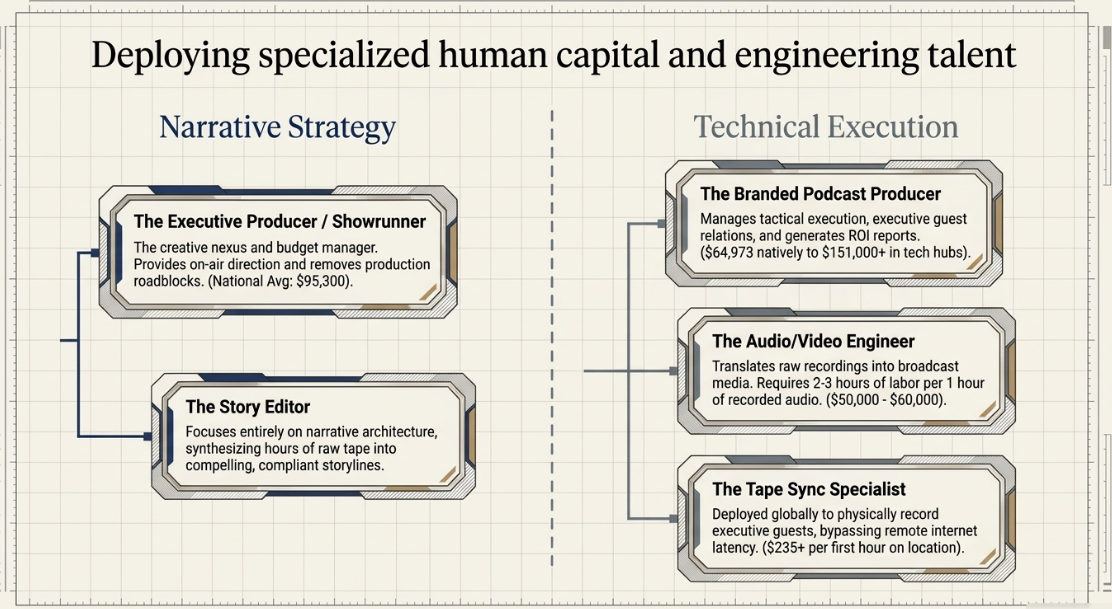
The Executive Producer / Showrunner The showrunner acts as the operational, strategic, and creative nexus of the podcast. This individual oversees and approves all aspects of production, from creating initial budgets and deployment schedules to defining daily goals, individual team member responsibilities, and season-long episode concepts.10 Beyond administrative oversight, the executive producer provides vital on-air direction to the host, offering feedback on line delivery and ensuring the performance aligns with the corporate vision and tonal guidelines.10 Furthermore, they organize kick-off meetings, supervise team members, navigate complicated interpersonal or technical situations, and actively remove roadblocks to ensure continuous, frictionless production.
The Story Editor / Editorial Consultant Distinct from a technical audio editor who physically cuts the waveform, the story editor focuses entirely on the narrative architecture of the content.11 This role is paramount in narrative, documentary, or high-stakes B2B formats. Story editors work closely with hosts, producers, and corporate clients to craft scripts, shape overall narrative arcs through storyboarding, and synthesize hours of raw tape into a compelling, coherent, and structurally sound storyline.11 They ensure that the messaging remains factually accurate, engaging, and directly tied to the brand's strategic objectives, often lending timely editorial feedback and maintaining rigorous quality control before the audio is finalized.11
The Podcast Producer The producer manages the day-to-day tactical execution of the show. In a corporate context, a "Branded Podcast Producer" is elevated beyond simple logistical coordination; they oversee the comprehensive editorial strategy, manage the guest pipeline (including highly sensitive executive guest relations), oversee the recording sessions, and generate ongoing business ROI and outcome reports for stakeholders.9 Standard per-episode deliverables managed by the producer often encompass SEO-optimized show notes, the creation of audiograms or social video clips, chapter marker generation, and final distribution coordination across all platforms.9
The Audio/Video Engineer Audio engineers translate raw, often flawed recordings into broadcast-ready media. They provide critical noise reduction, volume leveling, filler word removal, and nuanced audio enhancements.6 The industry standard operational metric suggests that for every one hour of recorded audio, an engineer requires a minimum of two to three hours of labor for comprehensive mixing, leveling, and production.12
The Tape Sync Specialist In remote recording environments—which are standard for B2B podcasts interviewing global executives—internet latency, bandwidth constraints, and platform compression severely degrade audio fidelity. To circumvent this, enterprise operations utilize "Tape Sync Engineers." These specialists physically travel to a remote guest's location equipped with professional field gear to record high-quality local audio stems directly from the source.9 These pristine local stems are then delivered to the primary producer and synchronized with the remote interview feed during post-production, guaranteeing studio-quality sound regardless of the guest's internet connection.
Compensation Frameworks, Geo-Arbitrage, and Market Rates
Understanding the labor economics of these specialized roles is essential for accurate OPEX forecasting. Compensation varies dramatically based on geographic location, educational background, years of experience, and the structural complexity of the audio content being produced.
The national average salary for an in-house Podcast Producer in the United States is reported at $64,973 per year, which breaks down to an hourly rate of approximately $31.13 The compensation distribution shows the 75th percentile earning $71,169, while entry-level roles start near $44,493.13 Education plays a notable role in this sector, with 71% of producers holding a Bachelor's degree and 14.6% holding a Master's degree, contributing to higher specialized earning potential.13
However, localized demand and cost-of-living adjustments drastically inflate these baseline figures. For instance, alternative aggregate data indicates that the national average for specific senior producer roles can reach $123,552.14 High-cost geographic anomalies drastically alter the OPEX model; cities such as Nome, Alaska, demand average salaries of $153,265, while tech-centric hubs like Cupertino, CA, and Mercer Island, WA, require salaries exceeding $151,000 per year.14 This represents a 22% to 24% premium over the already high $123,552 national average.14 Executive Producers and Showrunners naturally command leadership premiums, routinely averaging $95,300 natively, reflecting their comprehensive oversight and budget management responsibilities.10 Dedicated internal Audio/Video Engineers typically command salaries ranging from $50,000 to $60,000.12
For organizations leveraging an agile freelance or contractor model rather than internal full-time equivalents (FTEs), the hourly rates align with strict experience brackets. Entry-level personnel (0–2 years) charge between $20 and $40 per hour, handling basic edits for simple interview shows.9 Mid-level producers (2–5 years) charge $40 to $85 per hour to manage multi-track editing and small business clients.9 Senior professionals handling corporate podcasts and branded content command $85 to $150 per hour.9 Finally, specialists with over a decade of experience executing enterprise branded podcasts, major media narratives, or "Caspian Studios-level" story editing command elite rates of $150 to $250+ per hour.9 Tactical field roles, such as Tape Sync Engineers, operate on session-based pricing, billing a minimum of approximately $235 for the first hour of on-location recording according to Association of Independents in Radio (AIR) standards, with full sessions ranging from $200 to $500 plus separate mileage reimbursements.
Designing the Hardware Ecosystem and Studio Infrastructure
Achieving broadcast-quality audio and video is a non-negotiable requirement for enterprise brands seeking to establish industry authority and trust. The perceived quality of the content directly correlates with audience retention, brand positioning, and crucially, the willingness of high-profile executive-level guests to participate. A poorly produced podcast signals a lack of corporate resource commitment, severely damaging the brand's credibility. The studio infrastructure operates on a spectrum from remote desktop setups to multi-camera flagship broadcast spaces.
The Evolution to Video-First Podcasting
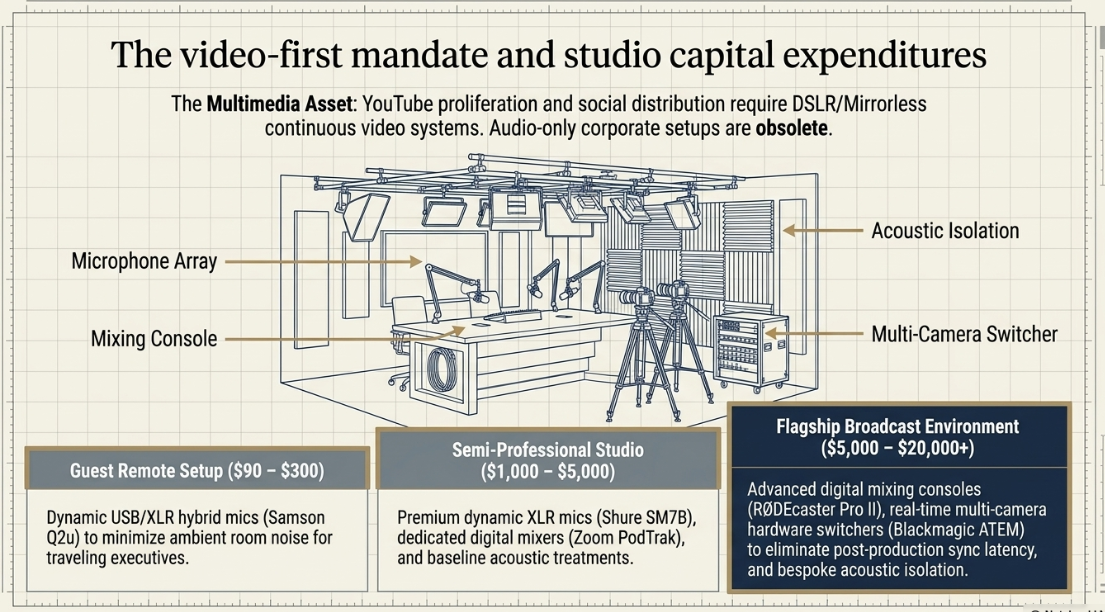
The modern enterprise podcast is inherently a multimedia asset. The proliferation of YouTube as a primary podcast consumption platform, combined with the necessity of generating vertical video clips for social media distribution, has rendered audio-only setups largely obsolete for growth-focused brands.16 Incorporating high-definition video ensures a competitive edge, heightens professionalism, and signals a deep commitment to delivering premium content.16
Video podcasting requires specific visual architectures. While consumer-grade webcams or smartphones may suffice for hobbyists, enterprise setups utilize Digital Single-Lens Reflex (DSLR) or Mirrorless cameras.16 These units offer interchangeable lenses, advanced autofocus tracking systems, full manual customization, and large image sensors capable of producing the shallow depth-of-field and cinematic aesthetic expected of top-tier corporate media.16 Mirrorless cameras, in particular, are increasingly favored for their compact form factor, lighter weight, and continuous video performance, effectively mitigating the overheating issues common in early DSLR models used for long-form interviews.
Studio Cost Tiers and Equipment Configuration
Establishing an in-house studio requires precise CAPEX allocation based on format, host count, and desired fidelity. The infrastructure is categorized into distinct tiers, emphasizing that a smart allocation of capital—specifically directing the majority of the budget toward the microphone—yields the highest return on audio quality.17
1. The Individual Executive Setup ($90 – $300) For corporate executives who primarily act as guests on other industry podcasts, or for solo hosts operating on a strict budget, minimizing ambient room noise is the primary objective. This is achieved by utilizing dynamic microphones with cardioid pickup patterns, rather than highly sensitive condenser microphones that capture background office noise.17 A highly cost-effective setup utilizes the Samson Q2u ($90), a versatile microphone that offers both USB plug-and-play simplicity and XLR connectivity for future upgrades.18 Paired with inexpensive but isolating studio headphones (e.g., Samson SR350 for $20) and an Innogear boom arm to bring the capsule close to the mouth, this setup drastically outperforms expensive condenser microphones sitting idly on a desk.18 For a slight upgrade, the Rode Podmic USB ($300) provides a heavier, broadcast-style aesthetic and superior sound profile while maintaining USB convenience.18
2. The Intermediate / Semi-Professional Studio ($1,000 – $5,000) This setup is engineered for corporate teams aiming to transcend basic consumer quality and establish a dedicated recording footprint. The foundation of this tier relies on premium dynamic XLR microphones, such as the industry-standard Shure SM7B, paired with multi-track audio interfaces or digital mixers like the Zoom PodTrak P4.21 These interfaces are necessary to handle XLR inputs, provide clean gain, and route audio directly to the editing software.21 Critically, this tier allocates $500 to $1,000 toward dedicated acoustic treatments, including bass traps and sound-absorbing panels, to mitigate hard-surface room reverberation.19 Visuals are supported by basic HD cameras and fundamental LED lighting kits, creating a comprehensive desktop broadcasting environment.19
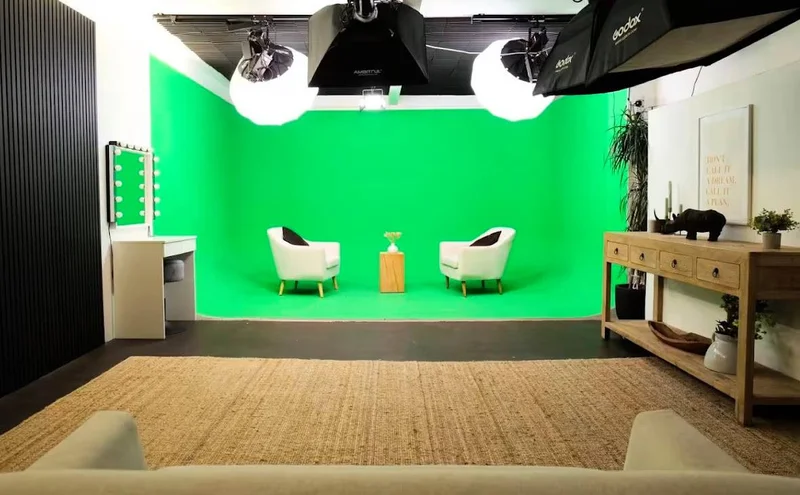
3. The Professional Flagship Studio ($5,000 – $20,000+) For category-leading brands treating their podcasts as flagship media properties, the studio mimics a traditional television broadcast environment. It is not uncommon for major corporations to invest upwards of $50,000 to construct bespoke architectural spaces.19 Audio capture is managed by advanced digital mixing consoles like the RØDEcaster Pro II ($699) or the compact RØDEcaster Duo ($479).23 These consoles feature studio-grade preamps, advanced APHEX audio processing, programmable sound pads for live music triggering, and multi-host combo XLR inputs.23 The visual architecture scales to multi-camera setups requiring hardware switchers (e.g., Blackmagic Design ATEM models) to cut seamlessly between hosts and guests in real-time, eliminating hours of post-production video syncing.19 This camera and switching infrastructure alone requires a budget of $3,000 to $8,000.19 Furthermore, the physical environment demands $2,000 to $5,000 for advanced acoustic isolation and professional soundproofing, while the physical set requires an additional $1,500 to $5,000 for overhead lighting grids, background design, bespoke furniture, and on-camera corporate branding elements.
The Technology Stack: Software Ecosystems and Digital Audio Workstations
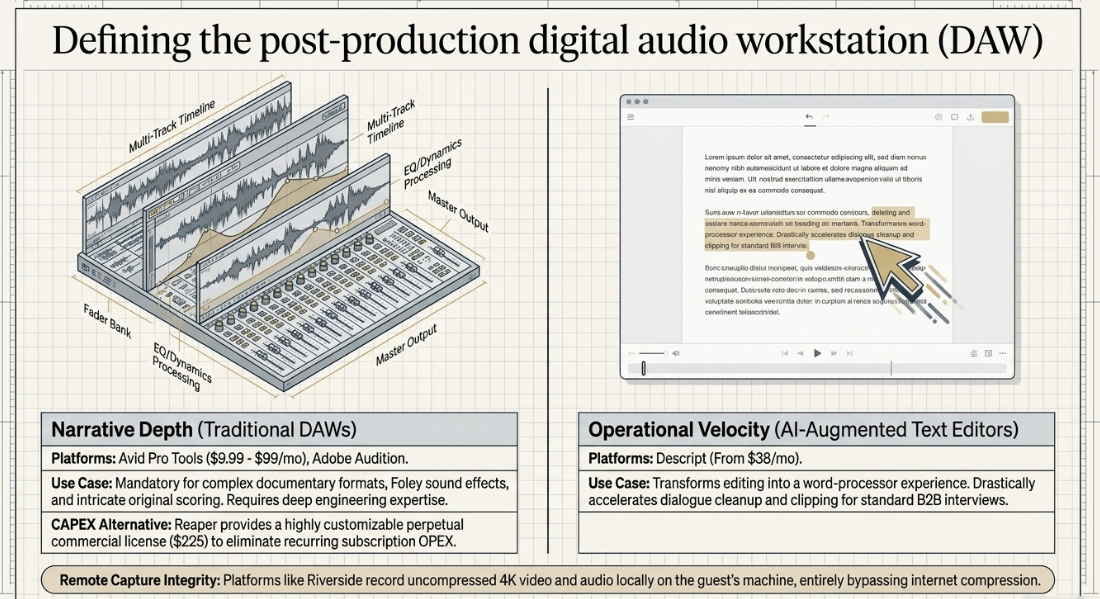
The operational efficiency and output velocity of a podcast production team are heavily dictated by its post-production technology stack. The software ecosystem governs how rapidly raw audio files can be processed, edited, cleared for copyright compliance, and distributed. Choosing the correct Digital Audio Workstation (DAW) requires balancing the technical capabilities of the engineering team against the required speed of deployment.
Digital Audio Workstations (DAWs) and AI-Augmentation
Historically, audio editing relied exclusively on complex, highly technical DAWs utilizing manual waveform manipulation. While professional engineers still mandate these tools for granular control, the advent of AI-powered, text-based editors has revolutionized corporate workflows, drastically reducing the time and technical expertise required for basic dialogue editing.
The strategic decision between a traditional DAW and a modern text-based editor hinges entirely on the specific format and workflow of the podcast. For documentary-style episodes or complex narrative formats requiring intricate music scoring, multi-layered Foley sound effects, and advanced equalization, platforms like Avid Pro Tools or Adobe Audition remain strictly necessary.26 However, these traditional platforms operate on subscription models, representing an ongoing OPEX burden, whereas highly capable alternatives like Reaper offer a perpetual commercial license for $225, freeing the organization from recurring fees.28
Conversely, for standard B2B interview formats where rapid content turnaround and social media clipping are prioritized, tools like Descript have become the operational standard. Descript allows producers to edit audio and video simply by deleting text in an automatically generated transcript, fundamentally accelerating the dialogue editing process for teams more comfortable with words than with waveforms.24
Furthermore, remote recording platforms like Riverside or Zencastr are vital infrastructure for enterprise teams conducting global interviews.24 Traditional video conferencing tools (e.g., Zoom) compress audio severely during transmission. Dedicated remote podcasting software bypasses internet degradation by recording high-resolution audio and 4K video locally on the guest's machine, subsequently uploading the pristine uncompressed files to the cloud.
Securing Sonic IP: Enterprise Music Licensing
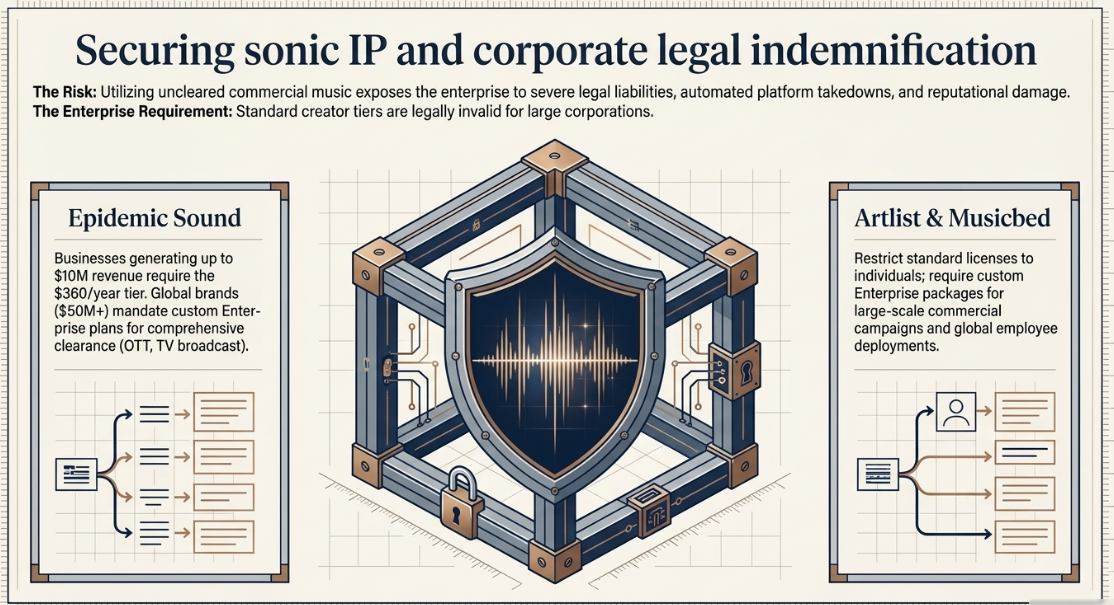
A critical, yet frequently mismanaged aspect of the enterprise audio stack is music licensing. Utilizing copyrighted commercial music without proper clearance exposes the organization to severe legal liabilities, automated platform takedowns, and reputational brand damage. Enterprise production teams must utilize commercial royalty-free libraries that provide comprehensive legal indemnification and broad usage rights.
Platforms such as Epidemic Sound, Artlist, and Musicbed offer vast catalogs of high-quality, cinematic music and sound effects, but their licensing models are strictly tiered based on the purchasing company's revenue and the intended use case.29
Epidemic Sound: While individual creators can access the platform for $9.99/month, businesses generating up to $10 million in revenue require the "Business" tier at $30/month ($360/year) to legally clear content for digital ads and corporate websites.29 For global agencies or brands with revenues exceeding $50 million, a custom "Enterprise" plan is legally mandatory to secure comprehensive clearance for complex workflows, global distribution, Over-The-Top (OTT) streaming, and TV broadcasting.29 Epidemic Sound secures these expansive rights by paying fixed upfront fees ($2,000 to $8,000 per track) directly to artists, allowing them to offer true royalty-free usage without backend rights complications or recoupment tracking.32
Artlist: Operating on a similar model, Artlist restricts its standard $16.60/month "Pro" tier to individual creators.30 Corporations are required to negotiate custom Enterprise packages to obtain the legal clearances necessary for large-scale commercial campaigns and employee deployments.30
Musicbed: Recognizing the diverse legal and indemnification needs of large organizations, Musicbed also provides custom Enterprise plans tailored for extensive commercial distribution and monetization, differentiating these from their individual plans ($29.99 to $109.98/month) which are strictly for personal use or independent freelance filmmakers.32
Procuring a proper enterprise license from these platforms ensures that internal marketing and legal teams are not burdened by tracking down individual copyright holders, managing usage renewals, or facing unpredictable backend royalty fees.
Enterprise Hosting, Private Distribution, and Security Architecture
Once the final audio file is mastered and legally cleared, it must be ingested into a podcast hosting platform. This platform acts as the central command for global distribution, RSS feed generation, and analytics aggregation.33 Consumer-grade or free hosting platforms are entirely insufficient for large corporations, which require granular team permissions, sophisticated programmatic monetization infrastructure, and rigorous data security protocols.
Evaluating the Public Hosting Market Leaders
The podcast hosting market is heavily stratified, with enterprise brands gravitating toward a select few premium providers. A rigorous analysis of RSS feeds across the top 10,000 podcasts reveals that Megaphone dominates the premium tier with a 20.3% market share, followed by Libsyn (14.5%), Simplecast (7.2%), and Omny Studio (7.0%).34
Megaphone (by Spotify): Megaphone is engineered exclusively for large-scale publishers, media networks, and established B2B brands managing extensive content catalogs.33 It provides a powerful ad-tech stack, including dynamic ad insertion (DAI) and exclusive access to the Spotify Audience Network (SPAN) for programmatic sales.33 It supports complex corporate operational controls, such as broadcast-to-podcast automation, team-based roles, and granular user hierarchies.33 Because it operates on a custom enterprise pricing model—historically requiring minimums around $500/month plus additional fees on excess downloads—it poses a high financial barrier to entry, effectively filtering out hobbyists and small businesses.33
Omny Studio (Triton Digital): Omny Studio stands as a premier enterprise platform particularly favored by commercial broadcasters and radio networks.37 While basic plans begin at approximately $29/month, its true architectural value lies in its custom enterprise tiers.37 It features robust broadcast capture tools for automatically converting live radio segments into on-demand podcasts, comprehensive content management, and advanced audience measurement powered by Triton Podcast Metrics, which tracks demographics and powers industry rankers.33
Simplecast (SiriusXM / AdsWizz): Simplecast is renowned across the industry for its highly polished interface and deep analytics.40 While entry-level plans begin at $15/month, the platform is strategically structured so that its most valuable tools—such as IAB-certified B2B analytics, advanced episode templates, white-label solutions, and direct access to the AdsWizz programmatic marketplace (where 80% of the world's podcast ad demand is bought)—are gated behind its higher Custom Enterprise and Business tiers.40 Unlike platforms aimed at beginners, Simplecast does not offer a free tier, cementing its focus on commercial podcasters.
Information Security and Internal Podcasting Infrastructure
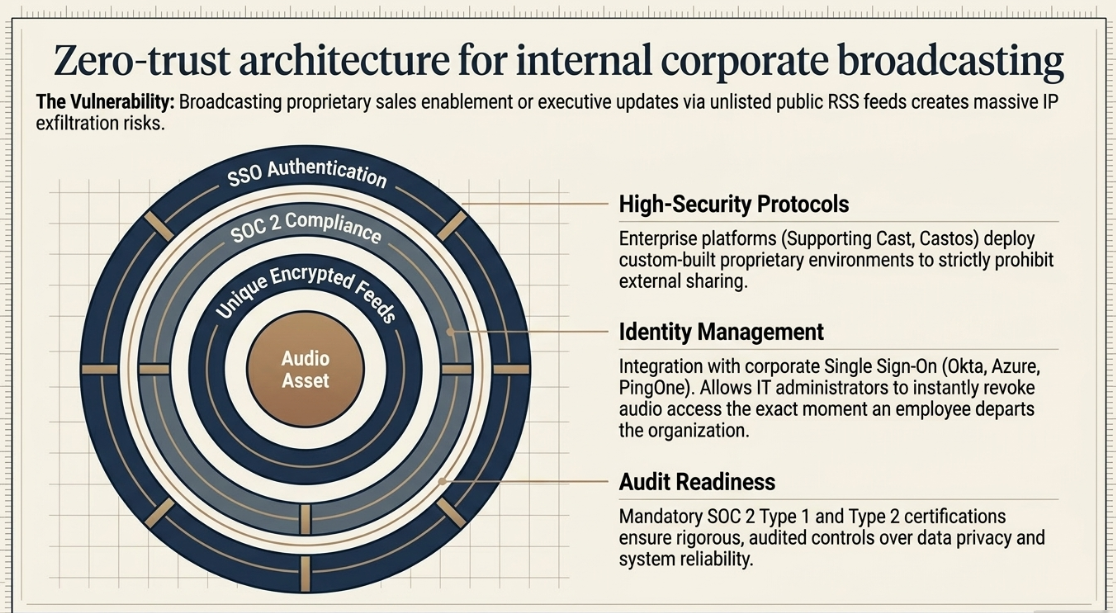
Not all enterprise audio is intended for public consumption. Organizations increasingly utilize private podcasts for internal communications, proprietary sales enablement, global employee onboarding, and sensitive executive updates. Internal podcasting is highly effective because it bypasses unread corporate emails and ignored intranets, delivering asynchronous audio directly to the mobile devices of hybrid, remote, and frontline workers.43 However, broadcasting proprietary corporate data over standard RSS feeds introduces massive IP security risks. If an internal, password-protected URL is leaked, anyone on the public internet can theoretically access the corporate audio.45
To mitigate these severe vulnerabilities, enterprise platforms like Supporting Cast, Castos, and Storyboard have engineered sophisticated private hosting environments designed specifically for corporate governance.44 Internal podcast security is generally categorized into three operational levels:
Low Security: A single, unlisted RSS feed shared internally (highly vulnerable to leakage).45
Medium Security: Employees register individually and receive a unique, private RSS feed mapped to their identity.45
High Security: A custom-built, proprietary corporate app that strictly prohibits audio downloading or sharing outside the secure environment.45
For most enterprises, the "Medium" or "High" security tiers are mandatory, supported by the following technical protocols:
Single Sign-On (SSO): True enterprise security relies on SSO authentication integrated with corporate identity providers such as Okta, Microsoft Azure, Google, OneLogin, and PingOne.44 This ensures that employees authenticate using their existing corporate credentials.47 Crucially, this allows IT administrators to instantly revoke podcast access the precise moment an employee departs the organization, preventing unauthorized exfiltration of internal communications.44
SOC 2 Compliance: Platforms like Supporting Cast hold SOC 2 Type 1 and Type 2 certifications, while identity providers like HYPR maintain stringent AICPA compliance.44 This certification is mandatory for corporate procurement, demonstrating to internal IT and legal departments that the vendor maintains rigorous, audited controls over data privacy, system security, and infrastructure reliability.44
Individualized Feeds and Access Control: Rather than relying on a single password-protected RSS feed, advanced systems generate unique, encrypted feeds for every individual listener.44 This allows administrators to track precise listening behavior per employee, detect suspicious download activity or unauthorized sharing, and restrict specific content to targeted internal departments.44
B2B Attribution, Pipeline Acceleration, and CRM Integration
The fundamental operational challenge in B2B podcasting is translating anonymous listener downloads into verifiable pipeline revenue. Corporate leadership and finance departments require rigorous, data-backed multi-touch attribution to justify ongoing capital investment. Operating without this infrastructure consigns the podcast to being viewed as an unjustifiable OPEX drain, a fate suffered by the majority of corporate shows.
Moving Beyond Vanity Metrics: The B2B ROI Framework
Strategic podcast operators explicitly differentiate between top-of-funnel visibility metrics (total downloads, subscriber counts, consumption rates) and bottom-of-funnel business outcomes (attributable leads, influenced pipeline, closed-won deals, Cost per Acquisition).49
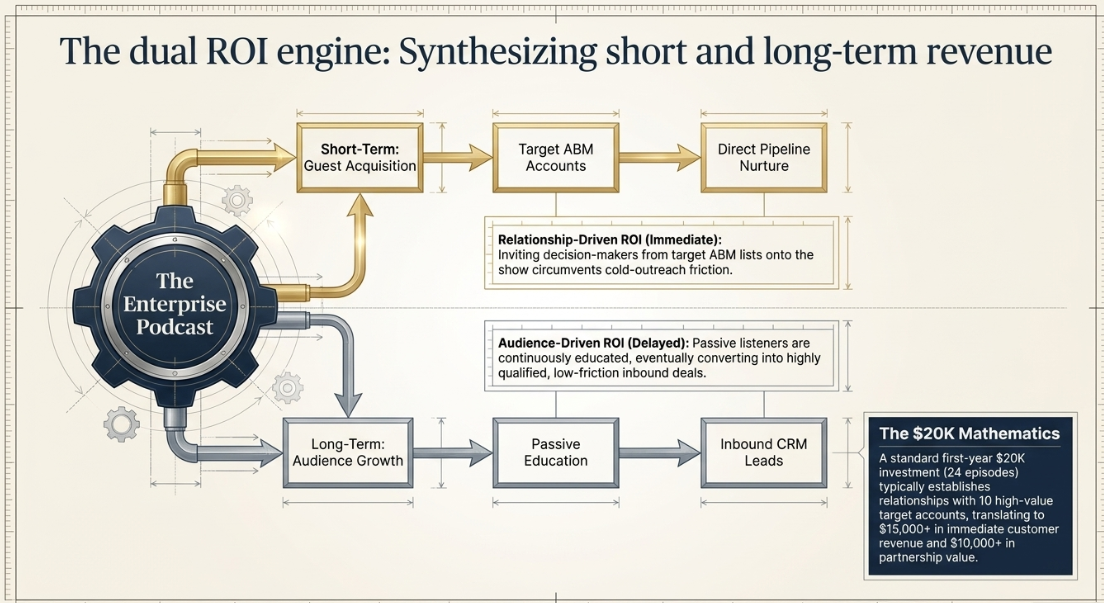
The "Fame B2B Podcast ROI Framework" posits a transformative approach, arguing that corporate podcasts generate two distinct, measurable classes of ROI. The first is Short-Term Relationship-Driven ROI, achieved through the strategic, targeted acquisition of guests.50 By inviting key decision-makers from target Account-Based Marketing (ABM) lists onto the show, the organization initiates a high-value, intimate relationship that effectively circumvents the friction of traditional cold outreach.1 Post-interview, these guests are systematically nurtured and transitioned into the sales pipeline. The second class is Long-Term Audience-Driven ROI, generated as passive listeners are educated over time and convert into highly qualified inbound leads.50 The framework's modeling demonstrates that a standard first-year investment of $20,000 (yielding roughly 24 episodes) typically establishes relationships with 10 high-value target accounts, directly translating into $15,000+ in immediate customer revenue and $10,000+ in partnership value, thereby achieving a cash-positive ROI while simultaneously building the audience.50
To operationalize this pipeline acceleration, specialized consultancies like Pro Podcast Solutions offer highly structured strategic optimization tiers.
At the Tier 1 ($2,995/month) level, organizations receive comprehensive performance intelligence, tracking website traffic correlation, lead generation attribution, and geographic concentration.1
At the Tier 2 ($5,995/month) level, the service establishes a full pipeline attribution framework. This involves integrating the podcast strategy directly with ABM targets, developing specific outreach templates for target-account guests, and tracking the exact Guest-to-Customer conversion rates.1
At the Tier 3 ($9,995/month) level, the engagement scales to a full strategic partnership, incorporating multi-channel ecosystem development, quarterly board reporting, executive thought leadership coaching, and competitive market positioning.1
CRM Integration and Advanced Multi-Touch Attribution
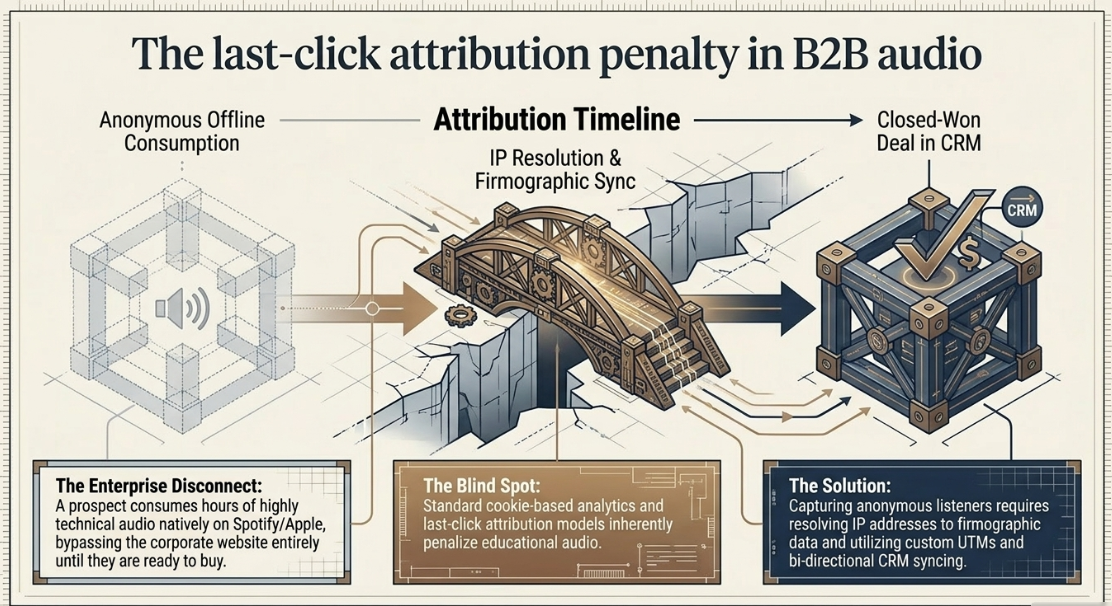
Proving that a podcast influenced a complex B2B buying cycle—which Gartner notes typically involves six to ten distinct stakeholders—requires deep technological integration between the hosting platform, the corporate website, and the primary CRM.51 Relying purely on traditional "last-click" attribution inherently penalizes educational audio content, which frequently serves as an early, trust-building touchpoint long before a formal demo is requested.51
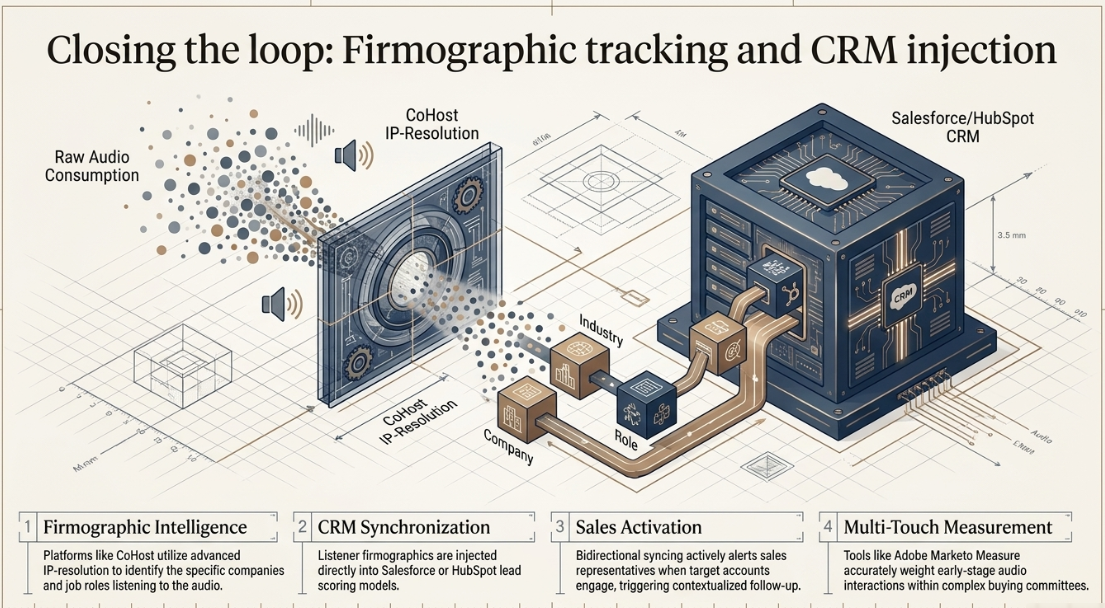
To bridge this data gap, modern enterprise marketers deploy platforms like CoHost, which specialize exclusively in B2B listener analytics and firmographic identification.
Firmographic Tracking Tiers: CoHost utilizes advanced IP-resolution and tracking pixels to identify the specific companies, industries, and job roles listening to the podcast. At its Pro tier ($89/month), it provides foundational Level 1 company-level intelligence.52 At the Premium tier ($170/month), it upgrades to Level 2 intelligence and integrates directly with Salesforce.52 The Enterprise tier (starting at $499/month) provides Level 3 intelligence, custom API builds, and dedicated growth experts.52
CRM Synchronization: By synchronizing listener firmographics with CRMs like Salesforce or HubSpot, marketing teams can inject podcast engagement data directly into lead scoring models. This bi-directional sync enriches account profiles, actively alerting sales representatives when target accounts are engaging with specific podcast topics, allowing for highly contextualized follow-up.53
Attribution Routing and Tools: Effective multi-touch attribution captures anonymous podcast listeners by utilizing custom UTM tracking URLs, vanity domains mentioned on-air, dynamic promo codes, and embedded website pixels.1 When a listener visits the corporate site using these vectors, cookies connect their session to known CRM contacts.51 Tools like Adobe Marketo Measure (Bizible) are highly favored for this within the Salesforce/HubSpot ecosystem, as they provide robust, bidirectional multi-touch attribution that accurately weights early-stage interactions.54 Conversely, tools like Cometly, while effective for basic HubSpot deal-event syncing to ad platforms, are often rejected by complex B2B enterprises due to their DTC-first architecture, inability to model multi-stakeholder buying committees, and lack of causal incrementality testing.54
Strategic Synthesis and Conclusion
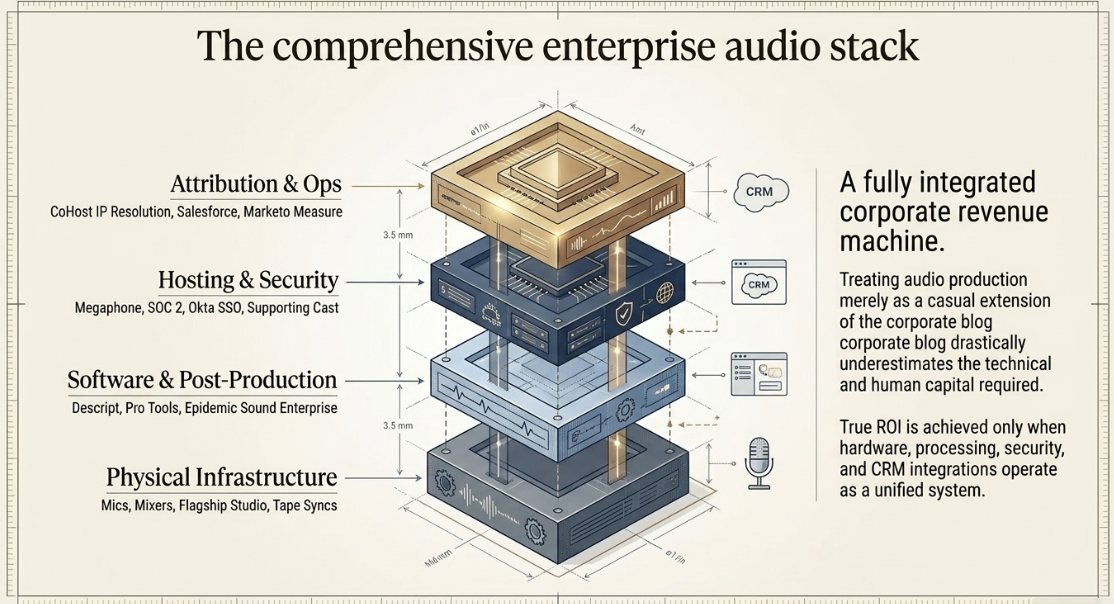
The operationalization of an enterprise podcast is fundamentally an exercise in rigorous business systems architecture. Treating audio production merely as a casual extension of the corporate blog drastically underestimates the financial, technical, and human capital required to produce authoritative, revenue-generating media.
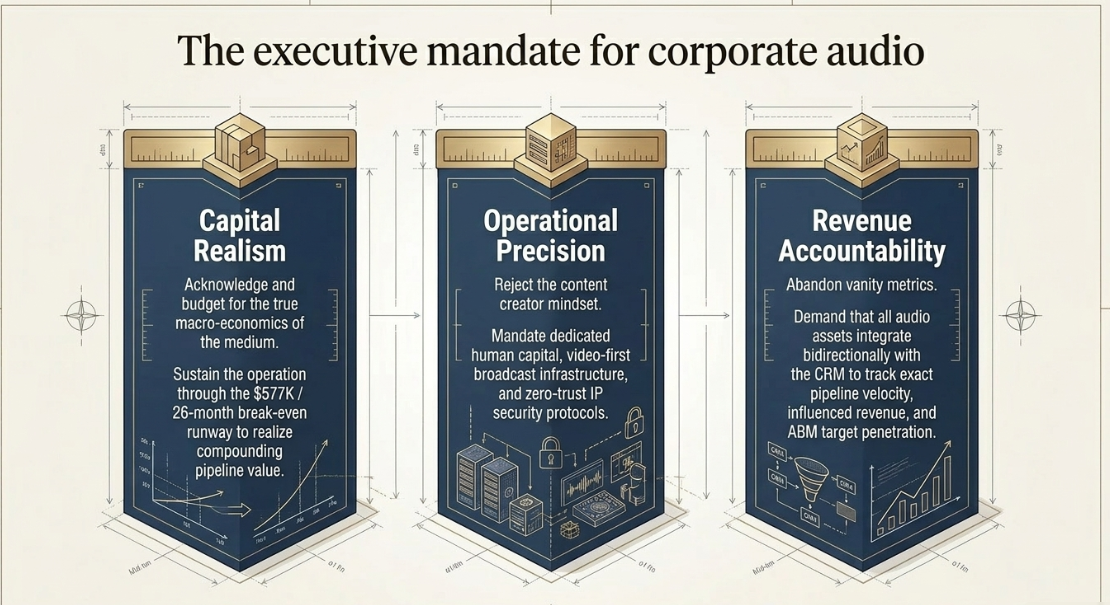
A successful enterprise audio strategy necessitates a clear-eyed evaluation of CAPEX versus OPEX realities, demanding an acknowledgment that initial cash buffers exceeding half a million dollars may be required to weather the latency of audience monetization and sustain high fixed labor costs.2 Whether an organization elects to build a $20,000 in-house multi-camera studio or outsource the entire operation to an $8,000-per-month specialized agency, the decision must be driven by a commitment to treat the podcast as a distinct, accountable business unit.9
Furthermore, the technology stack must be hardened to corporate standards. Employing AI-augmented, text-based DAWs for operational speed, securing custom enterprise music licenses to indemnify the brand against ruinous copyright infringement, and utilizing SOC 2 compliant, SSO-gated hosting platforms for internal communications are no longer optional upgrades; they are non-negotiable standards for modern corporate governance.26
Ultimately, the survival of the enterprise audio program rests entirely upon its attribution framework. By transitioning away from aggregate download counts and implementing CRM-integrated, ABM-aligned tracking via platforms like CoHost and Salesforce, marketing leadership can trace the exact pipeline velocity and revenue generation driven by their audio assets.1 Only by architecting the production team, technology stack, and analytics infrastructure with this level of precision can a B2B podcast transcend the status of an experimental cost center and become a verifiable, highly profitable enterprise revenue engine.
Works cited
Podcast Production Services for Enterprise & B2B | Pro Podcast ..., accessed June 11, 2026, https://propodcastsolutions.com/strategy-optimization/
Podcast Production Startup Costs: $42K CAPEX, $577K Runway; - Financial Models Lab, accessed June 11, 2026, https://financialmodelslab.com/blogs/startup-costs/podcast-production
Enterprise Podcast Production: How to Give Your Company a Voice - Podigee, accessed June 11, 2026, https://www.podigee.com/en/blog/enterprise-podcast/
Outsourcing Podcast Production Costs: Real Pricing, ROI, and What You'll Pay, accessed June 11, 2026, https://www.humanise.live/outsourcing-podcast-production-costs/
B2B Podcast Production Cost: 2026 Pricing Guide - ThePod.fm, accessed June 11, 2026, https://thepod.fm/resources/blog/podcast-production-cost-for-businesses
Podcast Producer Rates 2026: Per Episode Pricing - Fueler, accessed June 11, 2026, https://fueler.io/blog/podcast-producer-rates-per-episode-pricing
How Much Does Podcast Production Cost? | Lower Street, accessed June 11, 2026, https://lowerstreet.co/blog/podcast-production-costs
accessed June 11, 2026, https://rise25.com/lead-generation/podcast-production-pricing/#:~:text=Retainer%20ranges%20typically%20span%20%243%2C000,Guest%20research%20and%20booking%20coordination
Podcast Production Freelancing — Equipment, Rates & Client Guide ..., accessed June 11, 2026, https://www.jobbers.io/podcast-production-freelancing-equipment-rates-client-guide-2026/
10 Jobs in the Podcast Industry (Including Duties and Salaries) | Indeed.com, accessed June 11, 2026, https://www.indeed.com/career-advice/finding-a-job/jobs-in-podcast-industry
2025 Rate Guide | Association of Independents in Radio (AIR) - AIR Media, accessed June 11, 2026, https://airmedia.org/tools/2025-rate-guide
How much does it cost to hire a producer for a podcast? | Caspian Studios, accessed June 11, 2026, https://www.caspianstudios.com/caspian-blog/how-much-does-it-cost-to-hire-a-producer-for-a-podcast
Podcast Producer Salary, Hourly Rate (May 01, 2026) in the United States, accessed June 11, 2026, https://www.salary.com/research/salary/hiring/podcast-producer-salary
Salary: Podcast Producer (Jun, 2026) United States - ZipRecruiter, accessed June 11, 2026, https://www.ziprecruiter.com/Salaries/Podcast-Producer-Salary
All Our Rate Guides | Association of Independents in Radio (AIR) - AIR Media, accessed June 11, 2026, https://airmedia.org/tools/all-our-rate-guides
The Video Podcast Equipment Guide For Every Budget - StreamYard, accessed June 11, 2026, https://streamyard.com/blog/video-podcast-equipment
How To Set Up A Budget Podcast Studio In 2025 - KraftGeek, accessed June 11, 2026, https://kraftgeek.com/blogs/creator-inspiration/how-to-set-up-a-budget-podcast-studio-in-2025
2026 Podcast Gear Guide - Author Media, accessed June 11, 2026, https://www.authormedia.com/resources/podcast-gear-guide/
How Much Does It Cost to Build a Podcast Studio?, accessed June 11, 2026, https://www.buildsomethingmedia.com/post/how-much-does-it-cost-to-build-a-podcast-studio
How Much Does It Cost to Start a Podcast? - Reddit, accessed June 11, 2026, https://www.reddit.com/r/podcasting/comments/plp7e7/how_much_does_it_cost_to_start_a_podcast/
How Much Does It Really Cost to Start a Podcast? - YouTube, accessed June 11, 2026, https://www.youtube.com/watch?v=918jKNutRI0
10 Top Podcast Equipment Bundle with Camera Kits (Setup & Cost 2026) - Talks.co, accessed June 11, 2026, https://talks.co/p/podcast-equipment-bundle-with-camera/
Best Podcast Equipment for Beginners & Pros in 2026 - All Budgets - Riverside, accessed June 11, 2026, https://riverside.com/blog/podcast-equipment
21 Best Podcast Production Software: Features, Cost & Use (2026 Guide), accessed June 11, 2026, https://talks.co/p/podcast-production-software/
16 Best Podcast Recording Software in 2026 - StudioBinder, accessed June 11, 2026, https://www.studiobinder.com/blog/best-podcast-recording-software/
12 Best Editing Software for Podcasts in 2025 (Reviewed) - Adtwin - AI Audio Advertising Platform, accessed June 11, 2026, https://adtwin.ai/articles/best-editing-software-for-podcasts
11 Best Podcast Editing Software for Beginners & Pros (2026) - Riverside, accessed June 11, 2026, https://riverside.com/blog/podcast-editing-software
The 12 Best Podcast Editing Software Options for 2026, accessed June 11, 2026, https://transcript.lol/blog/best-podcast-editing-software
Pricing & Licensing - Epidemic Sound, accessed June 11, 2026, https://www.epidemicsound.com/pricing/
Artlist vs Epidemic Sound - Which is Better in 2024? | Wyzowl, accessed June 11, 2026, https://wyzowl.com/artlist-vs-epidemic-sound/
5 of the Best Music Licensing Sites for Cinematic Sounds - Raindance Film Festival, accessed June 11, 2026, https://raindance.org/5-of-the-best-music-licensing-sites-for-cinematic-sounds/
Musicbed vs. Epidemic Sound: Which should you choose?, accessed June 11, 2026, https://www.epidemicsound.com/blog/musicbed-vs-epidemic-sound/
The 14 Best Podcast Distribution Platforms For B2B Growth In 2026 - Fame.so, accessed June 11, 2026, https://www.fame.so/post/best-podcast-distribution-platforms
Podcast Hosting Market Share: An Analysis of the Top 10000 Shows - Reddit, accessed June 11, 2026, https://www.reddit.com/r/podcasting/comments/1onnmez/podcast_hosting_market_share_an_analysis_of_the/
31 Best Podcast Hosting Platforms In 2026 (Top 7 Have Free Offers), accessed June 11, 2026, https://www.podcastinsights.com/best-podcast-hosting/
What does megaphone charge for hosting? : r/podcasting - Reddit, accessed June 11, 2026, https://www.reddit.com/r/podcasting/comments/itygv8/what_does_megaphone_charge_for_hosting/
Entreprise Podcasting - Omny Studio - Triton Digital, accessed June 11, 2026, https://tritondigital.com/solutions/enterprise-podcasting
Omny Studio Software Reviews, Demo & Pricing - 2026, accessed June 11, 2026, https://www.softwareadvice.com/cms/omny-studio-profile/
Omny Studio - Triton Digital, accessed June 11, 2026, https://help.tritondigital.com/docs/omny-studio
Podcast Hosting Platforms Compared: Pricing, Features & Reviews 2026 - RSS.com, accessed June 11, 2026, https://rss.com/blog/best-podcast-hosting-platforms/
Top 15 Enterprise Podcast Solutions in 2026 - Content Allies, accessed June 11, 2026, https://contentallies.com/learn/top-enterprise-podcast-solutions
Simplecast: Podcast Hosting, Distribution & Analytics, accessed June 11, 2026, https://www.simplecast.com/
Enterprise Podcast Hosting Without Growth Penalties with Castos, accessed June 11, 2026, https://castos.com/enterprise-podcast-platform/
Enterprise podcast Solutions | Supporting Cast, accessed June 11, 2026, https://www.supportingcast.fm/enterprise-podcasting
Podcast hosting for internal use at companies/in enterprise? - Reddit, accessed June 11, 2026, https://www.reddit.com/r/podcasting/comments/vbfu3j/podcast_hosting_for_internal_use_at_companiesin/
Best Podcast Hosting Platforms for Okta - SourceForge, accessed June 11, 2026, https://sourceforge.net/software/podcast-hosting/integrates-with-okta/
Single Sign On (SSO) Setup - Castos Knowledge Hub, accessed June 11, 2026, https://support.castos.com/article/106-single-sign-on-sso-setup
HYPR Achieves SOC 2 Type 1 Security Certification, accessed June 11, 2026, https://www.hypr.com/blog/hypr-achieves-soc-2-type-1-security-certification
The ROI of B2B Podcasting: Metrics That Matter for Business Growth - Content Allies, accessed June 11, 2026, https://contentallies.com/learn/roi-b2b-podcasting-metrics
The Ultimate Guide To Measuring B2B Podcast ROI: From ... - Fame.so, accessed June 11, 2026, https://www.fame.so/post/ultimate-guide-to-measuring-b2b-podcast-roi
Multi-Touch Attribution in HubSpot: Simple Guide - RevBlack, accessed June 11, 2026, https://www.revblack.com/guides/multi-touch-attribution-made-simple-in-hubspot
CoHost · Podcast growth platform powered by B2B Analytics, accessed June 11, 2026, https://cohostpodcasting.com/
Podcast Growth Pricing & Plans for Brands · CoHost, accessed June 11, 2026, https://cohostpodcasting.com/pricing/
9 Best Marketing Attribution Tools for HubSpot CRM in 2026 - SegmentStream, accessed June 11, 2026, https://segmentstream.com/blog/articles/top-attribution-tools-for-hubspot
The Power of Closed-Loop Reporting in HubSpot-Salesforce Integration | SmartBug Media®, accessed June 11, 2026, https://www.smartbugmedia.com/blog/closed-loop-reporting-in-a-hubspot-and-salesforce-integration
CoHost Software Pricing, Alternatives & More 2026 | Capterra, accessed June 11, 2026, https://www.capterra.com/p/10038482/CoHost/