Industry Overview: Global Valuation and Macroeconomic Resilience
The global podcasting ecosystem has undergone a profound metamorphosis over the past decade, completing its transition from an experimental, early-adopter content channel into a mature, sophisticated, and heavily monetized digital asset class. As of 2026, the global industry value has achieved a staggering $28.6 billion valuation, reflecting a compound annual growth rate that routinely outpaces broader digital media sectors.1 This valuation represents not merely an increase in total listener volume, but a structural evolution in how audio content is distributed, consumed, and monetized on a global scale. The architecture of this space now supports over 4.4 million active podcasts globally and engages 672 million monthly listeners, marking an unprecedented 145% growth trajectory since 2019.3 This underscores the medium's resilience through varying macroeconomic cycles and its structural integration into the daily habits of the global digital populace. Total available episodes have simultaneously surged to 214 million, accommodating an increasingly diverse array of niche listener interests.3
The macroeconomic environment of 2026 demonstrates that brands are increasingly drawn to podcasts due to their unique capacity to deliver targeted, context-rich advertisements to highly specific, fiercely loyal audiences.1 Unlike traditional broadcast media, which suffers from high audience fragmentation, generalized demographic targeting, and systemic ad-skipping, podcast listeners exhibit a profound parasocial relationship with hosts. This psychological bond makes audiences exceptionally receptive to host-read or native advertisements. Consequently, advertisers are actively shifting budget allocations away from traditional linear radio and display networks toward podcasting. This capital influx creates a highly lucrative revenue stream for creators and networks, incentivizing further content diversification and elevating podcasting as a primary pillar within the broader digital advertising ecosystem.
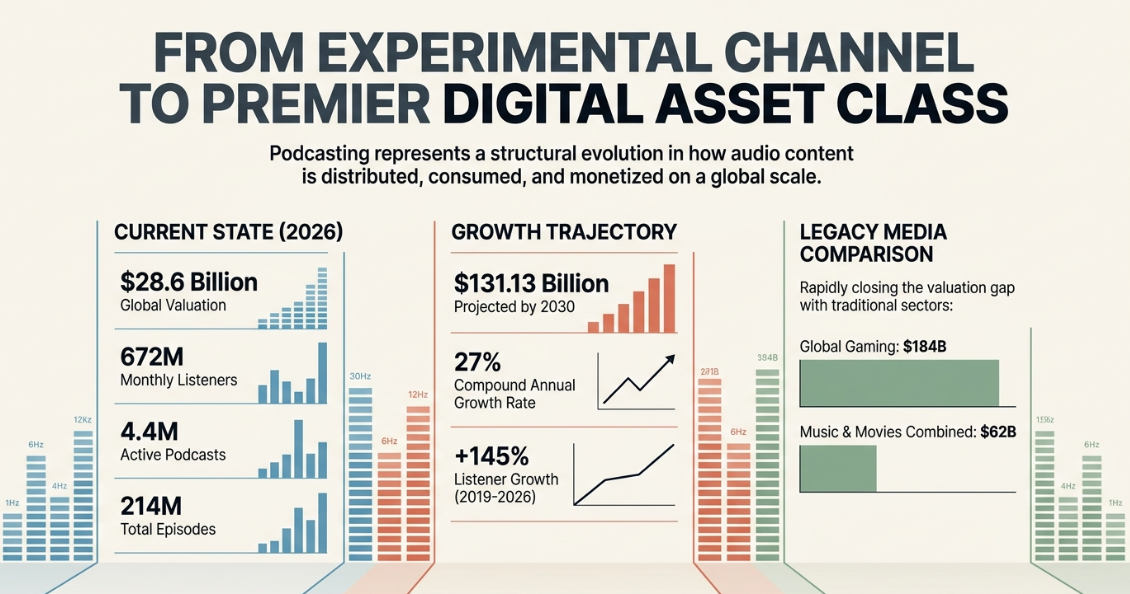
Furthermore, the industry's valuation is projected to expand significantly beyond the current decade. Advanced market forecasts indicate that the global podcasting market could reach a valuation of $131.13 billion by 2030, representing an annualized growth rate of 27% from the latter half of the 2020s.6 This forecasted hyper-growth is propelled by a convergence of technological advancements, including spatial audio rendering, ubiquitous smart personal audio devices, and the integration of artificial intelligence into content discovery algorithms.6 When contextualized against adjacent entertainment sectors, the macroeconomic weight of podcasting becomes evident; for comparison, the global gaming industry was valued at $184 billion, while traditional music and movies combined reached just over $62 billion.7 Podcasting is rapidly closing the valuation gap with legacy entertainment mediums.
Regional Disparities and International Growth Vectors
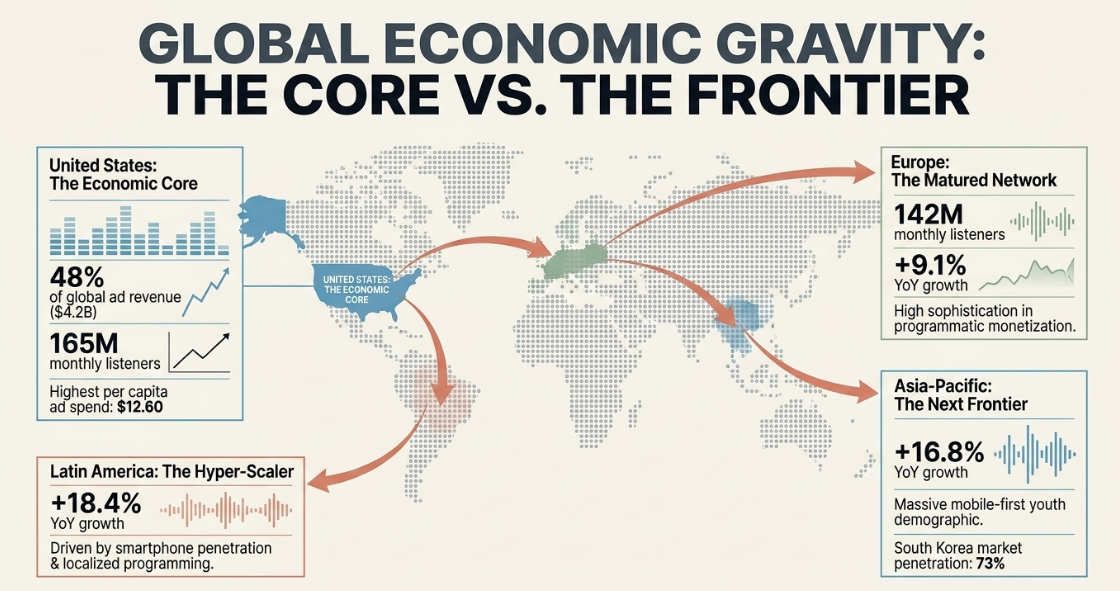
The economic center of gravity for podcasting remains the United States, which commands a disproportionate share of global advertising revenue. In 2026, the United States market generated $4.2 billion in podcast advertising revenue.5 This domestic dominance is driven by advanced programmatic advertising infrastructures, high advertiser literacy regarding audio-first formats, and a deeply entrenched culture of on-demand media consumption. The United States accounts for approximately 48% of global podcast advertising revenue, despite representing roughly 25% of the total global listener base.3 The American consumer base currently consists of approximately 165 million monthly listeners, constituting 55% of the total population aged 12 and older.9 Weekly listenership within the United States has reached 127 million individuals, while daily consumption captures 68 million active listeners.9 This disparity highlights the premium valuation of the American consumer, where the per capita advertising spend reaches $12.60, vastly outperforming regions such as the United Kingdom ($8.10) and Germany ($5.00).3
However, the future trajectory of the medium is increasingly defined by rapid international expansion. The most aggressive growth vectors are currently located in emerging markets, fundamentally altering the macroeconomic risk profile of the industry. By expanding the addressable market beyond North America, major streaming platforms and independent networks are effectively hedging against localized economic downturns.
Table 1 delineates the regional distribution of the global podcast audience and corresponding growth metrics for the fiscal year 2026.
Data compiled from aggregated regional reporting for the 2026 fiscal year.6
In Latin America, the surge in listenership is propelled by expanding smartphone penetration, decreasing mobile data costs, and robust investments by major platforms in local-language original programming.3 The region exhibits a 34% year-over-year growth trajectory in highly localized contexts, led primarily by Brazil and Mexico, representing the fastest-scaling audience globally.3 Similarly, the European market has matured rapidly, generating sophisticated regional networks that capitalize on highly specific cultural and linguistic demographics. Europe currently supports 142 million monthly listeners, expanding at a rate of 24% year-over-year in high-adoption sectors, capturing a growing share of local advertising budgets.4 Media conglomerates operating in Europe, such as Acast, have reported substantial net sales increases, underscoring the success of programmatic monetization in previously fragmented European markets.10
The Asia-Pacific region, while currently exhibiting lower overall penetration rates of around 15%, is positioned as the next frontier for hyper-scale expansion.11 Markets like South Korea are profound anomalies, leading the world with a staggering 73% monthly podcast penetration rate, fueled by advanced mobile infrastructure and a high propensity for subscription-based audio services.3 Emerging markets within this geography, specifically India, Indonesia, and the Philippines, are projected to drive the next wave of global audience acquisition due to their massive, mobile-first youth demographics.
Audience Profile and Demographics: The Psychographics of the Modern Listener
Listening Habits and Temporal Integration
The behavioral economics of podcast consumption reveal a highly engaged user base that systematically integrates audio content into non-discretionary time blocks. The historical evolution of this behavior is meticulously documented by the Share of Ear tracking survey. In 2014, traditional AM/FM radio listening accounted for 50% of all daily audio consumption in the United States.12 By 2023, podcasts had grown to represent 10% of total daily audio time, surpassing linear audio for on-demand preference, a trend that has accelerated violently through 2026.12
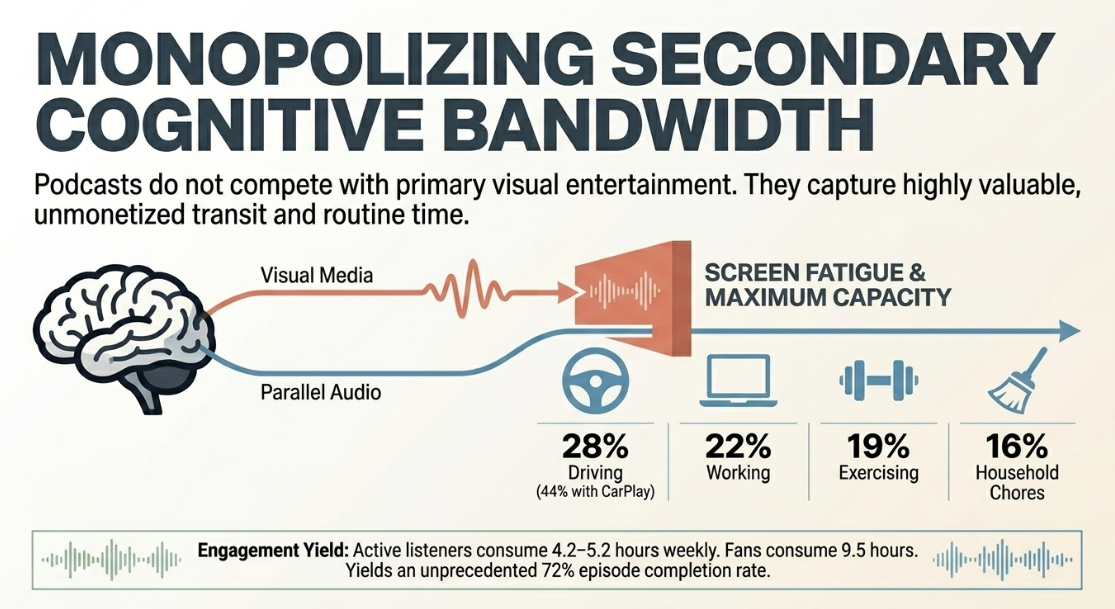
Active listeners in 2026 consume an average of 4.2 to 5.2 hours of podcast content per week globally, though in the United States, high-frequency consumers average 8.2 episodes and over 8 hours and 24 minutes of weekly listening time.9 Furthermore, self-identified podcast "fans"—who rank their affinity at a 5 or above on a 10-point scale—spend an extraordinary 9 hours and 24 minutes listening weekly, treating the medium as a primary structural element of their daily routine.12
This extensive consumption is structurally linked to the medium's unique capacity for parallel processing; podcasts are seamlessly integrated into daily commutes, exercise routines, and household chores [Prompt]. Empirical data indicates that 28% of consumption occurs while driving, 22% while working or studying, 19% during exercise, 16% during household chores, and 15% while relaxing at home.9 The integration of podcasting into the automotive ecosystem has been a particularly critical growth driver. Approximately 31% of the adult population who utilize a vehicle listen to podcasts in-car, a figure that surges to 44% among users of advanced infotainment interfaces such as Apple CarPlay and Android Auto.12 By transforming previously unproductive transit time into highly curated educational or entertainment experiences, podcasts have captured a segment of the "attention economy" that is entirely inaccessible to screen-dependent media. This sustained, passive-yet-attentive consumption model ensures that podcasts do not compete directly with primary visual entertainment, but rather monopolize the secondary cognitive bandwidth of the consumer.
The Professional and Economic Profile: A Premium Consumer Class
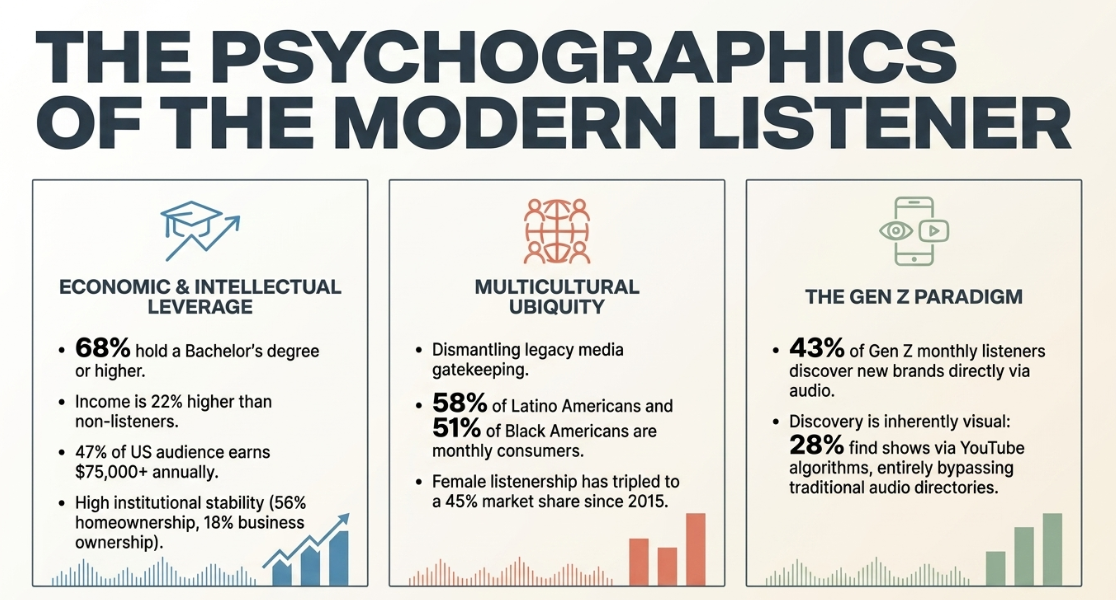
The demographic profile of the modern podcast consumer represents one of the most commercially attractive cohorts available to global advertisers. The audience is exceptionally well-educated, with 68% holding a bachelor's degree or higher.4 Furthermore, the average income of a podcast listener is 22% higher than that of a non-listener, indicating a high concentration of disposable, discretionary income.4 Data specific to the United States corroborates this premium profile, revealing that 47% of monthly consumers earn over $75,000 annually, surpassing the 43% baseline of the general population.12 This premium consumer profile correlates directly with higher incidences of institutional stability, boasting homeownership rates of 56% and business ownership rates of 18% among weekly consumers.12
Multicultural Adoption and Demographic Diversification
Historically perceived as an experimental medium dominated by early-adopter, tech-centric demographics, podcasting has achieved true mainstream ubiquity and robust multicultural adoption by 2026. The medium reflects rapid demographic diversification, fundamentally dismantling traditional barriers to entry in both content creation and consumption. Currently, 51% of Black Americans and 58% of Latino Americans are classified as monthly podcast consumers.12 This represents a profound acceleration from 2020 metrics, where Black American adoption stood at 33% and Latino adoption at just 24%.12
This multicultural expansion is mirrored by gender parity achievements. Female monthly listening has tripled over the past decade, growing from a mere 16% market share in 2015 to a robust 45% in 2026.12 This growth is supported by an influx of female-led production ecosystems, with 48% of the top 25 podcast shows reaching female audiences now being hosted or co-hosted by women.12
The proliferation of diverse voices is driven by the fundamentally decentralized nature of podcast distribution. Unlike traditional terrestrial radio or broadcast television, which are governed by high capital expenditures and strict corporate gatekeeping, podcasting allows marginalized or underrepresented communities to bypass traditional media hierarchies. For major advertising firms, this multicultural expansion provides an unprecedented mechanism for delivering highly targeted, culturally resonant brand messaging at scale, without relying on the broad, inefficient strokes of legacy demographic targeting. Furthermore, niche markets such as Spanish-language podcasts in the United States have become the fastest-growing sub-genres, experiencing a 28% listener growth year-over-year.9
Generational Behaviors and the Gen Z Paradigm
The consumption patterns of Generation Z (ages 13-24) present a distinct divergence from legacy audio consumption models. For this cohort, discovery mechanisms are intrinsically linked to social and visual algorithms rather than organic directory browsing. Gen Z listeners discover podcasts predominantly through YouTube searches (28%), social media cross-pollination (26%), and peer recommendations (19%).12 Furthermore, this generation exhibits a high degree of commercial receptivity within the audio format; 43% of Gen Z monthly listeners report discovering new brands or products via podcast audio, and 41% actively pay attention to the specific brands that sponsor their preferred hosts.12 This challenges the prevailing assumption that younger demographics are inherently resistant to advertising, proving instead that they are highly responsive to contextually relevant, host-endorsed marketing.
The Business-to-Business (B2B) Revolution
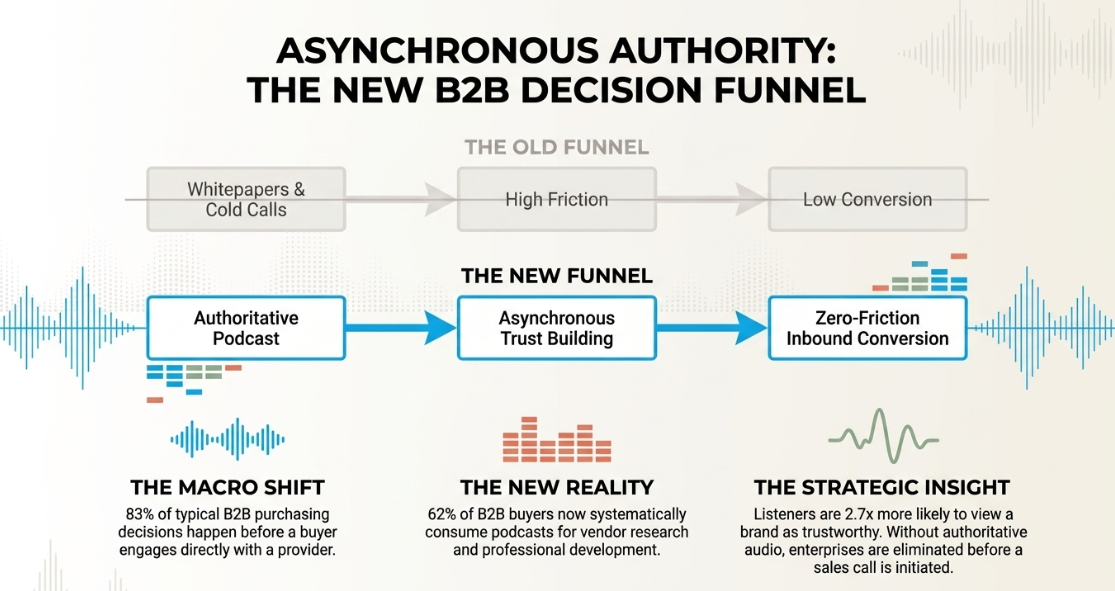
In the commercial sphere, the medium has fundamentally revolutionized business-to-business (B2B) marketing, enterprise communications, and procurement strategies. B2B marketing has historically relied on whitepapers, outbound sales communications, and traditional email campaigns. However, modern corporate buyers are demanding asynchronous, expertise-driven content. Analysis reveals that 62% of B2B buyers now systematically consume podcasts for professional development and vendor research prior to any direct engagement.4
This behavioral shift profoundly alters the traditional B2B sales funnel. Modern corporate decision-makers develop selection criteria and construct vendor shortlists based almost entirely on digital content. Research indicates that 83% of typical B2B purchasing decisions happen before a buyer engages directly with a provider, and buyers engage with three to seven pieces of content during their independent research phase.18 In this landscape, a B2B podcast is not merely a marketing tactic; it functions as a primary revenue driver and a structured touchpoint that earns attention from decision-makers.15
Podcasts serve as an asynchronous, long-form medium where industry leaders can articulate complex value propositions, demonstrate thought leadership, and establish intellectual authority. For a B2B buyer listening during a morning commute, a well-produced business podcast functions as a zero-friction educational tool, drastically reducing the cognitive resistance typically associated with B2B marketing collateral. This dynamic creates a distinct competitive advantage. Listeners are 2.7 times more likely to view a brand as "trustworthy" if the brand consistently publishes educational audio content.16 Consequently, corporate marketing departments are reallocating budgets from traditional lead generation to corporate podcasting, recognizing that if their digital presence does not convey immediate expertise and clarity, they will be eliminated from consideration long before a sales call is ever initiated.
Podcast Industry Dynamics: Creator Stabilization and Capital Concentration
Production Pipelines and the Eradication of Podfading
The industry dynamics of 2026 are characterized by intense professionalization and the structural stabilization of the creator class. Brands no longer view podcast advertising as an ancillary, experimental budget item; rather, it is recognized as a core, strategic channel essential for comprehensive media planning.5 This paradigm shift is vividly reflected in the stabilization of production pipelines and the dramatic reduction in content abandonment, colloquially known as "podfading."
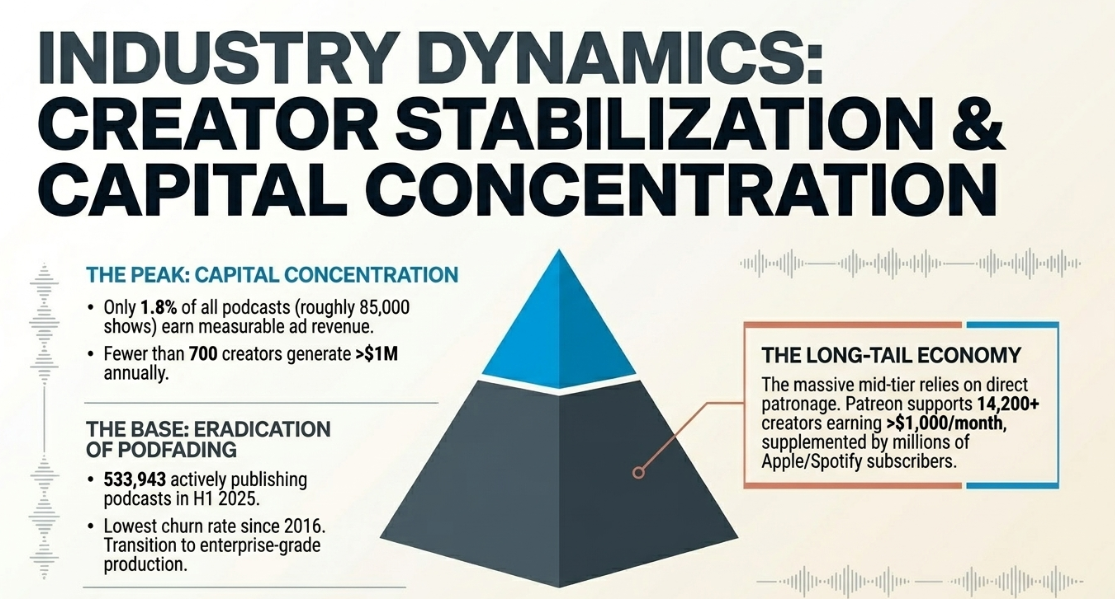
Historically, the podcast ecosystem was plagued by content saturation and high creator churn. However, mid-year data for 2025 recorded an unprecedented 533,943 active podcasts publishing new material, representing a massive leap from previous years.4 Concurrently, only 13,372 shows were classified as inactive or churning—the absolute lowest churn rate the industry has witnessed since 2016.4 During the first half of 2025 alone, creators released 13.2 million new episodes globally.21 This massive retention rate signals a transition from amateur experimentation to sustainable, enterprise-grade content production, supported by robust monetization tools and audience loyalty.
However, a macroeconomic analysis reveals a stark reality regarding capital distribution within the creator economy. While there are an estimated 4.1 to 4.8 million total podcasts listed across major directories like Apple Podcasts and Spotify, only approximately 1.9 million have published an episode within the last 90 days, and a mere 450,000 to 520,000 represent truly active, consistently publishing entities.9 More critically, the creator economy exhibits profound wealth concentration. Only 1.8% of all podcasts (roughly 85,000 shows) earn any measurable advertising revenue.9 Within this elite tier, approximately 12,400 creators generate over $100,000 annually, while fewer than 700 achieve revenues exceeding $1 million per year.9 This concentration highlights a monetization complexity where ad revenue is fiercely guarded by top-tier networks, leaving the "long tail" of independent creators to rely heavily on direct listener subscriptions. Platforms like Patreon host over 14,200 podcast creators earning over $1,000 per month, with an average subscription average revenue per user (ARPU) of $5.80 per month.9 Spotify Premium and Apple Podcasts also boast 8.4 million and 6.1 million paid audio subscribers, respectively, indicating a robust secondary economy based on direct patron support.
Monetization Economics: Host-Read Authenticity Versus Programmatic Scale
The economic mechanisms underpinning the industry involve sophisticated, bifurcated monetization frameworks. Total podcast ad revenue within the United States is projected to exceed $3 billion in 2026, driven by a 12.4% year-over-year growth rate that substantially outpaces broader digital advertising growth metrics.9 The ecosystem operates on two primary advertising models: host-read native advertisements and programmatic dynamic ad insertion (DAI).
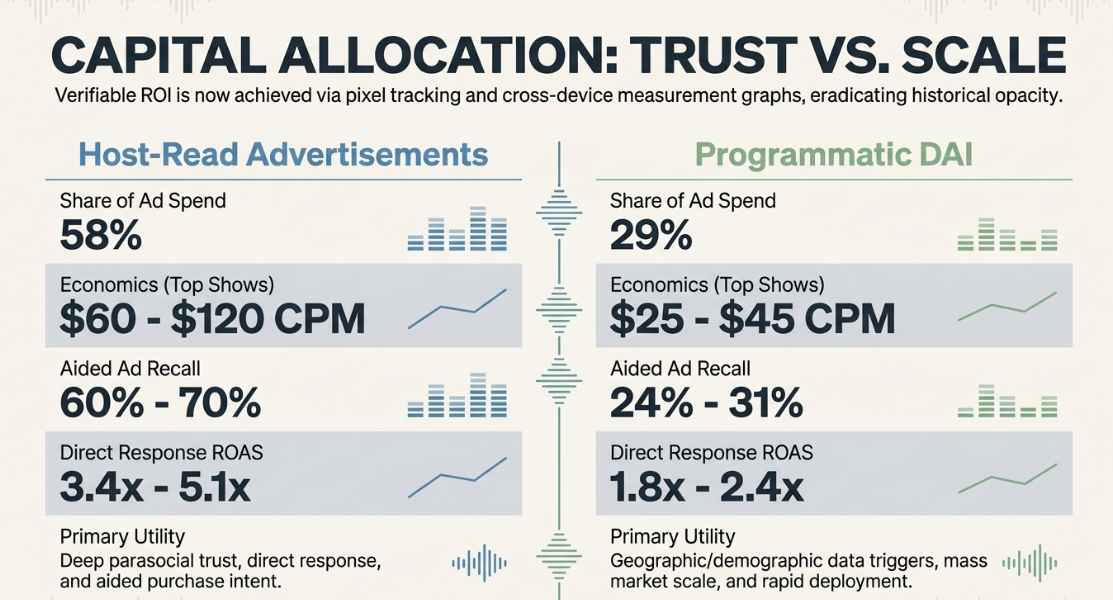
Host-read ads command the majority share at 58% of total ad spend.9 These formats are highly prized for their authenticity, seamless integration into the content narrative, and unparalleled ability to drive consumer action. Listeners demonstrate a profound trust premium for this format; recent studies indicate audiences are 63% more likely to trust host-read ads over standard digital audio formats, and 71% more likely to trust them compared to social media video advertisements.22 Alternatively, programmatic DAI currently accounts for 29% of ad spend (rising from 22% in 2024), offering media buyers the capacity to execute highly targeted campaigns across thousands of mid-tier shows utilizing geographic, demographic, and behavioral data triggers.9
Table 2 details the comparative performance, economic pricing, and engagement metrics between these two dominant advertising models.Financial and performance data reflects US market benchmarks for 2026.9
The introduction of advanced attribution modeling has eradicated the historical opacity of podcast marketing. Utilizing pixel-based tracking, customized promotional codes, and cross-device measurement graphs, performance marketers can now calculate Return on Ad Spend (ROAS) with absolute precision.3 Direct response campaigns leveraging host-read formats yield highly efficient acquisition costs: $42 to $88 per B2B qualified lead, and $24 to $58 per direct-to-consumer (DTC) acquisition.9 This verifiable ROI architecture has catalyzed a massive influx of corporate capital.
Genre Stratification and Advertising Capital Allocation
The industry has witnessed a rationalization of genre-based capital allocation, where advertisers deploy funds based on the precise demographic alignments of specific content verticals. News and Politics currently command the highest share of advertising revenue at 21%, functioning as a high-frequency daily touchpoint for deeply engaged listeners.9 This vertical is followed closely by Comedy (15%), True Crime (14%), Business & Finance (13%), and Society & Culture (11%).9
The corporate sponsorship mapping against these genres is highly strategic. Financial services institutions direct the largest segment of overall ad spend (15.8%), utilizing the medium's perceived intellectual authority and the audience's high-net-worth profile to market complex wealth management services and retail banking solutions.9 Consumer Packaged Goods (CPG) brands represent the second-largest sector at 13.2%, leveraging programmatic DAI for mass-market penetration, followed closely by Arts and Media (11.4%), Technology (10.6%), and Retail (9.8%).9 The healthcare and pharmaceutical sector has notably increased its footprint, capturing 8.9% of total ad spend as regulatory frameworks adjust to audio compliance standards.9
Engagement and Attention: The Economics of Retention
Retention Metrics and Session Durations
In an era defined by fractured attention spans and algorithmic feed scrolling, podcasting represents a stark macroeconomic anomaly: a long-form digital medium that consistently commands sustained, deep attention. Podcasts yield a remarkable 72% episode completion rate across the industry for episodes containing host-read ads.23 When contextualized against the average listening session duration of 22 to 42 minutes, this completion rate represents a volume of continuous brand exposure that is statistically unprecedented in modern digital advertising.9
The psychological mechanism driving this retention is rooted in the auditory nature of the medium. Unlike visual media, which requires absolute physical and cognitive focus, audio content acts as an augmenting layer to physical reality. Because the listener is physically engaged in secondary tasks, the impulse to actively skip, scroll, or abandon the content is significantly muted. Ad position fundamentally impacts engagement; pre-roll advertisements achieve an 87% completion rate but only a 48% recall rate, whereas mid-roll advertisements—the highest performing format—secure an 81% completion rate and a dominant 63% recall rate.9
Completion rates naturally scale inversely with episode length. Episodes under 15 minutes achieve a 76% completion rate, while episodes between 30 and 60 minutes command a 58% rate.9 However, even extended long-form episodes exceeding 90 minutes boast a 46% completion rate, indicating a profound tolerance for extended intellectual discourse among dedicated audiences.
The Dominance of Branded Content and the Halo Effect
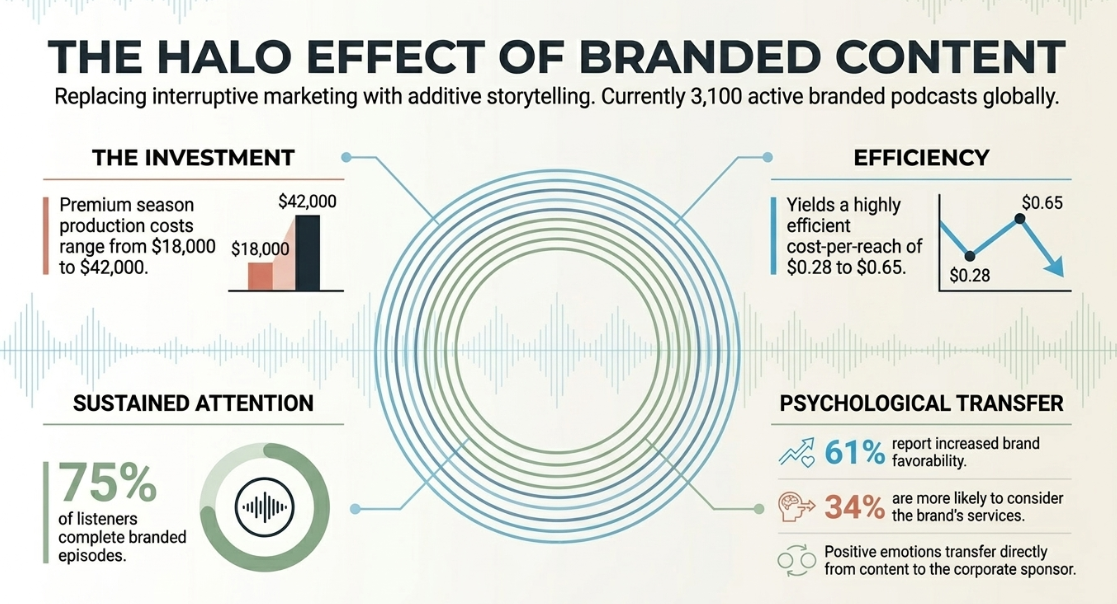
The unparalleled retention metrics of the broader medium translate directly into massive commercial advantages for corporate sponsors, particularly in the realm of bespoke branded content. Branded podcasts—shows entirely funded, conceptualized, and produced by a corporate entity—have emerged as a premier strategic vehicle. Currently, there are approximately 3,100 active branded podcasts in production globally, representing 5% of overall podcast ad spend and capturing 11% of the revenue mix for the top 500 performing shows.9
The engagement metrics for these corporate properties are extraordinary. Empirical data indicates that 75% of listeners report that branded episodes successfully hold their attention for the entire duration of the recording.24 This sustained engagement vastly outperforms standard display advertising, native articles, and social media video feeds, which are typically measured in seconds. A Shapley Analysis of key engagement drivers reveals that the primary factors determining listener recommendation are sustained attention and deep thematic relevancy.27
The resulting psychological phenomenon is quantified as the "Halo Effect," wherein the positive emotions, educational value, and entertainment derived from the podcast content are subconsciously transferred to the sponsoring brand. Research demonstrates that 61% of branded podcast listeners report feeling significantly more favorable toward the brand post-consumption, while listeners are 34% more likely to consider the brand's services and 22% more likely to execute a purchase.9
The economics of branded podcasts require significant capital commitment, with premium-tier episodes averaging production costs between $18,000 and $42,000, typically structured across 8 to 12 episode seasons.9 However, the cost-per-reach and long-term brand equity generated justify the expenditure. Listeners spend an average of 21 minutes engaged directly with a brand's narrative per 28-minute episode.9 When quantified, this depth of interaction equates to serving a consumer approximately 42 traditional 30-second broadcast advertisements consecutively, entirely devoid of the associated ad-fatigue or brand resentment. The median cost per branded listener reached is highly efficient, ranging from $0.28 to $0.65.9 The ability of professional brands to orchestrate this level of uninterrupted engagement is revolutionizing corporate communications, moving brands away from interruptive, top-down marketing toward additive, opt-in storytelling.
Format Evolution and Trends: The Shift Toward Multimodality
The Rise of Video Podcasts
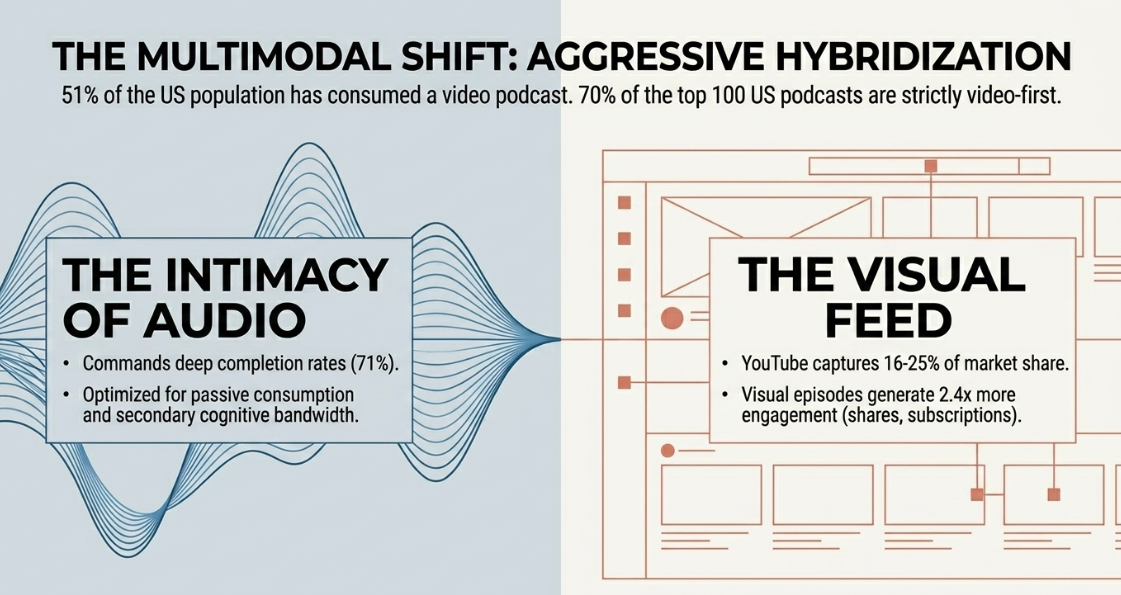
The most consequential structural shift within the 2026 podcast landscape is the aggressive hybridization of the format through the rise of video podcasts. What was once a strictly auditory medium, reliant entirely on RSS feeds and pure-play audio applications, has rapidly evolved into a multimodal content format. Data confirms that over half of the United States population (51%) has consumed a video podcast at least once, and currently, 52% of regular podcast listeners actively engage with visual formats.3 Within the trailing thirty days, 37% of the US population watched a video podcast, and 26% consumed one within the past week.12
This transition is driven by shifting consumer preferences and the inherent limitations of pure audio within the modern social media ecosystem. While audio excels at generating deep parasocial intimacy and facilitating multitasking, visual content is vastly superior for algorithmic discovery, social sharing, and non-verbal communication. For audiences, observing facial expressions, studio dynamics, and visual product demonstrations provides an added layer of authenticity that audio alone cannot deliver. This format duality has effectively bifurcated consumption preferences: audio-first consumption currently commands a 54% market share (characterized by high completion rates of 71% and high sensitivity to ad length), while video-first consumption commands 46% (characterized by a lower completion rate of 52%, but vastly superior top-of-funnel discovery).9 Impressively, over 70% of the top 100 podcasts in the United States now publish primary video-first episodes.9
Platform Impact and the Algorithmic Battlefield
The gravitational pull of video has radically altered the platform distribution architecture. YouTube has aggressively captured market share, rising to command between 16% and 25% of total platform listenership, competing directly with incumbent audio giants like Spotify (which maintains a ~30% share) and Apple Podcasts (25% share).9 More than one billion individuals now consume podcast-related content on YouTube globally every month, and YouTube Podcasts as a distinct vertical grew by 68% globally.3
The platform's dominance is underpinned by its sophisticated algorithmic recommendation engine. The historical flaw of the audio podcast ecosystem was the "discoverability problem"; traditional RSS feeds provided no organic mechanism for new listeners to locate niche shows. YouTube mitigates this friction by serving video podcast clips natively in user feeds based on behavioral modeling. Furthermore, empirical data proves that episodes including a visual component generate 2.4 times more engagement (likes, comments, shares, subscriptions) than audio-only releases.28
In response to YouTube's market encroachment, traditional audio platforms have rapidly re-engineered their software infrastructure. Spotify rolled out comprehensive video podcast capabilities across 108 international markets, allowing creators to seamlessly upload multimodal files. This capability increased average listening times on the platform by 24%.3 This platform parity ensures that creators are no longer forced to choose between mediums, but must instead engineer content that serves both master formats simultaneously.
Interactive Podcasting and Live Event Syndication
Beyond pre-recorded video, the medium is evolving toward real-time interactivity. Live podcast events and interactive broadcasting formats grew by an astonishing 156% globally heading into 2026.3 The integration of interactive elements—such as real-time polling, live Q&A sessions, and dynamic audience reactions—has been proven to increase listener engagement by a factor of 3.8x.3 Platforms like Spotify Live and X Spaces are increasingly integrating with traditional on-demand architectures, allowing enterprise brands to utilize live town halls or interactive product launches that are subsequently repackaged as evergreen podcast episodes.3
The Integration of Artificial Intelligence in Podcasting
Production Automation and Cost Arbitrage
The macroeconomic scalability of the podcast industry in 2026 is inextricably linked to the rapid deployment of artificial intelligence. The integration of advanced computational models has systematically dismantled the historical bottlenecks of audio production, distribution, and global syndication. The global market valuation of AI specifically tailored for podcasting is projected to reach $4.64 billion in 2026, advancing toward an estimated $26.6 billion by 2033, operating at a remarkable compound annual growth rate of 28.3%.6
The immediate economic impact of AI integration is a dramatic compression of operational overhead. AI-powered software suites have automated labor-intensive processes such as raw audio transcription, multi-track editing, automated show-note generation, and dynamic background noise reduction. This technological intervention reduces overall production time and capital expenditure by up to 30%, effectively lowering the barrier to entry.1 Approximately 34% to 40% of active podcasters now utilize AI tools within their daily production workflows, fundamentally altering the unit economics of content creation and allowing independent studios to rival the production fidelity of legacy broadcast networks.3 Furthermore, AI technologies are being utilized to increase podcast ad targeting accuracy by 50%, enabling programmatic engines to deploy dynamic ad insertion with unprecedented demographic precision.6
Table 3 models the projected growth trajectory of the AI podcasting sub-sector, highlighting the influx of enterprise capital into automation technologies.
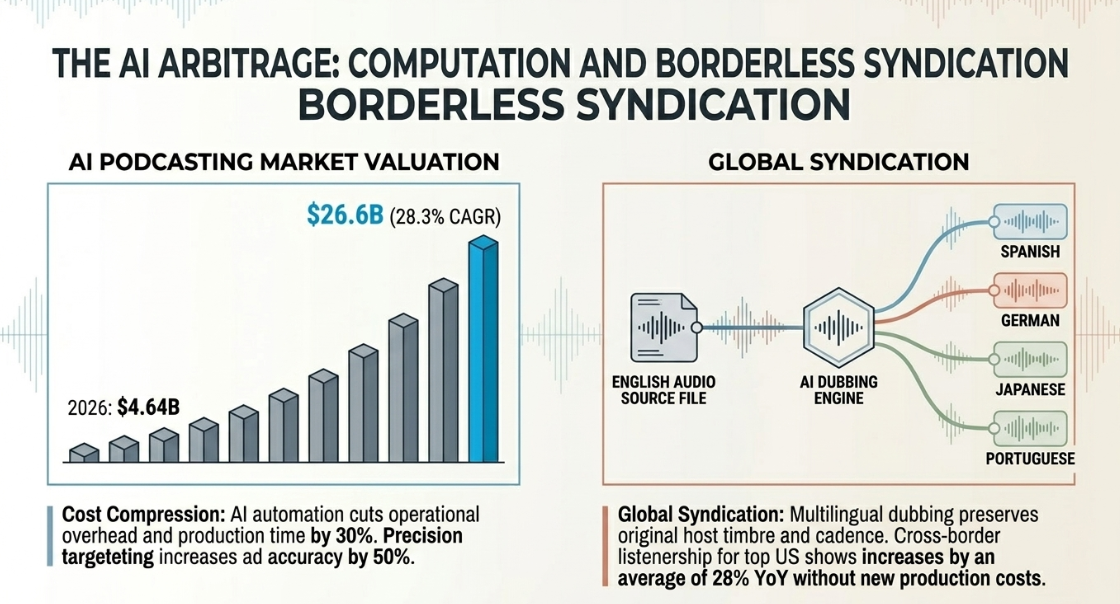
Projections indicate sustained hyper-growth driven by enterprise adoption of automated translation, programmatic ad generation, and voice cloning architectures.6
Multilingual Dubbing and Borderless Content Syndication
Beyond backend production, artificial intelligence is revolutionizing the global reach of the medium through real-time voice translation and multilingual dubbing. Major platforms, notably Spotify, have deployed sophisticated large language models capable of translating spoken audio into multiple languages in real-time, while perfectly preserving the original host's unique vocal timbre, cadence, and speech patterns.1
In 2026, approximately 25% of new commercial podcasts utilize some form of AI voice generation, scripting assistance, or multilingual dubbing.9 This technology effectively dissolves linguistic barriers, transforming what was once a geographically constrained asset into a universally exportable commodity. Shows recorded entirely in English can seamlessly penetrate the rapidly expanding Latin American or European markets without the prohibitive costs of hiring local voice actors or launching regional subsidiary shows. Statistical modeling demonstrates that multilingual AI dubbing has successfully increased cross-border listenership for top-tier United States shows by an average of 28% year-over-year.9 Consequently, AI not only optimizes the cost basis of production but exponentially increases the total addressable market and available ad inventory for global brands. Despite this rapid adoption, fully AI-hosted (synthetic voice) podcasts remain a niche experiment, accounting for under 3% of total listening time, reinforcing the fact that audiences still prioritize authentic human connection over purely synthetic content.
Sector-Specific Case Studies: Gaming and Niche Micro-Communities
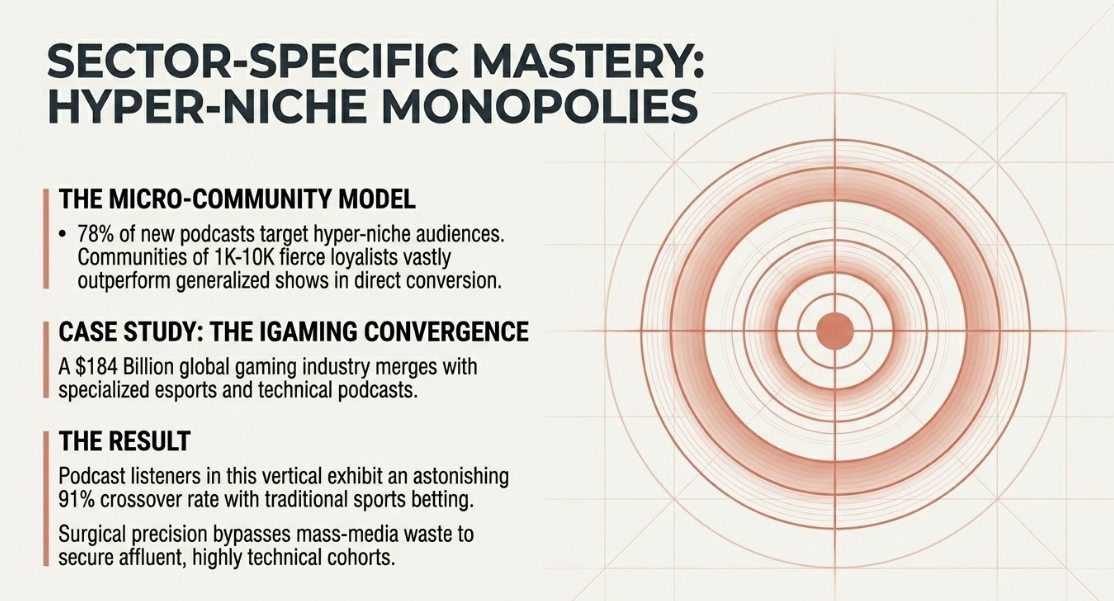
The maturation of the podcasting industry is heavily supported by the cultivation of hyper-niche micro-communities. The overarching market trend is shifting from broad, generalized content toward deep, highly specialized verticals. Research indicates that 78% of new podcasts launched in 2026 targeted a specific niche audience.3 These micro-communities—often consisting of 1,000 to 10,000 fiercely loyal listeners—generate disproportionately higher engagement, vastly superior conversion rates, and stronger community bonds than generalized pop-culture shows.3
A paramount example of this hyper-niche monetization is the convergence of podcasting with the global Esports and iGaming sectors. The global gaming industry is currently valued at $184 billion, heavily eclipsing traditional entertainment mediums.7 As Esports betting matured into a $2.8 billion gross gaming revenue generator by 2025, specialized sportsbooks recognized that their target demographic—highly technical, digitally native, and statistically driven users—were avid podcast consumers.7 Podcast sponsorships have consequently become a major marketing channel in the iGaming space, with casino brands and Esports platforms partnering with niche gaming podcasts to reach highly engaged, affluent listeners who exhibit a 91% crossover rate with traditional sports betting.6 These sector-specific applications demonstrate how podcasting functions as a surgical marketing instrument, bypassing mass-media waste to engage high-value cohorts directly.
Future Predictions and Strategic Implications for 2028 and Beyond
Forecasting the industry trajectory toward 2028 suggests that the hybridization of the medium and the integration of artificial intelligence will radically reconstruct the media landscape. Predictive models indicate that by 2028, a minimum of 60% of all active shows will feature a dedicated video component, driven concurrently by audience demand for visual authenticity and platform algorithmic incentives.3
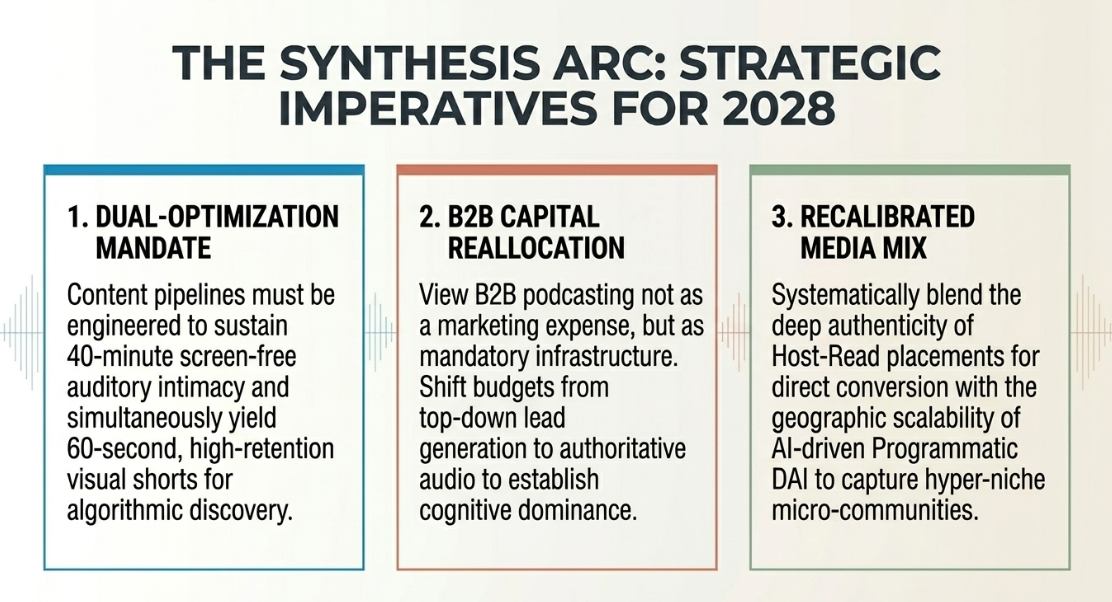
This evolution dictates a stringent strategic imperative for the creator economy and corporate sponsors alike. Professional brands, production studios, and enterprise marketers must fundamentally restructure their content pipelines to optimize for two distinct, yet overlapping objectives: auditory intimacy and algorithmic visual discovery [Prompt]. The content must remain intellectually compelling enough to sustain a 40-minute, screen-free session for a listener navigating rush-hour traffic, while simultaneously being visually dynamic enough to be segmented into 60-second, high-retention short-form videos for distribution across YouTube Shorts and social networks. This dual-optimization strategy requires an escalation in capital expenditure for studio set design, multi-camera arrays, and specialized video editing, effectively raising the barrier to entry and cementing the professionalization of the medium.
Furthermore, B2B enterprises must immediately reallocate capital toward branded audio infrastructure. With 62% of corporate procurement professionals finalizing vendor selection criteria based strictly on digital content, the absence of high-fidelity, authoritative podcast content represents a critical vulnerability in the corporate sales pipeline.15 B2B entities should view podcast production not as an arbitrary marketing expense, but as a mandatory capital expenditure required to establish cognitive dominance within niche vertical markets. The objective is to engineer a recurring "Halo Effect," where prolonged auditory engagement builds deep institutional trust, sequentially lowering client acquisition costs over extended time horizons.25
Advertising agencies must also recalibrate their media mix modeling to balance the authenticity of host-read placements with the geographic scalability of programmatic DAI. While programmatic networks offer the allure of rapid deployment and cost-efficiency across the long tail of micro-communities, premium capital must be reserved for host-read placements on high-affinity shows to drive targeted, direct-response conversions.
Ultimately, the evolution of the podcast industry encapsulates a broader macroeconomic shift toward asynchronous, highly specialized digital consumption. As of 2026, the medium successfully leverages the psychological premium of human voice, the algorithmic reach of video platforms, and the operational efficiencies of artificial intelligence. It operates as a highly resilient sector, insulated from the rapid ad-skipping behaviors that plague short-form digital media, and enriched by a consumer base possessing disproportionately high economic leverage. For the broader digital economy, podcasting is no longer an alternative broadcast channel; it is the definitive arena for sustained intellectual engagement and high-trust commercial interaction, establishing itself as a formidable vector of cultural influence and capital generation.
Works cited
Podcasting Market Size, Share | Analysis & Forecast [2033], accessed May 21, 2026, https://www.skyquestt.com/report/podcasting-market
Podcast Advertising Market - Global Strategic Business Report, accessed May 21, 2026, https://www.researchandmarkets.com/reports/6068373/podcast-advertising-market-global-strategic
Podcast Statistics 2026 | 80+ Facts & Data Points - Searchlab, accessed May 21, 2026, https://searchlab.nl/en/statistics/podcast-statistics-2026
The Strategic Imperative of Podcast Marketing for Professional, accessed May 21, 2026, https://www.finchley.co.uk/finchley-learning/visual-podcast/the-strategic-imperative-of-podcast-marketing-for-professional-brands-industry-landscape-and-roi-realization
2025 Podcast Advertising Data: Reach, ROI, and Listener Behavior -, accessed May 21, 2026, https://commandyourbrand.com/2025-podcast-advertising-data-reach-roi-and-listener-behavior/
33 Podcast Statistics 2026 (Number of Podcasts & Viewership), accessed May 21, 2026, https://podcastatistics.com/
Trader's View | Rip up the Esports rulebook to grow sportsbook revenues - Genius Sports, accessed May 21, 2026, https://www.geniussports.com/content-hub/traders-view-esports-sportsbook/
U.S. Creator Economy Market Size | Forecast 2026–2035, accessed May 21, 2026, https://evolvancemarketresearch.com/reports/u-s-creator-economy-market-size/
Podcast Statistics 2026: 130+ Advertising Data Points - Digital Applied, accessed May 21, 2026, https://www.digitalapplied.com/blog/podcast-statistics-2026-advertising-data
Europe Podcast Market Growth Analysis - Size and Forecast 2026-2030 | Technavio, accessed May 21, 2026, https://www.technavio.com/report/podcast-market-in-europe-industry-analysis
Must-Know Podcast Statistics in 2026 - Loopex Digital, accessed May 21, 2026, https://www.loopexdigital.com/blog/podcast-statistics
The Podcast Consumer 2025 - Edison Research at SSRS, accessed May 21, 2026, https://www.edisonresearch.com/the-podcast-consumer-2025/
Podcast Consumption at Record High (Edison Research) - RAIN News, accessed May 21, 2026, https://rainnews.com/podcast-consuption-at-record-high-edison-research/
65 Podcast Listener Statistics: 2026 Trends, Growth, Rank, ROI + Facts - Talks.co, accessed May 21, 2026, https://talks.co/p/podcast-listener-statistics/
Supercharge B2B Marketing with Adobe GenStudio for Performance Marketing, accessed May 21, 2026, https://business.adobe.com/summit/2025/sessions/supercharge-b2b-marketing-with-adobe-genstudio-os219.html
The Growing Role of Podcasts in B2B Marketing: Why Audio Is the New Authority Channel, accessed May 21, 2026, https://intentamplify.com/blog/podcasts-in-b2b/
How the B2B buyer journey has changed, and what you must do now - DEPT®, accessed May 21, 2026, https://www.deptagency.com/insight/how-the-b2b-buyer-journey-has-changed/
Business Podcast Strategy: Build Pipeline and Prove ROI | ThePod.fm, accessed May 21, 2026, https://thepod.fm/resources/blog/business-podcast
Why B2B Content Gets a C+ Grade, accessed May 21, 2026, https://contentstrategies.io/why-b2b-saas-content-gets-a-c-grade/
Weekly Industry News Roundup - Georgia Association of Broadcasters, accessed May 21, 2026, https://www.gab.org/weekly-news-roundup/
99 Future-Shaping Podcast Industry Stats & Trends (2026) [Infographic], accessed May 21, 2026, https://www.learningrevolution.net/podcast-stats/
TOP 20 PODCAST MARKETING STATISTICS 2026 THAT REVEAL AUDIO'S EXPLOSIVE BRAND POWER - Amra & Elma, accessed May 21, 2026, https://www.amraandelma.com/podcast-marketing-statistics/
Marketing In The Podcast Industry Statistics - Gitnux, accessed May 21, 2026, https://gitnux.org/marketing-in-the-podcast-industry-statistics/
Building Brand Authority With Podcast Marketing Strategy - Moburst, accessed May 21, 2026, https://www.moburst.com/blog/podcast-marketing-strategy/
Branded Podcast Made Them More Favorable Towards Brand Say 61% of Listeners - Podnews, accessed May 21, 2026, https://podnews.net/press-release/branded-podcast-report-signal-hill-2025
The “Why” and “How” Behind Branded Podcast Performance - Signal Hill Insights, accessed May 21, 2026, https://signalhillinsights.com/the-why-and-how-behind-branded-podcast-performance/
2025 Benchmark Report: Branded Podcasts - AWS, accessed May 21, 2026, https://sh-website-download.s3.us-east-2.amazonaws.com/2025+Branded+Podcast+Benchmark+Report.pdf
Creator Economy Market Size, Share | Growth Forecast [2034] - Fortune Business Insights, accessed May 21, 2026, https://www.fortunebusinessinsights.com/creator-economy-market-116180
Enterprise Video Strategy: Scaling and Expanding - Overcast HQ, accessed May 21, 2026, https://www.overcasthq.com/blog/enterprise-video-strategy-scaling-and-expanding/