The architecture of the digital marketing ecosystem has historically functioned within highly segmented verticals, treating the cultivation of organic community presence and the distribution of paid advertising media as fundamentally distinct and often disparate disciplines. For over a decade, marketing frameworks operated under the assumption that these two channels required separate strategies, isolated budgetary allocations, and distinct key performance indicators. This bifurcation, however, has been entirely rendered obsolete by a confluence of systemic evolutions in machine learning, platform algorithms, the deprecation of third-party data tracking, and a fundamental shift in consumer psychology regarding brand trust. The contemporary digital landscape is now defined by the absolute convergence of organic growth and paid amplification. The sophisticated algorithms that currently power major media platforms no longer evaluate advertising campaigns in a vacuum; instead, they assess the holistic representation of a brand, blending native organic engagement signals with paid optimization data to determine overall content visibility, audience resonance, and cost-efficiency.
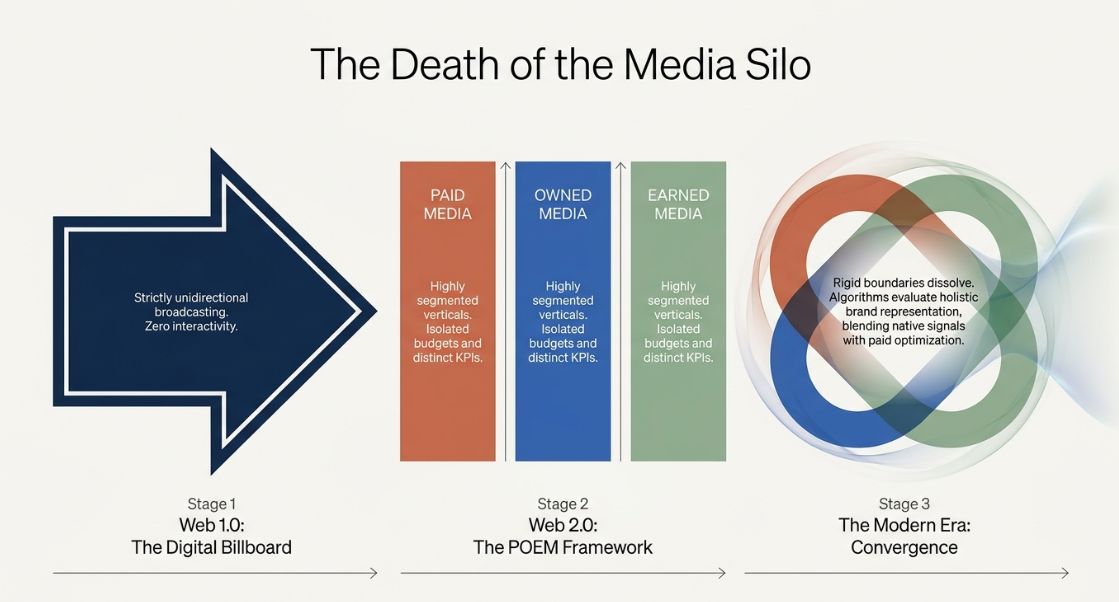
To understand the mechanics of this integration, it is necessary to examine the evolution of the Paid, Owned, and Earned Media (POEM) framework. In the nascent stages of digital marketing—often categorized as Web 1.0—the internet functioned primarily as a repository of digital billboards.2 Communication was strictly unidirectional, with businesses broadcasting messages to a global audience of strangers with minimal capacity for interaction or feedback.2 The advent of Web 2.0 introduced the social, interactive nature of the internet, fundamentally altering the media mix by introducing earned media into the equation.2 Historically, the POEM model was utilized to categorize these disparate efforts into neat silos: paid media represented the traditional domain of bought reach and social media advertisements; owned media encompassed the digital properties a brand controlled, such as websites and official social media profiles; and earned media represented the decentralized conversations, shares, and user-generated content created by the public.3
However, the rigid boundaries between these media types have dissolved. The sheer volume of owned media has increased exponentially due to frictionless publishing platforms, while earned media has fundamentally transformed the efficacy and mechanics of paid media.4 The paid media model is no longer the sole foundation of a marketing strategy; rather, it has evolved into a targeted catalyst deployed at key periods within the owned and earned media lifecycle to forcefully drive engagement.4 Modern digital strategies demand a concerted effort to direct messaging seamlessly through all these channels simultaneously, recognizing that integration is the primary lever for maximizing return on investment.2
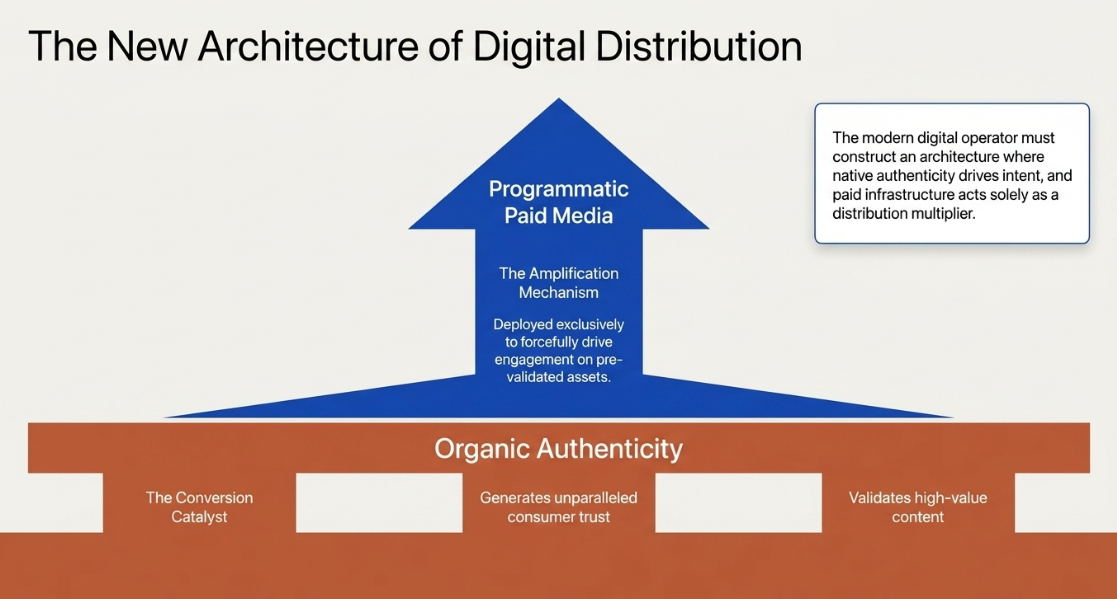
This convergence is further accelerated by an increasing consumer hostility toward traditional, interruptive advertising. The digital populace has developed acute advertising blindness, and in many sectors, outright resentment toward hyper-targeted tracking methodologies. A growing segment of the user base views non-consensual algorithmic tracking and interruptive marketing as an invasive violation of cognitive space, describing the assumption of arbitrary access to human attention as fundamentally unethical.7 The ethical concerns surrounding digital marketing are not unfounded; highly targeted programmatic algorithms have been utilized to exploit vulnerable demographics, such as identifying pregnant women through internet user data to dynamically serve breast-milk substitute advertisements masquerading as professional advice or user-generated content.8 As consumers actively deploy ad-blocking technologies and demand authentic peer-to-peer interactions, brands are forced to abandon legacy paid search and banner advertisements in favor of highly native, organically structured content.7 Consequently, the modern digital operator must construct an architecture where organic authenticity serves as the foundational conversion catalyst, and programmatic paid media is utilized exclusively as an amplification mechanism for pre-validated content.
The Role of Organic Discovery and Strategic Cross-Promotion
The foundational layer of any modern digital architecture relies heavily on robust organic discovery mechanisms. Organic media encompasses all content, distribution, and interactions that occur naturally without subsidized promotion or direct financial intervention.10 This includes the meticulous optimization of search engine visibility, the deployment of high-value content marketing, direct social media community engagement, and the cultivation of owned email lists.10 The intrinsic, irreplaceable value of organic reach lies in its unparalleled capacity to generate and sustain consumer trust. Consumer psychology and behavioral economics dictate a significantly higher degree of confidence in entities, products, or creators discovered through natural algorithmic recommendations, search queries, or direct peer-to-peer sharing compared to those presented via paid advertising formats.12 Organic marketing functions by fostering genuine engagement, aligning with user interests, and allowing the brand's inherent value to attract audiences naturally, culminating in long-term audience development and highly sustainable, high-intent traffic.11
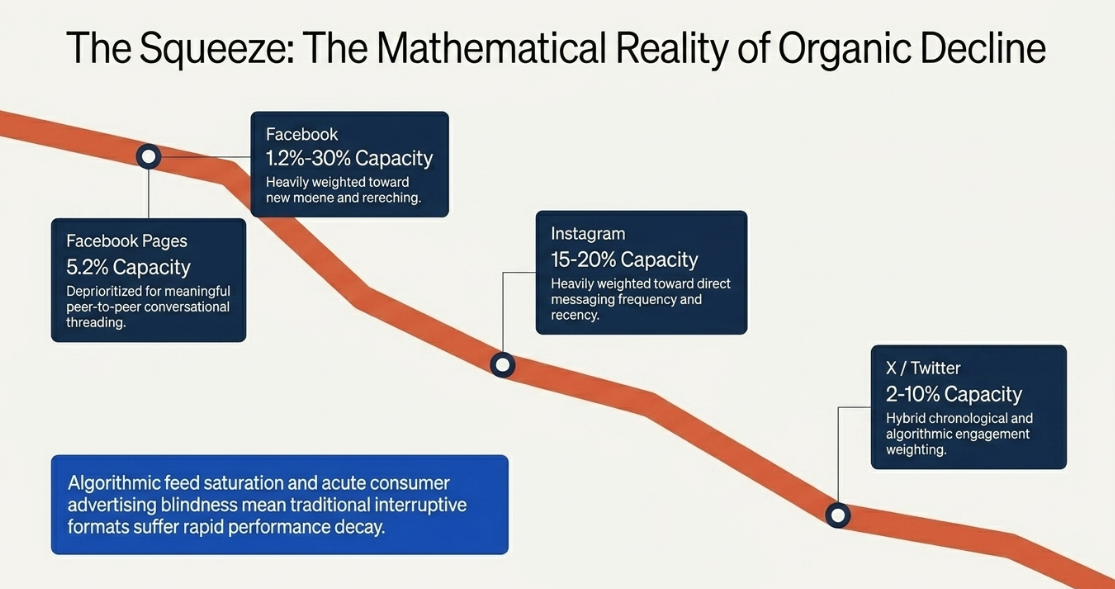
However, the mathematical reality of organic discovery has grown increasingly constrained and difficult to predict. As digital platforms mature and user bases expand, algorithmic feed saturation becomes an unavoidable consequence. To preserve the user experience and prevent feed congestion, platform engineers continuously adjust algorithms to deprioritize brand and publisher content in favor of individual creators and highly engaging media formats. Analyzing standard organic reach metrics—defined as the number of unique users who view content without the assistance of paid distribution—across legacy platforms reveals a stark, continuous trajectory of decline.
The diminishing returns of organic social distribution have precipitated a structural and philosophical evolution within the broader digital ecosystem, pushing brands and individual operators toward strategic cross-promotion and the aggressive, systematic development of owned media assets. This shift is most visible within the "creator economy," an industry projected to scale from experimental public relations tactics into a mainstream, high-stakes growth engine valued between $24 billion and $32.55 billion by the end of 2025 and 2026.14
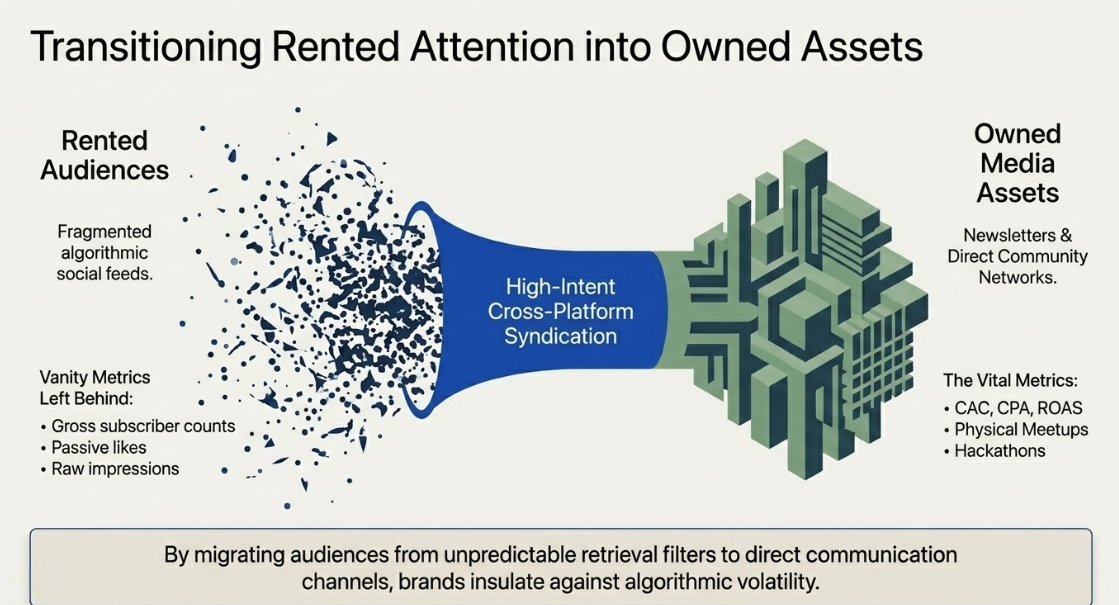
Within this burgeoning economy, the definition of success has pivoted dramatically. Operators are no longer treated as mere campaign line items or passive distribution channels; they function as autonomous media businesses and cultural partners.16 The strategic focus has shifted away from vanity metrics—such as gross subscriber counts, passive likes, and raw impressions—toward highly rigorous, revenue-centric metrics including Customer Acquisition Cost (CAC), Cost Per Action (CPA), and Return on Ad Spend (ROAS).14 This pivot heavily emphasizes cross-platform syndication and the deliberate conversion of rented social audiences into owned email lists and direct community networks. In an environment where visibility translates directly to currency, multi-platform publishing is no longer viewed as a supplementary growth tactic but rather as an absolute imperative for establishing authority and maintaining audience relationships.17
The most prominent manifestation of this strategic shift toward owned media is the resurgence and sophisticated evolution of the newsletter format. Within this highly targeted ecosystem, strategic cross-promotion has rapidly overtaken traditional social media algorithms as the most effective and reliable audience acquisition strategy. Newsletter platforms have engineered internal recommendation networks and peer-to-peer audience sharing mechanisms that drastically lower subscriber acquisition costs.18 Furthermore, monetization within these environments has shifted toward performance-based models, such as Pay-Per-Click (PPC) boosts and highly contextual sponsorships that reward creators for driving tangible user actions rather than passive views.18
This transition toward owned media allows operators—particularly the rising class of B2B creators—to contextualize their deep expertise within broader cultural and business conversations, making specialized knowledge highly accessible.16 These creators establish cross-platform content ecosystems that frequently transition from digital interfaces into physical, offline environments. Leading media brands and niche newsletters are increasingly hosting localized meetups, intensive hackathons, and immersive workshops to foster deep-rooted community ties.19 The underlying strategic rationale is unambiguous: by migrating audiences from unpredictable algorithmic social feeds to direct-to-consumer communication channels, brands insulate themselves against sudden, catastrophic shifts in platform retrieval filters while simultaneously cultivating a high-intent audience primed for advanced monetization.19
Interestingly, the pursuit of authenticity within organic discovery has led to unexpected content strategies that challenge traditional notions of brand building. The "faceless" YouTube channel has emerged as a highly profitable and effective model, proving that digital audiences prioritize extreme content value over the visible identity of the creator.20 Channels focusing on educational explainers, autonomous sensory meridian response (ASMR), software reviews, and gameplay walkthroughs routinely out-perform personality-driven content by eliminating the friction of camera shyness and focusing entirely on high-quality visuals, engaging audio, and rigorous search engine optimization.20
Simultaneously, the pressure to maintain organic visibility has sparked complex debates regarding originality versus algorithmic replication. Operators frequently engage in a delicate dance between producing unique, groundbreaking content and aggressively emulating proven formats or entire video concepts—a phenomenon often referred to as the copycat method.21 This dynamic highlights a deeper philosophical paradox inherent to digital connectivity: the act of communicating to the internet and constantly performing for algorithmic validation may actually diminish true, authentic connectedness.22 Video blogs and highly curated organic feeds testify to the psychological difficulty of remaining authentic while disseminating oneself across global networks, creating an environment where the need for an implied audience frequently supersedes genuine human interaction.
Strategic Paid Amplification and Programmatic Campaigns
While a rigorous organic infrastructure is mandatory for building trust, credibility, and brand loyalty, its inherent lack of scalability necessitates the integration of strategic paid amplification. Organic efforts are vital for maintaining a native presence and engaging with existing communities, but the algorithmic limitations detailed previously cap the velocity at which new audiences can be acquired.23 Conversely, relying entirely on pure paid media environments is a flawed strategy characterized by escalating bid costs, severe consumer ad blindness, and rapid performance decay. As global competition for premium advertising real estate intensifies, standard interruptive display formats and corporate banner advertisements suffer from massive user avoidance behaviors.9
The structural solution lies in a synergistic methodology that applies highly sophisticated programmatic distribution infrastructure directly to native, organically successful content. By seamlessly blending organic engagement signals with paid scaling initiatives, brands create a compounding effect that amplifies reach and conversions far beyond what either discipline could achieve in isolation.
The Architecture of Native Amplification and Spark Ads
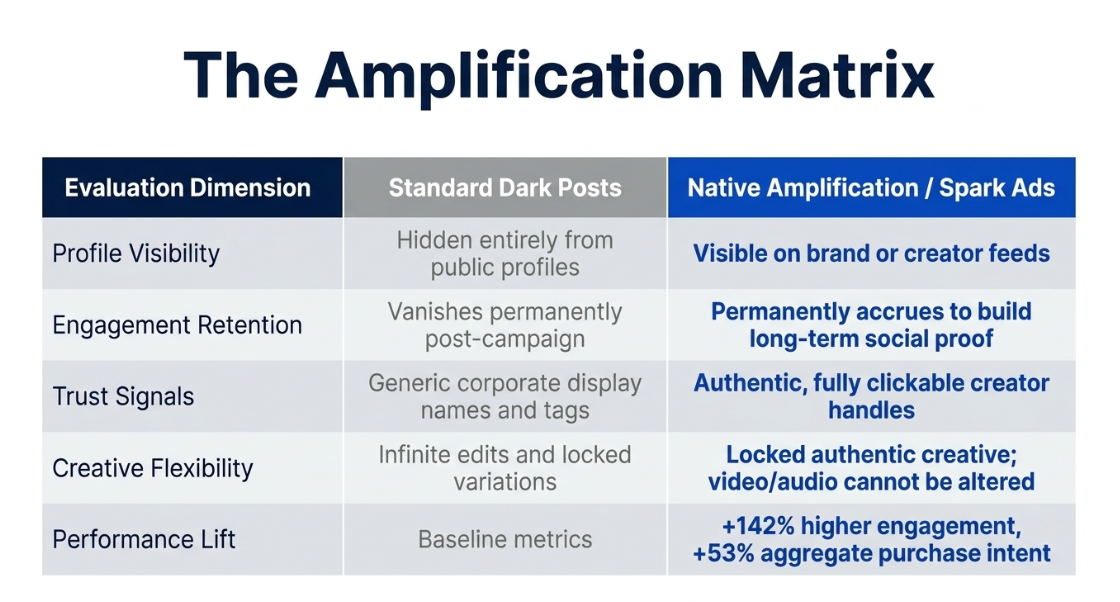
The most prominent and effective execution of this convergence is observed in platforms that allow advertisers to route paid media budgets through native creator handles rather than sterile corporate brand pages. Native advertisements—defined as paid media that perfectly mimics the form, function, and aesthetic of the organic content surrounding it—generate between 85% and 93% more clicks than standard banner ads, drive 52% higher visual engagement, and lift aggregate purchase intent by an astounding 53%.24 This outperformance is a direct result of their non-disruptive formatting; because they do not look or feel like traditional advertisements, they successfully bypass the psychological avoidance behaviors and skepticism associated with corporate marketing.24
On the short-form video platform TikTok, this mechanism is deployed through the highly innovative "Spark Ads" format. To understand the impact of Spark Ads, one must first analyze the mechanics of standard social media advertising. Standard in-feed advertisements are deployed as "dark posts." They are generated within the backend Ads Manager, remain entirely invisible on the brand's public profile, and enter the digital ecosystem with zero algorithmic momentum or social proof.25 When a standard campaign concludes and the budget is exhausted, the advertisement disappears entirely, and any likes, comments, or shares accrued during the campaign vanish into the digital ether, offering zero long-term residual value to the brand.25
Spark Ads fundamentally invert this ephemeral model. They allow brands to allocate programmatic paid distribution budgets to existing, public organic posts—either utilizing content from their own brand profile or leveraging content generated by a partnered creator (with their explicit backend authorization via a unique digital code).25 The structural advantages of this programmatic amplification are profound and multi-faceted. From a strict consumer perspective, the advertisement is virtually indistinguishable from standard user-generated content; it displays the original creator's authentic handle, clickable profile picture, unedited caption, and organic audio track.25 The ad blends seamlessly into the "For You" feed, feeling natural, personal, and driven by trusted user-generated elements.
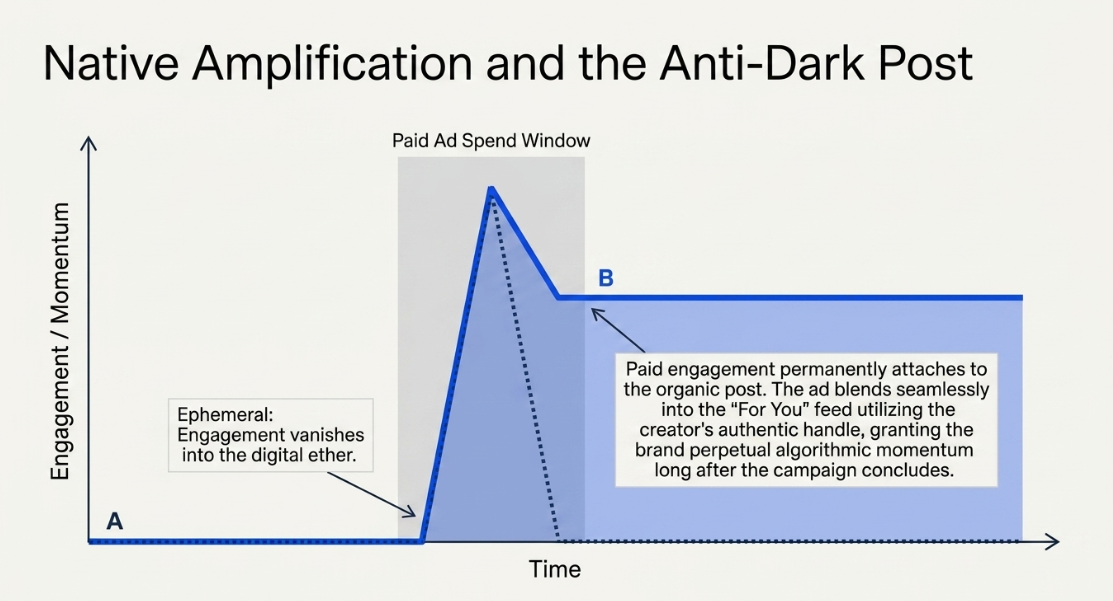
Crucially, all accrued engagement generated by the paid media spend—including every view, like, comment, share, and profile follow—permanently attaches directly to the original organic post.25 This creates a compounding, long-term social asset that delivers sustained brand value and algorithmic authority long after the paid campaign has concluded.25 Furthermore, Spark Ads support advanced interactive add-ons, including user polls, quizzes, and sophisticated augmented reality (AR) filters, allowing for virtual try-ons and gesture-based interactions that further elevate engagement metrics.25
Data compiled from global campaigns indicates that leveraging organic features within these native paid campaigns drives a 134% to 142% higher video completion rate and a 157% higher six-second view-through rate compared to non-native, interruptive formats.25 Real-world brand case studies validate these metrics. When the brand Photomyne deployed a portfolio of twelve organic posts from ten mid-tier creators as Spark Ads via TikTok's auction platform, the strategy yielded a 5x increase in total video views, a 2x increase in overall engagement, an impressive 27.5% conversion rate for application installs, and a 50% decrease in their Cost Per Action (CPA).29 Similarly, other major campaigns have documented a 25% higher click-through rate, a 24% higher conversion rate, and profound cost efficiencies including a 66% lower Cost Per Mille (CPM) and a 67% lower Cost Per Click (CPC) when utilizing Spark Ads.
While some content creators express anxiety that heavily boosting their best organic posts might confuse the algorithm and suppress future organic reach by mixing paid and organic data streams, the overall strategic consensus advises a hybrid approach.30 Sophisticated media buyers run standard dark ads to rapidly A/B test concepts in isolation; once a winning creative is identified, they post it organically and scale it aggressively with budget as a Spark Ad to accumulate permanent social proof and followers.
Meta Partnership Ads and the Andromeda Update
A parallel and equally transformative evolution is occurring within the Meta ecosystem (encompassing Facebook and Instagram) through the deployment of Advantage+ Dynamic Partnership Ads. Historically, the disciplines of influencer marketing and direct-response performance marketing operated in entirely separate silos.31 Influencer marketing was optimized for brand awareness, generating closeness, trust, and authentic user-generated content, while performance marketing was ruthlessly optimized for measurable efficiency, pixel data, and immediate sales conversions.31 Meta's Partnership Ads seamlessly merge these two methodologies by permitting brands to push sophisticated programmatic budgets through a creator's organic handle, preserving the vital credibility of the content while utilizing Meta's unparalleled targeting algorithms to scale reach far beyond the creator's organic follower base.31
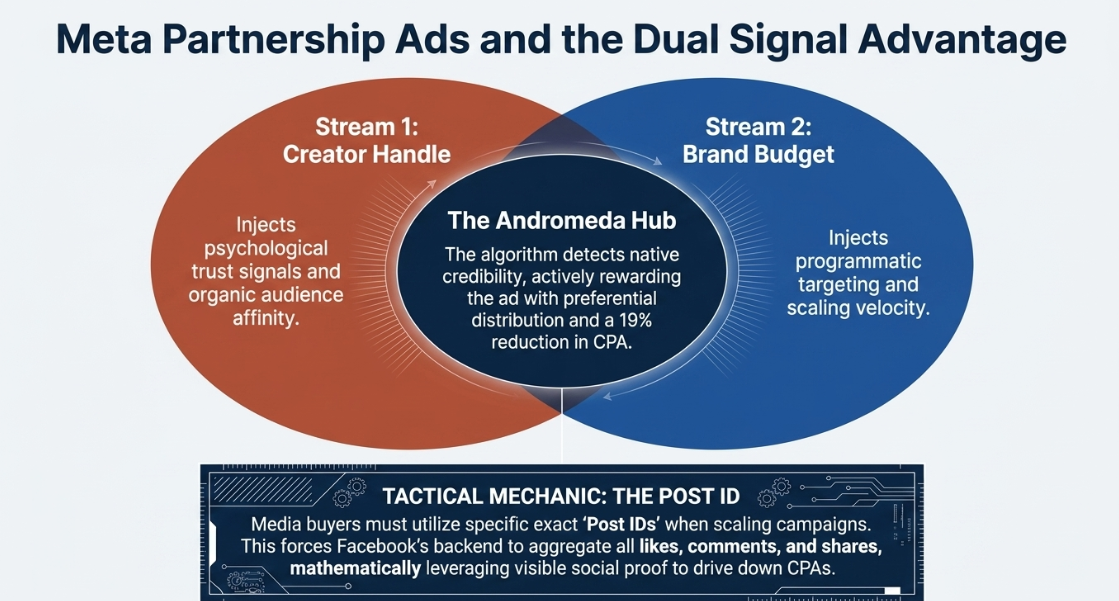
This advertising format has transitioned from an experimental tactic to an absolute necessity following Meta's rollout of the highly advanced "Andromeda" algorithmic update. The Andromeda architecture represents a fundamental shift in how content is retrieved and served; it heavily prioritizes media that generates genuine, authentic engagement, utilizing complex predictive models to evaluate a user's likelihood to interact with a post before it ever enters their feed.33 Because Partnership Ads run directly from a trusted creator's handle rather than a corporate entity, they inherently carry built-in psychological trust signals that traditional, highly polished corporate advertisements lack.32
The Andromeda algorithm actively detects this native credibility—registering that audiences interact differently when a familiar creator endorses a product—and rewards it with preferential distribution and lower auction costs.33 Running over-scripted, highly produced brand content under the Andromeda update leads to rapid performance decay, as audiences grow skeptical and swipe past the interruption.32 Conversely, Meta's internal studies confirm that integrating Partnership Ads into a media mix yields a 19% reduction in Cost Per Acquisition (CPA) and a 13% increase in aggregate click-through rates.32
The technical architecture of Partnership Ads also leverages a "Dual Signal Advantage." Because the ad header transparently displays both the creator and the partner brand, Meta's backend algorithms utilize historical interaction signals from both accounts to optimize ad ranking and delivery, unlocking massive incremental reach by combining the brand’s targeted paid audience with the creator's established community.32 This allows brands to invert the traditional, risky influencer model—where massive upfront fees are paid with no guarantee of performance—by testing a wide array of creators with small budgets, utilizing paid performance signals to identify winning assets, and heavily funding only the content that mathematically proves its efficacy.32
Furthermore, the mechanics of preserving social proof within the Meta platform remain a critical component of media buying. Advertisers utilize specific "Post IDs"—unique numeric identifiers assigned to every piece of published or unpublished content on Facebook—to ensure that identical ad sets consolidate their engagement metrics across multiple campaigns.35 When media buyers duplicate an ad without using the existing Post ID, Facebook generates a new post in the background, resetting the engagement counters to zero.38 By forcing the system to utilize the exact Post ID, all likes, comments, and shares are aggregated.35 While Facebook's machine learning algorithm strictly calculates the optimization "Learning Phase" based on isolated ad set performance data rather than aggregate Post ID metrics, the psychological impact of visible social proof is undeniable. Advertisements boasting thousands of likes and positive comments see significantly better engagement rates from real users, indirectly accelerating the algorithm's optimization process by driving higher CTRs and lower CPAs.
Programmatic AI Signals and the Shift to Creative Volume
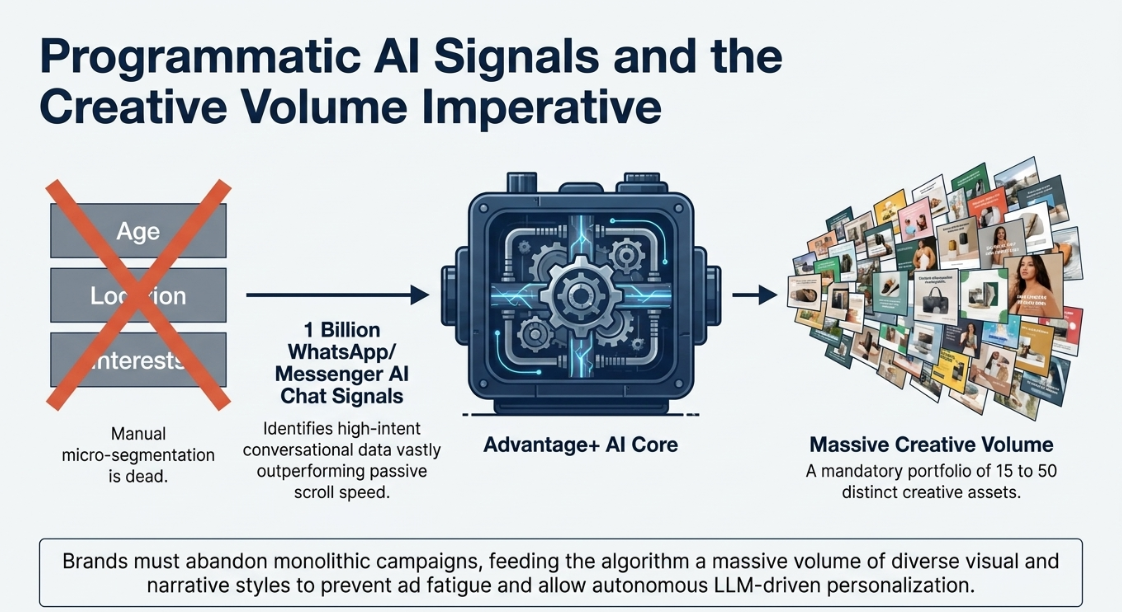
The underlying engine driving this massive convergence across both TikTok and Meta is the integration of advanced artificial intelligence into the media buying platforms themselves. Meta's Advantage+ delivery system has undergone a radical upgrade, now processing anonymized conversational intent signals from over one billion monthly users interacting with Meta AI across WhatsApp, Messenger, Instagram, and Facebook.40 These natural language processing integrations provide the algorithmic delivery system with highly accurate, nuanced purchase intent models that vastly outperform traditional, passive behavioral signals such as scroll speed or superficial page likes.40 Early eCommerce adopters who have restructured their campaigns to maximize the intake of these enriched chat signals are documenting an average 18% improvement in Return on Ad Spend (ROAS), with the most profound gains occurring in mid-funnel conversions where conversational intent perfectly aligns with product consideration.40
However, the efficacy of these AI optimizations is entirely dependent on the quality of a brand's server-side tracking. Because the Advantage+ system relies on continuous feedback loops between conversion events and the delivery algorithm, broken or inaccurate tracking severely limits the AI's learning ceiling.40 Implementing robust first-party data structures via the Conversions API (CAPI) is no longer an optional enhancement; it is the absolute foundation of modern campaign performance.40
A direct, structural consequence of this AI-driven automation is the complete obsolescence of manual audience micro-segmentation. As machine learning algorithms assume total control over demographic targeting and placement, the sole remaining differentiator for human marketers is creative quality, volume, and diversity. Meta's algorithmic models currently require between 15 and 50 active creative assets per campaign to optimize effectively and prevent ad fatigue.40 Consequently, brands are abandoning monolithic, single-creator campaigns in favor of dynamic multi-creator portfolios. By partnering with numerous micro-creators and utilizing Large Language Models (LLMs) to generate diverse marketing copy—a tactic that allowed JPMorgan Chase to achieve up to 450% higher click-through rates in pilot tests—brands feed the algorithm a massive array of authentic visual and narrative styles.24 This volume allows the machine learning models to autonomously align specific creative assets with their ideal consumer micro-segments, executing a level of personalization impossible through manual human intervention.
The YouTube Paradox
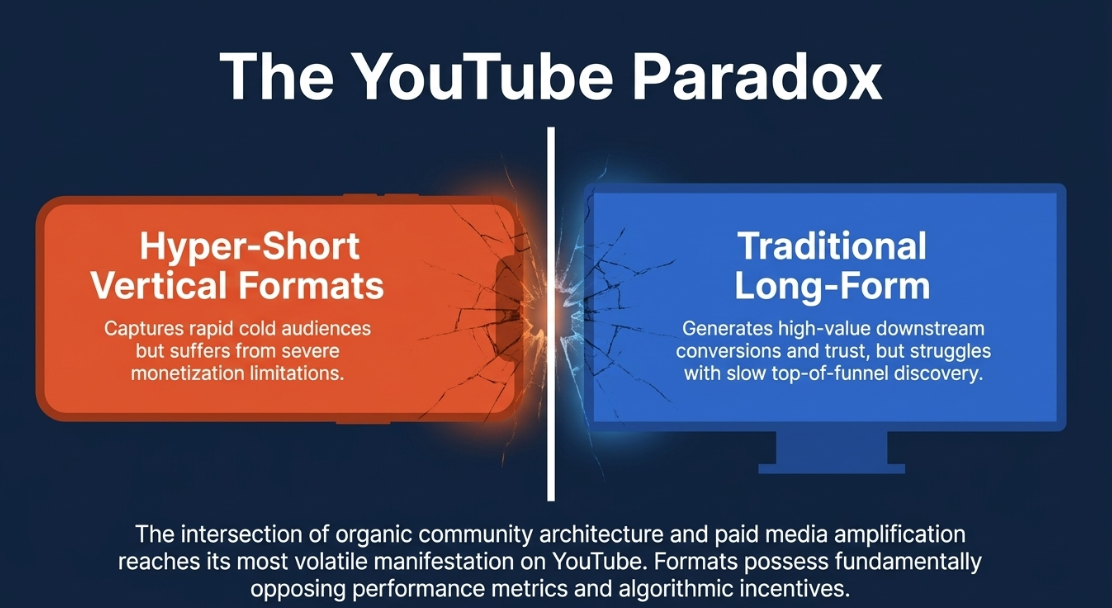
The intersection of organic community architecture and paid media amplification reaches its most complex, volatile, and highly debated manifestation on YouTube, creating a structural dilemma widely referred to by industry analysts as the "YouTube Paradox".41 This paradox emerges from the conflicting performance metrics, algorithmic incentives, and monetization realities of the platform's two primary content formats: hyper-short vertical videos (YouTube Shorts) and traditional horizontal long-form content.
The Dual-Format Imperative and the 41% Growth Multiplier
In the current digital economy, the question of whether a creator or brand should focus on short-form or long-form video has been definitively answered: both formats are strictly non-negotiable elements of a sustainable growth ecosystem.41 They serve fundamentally opposing, yet highly complementary roles.
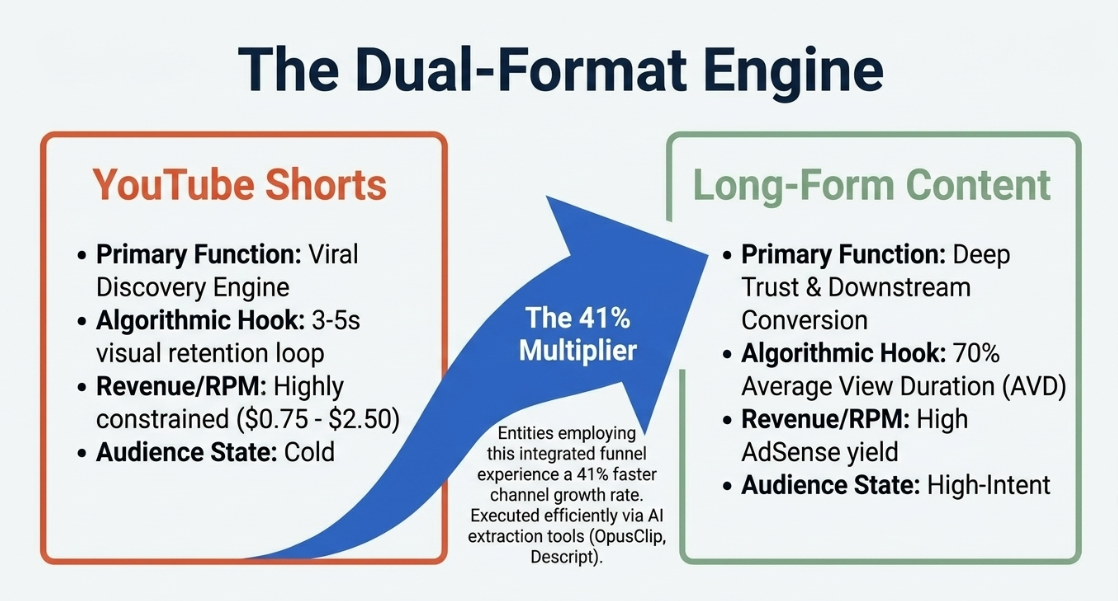
YouTube Shorts operate as the platform's ultimate, aggressive discovery engine. The format generates an astounding 200 billion daily views globally, representing a staggering escalation in content consumption.41 Shorts boast highly elevated engagement rates—averaging 5.91%, significantly outperforming competitors like TikTok (5.75%) and Instagram Reels (2%)—making them exceptionally efficient for capturing cold audiences who have never previously interacted with the channel.41 The algorithm governing Shorts heavily weights immediate viewer retention; content that fails to capture attention within the first three to five seconds faces severe and immediate algorithmic suppression.41 Consequently, successful Shorts rely on precise visual hooks, narrative loops, and trending audio transitions.41 However, their monetization yield is drastically limited. Because the format moves too quickly for traditional ad placements, the Revenue Per Mille (RPM) for Shorts ranges between a mere $0.75 and $2.50, representing a 60% to 80% reduction compared to long-form yields.41
Conversely, long-form content serves as the definitive revenue and trust-building foundation. While accumulating fewer raw, top-of-funnel impressions, long-form videos dominate total aggregate watch time and support multiple lucrative ad placements (including pre-roll, mid-roll, end-roll, and overlay advertisements), generating substantially higher AdSense revenue.41 More importantly, long-form content establishes the parasocial depth and narrative complexity required to drive high-value downstream conversions. Viewers of long-form content are significantly more likely to transition into owned-media ecosystems, such as signing up for email newsletters, purchasing comprehensive digital courses, or engaging in high-ticket consulting—revenue streams that typically generate five to ten times the income of raw platform advertising payouts.41
The optimal resolution to the YouTube Paradox is the execution of a sophisticated hybrid conversion system. Leading channels do not choose between formats; they engineer an ecosystem where Shorts act as a viral funnel, capturing millions of top-of-funnel views and systematically pulling those users into their deeply monetizable long-form library. A prime example is the creator MacDannyGun, who aggressively deployed Shorts to rapidly acquire 670,000 new subscribers, meticulously using the short clips as trailers to feed viewers into his longer, high-retention content.41 Data consistently demonstrates that entities employing this integrated dual-format strategy experience a 41% faster channel growth rate compared to those utilizing a monolithic format.
To execute this strategy without succumbing to production burnout, operators utilize highly efficient content repurposing workflows powered by artificial intelligence. By utilizing AI extraction tools such as OpusClip, Descript, Taja AI, Zubtitle, and WayinVideo, creators can autonomously identify engaging moments within a single long-form video and generate 10 to 15 optimized Shorts.20 This systematic batching reduces editing workflow times by 70% to 90%, allowing strategists to schedule a full month of daily Shorts and multiple long-form videos with an investment of only a few hours per week, thereby maximizing creative output and financial ROI simultaneously.41
Algorithmic Evolution: Satisfaction-Weighted Discovery
Underpinning the necessity of this dual-format approach is a fundamental shift in YouTube's core recommendation architecture. The platform has officially transitioned away from rewarding raw click-through rates (CTR) and aggregate view counts, instead prioritizing a complex metric known as "Satisfaction-Weighted Discovery".41 The algorithm now calculates a composite viewer satisfaction score by integrating multiple qualitative and quantitative data points, including direct user platform surveys ("Did you enjoy this video?"), advanced sentiment modeling derived from comment sections, and crucially, long-session retention data—monitoring whether a viewer continues to watch multiple videos from the same channel within a single session.41
Within this new framework, audience retention serves as the primary currency of algorithmic distribution. The system heavily penalizes videos that viewers abandon quickly; a steep drop-off in the first thirty seconds signals a severe mismatch between the title, thumbnail, and the actual content.42 A video demonstrating a 70% average view duration (AVD) with a smaller initial audience will consistently outpace, outrank, and ultimately cannibalize the reach of a high-view-count video that suffers a 90% abandonment rate.41 This retention-first model intrinsically favors high-quality, long-form content. Maintaining a 50% retention rate on a ten-minute video generates five minutes of aggregate watch time per viewer—a massive signal of satisfaction that the algorithm prioritizes heavily for broad promotion.
The Conflict of Paid Amplification on Organic Reach
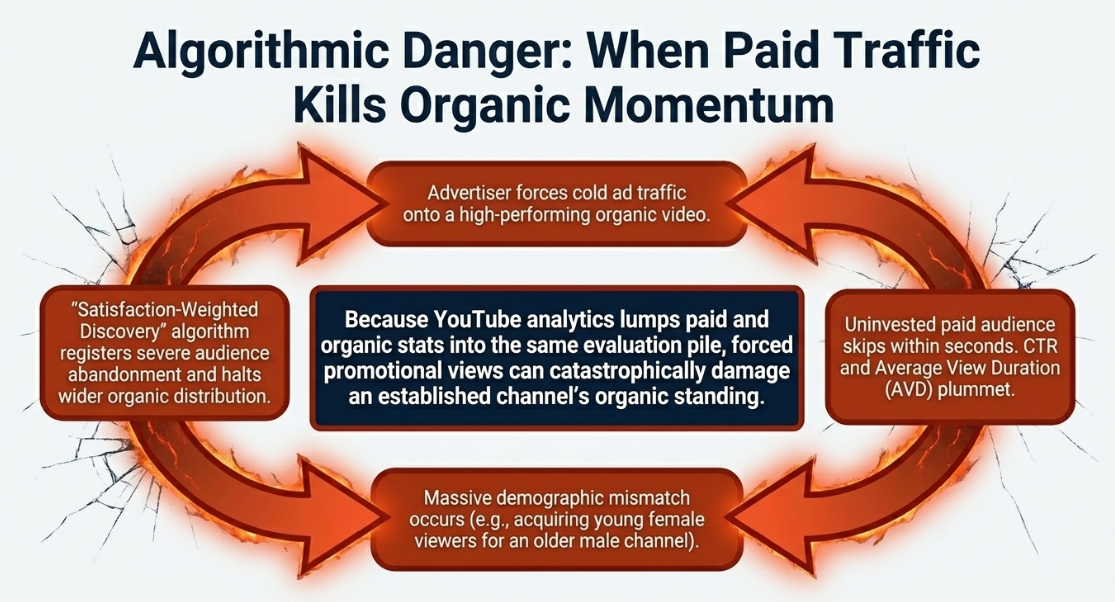
The primacy of the audience retention metric introduces a severe vulnerability when attempting to scale YouTube channels through paid advertising. One of the most pervasive and hotly debated issues within the digital media landscape revolves around whether deploying YouTube Ads artificially suppresses a channel's organic reach, effectively killing the channel's natural momentum.43
Officially, YouTube engineers maintain that the platform's advertising system and organic recommendation algorithms operate as entirely separate architectures.43 According to platform documentation, organic recommendations are based strictly on how content performs when it is recommended organically, meaning that running a promotion does not directly impact a video's eligibility for search and discovery.46 However, while the systems may be technically segregated, empirical testing by numerous creators demonstrates that running paid traffic generates indirect behavioral signals that can catastrophically damage organic momentum.48
When an advertiser funds a video campaign, the content is forcefully served to a massive, cold audience who has zero prior context or affinity for the creator. A vast majority of these paid viewers will skip the advertisement or click away within seconds.50 Consequently, the video's aggregate Click-Through Rate (CTR) and Average View Duration (AVD) plummet.51 Because the YouTube studio analytics dashboard does not cleanly separate paid promotional stats from organic stats for algorithmic evaluation, everything is lumped into the same performance pile.50
The damage is frequently severe. In one documented case study, a creator in the tractor implement niche launched a promotion on a video that organically held 700 views, a strong 67% retention rate at the thirty-second mark, and a 27% completion rate.52 Following the promotion, views spiked to 8,800, but the thirty-second retention rate collapsed to 20%, and the completion rate dropped to a dismal 2%.52 Furthermore, the promotion acquired 1,000 new subscribers, but the demographic data was entirely skewed; while the channel's organic base was 98% older males, 60% of the newly acquired paid subscribers were young females.52 This demographic mismatch creates a deadly feedback loop: when the creator publishes future videos, the algorithm tests the content against the new subscriber base. When these mismatched subscribers ignore the content, the algorithm registers low interest and halts wider organic distribution.52
Another extensive test conducted by the channel VaskoObscura between January and March 2025 yielded similar regrets. Initially, views and subscriber counts bumped upward, but as the low CTR and poor retention data from cold ad traffic flooded the analytics, the algorithm interpreted the video as uninteresting, leading to a massive drop in organic impressions that dragged down the performance of the entire channel.50 Similar experiments in the gaming niche recorded AVD drops from 5 minutes down to 2 minutes following promotional pushes.53
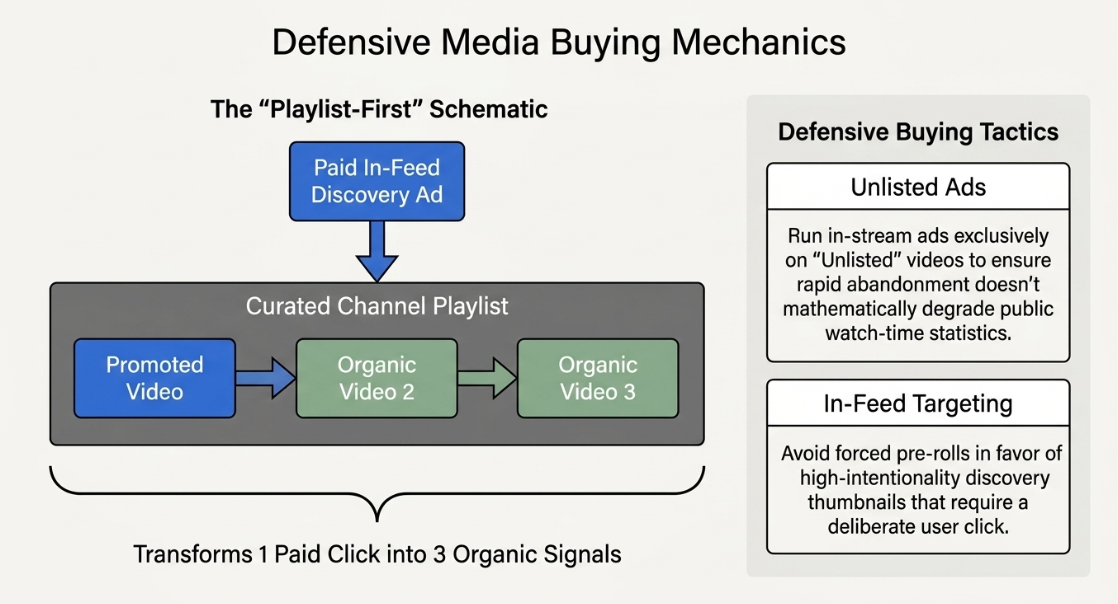
To mitigate this destructive algorithmic feedback loop, sophisticated media buyers deploy highly specific defensive campaign architectures. When running in-stream video advertisements, the asset must be uploaded to the channel as an "Unlisted" video.44 Unlisted content does not count toward the channel's public watch time statistics, ensuring that rapid abandonment by cold, uninvested ad traffic does not mathematically degrade the channel's organic algorithmic standing.44 Alternatively, running "In-Feed" discovery ads—where the video appears alongside organic search results as a thumbnail but requires a deliberate, intentional user click to initiate playback—yields significantly higher intentionality and preserves baseline retention metrics much more effectively than forced pre-roll advertisements.44
A highly effective mechanic utilized by elite media buyers is the "Playlist-First" tactic. Instead of linking a paid ad directly to a standalone video URL, the ad destination points to the video operating as the first item within a curated channel playlist.54 When the viewer finishes the promoted video, the playlist automatically seamlessly transitions into more of the channel's organic content. This strategic mechanic frequently turns a single paid click into two to four subsequent organic views, vastly improving overall session time and signaling high satisfaction to the algorithm.
Geographic Arbitrage and the Mechanics of RPM Optimization
For entities utilizing professional Google Ads infrastructure to amplify content, long-term financial success requires an acute, data-driven understanding of geographic yield variations. A common, often fatal mistake made by novice YouTube advertisers is optimizing campaigns solely for the lowest Cost Per View (CPV).54 Doing so inevitably floods the channel with cheap, low-retention views from developing markets that generate virtually zero downstream revenue.54
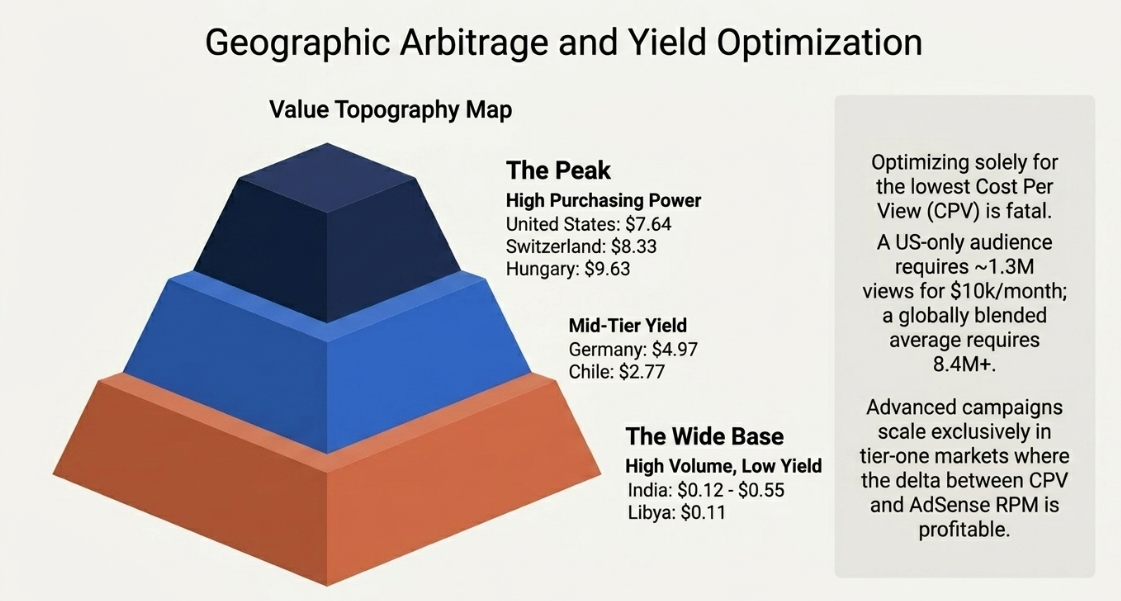
The financial viability of a YouTube channel is heavily dictated by its Revenue Per Mille (RPM)—the amount a creator earns per 1,000 views. Because multinational advertisers bid significantly higher amounts for access to high-income, high-purchasing-power consumer bases, the disparity in global RPMs is staggering.54 An analysis of regional RPM bands reveals extreme variations that dictate media buying strategies:
Comprehensive data representation of typical geographic RPM spreads across 84 tracked markets, highlighting the extreme variance in audience monetization value and the necessity for precise geographic targeting.54
The mathematical implications of these figures are profound. A single view originating from the United States, Switzerland, or Denmark generates exponentially more revenue than a view from Southeast Asia or North Africa. Based on first-party data models, generating a baseline of $10,000 a month in AdSense revenue requires approximately 1.3 million monetized views if the audience is exclusively based in the United States.54 If the audience reflects the global weighted average RPM of $1.19, that requirement jumps to 8.4 million views.54 If a poorly targeted ad campaign floods the channel with subscribers from low-RPM countries, the creator may require upward of 20 million views per month to achieve the exact same financial outcome.54
Consequently, revenue-optimized promotion strategies do not seek the cheapest available clicks. Instead, advanced programmatic campaigns engage in deliberate geographic arbitrage, scaling ad spend exclusively in tier-one markets where the delta between the upfront Cost Per View (CPV) and the downstream AdSense yield (RPM) is sustainable and profitable.54 This mathematically rigorous approach ensures that paid amplification directly supports the channel's overarching financial ecosystem rather than artificially inflating vanity metrics with non-monetizable traffic.
The Limitations of Native Promotional Tools and Verification
The intricacies of paid amplification on YouTube are further complicated by the platform's simplified native tools. The "Promotions Tab," accessible directly within the YouTube Studio dashboard, offers a highly frictionless gateway for creators to purchase views and subscribers.42 However, while this tool operates on the backend Google Ads infrastructure, it strips away virtually all critical optimization controls required for professional media buying.54
Advertisers utilizing the Promotions Tab lack the ability to target specific high-value keywords, dictate exact channel placements, or deploy sophisticated remarketing pixels.54 Furthermore, the analytics provided are exceptionally shallow, preventing creators from effectively monitoring retention drops.54 More critically, in a structural safeguard implemented by YouTube to prevent the artificial inflation of monetized channels, any watch hours or subscriber counts generated through the Promotions Tab are explicitly excluded from the eligibility requirements for the YouTube Partner Program (YPP).54 If a creator is utilizing the Promotions Tab in an attempt to cross the critical threshold of 1,000 subscribers and 4,000 watch hours, the paid views will yield zero progress toward monetization.
Due to the prevalence of fraudulent promotion services that sell bot traffic—which can trigger Community Guidelines strikes and permanent channel demonetization—creators must strictly verify the legitimacy of any promotional traffic sources.54 By navigating to the analytics dashboard and checking "Traffic Sources," legitimate Google Ads campaigns will be explicitly labeled as "YouTube advertising".51 If views from a third-party service are categorized as "External," "Embeds," or "Direct or unknown," the traffic is highly likely to be illegitimate and generated by fake engagement networks, posing a severe risk to the channel's algorithmic standing.54
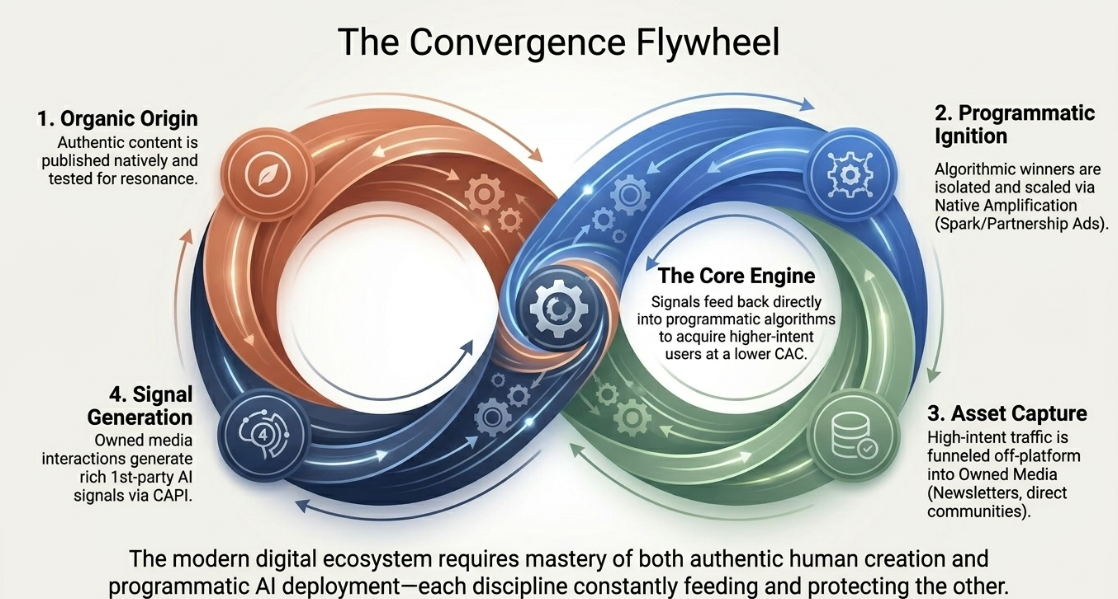
Ultimately, the YouTube Paradox highlights a broader theme within the digital landscape: the very advertisements that platforms rely upon for revenue often subsidize the tools (such as ad blockers) that users deploy to avoid them.7 Navigating this ecosystem requires a mastery of both authentic content creation and the highly technical, programmatic deployment of paid media, ensuring that one discipline constantly feeds and protects the other.
Works cited
2026 Ecommerce Guide: Organic vs Paid, AI, CRO - PBJ Marketing, accessed May 21, 2026, https://pbjmarketing.com/blog/2026-ecommerce-guide-organic-vs-paid-ai-cro
5 Critical Steps for Integrating Paid, Owned, and Earned Media - Online Marketing Institute, accessed May 21, 2026, https://www.onlinemarketinginstitute.org/blog/2013/11/integrating-paid-owned-earned-media/
Understanding the POEM Framework | PDF | Marketing Communications - Scribd, accessed May 21, 2026, https://www.scribd.com/document/933231859/POEM-Model-PR
Marketing Defined: Paid Owned Earned Media Strategy in a Social World, accessed May 21, 2026, https://urbanrenstrom.com/paid-owned-earned-media-in-a-social-world/
What are paid, owned, and earned media channels? What are its differences? - 10xDS, accessed May 21, 2026, https://10xds.com/blog/what-are-paid-owned-earned-media-channels/
P-O-E-M Framework in Digital Marketing? What it is & How to use? | by uparrow | Medium, accessed May 21, 2026, https://medium.com/@hellouparrow/p-o-e-m-framework-in-digital-marketing-what-it-is-how-to-use-bbc8397d0239
Google Tag Manager, the new anti-adblock weapon (2020) - Hacker News, accessed May 21, 2026, https://news.ycombinator.com/item?id=30411049
SCOPE AND IMPACT OF DIGITAL MARKETING STRATEGIES FOR PROMOTING BREASTMILK SUBSTITUTES - Cesni – Biblioteca, accessed May 21, 2026, https://cesni-biblioteca.org/archivos/248.pdf
Why Paid Media Is Non-Negotiable for Brands in 2025, accessed May 21, 2026, https://blog.hivestrategy.com/why-paid-media-is-non-negotiable-for-brands
Integrating Organic and Paid Media Strategies for Holistic Marketing Success - Float Media House, accessed May 21, 2026, https://www.floatmediahouse.com/blog-posts/integrating-organic-and-paid-media-strategies-for-holistic-marketing-success
What is Organic Marketing: A Guide to a Winning Organic Marketing Strategy, accessed May 21, 2026, https://contentwriters.com/blog/what-is-organic-marketing-a-guide-to-a-winning-organic-marketing-strategy/
The Pros and Cons of Organic vs. Paid Digital Marketing, accessed May 21, 2026, https://digitalschoolofmarketing.co.za/digital-marketing-blog/the-pros-and-cons-of-organic-vs-paid-digital-marketing/
Organic Reach: Natural Content Visibility - ContentStudio, accessed May 21, 2026, https://contentstudio.io/social-media-terms/organic-reach
Master 2025 Influencer Campaigns: Proven ROI Tactics - The Cirqle, accessed May 21, 2026, https://thecirqle.com/blog-post/master-2025-influencer-campaigns-proven-roi-tactics
The 10 Best Influencer Marketing Platforms to Scale Your Campaigns in 2026 - Skeepers, accessed May 21, 2026, https://skeepers.io/us/blog/best-influencer-marketing-platform/
The Future of Influence: The State of the 2026 Creator Economy - Journal of PR and Marketing News & Trends, accessed May 21, 2026, https://theprnet.com/journals/future-of-influence-2026-creator-economy
Growth of content syndication among creators - Audiorista, accessed May 21, 2026, https://www.audiorista.com/trends/growth-of-content-syndication-among-creators
PlayingNumbers/Complete-Newsletter-Guide: Complete roadmap for writing, growing, and monetizing your newseletter - GitHub, accessed May 21, 2026, https://github.com/PlayingNumbers/Complete-Newsletter-Guide
The State of Newsletters 2026 | beehiiv Blog, accessed May 21, 2026, https://www.beehiiv.com/blog/beehiiv-the-state-of-newsletters-2026
30 Faceless YouTube Channel Ideas for Profit in 2026 - Descript, accessed May 21, 2026, https://www.descript.com/blog/article/faceless-youtube-channel-ideas
SSSniperWolf Copycat Method Reveals Content Creation Trend - Celenic Earth Publications, accessed May 21, 2026, https://celenicearthpublications.com/sssniperwolf-copycat-method-trend/
Performing Shakespearean Appropriations: Essays in Honor of Christy Desmet (Shakespeare and the Stage) 1683933605, 9781683933601 - DOKUMEN.PUB, accessed May 21, 2026, https://dokumen.pub/performing-shakespearean-appropriations-essays-in-honor-of-christy-desmet-shakespeare-and-the-stage-1683933605-9781683933601.html
Combining Organic and Paid Social Strategies for Maximum Impact - PBJ Marketing, accessed May 21, 2026, https://pbjmarketing.com/blog/combining-organic-and-paid-social-strategies-for-maximum-impact
What is Programmatic Native Advertising and Why It Works - AI Digital, accessed May 21, 2026, https://www.aidigital.com/blog/programmatic-native-advertising
What Are TikTok Spark Ads? (And Are They Worth It?) | AdManage ..., accessed May 21, 2026, https://admanage.ai/blog/what-are-spark-ads-on-tiktok
About Spark Ads, accessed May 21, 2026, https://ads.tiktok.com/help/article/spark-ads
TikTok Spark Ads, Simplified: The Ultimate Guide with Skeepers, accessed May 21, 2026, https://skeepers.io/blog/tiktok-spark-ads/
Social Media Advertising- The Ultimate Guide - Bannerflow, accessed May 21, 2026, https://www.bannerflow.com/resources/ebooks-guides/ultimate-guide-to-social-media-advertising
Spark Ads 101: Make TikTok videos into ads, accessed May 21, 2026, https://ads.tiktok.com/business/en-US/blog/spark-ads-101-make-tiktoks-into-ads
Spark Ads killed my organic growth on TikTok : r/SocialMediaMarketing - Reddit, accessed May 21, 2026, https://www.reddit.com/r/SocialMediaMarketing/comments/1r38gnp/spark_ads_killed_my_organic_growth_on_tiktok/
Meta Partnership Ads: Influencers + Performance Marketing - Adsmurai, accessed May 21, 2026, https://www.adsmurai.com/en/articles/partnership-ads-meta
Why Meta Partnership Ads Are the Future of Social Feed Advertising, accessed May 21, 2026, https://www.agentio.com/blog/meta-partnership-ads-future-of-social-feed-advertising
Why Meta's Andromeda Update Is a Creator Partnership Ads Win, accessed May 21, 2026, https://www.socialnative.com/articles/why-metas-andromeda-update-is-a-creator-partnership-ads-win/
The Authenticity Edge: Science and Strategy Behind The Evolution of Meta Partnership Ads, accessed May 21, 2026, https://bir.ch/blog/the-authenticity-edge-science-and-strategy-behind-the-evolution-of-meta-partnership-ads
What Are Facebook Dark Posts & Why You Should Use Them - KlientBoost, accessed May 21, 2026, https://www.klientboost.com/facebook/facebook-dark-posts/
Facebook Dark Posts: Building Social Proof for Paid Advertising | Rocket Clicks, accessed May 21, 2026, https://rocketclicks.com/client-education/facebook-dark-posts-building-social-proof-for-paid-advertising/
How to Find Facebook Post ID: 4 Methods to Duplicate Ads & Preserve Social Proof, accessed May 21, 2026, https://adsuploader.com/blog/facebook-post-id
Scaling Facebook Ads Without Losing Social Proof (2026) | AdManage.ai Blog, accessed May 21, 2026, https://admanage.ai/blog/how-to-preserve-social-proof-scaling-facebook-ads
Facebook Dark Posts Explained: How to Use Post IDs to Preserve, accessed May 21, 2026, https://theoptimizer.io/blog/facebook-dark-posts
Meta Advantage+ AI Chat Signals: Strategy Guide 2026 - Digital Applied, accessed May 21, 2026, https://www.digitalapplied.com/blog/meta-advantage-plus-ai-chat-signals-strategy-2026
How to Balance YouTube Shorts and Long-Form Content for Maximum ROI in 2026 — Optimizing Both Formats - Marketing Agent Blog, accessed May 21, 2026, https://marketingagent.blog/2026/02/15/how-to-balance-youtube-shorts-and-long-form-content-for-maximum-roi-in-2026-optimizing-both-formats/
Unlock Your Audience: A Guide to Boosting YouTube Views and Rankings - Adaptify, accessed May 21, 2026, https://adaptify.ai/blog/unlock-your-audience-a-guide-to-boosting-youtube-views-and-rankings
Do YouTube Ads Hurt Your Channel Algorithm? (No) - Dynamoi, accessed May 21, 2026, https://dynamoi.com/learn/youtube-music-promotion/do-youtube-ads-hurt-your-channel-s-algorithm
The Truth About YouTube Ads and Your Channel's Growth | AdOutreach, accessed May 21, 2026, https://adoutreach.com/the-truth-about-youtube-ads-and-your-channels-growth/
[Question] Do YouTube Discovery Ads Kill Organic Performance? - Reddit, accessed May 21, 2026, https://www.reddit.com/r/youtubers/comments/mwjfxc/question_do_youtube_discovery_ads_kill_organic/
Youtube says promoting a video does not hurt organic growth (quote) : r/NewTubers - Reddit, accessed May 21, 2026, https://www.reddit.com/r/NewTubers/comments/1spjdab/youtube_says_promoting_a_video_does_not_hurt/
Get started with YouTube Promote - Google Help, accessed May 21, 2026, https://support.google.com/youtube/answer/12199105?hl=en-UG
accessed May 21, 2026, https://www.reddit.com/r/NewTubers/comments/1spjdab/youtube_says_promoting_a_video_does_not_hurt/#:~:text=Promotion%20doesn't%20directly%20hurt,t%20behave%20like%20organic%20ones.
Paid YouTube ads for creators: when they actually make sense - AIR Media-Tech, accessed May 21, 2026, https://air.io/en/audience-growth/paid-youtube-ads-for-creators-when-promotion-makes-sense-and-when-it-doesnt
Why I Regret Running YouTube Promotions And Why You Might Too, accessed May 21, 2026, https://www.vaskoobscura.com/blog/why-i-regret-running-youtube-promotions-and-why-you-might-too
If you 'promote' via Google Ads your YouTube video, will that make the natural YouTube algorithm cease functioning? - Quora, accessed May 21, 2026, https://www.quora.com/If-you-promote-via-Google-Ads-your-YouTube-video-will-that-make-the-natural-YouTube-algorithm-cease-functioning
Did Youtube Promotions ruin my new channel? (Promotion Results) : r/NewTubers - Reddit, accessed May 21, 2026, https://www.reddit.com/r/NewTubers/comments/1c81ij0/did_youtube_promotions_ruin_my_new_channel/
I ran an experiment on YouTube Promotions and this is the result : r/PartneredYoutube, accessed May 21, 2026, https://www.reddit.com/r/PartneredYoutube/comments/1aes0f0/i_ran_an_experiment_on_youtube_promotions_and/
YouTube Video Promotion: Organic, Paid, Scams [2026] |… - Dynamoi, accessed May 21, 2026, https://dynamoi.com/learn/youtube-music-promotion/the-complete-guide-to-youtube-video-promotion