The Strategic Maturation of Enterprise Audio in the Digital Economy
The enterprise audio and podcasting landscape has irrevocably transitioned from a peripheral marketing experiment into a core structural element of the modern digital strategy. As digital environments become increasingly saturated, heavily mediated by search algorithms, and fundamentally disrupted by generative artificial intelligence, consumer attention spans have fragmented across an ever-widening array of screens and platforms. Within this chaotic digital ecosystem, the intimate, long-form nature of audio provides an unprecedented vehicle for brand affinity, thought leadership, and deep, sustained audience engagement. With the global podcasting market projected to reach a massive valuation of $144.5 billion by the year 2035, business-to-business organizations are increasingly recognizing podcasting not merely as a transient communication channel, but as a mandatory, long-term infrastructure investment.1 According to recent industry data analyzing corporate capital allocation, 91% of digital marketers plan to maintain or aggressively increase their financial investment in podcasting and audio content, signaling a widespread executive consensus that audio is absolutely central to future marketing viability.
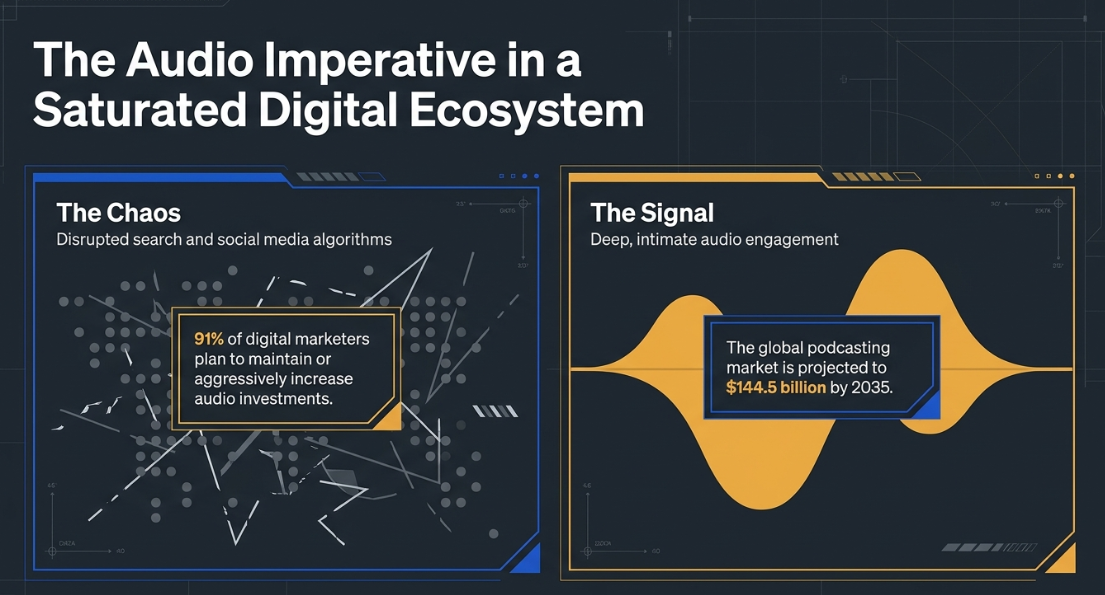
However, the rapid proliferation of enterprise audio has simultaneously exposed severe structural vulnerabilities in how organizations build, manage, fund, and measure these digital assets. When marketing departments treat corporate podcasts merely as auditory advertisements, or when they optimize primarily for vanity metrics such as aggregate download counts over qualified account engagement, the resulting shows often contribute absolutely nothing to actual revenue growth.2 This operational misalignment manifests in predictable patterns: marketing teams create shows centered around generic industry trends when the sales apparatus desperately requires access to specific enterprise buyers, or they interview consultants and authors when they should be strategically building relationships with high-value potential customers.2
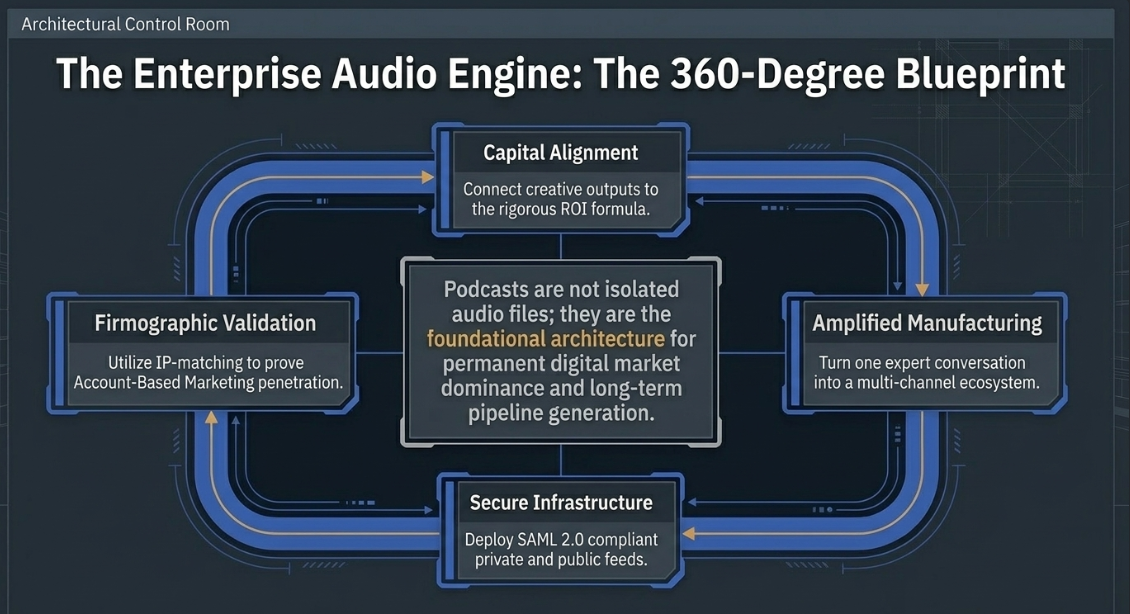
Strategic podcast marketing necessitates a fundamental paradigm shift in corporate thought. An enterprise podcast must no longer be viewed as merely an audio file hosted on an RSS feed; rather, it represents the foundational raw material for a comprehensive, 360-degree marketing and distribution engine. It serves as a continuous, high-yield manufacturing line for multimedia content, systematically powering sales enablement, customer success initiatives, internal communications, and rigorous lead generation architectures.3 To successfully execute this operational transition, organizations must first build a bulletproof business case that aligns flawlessly with the financial realities and accounting standards of the Chief Financial Officer. Subsequently, they must construct an operational plan grounded in highly realistic production economics, deploy an integrated and secure enterprise technology stack, and leverage advanced firmographic analytics to prove undeniable corporate value.
The Financial Realities and the CFO Perspective: Architecting the Business Case
A recurring, systemic bottleneck in the widespread adoption of enterprise audio is the deep structural and philosophical disconnect between creative marketing departments and corporate finance teams. During annual corporate budget planning cycles, marketing leaders frequently pitch creative concepts, high-profile guest lists, and elevated production quality, whereas finance departments demand a direct, mathematically sound line to bottom-line profitability.4
The Capital Expenditure Paradox and the Trust Crisis
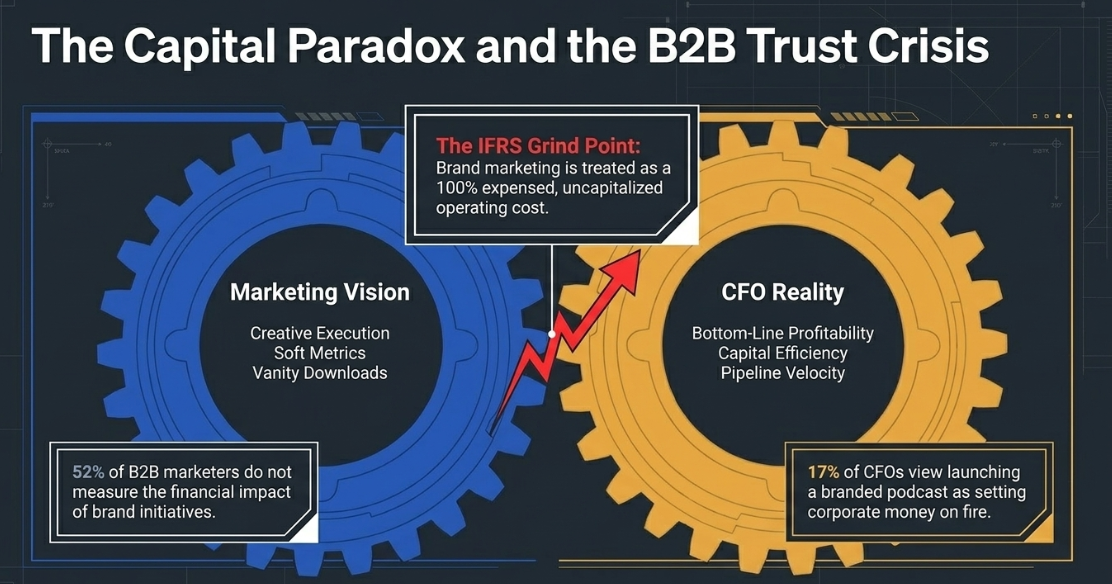
The friction between marketing and finance is deeply rooted in global accounting standards. Under current International Financial Reporting Standards, marketing initiatives are rigidly treated as short-term operating expenses rather than long-term capital expenditures.4 Because these marketing expenses must be fully recognized and 100% expensed in the fiscal year they are incurred, internally generated brand assets—such as a proprietary podcast network—cannot be capitalized on the corporate balance sheet.4 Consequently, when a corporation faces macroeconomic pressure to hit near-term profitability targets or satisfy shareholder demands, cutting the marketing budget immediately and artificially boosts paper profits.4
This accounting reality is severely exacerbated by a pervasive, industry-wide trust crisis within business-to-business marketing itself. According to a comprehensive Wynter report that surveyed 100 marketing leaders at enterprise companies generating over $50 million in annual revenue, an alarming 43% of marketing leaders actively distrust their own brand data, 11% harbor rapidly growing doubts regarding their attribution models, and 52% admit they do not measure the financial impact of their brand initiatives at all.5 Without highly reliable data linking brand activities directly to business outcomes, it is entirely logical that up to 17% of Chief Financial Officers view the initiation of a branded podcast as essentially setting fire to company money.4
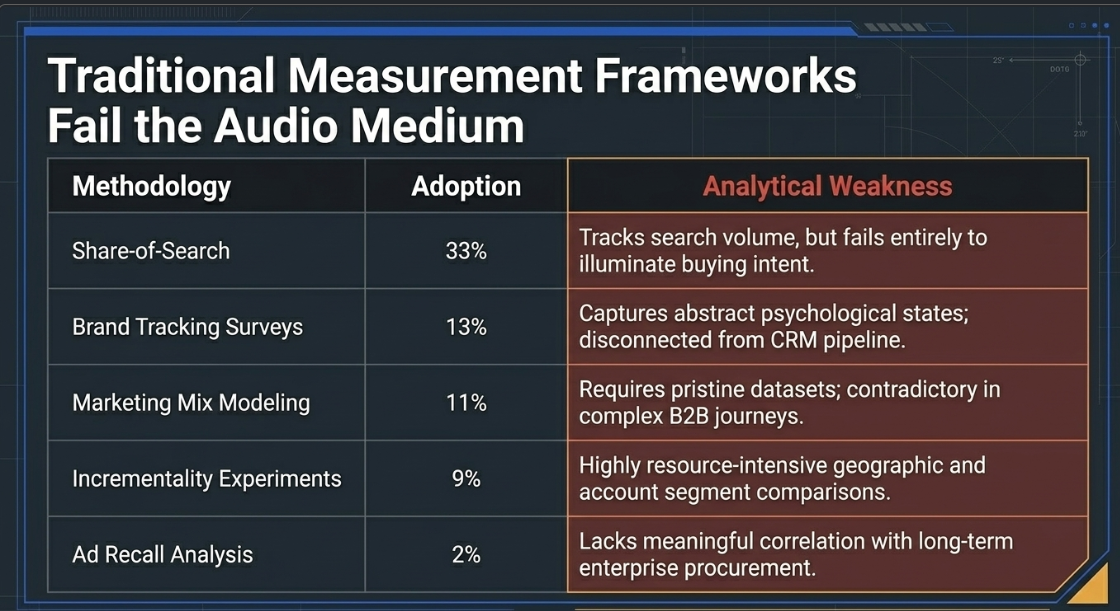
To secure budgetary approval in this skeptical environment, the internal corporate narrative must aggressively pivot away from soft metrics and creative execution, refocusing entirely on pipeline velocity, customer acquisition economics, and direct financial returns. The measurement mechanisms currently deployed by enterprise teams are often highly fragmented and analytically weak, leading to profound misallocations of capital
The Day-1 Shortlist Phenomenon and Pipeline Influence
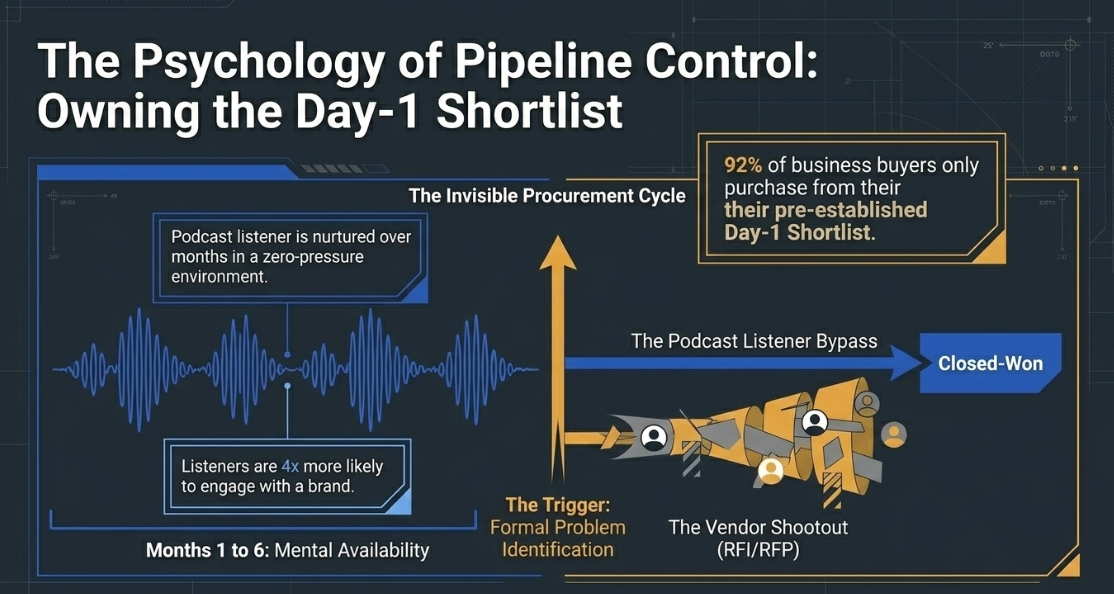
The ultimate financial justification for enterprise audio lies in its unparalleled ability to generate "mental availability" at scale. The aforementioned Wynter report highlights a foundational truth of enterprise procurement that connects brand directly to pipeline: 92% of business buyers only purchase from their pre-established "day-1 shortlist".5 By the time a corporate prospect formally requests a software demo or engages a sales representative, the vendor selection is essentially already predetermined. The prospect's shortlist was decided long before the vendor even knew the account was actively shopping. Strategic brand marketing—spearheaded by high-trust, intimate mediums like podcasting—is precisely what creates this critical mental availability, ensuring that buyers instinctively think of the brand before they formally identify a problem and initiate systemic research.
While 72% of software marketers focus heavily on top-of-funnel awareness, being famous is entirely meaningless if the brand is not ultimately purchased.5 Podcasts actively bridge this awareness-to-consideration gap. A rigorous 2022 Podcast Engagement Study demonstrated that listeners are up to four times more likely to engage with a brand after tuning into its podcast, signifying a direct, causal correlation between deep audio engagement and high-value consumer action.6 For example, when enterprise brands deliberately position their podcasts as highly educational masterclasses rather than thinly veiled sales pitches, they seamlessly transition buyers from mere passive awareness into active, high-intent consideration.7 This transition directly translates to a highly measurable increase in Request for Proposal invites, which directly lead to more qualified opportunities and closed-won deals, thereby providing the CFO with the exact pipeline velocity metrics they require.
Structuring the Mathematical ROI Architecture
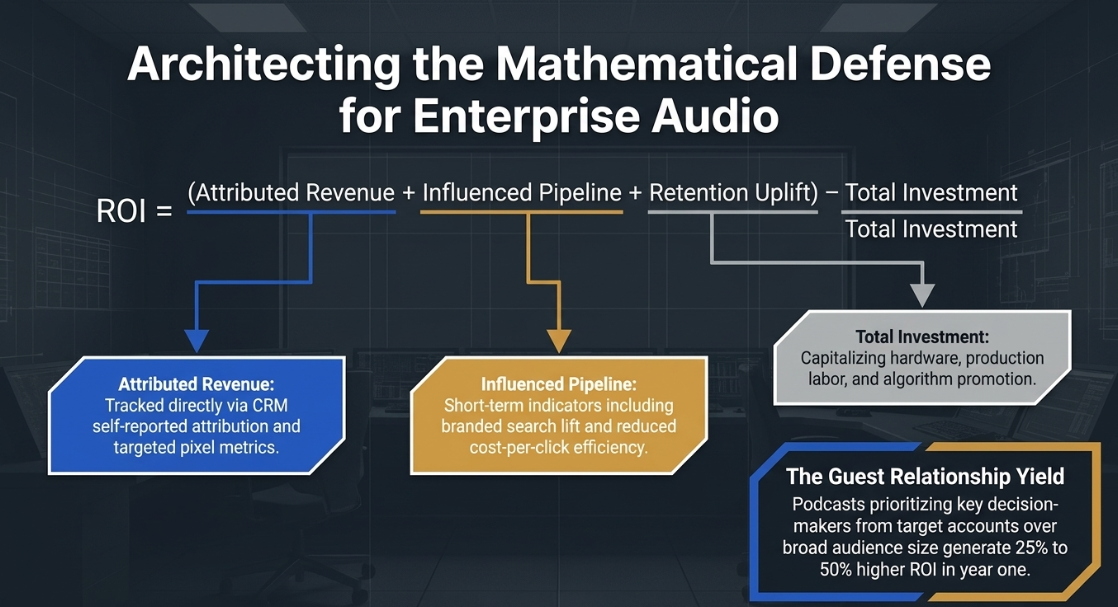
To successfully speak the language of corporate finance, marketing leaders must present sophisticated financial models that make intrinsic sense to the C-suite, focusing heavily on metrics like payback periods, incremental returns, ROI projections, and compound enterprise value.5 The true financial return of an enterprise podcast can be calculated and defended using a highly structured, empirical ROI equation:

By connecting these highly measurable business outcomes directly to the total capital investment, the resulting metrics move the CFO's needle rather than merely inflating the marketing department's ego.8 For instance, a basic financial defense model might demonstrate an annual total podcast cost of $30,000 (encompassing equipment, production, distribution, and algorithm promotion) against a podcast-influenced pipeline of $400,000 and directly attributable revenue of $120,000 tied directly to podcast-related commercial activity.9
Furthermore, the strategic orientation and booking philosophy of the podcast directly dictate its ultimate financial yield. A comprehensive analysis of over 100 corporate podcasts revealed a staggering finding: shows that deliberately prioritize guest relationships—such as inviting key decision-makers from target enterprise accounts to be interviewed—over broad, generic audience size consistently generate 25% to 50% higher ROI within their very first year of operation.2
If a highly aggressive CFO demands a proven financial return within a tight six-month window, marketers must not dismiss this request as impossible. Instead, they must propose tracking short-term metrics as highly reliable early indicators of a full 18-to-24-month return cycle.5 These early indicators include direct responses from localized brand campaigns, a measurable lift in branded search conversion rates, distinct improvements in cost-per-click efficiency across digital advertising platforms, and the volume of early pipeline influenced by the audio content.5 Additionally, marketers must actively capture self-reported attribution directly within their Customer Relationship Management systems; when a prospect explicitly states during a sales call that they have been listening to the CEO's podcast for months, that anecdotal data must be rigorously quantified as tangible, measurable evidence of brand impact.
Operational Economics: Structuring the Enterprise Audio Investment
Once the teleological alignment between marketing and finance is achieved and the business case is established, organizations must forcefully confront the operational economics of execution. Podcasting at an enterprise scale requires a highly defined operational plan, structured inter-departmental workflows, and a brutally realistic assessment of both initial capital expenditures and recurring labor costs. The financial commitments vary dramatically based on the production format, the publication frequency, and the strategic decision of whether the operation is insourced internally or outsourced to specialized media agencies.
Production Formats and Baseline Corporate Economics
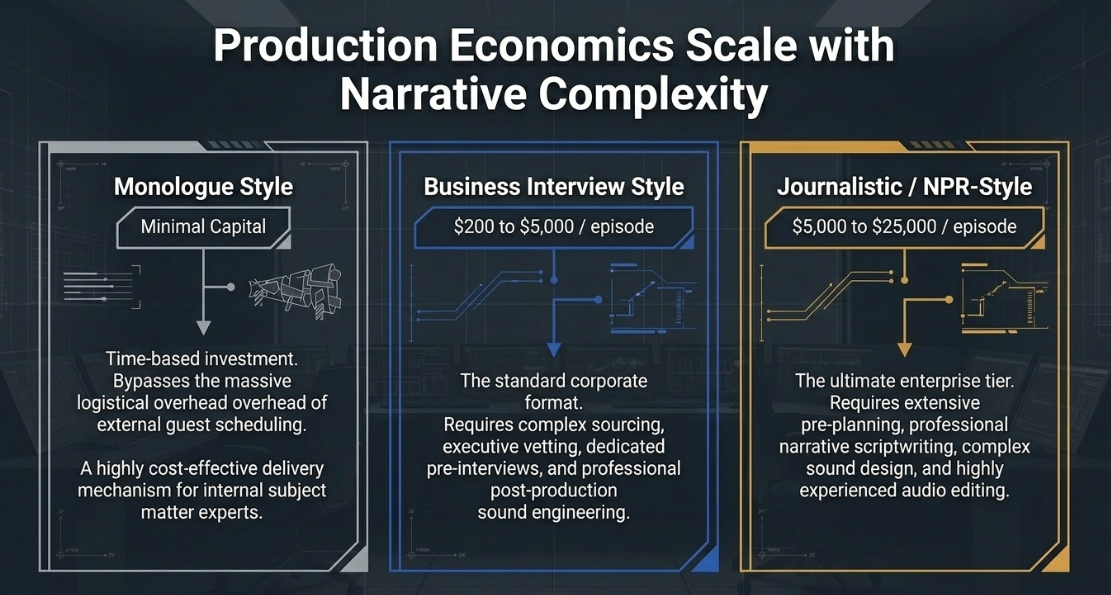
The logistical complexity and narrative depth of the podcast directly correlate with its required production budget. Enterprise shows generally fall into one of three stylistic categories, each demanding vastly different resource allocations and talent requirements:
In-House Media Operations vs. Agency Outsourcing
When determining the execution strategy, enterprises must carefully weigh the fixed costs of internal full-time equivalent headcount against the variable costs of specialized agency retainers. For many companies, podcasting feels like entirely unfamiliar territory, especially regarding accurate cost forecasting.1 While rudimentary podcasting can technically commence at zero cost utilizing basic computer setups and free consumer software, turning a podcast into a serious marketing channel requires an investment profile that closely resembles building a small, professional media operation.1
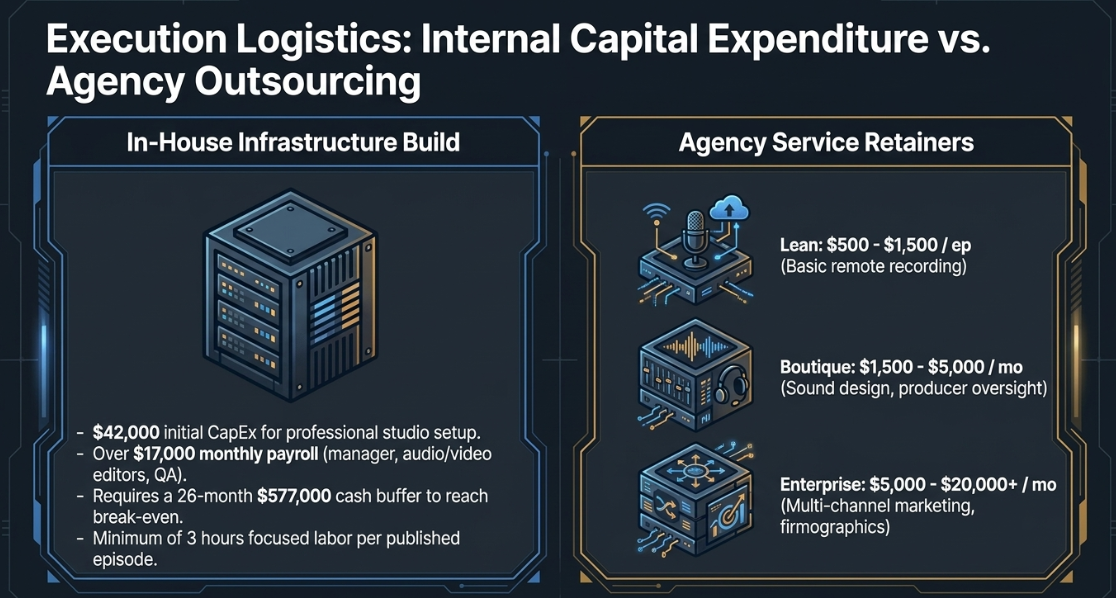
Running an internal podcasting operation typically requires a monthly operational budget ranging from $1,000 to $8,000, assuming the pre-existence of baseline corporate infrastructure.1 However, scaling an in-house podcast requires the allocation of an internal podcast manager—a role with typical market salaries ranging from $50,000 to over $90,000 annually—to coordinate guest scheduling, manage high-fidelity recordings, and seamlessly oversee the entire production pipeline.1 Consistently publishing a professional-grade show necessitates a dedicated team of specialists. The granular labor economics of this team include a podcast producer ($200 to $5,000 per episode), an audio editor to balance sound levels and integrate music ($40 to $1,500 per episode), a video editor specifically for social media clips ($40 to $300+ per video), writers for promotional assets like show notes and deeply researched blogs ($25 to $1,000 per asset), a graphic designer for custom thumbnails ($5 to $100 per episode), and Quality Assurance personnel ($18 to $50 per hour).1 The publishing and coordination process alone consumes a minimum of three hours of highly focused labor per episode.
For many enterprises, the operational burden of managing this multimedia manufacturing line is simply too severe, detracting from core business functions. Consequently, outsourced agency solutions are highly favored. These agencies typically cost between $2,000 and $20,000+ per month, depending heavily on the scope of services provided.1 They assume the entire operational burden, encompassing guest sourcing, pre-interview preparation, remote equipment setup, directory submissions, sound design, social media promotion, and final publishing.1
The cost structure for business-to-business podcast agencies is generally categorized into distinct service tiers tailored to specific corporate needs:
Capital Expenditure and Advanced Equipment Economics
While free tools exist, professional setups require dedicated hardware investments. Standard startup hardware includes professional USB microphones ($130 to $170), high-fidelity recorders ($200), complex audio interfaces ($100 to $200+), and acoustic accessories like boom arms and pop filters ($20 to $100).1 Software licensing for professional recording and editing platforms, such as Adobe Audition, adds ongoing variable costs averaging $20.99 per month, while enterprise-grade podcast hosting platforms typically average around $15 to $100 per month.1
Furthermore, if an enterprise decides to aggressively build its own internal production studio facility, or if a corporate media company is launching a dedicated podcast production service arm, the financial model requires significant upfront capitalization. The initial capital expenditure for a professional studio setup and workstations can easily reach $42,000.13 Running a scaled production operation involves significant monthly operating expenses, starting around $25,000 to $30,000, driven primarily by staff payroll exceeding $17,000 per month.14 Due to high customer acquisition costs—which can start at $500 in year one—and the extensive time required to achieve ultimate profitability, such operations require incredibly tight management of software licenses and variable contractor fees, often necessitating a minimum cash buffer of $577,000 to sustain the business through 26 months of negative cash flow until achieving a projected break-even point.
The 360-Degree Marketing and Distribution Engine: The Amplified Framework
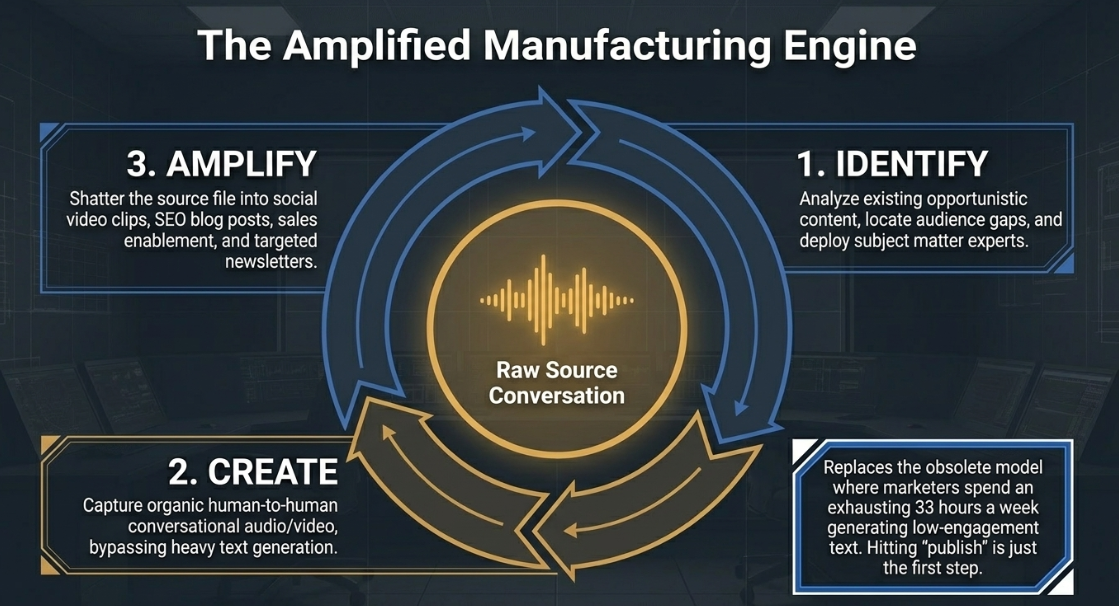
A fundamental, devastating error in traditional enterprise audio strategy is treating the podcast's publication to an RSS feed as the logical conclusion of the workflow. In reality, hitting "publish" is merely the rudimentary first step. The modern digital paradigm requires a massive operational shift from isolated content creation toward "Amplified Marketing"—a strategic, highly systemized framework where foundational expert conversations are systematically dismantled, repurposed, and distributed across a 360-degree content engine.
The Casted Amplified Marketing Playbook
Traditional content marketing strategies often severely burden content writers with ghostwriting high-volume, text-heavy materials optimized purely to rank high on search engine results pages, rather than genuinely connecting with human customers.3 This outdated approach frequently leads to massive marketer burnout and a generic "content void," with content creators spending an exhausting average of 33 hours a week merely generating low-engagement text.3 The Amplified Marketing framework, championed extensively by platforms like Casted, entirely upends this obsolete model by placing human-to-human conversations at the absolute center of the corporate content strategy.15
This comprehensive framework organizes multimedia content execution into three highly integrated operational phases:
Identify (Audience, Experts, Assets): Before any recording apparatus is activated, marketers meticulously define exactly who the content is for, deeply understanding the audience's preferences to build high credibility. They then pinpoint subject matter experts who can authoritatively address those topics. Crucially, the strategy involves a 360-degree review of all existing digital assets. By utilizing an Amplified Marketing Platform, enterprises track existing content to quickly search and resurface older items using metadata tags. They identify "opportunistic content"—topics demonstrating high traffic but low conversion, or low traffic but high conversion—ensuring that new audio content fills highly strategic, proven market gaps.3
Create (Audio, Video, Written Content): Instead of forcing marketing generalists to synthesize and write about highly technical topics they do not deeply understand, the strategy relies on capturing organic conversations with real industry experts. Utilizing highly simplified video and audio recording setups, the enterprise captures the foundational source material, completely bypassing the need for a hyper-expensive studio.3
Amplify (Omnichannel Distribution): Amplification is the mechanism where the foundational multimedia content is sliced, diced, and distributed across all channels. An hour-long conversation is transcribed and systematically wrung out into smaller, bite-sized assets. A single podcast episode generates a massive multimedia ecosystem: full-length videos, short-form social media clips, highly detailed blog posts, internal enablement materials, and specialized email newsletters.3 This process adds exponential value to the corporate bottom line, dramatically easing the content workload, and ensuring the enterprise maximizes the absolute ROI on its creative investments without starting from scratch for every campaign.16 Furthermore, content is distributed internally so sales and customer success teams can utilize these precise audio clips directly in their day-to-day operations.3
The PESO Model and Algorithmic Distribution
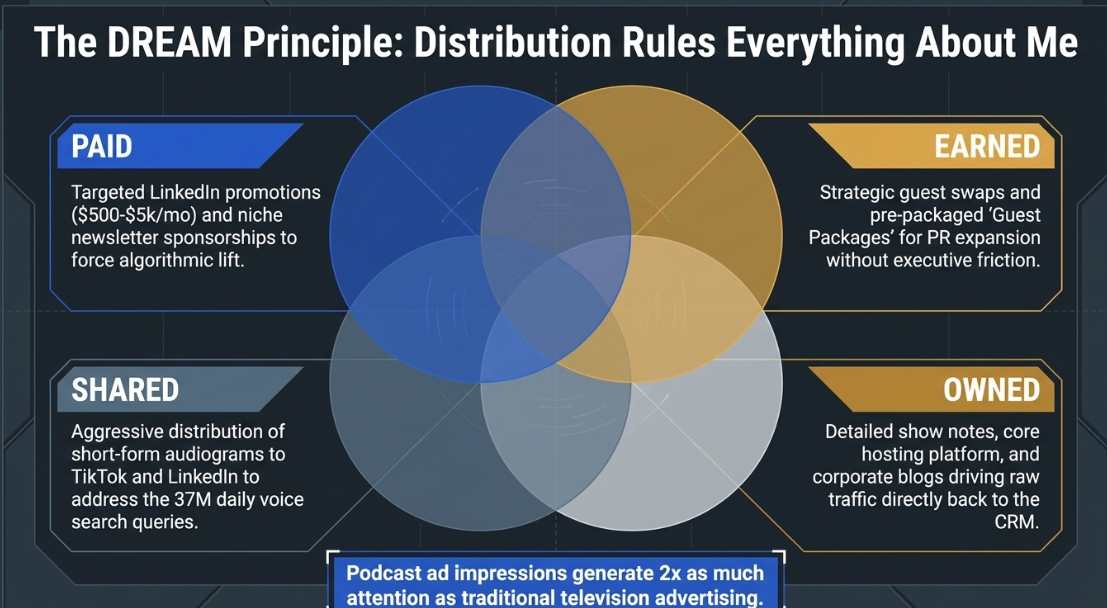
To operationalize this amplification engine at an enterprise scale, organizations seamlessly align their podcast assets with the PESO model, a foundational public relations framework defined in 2014 by Gini Dietrich that categorizes marketing channels into four deeply integrated pillars: Paid, Earned, Shared, and Owned media.17
Owned Media: The core podcast platform, website show notes, and corporate blogs where the brand exerts absolute control over the narrative.17
Shared Media: The aggressive distribution of bite-sized video and audiograms across highly algorithmic social platforms. With two in five internet users already utilizing platforms like TikTok for search, and ChatGPT recording 37 million queries daily, brands must maintain a 360-degree presence across these shared ecosystems.17
Earned Media (PR and Outreach): Leveraging guest networks. By executing strategic guest swaps and cross-promotions with other prominent shows, brands tap into massive established audiences. Providing guests with pre-packaged "Podcast Guest Packages" minimizes friction and ensures high-quality amplification across the guest's unique networks without creating additional labor for the executive.18 After a client appears on a podcast, public relations teams turn their appearance into external articles and newsletters, giving followers a 360-degree view of their expertise.19
Paid Media: Utilizing paid LinkedIn promotions (ranging from $500 to $5,000 per month) and highly targeted podcast ad placements or newsletter sponsorships (costing $200 to $3,000 per campaign) to algorithmically boost the reach of the organic audio assets.1
This entire distribution philosophy is perfectly encapsulated in the "DREAM" principle: Distribution Rules Everything About Me.18 In an incredibly noisy digital environment, even the absolute highest-quality audio asset will fail without rigorous, algorithmic, and social distribution. By designing for impact prior to scaling—what industry experts term the "Creator Engine Framework"—brands co-create narratives with industry influencers early in the process, nailing down Key Performance Indicators before execution, ensuring their content resonates natively across diverse media landscapes rather than merely pushing finished corporate briefs onto creators.
Furthermore, the raw engagement potential of these audio assets is vastly superior to traditional corporate media. According to Forrester's The Podcast Advertising Inflection Point report, podcast ad impressions generate twice as much attention as traditional television advertising.21 Because podcasters command immense, intimate trust—eight in ten listeners explicitly trust host recommendations on products and services—enterprises that leverage this attention through a 360-degree strategy effectively hack the traditional business-to-business sales cycle.21 Brands like Gabb, a "kid-safe tech" company, explicitly utilize this model to reach highly attentive parents, proving that podcasts perform exceptionally across the full marketing funnel.21 As voice search continues to dominate—with up to 40% of search traffic occurring via voice, rendering Google's "first page" irrelevant for those queries—a true 360-degree view of the customer must inherently incorporate massive audio architectures.22
The Enterprise Tech Stack and Highly Secure Audio Infrastructure
As audio content scales globally, corporate workflows inevitably become highly fragmented. IT teams are frequently left supporting an environment built reactively rather than intentionally, leading to a sprawling software pile that actively slows workflows, creates massive data silos, and introduces severe security vulnerabilities.23 A strong, robust tech stack must be evaluated not only for its immediate feature set but for its deep integration capabilities, long-term scalability, and rigorous cybersecurity posture.23 The strategic imperative is seamless, API-driven interoperability—connecting CRM systems, Enterprise Resource Planning (ERP) platforms, financial automation tools like Plooto, and media hosting platforms to ensure data continuity and workflow automation.24 This interoperability is achieved through advanced data architectures utilizing DevOps, CI/CD pipelines, containerization, and continuous metadata management.25
The Strict Requirements for Private Enterprise Podcasting
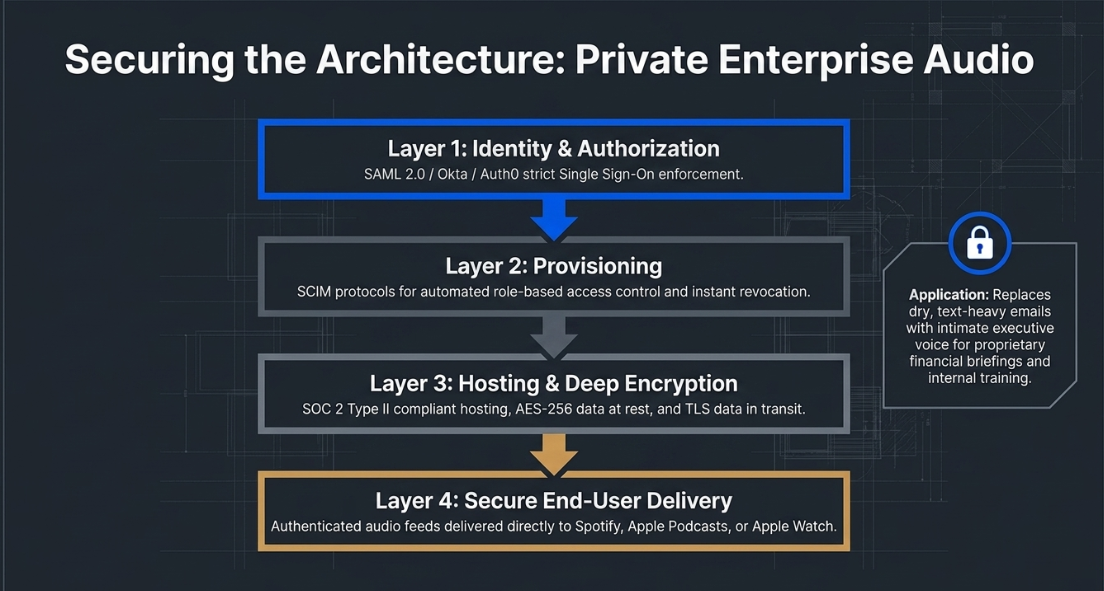
While public-facing marketing podcasts aim for maximum global reach through open RSS feeds distributed across major directories like Apple Podcasts and Spotify, a massive and growing segment of enterprise audio is dedicated strictly to internal communications, secure employee engagement, and private partner networks. Private podcast hosting revolutionizes internal corporate communication by replacing dry, text-heavy emails with the highly humanizing, intimate element of executive voice, often with plans starting around $150 a month.27
A standard public podcast platform severely lacks the essential customization, compliance, and security guardrails necessary for distributing highly sensitive corporate information, such as quarterly financial briefings or proprietary training modules.29 Consequently, enterprises must deploy specialized private podcast platforms—such as uStudio, Hypecast, or Supporting Cast—that integrate directly and seamlessly into the corporate security apparatus.29 These platforms provide authenticated, encrypted feeds that surface securely inside the consumer listening apps employees already use, such as Spotify, Apple Podcasts, Android Auto, and Apple Watch.30
To successfully pass stringent corporate IT, legal, and procurement audits, private podcasting platforms must support highly robust identity and access management protocols. Critical technical requirements include:
SAML 2.0 and Single Sign-On (SSO): Deep integration with enterprise identity providers like Okta and Auth0 ensures that only fully authorized personnel can access the audio content.27
SCIM User Management: Enables highly automated user provisioning and role-based access control, ensuring that content access is revoked instantaneously the moment an employee leaves the organization or changes departments.29
Compliance and Deep Encryption: Enterprise audio providers must rigorously maintain SOC 2 Type II or ISO 27001 certifications, utilize standard Data Processing Agreements (DPAs) for absolute GDPR compliance, and deploy robust, military-grade encryption for data in transit (TLS) and data at rest (AES-256).30
Auditability and Enterprise Analytics: The platform must provide transparent cryptographic key management, comprehensive audit logs tracking every login and role change, and advanced API integrations into preferred Business Intelligence tools (such as Tableau, Power BI, or Workday) to track highly granular employee engagement data.29
This highly secure infrastructure allows massive enterprises like AT&T, Procter & Gamble, General Electric, Dropbox, DHL, and L'Oréal to operate immense internal podcast networks safely.30 For example, Howdens Kitchens utilized expertly produced private internal podcasts to create a deeply embedded culture of sharing depot tips and operational tricks, giving their massive corporate business a highly local, intimate feel.32
Advanced Measurement and Firmographic Intelligence Analytics
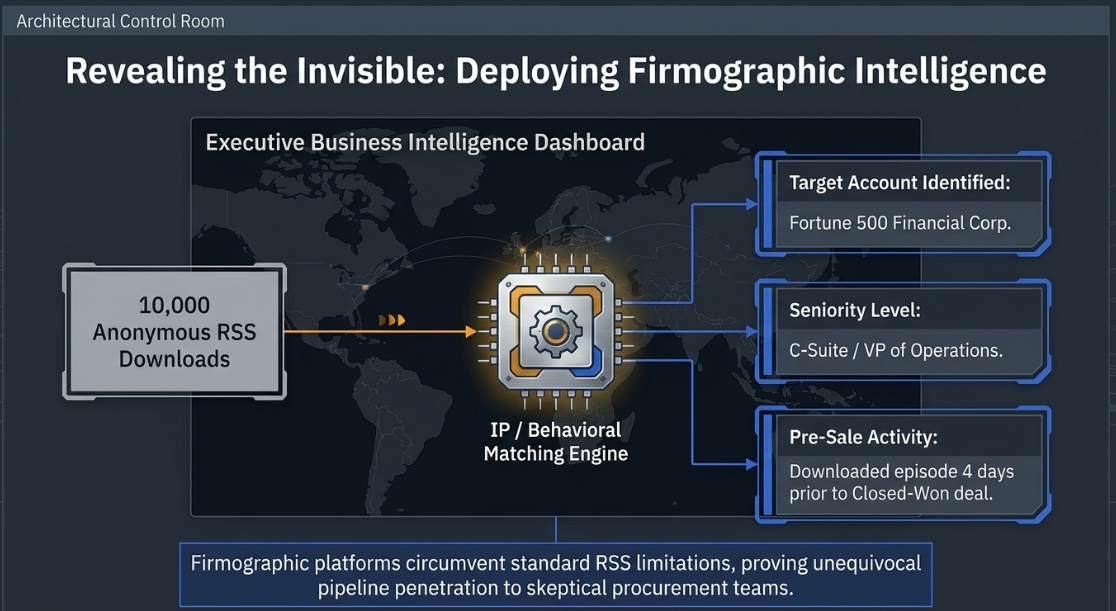
The ultimate operational challenge for the enterprise podcast remains accurate, revenue-tied measurement. Because podcasting fundamentally utilizes an open RSS distribution standard established over two decades ago, native attribution technology remains notoriously imprecise. Standard public podcast hosting platforms provide only highly basic analytics, such as global download figures, device types, and broad listener geography.12 However, they cannot inherently identify exactly who is listening, what specific company they work for, or whether they eventually purchased the enterprise software.12 For business-to-business demand generation and Account-Based Marketing teams, a vanity metric of 10,000 anonymous global downloads is virtually useless for calculating true pipeline impact.
The Deployment of Firmographic Intelligence
To rigorously justify the business case, enterprise marketing leaders deploy highly advanced, third-party analytics solutions that provide deep firmographic intelligence. Platforms like CoHost (developed as a highly independent analytics layer by the specialized podcast agency Quill) completely circumvent standard RSS limitations by identifying the specific business demographics of the podcast audience.12 Firmographic tools match listener IP addresses and highly complex behavioral data against global business databases to definitively reveal:
The specific target companies actively consuming the podcast.
The exact seniority levels and job functions of the listeners within those organizations.
The overarching industries engaging deeply with the audio content.12
By integrating this pristine firmographic data directly into standard Business Intelligence dashboards and utilizing it during Quarterly Business Reviews, B2B podcast agencies can directly and unequivocally prove to skeptical procurement and finance teams that the podcast is successfully penetrating designated target accounts.12 When a vendor can mathematically demonstrate that a highly specific podcast episode was downloaded by key C-suite decision-makers at a target enterprise mere days prior to a closed-won deal, the strategic audio asset is permanently validated.
Attribution Modeling and Qualitative Triangulation
Beyond raw firmographics, highly sophisticated marketing operations utilize a complex constellation of tracking tools to triangulate ROI. Solutions like Podsights are aggressively deployed to track pixel-based attribution, explicitly measuring how many listeners of a specific podcast episode subsequently visit the corporate domain to explore product features.33 Furthermore, tracking tools like Chartable evaluate the precise efficacy of cross-promotions by tracking the exact volume of listener migration between integrated audio shows.33
However, the industry's most sophisticated and honest operators readily acknowledge that quantitative tracking technology remains inherently imperfect. Consequently, high-level podcast measurement still relies heavily on the rigorous tracking of qualitative indicators. Meticulously monitoring social media sentiment, analyzing highly detailed listener reviews on Apple Podcasts, checking in on how supported the hosts feel, and meticulously cataloging direct self-reported attribution generated during live sales calls remain absolutely vital barometers of financial success.33
Monumental Paradigm Shifts: B2B Media Networks and Enterprise Case Studies
The rapid maturation of the 360-degree audio engine and the deployment of advanced measurement frameworks have catalyzed a profound, industry-altering paradigm shift: major B2B enterprises are no longer viewing themselves merely as content marketers; they are rapidly evolving into proprietary, global media networks. Recognizing that third-party data tracking (such as internet cookies) is rapidly degrading due to privacy regulations, industry titans are aggressively constructing massive, fully owned media ecosystems to aggregate highly attentive, first-party data directly from their target audiences.
The HubSpot Podcast Network Architecture
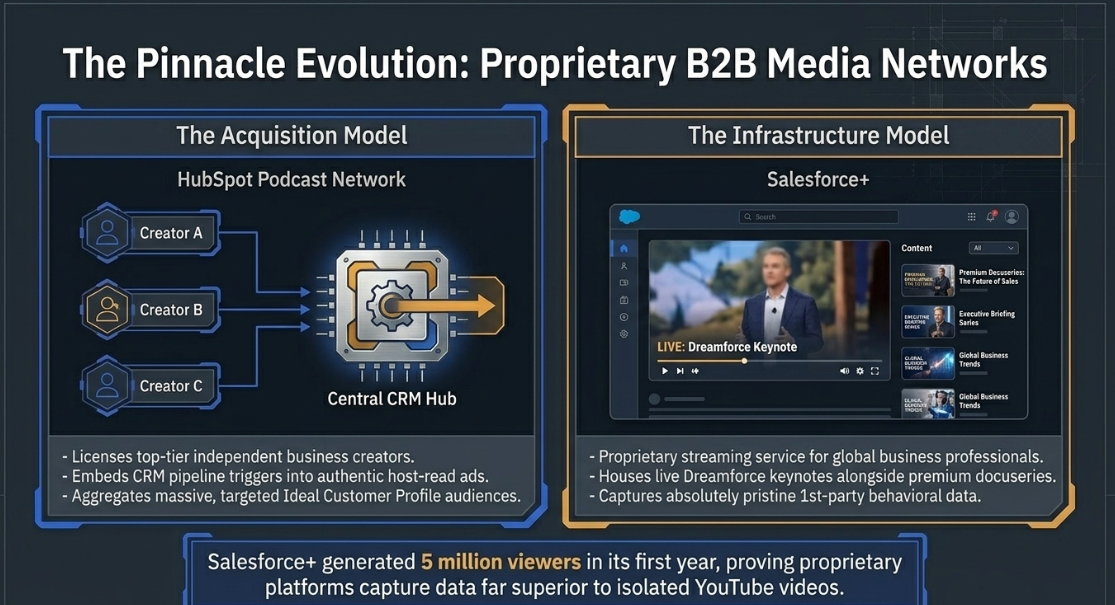
A premier, highly instructional case study of this media evolution is the HubSpot Podcast Network. Seeking to aggressively expand its top-of-funnel reach, HubSpot did not simply launch a single branded show. Instead, it systematically built a vast, interconnected audio destination for business professionals by licensing and acquiring top-tier, independent business podcasts.33
The operational genius of the HubSpot model lies in its mutually beneficial, symbiotic ecosystem. HubSpot meticulously identifies exceptional creators who already command massive audiences within its target Ideal Customer Profile.33 Through highly structured licensed agreements, HubSpot provides these independent creators with massive financial backing, cross-promotional pollination programs, and matching funds to amplify their marketing budgets across platforms like Facebook.33 In return, HubSpot secures highly authentic, deeply customized host-read advertisements that direct highly qualified traffic straight to its CRM ecosystem.33
Rather than pushing disruptive, hard-sell ads, the network embodies HubSpot's core inbound marketing philosophy—providing immense, free educational value to earn trust and mental availability at an industrial scale.33 The network features powerhouse shows like Entrepreneurs on Fire, Business Infrastructure, and Marketing Against the Grain (hosted by HubSpot executives Kipp Bodnar and Kieran Flanagan, designed to take listeners behind the scenes of digital marketing trends).34 Following their highly strategic acquisition of The Hustle, HubSpot further secured its pipeline by launching a Creators Program, acting essentially as a creative startup incubator to cultivate the next generation of diverse, emerging B2B audio talent who do not yet possess massive reach.
Salesforce+: The Proprietary B2B Streaming Service
Salesforce took the proprietary media network concept exponentially further by launching Salesforce+, a highly polished, free, unlimited streaming service specifically engineered for global business professionals.36 Designed aggressively to fight for attention amid economic headwinds and radically change how Salesforce engages prospects, Salesforce+ aims to deliver content that simultaneously educates, entertains, and inspires, actively and intentionally rejecting the obsolete paradigm of "boring B2B videos".38
Salesforce+ acts as the ultimate intersection of enterprise technology, corporate culture, and digital community. It serves as the central broadcasting hub for massive global live-streamed events like Dreamforce, Tableau Conference, and Agentforce World Tours, while simultaneously offering dozens of highly produced original on-demand series.36 Notable premium programming includes The Shift (a first-of-its-kind docuseries co-produced with NBCUniversal and CNBC Brand Studio highlighting corporate digital transformation across five countries), The Ecopreneurs, deep-dive executive interviews like The Pivot with Kara Swisher and Scott Galloway, and highly practical "how-to" product training modules covering Apex coding and Lightning Web Components.38
By operating its own proprietary streaming infrastructure, Salesforce captures absolutely pristine first-party behavioral data. Granular analytics reveal fascinating cross-content navigation patterns, explicitly proving that users who log on to watch a massive live keynote will frequently stay on the platform to engage with highly tactical, micro-level product videos within minutes.38 In its first year alone, the service reached a global audience of 5 million viewers and aired over 300 episodes, proving that the content is incredibly "sticky" and successfully drives vastly deeper user journeys than isolated YouTube videos.38
Slack, Shopify, and the Architecture of Long-Term Relationships
The immense financial efficacy of nuanced, top-of-funnel audio strategies is further evidenced by early enterprise pioneers like Slack and Shopify, both of which partnered closely with the premium audio production company Pacific Content.
Shopify's TGIM (Thank God It's Monday) and Slack's Variety Pack completely eschewed direct, aggressive product pitches in favor of highly produced, magazine-style storytelling.39 TGIM targeted ambitious, global entrepreneurs with highly motivational business stories, utilizing an incredibly soft branding approach where Shopify was merely the subtle presenter of the content, rather than the explicit subject.39 By utilizing highly comprehensive show notes in iTunes to direct listeners seamlessly to deeper, actionable content on the Shopify blog (such as free, downloadable financial cash flow planning spreadsheets), they effectively transitioned listeners from a highly passive audio environment into the active, monetizable Shopify software ecosystem.39
Slack's highly strategic approach perfectly mirrored the famous "Red Bull" model of branded media—creating exceptionally high-quality content that epitomized the brand's culture of workplace innovation, while maintaining a very light touch regarding the communication software itself.39 By aggressively leveraging the inherent emotional intimacy of the podcast medium, Slack provided a premium, trust-building "first touch" to millions of potential customers, ultimately generating over 4.5 million downloads for the Variety Pack and permanently cementing its cultural dominance in the global technology sector.
Validating Operational Scale and Crisis Management
The strategic viability of working with highly optimized agency partners is definitively demonstrated by the massive Meta case study executed by the agency Content Allies. Tasked with driving deep, sustained engagement within a highly complex, globally distributed enterprise environment, the agency systematically delivered 170,000 downloads within a highly compressed six-month period, exceeding the initial corporate target by a staggering factor of seven.12 Surviving the incredibly demanding procurement audits of a corporation like Meta, while simultaneously integrating advanced firmographic analytics like CoHost to mathematically prove audience quality, validates that enterprise podcasting can scale massively when supported by rigorous operational infrastructure.12
Similarly, other highly successful branded implementations demonstrate the extreme versatility of the medium. Morgan Stanley successfully utilized the agency StudioPod to launch Thriving Globally with Equity, while the software company Buffer launched a highly successful narrative podcast that completely repositioned them as the definitive voice of small business owners.32 Enterprise audio even serves as a highly potent crisis management and public relations tool, as perfectly demonstrated by McDonald's The Sauce podcast, which brilliantly turned a severe PR crisis regarding a Szechuan sauce shortage into a massive engagement opportunity by providing total, behind-the-scenes transparency to their consumers.41 Furthermore, organizations like Planful utilized platforms like Casted to seamlessly virtualize in-person events, creating massive fountains of audio content that helped them deeply understand the precise challenges their CFO clients were facing.
Strategic Conclusions on the Future of Enterprise Audio
The overwhelming volume of empirical data, rigorous financial modeling, and massive corporate case studies clearly indicate that enterprise audio is no longer a peripheral, experimental brand exercise; it is a vital, multi-dimensional, and highly operational mechanism for permanent digital market dominance. As digital marketing ecosystems continue to evolve at breakneck speed, and business-to-business buyers increasingly rely on highly self-directed research to form their critical day-1 shortlists, organizations that fail to cultivate deep, trust-based mental availability through human voice will face rapidly escalating customer acquisition costs and severely diminished pipeline velocity.
To fully capitalize on this highly intimate medium, executive corporate leadership must completely abandon the antiquated, epistemological notion that podcasts are simply isolated audio files measured by aggregate, anonymous downloads. Instead, the modern enterprise must view the corporate podcast as the central, beating nexus of a massive, 360-degree Amplified Marketing engine. By capturing highly authentic, deeply insightful expert conversations, organizations can sustainably manufacture an immense, continuous volume of optimized, multi-format media assets, effectively driving owned, earned, and shared distribution channels without exhausting their marketing personnel.
Simultaneously, the financial justification and operational execution must be brutally rigorous. The strict integration of firmographic measurement platforms directly links audio engagement to CRM pipeline acceleration, providing the exact, tangible ROI data required to appease highly skeptical corporate finance departments and transition marketing budgets from highly vulnerable short-term operating expenses to indispensable, capital-like business assets. Whether executed through highly targeted private feeds secured by sophisticated identity management protocols, or through the incredibly ambitious construction of proprietary global streaming networks like Salesforce+ and the HubSpot Podcast Network, enterprise audio has unequivocally cemented its position as the premier operational architecture for long-term customer relationships, pipeline generation, and enduring digital market share.
Works cited
How Much Does Podcasting Cost? A Guide for B2B Companies ..., accessed June 11, 2026, https://contentallies.com/learn/how-much-does-podcasting-cost-for-b2b-companies
The Definitive Guide To Measuring B2B Podcast ROI And Pipeline ..., accessed June 11, 2026, https://www.fame.so/post/measuring-b2b-podcast-roi-and-pipeline
Amplified Marketing Playbook | Multimedia Content Marketing - Casted, accessed June 11, 2026, https://www.casted.us/blog/amplified-marketing
The enterprise podcast budget: production costs vs. strategic ROI, accessed June 11, 2026, https://pendium.ai/jarpodcasts/the-enterprise-podcast-budget-production-costs-vs-strategic
The state of B2B SaaS brand marketing - Wynter, accessed June 11, 2026, https://wynter.com/post/the-state-of-b2b-saas-brand-marketing
The ROI of Branded Podcasts in Marketing: The Untapped Goldmine, accessed June 11, 2026, https://jarpodcasts.com/roi-of-branded-podcasts-in-marketing/
The Power of the Branded Podcast - Bengo Media, accessed June 11, 2026, https://bengomedia.com/the-power-of-the-branded-podcast/
accessed June 11, 2026, https://www.fame.so/post/ultimate-guide-to-measuring-b2b-podcast-roi#:~:text=B2B%20podcast%20ROI%20is%20%5B(,needle%2C%20not%20just%20marketing's%20ego.
The ROI of B2B Podcasting: Metrics That Matter for Business Growth - Content Allies, accessed June 11, 2026, https://contentallies.com/learn/roi-b2b-podcasting-metrics
B2B Podcast Production Cost: 2026 Pricing Guide - ThePod.fm, accessed June 11, 2026, https://thepod.fm/resources/blog/podcast-production-cost-for-businesses
Outsourcing Podcast Production Costs: Real Pricing, ROI, and What You'll Pay, accessed June 11, 2026, https://www.humanise.live/outsourcing-podcast-production-costs/
Best B2B Podcast Agencies for SaaS Companies 2026 - Upraw Media, accessed June 11, 2026, https://www.uprawmedia.com/blog/best-b2b-podcast-agencies-saas-companies
Podcast Production Startup Costs: $42K CAPEX, $577K Runway; - Financial Models Lab, accessed June 11, 2026, https://financialmodelslab.com/blogs/startup-costs/podcast-production
Calculating Monthly Running Costs for Podcast Production Services - Financial Models Lab, accessed June 11, 2026, https://financialmodelslab.com/blogs/operating-costs/podcast-production
What Is Amplified Marketing? - Casted, accessed June 11, 2026, https://www.casted.us/blog/what-is-amplified-marketing
How to Amplify Your Content from Start to Finish - Casted, accessed June 11, 2026, https://www.casted.us/blog/how-to-amplify-your-content-from-start-to-finish
PESO Model: Definition, Examples, and the Role of Data - DinMo, accessed June 11, 2026, https://www.dinmo.com/audience-strategies/acquisition/peso-model/
The 5 Stages of the Podcast Listener Journey | Pivot Six, accessed June 11, 2026, http://pivotsix.com/blog/podcast-customer-journey
Making Podcast PR Part of Your Earned Media Program | Articles on Podchaser, accessed June 11, 2026, https://www.podchaser.com/articles/podcast-insights/making-podcast-pr-part-of-your-earned-media-program
Can influencer marketing work in B2B? (Dave's Newsletter) - Exit Five, accessed June 11, 2026, https://www.exitfive.com/newsletter/can-influencer-marketing-work-in-b2b-daves-newsletter
The Podcast Advertising Inflection Point - Triton Digital, accessed June 11, 2026, https://tritondigital.com/static/7156b187389382045eea2a1ec1f56ea5/The-Podcast-Advertising-Inflection-Point(2).pdf
Reimagine Marketing Podcast Transcripts - SAS, accessed June 11, 2026, https://www.sas.com/en_us/explore/reimagine-marketing-podcast/transcripts-list.html
The Enterprise Tech Stack Is Getting More Complex. Strategy Has to Catch Up. - GCG, accessed June 11, 2026, https://gcgcom.com/technology/the-enterprise-tech-stack-is-getting-more-complex-strategy-has-to-catch-up/
Software Tech Stack Management: From Chaos to Control - Zylo, accessed June 11, 2026, https://zylo.com/blog/tech-stack-management/
Solving Data Interoperability Challenges in Enterprises with Massive Tech Stacks - Witboost, accessed June 11, 2026, https://witboost.com/knowledge-base/solving-data-interoperability-challenges-for-enterprises-with-big-tech-stacks-fmif
How to build an operational tech stack ready to scale with your business - Plooto, accessed June 11, 2026, https://www.plooto.com/blog/how-to-build-an-operational-tech-stack-ready-to-scale-with-your-business
Private Podcast Hosting, accessed June 11, 2026, https://blubrry.com/manual/goals-content-and-format/about-private-podcast-hosting/
Employee Engagement Platforms: What HR Teams Need | Supporting Cast, accessed June 11, 2026, https://www.supportingcast.fm/post/employee-engagement-platform
Private Podcast - uStudio, accessed June 11, 2026, https://ustudio.com/products/private-podcasting/
Private Internal Podcast on Spotify & Apple Podcasts | Hypecast + Supporting Cast, accessed June 11, 2026, https://hypecast.one/integrations/spotify-apple
Top 15 Enterprise Podcast Solutions in 2026 - Content Allies, accessed June 11, 2026, https://contentallies.com/learn/top-enterprise-podcast-solutions
Branded Podcast Case Studies - Message Heard, accessed June 11, 2026, https://messageheard.com/case-studies
HubSpot: How to Build a Podcast Network | Lemonpie, accessed June 11, 2026, https://www.lemonpie.fm/resource/hubspot-network
HubSpot Launches New Podcast Network for Business Professionals to Listen, Learn, and Grow Their Companies, accessed June 11, 2026, https://www.hubspot.com/company-news/hubspot-podcast-network
HubSpot Launches New Podcast with Kipp Bodnar and Kieran Flanagan to Share What's Next in Marketing, accessed June 11, 2026, https://www.hubspot.com/company-news/hubspot-launches-new-podcast-with-kipp-bodnar-and-kieran-flanagan-to-share-whats-next-in-marketing
Salesforce+ Events, accessed June 11, 2026, https://www.salesforce.com/plus
Salesforce+ Original Series and Events for Trailblazers, accessed June 11, 2026, https://www.salesforce.com/plus/experience/discover_agentforce
Salesforce Pushes the Boundaries of Content and Marketing with ..., accessed June 11, 2026, https://www.salesforce.com/in/news/stories/salesforce-plus-one-year-in/
Enter the branded podcast » Strategy, accessed June 11, 2026, https://strategyonline.ca/2016/07/05/enter-the-branded-podcast/
Top 10 B2B Podcast Production Companies for Enterprise Brands in 2026 - Content Allies, accessed June 11, 2026, https://contentallies.com/learn/top-b2b-podcast-agencies-enterprise
The Strategic Power of Branded Podcasts in Modern PR | 5W PR Agency Blog, accessed June 11, 2026, https://www.5wpr.com/new/the-strategic-power-of-branded-podcasts-in-modern-pr/