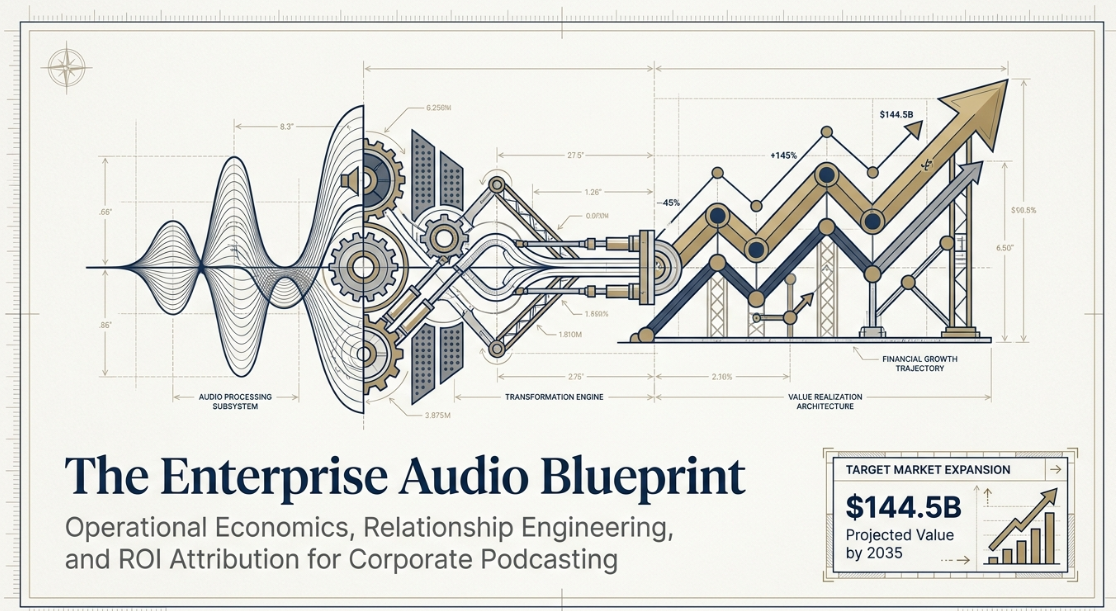
The digital media and corporate communications landscape is currently undergoing a profound structural shift, necessitating a fundamental recalibration of how enterprises approach audio and video broadcasting. For major corporate entities, podcasting has evolved from an experimental, top-of-funnel brand awareness exercise into a highly sophisticated, rigorously measurable channel for relationship engineering, business development, and secure internal communications. With the global podcasting market projected to reach an extraordinary $144.5 billion by 2035, enterprise organizations are increasingly recognizing that audio is no longer a peripheral marketing tactic.1 Rather, it constitutes a core business asset that demands rigorous financial modeling, strategic resource allocation, and advanced operational execution.
The convergence of audio and visual media further complicates this ecosystem. Video content is anticipated to account for 82% of all internet traffic by 2026, and video marketing adoption has correspondingly risen to 91% among businesses.2 Consequently, modern "audio" strategies must intrinsically incorporate visual layers, expanding the operational requirements to encompass lighting, framing, platform-specific editing, and algorithmic search optimization across platforms like YouTube, which currently dominates the market as the most widely used video platform by 82% of marketers.2
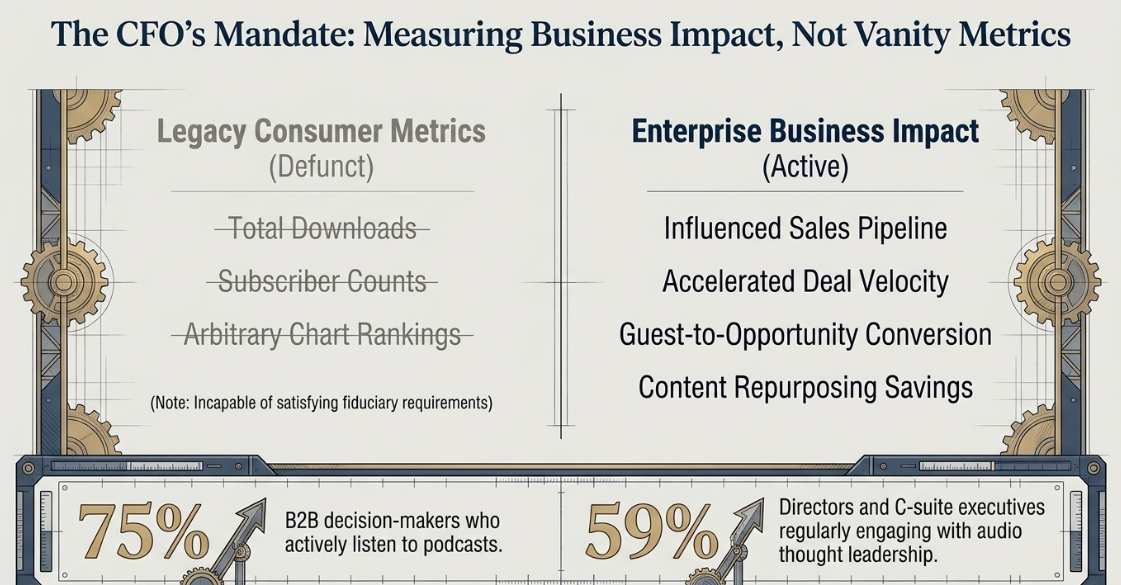
However, the primary barrier to entry for enterprise marketing teams is not technological, but financial and strategic. Translating audio content into measurable business value remains a complex operational challenge. Securing executive sponsorship—particularly from finance teams and the Chief Financial Officer (CFO)—requires moving beyond legacy consumer-focused vanity metrics such as total platform downloads, subscriber counts, or arbitrary chart rankings.3 The modern enterprise business case for audio must meticulously map upfront capital expenditures and ongoing operational costs directly against tangible business outcomes, including influenced sales pipeline, accelerated deal velocity, guest-to-opportunity conversion rates, and comprehensive content repurposing savings.3
This exhaustive analysis details the operational economics underlying enterprise podcasting. By dissecting production pricing tiers, granular resource allocation models, the structural dilemma of in-house versus external agency production, advanced return on investment (ROI) attribution frameworks, and the financial impact of content multiplication, this report establishes a definitive operational plan for maximizing the business value of corporate audio.
The Macroeconomic Shift Toward Enterprise Audio and Relationship Engineering
The foundational economic premise of enterprise podcasting relies on shifting the medium from a broad broadcasting tool to a strategic networking and relationship engineering platform. Traditional content marketing often relies on mass distribution and broad appeal. In stark contrast, B2B podcasting thrives on niche targeting and extreme precision. A show engineered for a general audience frequently fails to generate quantifiable business value; the most lucrative enterprise podcasts are deliberately designed to reach highly specific, technical, executive, or specialized niche audiences.6
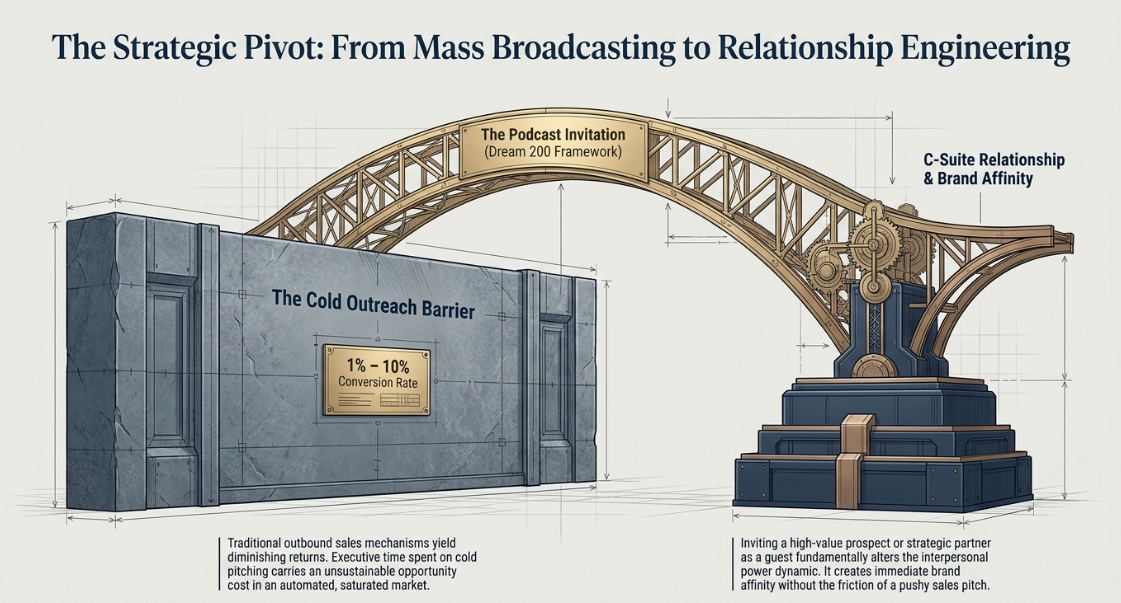
This strategic pivot is largely driven by the deteriorating efficacy of traditional outbound sales mechanisms. Cold outreach currently yields an abysmal conversion rate ranging from 1% to 10%.7 Consequently, executive time spent on cold pitching carries a massive opportunity cost, yielding diminishing returns in a marketplace saturated with automated outreach. By utilizing the podcast as a formal invitation to collaborate, enterprises can effectively bypass traditional corporate gatekeepers. Inviting a high-value prospect, an industry thought leader, or a strategic channel partner to feature as a guest on a well-produced corporate show fundamentally alters the interpersonal power dynamic. This approach, often aligned with networking methodologies such as the "Dream 200" framework, creates immediate brand affinity and relationship equity without the friction of a pushy sales pitch.4
Furthermore, the behavioral data underscores the efficacy of audio in capturing the sustained attention of senior decision-makers. Current market research indicates that 75% of B2B decision-makers actively listen to podcasts 8, and 59% of directors and C-suite executives regularly engage with audio thought leadership.5 Therefore, the operational economics of enterprise audio are justified not by the sheer volume of listeners, but by the net worth, professional seniority, and purchasing power of the specific individuals engaging with the content. High-performing podcasters understand the specific "jobs" listeners hire a podcast to do, offering real value—such as entertainment, information, or companionship—in exchange for the listener's most valuable resources: time and attention.
Capital Expenditures, Budgeting Frameworks, and Production Pricing Tiers
Establishing an operational budget for a corporate podcast requires an intimate understanding of the production pricing landscape and the distinct components that drive capital and operational expenditures. The cost of podcast production is highly variable and depends intrinsically on the desired scope, the format complexity, the quality of post-production, and the level of strategic marketing support required.6 Providers in the market sell entirely different outcomes, ranging from basic raw audio cleanup to full-scale, integrated business development systems.7
For an enterprise initiating a new podcast program, the financial architecture must account for both initial startup capital and ongoing monthly retainers. Total startup costs typically range from $6,500 to $28,000.7 This initial investment is generally distributed across strategy development ($3,000 to $10,000), brand identity and cover art design ($500 to $3,000), corporate website integration and technical routing ($1,000 to $5,000), and the initial launch and promotional campaign ($2,000 to $10,000).7
Once launched, ongoing operational costs are dictated by the chosen production tier. To build a defensible budget, organizations must categorize their ongoing operational requirements into one of the following production tiers:
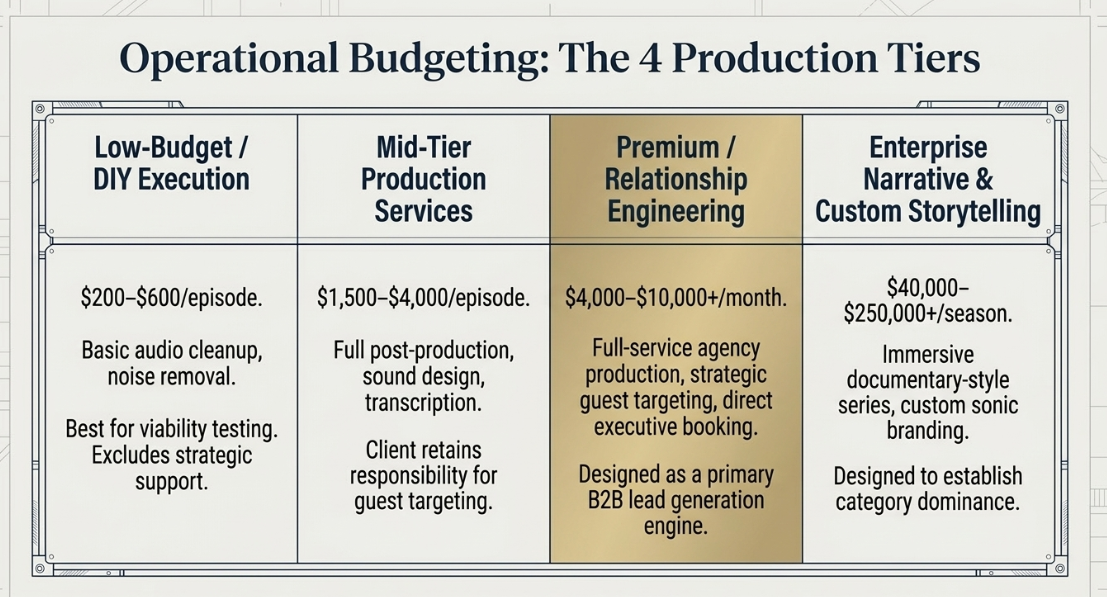
The choice between per-episode pricing and a monthly retainer model heavily influences operational agility and financial predictability. Per-episode pricing, typically ranging from $1,500 to $5,000, charges a fixed rate for discrete outputs and is highly effective for testing viability or executing limited-run seasonal shows.7 Some external agencies may also charge by the finished minute of audio, with baseline rates starting at $10 to $15 per finished minute.10 Conversely, monthly retainers, which can span from $3,000 to $25,000 per month, provide predictable fixed costs for a set number of episodes, fostering a deeper strategic partnership with the production team.7 For B2B enterprises utilizing methodologies that rely on consistent relationship engineering, the retainer model provides superior operational stability and economies of scale.
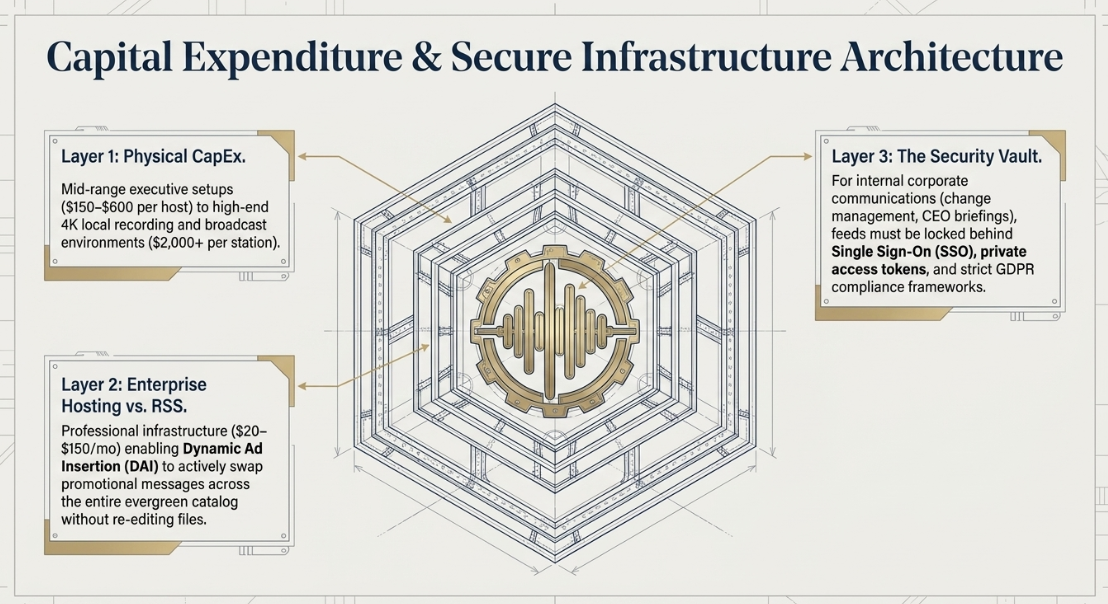
Beyond production fees, enterprises must budget for hardware capital expenditures and technical hosting infrastructure. Establishing an in-house studio or outfitting remote executives with professional equipment requires a physical capital outlay. A mid-range equipment setup—featuring quality XLR microphones (such as the Rode PodMic), audio interfaces, pop filters, boom arms, and premium closed-back headphones—typically costs between $150 and $600 per host.10 A high-end broadcast setup incorporating professional XLR microphones (like the Shure SM7B), advanced mixers, soundproofing materials, and sophisticated local 4K video recording tools can easily exceed $2,000 per station.10 In scenarios where guests require high-fidelity recording, enterprises may incur additional logistics costs to mail USB/XLR microphones directly to the guest's location prior to recording.10 Should the enterprise require physical studio recording, commercial studio rentals typically cost between $75 and $200 per hour in major markets.10 Furthermore, digital storage must be accounted for, as raw audio and 4K video files consume vast amounts of space; high-capacity external hard drives represent an ongoing operational expense ranging from $50 to $200.
Enterprise Hosting and Technical Infrastructure
Enterprise hosting platforms differ significantly from consumer-grade RSS hosts, and selecting the correct infrastructure is vital for long-term data ownership and security. Professional enterprise hosting costs between $20 and $150 per month, driven by the necessity for advanced features such as dynamic ad insertion (DAI), private feed capabilities, and IAB-compliant analytics.10
Dynamic Ad Insertion (DAI) is particularly vital for the economic longevity of a corporate show. A sophisticated Dynamic Ad Server allows podcasters to monetize and swap promotional messages across their entire catalog without having to touch, re-record, or re-edit the original audio files.10 This technology automatically drops active advertisements—whether pre-roll, mid-roll, or post-roll—into both newly published and older back-catalog episodes, ensuring that evergreen content continuously promotes current corporate initiatives, webinars, whitepapers, or hiring campaigns.10 The platform must also support granular placement controls, frequency capping, and the ability to run A/B testing on ad copy.10
Furthermore, for internal corporate podcasts utilized for employee onboarding, change management, or CEO briefings, the hosting platform must support secure, restricted access. Private podcasting infrastructure relies on features such as Single Sign-On (SSO) integration, invite-only access tokens, and password-protected feeds to ensure sensitive corporate data remains entirely within the organization.10 Finally, for multinational organizations operating in regions with strict data privacy laws, the chosen platform must guarantee strict General Data Protection Regulation (GDPR) compliance and provide clear data processing agreements.10
Resource Allocation and Temporal Complexity Models
A fundamental error in enterprise podcast budgeting is failing to account for the internal labor hours required to produce high-quality audio. Podcasting is an inherently time-intensive medium. When organizations opt for low-cost, execution-only external vendors, the heavy lifting of strategic planning, format design, guest acquisition, and audience growth roadmap development is inevitably shifted back onto internal marketing teams.3 This dynamic frequently leads to internal resource exhaustion, inconsistent publishing schedules, and ultimately, project abandonment due to a failure to sustain operational momentum.
To accurately model the hidden costs of production, organizations must align their operational plans with the time-effort configurations dictated by their chosen format complexity. The labor requirements can be segmented into four distinct levels of operational intensity:
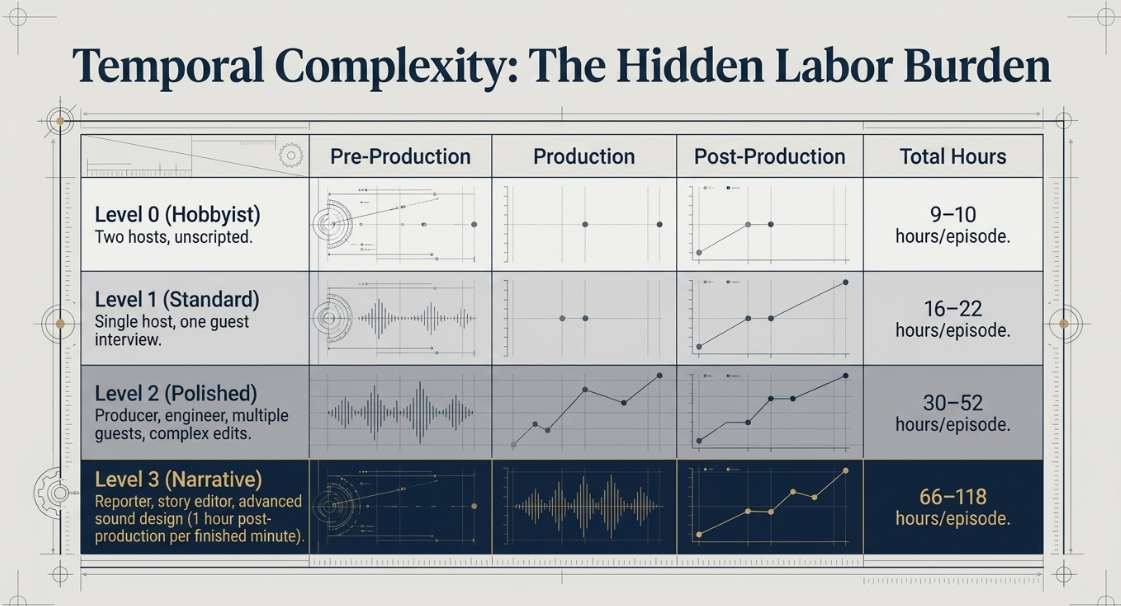
Understanding these temporal requirements is critical for calculating the true total cost of a podcast. Industry heuristics dictate that recording twice as much material as intended for use is standard, while a first rough edit typically requires three times the duration of the raw recording.14 In Level 3 narratives, sound design and mixing consume approximately one hour of post-production for every produced minute of the final episode.14
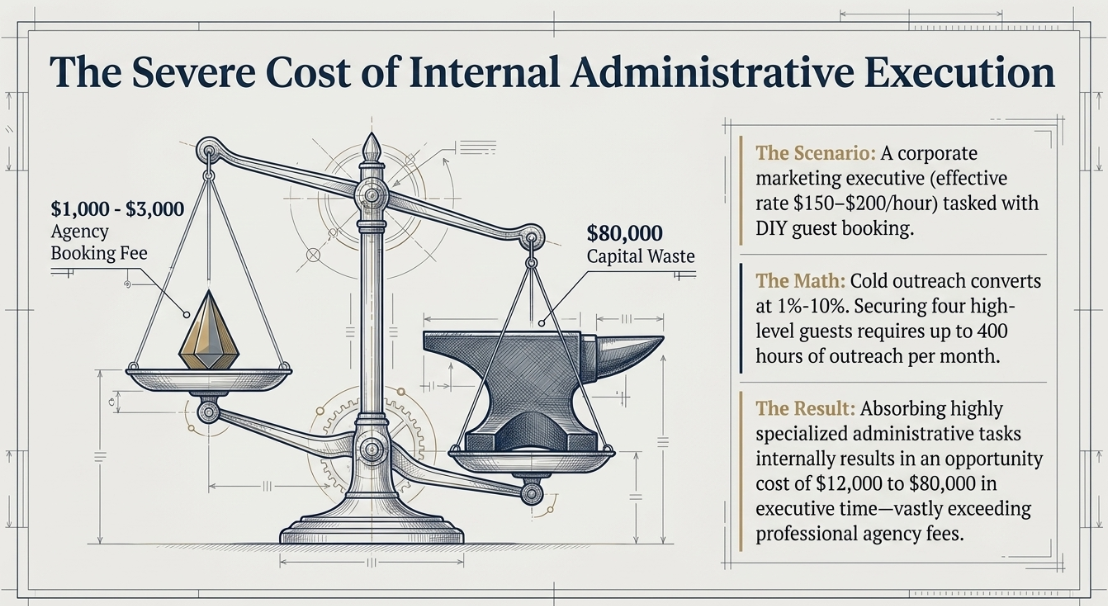
The financial implications of absorbing these hours internally are severe. If a corporate marketing executive earning an effective rate of $150 to $200 per hour is tasked with DIY guest booking, the capital waste is immense. Because cold outreach for guest booking converts at merely 1% to 10%, an executive might spend up to 400 hours monthly to secure four high-level guests.7 This translates to a hidden opportunity cost of $12,000 to $80,000 in executive time, vastly exceeding the $1,000 to $3,000 cost of hiring a professional booking agency.7 Consequently, utilizing internal executive resources for highly specialized, labor-intensive administrative tasks represents a profound operational failure.
The In-House Versus External Agency Operational Dilemma
The decision to build an in-house media team or contract an external podcast production agency represents a pivotal structural choice in the operational plan. This decision hinges on capacity, core competencies, strategic focus, legal frameworks, and the need for operational flexibility.3
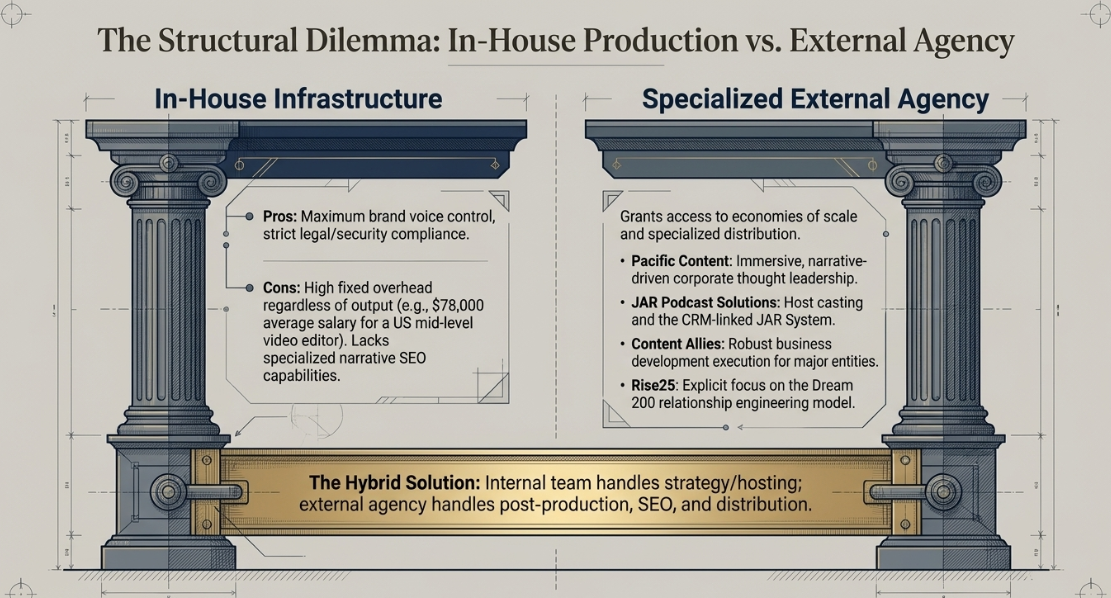
Building an in-house production capability provides maximum control over brand voice, data security, and immediate access to internal subject matter experts. For simple conversational formats, well-run in-house productions can be executed for approximately $15,000 annually.10 Furthermore, in-house capabilities ensure deep integration with the company’s internal communications infrastructure. Enterprise podcasting differs significantly from creator-led shows; corporate podcasts must operate within strict brand, legal, and information security frameworks, adhering to defined approval workflows and accessibility standards.15 Maintaining these processes internally reduces the risk of data leakage or off-brand messaging.
However, the in-house model lacks structural flexibility. Creative requirements fluctuate; an internal team represents a fixed cost in terms of full-time salaries, benefits, national insurance, and software licenses, regardless of whether the organization is in a high-output production cycle or navigating a lean operational phase.17 For example, the all-in annual cost of an in-house mid-level video editor in the United States averages $78,000.18 Furthermore, while an internal marketing team may excel at corporate messaging, they often lack the highly specialized technical skills required for advanced sound design, narrative audio scripting, and podcast-specific search engine optimization (SEO).19 Producing a standout show in a market saturated with "content soup"—where homogenous interview formats fail to capture attention—requires creative differentiation that specialized agencies are uniquely positioned to provide.20 As industry experts note, a show designed for "everyone" is ultimately a show for no one; audiences must be explicitly divided into core, adjacent, and transformational segments.9
Outsourcing to a specialized B2B podcast agency transfers the operational burden of execution, granting access to specialized tools and technology that would be financially impractical for a single brand to replicate.19 Agencies bring economies of scale, established distribution networks, and deep institutional knowledge. The market features several distinct agency profiles:
Pacific Content (part of Lower Street) specializes in narrative-driven, immersive audio stories that blur the line between entertainment and corporate thought leadership.9 They emphasize that branded shows must often be superior to non-branded shows simply to escape the gravitational pull of listener skepticism.9
JAR Podcast Solutions differentiates itself through host casting—sourcing and auditioning professional hosts on behalf of the brand—and operates on the proprietary "JAR System" (Job, Audience, Result), which mandates that every show connects to a defined business outcome before production begins.3
Content Allies focuses heavily on the business development model, providing enterprise credibility and robust operational execution for major corporations, as evidenced by their work with entities like Meta and Siemens.21
Rise25 focuses explicitly on relationship engineering, helping B2B businesses utilize podcasts to connect directly with their best clients, referrals, and strategic partnerships via their "Dream 200" methodology.7
Many enterprise teams ultimately adopt a hybrid production model to balance control and capability. In this configuration, the internal enterprise team develops the overarching content strategy, sources internal intellectual property, and hosts the interviews, while entirely outsourcing post-production, sound design, show notes creation, and distribution to an external agency.10 This mitigates the need for expensive full-time audio engineers while retaining absolute editorial control over the corporate narrative. When engaging external vendors, organizations must account for "search costs"—the upfront productivity lost by senior management when vetting and selecting the appropriate agency partner.
Financial Modeling: Constructing the Business Case and Measuring ROI
The ultimate success of an enterprise podcast operational plan is predicated on the ability to prove a return on investment. The podcasting industry has historically suffered from an over-reliance on superficial consumer metrics. Tracking downloads, subscriber counts, Apple Podcasts chart rankings, and completion rates provides insight into content resonance and audience health, but these data points do not satisfy the fiduciary requirements of a CFO.3 To build a defensible business case, marketers must shift to a revenue-first, CRM-integrated measurement framework that tracks business impact metrics. Success must be measured relative to direct business goals—such as awareness, consideration, and favorability—rather than comparing download numbers against major ad-supported entertainment shows.9
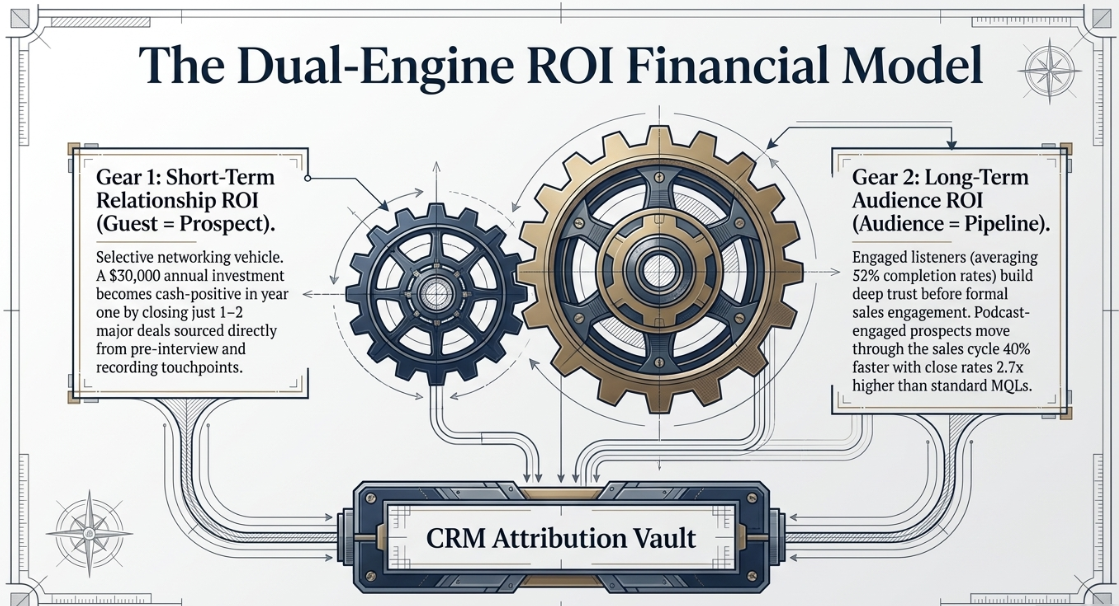
A sophisticated financial model evaluates B2B podcast ROI through a defined "Two-Class" attribution framework: Short-Term Relationship-Driven ROI and Long-Term Audience-Driven ROI.4
The Short-Term Relationship-Driven ROI model relies on utilizing the podcast as a targeted networking vehicle. By selectively inviting high-value prospects, target accounts, or strategic partners as guests, the enterprise bypasses traditional sales barriers. The collaborative process of pre-interview planning, recording, and post-launch promotion creates multiple high-value, non-transactional touchpoints with a key decision-maker. Consequently, a strategic annual podcast investment of $20,000 to $30,000 can become cash-positive in year one through the closure of just one or two major deals sourced directly from these guest relationships.4 Measuring this requires tracking the "Guest-to-Opportunity Conversion Rate" within the Customer Relationship Management (CRM) system.
The Long-Term Audience-Driven ROI model focuses on the conversion of passive, engaged listeners into active sales pipeline. Podcast listeners exhibit extraordinary engagement metrics; average B2B completion rates sit around 52%, signaling a depth of attention most digital formats cannot replicate.5 Highly produced shows achieve even stronger retention. Because deep trust is established over hours of listening prior to a formal sales engagement, podcast-engaged prospects move through the sales cycle up to 40% faster and exhibit close rates 2.7 times higher than standard marketing-qualified leads.4
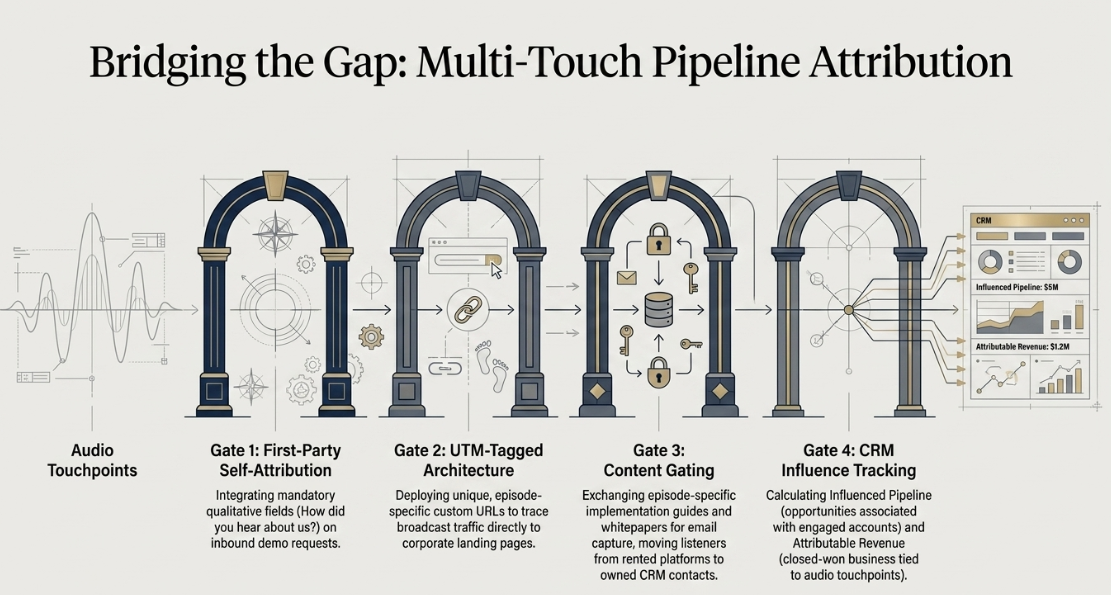
Connecting podcast consumption to tangible revenue requires the implementation of a rigorous Multi-Touch Attribution System.4 Because podcast applications do not pass click-through data seamlessly like web browsers, enterprises must engineer attribution gateways. This involves:
First-Party Self-Attribution: Integrating a required qualitative field (e.g., "How did you hear about us?") on all inbound demo requests and contact forms. This allows buyers to manually self-report if the podcast was the primary trust-building catalyst in their decision process.4
UTM-Tagged Architecture: Creating unique, episode-specific custom URLs (e.g., brand.com/podcast-offer) and UTM parameters for resources mentioned during the audio broadcast, ensuring traffic can be explicitly traced back to the show.4
Content Gating and Lead Magnets: Moving listeners from anonymous audio consumers to known CRM contacts by offering episode-specific implementation guides, checklists, or whitepapers in exchange for email capture.4
CRM Pipeline Influence Tracking: Tagging opportunities in the CRM to calculate "Influenced Pipeline"—the total monetary value of active sales opportunities associated with accounts that have engaged with podcast content—and "Attributable Revenue," which represents closed-won business directly tied to podcast touchpoints.4
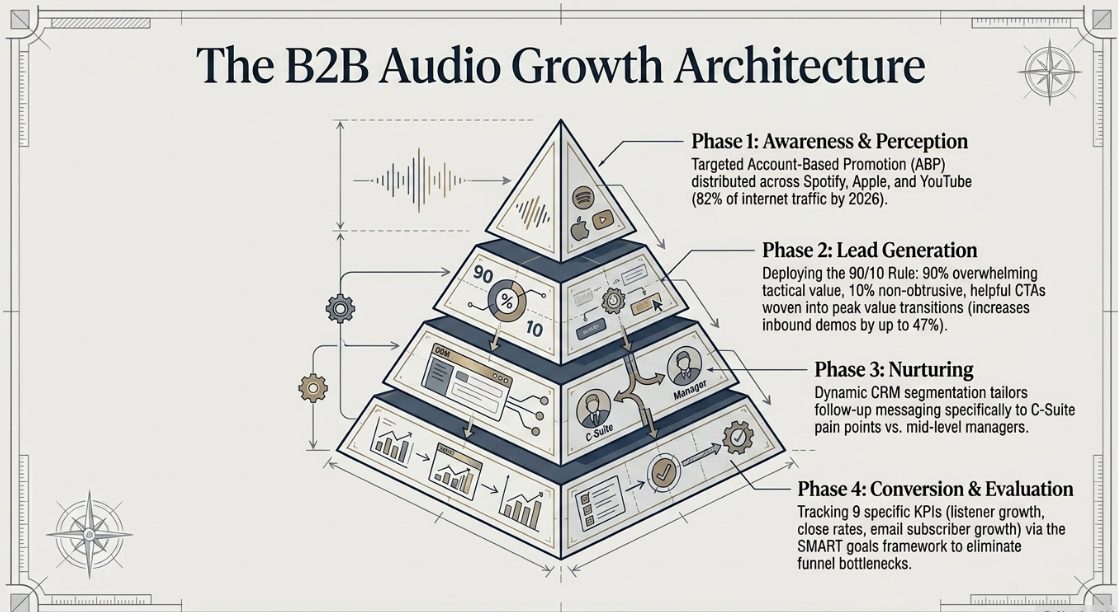
To systematically drive listeners toward these attribution gateways, the operational plan must mandate a deliberate content architecture utilizing a 90/10 value-to-conversion ratio. Episodes must deliver 90% overwhelming tactical value and reserve the remaining 10% for non-obtrusive, helpful calls-to-action (CTAs). Strategically weaving CTAs into content transitions at moments of peak value delivery—rather than relegating them to the outro where listener drop-off is highest—can increase inbound demo requests by up to 47%.4
Financial forecasting can be mathematically projected using established B2B ROI calculators. To calculate projected pipeline value, the enterprise inputs the podcast cadence (e.g., 4 episodes per month), average downloads, average deal size, the sales close rate, and the monthly podcast cost.4 For example, if an enterprise has an annual podcast cost of $30,000 (encompassing equipment, production, and distribution), and the CRM indicates a Podcast-Influenced Pipeline of $400,000 with Attributable Revenue of $120,000 directly tied to podcast activity, the financial viability of the asset is unequivocally proven.5 Furthermore, integrating Answer Engine Optimization (AEO) into the podcast's digital footprint ensures that transcripts and show notes feed generative AI search engines, capturing the 24% of marketers actively updating their strategies for AI-driven search.
The Four-Phase B2B Growth Funnel Architecture
To align the podcast with broader organizational objectives, the content strategy must be mapped across a comprehensive B2B growth funnel, seamlessly guiding potential customers from initial awareness to bottom-funnel action.4
1. Awareness & Perception Building (Top of Funnel)
At the top of the funnel, the objective is establishing brand presence and defining market positioning. Enterprises must brainstorm topics that answer the audience's core challenges, utilizing formats such as expert interviews, panel discussions, or solo commentary. Consistent publishing schedules, polished audio production (removing background noise and utilizing proper microphones), and wide distribution across Spotify, Apple Podcasts, and YouTube are critical. Amplification is achieved through account-based promotion (ABP), where distribution campaigns are personalized and targeted at a highly specific group of decision-makers, rather than chasing generic virality.4
2. Lead Generation (Middle of Funnel)
This phase transitions passive listeners into active prospects. It involves weaving in-episode CTAs that offer deeper content gateways. By providing exclusive incentives—such as downloadable frameworks, early product access, or webinar registrations—the enterprise captures high-quality leads and transitions the audience from rented podcast platforms onto owned email lists.4
3. Nurturing (Middle-to-Bottom of Funnel)
Once leads are captured, the enterprise deploys personalized, conversational email sequences to provide continuous value. Using CRM software, dynamic content segmentation allows the brand to address different audience personas uniquely, tailoring messaging to speak directly to the distinct pain points of C-suite executives versus mid-level managers. Engaging the audience on social media via interactive polls and live Q&A sessions further cements emotional connection and authority.4
4. Conversion & Evaluation (Bottom of Funnel)
The final stage relies on the accumulated trust to drive relationship-based conversions. Success in this phase requires rigorous evaluation of 9 Key Performance Indicators (KPIs): listener growth rate, social media shares, category ranking, ad revenue, website traffic, listener engagement, email subscriber growth, overall downloads, and the ongoing technical/communication skill level of the host.4 Employing the SMART goals framework ensures these metrics remain Specific, Measurable, Achievable, Relevant, and Time-bound, allowing the enterprise to identify funnel bottlenecks and continuously refine production and guest selection.
Financial Yield Maximization Through Content Repurposing
The final pillar of the enterprise audio operational plan is the systematic maximization of asset yield. The most egregious inefficiency in corporate media is treating a podcast episode as a terminal output. When an enterprise records an episode, publishes it, promotes it once, and subsequently abandons it, the conversational lifecycle ends prematurely, severely capping the potential ROI of the production investment.22 In a resource-constrained corporate environment, content repurposing is not a secondary tactical afterthought; it is a core strategic discipline that transforms a single audio or video investment into an expansive, multi-channel content engine.2
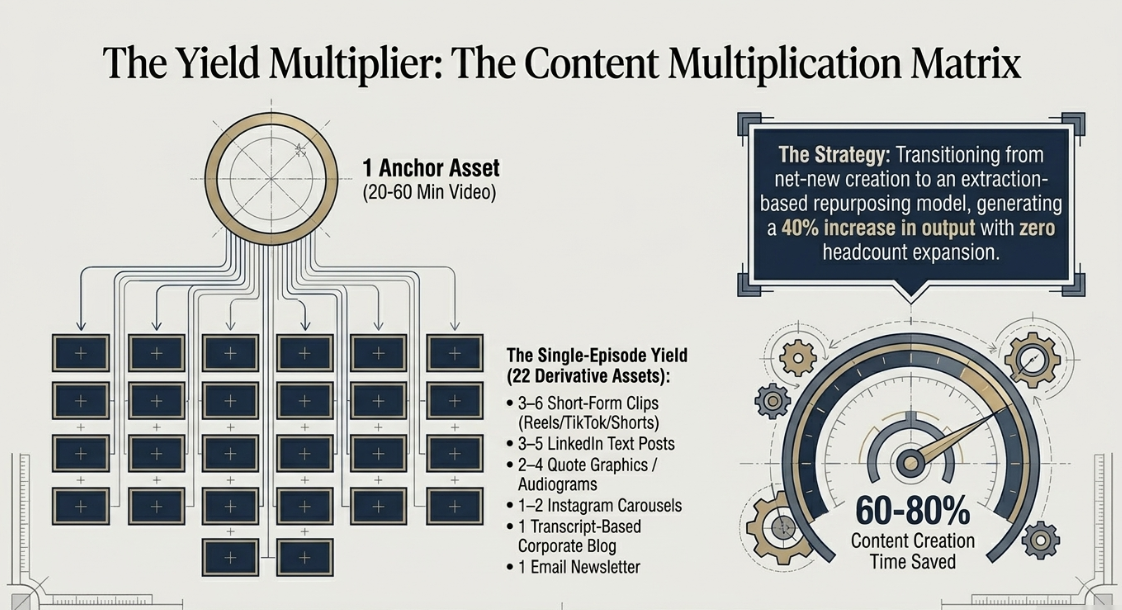
The economic advantage of content repurposing is staggering. Developing a net-new piece of content from scratch requires extensive ideation, research, drafting, and multiple rounds of stakeholder approval. Conversely, extracting assets from an already-approved, recorded podcast episode saves between 60% and 80% of content creation time.2 Furthermore, utilizing AI-driven workflows to assist in transcribing, summarizing, and reformatting this content reduces overall production costs by up to 65%.2 Marketing teams that systematically repurpose their anchor audio assets report a 40% increase in total content output without any proportional expansion in organizational headcount.2 Despite these overwhelming efficiencies, only 35% of marketers actively repurpose content, leaving a massive competitive advantage for enterprises that adopt the practice.2
The architecture of this strategy is defined by the "Content Multiplication Matrix." Under this operational framework, a single, highly produced anchor asset—such as a 20- to 60-minute long-form video podcast—serves as the foundational intellectual property. This anchor is systematically fragmented into dozens of platform-native derivative assets.18
As detailed in the matrix, a standard enterprise process for a single video podcast episode yields approximately 22 discrete pieces of content.18 Short-form video extraction is particularly critical, as 49% of marketers rank short-form video as the highest ROI-driving content format across the entire digital ecosystem.2
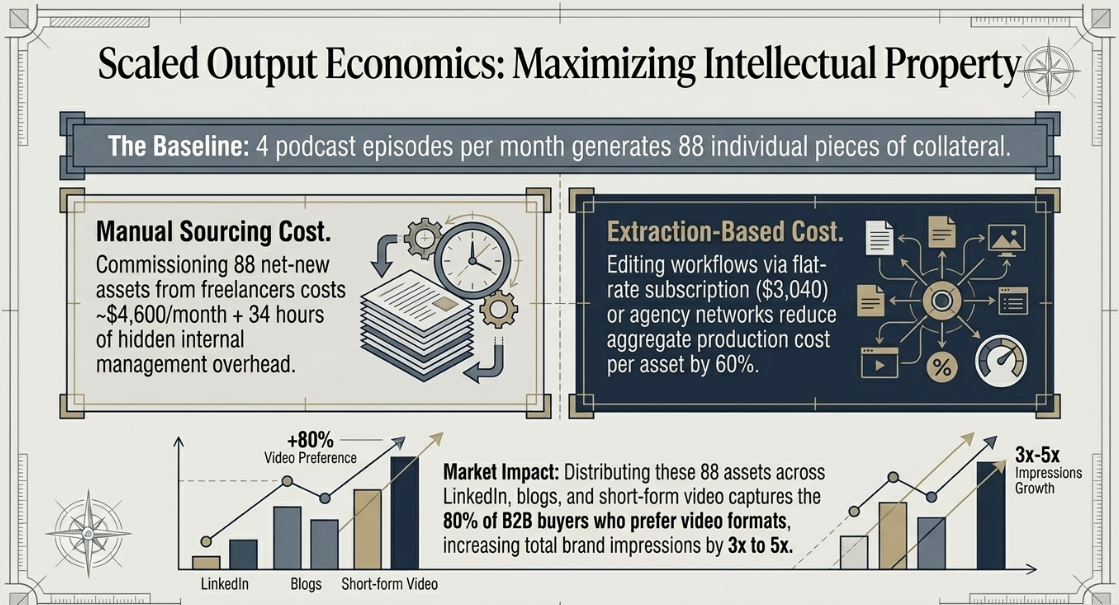
The financial implications of this matrix are profound when scaled operationally. Producing four long-form podcast episodes per month generates 88 individual pieces of collateral. If an enterprise were to commission these 88 assets individually from freelance creators without utilizing existing intellectual property, the cost would approximate $4,600 per month, requiring an estimated 34 hours of internal management overhead.18 By shifting to an extraction-based repurposing model, the enterprise achieves a 60% lower aggregate production cost per asset, maximizing the utility of the original recording session.18 To handle the editing of these assets, organizations can compare sourcing models: a local freelancer might cost $4,440 monthly (when factoring in 24 hours of hidden management time), an agency $12,000, and a flat-rate subscription service around $3,040.18
Furthermore, this multi-channel distribution strategy aligns perfectly with modern buyer behavior. Distributing insights across LinkedIn, corporate blogs, newsletters, and short-form video platforms increases total brand impressions by 3x to 5x without requiring any additional conceptual ideation from the marketing team.18 Brands that maintain this consistent, multi-platform presence accelerate their audience growth by a factor of 2.5x compared to entities relying on single-platform distribution.18 By capturing the 80% of B2B buyers who prefer consuming video formats 18, the enterprise ensures its thought leadership penetrates every layer of the target market, thereby continually feeding the top of the funnel and driving prospects toward the CRM attribution gateways. Content marketing delivers $3 in ROI for every $1 invested, and repurposing amplifies this return exponentially by extracting value across a multitude of formats rather than abandoning the asset after a single deployment.
Validating the Model: Enterprise Case Studies and Benchmarks
The theoretical frameworks and economic models detailed above are thoroughly validated by examining high-profile enterprise implementations. When major organizations align their podcast strategies with premium production values, targeted relationship engineering, and narrative storytelling, the results consistently outperform standard digital marketing metrics.
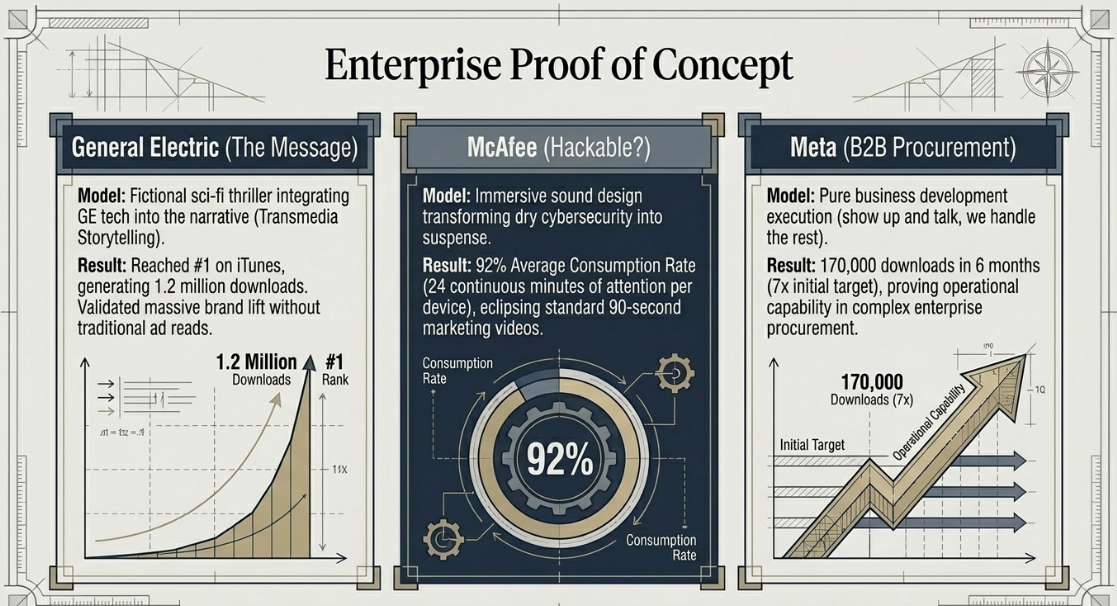
A prime example of narrative success is General Electric’s podcast, The Message. Partnering with BBDO New York, Panoply, and Giant Spoon, GE bypassed traditional corporate advertising to create a fictional, eight-part science-fiction thriller written by playwright Mac Rogers.23 Rather than interrupting the show with traditional ad reads, the podcast integrated GE technology directly into the storyline, allowing the narrative to behave like nonfiction and incorporating transmedia storytelling elements such as secret codes.25 This creative risk yielded massive brand lift, driving the podcast to the number one position on the iTunes charts and generating over 1.2 million downloads.25
Similarly, McAfee’s Hackable? podcast, developed in partnership with Pacific Content, sought to position cybersecurity not as a dry technical subject, but as an engaging, suspenseful narrative.26 The operational execution focused intensely on production quality and storytelling. The metrics achieved were extraordinary for a corporate show: 77% of respondents reported they "liked" or "loved" the podcast, and 88% stated they learned something new.28 More significantly, the "Digital Breadcrumbs" episode achieved a 92% Average Consumption rate, with listeners spending an average of 24 minutes per device engaged with the content—a staggering retention metric when compared to the 59% completion rate typical for standard 90-second marketing videos.29
In the realm of B2B procurement and thought leadership, Content Allies executed a highly successful campaign for Meta. Focusing on the business development proposition of "show up and have conversations, we handle everything else," the agency delivered 170,000 downloads in six months, exceeding the initial target by a multiple of seven.21 This outcome validates the operational capability required to satisfy the demands of a complex enterprise procurement environment.21 Additionally, Slack’s Slack Variety Pack, a podcast centered on work culture and teamwork produced by Pacific Content, demonstrated how brands can build long-term relationships with audiences by providing an "amazing first experience" rather than demanding short-term conversions, earning the title of the “World’s Most Ambitious Branded Podcast” from Contently.30
For brands focusing specifically on measurable B2B outcomes, JAR Podcast Solutions demonstrated the efficacy of their framework through an immersive, sound-designed show pairing emerging entrepreneurs with experienced founders. The initiative delivered a 90% listen-through rate, accompanied by a 6% lift in overall brand awareness and a 6% increase in brand consideration.32 Furthermore, optimizing podcast titles, descriptions, and transcripts for Search Engine Optimization (SEO) has proven highly effective for business coaches and consultants; executing advanced podcast SEO can generate a targeted 30% increase in inbound requests over a 12-month period by capturing high-intent search queries.
Conclusion: The Strategic Integration of Enterprise Audio
The transition of podcasting from a niche consumer medium to a formidable enterprise asset requires a fundamental restructuring of operational priorities and financial models. As demonstrated through the rigorous analysis of production economics, resource allocation paradigms, and advanced ROI attribution frameworks, corporate audio can no longer be managed as a peripheral, low-budget marketing experiment. It demands the same exhaustive financial oversight, strategic alignment, and systemic execution applied to any major corporate business development initiative.
To build a compelling and defensible business case for executive leadership, marketing leaders must definitively abandon superficial vanity metrics. The operational strategy must be explicitly anchored to business impact: generating qualified leads, influencing CRM pipeline, accelerating sales velocity, and fostering high-value relationships. This requires meticulously selecting the appropriate production tier—whether utilizing a secure, hybrid in-house model for sensitive internal communications or partnering with a premium agency to deliver narrative-driven thought leadership that escapes the homogenization of modern digital content.
Crucially, the operational plan must actively mitigate the hidden opportunity costs of executive time by acknowledging the intense, highly specialized labor hours required for complex audio formats. The success of the enterprise podcast is ultimately cemented through technological integration. The audio content must be irrevocably tethered to the organization's CRM through multi-touch attribution gateways to accurately quantify financial returns. Concurrently, the intellectual property generated during recording sessions must be ruthlessly optimized through a defined content multiplication matrix, driving down aggregate production costs by up to 65% while exponentially expanding brand reach across the entire digital ecosystem.
When architected with precision and executed with operational discipline, an enterprise podcast ceases to be a mere line-item marketing expense. It transforms into a high-yield, economically defensible asset that systematically engineers high-value relationships, scales corporate authority, and drives measurable, sustainable revenue growth across the organization.
Works cited
How Much Does Podcasting Cost? A Guide for B2B Companies (2026 Edition), accessed June 11, 2026, https://contentallies.com/learn/how-much-does-podcasting-cost-for-b2b-companies
Content Repurposing Statistics 2026: ROI Impact, Time Savings ..., accessed June 11, 2026, https://autofaceless.ai/blog/content-repurposing-statistics-2026
The enterprise podcast budget: production costs vs. strategic ROI - Pendium, accessed June 11, 2026, https://pendium.ai/jarpodcasts/the-enterprise-podcast-budget-production-costs-vs-strategic
The Definitive Guide To Measuring B2B Podcast ROI And Pipeline ..., accessed June 11, 2026, https://www.fame.so/post/measuring-b2b-podcast-roi-and-pipeline
The ROI of B2B Podcasting: Metrics That Matter for Business Growth - Content Allies, accessed June 11, 2026, https://contentallies.com/learn/roi-b2b-podcasting-metrics
How Much Does Podcast Production Cost? | Lower Street, accessed June 11, 2026, https://lowerstreet.co/blog/podcast-production-costs
Podcast Production Pricing: B2B Packages, Costs & ROI | Rise25, accessed June 11, 2026, https://rise25.com/lead-generation/podcast-production-pricing/
11 Ways to Repurpose Your Podcast Content and Reach New B2B Audiences - Goldcast, accessed June 11, 2026, https://www.goldcast.io/blog-post/repurpose-podcasts
The Most Important Things We've Learned About Making Successful ..., accessed June 11, 2026, https://pacific-content.com/the-most-important-things-weve-learned-about-making-successful-podcasts-with-brands/
Enterprise Podcast Production: How to Give Your Company a Voice - Podigee, accessed June 11, 2026, https://www.podigee.com/en/blog/enterprise-podcast/
B2B Podcast Production Cost: 2026 Pricing Guide - ThePod.fm, accessed June 11, 2026, https://thepod.fm/resources/blog/podcast-production-cost-for-businesses
How Much to Start a Podcast in 2026: Full Cost Breakdown & Best Budget Options - Talks.co, accessed June 11, 2026, https://talks.co/p/how-much-to-start-a-podcast/
Basic Concepts of Preparing a Budget for a Corporate Podcast - Podbean Blog, accessed June 11, 2026, https://blog.podbean.com/basic-concepts-of-preparing-a-budget-for-a-corporate-podcast/
Podcast Math - Narrative Beat, accessed June 11, 2026, https://narrativebeat.com/math
Enterprise Podcast Production Guide for B2B Brands - Content Allies, accessed June 11, 2026, https://contentallies.com/learn/enterprise-podcast-production-guide
When Should Brands & Agencies Consider In-House Production? | Wrapbook, accessed June 11, 2026, https://www.wrapbook.com/blog/when-should-brands-and-agencies-consider-in-house-production
Agency vs. In-House: What's Right for Your Business? - Workamajig, accessed June 11, 2026, https://www.workamajig.com/blog/in-house-creative-team-vs-outside-agency
Content Repurposing Calculator 2025 — How Much Content Can 1 ..., accessed June 11, 2026, https://contentbuck.com/tools/content-repurposing-calculator
In-house vs. outsourced podcast production: what's best for your business? - Come Alive, accessed June 11, 2026, https://comealivecreative.com/in-house-vs-outsourced-podcast-production/
The Podcasts We Wish Our Clients Would Listen To - Pacific Content, accessed June 11, 2026, https://pacific-content.com/the-podcasts-we-wish-our-clients-would-listen-to/
Best B2B Podcast Agencies for SaaS Companies 2026 - Upraw Media, accessed June 11, 2026, https://www.uprawmedia.com/blog/best-b2b-podcast-agencies-saas-companies
Podcast Repurposing: How to Expand Each Episode's Reach - Foundation Marketing, accessed June 11, 2026, https://foundationinc.co/lab/podcast-repurposing
The Message (podcast) - Wikipedia, accessed June 11, 2026, https://en.wikipedia.org/wiki/The_Message_(podcast)
GE Podcast Theater Returns With A New Sci-Fi Thriller "LifeAfter" - Fast Company, accessed June 11, 2026, https://www.fastcompany.com/3065471/ge-podcast-theater-returns-with-a-new-sci-fi-thriller-lifeafter
How General Electric Created The Hit Science-Fiction Podcast "The ..., accessed June 11, 2026, https://www.fastcompany.com/3053982/how-general-electric-created-the-hit-science-fiction-podcast-the-message
Hackable? - Pacific Content, accessed June 11, 2026, https://pacific-content.com/podcast/hackable/
Brand Camp Recap: "From You, Not About You: Crafting Branded Podcasts That Stand Out", accessed June 11, 2026, https://www.quillpodcasting.com/blog-posts/from-you-not-about-you-webinar-recap
Hackable? An Original Podcast by McAfee - The Shorty Awards, accessed June 11, 2026, https://shortyawards.com/10th/hackable-podcast
Podcast Metrics We All Should Talk About - Pacific Content, accessed June 11, 2026, https://pacific-content.com/podcast-metrics/
Slack Podcast: Slack Variety Pack - Pacific Content, accessed June 11, 2026, https://pacific-content.com/podcast/slack-variety-pack/
Pacific Content's podcasts are all sponsored by companies — but at least there aren't any ads, accessed June 11, 2026, https://www.niemanlab.org/2016/02/pacific-contents-podcasts-are-all-sponsored-by-companies-but-at-least-there-arent-any-ads/
Top 10 B2B Podcast Production Companies for Enterprise Brands in 2026 - Content Allies, accessed June 11, 2026, https://contentallies.com/learn/top-b2b-podcast-agencies-enterprise