Introduction: The Intersection of Cinematography and Broadcast Audio
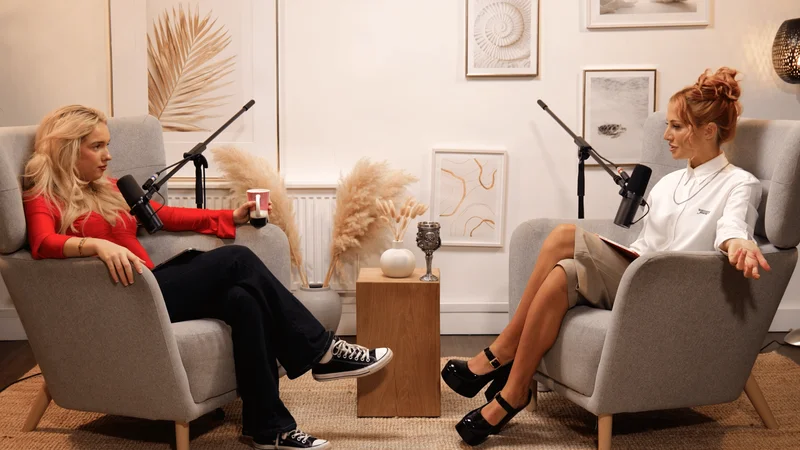
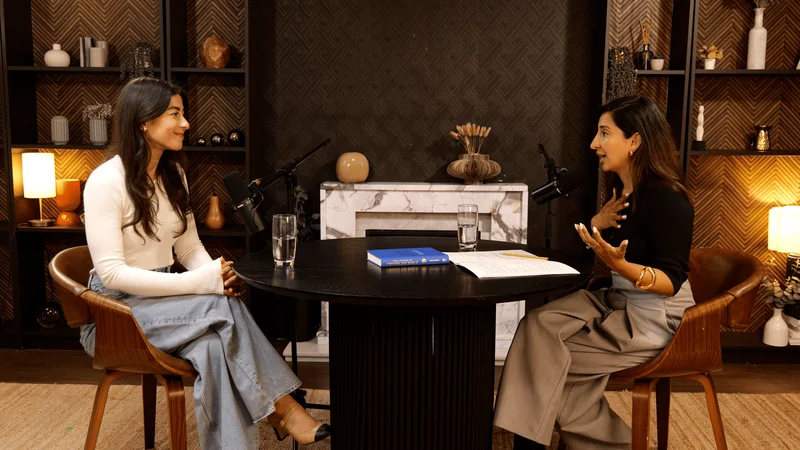
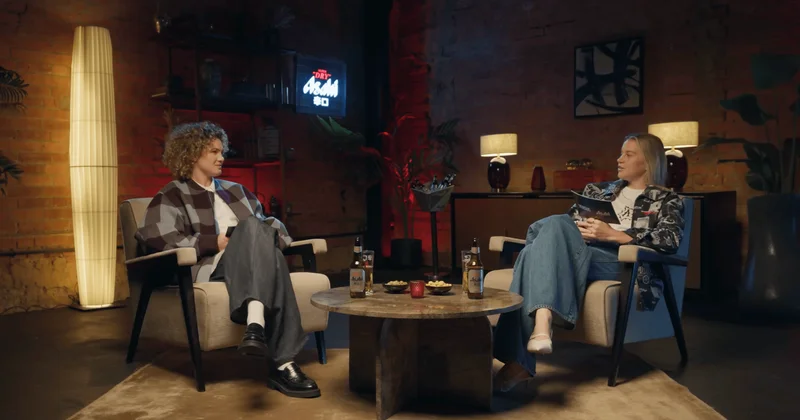
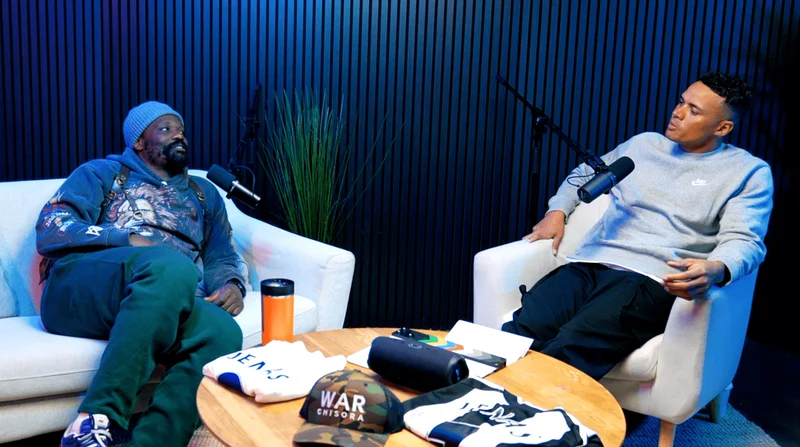
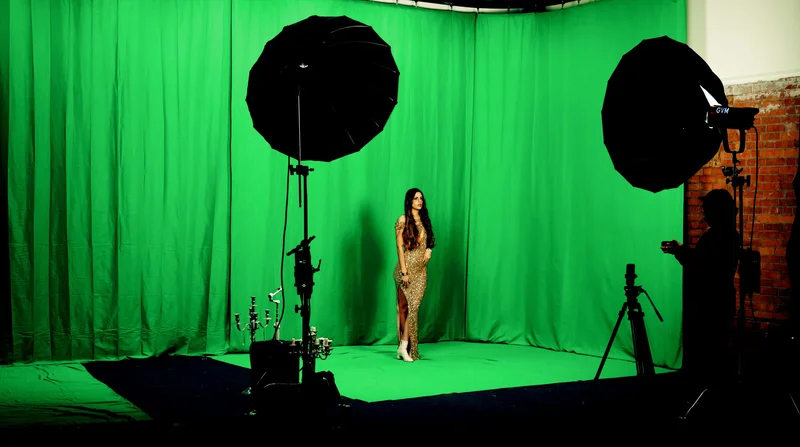
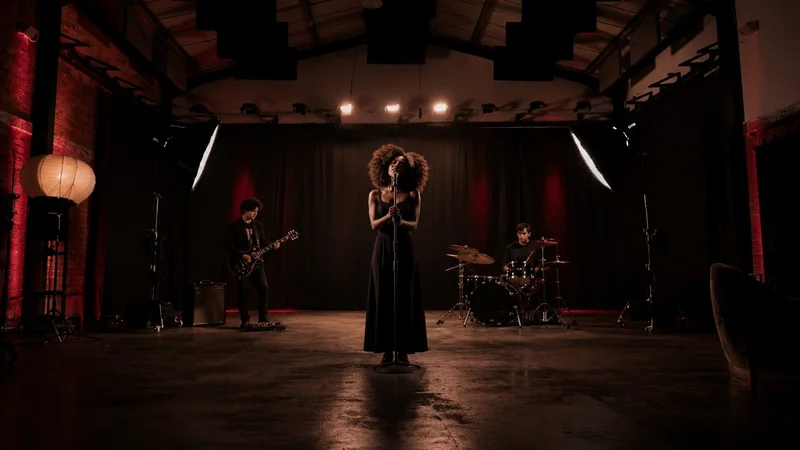
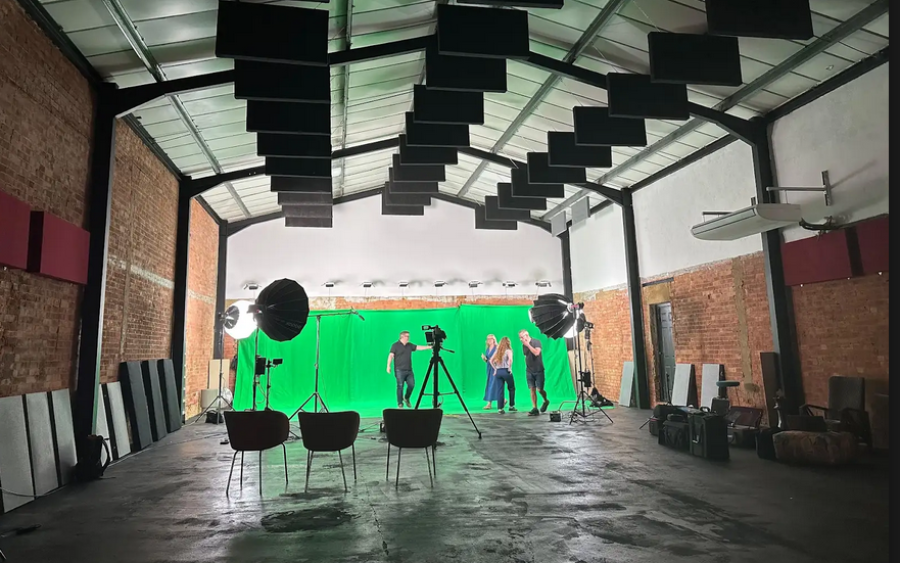
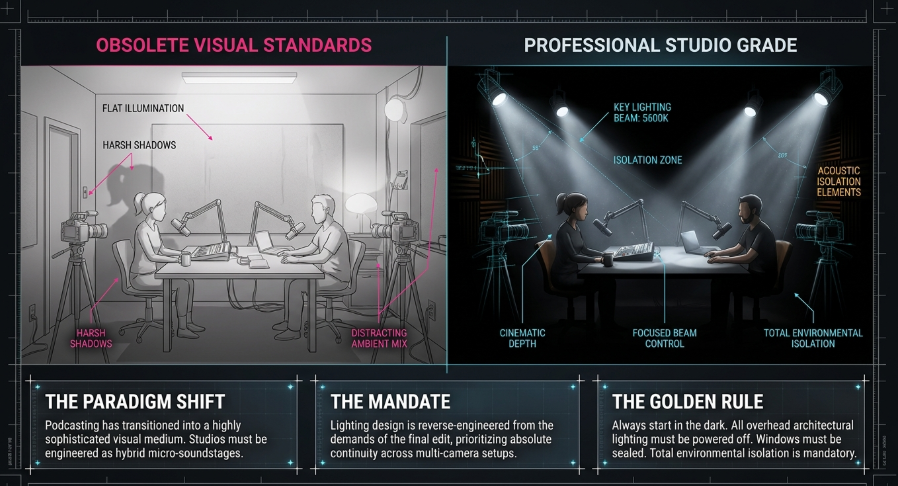
The rapid evolution of the podcasting medium over the past decade has fundamentally shifted its foundational technical requirements, transitioning it from a purely auditory broadcasting format into a highly sophisticated visual production medium. This paradigm shift dictates that modern podcast studios can no longer be engineered solely around acoustic isolation, microphone placement, and signal flow. Instead, these environments must be conceived as hybrid micro-soundstages, where the visual aesthetic-driven almost entirely by the lighting design-carries equal weight to the audio fidelity.
The application of cinematic lighting principles within the highly constrained, often heavily treated environments typical of podcast studios introduces a matrix of complex engineering challenges. These spaces demand high-fidelity illumination that renders human skin tones accurately across multiple camera angles, all while adhering to strict spatial limitations and avoiding the degradation of the room's carefully calculated acoustic properties. Lighting a video podcast is fundamentally not merely a matter of achieving adequate exposure on a camera sensor. It is the deliberate, architectural shaping of photons to create depth, convey a specific mood, establish a coherent spatial logic, and maintain absolute visual continuity across multi-camera setups and lengthy, unscripted recording sessions.
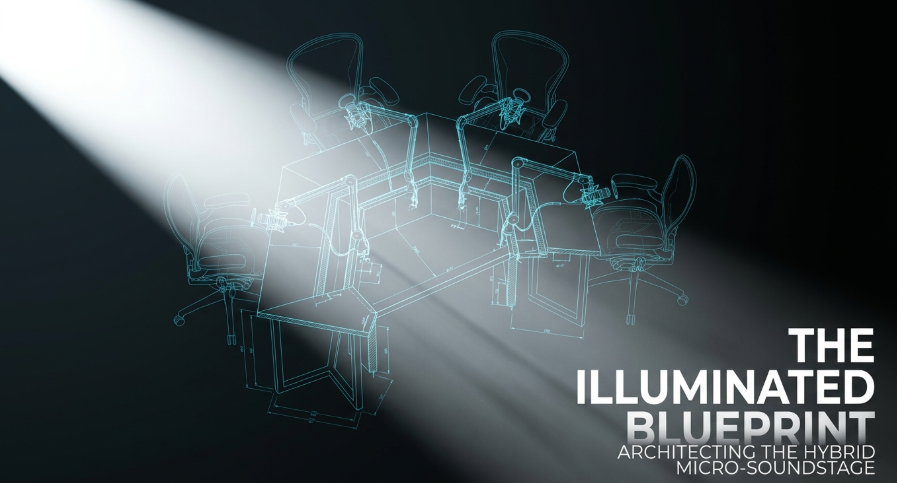
A poorly lit production, even when captured on elite, cinema-grade camera sensors, will inevitably appear amateurish, exhibiting flat dimensions, harsh, distracting shadows, and unnatural skin tones that disconnect the viewer from the content. Conversely, a meticulously designed lighting architecture elevates the production value, ensuring that the visual component matches the professionalism of the spoken dialogue. To achieve this, the lighting design must be reverse-engineered from the demands of the final edit, prioritizing consistency over fleeting creativity to ensure that automated switching tools and editors have predictable, perfectly matched footage. Cutback
This comprehensive report delineates the theoretical physics, advanced colorimetry, spatial methodologies, hardware ecosystems, structural rigging, and acoustic integrations required to engineer professional-grade lighting setups for video podcast studios. By analyzing the interaction between light modifiers, camera sensors, and sound waves, this document provides the framework for constructing scalable, automated, and high-fidelity broadcast environments.
Photometric Physics: The Foundational Laws of Studio Illumination
To execute a flawless lighting design within a confined studio space, a rigorous understanding of the underlying physical laws governing light behavior is mandatory. The manipulation of light within a podcast studio relies entirely on mathematical principles that dictate how energy propagates through space and how that energy interacts with the subjects on camera.
The Inverse Square Law: Mathematical Governance of Energy
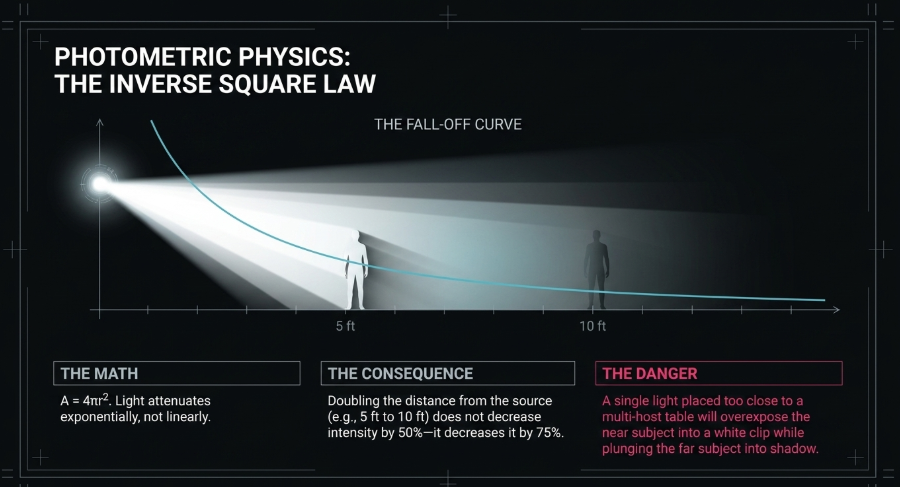
The behavior of light as it travels through space is strictly governed by the Inverse Square Law, a fundamental principle of physics that is critical for managing camera exposure, shadow fall-off, and the illumination of multiple subjects simultaneously. The law dictates that the intensity of a point-source wave is inversely proportional to the square of the distance from the source. TVTechnology
To conceptualize this, one must visualize the light source emitting a sphere of acoustical or optical energy. As the wave travels away from the source, this finite amount of energy is spread thinner and thinner along the expanding surface area of the sphere. The mathematical formula $A=4\pi r^{2}$ used to find the surface area of a sphere is, where $r$ represents the radius, or the distance from the source. Consequently, if the radius is doubled, the surface area of the sphere is quadrupled. Because the original energy is now spread out over four times the area, the resulting intensity is one-quarter of the original power. Audio University
In practical studio terms, this means that light does not simply fade linearly as it travels; it attenuates exponentially. If the distance between a luminaire and a podcast host is doubled (e.g., moving a light from five feet away to ten feet away), the light intensity does not decrease by a manageable 50%; rather, it decreases by 75%, forcing the camera operator to either open the lens aperture by two full stops or drastically increase the sensor's ISO, thereby introducing unwanted digital noise. Conversely, moving a light closer by half quadruples its intensity, potentially overexposing the subject's face into a pure white clip.
This principle behaves identically for both optical photons and acoustic sound waves traveling from a host's mouth to a microphone, sharing the exact same geometric expansion of energy. Audio University Understanding this rapid fall-off is absolutely crucial when engineering podcast setups, particularly those involving multiple hosts or guests sitting at varying distances from a single, shared light source. If a key light is placed too close to a table featuring two subjects, the individual positioned slightly closer to the light will be drastically overexposed, while the individual further away will plunge into shadow, creating an unusable multi-cam sequence.
To mitigate this mathematical consequence, lighting directors must utilize the Inverse Square Law to their advantage. By moving the luminaire further back and operating it at a substantially higher output, the baseline distance is increased. This places both subjects into a flatter, more gradual section of the fall-off curve, resulting in balanced exposure across the frame. To verify these exposure levels, professional studios utilize photometers to gauge illuminance, confirming that the intensity drop-off meets the required specifications before cameras roll. Used Keysight Equipment
Manipulating the Law: Dual-Layer Diffusion Techniques
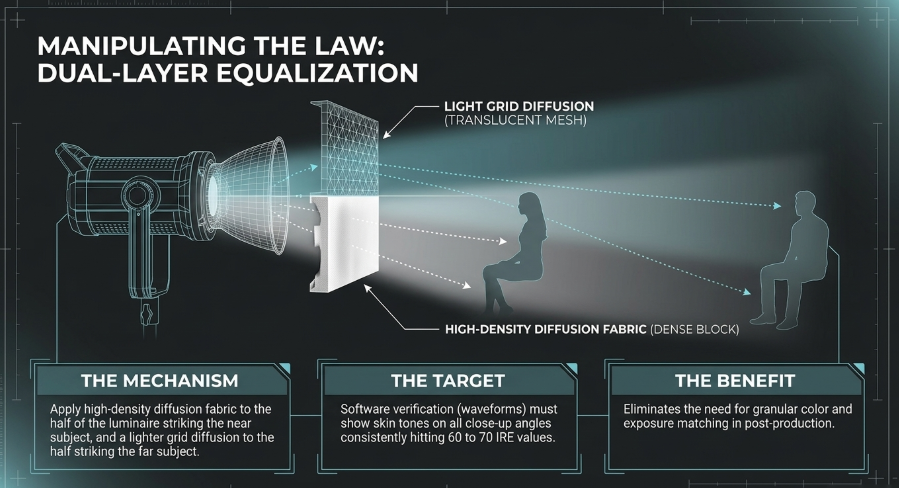
In highly constrained podcast studios where physically moving the lights further away is impossible due to wall boundaries, cinematographers frequently employ mechanical manipulation of diffusion fabrics to "cheat" the Inverse Square Law in multi-cam setups. For example, when a single, powerful luminaire (such as a Nanlite 120B) is used to illuminate two people sitting at different distances from the source, operators will layer different densities of diffusion across the face of the light. A highly dense diffusion material is applied only to the half of the light striking the nearer subject, while a less dense "light grid" diffusion is applied to the half striking the further subject.
This mechanical equalization counteracts the exponential fall-off of the Inverse Square Law. By utilizing tools like the waveform monitor and qualifier focus in software such as DaVinci Resolve, colorists can verify that the skin tone exposure on all faces consistently hits the ideal 60 to 70 IRE values, ensuring that the exposure is mathematically consistent across all close-up angles, thereby eliminating the need to tweak every shot separately in post-production.
Advanced Colorimetry and Spectral Metrics
The human visual cortex and the digital camera sensor perceive the color spectrum in fundamentally different ways. A light source that appears perfectly white and natural to the naked human eye may exhibit severe, uncorrectable green or magenta color casts when captured by a CMOS sensor equipped with a Bayer filter. Consequently, selecting lighting fixtures based on standard consumer metrics or casual visual observation is entirely insufficient for professional video podcasting.
The Limitations of the Color Rendering Index (CRI)
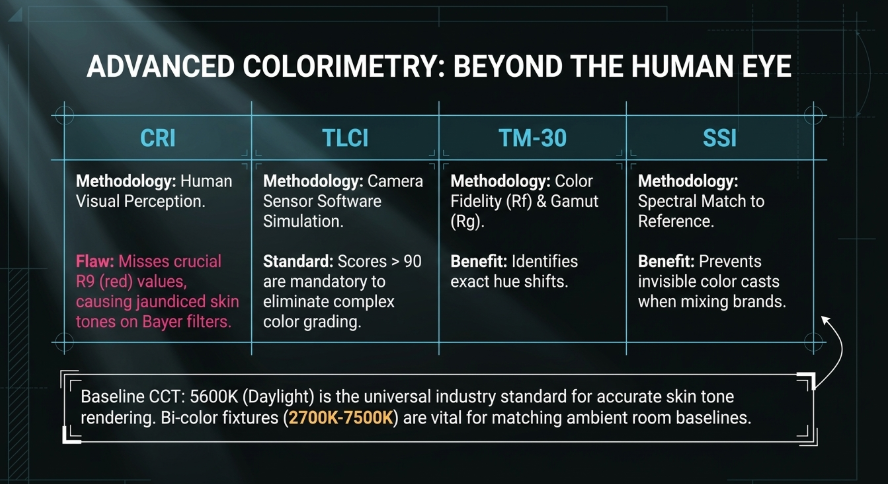
Historically, the Color Rendering Index (CRI) was the primary metric used by manufacturers to evaluate a light's ability to accurately reproduce colors across a theoretical maximum score of 100. Sigostreetlight However, CRI was developed primarily for architectural, retail, and interior design applications, measuring color reproduction based purely on human visual perception. Sigostreetlight
The fundamental inadequacy of the CRI rating for video production lies in its testing methodology. CRI relies on a highly limited palette of relatively unsaturated, pastel color swatches. It frequently fails to account for highly saturated reds (the R9 value), which are absolutely essential for the accurate reproduction of human skin tones. Videomaker Furthermore, because it does not account for how camera sensors translate light, a high-CRI light used in a high-end clothing store might make fabrics look vibrant to shoppers, but simultaneously make a podcast host look jaundiced or deeply unnatural on a 4K camera. Sigostreetlight
The Television Lighting Consistency Index (TLCI) Standard
For broadcast television, filmmaking, and premium video podcasting, the Television Lighting Consistency Index (TLCI) has superseded CRI as the mandatory standard of evaluation. Unlike CRI, which utilizes a human observer, the TLCI utilizes advanced software to calculate the exact color response that would result when the light interacts with a standardized video camera sensor. Sigostreetlight This makes it exponentially more aligned with how electronic devices actually "perceive" light. GVM Official Site
A TLCI score provides a highly accurate, single-number prediction of the post-production workload required to fix the lighting.
85 to 100: Footage will require zero to minimal color correction, ensuring accurate skin tones straight out of the camera.
70 to 85: Footage exhibits noticeable color shifts that are relatively simple to correct in software.
50 to 70: Footage will require highly complex, time-consuming color correction to salvage.
25 to 50: Footage requires the use of advanced digital mattes and qualifiers to correct, and the final image will still likely appear degraded.
Below 25: The spectral deficiency is so severe that the footage is impossible to color-correct without destroying the image. Videomaker
Professional podcast studios must exclusively deploy luminaires with a TLCI of 95 or higher to guarantee pristine, broadcast-ready skin tones and avoid massive bottlenecks in post-production. NEEWER
Modern Supplemental Metrics: TM-30 and SSI
As LED technology has advanced, lighting directors have adopted even more granular metrics to ensure perfection. The TM-30 standard scores both the color fidelity $R_{f}$ and the saturation $R_{q}$ of a light, while providing a vector graphic that shows exactly how the rendering of specific hues may shift under the fixture. YouTube
Furthermore, the Spectral Similarity Index (SSI) allows cinematographers to see how spectrally identical two different lights are to one another. YouTube This is particularly critical in podcast studios that mix lighting brands. Even if a Godox panel and an Aputure COB light both claim to have a color temperature of 5600K and a perfect tint, their underlying spectral curves may differ wildly, causing them to mismatch on camera. YouTube High SSI scores alert operators to these invisible discrepancies before the shoot begins.
Correlated Color Temperature (CCT) Management
Correlated Color Temperature (CCT), measured in degrees Kelvin (K), dictates the perceived warmth (yellow/orange) or coolness (blue/white) of the emitted light. Lume Cube The selected CCT establishes the foundational psychological mood of the podcast. While older studio lights and household practical bulbs frequently operated at 3200K (a warm, tungsten look), the modern standard for video podcasting has shifted predominantly to daylight balances between 5000K and 6500K, with 5600K being the universal industry standard. Lume Cube
Operating at 5600K accurately simulates natural daylight, rendering most human skin tones exactly as they appear in real life. B&H eXplora To achieve a unified, professional look, it is imperative that all key lights, fill lights, and camera white balance settings are locked to the exact same color temperature. Ikan Corp To facilitate this, modern creators heavily favor bi-color LED fixtures, which allow the operator to smoothly dial the color temperature from 2700K up to 6500K or 7500K. NEEWER This bi-color flexibility is vital when a studio incorporates practical desk lamps (which run warm) or has a window spilling daylight (which runs cool), allowing the lighting director to seamlessly match the scene's ambient baseline without using physical gels. NEEWER
Luminaire Taxonomies and Hardware Ecosystems
The execution of complex lighting diagrams relies entirely upon the selection of appropriate luminaires. The podcasting industry has abandoned older tungsten and fluorescent technologies in favor of highly efficient LED ecosystems, which offer robust output with minimal heat generation. The selection of the lighting fixture is dictated by the dimensions of the studio, the required throw distance, and the available budget. B&H eXplora
The Obsolescence of Ring Lights
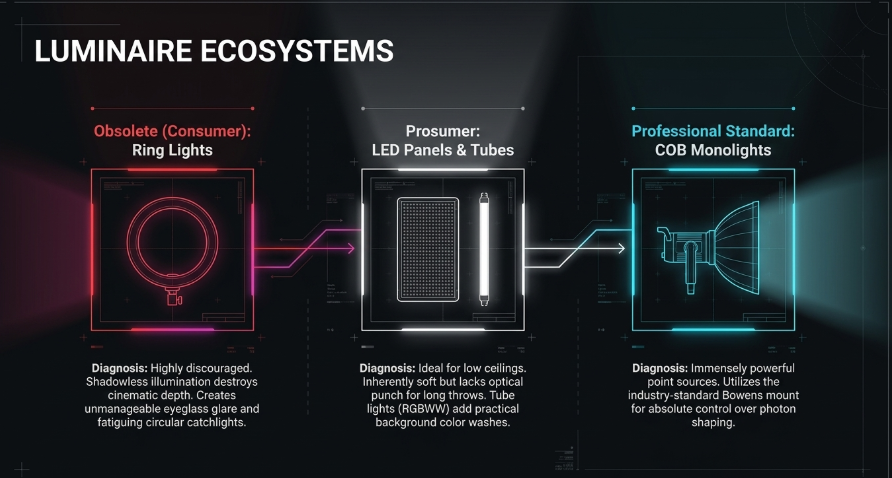
Historically, ring lights were heavily favored by entry-level creators and beauty vloggers due to their extreme ease of use and their unique ability to completely eliminate facial shadows. YouTube Because the circular light source surrounds the camera lens, it fills in every contour of the face simultaneously. However, ring lights are now widely discouraged in professional podcast production.
Their shadowless illumination delivers a harsh, flattened image that strips the face of natural shape and cinematic depth. Helio Furthermore, ring lights are physically fatiguing for hosts to look into for long durations, and they generate highly distracting, unmistakable circular catchlights in the subjects' eyes. Crucially, for guests who wear glasses, ring lights create severe, unmanageable ring-shaped reflections that obscure the eyes and sever the visual connection with the audience. YouTube
Prosumer Solutions: LED Panels and Tube Lights
LED panels, consisting of flat, rectangular arrays of individual LED diodes, have become the standard for prosumer studios and commercial spaces with restrictive low ceilings. B&H eXplora Fixtures such as the Neewer NL660, the GVM 800D-RGB, and the Amaran Verge Max offer a naturally soft spread of light directly out of the fixture, requiring minimal external modification. NEEWER
Because the light originates from a wider surface area than a single bulb, panels are inherently softer. While they lack the raw optical punch required to push light through heavy diffusion fabrics at long distances, their slim profile and widespread integration of built-in barn doors make them ideal for tight podcasting booths where space is at a premium. Hypop
To add depth and visual interest to the set, lighting designers frequently deploy LED Tube Lights. Fixtures like the 2-foot Nanlite PavoTube II 15C or the 4-foot Amaran T4C provide full RGBWW capabilities. B&H eXplora These are rarely used to light the subjects' faces; rather, they are tucked behind furniture, mounted to walls, or used as practical, in-frame light sources to cast dynamic color washes against the studio background, creating the "expensive" aesthetic characteristic of top-tier podcasts. Apex Photo Studios
The Professional Standard: Chip-on-Board (COB) Monolights
For true professional setups, COB (Chip-on-Board) monolights are the undisputed industry standard. YouTube In a COB luminaire, hundreds of microscopic LED chips are densely packed onto a single, small circular module. This creates a singular, immensely powerful point source of light. YouTube
Fixtures such as the Amaran 100d, the Nanlite FS-300B, and the massive Aputure LS 600x Pro generate output levels capable of mirroring actual sunlight. B&H eXplora The defining advantage of COB lights is not just their power, but their utilization of the Bowens mount-an industry-standard bayonet system located on the front of the fixture. This standardized mount allows the singular COB light to accept a vast, interchangeable array of heavy-duty light modifiers, granting the lighting director absolute control over the shape, softness, and direction of the photons. YouTube
The Geometry of Light Modifiers
A bare COB light produces an abrasive, hard illumination that casts sharp, unflattering shadows, highlighting every skin imperfection and creating harsh transitions from light to dark. To render light flattering for human subjects, modifiers are attached to the luminaire. The underlying physics of soft light dictate that the larger the surface area of the light source relative to the subject, the softer and more flattering the light becomes. Visual Education Modifiers mechanically increase this surface area.
Softboxes: Parabolic and Rectangular
Softboxes enclose the bare light fixture within a fabric tent, forcing the photons to bounce off a highly reflective silver interior before passing through one or two layers of translucent diffusion fabric covering the front. Visual Education This process homogenizes the light.
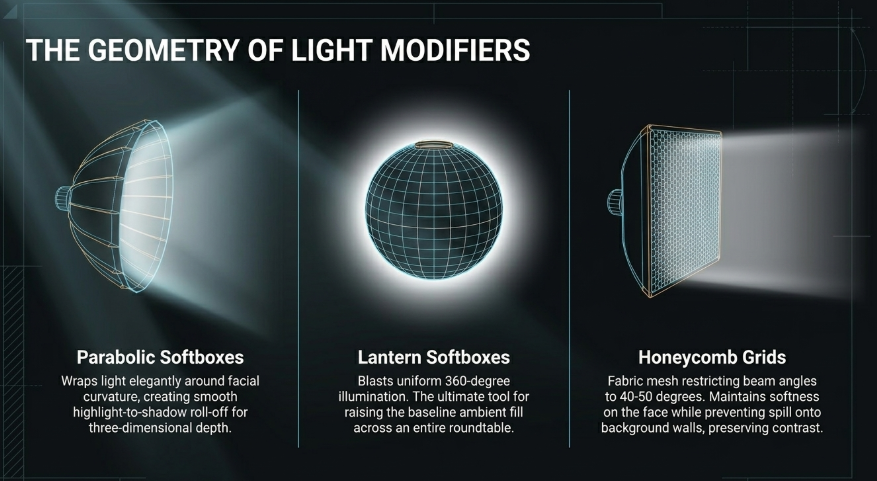
A parabolic softbox (shaped like a deep umbrella) is highly coveted in podcasting because it creates a highly contoured, directional soft light. Unlike flat panels, the parabolic shape wraps the light elegantly around the curvature of the human face, creating a smooth, cinematic roll-off from highlight to shadow. YouTube This gradual transition provides the three-dimensional depth that separates a premium podcast from a basic webcam stream. YouTube Rectangular and octagonal softboxes operate on similar principles, though octaboxes are often preferred for portraiture and podcasting as they create a natural, round catchlight in the subject's eyes. Visual Education
Lantern Softboxes and Omni-directional Fill
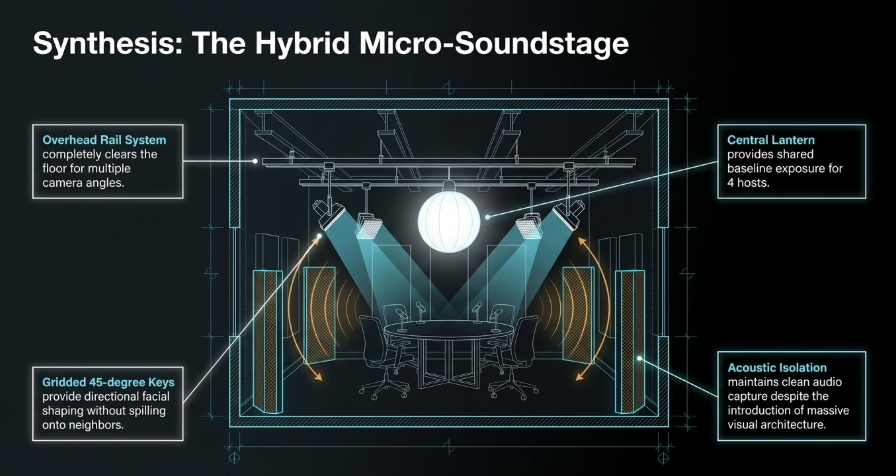
Shaped like a traditional paper globe, lantern modifiers do not direct light forward; instead, they blast light uniformly in a 360-degree radius. Helio While they lack the precise control of a parabolic softbox, lanterns are the ultimate tool for raising the baseline ambient fill level of an entire room. In multi-person roundtable podcasts, a single high-powered COB light equipped with a lantern softbox, suspended directly over the center of the table, can evenly illuminate three or four hosts simultaneously with incredibly soft, wrap-around light. YouTube
Diffusers vs. Umbrellas
While shoot-through and reflective umbrellas are highly affordable and easy to collapse, they lack directional control, aggressively spilling unwanted light onto the studio walls and ceiling, which destroys contrast. YouTube Dedicated diffusers, where a translucent screen is placed entirely independent of the light source (often held on its own stand), scatter light evenly but require substantial floor space, making them impractical for small studios. YouTube
Honeycomb Grids
To reclaim control over soft light, cinematographers utilize grids, also known as honeycombs. Attached via velcro to the front edge of a softbox, a grid is a fabric mesh that restricts the beam angle of the light, typically to 40 or 50 degrees. Visual Education While the light passing through the grid remains perfectly soft on the subject's face, the grid prevents the photons from spilling outward onto the walls and background. This is absolutely essential for maintaining deep, moody backgrounds in dramatic podcast setups, ensuring the subject pops against a darker backdrop. YouTube
Spatial Logic: Scaling Setup Paradigms
The physical positioning of luminaires relative to the subject and the camera lens dictates the texture and depth of the visual image. The spatial logic applied to a podcast studio must be inherently scalable, beginning with solitary hosts and expanding gracefully to accommodate complex multi-guest roundtable discussions. Cutback
The Three-Point Lighting Framework
The foundational paradigm of all cinematic and broadcast lighting is the three-point setup. This configuration isolates the subject from the background, provides dimensional modeling on the face, and dictates the contrast ratios. IU Pressbooks
The Key Light: This is the primary illuminant and the brightest source on the set, doing the vast majority of the lighting work and defining the visual mood. The strict, standard positioning for the key light dictates an angle of 30 to 45 degrees offset to the left or right of the camera axis, elevated slightly above the subject's eye level, and tilted downward toward the face. This specific geometry casts flattering, natural shadows beneath the jawline and the nose, creating facial shape and avoiding the featureless illumination characteristic of amateur, head-on setups. Helio
The Fill Light: Positioned on the opposing side of the camera axis, the fill light operates at a significantly lower intensity than the key light. United Wolves Productions Its sole functional purpose is to lift the density of the shadows cast by the key light, thereby reducing the overall contrast ratio. While high contrast (a heavy shadow side) may be suitable for dramatic, true-crime storytelling, conversational business or comedy podcasts generally require softer, more welcoming contrast ratios achieved through adequate fill.
The Backlight (Hair Light or Rim Light): Positioned behind the subject and often elevated high on a wall or ceiling mount out of frame, the backlight strikes the subject's shoulders, neckline, and the crown of the head. United Wolves Productions This creates a sharp, luminous outline-a "halo" effect that physically separates the subject from the background elements. This separation introduces vital three-dimensional depth to a fundamentally two-dimensional video medium, giving the production an "expensive" cinematic polish. Apex Photo Studios
The Two-Person Cross-Lighting Strategy
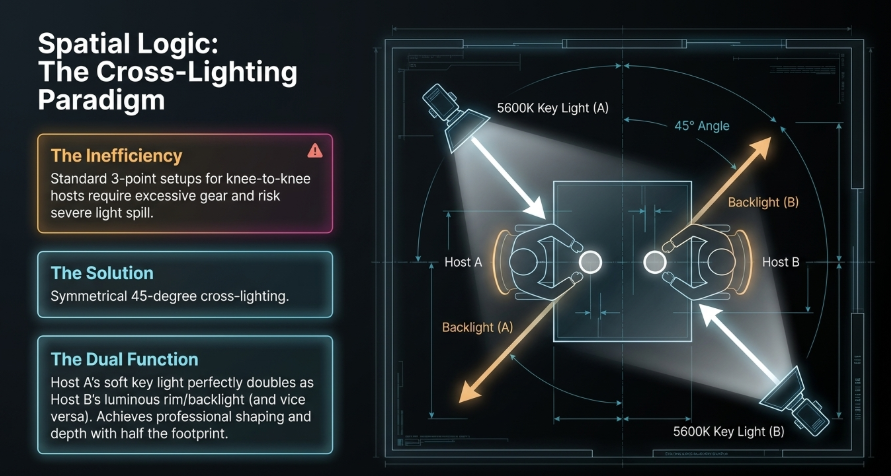
While the three-point system is optimal for a single solitary host, video podcasts frequently feature dynamic conversations between two individuals facing each other. Deploying two distinct three-point setups for two hosts sitting knee-to-knee at a table is highly inefficient, requires excessive gear, and risks severe light spill where Host A's key light inadvertently becomes a harsh backlight for Host B. Apex Photo Studios
The professional standard for this arrangement is the "cross-lighting" technique. In a cross-lighting diagram, two powerful key lights are placed at roughly 45-degree angles on opposite outer sides of the set. The luminaire placed behind and to the left of Host A is aimed across the table to serve as the key light for Host B. Conversely, the luminaire behind Host B serves as the key light for Host A.
This highly symmetrical geometry accomplishes two critical tasks simultaneously with minimal footprint: it provides a pristine, soft key light for each subject while naturally functioning as a subtle, rimming backlight for the opposing subject. This setup maintains the "shape" on both faces and is often augmented with a single, low-intensity ambient fill light to control overall room shadow density. Apex Photo Studios
Three and Four-Person Roundtable Dynamics
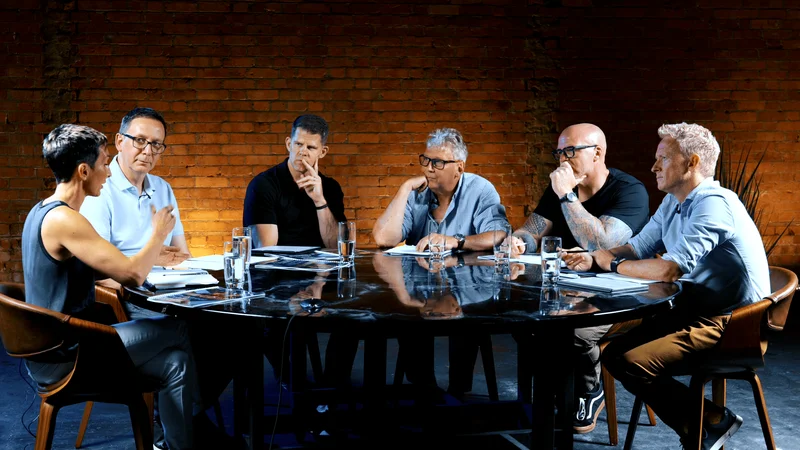
When the podcast format scales to three or four participants, the methodology shifts from individual key lights to shared, systemic illumination designed backward from the editing process. In a three-person triangle setup (where hosts face the center) or a four-person roundtable, symmetry and consistency are paramount. If the lighting varies between camera angles, the cuts will feel jarring to the viewer, and automated Al editing tools will struggle. Cutback
The strategy for large groups relies heavily on overhead central fill sources. A massive lantern softbox is typically suspended directly over the center of the table. This central source distributes a baseline exposure evenly across all participants, ensuring no one falls into total darkness. YouTube
This central fill is then supplemented by highly directional key lights equipped with thick honeycomb grids, placed at 30 to 45-degree angles pointing at each specific seat. Cutback The grids are mandatory in this configuration; they ensure that the key light aimed at Guest A does not spill over and inadvertently blast Guest B with a harsh, unflattering side-light. YouTube This multi-point configuration demands meticulous management of the Inverse Square Law-often utilizing the previously mentioned dual-layer diffusion techniques-to guarantee that the proximity of the lights does not result in asymmetrical exposure values across the different wide and close-up camera angles. Cutback
Acoustic Symbiosis: Managing Noise and Room Reflections
A critical, defining differentiation between traditional commercial filmmaking and video podcasting is the uncompromising priority placed on audio fidelity. In a podcast studio, the visual design cannot operate in a vacuum; it must be completely subservient to the acoustic environment. The introduction of high-powered luminaires and massive fabric modifiers directly impacts both the mechanical noise floor and the reverberation time of the recording space.
Eradicating Mechanical Luminaire Noise
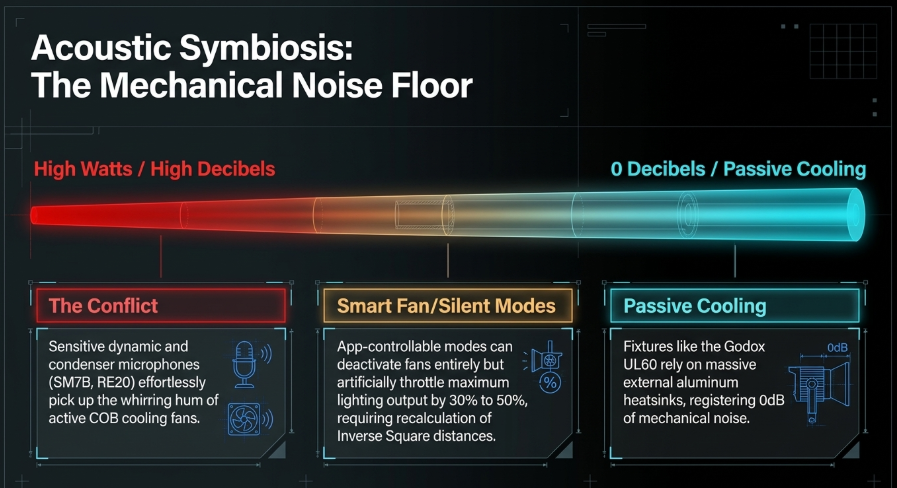
Professional COB LED lights generate significant thermal energy, necessitating active cooling systems to prevent the diodes from melting. The cooling fans embedded in high-output fixtures emit a continuous, whirring hum. Because broadcast podcasting relies heavily on highly sensitive condenser and dynamic microphones (such as the Shure SM7B or Electro-Voice RE20) often boosted by preamps, this mechanical noise floor will inevitably bleed into the audio tracks. YouTube In a tightly sealed, acoustically treated podcast studio, a loud fan becomes a glaring, unacceptable audio artifact. YouTube
To combat this, studios must specifically source luminaires engineered for silent operation. Fixtures utilizing purely passive heat dissipation-such as the Godox UL60 and UL150, or the fanless Neewer NL660 panels-rely entirely on massive external aluminum heatsinks, rendering them acoustically invisible and registering 0 decibels of mechanical noise, making them entirely safe to place near microphones. NEEWER
Alternatively, many modern mid-tier to high-end COB lights feature a "Smart Fan" or "Silent Mode" controllable via an app interface. Engaging this mode artificially throttles the maximum lighting output (often capping the luminaire at 50% or 70% of its maximum brightness) to keep thermal limits low enough that the fan can be entirely deactivated during recording. NEEWER Lighting directors must account for this 30% to 50% loss in output when calculating the Inverse Square Law distances during the pre-production phase.
The Acoustic Footprint of Light Modifiers
A frequently overlooked consequence of professional lighting is the acoustic footprint of the light modifiers themselves. Small podcast studios often struggle inherently with low-frequency acoustic anomalies (room modes) and excessive reverberation times, known as RT60 (the time it takes for sound energy to decay 60 decibels from its original amplitude). Acoustic Fields
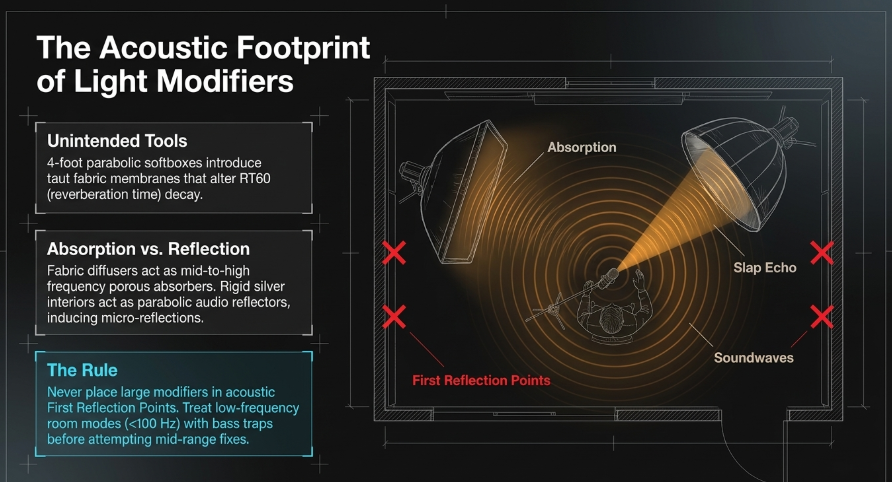
When massive, 3-foot or 4-foot parabolic softboxes are introduced into a compact 10x10 foot room, they introduce large, taut fabric membranes directly into the acoustic space. Depending on their exact placement and fabric construction, these modifiers act as unintended acoustic tools. A large softbox can serve as a mid-to-high frequency porous absorber, inadvertently deadening the room slightly by absorbing vocal frequencies. Acoustic Fields
Conversely, the rigid, highly reflective silver interiors of the softboxes, if angled improperly toward a sound source, can act as acoustic mirrors, introducing micro-reflections or "slap echo" directly back into the host's microphone. Acoustical Surfaces
Furthermore, true acoustic diffusion relies on the mathematically precise scattering of sound waves to break up reflections while maintaining a room's natural liveliness and tricking the ear into perceiving a larger space. YouTube As noted by acoustic engineers, randomly placing large objects does not equal diffusion. GIK Acoustics Lighting modifiers placed haphazardly in the acoustic "First Reflection Points" (the specific areas on the side walls midway between the speaker and the microphone where sound first bounces) will severely disrupt the calculated diffusion and absorption strategies of the studio's acoustic treatment. Acoustical Surfaces Lighting directors and audio engineers must collaborate to ensure that large softboxes are flown at angles that deflect vocal energy away from the microphones, rather than acting as parabolic audio reflectors, and that fundamental low-frequency issues (below 100 Hz) are treated with bass traps before attempting to correct the mid-range interference caused by the lighting gear. Acoustic Fields
Environmental Control: Mitigating Glare and Light Spill
The practical execution of studio lighting frequently encounters environmental and physical obstacles that threaten to degrade the video quality. Addressing these issues requires a strict application of physical geometry and environmental isolation.
Eradicating Eyeglass Glare and Monitor Reflections
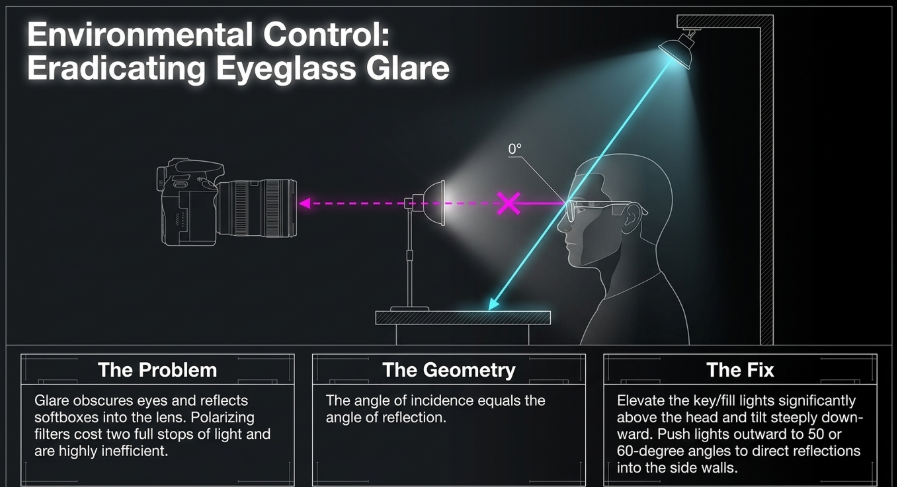
One of the most persistent and frustrating issues in video podcasting is the glare reflected off a host's or guest's eyeglasses. This glare obscures the subject's eyes, severing the vital visual connection with the audience, and reflects ugly, glaring white squares of softbox diffusion directly into the camera lens. YouTube
This challenge is solved by applying the Law of Reflection, which dictates that the angle of incidence equals the angle of reflection. If a key light is placed at eye level and directly in front of the host, the light strikes the glasses at a 0-degree angle and bounces straight back into the camera lens. Helio
To eradicate this glare, the lighting geometry must be fundamentally altered. The primary, most effective solution is to elevate the key light and fill light significantly above the subject's head, tilting the fixtures downward at a steep angle. YouTube By raising the incidence angle, the light reflects off the glasses and strikes the floor or the desk, completely missing the camera's line of sight. YouTube Additionally, pushing the lights further out to the sides (increasing the standard 45-degree angle to 50 or 60 degrees) will push the reflection out toward the studio side walls. Lume Cube
If the reflection originates from a computer monitor rather than a luminaire, lowering the brightness of the screen, raising the temples of the glasses slightly to tilt the lenses down, or physically tilting the monitor backward can shift the reflection plane away from the camera. Reddit While polarizing filters on the camera lens and polarizing gels over the lights can theoretically mitigate glare from non-metallic surfaces, they are generally highly inefficient against direct, multi-source lighting reflections and require a massive sacrifice in overall exposure (often losing two full stops of light), making them a last resort. Reddit
Managing Ambient and Competing Light Sources
A perfectly controlled lighting environment is the absolute cornerstone of professional video production. Uncontrolled ambient illumination-such as sunlight streaming through a window or fluorescent overhead office lights-introduces competing color temperatures and unpredictable exposure shifts as clouds pass by or the sun sets during a lengthy recording session. United Wolves Productions
The fundamental rule of studio design is to always "start in the dark". Vimeo All overhead architectural lighting must be powered off, and all windows must be rigorously sealed with blackout curtains or heavy blinds. Vimeo This total environmental control ensures that the only photons striking the sensor are those deliberately placed by the lighting designer, preventing undesired mixed color casts, distracting background hotspots, and fluctuating exposures. United Wolves Productions
If natural light must be used due to severe budget constraints or specific location aesthetics, it should never be direct sunlight. North-facing windows provide the softest, most consistent light. United Wolves Productions Alternatively, filming on a cloudy day essentially transforms the cloud cover into a massive, natural softbox, providing perfectly even exposure without harsh shadows, though it remains uncontrollable over time. YouTube In these scenarios, a single LED light should be placed on the side opposite the window to act as a fill, balancing the contrast ratio. YouTube
Structural Engineering: Grip, Stands, and Overhead Grids
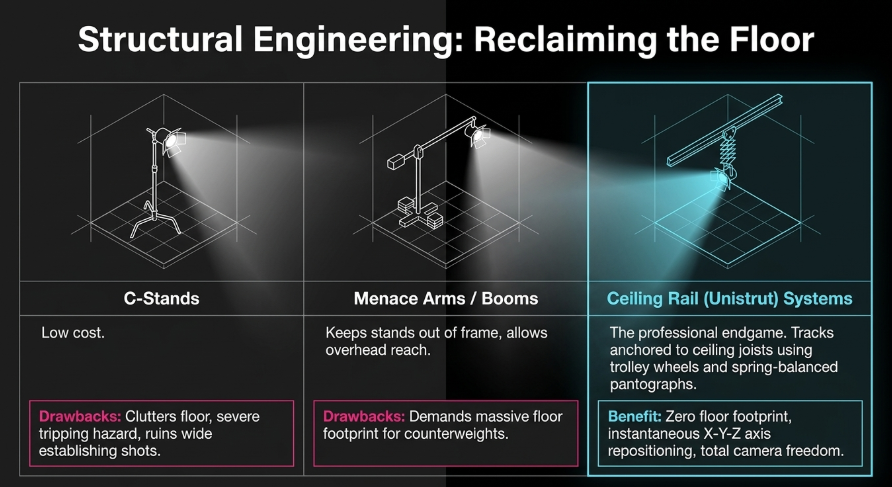
The physical rigging of luminaires in a podcast studio requires careful logistical planning to maximize floor space, ensure safety, and allow for unimpeded camera operation. A common error in amateur setups is cluttering the studio floor with flimsy tripods, which present severe tripping hazards, restrict camera placement, and easily tip over under the weight of large modifiers. Reddit
Floor Mounting and Boom Arms
For standard floor mounting, heavy-duty C-Stands are mandatory when flying large parabolic softboxes or heavy COB fixtures. YouTube However, C-Stands still occupy valuable real estate. To position a backlight or an overhead fill light without the stand itself entering the camera frame, operators must utilize boom arms. A popular solution for smaller kits is the Menace Arm, built from 1.5-inch aluminum speedrail. This allows a heavy fixture (like a 600W COB) to be cantilevered deep over the set while the heavy base remains hidden against the wall, counterbalanced by sandbags. Reddit Similarly, the Matthews Mini Max boom system provides substantial reach, though it demands a large footprint in the room. Reddit
Overhead Track Lighting and Ceiling Rail Systems
The ultimate, uncompromised structural solution for permanent podcast studios is the complete removal of floor stands via the implementation of overhead studio track lighting or ceiling rail systems. Reddit
By anchoring an aluminum grid (such as a Unistrut system) directly to the ceiling joists, luminaires can be suspended entirely from above. A standard DIY or prosumer implementation involves mounting 8-foot Unistrut rails parallel to each other on the ceiling. YouTube Heavy-duty trolley wheels are inserted into the tracks, allowing them to glide smoothly. Attached to these trolleys are Pantographs-scissor-like extension arms (often utilizing lazy tong riveters and spring balancers) that allow the light to be pulled down to eye level or pushed flush against the ceiling. YouTube
This architecture entirely removes all light stands, power cables, and sandbags from the floor. This allows podcast hosts to move freely, permits cameras to capture wide-angle establishing shots without exposing unsightly grip gear, and enables lighting configurations to be smoothly repositioned across the X, Y, and Z axes in seconds as the set evolves from a solo recording to a four-person interview. Reddit
Centralized Automation: Remote Control Protocols
As a podcast studio matures, the sheer volume of lighting fixtures increases exponentially. In a four-person roundtable setup, it is common to deploy four key lights, an overhead lantern fill, multiple rim lights, and a dozen RGB practical accent lights to paint the background. United Wolves Productions Physically walking around with a ladder to adjust the intensity and color temperature dials on fifteen different fixtures-especially those mounted on high ceiling grids-is a logistical impossibility. This necessitates the integration of remote, automated lighting control ecosystems.
Proprietary App-Based Ecosystems
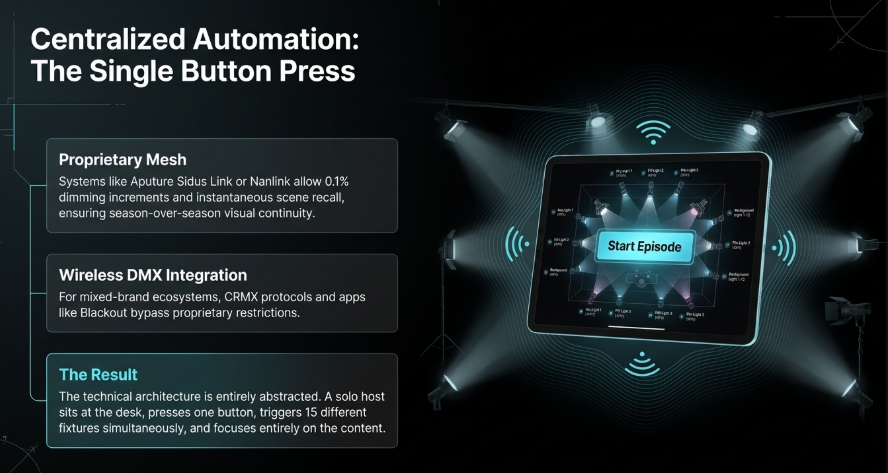
Modern LED fixtures are universally equipped with Bluetooth mesh technology or integrated Wi-Fi, allowing an entire studio grid to be controlled via a single iPad or smartphone tablet. For studios operating exclusively within the Aputure and Amaran hardware family, the Sidus Link and Sidus Link Pro 2.0 applications provide an exceptionally powerful, wireless control workstation. Aputure The software allows operators to build a virtual "Stage" layout, mapping out the physical location of each light on the tablet screen. YouTube Adjustments to intensity (down to highly precise 0.1% dimming increments), CCT, and RGB background colors can be manipulated instantly without touching the lights. YouTube Furthermore, Sidus Link allows for the saving of specific "Scenes" or "Palettes." This means a studio can instantly recall the exact lighting parameters of "Episode 1" months later, guaranteeing absolute visual consistency across a podcast's multi-year season, a feature critical for maintaining brand identity. Aputure
Similarly, for studios deploying Nanlite fixtures (such as the Forza COB line or PavoTube accents), the NANLINK app offers centralized control, managing brightness, color temperature, and practical lighting effects across the studio floor. B&H eXplora
Mixed Ecosystems and Wireless DMX Integration
A significant operational challenge arises when a studio mixes lighting brands based on budget or specific fixture requirements (e.g., using powerful Aputure key lights, Nanlite RGB tube lights for accents, and cheap Godox panels for background fill). Reddit The proprietary apps (Sidus Link and Nanlink) cannot communicate with competitor hardware, leaving the operator juggling multiple tablets and apps. Reddit
To unify control across a mixed-brand studio, the production must upgrade to a standard DMX (Digital Multiplex) workflow. Reddit By utilizing wireless DMX transmitters and receivers (such as those from RatPac, Lumen Radio, or systems utilizing CRMX protocols), the lighting director can bypass proprietary brand restrictions. Reddit
Using professional, tablet-based programming software like the Blackout app, or the expanded DMX auto-patching features in Sidus Link Pro, an operator can control every parameter of every light-regardless of the manufacturer-from a single master board. YouTube This ensures total studio automation, allowing a solo podcast host to sit at their desk, press a single button on an iPad, and instantly trigger the perfect lighting setup for all fixtures simultaneously.
Budgetary Phasing and Implementation Strategies
The architecture of a podcast lighting setup is highly modular, allowing for progressive scaling as the production's capital, studio space, and viewership grow. Achieving a clean, professional image does not strictly require a massive initial expenditure; rather, it requires the strategic application of the principles discussed above.
Foundational and Zero-Budget Solutions
For emerging creators, the absolute minimum requirement is avoiding "flat" lighting by ensuring the main source of illumination originates from an offset 45-degree angle rather than directly behind the camera lens. Cutback A highly popular DIY hack for extreme budget constraints involves repurposing common household hardware into pseudo-studio gear. For instance, inexpensive IKEA Tertial or LERSTA work lamps, equipped with high-CRI smart LED bulbs, can be clamped to desks or placed on the floor. YouTube By clipping a layer of baking parchment paper or sheer white fabric over the lamp housing using pony clamps, the harsh, direct bulb is heavily diffused, effectively creating a makeshift softbox. YouTube While this DIY approach lacks the sheer output, directional control, and color precision of professional gear, it effectively introduces soft, dimensional 45-degree lighting to a face for under $40, representing a massive upgrade over ceiling office lights. YouTube Similarly, large IKEA Regolit paper shades can mimic the effect of a professional lantern softbox for cheap overhead fill. YouTube
Prosumer and Professional Deployments
As capital allows, studios should phase their upgrades strategically, always prioritizing the power and softness of the main Key Light before investing heavily in background RGB tubes or hair lights. A standard prosumer upgrade path involves transitioning from bare bulbs to a 200W or 300W Bi-Color COB light (such as the Amaran 200x S or Nanlite FS-300B) paired with a 35-inch parabolic softbox. YouTube This single, highly softened key light immediately elevates the visual texture of the skin, carves out professional-grade contrast ratios, and sets a robust aesthetic foundation.
Once the key light is established, the studio can expand into the cross-lighting paradigms for two-person setups, eventually culminating in the ceiling-mounted, DMX-controlled, multi-host roundtable environments that define the top tier of the podcasting industry. Apex Photo Studios
Conclusion
The lighting design of a modern video podcast studio is a meticulous, highly technical synthesis of photometric science, spatial geometry, acoustic awareness, and aesthetic intent. It requires far more than merely illuminating subjects so they register on a camera sensor; it demands the architectural control of photons to craft an environment that enhances the spoken word.
By strictly adhering to the mathematical principles of the Inverse Square Law to manage exposure fall-off across multi-host environments, demanding high TLCI ratings for immaculate, grade-free skin tone reproduction, and deploying sophisticated COB luminaires paired with parabolic softboxes, producers can architect a visual environment that matches the premium quality of their audio. Furthermore, the mastery of cross-lighting paradigms, the eradication of eyeglass glare through precise angle of incidence management, and the integration of silent, fanless fixtures ensure that the visual demands of the medium never compromise the acoustic sanctity of the recording space.
Ultimately, a strategically lit podcast studio operates as a highly controlled, automated ecosystem. By leveraging ceiling rail systems and wireless DMX protocols, the technical complexity is abstracted away, allowing hosts to forget the mechanics of production and focus entirely on the delivery of their content, secure in the knowledge that the visual presentation is flawless.