Executive Summary and Macroeconomic Context of the Podcasting Industry
The media and broadcasting landscape in 2026 reflects a global industry that has moved definitively beyond its experimental and hobbyist origins into a rigorous, high-stakes economy of attention. With global monthly podcast listeners continually expanding and audience demographics maturing, the qualitative distinction between professional-grade content and amateur recordings has become the primary determinant of listener retention, algorithmic discoverability, and commercial viability. The contemporary podcast is no longer strictly an auditory experience; it has evolved into a multi-sensory, multi-platform broadcast-often referred to as a "vodcast"-requiring bespoke architectural acoustics, broadcast-quality video infrastructure, specialized lighting, and complex signal routing ecosystems. Consequently, the overarching question of how much it costs to build a podcast studio cannot be answered with a single figure. Instead, it has diversified into highly stratified architectural and operational tiers, ranging from basic home configurations costing a few hundred dollars to multi-million-pound commercial facilities requiring complex civil engineering.
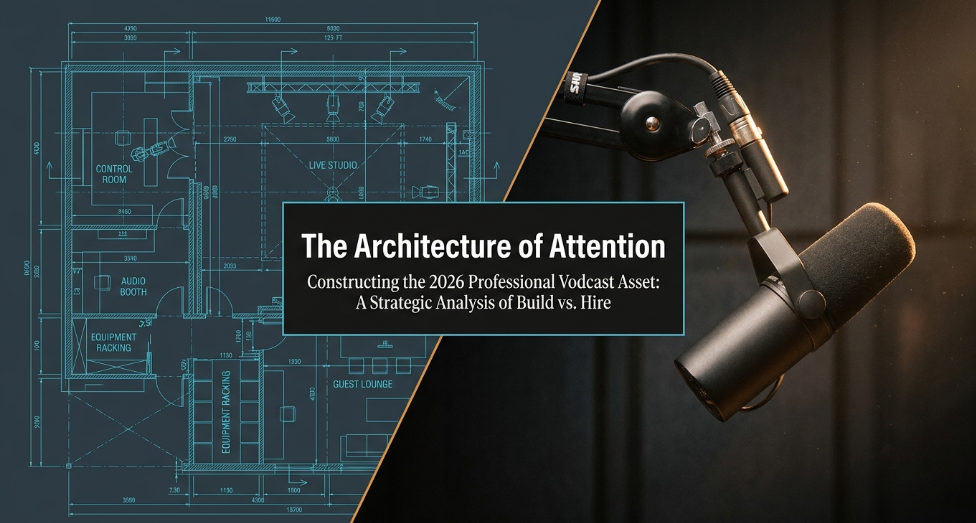
Constructing a professional podcast studio in the current macroeconomic climate demands a profoundly multidisciplinary approach. The process intersects acoustic engineering, commercial electrical contracting, systems integration, interior architecture, and digital workflow optimization. When a business, particularly in the B2B sector, initiates a comprehensive podcasting strategy, the total startup costs typically range from $6,500 to $28,000 (Rise 25). This initial capital injection encompasses not only the physical studio integration but also strategy development ($3,000 to $10,000), branding and sonic identity ($500 to $3,000), and initial marketing campaigns ($2,000 to $10,000) (Rise 25). However, the physical construction of the recording environment represents an entirely separate capital expenditure that scales aggressively based on the required noise floor, visual aesthetic, and real estate footprint.
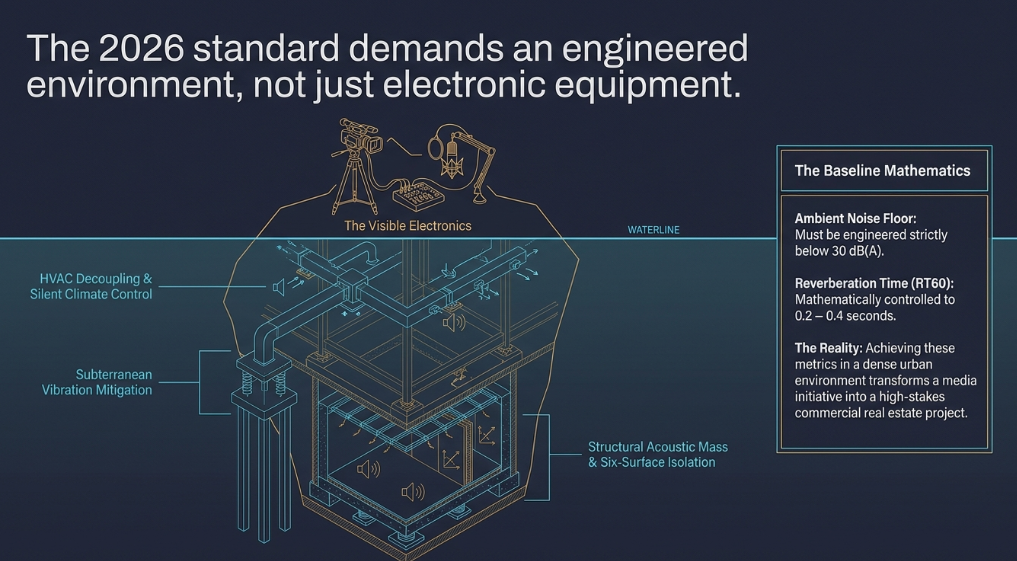
The baseline expectation for a professional studio in 2026 dictates an ambient noise floor below 30 dB(A) and a reverberation time (RT60) of 0.2 to 0.4 seconds. Achieving these metrics, particularly in dense urban environments like London, introduces profound engineering challenges that elevate costs exponentially, transforming what was once a consumer electronics purchase into a commercial construction project. This comprehensive report exhaustively evaluates the fiscal and technical requirements for building a podcast studio. By synthesizing global equipment pricing, specific structural construction costs, specialized labor rates, and the economics of digital post-production, this analysis provides a definitive blueprint for allocating capital across the complete spectrum of podcast studio development.
Strategic Tiering and Capital Outlay Framework
The financial commitment required to build a podcast studio must be meticulously contextualized within distinct architectural and operational tiers. The capital outlay for these tiers is dictated by the intended commercial application, the physical footprint of the real estate, and the required fidelity of the audio-visual output. Moving from one tier to the next represents an exponential increase in both capital expenditure (CAPEX) and ongoing operational expenditure (OPEX).
The Entry-Level or Basic Home Studio represents the absolute minimum viable product for independent creators, solo commentators, and bootstrapped startups engaging in content experimentation. This configuration is typically assembled within an existing, unmodified residential or office room. Acoustic treatment at this level is minimal and often applied via do-it-yourself (DIY) methods, relying on surface-mounted absorptive materials rather than structural isolation to nominally reduce mid-to-high frequency flutter echo. The capital expenditure for this basic tier ranges between $500 and $3,000 (approximately £500 to £3,000 in the UK market). The equipment utilized is strictly consumer-to-prosumer grade, optimized for single-source recording via USB interfaces, circumventing the complexities of multi-camera switching, synchronized timecode, or advanced signal routing (Finchley).
The Project Studio, or Semi-Professional facility, is the most prevalent model for serious corporate communications, mid-level media networks, and dedicated production businesses seeking to refine their messaging and broadcast authority. Constructed within converted garages, residential basements, or dedicated commercial spare rooms, these facilities are capable of producing broadcast-quality material that adheres to international delivery standards (such as -16 LUFS for stereo podcast delivery). The total estimated construction and equipment costs for this intermediate tier span broadly from $7,000 to $30,000. A significant portion of this budget is dedicated to the physical space rather than just the electronics. Acoustic treatment and soundproofing at this level represent a capital sink ranging from $2,000 to $10,000, encompassing high-density absorption panels, mathematical diffusers, corner bass traps, and fundamental soundproofing measures such as decoupled wall structures (Finchley).
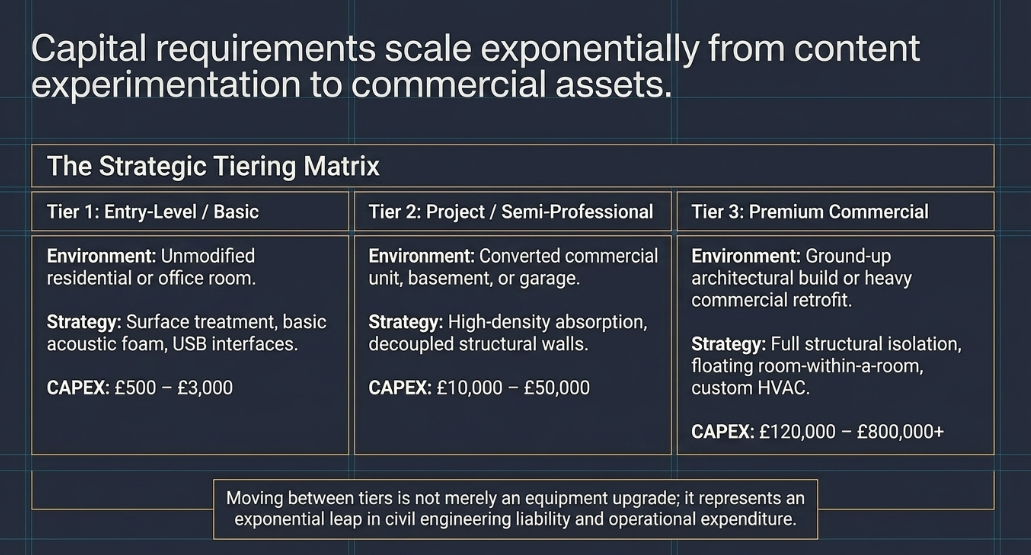
The Premium Commercial Studio represents a ground-up architectural endeavor or a heavy retrofit of premium commercial real estate. These spaces are purpose-built business assets designed to command high hourly rental rates, accommodate multi-person panels, and attract high-profile celebrity or executive talent. The construction of a stand-alone professional recording property, or the heavy conversion of an existing commercial asset, requires an investment ranging from £120,000 to £800,000. Within this elite tier, capital is distributed across vast infrastructure requirements. A custom-built facility may allocate £100,000 purely to space acquisition and structural framing, a further £50,000 to high-end acoustic treatment, architectural soundproofing, and floating room-within-a-room isolation, and another £50,000 to premium analog recording consoles, outboard mastering gear, and fiber-optic routing.
Structural Acoustics and the Physics of Urban Isolation
A critical point of failure in modern studio construction, and a primary source of unanticipated budget overruns, is the conceptual conflation of acoustic treatment with structural soundproofing. Acoustic treatment manages the behavior of sound waves inside a room, controlling reflections, standing waves, and reverberation to ensure clarity. Soundproofing, conversely, is the practice of preventing sound transmission between the interior of the studio and the external environment. In dense urban centers, achieving the required degree of isolation is an exercise in structural mass, mechanical decoupling, and meticulous airtight sealing.
The architectural challenges of building a podcast studio in London provide a perfectly illustrative baseline for worst-case urban acoustic engineering. Urban noise is constant and pervasive. Vehicular traffic, sirens, and pedestrian activity can easily raise baseline environmental noise levels by 20 to 30 decibels during peak operational hours. More pernicious, however, is the low-frequency structural vibration generated by subterranean transport infrastructure. For studios located in Central London or near transport hubs like Bermondsey's Biscuit Factory, the London Underground produces a distinct low-frequency rumble operating in the 30 to 80 Hz frequency band. Because low-frequency sound waves are incredibly long and carry immense energy, they travel directly through the ground, up through the building foundations, and vibrate microphone stands and diaphragms directly (NextMedia London).
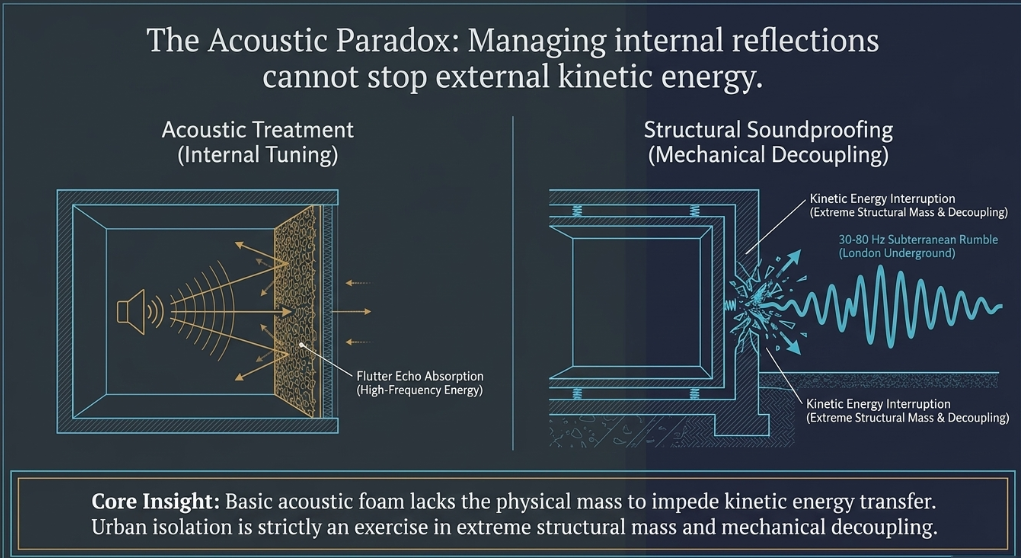
Mitigating this low-frequency kinetic transmission requires profound structural intervention. Basic acoustic foam or lightweight panels are entirely ineffective against such long waveforms, as they lack the physical mass to impede the energy transfer. The only viable engineering solution is complete mechanical decoupling, achieved by constructing a "room within a room." This requires the installation of floating floors and decoupled wall and ceiling systems. A professional floating floor necessitates a minimum structural build-up of 65mm, typically consisting of 40mm of dense concrete or specialist acoustic screed poured over a 25mm high-performance acoustic isolation mat or resilient rubber mounts (NextMedia London).
The vertical partitions (walls) must be constructed using the principles of mass and damping. This frequently involves erecting independent timber or metal stud frames spaced away from the existing boundary walls. These new frames are clad in double drywall systems, commonly utilizing two layers of 12.5mm high-density acoustic plasterboard (NextMedia London). Between these heavy plasterboard layers, viscoelastic damping compounds, such as Green Glue, are liberally applied. The physical mechanism of these compounds is to convert vibrational acoustic energy into microscopic, trace amounts of heat as the panels flex against one another. Furthermore, Mass Loaded Vinyl (MLV), a dense, flexible acoustic membrane weighing approximately 5 kilograms per square meter, is often integrated into the wall or floor structure to drastically increase mass without sacrificing significant square footage (NextMedia London).
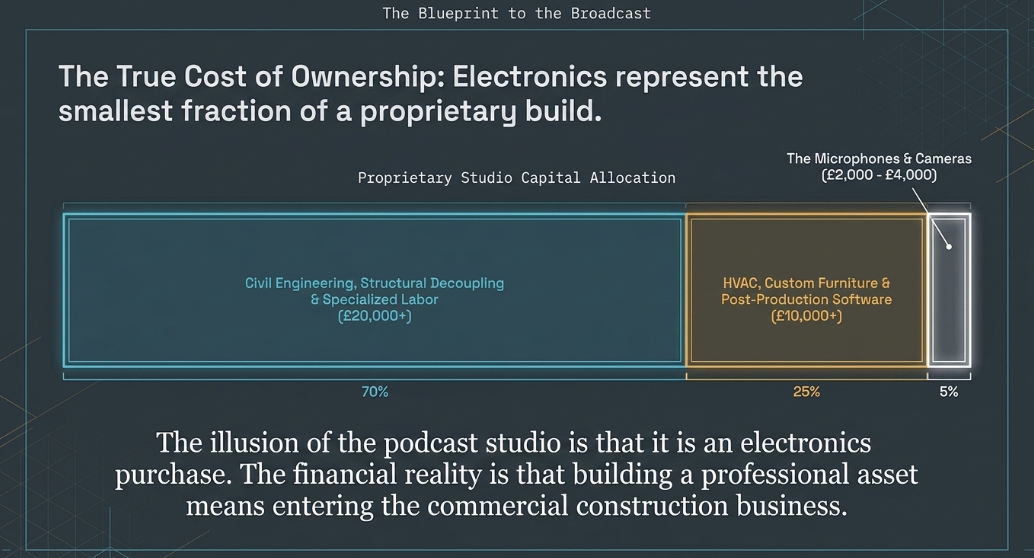
The financial implications of this structural work are substantial and form the bulk of mid-to-high-tier construction budgets. In the UK, the average total cost to soundproof a standard room ranges broadly from £11,050 to £20,650 (Checkatrade). Creating a comprehensive acoustic envelope requires addressing all six surfaces of the room. Specifically, erecting an insulated 25-square-meter independent stud wall in front of an existing boundary wall costs an average of £4,200, comprising approximately £2,400 in raw materials and £1,800 in specialized labor (Checkatrade). Alternatively, a less invasive method of adding high-density acoustic plasterboard mounted on resilient isolation batons to an existing 25-square-meter wall costs approximately £2,600 (Checkatrade).
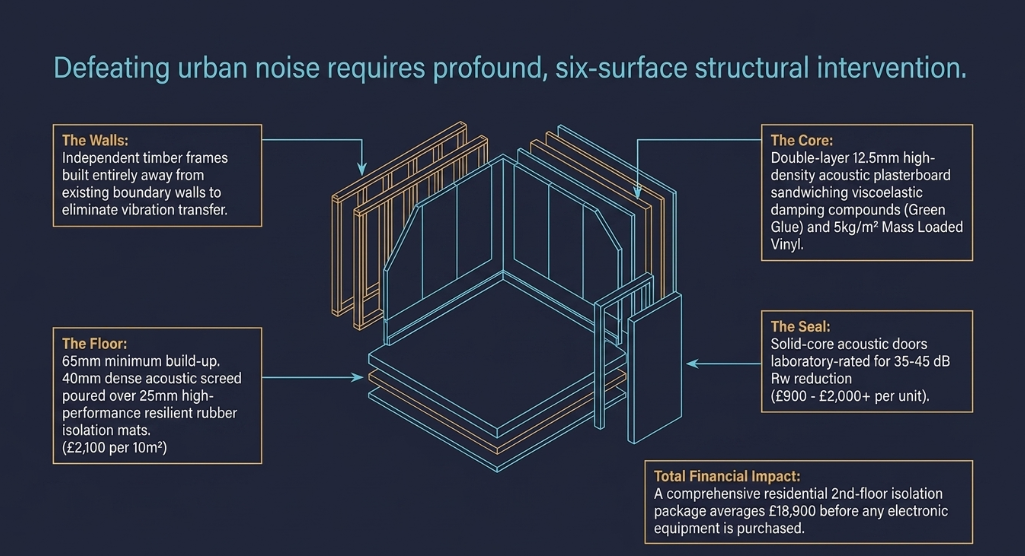
Floor soundproofing, essential for combating both impact noise and subterranean rumble, averages £2,100 for a 10-square-meter area (Checkatrade). The ceiling must also be addressed to prevent noise flanking from upper floors or rain impact on roofs. The installation of soundproof ceiling panels or suspended acoustic ceilings costs between £550 and £750 (Checkatrade). If a creator is building a project studio in a residential second-floor bedroom subject to significant noise flanking, a comprehensive wall, floor, and ceiling isolation package averages £18,900 (Checkatrade).
Older architecture, such as the Victorian buildings prevalent in European urban centers, presents an additional hazard known as flanking transmission. The solid masonry construction of these buildings acts as a highly efficient acoustic conduit, allowing sound energy to travel through the continuous rigid structure, thereby bypassing carefully isolated sections of the room. Remedying this requires meticulous attention to acoustic sealing, particularly at structural weak points like windows and doors. The installation of professional-grade acoustic door seals, drop-down sweeps, and perimeter gaskets costs approximately £300, including labor (MyJob Quote). However, sealing a hollow-core door is futile. Upgrading to a solid-core acoustic door, laboratory-rated to achieve a 35 to 45 dB Rw (Weighted Sound Reduction Index) reduction, requires an investment of around £900 per unit (MyJob Quote). For Tier 3 commercial studios demanding absolute, uncompromising isolation, specialist high-specification steel acoustic doors or timber acoustic door systems featuring complete, proprietary frame seals range from £1,200 to £2,000 per unit (MyJob Quote).
Internal Acoustic Treatment and Silent Environmental Control
Once the room is structurally isolated from external noise intrusion, the internal acoustic signature must be meticulously tuned. Without internal treatment, a perfectly soundproofed room acts as a highly reflective echo chamber; sound waves bounce infinitely between parallel hard surfaces, resulting in a cacophony of flutter echoes and standing waves that render speech unintelligible and fatiguing to the listener. To achieve the stringent broadcast target reverberation time (RT60) of 0.2 to 0.4 seconds, calculated broad-spectrum absorption is mandatory (NextMedia London).
The industry-standard core material for constructing broadband acoustic absorbers and bass traps is high-density mineral wool or stone wool. Rockwool RW3 is the overwhelmingly preferred substrate for custom acoustic treatments. Engineered with a specific density of 60 kilograms per cubic meter, RW3 provides exceptional thermal insulation, top-tier fire protection (carrying an A1 Non-Combustible rating), and profound acoustic absorption coefficients that remain effective deep into the lower-mid frequency spectrum (Soundstop). Due to global supply chain disruptions and raw material cost inflation throughout 2026, the market price for a standard pack of 50mm Rockwool RW3 acoustic insulation slabs (containing 8 slabs covering 5.76 square meters) fluctuates between £42 and £50, exclusive of VAT (Soundstop).
For commercial facilities or independent creators opting for pre-fabricated, aesthetically polished solutions rather than custom-built, fabric-wrapped DIY panels, acoustic manufacturing companies like GIK Acoustics and Vicoustic offer comprehensive, mathematically verified room kits. These systems include professionally manufactured broadband absorbers to manage early reflections, sophisticated diffusion modules to scatter high frequencies and maintain 'air' in the room, and critical corner bass traps. The GIK Acoustics Room Kit 1, heavily utilized in mid-tier project studios, is a professional acoustic solution that includes six 242 Acoustic panels and five specialized bass traps (four 244 models and one Monster Bass Trap) (Hi-Fi+). Professional room treatments demand these deep bass trapping solutions, often requiring absorption units at least 100mm thick to effectively tame low-frequency build-up in trihedral room corners. Failing to trap bass results in audio that sounds perpetually boomy, muddy, and amateur (NextMedia London).
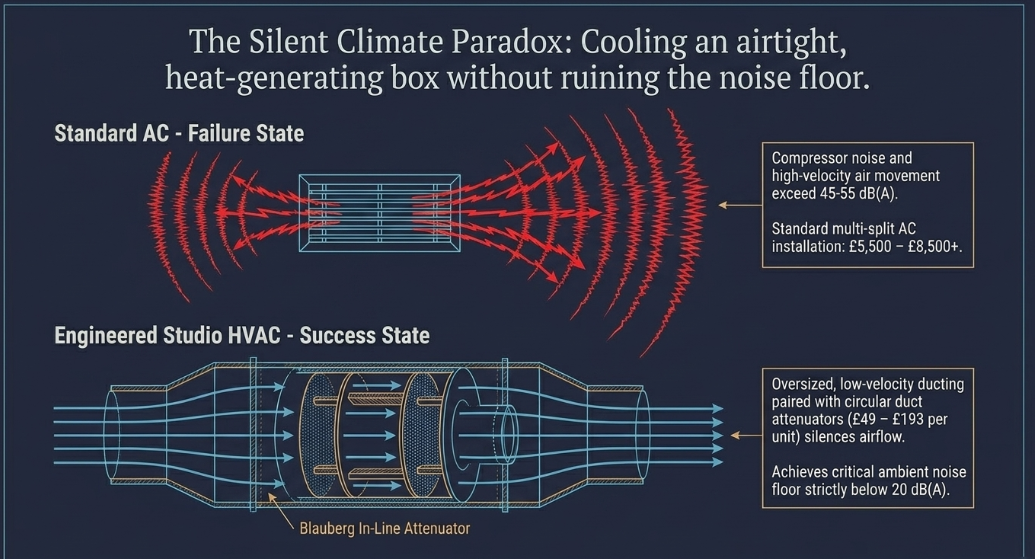
Beyond the passive acoustic paneling, the studio environment must maintain a comfortable climate for the talent. This represents a profound engineering paradox. A soundproofed studio is, by definition, a highly insulated, airtight box. When this box is populated by heat-emitting high-performance computing equipment, continuous lighting rigs, and multiple human bodies, the internal temperature rises rapidly. Standard domestic or commercial HVAC (Heating, Ventilation, and Air Conditioning) systems are entirely unsuitable for recording environments due to mechanical compressor noise and high-velocity air movement, which can easily exceed 45 to 55 dB(A), ruining the noise floor (NextMedia London).
Achieving a silent climate control solution requires specialized air conditioning systems and highly customized ducting architecture. A standard single-room split air conditioning system, which must be legally installed by F-Gas registered engineers in the UK, costs between £2,000 and £3,500 for supply and installation (Heatable). For larger studios requiring zoned multi-split systems (cooling a live room, control room, and lounge), costs escalate sharply to between £5,500 and £8,500 (Heatable).
However, simply installing the AC unit is insufficient. To ensure the moving air does not generate acoustic interference at the vent grille, the system must utilize oversized, low-velocity supply diffusers. Furthermore, extensive duct silencers must be installed in-line within the ventilation system. Circular duct attenuators, designed with sound-absorbing internal baffles to reduce the noise generated by fan units while allowing unimpeded airflow, vary in price based on diameter and length. Standard Blauberg or generic duct attenuators ranging from 100mm to 400mm in diameter cost between £49 and £193 per unit (Buy Insulation Online). The strategic integration of these attenuators, sometimes in series, guarantees that the HVAC system operates virtually silently, keeping the ambient room noise below the critical 20 dB(A) threshold required for professional, uncompromised broadcast (NextMedia London).
Specialized Labor and Consultancy Economics
The execution of these complex structural, acoustic, and electrical systems relies heavily on highly specialized, credentialed labor. In major urban centers, the cost of retaining these professionals constitutes a significant, and often underestimated, percentage of the overall studio build budget. Analyzing the day rates of the UK labor market in 2026 provides a clear, quantitative window into these capital requirements.
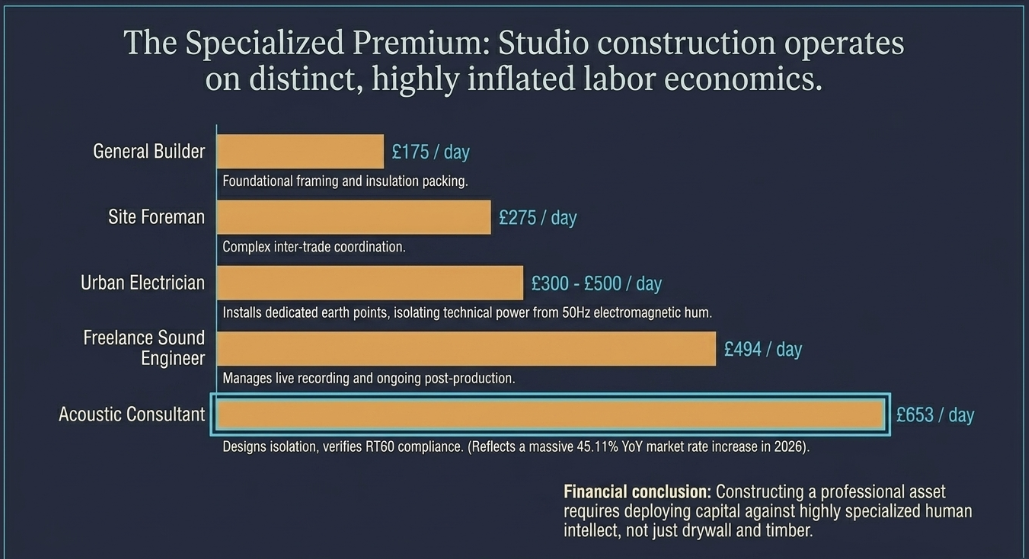
The architectural design, regulatory compliance, and acoustic verification of the space are typically overseen by an Acoustic Consultant. These experts conduct environmental noise impact assessments (crucial for planning permission in mixed-use urban zones), design the structural isolation elements, and verify the final room acoustics using specialized hardware and software suites like Room EQ Wizard. In 2026, the demand for acoustic engineering has driven market rates upward. The median daily rate for an acoustics specialist in the UK has experienced a massive year-on-year increase of 45.11%, reaching £653 per day (IT Jobs Watch). Senior, director-level consultants with over a decade of industry experience typically charge hourly rates ranging from £80 to well over £150 for advanced structural and environmental noise impact assessments (Heyda).
The electrical infrastructure of a podcast studio requires similarly specialized attention. Victorian buildings and older commercial units often feature degraded or improperly grounded electrical systems that introduce severe electromagnetic interference (50Hz or 60Hz hum) directly into the sensitive analog audio signal chain. A qualified electrician must be contracted to install dedicated earth points, isolated technical power grounds, and heavy-duty power conditioning units to physically separate the studio's technical power from standard domestic, lighting, or commercial HVAC circuits. In 2026, the Joint Industry Board (JIB) implemented a 3.95% increase to graded operative rates, establishing standard foundational hourly wages between £19.04 and £22.19 for approved technicians (Total Skills UK). However, the actual market day rate for electricians to the end-consumer ranges significantly higher, from £300 to £500 (Total Skills UK). In London, hourly rates frequently command £50 to £60, escalating to punitive rates of £100 to £130 per hour for small diagnostic jobs, initial hours, or out-of-hours technical installations (MyBuilder).
The physical construction of the decoupled framing, the heavy lifting of high-density drywall installation, and the aesthetic finishing work is handled by general builders and laborers. The average daily rate for a general builder is £175, while a dedicated site foreman required to manage the complex interplay of trades commands £275 per day (Cost Estimator). Plasterers, whose work is essential for skimming and sealing the heavy acoustic drywall to ensure airtight integrity, operate at an average day rate of £177 (Cost Estimator).
Once the physical studio is constructed and operational, the ongoing cost of human capital-specifically, professional Sound Engineers to manage recording sessions, mix audio live, and handle complex post-production becomes a critical operational expense. The median daily rate for a freelance sound engineer has surged by 79.55% year-on-year, reaching £494 in 2026, with average hourly rates sitting at £51 (YunoJuno). These rates fluctuate based on a multitude of factors, including the engineer's proficiency with specific digital audio workstations (DAWs), their ability to handle post-production video syncing, and whether they are required to supply their own specialized equipment (YunoJuno). Negotiating these rates often involves balancing hourly fees against project-based deliverables or long-term retainer agreements for ongoing podcast networks.
The Audio Signal Chain: Microphones, Interfaces, and Routing Architecture
The core functional mandate of the studio is the uncompromised, high-fidelity capture of the human voice. The audio equipment utilized determines the baseline noise floor, the transient response to sudden loud noises (like laughter), and the overall tonal balance of the recording.
In entry-level setups, the signal chain is highly simplified to reduce both cost and technical friction. Budget-friendly setups ranging from $70 to $300 often rely entirely on USB microphones. Devices such as the Fifine K669В ($31.99) or the highly versatile Audio-Technica ATR2100x-USB ($99) are staples of this tier (Podcast Monkey). The ATR2100x-USB is particularly notable as it provides both USB and XLR connectivity, offering a clear upgrade path (Podcast Monkey). These microphones universally feature cardioid polar patterns, a directional pickup design that rejects off-axis ambient noise from the sides and rear, compensating somewhat for untreated room acoustics (Podcast Monkey). Accompanied by basic closed-back headphones for monitoring without microphone bleed, like the Sony MDR-ZX110 ($12.99), and an inexpensive pop filter ($7.99) to mitigate harsh plosives, this tier provides functional audio capture without the need for external interfaces or complex routing (Talks.co).
Moving to a mid-range project studio requires a fundamental transition to an analog XLR infrastructure. This introduces the absolute necessity of an audio interface, a critical piece of hardware that houses the preamplifiers to boost the low-level microphone signal and the analog-to-digital (A/D) converters that digitize the audio for the computer processor. A standard mid-range setup ($300 to $700) typically features an interface like the Focusrite Scarlett Solo 3rd Gen ($109.99), recognized for its transparent preamps and stable drivers (Talks.co). This is paired with robust dynamic microphones mounted on articulated broadcast arms with shock mounts ($80+) to prevent desk thumps from reaching the capsule, and accurate, flat-response monitoring headphones like the Audio-Technica M30x ($60) (Talks.co).
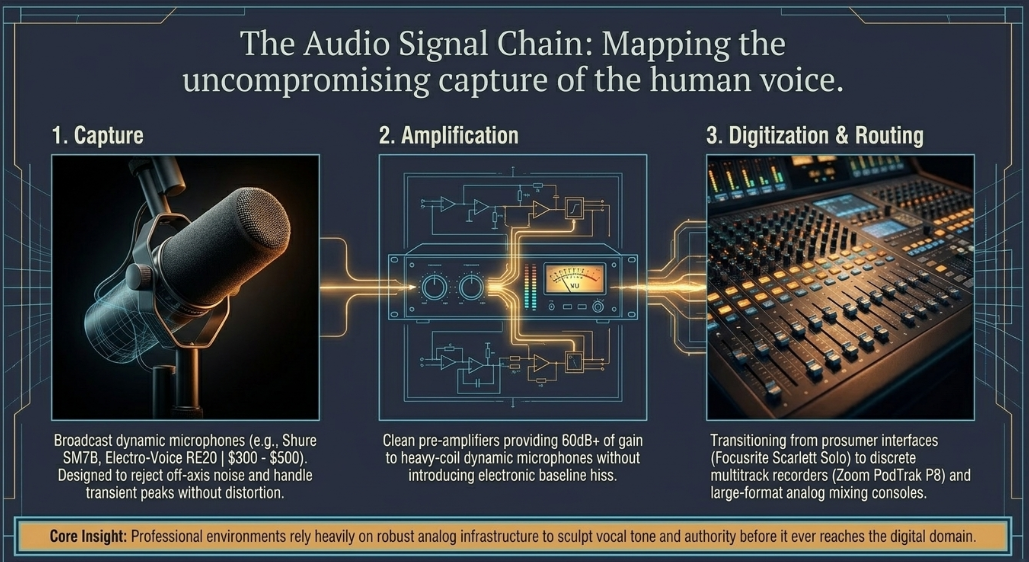
Premium commercial studios operate exclusively with industry-standard broadcast dynamic microphones and complex multi-track routing systems. The microphone locker in a high-end facility is a major point of prestige and tonal quality, often featuring classics like the Electro-Voice RE20 ($449) or the ubiquitous Shure SM7B ($300-$500). These microphones are celebrated for their rich, authoritative broadcast tone, proximity effect control, and their ability to handle loud transient peaks without distortion. Because these heavy-coil dynamic microphones possess notoriously low output levels, they demand exceptionally high-quality preamplifiers providing 60dB+ of clean gain to achieve an adequate signal without introducing electronic hiss to the noise floor.
Rather than standard computer interfaces, Tier 2 and Tier 3 studios often deploy multi-track recorders and mixers designed specifically for podcast workflows. The Zoom PodTrak P8 ($549) provides discrete multitrack recording capabilities directly to an internal SD card, preventing data loss during computer crashes, while offering simultaneous USB interface functionality, mix-minus channels for remote callers, and dedicated sound pad triggers (Talks.co). High-impedance, closed-back studio headphones, such as the 80-Ohm Beyerdynamic DT 770 PRO ($159), provide the extreme isolation necessary for critical monitoring during live recording (Talks.co). At the absolute highest echelon of Tier 3 facilities, the audio signal chain bypasses prosumer interfaces entirely, utilizing large-format analog mixing consoles costing tens of thousands of dollars, coupled with towering 19-inch racks of analog outboard compressors and equalizers to sculpt the vocal tone before it ever reaches the digital domain.
Visual Broadcast Infrastructure: The Vodcast Standard
By 2026, the audio-only podcast format has been largely superseded by the video podcast, or "vodcast." This shift is driven by algorithmic preferences on major distribution platforms like YouTube, Spotify's video integration, and the viral necessity of short-form vertical video clips for social media marketing. Incorporating a professional video infrastructure into a studio build is no longer an optional aesthetic add-on; it is a fundamental architectural design requirement that directly dictates lighting grids, heat dissipation, cable management, data storage capabilities, and live switching architecture.
A professional multi-camera setup requires at least three distinct angles-typically a wide establishing shot to show the spatial context, and dedicated, tight close-ups for both the host and the guest. This configuration allows for dynamic editing, heightened audience engagement, and masking of audio edits. While consumer smartphones like the iPhone 11 Pro or Samsung Galaxy S20 are technologically capable of 4K video recording (Riverside), they lack the shallow depth of field, advanced color science, interchangeable optics, and, critically, the thermal management required for long-form, multi-hour studio broadcasting without overheating.
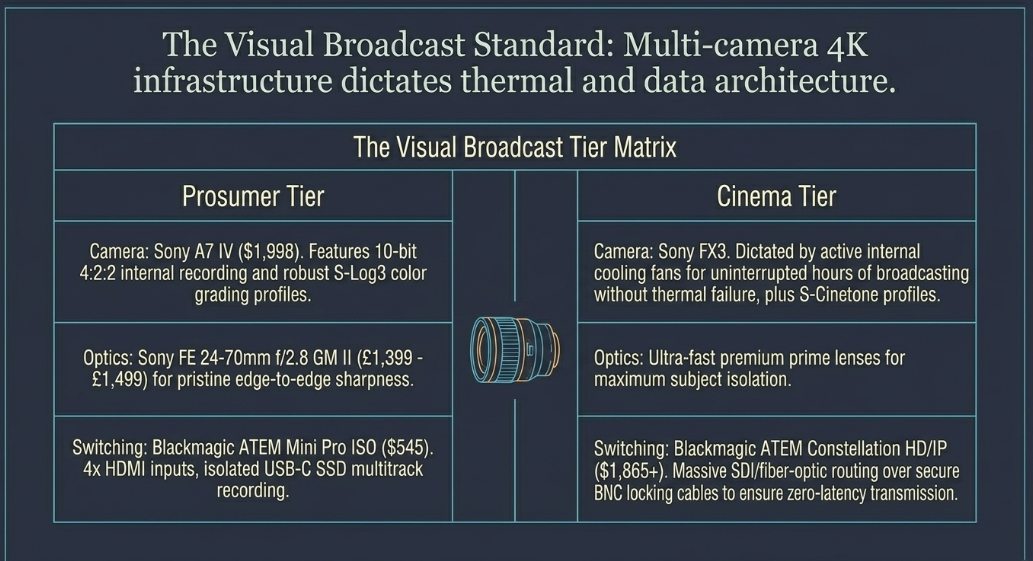
The prosumer tier frequently utilizes specialized vlogging and entry-level mirrorless cameras like the Sony ZV-E10. As an APS-C mirrorless camera capable of 4K UHD video at 30fps and 120fps high-speed HD, it offers a dramatic step up from webcams at a reasonable price point (YouTube). However, for broadcast-grade Tier 2 and Tier 3 studios, full-frame cameras are the definitive industry standard. The Sony A7 IV, benefiting from a 2026 price reduction making it available for $1998, offers profound capabilities including 10-bit 4:2:2 internal recording, exceptional real-time eye autofocus, and robust S-Log3 gamma curves, allowing colorists to extract maximum dynamic range during grading (Digital Camera World).
At the premium end of the visual spectrum, cinema-line cameras like the Sony FX3 command the studio environment. While sharing similar 12-megapixel full-frame sensor characteristics with the A7 IV, the FX3 provides superior active thermal cooling via internal fans for uninterrupted hours of recording. It also offers Sony's highly regarded S-Cinetone color profiles straight out of the box (reducing grading time), and a rugged form factor designed expressly for professional video rigging and top-handle XLR audio integration (B&H Photo).
The optical quality of these high-resolution camera systems is entirely dictated by the lenses attached to them. For shallow depth of field-which blurs the background and focuses listener attention entirely on the speaker and pristine corner-to-corner sharpness, premium optics are required. The Sony FE 24-70mm f/2.8 GM II, serving as the optimal standard zoom for flexible framing in varied studio layouts, costs between $1198 and $1498 (or £1399 - £1499 in the UK market) (Amateur Photographer). For ultra-fast prime lens applications providing maximum subject isolation and low-light performance, the Sony FE 50mm f/1.2 GM is an outstanding, albeit highly expensive, choice (Digital Camera World).
Managing multiple 4K video feeds requires robust, zero-latency live production switchers. The Blackmagic Design ATEM ecosystem is the undisputed dominant force in this sector. For basic configurations, the ATEM Mini Pro ISO ($545) allows a single operator to switch up to 4 HDMI inputs live, whilst simultaneously recording isolated tracks (ISOs) of each individual camera to an external USB-C SSD. Crucially, it generates a DaVinci Resolve project file mapping all live cuts for immediate, non-destructive post-production adjustment (B&H Photo).
For larger studios requiring extensive connectivity and longer cable runs where HDMI signal degrades, SDI infrastructure is mandatory. The ATEM SDI Extreme ISO ($1645) or the ATEM 2 M/E Constellation HD ($1865) provide massive routing capabilities over secure BNC locking cables (B&H Photo). The flagship ATEM 4 M/E Constellation IP switcher expands this architecture to enterprise levels, offering up to 80 SDI inputs, SMPTE-2110 IP video integration via redundant 100G fiber Ethernet connections, and comprehensive 64-channel MADI audio routing (No Film School).
Studio Lighting and Ergonomic Furniture Integration
To properly illuminate these high-resolution sensors and ensure the talent appears professional and vibrant, a traditional three-point LED lighting configuration (consisting of a key light, fill light, and back/hair light) is mandatory. The market for continuous video lighting is highly competitive, dominated by precision instruments from manufacturers like Aputure and Nanlite (Filmgear Canada).
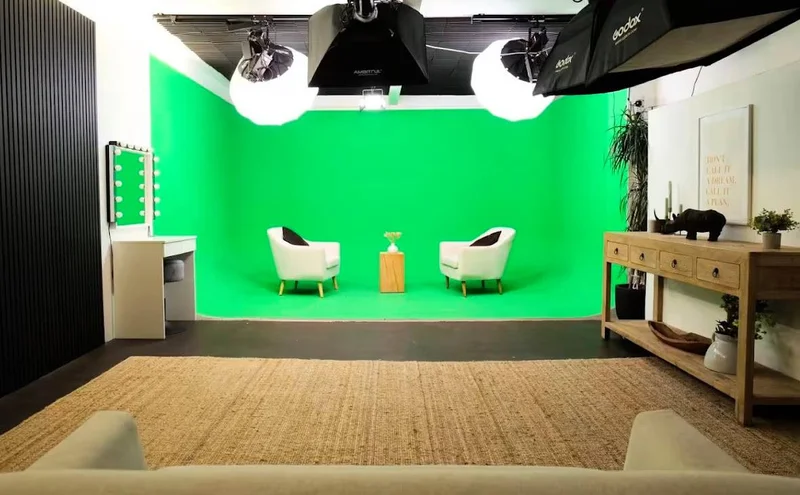
For content creators or studios operating with limited ceiling height or physical footprint, the Amaran Verge series provides ultra-slim soft-edge lighting panels ranging from $119 to $359 (Filmgear Canada). These panels are less than 1.5 inches thick and produce a true-to-life soft catchlight in the subject's eyes. Larger, dedicated spaces rely on high-output continuous fixtures. The Amaran Pano series (such as the 60c and 120c) offers versatile RGB color capabilities for dynamic background washing (Filmgear Canada). For the primary key lights, professional studios turn to Godox's Knoled series or Aputure's powerful point-source LED engines equipped with massive softbox modifiers to provide consistent, color-accurate (high CRI/TLCI) illumination that perfectly mimics high-end television broadcast environments (Reddit).
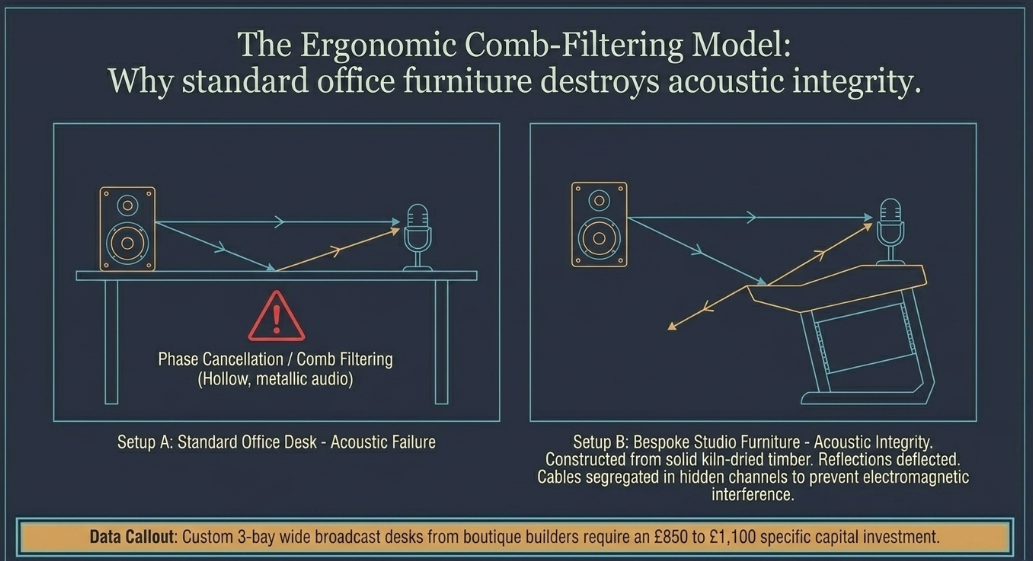
The tactile interface of the podcast studio-the desk and seating arrangement-plays a crucial role in both acoustic performance and talent comfort. Standard office furniture is often actively detrimental to recording environments. Flat, hard, reflective surfaces introduce comb filtering, a phenomenon where immediate early reflections off the desk surface enter the microphone slightly delayed from the direct sound, causing phase cancellation and a hollow, metallic audio signature. Professional studio furniture is uniquely designed to minimize these acoustic reflections while housing extensive technical equipment within arm's reach. Custom music and broadcast desks seamlessly integrate 19-inch equipment racks, articulated monitor and microphone arms, and hidden, segregated cable management channels to keep audio and power cables separate, preventing interference.
Boutique UK manufacturers such as Chunky Studio Furniture and StudioRacks offer bespoke solutions built from solid, kiln-dried timber, tailored precisely to the ergonomic footprint of the room and the exact dimensions of the mixing consoles used. A custom 3-bay wide studio desk from these specialized builders typically costs between £850 and £1,100 (Chunky Studio Furniture). Commercial, mass-produced alternatives, such as the Zaor MIZA line, provide highly structured, off-the-shelf ergonomic designs with integrated racking. Prices for these units range from €444 for junior models up to nearly €1,900 for flagship, expansive workstations (MUSIC STORE Professional).
Post-Production Economics and Digital Audio Restoration
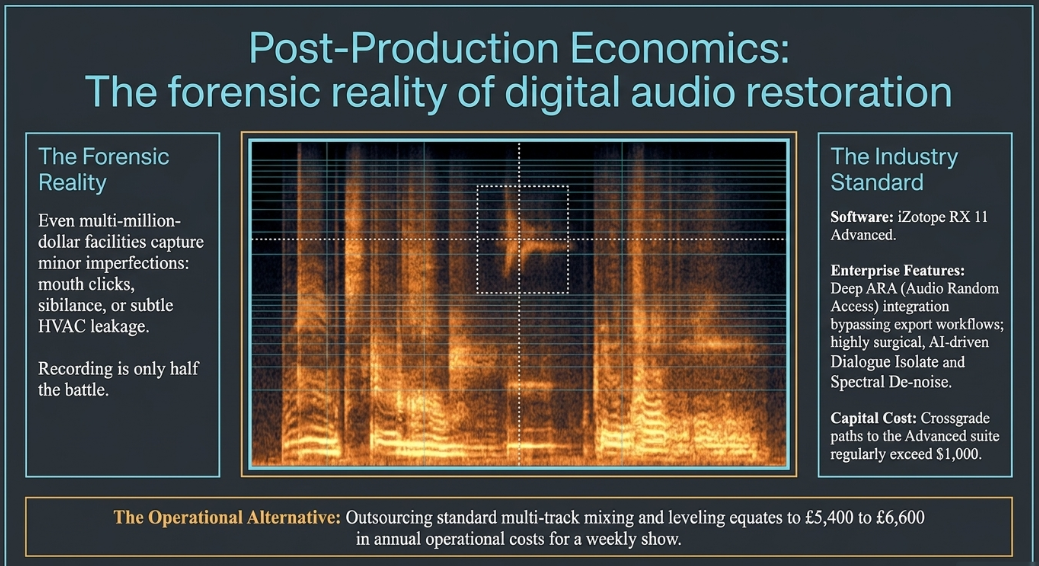
The final stage of podcast production occurs entirely in the digital domain. While digital audio workstations (DAWs) like Reaper, Logic Pro, and Avid Pro Tools provide the core architecture for multi-track editing, timeline arrangement, and final mixing, the defining tool of 2026 podcast post-production is specialized digital audio restoration software. Even in meticulously engineered, multi-million-dollar studios, minor imperfections inevitably occur during the recording process-such as intrusive mouth clicks, harsh sibilance, clothing rustle, or subtle HVAC rumble leaking through the ducting. These issues must be forensically addressed before broadcast. The undisputed industry standard for this highly technical task is the iZotope RX 11 suite (iZotope).
Available in multiple functional tiers, RX 11 Elements provides basic, automated algorithmic repair for entry-level podcasters. Moving up, RX 11 Standard introduces a dedicated standalone audio editor and 18 advanced processing modules, including spectral de-noise and de-crackle (iZotope). However, the flagship iteration, RX 11 Advanced, is considered a mandatory expense for professional commercial studios and post-production houses. It features highly surgical, Al-driven modules such as Dialogue Isolate (which now includes integrated Dialogue De-reverb to dry out overly ambient recordings), De-rustle, and Advanced Spectral De-noise tools (iZotope).
Furthermore, a critical advancement in RX 11 is the incorporation of deep ARA (Audio Random Access) support. This integration allows the spectral editor to function directly within hosts like Pro Tools (version 2024.06 and higher) and Logic Pro natively, completely bypassing the tedious, time-consuming workflow of exporting audio files to a standalone app and re-importing them after processing (iZotope). The financial investment for this enterprise-grade software is substantial; professional engineers note that base purchases or crossgrade paths from previous versions to the Advanced suite regularly exceed $1,000, representing a significant capital software expenditure (Reddit).
For creators or businesses that do not employ in-house engineers, the cost of outsourcing this post-production labor varies significantly based on the required fidelity and the complexity of the editing brief. Basic dialog editing-encompassing simple algorithmic noise removal and structural cuts to remove prolonged silences or errors-costs between £30 and £50 per episode, suitable for solo commentary shows (John Isaacson). Standard editing, which includes full multi-track mixing, dynamic leveling to hit LUFS targets, and intro/outro music integration, ranges from £75 to £150 per episode (John Isaacson). Premium, broadcast-quality post-production, featuring intricate sound design, mastering, and the extraction and formatting of viral social media video clips, demands £200 to £400+ per episode (John Isaacson). For a standard weekly 30-minute podcast, outsourcing standard editing equates to an annual operational cost of £5,400 to £6,600 (John Isaacson).
Economic Viability Analysis: Proprietary Build vs. Turnkey Studio Hire
For many corporate organizations, media brands, and independent creators, the staggering capital expenditure required to design, construct, equip, and maintain a Tier 2 or Tier 3 podcast studio prompts a fundamental, board-level economic question: Is it more financially viable and strategically sound to build a proprietary in-house facility, or to rent time in a commercial, fully-crewed turnkey studio?
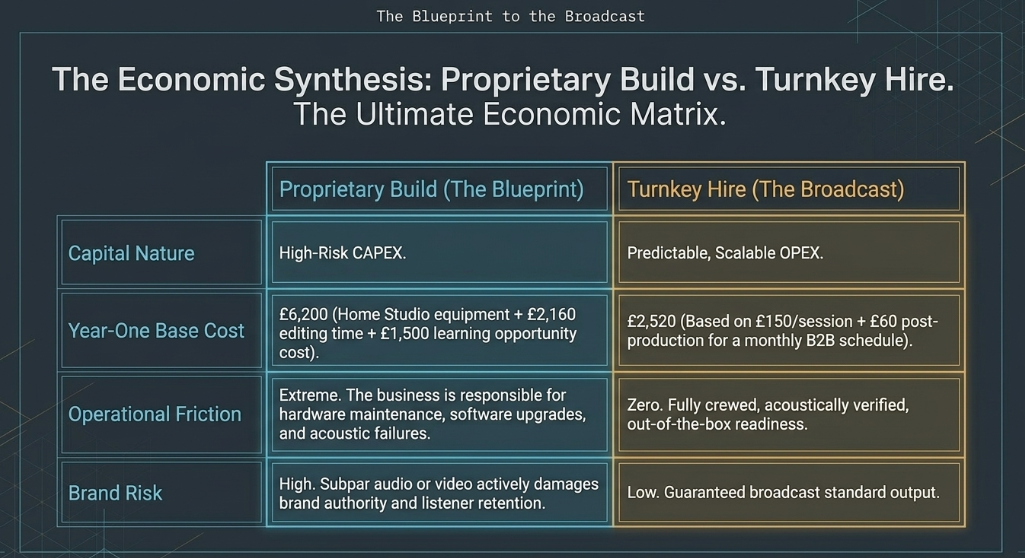
The true cost of producing a podcast via an in-house, DIY studio build involves both explicit, easily measurable financial outlays and hidden operational friction and opportunity costs. In a comprehensive economic model mapping the true cost of producing a single monthly show over a 12-month cycle, a DIY Home Studio approach incurs an estimated £6,200 in Year One (Podcast Studio Glasgow). This figure is comprised of approximately £2,000 for mid-range, prosumer equipment, £1,500 in lost time dedicated solely to learning technical operations (calculated at a modest opportunity cost of £30 per hour), £2,160 in self-editing and troubleshooting time across the 12 episodes, plus recurring software subscriptions and immediate equipment depreciation (Podcast Studio Glasgow). This approach also carries the unquantifiable risk of producing subpar audio that damages brand authority.
Conversely, leveraging an established commercial podcast studio shifts the financial burden entirely from a high-risk capital expenditure (CAPEX) to a predictable, scalable operational expenditure (OPEX). In premium urban markets like London, professional podcast studio dry hire (where the client rents the facility and operates the gear themselves) or wet hire (where a professional engineer is included) ranges from £60 to £170 per hour, exclusive of VAT (Finchley).
Premium, full-service facilities frequently charge structured package rates. An engineer-led session typically costs £99 per hour, escalating to £349 for a half-day (4-hour) block, and £649 for an eight-hour full day of bulk content recording (Podcast Studio London). When mapping this external service model against a monthly publication schedule, the professional studio route presents highly compelling economics for B2B brands. Utilizing a turnkey facility costs approximately £150 per recording session, with an additional £60 for two hours of minimal post-production polish, yielding a total annual expenditure of exactly £2,520 (Podcast Studio Glasgow).
This rental approach entirely eliminates the need for massive capital equipment purchases or £20,000 structural soundproofing investments. It erases the technical learning curve, circumvents the severe reputational risk of poor audio/video quality, and shields the creator from hardware maintenance and software upgrade liabilities (Podcast Studio Glasgow). Furthermore, premium commercial facilities often provide holistic launch and production retainers ranging from £1,500 fixed-fee launch packages to £2,500 monthly retainers. These comprehensive packages integrate sonic branding, multi-platform distribution strategy, show notes authoring, and growth marketing into the fixed fee, allowing the creator to focus entirely on content delivery rather than technical engineering (Podcast Studio London).
Conclusion
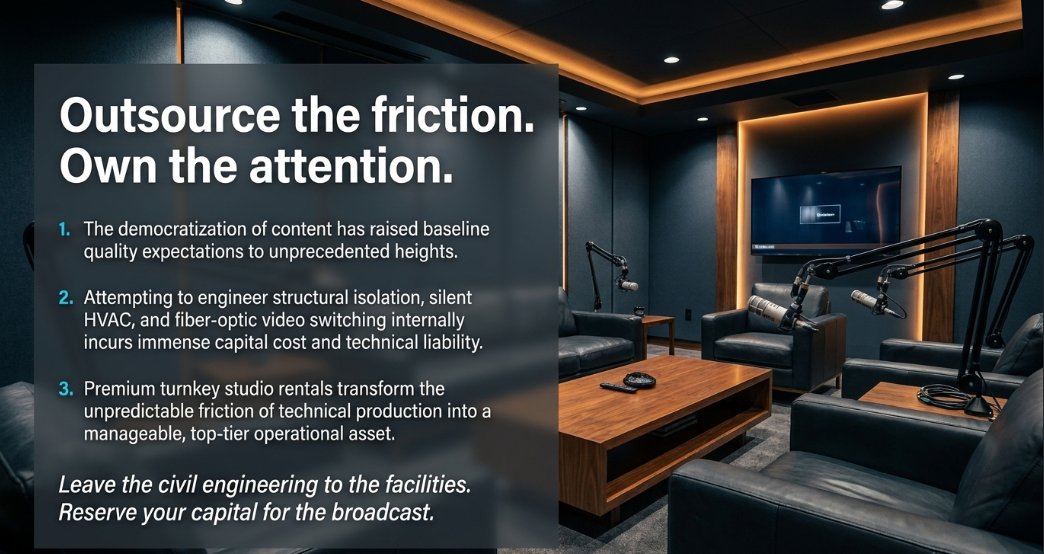
The design and construction of a podcast studio in 2026 is an exercise in extreme technical specificity and architectural acoustics. The profound democratization of digital content creation has, paradoxically, raised the baseline expectations for production quality to unprecedented heights, rendering consumer-grade audio and video setups insufficient for serious commercial endeavor or brand building.
As exhaustively demonstrated throughout this analysis, the capital required to build a studio varies by orders of magnitude depending on the target operational tier. While a highly functional, entry-level audio environment can be assembled for under $1,000, achieving the broadcast-grade structural isolation, mathematical acoustic neutrality, and multi-camera 4K visual standard demanded by top-tier networks requires a capital investment ranging from tens to hundreds of thousands of dollars. In challenging urban environments, the costs of civil structural decoupling-necessitated by the physics of ground-borne vibration and traffic noise-will easily dominate the budget, frequently exceeding the cost of the sophisticated electronic equipment housed within the room.
Furthermore, the sharp escalation in specialized labor rates across the acoustics and electrical sectors, the stringent physical requirements for silent HVAC systems, and the imperative for complex, fiber-optic video switching infrastructure underscore a fundamental reality: modern podcast studio design is a rigorous architectural and engineering discipline, not merely a consumer electronics purchasing decision. For corporate entities and creators unwilling to absorb these immense capital costs, structural liabilities, and technical learning curves, the flourishing market of premium turnkey studio rentals offers a highly structured, risk-averse economic alternative, transforming the unpredictable friction of technical production into a manageable, top-tier operational asset.