Introduction to the Mechanics of Sound Propagation and Boundary Interaction
The behavior of sound within any physical environment is governed by a highly complex interplay of mechanical wave propagation, geometric boundary conditions, and the intricacies of human psychoacoustics. Sound, at its fundamental physical level, is a mechanical wave that transports energy through a physical medium-such as air, water, or solid architectural structures-via continuous particle-to-particle interaction. As a sound wave propagates outward from an acoustic source and reaches the terminus of its medium, it inevitably encounters physical boundaries. Whether these boundaries are the walls of a small vocal booth, the sheer rock face of a canyon cliff, or the interface between air and water, the mechanical wave undergoes a series of characteristic behaviors: transmission through the new medium, refraction, diffraction around obstacles, and, most critically for the study of spatial acoustics, reflection. The nature of these acoustic reflections ultimately defines the sonic signature of a space. In the disciplines of architectural acoustics, environmental noise control, and audio engineering, the terms "echo" and "reverberation" are frequently conflated by laypersons, treated as interchangeable descriptors for any reflected sound. Fundamentally, both phenomena are born from the exact same physical process: the reflection of sound waves off a boundary surface Conwed. However, acoustically, physically, and perceptually, they represent entirely distinct phenomena. The defining differences between the two are dictated by reflection density, the temporal gap between the direct sound and the reflected sound, the architectural geometry of the space, and the neuro-auditory processing limitations of the human brain Conwed. An exhaustive understanding of the difference in sound quality between room reverberation and discrete echoes requires a multidisciplinary analysis spanning wave physics, psychoacoustic thresholds, material science, algorithmic signal processing, and architectural engineering. This report delves into the foundational physics of wave reflection, the psychoacoustic mechanisms that govern human spatial perception, the mathematical modeling of acoustic decay, the material science of sound absorption, and the creative engineering applications used to manipulate these auditory phenomena.

The Physics of Sound Reflection: Echo Versus Reverberation
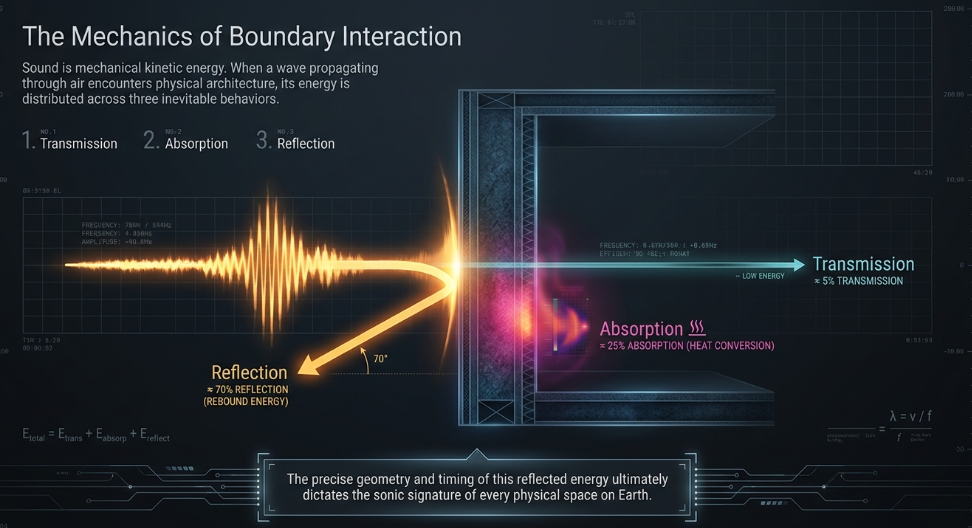
The physical and perceptual distinction between an echo and reverberation is defined primarily by the time delay and the reflection density of the acoustic energy returning to the listener Conwed. When a sound wave encounters a boundary, a portion of its energy is absorbed by the material, a portion is transmitted through the structure, and the remainder is reflected back into the acoustic medium. The temporal spacing of these reflections determines whether the human ear perceives a distinct repetition of the sound or a continuous, fading wash of noise.
The Physical Definition of an Echo
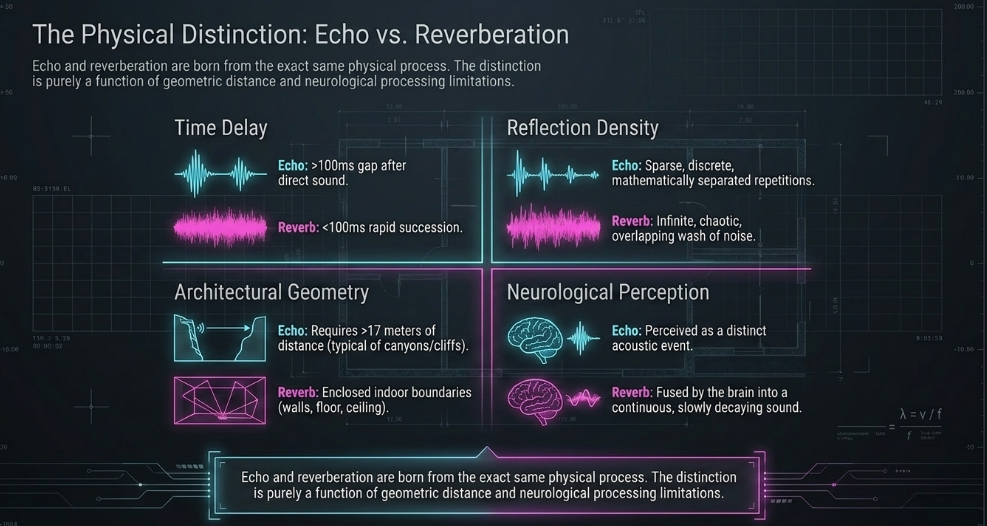
An echo is defined as a distinct, single reflection-or a sparse, mathematically separated series of discrete reflections-that arrives at the listener with a sufficient time delay after the original, direct sound has ceased Physics Stack Exchange. For an echo to be perceived as a discrete acoustic event entirely separated from the original sound source, the reflected sound wave must reach the listener's ear at least 0.1 seconds (100 milliseconds) after the direct sound has been perceived. Because the speed of sound in air at standard room temperature is approximately 340 meters per second, a time delay of 0.1 seconds requires the sound wave to travel a round-trip distance of roughly 34 meters. Therefore, a highly reflective boundary must be located at least 17 meters away from the acoustic source and the listener to generate a true, naturally occurring echo Physics Classroom. Due to this strict distance requirement, distinct, unmasked echoes are most commonly experienced in large, uncontained outdoor environments, such as deep canyons or sheer rock cliffs. In these vast outdoor scenarios, the acoustic reflection leaves the source, bounces off a distant, hard surface, and returns directly to the listener without interacting with the dense array of secondary boundaries found in enclosed rooms.
The Physical Definition of Reverberation
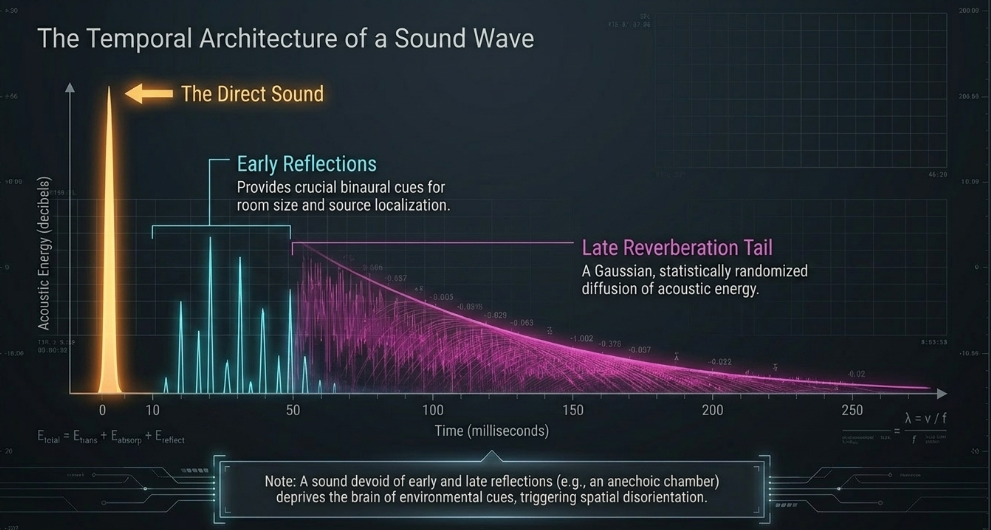
Conversely, reverberation is characterized by a highly dense sequence of multiple, overlapping sound reflections that arrive at the listener in rapid succession, typically in far less than 0.1 seconds. In enclosed indoor spaces, sound waves bounce off a wall, then immediately reflect off another wall, hit the ceiling, strike the floor, and continue to reflect off multiple structural surfaces in a chaotic, three-dimensional geometric pattern. Because the physical distances between these architectural boundaries are typically significantly less than 17 meters, the reflections return to the listener's ears in mere fractions of a second Physics Classroom. The human auditory system cannot distinguish between these highly dense, rapid, and overlapping reflections; instead, the human brain and short-term auditory memory blend them together with the direct sound, creating the perception of a single, continuous, and slowly decaying noise. From a mathematical and physical standpoint, an enclosed room's reverberation profile consists of sparsely distributed "early reflections" that bounce once or twice before reaching the ear, followed immediately by an exponentially decaying, highly dense field of "late reflections" or "late reverb". This late reverberant field is essentially Gaussian in nature, meaning it is a statistically randomized, chaotic diffusion of acoustic energy that loses intensity over time due to the absorption of sound by air molecules and the frictional resistance of room materials Physics Stack Exchange.
Psychoacoustics and Human Auditory Perception
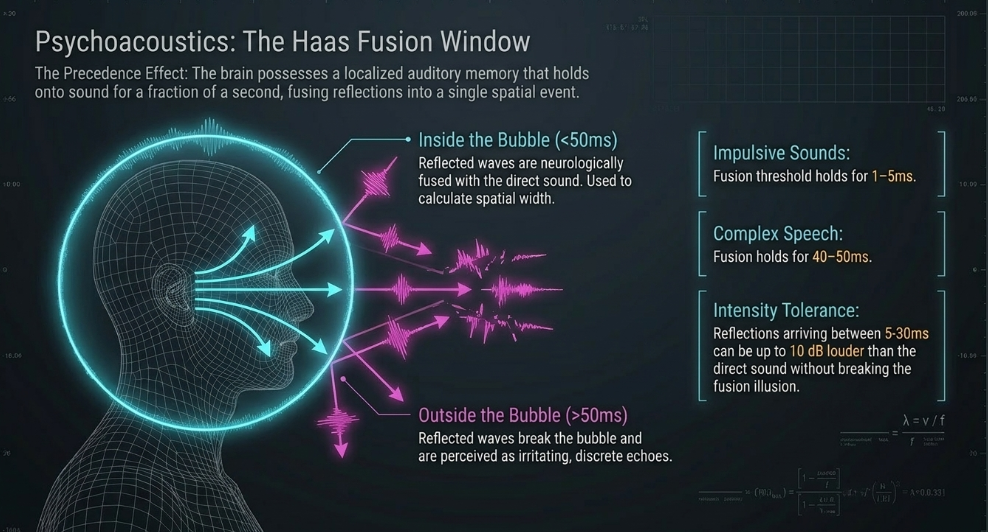
The differentiation between an echo and reverberation is not merely a matter of wave physics; it is heavily reliant on the neurological processing limitations and evolutionary adaptations of the human auditory system. The human brain exhibits a localized auditory memory that holds onto the perception of a sound for approximately a tenth of a second. Reflections arriving within this specific temporal window are neurologically fused with the original sound, meaning the perception of reverberation is inherently a psychoacoustic illusion.
The Precedence Effect and the Law of the First Wavefront
The foundational psychoacoustic concept for understanding spatial hearing is the Precedence Effect, also known as the "law of the first wavefront" or the Wallach Effect. When two identical versions of the same sound are presented to a listener separated by a sufficiently short time delay-specifically one that falls below the listener's neurological "echo threshold"-the listener does not hear two distinct sounds. Instead, they perceive a single, fused auditory event. Crucially, the perceived spatial location of this fused sound is dominated almost entirely by the physical location of the sound that arrived at the ear first (the direct sound or the first wavefront). The lagging sound (the acoustic reflection) does subtly affect the perceived width, level, and thickness of the sound source, but its impact on directional localization is mostly suppressed by the brain. This phenomenon was first explored conceptually in 1851 by Joseph Henry in his publication "On The Limit of Perceptibility of a Direct and Reflected Sound," and the law of the first wavefront was later formally described and named in 1948 by Lothar Cremer. In 1949, Hans Wallach and his colleagues demonstrated that when successive sounds coming from sources at different locations were heard as fused, the apparent location was dominated by the first-arriving wavefront.
The Precedence Effect operates across distinct localized thresholds based on precise time delays. For delays under 2 milliseconds, listeners experience summing localization, perceiving a single sound originating from a phantom direction somewhere between the lead and lag sources. This principle is actively utilized in intensity stereophony, where slight volume and timing differences between left and right speakers determine the localized direction. For delays between 2 and 5 milliseconds, localization dominance occurs, where the listener perceives one sound whose location is determined entirely by the leading source. During this short delay window, listeners experience lag discrimination suppression, rendering them significantly less capable of discriminating the actual physical location of the lagging sound source Wikipedia.
The Haas Effect and Intensity Thresholds
The specific parameters of this acoustic fusion were extensively documented by Dr. Helmut Haas in his 1949 Ph.D. thesis, leading to what is now colloquially known in audio engineering and acoustics as the Haas Effect. Haas discovered that if early reflections arrive within a small window of time after the direct sound, human beings cannot tell them apart from the direct sound. This small window of time is considered the "echo threshold," and it varies depending Composing Gloves on the transient nature and spectral complexity of the sound content. For impulsive signals, such as sharp clicks or snare drum hits, the fusion threshold is extremely short, typically occurring when the lag between the direct sound and the reflection is strictly between 1 and 5 milliseconds. However, for more complex sounds such as human speech, the fusion threshold is much higher, occurring with delays up to roughly 40 or 50 milliseconds. For dense musical compositions with overlapping harmonic content, such as piano music or orchestral performances, fusion can sometimes approach delays of up to 100 milliseconds before a reflection is perceived by the brain as an irritating, discrete echo Wikipedia.
A specific and fascinating variant of the Precedence Effect described by Haas dictates conditions under which a sound reflection can actually be physically louder than the original source without being perceived as a separate echo. Haas demonstrated an intensity tolerance whereby a single reflection arriving between 5 and 30 milliseconds after the direct sound can be up to 10 decibels (dB) louder than the direct sound, yet still be psychoacoustically fused into a single auditory event. The Precedence Effect generally breaks down entirely, resulting in the perception of a distinct echo, only if the second-arriving sound is at least 15 dB louder than the first, or if it exceeds the 50-millisecond time threshold for speech.
The Perception of Space, Distance, and Soundstage Width
The human brain constantly utilizes the ratio, timing, and density of early reflections versus the late reverberant tail to subconsciously calculate the physical size of a room and the listener's distance from the sound source. Early reflections-those arriving immediately after the direct sound within the Haas window-provide vital binaural cues regarding the physical dimensions YouTube of the environment and the spatial positioning of the source within that geometry. If early reflections are suddenly removed from a signal, the positional tracking of the sound source becomes significantly less obvious to the listener Waves.
Late reflections, which are heavily diffused and lacking in directional cues, provide a sense of atmospheric envelopment, spatial size, and sustain. For diffuse late reverberation, incoherent ear signals are observed, and the auditory spatial impression involves a combination of binaural cues, including the lateral distribution of energy impinging on the listener across different frequency bands and interaural coherence PMC. A sound completely devoid of early and late reflections-such as one generated in a purely anechoic chamber or listened to via dry headphone signals-sounds unnatural and deeply unsettling because it deprives the auditory system of the environmental cues required for spatial orientation CMU. Conversely, classical music is often recorded using spaced microphone techniques designed specifically to capture these reflections, giving rise to a more airy, spacious aural impression and increasing the perceived overall soundstage width Audio Engineering Society.
Rhythmic and Temporal Impact of Reflections
Beyond basic spatial perception, the presence of discrete echoes and reverberation can profoundly influence neuro-auditory tempo perception, emotional regulation, and musical rhythm. Research indicates that when humans are exposed to an acoustic environment with discrete, long-delay echoes, their internal rhythmic entrainment is actively altered PubMed. In experimental settings, if the delay of an echo is shorter than the inter-onset interval between two musical notes, individuals tend to unconsciously accelerate their reproduced tempo PubMed. Conversely, if the echo delay is longer than the note interval, they tend to slow down their tempo PubMed.
Furthermore, studies have shown that a low-frequency (3 Hz) amplitude-modulated signal can induce a subsequent oscillation of perceptual detectability of a brief acoustic stimulus, providing evidence that rhythmic contexts and echoes have a direct influence on the subsequent auditory perception of discrete acoustic events PMC. Rhythm perception is not merely a function of temporal structure but is actively shaped by the spectral properties, consistency in spectral cues, and reflection density of the acoustic environment bioRxiv. This ties into broader psychoacoustic phenomena, such as the Shepard tone illusion (a continuous Risset scale or Shepard-Risset glissando) where tones appear to ascend or descend Wikipedia infinitely, demonstrating how frequency masking and timing overlap can completely distort the brain's perception of acoustic reality. The manipulation of these cues-such as tempo, rhythmic units, and reverberant decay-has been shown to significantly regulate emotional states, shifting listener mood along semantic scales from relaxing to stressing, or expressionless to expressive Frontiers.
Architectural Acoustics and the Mathematics of RT60
In the field of architectural acoustics, the quantitative measurement of reverberation is expressed as RT60 (Reverberation Time). Invented over a century ago by the pioneering acoustician W.C. Sabine, RT60 is precisely defined by the ISO 3382 standard as the time duration required for the sound energy in an enclosed space to decrease by 60 decibels (dB) after the emission of the sound source has stopped Commercial Acoustics.
RT60 is the fundamental architectural tool used to shape the sound of every room Commercial Acoustics. By measuring RT60, architects and acoustic consultants obtain an objective, quantitative indication of the acoustic quality of a space SVANTEK. If the reverberation time is too long, the environment creates excessive echo, speech loses intelligibility because important high-frequency consonant details are masked by louder, lingering low-frequency vowel sounds, and music sounds muddy Commercial Acoustics. On the other hand, if the reverberation time is too short, the room will sound sterile, dead, and uninviting, reducing the rich, warm acoustic resonance necessary for a concert hall orchestra SVANTEK.
The Sabine and Eyring Formulations
The traditional objective measure of reverberation relies on Sabine's formula, which states that reverberation time is directly proportional to the physical volume of the room and inversely proportional to the total equivalent absorption area of its boundary surfaces Commercial Acoustics. The mathematical expression is:
$RT_{60} = 0.161 \times \frac{V}{A}$
Where V is the cubic volume of the room in cubic meters, and A is the total sound absorption measured in Sabins Commercial Acoustics. Total absorption is calculated by multiplying the surface area of each finish type in the room by its respective Noise Reduction Coefficient (NRC) Commercial Acoustics. While Sabine's equation is foundational for predicting RT60 in large, highly reverberant spaces like gymnasiums, concert halls, and cathedrals, it assumes a perfectly diffuse sound field where sound energy is distributed randomly and equally in all directions Acoustics Insider.
In rooms treated with high levels of acoustic absorption, the Sabine formulation often fails, slightly underestimating absorption effectiveness at high coefficient levels Firgelli Automations. In these scenarios, the Eyring modification to Sabine's model is frequently utilized for a more accurate prediction of decay time Firgelli Automations:
$RT_{60}=\frac{-0.161\times V}{S\times ln(1-\overline{\alpha})}$
Where S is the total surface area of the room and $\alpha$ is the average absorption coefficient of all surfaces. By utilizing the Eyring model, acoustic engineers can recalculate the required absorption to meet specific target compliance, determining the precise square meterage of acoustic panels needed to bring a room from an untreated 2.5 seconds down to a highly controlled 1.38 seconds Firgelli Automations.
Frequency-Dependent Decay and the Bass Ratio
RT60 is not a static, monolithic value across the human hearing spectrum; it is highly frequency-dependent Firgelli Automations. The reverberation time varies with frequency due to the physical nature of sound-absorbing materials and the absorption of high frequencies by the air itself Prosoundtraining. Low frequencies, characterized by long, powerful wavelengths, carry significantly more acoustic energy and are far more difficult to absorb than short, high-frequency sound waves Prosoundtraining. As a result, a room treated with standard fiberglass panels may achieve an RT60 of 1.15 seconds at treble frequencies, while the bass-frequency RT60 remains highly elevated at 2.35 seconds Firgelli Automations.
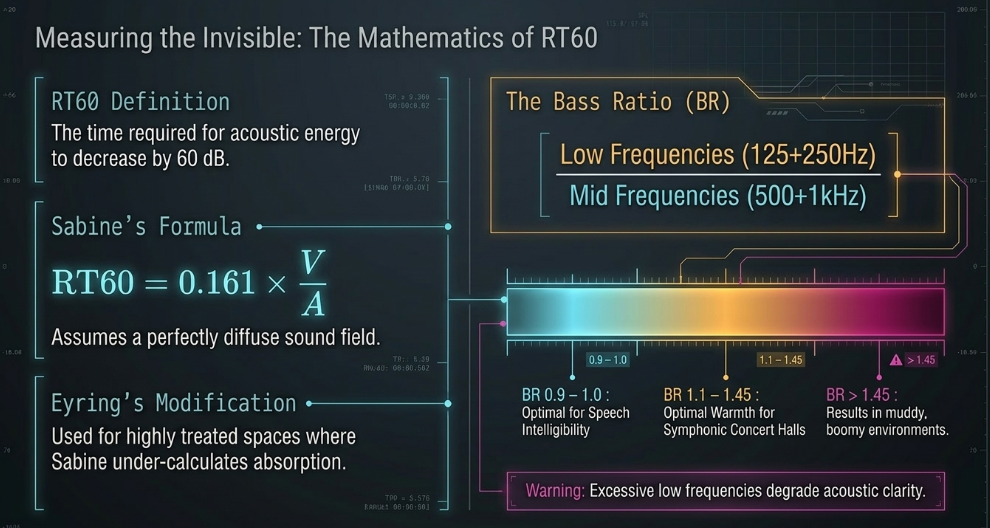
This relative reverberation time of low frequencies compared to mid-frequencies is quantified as the "Bass Ratio" (BR), which mathematically defines the acoustical "warmth" of a space Biamp. The ratio is calculated by comparing the average of low-frequency octave bands to mid-frequency octave bands:
$BR = \frac{RT60_{125Hz} + RT60_{250Hz}}{RT60_{500Hz} + RT60_{1kHz}}$
To achieve optimal speech intelligibility in a room, the ideal Bass Ratio should be kept relatively flat, strictly between 0.9 and 1.0 Biamp. However, for concert halls designed for symphonic music, the Bass Ratio must be elevated to preserve musical warmth and natural tone. A concert hall with an overall RT60 of less than 1.8 seconds requires a Bass Ratio between 1.1 and 1.45, whereas a hall with an RT60 greater than 1.8 seconds targets a ratio between 1.1 and 1.25 Biamp. If the Bass Ratio becomes too excessive, however, the room will cross the threshold from pleasantly "warm" to objectionably "boomy" and muddy Firgelli Automations. This issue was historically documented in a prominent English music hall, where a wood floor installed over a carpet absorbed disproportionate amounts of bass energy, resulting in too-short low-frequency RT60s and an objectionably thin sound Prosoundtraining.
The "Small Room Myth" and Acoustic Reality
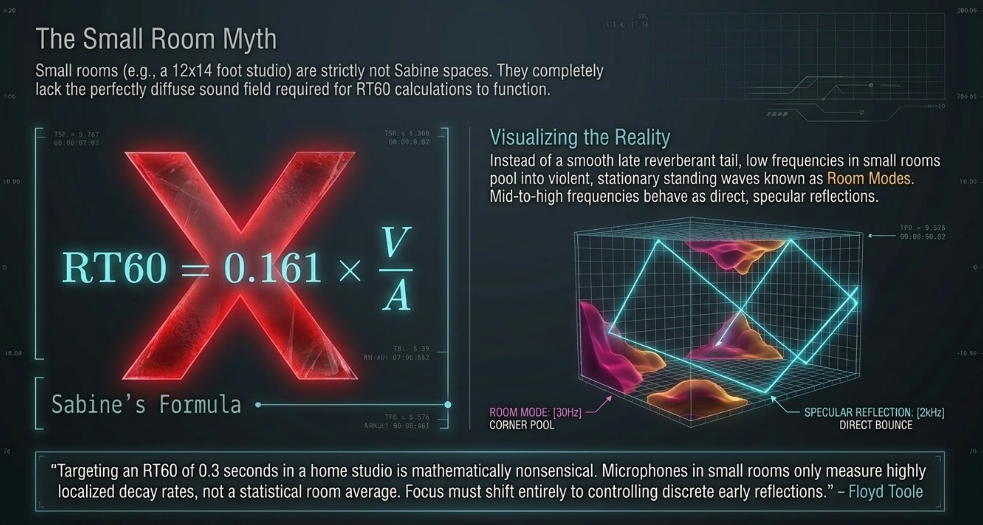
A critical and highly debated caveat in modern acoustics is the application of Sabine RT60 mathematics to small rooms, such as home recording studios, podcast booths, or private executive offices. As prominent acoustic researchers like Floyd Toole have forcefully noted in texts such as Sound Reproduction - Loudspeakers and Rooms, small rooms are strictly "not Sabine spaces" Acoustics Insider. They completely lack the perfectly diffuse sound field required for RT60 calculations to function accurately Acoustics Insider.
In a small room-such as a standard 12x14 foot bedroom studio-low-frequency acoustic behavior is not defined by a statistical reverberant tail, but rather by powerful standing waves (room modes) that dominate the low end Acoustics Insider. Mid-to-high frequencies are dominated by direct, specular reflections rather than a diffuse field Acoustics Insider. Furthermore, once absorption panels are placed in a small room, any chance of true acoustic diffusion is killed Acoustics Insider. Consequently, targeting a specific RT60 number (such as the oft-cited myth of aiming for 0.3 seconds in a home studio) is acoustically invalid and mathematically nonsensical Acoustics Insider. What is actually being measured by software like Room EQ Wizard in a small room is simply the decay rate at a highly specific microphone position; moving the microphone mere feet will yield a completely different RT60 reading Acoustics Insider. Therefore, in small room acoustics, the focus must shift entirely away from RT60 targets and toward controlling discrete early reflections and balancing the decay rate evenly across the frequency spectrum to avoid the ruined sound of uneven treatment Acoustics Insider.
Geometric Influences on Echo and Spatial Distortion
The architectural layout and geometric shape of a room heavily dictate whether it will generate a diffuse reverberant field or problematic, distinct echoes. Most non-specialists envision a room as a simple box consisting of two sets of parallel walls, a floor, and a ceiling Avant Acoustics. From an acoustic perspective, this simple geometry is fraught with issues.
Parallel Surfaces and Flutter Echo
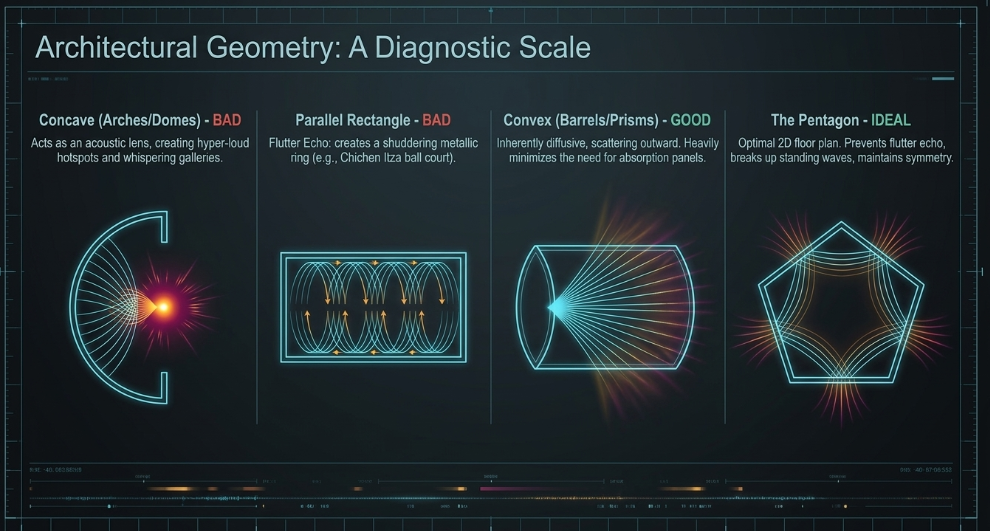
The most common and destructive architectural defect in rectangular rooms is "flutter echo," a phenomenon where a sound wave bounces rapidly and repeatedly back and forth between two parallel, acoustically hard and reflective surfaces TIU Engineering. Flutter echoes occur at rapid succession intervals-typically spaced 30 to 50 milliseconds apart-and create a distinct metallic, ringing, or "infinity mirror" auditory effect that completely destroys speech intelligibility and monitoring clarity SUPAWOOD.
A spectacular historical example of profound flutter echo is found at the Great Ball Court in Chichen Itza, Mexico SUPAWOOD. Defined by two massive, hard-surfaced stone parallel walls, the playing arena generates an eerie, shuddering ambiance where flutter echoes occur four times every second as the sound of voices and the impact of the 9kg rubber ball decay SUPAWOOD. In everyday modern architecture, untreated hard-surfaced parallel walls must be avoided. To prevent flutter echo and improve sound dispersion, acousticians recommend changing the geometry of surfaces so that they are at least 10 degrees out of parallel TIU Engineering.
Concave vs. Convex Planes
Curved architectural structures present their own unique acoustic challenges. Concave surfaces-such as domed ceilings, arched vaults, or curved rear walls-are generally highly detrimental to acoustic quality because they act as acoustic lenses TIU Engineering. Just as a magnifying glass focuses light, a concave wall forces reflected sound waves to converge at a single focal point located at the geometric center of the curve TIU Engineering. This creates abnormally loud acoustic "hotspots" within the space and forces sound to travel unusually long distances along the curve's surface (a whispering gallery effect) Avant Acoustics. Focusing reflected sound is almost universally undesirable, and concave shapes should be avoided or heavily treated with sound-absorbing materials to mitigate the problem TIU Engineering.
Conversely, convex shapes-such as half-cylinders, barrels, hemispheres, pyramids, prisms, and variously-angled sawtooth patterns-are inherently diffusive and highly encouraged in acoustic design TIU Engineering. Rather than focusing sound, convex shapes naturally scatter and reflect sound energy in many directions Avant Acoustics. This geometric diffusion helps musical sounds blend cohesively, reduces unwanted discrete reflections, and greatly minimizes the need for additional absorptive materials TIU Engineering.
The Impact of 2D Floor Plan Shapes
While a simple "cubed" rectangular room usually results in the fewest resonant modal frequencies (which is undesirable, as room modes should ideally be dense and evenly spaced to provide acoustic "warmth"), other geometric floor plans offer varying degrees of acoustic success TIU Engineering.
Triangle: A true triangle prevents side-wall flutter echo because the walls are far from parallel, but equilateral triangles present severe low-frequency modal problems similar to a perfect cube TIU Engineering.
Trapezoid: By ensuring at least one set of walls is not parallel, a trapezoid breaks up flutter echoes and creates complex modal behavior, though concave curvatures on the front or back walls must be evaluated TIU Engineering.
Pentagon: The pentagon is a highly favored 2D floor plan shape among acousticians because it offers a large seating area, excellent sightlines, and completely lacks major parallel or curved walls TIU Engineering.
Hexagon and Octagon: While featuring more facets, these shapes fall back into the problematic "rectangular group" because they possess multiple pairs of parallel walls, reviving the strict requirement for flutter echo precautions TIU Engineering.
Heptagon: Though acoustically viable and similar to the pentagon, a heptagon begins to closely resemble a cylinder, which introduces the focal point issues of concave planes and significantly drives up construction costs without offering real acoustical improvements TIU Engineering.
Ultimately, while complex interior geometry is beneficial, the macro-structure of the room (especially in performance halls and studios) must maintain mirror-image symmetry along the center line axis TIU Engineering. Asymmetrical rooms lead to inconsistent acoustical zones, skewed stereo imaging, and immensely complex sound system calibration requirements TIU Engineering.
Material Science: Absorption Coefficients and Acoustic Control
To achieve the precise RT60 targets required for a specific room and to control detrimental echoes, acousticians must manipulate the physical boundary materials of the space. The efficiency of a specific material in absorbing sound energy is quantified by its absorption coefficient $(\alpha)$ which represents the mathematical fraction of incident sound energy that is absorbed by the surface rather than reflected back into the room Acoustic Supplies. A coefficient of 0.00 indicates a highly reflective surface that absorbs nothing, while a value of 1.00 indicates total, 100% acoustic absorption Acoustic Supplies.
The Noise Reduction Coefficient (NRC)
Because acoustic absorption is inherently frequency-dependent, the industry relies on the Noise Reduction Coefficient (NRC) to provide a simplified, single-number rating for consumer and architectural materials Acoustical Surfaces. The NRC is calculated by taking the arithmetic average of a material's absorption coefficients at the specific mid-range octave bands of 250 Hz, 500 Hz, 1000 Hz, and 2000 Hz, and then rounding the result to the nearest multiple of 0.05 Acoustical Surfaces.
While the NRC rating is a highly useful approximation for speech frequencies and mid-band reverberation control, it possesses a severe limitation: it entirely ignores extreme low frequencies (measured at 125 Hz) and extreme high frequencies (measured at 4000 Hz) Second Skin Audio. Consequently, a material boasting a high NRC rating of 0.90 might still perform terribly at trapping problematic low-frequency bass energy, making NRC a potentially misleading metric for critical listening environments like recording studios Second Skin Audio.
Octave Band Absorption Profiles of Common Materials
To accurately model RT60, acousticians must look beyond the NRC and evaluate the specific absorption coefficients across the entire frequency spectrum. The following table illustrates the absorption profiles for common building materials and finishes across six octave bands, synthesizing data from acoustic supply databases Acoustic Supplies.
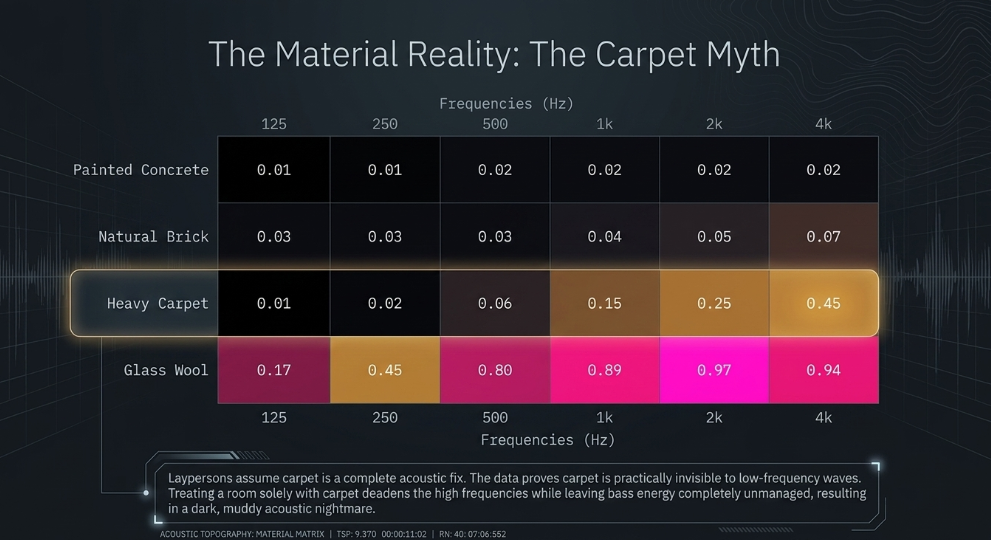
A critical acoustical insight drawn from this structured data is the profound impact of surface treatments on wave reflection. For example, rough, unpainted concrete and natural brick possess a highly porous microstructure that provides a small degree of high-frequency absorption (up to 0.10 at 4 kHz) Acoustic Supplies. However, the architectural practice of painting or sealing these masonry surfaces completely fills the porous voids, rendering the material totally reflective and dropping the absorption coefficient to a near-zero 0.02 across all frequency bands Acoustic Supplies.
Similarly, standard carpeting is often erroneously assumed by laypersons to be a comprehensive acoustic treatment. While heavy carpet on padding does provide moderate absorption at the highest frequencies (0.45 at 4 kHz), it is essentially acoustically transparent at low frequencies, possessing an absorption coefficient of just 0.01 at 125 Hz Acoustic Supplies. Treating a room solely with carpet will severely deaden the high frequencies while leaving low-frequency reverberation completely unmanaged, resulting in a dark, muddy, and boomy acoustic environment.
Velocity-Based Porous Absorption and Bass Trapping
To properly manage full-spectrum reverberation, acousticians rely on specialized acoustic treatments. The most common form of treatment is the porous absorber, which includes materials like fiberglass, mineral wool, dense PET fibers, and open-cell polyurethane foam GIK Acoustics.
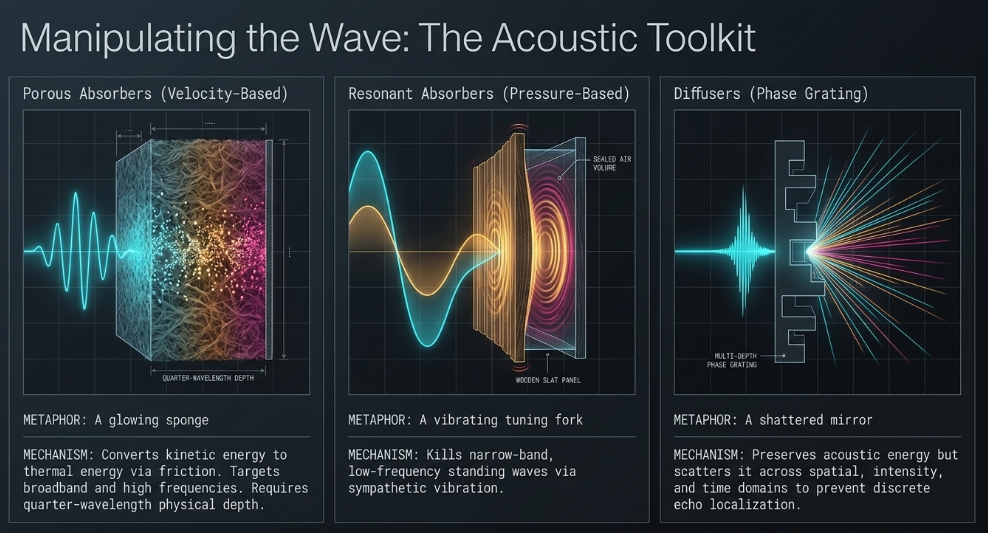
Porous absorbers operate as "velocity-based" devices Acoustics Insider. Their mechanism of action relies entirely on the principle of energy conversion via friction Acoustics Insider. As a sound wave penetrates the open-cell structure of the panel, the moving air molecules rub against the densely packed internal fibers Acoustics Insider. This physical friction generates heat, converting the mechanical kinetic energy of the sound wave into trace amounts of thermal energy, thereby robbing the wave of its acoustic power and removing it from the room's reverberant field Acoustics Insider.
Because they rely on the velocity of the air particles, porous absorbers must be placed where sound particle velocity is highest (typically at a quarter-wavelength distance from a rigid boundary) Acoustics Insider. Porous panels are highly effective broadband absorbers, managing everything from mid-range speech to high-frequency cymbal crashes GIK Acoustics. However, their effectiveness at low frequencies is dictated absolutely by their physical depth Acoustics Insider. Because bass frequencies possess extremely long wavelengths (a 60 Hz wave is over 18 feet long), a standard 2-inch acoustic panel is virtually invisible to them Acoustics Insider. To effectively trap bass frequencies, porous absorbers must be extremely deep-often exceeding 6 inches of insulation material-and placed across the tri-hedral corners of a room where low-frequency room modes naturally accumulate and pool GIK Acoustics. Shallow panels can utilize highly dense materials, but extremely deep bass traps require materials with lower gas-flow resistivity (lower density) to ensure the sound wave can transmit through the entire depth of the trap without being prematurely reflected off the surface Acoustics Insider.
Pressure-Based Resonant Absorption
When the specific geometry of a room causes problematic, narrow-band low-frequency standing waves that are too powerful for deep porous absorbers to mitigate, acousticians deploy resonant absorbers Feltcombo. Resonant devices-such as Helmholtz resonators, tuned membrane panels, and diaphragmatic absorbers-operate on entirely different physical principles Feltcombo. They are "pressure-based" rather than velocity-based absorbers, responding directly to sound pressure fluctuations rather than particle velocity Feltcombo.
A resonant bass trap utilizes internal air chambers or perforated wooden faces that are precisely and mathematically tuned to vibrate only when struck by a very specific problem frequency Feltcombo. When the targeted resonant frequency hits the device, the membrane or air mass vibrates violently in sympathetic resonance, converting the problematic acoustic pressure into kinetic energy and effectively neutralizing the standing wave Feltcombo. Because resonant absorbers are precision surgical instruments with extremely narrow bandwidths, they are typically deployed only after a comprehensive broadband porous trapping strategy has been implemented Feltcombo.
Acoustic Diffusion: Preserving Energy and Minimizing Localization
While heavy absorption successfully removes acoustic energy to lower the RT60 and eliminate discrete echoes, excessive absorption can rapidly render a room acoustically "dead," sterile, and perceptually oppressive SVANTEK. To eliminate flutter echoes and harsh specular reflections while simultaneously preserving musical vibrance, high-frequency brightness, and acoustic envelopment, acousticians employ diffusers Masacousticspro.
Unlike absorbers that convert sound into heat, an acoustic diffuser is a device with a mathematically non-uniform surface that scatters sound waves irregularly in multiple directions Masacousticspro. This redistribution of acoustic energy prevents the sound from being absorbed, retaining the acoustic power in the environment but breaking up the coherent wave front so that the brain can no longer localize it as a discrete echo Masacousticspro. A high-quality diffuser impacts sound across three specific domains:
Spatial Domain: It physically scatters the sound waves over a wide, 180-degree angle rather than allowing a direct, specular reflection path GIK Acoustics.
Intensity Domain: It splits the intensity of the initial wavefront among various smaller reflections, making each individual reflection significantly weaker and harder for the human ear to distinguish GIK Acoustics.
Time Domain: Because sound travels at roughly 1 foot per millisecond, the varying physical depths of the diffuser's wells create different path lengths for the sound waves. This causes the scattered reflections to arrive back at the listener at slightly staggered times, diluting the concentration of the sound and smearing the transient impact GIK Acoustics.
Types of Acoustic Diffusers
The specific width, height, spacing, and geometric pattern of a diffuser determine the precise frequency range over which it operates GIK Acoustics. Diffusers are generally categorized by the mathematical principles behind their design:
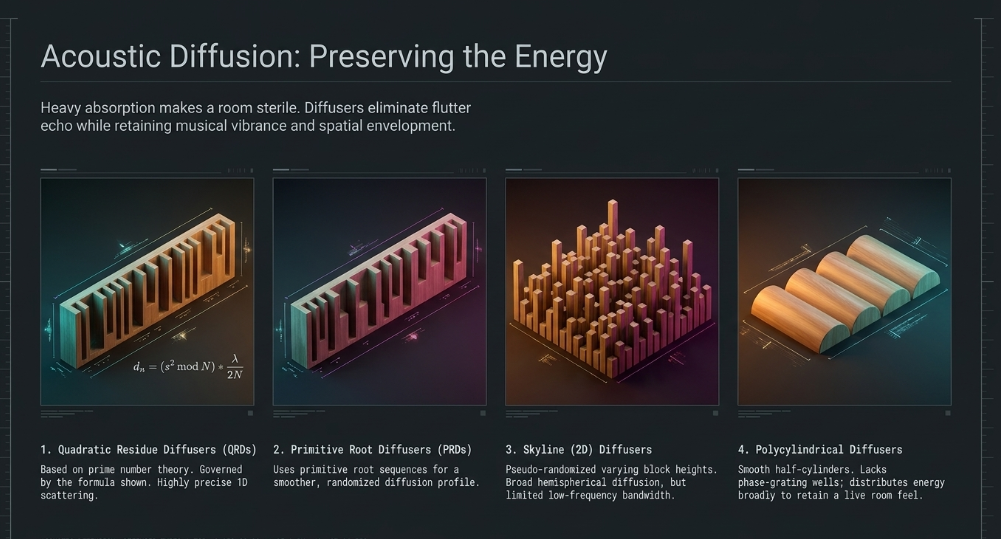
Quadratic Residue Diffusers (QRDs): Based on complex number theory developed by Manfred Schroeder, QRDs consist of a series of wells or slats of varying depths separated by thin, rigid dividers Aural Exchange. The depth of the n-th well is determined by the strict mathematical formula $d_{n}=(s^{2}(mod~N))\times\frac{\lambda}{2N}$ , where n is the well number, S is a prime number (such as 7, 13, or 17, which represent the repeating sequence order), and $\lambda$ is the wavelength corresponding to the design frequency Aural Exchange. QRDs provide highly precise 1D diffusion, scattering sound evenly in a single plane (either horizontally or vertically depending on orientation) Aural Exchange.
Primitive Root Diffusers (PRDs): Similar in construction to QRDs, PRDs utilize primitive root sequences ( $g^{n}(mod~p)$ ) instead of quadratic residues Aural Exchange. This distinct mathematical sequence results in less periodicity and a smoother, more randomized diffusion profile than standard QRDs, though they still provide 1D scattering Aural Exchange.
Skyline (2D) Diffusers: Utilizing an array of wooden or foam blocks set at pseudo-randomized heights, Skyline diffusers scatter sound simultaneously in two dimensions (both horizontally and vertically) Acoustic Geometry. Visually resembling a cityscape, they create excellent focal points and provide broad hemispherical diffusion Acoustic Geometry. However, empirical acoustical measurements indicate that their effective bandwidth-particularly their ability to diffuse lower frequencies given a specific physical depth-is often more limited than that of precisely calculated 1D QRDs YouTube.
Polycylindrical Diffusers: Moving away from number theory, these diffusers employ smooth, curved cylindrical structures (often half-cylinders) to scatter sound multidirectionally Masacousticspro. Because they lack the phase-grating wells of Schroeder diffusers, poly-cylindrical devices do not focus diffusion on a single mathematical point; rather, they distribute energy broadly and evenly across large spaces, making them ideal for retaining a live room's natural acoustic vibrance Masacousticspro.

In professional recording studios and critical listening environments (such as home theaters), standard acoustic placement protocol dictates using absorptive panels at the "mirror points"-the first reflection points on the side walls and ceiling directly between the listener and the speakers-to preserve phase clarity and Haas-effect imaging Overtone Acoustics. Conversely, large 1D QRDs or Skyline diffusers are frequently deployed on the rear wall behind the listener Aural Exchange. This rear-wall placement effectively breaks up late slapback echoes while simultaneously tricking the brain into perceiving the physical room as significantly larger and more spacious than its actual dimensions GIK Acoustics.
Digital Signal Processing and Artificial Spatialization
In the realm of modern audio engineering, sound design, and music production, the natural physical phenomena of echo and reverberation are artificially simulated using Digital Signal Processing (DSP) to impart a sense of depth, space, and three-dimensionality to recorded tracks Audient. Dry, close-miked recordings (such as a vocal recorded in an anechoic booth or a digitally generated synthesizer) contain no spatial information; without artificial spatialization, they sound distinctly unnatural CMU.
Delay Versus Reverb Processing
While technologically related-reverb is ultimately a highly complex, randomized form of delay-reverb and delay plugins serve fundamentally different aesthetic and psychological functions in a mix Audient.
Delay is a time-based effect that generates separate, distinct, and highly manipulable copies of the original signal Boris FX. It artificially mimics the physics of an outdoor echo Boris FX. Unlike a natural echo that decays at a fixed environmental rate, digital delay can be perfectly tempo-synced to a song's BPM, panned wide across the stereo field, or set with infinite feedback to loop forever Boris FX. Delay is primarily utilized by mix engineers to create rhythmic textures, introduce movement, and bounce elements (like guitar solos) around the stereo image without pushing the sound backward in the depth field Audient. Common delay types include "Analog Delay" (which degrades the sound quality slightly with each repeat), "Ping-Pong Delay" (where the echo bounces rhythmically between the left and right speakers), and "Digital Delay" (which offers mathematically perfect, clean repetitions) Boris FX.
Reverb plugins, on the other hand, utilize complex algorithms (or convolution impulse responses captured from real architectural spaces) to simulate the incredibly dense, smooth pattern of millions of overlapping sound reflections associated with physical environments Boris FX. Rather than creating a rhythmic pulse, reverb is utilized to blend disparate instruments together, placing them within a cohesive, virtual acoustic space-be it a claustrophobic wooden room, a massive stone cathedral, or the splashy, dripping sound of a mechanical spring reverb Boris FX.
Critical Reverb Parameters
To accurately sculpt and emulate these spatial environments, digital reverb processors rely on the manipulation of several critical DSP parameters:
Pre-Delay: This vital control dictates the exact time gap (in milliseconds) between the original dry sound and the onset of the first early reflections Medium. Psychoacoustically, a longer pre-delay tricks the brain into perceiving a much larger physical space, as it simulates the time taken for sound to travel to a distant boundary and back Eventide Audio. In mixing practice, engineers use pre-delay to separate the initial transient attack of a lead vocal or snare drum from the dense wash of the reverb tail, preserving clarity and punch Eventide Audio. Pre-delay is frequently calculated using the formula $7,500\div BPM$ to ensure the onset of the reverb aligns perfectly with the rhythmic grid of the track Eventide Audio.
Decay Time (RT60 Emulation): This controls the duration of the late reverb tail Medium. A short decay (e.g., 0.5 seconds) adds immediate thickness and intimacy to a dry vocal, while a long decay (e.g., 4.0 seconds) wraps the sound in a dreamy, ethereal haze suitable for vast cinematic soundscapes Medium.
Diffusion: This parameter regulates the density of the reflections within the reverb tail Medium. Low diffusion settings allow discrete echoes to be heard rattling around within the reverb, creating a "pingy," fluttering, or metallic sound typical of small, hard-walled rooms Music Stack Exchange. High diffusion packs the reflections tightly together, creating a lush, smooth, atmospheric pad of sound Music Stack Exchange.
Room Size: This determines the spacing and timing of the virtual early reflections, dictating the perceived physical dimensions of the simulated room Music Stack Exchange.
Damping: This governs how quickly high frequencies decay relative to low frequencies Medium. Heavy high-frequency damping simulates a room filled with soft materials (like heavy curtains and carpets) or the natural absorption of high frequencies by air over long distances, resulting in a dark, warm reverb tone Medium.
Creative Audio Engineering: Historical and Technical Milestones
By aggressively manipulating the psychoacoustic principles of the echo threshold and the physics of acoustic decay, audio engineers have birthed iconic, genre-defining production techniques.
Slapback Echo and Tape Delay
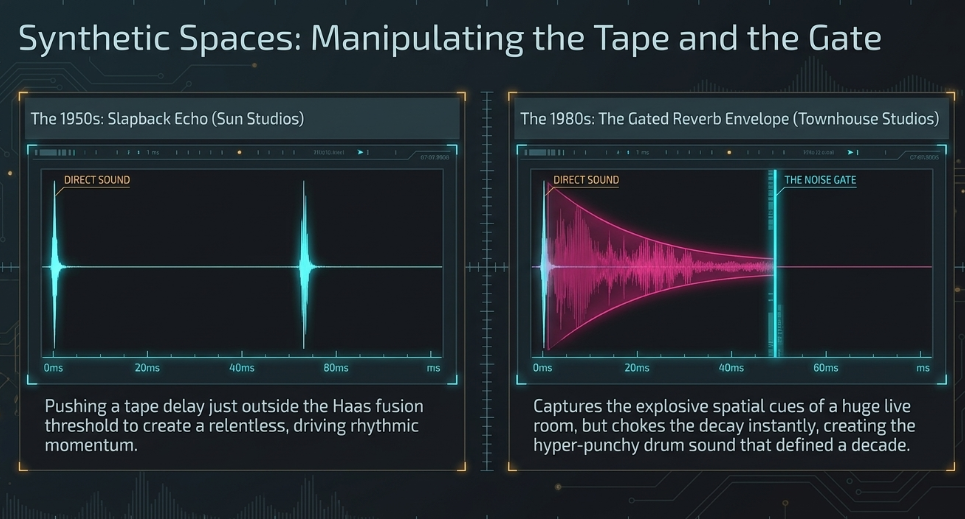
One of the most famous applications of artificial echo is the "Slapback Echo." Slapback relies on a single, short delay-typically set between 70 and 120 milliseconds-with zero feedback (no repeating echoes) Boris FX. Because this time delay falls just outside the Haas Precedence Effect fusion threshold, the brain perceives it as a distinct, immediate, and extremely fast echo. Historically, this effect was pioneered in the 1950s at Sun Studios using reel-to-reel magnetic tape machines Reverb. By recording a signal to tape and playing it back immediately via a playback head spaced a few inches away, engineers generated a warm, slightly degraded physical echo Boris FX. Slapback echo became the defining vocal and guitar aesthetic of rockabilly and early rock and roll (epitomized by artists like Elvis Presley), providing a relentless, driving rhythmic momentum that helped define the era Physics Classroom Boris FX. Later devices, such as the Roland Space Echo RE-201, pushed the boundaries of tape delay further, allowing for self-oscillating repeats and creating the heady, textured delays heavily utilized in dub reggae and ambient music Reverb.
The Gated Reverb Phenomenon
Perhaps the most famous manipulation of room acoustics in recorded music history is the "Gated Reverb" drum sound, which dominated the pop music landscape of the 1980s Wikipedia. Instead of allowing a dense room reverb tail to decay naturally (following the exponential RT60 decay curve predicted by Sabine), a dynamic noise gate is applied to abruptly cut the reverberation off the instant its volume drops below a specific decibel threshold Wikipedia. This technique provides the massive, explosive spatial cues of a huge live room without cluttering the song's rhythm track with a long, muddy decay tail, resulting in a distinctly succinct, hyper-punchy sound Wikipedia.
The gated reverb technique was famously discovered by sheer accident in 1979 at London's Townhouse Studios by producer Steve Lillywhite and engineer Hugh Padgham, during the recording sessions for Peter Gabriel's third solo album (specifically the track "Intruder") Wikipedia. While drummer Phil Collins was playing in the live room, Padgham accidentally activated an overhead talkback microphone located above the drum kit rather than the standard overhead recording mics iZotope. The talkback channel on the studio's Solid State Logic (SSL) 4000 E console was hardwired through an extreme "listen mic" compressor and a heavy noise gate designed solely to keep studio speech intelligible across the glass iZotope. When Collins struck the drums, the extreme compression exponentially amplified the explosive room reverberation of the large Townhouse live room; a fraction of a second later, the noise gate instantly choked the sound out Wikipedia.
The resulting sound was so brash, aggressive, and revolutionary that Gabriel and Collins built the entire aesthetic of the album around it iZotope. Collins subsequently utilized the exact same gated reverb technique on his solo hit "In the Air Tonight," cementing the booming, synthetic-sounding snare drum as the quintessential acoustic signature of 1980s pop, rock, and new wave music Wikipedia.
Acoustic Standards and RT60 Targets in Specialized Environments
Beyond musical production and recording studio applications, strictly managing the interplay of reverberation and echo is critical for modern civic, educational, healthcare, and corporate architecture. Acoustical comfort is considered a foundational element of indoor environmental quality, heavily influencing human stress levels, physiological well-being, and cognitive performance MDPI.
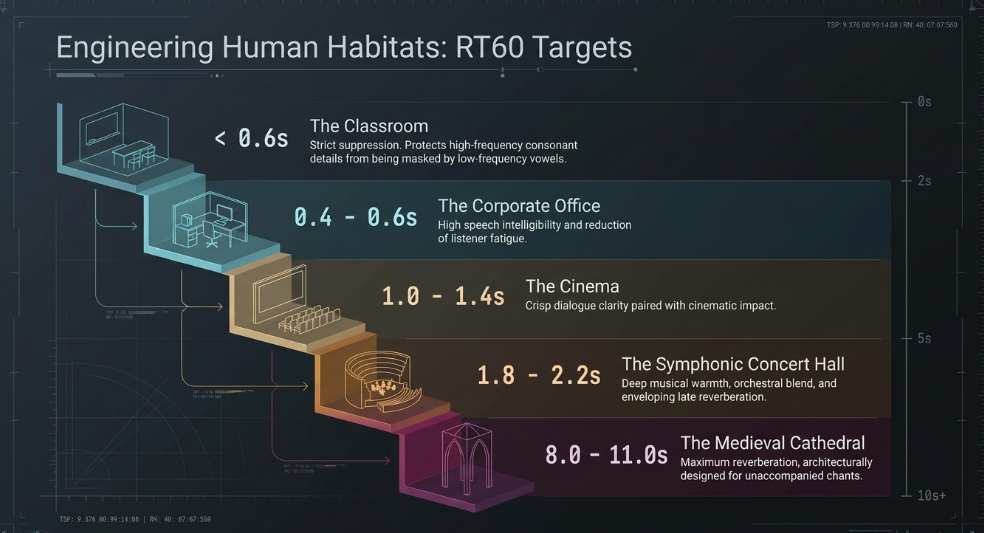
To ensure environments function appropriately, architects design spaces to meet specific, empirically validated RT60 target ranges. The following table synthesizes the recommended RT60 standards compiled from ANSI/ASA guidelines, WELL building standards, and global acoustical consulting best practices Commercial Acoustics:
Educational Facilities and Classrooms
In educational environments, the acoustic standards are stringent and uncompromising. Guidelines such as ANSI/ASA S12.60 strictly mandate incredibly low unoccupied reverberation times-specifically less than 0.6 seconds for standard classrooms under 10,000 cubic feet, and less than 0.7 seconds for larger learning spaces Baswana. This is due to the fundamental mechanics of speech intelligibility. Human speech consists of loud, low-frequency vowels and soft, high-frequency consonants SVANTEK. Because children are still undergoing neurological and auditory development, they lack the adult ability to subconsciously "fill in the blanks" of degraded speech Commercial Acoustics. If a classroom possesses an RT60 of 1.5 seconds, the lingering, powerful low-frequency vowel sounds will completely mask the delicate, higher-frequency consonant sounds of the teacher's subsequent words, profoundly impairing auditory learning, language acquisition, and student engagement Commercial Acoustics.
Healthcare and Hospital Environments
In hospital wards, where patients remain stationary for extended periods, the acoustic environment is considered one of the most critical factors influencing patient recovery and physiological comfort. Excessive noise exposure and high reverberation times in hospitals have been definitively associated with negative physiological effects, including elevated heart rates, fatigue, induced tinnitus, and sleep disruption MDPI. Acoustic consulting in healthcare involves utilizing high-NRC ceiling treatments and STC-rated soundproofing to control reverberation and block ambient noise from medical equipment, alarms, and hallway footfalls Commercial Acoustics.
The Paradox of the Open-Plan Office
In commercial real estate, the massive proliferation of Activity Based Working (ABW) and open-plan offices has introduced severe, unique acoustical challenges ODEON. Open designs intentionally remove physical acoustic barriers to foster collaboration, allowing noise to propagate freely across the floorplate ODEON. To properly assess and address these modern environments, acousticians utilize the international standard ISO 3382-3, which was designed specifically for open-plan acoustic measurements ODEON. Because open offices are not enclosed reverberant chambers, merely measuring RT60 is insufficient; instead, ISO 3382-3 measures the spatial decay rate of noise and the speech intelligibility index as a function of distance from the source ODEON.
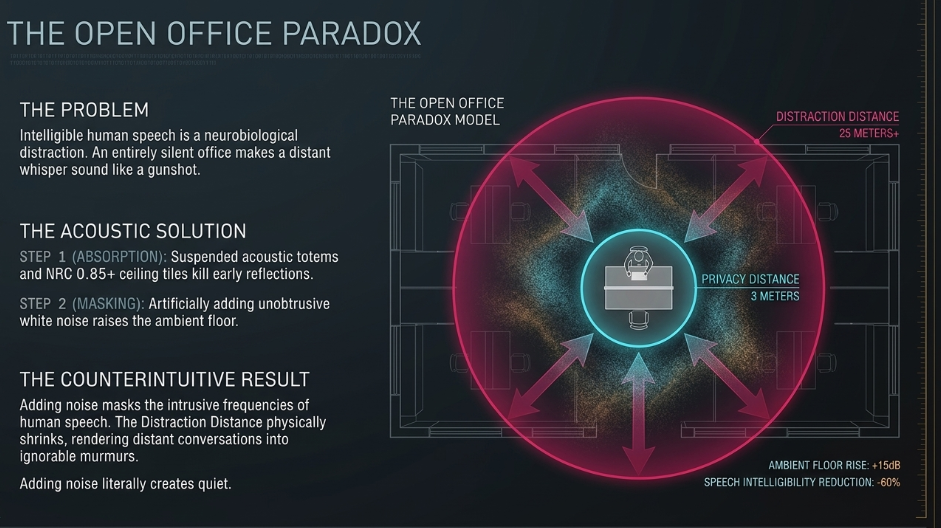
The primary acoustical paradox of an open office is attempting to balance the need for speech intelligibility with the absolute necessity of speech privacy MDPI. Clear human speech is considered a massive cognitive distraction; humans are neurobiologically hardwired to listen to and process intelligible conversations ODEON. If a worker can clearly hear a phone conversation 30 feet away, their cognitive performance drops significantly ODEON. Therefore, acoustical engineering in open offices focuses on reducing the "distraction distance" and achieving a tight "privacy distance" ODEON.
This is achieved through a multi-tiered approach. First, highly absorptive ceiling tiles (NRC 0.85+) and suspended sound-absorbing "Silente panels" or "Menhir totems" are installed to violently kill early reflections and reduce the overall RT60 to around 0.5 to 0.65 seconds WELL Certified. However, merely deadening the room is not enough; a completely silent room makes every dropped pen or distant whisper sound like a gunshot. Thus, engineers must actively introduce background noise via electronic Sound Masking systems Commercial Acoustics. Counterintuitively, artificially raising the ambient noise floor with specifically tuned, unobtrusive white or pink noise effectively masks the intrusive frequencies of human speech Commercial Acoustics. When properly calibrated, this masking renders distant conversations into unintelligible, ignorable murmurs, thereby securing speech privacy, eliminating the distraction distance, and drastically reducing cognitive fatigue and stress for adjacent workers Commercial Acoustics.
Conclusion
The distinction between reverberation and echo extends far beyond basic semantics or subjective audio quality; it represents a profound intersection of mechanical wave physics, temporal spatial mathematics, architectural geometry, and human neurology. An echo is a solitary, delayed reflection that breaks the human brain's fusion threshold, providing distinct locational data or, if poorly managed indoors, severe auditory distraction. Reverberation, conversely, is a dense, Gaussian amalgamation of countless rapid reflections that the brain fuses together, providing our auditory system with an immersive, subconscious map of spatial geometry, physical size, and boundary textures.
By deeply understanding and mathematically manipulating the psychoacoustic principles of the Haas effect, calculating frequency-dependent decay via the Sabine and Eyring formulas, and treating architectural boundaries with precise NRC-rated porous absorbers, resonant bass traps, and phase-grating Schroeder diffusers, acousticians can completely alter the sonic footprint and psychological impact of any environment. Whether an audio engineer is utilizing algorithmic DSP delays to double a vocal track, gating compressed room reverb to synthesize massive percussive impacts, or an architectural acoustician is installing suspended acoustic clouds and active sound masking to drive down the distraction distance in a modern open-plan office, the absolute mastery of reflected sound remains the foundational pillar of acoustic control. Ultimately, the ability to control sound reflection is the ability to directly dictate human spatial perception, cognitive focus, emotional response, and acoustic comfort within the physical world.