Introduction: The Sonic Imperative in a Competitive Audio Landscape
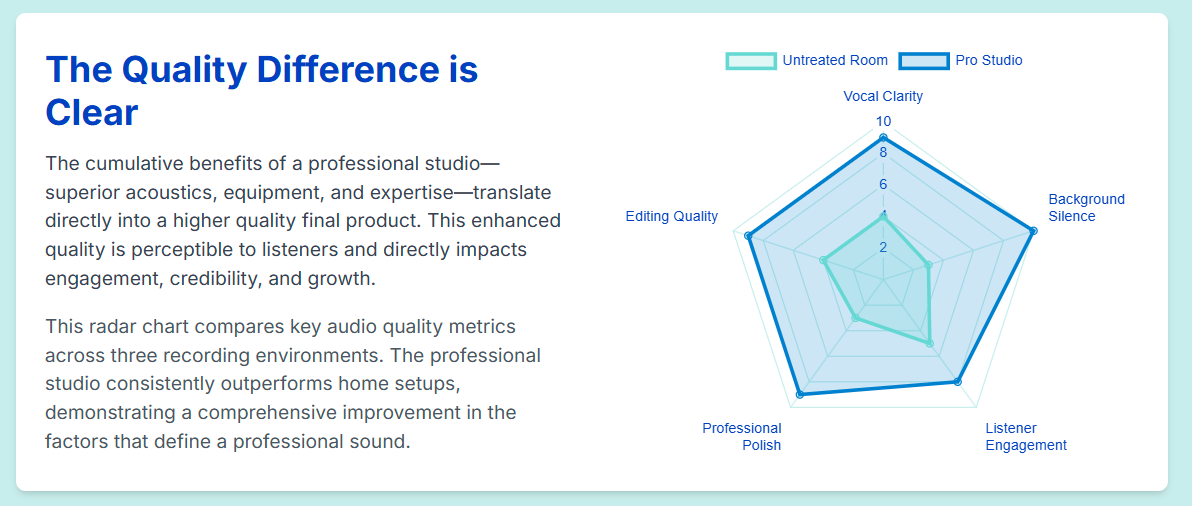
In the mature and increasingly saturated global podcasting market, the standards for listener expectation have irrevocably shifted. Audio quality is no longer a peripheral concern or a charming hallmark of an independent creator; it is a fundamental prerequisite for establishing credibility, retaining an audience, and achieving commercial viability. Within a premier media capital such as London, where the density of high-quality content sets an exceptionally high bar, this sonic imperative is even more pronounced. Listeners, consciously or subconsciously, equate professional sound with a professional brand, and any deviation—be it distracting room echo, intrusive background noise, or inconsistent volume levels—serves as an immediate signal to disengage.1
Therefore, the decision for a serious podcaster, content creator, or brand manager to utilize a dedicated, professional studio is not merely an operational choice but a foundational strategic investment. It is an investment in brand equity, a commitment to respecting the listener's time and attention, and a crucial enabler of long-term growth.3 A professional recording environment provides an unparalleled advantage that extends far beyond the superficial polish of the final product. It encompasses the immutable physics of a controlled acoustic space, the precision of a professional-grade technology chain, the indispensable expertise of an on-site audio engineer, and the unique strategic benefits conferred by operating within London's world-class media ecosystem.
This report will provide a multi-faceted and exhaustive analysis of these factors. It will deconstruct the technical, financial, and market-specific dimensions that underscore the necessity of a dedicated London studio for professional audio engineering. The analysis will begin by examining the physical recording environment, clarifying the critical distinction between soundproofing and acoustic treatment. It will then dissect the professional signal chain, from microphone to monitor, demonstrating the technological superiority over consumer-level alternatives. The report will subsequently quantify the immense value of the on-site audio engineer, both as a live technician and a post-production artisan. Following this, it will explore the unique strategic advantages of the London market itself, from its competitive studio landscape to its unparalleled concentration of talent and networking opportunities. Finally, a definitive cost-effectiveness analysis will compare the financial and strategic implications of professional studio hire against the true cost of building a home studio to a comparable professional standard. The cumulative evidence will demonstrate that for those committed to excellence, the professional London studio is not a luxury, but the very blueprint for sonic success.

Section 1: The Controlled Environment: The Physics of Professional Sound
The single most critical, and least replicable, element in achieving professional-grade audio is the recording space itself. A common misconception among aspiring creators is that high-end microphones or software can compensate for a poor recording environment. The laws of physics, however, are unforgiving. The acoustic properties of the room in which a sound is captured are imprinted upon the recording at the source, and any flaws become a permanent part of the audio file. A professional studio is, first and foremost, an acoustically controlled environment, meticulously engineered to manage sound energy in a way that is virtually impossible to achieve in a typical domestic setting. This control is predicated on a foundational understanding of two distinct but complementary principles: soundproofing and acoustic treatment.
1.1 Soundproofing vs. Acoustic Treatment: A Foundational Dichotomy
The failure to distinguish between soundproofing and acoustic treatment is the primary source of wasted investment and persistent audio problems in amateur setups. While often used interchangeably, they address two entirely different acoustic challenges, and both are essential for a professional result.5
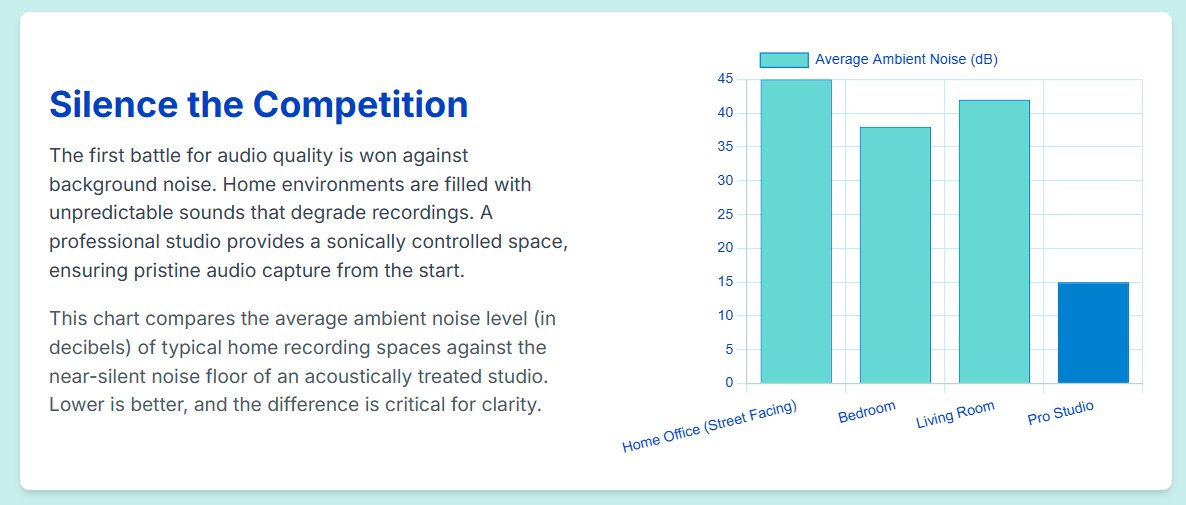
Soundproofing is the science of isolation. Its sole purpose is to prevent sound from entering or leaving a given space.5 This is a structural challenge, addressed by adding mass, decoupling physical structures to stop the transmission of vibrations, and meticulously sealing any air gaps. Professional studios employ techniques like building a "room-within-a-room," using multiple layers of high-density drywall, installing solid-core doors with acoustic seals, and using double-glazed windows.6 The goal of soundproofing is to create a sonic "black canvas"—a space with an extremely low noise floor, completely isolated from external contaminants like London traffic, sirens, construction noise, or even the hum of a building's HVAC system.7
Acoustic Treatment, by contrast, is the science of controlling sound within a space. Its purpose is to manage how sound waves reflect off the surfaces of the room, thereby controlling echo (reverberation), standing waves, and uneven frequency response.9 This is achieved through the strategic use of absorptive and diffusive materials. If soundproofing creates the silent canvas, acoustic treatment is the process of "painting the picture" on that canvas, ensuring the sound captured is clear, intelligible, and free from the room's own sonic signature.
The necessity of employing both principles in tandem cannot be overstated. Consider a freestanding concrete bunker: it would be exceptionally soundproof, blocking nearly all external noise. However, the hard, reflective parallel surfaces would create a cacophony of echoes and reverberation, rendering it sonically unusable for recording—it would sound like a cavernous bathroom or gymnasium.12 This illustrates that isolation without internal control is just as problematic as internal control without isolation.
This fundamental misunderstanding leads to a common and costly error in home setups. An amateur podcaster in a typical London flat, plagued by the sound of passing traffic, may purchase acoustic foam panels and cover their walls, believing this will "soundproof" the room.10 However, as acoustic science dictates, foam is a lightweight, porous material designed to absorb mid- and high-frequency reflections
inside the room; it has virtually no mass and therefore no ability to block the low-frequency sound energy of traffic from passing through the walls.5 The raw recording is consequently contaminated with the external noise, which remains entirely unaddressed. Furthermore, the excessive and untargeted use of foam can make the room sound overly "dead" and unnatural by absorbing too much high-frequency energy.8 This leaves the creator with a compromised audio file that requires heavy-handed corrective measures in post-production. They are forced to rely on digital tools like noise gates and spectral de-noise plugins, which are imperfect solutions that can introduce audible artifacts and degrade the integrity of the vocal performance, making it sound processed and unnatural.8 A professional studio, by correctly engineering both soundproofing and acoustic treatment from the ground up, eliminates this entire chain of compromises at the source, guaranteeing a pristine raw recording that serves as the essential foundation for a professional product.
1.2 The Anatomy of an Acoustically Engineered Space
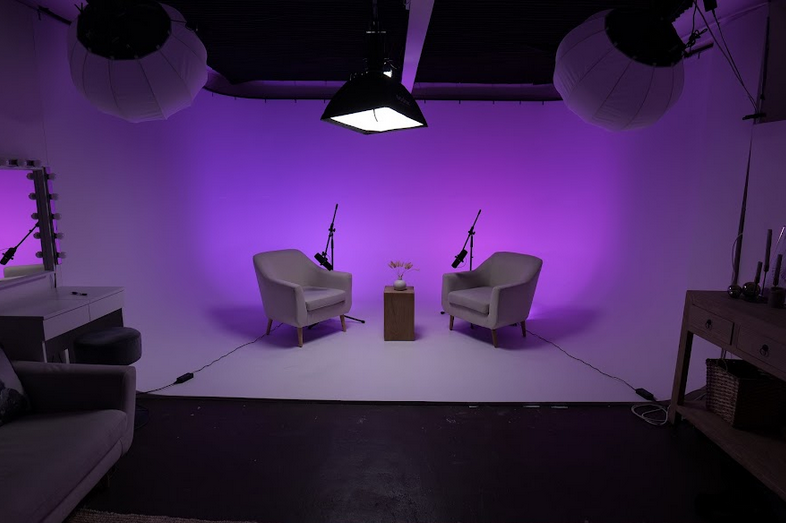
A professional studio achieves its pristine internal sound through a carefully balanced application of three primary acoustic tools: absorption, diffusion, and bass trapping. These elements are deployed strategically based on acoustic analysis to tame the specific sonic challenges of a room's geometry.7
Absorption is the most common form of acoustic treatment. High-density acoustic panels, typically made of fiberglass or mineral wool, are placed at "first reflection points" on walls and ceilings. These are the points where the sound from the speaker's mouth would bounce directly off a surface and into the microphone, creating a short, distinct echo that can blur the clarity of the voice. By absorbing this reflected energy, these panels prevent "flutter echo" and harshness, resulting in a clearer, more direct vocal sound.7
Bass Trapping is a specialized and critical form of absorption that targets low-frequency sound waves. Due to their long wavelengths, low frequencies have a tendency to accumulate in the corners of a room, creating resonances that result in a "boomy," "muddy," or uneven bass response.7 This is a particularly severe problem in the small, cuboid rooms typical of domestic environments.15 Professional studios install large, dense bass traps in all available corners to absorb this low-frequency energy, leading to a tighter, clearer, and more balanced low end in the recording.10
Diffusion is a more advanced technique used to scatter sound energy rather than absorb it. Diffusers are complex, uneven surfaces that break up strong reflections and disperse them in multiple directions. This reduces the negative impact of echoes without removing all the sonic energy from the room, which can happen in a space treated only with absorption. The result is a recording environment that sounds controlled yet natural, open, and spacious—a hallmark of high-end studio design.7
This combination of acoustic tools is deployed to create an environment that is acoustically "flat" and "honest." This does not mean the room is silent or anechoic; it means that the room itself does not unduly color the sound being recorded. What the microphone captures, and what the engineer hears through the studio monitors, is a true and accurate representation of the sound source. This acoustic honesty is vital for making effective engineering decisions during the mixing process.
The danger of an untreated room lies in its acoustic dishonesty. A typical rectangular home studio with parallel walls will inevitably have "standing waves," which create significant peaks and nulls (dips) in the low-frequency response at different points in the room.15 A podcaster sitting at their desk might be in a low-frequency null, hearing very little bass from their own voice. To compensate for what they perceive as a thin sound, they might boost the bass frequencies using an equalizer (EQ).15 However, when that recording is played back on a different system—in a car with a subwoofer, or on high-quality headphones—that boosted bass, which was added to compensate for a room flaw, will now be overwhelmingly powerful and muddy.13 The acoustically engineered environment of a professional studio prevents this entire scenario. It is not designed to "sound good" in isolation; it is designed to be a neutral and accurate tool. This neutrality ensures that all engineering decisions are based on the intrinsic qualities of the audio itself, not the deceptive acoustics of the room, resulting in a final product that translates reliably and professionally across all consumer listening platforms.
Section 2: The Professional Signal Chain: The Technology of Flawless Audio
Beyond the critical importance of the physical room, the quality, architecture, and control offered by the recording equipment in a professional studio provide a decisive advantage over consumer-grade setups. The "signal chain"—the path the audio takes from the sound source to the recording device—is comprised of multiple components. In a professional environment, each link in this chain is a high-quality, specialized piece of equipment designed for optimal performance. This professional architecture delivers a level of clarity, low noise, and granular control that is simply unattainable with the all-in-one, compromise-laden devices typical of home setups.
2.1 A Comparative Analysis of Podcasting Hardware
The technological gap between amateur and professional podcasting is most evident when comparing the core hardware components.
Microphones: The most common entry point for home podcasters is the USB microphone (e.g., Blue Yeti), which contains a microphone capsule, preamplifier, and analog-to-digital converter in a single, convenient plug-and-play unit.16 While accessible, this all-in-one design necessitates compromises in component quality. Professional studios exclusively use XLR microphones, which are dedicated transducers that output an analog signal. These microphones require a separate audio interface or mixer to function.18 Industry-standard dynamic microphones like the Shure SM7B are prized for their warmth, smoothness, and exceptional rejection of off-axis sound, making them ideal for recording vocals in less-than-perfect rooms.1 Professional condenser microphones, such as the Rode NT1-A, offer greater sensitivity and detail, making them suitable for pristine, acoustically treated environments.14 These microphones feature superior build quality and internal components, resulting in a richer, cleaner, and more nuanced sound capture.
Audio Interfaces and Mixers: The audio interface (e.g., Focusrite Scarlett 2i2, MOTU M2) is the heart of the professional studio's signal chain. It performs two crucial functions: its high-quality preamplifier provides clean, low-noise amplification (gain) to the weak signal from an XLR microphone, and its high-resolution analog-to-digital converter (ADC) transforms that analog signal into a digital format for the computer with far greater fidelity than a computer's built-in sound card.14 For more complex productions involving multiple hosts, guests, or audio sources (like music or sound effects), a mixer (e.g., Rodecaster Pro II, Zoom PodTrak P4) serves as a central control hub. It allows an engineer to manage levels, apply processing, and route audio for multiple channels in real-time, a necessity for any show with more than one participant.16
The fundamental advantage of this professional XLR/interface/mixer chain is not just incrementally "better sound," but rather decoupled functionality and granular control. A USB microphone is a closed system. The professional chain, by contrast, separates the distinct tasks of sound capture (microphone), amplification (preamplifier), and conversion (ADC), allowing each component to be a best-in-class device optimized for its specific function.
This separation is critical for a fundamental audio engineering practice known as "gain staging." Consider a podcaster using a USB microphone who finds their recording is too quiet. Their only option is to increase the digital gain within their recording software. This action not only boosts their vocal signal but also amplifies the inherent electronic noise (hiss) from the microphone's inexpensive internal preamplifier and converter, resulting in a signal that is louder but audibly noisier.8 Now, consider a podcaster in a professional studio using a Shure SM7B, a microphone famous for requiring a large amount of amplification.19 The studio's professional audio interface is equipped with a high-quality, low-noise preamplifier specifically designed to provide a significant amount of clean gain. The engineer can precisely set the gain at the analog stage to achieve a robust, healthy level
before the signal is ever converted to digital. This maximizes the signal-to-noise ratio, capturing a rich, clean, and dynamic signal that is free of hiss and requires minimal corrective processing in post-production.23 This level of control at the most critical stage of recording is simply impossible with an integrated USB device and is a cornerstone of professional audio capture.
2.2 The Critical Role of Accurate Monitoring
The principle "you can't mix what you can't hear" is an axiom in audio engineering. Effective decisions about sound quality can only be made if the tools used for listening provide an accurate, uncoloured representation of the audio. Professional studios invest heavily in accurate monitoring systems, another area where home setups typically fall short.
Studio Headphones: During recording, engineers and hosts rely on professional closed-back studio headphones, such as the Audio-Technica ATH-M50X or Beyerdynamic DT 700 Pro X.14 These headphones serve two purposes. First, their closed-back design provides excellent isolation, preventing the sound from the headphones from "bleeding" out and being picked up by the sensitive microphone. Second, and more importantly, they are designed to have a "flat" frequency response. This means they do not artificially boost or cut certain frequencies, allowing the wearer to hear exactly what the microphone is capturing, including subtle but critical flaws like low-level hum, plosive pops, or excessive sibilance.18
Studio Monitors: For the post-production processes of mixing and mastering, engineers use high-fidelity studio monitors (speakers) in a room that has been acoustically treated and calibrated. These speakers are also designed for accuracy, providing a true representation of the audio so that the engineer can make informed decisions about EQ, compression, stereo balance, and overall loudness.7
This commitment to accuracy is a stark contrast to consumer listening devices. Headphones like AirPods or Beats, or typical consumer speakers, are engineered to make audio sound pleasurable, often by exaggerating the bass and treble frequencies in a "smiley-face EQ curve." Using such devices for mixing is akin to painting a portrait while wearing rose-tinted glasses—the resulting work will only look correct through that same distorted lens.
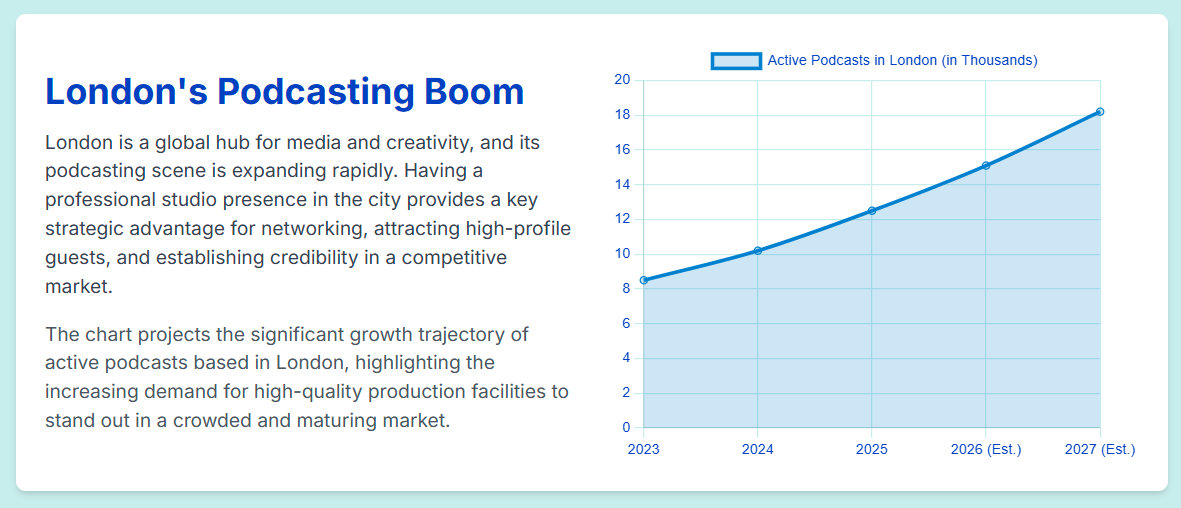
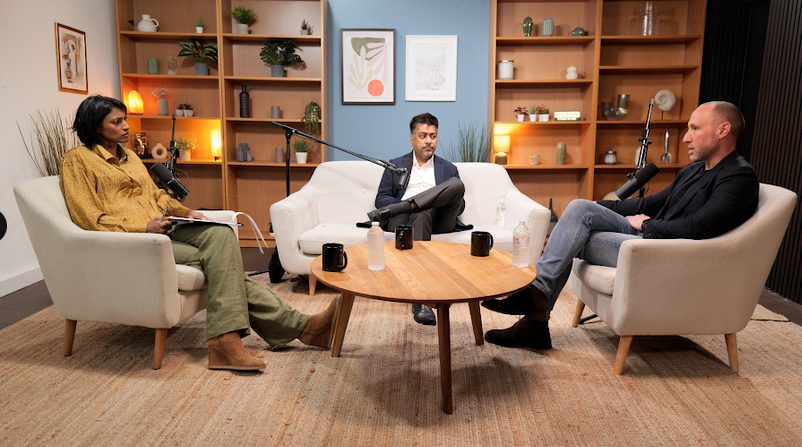
Image Credit: Finchley studio
This leads to a common failure in DIY podcast production. A home podcaster might edit their show while listening on consumer earbuds that have a heavily boosted bass response. Hearing their own voice as deep and full-bodied, they see no need to adjust the low-end frequencies with EQ. However, when a listener plays that same episode in their car, which may have a powerful sound system, the uncorrected and exaggerated low-frequency energy in the podcaster's voice becomes an overwhelming, muddy, and unpleasant "boom" that obscures clarity.13 A professional studio's investment in accurate monitoring is, therefore, an investment in
translatability. It is a guarantee that the final mastered audio will sound balanced, clear, and professional across the vast and unpredictable ecosystem of consumer playback systems, from laptop speakers to high-end sound systems. This reliability is a hallmark of professional production and a critical factor in audience satisfaction.
Section 3: The Engineer: The Indispensable Human Element
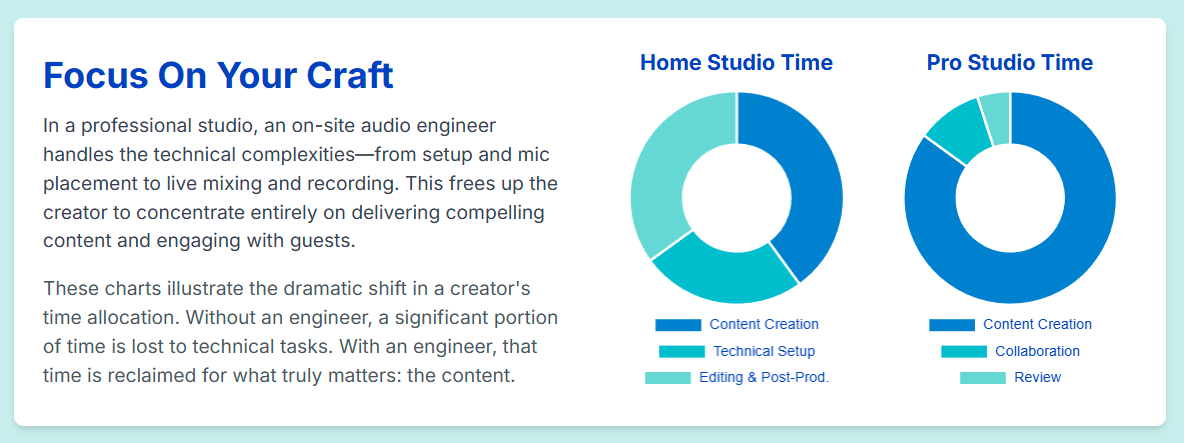
While the acoustic environment and the technological signal chain are foundational pillars of professional audio, the third and perhaps most vital component is the human expertise of the on-site audio engineer. In a professional studio setting, the engineer is far more than a passive technician who simply presses "record." They are an active quality controller, a creative partner, and an efficiency expert whose skills are a force multiplier, elevating the final product and streamlining the entire production process. Their value is demonstrated both in real-time during the recording session and through the skilled craft of post-production.
3.1 The Engineer as a Live Technician
The most significant impact of a professional engineer is their ability to prevent problems at the source. By ensuring the raw audio captured is as clean and polished as possible, they dramatically reduce the need for time-consuming and quality-degrading corrective work later on. This "get it right at the source" philosophy is a core tenet of professional audio production and is actively managed by the engineer throughout the recording session.
Their work begins before the host even speaks. The engineer is responsible for selecting the appropriate microphone for each person's voice and for the specific format of the show.25 They meticulously handle microphone placement, a critical factor in audio quality. By positioning the mic at the optimal distance and angle, they can achieve a rich vocal tone while simultaneously minimizing common problems like plosives (the harsh "p" and "b" sounds caused by bursts of air) and sibilance (the sharp "s" sounds).8 For multi-person shows, they ensure the microphones are oriented correctly to reject sound from other speakers, preventing "bleed" and maintaining clean separation between vocal tracks.24
Once the mics are in place, the engineer performs the crucial task of gain staging. They carefully set the input gain level on the preamplifier for each individual microphone, ensuring the signal is strong and clear but never so loud that it "clips" or distorts.8 This is a delicate balancing act that requires a trained ear and a deep understanding of the equipment.
Throughout the recording, the engineer is not merely a passive observer. They are actively monitoring the incoming audio through professional headphones, listening intently for any technical issues that the host, who is rightly focused on delivering their content, would almost certainly miss. This could be the subtle hum from a faulty cable, the distracting noise of a guest's rattling jewelry, the sudden kick-in of a building's air conditioning unit, or a noisy guitar pedal.23 When such an issue arises, the engineer can pause the session and resolve the problem on the spot, preserving the integrity of the recording.
This preventative approach provides a clear return on investment. Imagine a solo podcaster recording at home who is positioned too close to their microphone. This results in a "boomy" sound due to the proximity effect and harsh plosives on every other sentence.8 Unaware of this during the recording, they are later faced with a deeply flawed audio file. In post-production, they must spend hours painstakingly editing out each plosive and applying complex EQ to try and correct the boominess, often with unnatural-sounding results.28 In a professional studio, the engineer would identify the poor mic technique within the first ten seconds. They would politely pause the recording, coach the host to move back a few inches and speak slightly off-axis to the microphone, and perhaps add a pop filter for extra protection.14 The remainder of the session would be recorded cleanly. The post-production time required to fix that specific issue is thus reduced from several hours to zero. In this context, the engineer's fee is not an expense; it is an insurance policy against lost time and compromised audio quality.
3.2 The Engineer as a Post-Production Artisan
The value of professional expertise extends into the post-production phase, which is often misunderstood by DIY creators as a single, monolithic task called "editing." In reality, professional audio post-production is a multi-stage process involving three distinct disciplines: editing, mixing, and mastering. A professional studio or production house offers expertise in all three, transforming a collection of raw recordings into a polished, broadcast-ready product.30
Editing is the foundational, structural stage. Here, the engineer meticulously goes through the raw audio, cutting out mistakes, stumbles, and unwanted noises. They remove filler words ("ums," "ahs," "you knows") and tighten up long, awkward pauses to improve the pacing and flow of the conversation, creating a more engaging and professional-sounding narrative.2
Mixing is where the creative and technical artistry truly begins. In this phase, the engineer takes all the individual audio elements—the host's voice, the guest's voice, intro/outro music, advertisements, sound effects—and balances them into a cohesive whole.33 This involves more than just adjusting volume faders. The engineer uses equalization (EQ) to shape the tonal character of each element, ensuring, for example, that the host's and guest's voices occupy slightly different frequency ranges so they don't "mask" each other and both remain clear. They apply compression to control the dynamic range, evening out the volume of each voice so that whispers are audible and shouts are not jarring. They might use techniques like "ducking" to automatically lower the music volume whenever someone speaks. The goal of mixing is to create a rich, clear, and well-balanced sonic landscape.2
Mastering is the final quality control step before distribution. The engineer takes the final stereo mix and applies subtle processing to optimize its overall loudness, dynamics, and tonal balance.2 A key goal is to ensure the episode meets the loudness standards of major platforms like Spotify and Apple Podcasts (typically around -16 LUFS for stereo content), so that it plays back at a comparable volume to other professional shows.34 This prevents listeners from having to constantly adjust their volume control. Mastering ensures the podcast sounds polished, professional, and consistent across all episodes and on any listening device.35
The failure to properly execute these distinct stages is a primary reason why many DIY podcasts sound amateurish. A home creator might perform a basic edit, add music, and export the file. The result is often an episode where the host is much louder than the guest, the intro music is jarringly loud, and the overall volume is significantly lower than other podcasts. A professional engineer, by applying the discrete skills of mixing and mastering, transforms those raw parts into a seamless, balanced, and broadcast-ready final product. This transformation requires a trained ear and technical expertise, representing a significant value-add provided by dedicated studios.
Section 4: The London Advantage: Leveraging a Global Media Capital
Choosing to record in a professional studio in London offers a unique suite of strategic advantages that extend far beyond the technical quality of the audio. As one of the world's foremost media hubs, London provides a dense, competitive, and highly developed ecosystem for content creators. Leveraging this ecosystem by working within its professional infrastructure can provide access to a network of talent, resources, and opportunities that are geographically concentrated and difficult to replicate elsewhere.
4.1 The London Studio Market: A Landscape of Accessibility and Quality
The podcast studio market in London is mature, diverse, and highly competitive, which benefits the creator in terms of both choice and value. The city offers a vast array of recording facilities, from boutique, aesthetically-driven spaces in creative districts like Shoreditch and London Bridge to large-scale, full-service production houses in areas like Fulham and the Tileyard creative campus.30 This variety allows podcasters to select a studio that aligns with their specific brand identity, technical requirements, and budget.
This density of competition has also led to accessible and transparent pricing. A fully professional recording session, including an on-site engineer and often multi-camera video capture as standard, can be hired for hourly rates ranging from approximately £69 to £150 plus VAT.39 Many studios offer discounted packages for block bookings or bundled services that include post-production, representing significant value for regular creators.31
Crucially, the London studio market has evolved beyond simple room rental. The leading players now operate as full-service production agencies, offering an end-to-end solution for podcasters. These services can include everything from initial concept development and strategy to guest sourcing, scripting, recording, comprehensive post-production, social media clip creation, and even distribution and monetization support.30 This integrated service model transforms the studio from a mere utility into a strategic production partner.
This evolution provides a powerful efficiency advantage. A podcaster operating in a less mature market might need to manage a fragmented and time-consuming workflow: hiring a studio for recording, then separately sourcing and vetting a freelance audio editor, a freelance video editor, and a social media manager. This involves juggling multiple relationships, contracts, and communication channels. In London, a creator can engage a single entity, such as TYX Studios or London Podcast Studios, that provides all of these services under one roof.30 This streamlined model ensures a consistent standard of quality across all outputs, simplifies project management to a single point of contact, and frees up the creator's time and mental energy to focus on what they do best: creating compelling content.
4.2 The Talent Ecosystem: A Concentration of World-Class Professionals
London's status as a global media capital has fostered an unparalleled concentration of audio engineering talent. This deep talent pool is continually refreshed and developed by world-class educational institutions. Universities and institutes such as the University of West London (UWL), the SAE Institute, and the Institute of Contemporary Music Performance (ICMP) offer highly specialized degree programs in Sound Engineering, Audio Production, and related fields, producing a steady stream of skilled graduates trained on industry-standard equipment and practices.46
This academic pipeline feeds directly into a thriving local industry. London is the headquarters for major media and broadcasting corporations like Global (the parent company of Capital, LBC, and Radio X), numerous post-production houses, and a high density of recruitment agencies that specialize in placing talent in media technology and sound engineering roles.50 This concentration of opportunity acts as a magnet, attracting and retaining the best audio professionals from across the UK and internationally. Freelance platforms also reflect this, showing a significant number of top-rated, highly experienced audio engineers based in and around the city.52
This dynamic creates a virtuous cycle. The abundance of top-tier talent allows London studios to staff their facilities with highly experienced and skilled engineers. The reputation for quality that these studios build, in turn, attracts high-profile clients and complex, challenging projects. The availability of such high-quality work then provides the career opportunities that keep the best talent in the city.
For a podcaster, this means that the on-site engineer included in their studio hire is not just a recent graduate or a hobbyist. They are likely to be a seasoned professional whose expertise has been forged in a competitive, world-class media environment. They are immersed in the latest industry trends, proficient with cutting-edge technology, and possess a level of problem-solving skill honed by working on a diverse range of broadcast-quality projects. When a creator books a session in a professional London studio, they are not just renting a room and some equipment; they are gaining access to this embedded, high-caliber human expertise. This is a qualitative advantage that is difficult to quantify but has a profound impact on the final product, and one that is challenging to find and verify when hiring freelancers remotely or operating in a less concentrated market.
4.3 Beyond the Studio Walls: Networking, Collaboration, and Guest Access
Using a professional studio in London provides significant "soft" benefits that are rooted in the city's unique social and professional fabric. These facilities often serve as nexuses for the creative community, providing opportunities for networking, collaboration, and access to guests that can be instrumental in a podcast's growth.
Many studios are strategically located within larger creative hubs, such as Tileyard London, or in districts known for their media and tech industries.30 The simple act of being physically present in these environments increases the potential for serendipitous encounters with other podcasters, producers, musicians, and industry executives. Furthermore, many studios and related organizations actively foster this community by hosting networking events, workshops, and Q&A sessions designed to encourage interaction and collaboration among creators.53
Perhaps the most tangible benefit is the enhanced ability to attract and host high-profile guests. London's standing as a global center for finance, academia, technology, arts, and culture means there is an unparalleled density of world-leading experts, artists, and public figures.56 Organizations like Future of London even maintain a "Speaker Bank" to connect content creators with a diverse range of expert speakers from across the city's sectors.59 For these potential guests, time is a precious commodity, and their decision to appear on a podcast can be influenced by the professionalism of the operation.
A professional studio address in London acts as a powerful signaling mechanism. It conveys a commitment to quality and a respect for the guest's time and contribution. Consider the difference between two invitations extended to a leading academic from Queen Mary University of London.58 The first is from a home-based podcaster: "Would you be willing to join me for a recording? I can send you a software link, and we can connect from my spare bedroom." This approach may raise legitimate concerns for the guest about the potential for technical difficulties, poor audio quality, and a generally amateurish experience. The second invitation comes from a podcaster using a professional facility: "Would you be willing to join me for a recording at our studio in London Bridge, just a short tube ride from your campus? We have a professional engineer on-site to handle all technical aspects, ensuring a seamless experience and a broadcast-quality result".37 The second proposition is vastly more compelling. It minimizes friction for the guest, guarantees a professional outcome, and signals that the podcast is a serious and credible platform.4 In this way, the studio becomes an integral part of the podcaster's brand and value proposition. It is a tangible asset that enhances credibility and directly improves the ability to grow the show's influence by attracting higher-caliber guests, which in turn attracts a larger audience and, ultimately, potential sponsors.
Section 5: The Definitive Comparison: Professional Hire vs. The Pro-Grade Home Build
The final consideration for any serious creator is a direct, financially grounded comparison between hiring a professional studio and attempting to replicate that professional standard in a home environment. While the DIY route can appear more cost-effective at first glance, a thorough analysis reveals that the true cost of building a genuinely professional-grade home studio is substantial. When factoring in capital expenditure, hidden costs, and the value of the creator's own time, the strategic and financial calculus overwhelmingly favors professional hire for the majority of use cases.
5.1 The True Cost of a Professional Home Studio in the UK
There is a significant and often underestimated financial chasm between a basic "home setup" and a "pro-grade home studio." A starter setup, consisting of a USB microphone and free software, can be assembled for a few hundred pounds.61 However, this does not come close to replicating the controlled environment and technical capabilities of a professional facility. To build a home studio to a
comparable standard requires a major capital investment project, with costs spanning construction, acoustic treatment, and equipment.
Construction and Soundproofing: This is the largest, most complex, and most frequently overlooked expense. As established, true soundproofing is a construction endeavor. It often requires building a decoupled "room-within-a-room" structure, adding significant mass with multiple layers of acoustic-grade drywall, installing specialized doors and windows, and creating isolated ventilation systems.6 In a dense urban environment like London, where ambient noise is high and space is at a premium, this process is both challenging and extremely expensive. Credible estimates for this level of construction alone can easily run into tens of thousands of pounds.62
Acoustic Treatment: Even after soundproofing, the room must be acoustically treated to a professional standard. A comprehensive package of high-performance bass traps, broadband absorption panels, and diffusers necessary to properly treat a small room can cost between £1,000 and £3,000, and significantly more for larger spaces.
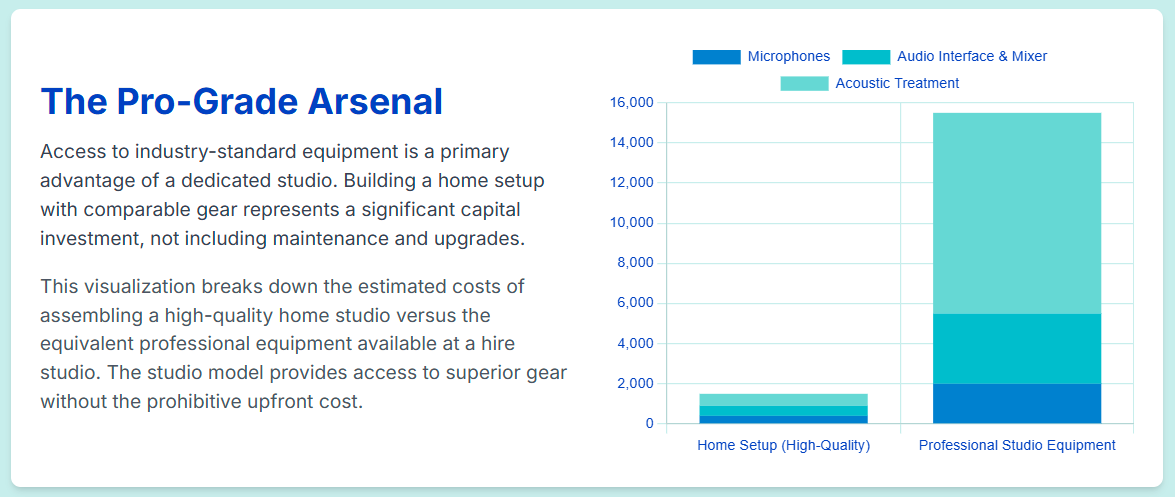
Equipment: Assembling a professional-grade signal chain is also a considerable expense. A robust setup for a two-person video podcast would require an investment of thousands of pounds. For example, a high-quality audio chain alone—consisting of two Shure SM7B microphones (£800), a Rodecaster Pro II mixer (£623), two pairs of Beyerdynamic DT 770 PRO headphones (£250), plus quality stands and cables (£200)—would total approximately £1,873.19 Adding two professional-quality cameras (e.g., Sony ZV-E10s, ~£1,400), lenses, a three-point lighting kit (£200+), and a powerful computer for recording and editing (£1,500+) can easily push the total equipment cost well over £5,000.
When combined, the total capital expenditure to build a home studio that genuinely approaches a professional standard in the UK can realistically range from a heavily compromised minimum of £10,000 to well over £20,000, with high-end builds reaching £60,000 or more before equipment is even considered.45 This analysis makes it clear that a fair comparison is not between professional hire and a £500 starter kit, but between professional hire and a five-figure capital investment project.
5.2 A Cost-Effectiveness and ROI Analysis
A simple break-even analysis based on capital investment versus rental fees is misleading, as it fails to account for the significant non-monetary costs of the DIY approach and the immense value of outsourced expertise. A holistic analysis of return on investment (ROI) reveals the strategic superiority of professional hire.
Let us model a scenario for a weekly podcast. A 1.5-hour recording session at a mid-range, high-quality London studio like Podcast House costs £225.42 Over a 52-week year, the total cost for studio time would be £11,700. This fee includes the use of the acoustically perfected room, access to tens of thousands of pounds worth of professional equipment, and, crucially, the time and expertise of an on-site audio engineer who handles all technical aspects of the recording.
Now consider the pro-grade home build. Using a conservative capital expenditure figure of £15,000, amortized over a three-year period, the annual "cost" of the studio is £5,000. While this appears cheaper on paper, it omits the enormous hidden costs. The creator must now invest hundreds of hours into learning the complex skills of audio engineering, acoustics, and troubleshooting.63 Every session requires time for setup, calibration, and breakdown. Any technical issue, from a software glitch to a faulty cable, becomes the creator's problem to solve, eating into valuable production time.4 Most importantly, the time spent on these technical and operational tasks is time
not spent on the activities that actually drive podcast growth: planning compelling content, researching and booking high-profile guests, marketing the show, and engaging with the audience.
This opportunity cost is where the true ROI of professional hire becomes apparent. Imagine a creator saves 8 hours per week by outsourcing all technical concerns to a studio and engineer. Instead of troubleshooting a noisy microphone, they are sending outreach emails to dream guests. Instead of spending hours editing out room echo, they are creating promotional clips and engaging with listeners on social media. Over the course of a year, this creator has reinvested over 400 hours directly into growth-focused activities. This massive reallocation of time and focus dramatically accelerates the podcast's journey towards building a substantial audience, securing sponsorships, and achieving monetization. The higher per-episode cost of the professional studio is therefore not just an expense for better audio quality; it is a strategic investment in speed, efficiency, and focus, which ultimately delivers a far superior return.

Conclusion: A Strategic Investment in Professional Credibility
The cumulative evidence presents a clear and compelling case: for any podcaster, brand, or content creator in London who is serious about their craft, a dedicated professional studio is an essential component of their production strategy. The pursuit of professional-grade audio is not a matter of simply purchasing an expensive microphone; it is about controlling the fundamental variables of environment, technology, and expertise. A professional studio is the only solution that addresses all three of these pillars in an integrated and uncompromising manner.
The acoustically engineered environment of a studio provides a sonically neutral foundation that is free from external noise and internal reflections—a prerequisite for clean, clear audio that is physically and financially impractical to replicate in a domestic setting. The professional signal chain, from XLR microphone to calibrated monitor, offers a level of control, fidelity, and reliability that consumer-grade equipment cannot match. Most crucially, the on-site audio engineer provides an indispensable layer of real-time quality control and post-production artistry, preventing costly mistakes and transforming raw recordings into a polished, broadcast-ready product. This outsourcing of technical complexity allows the creator to reclaim their most valuable asset—time—and reinvest it into the content and growth strategies that truly matter.
Furthermore, leveraging London's unique and mature media ecosystem provides a distinct competitive advantage. The city's dense network of high-quality, competitively priced studios, its deep pool of world-class engineering talent, and its unparalleled access to high-profile guests transform the studio from a recording space into a strategic hub for networking and brand building. A professional London studio address acts as a powerful signal of credibility, opening doors to guests and opportunities that might otherwise remain inaccessible.
When subjected to a rigorous cost-effectiveness analysis, the argument becomes definitive. The substantial capital investment and hidden time costs required to build a truly professional-grade home studio far outweigh the predictable, value-inclusive fees of professional hire. The decision to use a dedicated studio is, therefore, not a recurring expense but a strategic investment in efficiency, quality, and professional credibility.
For creators embarking on their podcasting journey or established shows seeking to elevate their production value, the recommendation is unequivocal: begin by hiring a professional London studio. This approach establishes an immediate benchmark for quality, minimizes financial risk, and allows for a singular focus on creating outstanding content. Only when the scale, frequency, and revenue of the podcast make the significant capital investment in a private facility unequivocally justifiable should a home build be considered. In the competitive sonic landscape of London, the professional studio is the most direct and effective path to being heard.
In the competitive audio landscape of 2025, listeners have sophisticated ears. They can instantly tell the difference between amateur and professional sound. While many creators invest in a good microphone, they often overlook the most critical factor in achieving broadcast-quality audio: the science of audio engineering.
Professional audio engineering isn’t about a fancy plugin or a piece of software; it’s a holistic process that relies on a controlled environment. A dedicated podcast studio London provides the foundational pillars of elite sound that are simply unattainable in a home or office setting. Here’s why it’s essential.
## 1. The Crucial Foundation: Acoustic Control
The single biggest variable in any audio recording is the room itself. An untreated space is an acoustic battleground, with sound waves bouncing off walls, ceilings, and desks, causing a host of problems that even the most expensive microphone cannot fix.
A professional studio solves this with a two-pronged approach:
Soundproofing: This is about isolation. A purpose-built studio is designed to block out the unpredictable noise of the outside world—the rumble of the tube, London traffic, and construction. This creates a silent canvas to record on.
-
Acoustic Treatment: This is about controlling the sound inside the room. Through a calculated combination of broadband absorption panels, bass traps, and diffusers, a studio eliminates echo (reverb) and standing waves (unpleasant frequency buildups).
Why this is essential for engineering: This controlled environment provides an acoustically "neutral" space. It allows an engineer to capture the pure, direct tone of your voice without any colouration or distortion from the room. You can’t edit out a bad room, but you can polish a clean recording to perfection.
## 2. The Purity of the Path: The Signal Chain
The journey your voice takes from your mouth to the final recording file is known as the signal chain. Every component in this chain can either preserve its quality or degrade it.
The Home Setup: A typical DIY chain (USB mic into a laptop) is short but compromised. It's susceptible to electronic noise from the computer, low-quality preamps, and inferior digital conversion.
The Studio Setup: A premier studio like Finchley Studio offers a pristine, professional signal chain: broadcast microphone → high-end XLR cable → quiet, powerful preamp → professional audio interface with superior analog-to-digital converters.
Why this is essential for engineering: A professional signal chain captures your voice with maximum detail, depth, and clarity, and with a minimal noise floor. An audio engineer can only work with the information they are given. Starting with a rich, clean, high-fidelity signal gives them the raw material needed for precise and impactful mixing, equalization, and mastering in post-production.
## 3. The Human Element: The On-Site Engineer
Having professional equipment is one thing; having the expertise to operate it to its full potential is another. This is where the on-site technician or audio engineer becomes invaluable.
During your session, they are performing active audio engineering:
-
Proper Gain Staging: Setting the microphone preamp to the perfect level to get a strong, clear signal without distortion (clipping).
Expert Mic Technique: Guiding you on placement to avoid plosives (harsh ‘p’ sounds) and sibilance (sharp ‘s’ sounds).
Real-Time Monitoring: Using trained ears and reference-grade headphones to listen for and correct any issues—a buzzing cable, a distracting noise—as they happen.
Why this is essential for engineering: The on-site engineer is your first line of quality control. They ensure that the raw audio files you leave with are technically flawless. This saves countless hours of frustrating "rescue work" in post-production and guarantees the best possible source material for the final mix.
Ultimately, a professional studio provides an environment where the art and science of audio engineering can thrive, ensuring your podcast has the sonic excellence to stand out.
Elevate Your Podcast at Finchley Studio
Now that you understand the technical difference a professional environment makes, the next step is choosing a studio built for audio excellence. At Finchley Studio, we are dedicated to providing creators with acoustically perfect spaces, a pristine signal chain, and expert support. This commitment is why leading organisations like the BBC and Lloyds Bank trust us with their recording needs. But don't just take our word for it—see what other creators are saying in our Google reviews and on Trustpilot.
We offer a diverse range of meticulously designed sets to match your vision, all engineered for flawless sound. Explore our spaces:
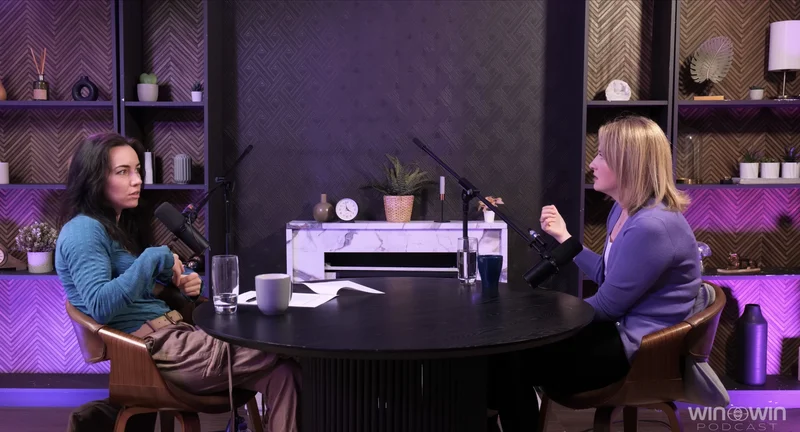
Dialogue Room: An intimate, acoustically treated space perfect for crisp, clear conversations.
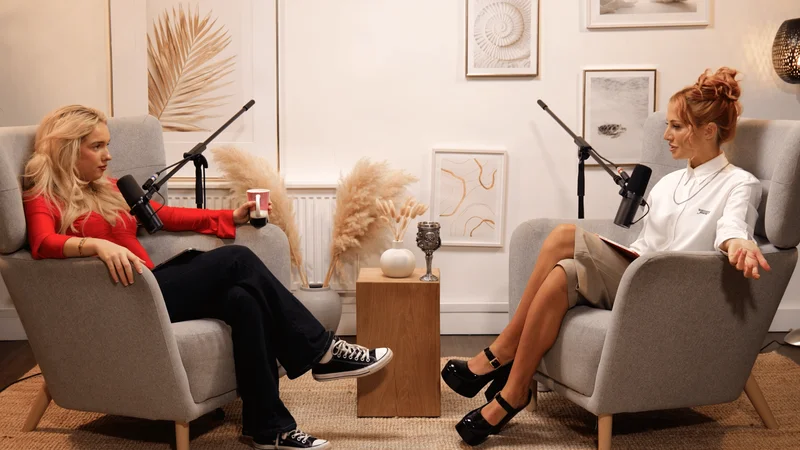
Lounge Studio: A relaxed setting for natural group discussions without compromising on audio quality.
CEO Set: A premium backdrop for executive content where every word is captured with authority.
Blackwood Studio: A sophisticated set with a modern aesthetic, engineered for broadcast-standard audio.
The Brick Studio: A versatile warehouse space with professional sound treatment for larger-scale productions.
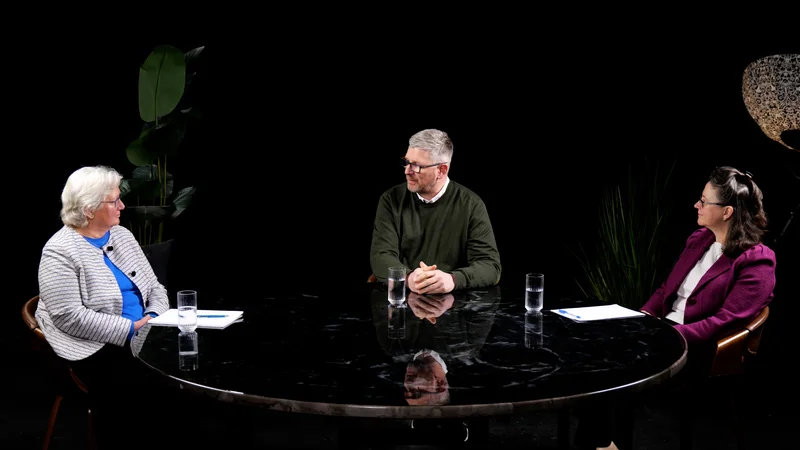
Gathering Studio: A professional environment designed for roundtable discussions where every voice is heard clearly.
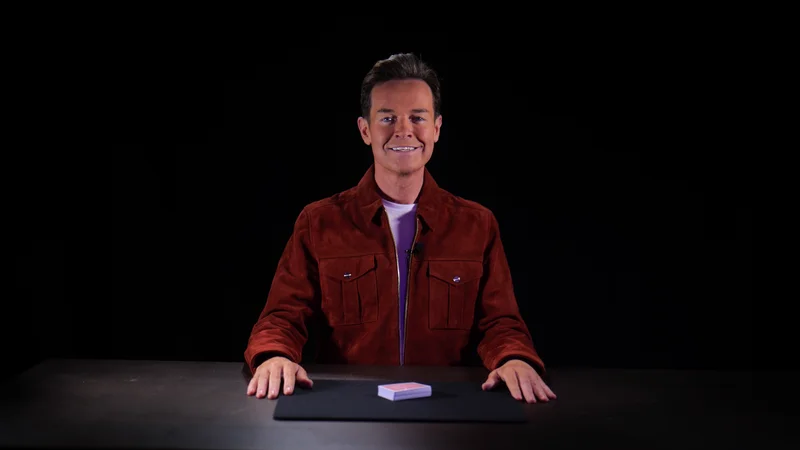
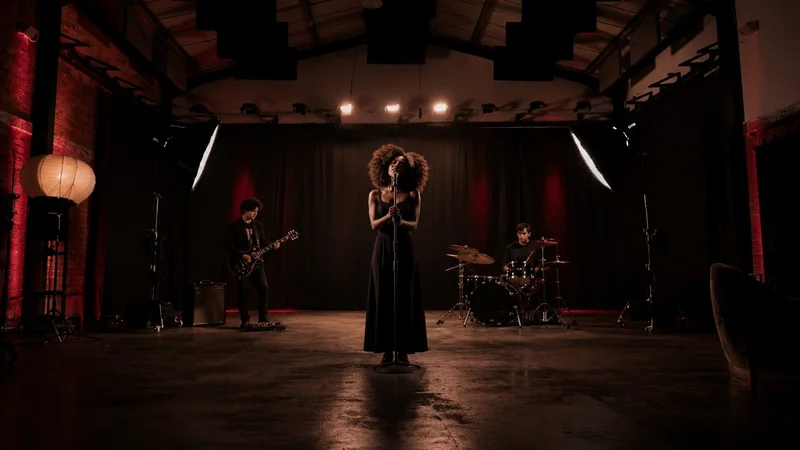
Blackout Set: A fully controlled space ideal for dramatic recordings that demand pristine audio.
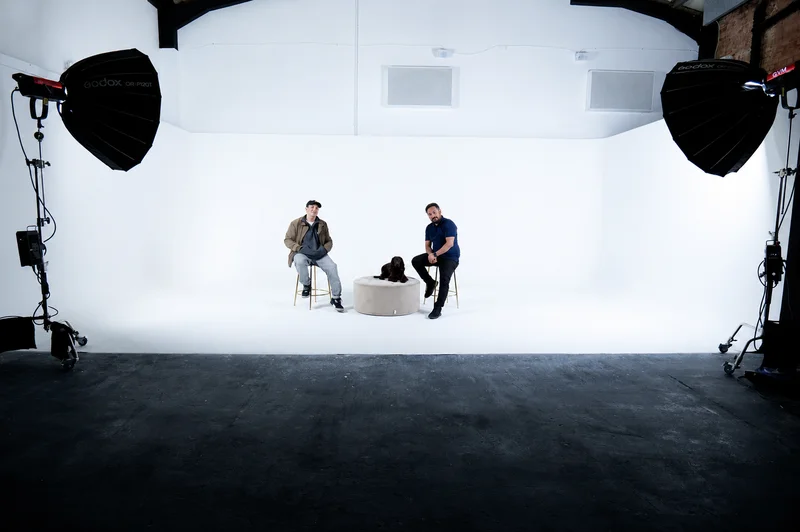
White Infinity Cove: A seamless visual backdrop complemented by a clean audio environment.
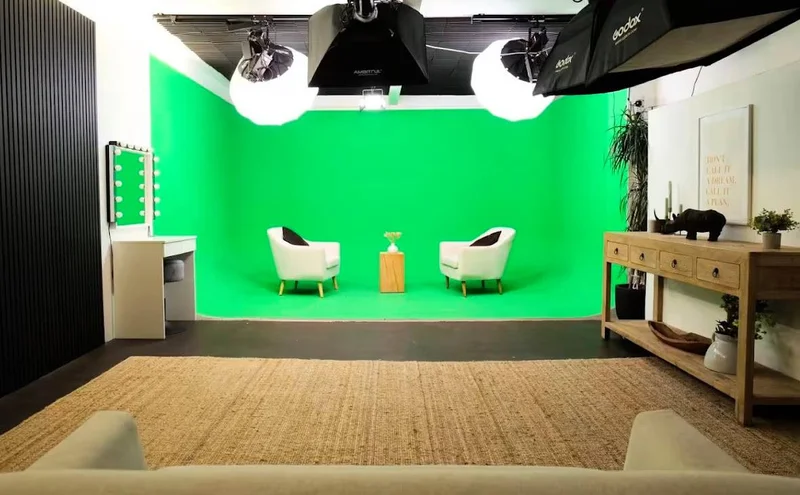
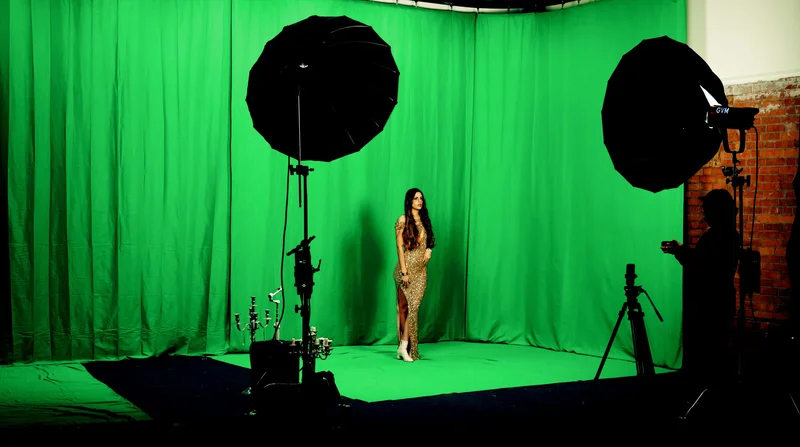
Green Screen Cove: A pre-lit studio for immersive visuals, backed by professional sound capture.
Giant Green Screen: One of London's largest green screens for ambitious productions where audio cannot be compromised.
To complete your project, our professional Video Editing Service can mix and master your audio to perfection. The team at Finchley Studio is here to ensure your vision is heard.
Ready for your podcast to sound its absolute best? See why creators rate Finchley Studio as their go-to production space.
Find Us Easily: Our studio is conveniently located just a two-minute walk from Finchley Central on the Northern Line and adjacent to the Travelodge London Finchley. We offer one free parking space per booking.
what3words: orders.yards.jokes
Stay Connected: Follow our journey and see behind-the-scenes content on our social media channels:
Have questions? Check our FAQ or get in touch directly.
WhatsApp: +447587827200
Phone: +447587827200
Email: [email protected]
Works cited
Podcast Studio Setup: The Complete Guide To Setting Up Your Home Studio - Rob Cressy, accessed September 4, 2025, https://robcressy.com/podcast-studio-setup/
Podcast Engineering: A Career Path in the Booming Audio Industry, accessed September 4, 2025, https://future-school.in/blogs/podcast-engineering-a-booming-industry-for-sound-engineers/
Professional Podcast Studio Set Up Vs DIY Podcast Studio Set Up - Sound Zero, accessed September 4, 2025, https://sound-zero.com/professional-podcast-studio-set-up-vs-diy-podcast-studio-set-up/
The Benefits of Using a Professional Podcast Studio vs. DIY Setup | Umbrella Creative, accessed September 4, 2025, https://umbrellacreative.com.au/the-benefits-of-using-a-professional-podcast-studio-vs-diy-setup/
The Difference Between Sound Treatment and Soundproofing, accessed September 4, 2025, https://www.whisperroom.com/blog/the-difference-between-sound-treatment-and-soundproofing
The difference between soundproofing vs acoustic panels, accessed September 4, 2025, https://www.gikacoustics.com/acoustic-treatment-vs-soundproofing/
The Ultimate Checklist for Designing Podcast Studios, accessed September 4, 2025, https://www.axiomintegration.com/blog/2024/the-ultimate-checklist-for-designing-podcast-studios.html
Home Studio Mistakes To Avoid In 2025 | Top Prevention Tips, accessed September 4, 2025, https://mixingmonster.com/home-studio-mistakes/
www.whisperroom.com, accessed September 4, 2025, https://www.whisperroom.com/blog/the-difference-between-sound-treatment-and-soundproofing#:~:text=%E2%80%8DAcoustic%20treatment%20shapes%20how%20sound,using%20absorptive%20and%20diffusive%20materials.&text=%F0%9F%92%AC%20While%20soundproofing%20stops%20noise,treatment%20improves%20sound%20clarity%20inside.
How to Soundproof a Room for Podcasts, accessed September 4, 2025, https://www.soundproofcow.com/soundproof-room-for-podcasts/
Podcast Studio Acoustic Design: The Perfect Environment - Sound Zero, accessed September 4, 2025, https://sound-zero.com/podcast-studio-acoustic-design/
Soundproofing and acoustic treatment together? : r/audioengineering - Reddit, accessed September 4, 2025, https://www.reddit.com/r/audioengineering/comments/ir08m2/soundproofing_and_acoustic_treatment_together/
10 Common Home Recording Mistakes | Home Brew Audio, accessed September 4, 2025, https://www.homebrewaudio.com/2022/10-common-home-recording-mistakes/
Podcast Studios: Everything You Need To know [Guide], accessed September 4, 2025, https://streamworks.ae/article/podcast-studios-guide
Studio SOS: Common Studio Problems - Sound On Sound, accessed September 4, 2025, https://www.soundonsound.com/techniques/studio-sos-common-studio-problems
Best Podcast Equipment for Beginners & Pros in 2025 - All Budgets - Riverside, accessed September 4, 2025, https://riverside.com/blog/podcast-equipment
How To Podcast - Production Equipment List - Go Camp Pro, accessed September 4, 2025, https://gocamp.pro/blog/how-to-podcast-production-equipment-list
Podcast Studio Setup: How to Create a Great Podcast Recording Room - Castos, accessed September 4, 2025, https://castos.com/podcast-studio-setup/
Essential Podcast Equipment: Gear Up for Professional Sound - Heartcast Media, accessed September 4, 2025, https://www.heartcastmedia.com/podcast-equipment/
Essential Equipment Needed To Build Your Own Podcast Studio - Media Pouch, accessed September 4, 2025, https://pouch6studios.com/build-your-own-podcast-studio/
The Best Podcast Equipment for 2025 - PCMag, accessed September 4, 2025, https://www.pcmag.com/picks/the-best-podcast-equipment
Ultimate Guide to Podcast Equipment in 2025, accessed September 4, 2025, https://thepodcastconsultant.com/blog/podcast-equipment
Home Studio Troubleshooting Tips, Part 1: Hardware - Yamaha Music, accessed September 4, 2025, https://hub.yamaha.com/proaudio/recording/home-studio-troubleshooting-tips-part-1-hardware/
What is Audio Engineering? - Quill Podcast Agency, accessed September 4, 2025, https://www.quillpodcasting.com/blog-posts/audio-engineering
Audio engineer - Wikipedia, accessed September 4, 2025, https://en.wikipedia.org/wiki/Audio_engineer
The Most Common Problem You Come Across When Recording an Artist? | with Abbey Road Engineer John Barrett, accessed September 4, 2025, https://www.abbeyroad.com/news/the-most-common-problem-you-come-across-when-recording-an-artist-with-abbey-road-engineer-john-barrett-2783
Podcast Audio Engineer Jobs: Career Info & Role Description | Lower Street, accessed September 4, 2025, https://lowerstreet.co/careers/podcast-audio-engineer
Podcast Editing: How to Do It In 11 Steps (Tutorial & Free Guide) - Riverside, accessed September 4, 2025, https://riverside.com/blog/podcast-editing
Podcast Editing: How & Where to Edit Your Podcast in 2025, accessed September 4, 2025, https://www.thepodcasthost.com/editing-production/podcast-editing/
Podcast Production Services in London | For Brands & Creators, accessed September 4, 2025, https://tyxstudios.com/podcast-production
London Podcast Production Company & Agency | Full-Service, accessed September 4, 2025, https://www.londonpodcaststudios.co.uk/full-service-podcast-production-agency-london
Podcast Editing Production Company - Floom Creative, accessed September 4, 2025, https://floomcreative.co.uk/podcast-editing-production-company/
Audio Engineering Explained - Record and Mix Music Professionally - Soundtrap Blog, accessed September 4, 2025, https://blog.soundtrap.com/the-job-of-the-audio-engineer/
Podcast Production 101: The Difference Between Mixing and Mastering, accessed September 4, 2025, https://tansyasteracademy.com/podcast-production-101-the-difference-between-mixing-and-mastering/
www.audioanimals.co.uk, accessed September 4, 2025, https://www.audioanimals.co.uk/podcast-mixing-mastering-faq#:~:text=Podcast%20mixing%20and%20mastering%20ensures,podcast%20to%20keep%20listeners%20engaged.
Podcast Production London – Professional Studio & Editing, accessed September 4, 2025, https://www.blueprintstudioslondon.com/podcast-production-london
Outset Studio | Creative Podcast Studios in London & Manchester, accessed September 4, 2025, https://outsetstudio.com/
www.finchley.co.uk, accessed September 4, 2025, https://www.finchley.co.uk/finchley-learning/podcast-studio-london-networking-opportunities-for-creators#:~:text=If%20you're%20looking%20for,interaction%20and%20collaboration%20among%20podcasters.
Podcast Studio For Hire in Central London | Shoreditch, accessed September 4, 2025, https://premierepodcaststudios.com/
Podcast Studio Hire From £60p/h in London - Mavro Worldwide, accessed September 4, 2025, https://www.mavroworldwide.com/podcaststudiohire-black
Bookings & Pricing — London Podcast ... - London Podcast Studio, accessed September 4, 2025, https://www.londonpodcaststudios.co.uk/london-podcast-studio-hire-bookings
Podcast House | Podcast Recording Studio in Central London, UK for Audio & Video, accessed September 4, 2025, https://www.podcasthouse.uk/
Book Now — Podcast Studio Hire, accessed September 4, 2025, https://podcaststudiohire.co.uk/booking
Podshop: Podcast Production Companies | Podcast Editing, accessed September 4, 2025, https://www.podshoponline.co.uk/
Podcast House | Podcast Recording Studio in Central London, UK ..., accessed September 4, 2025, https://www.podcasthouse.uk/blog/your-most-popular-questions-answered
BSc (Hons) Sound Engineering | University of West London, accessed September 4, 2025, https://www.uwl.ac.uk/course/undergraduate/sound-engineering
MSc Digital Audio Engineering | University of West London, accessed September 4, 2025, https://www.uwl.ac.uk/course/postgraduate/digital-audio-engineering
BA (Hons) Audio Engineering and Production - ICMP, accessed September 4, 2025, https://www.icmp.ac.uk/course/ba-hons-audio-engineering-and-production
Sound Engineering & Music Production courses in London with SAE UK, accessed September 4, 2025, https://www.sae.edu/gbr/audio-london/
The home of Global Media and Entertainment Careers, accessed September 4, 2025, https://careers.global.com/
Sound Engineer recruitment agency listing - London, accessed September 4, 2025, https://www.agencycentral.co.uk/agencysearch/mediapr/skills/televisionradio/soundengineer.htm
Hire the best Audio Engineers in the United Kingdom - Upwork, accessed September 4, 2025, https://www.upwork.com/hire/audio-engineers/gb/
Podcasting events near London, GB - Meetup, accessed September 4, 2025, https://www.meetup.com/find/gb--london/podcasting/
Podcast Production, Podcast Training & MIC's Podcast Club • MIC media, accessed September 4, 2025, https://micmedia.co.uk/
Podcast x TV Networking - PACT, accessed September 4, 2025, https://www.pact.co.uk/event/podcast-x-tv-networking.html
Diversifying Research Podcast | Faculty of Medicine - Imperial College London, accessed September 4, 2025, https://www.imperial.ac.uk/patient-experience-research-centre/ppi/diversifying-research-podcast/
How UK Podcasts Are Championing Diversity and Inclusion - Finchley Studios, accessed September 4, 2025, https://www.finchley.co.uk/finchley-learning/exploring-diversity-in-podcasts-uk
How To Make The City More Inclusive with Social Class Expert, Dr Louise Ashley, accessed September 4, 2025, https://podcasts.apple.com/gb/podcast/how-to-make-the-city-more-inclusive-with-social/id1390207349?i=1000648078640
Speaker Diversity Network | Future of London, accessed September 4, 2025, https://www.futureoflondon.org.uk/networks/diversity/
Podcast Recording Studio vs. Home Setup: Which is Best for You?, accessed September 4, 2025, https://www.paragoncreativestudios.co.uk/podcast-recording-studio-vs-home-setup-which-is-best-for-you/
Building a Home Recording Studio on a Budget - London College of Contemporary Music, accessed September 4, 2025, https://www.lccm.org.uk/blog/building-a-home-recording-studio-on-a-budget/
How much to make a respectable professional grade recording studio? - Reddit, accessed September 4, 2025, https://www.reddit.com/r/musicproduction/comments/11y4jwi/how_much_to_make_a_respectable_professional_grade/
Home Studio vs. Professional Podcast Studio: Pros and Cons - Authentic Exposure Studio, accessed September 4, 2025, https://theaestudio.co/home-studio-vs-professional-podcast-studio/
lowerstreet.co, accessed September 4, 2025, https://lowerstreet.co/careers/podcast-audio-engineer#:~:text=A%20podcast%20audio%20engineer%20has,equipment%20during%20in%2Dperson%20recordings.