The landscape of professional podcasting has undergone a radical transformation, evolving from a fragmented, grassroots distribution network of compressed mp3s into a highly sophisticated, multi-platform broadcast medium. In the contemporary media ecosystem, a podcast is no longer merely an auditory experience; it is a meticulously engineered digital product that often encompasses simultaneous high-definition video simulcasts, dynamic range standards mandated by streaming platforms, and an unyielding commitment to acoustic fidelity. Achieving this elite level of production value is not a matter of serendipity. It requires a rigorous, almost academic understanding of digital audio theory, the meticulous selection of preamplification and conversion hardware, and the deployment of mathematically matched monitoring systems. The modern podcast engineer must navigate a complex signal path, translating analog acoustic energy into discrete binary code, manipulating that code with extreme precision, and subsequently converting it back into analog voltage to drive the physical mechanisms of a headphone transducer.
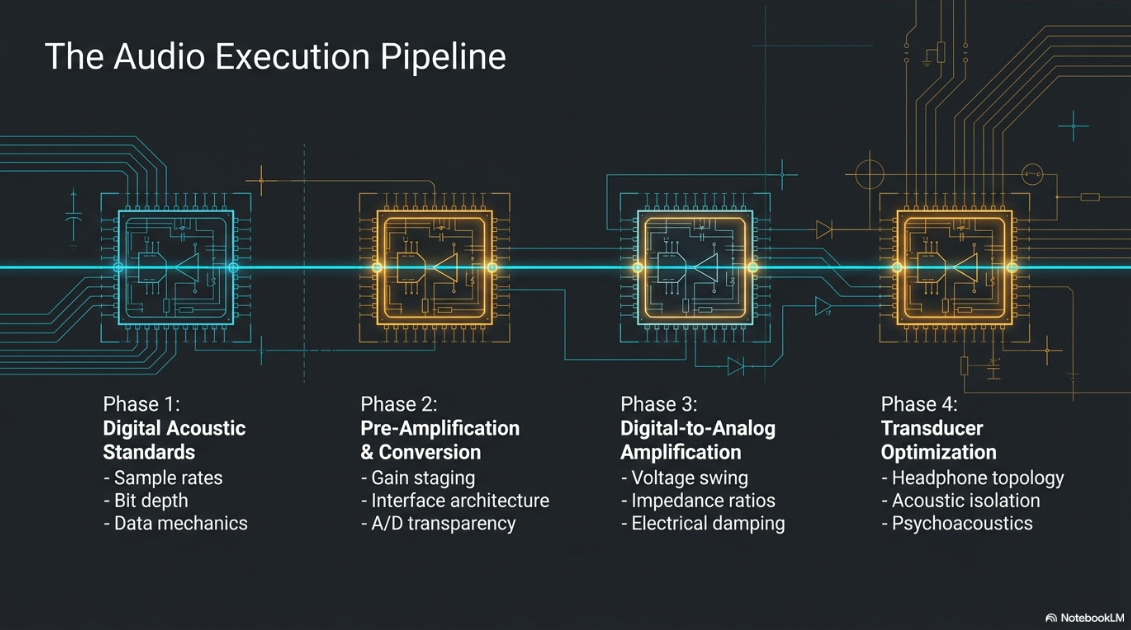
This comprehensive report provides an exhaustive, peer-level analysis of the audio execution pipeline for professional podcasting. It traces the signal flow from the underlying digital acoustic standards of temporal and amplitude resolution, through the critical preamplification and conversion stages of modern audio interfaces, and ultimately into the physics and psychoacoustics of headphone selection and amplifier impedance matching. By unifying theoretical physics with practical hardware deployment, this analysis serves as a definitive architecture for engineering a broadcast-grade podcast.
Digital Audio Foundations: Temporal Resolution and Amplitude Quantization
The absolute foundation of any professional broadcast lies in the digital architecture utilized to capture, store, and manipulate analog sound waves. Acoustic energy is continuous, defined by microscopic variations in air pressure over time. Digital audio, conversely, is discrete. The translation of this continuous acoustic energy into binary data is governed by two immutable parameters: sample rate and bit depth. Together, these metrics define the absolute boundaries of a recording's temporal and dynamic resolution.
The Physics of Sample Rates and the Nyquist-Shannon Theorem
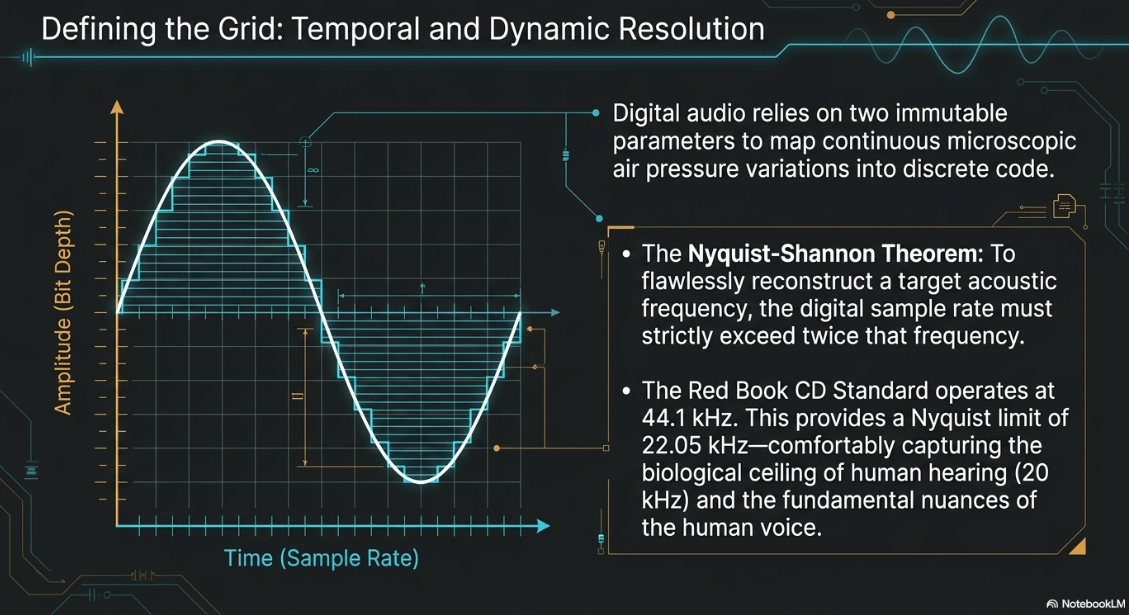
The sample rate, measured in Hertz (Hz) or kilohertz (kHz), dictates the temporal precision of the digital audio signal. It represents the exact number of discrete, microscopic snapshots taken of an analog waveform every single second1. The mathematical imperative governing sample rates is defined by the Nyquist-Shannon sampling theorem. This foundational principle of signal processing dictates that to faithfully capture and digitally reconstruct a specific analog acoustic frequency, the digital sample rate must be strictly greater than twice that target frequency1. This critical upper limit of frequency reproduction is known in acoustics and signal processing as the Nyquist limit.
For decades, the consumer audio industry was anchored by the Red Book compact disc standard of 44.1 kHz, which corresponds to 44,100 discrete snapshots per second1. Applying the Nyquist-Shannon theorem, a 44.1 kHz sample rate provides a Nyquist limit of 22.05 kHz1. Because human hearing typically reaches its absolute biological ceiling at 20 kHz (and often much lower depending on the age and hearing health of the listener), a 44.1 kHz sample rate comfortably encompasses the entirety of the human auditory spectrum. Theoretically, this rate perfectly captures the nuances, sibilance, and fundamental frequencies of the human voice without any degradation1. However, the professional broadcast and podcasting landscape has decisively shifted away from this standard.
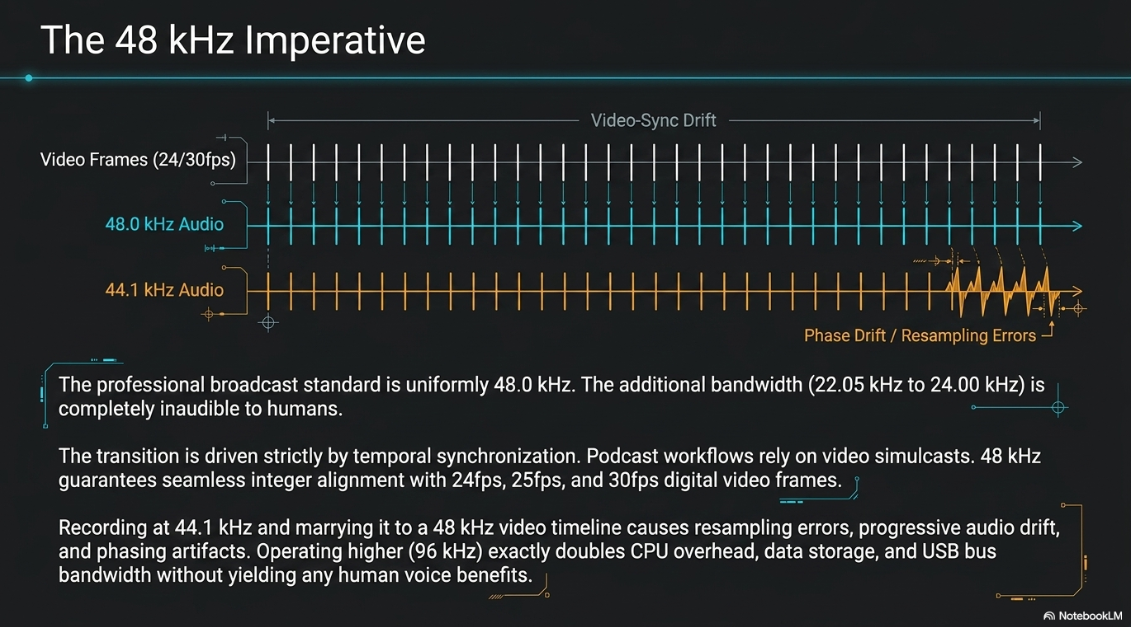
The strict industry benchmark for modern podcasting, television broadcasting, and professional video production is now uniformly 48.0 kHz1. This transition from 44.1 kHz to 48.0 kHz is not primarily driven by an empirical quest for higher acoustic fidelity. The additional bandwidth captured between 22.05 kHz and 24.00 kHz remains completely inaudible to human subjects1. Rather, the ubiquitous adoption of 48 kHz is rooted in the mathematics of temporal synchronization. The contemporary podcast industry is heavily reliant on video simulcasts distributed via platforms like YouTube, Spotify, and Apple Podcasts. Establishing a baseline recording and processing sample rate of 48 kHz guarantees seamless temporal alignment with digital video frame rates (such as 24fps, 25fps, and 30fps)1. When a podcast is recorded at 44.1 kHz and later married to a 48 kHz video timeline in post-production, the non-integer mathematical relationship between the audio samples and the video frames inevitably introduces complex resampling errors, resulting in progressive audio drift and phasing artifacts as the broadcast timeline extends1.
While higher sample rates, such as 88.2 kHz, 96 kHz, or even the 192 kHz rates supported by premium audio interfaces, offer vast ultrasonic bandwidths and theoretical benefits for heavy pitch-shifting or time-stretching, they are practically unnecessary for standard spoken-word podcasts1. Operating a podcast workflow at 96 kHz exactly doubles the central processing unit (CPU) overhead, data storage requirements, and bus transfer bandwidth without yielding any discernible acoustic benefits for human voice reproduction1. Therefore, 48 kHz remains the optimal, mathematically sound baseline for all professional podcast execution.
Bit Depth, Quantization Error, and Dynamic Headroom
While the sample rate defines precision across the axis of time, bit depth defines the amplitude precision—or volume resolution—of each individual sample snapshot. Bit depth represents the quantization level of the audio signal, meaning it dictates the exact number of discrete binary values available to record the dynamic intensity of the sound wave at any given microsecond1.
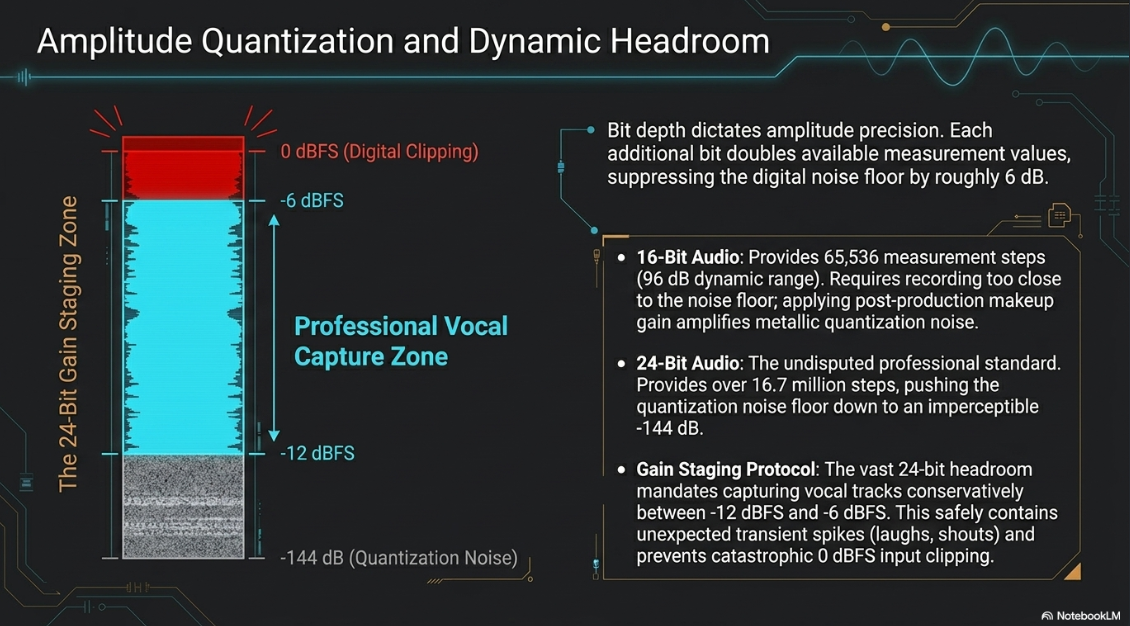
The mathematics of bit depth operate exponentially. Each additional bit of depth increases the available amplitude measurement values by a factor of two, which subsequently adds approximately 6 decibels (dB) of dynamic range to the digital noise floor1. The distance between the loudest peak a digital system can handle (0 dBFS, or decibels relative to full scale) and the lowest level of quantization noise it generates represents the available dynamic range.
Historically, 16-bit audio was the consumer standard. Operating at 16-bit provides 65,536 discrete amplitude measurements and yields a theoretical dynamic range of approximately 96 dB1. While 96 dB of dynamic range is entirely adequate for final delivery to the end consumer (as the ambient noise floor of a living room or a moving car is generally much higher than the 16-bit noise floor), capturing primary, unprocessed audio at 16-bit introduces severe risks during production1. If a host speaks quietly, the signal rests closer to the digital noise floor. When the audio engineer applies dynamic compression and makeup gain to achieve broadcast loudness, the harsh, metallic sound of 16-bit quantization noise is amplified into the audible spectrum, ruining the acoustic profile of the podcast1.
Consequently, 24-bit audio is the undisputed professional recording standard across all tiers of audio engineering1. It provides over 16.7 million discrete measurement steps for amplitude, pushing the quantization noise floor down to a staggering absolute value of -144 dB1. This vast dynamic range fundamentally alters the gain staging philosophy for podcast recording. Because the digital noise floor is suppressed well below the physical thermal noise generated by the analog cables, microphones, and preamplifiers, vocal recordings can—and should—be captured conservatively1.
Broadcast engineers uniformly mandate gain staging protocols that allow the human voice to peak safely between -12 dBFS and -6 dBFS1. This conservative approach guarantees that unexpected transient acoustic spikes—such as a sudden burst of laughter, a cough, or an animated shout—will not breach the 0 dBFS threshold, which causes catastrophic and irreversible digital clipping at the input stage1. The immense headroom provided by 24-bit resolution ensures that even when these conservatively recorded tracks are heavily compressed and limited in post-production to hit the standard podcast loudness targets (typically -16 LUFS for stereo or -19 LUFS for mono), the digital noise floor remains completely imperceptible to the listener1.
The Data Mechanics of Uncompressed Media
Capturing pristine, uncompressed audio at these professional benchmarks (48 kHz / 24-bit) necessitates specific data management calculations. Unlike lossy formats like MP3 or AAC, which use psychoacoustic algorithms to permanently discard data to achieve small file sizes, professional recording demands uncompressed WAV or AIFF files1. These formats retain the exact mathematical replica of the analog waveform.
The bit rate of uncompressed digital audio is calculated simply as the product of the sample rate, the bit depth, and the number of channels1. For a standard stereo podcast master recorded at 48,000 Hz at 24-bit resolution across 2 channels, the data footprint is massive, demanding robust local storage arrays, highly formatted SDXC cards (typically formatted in exFAT with write speeds exceeding 100MB/s), and high-speed USB 3.0 or USB-C bus-powered interfaces capable of maintaining uninterrupted, rapid data transfer without latency2.
The Acoustic-to-Electrical Conversion: Preamplification Topologies
The journey of a podcast from an acoustic thought to a digital file requires physical mediation. This mediation occurs at the audio interface, a critical piece of hardware that acts as the absolute gateway into the digital realm. In a professional podcasting workflow, the audio interface is tasked with three distinct and highly sensitive functions: it must amplify the microscopic analog voltage generated by the microphone via a preamplifier; it must convert that amplified analog voltage into binary data via an Analog-to-Digital Converter (ADC); and it must route digital data back into analog voltage for monitoring via a Digital-to-Analog Converter (DAC) and headphone amplifier3.
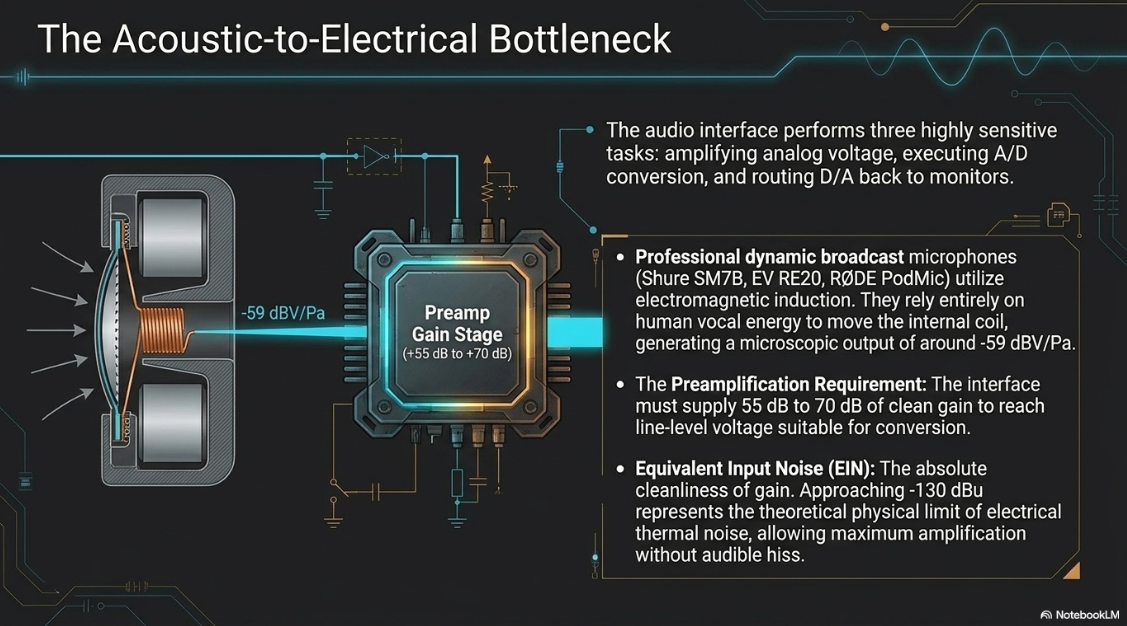
The preamplification stage is arguably the most critical analog bottleneck in the entire signal chain. The most revered broadcast microphones used in podcasting—such as the Shure SM7B, the Electro-Voice RE20, or the RØDE PodMic—are dynamic microphones10. Dynamic microphones generate electrical current through electromagnetic induction, using a physical voice coil suspended in a magnetic field. Because they do not receive external power, the physical energy of the human voice alone must move the mass of the coil. Consequently, the electrical output of professional dynamic microphones is notoriously weak, often sitting at a microscopic -59 dBV/Pa.
To bring this faint signal up to a robust, line-level voltage suitable for digital conversion without introducing analog hiss, the interface's preamplifier must supply an immense amount of clean gain—typically between 55 dB and 70 dB depending on the speaker's vocal projection3. The absolute cleanliness of this gain is empirically quantified by its Equivalent Input Noise (EIN) specification. Measured in dBu or dBV and usually A-weighted to reflect human hearing sensitivity, EIN represents the inherent noise floor generated by the internal circuitry of the preamplifier itself2. An EIN approaching -130 dBu represents the theoretical physical limit of electrical thermal noise; a preamplifier with this rating can be maximized without adding any audible hiss to the podcast6.
Audio Interface Architecture: Evaluating Hardware Solutions
The audio interface market is densely populated, but professional podcast execution generally demands specific architectural topologies. The market currently diverges into two distinct philosophical approaches: integrated, all-in-one broadcast production consoles, and dedicated desktop interfaces optimized for pristine conversion and integration with a host computer's Digital Audio Workstation (DAW)3. The selection of this hardware dictates the entire operational workflow, the required external processing, and the ultimate fidelity of the program.
Integrated Production Consoles: The Broadcast Paradigm
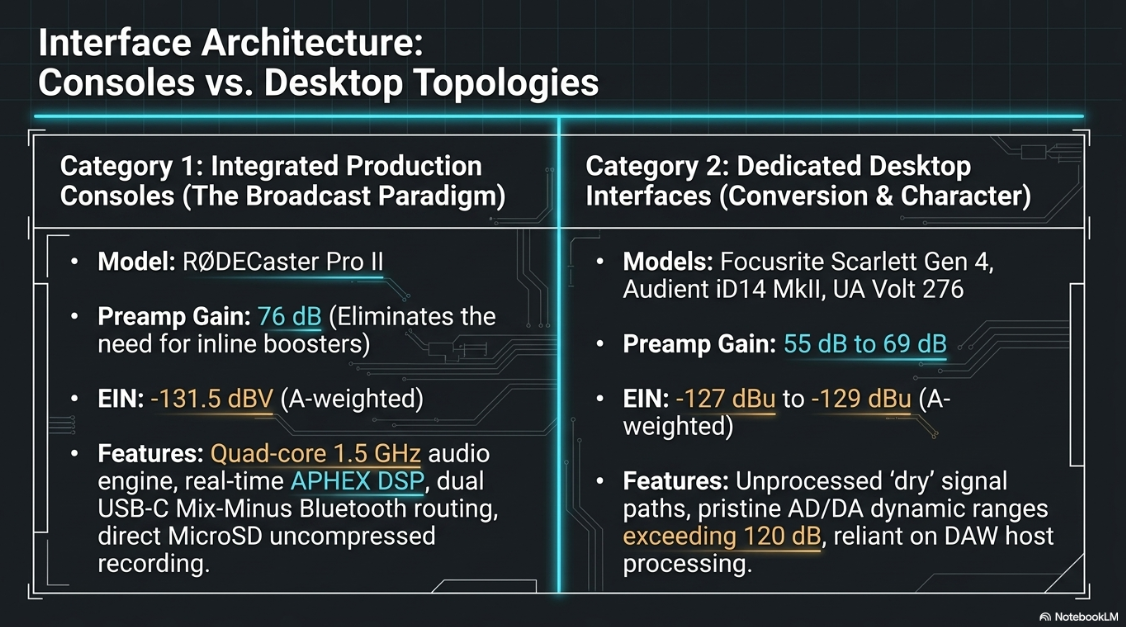
The most prominent architectural trend in modern podcasting is the adoption of integrated production studios, which merge a multi-channel analog mixer, a digital interface, a standalone recorder, and a robust DSP (Digital Signal Processing) engine into a single chassis2. This paradigm is best exemplified by the RØDECaster Pro II.
Designed specifically to eliminate the need for racks of external outboard gear, the RØDECaster Pro II represents an apex in streamlined audio production10. The critical analog entry point consists of four high-quality Neutrik combo inputs capable of accepting microphone, instrument, or line-level signals2. These inputs feed into RØDE’s custom-designed "Revolution Preamps." Addressing the historical difficulty of driving low-output dynamic microphones, the Revolution Preamps deliver an extraordinary 76 dB of available gain2. Crucially, this immense gain is paired with an astonishingly low Equivalent Input Noise (EIN) of -131.5 dBV (A-weighted)2. At -131.5 dBV, the thermal noise generated by the console is virtually non-existent, entirely eliminating the need for expensive inline microphone boosters (such as Cloudlifters) that were previously mandatory for broadcast dynamic microphones10.
The most powerful aspect of an integrated console is its internal processing capability. The RØDECaster Pro II features a high-performance 1.5 GHz quad-core audio engine, which hosts studio-grade APHEX audio processing2. This allows the podcast producer to apply highly complex signal chains—including high-pass filters, de-essers, noise gates, and legendary APHEX emulations like the Aural Exciter and Big Bottom compressors—directly to the audio in real-time4. The processed audio is then printed directly to a microSD card or streamed to a computer at 48 kHz / 24-bit resolution2. Furthermore, the routing capabilities are explicitly designed for modern broadcasting; dual USB-C interfaces and advanced Bluetooth connectivity allow for the seamless integration of remote guests via smartphones or secondary computers, automatically generating complex mix-minus routings that prevent audio feedback loops and echo for the remote caller2.
Dedicated Desktop Audio Interfaces: Conversion and Character
For podcasters, engineers, and producers who prefer to maintain an unprocessed, "dry" signal path on the way in, relying instead on computer-based plugins within a DAW for post-production manipulation, dedicated desktop audio interfaces offer uncompromising conversion quality and specialized preamplifier topologies.
The Focusrite Scarlett 4th Generation Series
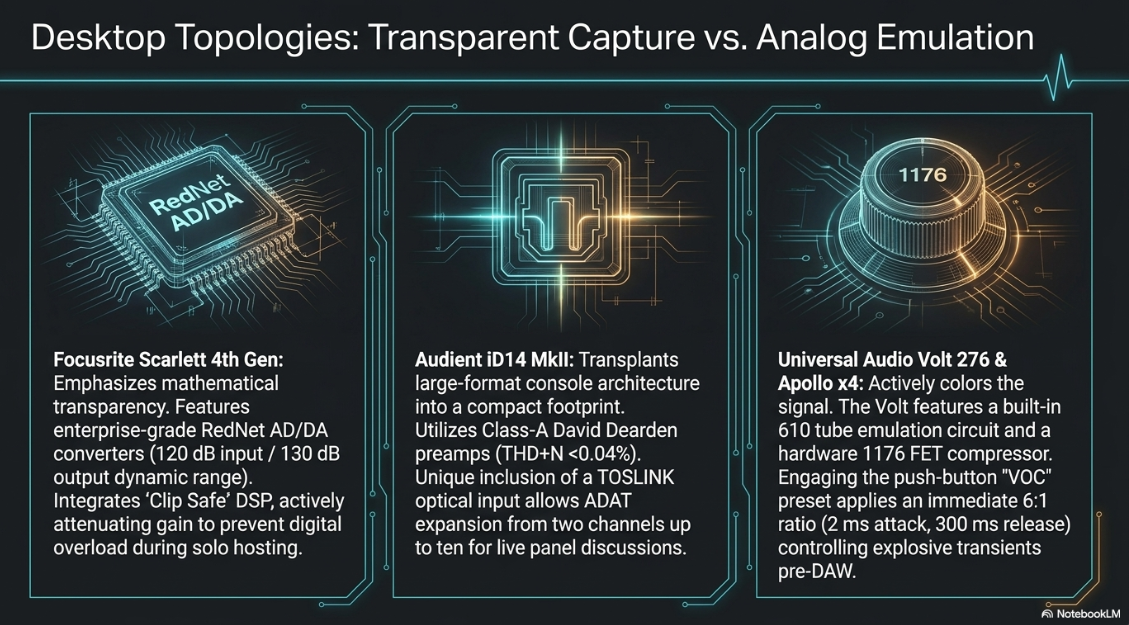
The 4th Generation of the ubiquitous Focusrite Scarlett series (specifically the Solo, 2i2, and 4i4 configurations) represents a massive evolutionary leap in accessible broadcast audio3. The Scarlett 2i2 Gen 4 features two fully upgraded microphone preamps capable of delivering up to 69 dB of gain3. While 69 dB is slightly lower than the RØDECaster's 76 dB, it is entirely sufficient to drive standard professional dynamic microphones to broadcast levels without severe noise penalties3. The EIN of the Scarlett preamps is rated at an exceptionally quiet -127 dBu (A-weighted)3.
A major architectural shift in the 4th Generation is the implementation of RedNet-derived AD/DA (Analog-to-Digital / Digital-to-Analog) converters, which are adopted directly from Focusrite's high-end enterprise studio lines3. These converters yield an immense dynamic range of 120 dB on the input stage and an incredible 130 dB on the digital-to-analog output stage, ensuring that the conversion process is mathematically transparent3. Furthermore, Focusrite has integrated advanced DSP safety nets, including "Auto Gain" to automatically optimize recording levels during a soundcheck, and "Clip Safe," which continuously monitors the input signal and rapidly attenuates the gain if it detects an impending digital overload—a critical failsafe for solo podcasters who must act as their own audio engineers while hosting5. The Scarlett also features an analog "Air Mode," which injects a high-end presence boost and harmonic-rich drive reminiscent of classic studio consoles, adding immediate clarity to dark-sounding voices3.
The Audient iD14 MkII
The Audient iD14 MkII distinguishes itself by transplanting large-format analog console architecture into a highly compact desktop footprint11. It features two distinct Class-A microphone preamps originally designed by audio legend David Dearden, optimized over decades for low noise, incredibly low distortion (THD+N @ 0dBu MAX GAIN of <0.04%), and high common-mode rejection11. The digital conversion relies on premium Asahi Kasei (AK5574EM) ADC chips and Cirrus Logic (CS43198) DAC chips, resulting in an A/D dynamic range of 120 dB and a highly impressive D/A dynamic range of 125.5 dB15.
The iD14 MkII provides 58 dB of clean gain and boasts an EIN of 129 dB (A-Weighted)15. What makes the Audient highly appealing for expansive, long-term podcast setups is its digital expandability. It is one of the few desktop interfaces in its class to include a TOSLINK optical input, allowing the producer to accept ADAT or S/PDIF digital signals11. This means that by purchasing an external 8-channel microphone preamplifier (such as an ASP880), the podcaster can instantly expand their system from two microphones to ten over a single optical cable, accommodating massive panel discussions or live band recordings11.
The Universal Audio Volt Series
Universal Audio (UA), historically known for their elite Apollo interfaces and DSP-accelerated plugins, approaches the desktop interface market with a heavy emphasis on embedded analog tonal emulation. The Volt 276 is a 2-in/2-out USB-C interface providing 55 dB of available gain and a professional EIN of -127 dBu7. The defining characteristic of the Volt series is its onboard, switchable analog circuitry designed to actively color the podcast audio before it reaches the digital converter7.
The Volt 276 includes a "Vintage Mic Preamp" mode, which engages a built-in tube emulation circuit engineered to replicate the rich, harmonic saturation and full-bodied sound of the legendary Universal Audio 610 tube preamp—a console famous for its use by historical recording artists7. In addition to the tube emulation, the "76" models feature a hardware 76 Compressor—an analog FET compression circuit inspired by the universally acclaimed 1176 Limiting Amplifier7. This compressor offers tailored, push-button presets (VOC, GTR, FAST) that apply an immediate 6:1 compression ratio with varying attack and release times7. Engaging the VOC (Vocal) preset (featuring a 2 ms attack and 300 ms release) instantly controls explosive vocal transients, ensures consistent loudness, and delivers "album-ready punch" directly to the DAW without the need for software plugins7.
The Universal Audio Apollo x4 Gen 2
For high-end studio applications where DSP tracking with zero latency is paramount, the Apollo x4 Gen 2 Studio+ Edition offers uncompromising specifications. Boasting a massive 12 inputs and 18 outputs, it leverages Quad-Core built-in DSP to run Universal Audio's legendary plugin emulations natively on the interface hardware8. The Apollo x4 delivers a dynamic range of 123 dB (A-Weighted) on the microphone inputs and an astonishing 129 dB on the monitor outputs8. With a THD+N rating of -117 dB (0.00014%) on the mic inputs, it represents the pinnacle of transparent capture, albeit at a significantly higher financial investment than the entry-level desktop units8.
Pre-Amplification and Conversion Topologies Comparison
Note: While manufacturers intermix dBu and dBV metrics in specifications, all units presented possess ultra-low thermal noise floors suitable for professional broadcast.
The Physics of D/A Conversion and Headphone Amplification
While the analog-to-digital capture stage is critical for the final product, the monitoring stage is equally vital for the podcast engineer. An engineer cannot correct a muddy frequency, a harsh sibilant spike, or an imbalanced mix if they cannot hear the audio accurately. The translation of binary digital audio back into physical sound waves requires a DAC (Digital-to-Analog Converter) feeding an amplifier, which subsequently drives a headphone transducer—a moving voice coil suspended within a magnetic field. Driving this electromechanical transducer properly is a complex exercise in electrical engineering, dictated by impedance, sensitivity, voltage swing, and the mathematical relationship of electrical damping.
Understanding Headphone Impedance and Sensitivity
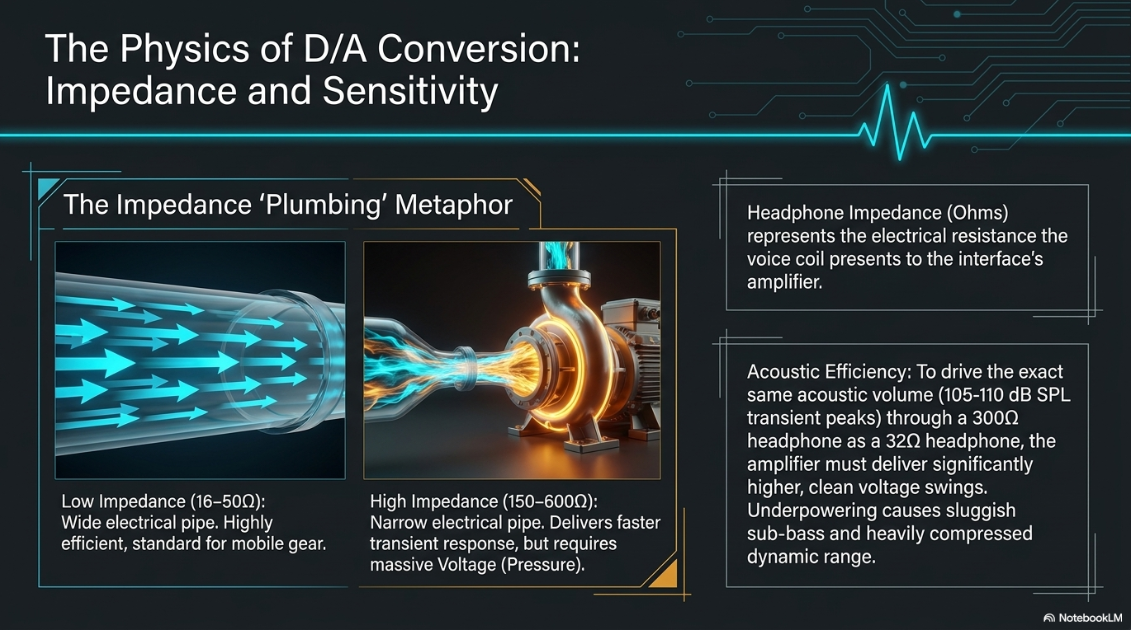
Headphone impedance, measured in ohms (
Low Impedance (16–50

Medium Impedance (50–100

High Impedance (150–600


Impedance, however, is only half of the acoustic equation. It must be coupled with sensitivity, measured in decibels per milliwatt (dB/mW) or decibels per volt (dB/V)22. Sensitivity measures the acoustic efficiency of the specific transducer design—dictating exactly how effectively the driver converts electrical power into raw sound pressure levels (SPL)22.
Without an amplifier capable of generating adequate voltage to overcome the resistance of high-impedance loads, the headphones suffer from severe acoustic degradation22. The dynamic range becomes heavily compressed, the critical sub-bass and mid-bass frequencies become soft, loose, and sluggish due to an inability to control the driver excursion, and the engineer is forced to turn the physical volume knob to its maximum limit, introducing the risk of introducing harsh amplifier clipping and harmonic distortion into the monitoring path22. To achieve a comfortable, highly dynamic, and distortion-free listening level—often targeting transient peaks around 105 dB to 110 dB SPL to ensure sufficient headroom for monitoring uncompressed tracking sessions—the amplifier must provide specific, clean milliwatt (mW) output into the designated ohm load22.
Interface Headphone Amplifier Topologies and Limitations
The ability of standard audio interfaces to drive professional, high-impedance headphones varies drastically, often dictating whether an external, standalone headphone amplifier is required.
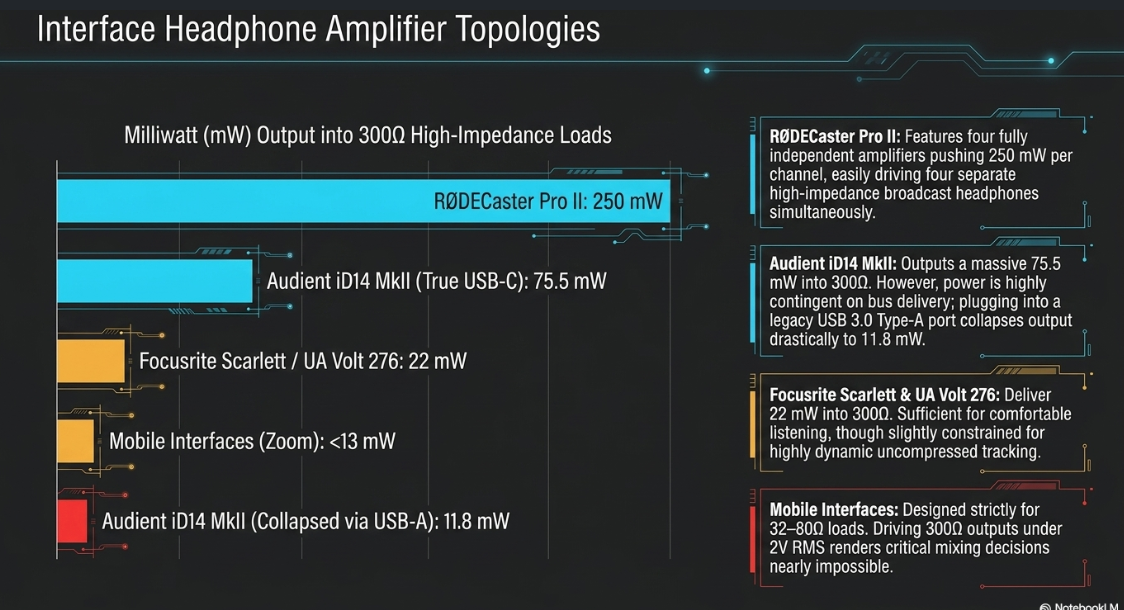
Focusrite Scarlett 4th Gen: Recognizing the demands of modern producers, Focusrite significantly upgraded the custom-designed headphone amplifier for the 4th generation. The interface now outputs 32 mW into a 33


Universal Audio Volt 276: The Volt offers an impressive 84 mW per channel into 32


Audient iD14 MkII: The Audient features an astonishingly robust headphone amplifier topology that rivals dedicated audiophile equipment. It is capable of delivering an enormous 280 mW into 62


RØDECaster Pro II: As a dedicated console designed to host panel discussions with multiple guests, it boasts four fully independent, high-power headphone outputs, capable of outputting 250 mW per channel2. This immense power ensures that even if four separate hosts are utilizing demanding, high-impedance broadcast headphones, the console maintains punchy, undistorted monitoring across all channels.
Entry-Level and Mobile Limitations: Devices designed for extreme portability or tight budgets often sacrifice amplifier voltage. For example, compact interfaces like the Zoom AMS-24 or the Presonus Quantum ES4 are designed primarily for 32–80


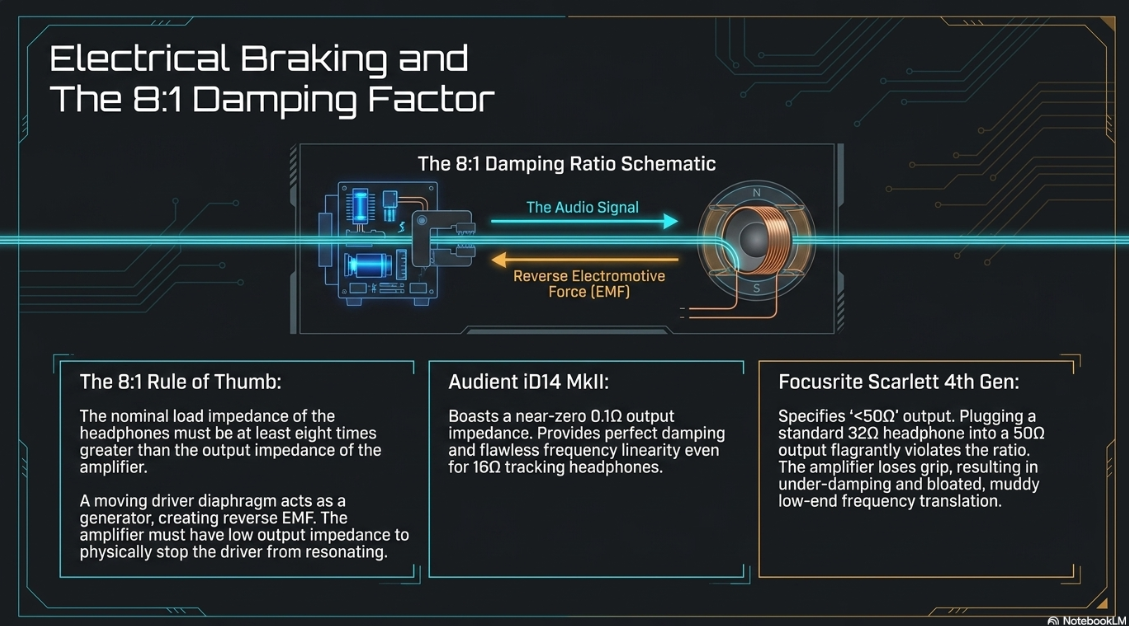
The 8:1 Damping Factor Rule and Impedance Matching
An absolutely critical, yet frequently misunderstood, metric in podcast audio monitoring is the output impedance of the interface's headphone amplifier itself. The mathematical relationship between the amplifier's output impedance and the headphone's load impedance dictates the electrical damping factor of the system24.
When a headphone driver diaphragm moves, it acts as a tiny generator, creating a reverse electromotive force (EMF) that flows back down the cable into the amplifier. The amplifier must have a low enough output impedance to electrically absorb this reverse energy and physically stop the driver from continuing to ring or resonate after the electrical signal has ceased24. Audio engineers strictly adhere to the "8:1 Rule of Thumb," which dictates that the nominal load impedance of the headphones must be at least eight times greater than the output impedance of the amplifier they are plugged into22.
If the amplifier's output impedance is too high relative to the headphones, the amplifier loses its electrical grip on the moving mass of the voice coil. This under-damping results in audible distortion, ringing, and severe non-linear frequency response variations—almost universally manifesting as a bloated, muddy, and wildly inaccurate emphasis in the low and mid-bass frequencies24.
The Audient iD14 MkII boasts a remarkably low headphone output impedance of just 0.1


The Focusrite Scarlett 2i2 Gen 4, conversely, specifies a headphone output impedance of "< 50


Standalone Solutions: If an interface lacks the power or proper output impedance, engineers must patch the interface's balanced line-outputs into a dedicated, standalone headphone amplifier. Devices like the JDS Labs Atom Amp+ offer an extremely accurate response with up to 250 mW into 300


Transducer Topologies: Monitoring Strategies for Tracking and Mixing
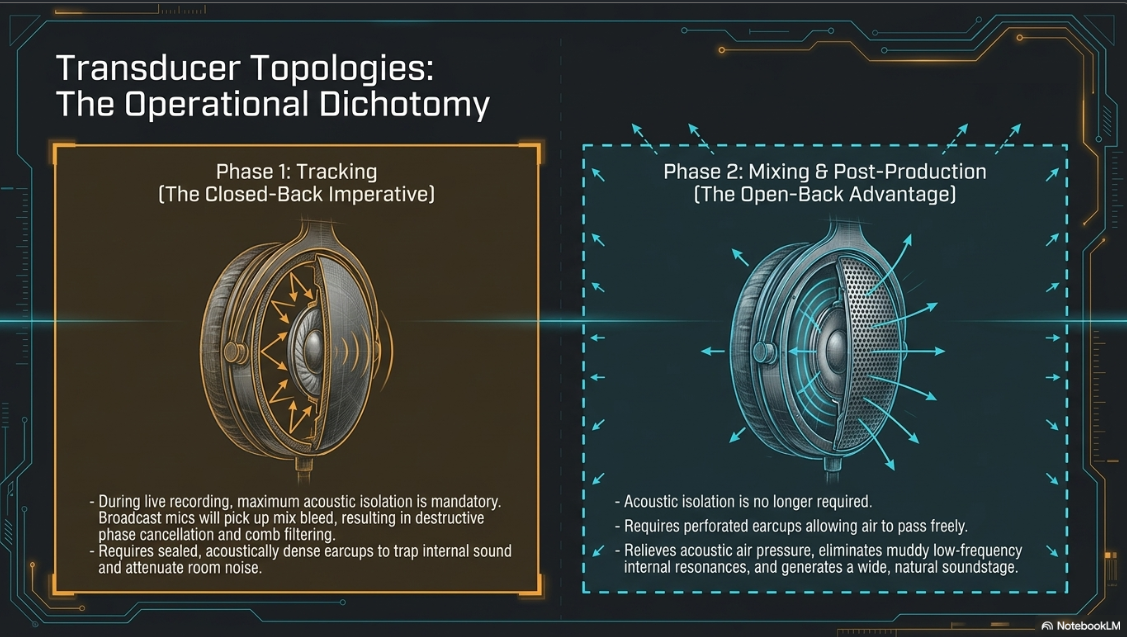
Headphone selection for professional podcasting is not monolithic; it is generally divided into two discrete, sequential phases: tracking (the active recording of the audio) and mixing (the post-production equalization, compression, and editing). Each phase presents distinct acoustic challenges and requires a vastly different transducer topology to achieve optimal results.
Phase 1: Tracking and the Closed-Back Imperative
During the live recording of a podcast, maximum acoustic isolation is mandatory. Broadcast microphones—whether dynamic like the SM7B or highly sensitive condensers—will mercilessly pick up ambient noise. If the monitoring mix (containing remote guests, soundboard stingers, or the host's own real-time voice) bleeds from the headphone earcups back into the active microphone, it creates destructive phase cancellation, comb filtering, and highly distracting echoes31. Therefore, tracking demands closed-back headphones. These models feature sealed, acoustically dense earcups that prevent internal sound leakage outward and offer high passive attenuation of external room noise inward31.
Beyerdynamic DT 770 PRO and PRO X
The Beyerdynamic DT 770 PRO is a legendary, battle-tested industry standard, renowned globally for its extreme isolation, punchy bass extension, and crisp, highly analytical treble23. It is often described as having an energetic and spatial sound signature, characterized by a finely resolved presentation rather than a strictly flat, neutral profile23. Historically available in 32, 80, and 250 
Hand-assembled in Germany, the PRO X incorporates the highly efficient Stellar.45 dynamic driver31. Crucially, the PRO X version operates at a highly versatile nominal impedance of 48 
Sony MDR-7506
A ubiquitous stalwart of the television and broadcast industry, the Sony MDR-7506 is a 63 
Audio-Technica ATH-M50x
Operating at an efficient 38 
Phase 2: Mixing, Mastering, and the Open-Back Advantage
Once the live tracking phase is complete and the audio files are imported into the DAW for post-production editing, the requirement for acoustic isolation completely vanishes. For the intricate processes of mixing, equalizing, and mastering the final podcast, professional audio engineers heavily favor open-back headphones32. Open-back designs feature perforated earcups that allow air and sound waves to pass freely through the rear of the driver housing36. This physical openness relieves acoustic air pressure, entirely eliminates the muddy, low-frequency resonances that bounce around inside sealed closed-back cups, and generates an exceptionally wide, dimensional, and natural soundstage36.
Sennheiser HD 490 PRO
The Sennheiser HD 490 PRO represents a modern masterclass in open-back reference monitoring for critical audio engineers36. Engineered with a nominal impedance of 130 
A revolutionary aspect of the HD 490 PRO is its dual-pad physical tuning system. Acoustic engineering dictates that the internal geometry and physical fabric of headphone earpads drastically alter a transducer's frequency response37. Sennheiser explicitly exploits this acoustic reality by including two discrete, washable pad sets designed for entirely different tasks:
Mixing Pads (Fabric): Utilizing these pads yields a lean, exceptionally clean, and highly articulate sound signature reminiscent of legendary reference models39. The mid-bass is strictly neutralized, providing absolute, unvarnished clarity across the frequency spectrum. This unforgiving honesty makes the Mixing pads ideal for executing critical panning, equalization, and vocal compression decisions without the masking effect of low-end sonic bloom37.
Producer Pads (Velour): Swapping to the velour pads introduces a gentle, calculated low-frequency shelving boost starting around 400 Hz, adding roughly 4 dB of gain at 100 Hz38. This physical EQ alteration elevates the bass presence and provides a warmer, fuller, and slightly more engaging soundstage38. This caters to general producing and broad creative work, though the increased mid-bass warmth can sometimes obscure microscopic, granular mix details39.
Furthermore, the HD 490 PRO explicitly addresses the persistent spatial limitations of headphone mixing by integrating advanced software DSP solutions36. The headphones are bundled with the dearVR MIX-SE plugin from Dear Reality36. By placing this software plugin on the master output bus of a DAW, the algorithm simulates the precise acoustic reflections and speaker placements of ideal, physical mixing studios36. This DSP effectively mitigates the unnatural, "in-the-head" stereo localization inherent to headphone listening, helping the engineer ensure that the podcast mix will translate consistently and accurately to car stereos, smart speakers, and consumer earbuds in the real world36.
Neumann NDH 30
Another formidable competitor in the open-back reference space is the Neumann NDH 30, operating at 120 
Transducer Topologies and Headphone Specifications Comparison


Environmental Auditioning and Procurement Dynamics
Analyzing specifications, logarithmic frequency charts, and mathematical impedance ratios is an absolute necessity for establishing a clean signal chain. However, audio engineering remains an inherently subjective, psychoacoustic discipline. Headphone transducers interact uniquely with the specific anatomical geometry of the listener's ear canal, the shape of their outer ear (pinna), and their overall cranial structure—a highly individualized acoustic phenomenon known as the Head-Related Transfer Function (HRTF)37. Furthermore, critical physical comfort parameters—such as the clamping force across the jawline, the weight distribution of the headband over the skull, and the thermal breathability of the earpads—cannot be quantified on a manufacturer's spec sheet31. Yet, these physical factors entirely dictate an audio professional's ability to meticulously edit a dense, two-hour podcast without suffering from physical or auditory fatigue31.
Consequently, the procurement of professional audio gear—particularly transducers and preamplifiers—should always involve physical auditioning in a controlled acoustic environment rather than blind online purchasing. The United Kingdom, particularly the greater London area, hosts a robust, highly specialized ecosystem of pro-audio retail showrooms dedicated strictly to critical listening and gear evaluation.
For instance, KMR Audio, operating out of their London showroom (Unit 17 Forest Trading Estate), offers over two decades of deep industry knowledge41. They maintain a vast physical inventory of premium outboard gear, channel strips, microphones, and monitoring equipment specifically designated for physical demonstration42. KMR provides both meticulously treated physical testing environments and dedicated video demo rooms, allowing professionals to audition complex signal chains—from premium Universal Audio interfaces to high-end analog equalizers—before committing to a significant studio investment43.
Similarly, Audio Sanctuary in London focuses explicitly on the nuanced interaction of high-end headphones, dedicated headphone amplification, and portable audio, acting as a dedicated space to physically test the exact amplifier-to-headphone impedance damping interactions discussed throughout this report47. Operations like Funky Junk provide rigorous auditioning of world-class nearfield monitors and outboard gear in purpose-built, acoustically flat pro-audio demo rooms48. The Premium Sound showroom in Kensington caters to the nexus of high-fidelity audio and critical listening, complete with professionally equipped demo rooms explicitly designed to eliminate acoustic distractions during equipment evaluation49. Finally, outlets like The Disc DJ Store offer broad access to essential studio bundles, providing rapid procurement of DAWs, audio interfaces, and studio headphones for the evolving broadcast facility50. Securing hardware through these specialized, interactive channels ensures that the mathematical theory of the gear translates effectively to the acoustic, physical reality of the individual audio engineer.
Works cited
Audio Execution for a Professional Podcast: File Formats and Settings: Compressed and Uncompressed File Formats: Bouncing Your Files in Audacity - Finchley Studios, https://www.finchley.co.uk/finchley-learning/visual-podcast/audio-execution-for-a-professional-podcast-file-formats-and-settings-compressed-and-uncompressed-file-formats-bouncing-your-files-in-audacity
Rode RODECaster Pro II integrated audio production studio | Chamberlain Music, https://www.chamberlainmusic.com/products/rodecasterproii
Focusrite Scarlett 2i2 4th Gen USB-C Audio Interface - The Music Spot, https://www.musicspot.com.au/focusrite-scarlett-2i2-4th-gen-usb-c-audio-interfa
RODECaster Pro II DataSheet V06 | PDF | Usb - Scribd, https://www.scribd.com/document/781129851/RODECaster-Pro-II-DataSheet-V06
Focusrite Scarlett 2i2 4th Gen USB Audio Interface Price - Ion Audio Visual, https://www.ion.com.pk/shop/focusrite-scarlett-2i2-4th-gen-audio-interface/
2i2 4th Gen Specifications - Focusrite User Guides, https://userguides.focusrite.com/hc/en-gb/articles/19640392541202-2i2-4th-Gen-Specifications
Universal Audio - VOLTSB276 Studio Pack - Nantel Musique, https://nantelmusic.com/products/universal-audio-voltsb276-studio-pack
Universal Audio Apollo x4 Gen 2 Studio+ Edition - VPLAK, https://www.vplak.com/universal-audio-apollo-x4-gen-2-studio-edition-p12965
Universal Audio VOLT 276 - Broadcast Supply Worldwide, https://bswusa.com/universal-audio-volt-276/
RØDECaster Pro II | Integrated Audio Production Studio | RØDE (GB), https://rode.com/en-gb/products/rodecaster-pro-ii
Audient iD14 MKII Desktop 10x6 USB Type-C Audio Interface - Tanotis, https://www.tanotis.com/products/audient-id14-mkii-desktop-10x6-usb-type-c-audio-interface
Universal Audio Volt 276 USB Audio Interface - Strait Music, https://www.straitmusic.com/products/universal-audio-volt-276-usb-audio-interface
Looking for a setup that supports 250 ohm headphones and an XLR mic - Reddit, https://www.reddit.com/r/HeadphoneAdvice/comments/ppk6zg/looking_for_a_setup_that_supports_250_ohm/
The Ultimate Creator Equipment Guide 2026: Every Creator, Every Niche, Every Tier - Alan Spicer - YouTube Certified Expert, https://alanspicer.com/creator-equipment-guide-2026/
Audient iD14 MKII Review - High-Performance Audio Interface - SoundGale, https://soundgale.com/audient-id14-mkii-review/
Rodecaster Pro II Quad Bundle with NTH-50 Headphones - Gear4music, https://www.gear4music.com/Recording-and-Computers/Rodecaster-Pro-II-Quad-Bundle-with-NTH-50-Headphones/7CUG
Rode RODECaster Pro II 4 Person Bundle (RODECASTERPROII) - CVP.com, https://cvp.com/product/rode-rodecasterproii-pro-ii-4-person-bundle
Rode Launches New RODECaster Pro II for Audio Production - 42West - Adorama, https://www.adorama.com/alc/rodecaster-pro-ii/
Focusrite Scarlett Solo USB-C Audio Interface (4th Generation) - eBay, https://www.ebay.com/itm/166339009314
Anything better than Audient ID14 MKII but less than $1000?, https://www.audiosciencereview.com/forum/index.php?threads/anything-better-than-audient-id14-mkii-but-less-than-1000.29024/
Universal Audio - VOLT276 Audio Interface - Nantel Musique, https://nantelmusic.com/products/universal-audio-volt276-audio-interface
Headphone Impedance Explained: 16, 32, 80, 250 Ohm (2026) - Auris Music Player, https://aurisplayer.com/blog/headphone-impedance.html
What impedance should I choose for my headphones? - beyerdynamic Blog, https://blog-en.beyerdynamic.com/what-impedance-should-i-choose-for-my-headphones/
Headphones Ohms Ratings Explained - zZounds Music Blog, https://blog.zzounds.com/2021/09/01/headphones-ohms-ratings-explained/
Focusrite Scarlett 4th Gen | Page 2 | Audio Science Review (ASR) Forum, https://www.audiosciencereview.com/forum/index.php?threads/focusrite-scarlett-4th-gen.47544/page-2
Which headphones do you have and ACTUALLY use? - Page 2 - Gear - BassBuzz Forum, https://forum.bassbuzz.com/t/which-headphones-do-you-have-and-actually-use/84965?page=2
Universal Audio UAD VOLT 2 ออดิโออินเตอร์เฟส - LiveForSound, https://www.liveforsound.com/product/product/uad-volt-2/
Preamp Gain for Headphone Amps : r/oratory1990 - Reddit, https://www.reddit.com/r/oratory1990/comments/1durizx/preamp_gain_for_headphone_amps/
Will a headphone amp make a difference even with an interface? - Reddit, https://www.reddit.com/r/musicproduction/comments/1359d6t/will_a_headphone_amp_make_a_difference_even_with/
PROEL HPAMP106 6-CH Headphone Amplifier - MS - THE MIX OF SHARING, https://themixofsharing.com/shop/proel-hpamp106-6-ch-headphone-amplifier/
beyerdynamic DT 770 PRO X - Thomann, https://www.thomann.co.uk/beyerdynamic_dt_770_pro_x.htm
Best budget studio headphones 2026: Affordable studio cans | MusicRadar, https://www.musicradar.com/news/best-budget-studio-headphones
Best Studio Headphones for Monitoring Under $400 in 2026 - beyerdynamic Australia, https://www.beyerdynamic.com.au/blogs/news/best-studio-headphones-for-monitoring-under-400-in-2026
Beyerdynamic DT 700 Pro X & DT 900 Pro X - Sound On Sound, https://www.soundonsound.com/reviews/beyerdynamic-dt-700-pro-x-dt-900-pro-x
Audio-Technica ATH-M50x vs Sony MDR-7506 (or other in similar range) as first pair of legit headphones for playing guitar and beginner music production? - Reddit, https://www.reddit.com/r/musicproduction/comments/1b0k52f/audiotechnica_athm50x_vs_sony_mdr7506_or_other_in/
Sennheiser HD 490 PRO PLUS Headphones (SEN-700287) - CVP.com, https://cvp.com/product/sennheiser-hd-490-pro-plus-headphones-sen-700287
Sennheiser HD 490 Pro review: Brilliant for mixing on headphones | MusicTech, https://musictech.com/reviews/studio-recording-gear/sennheiser-hd-490-pro-review/
Sennheiser HD 490 Pro - Sound On Sound, https://www.soundonsound.com/reviews/sennheiser-hd-490-pro
Sennheiser HD 490 Pro review: a flexible but imperfect solution - unheardlab.com, https://unheardlab.com/2025/10/10/sennheiser-hd490-pro-review-a-flexible-but-imperfect-solution/
Sennheiser HD 490 Pro Plus Headphones: Review - ecoustics.com, https://www.ecoustics.com/reviews/sennheiser-hd-490-pro-plus/
Contact Us - KMR Audio, https://kmraudio.com/pages/contact
KMR Audio: Recording Studio Equipment | Best Pro Audio in London, https://kmraudio.com/
London Showroom - KMR Audio, https://kmraudio.com/pages/london-showroom
Terms and Conditions - KMR Audio, https://kmraudio.com/pages/terms-and-conditions
Demo Room - KMR Audio, https://kmraudio.com/blogs/demo-room
Top 6 kmraudio.com Alternatives 2026 - i4studio, https://i4studio.eu/top-6-kmraudio-com-alternatives-2026/
Audio Sanctuary: The Headphone and Portable Audio Specialists, https://www.audiosanctuary.co.uk/
Funky Junk – Leading Pro Audio Solutions Since 1990 - Funky Junk, https://www.funky-junk.com/
Premium Sound | Home audio retailer in London, https://premiumsound.co.uk/
Buy Studio Equipment in London from The Disc DJ Store, https://www.thediscdjstore.com/pages/studio-equipment-london