Introduction
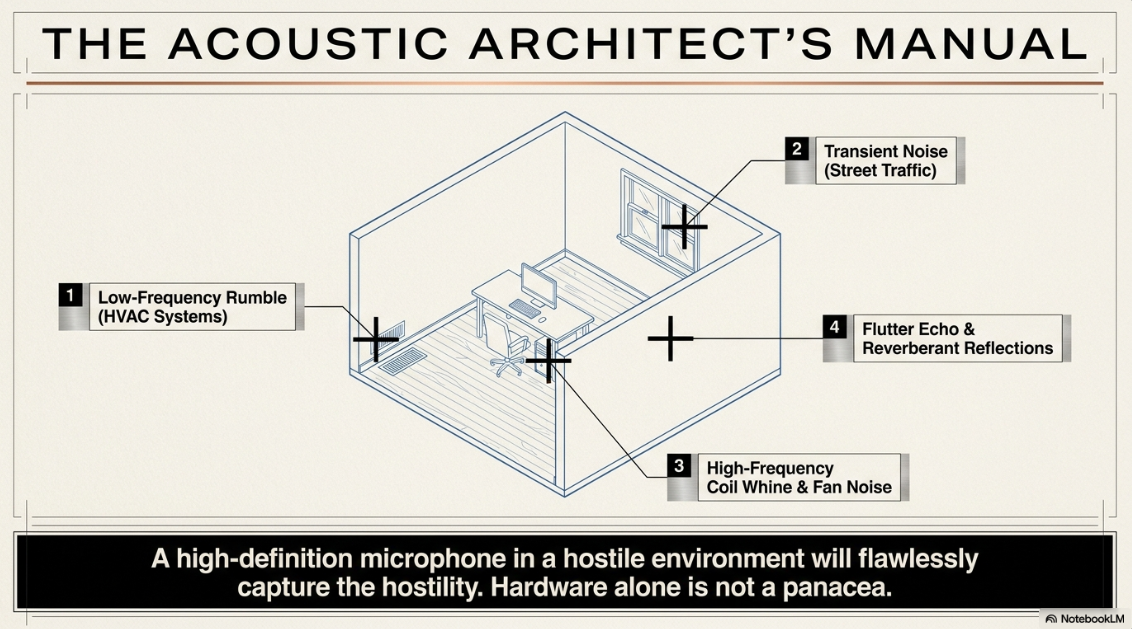
The democratization of media production has shifted the epicenter of broadcast audio from purpose-built, acoustically optimized studios to domestic spaces and home offices. While high-definition recording hardware has become financially accessible to independent creators, the environments in which this hardware is deployed remain largely hostile to pristine audio capture. Residential rooms are plagued by a litany of sonic artifacts: low-frequency rumble from HVAC systems, transient noise from street traffic, high-frequency coil whine from computer components, and, most critically, the reverberant reflections generated by hard parallel surfaces. Achieving professional, broadcast-quality spoken-word audio in these environments requires far more than merely purchasing a premium microphone.
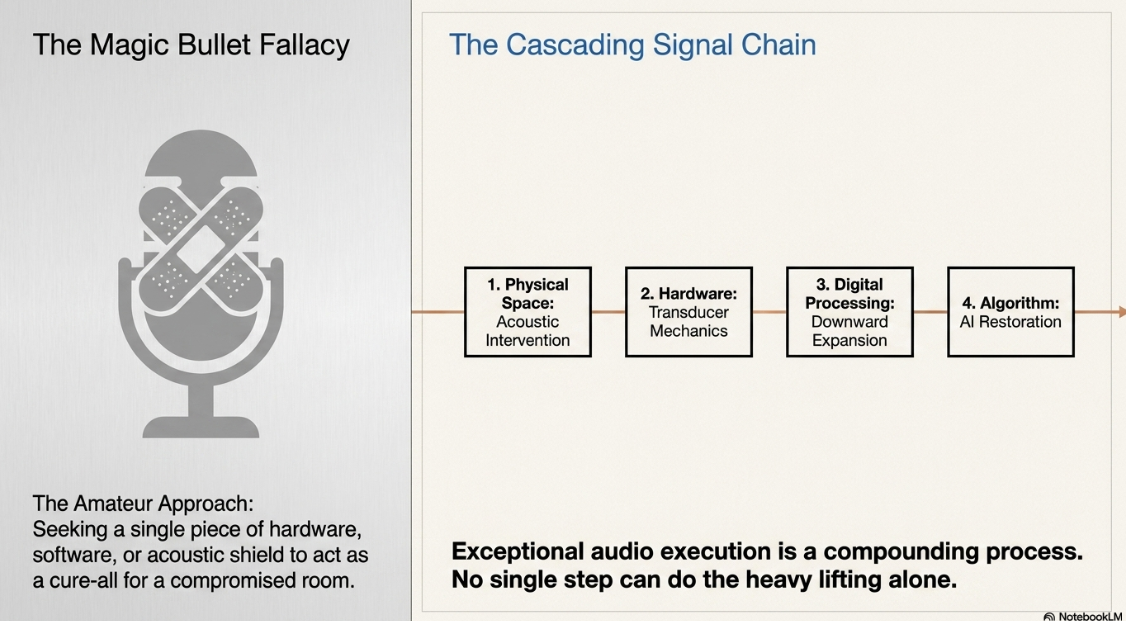
In professional audio engineering, the mitigation of background noise in an untreated environment requires a tiered, multi-disciplinary approach. A common misconception among novice broadcasters is that a single software plugin, a specific polar pattern, or an expensive piece of hardware can act as a panacea for poor acoustics. In reality, exceptional audio execution is the result of a cascading chain of interventions, beginning with the physical space and ending with advanced algorithmic processing. This report provides an exhaustive analysis of the mechanisms required to achieve broadcast-quality podcast audio in home environments. The analysis is structured across four primary domains: the physical acoustic treatment of the recording space, the physics and selection of transducer hardware (microphones), the application of dynamic range processing (expanders and gates), and the deployment of advanced artificial intelligence (AI) audio restoration software.
Phase 1: The Acoustic Environment and the Physics of Room Treatment
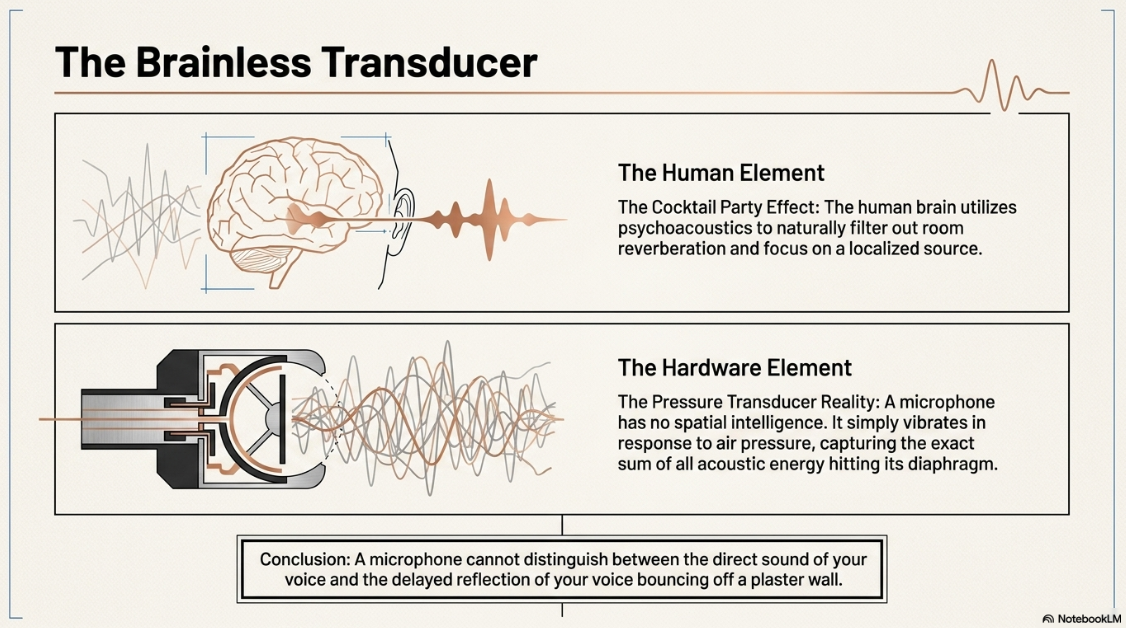
Before addressing electronic hardware, the physical behavior of sound waves within the recording space must be managed. A microphone is merely a pressure transducer; it cannot distinguish between the direct sound of a human voice and the reflected sound of that voice bouncing off a plaster wall1. While the human brain utilizes psychoacoustics to naturally filter out room reverberation and focus on a localized sound source—a phenomenon commonly referred to as the "cocktail party effect"—a microphone captures the sum of all acoustic energy hitting its diaphragm2. Consequently, treating the room is the foundational step in professional audio execution.
The Physics and Fallacies of Reflection Filters
A ubiquitous attempt to solve residential acoustics among amateur podcasters is the deployment of portable reflection filters or isolation shields placed directly behind the microphone on the stand. However, empirical data, acoustic measurements, and physical principles suggest that these devices are frequently misunderstood and often introduce new acoustic anomalies that degrade the vocal recording3.
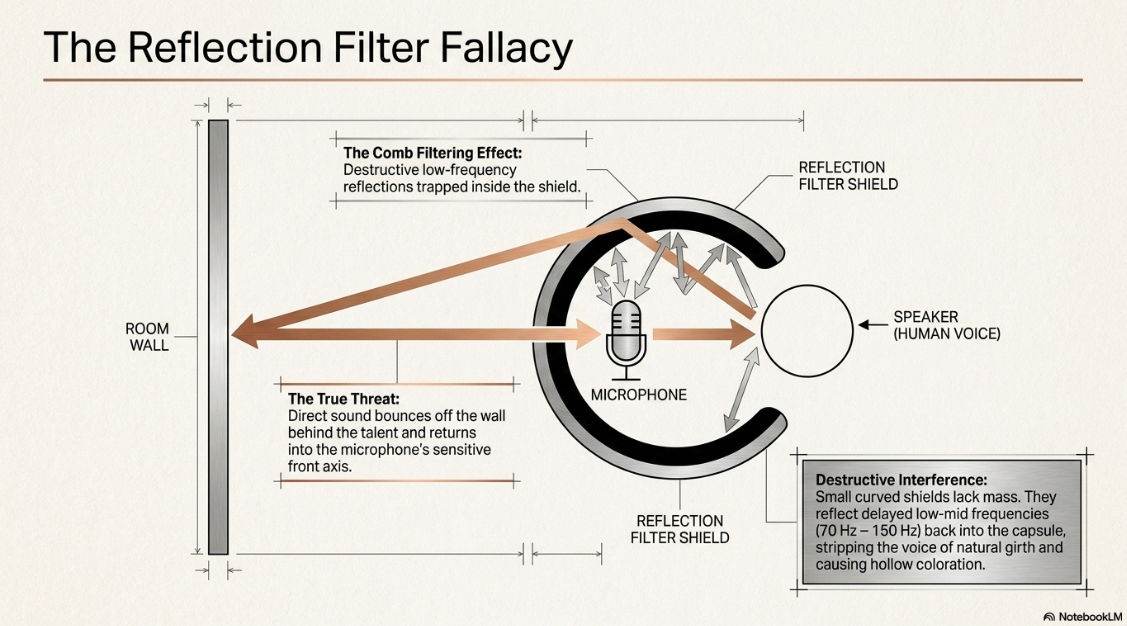
Most broadcast microphones utilize a unidirectional cardioid polar pattern, meaning they are highly sensitive to audio originating from the front axis, moderately sensitive to the sides, and largely reject audio from the rear. Consequently, placing a semi-circular absorptive shield behind the microphone does little to block room reflections, as the rear of the microphone is already rejecting sound by design4. The primary source of destructive reflections in a vocal recording does not come from behind the microphone, but rather originates from the wall directly behind the talent. As the speaker projects their voice, the sound wave travels past the microphone, hits the rear wall, and bounces directly back into the highly sensitive front axis of the microphone capsule4.
Furthermore, portable reflection shields often cause severe phase-cancellation issues known as comb filtering3. Due to their compact size and proximity to the microphone, these shields lack the mass and depth required to fully absorb low-mid and low-frequency energy. Instead of being absorbed, sound energy reflects off the inner curved walls of the filter and bounces back into the microphone with a slight time delay3. Because the microphone is placed so close to the obstacle, diffraction does not have the space to dissipate the energy3. This interaction between the direct sound wave from the vocalist's mouth and the delayed reflected wave from the shield causes specific frequencies to cancel each other out, resulting in a hollow, unnatural coloration. This degradation is particularly noticeable in the lower registers of a male voice, typically in the 70 Hz to 150 Hz range, stripping the vocal of its natural "girth"3.
Acoustic tests comparing products like the sE Reflexion Filter to larger, denser traps indicate that while compact filters can attenuate higher frequencies (providing around 10dB of attenuation above 2kHz), they can introduce terrible comb filtering if the microphone is improperly placed4. Proper microphone placement—specifically, pushing the capsule slightly forward of the front edges of the filter rather than burying it deep inside the curve—is vital to minimizing this destructive acoustic interference4. Ultimately, reflection filters address secondary reflections reaching the rear and sides of the microphone, but they are entirely ineffective if the primary reflections bouncing off the wall behind the performer are not addressed first4.
Broadband Absorption: Acoustic Foam versus Mineral Wool
The most effective method for controlling room reflections and maximizing background noise rejection is the installation of broadband acoustic panels. The strategic priority for placement should be the space directly behind the speaker, followed by the first reflection points on the side walls4. However, the material composition of these panels dictates their efficacy across the frequency spectrum.
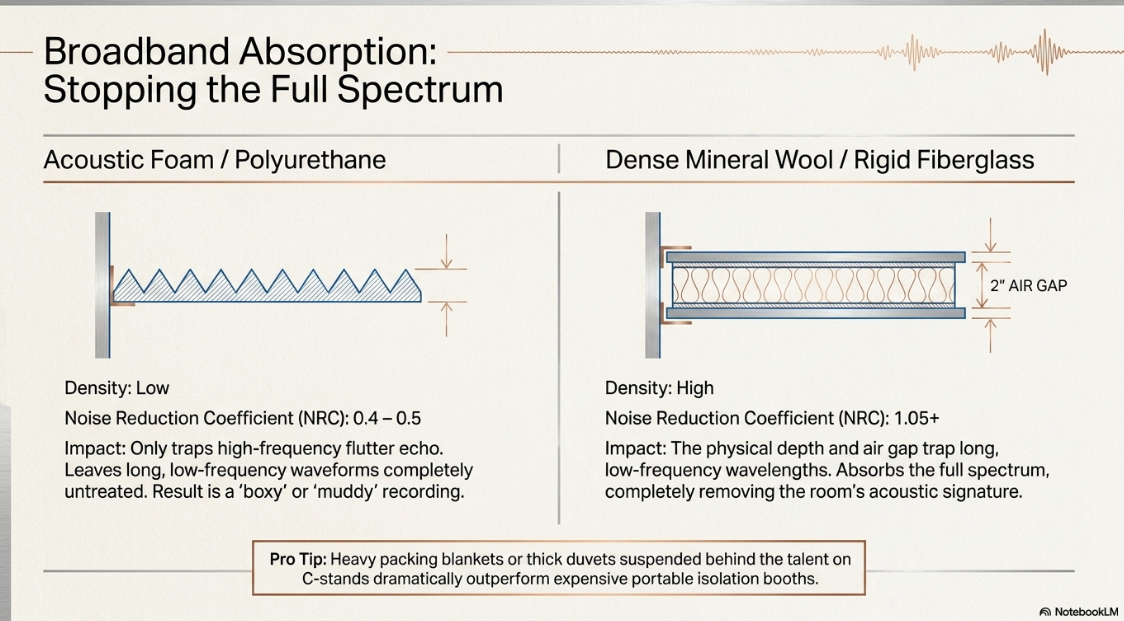
Acoustic foam, such as the polyurethane wedges and pyramids manufactured by Auralex, is immensely popular due to its low cost, aesthetic appeal, and light weight. Secondary market analysis indicates high availability of products like Auralex Studiofoam Wedgies and MoPads at relatively low price points7. However, acoustic foam generally possesses a lower Noise Reduction Coefficient (NRC)—often around 0.4 to 0.5 for standard one-to-two-inch thicknesses—meaning it primarily absorbs high-frequency energy, commonly referred to as "flutter echo"8. Because standard foam lacks the density to trap longer waveforms, it leaves low-mid and low frequencies virtually untreated. This disproportionate absorption can result in a "boxy" or "muddy" recording environment, as the room retains its low-end reverberation while sounding artificially deadened and lifeless in the high end10.
Conversely, architectural acoustic panels constructed from dense mineral wool or rigid fiberglass (such as Rockwool RWA45 or Owens Corning 703) offer vastly superior broadband absorption9. Manufacturers like GIK Acoustics utilize a patented "two-frame" system incorporating a rigid absorptive core and a built-in air gap, achieving exceptional NRC ratings exceeding 1.058. By utilizing panels that are at least two to four inches thick and spacing them a few inches away from the wall, the air gap significantly increases the panel's ability to trap longer, lower-frequency wavelengths6. In a small room, attempting to control sub-bass frequencies with foam is impossible; adequate bass traps require substantial square footage and density6.
For home studio operators working within strict budgets, do-it-yourself (DIY) panels built from Rockwool slabs wrapped in acoustically transparent, fire-retardant fabric provide professional-grade treatment at a fraction of the cost of commercial options11. Bales of Rockwool can often be procured for around $50, making it a highly cost-effective solution for treating primary reflection points11. If permanent or semi-permanent acoustic treatment is impossible due to rental agreements or aesthetic constraints, the deployment of thick polyester duvets or heavy packing blankets suspended on lighting stands behind the talent remains one of the most highly effective, non-destructive acoustic interventions available4. This rudimentary setup provides substantial broadband absorption, often outperforming expensive portable isolation booths by taking the room acoustics entirely out of the equation4.
Phase 2: Transducer Mechanics and Microphone Selection
If the acoustic environment cannot be perfectly controlled, the selection and physical placement of the microphone act as the second line of defense against background noise. The discourse surrounding podcast microphones is heavily dominated by the debate between dynamic (moving-coil) and condenser (capacitor) capsules.
Deconstructing the Sensitivity Myth
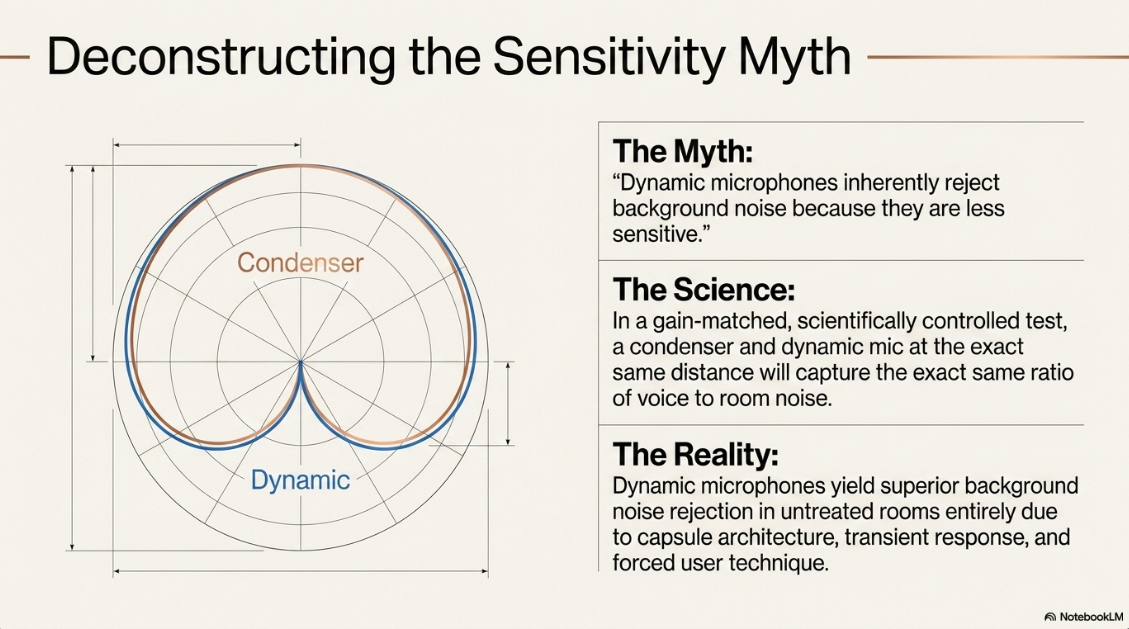
A pervasive doctrine in home recording and podcasting is that dynamic microphones are inherently better at rejecting background noise because they are "less sensitive" than condenser microphones. Various acoustic publications have challenged this as a technical myth, stating that if a dynamic and a condenser microphone share the exact same polar pattern (e.g., both are strict cardioids), are placed at the exact same distance from the sound source, and their preamps are gain-matched so the output level is identical, they will capture the exact same ratio of direct signal to ambient room noise1. A microphone membrane simply vibrates in response to air pressure changes; it possesses no spatial intelligence to differentiate between a direct vocal wave and a reflected wave containing room reverberation1.
However, while the theoretical parity between condenser and dynamic microphones holds true in highly controlled, gain-matched scientific testing, this parity completely breaks down in practical application. In the operational reality of an untreated home studio, dynamic microphones consistently yield superior background noise rejection. The underlying reasons are rooted not in acoustic magic, but in applied physics, capsule design architecture, and user technique1.
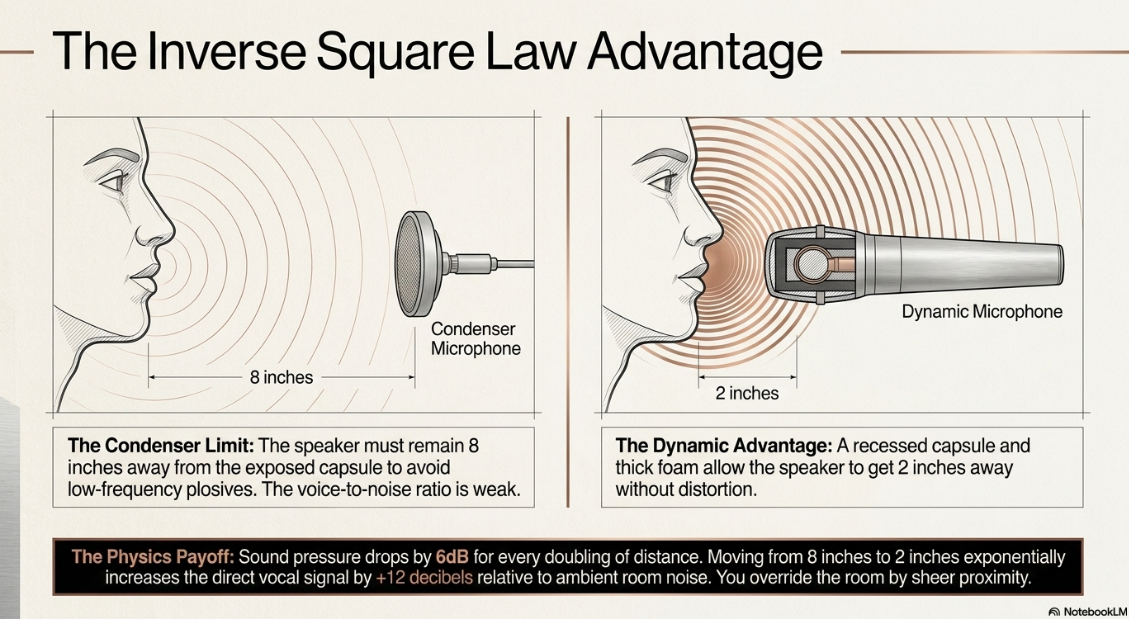
First, the physical construction of the microphones dictates how close the user can get to the capsule. Condenser microphones are highly sensitive to sudden bursts of air pressure, known as plosives. To prevent severe distortion and low-frequency "pops," vocalists must maintain a distance of roughly six to eight inches from a large-diaphragm condenser capsule, even when utilizing an external pop filter14. Furthermore, condenser capsules sit relatively close to the front grille of the microphone housing14. Conversely, broadcast dynamic microphones are designed with robust, heavier diaphragms, thick inner foam pop filters, and extended grilles that physically recess the capsule deep within the microphone body14. This design allows the user to practically touch their lips to the microphone grille without causing distortion1.
This difference in proximity drastically alters the signal-to-noise ratio due to the inverse square law of acoustics, which states that sound pressure level (SPL) drops by 6 decibels for every doubling of distance14. If a podcaster speaks 8 inches away from a condenser microphone, and then switches to a dynamic microphone placed 2 inches away from their mouth, the direct signal of the voice at the dynamic capsule increases by 12 decibels relative to the ambient room noise14. By getting significantly closer to the source, the dynamic microphone exponentially improves the ratio of the desired voice to the unwanted room reflections.
Second, the inherent frequency response curves of the two microphone types impact how the human ear perceives background noise. Condenser microphones are engineered for high-frequency accuracy, transient speed, and a wide dynamic range. In a pristine, acoustically treated studio, this sensitivity produces a rich, detailed, and lifelike audio reproduction that dynamic microphones cannot match14. However, in an untreated room with hard floors and bare walls, this sensitivity becomes a massive liability. The condenser will effortlessly capture the high-frequency "hiss" of room reflections, street noise, and mouth clicks15.
Dynamic microphones, on the other hand, inherently suffer from a slower transient response due to the physical mass of the moving copper coil attached to the diaphragm, resulting in a natural roll-off of high frequencies1. In an untreated room, this physical limitation acts as a natural mechanical filter. The reduced high-frequency and high-midrange pickup softens harsh ambient textures, rendering background noise less detailed, less realistic, and therefore less distracting and intelligible to the human ear1. Consequently, if a room has carpet, soft furniture, and no obvious echo, a condenser microphone like the AT2020 or Elgato Wave:3 is appropriate; but if the room features hard surfaces, echo, or background noise, a dynamic microphone is mandatory15.
Market Analysis of Standard Podcast Hardware
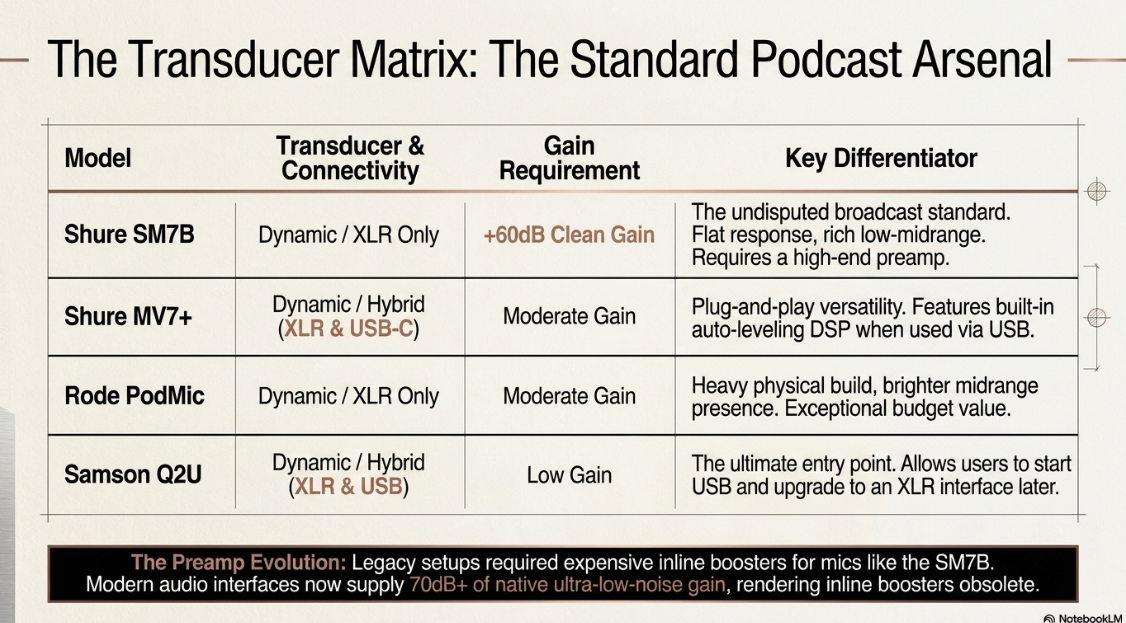
The modern podcasting market is dominated by a few key hardware choices that leverage dynamic capsule technology to reject room noise. Understanding the performance profiles, connectivity limitations, and pre-amplification requirements of these models is crucial for equipment procurement and studio design.
Preamplification, Gain Staging, and Digital Conversion
For microphones utilizing standard XLR connectivity, an external audio interface is required to amplify the micro-voltage generated by the dynamic capsule (preamplification) and convert that analog signal into a digital data stream for the computer (Analog-to-Digital conversion)15. The noise floor of the interface's preamplifier is a critical vector for the introduction of background noise.
When driving a notoriously gain-hungry microphone like the Shure SM7B directly into entry-level or older-generation audio interfaces, pushing the gain dial to near 100% introduces severe electronic hiss—the self-noise of the preamp components struggling to deliver clean power13. To circumvent this limitation, broadcasters have historically utilized inline phantom-powered preamps, such as the TritonAudio FetHead or Cloud Microphones Cloudlifter13. These devices sit between the microphone and the interface, utilizing the interface's 48V phantom power to provide roughly 25 to 27 decibels of ultra-clean, transparent gain before the signal even hits the primary interface's preamp13. This gain staging allows the interface preamp to run at a much lower, quieter level, eliminating electronic hiss.
However, the hardware landscape is rapidly evolving. In recent years, purpose-built podcasting interfaces such as the Rodecaster Pro II, Elgato Wave XLR, and Focusrite Vocaster series have integrated incredibly powerful preamps, often supplying over 70dB of native, ultra-low-noise gain17. Furthermore, standard entry-level interfaces like the Focusrite Scarlett Solo 4th Gen have drastically improved their preamp architecture17. For users equipped with these modern interfaces, the necessity of an expensive inline gain booster like a Cloudlifter is effectively rendered obsolete, streamlining the signal chain and reducing overall setup costs.
These modern interfaces and digital-hybrid microphones (like the Shure MV7+) also frequently include onboard Digital Signal Processing (DSP). This allows users to apply noise gates, compression, and equalization at the hardware level, processing the audio before it is ever printed to the Digital Audio Workstation (DAW), thereby reducing the reliance on post-production editing15.
Phase 3: Dynamic Range Processing
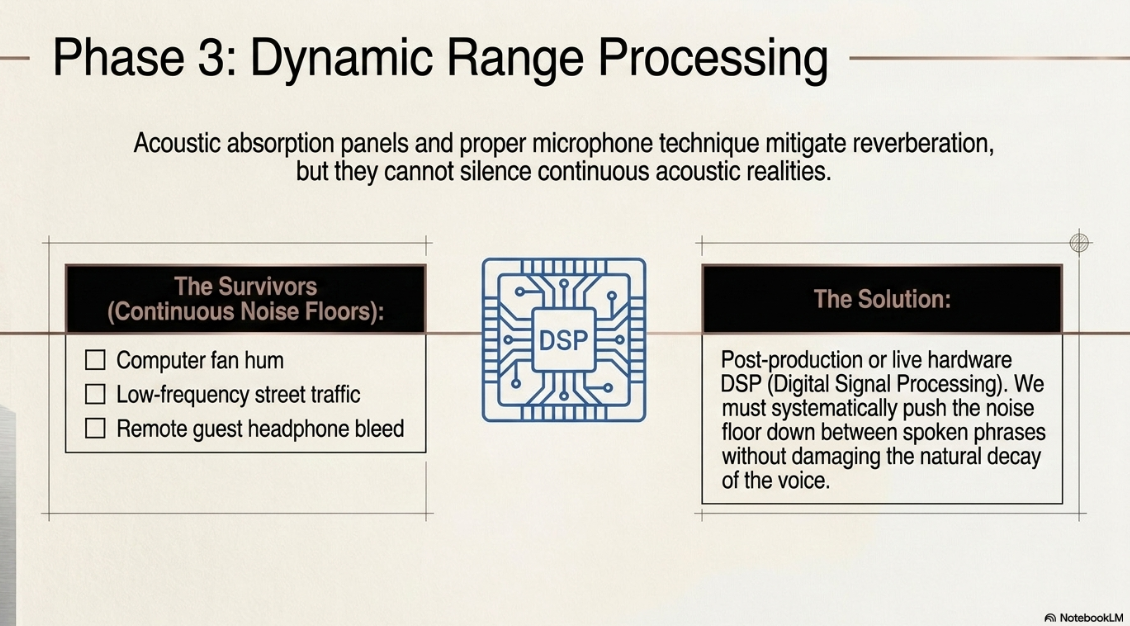
Once the acoustic environment is mitigated through absorption panels and the hardware is optimized via dynamic microphones and clean preamplification, residual background noise must be addressed. No amount of acoustic treatment can silence the persistent hum of a computer fan, the rumble of distant traffic, or headphone bleed from a remote guest. To manage these continuous noise floors, audio engineers deploy dynamic range processors in post-production or via live DSP: specifically, noise gates and downward expanders23.
While both tools are designed to attenuate audio signals that fall below a specified volume threshold, their operational mechanics differ significantly, yielding vastly different psychoacoustic results on human speech.
The Limitations of Noise Gates
A noise gate functions as a highly aggressive, automated mute switch. Conceptually similar to a compressor that attenuates signals exceeding a threshold, a gate attenuates signals falling below it25. A true noise gate operates with an infinite ratio; when the input signal falls below the user-defined threshold level, the gate closes entirely, reducing the audio output to absolute digital silence23. When the speaker begins to talk, breaking the threshold, the gate opens instantly, allowing the signal to pass completely unaltered25.
While this sounds like a perfect solution for eliminating room noise during silent intervals, strict noise gates frequently ruin professional podcast audio. Because background noise (like a refrigerator hum or HVAC system) is continuous, that noise is still actively recorded alongside the voice when the talent speaks and the gate opens26. The abrupt juxtaposition between the absolute digital silence of the closed gate and the sudden influx of a voice layered with room noise is highly distracting and unnatural to the human ear26.
Furthermore, human speech naturally tapers off in volume at the end of sentences, and certain consonants contain very little acoustic energy. If the threshold is set too aggressively, the gate will prematurely chop off the ends of words and natural breaths, destroying the natural transient decay of the performance and yielding a robotic, stuttering cadence27. Additionally, minor volume fluctuations near the threshold—often caused by a speaker moving slightly away from the microphone or tailing off in volume over time—can cause "chatter," a phenomenon where the gate rapidly stutters open and closed as it struggles to determine if the signal is speech or noise26. Over-gating makes a track sound lifeless and heavily processed, which is counter-productive to the intimacy required in podcasting27.
Downward Expanders: The Transparent Alternative
For spoken-word audio, a downward expander is infinitely preferable to a rigid noise gate. While a noise gate cuts off sound entirely, an expander increases the dynamic range of an audio signal by attenuating signals below the threshold by a specific, user-defined ratio23. A downward expander can be conceptualized as a softer, more forgiving version of a noise gate23.
If the expander's ratio is set to 1:2, for every 1dB the signal falls below the threshold, the expander reduces the output by 2dB26. If the ratio is increased to 1:3, the attenuation becomes steeper. This creates a gentle, proportional slope that smoothly pushes the background noise down to a much quieter level during pauses without completely muting the track28. The result is a psychoacoustically transparent reduction in ambient noise that preserves the subtle nuances, breath, and natural decay of human speech, bridging the gap between the vocal phrases and the background noise seamlessly26.
Critical Parameters for Dynamic Control
To successfully dial in a downward expander or a soft gate for podcasting without damaging the wanted signal, the temporal parameters must be meticulously configured26:
Threshold: The decibel level at which the processor engages. It must be set slightly above the ambient noise floor but comfortably below the quietest syllables of the talent's voice23.
Attack: Determines how quickly the gate opens when the threshold is breached. For speech, a highly fast attack time (often under 1 millisecond) is mandatory to ensure the hard consonants, plosives, and transients at the beginning of words are not clipped or swallowed by the processor27.
Hold: A crucial setting for speech that dictates how long the gate remains open after the signal drops below the threshold. A hold time of 100 to 300 milliseconds prevents the gate from clamping down during micro-pauses between words or during a note's natural sustain26.
Release: Governs the speed at which the attenuation is applied once the hold time expires. A slower release (e.g., 200 to 500 milliseconds) ensures a smooth, natural fade-out of the room tone, masking the transition between the voice and the background noise and avoiding choppy, unnatural cuts26.
Range/Floor: Rather than reducing the below-threshold signal to zero, the range control dictates the maximum amount of gain reduction applied (e.g., -12dB or -15dB). Allowing a low level of continuous room tone to remain is almost always more pleasing to the listener than stark digital silence, as it reduces the stark contrast between the noise floor during speech and the noise floor during silence26.
Advanced users may also employ multiband gating or sidechain processing to isolate noise reduction to specific frequency bandwidths24. For example, multiband processing allows an engineer to heavily gate the low-frequency rumble of a passing truck while leaving the high-frequency breath and presence of the voice completely unaffected27. Similarly, sidechain compression—often used in de-essers—allows a specific frequency band (like harsh sibilance) to trigger its own compression, dynamically removing harsh "S" sounds without muffling the rest of the vocal24.
Phase 4: Artificial Intelligence and Algorithmic Restoration
When acoustic treatment, optimal hardware selection, and traditional dynamic processing are insufficient to rescue a compromised recording, engineers must turn to algorithmic audio repair. The most profound technological shift in audio execution over the past decade is the advent of Artificial Intelligence (AI) and Artificial Neural Networks (ANN) in audio restoration2.
Historically, audio repair relied on crude phase cancellation or destructive spectral subtraction. These legacy methods operated on the assumption that noise was static, and attempting to remove dynamic noise often left behind swirling, metallic audio artifacts colloquially known as "space monkeys" or "underwater" sounds2. However, the landscape began shifting in 1997 when Prosoniq released SonicWorX Artist, an early ANN-based product capable of isolating voice from background noise with fewer post-processing artifacts2. By 2012, Zynaptiq's Unveil software proved that reverberation could be algorithmically removed with minimal signal degradation2. Today, modern machine learning algorithms, trained on vast datasets of pristine human speech and varied noise profiles, can mathematically separate overlapping sound sources with unprecedented accuracy, achieving what was once considered impossible (the "cocktail party effect")2.
The current landscape of AI audio restoration is divided into three distinct operational tiers: surgical mastering suites, real-time plugin integrations, and automated cloud-based processors.
Surgical Spectral Editing: The iZotope RX Standard
Since its initial launch in 2001 and the subsequent integration of complex machine learning algorithms in 2016, iZotope RX has maintained its position as the undisputed industry gold standard for audio restoration2. Now in its 11th and 12th iterations, RX operates primarily as a standalone spectral editor, allowing engineers to visually inspect audio frequencies over time via a spectrogram29.
Modules such as Dialogue Isolate and De-Reverb utilize deep learning to identify the specific harmonic structure of human speech and surgically extract it from highly compromised environments, separating it from overlapping noise like sirens, wind, or cross-talk2. While RX features tools like the Repair Assistant for automated workflows, its true power lies in granular manual control. Professional users can dictate the exact severity of the processing on isolated frequency bands, ensuring that the high-frequency harmonics of the voice are not destroyed alongside the noise29. However, this precision comes with significant barriers: a steep learning curve and a prohibitive cost often exceeding £300, restricting it primarily to professional post-production houses and dedicated audio engineers32.
Real-Time Neural Networks: Waves and Accentize
For content creators seeking rapid, non-destructive workflows directly within a Digital Audio Workstation (DAW) or a non-linear video editor like Adobe Premiere Pro, real-time AI plugins have revolutionized the mixing process32.
Waves Clarity Vx: Utilizing advanced neural network architecture, Clarity Vx operates as a highly intuitive, single-knob plugin that performs real-time separation of voice and background noise29. It has gained massive popularity for its speed, affordability, and ability to handle broadband noise dynamically without taxing the host computer's CPU excessively, making it ideal for fast-turnaround podcast production29.
Accentize dxRevive Pro: This software represents the next paradigm evolution of AI audio processing. While traditional denoisers (even advanced ones) simply subtract offending frequencies, leaving gaps in the audio spectrum, dxRevive Pro uses machine learning to synthesize and rebuild missing frequency bands29. If a low-quality microphone, extreme distance, or an overly aggressive noise gate has stripped the high-end clarity and presence from a voice, the AI interprets the remaining phonetic characteristics and mathematically generates the missing harmonics32. This effectively makes a compromised lavalier mic or a heavily degraded recording sound as though it was captured on a studio condenser in a treated room32.
Automated Cloud Processing: Strengths and Liabilities
The lowest barrier to entry for podcast noise reduction lies in browser-based AI enhancers. These platforms require no software installation, no DSP hardware, and no technical audio expertise, making them highly attractive to novice creators30.
Adobe Podcast Enhance: Widely adopted due to its integration with the Adobe ecosystem, this tool utilizes AI to heavily reconstruct speech from noisy environments. However, audio professionals heavily caution against its use in broadcast-tier or professional projects32. Because the platform relies heavily on aggressive voice synthesis to mask noise, it offers virtually no parameter fine-tuning32. Consequently, it frequently generates a robotic, hyper-processed cadence that sounds distinctly artificial, destroying the natural timbre of the speaker32. It is suitable for quick YouTube or social media content where turnaround time supersedes fidelity, but it fails rigorous professional quality control standards32.
Isolate Audio & SimpleClean: Emerging web platforms are attempting to provide more nuanced cloud processing without the synthesis artifacts. Isolate Audio utilizes natural-language prompting, allowing users to type specific extraction requests (e.g., "remove sirens in the background" or "isolate the dog barking")30. The AI then outputs a dual-track separation, providing the isolated noise and the clean dialogue as separate files for granular mixing control30. SimpleClean focuses entirely on spoken-word algorithms, prioritizing the preservation of natural tonal cadences over absolute noise destruction33. It caters to high-volume creators by offering bulk processing for series-length podcast episodes, supporting multiple file formats, and automatically deleting files after seven days to ensure privacy33.
The Ethical and Acoustic Limitations of Generative Audio
While generative AI models solve previously intractable acoustic problems, their over-utilization introduces significant ethical and qualitative dilemmas in documentary and journalism-based podcasting2. When an AI plugin like dxRevive or Adobe Podcast Enhance rebuilds a voice, it is actively synthesizing audio data that did not exist in the original physical recording space2.
If these algorithms are pushed too hard to compensate for a terrible acoustic environment, the phase coherence and the fundamental reality of the original performance are destroyed. The voice becomes disconnected from its environment, resulting in an uncanny valley effect where the listener inherently senses that the audio is fabricated. The golden rule of professional audio engineering remains paramount: artificial intelligence should be utilized to clean an adequate recording, not relied upon to resurrect a fundamentally broken one.
Conclusion
The pursuit of broadcast-quality audio in an untreated residential environment cannot be achieved through a singular piece of hardware or software. It is a compounding, systemic process that requires strict adherence to the physics of acoustics, transducer mechanics, and signal flow.
To successfully execute professional podcast audio at home, creators must deploy a hierarchical framework:
Acoustic Intervention: Address the physical space before touching a microphone. Broadband absorption panels containing dense mineral wool (like Rockwool) should be prioritized on the walls surrounding the talent8. Broadcasters must deliberately avoid the use of small, portable reflection filters that introduce destructive comb filtering into the low-mid frequencies3.
Hardware Optimization: Utilize dynamic broadcast microphones (e.g., Shure SM7B, Shure MV7+, Rode PodMic)16. The inherent high-frequency roll-off of dynamic capsules, combined with strict proximity technique (speaking 1 to 2 inches from the diaphragm), exploits the inverse square law to push the direct vocal signal exponentially higher than the room's ambient noise floor14.
Clean Amplification: Ensure the audio interface or inline preamplifier (such as a Cloudlifter or FetHead) can provide sufficient, low-noise gain (+60dB or more) to drive dynamic microphones, preventing electronic hiss from compromising the analog-to-digital conversion13.
Transparent Dynamics: Apply downward expansion rather than hard noise gates23. By gently reducing the noise floor by a ratio of 1:2 or 1:3 during pauses, and utilizing appropriate hold and release times, the audio maintains psychoacoustic naturalism without introducing jarring digital silence, chatter, or transient clipping26.
Targeted AI Repair: Deploy AI audio restoration software (such as iZotope RX, Waves Clarity Vx, or Accentize dxRevive Pro) strictly as a final polish to remove anomalous noises or rebuild lost frequencies29. Broadcasters must meticulously avoid fully automated, non-adjustable "enhancers" that synthesize robotic artifacts and degrade the authenticity of the performance32.
By respecting this chronological hierarchy of audio engineering, content creators can successfully mask the acoustic realities of a home environment, delivering podcasts with the clarity, warmth, presence, and professional polish expected by modern audiences.
Works cited
Is Sound on Sounds Myth about Dynamic and Condensers rejecting the same reverb and ambient noise false? Imo it's false. - Reddit, https://www.reddit.com/r/audioengineering/comments/12z7rho/is_sound_on_sounds_myth_about_dynamic_and/
THE IMPACT OF AI IN THE FIELD OF SOUND FOR PICTURE. A HISTORICAL, PRACTICAL, AND ETHICAL CONSIDERATION - CONCEPT, https://concept.unatcpress.ro/index.php/cpt/article/download/209/193
Help with building a vocal booth in bedroom - SOS FORUM, https://www.soundonsound.com/forum/viewtopic.php?t=68980
Q. Which portable vocal screen should I buy? - Sound On Sound, https://www.soundonsound.com/sound-advice/q-which-portable-vocal-screen-should-buy
Mic stand and reflection filter : r/WeAreTheMusicMakers - Reddit, https://www.reddit.com/r/WeAreTheMusicMakers/comments/6hevlz/mic_stand_and_reflection_filter/
Which acoustic panels? There appears to be numerous dealers for these panels from $-$$$. Any recommendation for suppliers that are more well made than others? : r/audiophile - Reddit, https://www.reddit.com/r/audiophile/comments/1nw0gde/which_acoustic_panels_there_appears_to_be/
Auralex Pro Audio Acoustic Treatments for sale - eBay UK, https://www.ebay.co.uk/b/bn_9663080
FlexRange® Acoustic Panel, https://www.gikacoustics.net/en-gb/products/flexrange-acoustic-panel
Architectural Acoustic Panel Market Size, Share & Trends Report 2035, https://www.marketresearchfuture.com/reports/architectural-acoustic-panel-market-23020
For recording vocals at home, is acoustically treating your room/space combined with using a reflection filter the best you can get for good quality vocals? - Reddit, https://www.reddit.com/r/audioengineering/comments/ikb2fu/for_recording_vocals_at_home_is_acoustically/
Need advice for acoustic treatment in a home studio : r/audioengineering - Reddit, https://www.reddit.com/r/audioengineering/comments/ms9roq/need_advice_for_acoustic_treatment_in_a_home/
Looking for a material for acoustic panels - Reddit, https://www.reddit.com/r/Acoustics/comments/zldytb/looking_for_a_material_for_acoustic_panels/
is it normal for a condenser to make this much background noise. gain is cranked pretty high. focusrite Scarlett and se2200 - Reddit, https://www.reddit.com/r/Reaper/comments/ypyeei/is_it_normal_for_a_condenser_to_make_this_much/
I don't get it, why are dynamic mics better than condenser mics in untreated spaces? - Reddit, https://www.reddit.com/r/audioengineering/comments/untwmx/i_dont_get_it_why_are_dynamic_mics_better_than/
Best Podcast Mic Under $200 in 2026: Top Picks Tested, https://podcastsetuplab.com/best-podcast-mic-under-200-the-best-sounding-mics-you-can-actually-afford/
Buy Shure SM7B from £339.00 (Today) - Microphones - Idealo, https://www.idealo.co.uk/compare/672788/shure-sm7b.html
Shure SM 7 B Podcast Bundle - Thomann, https://www.thomann.co.uk/shure_sm_7_b_podcast_bundle.htm
Shure SM7B vs. Shure MV7+ vs. Rode PodMic: Ultimate Podcast Microphone Comparison, https://podcastprovisions.com/blogs/news/shure-sm7b-vs-shure-mv7-vs-rode-podmic-ultimate-podcast-microphone-comparison
Shure MV7X XLR Podcast Mic - Andertons Music Co., https://www.andertons.co.uk/shure-mv7x-xlr-podcast-mic-pmv7x-1/
Which Podcast Mic Is Really Worth Your Money? - YouTube, https://www.youtube.com/watch?v=Us0u7e5LsYU
Shop Premium Computer Recording Equipment at Ubuy Djibouti, https://www.ubuy.dj/fr/category/computer-recording-equipment-21676
Buy Branded Computer Recording Audio Interfaces Online at Ubuy Angola, https://www.ubuy.co.ao/en/category/computer-recording-audio-interfaces-22276
Noise-Gate vs Expander: What's the Difference? - LEVELS Music Production, https://www.levelsmusicproduction.com/blog/noise-gates-vs-expanders-what-s-the-difference
Audio dynamics 101: compressors, limiters, expanders, and gates - iZotope, https://www.izotope.com/community/blog/audio-dynamics-101-compressors-limiters-expanders-and-gates
What is a Noise Gate? | Studio Essentials - Produce Like A Pro, https://producelikeapro.com/blog/noise-gate/
Production Techniques Using Gates & Expanders, https://www.soundonsound.com/techniques/production-techniques-using-gates-expanders
What Is a Noise Gate and How to Use It - LALAL.AI, https://www.lalal.ai/blog/what-is-a-noise-gate/
A Podcaster's Guide To Noise Reduction | by Joe Nash - Medium, https://medium.com/@jowie/a-podcaster-s-guide-to-noise-reduction-e8cad9fc21f4
Why RX Still Beats AI in Pro Audio Restoration - YouTube, https://www.youtube.com/watch?v=t6OTwQiP7u4&vl=en
The 12 Best Audio Restoration Software Options for 2026 | Isolate Audio, https://isolate.audio/articles/audio-restoration-software
Plug-ins | Page 3 - Sound On Sound, https://www.soundonsound.com/plug-ins?page=2
Who isn't using Audition / Premiere for cleaning their audio? - Reddit, https://www.reddit.com/r/premiere/comments/1ocuzkq/who_isnt_using_audition_premiere_for_cleaning/
The 12 Best Audio Cleaning Software Tools for 2026 | SimpleClean Blog, https://simpleclean.app/blog/best-audio-cleaning-software