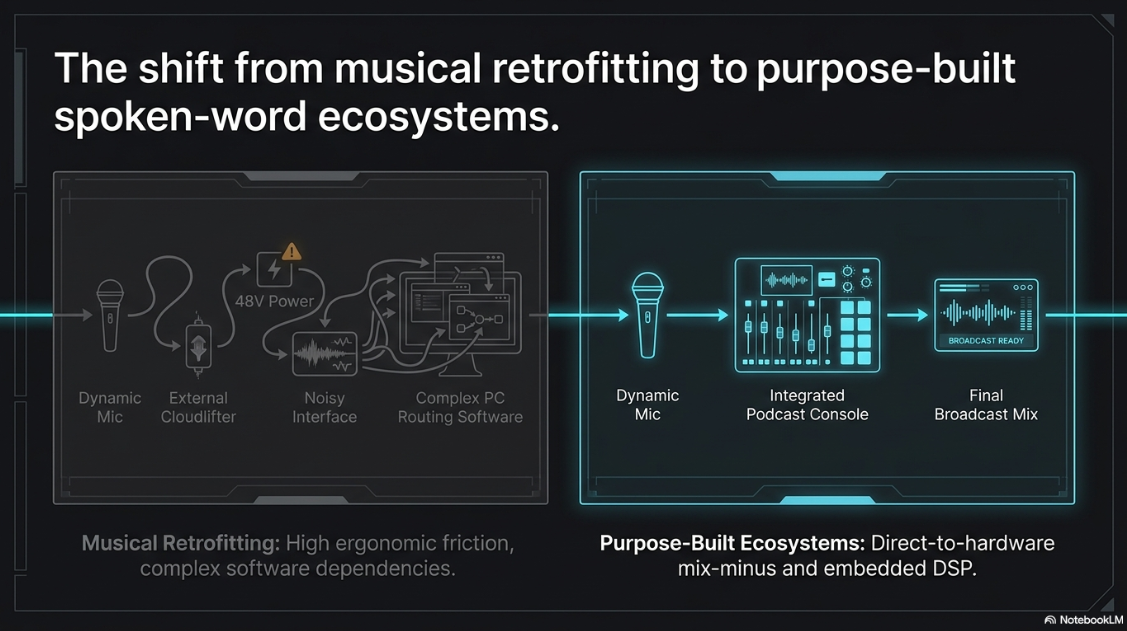
The transition of podcasting from a niche, hobbyist medium to a dominant pillar of global digital media has precipitated a fundamental restructuring of audio hardware manufacturing. Historically, spoken-word content creators were forced to retrofit their production pipelines with equipment designed explicitly for musicians, music producers, and film sound engineers. This reliance on legacy hardware introduced pervasive ergonomic friction, necessitated highly complex software routing to facilitate remote interviews, and often paired low-sensitivity broadcast microphones with preamplifiers that lacked the clean gain required to drive them without introducing prohibitive noise.
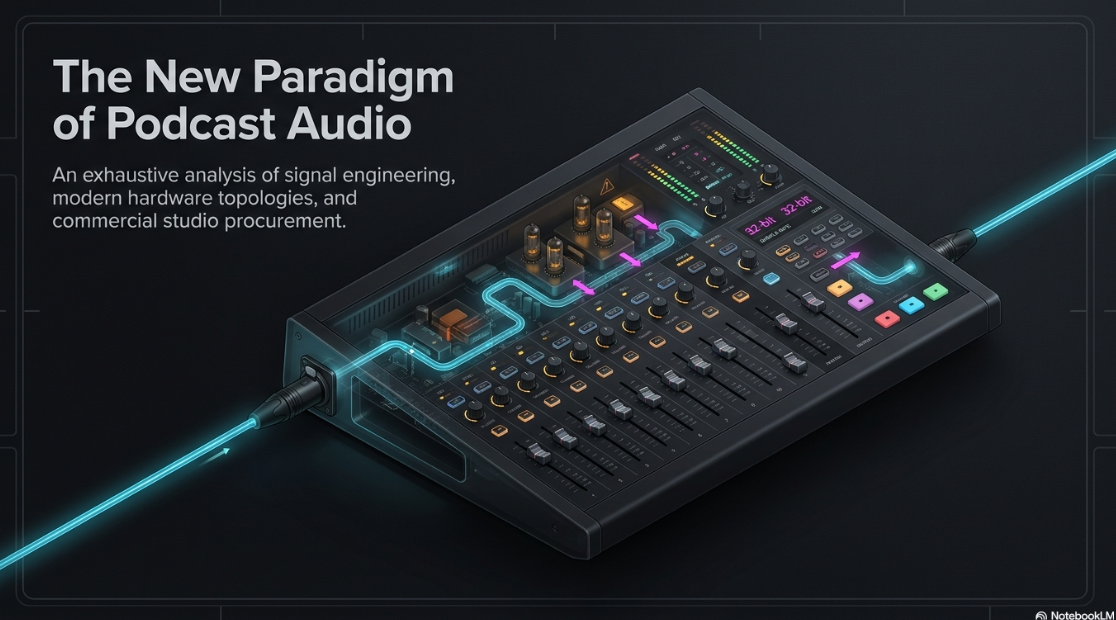
Over the past several years, the engineering paradigm has shifted dramatically. The contemporary hardware ecosystem is now saturated with purpose-built audio interfaces, portable multitrack field recorders, and integrated broadcast consoles that directly address the specific topological demands of podcast production. This evolution encompasses the integration of ultra-low-noise preamplifiers, the deployment of 32-bit floating-point analog-to-digital conversion, the hardware-level implementation of mix-minus routing, and the consolidation of outboard digital signal processing into single, desktop-friendly chassis. This report provides an exhaustive, highly technical analysis of the equipment landscape, evaluating the physical mechanisms of signal capture, the mathematics of digital conversion, the comparative performance of leading hardware units, and the procurement economics within the United Kingdom professional audio market.
The Physics and Engineering of Signal Amplification
The foundational challenge in professional podcast audio execution lies at the very beginning of the signal chain: the conversion of acoustic energy into electrical voltage, and the subsequent amplification of that voltage. Understanding the requirements of modern audio interfaces requires a thorough examination of transducer physics and preamplifier topology.
Transducer Sensitivity and Impedance
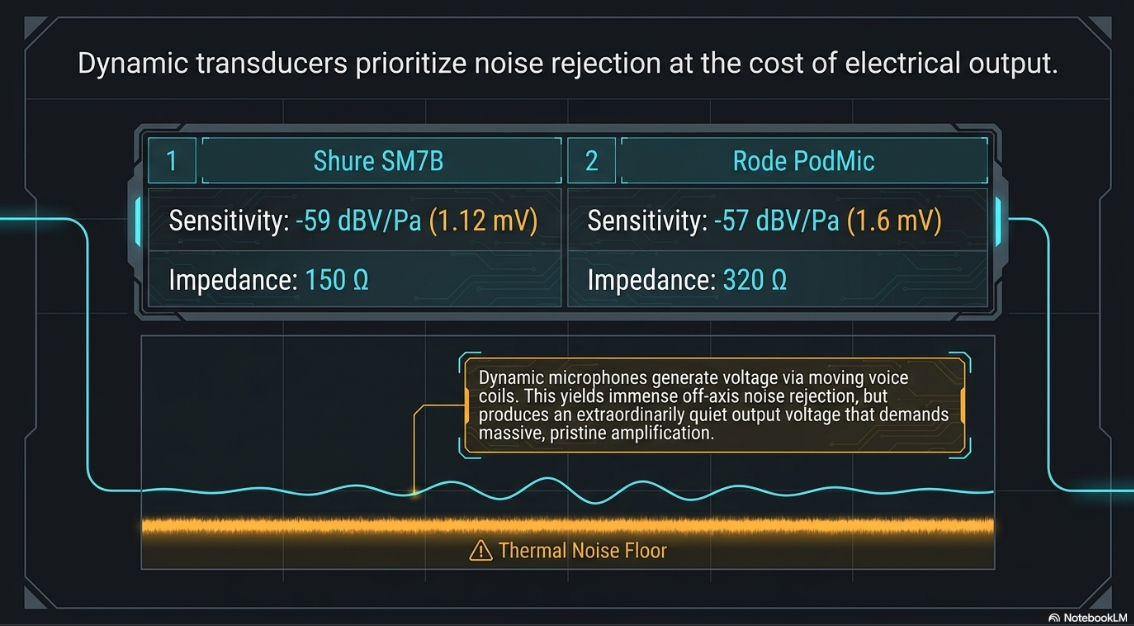
The industry standard for broadcast vocal capture is the dynamic microphone, favored for its robust off-axis noise rejection and pronounced proximity effect, which imparts a desirable low-frequency resonance to the human voice. However, dynamic microphones generate electrical signals via electromagnetic induction—a voice coil moving within a magnetic field—which inherently produces a very low output voltage compared to externally powered condenser microphones.
The ubiquitous Shure SM7B, for instance, operates with a sensitivity of -59 dBV/Pa (1.12 mV) and an impedance of 150 ohms1. In contrast, a modern alternative like the Rode PodMic operates with a slightly higher sensitivity of -57 dBV/Pa (1.6 mV) and a 320-ohm impedance1. Because these output signals are extraordinarily quiet, they demand preamplification that can deliver immense gain without simultaneously amplifying the inherent thermal noise of the electronic components. Historically, driving an SM7B required an inline active gain booster (such as a Cloudlifter), which added roughly £150 to the cost of the microphone and introduced additional cable runs that served as potential points of failure1.
Equivalent Input Noise (EIN) and Gain Architecture
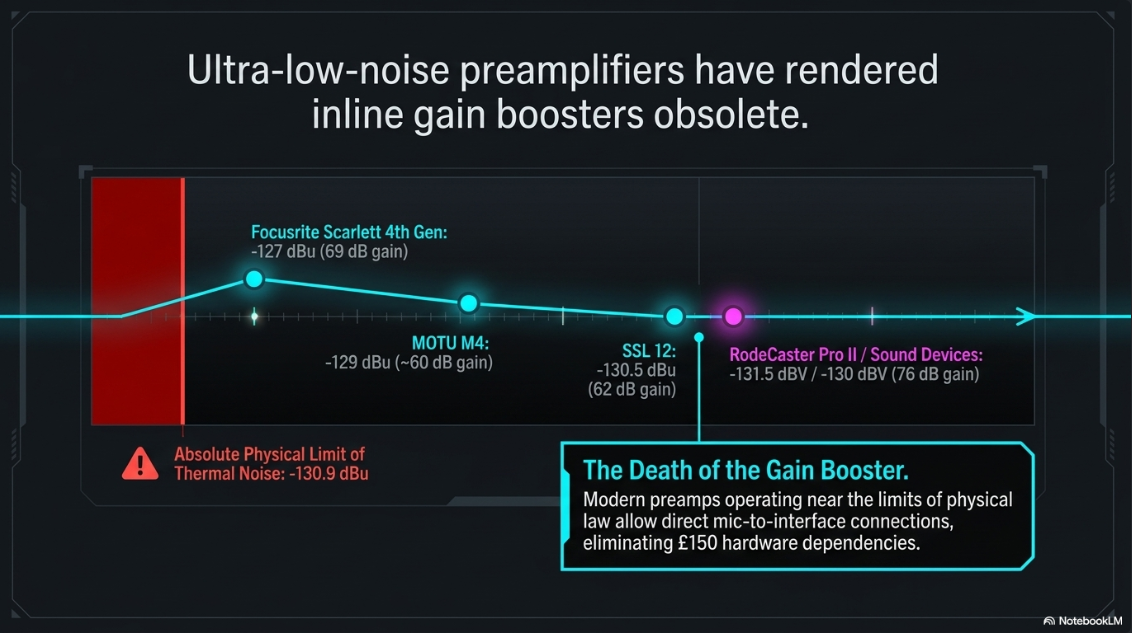
Modern audio interfaces have effectively rendered inline gain boosters obsolete by engineering preamplifiers with exceptional gain ranges and highly optimized Equivalent Input Noise (EIN) figures. EIN is a critical metric used to quantify the self-noise of a preamplifier, typically measured in dBu or dBV, and is usually A-weighted to account for the non-linear sensitivity of human hearing across different frequencies.
The absolute thermal noise limit of a 150-ohm resistor (the standard source impedance used for testing microphone inputs) at room temperature is approximately -130.9 dBu. Therefore, an audio interface preamplifier boasting an EIN approaching this theoretical floor is operating near the absolute limits of physical law regarding electrical noise.
The current generation of hardware routinely approaches this limit. The Focusrite Scarlett 4th Generation series offers an EIN of -127 dBu with 69 dB of available gain2. The MOTU M4 delivers a measured -129 dBu EIN4. The Solid State Logic (SSL) 12 provides a stellar -130.5 dBu EIN alongside 62 dB of gain8. Pushing the boundaries further, the RodeCaster Pro II features proprietary "Revolution Preamps" that claim an extraordinary -131.5 dBV EIN and 76 dB of gain, and the Sound Devices MixPre-6 II utilizes custom "Kashmir" preamps delivering -130 dBV EIN with up to 76 dB of gain3.
The second-order implication of these high-gain, ultra-low-noise preamps is profound for the podcaster. By connecting a low-sensitivity dynamic microphone directly to the interface, the creator simplifies the signal chain, reduces the physical footprint of the studio, eliminates the need for 48V phantom power to drive an intermediary booster, and preserves the unadulterated transient response of the original acoustic capture1.
Analog-to-Digital Conversion and the Bit Depth Paradigm
Once the analog signal is properly amplified, it must be digitized. In recent years, the podcasting and location sound industries have been consumed by debates surrounding bit depth, specifically the transition from 24-bit integer recording to 32-bit floating-point recording. Understanding the utility—and the controversy—of this transition requires a deep dive into the mathematics of digital audio sampling.
The Mathematics of Bit Resolution and Dynamic Range
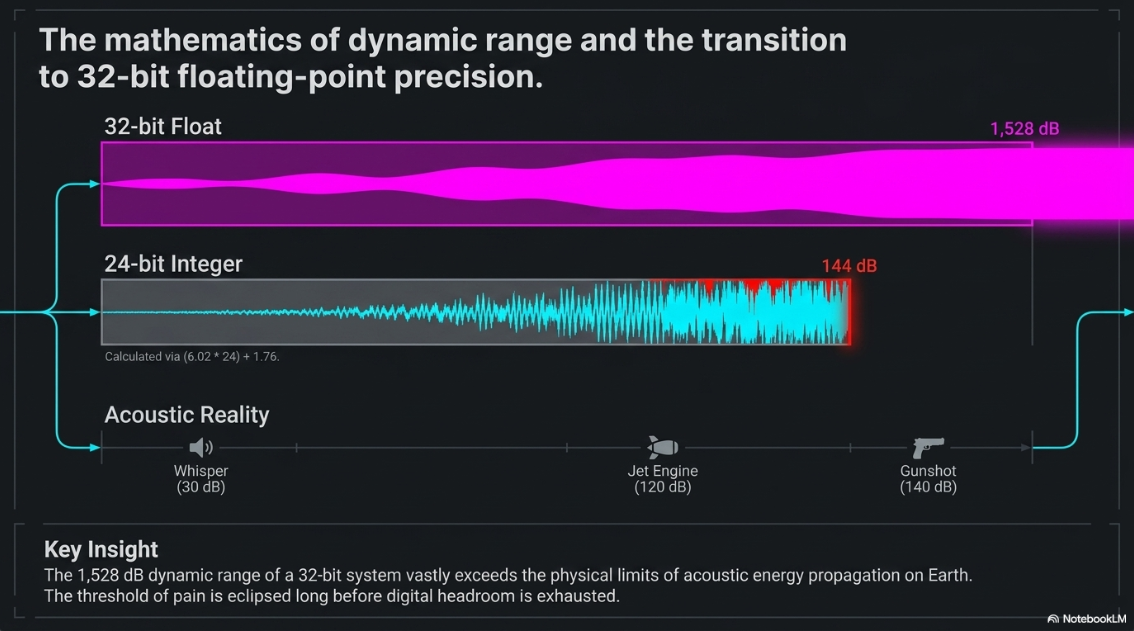
In digital audio, the sample rate (e.g., 44.1 kHz, 48 kHz, 192 kHz) dictates the frequency response, determining how many times per second the continuous analog wave is measured. Conversely, the bit resolution (or bit depth) determines the amplitude accuracy of those measurements, which ultimately defines the dynamic range of the system11. Dynamic range is the difference between the absolute noise floor (quantization error) and the maximum signal level before digital distortion (clipping) occurs12.
The dynamic range of a digital system can be approximated by the formula: Dynamic Range (dB) = (6.02 * Bit Resolution) + 1.7611. For a 16-bit system (the standard for Compact Discs), there are 

While 144 dB far exceeds the limits of human hearing and is more than sufficient for a controlled studio environment where a snare drum might peak around 120 dB, it presents an operational hazard for field recordists and podcasters facing entirely unpredictable acoustic environments11. If an input signal exceeds the maximum mathematical threshold of the system (0 dBFS) in a 24-bit integer format, the analog-to-digital converter runs out of numbers to represent the wave's peak. The waveform is violently truncated, resulting in permanent, harsh digital clipping that is functionally impossible to recover in post-production without severe audio degradation11.
Conversely, if a recordist attempts to protect against this by setting the preamp gain extremely low to provide a vast "safety buffer," the audio will be captured too close to the noise floor. When the producer subsequently boosts this quiet audio in their Digital Audio Workstation (DAW), they simultaneously amplify the quantization noise and the preamplifier's self-noise, introducing an unacceptable hiss into the broadcast12.
The 32-Bit Floating-Point Architecture
The 32-bit floating-point format fundamentally alters this architecture by abandoning a linear integer scale in favor of digital scientific notation. The 32 bits are divided into three components: 1 bit is assigned to the sign (indicating a positive or negative value), 8 bits represent the exponent, and 23 bits represent the "mantissa," which contains the significant digits of the amplitude11.
This algorithmic structure yields 

Hardware Implementation: The Dual-ADC Topology
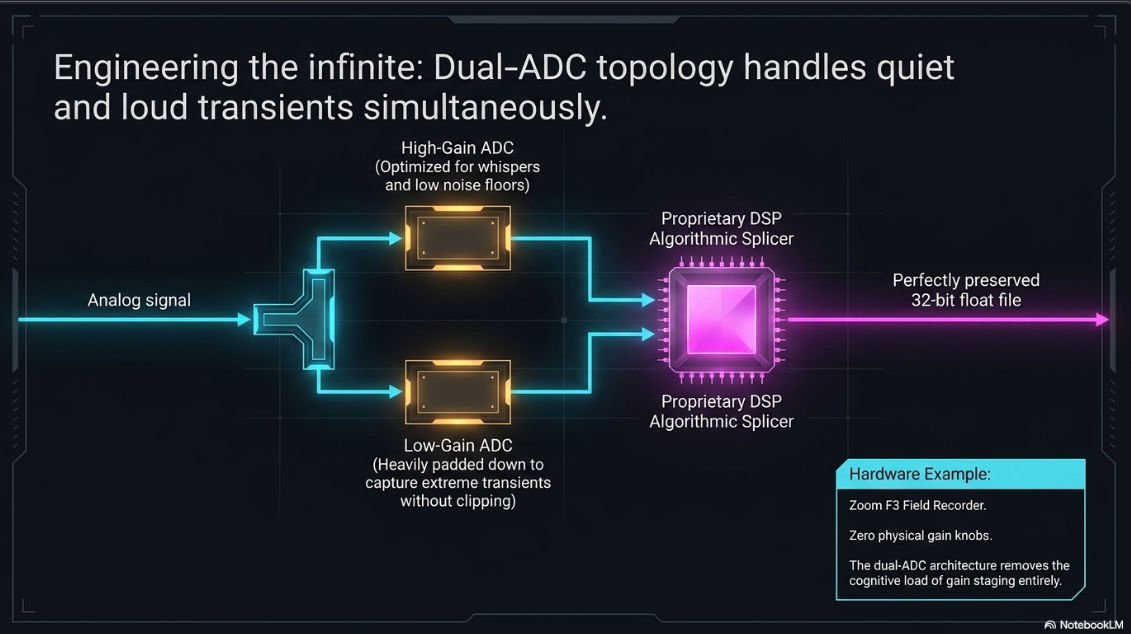
Because no single physical analog-to-digital converter (ADC) can process 1,528 dB of dynamic range, manufacturers implement 32-bit float recording via a complex hardware topology utilizing dual (or multiple) ADCs for every individual channel14.
In this architecture, the analog signal from the microphone preamp is split into two distinct paths. The first ADC is calibrated specifically to handle low-level, quiet sounds, optimizing the noise floor but lacking the headroom for loud transients14. The second ADC is padded down significantly, designed exclusively to handle extreme, loud transients without clipping, though it would be too noisy for quiet dialogue14. A proprietary Digital Signal Processing (DSP) chip receives both data streams in real-time and makes a sample-by-sample algorithmic decision, seamlessly splicing the optimal data points together16.
The resulting 32-bit float audio file captures the absolute entirety of the microphone's physical dynamic capability16. In post-production, a podcaster can import a file that visually appears as a destroyed, flattened square wave due to immense volume. By simply lowering the clip gain within the DAW, the completely smooth, unclipped waveform is mathematically restored with zero distortion11. Similarly, a whisper recorded in the field can be boosted by 50 dB with absolute clarity, revealing no additional digital quantization noise penalty12.
The Industry Debate: Necessity versus Overhead
The integration of 32-bit float hardware presents a profound third-order effect on production workflows: it effectively eliminates the need for gain staging12. Field recorders like the Zoom F3 entirely lack physical gain knobs, shifting the cognitive load of the host away from technical monitoring and allowing them to focus entirely on interviewing and narrative flow13.
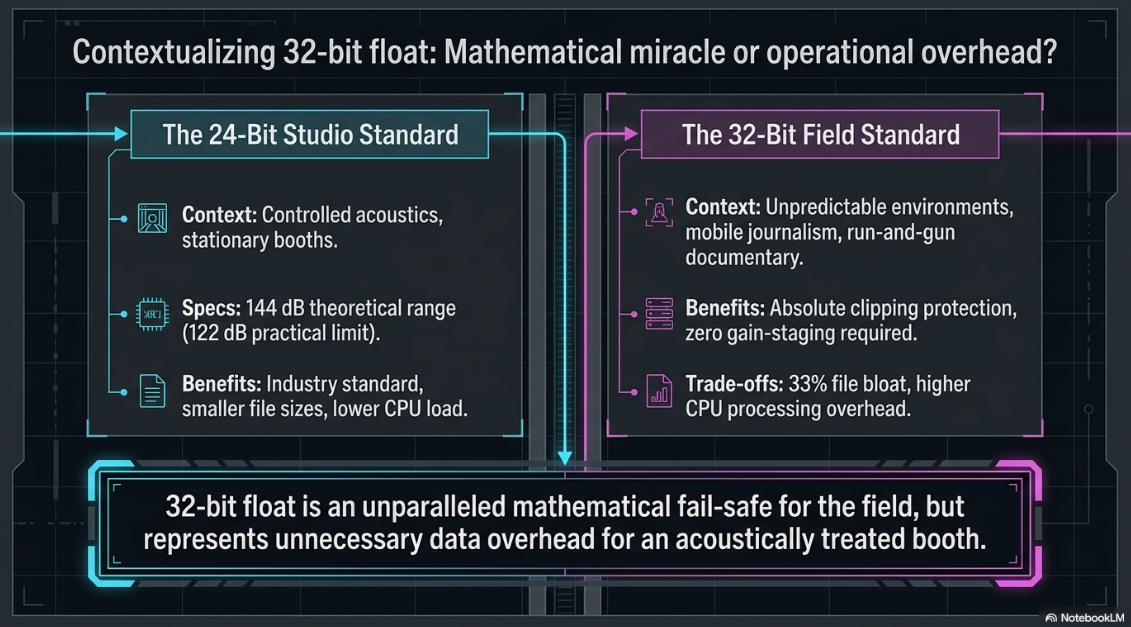
Despite these apparent miracles, there is a fierce debate among professional audio engineers regarding its absolute necessity. Critics point out that the theoretical digital noise limits of 32-bit recording are largely irrelevant because the self-noise of the analog microphone and the preamplifier themselves are significantly higher than the 24-bit noise floor16. A perfect 24-bit system has a theoretical dynamic range of 144 dB (or roughly 141 dB when employing TPDF dither, which raises the noise floor by about 3 dB to prevent quantization distortion)16. In reality, the very best 24-bit converters struggle to achieve more than a 122 dB dynamic range16.
Veteran location sound mixers argue that a high-quality 24-bit recorder, when properly gain-staged to peak at analog overload points, or when utilizing a dual-track recording method (where a second "safety track" is recorded simultaneously at -12 dB to -20 dB lower), provides the exact same practical protection against clipping without the severe file-size bloat associated with 32-bit float15. A 32-bit audio file demands 33% more data storage and places a significantly higher computational burden on the CPU during mixing and summing11. Furthermore, there is industry skepticism regarding cheaper recorders that market "32-bit float" capabilities but internally utilize only a single ADC, merely writing 24-bit data into a 32-bit wrapper to appease DAW scaling, which offers none of the actual dual-ADC dynamic benefits15.
Ultimately, the conclusion is highly context-dependent. For stationary studio podcasters recording in controlled acoustic environments, 24-bit resolution remains the professional standard and is entirely adequate11. However, for journalists, documentary producers, or creators operating in highly unpredictable field environments where a whisper can turn into a scream instantly, true dual-ADC 32-bit float recording is an unparalleled fail-safe mechanism that prevents lost takes11.
The Desktop Audio Interface Landscape
For podcasts recorded in a dedicated studio, the desktop audio interface acts as the central nervous system of the operation. Modern interfaces distinguish themselves through preamplifier quality, driver stability, latency performance, and specialized routing capabilities such as hardware loopback.
Entry-to-Mid Level Interfaces (Under £250)
The sub-£250 market is fiercely competitive, characterized by manufacturers democratizing flagship converter technology and advanced DSP for home creators.
Focusrite Scarlett 4th Generation The Focusrite Scarlett series remains an industry omnipresence. The 4th generation models (including the Solo, 2i2, and 4i4) have undergone a total redesign2. They now utilize the studio-grade RedNet converters, achieving a 120 dB dynamic range2. For podcasters lacking formal audio engineering training, the 4th Gen series introduces two revolutionary automated features: "Auto Gain" and "Clip Safe"2. Auto Gain requires the user to speak into the microphone for several seconds while the interface mathematically calculates and sets the optimal preamp level2. Clip Safe operates continuously in the background, analyzing the input signal up to 96,000 times per second; if a sudden loud sound threatens to clip the converter, the interface automatically and instantaneously attenuates the analog gain2. Pricing for the Scarlett 4i4 4th Gen currently sits at approximately £247 in the UK19.
MOTU M4 and M2 The MOTU M4 (£210–£269) approaches the mid-tier market from an audiophile perspective7. It is equipped with ESS Sabre32 Ultra DAC technology, components historically reserved for elite studio equipment and high-end hi-fi systems4. This architecture yields a measured 120 dB dynamic range on the outputs and drives a headphone amplifier that negates the need for external headphone distribution boxes4. MOTU addresses the visual feedback deficit in desktop recording by replacing simple LED clip lights with a full-color LCD screen, providing precise, high-resolution metering4.
Crucially for podcasters who monitor their own processed voices through software, the M4 boasts expertly engineered drivers that achieve best-in-class ultra-low Round Trip Latency (RTL)4. At 96 kHz with a 32-sample buffer, the M4 achieves a stunning 2.5 ms RTL4. Even at standard broadcast rates of 48 kHz (64-sample buffer), empirical measurements place the MOTU M4 around 5.9 ms RTL, outpacing competitors like the Scarlett 2i2 (~7.4 ms RTL) and the Audient iD14 MkII (~8.3 ms RTL)5. Furthermore, the M4 features DC-coupled outputs, allowing it to interface with modular synthesizers, and dedicated hardware loopback for live streaming5.
Universal Audio Volt 276 and Audient EVO 8 The Universal Audio Volt 276 (£229) differentiates itself through the deployment of analog character circuits23. It features a built-in analog compressor modeled after UA’s highly regarded 1176 limiting amplifier, offering distinct presets for vocals, guitars, and synths23. Additionally, it includes a vintage tube preamp emulation based on the iconic UA 610 console23. For podcasters seeking "radio-ready" presence on the way in, the Volt 276 offers immediate sonic enhancement without relying on CPU-intensive DAW plugins23.
Conversely, the Audient EVO 8 (£147) prioritizes extreme workflow automation21. It features "Smartgain," a proprietary algorithm that sets input levels automatically across all four of its microphone channels simultaneously24. Operating purely on USB bus power, it is a highly capable mobile solution for four-person podcast panels24.
Podcast-Specific Interfaces: The Focusrite Vocaster
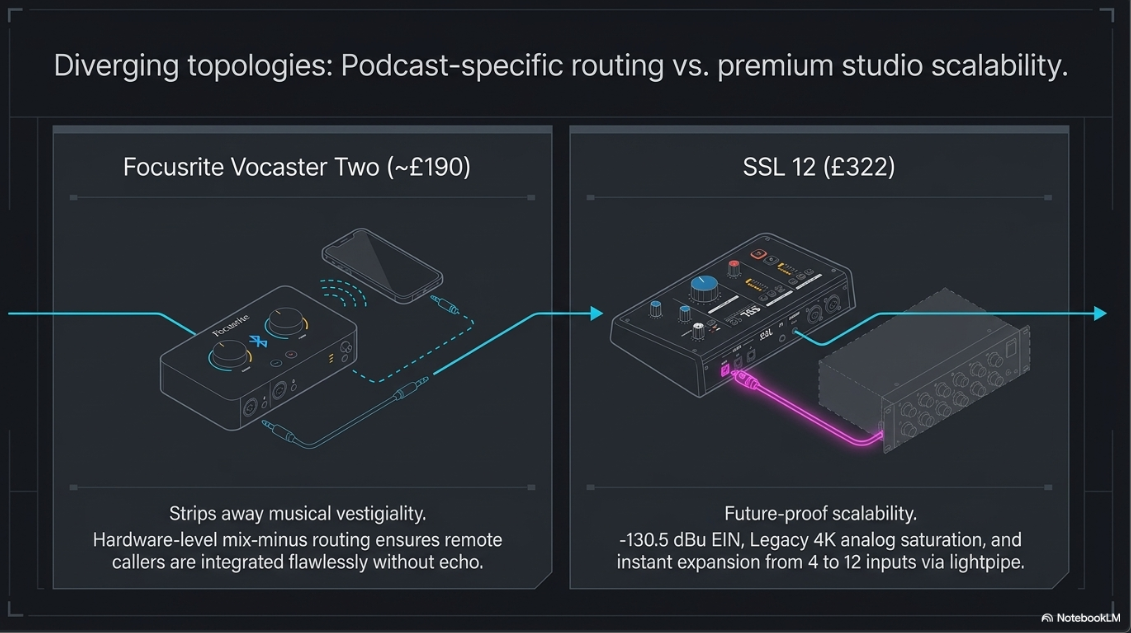
Recognizing that podcasters possess fundamentally different operational needs than musicians, Focusrite developed the Vocaster series. The Vocaster Two (approximately £190 or $249.99) strips away musical vestigiality, such as Hi-Z instrument inputs or 5-pin MIDI DIN ports, optimizing purely for spoken word25.
The unit provides 70 dB of gain, Auto Gain functionality, dedicated physical mute buttons for both the host and the guest, and four onboard voice enhancement presets controlling compression, EQ, and rumble reduction25. The Vocaster Two’s defining feature is its connectivity matrix: it includes Bluetooth 5.0 integration and a TRRS phone input25. This allows producers to route remote phone calls wirelessly or via physical cable directly into the podcast mix25. The device automatically handles the complex mix-minus routing at the hardware level, ensuring that the remote caller hears the podcast hosts perfectly without hearing a disorienting, delayed echo of their own voice25.
Premium Desktop Interfaces (£300+)
For professional broadcasting suites demanding utmost audio fidelity, expansive routing, and future-proof scalability, the Solid State Logic (SSL) 12 commands the premium desktop tier.
Priced at £322, the SSL 12 is a 12-input/8-output USB-C interface27. It features four SSL-designed microphone preamps delivering -130.5 dBu EIN and 62 dB of gain8. The unit's standout feature is the physical "Legacy 4K" switch, an analog enhancement circuit inspired by the classic SSL 4000-series recording consoles8. Engaging this circuit introduces a controlled high-frequency EQ boost and subtle harmonic saturation to the vocal signal, cutting through dense mixes with minimal post-production EQ8.
Furthermore, the SSL 12 anticipates studio growth by including an ADAT optical input8. This lightpipe protocol allows the facility to connect an external 8-channel microphone preamplifier via a single optical cable8. This instantly expands the interface from 4 to 12 microphone inputs to accommodate large roundtable panels or live bands8. The complex routing is managed seamlessly by the SSL 360° software mixer, which facilitates near-zero latency, independently panned headphone mixes for multiple guests8. While its latency hovers around 9.5 ms RTL natively, its routing flexibility is peerless in its price bracket22.
Data compiled from current UK market analysis and technical specifications across leading retail channels2.
Portable Multitrack Recorders: Field Operations and Battery-Powered Consoles
While desktop interfaces tether a creator to a computer, portable multitrack recorders allow podcasters to bypass the PC entirely, offering exceptional reliability and tactile control for on-location interviews, live audience events, and mobile journalism.
The Zoom PodTrak Series
Zoom identified a massive gap in the market for battery-powered, podcast-specific field recorders, launching the PodTrak P4 and the larger PodTrak P8.
Zoom PodTrak P4 The PodTrak P4 (£143–£164) is arguably the most disruptive compact recorder currently available31. Despite a form factor barely larger than a modern smartphone, it features four XLR microphone inputs equipped with preamps providing 70 dB of gain, allowing it to drive broadcast dynamic microphones effortlessly without external lifters32.
Crucially, it solves a major logistical issue by featuring four independent 3.5mm headphone outputs, each with a dedicated physical volume control knob, entirely eliminating the need for an external headphone distribution amplifier32. For remote guests, the P4 features a dedicated TRRS smartphone input and USB PC connection with automatic mix-minus, preventing caller feedback32. Four customizable sound pads allow for live triggering of intro music, sponsor reads, or laugh tracks32. It can operate on two AA batteries (providing roughly 1.5 to 4 hours depending on phantom power usage) or a USB power bank for marathon sessions32. Simultaneously, it functions as a 2-in/2-out USB audio interface for PC/Mac/iOS32.
Zoom PodTrak P8 The PodTrak P8 (£295 est.) expands the P4 architecture into a comprehensive tabletop production console33. It increases the capacity to six XLR inputs and six independent headphone outputs34. The operational hub of the P8 is a 4.3-inch full-color LCD touchscreen that provides highly intuitive visual feedback and allows for basic onboard editing—trimming, splitting, and fading audio files directly on the device's SDXC card without ever transferring files to a computer33.
The P8 introduces dedicated onboard DSP explicitly tailored for spoken word, including a one-touch Compressor/DeEsser to tame sibilance, a Tone Adjustment slider to make voices perceptually brighter or darker, and a Low Cut filter to eliminate low-frequency HVAC rumble34. Channel six acts as a dedicated remote interview channel, featuring USB and TRRS inputs with automatic mix-minus, while an optional BTA-2 Bluetooth adapter can be attached for wireless call recording34.
High-Fidelity Field Recorders
For documentary-style podcasters prioritizing absolute pristine audio fidelity, environmental sound capture, and physical durability, field recorders from Sound Devices and Zoom's professional F-Series represent the apex tools.
Sound Devices MixPre-6 II The Sound Devices MixPre-6 II is a premium, robust field recorder capable of actual 32-bit float recording at ultra-high sample rates up to 192 kHz9. It features Sound Devices' highly acclaimed, custom-designed "Kashmir" preamplifiers9. These ultra-low-noise preamps offer an extraordinary 76 dB of available gain and an EIN rating of -130 dBV, resulting in a transparent, highly detailed capture that is standard in Hollywood film production9. Beyond standard mono/stereo podcasting, the MixPre-6 II is uniquely equipped for spatial audio capture; it features an Ambisonic plugin capable of recording first-order ambisonics (A-Format or B-Format via FuMa or AmbiX) and providing real-time binaural decoding for immersive headphone monitoring9. This makes it an elite choice for immersive audio storytelling, VR audio, and dense soundscape capture9.
Zoom F3 The Zoom F3 (£279–£291) is an ultra-compact, two-channel field recorder built specifically around 32-bit float, dual-ADC technology17. Housed in a rugged metal chassis with slide-resistant rubber feet and a standard tripod mount (capable of being velcro-strapped directly to a boom pole), the F3 is designed to withstand harsh field conditions18. It features two locking XLR inputs with an astonishingly low noise floor (-127 dBu EIN)18. Because it relies entirely on the 32-bit float architecture, it completely lacks physical gain adjustment knobs; the user simply presses record, and the unit captures clip-free audio flawlessly regardless of acoustic spikes17. The LCD screen displays a real-time waveform of the audio, and the device can be controlled wirelessly via Bluetooth up to 30 feet away using an iOS/Android application, allowing the producer to stay completely out of the shot18.
Integrated Broadcast Consoles: The All-in-One Paradigm
While desktop audio interfaces tether users to a computer DAW, and portable recorders prioritize battery-operated mobility, the integrated broadcast console represents a third paradigm: an all-in-one standalone studio designed for permanent desktop installation but operating entirely independently of computer processing.
The RodeCaster Pro II (£523) and its smaller sibling, the RodeCaster Duo (£499 standalone, or £899 in a two-person bundle) currently dominate this sector10. Rode engineered these consoles with ultra-low noise "Revolution Preamps" boasting an excessive 76 dB of gain and a staggering -131.5 dBV EIN3. This level of amplification guarantees that any microphone on the market, regardless of sensitivity, can be driven cleanly with massive headroom3.
The underlying architecture relies heavily on integrated, studio-grade DSP. Rather than utilizing standard digital EQs, the RodeCaster units feature onboard APHEX audio processing, incorporating their legendary Aural Exciter (adding high-frequency sheen) and Big Bottom (adding low-end resonance) emulations3. This imparts top-tier, polished broadcast sound in real-time, meaning the files printed to the SD card require virtually zero post-production mixing3.
The second-order impact of the RodeCaster series is the total consolidation of external studio peripherals. The units feature:
Advanced wideband Bluetooth connectivity for crystal-clear remote phone calls3.
Dual USB-C interfaces, allowing two distinct computers (e.g., a streaming PC managing OBS and a chat laptop running Discord) to be connected and routed simultaneously3.
Built-in wireless receivers supporting up to two RØDE Series IV transmitters (such as the Wireless PRO or Wireless GO II), instantly turning the console into a wireless receiver hub without running physical cables across the room3.
Fully programmable, assignable RGB SMART pads capable of triggering samples, sending MIDI commands to software, or executing automated mixer actions (like fading all channels simultaneously)3.
Furthermore, Rode continually updates the hardware ecosystem via firmware. The recently deployed "CallMe" integration utilizes the console's Wi-Fi or Ethernet connection to allow remote guests to simply click a browser-based web link and connect directly to the RodeCaster in ultra-low latency10. This bypasses third-party software like Zoom, Teams, or Skype entirely, ensuring pristine audio fidelity that is isolated from standard internet compression algorithms10.
Digital Audio Workstations and Software Ecosystems
While standalone hardware is highly capable, the majority of professional podcast editing and mixing still occurs within a Digital Audio Workstation (DAW). Procuring an audio interface often includes access to stripped-down versions of premium DAWs, which represents significant added value.
For example, the MOTU M4 includes licenses for MOTU Performer Lite and Ableton Live Lite, along with over 6 GB of loops and samples4. The SSL 12 provides the expansive SSL Production Pack, which grants perpetual licenses for SSL Vocalstrip 2 and Drumstrip plugins, a 3-month subscription to SSL Complete, Auto-Tune Unlimited, Celemony Melodyne Essential, and IK Multimedia Amplitube 5 SE8. These software suites equip a creator with industry-standard tuning, compression, and vocal processing tools straight out of the box.
For enterprise-level studios, Avid Pro Tools remains the industry standard. Pro Tools Ultimate (priced at approximately £1,369 for a perpetual license or £594 for an annual subscription) provides 256 tracks of audio, advanced surround sound and spatial mixing capabilities, and deep video integration for vodcasts40. A standout feature for modern podcasters is Avid's Cloud Collaboration, which allows editors and producers to upload project files to cloud storage and work simultaneously with remote musicians or co-hosts over the internet in real-time40. Additionally, the Project Revision feature allows engineers to non-destructively explore and recall alternate versions of a mix, which is invaluable for client-based podcast production40.
Commercial Procurement, Warranties, and Lifecycle Management
For producers and facility managers outfitting a podcast studio, the raw capital expenditure (CapEx) of equipment must be carefully weighed against long-term longevity, warranty coverage, and the total cost of ownership (TCO). The UK pro-audio retail market, highly visible through major vendors such as Gear4music, Andertons, and PMT, provides a clear framework for hardware procurement in the 2025/2026 fiscal landscape.
Warranty Structures and Risk Mitigation
Professional hardware is subjected to intense, cyclical daily use, making extensive warranty coverage a critical factor in mitigating TCO. While standard EU and UK consumer law mandates baseline 14-day return protections, major pro-audio retailers heavily incentivize long-term procurement through extended warranty schemes.
Gear4music, for instance, offers a baseline 3-year warranty and a generous 30-day money-back guarantee on all new hardware, providing free collection if goods develop a fault within the first 180 days17. However, for professional studios requiring strict uptime and zero risk, they offer a comprehensive 10-year extended warranty scheme19. This scheme typically carries an approximate 9% to 10% price premium. For example, adding the 10-year warranty to the £523 RodeCaster Pro II costs an additional £47.10, while adding it to the £247 Focusrite Scarlett 4i4 costs £24.10, and to the £164 Zoom Podtrak P4 costs £14.8319. Crucially, this 10-year extension upgrades the return window to a 180-day money-back guarantee and guarantees free collection and return carriage for any necessary repairs over a decade17. For commercial facilities, this trivial upfront cost entirely neutralizes hardware replacement risk for a decade.
Data reflecting current UK retail policies for commercial and consumer audio equipment17.
Strategic Capital Allocation Tiers
Based on the technical specifications and market economics outlined, professional podcast setups can be categorized into three distinct procurement tiers.
1. The Bootstrapped Setup (Sub £150) For entry-level production, mobile kits, or secondary travel systems, the Focusrite Scarlett Solo 4th Gen (£122) and the Zoom PodTrak P4 (£143) represent exceptional commercial value19. The P4 is particularly dominant in this bracket regarding Return on Investment (ROI), offering a complete four-track recording system, headphone distribution, and remote-call mix-minus solutions for the identical cost of a single entry-level desktop interface32.
2. The Professional Mid-Tier (£200 - £350) This bracket captures the widest swath of professional podcasters recording in acoustic studios. The Universal Audio Volt 276 (£229) and MOTU M4 (£210–£269) provide premium hardware DSP compression and elite ESS Sabre conversion respectively, ensuring broadcast-quality capture7. For facilities expanding into multi-mic setups with an eye toward future ADAT expansion, the SSL 12 (£322) is the definitive recommendation, offering elite analog character via the Legacy 4K circuit and exceptional software routing flexibility through the SSL 360° matrix28.
3. Elite Field and Broadcast Consolidation (£500 - £1,500+) Studios operating with zero-compromise budgets must decide between extreme mobility and complete desktop consolidation. For high-stakes mobility, the Sound Devices MixPre-6 II or Zoom F6 provide unassailable 32-bit float field reliability, ensuring no audio is ever lost to digital clipping9. For fixed studio installations, the RodeCaster Pro II (£523 standalone, or approximately £1,559 in a fully rigged four-person bundle complete with microphones, cables, and boom arms) eliminates the need for separate desktop interfaces, multi-channel headphone amps, external DSP processing racks, and complex routing software10. This massive hardware consolidation offsets its higher initial CapEx by drastically reducing system complexity, minimizing cable runs, and accelerating setup and strike times for studio engineers3.
Works cited
Shure SM7B vs Rode PodMic: Which Broadcast Dynamic Wins For YouTube? - Alan Spicer, https://alanspicer.com/shure-sm7b-vs-rode-podmic/
Focusrite Scarlett 2i2 (4th Gen) USB-C audio interface | Chamberlain Music, https://www.chamberlainmusic.com/products/mosc0033
Which Audio Interface for Podcasting? Here's 4 from Focusrite and Rode, https://thegrowthagency.co.uk/news/which-audio-interface-for-podcasting-heres-4-from-focusrite-and-rode
Motu M4 4-In / 4-Out USB Audio Interface - GuitarGuitar, https://www.guitarguitar.co.uk/product/240111417867027--motu-m4-4-in-4-out-usb-audio-interface
MOTU M4 & M2, https://www.soundonsound.com/reviews/motu-m4-m2
MOTU M4 | Woodbrass.com, https://www.woodbrass.com/en-gb/audio-interfaces-usb-motu-m4-p311714.html
Motu Intros M2 & M4, New DC-Coupled Audio Interfaces With A Unique Loopback Function, https://synthanatomy.com/2019/11/motu-intros-m2-m4-new-affordable-dc-coupled-audio-interfaces.html
SSL 12 | Solid State Logic, https://solidstatelogic.com/products/ssl-12
September 2023: Sound Devices MixPre-6 II - Recording Magazine, https://www.recordingmag.com/resources/featured-reviews/september-2023-sound-devices-mixpre-6-ii/
Rode RodeCaster Pro II Four-Person Podcasting Bundle - Gear4music, https://www.gear4music.com/Recording-and-Computers/Rode-RodeCaster-Pro-II-Four-Person-Podcasting-Bundle/69RZ
24-Bit vs. 32-Bit Float Recording: Which to Use and When? - WaveInformer, https://waveinformer.com/2025/12/20/24-bit-vs-32-bit-float-recording/
What is 32-bit Float Resolution? - TASCAM Europe, https://www.tascam.eu/en/what-is-32-bit-float-resolution
32-Bit Float Recording and Why It Is Amazing - Digital Omnium, https://digitalomnium.com/32-bit-float-recording-and-why-it-is-amazing/
32-bit field recording - Mindful Audio, https://mindful-audio.com/blog/32-bit-field-recording
Does a 24-bit recorder with safety track achieve the same as a 32-bit float recorder? - Reddit, https://www.reddit.com/r/LocationSound/comments/1itvvoz/does_a_24bit_recorder_with_safety_track_achieve/
32 Bit Floating Point Recording - Please help Me To Understand - SOS FORUM, https://www.soundonsound.com/forum/viewtopic.php?t=81265
Zoom F3 Multitrack Field Recorder - Gear4music, https://www.gear4music.com/Recording-and-Computers/Zoom-F3-Multitrack-Field-Recorder/4OFO
Zoom F3 Multitrack Field Recorder - Andertons Music Co., https://www.andertons.co.uk/zoom-f3-multitrack-field-recorder/
Focusrite Scarlett 4i4 4th Gen - Andertons Music Co., https://www.andertons.co.uk/focusrite-scarlett-4i4-4th-gen/
MOTU M4 4x4 USB Audio Interface - Rubadub, https://rubadub.co.uk/products/motu-m4-4x4-usb-audio-interface
Audio Interfaces - Andertons Music Co., https://www.andertons.co.uk/browse/recording/audio-interfaces/
Audio Execution for a Professional Podcast: Gear: Audio Interface: The Analog to Digital Connection - Finchley Studios, https://www.finchley.co.uk/finchley-learning/visual-podcast/audio-execution-for-a-professional-podcast-gear-audio-interface-the-analog-to-digital-connection
Universal Audio Volt 276 2-in/2-out USB 2.0 Audio Interface - Andertons Music Co., https://www.andertons.co.uk/universal-audio-volt-276-2-in-2-out-usb-20-audio-interface/
Audient EVO 8 4-in 4-out Audio Interface - Andertons Music Co., https://www.andertons.co.uk/audient-EVO-8-4-in-4-out-audio-interface/
Vocaster Two - Focusrite, https://focusrite.com/products/vocaster-two
Audio Interface for a Beginner Podc… AI recommendations - Parse, https://parse.gl/prompts/p/what-is-the-best-audio-interface-for-a-beginner-podcaster--584818e3-3911-403e-b9ad-9926e9b71baa
SSL 12 – Thomann UK, https://www.thomann.co.uk/ssl_12.htm
SSL 12 Audio Interface - Andertons Music Co., https://www.andertons.co.uk/ssl-12-audio-interface/
Home Recording for Beginners - Andertons Music Co., https://www.andertons.co.uk/home-recording-for-beginners-guide
SSL 12 USB Audio Interface at Gear4music, https://www.gear4music.com/Recording-and-Computers/SSL-12-USB-Audio-Interface/59G7
Zoom PodTrak P4 at Gear4music, https://www.gear4music.com/Recording-and-Computers/Zoom-PodTrak-P4/3JG2
Zoom PodTrak P4 Podcast Recorder - Andertons Music Co., https://www.andertons.co.uk/zoom-podtrak-p4-podcast-recorder/
Zoom PodTrak P8 podcasting mixer and interface - Chamberlain Music, https://www.chamberlainmusic.com/products/p8
Zoom PodTrak P8 Podcast Recorder - Westend DJ, https://westenddj.co.uk/products/zoom-podtrak-p8-podcast-recorder
ZOOM PodTrak P8 - Podcast Studio Mixer w/ Sound Pads, https://www.think2tw.com/en/products/zoom-podtrak-p8
Zoom PodTrak P8 Portable Multitrack Podcast Recorder - ProAV, https://proav.co.uk/zoom-podtrak-p8-portable-multitrack-podcast-recorder
Zoom Podtrak P8 Podcast Recorder - Precision Camera, https://www.precision-camera.com/zoom-podtrak-p8-podcast-recorder/
Rode RodeCaster Pro II at Gear4music, https://www.gear4music.com/Recording-and-Computers/Rode-RodeCaster-Pro-II/4U7L
Rode RodeCaster Duo Two-Person Podcasting Bundle at Gear4music, https://www.gear4music.com/Recording-and-Computers/Rode-RodeCaster-Duo-Two-Person-Podcasting-Bundle/69RY
Pro Tools Ultimate Perpetual License at Gear4music, https://www.gear4music.com/Recording-and-Computers/Pro-Tools-Ultimate-Perpetual-License/5ZSL
Rode Rodecaster Video at Gear4music, https://www.gear4music.com/PA-DJ-and-Lighting/Rode-Rodecaster-Video/6PCI
Focusrite Scarlett 4i4 4th Gen Audio Interface - Gear4music, https://www.gear4music.com/Recording-and-Computers/Focusrite-Scarlett-4i4-4th-Gen-Audio-Interface/5O8K
DJ Equipment - Compare prices with Kelkoo, https://www.kelkoo.co.uk/c/electronics/dj-equipment-100342923/