Introduction to Broadcast-Grade Audio Interfaces and the Evolution of the Signal Chain
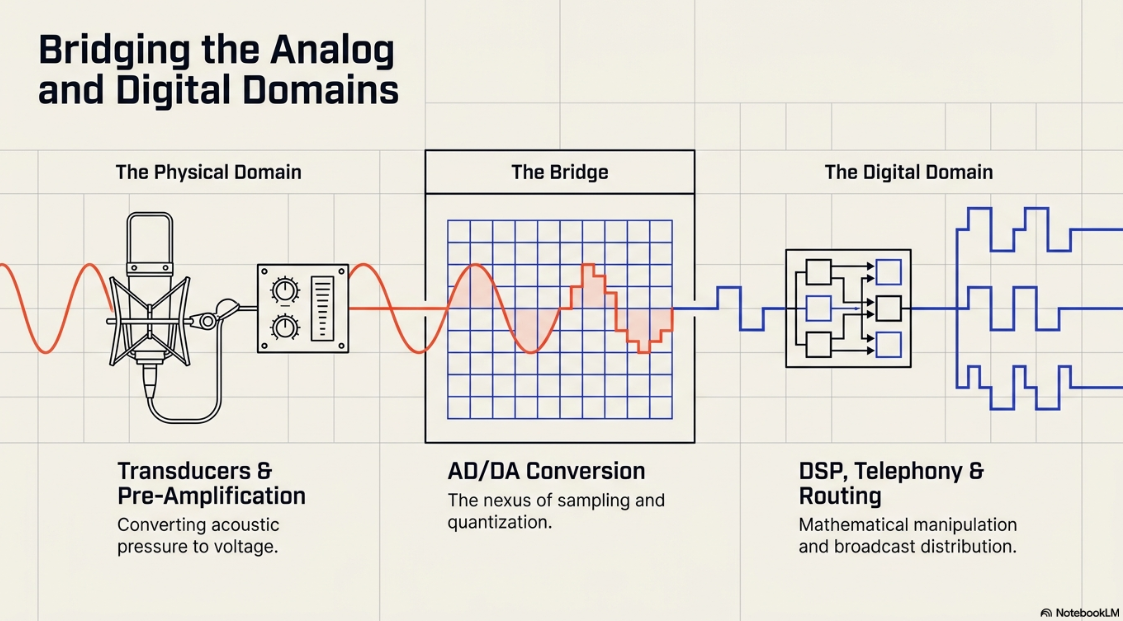
The architectural foundation of any professional spoken-word broadcast, podcast, or live-streamed production relies entirely on the precise capture, amplification, and routing of acoustic energy. At the absolute epicenter of this electromechanical signal chain lies the audio interface, a critical hardware node responsible for bridging the analog and digital domains. Historically, podcasters and broadcast engineers were forced to repurpose traditional music production interfaces—devices engineered primarily for tracking multi-piece bands, electric guitars, and drum kits1. However, the modern podcasting ecosystem has necessitated a paradigm shift toward bespoke broadcast consoles and interface topologies optimized specifically for speech reproduction, remote telephony, and rapid content delivery.
An audio interface performs two primary functional mandates: analog-to-digital (AD) conversion, which translates analog electrical voltage from a transducer (microphone) into binary data for a computer, and digital-to-analog (DA) conversion, which translates binary data back into electrical voltage for monitoring via headphones or active studio monitors2. Beyond mere digital conversion, the modern interface acts as the central nervous system for routing, mixing, and processing audio. The technical specifications of an interface—specifically the architectural layout of its inputs and outputs, the quality of its preamplifiers, its thermal noise floor, and its internal routing matrices (such as loopback and mix-minus)—directly dictate the acoustic fidelity and operational efficiency of the final production1.
This comprehensive report examines the electromechanical and digital characteristics of audio interfaces within the strict context of professional podcasting. By analyzing the nuanced physical requirements of microphone inputs, the mathematical limits of preamplifier gain stages, the necessity of complex output distribution, and the advent of onboard digital signal processing, this analysis establishes a definitive framework for engineering a pristine, scalable, and resilient podcasting architecture.
The Physics and Topology of Analog Inputs
The primary point of physical interaction between a microphone and an audio interface is the analog input receptacle. Professional microphones are passive analog devices that output remarkably low-level electrical signals—often generating less than ten millivolts (10 mV) of electrical pressure in response to human speech3. To accommodate these fragile, low-voltage signals without introducing catastrophic environmental noise, interfaces are equipped with specialized input connectors and differential amplification circuitry.
XLR, TRS, and the Implementation of Combo Connectors
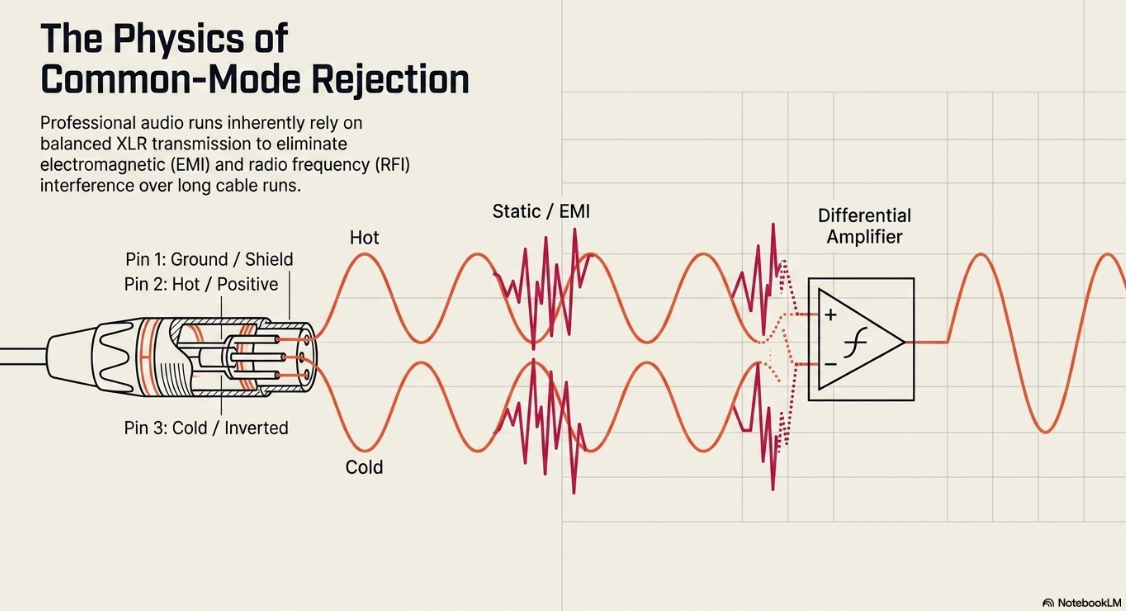
In professional audio engineering, the XLR connector operates as the ubiquitous industry standard for microphone-level signals. The standard three-pin XLR connector relies on a balanced audio transmission principle to preserve signal integrity. Pin 1 acts as the ground or electrical shield, Pin 2 transmits the positive (hot) audio signal, and Pin 3 transmits the negative (cold) inverted signal5. As the audio signal travels down the cable, it acts as an antenna, absorbing electromagnetic interference (EMI) and radio frequency interference (RFI) from power supplies, lighting rigs, and mobile phones. When the signal reaches the differential amplifier at the interface's input stage, the phase of the cold signal is mathematically inverted and summed with the hot signal. Through a process known as common-mode rejection, the absorbed interference—which is in phase on both the hot and cold lines—is phase-canceled and eliminated, ensuring a pristine signal even over extensively long cable runs.
Many modern audio interfaces engineered for versatility utilize "combo jacks," which physically merge a female XLR connector with a 1/4-inch (6.35mm) TRS (Tip-Ring-Sleeve) jack into a single space-saving chassis component, predominantly manufactured by industry leaders such as Neutrik5. This topological design allows a single physical input to accept either a low-voltage microphone-level signal via XLR or a robust line-level or instrument-level signal via a TRS or TS cable5. Instrument inputs often feature a switchable High-Z (high impedance) circuit. Engaging the High-Z switch raises the input impedance to 1 Megohm (
Transducer Topologies: Dynamic versus Condenser Microphones
The choice of microphone fundamentally dictates the electrical demands placed upon the audio interface's input stage. Broadcast environments generally rely on two primary transducer topologies: dynamic microphones and condenser microphones.
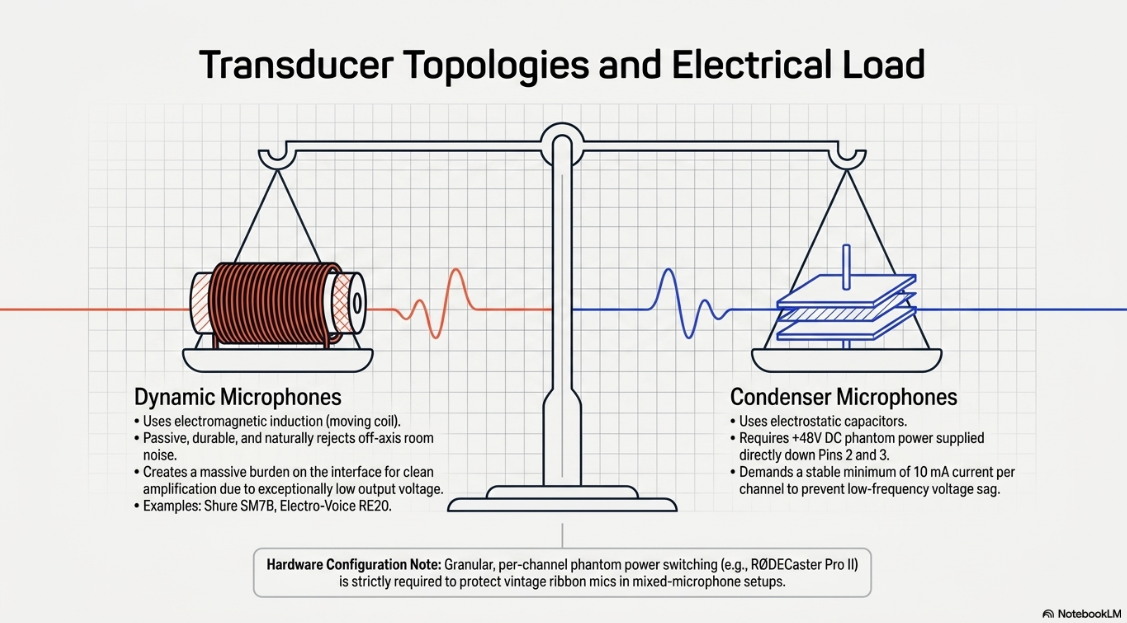
Dynamic microphones, such as the legendary Shure SM7B, the Electro-Voice RE20, or the RØDE Procaster, operate utilizing electromagnetic induction. Sound waves physically strike a mylar diaphragm attached to a wire coil suspended within a permanent magnetic field. The movement of the coil generates a faint electrical current directly proportional to the acoustic wave4. Because they are entirely passive and relatively heavy moving parts, dynamic microphones are highly durable and naturally reject off-axis background noise, making them the absolute ideal choice for podcasters operating in untreated acoustic environments4. However, their passive electromechanical nature results in a remarkably low output voltage, transferring an immense burden onto the audio interface to provide massive, clean amplification.
Conversely, condenser microphones utilize electrostatic technology, featuring an ultra-thin conductive diaphragm placed micrometers away from a solid metal backplate, effectively creating a capacitor. To capture sound, this capacitor must be continuously electrically charged. This polarizing charge is supplied by the audio interface in the form of +48V phantom power4. Phantom power is transmitted as a direct current (DC) voltage equally down Pins 2 and 3 of the balanced XLR cable, referencing Pin 1 as the electrical ground6. Because the +48V voltage is applied equally to the hot and cold audio lines, the differential inputs of the interface ignore the DC voltage, preventing catastrophic damage to the sensitive audio circuitry.
The electrical stability and current capacity of an interface's phantom power supply are paramount to acoustic success. A robust audio interface must deliver a stable minimum of 10 milliamperes (10 mA) per channel to properly polarize large-diaphragm condenser capsules. Budget interfaces often suffer from voltage sag under heavy loads—such as when powering multiple condenser microphones simultaneously—which physically manifests as a loss of low-frequency response or intermittent signal dropouts3. Furthermore, in multi-guest podcasting scenarios utilizing a heterogeneous mix of dynamic and condenser microphones, the audio interface must feature independent, switchable phantom power for each specific input channel1. Applying global phantom power across all inputs simultaneously can risk destroying vintage or fragile ribbon microphones that may be inadvertently connected to adjacent channels1. The RØDECaster Pro II natively addresses this by allowing granular, per-channel phantom power switching, ensuring a safe operating environment for mixed-microphone panels1.
Input Impedance Bridging
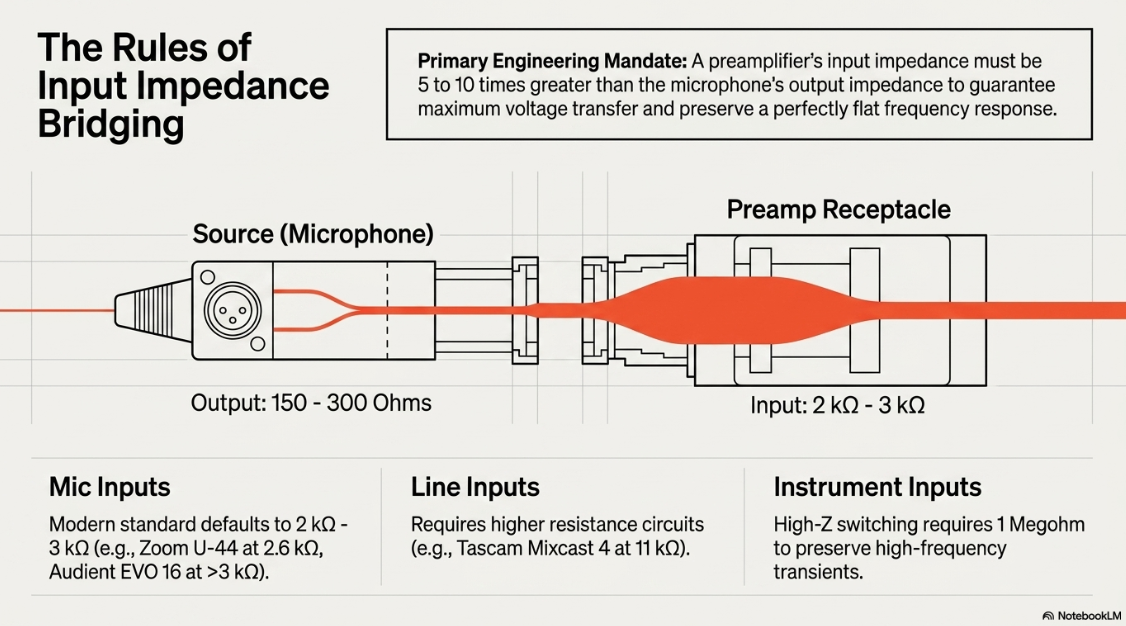
A secondary, highly nuanced technical specification of the analog input stage is input impedance. According to the foundational principles of voltage bridging in audio engineering, a preamplifier's input impedance should theoretically be at least five to ten times greater than the connected microphone's output impedance. This impedance mismatch ensures maximum voltage transfer and preserves a flat frequency response3.
Modern dynamic and condenser microphones typically feature output impedances ranging from 150 ohms to 300 ohms. Consequently, contemporary audio interfaces generally default to a microphone input impedance between 2 k$\Omega$ and 3 k$\Omega$3. For example, the Zoom U-44 features a microphone input impedance of 2.6 k$\Omega$8, the Tascam Mixcast 4 utilizes an 11 k$\Omega$ impedance for its line inputs12, and the Audient EVO 16 features an impedance greater than 3 k$\Omega$ for its microphone inputs6. However, specific vintage dynamic microphones interact dynamically with the preamp's impedance load. Lowering or raising the input impedance can physically alter the microphone's transient response and frequency curve, fundamentally affecting the tonal character of the presenter's voice3. While standard bridging is ideal for transparency, high-end interfaces occasionally offer switchable impedance settings to perfectly match or intentionally mismatch the transducer to achieve a specific vintage tonal coloration.
Preamplification: The Engine of Acoustic Fidelity
Once the analog signal successfully navigates the input connector, it must be amplified from a microscopic microphone-level signal (often measured in fractions of a millivolt) to a robust, standardized line-level signal (nominally +4 dBu for professional balanced gear or -10 dBV for consumer unbalanced gear)12. This critical amplification is executed by the microphone preamplifier (commonly referred to as the preamp). Within the strict context of spoken-word podcasting, the preamplifier is unequivocally the most vital analog component determining the ultimate acoustic fidelity of the broadcast2.
Maximum Clean Gain Thresholds
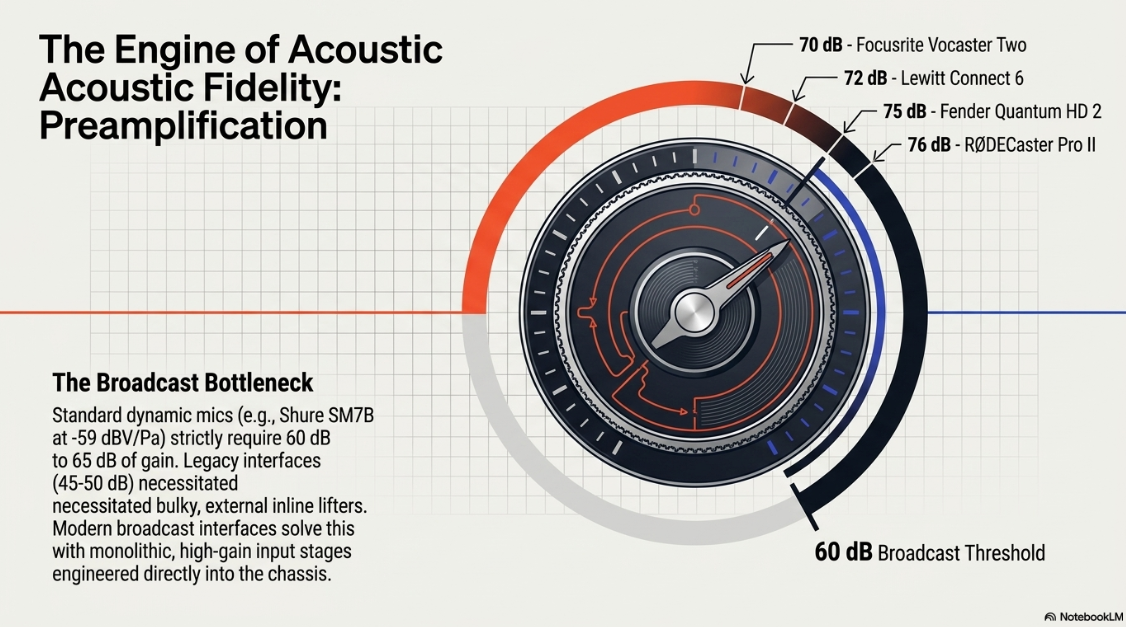
The foundational requirement of a podcast-centric preamplifier is its maximum clean gain capacity. Because modern broadcast standards heavily favor low-output dynamic microphones to isolate vocalists from room reverberation and ambient noise, the preamp must possess immense electrical lifting power. The Shure SM7B, universally acknowledged as the gold standard for broadcast dialogue, possesses a notoriously low sensitivity rating of -59 dBV/Pa and mathematically requires between 60 dB and 65 dB of gain to reach an optimal digital recording level in standard room conditions3.
Historically, consumer and prosumer audio interfaces maxed out at approximately 45 dB to 50 dB of gain. This proved drastically insufficient for broadcast dynamic microphones, resulting in quiet, unusable audio that, when digitally boosted in post-production, revealed an ocean of electronic hiss3. This hardware limitation birthed an entire sub-industry of "inline preamps" or "mic activators" (such as the Cloudlifter or SE Electronics Dynamite). These devices utilized the interface's phantom power to provide a fixed, clean 25 dB analog boost before the signal ever reached the interface. However, the modern era of podcast-centric audio interfaces has effectively rendered inline preamps obsolete by engineering monolithic, high-gain input stages directly into the chassis.
The current generation of broadcast interfaces boasts extraordinary gain ranges that effortlessly drive demanding transducers. The Focusrite Vocaster Two, designed specifically for podcasters, delivers over 70 dB of gain14. The Lewitt Connect 6, an advanced DSP-powered interface, supplies 72 dB of clean gain16. The Fender Quantum HD 2 pushes the boundary further with +75 dB of gain18, while the RØDE RØDECaster Pro II utilizes its proprietary "Revolution Preamps" to deliver a massive 76 dB of pristine amplification7. This abundance of built-in clean gain ensures that even the most stubborn dynamic microphones can be driven to professional broadcast levels without the financial burden or physical clutter of external hardware bridging the gap1.
Equivalent Input Noise (EIN) and Thermal Limits
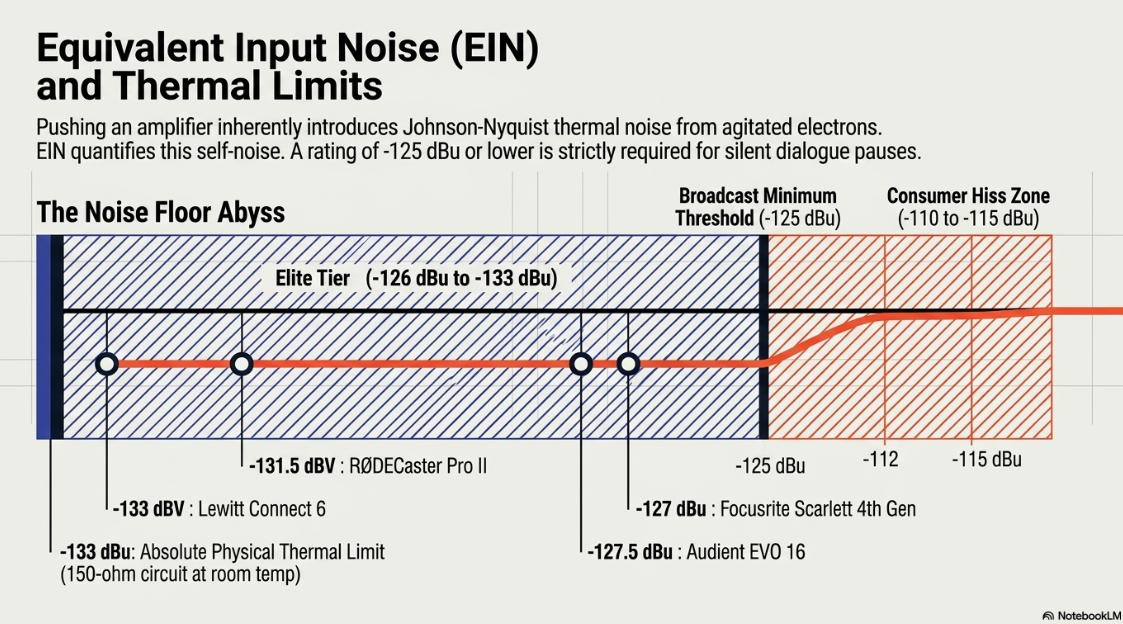
Pushing any preamplifier to its maximum gain is mathematically bound by the inescapable physical limits of thermal noise, often referred to as Johnson-Nyquist noise. As the gain potentiometer is turned up, the amplifier inherently introduces a baseline level of electronic hiss resulting from the thermal agitation of electrons within the internal resistive circuitry. The standardized metric used to quantify this self-noise is Equivalent Input Noise (EIN), expressed in decibels relative to unloaded voltage (dBu or dBV)3.
EIN provides a standardized, objective measurement of how much noise the preamplifier adds to the signal when its gain is maximized. A lower absolute numerical value indicates a quieter, superior preamp architecture. The theoretical physical limit for thermal noise in a standard 150-ohm microphone circuit operating at room temperature is approximately -133 dBu. Consumer-grade audio interfaces typically feature an EIN hovering around -110 dBu to -115 dBu3. When paired with a low-output dynamic microphone requiring 60 dB of gain, an interface with a -110 dBu EIN will introduce a highly audible, rushing waterfall of hiss into the podcast recording, degrading the perceived professionalism of the show.
For professional podcasting, an EIN of -125 dBu or lower is strictly required to maintain a silent noise floor during dialogue pauses and intimate vocal deliveries4. The industry has risen to meet this demand with exceptional engineering. The Focusrite Scarlett 4th Generation preamps achieve a highly respectable -127 dBu3, while the Audient EVO 16 pushes this boundary to -127.5 dBu6. At the absolute pinnacle of current broadcast engineering, the Lewitt Connect 6 reports an EIN of -133 dBV (A-weighted)19, and the RØDECaster Pro II achieves an astonishingly quiet -131.5 dBV EIN7. These ultra-low noise thresholds ensure that the signal-to-noise ratio remains pristine, capturing the warmth, resonance, and intimacy of the human voice without the intrusion of electronic interference4.
Digital Conversion Protocols and Driver Architecture
Following analog preamplification, the electrical signal must be digitized for computer storage and processing. The Analog-to-Digital Converter (ADC) samples the continuous voltage wave at discrete, hyper-fast time intervals and quantizes the amplitude into binary values. The precision and fidelity of this conversion are strictly governed by two mathematical parameters: the sample rate and the bit depth21.
Sample Rate, Bit Depth, and Nyquist Constraints
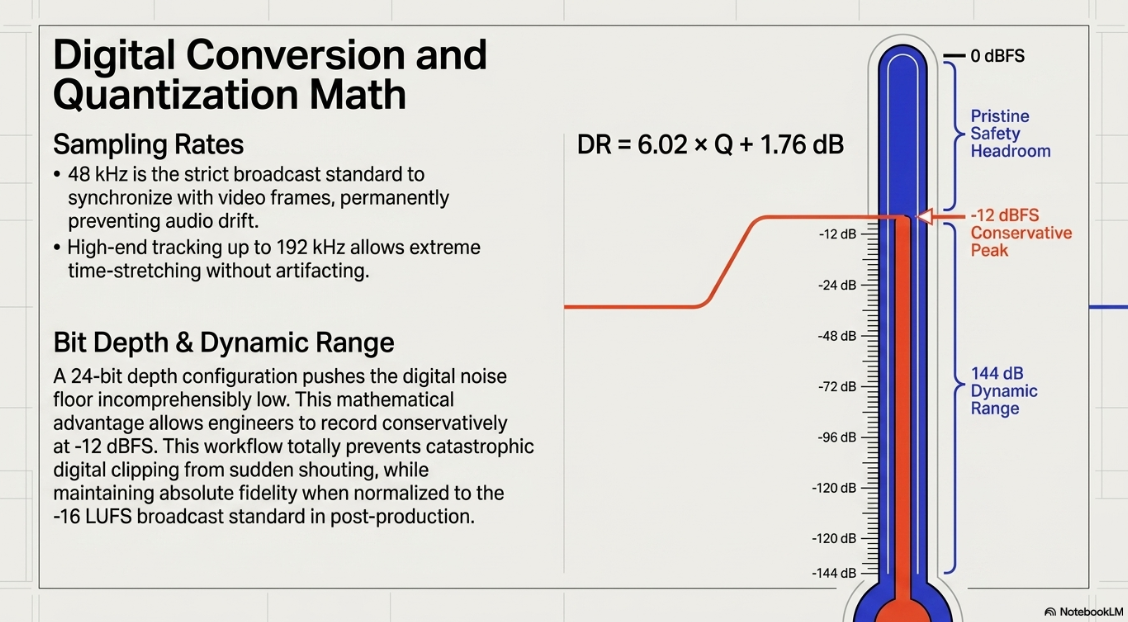
The sample rate dictates the frequency at which the analog audio is captured. Based on the Nyquist-Shannon sampling theorem, the sample rate must be at least twice the highest frequency intended to be recorded to prevent digital aliasing. Because human hearing biologically tops out at roughly 20 kHz, a sample rate of 44.1 kHz (the CD standard) or 48 kHz (the video standard) perfectly captures the entire audible acoustic spectrum without aliasing artifacts5. Professional video, film, and broadcast audio almost exclusively standardizes on 48 kHz to synchronize effortlessly with standard video frame rates, preventing audio drift over long podcast recordings10. However, many high-end interfaces, such as the RME Fireface UCX II, the Audient EVO 16, and the Focusrite Scarlett series, support conversion up to 96 kHz or even 192 kHz5. While ultrasonic frequencies are inaudible to humans, tracking at 96 kHz allows for extreme digital manipulation, time-stretching, and pitch-shifting in post-production without introducing destructive artifacting.
Bit depth determines the dynamic range and the quantization noise floor of the digital recording. A 16-bit depth offers roughly 96 dB of dynamic range, which was sufficient for early digital mediums. Modern interfaces unequivocally utilize 24-bit conversion, yielding a massive theoretical dynamic range of 144 dB4. The mathematical formula for digital dynamic range is expressed as:

where 
Driver Latency, Buffer Management, and USB Protocols
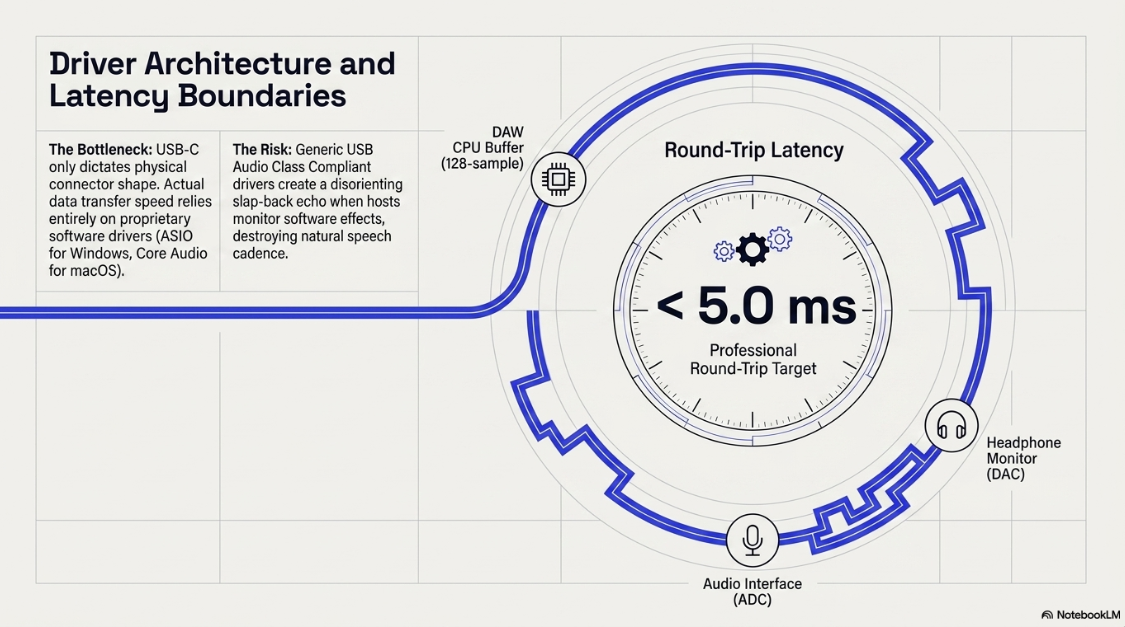
Once digitized, the audio data is transmitted to the host computer via digital protocols, predominantly USB-C or Thunderbolt21. It is critical to note that USB-C refers solely to the physical connector shape, not the data transfer protocol; a well-engineered USB 2.0 interface can easily outpace a poorly coded USB-C interface3. The efficiency of this data transmission relies entirely on the interface's software drivers—ASIO for Windows environments and Core Audio for macOS.
Round-trip latency—the time it takes for audio to enter the interface, travel through the digital audio workstation (DAW) for processing, and return to the headphones—is a critical operational factor when a host is monitoring their voice with software effects applied3. A poorly coded driver will result in massive latency, creating a disorienting, slap-back echo effect in the presenter's headphones, which severely disrupts speech cadence and train of thought. Real-world latency is heavily dependent on the DAW's buffer size and the computer's CPU load. Professional interfaces, supported by proprietary, highly optimized drivers (such as those from RME or Audient), aim for round-trip latencies of 
Output Architecture and Multi-Host Distribution Topologies
While inputs physically capture the sound, outputs govern how the host, guests, and producers monitor the ongoing broadcast. The structural requirements for a podcast interface's output matrix scale aggressively as the number of in-person participants increases.
Independent Headphone Amplification
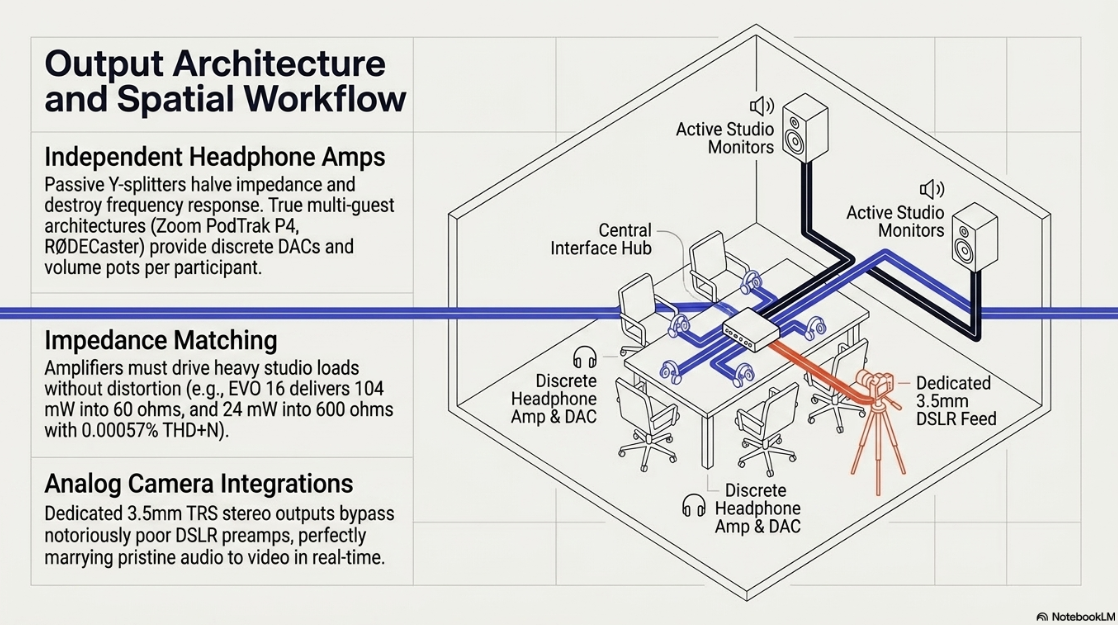
In a solo broadcasting scenario, a single headphone output is sufficient. However, panel discussions, co-hosted shows, and interview formats require strict acoustic isolation and personalized monitoring. Attempting to split a single headphone output to multiple listeners using a passive Y-splitter halves the impedance load and severely degrades both audio volume and frequency response, making it an entirely unacceptable solution for professional environments.
A professional multi-guest podcast interface must physically provide one independent, discrete headphone output per in-room participant, each equipped with its own dedicated digital-to-analog converter (DAC) and physical volume potentiometer1. The Zoom PodTrak P4, specifically engineered from the ground up as a specialized podcast tool, features four independent headphone outputs with individual gain controls, allowing a four-person panel to monitor the recording comfortably without requiring external, bulky headphone distribution amplifiers1. Similarly, the Tascam Mixcast 4 and the RØDECaster Pro II feature four robust 1/4-inch TRS stereo headphone jacks driven by internal amplification10. The Lewitt Connect 6 utilizes two independent headphone outputs (one 3.5mm and one 6.35mm), allowing a host and a guest to drive high-impedance studio headphones comfortably16.
The headphone amplifiers themselves must supply enough milliwatt (mW) power to drive professional studio monitoring headphones, which often possess high impedances (varying from 80 ohms up to 600 ohms). For example, the Tascam Mixcast 4 delivers 45 mW + 45 mW into a 32-ohm load12, while the Audient EVO 16 delivers up to 104 mW into 60 ohms, and can even supply 24 mW into a massive 600-ohm load with a mere 0.00057% Total Harmonic Distortion (THD+N)6. Failing to match headphone impedance with adequate amplifier output physically results in distorted, painfully quiet playback that fatigues the listener.
Monitor, Camera, and Analog Integrations
Beyond localized headphone monitoring, the interface must successfully interface with external studio ecosystems. Balanced line outputs (typically 1/4-inch TRS jacks) are required to connect the interface to active studio monitors for post-production mixing, editing, and critical listening6.
Furthermore, the exponential rise of "vodcasting" (video podcasting) on platforms like YouTube has necessitated dedicated analog outputs specifically calibrated for consumer video cameras. Devices like the Focusrite Vocaster Two and the Lewitt Connect 6 feature dedicated 3.5mm (1/8-inch) TRS stereo outputs designed to pipe the final stereo mix directly into a DSLR or mirrorless camera's audio input14. This specific topological feature eliminates the tedious, time-consuming process of syncing secondary audio to video in post-production software, as the pristine interface audio is permanently married to the video file in real time at the point of capture14.
Telephony Integration: Mix-Minus, Loopback, and Digital Routing
Perhaps the most defining characteristic that permanently separates a generic music production interface from a broadcast-grade podcasting console is the integration of advanced routing matrices for remote telephony. Post-2020, podcasts rely heavily on remote guests dialing in via teleconferencing software (Zoom, Microsoft Teams, Skype) or traditional cellular networks.
The Physics and Mechanics of Mix-Minus
When a host conducts an interview with a remote guest over the internet or a phone line, routing the audio is inherently complex. The host must hear the remote guest in their headphones, and the remote guest must hear the host. If the host simply routes the main master output of the audio interface back into the teleconferencing software, the remote guest will hear the host's voice, any sound effects played, and crucially, a delayed version of their own voice returning to them over the latency-ridden internet connection4. This latency-induced feedback loop disrupts speech patterns, causes extreme psychological distraction, and renders conversations entirely impossible1.
To solve this, broadcast interfaces utilize a highly specific routing matrix known as "mix-minus." Mix-minus is an audio engineering configuration where a specific output channel contains the entirety of the program mix minus the audio input originating from that specific destination1. When a remote guest speaks, their audio enters the interface, is routed to the host's headphones and the recording medium, but is electronically subtracted from the return feed sent back over the internet or Bluetooth connection25.
The integration of mix-minus at the hardware level is a monumental workflow advantage. The Zoom PodTrak P4 handles this natively, allowing remote guests to connect via a TRRS smartphone cable (adhering to the CTIA standard) or via a USB connection on Channel 6, executing an automated mix-minus protocol that requires zero configuration from the user1. The Focusrite Vocaster Two executes mix-minus over both its TRRS smartphone connection and its integrated Bluetooth 5.0 receiver, allowing broadcast guests to converse naturally without echo14. The RØDECaster Pro II utilizes advanced internal routing to ensure that its Bluetooth and dual-USB communication channels automatically exclude the selected channel's input from the return feed, preventing any possibility of feedback10. Attempting to configure mix-minus manually using a generic 2-channel interface requires complex, frustrating digital routing inside a DAW or virtual audio cables, underscoring the immense value of hardware-level integration1.
Stereo Loopback and Virtual Routing
While mix-minus manages remote guests, loopback functionality manages the host computer's internal audio. Stereo loopback involves creating virtual input channels within the audio interface that mathematically "listen" to the host computer's system audio (e.g., YouTube playback, Spotify, video game audio, or browser-based soundboards)6.
Instead of relying on acoustic bleed or messy auxiliary cables routed from the headphone jack back into an input, loopback digitally intercepts the audio playing on the host's computer at the driver level. It then routes it directly back into the recording software or live stream software (like OBS) as a distinct, controllable audio track12. The Lewitt Connect 6 features three independent loopback channels, enabling the operator to digitally capture multiple software sources simultaneously16. The Audient EVO 16 and Focusrite Vocaster series similarly utilize proprietary software mixers (such as the Vocaster Hub) to seamlessly blend physical microphone inputs with virtual loopback streams, creating a cohesive, broadcast-ready "Show Mix"6.
Digital Signal Processing (DSP) and Workflow Automation
Historically, processing a vocal signal with equalization (EQ), compression, and noise gating required either expensive outboard rackmount hardware (which is physically cumbersome) or software plugins operating within a DAW (which introduce latency and consume heavy CPU resources). Modern podcast audio interfaces have successfully internalized these processing tasks through onboard Digital Signal Processing (DSP) chips16. By processing the audio mathematically at the hardware level before it ever reaches the computer, zero-latency effects can be applied in real-time, delivering a polished, radio-ready sound straight to disk16.
Dynamic Range Compression, Equalization, and Enhancements
Human speech is highly dynamic; a host might whisper a poignant thought and subsequently laugh uproariously. Compression automatically attenuates transient peaks, reducing the dynamic range and increasing the perceived average loudness of the vocal track, ensuring the listener does not need to constantly adjust their volume dial in their car or on their phone9. Equalization (EQ) is utilized to shape the frequency response—typically applying a high-pass filter to remove structural low-end rumble (HVAC systems, traffic) and boosting upper-midrange frequencies to enhance vocal intelligibility, presence, and "air"9.
The RØDECaster Pro II represents the zenith of onboard DSP, featuring studio-grade APHEX processing natively built into its 1.5GHz quad-core audio engine. It offers high-pass filters, de-essers, noise gates, and the legendary Aural Exciter and Big Bottom processing on every single channel10. The Lewitt Connect 6 relies on a powerful internal DSP chip offering a zero-latency compressor, a four-band EQ, an expander, and a proprietary one-knob maximizer designed to dynamically "glue" the final mix together for maximum loudness without clipping16. Even compact analog/digital hybrid mixers like the Mackie ProFX6v3+ incorporate streamlined one-knob compression and GigFX+ engines to shape the sound effortlessly at the point of capture9. The Focusrite Vocaster series offers an "Enhance" function, utilizing four distinct voice presets designed to instantly apply broadcast-style EQ and compression to the host's voice with a single button press4.
Auto-Gain and Algorithmic Leveling
One of the most profound technological advancements in recent interface design is the democratization of gain staging through algorithmic Auto-Gain technology. Properly setting microphone levels traditionally required the talent to speak at broadcast volume while an audio engineer manually rode the analog gain potentiometer, carefully leaving ample headroom to avoid destructive digital clipping14.
Modern interfaces, including the Focusrite Vocaster Two, Audient EVO 16, and Lewitt Connect 6, now feature automated setup routines14. The user engages a physical or software button, speaks into the microphone for roughly ten seconds, and the interface's DSP actively analyzes the RMS and transient peak levels of the incoming acoustic signal. The algorithm then mathematically sets the perfect analog preamp gain15. The Audient EVO 16's proprietary "Smartgain" feature can intelligently analyze and set the precise gain for up to eight microphones simultaneously, drastically reducing setup time for complex panel interviews and preventing catastrophic digital distortion during unpredictable live recordings6.
Market Topology and Architectural Case Studies (2025–2026 UK Market Data)
The current audio interface landscape can be categorized into three distinct architectural tiers, each tailored to specific operational requirements, budget constraints, and technical proficiencies. The following analysis utilizes recent pricing and availability data from major UK audio retailers (Thomann, Gear4music, Scan, Andertons, etc.) to contextualize the market11.
Tier 1: Compact Solo/Dual-Host Desktop Interfaces
Designed for highly portable, single-host or intimate two-person interviews, these interfaces prioritize a minimal desktop footprint and plug-and-play simplicity.
Focusrite Scarlett 2i2 (4th Gen): Long considered the ubiquitous industry standard for home recording, the 4th Generation 2i2 offers a phenomenal 69 dB of gain and an elite -127 dBu EIN3. While it lacks advanced hardware DSP or dedicated podcast hardware buttons, its raw AD/DA conversion quality makes it a staple for producers who prefer mixing entirely in the box. Priced at approximately £149 to £185, it represents exceptional value for high-fidelity capture2.
Focusrite Vocaster Two: Specifically engineered as a spoken-word evolution of the Scarlett, the Vocaster Two strips away instrument inputs in favor of podcast-centric conveniences. It features 70 dB of gain, Auto-Gain, Bluetooth integration for mix-minus phone calls, and dedicated camera outputs14. However, its strict dual-input architecture rules it out for multi-guest panel discussions1.
Lewitt Connect 6: Operating as a hybrid powerhouse, the Connect 6 features 72 dB of gain, -133 dBV EIN, and comprehensive DSP processing. Its defining characteristic is its dual USB-C architecture, allowing lossless digital audio transfer simultaneously between a computer and an Apple MFi-certified or Android mobile device16. This permits hosts to stream directly to mobile platforms (Instagram, TikTok) while capturing studio-grade audio to a desktop DAW. It retails competitively between £179 and £24917.
Tier 2: Dedicated Podcast Consoles and Multi-Track Recorders
These devices merge the analog routing of an audio interface with the functionality of a mixing board and a standalone recorder, designed for complex, multi-guest architectures.
Zoom PodTrak P4: Positioned as the ultimate portable broadcast solution, the P4 features four XLR inputs (with 70 dB of gain), four independent headphone outputs with volume control, and integrated sound pads for triggering stingers and ads1. It operates entirely standalone, recording multitrack audio directly to an SD card (up to 512GB) while running on AA batteries, making it indispensable for field recordings in coffee shops or conference halls4. At approximately £195 to £220, it is the most accessible entry point for genuine four-person panel recording1.
Tascam Mixcast 4: Featuring a vibrant 5-inch color touchscreen, four combo inputs, four headphone outputs, and Bluetooth, the Mixcast 4 acts as a complete production studio12. It boasts a -125 dBu EIN and allows for internal SD card recording (up to 14-channel poly BWF format) alongside direct integration with streaming software via its USB-C connection12.
Tier 3: Professional Integrated Audio Production Studios
Representing the apex of current broadcast technology, these units offer uncompromising preamplification, massive digital routing capabilities, and highly tactile control surfaces.
RØDE RØDECaster Pro II: The undisputed heavyweight of podcasting consoles. Driven by a 1.5GHz quad-core audio engine, it offers four Neutrik combo inputs with Revolution Preamps yielding 76 dB of gain and an ultra-low -131.5 dBV EIN7. It natively handles dual-USB routing, Bluetooth mix-minus, and features fully customizable SMART pads capable of triggering MIDI, vision switching, or sound effects7. Its 5.5-inch high-definition haptic touchscreen removes the need for computer-based control software11. Retailing between £444 and £629 depending on the retailer, it effectively consolidates an entire rack of studio gear into a single desktop footprint11. For those needing a smaller footprint, the RØDECaster Duo provides the same engine with two inputs, retailing from £346 to £46929.
Audient EVO 16: For installations requiring massive analog input counts (such as radio stations or live panel venues), the EVO 16 offers eight EVO preamps (58 dB gain, -127.5 dBu EIN) in an expandable desktop/rackmount hybrid chassis6. Its multi-channel Smartgain and ADAT optical expansion capabilities (allowing up to 24 inputs and 24 outputs) provide immense scalability for complex studio builds, retailing at roughly £378 to £3856.
Structured UK Market Comparison (Select 2025–2026 Interfaces)
Second and Third-Order Market Implications
The granular technical data surrounding modern interface architecture reveals several compounding, third-order trends within the broader professional audio and broadcast industry.
Firstly, the rapid commoditization of high-end AD/DA conversion and ultra-low-noise preamplification has effectively collapsed the sonic gap between "bedroom studios" and million-dollar broadcast facilities. A decade ago, achieving a -130 dB noise floor paired with 70 dB of clean gain required a dedicated outboard analog preamplifier (such as a Rupert Neve Designs or API module) costing thousands of dollars14. Today, this pristine acoustic baseline is integrated directly into compact, bus-powered USB-C chassis units. The profound implication is that the primary differentiating factor in modern podcast quality is no longer the analog capture hardware, but rather the acoustic treatment of the recording environment and the presenter's microphone technique3.
Secondly, the convergence of audio interfaces and tactile mixing consoles into unified "Production Solutions" (exemplified by the RØDECaster series and the Tascam Mixcast) indicates a workflow shift toward physical tactility and computer independence7. Content creators are aggressively moving away from clicking a mouse within a complex DAW to adjust parameters. The inclusion of haptic touchscreens, physical motorized or fluid faders, and tactile SMART pads signifies that the interface is no longer a passive data bridge; it is an active, performative instrument7. This hardware-centric approach minimizes screen fatigue and allows non-engineers to produce highly complex, multi-layered broadcasts in real-time, drastically reducing the hours required for post-production editing.
Finally, the advent of dual-USB architectures, as prominently featured in the Lewitt Connect 6 and RØDECaster Pro II, signals the permanent integration of mobile computing into the professional broadcast chain10. As audience consumption habits migrate heavily toward short-form, vertically oriented video on platforms like TikTok and Instagram Reels, audio interfaces must now natively route lossless digital audio into iOS and Android devices while simultaneously supplying charging power to keep the devices alive during long streams4. The traditional barrier between "desktop recording" and "mobile streaming" has evaporated; the modern audio interface acts as an agnostic digital router, bridging traditional desktop OS environments with mobile ARM architectures seamlessly17.
Conclusion
The deployment of audio infrastructure for a professional podcast mandates a highly precise understanding of acoustic physics, electrical engineering, and digital routing matrices. Procuring an audio interface requires evaluating the hardware against the strict operational parameters of the broadcast, ensuring the inputs and outputs align with the scale of the production.
For setups relying on notoriously insensitive dynamic microphones (such as the Shure SM7B or Electro-Voice RE20), the preamplification stage must mathematically guarantee at least 60 dB to 70 dB of clean gain paired with an Equivalent Input Noise (EIN) floor dropping below -125 dBu to prevent electronic hiss3. For multi-host panel discussions, the physical topology must feature independent, robust headphone amplification arrays capable of driving high-impedance studio monitors to ensure acoustic isolation and participant comfort1. Furthermore, in the modern era of hybrid, remote broadcasting, hardware-level mix-minus capabilities and stereo loopback matrices are non-negotiable requirements to prevent telephony latency and echo degradation1.
By leveraging modern, podcast-optimized consoles such as the RØDECaster Pro II for multi-participant tactile control, the Zoom PodTrak P4 for portable SD-card-based fieldwork, or the Lewitt Connect 6 for DSP-heavy mobile integration, engineers and producers can architect zero-latency, high-fidelity broadcast environments that rival traditional global radio syndicates4. The ultimate acoustic success of a podcast is directly bound by the capability of its interface—the indispensable, electromechanical nexus of the entire broadcast signal chain.
Works cited
How to Choose the Best Audio Interface for Multiple Guests - Podcast Studio Hire Services in Central London, https://nextmedia.london/audio-interface-multiple-guests/
How to Choose an Audio Interface - Andertons Music Co., https://www.andertons.co.uk/how-to-choose-audio-interface
Do You Need an Audio Interface for a Microphone? (2026 Guide), https://electronics.alibaba.com/question/audio-interface-for-microphone-what-you-actually-need
Best Audio Interface for Podcasting (2026): Expert Tested, https://bestaudiohub.com/audio-interface-for-podcasting/
USB C audio interface - Tags - Juno Records, https://www.juno.co.uk/tags/USB+C+audio+interface/
Audient EVO 16 24-in 28-out USB-C Audio Interface - Andertons Music Co., https://www.andertons.co.uk/audient-evo16-24in-28out-usb-desktop-audio-interface/
RØDECaster Pro II | Integrated Audio Production Studio | RØDE (GB), https://rode.com/en-gb/products/rodecaster-pro-ii
U-44 Handy Audio Interface - ZOOM, https://zoomcorp.com/en/gb/audio-interface/audio-interfaces/u-44/
Mackie ProFX6v3+ Analog Mixer With Bluetooth - Fair Deal Music, https://www.fairdealmusic.co.uk/products/mackie-profx6v3-analog-mixer-with-bluetooth
Rode RODECaster Pro II 4 Person Bundle (RODECASTERPROII) - CVP.com, https://cvp.com/product/rode-rodecasterproii-pro-ii-4-person-bundle
Rode Rodecaster Pro II – Thomann UK, https://www.thomann.co.uk/rode_rodecaster_pro_ii.htm
Mixcast 4 | Podcast Mixer, Recorder, USB Audio Interface & Streamer | TASCAM - United States, https://tascam.com/us/product/mixcast_4
Podcasting - Tascam Mixcast 4, https://www.tascam.eu/en/docs/Podcasting-Flyer_EN.pdf
Focusrite Vocaster Two – Thomann UK, https://www.thomann.co.uk/focusrite_vocaster_two.htm
Focusrite Vocaster One review - MusicRadar, https://www.musicradar.com/reviews/focusrite-vocaster-one
Lewitt Connect 6 Recording Package at Gear4music, https://www.gear4music.com/Recording-and-Computers/Lewitt-Connect-6-Recording-Package/6KXQ
Lewitt CONNECT 6 Dual USB-C Audio Interface LN146410 - CONNECT6 | SCAN UK, https://www.scan.co.uk/products/lewit-connect-6-audio-interface-for-live-streaming-podcast-and-music-production-micpres-2in-2out-dsp
The 16 Best Audio Interfaces 2026 - Gear4music, https://www.gear4music.com/blog/best-audio-interfaces/
Lewitt CONNECT 6 - USB-C audio interface, compatible with macOS, Windo - Studiocare, https://studiocare.com/products/lewitt-connect-6-usb-c-audio-interface-compatible-with-macos-windows-ios-android
Lewitt CONNECT 6 USB-C Audio Interface - Fair Deal Music, https://www.fairdealmusic.co.uk/products/lewitt-connect-6-usb-c-audio-interface
The Best Audio Interfaces for Music Production in 2026: A Complete Buyer's Guide, https://developdevice.com/blogs/news/best-audio-interface-for-music-production-2026
Shop Audio Interfaces at MUSIC STORE | United Kingdom, https://www.musicstore.com/en_GB/GBP/Pro-Audio/Audio-Interfaces/cat-RECORDING-RECAINT
Best audio interface 2026: For home recording and more - MusicRadar, https://www.musicradar.com/news/the-best-audio-interfaces
EVO By Audient EVO 16 USB Audio Interface - Gear4music, https://www.gear4music.com/Recording-and-Computers/EVO-By-Audient-EVO-16-USB-Audio-Interface/4VQB
Understanding "Mix-minus" on RØDECaster Series – RØDE, https://help.rode.com/hc/en-us/articles/8977666542351-Understanding-Mix-minus-on-R%C3%98DECaster-Series
Audient EVO 16 - Thomann, https://www.thomann.co.uk/evo_16.htm
Evo by Audient EVO 16 Audio Interface - Bax Music, https://www.bax-shop.co.uk/external-audio-interfaces/evo-by-audient-evo-16-audio-interface
Audio Interfaces - Andertons Music Co., https://www.andertons.co.uk/browse/recording/audio-interfaces/
RØDE Caster Duo (10 stores) find prices - PriceRunner, https://www.pricerunner.com/pl/713-3206490852/Studio-Equipment/ROEDE-caster-Duo-Compare-Prices
USB Audio Interfaces Professional Recording Gear | SCAN UK, https://www.scan.co.uk/shop/music-and-pro-audio/audio-interfaces/usb-audio-interfaces
Lewitt Connect 6 – Thomann UK, https://www.thomann.co.uk/lewitt_connect_6.htm
Buy Rode RØDECaster Pro 2 from £444.00 (Today) - Idealo, https://www.idealo.co.uk/compare/202009659/rode-rdecaster-pro-2.html
Rode Audio Interfaces | guitarguitar, https://www.guitarguitar.co.uk/rode/recording/audio-interfaces/
Evo by Audient - EVO 16 LN126580 - Scan, https://www.scan.co.uk/products/evo-by-audient-evo-16-10-in-4-out-high-performance-usb-interface-with-scroll-controlevo16-24in-28out
Full text of "Sound-eng" - Internet Archive, https://archive.org/stream/Sound-eng/_2_djvu.txt