The modern professional podcast operates at the complex intersection of traditional broadcast engineering, acoustic physics, and high-performance digital data processing. At the operational core of this convergence lies the audio interface—a highly sophisticated hardware unit tasked with translating the continuous fluctuations of analog acoustic pressure into discrete digital data, and subsequently back again for monitoring. The fidelity, clarity, transient response, and real-time reliability of a spoken-word production rely fundamentally on the precise execution of the analog-to-digital conversion (ADC) process, the meticulous management of preamplification gain staging, and the absolute minimization of data transfer latency1.
As the podcasting and broadcast industry matures into the 2025–2026 technological landscape, the hardware facilitating these productions has undergone a radical evolution. Modern audio interfaces now routinely integrate features previously reserved for high-end, large-format studio consoles. These include 32-bit digital-to-analog conversion architectures, Class-A analog preamplifiers, proprietary FPGA-driven processing, Digital Signal Processing (DSP) accelerated zero-latency monitoring, auto-gain calibration circuits, and dynamic hardware loopback routing3.
This exhaustive research report provides a mathematically rigorous, structurally detailed, and commercially contextualized analysis of the audio interface ecosystem. It deconstructs the fundamental physics of the ADC process, examines the signal chain architecture step-by-step, evaluates the compounding impact of latency on real-time broadcast performance, and provides a comprehensive comparative analysis of the leading hardware solutions available for professional podcast deployment.
The Paradigm of Analog vs. Digital Audio
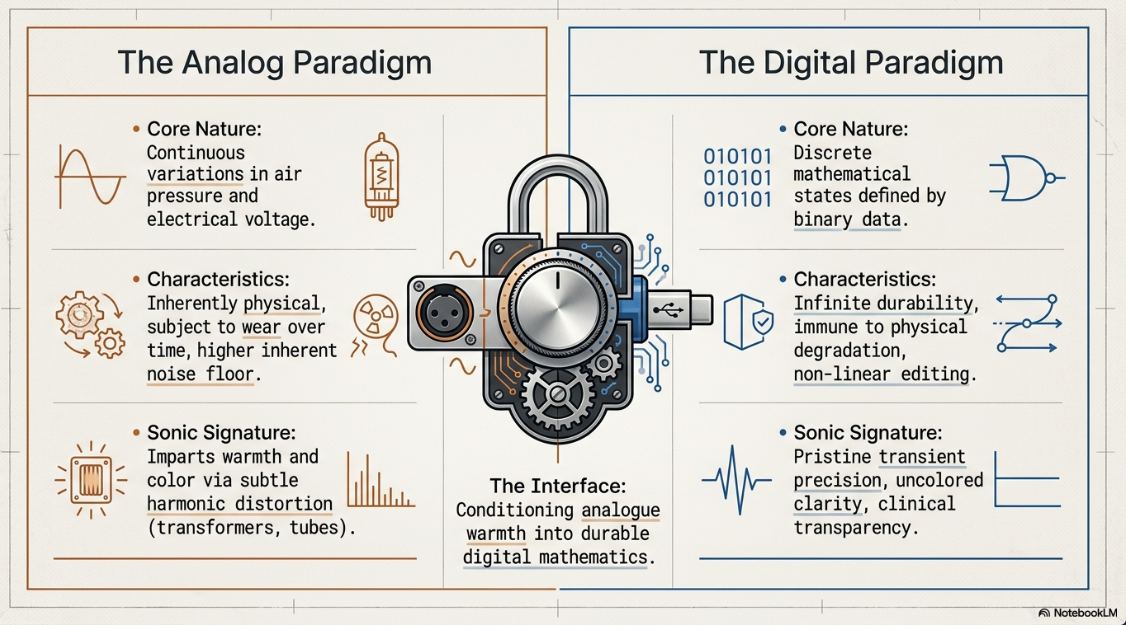
Before detailing the conversion mechanics, it is crucial to understand the distinct paradigms of the analog and digital domains. The human voice, inherently, is an analog phenomenon consisting of continuous variations in air pressure over time6. Analog recording systems capture these continuous sound waves directly onto physical media, utilizing electronic components that operate in a continuous voltage domain7. This analog approach is historically renowned for imparting "warmth" and "color" to a recording. The warmth often attributed to analog hardware is a byproduct of subtle harmonic distortion introduced by physical transformers, vacuum tubes, and tape saturation, which injects pleasing overtones into the signal path7. While highly sought after in genres like rock and jazz, analog audio suffers from physical degradation, wear and tear, and a higher inherent noise floor7.
Digital audio, conversely, relies on converting these analog sound waves into a series of binary numbers7. This process ensures extreme durability, as data is completely resistant to physical degradation over time7. Digital recordings are praised for their uncolored clarity, pristine transient precision, and high-resolution accuracy in capturing and reproducing complex sonic information7. For spoken-word broadcasts, voiceovers, and electronic music, this level of clinical transparency is generally preferred, as it accurately represents the original audio source without introducing unwanted harmonic coloration, while allowing for seamless non-linear editing, manipulation, and global distribution7. The audio interface serves as the critical bridge between these two domains, conditioning the analog warmth of the microphone and translating it into the durable, precise mathematics of the digital realm1.
The Physics and Mathematics of Analog-to-Digital Conversion
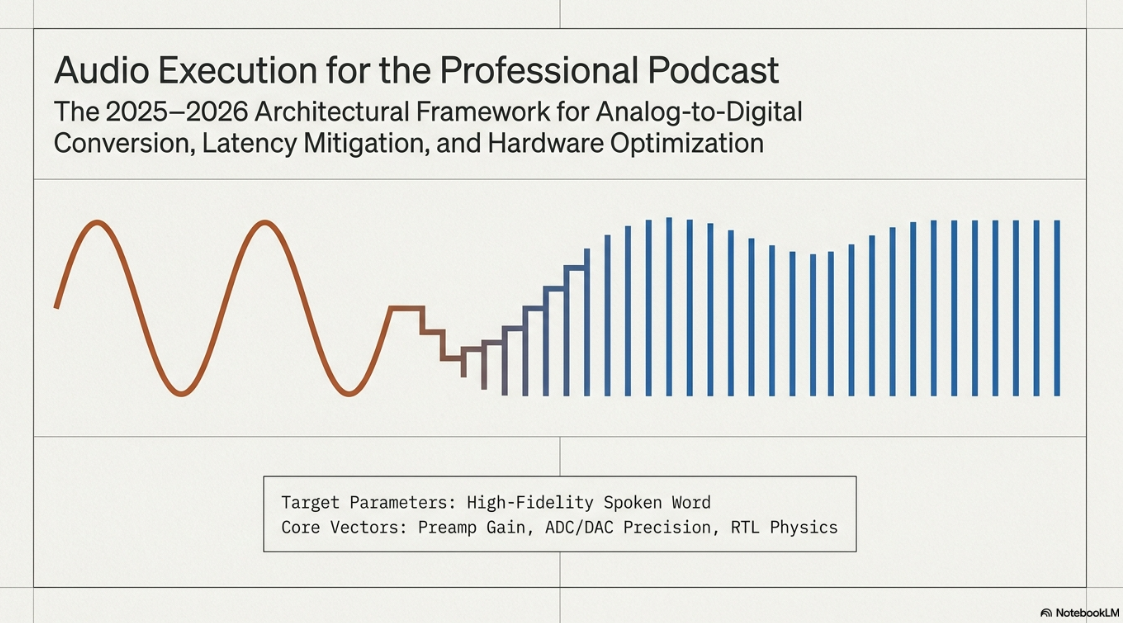
To capture the human voice, a microphone transducer converts continuous acoustic energy into a continuous, low-voltage electrical signal2. Because modern computing systems and Digital Audio Workstations (DAWs) process information in discrete binary states, this continuous analog voltage must be digitized. The analog-to-digital converter (ADC) achieves this transformation through a strict two-step procedure: sampling, which is the discretization of the signal in time, and quantization, which is the discretization of the signal in amplitude6.
Sampling: Time-Domain Discretization and the Nyquist-Shannon Theorem
Sampling involves measuring the instantaneous voltage of an analog waveform at uniform, equally spaced moments in time2. The rate at which these measurements are taken is known as the sampling rate, expressed in Hertz (Hz) or samples per second6. One can visualize this process as capturing a very fast series of "snapshots" of the audio waveform, analogous to the frame rate in video production2. The higher the sample rate, the more closely these digital snapshots track rapid changes in the sound wave, directly corresponding to the system's ability to capture high-frequency detail2.
The fundamental mathematical framework governing this process is the Nyquist-Shannon sampling theorem2. The theorem dictates that in order to accurately and fully reconstruct a bandlimited signal, the sampling rate (


The minimum acceptable sampling rate (

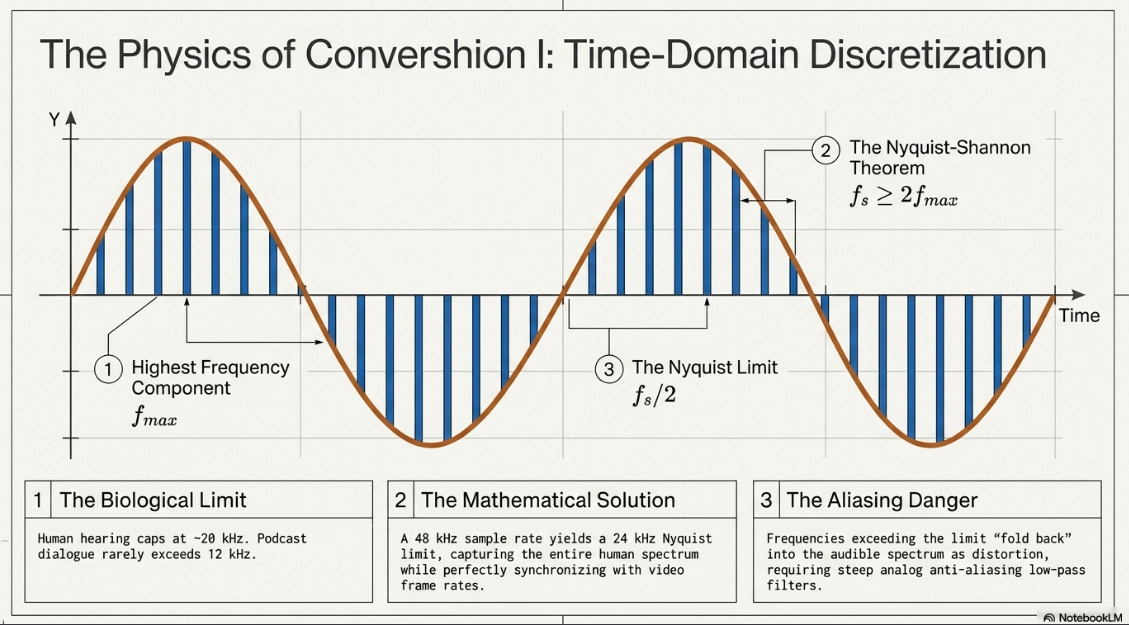
In the specific context of podcasting and vocal capture, human speech rarely contains meaningful acoustic information above 10 kHz to 12 kHz, and the absolute biological limit of human hearing sits at approximately 20 kHz2. Consequently, the traditional Compact Disc standard sampling rate of 44,100 Hz (44.1 kHz) is mathematically sufficient, as its Nyquist frequency of 22.05 kHz comfortably covers the full spectrum of human hearing2. However, professional broadcast environments, film, and video-centric podcasts default heavily to 48 kHz (capturing up to 24 kHz) due to standardized mathematical synchronization with video frame rates2.
While modern, elite audio interfaces support extreme, high-resolution sampling rates of 88.2 kHz, 96 kHz, and up to 192 kHz to capture supersonic frequencies (beyond human hearing), employing such rates for standard podcast dialogue presents significant systemic trade-offs2. Recording at 192 kHz makes calculations relatively simple for the converter and reduces the steepness required for anti-aliasing filters, which can marginally improve phase accuracy2. However, doubling the sample rate doubles the data throughput, increasing file sizes exponentially and placing immense strain on the host computer's CPU without providing a perceptible improvement to the end listener's auditory experience2.
Quantization: Amplitude Discretization and Bit Depth
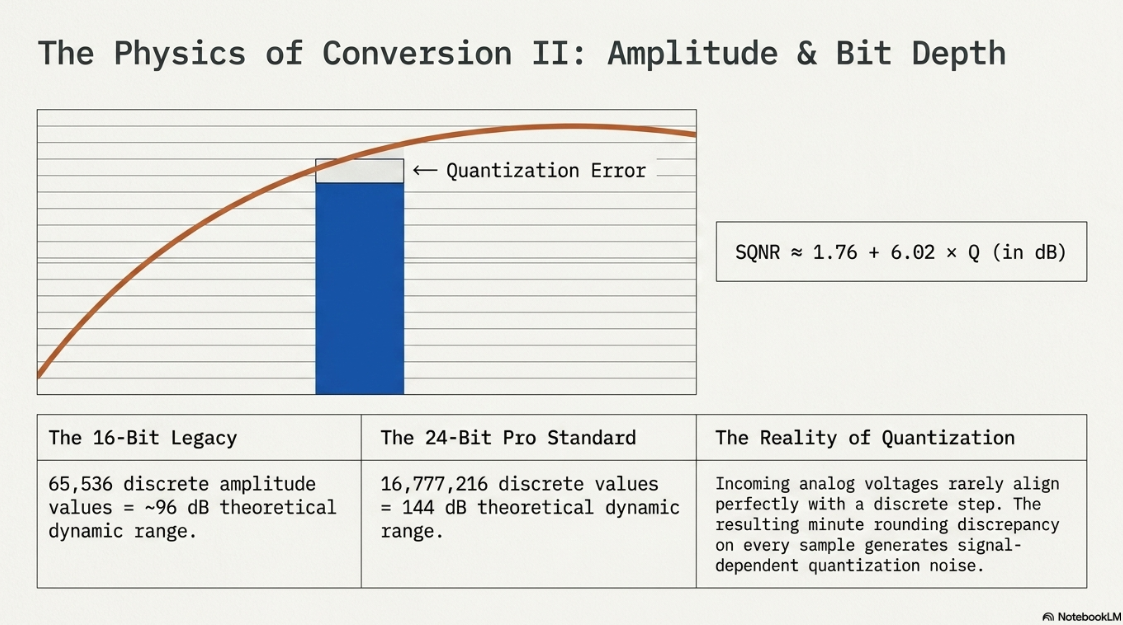
Once a sample is taken in the time domain, its analog amplitude must be rounded to the nearest available numerical value that the digital system can physically store2. This process of representing the amplitude of individual samples as binary integers is called quantization6. The number of discrete amplitude levels available is strictly determined by the bit depth (

Historically, the consumer standard of 16-bit audio provided 65,536 discrete amplitude values per sample, yielding a theoretical maximum dynamic range of roughly 96 dB2. In the 2025 and 2026 technological landscape, the baseline standard for professional recording interfaces has shifted universally to 24-bit resolution2. A 24-bit system provides 16,777,216 discrete values for each individual sample, generating a theoretical maximum dynamic range of 144 dB2. The mathematical relationship between bit depth and maximum signal-to-quantization-noise ratio (SQNR) for an ideal ADC operating with a full-scale sinusoidal input is commonly expressed as:

Because the incoming analog signal voltage rarely aligns perfectly with an available discrete quantization step, a minute rounding error occurs on every single sample2. This rounding discrepancy is termed quantization error2. In an ideal ADC, this error is uniformly distributed between 

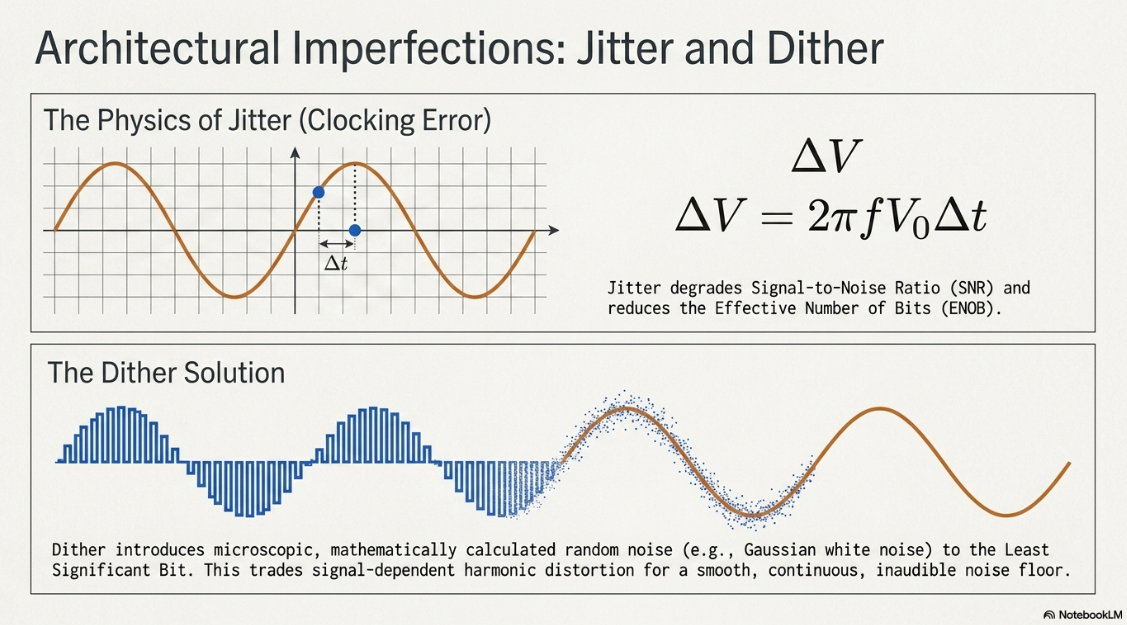
To mitigate this, high-end audio interfaces apply a process called dither9. Dither introduces a microscopic, mathematically calculated amount of random noise (such as Gaussian white noise) to the analog input signal just before conversion9. This randomizes the state of the LSB, effectively decorrelating the quantization error from the audio signal itself9. By trading signal-dependent distortion for a smooth, continuous, and unobtrusive noise floor, dither ensures that micro-dynamics, reverb tails, and low-level ambient details are preserved accurately1. Higher bit depths inherently make this quantization error so vanishingly small that the noise floor becomes practically inaudible in complex productions2.
Clocking, Jitter, and Converter Non-Linearities
An ideal ADC relies on an absolutely stable master clock to capture samples at perfectly spaced intervals. However, physical quartz oscillators and clocking circuits possess microscopic timing uncertainties known as clock jitter1. If a sample is captured slightly too early or too late due to a non-ideal sampling clock, it records the incorrect amplitude of the moving waveform9. Assuming a sinusoidal input signal with amplitude 



This temporal deviation introduces additional recorded noise that degrades the Signal-to-Noise Ratio (SNR) and reduces the Effective Number of Bits (ENOB) below what the 24-bit quantization theoretically predicts9. The ENOB summarizes the number of bits in an ADC's return that are, on average, actual signal rather than noise9. Jitter error is essentially zero for DC signals and minimal at low frequencies, but it becomes highly significant when tracking signals of high amplitude and high frequency9.
Furthermore, all physical ADCs suffer from nonlinearities caused by microscopic physical imperfections in the silicon architecture9. Integral Nonlinearity (INL) and Differential Nonlinearity (DNL) cause the converter's output to deviate slightly from a perfectly linear mathematical function of its input9. These nonlinearities introduce spurious distortion artifacts that reduce the effective resolution of the converter9. While technologies like the sliding scale principle can randomize these errors to improve linearity, elite audio interfaces (such as the Universal Audio Apollo Twin X and RME Babyface Pro FS) utilize proprietary low-jitter clocking architectures and flagship conversion chips to minimize these physical errors5. The result is a practical dynamic range that often exceeds 120 dB, approaching the theoretical limits of 24-bit audio8.
This is to be contrasted with Time-to-Digital converters (TDCs), which are utilized in entirely different scientific applications to recognize events and provide a digital representation of analog time, such as measuring time of flight or propagation delay9. In the audio realm, the ADC's primary metric is maintaining absolute amplitude fidelity across the human hearing spectrum.
The Audio Interface Signal Chain Architecture
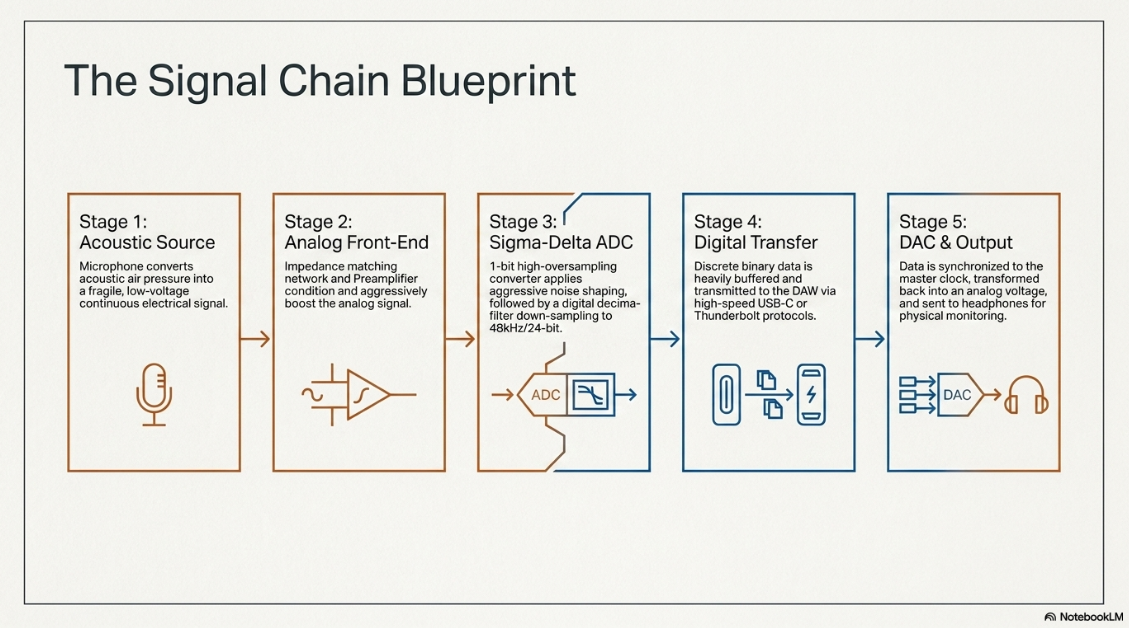
An audio interface acts as the central hub of a podcast studio, interfacing the analog sound world with the digital world of computers and DAWs1. It is not a singular component, but rather a composite unit integrating several distinct, high-precision electronic stages: impedance matching networks, preamplifiers, ADCs, DACs, clocking circuits, high-speed data buffers, and host-connection drivers1.
The Analog Front-End: Preamplification and Impedance Matching
The internal signal path of an audio interface begins at the analog input section1. For a professional podcast, the input source is almost exclusively a microphone. Microphones output a highly fragile, "mic-level" signal, which must be electrically conditioned via an impedance matching network before being sent to the preamplifier1.
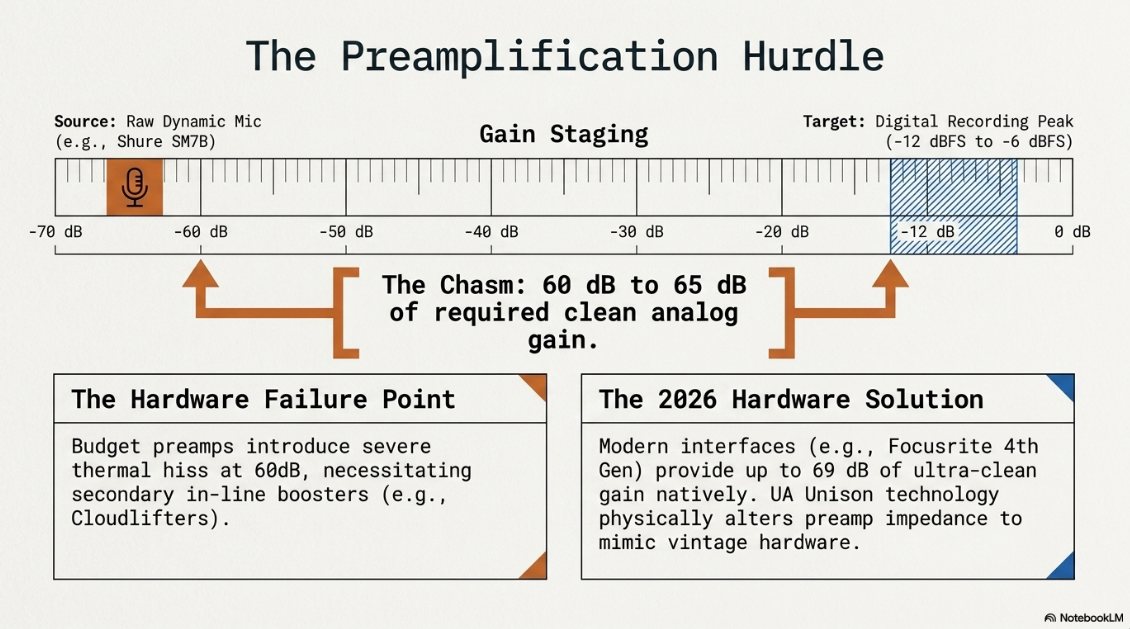
Dynamic microphones—the preferred choice for professional podcasting due to their off-axis noise rejection, durability, and pleasing proximity effect—have notoriously low output sensitivities compared to studio condenser microphones11. Industry-standard dynamic microphones, such as the Shure SM7B, the RØDE PodMic, or the Samson Q2U, require an immense amount of clean analog amplification to reach a healthy digital recording level11. To capture the full color and dynamic range of the voice without distortion, audio engineers aim for vocal peaks hitting between approximately -12 dBFS and -6 dBFS on the input meter12. To achieve this level with an SM7B, the preamplifier must provide between 60 dB and 65 dB of gain11.
The microphone preamplifier is strictly responsible for providing this boost12. If a preamp is inadequately designed or built with cheap components, pushing the gain knob to 60 dB will introduce severe thermal noise, audible hiss, and a degraded Signal-to-Noise Ratio11. Conversely, setting the gain too low results in a weak signal that, when digitally boosted later in the DAW, brings up the noise floor of the entire system12. In previous years, podcasters utilizing budget interfaces were forced to purchase secondary in-line active preamplifiers (e.g., Cloudlifters) to cleanly boost the signal before it reached the audio interface11.
However, the current generation of audio interfaces has largely resolved this bottleneck11. The Focusrite Scarlett 4th Gen interfaces, for instance, utilize a completely redesigned preamp architecture that delivers up to 69 dB of gain, cleanly driving demanding dynamic microphones without requiring any secondary amplification hardware5. Audient takes a different approach, lifting the exact discrete Class-A console preamplifier circuit from their large-format ASP8024-HE recording console and placing it directly into their compact desktop units like the iD14 MKII, delivering ultra-low noise with a touch of classic analog warmth13.
Elite interfaces elevate preamplification further by digitizing the analog characteristics. The Universal Audio Apollo series utilizes proprietary "Unison" technology4. When a user loads a Unison plugin (such as a Neve or API preamp emulation), the software actually alters the physical impedance and gain-staging behavior of the hardware preamp in real-time to perfectly mimic the electronic response of the vintage console being emulated10.
ADC Architecture and Data Transfer Protocols
Once amplified, the analog signal is sent to the ADC. Modern professional audio interfaces rely predominantly on Sigma-Delta (
The resulting digital audio data stream is heavily buffered and transmitted to the host computer utilizing a high-speed digital interface protocol1. USB-C (operating on USB 2.0 or 3.0 protocols) has become the ubiquitous standard for home and project studios due to its speed, universal compatibility across Mac and PC, and bus-powering capabilities5. Thunderbolt 3 and Thunderbolt 4 interfaces remain highly popular in larger professional setups (e.g., Universal Audio Apollo X series) due to their extreme PCIe-level bandwidth, which allows for massive track counts and ultra-low latency data transfers without utilizing the host CPU's USB controller14.
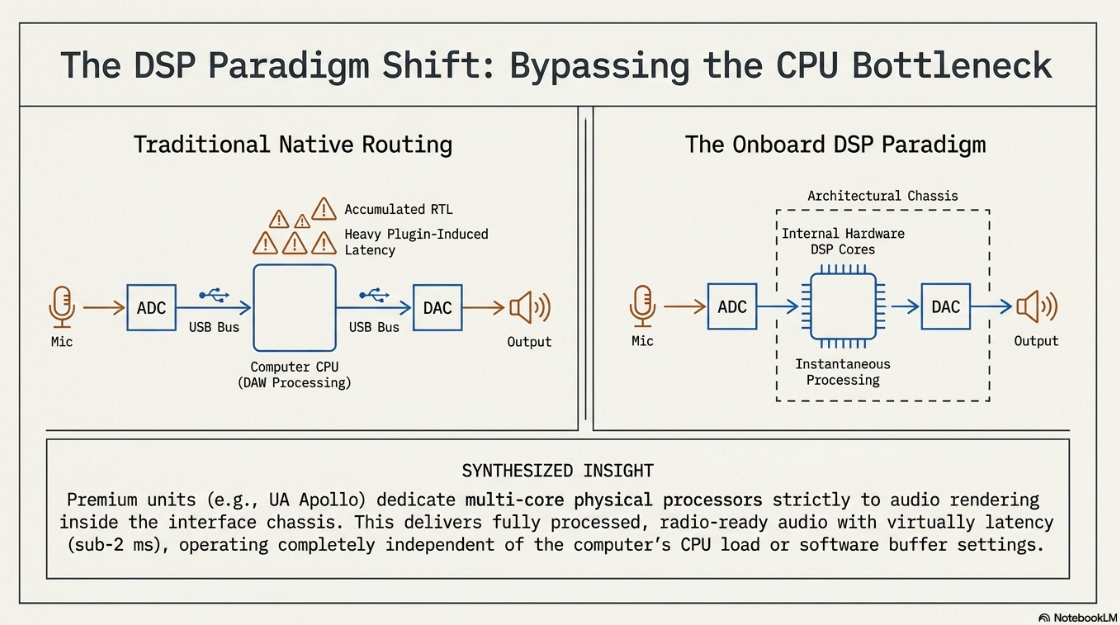
The host computer receives this data, routes it through the DAW, applies software processing, and then sends the digital data back into a buffering stage, synchronized to the master clock1. Finally, the data is transformed back into an analog voltage by the Digital-to-Analog Converter (DAC), which feeds the output drivers to power the studio monitors or headphones1. Every single stage of this data journey—from the ADC, through the USB bus, into the software buffer, and out through the DAC—accumulates minute delays, resulting in a systemic phenomenon known as latency1.
Latency: The Physics of Real-Time Monitoring
For podcasters, particularly those recording remote interviews, taking live caller audio, or monitoring their own voice with software compression and equalization in real-time, latency is the single most critical operational variable14. Latency is strictly defined as the delay between the physical acoustic event entering the microphone and the processed audio reaching the headphones14.
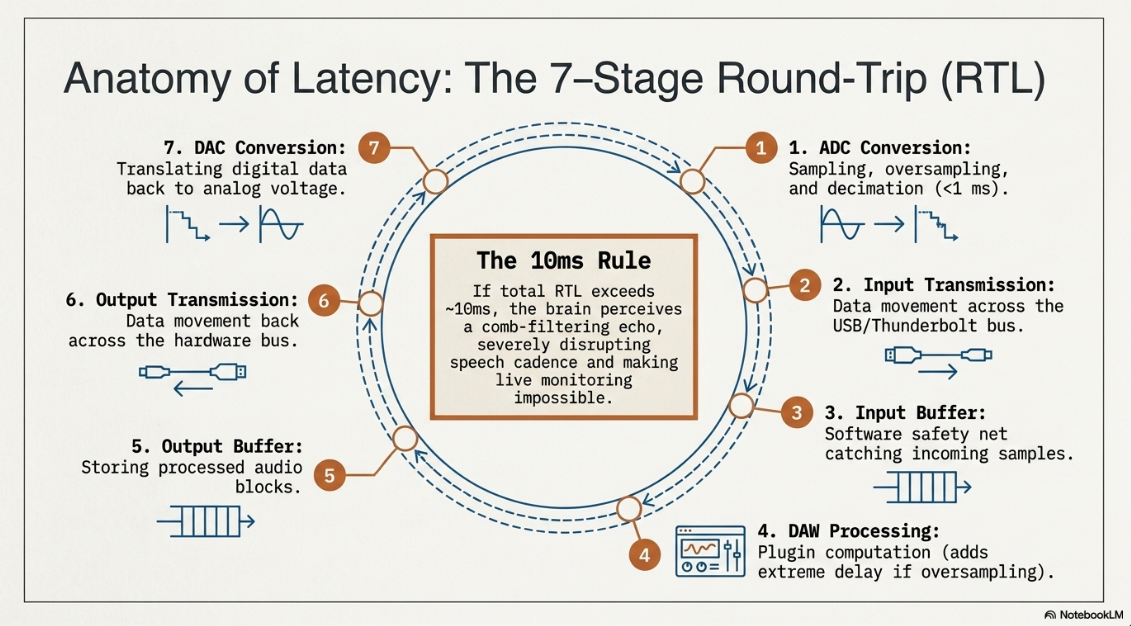
If the latency exceeds roughly 10 milliseconds (ms), the brain perceives the delay between the bone-conducted sound of the speaker's own voice and the delayed audio arriving in the headphones. This creates a distinct "comb filtering" auditory effect, causing a distracting echo that severely disrupts natural speech cadence and makes live monitoring nearly impossible14.
Understanding Round-Trip Latency (RTL)
Round-Trip Latency (RTL) represents the cumulative, total delay of the entire digital ecosystem18. It is mathematically composed of the following sequential stages1:
ADC Conversion Time: The time taken by the hardware to sample, oversample, and decimate the signal (typically well under 1 ms).
Input Transmission: The delay of moving data across the USB or Thunderbolt bus structure.
Input Buffer: A software safety net of samples stored by the computer to prevent audio dropouts (clicks, pops, and digital static) during momentary CPU spikes.
DAW Processing: The time the host software takes to apply plugins. Plugins that utilize look-ahead algorithms, internal buffering, or heavy oversampling introduce substantial latency of their own5.
Output Buffer: Storing the processed audio blocks before dispatching them back to the hardware.
Output Transmission: Moving the data back across the computer's bus.
DAC Conversion Time: Translating the digital signal back into an analog voltage18.
Buffer Physics, CPU Overhead, and Empirical Measurements
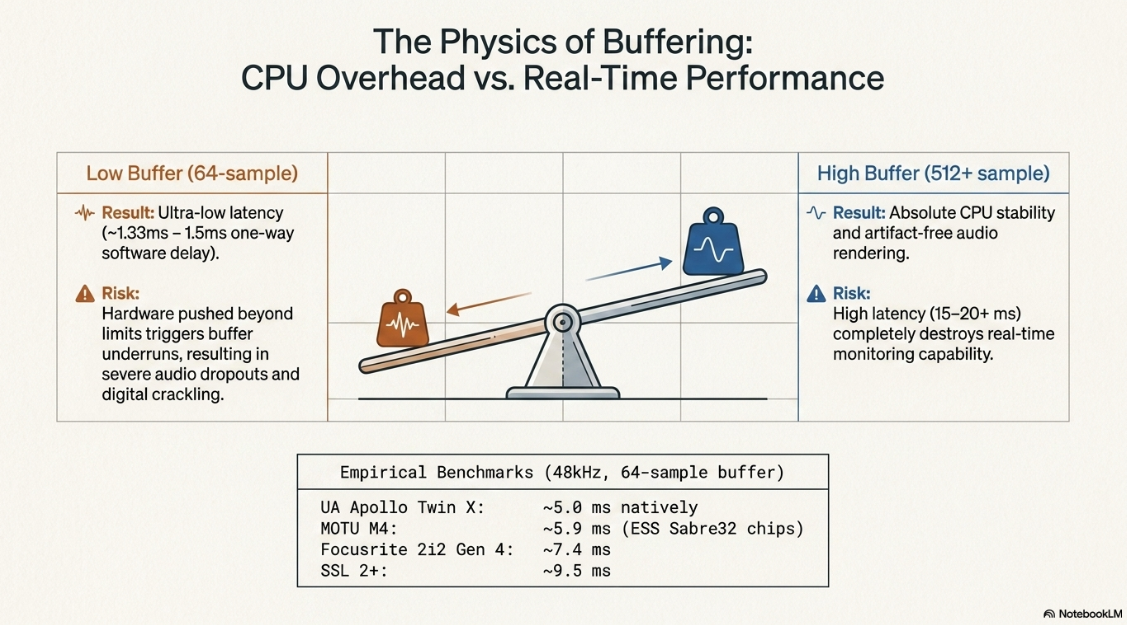
The buffer size is the primary user-adjustable parameter dictating the severity of latency in a computer-based setup. The buffer is measured in discrete blocks of samples (e.g., 32, 64, 128, 256, 512, 1024)15. At a standard sample rate of 48 kHz, an ultra-low 64-sample buffer accounts for approximately 1.33 ms to 1.5 ms of one-way delay just within the software layer15. Moving to a 128-sample buffer creates a low latency environment of roughly 3 ms, a 256-sample buffer creates a moderate 6 ms delay, and larger buffers of 512 or 1024 samples create high latency that maximizes CPU headroom at the complete cost of real-time performance15.
However, the total RTL depends heavily on the efficiency of the interface's custom software drivers. Independent benchmark testing utilizing tools like the Oblique RTL Utility reveals the distinct architectural differences among modern class-leading interfaces operating at 48 kHz with a 64-sample buffer5:
Universal Audio Apollo Twin X: ~5.0 ms RTL natively (drops to sub-2 ms when utilizing hardware DSP tracking)5.
MOTU M4 / M2: ~5.9 ms RTL20. At 44.1 kHz with a 16-sample buffer, the MOTU M4 reports a theoretical RTL of 1.6 ms, though empirical measurements yield a highly impressive 3.8 ms20.
Focusrite Scarlett 2i2 (4th Gen): ~7.4 ms RTL5.
Audient iD14 MkII: ~8.3 ms RTL5.
Solid State Logic SSL 2+: ~9.5 ms RTL5.
When users attempt to push their hardware beyond the physical capabilities of their host CPU by lowering the buffer size too aggressively (e.g., down to 32 or 16 samples on an older machine), the processor inevitably fails to compute the audio blocks in time. This results in buffer underruns, producing severe audio dropouts, distortion, and digital crackling16. Inversely, setting a highly conservative buffer (e.g., 192 or 256 samples) guarantees absolute CPU stability and artifact-free audio, but raises the latency into the 15–20 ms range15.
Furthermore, users must account for plugin-induced latency. If a podcaster utilizes a chain of digital plugins (e.g., an amp simulator, a vocal EQ, and a heavy compressor) and each plugin utilizes a 128-sample internal buffer at 48 kHz, the plugins alone will inject 8 ms of latency into the chain19. If the interface already operates at 7 ms RTL, the combined 15 ms delay will severely distract the performer19.
The Onboard DSP Paradigm
To circumvent the strict physics of buffer latency and CPU overload, the professional podcasting industry is heavily shifting toward hardware-based Digital Signal Processing (DSP)4. Interfaces like the Universal Audio Apollo series feature massive, multi-core internal computer processors (DUO or QUAD core) dedicated entirely to audio rendering4.
Instead of routing the audio into the computer's DAW for processing, the interface applies the effects instantly at the hardware level, before the signal ever hits the USB or Thunderbolt bus4. This architectural shift enables podcast hosts to monitor fully processed, "radio-ready" voices in their headphones with virtually zero latency (sub-2 ms), operating completely independent of the computer's CPU load or software buffer settings4.
Key Technical Specifications and Operational Features for Professional Podcasting
When selecting an audio interface specifically optimized for podcasting, voiceover, and broadcast work, rather than purely musical instrumentation, certain technical specifications and unique workflow features take absolute precedence.
Hardware Loopback Functionality
Modern podcasts frequently integrate remote guests via VOIP applications (Zoom, Skype, Riverside), playback of web browser audio, or background music generated from streaming software4. Traditional audio interfaces severely struggle to capture the computer's internal audio alongside the microphone inputs on separate channels14.
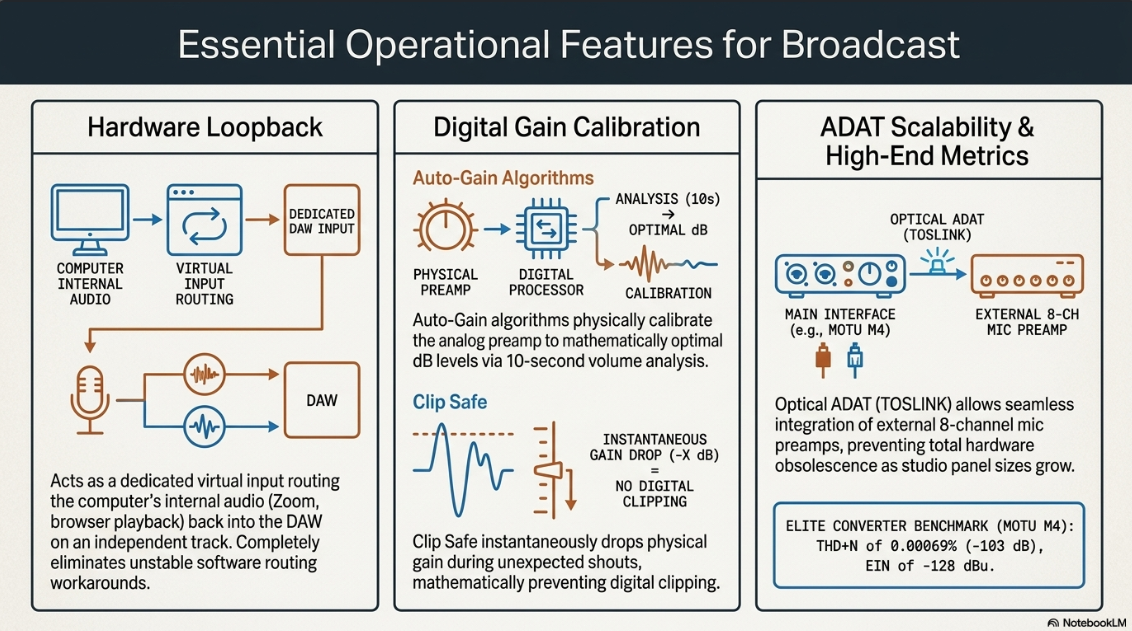
The industry has resolved this via Loopback functionality14. Loopback acts as a dedicated virtual input channel, internally routing the computer's stereo audio output back into the recording DAW as an independent, recordable track4. High-quality interfaces like the MOTU M2/M4, Focusrite Scarlett 4th Gen, SSL 2+, and PreSonus Revelator io24 have baked this feature directly into their standard driver sets, entirely eliminating the need for complex, unstable software routing workarounds4.
Digital Gain Calibration: Auto-Gain and Clip Safe
Given the low output voltage of broadcast microphones, managing preamplification manually can be error-prone. Modern interfaces have introduced digital automation to this analog stage11. Features such as "Auto-Gain" (prominently found in the Focusrite Scarlett 4th Gen and Universal Audio Apollo Gen 2 units) actively analyze the host's speaking volume for a period of ten seconds, and then physically calibrate the analog preamp to the mathematically optimal dB level, preventing digital clipping4.
Accompanying features like "Clip Safe" act as a secondary, real-time safety net. If a host laughs unexpectedly or shouts, the hardware instantaneously reduces the gain stage to prevent digital distortion, effectively rescuing takes that would otherwise be ruined by a clipped signal11.
ADAT Expansion for Studio Scalability
A common operational error in podcast studio design is purchasing an interface based solely on immediate needs (e.g., buying a strict 2-channel interface for a two-host show)14. When the production inevitably expands to include a third guest, a panel discussion, or in-studio musical performances, the hardware becomes immediately obsolete16.
Interfaces equipped with optical ADAT (Alesis Digital Audio Tape) or SPDIF connectivity (e.g., Audient iD14 MKII, Universal Audio Apollo Twin X) provide a critical hedge against this obsolescence5. The ADAT protocol allows for the transmission of up to eight channels of uncompressed digital audio over a single optical TOSLINK cable5. An interface with an ADAT input can seamlessly integrate an external 8-channel microphone preamplifier unit (such as the Focusrite Scarlett OctoPre)13. This protocol transforms a modest 2-channel desktop interface into a highly capable 10-channel recording console when required, fundamentally protecting the initial hardware investment while allowing the studio's technical capabilities to scale linearly with its production demands13.
Advanced Converters and DC Coupling
For testing and advanced metrics, Equivalent Input Noise (EIN) remains a critical metric for podcasting, measuring the inherent noise floor of the preamp when operating at high gain. A professional interface should exhibit an A-weighted EIN approaching -128 dBu or -129 dBu. Total Harmonic Distortion plus Noise (THD+N) measures the percentage of unwanted harmonic artifacts introduced by the circuitry9.
High-end converters, such as the ESS Sabre32 Ultra DACs found in the MOTU M4, boast exceptional metrics18. In empirical testing at 24-bit/96kHz, the M4 demonstrated a THD+N of 0.00069% (roughly -103 dB) in a loopback test, indicating that the digital potentiometers and analog components impart virtually zero quality loss to the signal18. Furthermore, interfaces like the MOTU M-series offer DC-coupled outputs, allowing them to send control voltage (CV) to external analog modular synthesizers—a niche but highly valuable feature for electronic music producers integrating spoken word into hybrid setups5.
Comparative Analysis of Leading Audio Interfaces (2025–2026 Landscape)
The retail landscape for professional audio interfaces—as observed through leading pro-audio distributors such as KMR Audio, Andertons, and West End DJ—presents a wide spectrum of pricing, capabilities, and software bundles25. The market can be broadly segmented into budget mobile solutions, mid-tier desktop champions, premium DSP-enabled studio rigs, and standalone broadcast consoles3.
Entry-Level and Mobile Solutions (Sub £150)
This category is dominated by bus-powered, highly portable interfaces providing 1 or 2 inputs, sufficient for solo podcasters, mobile journalists, or absolute beginners3.
Analysis: For dynamic microphones requiring immense headroom, the Focusrite Scarlett Solo 4th Gen stands entirely alone in the entry-level bracket, offering 69 dB of gain and bypassing the need for an external Cloudlifter, making its slightly higher price point highly economical in the long run11.
The Mid-Tier Desktop Standard (£150 – £350)
This tier represents the "sweet spot" for most home studios and professional podcasters, offering exceptional conversion quality, loopback features, and robust build quality11.
Analysis: The Focusrite Scarlett 2i2 4th Gen is the dominant recommendation for home podcasters11. By supplying 69 dB of gain and leveraging converters trickled down from their high-end RedNet broadcast line, Focusrite has negated traditional hardware limitations11. Meanwhile, the MOTU M4 retains a strict edge for producers prioritizing pure, clinical audio transparency and aggressive latency mitigation, backed by elite ESS Sabre32 chips11. The SSL 2+ MKII strongly appeals to creators seeking analog "color," injecting pleasant harmonic distortion and a high-frequency presence lift suited for vocal tracking4. Finally, the Audient iD14 MKII provides unmatched expandability in this price bracket via its ADAT digital input, alongside massive dynamic range and tactile hardware control via its ScrollControl wheel13.
Premium Desktop and Professional Studio Rigs (£500+)
For professional commercial studios requiring pristine conversion, robust headroom, extreme driver stability, and zero-latency hardware processing, the market shifts to the premium tier, heavily dominated by Universal Audio, RME, and Apogee10.
Analysis: The Universal Audio Apollo Gen 2 architecture strictly defines the modern high-end podcast workflow. By handling EQ, heavy compression (e.g., LA-2A, 1176 emulations), and noise gating on the interface's internal DSP cores, it completely offloads the processing strain from the host computer5. The integration of Apollo Monitor Correction (e.g., SoundID Reference) further allows the hardware to mathematically compensate for acoustic deficiencies in the podcaster's physical room environment, a feature indispensable for critical dialogue editing4. RME, conversely, is favored in live broadcast environments where total driver stability is paramount; their proprietary FPGA chips and dedicated drivers routinely offer the lowest native round-trip latency on the market without forcing the user to rely on an external DSP plugin ecosystem10.
Standalone and Broadcast Consolidation
While traditional interfaces require a host computer to operate, a parallel hardware ecosystem has emerged that consolidates the preamps, ADCs, digital mixer, and standalone multi-track recorder into a single, cohesive chassis14.
RØDECaster Pro II / Duo: Priced at roughly £523 in the UK, the RØDECaster functions as a comprehensive, all-in-one audio production studio17. It features ultra-low noise Revolution preamps with immense gain, built-in APHEX processing (exciters, big bottom EQs, compressors, and de-essers), and integrated sound pads for triggering live audio4. Crucially, it can operate entirely without a PC, recording multi-track audio directly to an SD card, while simultaneously acting as a highly capable USB-C interface for live streaming or remote caller integration14. Similar, highly capable alternatives include the Zoom PodTrak P814.
Sound Devices MixPre Series (3 II / 6 II / 10T): Favored by field documentarians, film sound recordists, and mobile podcasters, these units offer groundbreaking 32-bit float recording capabilities and pristine Kashmir preamps38. 32-bit float audio practically possesses an infinite dynamic range, meaning the analog signal physically cannot clip the digital converter; severely distorted or overly loud inputs can simply be attenuated mathematically in post-production with absolutely no loss of digital data. Furthermore, they feature HDMI timecode readers and generators, and act as highly capable class-compliant USB interfaces operating up to 192 kHz38.
Second-Order and Third-Order Implications in Podcast Audio Execution
Moving beyond base specifications and mathematical formulas, analyzing the trajectory of the podcasting hardware ecosystem reveals several nuanced underlying trends and implications for the future of professional audio production.
The Diminishing Returns of Extreme Sample Rates vs. System Overhead
While high-resolution audio formats (such as 96 kHz and 192 kHz) are heavily marketed as hallmarks of high-end interfaces (e.g., Apogee Symphony, SSL 2+ MKII), the actual utility of these rates in vocal-centric podcasting represents a sharp point of diminishing returns2. Operating a session at 192 kHz essentially quadruples the data throughput required compared to standard 48 kHz2. This massive influx of data mandates drastically smaller buffer times to maintain latency parity, which places extreme, often unsustainable stress on the computer's CPU2.
The second-order implication is that podcasters chasing extreme, supersonic sample rates often unintentionally trigger the very buffer underruns, latency spikes, and audio dropouts they seek to avoid2. The audible artifacts of a failing CPU operating at 192 kHz (clicks, pops, and static) are far more detrimental to a production than the negligible theoretical benefits of capturing frequencies well beyond the limits of human hearing2. Thus, for spoken-word and broadcast formats, the optimal execution remains an incredibly stable 48 kHz / 24-bit setup, deliberately allocating the computer's processing resources toward complex signal routing, real-time noise reduction, and video encoding rather than raw mathematical bandwidth2.
The Software-Hardware Feedback Loop and Ecosystem Lock-In
The rapid industry transition toward DSP-enabled interfaces, such as the Universal Audio Apollo and the Antelope Synergy Core lines, signals a broader shift in the digital audio economy5. By placing crucial plugin processing (Auto-Tune, vintage compression, channel strips) strictly inside the interface hardware, manufacturers elegantly resolve the latency bottlenecks inherent to operating systems like Windows and macOS5.
However, the third-order effect of this DSP architecture is deep ecosystem lock-in5. A studio that constructs its entire podcast signal chain, workflow, and sonic signature around UAD's proprietary plugin environment becomes highly tethered to Universal Audio's hardware architecture5. As a result, when it is time to upgrade the studio or expand input counts, the organization is heavily incentivized financially and operationally to remain within that brand's ecosystem, as their software licenses are inexorably tied to the hardware DSP chips5. Competitors are responding by offering their own integrated software-hardware routing solutions—such as Audient's highly advanced iD Mixer routing matrix and Focusrite's Control software—signaling that the proprietary software controller is now equally as important as the physical preamplifier in securing consumer loyalty13.
Conclusion
The flawless execution of professional podcast audio relies upon meticulously mastering the transition of sound from the physical, acoustic domain to the digital, mathematical domain. The audio interface, serving as the absolute arbiter of this process, is governed by rigid physical laws surrounding sampling rates, bit depth precision, quantization errors, clocking jitter, and signal amplification.
Within the 2025–2026 technological environment, the hardware available to broadcasters has reached unprecedented levels of performance, capability, and economic accessibility. Mid-tier interfaces like the Focusrite Scarlett 4th Gen and MOTU M4 now provide enough ultra-clean analog gain to effortlessly drive industry-standard broadcast microphones, while simultaneously achieving exceedingly low round-trip latencies5. On the premium end of the market, DSP-equipped units like the Universal Audio Apollo Twin X Gen 2 and standalone powerhouses like the RØDECaster Pro II have effectively removed the host computer's processing limitations from the monitoring equation entirely. They deliver latency-free, fully processed audio streams that rival the sonic imprint of world-class, large-format analog recording consoles4.
Ultimately, the supreme optimization of the audio interface requires balancing the physics of digital conversion, the systemic strains of data latency and buffer sizing, and the specific functional requirements of the broadcast format. By strategically leveraging loopback capabilities, high-headroom preamplification, hardware DSP processing, and optical digital expansion protocols, audio producers ensure a signal chain that is not only mathematically precise and aurally transparent, but inherently scalable for the rigorous future of broadcast media.
Works cited
Best Audio Interface Explained: ADC, DAC & Latency - Blikai, https://www.blikai.com/blog/components-parts/best-audio-interface-explained-adc-dac-latency
How Do Audio Signals Work in Analog and Digital Audio - MasteringBOX, https://www.masteringbox.com/learn/audio-signals
The Best Audio Interfaces by Budget in 2026 - Green Musicians, https://www.greenmusicians.com/en/blog/post/best-audio-interfaces-by-budget-2026.html
The 16 Best Audio Interfaces 2026 - Gear4music, https://www.gear4music.com/blog/best-audio-interfaces/
Best Audio Interfaces for Electronic Music Producers (2025) - - SYNTHO, https://syntho.com/2025/10/29/best-audio-interface-electronic-music/
Chapter 5 - Digital Sound & Music, https://digitalsoundandmusic.com/chapters/ch5/
Does Digital or Analog produce better audio? - Hypebot, https://www.hypebot.com/does-digital-or-analog-produce-better-audio/
Digital Audio Basics: Sample Rate and Bit Depth - PreSonus, https://www.presonus.com/blogs/technical/sample-rate-and-bit-depth
Analog-to-digital converter - Wikipedia, https://en.wikipedia.org/wiki/Analog-to-digital_converter
Which audio interface should you choose for your studio setup? - Sienna Sphere Blog, https://siennasphere.acustica-audio.com/blog/which-audio-interface-should-you-choose-for-your-studio-setup/
Best Audio Interface for Podcasting 2025: Top Picks Tested, https://podcastsetuplab.com/best-audio-interface-for-podcasting/
Best Audio Interfaces for Studio-Quality Vocal Recording – 2026 Guide, https://thevocalcoachlondon.com/audio-interfaces-guide/
Audient ID14 MkII USB Audio Interface - Andertons Music Co., https://www.andertons.co.uk/audient-id14-mkii-10-in-4-out-high-performance-usb-interface-with-scroll-control/
10 Best Audio Interfaces for Podcasting 2025 - Sounds Debatable, https://soundsdebatable.com/audio-interfaces-podcasting/
The Best Audio Interfaces for Music Production in 2026: A Complete Buyer's Guide, https://developdevice.com/blogs/news/best-audio-interface-for-music-production-2026
7 Best Audio Interfaces for the Home Studio in 2026 - The AirGigs Music Production Blog, https://blog.airgigs.com/2026/05/7-best-audio-interfaces-for-the-home-studio-in-2026/
Best audio interfaces for for studios, bedrooms and podcasters in 2025 - MusicTech, https://musictech.com/guides/buyers-guide/best-audio-interfaces-for-studios-bedrooms-podcasters/
Motu M4 review: With measurements and Linux notes - Pantherin gainit, https://panther.kapsi.fi/posts/2020-02-02_motu_m4
what is the lowest latency interface in 2025 with well written drivers and support - Reddit, https://www.reddit.com/r/musicproduction/comments/1n2bcne/what_is_the_lowest_latency_interface_in_2025_with/
MOTU M4 & M2, https://www.soundonsound.com/reviews/motu-m4-m2
Scarlett 2i2 4th Gen 19.3ms Round Trip Latency : r/Focusrite - Reddit, https://www.reddit.com/r/Focusrite/comments/1d1uy9s/scarlett_2i2_4th_gen_193ms_round_trip_latency/
Audio Interface Latency Benchmarks - Page 2 - Hardware - Gig Performer Community, https://community.gigperformer.com/t/audio-interface-latency-benchmarks/5336?page=2
Universal Audio Apollo X Gen 2, https://kmraudio.com/collections/universal-audio-apollo-x-gen-2
10 Best Audio Interfaces 2026 (Home Studio to Pro) - Meshplugins.com, https://shop.meshplugins.com/blogs/the-hidden-sauce/best-audio-interfaces
Beginner's Guide to Audio Interfaces - Andertons Music Co., https://www.andertons.co.uk/beginners-guide-audio-interfaces
Audio Interfaces - Westend DJ, https://westenddj.co.uk/collections/audio-interfaces
London Showroom - KMR Audio, https://kmraudio.com/pages/london-showroom
KMR Audio: Recording Studio Equipment | Best Pro Audio in London, https://kmraudio.com/
The 5 best audio interfaces 2026 for home and pro studios, https://higherhz.org/reviews/equipment/best-audio-interfaces/
How to Choose an Audio Interface - Andertons Music Co., https://www.andertons.co.uk/how-to-choose-audio-interface
How to Build a Home Studio for £500 - Andertons Music Co., https://www.andertons.co.uk/how-to-build-a-home-studio-for-500
Focusrite Scarlett 2i2 4th Gen - Andertons Music Co., https://www.andertons.co.uk/focusrite-scarlett-2i2-4th-gen/
Universal Audio Buyers Guide - Andertons Music Co., https://www.andertons.co.uk/universal-audio-buyers-guide
MOTU M4 4-in / 4-out USB-C Audio Interface - Andertons Music Co., https://www.andertons.co.uk/motu-m4-4-in-4-out-usb-c-audio-interface/
Audio Interfaces - KMR Audio, https://kmraudio.com/collections/audio-interfaces
Best MIDI Interface Guide - Andertons Music Co., https://www.andertons.co.uk/best-midi-interface-guide
Universal Audio Apollo Interfaces - Andertons Music Co., https://www.andertons.co.uk/browse/brands/universal-audio/universal-audio-apollo-interfaces/
MixPre Comparison Chart - Sound Devices, https://www.sounddevices.com/mixpre-comparison-chart/
Rode RODECaster Pro II - Andertons Music Co., https://www.andertons.co.uk/rode-rodecaster-pro-ii/