The Evolution of the Podcast Production Ecosystem
The landscape of broadcast-quality spoken-word audio has undergone a profound transformation, moving away from centralized, acoustically perfect studio environments toward decentralized, highly portable, and versatile field recording setups. At the core of this architectural shift is the convergence of the standalone field recorder and the desktop USB audio interface. Historically, production workflows required distinct hardware for different environments: dedicated desktop interfaces tethered to computers for studio tracking, and battery-powered digital recorders for location recording. The modern podcasting ecosystem has merged these functions into singular, highly advanced hardware units. Current-generation portable recorders not only capture high-fidelity multitrack audio to internal storage media but simultaneously bridge analog microphone signals to digital audio workstations (DAWs) and remote conferencing platforms via USB connectivity1.
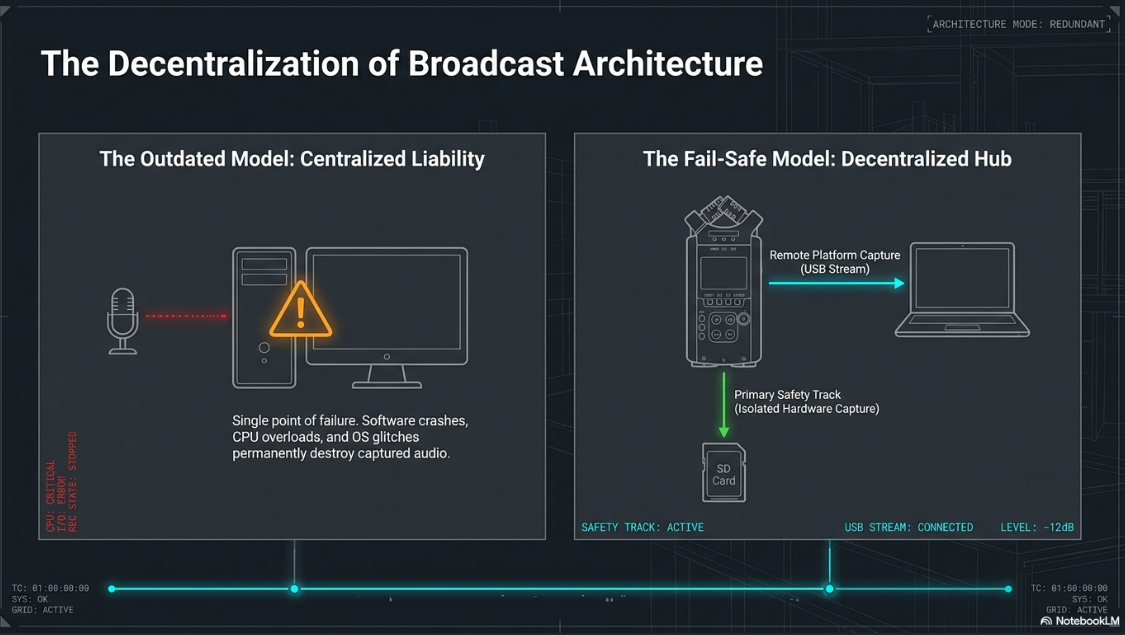
This dual-functionality presents a paradigm of redundant recording, which has become the gold standard in professional audio execution. In a professional workflow, the ability to record a primary safety track to a localized SD card while simultaneously streaming the audio to a computer for remote platform capture (such as Riverside.fm, Zencastr, or Zoom) ensures that digital dropouts, computer crashes, or software glitches do not result in catastrophic data loss4. Relying solely on a computer for recording is widely considered a liability in mission-critical broadcast scenarios2.
Furthermore, utilizing an external portable recorder as an interface allows producers to harness professional-grade XLR microphones, high-headroom preamplifiers, and advanced digital signal processing (DSP) algorithms that far exceed the capabilities of consumer-grade USB microphones8. While standalone USB microphones provide convenience for hobbyists, they severely limit future upgradeability, restrict multi-host physical recording capabilities, and often lack the robust circuitry required for pristine analog-to-digital conversion8. By deploying a dedicated hardware recorder as the central hub, audio engineers establish a scalable, fail-safe architecture capable of adapting to any acoustic environment or geographical limitation.
Transducer Physics: Selecting External Microphones for Portable Architectures
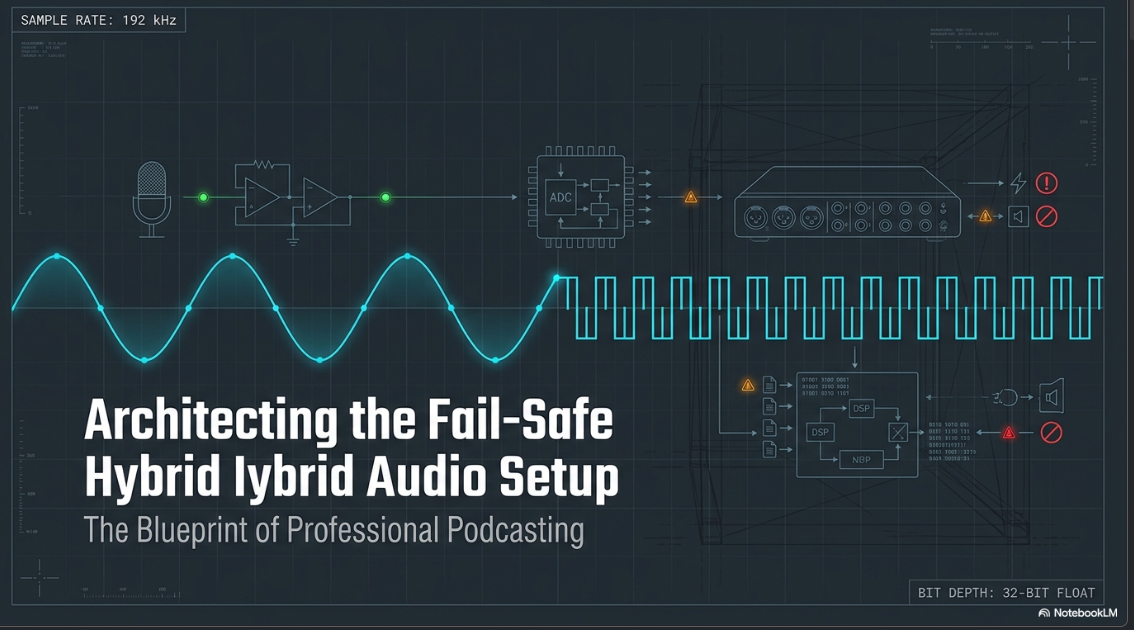
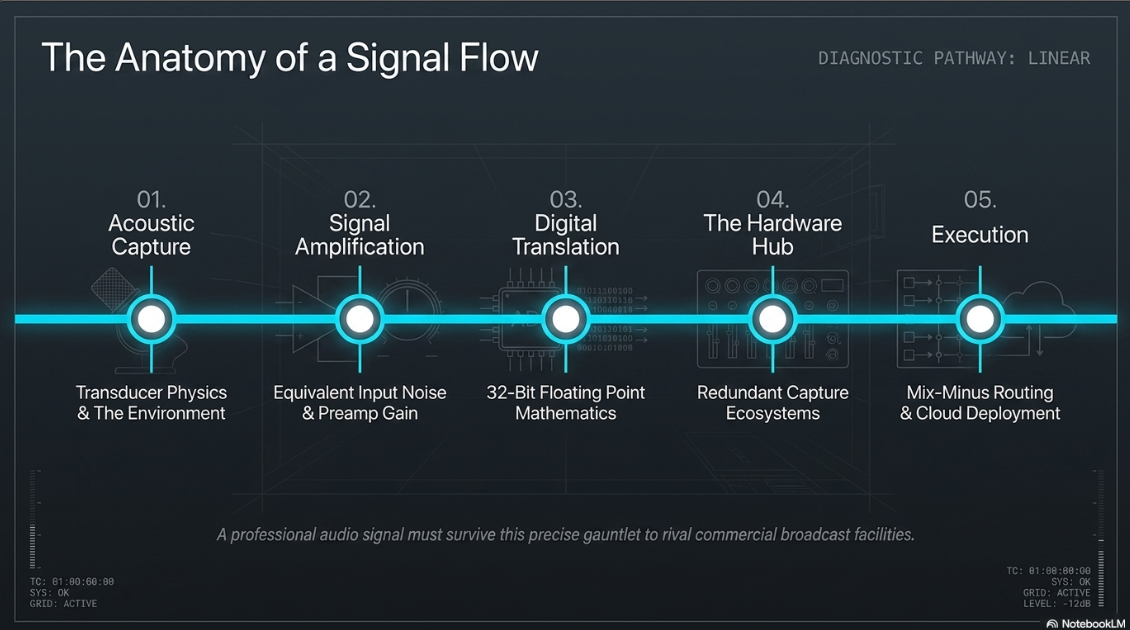
The initial stage of any audio signal chain is the transducer—the microphone—which converts acoustic kinetic energy into electrical voltage. In the context of podcasting, the selection of the transducer fundamentally dictates the required preamplification, the necessary hardware connections, and the overall interaction with the recording environment. Microphones generally fall into two primary categories based on their internal operating principles: dynamic (moving-coil) and condenser (capacitor).
Dynamic Versus Condenser Topologies
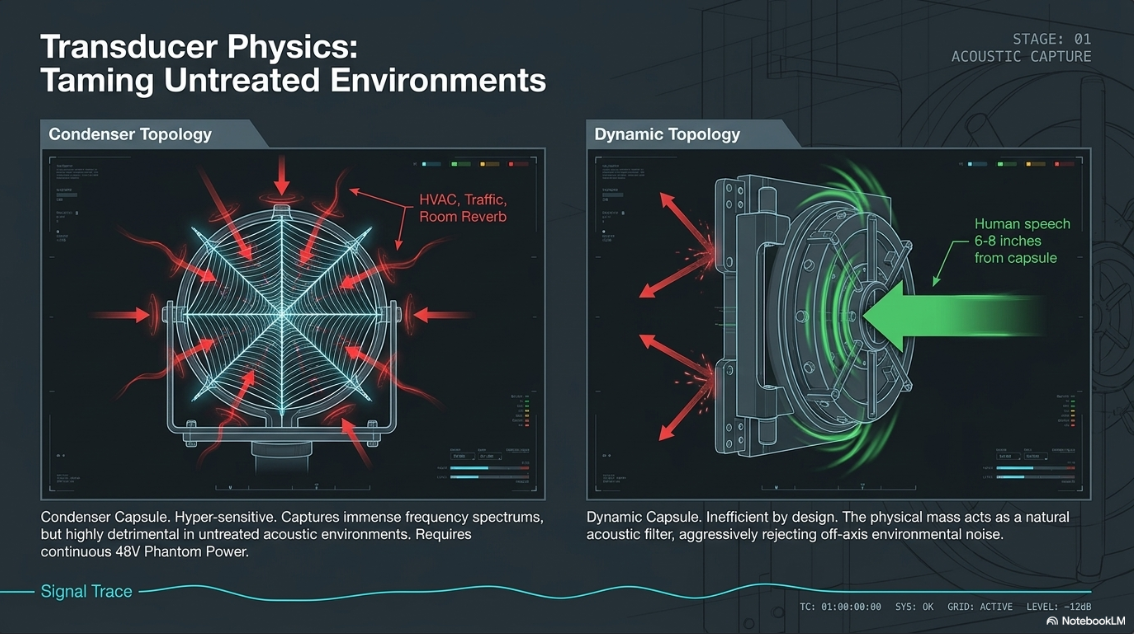
Condenser microphones utilize a thin, electrically charged diaphragm positioned in close proximity to a solid metal backplate. As acoustic waves hit the diaphragm, the distance between it and the backplate fluctuates, altering the capacitance and generating an audio signal. This design is highly sensitive, capable of capturing a massive frequency spectrum with exceptional transient response. However, this hyper-sensitivity is often highly detrimental in podcasting applications7. Most home studios, hotel rooms, or field locations lack proper acoustic treatment, meaning condenser microphones will faithfully capture every unwanted environmental artifact: HVAC systems, traffic noise, computer fans, and the acoustic reflections (reverb) of the room itself11. Furthermore, condenser microphones require 48V phantom power—a continuous electrical current supplied by the interface or recorder—to charge the capsule and power the internal active circuitry13.
Conversely, dynamic microphones operate on the principle of electromagnetic induction. A diaphragm is attached to a small coil of wire suspended within a magnetic field. Sound waves vibrate the diaphragm, moving the coil and generating a corresponding electrical current. Because the physical mass of the moving coil is heavier than a condenser's delicate membrane, dynamic microphones require significantly more acoustic energy to induce movement. This inherent inefficiency acts as a natural acoustic filter, aggressively rejecting off-axis environmental noise and distant room reflections12. For untreated rooms, noisy outdoor environments, and multi-person setups where microphone bleed (the sound of one speaker leaking into another's microphone) is a primary concern, dynamic microphones are the industry standard7.
Polar Patterns, Off-Axis Rejection, and Spatial Placement
The directional sensitivity of a microphone—its polar pattern—determines how it interacts with the surrounding acoustic space. Understanding these patterns is essential for positioning hardware in the field.
Cardioid patterns pick up sound primarily from the front (0º axis) while rejecting sound from the rear (180º). This is the most common pattern for podcasting, offering a wide enough 'sweet spot' for the host while ignoring ambient noise originating from behind the microphone12. Supercardioid and hypercardioid patterns feature a tighter, more focused front pickup area, offering superior side rejection (90º and 270º) but introducing a small, sensitive lobe at the rear. These are highly effective for multi-person setups if the microphones are positioned carefully so that co-hosts sit in the null zones rather than the rear pickup lobe12. Finally, omnidirectional patterns capture audio equally from all directions (360º), which is generally disastrous for podcasting unless the explicit goal is to capture the ambient noise of a public setting alongside the speech12.
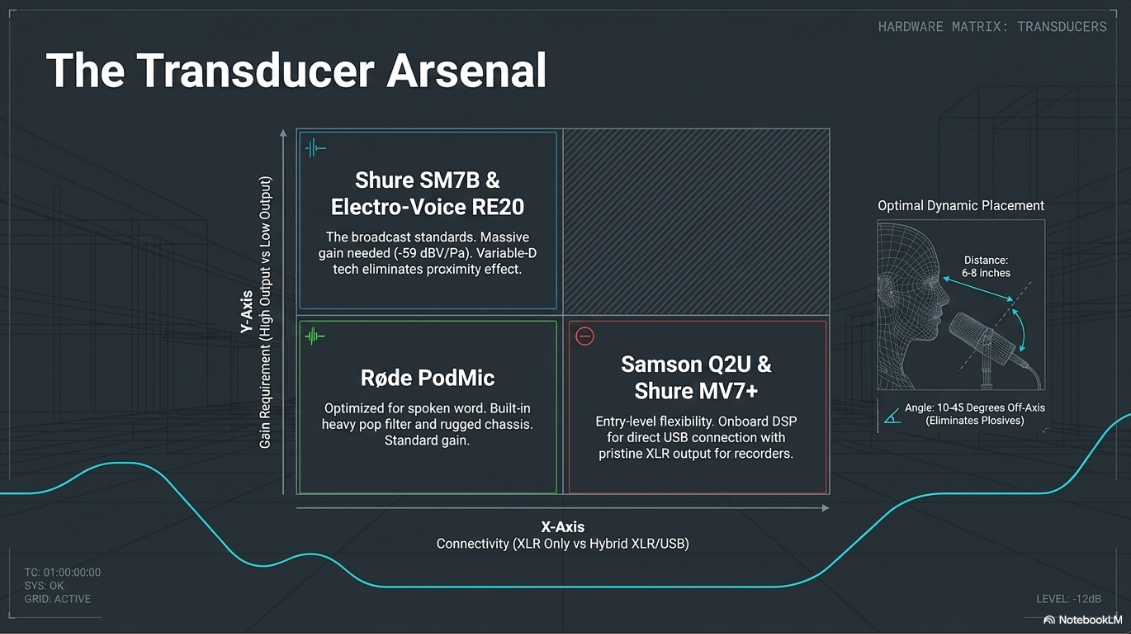
Proper spatial placement of the transducer is equally critical. For dynamic microphones, optimal placement dictates positioning the capsule six to eight inches from the speaker's mouth11. Speaking directly into the center of the diaphragm yields a bright, articulate sound, while angling the microphone slightly off-axis (between 10 and 45 degrees) produces a richer, warmer tone with enhanced lower frequencies while simultaneously reducing the impact of plosives (harsh bursts of air from 'P' and 'B' consonants)15.
Recommended Transducers for Hybrid Setups
Selecting the proper microphone dictates the hardware requirements for the subsequent portable recorder, particularly concerning necessary preamplifier gain and connectivity.
Preamplification Physics: Gain, Headroom, and Equivalent Input Noise
When an analog signal leaves a dynamic microphone, it travels down the XLR cable as a "mic-level" signal. This voltage is extraordinarily low—often measured in fractional millivolts. Before this signal can be converted into digital data by the portable recorder's internal circuitry, it must be amplified to a robust "line-level" by a preamplifier (preamp). The physics of preamplification represent the most critical bottleneck in podcast audio quality, dictating the clarity and professional sheen of the final product.
The Challenge of Low-Output Dynamic Microphones
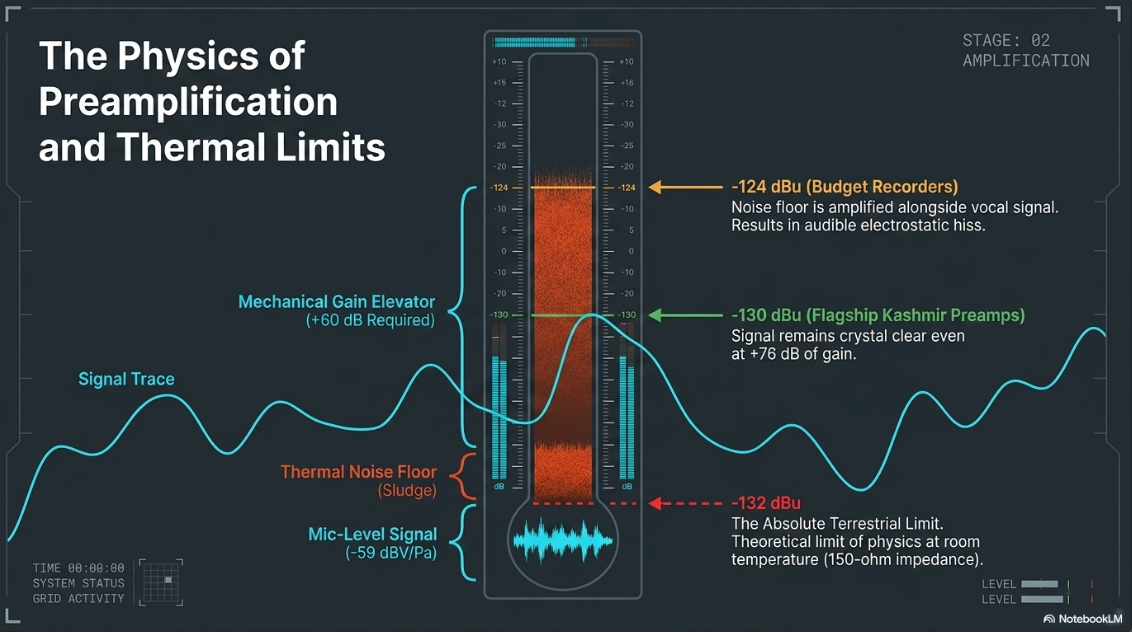
High-end dynamic microphones like the Shure SM7B and the Electro-Voice RE20 are notorious for their exceptionally low sensitivity ratings. The SM7B, for instance, outputs a signal of approximately -59 dBV/Pa. To bring this signal up to a healthy digital recording level (peaking around -12 dBFS to -6 dBFS, leaving appropriate headroom for unexpected loud moments), the preamplifier must provide between +55 dB and +60 dB of clean gain11. This demand places massive stress on the electrical components within the portable recorder.
Equivalent Input Noise (EIN) and Thermal Limits
Every electronic circuit generates inherent self-noise due to the thermal agitation of electrons. In microphone preamplifiers, this self-noise is measured as Equivalent Input Noise (EIN). EIN is expressed in decibels relative to a specific voltage (dBu), and it represents the absolute noise floor of the preamp when operating at maximum gain. The theoretical physical limit for EIN at room temperature with a 150-ohm source impedance is approximately -132 dBu to -133 dBu21. Noise is a fundamental reality of physics; the goal of high-end hardware engineering is to approach this theoretical minimum.
Budget to mid-tier portable recorders often struggle in this domain. A device like the popular Zoom PodTrak P4 offers an impressive 70 dB of total gain, but its EIN is rated at -124 dBu20. While this is entirely adequate for high-output condenser microphones, when the gain is cranked to +60 dB to drive a Shure SM7B, the -124 dBu noise floor is amplified directly alongside the vocal signal. This results in an audible, fatiguing electrostatic hiss permeating the recording20.
Conversely, flagship devices like the Sound Devices MixPre series feature proprietary "Kashmir" Class-A discrete preamplifiers. These ultra-premium preamps boast an EIN of -130 dBu and can provide up to +76 dB of gain5. Because their noise floor approaches the absolute limits of terrestrial physics, they can amplify the quietest dynamic microphones effortlessly without introducing audible hiss, rendering the signal crystal clear20.
Inline Preamplifiers: JFET Topology and Gain Optimization
For podcasters utilizing portable recorders with noisier preamplifiers (EIN ratings of -124 dBu or worse), driving a low-output dynamic microphone directly can severely degrade a recording. The industry-standard solution is the deployment of an inline preamplifier, commonly referred to as a "mic activator."
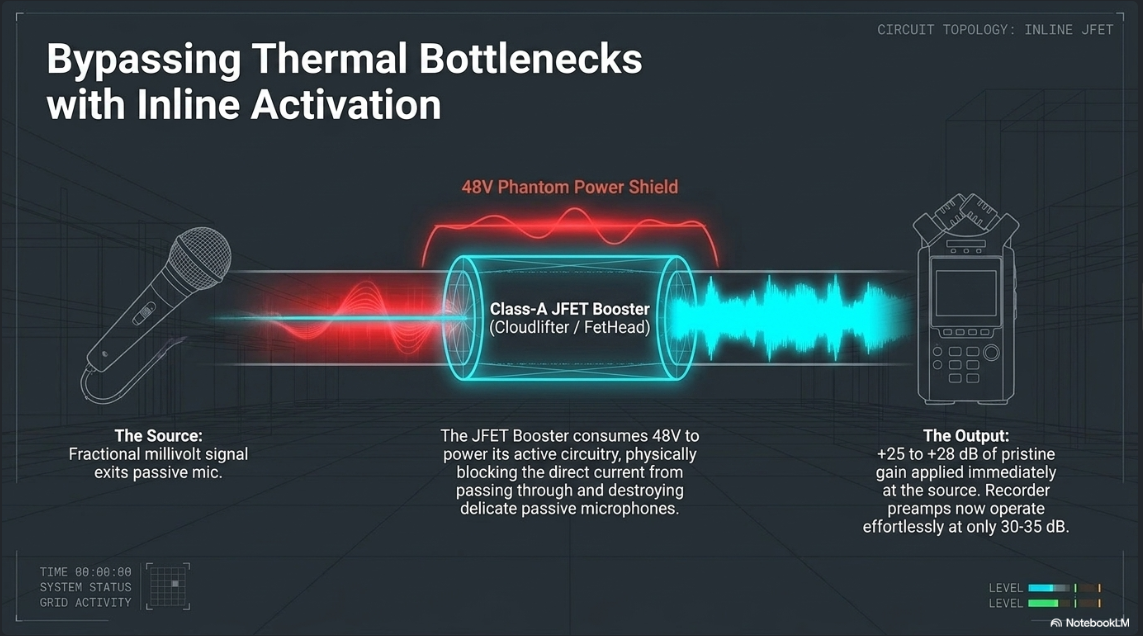
Prominent models in this category include the Cloud Microphones Cloudlifter CL-1 (providing +25 dB of gain), the Triton Audio FetHead (+27 dB), and the sE Electronics Dynamite DM-1 (+28 dB)25. These compact, cylindrical devices sit in the analog signal chain between the microphone and the portable recorder.
Inline preamplifiers utilize Class-A Junction Field Effect Transistor (JFET) circuitry to provide ultra-clean, transparent gain. To power this active circuitry, the devices require 48V phantom power supplied by the portable recorder via the XLR cable. Crucially, the inline preamp consumes the phantom power to operate its JFETs and completely blocks the 48V direct current from passing through to the microphone25. This is a vital safety mechanism, particularly for delicate passive ribbon microphones, which can be instantly destroyed if exposed to stray phantom voltage25.
By adding approximately 25 to 28 dB of pristine gain immediately at the source, the inline preamp elevates the mic-level signal before it travels down the cable and hits the recorder. Consequently, the audio engineer only needs to apply 30 to 35 dB of gain at the portable recorder's preamplifier. This allows the recorder's internal components to operate in a much more efficient, lower-noise sweet spot21. The mathematical result is a vastly improved Signal-to-Noise Ratio (SNR), essentially converting a low-output microphone into a high-output microphone and rendering the audio virtually noise-free21.
Analog-to-Digital Conversion and the 32-Bit Floating Point Paradigm
Once the analog voltage is sufficiently amplified, it must be converted into digital data. For decades, digital audio has been governed by fixed-point integer mathematics, primarily operating at 16-bit or 24-bit depths. The bit depth dictates the digital dynamic range—the mathematically definable space between absolute silence (the digital noise floor) and digital clipping (0 dBFS). In digital audio, clipping occurs when a signal exceeds the maximum values that the bit depth can encode, resulting in the permanent destruction and aggressive distortion of the audio waveform29.
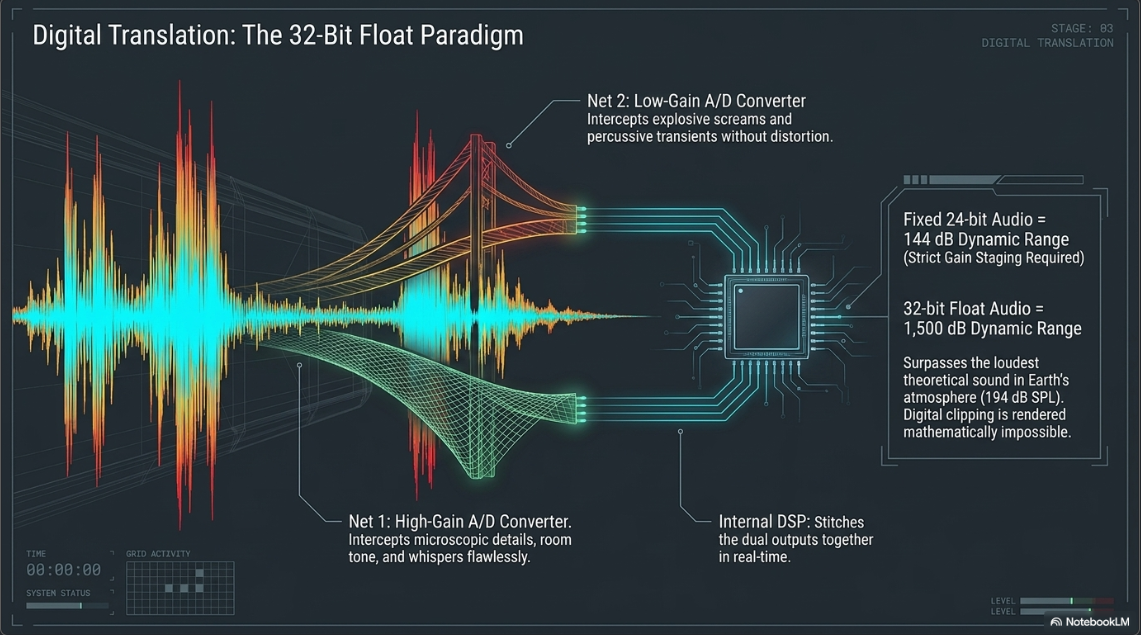
A standard 16-bit recording yields roughly 96 dB of dynamic range, while a professional 24-bit recording yields 144 dB of dynamic range. In a 24-bit paradigm, gain staging is a highly delicate balancing act. An engineer must set the preamp gain high enough so that the speaker's voice sits well above the noise floor, but low enough so that sudden outbursts of laughter, screaming, or percussive table bumps do not breach 0 dBFS and cause irreversible clipping29.
The recent introduction of 32-bit floating-point audio into portable recorders and USB audio interfaces has fundamentally revolutionized field recording by effectively eliminating the gain-staging problem.
The Mathematics of 32-Bit Float
Unlike fixed-point integers, floating-point data architecture uses a mantissa and an exponent to represent audio data. This allows the digital scale to dynamically slide up or down to accommodate the incoming signal. The resulting mathematical dynamic range of a 32-bit float file exceeds 1,500 dB31. Because the threshold of human hearing is 0 dB SPL and the loudest sound physically possible in Earth's atmosphere (the theoretical limit of acoustic shockwaves) is roughly 194 dB SPL, a 1,500 dB dynamic range vastly exceeds the physical limitations of acoustic sound propagation29.
Dual A/D Converter Architecture
To translate this mathematical theory into physical hardware, manufacturers like Sound Devices, Tascam, and Zoom utilize dual Analog-to-Digital (A/D) converters for every single input channel30. The best single A/D converters on the market yield roughly 130 dB of dynamic range, which cannot cover the massive headroom required by 32-bit float31. Therefore, two converters operate in tandem:
The High-Gain Converter: Optimized for capturing incredibly quiet whispers, ambient room tone, and low-level details without introducing digital noise.
The Low-Gain Converter: Optimized to intercept massive transients, screams, and extreme volumes without distorting.
The digital signal processor inside the recorder seamlessly stitches the output of these two converters together in real-time, resulting in a single continuous 32-bit float data stream31.
When using a 32-bit float portable recorder as a USB interface, the DAW receives a signal that is fundamentally immune to digital clipping. If a podcaster screams and the waveform appears visually clipped (squared off) on the computer screen, the engineer simply drags the clip gain down inside the software after recording. Because the peak information is mathematically preserved via the floating exponent, the audio is restored perfectly without a trace of distortion29. Conversely, if audio is recorded far too quietly, it can be normalized upward by 60 dB or more without artificially raising the digital noise floor31. This technology is so profound that it effectively removes the need for input gain knobs entirely, a design philosophy perfectly realized in ultra-compact devices like the Zoom F332.
It is vital to note that to maintain these benefits, the recording must be saved and processed in the 32-bit float WAV file format; standard 32-bit integer formats do not provide the same exponential dynamic range31.
Hardware Ecosystem Analysis: Flagship Hybrid Recorders
The current hardware market offers a broad spectrum of portable recorders capable of functioning as elite desktop USB interfaces. Selecting the appropriate chassis requires aligning hardware specifications with the specific workflow demands of the podcast.
1. Zoom PodTrak P4
The Zoom PodTrak P4 represents a highly specialized, accessible entry point into decentralized podcast production. It is fundamentally designed to solve complex routing problems that historically required bulky, expensive mixing consoles.
Preamplifiers and Inputs: The unit features four XLR inputs providing up to 70 dB of gain. While the aforementioned EIN of -124 dBu dictates that low-output dynamic microphones may require inline preamps for optimal clarity, the raw power is substantial20.
Localized Monitoring: The P4 features four independent 3.5mm headphone outputs, each with a dedicated physical volume potentiometer. This eliminates the need for external headphone splitters or discrete headphone amplifiers during multi-host in-person recordings22.
The Mix-Minus Matrix: The P4's greatest technological asset is its built-in, automatic mix-minus capability. When a smartphone is connected via the dedicated TRRS jack, or a computer is connected via USB for remote conferencing (e.g., Riverside.fm or Zoom), the P4 automatically routes the local studio audio to the remote guest, while routing the remote guest's audio back to the local headphones. Crucially, it subtracts the remote guest's own voice from the return feed, eliminating the catastrophic echo and feedback loops that plague standard audio interfaces22.
Interface Capabilities: It functions as a 2-in/2-out interface operating at 16-bit / 44.1 kHz. While it lacks audiophile resolution and 32-bit float technology, it perfectly matches standard broadcasting requirements for spoken word20.
2. Tascam Portacapture Series (X8 and X6)
The Tascam Portacapture series eschews traditional menu-diving interfaces, leveraging smartphone-style touchscreen interfaces paired with next-generation 32-bit float technology.
Inputs and Conversion: The flagship X8 features four locking XLR/TRS combo jacks with proprietary HDDA preamps featuring an EIN of -126 dBu33. The A/D converters operate at an immense 192 kHz / 32-bit float37. It also features two detachable 14.6mm large-diaphragm condenser microphones that can be configured in A-B or True X-Y stereo patterns33.
USB Interface Mode: Driverless, class-compliant architecture allows the X8 to function seamlessly as an 8-input / 2-output audio interface. It possesses the processing power to simultaneously record to its internal micro-SD card while streaming 32-bit float audio directly into a DAW or NLE software33.
DSP and UI: The 3.5-inch color touchscreen "Launcher" interface allows users to select application-specific modes (e.g., Podcast, Field, ASMR, Music). These modes automatically configure the internal compressor, limiter, low-cut filters, and noise gates for the specific acoustic scenario, streamlining the setup process32.
3. Sound Devices MixPre II Series (MixPre-3, 6, and 10)
For uncompromising audiophile quality, film-industry standard reliability, and cinematic-grade field production, Sound Devices is the apex standard. The MixPre II series functions as both an ultra-premium desktop interface and a bulletproof location recorder.
Kashmir Preamplifiers: As previously established, these discrete, Class-A preamps yield an unparalleled EIN of -130 dBu and +76 dB of gain, allowing the direct drive of any passive dynamic or delicate ribbon microphone without external inline activation5.
Advanced Routing and USB: The MixPre-6 II can serve as an 8-in / 4-out USB audio interface for Mac or Windows. It supports full 32-bit float throughput over USB14. Furthermore, it supports complex routing matrices, allowing users to isolate localized microphone sources from computer USB returns, creating pristine, bespoke mix-minus setups for remote conferencing14.
Timecode Integration: Essential for videographers and video-podcasting, the MixPre series includes an internal Temperature Compensated Crystal Oscillator (TCXO) accurate to 0.2 ppm, translating to less than half a frame of drift per 24 hours. Timecode can be synchronized via HDMI or 3.5mm inputs, allowing the audio hardware to sync perfectly with multi-camera arrays in post-production14.
4. Zoom F-Series
Zoom's advanced professional lines offer highly robust 32-bit float technology across rugged field form factors.
Zoom F6: A highly compact 6-input field recorder with dual A/D converters, an EIN of -127 dBu, and massive gain capability up to 75 dB30. When operating in standard 24-bit modes, the F6 utilizes advanced look-ahead hybrid limiters. By adding a microscopic 1-millisecond delay to the signal path, the DSP "looks ahead" and intercepts peaking transients, compressing them before they can cause digital clipping30.
Hardware Comparison Matrix
Power Management and Storage Media in Field Operations
Decentralized podcasting requires absolute reliance on internal power delivery and localized storage. Ensuring hardware stability prevents catastrophic data loss during extended field recordings.
Battery Chemistry and Power Delivery
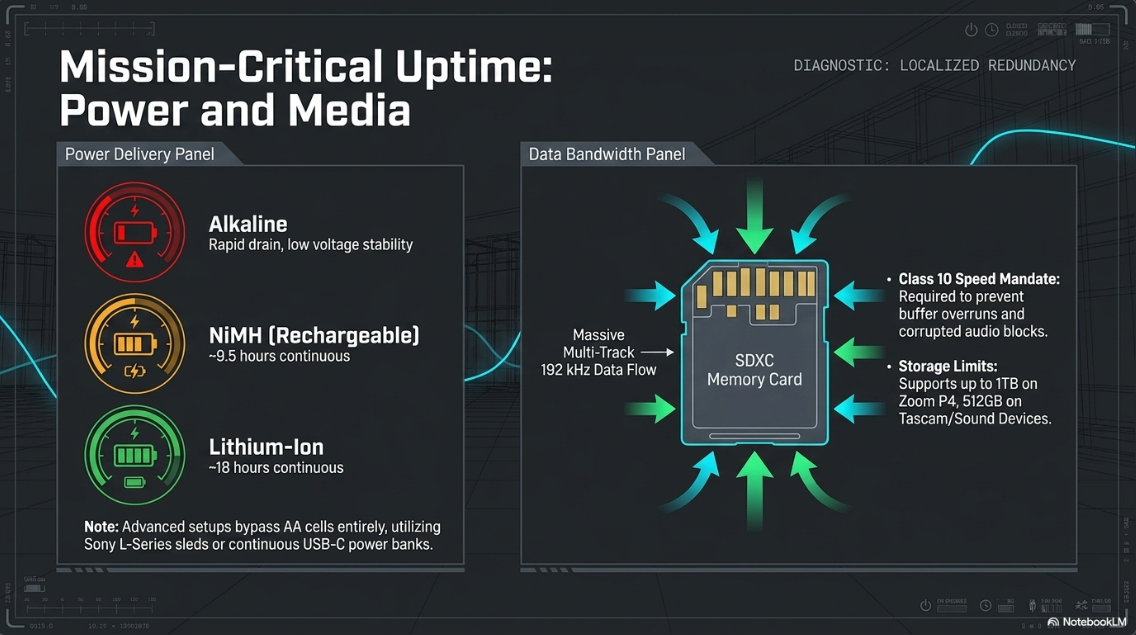
The lifespan and stability of a portable recorder are dictated heavily by battery chemistry. Devices like the Tascam Portacapture X8 and the Sound Devices MixPre series rely on AA batteries, but the type of AA cell drastically alters performance36. Standard alkaline batteries drain rapidly when supplying continuous 48V phantom power to multiple XLR microphones36.
Lithium-Ion AA Cells: Provide the most robust and longest-lasting performance. For instance, the Tascam Portacapture X8 can operate for up to 18 hours on lithium batteries, compared to only 11 hours on standard alkalines36.
NiMH (Nickel-Metal Hydride): Rechargeable NiMH batteries are highly recommended for consistency and cost-effectiveness over time, offering approximately 9.5 hours of life under similar loads22.
L-Mount and USB Bus Power: Advanced recorders support external power ecosystems. The MixPre series can utilize Sony L-Series battery sleds for massive extended runtimes23. Virtually all modern recorders, including the Zoom P4 and Tascam X8, feature USB-C ports that accept power from external USB power banks or direct AC wall adapters, allowing for uninterrupted all-day studio operation33.
Storage Media Specifications
Data must be written to stable, high-speed storage. Recorders universally rely on the Secure Digital (SD) format, spanning standard SD, SDHC (High Capacity), and SDXC (eXtended Capacity)22. When recording massive 32-bit float, 192 kHz files across six or eight isolated tracks, data bandwidth is immense.
Capacity Limits: The Zoom PodTrak P4 supports SDXC cards up to 1 TB, while the MixPre and Portacapture series support capacities up to 512 GB22.
Speed Class: To prevent buffer overruns and recording failures, cards must meet a minimum specification of Class 10 or higher22. Using low-speed generic cards will result in corrupted audio blocks.
Advanced Software Execution and Signal Flow
Integrating a portable recorder as an audio interface requires precise software configuration to maximize audio fidelity and ensure stable data transfer between the hardware and the host computer.
USB Audio Class Compliance vs. ASIO Drivers
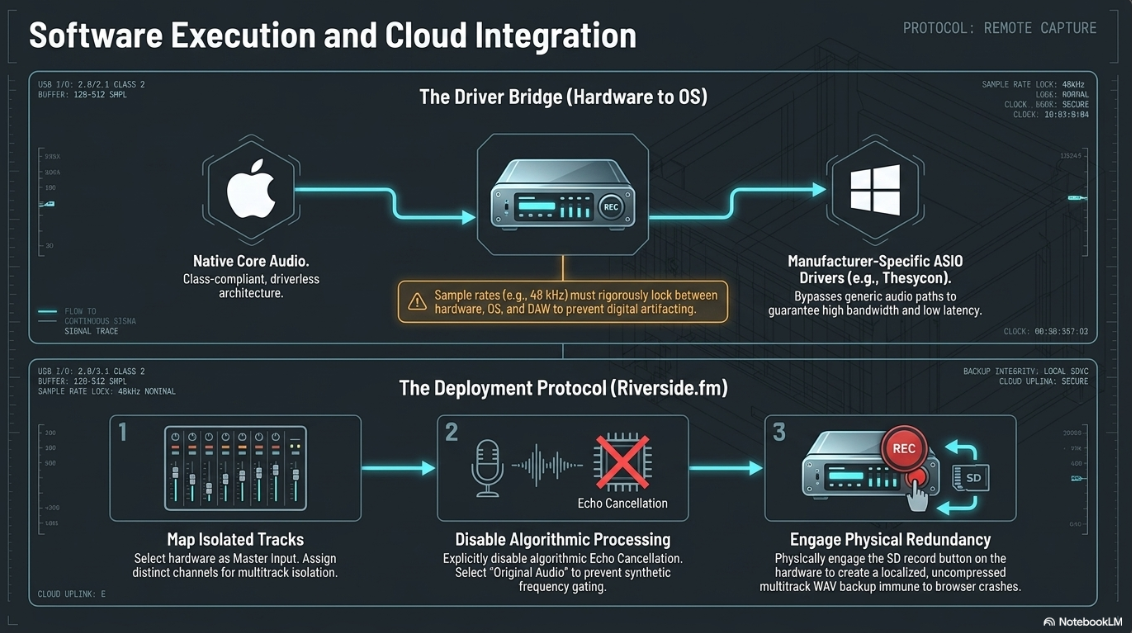
The protocol by which the audio hardware speaks to the computer's operating system is paramount. On macOS operating systems, most portable recorders utilize Core Audio. This is a highly efficient, native class-compliant audio framework engineered by Apple that requires no external drivers43. The Mac will instantly recognize devices like the MixPre or Portacapture as multitrack inputs and outputs.
On Windows architectures, the situation is vastly different. Relying on standard generic Windows audio drivers can result in unacceptable latency, dropped audio packets, and synchronization errors. Professional implementation requires the installation of ASIO (Audio Stream Input/Output) drivers provided directly by the hardware manufacturer (such as Sound Devices' custom Thesycon ASIO driver)24. ASIO bypasses the standard Windows audio path, providing a direct, high-bandwidth, low-latency bridge between the recorder's DSP and the DAW14. When configuring this connection, it is absolutely critical that the sample rate established on the recorder hardware strictly matches the sample rate within the Windows audio settings and the DAW (e.g., locking both to 48 kHz). Mismatched sample rates will inevitably result in digital artifacting, clicking, and popping43.
Digital Audio Workstations (DAWs)
Once the data reaches the computer, it must be captured and edited. Software environments range from industry-standard monoliths like Adobe Audition or Pro Tools to highly customizable environments like Reaper. Advanced users often deploy custom configurations like ReaClassical within Reaper to streamline multitrack folder routing, CD track offsets, and vertical versus horizontal take management47. Regardless of the software, the primary goal is isolating every individual microphone onto a separate recording track, allowing the engineer to apply independent EQ, compression, and noise gating to each speaker in post-production7.
Integrating with Remote Conferencing Platforms (Riverside.fm)
When producing a hybrid podcast—featuring local hosts recorded through the portable interface alongside remote guests connecting over the cloud—web-based platforms like Riverside.fm or Zencastr are heavily utilized. Unlike standard Zoom or Skype calls, which aggressively compress audio to favor real-time connection stability, these specialized platforms capture high-fidelity, uncompressed WAV audio locally on each participant's machine before uploading it to a cloud server in the background7.
The Deployment Protocol:
Hardware Connection: Connect the XLR dynamic microphones into the portable recorder (e.g., Inputs 1 and 2). Connect the recorder to the computer via a high-bandwidth, data-capable USB-C cable48.
Multitrack Isolation: Inside the remote software's lobby settings, select the portable recorder as the master audio input. Depending on the interface capabilities, it is critical to map the distinct channels (Input 1 for Host A, Input 2 for Host B) so that the remote platform registers them as completely isolated tracks48.
Echo Cancellation Defeat: Because the local hosts are using dedicated directional dynamic microphones and monitoring via closed-back headphones, the software's built-in "Echo Cancellation" and "Noise Reduction" algorithms must be explicitly disabled. These algorithms degrade audio quality significantly by aggressively gating frequencies and creating a synthetic, underwater sound. Selecting the "Original Audio" or "Original Sound" toggle guarantees pristine transmission without algorithmic interference43.
Redundant SD Capture: The most critical step in a professional workflow is to physically engage the record button on the portable hardware while the online session runs. This guarantees a localized, multitrack WAV file backup that is completely isolated from internet fluctuations or browser crashes6.
The Two-Bus Matrix for Complex Mix-Minus
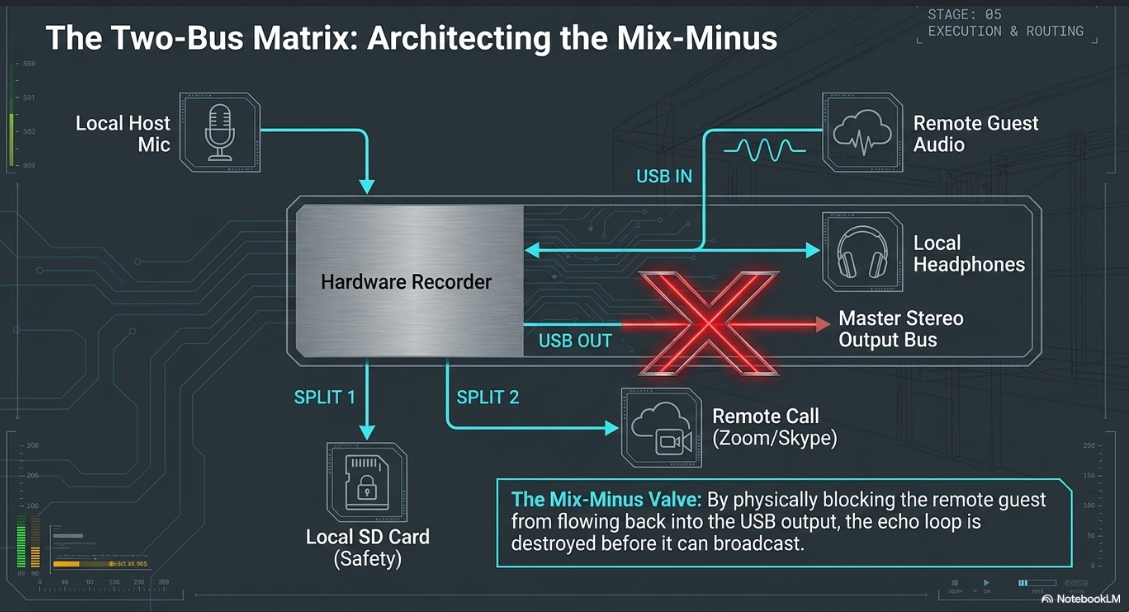
For power-users leveraging advanced recorders like the Sound Devices MixPre in combination with standard conferencing software (e.g., Zoom or Skype), preventing localized feedback requires strict routing architectures. Using the "Two Bus Method," the engineer configures the MixPre's internal logic:
Local microphones are routed to the physical SD card for recording and strictly out to the USB transmission lines feeding the Zoom software.
The incoming USB audio from the Zoom software (representing the remote guests) is routed back down the USB cable into the MixPre and directed only to the headphone amplifiers for local monitoring43.
Critically, the USB incoming audio must never be routed to the Master Stereo Output Bus that feeds back into the computer, as this will result in the remote guest hearing an immediate, delayed echo of their own voice, ultimately generating an infinite feedback loop43.
Environmental Acoustic Treatment and Physical Deployment Logistics
No combination of elite 32-bit float preamplifiers, Class-A JFET inline boosters, and broadcast-standard dynamic microphones can out-perform the immutable physics of poor room acoustics. An interface simply digitizes the analog voltage it receives; if the analog voltage contains severe room reverberation and echo, the digital file will sound amateurish, regardless of the bitrate.
Room Physics: Mass, Damping, and Decoupling
Acoustic treatment revolves around controlling and absorbing kinetic sound energy. For fixed studios or temporary hotel setups, podcasters must focus on minimizing flat, reflective surfaces that generate standing waves7.
Absorption: Utilizing dense acoustic foam panels, heavy moving blankets, or thick carpeting to absorb high-frequency flutter echoes and reflections7.
Bass Trapping: Placing dense, high-mass objects (such as specialized bass traps) in the trihedral corners of a room to absorb low-frequency standing waves that create a muddy, "boomy" recording49. Acoustic panels should be placed across dihedral corners and evenly across flat walls.
Decoupling and Damping: For advanced studio builds, separating sound vibrations from transferring through physical objects is paramount. This involves techniques like building floating floors, using Green Glue to dampen vibrations between drywall layers, or utilizing mass-loaded vinyl49.
Monitoring Protocol: Every local participant must wear closed-back headphones. Open-back headphones leak monitor audio back into the sensitive microphone capsules, causing subtle phase-cancellation issues and distinct echoes in the recording7.
Field Deployment Order of Operations
When mobilizing a portable interface setup for on-location recording, systematic physical deployment is necessary to protect sensitive electronic equipment and establish a stable, noise-free signal flow. The standard estimated teardown/setup time for a comprehensive 4-person portable rig is approximately 75 minutes for a novice, dropping to roughly 25-30 minutes once the operator is intimately familiar with the process11.
Surface Stabilization: Establish a flat, highly stable, vibration-free surface. Minimum requirements involve one surface for the laptop and interface, and additional stable points for microphone stands. Vibration from unstable tables transfers directly into microphone chassis, creating low-frequency handling noise that preamplifiers will easily amplify11.
Cable Routing (Bottom-Up): Unpack equipment strategically and connect the analog and digital signal paths sequentially following the flow of data: Microphone


Gain Staging and Active Monitoring: Position participants correctly around the microphones. For standard 16-bit or 24-bit recorders, set the analog gain so that vocal peaks consistently hit between -12 dB and -6 dB. This preserves 6 to 12 dB of digital headroom for unexpected loud moments, preventing clipping distortion11. Connect closed-back headphones to the localized monitor outputs and establish comfortable unity gain for all participants7. Wear headphones continuously to monitor for background noise shifts or level drift.
Teardown Sequence (Top-Down): To protect the delicate preamplifiers from sudden voltage spikes or phantom power pops, disconnect the rig in reverse order. Power down the 48V phantom power first, remove microphones, strike boom arms and stands, disconnect the portable interface, and finally pack the laptop. This protocol preserves cable integrity and prevents physical damage to Class-A components11.
Strategic Implications and Future Outlook
The integration of high-fidelity portable recorders functioning as USB audio interfaces represents the current pinnacle of audio execution for professional podcasting. This hybrid architecture entirely decentralizes the traditional broadcast studio, empowering creators to capture pristine, multitrack audio in highly variable field environments without sacrificing the necessary digital connectivity required for global, cloud-based remote collaboration.
By comprehensively understanding the transduction physics of dynamic versus condenser microphones, navigating the preamplification bottlenecks surrounding Equivalent Input Noise, and strategically deploying inline JFET preamplifiers or next-generation 32-bit floating-point A/D converters, audio engineers can eliminate the specter of electrostatic noise and digital clipping entirely. When executed with highly disciplined routing matrices, strict redundant dual-recording protocols, and fundamental acoustic environment control, this modular hardware ecosystem delivers an uncompromising, broadcast-ready sonic footprint capable of rivaling any established commercial studio facility. As the technology continues to miniaturize and floating-point logic becomes ubiquitous, the barrier between location recording and studio-grade post-production will continue to dissolve, making impeccable audio accessible across all tiers of professional media production.
Works cited
The Complete Guide to Podcast Recording Equipment for Beginners - OBSBOT, https://www.obsbot.com/blog/podcast/podcast-recording-equipment
Audio interface or digital recorder? : r/podcasting - Reddit, https://www.reddit.com/r/podcasting/comments/l2vbk9/audio_interface_or_digital_recorder/
What is a Podcast Recorder, & Do I Need One? - Alitu, https://alitu.com/blog/what-is-a-podcast-recorder-do-i-need-one
Which Recorder Should You Buy? A Consumer's Guide to Choosing the Right Portable Recording Device | TASCAM, https://tascam.com/us/learn/detail/50931
Sound Devices MixPre-10T 10-Channel / 12-Track Multi-Track Field Recorder, https://digitech.tv/sound-devices-mixpre-10t-10-channel-12-track-multi-track-field-recorder
PodTrack P4 Full Setup Guide and Using with Riverside - YouTube, https://www.youtube.com/watch?v=aZ4-J2dVA0M
Best 4 Person Podcast Setup: Starter Kit, Equipment & Guide - Talks.co, https://talks.co/p/4-person-podcast-setup/
Getting Started: Podcast Hardware - Focusrite, https://focusrite.com/articles/getting-started-podcast-hardware/
5 Reasons Why Serious Podcasters Should Use An Audio Interface - Podlad, https://www.podlad.com/blog/5-reasons-why-serious-podcasters-should-use-an-audio-interface
Audio Interface vs. Mixer for Podcasting (Which To Get?) - Claricast, https://claricast.com/audio-interface-vs-mixer-for-podcasting-which-should-you-get/
Portable Podcast Setup: Essential Gear Guide for Field Recording, https://thepodcastconsultant.com/blog/portable-podcast-setup
Choosing a Podcast Microphone - Riverside, https://riverside.com/blog/podcast-microphone
The Best USB Microphones for 2026 - PCMag UK, https://uk.pcmag.com/audio-recording/116655/the-best-usb-microphones
MixPre-6 II - Sound Devices, https://www.sounddevices.com/product/mixpre-6-ii/
Podcast Equipment Guide: What I Recommend After 500 Episodes - Buzzsprout, https://www.buzzsprout.com/blog/podcast-equipment-guide
The best podcasting microphones 2026: Record your voice like a pro - SoundGuys, https://www.soundguys.com/best-podcasting-microphone-13540/
For Non-Techie Podcasters: How to Choose the Best USB Microphone for Podcasting, https://squadcast.fm/blog/for-non-techie-podcasters-how-to-choose-the-best-usb-microphone-for-podcasting/
3 Powerful Portable Podcasting Setups For Recording On The Road (GB) - RØDE, https://rode.com/en-gb/about/news-info/3-powerful-portable-podcasting-setups-for-recording-on-the-road
Best podcasting microphones 2026: My top picks, with demos - MusicRadar, https://www.musicradar.com/news/best-podcasting-microphones
Zoom PodTrak P4 Review and Audio Test : r/podcasting - Reddit, https://www.reddit.com/r/podcasting/comments/jl0gbx/zoom_podtrak_p4_review_and_audio_test/
Are cloudlifters and fetheads truly noise free : r/audioengineering - Reddit, https://www.reddit.com/r/audioengineering/comments/12jucvo/are_cloudlifters_and_fetheads_truly_noise_free/
PodTrak P4 - ZOOM, https://zoomcorp.com/en/de/podcast-recorders/podcast-recorders/podtrak-p4/
Sound Devices MixPre-10 II 10-Channel / 12-Track Multitrack 32-Bit Field Recorder, https://videoguys.com.au/products/sound-devices-mixpre-10-ii-10-channel-12-track-multitrack-32-bit-field-recorder
Sound Devices MixPre-10M, https://www.soundonsound.com/reviews/sound-devices-mixpre-10m
FetHead - Triton Audio, https://www.tritonaudio.com/product/fethead/
Cloud Microphones Cloudlifter CL-1 Single Channel Powered Microphone Preamp - Andertons Music Co., https://www.andertons.co.uk/cloud-microphones-cloudlifter-cl-1-single-channel-powered-preamp-for-ribbon-dynamic-microphones/
Best Inline Preamp (Cloudlifter vs Fethead vs Dynamite) - Kettner Creative, https://kettnercreative.com/microphone/best-inline-preamp/
FetHead vs Cloudlifter: Which is the Best Mic Activator?, https://crumplepop.com/fethead-vs-cloudlifter-which-is-best-for-you/
In Focus: TASCAM DR-40XP 32-bit float portable recorder - Mixdown Magazine, https://mixdownmag.com.au/features/in-focus-tascam-dr-40xp-32-bit-float-portable-recorder/
F6 Field Recorder - ZOOM, https://zoomcorp.com/en/gb/field-recorders/field-recorders/f6/
How is a 32-bit float file recorded? - Sound Devices, https://www.sounddevices.com/how-is-a-32-bit-float-file-recorded/
10 Best Portable Audio Recorders 2026 (32-bit Float) - Meshplugins.com, https://shop.meshplugins.com/blogs/the-hidden-sauce/best-portable-audio-recorders
Portacapture X8 | 8-Channel 32-Bit Float Portable Audio Field Recorder | TASCAM, https://tascam.com/us/product/portacapture_x8
Zoom PodTrak P4 Review | A Near-Perfect Podcast Recorder - Focus Camera, https://wavelength.focuscamera.com/zoom-podtrak-p4-review-a-near-perfect-podcast-recorder/
Zoom PodTrak P4 – Thomann UK, https://www.thomann.co.uk/zoom_podtrak_p4.htm
Tascam Portacapture X8 - Canford, https://www.canford.co.uk/ProductResources/resources/T/Tascam/Solid%20State%20Recorders/Tascam%20PortacaptureX8-Flyer_EN%20(007).pdf
Tascam Portacapture X8 – Thomann UK, https://www.thomann.co.uk/tascam_portacapture_x8.htm
Tascam Portacapture X8 | 32-Bit Float Portable Audio Recorder, https://www.tascam.eu/en/portacapture_x8
Tascam Portacapture X8 32 Bit Float Portable Audio Recorder, https://www.parkcameras.com/shop/tascam-portacapture-x8-32-bit-float-portable-audio-recorder_t841039t
Tascam Portacapture X8 32-Bit Multi-Track Recorder - Pinknoise Systems, https://pinknoise-systems.co.uk/products/tas-port
Sound Devices MixPre-3 II 3-Channel / 5-Track Multitrack 32-Bit Field Recorder, https://www.rubbermonkey.co.nz/Sound-Devices-MixPre-3-II-3-Channel-5-Track-Multitrack-32-Bit-Field-Recorder
Sound Devices MixPre-6 II - Multitrack recorders - Woodbrass, https://www.woodbrass.com/en-gb/multitrack-recorders-sound-devices-mixpre-6-ii-p251561.html
Setting up a MixPre for Zoom Conferencing and Webinars - Sound Devices, https://www.sounddevices.com/setting-up-a-mixpre-for-zoom-conferencing-and-webinars/
Sound Devices MixPre 6 II | Audio Recorder Card - Adcom, https://www.adcom.it/en/audio/audio-recorders/audio-recorder-card/sound-devices-mixpre-6-ii/p_r_15_102_1477_49860
Zoom PodTrak P4 Podcast Mic Set - Thomann, https://www.thomann.co.uk/zoom_podtrak_p4_podcast_mic_set.htm
Sound On Sound 04 2021 USA | PDF | Microphone | Recording - Scribd, https://www.scribd.com/document/525958970/Sound-on-Sound-04-2021-USA
ReaClassical Manual - GitHub, https://raw.githubusercontent.com/chmaha/ReaClassical/main/PDF-Manual/ReaClassical-Manual.pdf
How to Record a Podcast with Multiple Mics (3 Ways) - Riverside, https://riverside.com/blog/how-to-record-a-podcast-with-multiple-mics
Full Guide on How to Easily Build a Podcast Studio at Home - Riverside, https://riverside.com/blog/podcast-studio-setup
️ Podcast Equipment & Setup: Your Fun and Friendly Guide to Sounding Pro in 2025 - That Toronto Studio, https://www.thattorontostudio.ca/blog/podcast-equipment-setup-guide